Four More Short Nonfiction Books for Novellas for November
Short nonfiction turns up in every genre. Today I have a feminist manifesto, some miniature travel essays, a memoir of the writing life, and a book of environmentalist speeches.
Dear Ijeawele, or A Feminist Manifesto in Fifteen Suggestions by Chimamanda Ngozi Adichie (2017)
[63 pages]
 My fourth book this year by Adichie, who is also making a repeat appearance on one of my nonfiction novellas lists; I reviewed “We Should All Be Feminists” in 2017. While this builds on the TED talk that fueled that essay, it is more successful for me because of the frame: a long letter to a childhood friend who had just had a baby girl and wanted advice about how to raise her as a feminist. Adichie’s premises are that women matter equally and that if you can’t reverse the genders in a scenario and get acceptable results (e.g. ‘women should leave men who cheat,’ but we don’t necessarily demand the opposite), an argument is sexist.
Even when her points seem obvious – gender roles are nonsense, don’t hold up marriage as the pinnacle of achievement, downplay appearance – they are beautifully expressed, and there are lots of tactics that wouldn’t have occurred to me in the context of feminism: Normalize differences between people. Teach a girl to love reading – “Books will help her understand and question the world, help her express herself”. And beware of how language is used: if people deride a woman for ambition where they wouldn’t criticize a man, their problem is not with ambition but with women. Hillary Clinton and Kamala Harris come to mind…
Go ahead and buy a stack of this book to have on hand the next time a friend has a baby (boy or girl). Adichie wasn’t a mother when she wrote it, but in her Introduction she says that, looking back after the birth of her daughter, it still rang true and gave her plenty to live up to. 
[By the way, did you hear that Adichie is the Women’s Prize’s Winner of Winners for Half of a Yellow Sun? Her novel came out at #2 in my ranking of all 25 winners, so I’m pleased!]
A Time to Keep Silence by Patrick Leigh Fermor (1957)
[95 pages]
 Three brief essays about visits to monasteries: The Abbey of St. Wandrille de Fontanelle (Benedictine) and La Grande Trappe (Cistercian) in France, and the rock monasteries of Cappadocia in Turkey. I’ve read a fair bit about the monastic life, so I found little that was new in Fermor’s accounts of austere daily routines and religious history. I had more interest in the rock monasteries where some Church Fathers were based, simply because Turkey is a relatively unfamiliar setting for me, but despite Fermor’s rich descriptive gifts, this piece was, at nine pages, little more than a sketch. Alas, this was a disappointment.
The Cost of a Best Seller by Frances Parkinson Keyes (1953)
[118 pages]
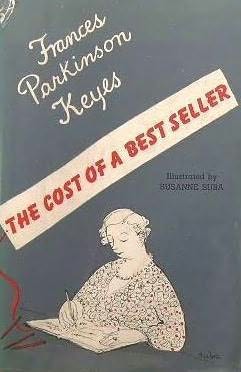 I picked up a £1 dustjacketless copy on a whim from the outdoor clearance area at the Hay Cinema Bookshop in September and started reading it immediately, off and on as a bedside book. Keyes is a twentieth-century author whose dozens of potboilers sold in their millions, but she has been largely forgotten since. Imagine my surprise, then, when her best-known novel, Dinner at Antoine’s (1948), turned up on a recent Book Riot list of New Orleans-themed literature – though mostly for the reference to the still-popular title restaurant.
When Keyes began writing, a mother of three young children in an attic room, it was to supplement her husband’s income, but the work soon became an obsession and allowed her to maintain her independence after her husband, a U.S. senator, died. Not until 17 years after the publication of her first novel did she have her first bestseller. She depicts fame as a double-edged sword: It allowed her to travel in Europe and to Louisiana, where she later made her home, but also made heavy demands on her time, requiring responses to annoying letters, hours spent signing books, and attendance at literary lunches. For someone with back problems, these commitments could be literally as well as figuratively painful.
Keyes has the popular fiction writer’s bitterness about never getting critical recognition. This memoir was pleasant enough, but hasn’t induced me to read any more by her. Readers fond of her work might get something more out of it. For the most part, it doesn’t feel dated, but one detail really got to me: Whenever she needed to ensure that she wouldn’t be disturbed, she would go work in the old slave quarters of her New Orleans mansion. Yipes! 
No One Is Too Small to Make a Difference by Greta Thunberg (2019)
[68 pages]
 “Our house is on fire. … I want you to panic.” Starting with a speech she gave on a climate march in Stockholm in September 2018 and ending with her address to the UK parliament in April 2019, this punchy pamphlet of rhetoric makes it clear why the teenage Thunberg has rapidly become such an important public figure. She attributes her bluntness to her Asperger’s: the way her mind works, she sees climate breakdown as a simple, black and white issue – either we care or we don’t; either we stop emitting carbon or we don’t; either we find new ways of doing things now, or we stand by and watch it all go to ruin. She calls governments and international bodies to account for their inaction and lack of commitment, and for subsidizing fossil fuels and encouraging consumerism as usual.
Peppering in key statistics and accepted scientific guidelines but staying at a lay level, she calls on the world’s decision-makers to create hope for young people and others who will be most affected by global warming but don’t have a seat at the table. I admire Thunberg’s bravery as well as her words. The only issue with a wee book like this one is that the same points and language recur in multiple speeches, so there is inevitable repetition. 
It’s been Nonfiction week here on Novellas in November. #NovNov meets #NonficNov!

Starting Monday: Literature in Translation week, which Cathy is hosting.
Faber Live Fiction Showcase 2020
In February 2018 Annabel and I attended the Faber Spring Party with some other blogger friends, the first time I’d been to such an event. The hoped-for repeat invitation never came last year, but 2020’s perverse gifts meant I could attend the publisher’s latest showcase as a webinar. It was free to sign up to be a Faber member (you can do so here), and now I get e-mails about new releases and interesting upcoming events.

Six new and forthcoming novels were featured last night, with author readings. There were some connection issues where the sound and image froze for a couple seconds so the voice was temporarily out of sync with the picture, which made it more difficult to engage with the extracts, but I still enjoyed hearing about these new-to-me writers.
Love After Love by Ingrid Persaud
 This one came out in April, and was already on my radar. It’s about a widow, Betty, her son, Solo, and their lodger, Mr. Chetan, and how people come together to make a family despite secrets and “way too much rum”. Persaud read two excerpts, one in Betty’s voice and one from Mr. Chetan’s perspective. I loved the Trinidadian accents. (Comes with praise from Claire Adam and Marlon James.)
Meanwhile in Dopamine City by D.B.C. Pierre
 Published in August and shortlisted for the Goldsmiths Prize. Pierre described his new novel as a book of voices about a single father trying to withhold a smartphone from his youngest child. One passage he read had a professor speaking to a Silicon Valley type; another was someone trying to compose the perfect tweet after hearing of the death of someone they don’t like. I’ve never read any Pierre and I don’t think I’ll start now.
A Crooked Tree by Una Mannion
 Out on January 21st. A literary debut with a touch of the thriller, set in Philadelphia in 1981 and starring a large Irish American family. (Mannion herself is from Philadelphia but now lives in County Sligo.) She read from the first chapter, about a quarrelsome family drive about to go badly wrong. I was reminded of Lorrie Moore and Ann Patchett.
little scratch by Rebecca Watson
 Out on January 14th. This one was already on my TBR. It’s about a day in the life of a woman in her twenties. While going through the daily routine of office life, she’s suppressing memories of a recent sexual assault. Watson’s delivery was very engaging. She read a passage in which the protagonist neurotically overthinks a colleague asking her what she’s been reading lately. “Why is it when anyone asks what I’ve read I go blank?!” (I can sympathize.)
Come Join Our Disease by Sam Byers
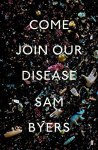 Byers’s third novel comes out on March 18th. Maya, who’s homeless, is offered a spot on a rehabilitation and wellness program – if she’ll document it on Instagram. He read about Maya being seized from her encampment. Two early Goodreads reviews made me laugh out loud and convinced me this isn’t for me: “Reads like David Foster Wallace mixed with Marquis de Sade in a blender” and “Promising start but soon disappears up its own arse.”
This One Sky Day by Leone Ross
 On the magical Caribbean island of Popisho, something odd is happening to all of the women. I think (though I had some trouble hearing and following) their genitals are falling off, rendering sex a little difficult. The patois was similar to Persaud’s Trini, and, like little scratch, this is a circadian novel. It made me think of the descriptions of Monique Roffey’s books. I found the premise a little silly, though. This is unlike to draw in those suspicious of magic realism.
If I had to pick just one? I’m going to request a proof copy of little scratch. And my library system has two copies, so I’ll also place a hold and try to read Love After Love soon (though before the end of the year now looks doubtful). It helped that these two authors gave the best readings.
10 Favorite Nonfiction Novellas from My Shelves
What do I mean by a nonfiction novella? I’m not claiming a new genre like Truman Capote did for the nonfiction novel (so unless they’re talking about In Cold Blood or something very similar, yes, I can and do judge people who refer to a memoir as a “nonfiction novel”!); I’m referring literally to any works of nonfiction shorter than 200 pages. Many of my selections even come well under 100 pages.
I’m kicking off this nonfiction-focused week of Novellas in November with a rundown of 10 of my favorite short nonfiction works. Maybe you’ll find inspiration by seeing the wide range of subjects covered here: bereavement, social and racial justice, hospitality, cancer, nature, politics, poverty, food and mountaineering. I’d reviewed all but one of them on the blog, half of them as part of Novellas in November in various years.
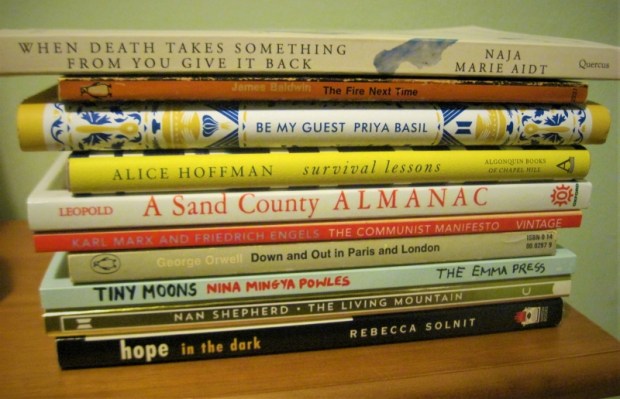
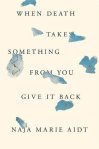 When Death Takes Something from You Give It Back: Carl’s Book by Naja Marie Aidt [137 pages]: In March 2015 Aidt got word that her son Carl Emil was dead. The 25-year-old jumped out of his fifth-floor Copenhagen window after taking some mushrooms. The text is a collage of fragments: memories, dreams, dictionary definitions, journal entries, and quotations. The playful disregard for chronology and the variety of fonts, typefaces and sizes are a way of circumventing the feeling that grief has made words lose their meaning forever.
 The Fire Next Time by James Baldwin [89 pages]: A hard-hitting book composed of two essays: “My Dungeon Shook,” is a letter addressed to his nephew and namesake on the 100th anniversary of emancipation; and “Down at the Cross: Letter from a Region in My Mind,” which first appeared in the New Yorker and tells of a crisis of faith that hit Baldwin when he was a teenager and started to question to what extent Christianity of all stripes was upholding white privilege. This feels completely relevant, and eminently quotable, nearly 60 years later.
 Be My Guest: Reflections on Food, Community and the Meaning of Generosity by Priya Basil [117 pages]: A thought-provoking essay that reaches into many different topics. Part of an Indian family that has lived in Kenya and England, Basil is used to culinary abundance. However, living in Berlin increased her awareness of the suffering of the Other – hundreds of thousands of refugees have entered the EU to be met with hostility. Yet the Sikh tradition she grew up in teaches kindness to strangers. She asks how we can all cultivate a spirit of generosity.
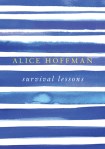 Survival Lessons by Alice Hoffman [83 pages]: Hoffman wrote this 15 years after her own experience of breast cancer to encourage anyone going through a crisis. Each chapter title begins with the word “Choose” – a reminder that, even when you can’t choose your circumstances, you can choose your response. This has been beautifully put together with blue-tinted watercolor-effect photographs and an overall yellow and blue theme (along with deckle edge pages – a personal favorite book trait). It’s a sweet little memoir with a self-help note.
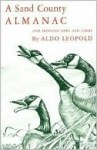 A Sand County Almanac by Aldo Leopold [92 pages]: Few know how much of our current philosophy of wilderness and the human impact on the world is indebted to Aldo Leopold. This was published in 1949, but so much rings true today: how we only appreciate wildlife if we can put an economic value on it, the troubles we get into when we eradicate predators and let prey animals run rampant, and the danger of being disconnected from the land that supplies our very life. And all this he delivers in stunning, incisive prose.
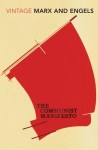 The Communist Manifesto by Karl Marx and Friedrich Engels [70 pages]: Maybe you, like me, had always assumed this was an impenetrable tome of hundreds of pages? But, as I discovered when I read it on the train to Manchester some years ago, it’s very compact. That’s not to say it’s an easy read; I’ve never been politically or economically minded, so I struggled to follow the argument at times. Mostly what I appreciated was the language. Like The Origin of Species, it has many familiar lines and wonderful metaphors.
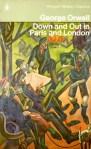 Down and Out in Paris and London by George Orwell [189 pages]: Orwell’s first book, published when he was 30, is an excellent first-hand account of the working and living conditions of the poor in two world cities. He works as a dishwasher and waiter in Paris hotel restaurants for up to 80 hours a week and has to pawn his clothes to scrape together enough money to ward off starvation. Even as he’s conveying the harsh reality of exhaustion and indignity, Orwell takes a Dickensian delight in people and their eccentricities.
 Tiny Moons: A Year of Eating in Shanghai by Nina Mingya Powles [85 pages]: This lovely pamphlet of food-themed essays arose from a blog Powles kept while in Shanghai on a one-year scholarship to learn Mandarin. From one winter to another, she explores the city’s culinary offerings and muses on the ways in which food is bound up with her memories of people and places. This is about how food can help you be at home. I loved how she used the senses – not just taste, but also smell and sight – to recreate important places in her life.
 The Living Mountain by Nan Shepherd [108 pages]: This is something of a lost nature classic. Composed during the later years of World War II but only published in 1977, it’s Shepherd’s tribute to her beloved Cairngorms, a mountain region of Scotland. But it’s not a travel or nature book in the way you might usually think of those genres. It’s a subtle, meditative, even mystical look at the forces of nature, which are majestic but also menacing. Shepherd dwells on the senses, the mountain flora and fauna, and the special quality of time and existence (what we’d today call mindfulness) achieved in a place of natural splendor and solitude.
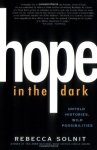 Hope in the Dark: Untold Histories, Wild Possibilities by Rebecca Solnit [143 pages]: Solnit believes in the power of purposeful individuals working towards social justice, even in the face of dispiriting evidence (e.g. the largest protests the world had seen didn’t stop the Iraq War). Instead of perfectionism, she advises flexibility and resilience; things could be even worse had we not acted. Her strong and stirring writing is a reminder that, though injustice is always with us, so is everyday heroism.
Keep in touch via Twitter (@bookishbeck / @cathy746books) and Instagram (@bookishbeck / @cathy_746books). We’ll add any of your review links in to our master posts. Feel free to use the terrific feature image Cathy made and don’t forget the hashtag #NovNov.

Any suitably short nonfiction on your shelves?
My Year in Nonfiction (Thus Far)
If your household is anything like mine, stressful days and nights of lost sleep are ceding to relief after the U.S. election result was finally announced. We celebrated with whoopie pies (a Pennsylvania specialty) and Prosecco.


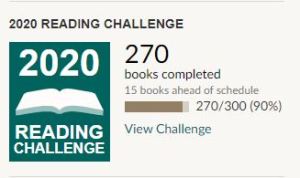
And look: I happened to pass 270 yesterday as well!
I’d taken part in the Six Degrees of Separation meme every month since February, but this time I had no inspiration. I was going to start with these two apple covers…
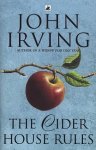
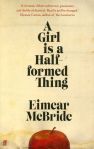
…but that’s as far as I got. Never mind! I’ll be back next month, when we all start with the YA classic Are You There God? It’s Me, Margaret by Judy Blume.
Instead, I’m catching up with this past week’s Nonfiction November prompt: Your Year in Nonfiction. It was hosted by Leann of Shelf Aware.

 What topics have been prominent in your year’s nonfiction reading?
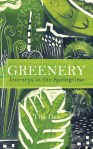
I’ve read a lot of nature and popular science, probably more than in an average year. Greenery by Tim Dee has been an overall highlight. I managed to read 12 books from the Wainwright Prize longlists, and I’m currently reading four books of nature-themed essays or journals. Thoughtful as well as consoling.

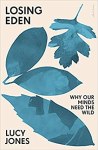
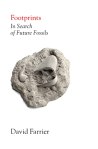
The popular science material has focused on environmentalism and current events, which has inevitably involved politics and long-term planning (Annabel called this category “The State We’re In”): e.g. Losing Eden, Footprints, The Good Ancestor, and Notes from an Apocalypse.


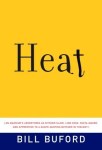 Thanks to the food and drink theme I set for my 20 Books of Summer, I read a number of foodie memoirs. The best one was Heat by Bill Buford, but I also really enjoyed Kitchen Confidential by Anthony Bourdain and My Berlin Kitchen by Luisa Weiss.
 Since the Wellcome Book Prize didn’t run this year, I’ve read fewer health-related books, although I did specially read Not the Wellcome Prize shortlistee The Remarkable Life of the Skin by Monty Lyman, and Dear Life by Rachel Clarke, a palliative care doctor, has been one of my overall best nonfiction reads of the year.
Not very well represented in my nonfiction reading this year were biographies and travel books. I can struggle with the depth and dryness of some books from these genres, but I’d like to find some readable options to get stuck into next year.
What are your favorite nonfiction books you’ve read so far?
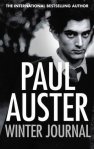
I’m a huge memoir junkie. Some of the most memorable ones this year have been Winter Journal by Paul Auster, Traveling Mercies by Anne Lamott (a reread), and A Three Dog Life by Abigail Thomas (another reread).


An incidental theme in the life writing I’ve read in 2020 is childhood (Childhood by Tove Ditlevsen, Cider with Rosie by Laurie Lee, Oleander, Jacaranda by Penelope Lively, Period Piece by Gwen Raverat); I hope to continue reading around this topic next year.
What books have you recommended the most to others?
I’ve mentioned the Clarke (above) in any discussions of books about illness and death.
I recommended the memoir Are You Somebody? by Nuala O’Faolain more than once following Reading Ireland Month.
Entangled Life, Merlin Sheldrake’s enthusiastic book about fungi, is one I can imagine suggesting to readers who don’t often pick up nonfiction.
And Signs of Life by Dr. Stephen Fabes has generated a fair bit of interest among my Goodreads friends.


Besides Annabel, Kate and Liz also wrote about their 2020 nonfiction reading habits.
How has your nonfiction reading been going this year?
Three for Novellas in November: Bythell, Carey and Diop
I started my reading for Novellas in November early with these three review books, one nonfiction and two fiction. They have in common the fact that they are published today –although I believe two were released early to beat the lockdown. Don’t worry, though; there are still plenty of ways of getting hold of new books: most publishers and bookshops are still filling orders, or you can use the UK’s newly launched Bookshop.org site and support your local indie.
Seven Kinds of People You Find in Bookshops by Shaun Bythell
[137 pages]
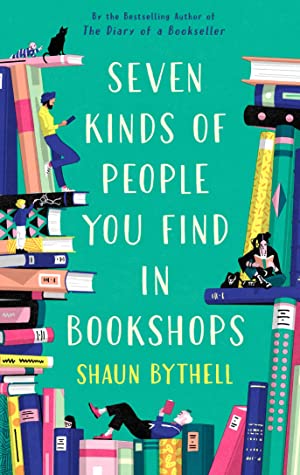 Cheerfully colored and sized to fit into a Christmas stocking, this is a fun follow-up to Bythell’s accounts of life at The Bookshop in Wigtown, The Diary of a Bookseller and Confessions of a Bookseller. Within his seven categories are multiple subcategories, all given tongue-in-cheek Latin names as if naming species. When I saw him chat with Lee Randall at the opening event of the Wigtown Book Festival, he introduced a few, such as the autodidact who knows more than you and will tell you all about their pet subject (the Homo odiosus, or bore). This is not the same, though, as the expert who shares genuinely useful knowledge – of a rare cover version on a crime paperback, for instance (Homo utilis, a helpful person).
There’s also the occultists, the erotica browsers, the local historians, the self-published authors, the bearded pensioners (Senex cum barba) holidaying in their caravans, and the young families – now that he has one of his own, he’s become a bit more tolerant. Setting aside the good-natured complaints, who are his favorite customers? Those who revel in the love of books and don’t quibble about the cost. Generally, these are not antiquarian book experts looking for a bargain, but everyday shoppers who keep a low-key collection of fiction or maybe specifically sci-fi and graphic novels, which fly off the shelves for good prices.
So which type am I? Well, occasionally I’m a farter (Crepans), but you won’t hold that against me, will you? I’d like to think I fit squarely into the normal people category (Homines normales) when I visited Wigtown in April 2018: we went in not knowing what we wanted but ended up purchasing a decent stack and even had a pleasant conversation with the man himself at the till – he’s much less of a curmudgeon in person than in his books. I do recommend this to those who have read and loved his other work.
With thanks to Profile Books for the free copy for review.
The Swallowed Man by Edward Carey
[160 pages]
 Carey’s historical novel Little was one of my highlights of 2018, so I jumped at the chance to read his new book. Interestingly, this riff on the Pinocchio story, narrated by Geppetto from the belly of a giant shark, originally appeared in Italian to accompany an exhibition hosted by the Fondazione Nazionale Carlo Collodi at the Parco di Pinocchio in Collodi. Geppetto came from a pottery-painting family but turned to wood when creating a little companion for his loneliness, the wooden boy who astounded him by coming to life. Now a son rather than a mere block of wood, Pinocchio sets off for school but never comes home. When he gets word that a troublesome automaton has been thrown into the sea, Geppetto sets out in a dinghy to find his son but is swallowed by the enormous fish that has been seen off the coast.
The picture of this new world-within-a-world is enthralling. Geppetto finds himself inside a swallowed ship, the Danish schooner Maria. Within the vessel is all he needs to occupy himself, at least for now: wood on which to paint the women he has loved; candle wax and hardtack for sculpting figures. Seaweed to cover his bald spot. Squid ink for his pen so he can write this notebook. A crab that lives in his beard. Relics of the captain’s life to intrigue him.
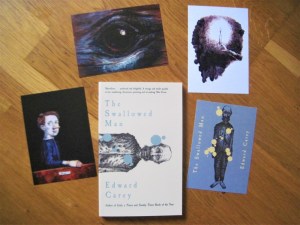
As a narrator, Geppetto is funny and gifted at wordplay (“This tome is my tomb”; “I unobjected him. Can you object to that?”), yet haunted by his decisions. Carey deftly traces Geppetto’s state of mind as he muses on his loss and imprisonment. The Afterword adds a sly pseudohistorical note to the fantasy. There are black-and-white illustrations throughout, as well as photos of the objects described in the text (and, presumably, featured in the exhibition). For me this didn’t live up to Little, but it would be a great introduction to Carey’s work.
With thanks to Gallic Books for the free copy for review.
At Night All Blood Is Black by David Diop
[145 pages; translated from the French by Anna Moschovakis]
 I had no idea that Africans (“Chocolat soldiers”) fought for France in World War I. Diop’s second novel, which has already won several major European prizes, is about two Senegalese brothers-in-arms caught up in trench warfare. Alfa Ndaiye, aged 20, considers Mademba Diop his blood brother or “more-than-brother” (the novel’s French title is “Soul Brother”). From the start we know that Mademba has died. Gravely injured in battle, entrails spilling out, he begged Alfa to end his misery; three times Alfa refused. Having watched his friend die in agony, he knows he did the wrong thing. Slitting the man’s throat would have been the compassionate choice. From now on, Alfa will atone by brutally wreaking Mademba’s method of death on Germans. “The captain’s France needs our savagery, and because we are obedient, myself and the others, we play the savage.” Alas, I thought this bleak exploration of (in)humanity was marred by the repetitive language and unpleasantly sexualized metaphors.
With thanks to Pushkin Press for the proof copy for review.
Do any of these novellas take your fancy?
What November releases can you recommend?
Two Recent Reviews for BookBrowse
The Bell in the Lake by Lars Mytting
 A legend from Mytting’s hometown tells of two centuries-old church bells that, like conjoined twins, were never meant to be separated. Inspired by that story and by the real-life move of a stave church from Norway to what is now Poland, he embarked on a trilogy in which history and myth mingle to determine the future of the isolated village of Butangen. The novel is constructed around compelling dichotomies. Astrid Hekne, a feminist ahead of her time, is in contrast with the local pastor’s conventional views on gender roles. She also represents the village’s unlearned folk; Deborah Dawkin successfully captures Mytting’s use of dialect in her translation, making Astrid sound like one of Thomas Hardy’s rustic characters.
- See my full review at BookBrowse.
- See also my related article on stave churches.
- One of the coolest things I did during the first pandemic lockdown in the UK was attend an online book club meeting on The Bell in the Lake, run by MacLehose Press, Mytting’s UK publisher. It was so neat to see the author and translator speak “in person” via a Zoom meeting and to ask him a couple of questions in the chat window.
- A readalike (and one of my all-time favorite novels) is Carsten Jensen’s We, the Drowned.
Memorial by Bryan Washington
 In Washington’s debut novel, set in Houston and Osaka, two young men reassess their commitments to their families and to each other. The narration is split between Benson and Mike, behind whose apparent lack of affect is a quiet seam of emotion. Both young men are still shaken by their parents’ separations, and haunted by patterns of abuse and addiction. Flashbacks to how they met create a tender backstory for a limping romance. Although the title (like most of the story titles in Lot) refers to a Houston neighborhood, it has broader significance, inviting readers to think about the place our loved ones have in our memories. Despite the tough issues the characters face, their story is warm-hearted rather than grim. Memorial is a candid, bittersweet work from a talented young writer whose career I will follow with interest.
- See my full review at BookBrowse.
- See also my related article on the use of quotation marks (or not!) to designate speech.
 I enjoyed this so much that I immediately ordered Lot with my birthday money. I’d particularly recommend it if you want an earthier version of Brandon Taylor’s Booker-shortlisted Real Life (which I’m halfway through and enjoying, though I can see the criticisms about its dry, slightly effete prose).
- This came out in the USA from Riverhead in late October, but UK readers have to wait until January 7th (Atlantic Books).
Novellas in November Begins!
Burnt out on doorstoppers after Victober? Wondering how you’ll ever reach your reading target in this strange year? It’s time to stack up the short books (anything under 200 pages) and get reading towards Novellas in November!
Here’s a reminder of the weekly themes Cathy and I are taking it in turn to host:
2–8 November: Contemporary fiction (Cathy)
9–15 November: Nonfiction novellas (Rebecca)
16–22 November: Literature in translation (Cathy)
23–29 November: Short classics (Rebecca)
Leave your links here and/or on Cathy’s intro post at 746 Books and we’ll update our blogs through the month to include them. We look forward to seeing what you read!
Don’t forget to tag us on Twitter (@bookishbeck / @cathy746books) and Instagram (@bookishbeck / @cathy_746books) and use the hashtag #NovNov.
Novellas in November 2020 posts:
Mrs Caliban by Rachel Ingalls (reviewed by Cathy at 746books)
The Spare Room by Helen Garner (reviewed by Cathy at 746books)
Train Dreams by Denis Johnson (reviewed by Hopewell’s Library of Life)
Three Novellas – Bythell, Carey and Diop
Mostly Hero by Anna Burns (reviewed by Cathy at 746books)
Dark Wave by Lana Guineay (reviewed by Lisa at ANZ LitLovers)
Train Dreams by Denis Johnson (reviewed by Cathy at 746books)
The Swallowed Man by Edward Carey (reviewed by Susan at A life in books)
The Man from London by Georges Simenon (reviewed by Helen at She Reads Novels)
Cyclone by Vance Palmer (reviewed by Lisa at ANZ LitLovers)
Short Fiction from Steinbeck and Triolet (reviewed by Carol at cas d’intérêt)
Contemporary Fiction novella recommendations (Monika at Lovely Bookshelf)
Red at the Bone by Jacqueline Woodson (reviewed by Kim at Reading Matters)
Surfacing – Margaret Atwood (1973) (reviewed by Ali at Heavenali)
Simenon, Greg & Moss (reviewed by Annabel at Annabookbel)
10 Favorite Nonfiction Novellas from My Shelves
The Guest Cat by Takashi Hiraide (reviewed by Margaret at BooksPlease)
300 Arguments by Sarah Manguso (reviewed by Cathy at 746books)
The Poisoning by Maria Lazar (reviewed by Juliana at The Blank Garden)
Summerwater by Sarah Moss (reviewed by Lisa at ANZ LitLovers)
The Invisible Land by Hubert Mingarelli (reviewed by Susan at A life in books)
The Moon Is Down by John Steinbeck (reviewed by Lisa at ANZ LitLovers)
Two Reviews for Non-fiction Novella Week (Cathy at 746books)
A Month in Siena by Hisham Matar (reviewed by Imogen at Reading and Viewing the World)
Our Nig by Harriet E. Wilson (reviewed by Juliana at The Blank Garden)
Runaway Amish Girl: The Great Escape by Emma Gingerich (reviewed by Hopewell’s Library of Life)
The Days of Abandonment by Elena Ferrante (reviewed by Radhika’s Reading Retreat)
8 Novellas in Translation (reviewed by Grant at 1streading)
Nonfiction novella recommendations (Monika at Lovely Bookshelf)
Four More Short Nonfiction Books for Novellas for November
Quicksand and Passing by Nella Larsen (reviewed by Davida at The Chocolate Lady’s Book Review Blog)
Bill Bailey’s Remarkable Guide to Happiness (reviewed by Annabel at Annabookbel)
The Legend of the Holy Drinker by Joseph Roth (reviewed by Karen at Kaggsy’s Bookish Ramblings)
Chess by Stefan Zweig (reviewed by Cathy at 746books)
Popcorn by Cornelia Otis Skinner (reviewed by Ali at Heavenali)
The Transmigration of Bodies by Yuri Herrera (reviewed by Imogen at Reading and Viewing the World)
The Hidden Life of Trees by Peter Wohlleben (reviewed by Hopewell’s Library of Life)
The Taiga Syndrome by Cristina Rivera Garza (reviewed by Cathy at 746books)
Three novellas: Albertalli, Meruane, Moore (reviewed by Dr Laura Tisdall)
A Meal in Winter by Hubert Mingarelli (reviewed by Karen at Booker Talk)
Wendy McGrath’s Trilogy (reviewed by Marcie at Buried in Print)
Dog Island by Philippe Claudel (reviewed by Susan at A life in books)
The Man behind Narnia by AN Wilson (reviewed by Margaret at BooksPlease)
Fall on Me by Nigel Featherstone (reviewed by Nancy at NancyElin)
An interview with Cath Barton, author of novella The Plankton Collector, by Kathryn at Nut Press
Black Water by Joyce Carol Oates (reviewed by Kim at Reading Matters)
Translated novella recommendations (Monika at Lovely Bookshelf)
Happiness, As Such by Natalia Ginzberg (reviewed by Jacqui at JacquiWine’s Journal)
Dolores by Lauren Aimee Curtis (reviewed by Nancy at NancyElin)
The Provincial Lady Goes Further by E.M. Delafield (reviewed by Hopewell’s Library of Life)
The Pigeon by Patrick Süskind (reviewed by Cathy at 746books)
A Girl Returned by Donatella Di Pietrantonio (reviewed by Ali at Heavenali)
Sweet Days of Discipline by Fleur Jaeggy (reviewed by Cathy at 746books)
Icefall by Stephanie Gunn (reviewed by Nancy at NancyElin)
Maigret and the Reluctant Witnesses by Georges Simenon (reviewed by Margaret at BooksPlease)
The Silence by Don DeLillo (reviewed by Kim at Reading Matters)
My favourite classic novellas (Cathy at 746books)
Short Classics recommendations (Monika at Lovely Bookshelf)
Good Morning, Midnight by Jean Rhys (reviewed by Imogen at Reading and Viewing the World)
Cheerful Weather for the Wedding by Julia Strachey (reviewed by Radhika’s Reading Retreat)
The Spare Room by Helen Garner (reviewed by Brona’s Books)
The Jew’s Beech-Tree by Annette von Droste-Hülshoff (reviewed by Juliana at The Blank Garden)
Daughters by Lucy Fricke (reviewed by Lizzy’s Literary Life)
What Are You Going Through by Sigrid Nunez (reviewed by Kim at Reading Matters)
The Mystery of the Enchanted Crypt by Eduardo Mendoza (reviewed by Reese Warner)
The Hound of the Baskervilles by Sir Arthur Conan Doyle (reviewed by Cathy at 746books)
In the Sweep of the Bay by Cath Barton (reviewed by Calmgrove)
Maud Martha by Gwendolyn Brooks (reviewed by Juliana at The Blank Garden)
Short Classics: Orwell + Austen, Buchan, Capote, Wharton (Margaret at BooksPlease)
Follies and The Power of Privilege (reviewed by Liz at Adventures in reading, running and working from home)
The Strange Bird by Jeff Vandermeer (reviewed by Annabel at Annabookbel)
Girl Reporter by Tansy Roberts (reviewed by Nancy at NancyElin)
The House of Dolls by Barbara Comyns (reviewed by Ali at Heavenali)
Elizabeth and Her German Garden by Elizabeth Von Arnim (reviewed by Brona’s Books)
Simpson Returns by Wayne Macauley (reviewed by Nancy at NancyElin)
Miscellaneous Novellas: Murdoch, Read & Spark; Comics; Art Books
Three short classics from the 746: Mann, West, Atwood (reviewed by Cathy at 746books)
Writers on Writers: Josephine Rowe on Beverley Farmer (reviewed by Brona’s Books)
Utz by Bruce Chatwin (reviewed by Calmgrove)
A Novellas Inventory (Market Garden Reader)
Three novellas by Ivan Turgenev (reviewed by Book Around the Corner)
The Lifted Veil & Silly Novels by Lady Novelists by George Eliot (reviewed by Helen at She Reads Novels)
The Weight of Things by Marianne Fritz (reviewed by J. C. Greenway at 10 million hardbacks)
Theo by Paul Torday (reviewed by Davida at The Chocolate Lady’s Book Review Blog)
Another novella by Triolet (reviewed by Carol at cas d’intérêt)
The Three Graces of Va-Kill by
Miscellaneous novellas: Oates, Moss, Orstavik, de Moor, Hull (reviewed by Naomi at Consumed by Ink)
See also this terrific list of Australian novellas put together by Brona, a list of 17 intriguing novellas you can read in a day (or an afternoon) put together by Kim, and Louise Walter’s thoughts on the writing (and publishing) of novellas.
R.I.P. Part II: Wakenhyrst by Michelle Paver
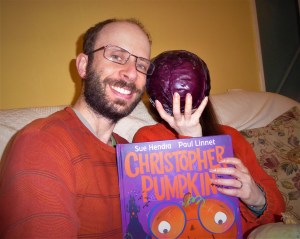
A rainy and blustery Halloween here in southern England, with a second lockdown looming later in the week. I haven’t done anything special to mark Halloween since I was in college, though this year a children’s book inspired me to have some fun with our veg box vegetables for this photo shoot. Just call us Christopher Pumpkin and Rebecca Red Cabbage.
It’s my third year participating in R.I.P. (Readers Imbibing Peril). In each of those three years I’ve reviewed a novel by Michelle Paver. First it was Thin Air, then Dark Matter – two 1930s ghost stories of men undertaking an adventure in a bleak setting (the Himalayas and the Arctic, respectively). I found a copy of her latest in the temporary Little Free Library I started to keep the neighborhood going while the public library was closed during the first lockdown.

Wakenhyrst by Michelle Paver (2019)
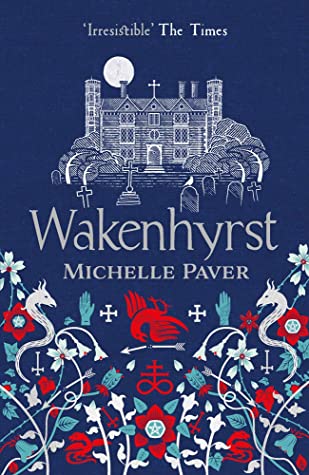 There’s a Gothic flavor to this story of a mentally unstable artist and his teenage daughter. Edmund Stearne is obsessed with the writings of Medieval mystic Alice Pyett (based on Margery Kempe) and with a Bosch-like Doom painting recently uncovered at the local church. Serving as his secretary after her mother’s death, Maud reads his journals to follow his thinking – but also uncovers unpleasant truths about his sister’s death and his relationship with the servant girl. As Maud tries to prevent her father from acting on his hallucinations of demons and witches rising from the Suffolk Fens, she falls in love with someone beneath her class. Only in the 1960s framing story, which has a journalist and scholar digging into what really happened at Wake’s End in 1913, does it become clear how much Maud gave up.
There are a lot of appealing elements in this novel, including Maud’s pet magpie, the travails of her constantly pregnant mother (based on the author’s Belgian great-grandmother), the information on early lobotomies, and the mixture of real (eels!) and imagined threats encountered at the fen. The focus on a female character is refreshing after her two male-dominated ghost stories. But as atmospheric and readable as Paver’s writing always is, here the plot sags, taking too much time over each section and filtering too much through Stearne’s journal. After three average ratings in a row, I doubt I’ll pick up another of her books in the future.
My rating:
My top R.I.P. read this year was Sisters by Daisy Johnson, followed by 666 Charing Cross by Paul Magrs (both reviewed here).
Have you been reading anything spooky for Halloween?
Doorstopper of the Month: The Cider House Rules by John Irving (A Reread)
Next month will be all about the short books (#NovNov!), but first it was time to get this excessively long one out of the way. My husband’s and my reading tastes don’t overlap in many areas, but John Irving is our mutual favorite author. I first started The Cider House Rules (1985) on our second honeymoon – being from two different countries, we had two nuptial ceremonies and two honeymoons, one per continent – which was a road trip through New England. We drove from Maryland to Maine and back; I have a specific memory of reading the chunky Irving hardback at our B&B in Stowe, Vermont. I was a much less prolific reader in those days, so I had to return my American library copy partially read and then pay to reserve one from the Hampshire Libraries system once we were back in the UK.
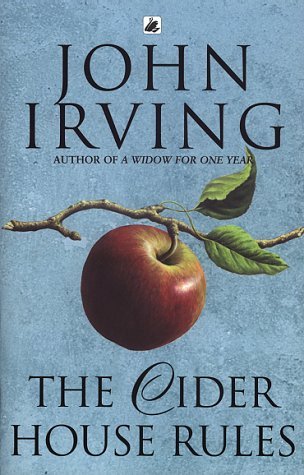
Thirteen years on, I remembered the orphanage and cider farm settings, the dynamic between Doctor Wilbur Larch and his protégé, Homer Wells, and Homer’s love for his best friend’s girl, Candy. I also remembered that this is a Trojan horse of a novel: it advocates, not very subtly, for abortion rights through pictures of women in desperate situations. Luckily, by the time I first read it I was no longer slavishly devoted to the American Religious Right. But this time I felt that even readers who consider themselves pro-choice might agree Irving over-eggs his argument. My memory of the 1999 film version is clearer. It severely condenses the book’s 40 years or so of action, cutting subplots and allowing Tobey Maguire and Charlize Theron to play the leads all the way through. A shorter timeframe also more neatly draws a line between Rose Rose’s experience and Homer’s change of heart about offering abortions.
I had a strong preference for the scenes set at St. Cloud’s orphanage in Maine. Dr. Larch is celibate and addicted to ether – all a result of his first sexual encounter with a prostitute. He has an ironclad conviction that he is doing the Lord’s work for the pregnant women who get off the train at St. Cloud’s, whether they come for an abortion or to leave a live baby behind. Homer Wells is the one orphan who never finds an adoptive home; he stays on and becomes Larch’s trainee in obstetrics, but vows that he won’t perform abortions. As a young adult, Homer is pulled away from the orphanage by his puppy love for Wally and Candy, a couple-in-trouble who come up from his family’s apple farm. Homer thinks he’ll go back with his new friends for a month or two, but instead he stays at Ocean View orchard for decades, his relationship with Candy changing when Wally goes off to war and comes back disabled.
I had forgotten the bizarre scenario Larch has to set up for the orphanage’s board of trustees to accept his chosen successor, and the far-fetched family situation Homer, Candy and Wally end up in. The orchard sections could feel endless, so I always thrilled to mentions of what was happening for Dr. Larch and the nurses back at St. Cloud’s.

Oktoberfest reading and snacking.
The Dickensian influence – lots of minor characters and threads tying up nicely by the end; quirks of speech and behavior – has generally been the aspect I like the most about Irving’s work, and while I loved the explicit references to David Copperfield here (a few kids get their names from it, it’s read aloud to the boy orphans every night, and its opening question about whether the protagonist will be the hero of his own life or not applies to Homer, too), I did find the novel awfully baggy this time. I even put in a slip of paper where I felt that things started to drift: page 450.
One further note to make about the film: it, rather unforgivably, eliminates Melony, a larger-than-life character and necessary counterpart to the book’s multiple passive females. She’s the de facto head of the girl orphans, as Homer is for the boys, and initiates Homer into sex. But her feelings for him are more of hero worship than of romantic love, and when he breaks his promise and leaves St. Cloud’s without her, she sets off to hunt him down. Her odyssey, delivered in parallel, is nearly as important as Homer’s (see what I/Irving did there?).
While I loved the medical history material and Dr. Larch’s moral fiber, this time I found Homer a little insipid and annoying (he answers nearly every question with “Right”), and the plot somewhat slack and obvious. In my memory this is probably #3 out of the Irving novels I’ve read, below A Prayer for Owen Meany and The World According to Garp – both of which I’d also like to reread to see if they’ve retained their power.
Page count: 731
My original rating (July–September 2007):
My rating now:
Done any rereading, or picked up any very long books, lately?
October Releases by Rachel Mann, Sigrid Nunez and Ruth Janette Ruck
A calmer month for new releases after September’s bumper crop. I read a sophisticated mystery set at a theological college, a subtle novel about empathy and being a good friend, and a memoir of raising one of Britain’s first llamas.
The Gospel of Eve by Rachel Mann
Last year I dipped into Mann’s poetry (A Kingdom of Love) and literary criticism/devotional writing (In the Bleak Midwinter); this year I was delighted to be offered an early copy of her debut novel. The press materials are full of comparisons to Donna Tartt’s The Secret History; it’s certainly an apt point of reference for this mystery focusing on clever, Medieval-obsessed students training for the priesthood at a theological college outside Oxford.
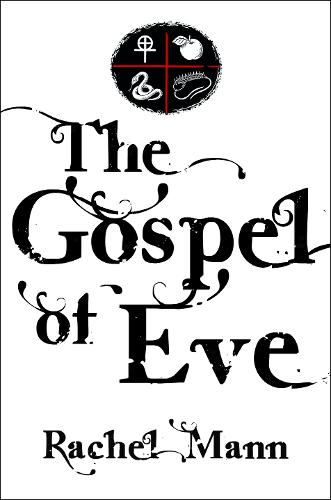 It’s 1997 and Catherine Bolton is part of the first female intake at Littlemore College. She has striven to rid herself of a working-class accent and recently completed her PhD on Chaucer, but feels daunted by her new friends’ intelligence and old-money backgrounds: Ivo went to Eton, Charlie is an heiress, and so on. But Kitty’s most fascinated with Evie, who is bright, privileged and quick with a comeback – everything Kitty wishes she could be.
If you think of ordinands as pious and prudish, you’ll be scandalized by these six. They drink, smoke, curse and make crude jokes. In seminars with Professor Albertus Loewe, they make provocative mention of feminist theory and are tempted by his collection of rare books. Soon sex, death and literature get all mixed up as Kitty realizes that her friends’ devotion to the Medieval period goes as far as replicating dangerous rituals. We know from the first line that one of them ends up dead. But what might it have to do with the apocryphal text of the title?
I didn’t always feel the psychological groundwork was there to understand characters’ motivations, but I still found this to be a beguiling story, well plotted and drenched in elitism and lust. Mann explores a theology that is more about practice, about the body, than belief. Kitty’s retrospective blends regret and nostalgia: “We were the special ones, the shining ones,” and despite how wrong everything went, part of her wouldn’t change it for the world.
My thanks to publicist Hannah Hargrave for the proof copy for review. Published today by Darton, Longman & Todd Ltd.
What Are You Going Through by Sigrid Nunez
A perfect follow-up to The Friend and very similar in some ways: again we have the disparate first-person musings of an unnamed narrator compelled to help a friend. In Nunez’s previous novel, the protagonist has to care for the dog of a man who recently killed himself; here she is called upon to help a terminally ill friend commit suicide. The novel opens in September 2017 in the unfamiliar town she’s come to for her friend’s cancer treatments. While there she goes to a talk by an older male author who believes human civilization is finished and people shouldn’t have children anymore. This prophet of doom is her ex.
 His pessimism is echoed by the dying friend when she relapses. The narrator agrees to accompany her to a rental house where she will take a drug to die at a time of her choosing. “Lucy and Ethel Do Euthanasia,” the ex jokes. And there is a sort of slapstick joy early in this morbid adventure, with mishaps like forgetting the pills and flooding the bathroom.
As in Rachel Cusk’s Outline trilogy, the voice is not solely or even primarily the narrator’s but Other: her friend speaking about her happy childhood and her estrangement from her daughter; a woman met at the gym; a paranoid neighbor; a recent short story; a documentary film. I felt there was too much recounting of a thriller plot, but in general this approach, paired with the absence of speech marks, reflects how the art we consume and the people we encounter become part of our own story. Curiosity about other lives fuels empathy.
With the wry energy of Jenny Offill’s Weather, this is a quiet novel that sneaks up to seize you by the heartstrings. “Women’s stories are often sad stories,” Nunez writes, but “no matter how sad, a beautifully told story lifts you up.” Like The Friend, which also ends just before The End, this presents love and literature as ways to bear “witness to the human condition.”
With thanks to Virago for the proof copy for review.
Along Came a Llama: Tales from a Welsh Hill Farm by Ruth Janette Ruck
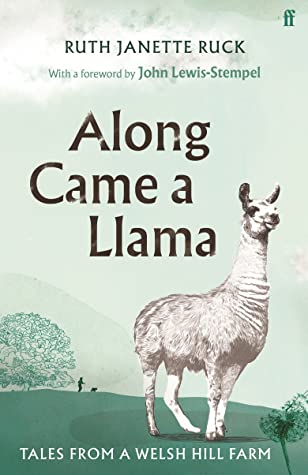 Originally published in 1978 (now reissued with a foreword by John Lewis-Stempel), this is an enjoyably animal-stuffed memoir reminiscent of Gerald Durrell and especially Doreen Tovey. Ruck (d. 2006) and her family – which at times included her ill sister, her elderly mother and/or her sister-in-law – lived on a remote farm in the hills of North Wales. On a visit to Knaresborough Zoo, Ruck was taken with the llamas and fancied buying one to add to their menagerie of farm animals. It was as simple as asking the zoo director and then taking the young female back to Wales in a pony box. At that time, hardly anyone in the UK knew anything about llamas or the other camelids. No insurance company would cover their llama in transit; no one had specialist knowledge on feeding or breeding. Ruck had to do things the old-fashioned way, finding books and specialist scientific papers.
But they mostly learned about Ñusta (the Quechua word for princess) by spending time with her. At holidays they discovered her love of chocolate Easter eggs and cherry brandy. The cud-chewing creature sometimes gave clues to what else she’d been eating, as when she regurgitated plum stones. She didn’t particularly like being touched or trailed by an orphaned lamb, but followed Ruck around dutifully and would sit sociably in the living room. Life with animals often involves mild disasters: Ñusta jumps in a pool and locks Ruck’s husband in the loo, and the truck breaks down on the way to mate her with the male at Chester Zoo.

A vintage cover I found on Goodreads.
From spitting to shearing, there was a lot to get used to, but this account of the first three years of llama ownership emphasizes the delights of animal companionship. There were hardships in Ruck’s life, including multiple sclerosis and her sister’s death, but into the “austere but soul-rewarding life of a hill firm … like a catalyst or a touch of magic, the llama came along.” I was into llamas and alpacas well before the rest of the world – in high school I often visited a local llama farm, and I led a llama in a parade and an alpaca in a nativity play – so that was my primary reason for requesting this, but it’s just right for any animal lover.
With thanks to Faber & Faber for the free copy for review.
 Bookish Beck = Rebecca Foster. American transplant to England. Freelance proofreader and book reviewer.
