Barbara Kingsolver in Conversation about “Unsheltered”
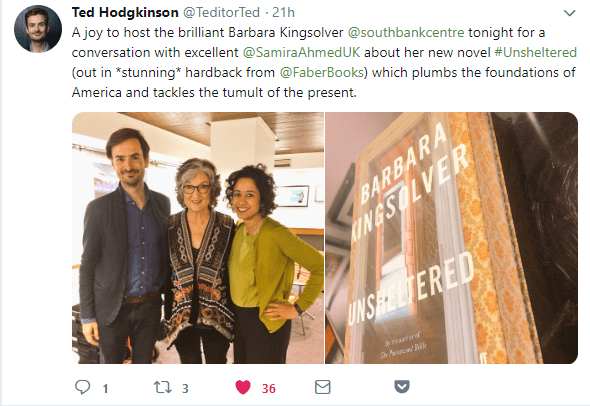
Through a Faber & Faber Twitter giveaway, I won tickets to see Barbara Kingsolver speak about her new novel, Unsheltered, at the Royal Festival Hall in London on Monday the 12th. (Yes, this is the second lot of tickets I’ve won within a month. When all you have to do is reply to a tweet or retweet it, I don’t know why more people don’t enter these competitions!) It was great to meet up with fellow bloggers Clare and Laura – half of my Wellcome Prize shadow panel – to hear Kingsolver chat with Samira Ahmed of Radio 4 and BBC One.
 In person Kingsolver was a delight – warm and funny, with a generic American accent that doesn’t betray her Kentucky roots. In her beaded caftan and knee-high oxblood boots, she exuded girlish energy despite the shock of white in her hair. Although her fervor for the scientific method and a socially responsible government came through clearly, there was a lightness about her that tempered the weighty issues she covers in her novel.
In case you are unfamiliar with it, Unsheltered is the story of two residents of Vineland, New Jersey: in the present day, fifty-something Willa Knox is trying to keep her enlarged nuclear family together in the face of underemployment, a crumbling house, divided political loyalties and serious illness. In a parallel story line set in the 1870s that unfolds in alternating chapters, science teacher Thatcher Greenwood butts heads with his principal over Darwin’s writings and is alarmed by the actions of the town’s dictator-like founder, Charles Landis.
Kingsolver revealed that she always starts with theme rather than character or setting. A novel arises from a compelling question she wants to wrestle with. When she started this one five years ago, she wanted to write about paradigm shift. She felt like the regular rules have failed us, that the world no longer provides the ‘shelter’ we expect – a good job after a degree, a pension at the end of a career, adequate health care, and so on. Consumption and growth, the economic tools we’ve always relied on, won’t work anymore. How will we cope with the end of the world as we know it? Looking for a time period when people were also asked to rise to the occasion upon a shift in worldview, she settled on the 1870s, the decade following the Civil War, when America was divided along nearly the same lines as today.
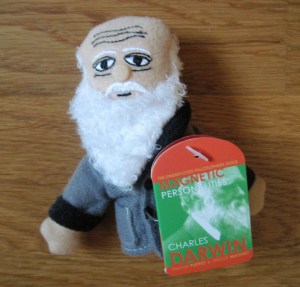
Darwin: “such a sweet guy!” said Kingsolver.
Initially she thought she might make Darwin himself a character, but that would have required setting the book at least partially in England, and she’s come to terms with the fact that she’s an American novelist. Instead, she researched the champions of Darwin in America, starting with Asa Gray. Things didn’t work out with Gray – “it was like dating,” she jokes – but then she came across Mary Treat, a self-taught ‘lady scientist’ who corresponded with Darwin, and made him Thatcher’s neighbour in Vineland.
In the scene Kingsolver read from the historical thread, Mary experiments at letting a carnivorous plant nibble at her finger. The other reading, from the contemporary section, pictured Willa – part of the “sandwich generation,” doing the unpaid labor of caring for an aging relative to make up for a shortfall in the services the state should be providing – facing a pile of bills. “Willa is the peanut butter trying to hold everything together,” Kingsolver said – a feeling familiar to her from when she and her sister cared for their dying mother.
At Ahmed’s leading, Kingsolver also discussed the modern anti-fact movement, female anger and the balance between honoring the past and erasing it (the example Ahmed gave was Laura Ingalls Wilder’s name being taken off of the ALA children’s book medal because she is now considered to have a backward attitude to race). Kingsolver described the novel as her “love letter to millennials” such as her two resilient twenty-something daughters who are having to creatively make up for the ways in which Baby Boomers have ruined the world.
It’s impossible to ignore the similarities between Landis, Vineland’s leader, and Donald Trump. There was much knowing laughter from the audience, in fact, as she described Landis and his megalomaniac behavior. Although she peppered in a few of the more explicit Trump allusions (e.g., “Lock him up!”) later on, she wrote the bulk of the book before his presidential run was ever a possibility. Kingsolver said that this is not the first time that she has anticipated rather than responded to world events: for The Poisonwood Bible she wrote a scene of the death of Mobutu two months before he died in real life.
I reviewed Unsheltered for BookBrowse ( ) and have also been moderating their online book club discussion of it. It’s been fascinating to see the spread of opinions, especially in the thread asking readers to describe the novel in three words. Descriptors have ranged from “preachy,” “political” and “repressive” to “prophetic,” “hopeful” and “truth.” My own three-word summary was “Bold, complex, polarizing.” I sensed that Kingsolver was going to divide readers – American ones, anyway; British readers should be a lot more positive because even centrist politics here start significantly further left, and there is for the most part very little resistance to concepts like socialism and climate change. I have a feeling the site’s users are predominantly middle-class, middle-aged white ladies (which, to be fair, was also true of the London audience), and we know that they’re a bastion of Trump support.
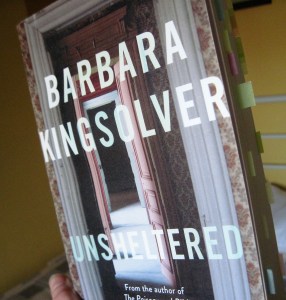
My proof copy of Unsheltered: lots to think about.
It’s clear what Kingsolver’s political leanings would be, but she emphasized the importance of having conversations with family members and neighbors who voted a different way (for Brexit, perhaps) that don’t begin with “You idiot…” “As a novelist you have to generate that absolute empathy” for every character, she insisted, even Willa’s hateful, Fox News-blasting father-in-law, Nick, who’s an example of the ‘pull up the ladder’ type of first-generation immigrant. It’s important to remember that “it’s all coming from a place of fear,” she noted.
“We come to literature with our own nutritional needs,” Kingsolver remarked, and she loves that readers can take such different messages from her writing. Novels don’t give answers but bring you into conversation with yourself, she suggested. In asking “What is the human animal?” and “What can we do about it?” she hopes that she’s expanding our humanity. That is what she believes literary fiction should do, and she argued passionately on its behalf.
Being careful not to give any spoilers about her story lines’ endings during the question time, she said, “I promise I will not leave you in despair.” I hope that, if you haven’t already, you will all read Unsheltered, coming to it with an open mind. It’s one of the most important books of the year.
Wise Children by Angela Carter: On the Page and on the Stage
“What a joy it is to dance and sing!”

Through a Granta giveaway on Twitter I won two tickets to see Wise Children at London’s Old Vic theatre on October 18th. Clare of A Little Blog of Books joined me for an excellent evening at the theatre, and we both followed it up by reading the novel – Angela Carter’s final book, published in 1991. (Clare’s write-up of the book and play is here.) It has one of the best openers I’ve come across recently:
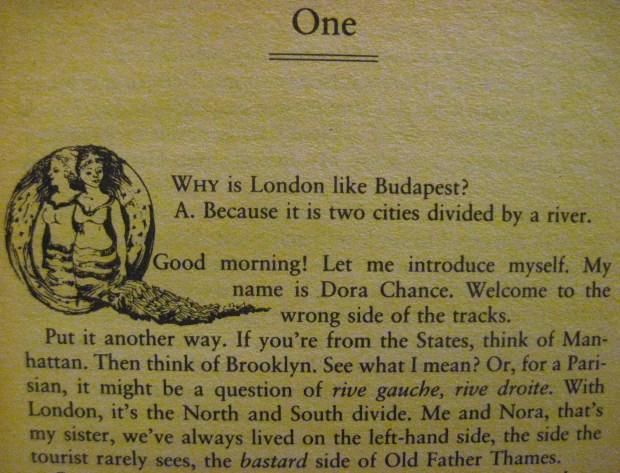
Twins Nora and Dora Chance turn 75 today; their father, Shakespearean actor Melchior Hazard, who has never publicly acknowledged them because they were born out of wedlock to a servant girl who died in childbirth, turns 100. At the last minute an invitation to his birthday party arrives, and between this point and the party Dora fills us in on the sisters’ knotty family history. Their father is also a twin (though fraternal); his brother Peregrine was more of a father to them than Melchior, with “Grandma” Chance, the owner of the boarding house where they were born, the closest thing they had to a mother growing up. By the time they’re teenagers, the girls are on stage at music halls. After a jaunt to Hollywood to appear in Melchior’s filming of A Midsummer Night’s Dream, they’re back in time for wartime deprivation and tragedy in South London, and decades of shabby nostalgia follow.
It’s a big, bawdy story that has, amazingly, been compressed into just 230 pages. There are five sets of twins in total, with multiple cases of doubling, incest and mistaken identity that would make Shakespeare proud. The novel is composed of five long chapters, like the acts in a play, with a Dramatis Personae on the last two pages (though it might have proven more helpful at the start), and the sisters even live at 49 Bard Road. Dora’s voice is slang-filled and gossipy, and she dutifully presents the sisters’ past as the tragicomedy that it was.
Indeed, Wise Children seems perfect for the stage, and Emma Rice’s production recreates everything that’s best about the book, including Dora’s delightful narration. At the start, resplendent in kimonos and turbans, she and Nora greet us from their Brixton home – represented by a kitschy caravan, which with minor redecoration between scenes serves for all the play’s interiors. The 75-year-olds remain on stage for virtually the entire performance, watching along with the audience from the wings and adding in fragments of commentary, often drawn directly from the text, as scenes from their past unfold (including plenty of simulated sex – I wouldn’t recommend taking along any under-15s).
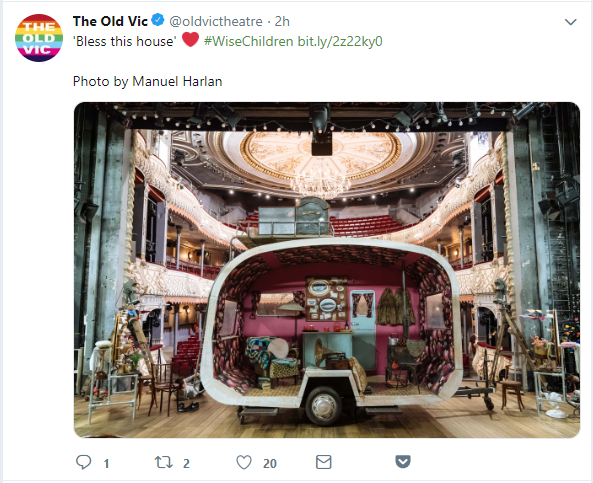
Androgynous extras cycle into various roles as the action proceeds, with the twins represented first by puppets, then by three sets of actors of various races and genders – the teenage/young adult Nora is played by a Black man, while 75-year-old Dora is a man perhaps of South Asian extraction. This adds extra irony to the humor of one of Nora’s lines: “It’s every woman’s tragedy that, after a certain age, she looks like a female impersonator.” Grandma Chance, with her beehive, cat-eye glasses and nude bodysuit, steals the show, with seaside comedian Gorgeous George coming a close second as the most entertaining character.
The play has cut out most of the 1980s layer of characters and made the story line stronger in doing so. The only other scene I wish could have been included is a farcical multiple wedding ceremony in Hollywood. The glitzy costumes, recurring butterflies, and John Waters-esque tacky-chic of the set all felt true to the atmosphere of the book, and the songs mentioned in the text (such as “I Can’t Give You Anything but Love, Baby”) are supplemented by a couple of numbers that evoke the 1980s setting: “Electric Avenue” and “Girls Just Want to Have Fun.”
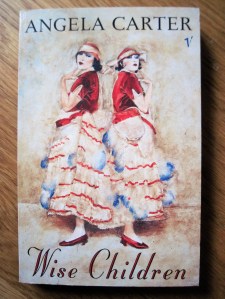 This was my fifth book by Carter, and now a joint favorite with The Bloody Chamber and Other Stories – but I liked the play that little bit better. If you get a chance to see it in London or on tour further afield, don’t pass it up. It’s a pure joy.
My rating: Book; Play 
To compare the thoughts of some professional theatregoers and see a few photos, check out the reviews on the Guardian and Telegraph websites.
Birthday Goings-on & Booker Prize Predictions
For a low-key early birthday outing we went to The Living Rainforest, a local tourist attraction run by a conservation charity. It’s on the small side, but our tickets got us free annual entry, so we’ll likely come back with family and friends with kids. Along with the tropical plants (including various fig trees I sought out especially!), there are birds both free-roaming and in cages, marmosets and monkeys, fish and turtles, an armadillo, and an elusive sloth we didn’t manage to see. Afterwards we went around the corner for cappuccinos and generous slabs of cake at the Hampstead Norreys community shop café.


My birthday itself was a gloomy day, but I didn’t mind at all; I filled it with reading and feasting, plus listening to music, working on a jigsaw puzzle, and having the cat on my lap. Each year my husband happily takes on impressive cooking and baking projects of my choice. This year we had acorn squash and black bean enchiladas with homemade salsa and guacamole, followed by Mexican rice pudding flavored with cinnamon and lime. In the afternoon with presents we’d had David Lebovitz’s Banana Cake with Mocha Frosting and Salted Candied Peanuts from Ready for Dessert. A delicious and decadent grown-up cake.


I got chocolate, notebooks, Lush shampoo, a bunch of llama/alpaca stuff, and 10 books as gifts (I suspect there might be more books to come, though). Looking back at my birthday book hauls from 2016 and 2017, I can see that I’ve had mixed success with getting through the acquisitions in a timely fashion: I’ve now read 9 out of 12 of 2016’s, but only 4 out of 11 of 2017’s. Though I’m very excited about some of my new books – I marked them as high priority on my wish list, after all – that doesn’t always translate into reading them soon. However, I’ve added two of them to my novellas pile for November, and I’ll read the first L’Engle journal in December as it starts around Christmastime.
Tomorrow the Man Booker Prize will be announced. Although I’ve only read one and a third books from the shortlist, I’m going to have a go at making predictions anyway. Here are the six nominees in what I think is their likelihood of winning:
 #1: I fully expect Richard Powers to win for The Overstory. This is the one I’m partway through; I started reading a library copy on Friday. I’m so impressed by the novel’s expansive nature. It seems to have everything: love, war, history, nature, politics, technology, small-town life, family drama, illness, accidents, death. And all of human life is overshadowed and put into perspective by the ancientness of trees, whose power we disregard at a cost. I’m reminded of the work of Jonathan Franzen (Freedom + Purity), as well as Barbara Kingsolver’s latest, Unsheltered – though Powers is prophetic where she’s polemic.
 #2: Washington Black by Esi Edugyan is a good old-fashioned adventure story about a slave who gets the chance to leave his Barbados sugar plantation behind when he becomes an assistant to an abolitionist inventor, Christopher “Titch” Wilde. Wash discovers a talent for drawing and a love for marine life and pursues these joint interests in the disparate places where life takes him. Part One was much my favorite; none of what followed quite matched it in depth or pace. Still, I enjoyed following along on Wash’s escapades, and I wouldn’t mind seeing this take the prize – it would be great to see a woman of color win.
 #3: The Mars Room by Rachel Kushner: Kushner is well respected, though I’ve failed to get on with her fiction before. An inside look at the prison system, this could be sufficiently weighty and well-timed to win.
 #4: Everything Under by Daisy Johnson: A myth-infused debut novel about a mother and daughter. On my library stack to read next, and the remaining title from the shortlist I’m most keen to read.
 #5: The Long Take by Robin Robertson: A novel, largely in verse, about the aftermath of war service. Also on my library stack. Somewhat experimental forms like this grab Booker attention, but this might be too under-the-radar to win.
 #6: Milkman by Anna Burns: Set in Belfast during the Troubles or a dystopian future? From my Goodreads friends’ reviews this sounds wooden and overwritten. Like the Kushner, I’d consider reading it if it wins but probably not otherwise.
Do you follow the Booker Prize? Which novel do you expect to win?
Second Person Narrative at New Era Theatre
It was a busy weekend for me: we saw Teesside folk duo Megson play at our local arts centre on Friday evening; on Saturday I baked a Dorset apple cake to take down to Hampshire for my father-in-law in advance of his 70th birthday, and in the evening, while my hubby got on with PhD stuff, I went to New Era Theatre, housed in a former chapel in our church carpark, for the first time. It’s a cozy space with only about 50 seats, and I sat on the front row.


The production was called Second Person Narrative, written by Jemma Kennedy and directed by Andy Kempe. Four actresses of different ages play the main character, known only as “You,” at various stages of her life. She’s an Everywoman, completely ordinary but also unique. Short scenes jump ahead three to six years at a time to highlight the big and small events that shape her life. At age 11, she tells the photographer on school picture day that she wants to be an explorer and save animals. At 23, she’s trying to spin her minimal experience into an enticing CV. At 36, she’s disillusioned by her first trip to the rainforest.
The set was a blue rectangular space with an Astroturf floor, hanging clouds covered in timepieces, and a gallery wall at the back where artifacts from You’s life accumulated scene by scene: her stuffed rabbit, a bouquet of flowers, a backpack, a cocktail shaker, and so on. The items are clever reminders of touchpoints from her story, but the wall is depressing: you look at it and wonder, Is that really all that a life adds up to? Occasional music emphasized the theme of time passing, with snippets of “As Time Goes By” and “Time after Time,” and the ending of each scene was signaled by the sound of a camera click.
 Supporting characters seemed to serve as commentators on the protagonist’s choices. Her friends, mostly female, were dressed in white, while older males were in gray and played officious roles: her first work supervisor, a persnickety boyfriend who barely noticed when she left him during a trip to Italy, and a trio of men trying to turn her into a TV role model in her twenties or sell her a retirement flat in her seventies. By contrast, You wore red and black. Actresses played multiple roles: You’s mother and Granny from the early years were You in the third and fourth stages of life. This wasn’t just for convenience’s sake; it provides continuity and shows the character coming to resemble the generations of women before her.
The two most poignant scenes for me were when You is shopping with her mother and the salesgirl assumes the older woman will be in the market for things like a full-length caftan, and when sixtysomething You, having published a poetry collection, has to field inane questions from readers who don’t differentiate between a writer’s biography and art. Other scenes, though, such as You awkwardly flirting in a bar, didn’t add much to the whole.
I did expect the play to make more of the second person perspective. It’s something I find fascinating in books – though it’s often difficult to sustain for any longer than a short story or one chapter. The main character is never addressed by name; others refer to “she” or “her.” On a few occasions other actors come to the edge of the stage and carry on a one-sided dialogue, turning the audience into “You” and letting us fill in for ourselves what she’s saying in reply. What was confusing to me about that was that, as the years passed, the audience wasn’t only taking on the role of You, but her daughter and granddaughter too.
Only once is actual second person narration employed. This is during a nice meta moment when You, now 56, is hosting a book club meeting for friends; the text they’re discussing is Second Person Narration. After an argument with her daughter, she says aloud, “You look at your friends. You feel embarrassed. You pick your black top off the floor and wonder if you can actually still get into it.” One of the friends on stage asks, “Why is she talking like that?”
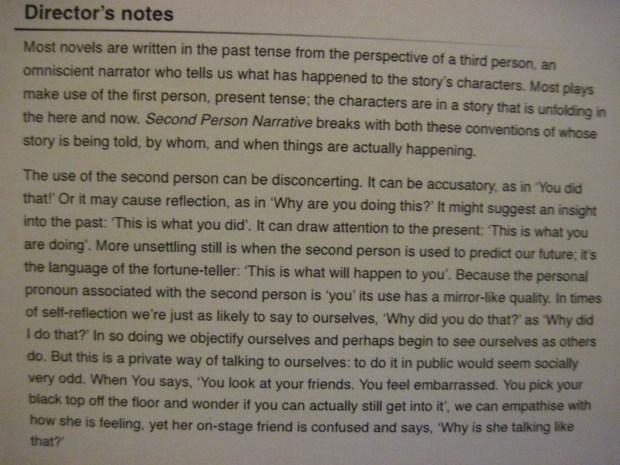
Overall, I found the production a bit odd and not entirely coherent, but it did succeed in making me think about the expectations placed on a woman’s life – by her family and friends, by society at large, and also by herself. The ending then, I think, specifically invites us to question how things would have gone differently had You been born male.
My rating: 
What do you make of second person narration? Do you think you would have enjoyed this play?
Rebecca Stott, Duke Special & More at Greenbelt 2018
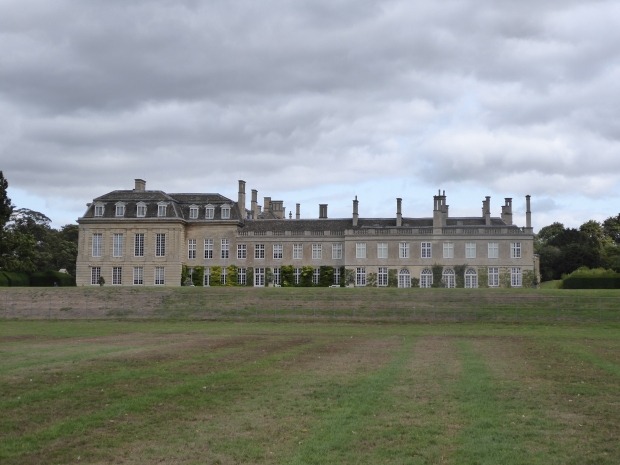
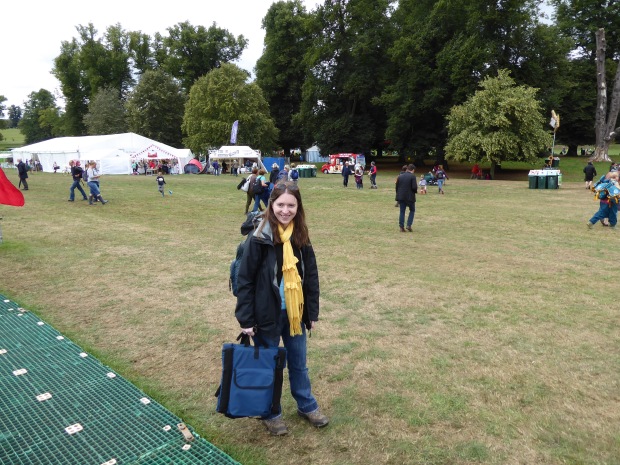
After five years away, we finally made it back to Greenbelt, a progressive Christian summer arts festival held on the grounds of Boughton House, on the Bank Holiday. The festival is a mixture of talks, music, performances and more, and given how much we’d paid and how far we’d traveled just for the one day, we tried to pack in as much as possible.
We started the day with “Beyond Forgiveness,” a presentation by Jo Berry and Pat Magee. Berry’s father, a Tory MP, was killed when the IRA bombed the Conservative Party conference in Brighton in 1984. Magee spent 14 years in prison for his role in the bombing. When he got out of jail, he met Berry at her request and they talked and listened to each other for several hours. For the first time, Magee said, he could see her father as a real person and realized that the IRA had been just as guilty of dehumanizing and misrepresenting people as the English were. Berry, too, felt that “I’d met my enemy and seen his humanity.” The two have now shared a stage more than 200 times, speaking about the value of empathy in healing broken relationships while also addressing imbalances of power that lead to violence.
To my surprise, cookery displays and musical comedy seemed to be the order of the day. A model kitchen is a new addition to the festival, giving celebrity chefs hour-long sessions to demonstrate a particular dish. Jack Monroe, promoting her new book Cooking on a Bootstrap, cooked a sausage lasagna. She made us all laugh with her idea of “the inverse sausage fallacy” – the cheaper a sausage is, the better it tastes because of all the salt, sugar and spices added to cheaper bits of meat. She started writing recipes when she was a single mother on the dole, and so she encouraged audience members to donate nice things you would like to eat, as well as everyday hygiene products, to food banks. For a “What Vegans Eat” session, Brett Cobley (aka EpiVegan) made a pea and asparagus risotto and answered questions about protein sources, egg replacements, plant milks and harder-to-find ingredients.
Uproarious musical comedy came in the form of Harry & Chris, who made up impromptu raps about New Year’s Day, the Teletubbies and phobias, and Flo & Joan, who sang about divorce statistics, unnecessary inventions for women, and sex robots (the show was fairly crude and came with an 18+ warning). The overall musical highlight of the day was Duke Special, a Greenbelt favorite we’ve seen play quite a number of times now. His pop combines his smooth Belfast tenor with music hall and Big Band stylings, and his songs are often drawn from poetry and 1920s–40s songbooks. His latest project, Hallow, is a beautiful set of Michael Longley poems set to music. He played “Another Wren” and “Emily Dickinson” from that album, various covers (including two bizarre ditties by Ivor Cutler), and crowd favorites “Last Night I Nearly Died,” “Freewheel” and “Our Love Goes Deeper than This.” We also sampled performances by Martyn Joseph, Wallis Bird and CC Smugglers.
Duke Special was a good bridge between music and literature. From the literature program I also saw Rabbi Jonathan Wittenberg speak on “Things My Dog Has Taught Me about Being a Better Human,” the title of his recent book. (His dog Mitzpah had a special dispensation to join him on stage; no animals are allowed on site otherwise!) The rabbi spoke about lessons in listening, attention, trust and seizing the moment. Mitzi and his previous dog Safi have also given him a connection with the rest of creation. Although he lives in the London suburbs and has an inner-city synagogue, they have accompanied him on long walks in Scotland and Germany. Wittenberg was a warm and witty speaker and I very much liked the sound of his book. It could make a good follow-up to The Power of Dog.
My other festival highlight was Rebecca Stott, in conversation with Radio 4 presenter Malcolm Doney. I read her Costa Prize-winning memoir In the Days of Rain: A daughter. A father. A cult in April and it’s been one of my stand-out reads of the year so far. The book conveys a huge amount of information about the Exclusive Brethren and Stott’s family history but never loses sight of what is most important: what it was like to be in a cult and have your life defined by its rules and its paranoia about the outside world. Stott remembers 6 a.m. Sunday communion services and her constant terror of being left behind in the Rapture.
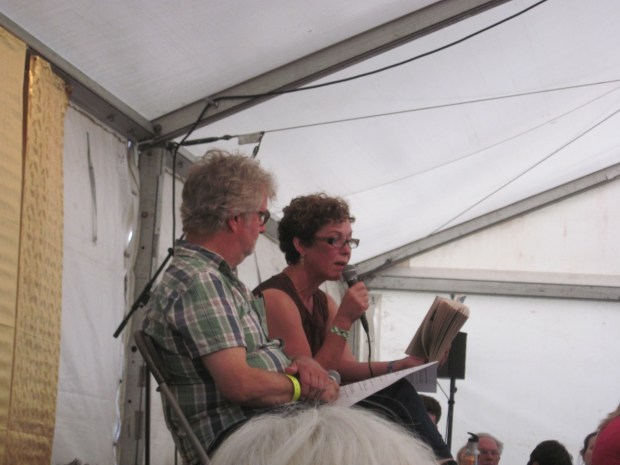
Rebecca Stott reading from In the Days of Rain.
Unfortunately, the talk didn’t add much to my experience of reading her book. The interviewer, catering to those who haven’t read the book yet, led her through her whole story bit by bit, and because I’d read it fairly recently it was all familiar. However, Stott spoke wonderfully and was full of wry compassion for her younger self. I was most interested to hear about the book’s aftermath: she’s received 300 letters from ex-Brethren that her daughter is transcribing to send to a Brethren Church archive in Manchester. When asked during a Q&A where she sees cult tendencies today, she mentioned Trump supporters!


Whereas I read In the Days of Rain from the library, I happen to own two Stott books I haven’t read yet, so I cheekily brought along my paperback of Ghostwalk for signing. She was intrigued to see the older cover design and told me she thinks the prose style in her debut novel is much richer than in Rain, and she hopes I’ll like it. I thanked her for the talk, told her how much I’d enjoyed her memoir, and recommended her two books vaguely about cults: Educated by Tara Westover, which she already knew well, having done some events with Westover, and The Incendiaries by R.O. Kwon, which was new to her (my blog tour review is coming up on Monday). I caught myself using the word “brilliant” three times in speaking about Stott’s work and these other books – nuance and vocabulary alike clearly go out the window when nervously speaking to admired authors!
Some readers of this blog would have been delighted by the event I rushed to straight after Stott’s talk: Jon McGregor giving readings from Reservoir 13, with Sigur Rós-esque backing and interlude music from Haiku Salut. I heard about the police reconstruction with actors from Manchester, and collecting bilberries on the heath in August. Unfortunately, I found it just as dull read aloud as I did when I tried the book last year, and I left early.
During bits of down time I pulled out a Katherine Mansfield story collection I found in a charity shop last week and read “Bank Holiday” and “The Garden Party.” The former is a very short piece whose carnival atmosphere rises to a note of indeterminate striving:
“And up, up the hill come the people, with ticklers and golliwogs, and roses and feathers. Up, up they thrust into the light and heat, shouting, laughing, squealing, as though they were being pushed by something, far below, and by the sun, far ahead of them – drawn up into the full, bright, dazzling radiance to…what?”
 It was my first time reading the famous “The Garden Party,” which likewise moves from a blithe holiday mood into something weightier. The Sheridans are making preparations for a lavish garden party dripping with flowers and food. Daughter Laura is dismayed when news comes that a man from the cottages has been thrown from his horse and killed, and thinks they should cancel the event. Everyone tells her not to be silly; of course it will go on as planned. The story ends when, after visiting his widow to hand over leftover party food, she unwittingly sees the man’s body and experiences an epiphany about the simultaneous beauty and terror of life. “Don’t cry,” her brother says. “Was it awful?” “No,” she replies. “It was simply marvellous.” Mansfield is especially good at first and last paragraphs. I’ll read more by her someday.
How did you all spend your Bank Holiday? / How do you plan to spend Labor Day?
Did any reading get done?
The Bookshop Band & The June–July Outlook
The Bookshop Band played in an Oxfordshire village 35 minutes’ drive from us yesterday evening. I’ve now seen them four times; I don’t think that quite qualifies me as a groupie, though I do count them among my favorite artists and own their complete discography.
The small church provided great acoustics and an intimate setting, and the set list was a fun mixture of old and new. All of their songs are based on literature: When they were the house band at Mr B’s Emporium of Reading Delights in Bath, they would write two songs based on an author’s new book on the very day that s/he would be making an appearance at the shop in the evening. A combination of slow reading and procrastination, I suppose. You’d never believe it, though, because their songs are intricate and thoughtful, often pulling out moments and ideas from books (at least the ones I’ve read) that never would have occurred to me.
Here’s what they played last night, and which books the songs were based on:
- “Once Upon a Time” – For a radio commission they crafted this compilation of first lines from various books.
- “Cackling Farts” – A day-in-the-life song featuring archaic vocabulary words from Mark Forsyth’s The Horologicon.
- “You Make the Best Plans, Thomas” – Hilary Mantel’s Bring Up the Bodies (one of my absolute favorites of their songs).
- “Why I Travel This Way” – Yann Martel’s The High Mountains of Portugal (I have heard this live once before, but it’s never been recorded).
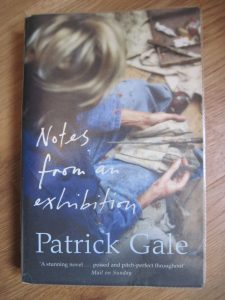 “Petroc and the Lights” – Patrick Gale’s Notes from an Exhibition (which reminds me that I really need to read it soon!).
- “Dirty Word” – A brand-new song based on Aldous Huxley’s Brave New World; it stemmed from their recent commission to write about banned books for the V&A.
- “How Not to Woo a Woman” – Rachel Joyce’s The Unlikely Pilgrimage of Harold Fry (it must be a band favorite as they’ve played it every time I’ve seen them).
- “Curious and Curiouser” – Lewis Carroll’s Alice in Wonderland.
- “Sanctuary” – A new song they wrote for the launch event at the Bodleian Library for Philip Pullman’s La Belle Sauvage (The Book of Dust, #1).
- “Room for Three” – The other song they wrote for the Pullman event
- “We Are the Foxes” – Ned Beauman’s Glow.
- “Edge of the World” – Emma Hooper’s Etta and Otto and Russell and James.
- “Faith in Weather” – The only one not based on a book; this was inspired by a Central European folktale about seven ravens (another of my absolute favorites).
- “Thirteen Chairs” – Dave Shelton’s Thirteen Chairs (another one they’ve played every time I’ve seen them).
I’m always impressed by Ben and Beth’s musicianship (guitars, ukuleles, cello, harmonium and more), and I also admire how they’ve continued touring intensively despite being new parents. They’re currently on the road for two months, and one-year-old Molly simply comes along for the ride!

A gorgeous sunset as we left the gig last night.
It’ll be a busy week on the blog. I have posts planned for every day through Saturday thanks to Library Checkout, the Iris Murdoch readalong, and various features reflecting on the first half of the year and looking ahead to the second half.
It turns out I’ll be in America for three weeks of July helping my parents pack and move, so I may have to slow down on the 20 Books of Summer challenge, and will almost certainly have to substitute in some books I have in storage over there. (I’m pondering fiction by Laurie Colwin, Hester Kaplan, Antonya Nelson and Julie Orringer; and nonfiction by Joan Anderson, Haven Kimmel and Sarah Vowell.) I have a few books lined up to review for their July release dates, but it’ll be a light month overall.
The Wellcome Book Prize 2018 Awards Ceremony
 Hey, we got it right! Mark O’Connell’s To Be a Machine, our shadow panel’s pick, won the Wellcome Book Prize 2018 last night. Of the three shadow panels I’ve participated in and the many others I’ve observed, this is the only time I remember the shadow winner matching the official one. Clare, Paul and I were there in person for the announcement at the Wellcome Collection in London. When we briefly spoke to the judges’ chair, Edmund de Waal, later in the evening, he said he was “relieved” that their decision matched ours – but I think it was definitely the other way around!
Simon Chaplin, Director of Culture & Society at the Wellcome Trust, said that each year more and more books are being considered for the prize. De Waal revealed that the judges read 169 books over nine months in what was for him his most frightening book club ever. “To bring the worlds of medicine and health into urgent conversation” requires a “lyrical and disciplined choreography,” he said, and “how we shape stories of science … is crucial.” He characterized the judges’ discussions as both “personal and passionate.” The Wellcome-shortlisted books make a space for public debate, he insisted.

Judges Gordon, Paul-Choudhury, Critchlow, Ratcliffe and de Waal. Photo by Clare Rowland.
The judges brought each of the five authors present onto the stage one at a time for recognition. De Waal praised Ayobami Adebayo’s “narrative of hope and fear and anxiety” and Meredith Wadman’s “beautifully researched and paced thriller.” Dr Hannah Critchlow of Magdalene College, Cambridge called Lindsey Fitzharris’s The Butchering Art “gruesome yet fascinating.” Oxford English professor Sophie Ratcliffe applauded Kathryn Mannix’s book and its mission. New Scientist editor-in-chief Sumit Paul-Choudhury said Mark O’Connell’s book is about the future “just as much as what it means to be human in the twenty-first century.” Journalist and mental health campaigner Bryony Gordon thanked Sigrid Rausing for her “great honesty and stunning prose.”
But there can only be one winner, and it was Mark O’Connell, who couldn’t be there as his wife is/was giving birth to their second child imminently. The general feeling in the room was that he’d made the right call by deciding to stay with his family. He must be feeling like the luckiest man on earth right now, to have a baby plus £30,000! Max Porter, O’Connell’s editor at Granta and the author of Grief Is the Thing with Feathers, received the award on his behalf and read out the extremely witty speech he’d written in advance.
Afterwards we spoke to three of the shortlisted authors. Kathryn Mannix said she’d so enjoyed following our shadow panel reviews and that it was for the best that O’Connell won, as any other outcome might have spoiled the lovely girls’ club the others had going on during the weekend’s events. I got two signatures and we nabbed a quick photo with Lindsey Fitzharris. It was also great to meet Simon Savidge, the king of U.K. book blogging, and author and vlogger Jen Campbell. Other ‘celebrities’ spotted: Sarah Bakewell and Ben Goldacre.
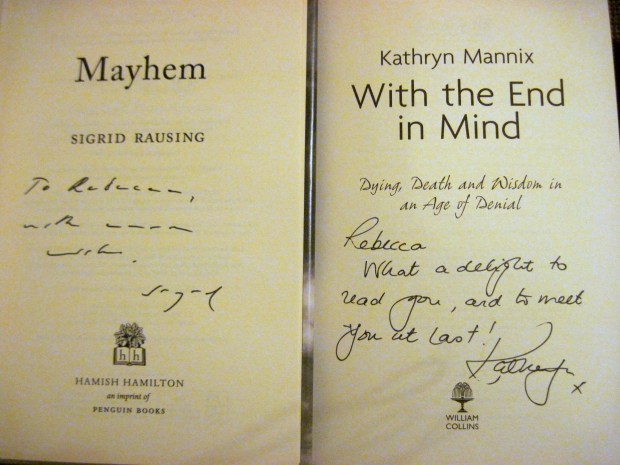
This time I stayed long enough for pudding canapés to come around – raspberry cake pops and mini meringues with strawberries. What a great idea! On the way out I again acquired a Wellcome goody bag: this year’s tote with a copy of The Butchering Art, which I only had on Kindle before. I’d also treated myself to this brainy necklace from the Wellcome shop and wore it to the ceremony. An all-round great evening. I’m looking forward to next year’s prize season already!

Paul, Lindsey Fitzharris, Clare and me.


Wellcome Book Prize Shortlist Event
Five of the six shortlisted authors (barring Dublin-based Mark O’Connell) were at the Wellcome Collection in London yesterday to share more about their books in mini-interviews with Lisa O’Kelly, the associate editor of the Observer. She called each author up onto the stage in turn for a five-minute chat about her work, and then brought them all up for a general conversation and audience questions. Clare and I found it a very interesting afternoon. Here’s some context that I gleaned about the five books and their writers.
 Ayobami Adebayo says sickle cell anemia is a massive public health problem in Nigeria, as brought home to her when some friends died of complications of sickle cell. She herself was tested for the gene and learned that she is a carrier, so her children would have a 25% chance of having the disease if her partner was also a carrier. Although life expectancy with the disease has improved to 45–50, a cure is still out of reach for most Nigerians because bone marrow/stem cell transplantation and anti-rejection drugs are so expensive. Compared to the 1980s, when her book opens, she believes polygamy is becoming less fashionable in Nigeria and people are becoming more open to other means of becoming parents, whether IVF or adoption. It’s a way of acknowledging, she says, that parenthood is “not just about biology.”
Sigrid Rausing started writing her book soon after her sister-in-law Eva’s body was found: just random paragraphs to make sense of what had happened. From there it became an investigation, a quest to find the nature of addiction. She thinks that as a society we still don’t quite understand what addiction is, and the medical research and public perception are very separate. In addition to nature and nurture, she thinks we should consider the influence of culture – as an anthropologist by training, she’s very interested in drug culture and how that drew in her brother, Hans. Although there have been many memoirs by ex-addicts, she can’t think of another one by a family member. Perhaps, she suggested, this is because the addict is seen as the ultimate victim. She referred to her book as a “collage,” a very apt description.
Kathryn Mannix spoke of how her grandmother, born in 1900, saw so much more death than we do nowadays: siblings, a child, and so on. Today, though, Mannix has encountered people in their sixties who are facing, with their parents, their very first deaths. Death is fairly “gentle” and “dull” if you’re not directly involved, she insists; she blames Hollywood and Eastenders for showing unusually dramatic deaths. She said once you understand what exactly people are afraid of about dying (e.g. hell, oblivion, pain, leaving their families behind) you can address their specific concerns and thereby “beat out the demon of terror and fear.” Mannix never intended to write a book, but someone heard her on the radio and invited her to do so. Luckily, from her medical school days onward, she’d been writing an A4 page about each of her most mind-boggling cases to get them out of her head and move on. That’s why, as O’Kelly put it, the characters in her 30 stories “leap off the page.”
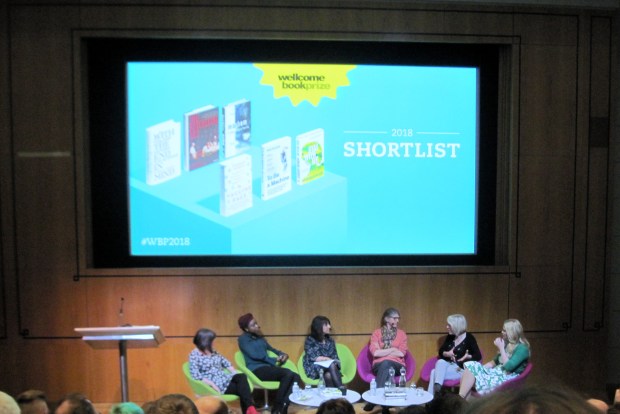
Mannix, Adebayo, O’Kelly, Rausing, Wadman & Fitzharris
Lindsey Fitzharris called The Butchering Art “a love story between science and medicine” – it was the first time that the former (antisepsis) was applied to the latter. She initially thought Robert Liston was her man – he was so colorful, larger than life – but eventually found that the real story was with Joseph Lister, the quiet, persistent Quaker. (However, the book does open with Liston performing the first surgery under ether.) Fitzharris is also involved in the Order of the Good Death, author Caitlin Doughty’s initiative, and affirmed Mannix’s efforts to remove the taboo from talking about death. I think I heard correctly that she said there is a film of The Butchering Art in the works?! I’ll need to look into that some more.
Meredith Wadman started with a brief explanation of how immunization works and why the 1960s were ripe for vaccine research. This segment went really science-y, which I thought was a little unfortunate as it may have made listeners tune out and be less interested in her work than the others’. It was perhaps inevitable given her subject matter, but also a matter of the questions O’Kelly asked – with the others she focused more on stories and themes than on scientific facts. It was interesting to hear what Wadman has been working on recently: for the past 6–8 months, she’s been reporting for Science on sexual harassment in science. For her next book, though, she’s pondering the conflict between a congressman and a Centers for Disease Control scientist over funding into research that might lead to gun control.
The question time brought up the issues of medical misinformation online, the distrust people with chronic illnesses have of medical professionals, and euthanasia – Mannix rather dodged that one, stating that her book is about the natural dying process so that’s not really her area. (Though it does come up in a chapter of her book.) We also heard a bit about the projects up next for each author. Rausing’s next book will be a travel memoir about the Capetown drought, taking in apartheid and her husband’s family’s immigration. Adebayo is at work on a very nebulous novel “about people,” and possibly how privilege affects access to healthcare.
Meeting Mrs. Malaprop
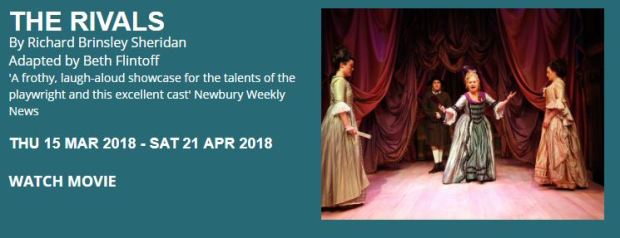
I’d been aware for perhaps a few years that malapropisms are named after a character who’s prone to verbal gaffes. Last night I met Mrs. Malaprop herself at a performance of Richard Brinsley Sheridan’s The Rivals (1775) at nearby Watermill Theatre. This was our second trip to the Watermill, after The Picture of Dorian Gray last September. It’s a small and intimate venue and the production was somewhat in the round, so we were in a row to the left-hand side of the stage. It felt like we were right inside the action, though occasionally one actor would block another such that we couldn’t see the looks passing between them.
It was a small cast of eight actors, four of whom did double duty as servants. We meet two young couples—Lydia Languish and Captain Jack Absolute, with whom she’s fallen in love while he’s in disguise as penniless “Ensign Beverley” – they plan to elope; and Julia Melville and Faulkland, who saved her from drowning and has been her betrothed for years—along with two guardian figures, Sir Anthony Absolute and Mrs. Malaprop, and two hapless suitors played for laughs, country bumpkin Bob Acres and over-the-top-Irish Sir Lucius O’Trigger. The characters’ paths cross in amusing ways while they are all in Bath.
One of the key words in the play is “caprice” – a term you don’t encounter so often these days. (The adjectival form, capricious, is common enough, but I can’t remember the last time I saw the noun.) Several of the characters could be described as capricious, but especially Faulkland, who torments Julia with his doubts about the constancy of her love, and Lydia, who rather loses interest in Captain Jack once she realizes that their guardians approve of their match and she won’t have to undertake a romantic elopement instead.
What with the disguises, misunderstandings, and general farcical atmosphere, The Rivals is reminiscent of a Shakespearean comedy, though the language is easier to follow. Here in Beth Flintoff’s adaptation, much of the humor comes through in accents and exaggerated facial expressions, though Sir Anthony’s growled insults to his son and Bob Acres’ attempts to pass himself off as a gentleman are also highlights. The whole cast (see this full list) was terrific, including several actors familiar from British television and bit parts in films.
And, of course, there’s Mrs. Malaprop and her wondrous malapropisms. Sheridan would have taken her name from malapropos, a synonym for “inappropriate” first recorded in 1630, and an adaptation of the French term mal à propos (“poorly placed”). The first recorded use of “malaprop” for the wrong use of words was by Lord Byron in 1814. Some of the malapropisms in the play fell flat because both the spoken and intended words are too obscure nowadays. I think the director probably left out certain ones, and added at least one anachronistically modern one: “calamari” for calamity. But there were still some excellent ones. Here are a few of my favorites (see also this complete list):
“promise to forget this fellow – to illiterate him, I say, quite from your memory.”
“He is the very pine-apple of politeness!”
“she’s as headstrong as an allegory on the banks of the Nile.”
[I even spotted a malapropism (can I use that term for written rather than spoken words?) on my cornflakes box this morning:
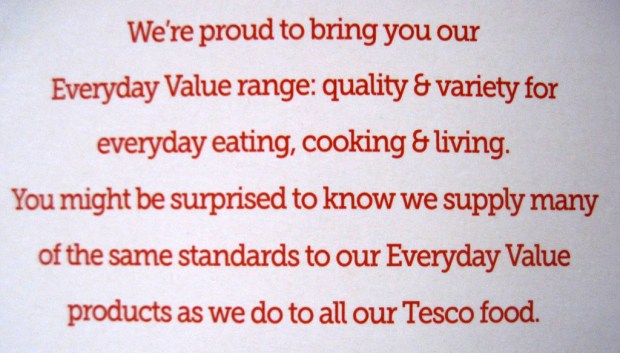
Do you spot it too?]
Great acting, costumes and hairstyles; laughs aplenty; and a rhyming prologue and epilogue that made reference to the modern day (“I’m not going to hex it with jokes about … anything unpleasant!” and “eat less baked beans and drink more champagne”): Altogether a splendid evening out at the theatre.
My rating: 
A Publisher Party and a One-Man Play
I was a veritable social butterfly this past week: I went out two evenings in a row! (Believe me, that’s rare.) On Tuesday I met up with bloggers Annabel, Eric and Kim at the Faber Spring Party held at Crypt on the Green in London, and on Wednesday my husband and I attended a performance at the University of Reading of Michael Mears’s one-man play on the plight of Britain’s conscientious objectors during World War I, This Evil Thing.
Faber Spring Party
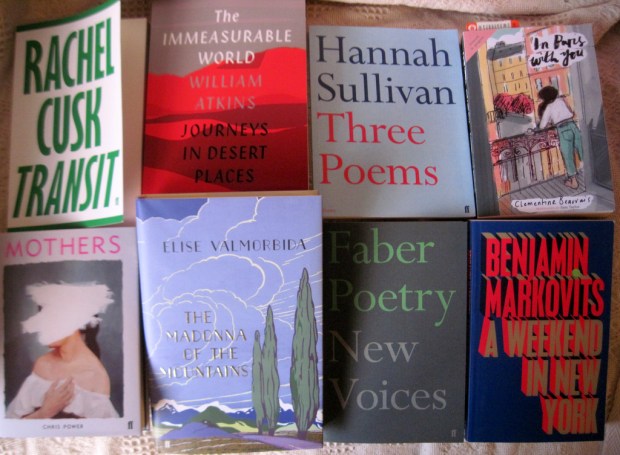
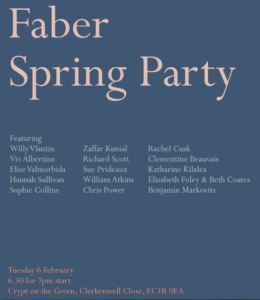 I’ve never been to an event quite like this. Publisher Faber & Faber, which will be celebrating its 90th birthday in 2019, previewed its major releases through to September. Most of the attendees seemed to be booksellers and publishing insiders. Drinks were on a buffet table at the back; books were on a buffet table along the side. Glass of champagne in hand, it was time to plunder the free books on offer. I ended up taking one of everything, with the exception of Rachel Cusk’s trilogy: I couldn’t make it through Outline and am not keen enough on her writing to get an advanced copy of Kudos, but figured I might give her another try with the middle book, Transit.

For the evening’s presentation, each featured author had a few minutes to introduce their new book and/or give a short reading.
Rachel Cusk opened the evening with a reading from Kudos. If you’re familiar with her recent work, you won’t be surprised at this synopsis: a man on a plane recounts having his dog put to sleep. (Out on May 3rd.)
William Atkins’s book on deserts, The Immeasurable World, is based on three years of travel and is, he is not ashamed to say, in the old-fashioned travel writing tradition. (Out on June 7th.)
Hannah Sullivan’s Three Poems is a hybrid work of poem-essays. #2 is more philosophical, she said; #3 is about her father’s death and her son’s birth. She read sonnet 3.21. (Out now.)
Clémentine Beauvais’s In Paris with You is a YA romance in free verse, loosely based on Eugene Onegin. I don’t know the source text but started this on the train ride home and it’s enjoyable thus far. I’m in awe at how translator Sam Taylor has taken the French of her Songe à la douceur and turned it into English poetry. (Out on June 7th.)
Chris Power’s Mothers is a book of linked short stories, three of which are about a character named Eva. He read a portion of a story about her having an encounter with an unpleasant man in Innsbruck. (Out on March 1st.)
Elise Valmorbida’s The Madonna of the Mountains, set in 1923–50, is a saga that resembles “an Italian Mother Courage,” she says. She read a scene in which a character comes across a madwoman. (Out on April 5th.)
Zaffar Kunial read the poem “Spark Hill” from his forthcoming collection Us. It’s about a childhood fight in the area of Birmingham where he grew up. He had a folder open in front of him but, impressively, recited the long poem completely from memory. (Out on July 5th.)
American novelist Benjamin Markovits was a professional basketball player in Germany for six months. Like the tennis-playing protagonist of his upcoming book, A Weekend in New York, he got tired of being measured. After 15 years, his hero is eager to escape a life of being constantly ranked. This is the first in a quartet of novels that inevitably invites comparison with John Updike’s “Rabbit” books. (Out on June 7th.)
I confess I didn’t previously know the name Viv Albertine; she was the guitarist for the female punk band The Slits, and To Throw Away Unopened is her second memoir. Albertine realized that it was her mother who had made her an angry rebel; the title is the label on a bag she found in her mother’s room after her death. (Out on April 5th.)
Sophie Collins incorporates hybrid forms in her poetry – what she calls “lyric essays.” The theme of her book Who Is Mary Sue? is perceptions of women’s writing (with “Mary Sue” as a metonym for the stereotypical good girl). She read from “Engine.” (Out now.)
Katharine Kilalea’s debut novel Ok, Mr Field is about an injured concert pianist who becomes obsessed with a house he buys in South Africa. (Out on June 7th.)
Elizabeth Foley and Beth Coates are the authors of two Homework for Grown-Ups books. Their new book, What Would Boudicca Do?, is about lessons we can draw from the women of history. For instance, the sampler booklet has pieces called “Dorothy Parker and Handling Jerks” and “Frida Kahlo and Finding Your Style.” There’s a heck of a lot of books like this out this year, though, and I’m not so sure this one will stand out. (Out on September 6th.)
Richard Scott read two amazingly intimate poems from his upcoming collection, Soho. One, “cover-boys,” was about top-shelf gay porn; the other was about mutilated sculptures of male bodies in the Athens archaeological museum. If you appreciated Andrew McMillan’s Physical, you need to get hold of this the second it comes out. I went back and read “cover-boys” in the sampler booklet and it wasn’t nearly as powerful as it was aloud; Scott’s reading really brought it to life, in contrast to some other authors’ dull delivery. (Out on April 5th.)
Sue Prideaux’s forthcoming biography of Friedrich Nietzsche is entitled I Am Dynamite! She encountered her subject when she wrote her first biography, of Edvard Munch. Although Nietzsche has been embraced by far-right groups in America, he was in fact against racism, nationalism, and anti-semitism, so he has important messages for us today. I’ll be keen to get hold of this one. (Out on September 6th.)
Guitar in hand, Willy Vlautin closed the evening with a performance of the title track from the soundtrack album to his fifth novel, Don’t Skip Out on Me – he was the singer in Portland, Oregon alt-country band Richmond Fontaine, which has recently stopped touring. He said the novel asks, “can you make the scars of broken people bearable?” (Out now.)

Now that I’ve got this terrific stack of books, wherever do I start?! I’m currently reading the Beauvais; from there I’ll focus on ones that have already been released, starting with Vlautin and the two poetry collections. The titles that aren’t out until June can probably wait – though it’s tempting to be one of the privileged few who get to read them nearly four months early. One Faber book per week should see me getting through all these by the final release date.
This Evil Thing
Michael Mears plays about 50 different characters in this one-man production. He’s an actor and pacifist who has written a number of solo pieces over 20 years. In this commemorative year of the end of the First World War, he knew we would hear a lot about battles, soldiers, and their families back home. But conscientious objectors weren’t likely to be remembered: theirs is a “story that’s rarely told,” he realized. This Evil Thing sets out to correct that omission. The title phrase refers not to war in general but specifically to conscription.
 The two main characters Mears keeps coming back to in the course of the play are Bert Brocklesby, a Yorkshire preacher, and philosopher Bertrand Russell. Brocklesby refused to fight and, when he and other COs were shipped off to France anyway, resisted doing any work that supported the war effort, even peeling the potatoes that would be fed to soldiers. He and his fellow COs were beaten, placed in solitary confinement, and threatened with execution. Meanwhile, Russell and others in the No-Conscription Fellowship fought for their rights back in London. There’s a wonderful scene in the play where Russell, clad in nothing but a towel after a skinny dip, pleads with Prime Minister Asquith.
As in solo shows I’ve seen before (e.g. A Christmas Carol with Patrick Stewart), Mears had to find subtle ways to distinguish between characters: he used a myriad different voices, including regional accents; he quickly donned a jacket, hat, or pair of glasses. Russell was identified by his ever-present pipe. The most challenging scene, Mears said in the Q&A at the end, was one with four characters in a French street café.
Mears reveals during the play that his grandfather fought in WWI and his father in WWII, but he has never had to put his own pacifist views to the test. What about Hitler? people always ask. Mears is honest and humble enough to admit that he doesn’t know what he would have done had he been called on to fight Hitler, or had he faced persecution as a CO in WWI. Ultimately, what Mears hopes audiences take from his play, which won acclaim at the Edinburgh Festival Fringe, is that “this is not an irrelevant piece of history.” Standing up for what you believe in, especially if it goes against the spirit of the times, is always valuable.
 Bookish Beck = Rebecca Foster. American transplant to England. Freelance proofreader and book reviewer.
 Bookish Beck