The Best Books from the First Half of 2018
Here’s a quick look back at a baker’s dozen of 2018 releases that have stood out most for me so far. I’ve linked to books that I’ve already reviewed in full on the blog or elsewhere.
Fiction:
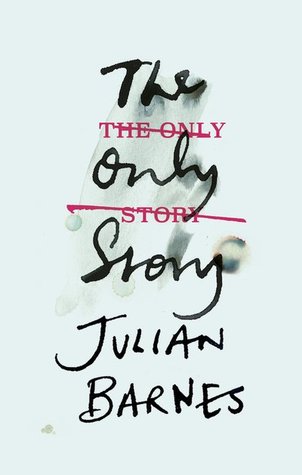 The Only Story by Julian Barnes: A familiar story: a May–December romance fizzles out. A sad story: an idealistic young man who swears he’ll never be old and boring has to face that this romance isn’t all he wanted it to be. A love story nonetheless. Paul met 48-year-old Susan, a married mother of two, at the local tennis club when he was 19. The narrative is partly the older Paul’s way of salvaging what happy memories he can, but also partly an extended self-defense. Barnes takes what could have been a dreary and repetitive story line and makes it an exquisitely plangent progression: first-person into second-person into third-person. The picture of romantic youth shading into cynical but still hopeful middle age really resonates, as do the themes of unconventionality, memory, addiction and pity.
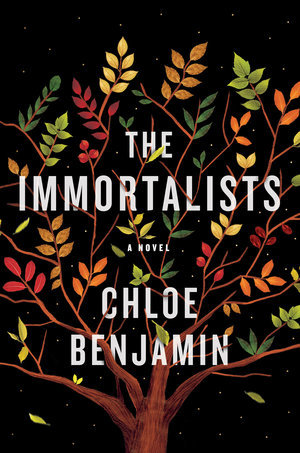 The Immortalists by Chloe Benjamin: Summer 1969: four young siblings escape a sweltering New York City morning by visiting a fortune teller who can tell you the day you’ll die. In the decades that follow, they have to decide what to do with this advance knowledge: will it spur them to live courageous lives, or drive them to desperation? This compelling family story lives up to the hype. Imagine the fun Benjamin had researching four distinct worlds: Daniel, a military doctor, examines Iraq War recruits; Klara becomes a magician in Las Vegas; Varya researches aging via primate studies; and Simon is a dancer in San Francisco. The settings, time periods, and career paths are so diverse that you get four novels’ worth of interesting background.
 Florida by Lauren Groff: Two major, connected threads in this superb story collection are ambivalence about Florida, and ambivalence about motherhood. There’s an oppressive atmosphere throughout, with environmental catastrophe an underlying threat. Set-ups vary in scope from almost the whole span of a life to one scene. A dearth of named characters emphasizes just how universal the scenarios and emotions are. Groff’s style is like a cross between Karen Russell’s Swamplandia! and Cormac McCarthy’s The Road, and her unexpected turns of phrase jump off the page. A favorite was “Above and Below,” in which a woman slips into homelessness. Florida feels innovative and terrifyingly relevant. Any one of its stories is a bracing read; together they form a masterpiece.
 Motherhood by Sheila Heti: Should one have children? Should I have children? No matter who’s asking the questions or in what context, you’re going to get the whole gamut of replies. Heti’s unnamed heroine consults a fortune teller and psychics, tosses coins and interprets her dreams as The Decision looms. Chance, inheritance, and choice vie for pride of place in this relentless, audacious inquiry into the purpose of a woman’s life. I marked out dozens of quotes that could have been downloaded directly from my head or copied from my e-mails and journal pages. The book encapsulates nearly every thought that has gone through my mind over the last decade as I’ve faced the intractable question of whether to have children. Heti has captured brilliantly what it’s like to be in this situation in this moment in time.
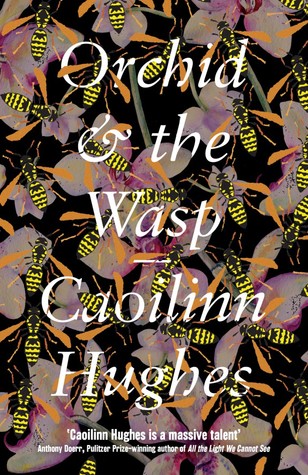 Orchid & the Wasp by Caoilinn Hughes: The action spans about nine years: a politically turbulent decade that opens with the Iraq War protests and closes with the Occupy movement in New York City. Gael Foess, our lovable antiheroine, is a trickster. She’s learned well her banker father’s lesson that money and skills don’t get distributed fairly in this life, so she’s going to do what she can to ensure that her loved ones succeed. Art, music, religion and health are major interlocking themes. The author is wonderfully adept at voices, and the book’s frenetic pace is well matched by the virtuosic use of language – wordplay, neologisms, and metaphors drawn from the arts and nature. Hughes is an exciting writer who has rightfully attracted a lot of buzz for her debut.
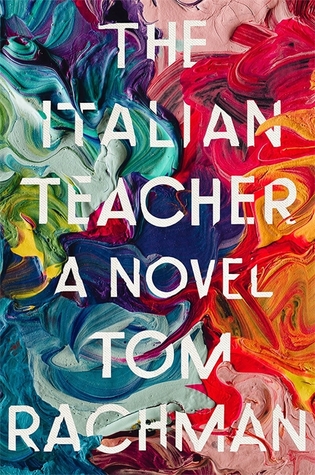 The Italian Teacher by Tom Rachman: Charles “Pinch” Bavinsky is just an Italian teacher, though as a boy in Rome in the 1950s–60s he believed he would follow in the footsteps of his sculptor mother and his moderately famous father, Bear Bavinsky, who paints close-ups of body parts. We follow Pinch through the rest of his life, a sad one of estrangement, loss and misunderstandings – but ultimately there’s a sly triumph in store for the boy who was told that he’d never make it as an artist. Rachman jets between lots of different places – Rome, New York City, Toronto, rural France, London – and ropes in quirky characters in the search for an identity and a place to belong. This is a rewarding story about the desperation to please, or perhaps exceed, one’s parents, and the legacy of artists in a fickle market.

The ‘bests’ that I happen to own in print.
Nonfiction:
 The Line Becomes a River by Francisco Cantú: Francisco Cantú was a U.S. Border Patrol agent for four years in Arizona and Texas. Impressionistic rather than journalistic, his book is a loosely thematic scrapbook. He inserts snippets of U.S.–Mexico history, including the establishment of the border, and quotes from other primary and secondary texts. He also adds in fragments of his family’s history: His ancestors left Mexico during the Mexican Revolution of the 1910s, but there’s no doubt his Latino name and features made him a friendly face for illegal immigrants. The final third of the book makes things personal when his friend is detained in Mexico. Giving faces to an abstract struggle, this work passionately argues that people should not be divided by walls but united in common humanity.
 The Unmapped Mind by Christian Donlan: Some of the best medical writing from a layman’s perspective I’ve ever read. Donlan, a Brighton-area video games journalist, was diagnosed with (relapsing, remitting) multiple sclerosis in 2014. “I think sometimes that early MS is a sort of tasting menu of neurological disease,” Donlan wryly offers. He approaches his disease with good humor and curiosity, using metaphors of maps to depict himself as an explorer into uncharted territory. The accounts of going in for an MRI and a round of chemotherapy are excellent. Short interludes also give snippets from the history of MS and the science of neurology in general. What’s especially nice is how he sets up parallels with his daughter’s early years. My frontrunner for next year’s Wellcome Book Prize so far.
 Free Woman by Lara Feigel: Doris Lessing lived by ideals of free love and Communism, but it came at the price of abandoning her children. Lara Feigel could identify with Lessing in some ways, and as she entered a rocky time in her mid-thirties – a miscarriage followed by IVF, which was a strain on her marriage; the death of a close friend; ongoing worry over how motherhood might affect her academic career – she set out to find what Lessing could teach her about how to be free. A familiarity with the works of Doris Lessing is not a prerequisite to enjoying this richly satisfying hybrid of biography, literary criticism and memoir. The Golden Notebook is about the ways in which women compartmentalize their lives and the struggle to bring various strands into harmony; that’s what Free Woman is all about as well.
 Implosion by Elizabeth W. Garber: The author grew up in a glass house designed by her father, Modernist architect Woodie Garber, outside Cincinnati in the 1960s to 70s. This and Woodie’s other most notable design, Sander Hall, a controversial tower-style dorm at the University of Cincinnati that was later destroyed in a controlled explosion, serve as powerful metaphors for her dysfunctional family life. Woodie is such a fascinating, flawed figure. Garber endured sexual and psychological abuse yet likens him to Odysseus, the tragic hero of his own life. She connected with him over Le Corbusier’s designs, but it was impossible for a man born in the 1910s to understand his daughter’s generation. This definitely is not a boring tome just for architecture buffs. It’s a masterful memoir for everyone.
 Skybound by Rebecca Loncraine: Each year seems to bring one exquisite posthumous memoir about facing death with dignity. For Rebecca Loncraine, after treatment for breast cancer in her early thirties, taking flying lessons in an unpowered glider was her way of rediscovering joy and experiencing freedom by facing her fears in the sky. She discovered a particular love for flying alongside birds: red kites in Wales, and vultures in Nepal. The most remarkable passages of the book are the exhilarating descriptions of being thousands of feet up in the air and the reflections on why humans are drawn to flight and what it does for our bodies and spirits. Loncraine had virtually finished this manuscript when her cancer returned; she underwent another 14 grueling months of treatment before her death in September 2016.
 Bookworm by Lucy Mangan: Mangan takes us along on a nostalgic chronological tour through the books she loved most as a child and adolescent. No matter how much or how little of your early reading overlaps with hers, you’ll appreciate her picture of the intensity of children’s relationship with books – they can completely shut out the world and devour their favorite stories over and over, almost living inside them, they love and believe in them so much – and her tongue-in-cheek responses to them upon rereading them decades later. There are so many witty lines that it doesn’t really matter whether you give a fig about the particular titles she discusses or not. A delightful paean to the joys of being a lifelong reader; recommended to bibliophiles and parents trying to make bookworms out of their children.
 Educated by Tara Westover: This is one of the most powerful and well-written memoirs I’ve ever read. It tells of a young woman’s off-grid upbringing in Idaho and the hard work that took her from almost complete ignorance to a Cambridge PhD. Westover’s is an incredible story about testing the limits of perseverance and sanity. Her father may have been a survivalist, but her psychic survival is the most impressive outcome here. What takes this astonishing life story to the next level, making it a classic to sit alongside memoirs by Alexandra Fuller, Mary Karr and Jeannette Walls, is the writing. Westover writes with calm authority, channeling the style of the scriptures and history books that were formative in her upbringing and education.
What are some of the best books you’ve read so far this year?
What 2018 releases do I need to catch up on right away?
20 Books of Summer, #1–3: Hadley, Timms & Tyler
I’ve been reading sophisticated short stories, a food/travel memoir, and a prize-winning slice of cozy Americana.
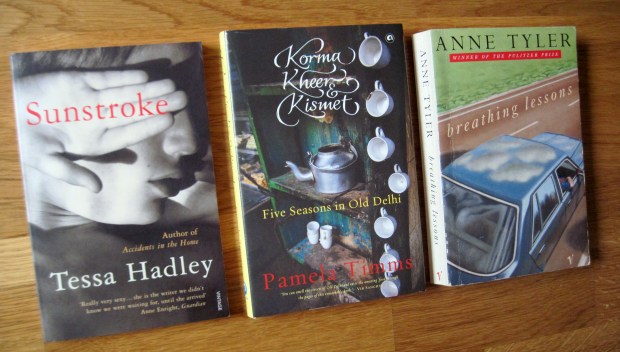
Sunstroke and Other Stories by Tessa Hadley (2007)
Everything is running away so fast; your deepest responsibility is to snatch at all the living you can.
Here’s a little something I wrote as an introduction to a review of Hadley’s most recent short story collection: “When I think of Tessa Hadley’s books, I picture a certain quality of light. I see piercing yellow shafts of sunlight filling airy, wood-floored rooms and lowering over suburban English gardens to create languid summer evenings. I think of childhood’s sense of possibility and adolescence’s gently scary feeling of new freedoms opening up. And, even when the story lines are set in the present day, I imagine the calm sophistication of 1950s–70s fashions: smart sweater sets and skirts, or flowing hippie dresses.” This volume is from a decade earlier and is not quite as strong, but that distinct atmosphere is still there.
 Each story pivots on a particular relationship: A mother fends off her son’s spurned lover; a teenager helps her older sister recover from a miscarriage; a woman hosts her former brother-in-law. Several stories revisit the same place or situation decades later. Claudia flirted with Graham when he was a teenager and she a grown woman; in “Phosphorescence” he tests whether there’s still any power in that connection 25 years later. In “A Card Trick” Gina goes back to a writer’s home she visited with family friends 25 years ago and reflects on how life has failed to live up to expectations. In “Matrilineal” Nia shares the comfort of a bed with her mother twice: once as a little girl the night they run away from her father, and again 40 years later in a hotel in New York City.
My two favorites were “The Surrogate,” in which a young woman falls for her professor – and for a pub customer who happens to look like him; and “Exchanges,” about two women on the cusp of middle age whose lives have diverged.

Korma, Kheer and Kismet: Five Seasons in Old Delhi by Pamela Timms (2014)
The only diary I’ve ever religiously maintained is my food journal.
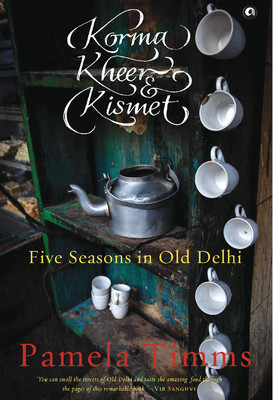 Timms is a Scottish journalist and food blogger who moved to India in 2005 when her husband got a job as a foreign correspondent. She delights in the street food stalls of Old Delhi, where you can get a hearty and delicious meal of mutton curry or fried vegetable dumplings for very little money. Often the snacks are simple – the first roasted sweet potatoes of the season or a big bowl of rice pudding made with buffalo milk and flavored with cardamom – but something about snatching sustenance while you’re on the go can make it the best thing you’ve ever tasted. It takes some searching to avoid the “pizza-fication” of Indian cuisine and discover an authentic hole-in-the-wall. Timms relies on local knowledge to locate hidden treasures and probes the owners until she gets recipes to recreate at home.
There isn’t a strong narrative to the book, but the food descriptions are certainly mouth-watering. Timms also captures the “magnificent mayhem of the spice market” and the extremes of the climate – a Delhi summer is like “being trapped inside a tandoor for three months of the year.” I reckon “Mr Naseem’s Sheer Khurma” will be fairly easy and so worth trying as a light dessert to follow a curry feast. Made with whole milk, ground rice, dried fruits and nuts, it’s a sweet custard traditionally used to break the Ramadan fast.

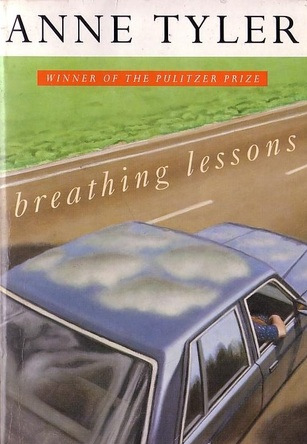
Breathing Lessons by Anne Tyler (1988)
“Was there a certain conscious point in your life when you decided to settle for being ordinary?”
Tyler won the Pulitzer Prize for this one. I’d rate it third out of the seven of her novels I’ve read so far, after Dinner at the Homesick Restaurant and The Accidental Tourist. (In general I seem to like her 1980s work the best.) The main action takes place all on one day, as Maggie Moran and her husband Ira travel from Baltimore up to Pennsylvania to attend the funeral of her childhood friend’s husband and pay a visit to their son’s ex-wife and their granddaughter.
 Of course, circadian narratives are so clever because they manage to interleave sufficient flashbacks to fill in the background. So we learn how 48-year-old Maggie – a precursor of Rebecca Davitch from Back When We Were Grown-ups and Abby Whitshank from A Spool of Blue Thread and the epitome of the exuberant, slightly ditzy, do-gooding heroine – has always meant well but through a combination of misunderstandings and fibs has botched things. She settled on Ira almost out of embarrassment: she’d heard a rumor he’d been killed in military training and sent his father an effusive condolence letter. When their son Jesse got Fiona pregnant, Maggie convinced Fiona to give him a chance based on a sentimental story about him that she perhaps half believed, and now, years later, she’s trying to do the same.
I loved the funeral scene itself – Serena is determined to recreate her wedding to Max, note for note – but I wearied of a sequence in which Maggie and Ira help an older African-American gentleman with car trouble. This is very much the Maggie show, so your reaction to the novel will largely depend on how well you’re able to tolerate her irksome habits. (Really, does she have to confuse the brake and the accelerator TWICE in one day?) Ira is the usual Tylerian standoffish husband, and Jesse the standard layabout progeny. What I found strangest was how little Tyler bothers to develop the character of the Moran daughter, Daisy.
Still, I enjoyed this. It’s a story about the mistakes we make, the patterns we get stuck in, and the ways we try to put things right. Sometimes it works; sometimes it doesn’t. Ultimately, we’re all making up this life business as we go along.
(I’ll also be reviewing Anne Tyler’s new novel, Clock Dance, on July 12th.)
Still More Books about Cats
The past two years I’ve had biannual specials on cat books. You might think I would have run out of options by now, but not so! Granted, my choices this time are rather light fare: several children’s picture books, two slight gift books, and a few breezy memoirs. But it’s nice to have a fluffy post every now and again, and today’s is in honor of getting past a week of the year I always dread: June 15th is the U.S. tax deadline for citizens living abroad, so I’ve been drowning in forms and numbers. To celebrate getting both my IRS and HMRC tax returns sent off by today, here’s some feline-themed reads to enjoy over a G&T or other summery tipple of your choice.
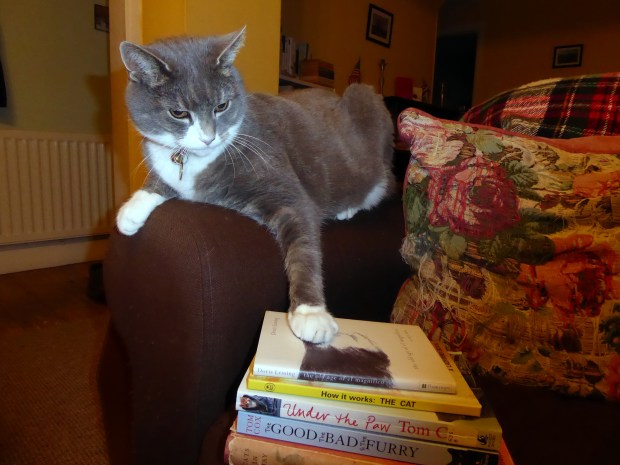
Alfie likes cat books, too. The stacks are good for scratching one’s cheek against.
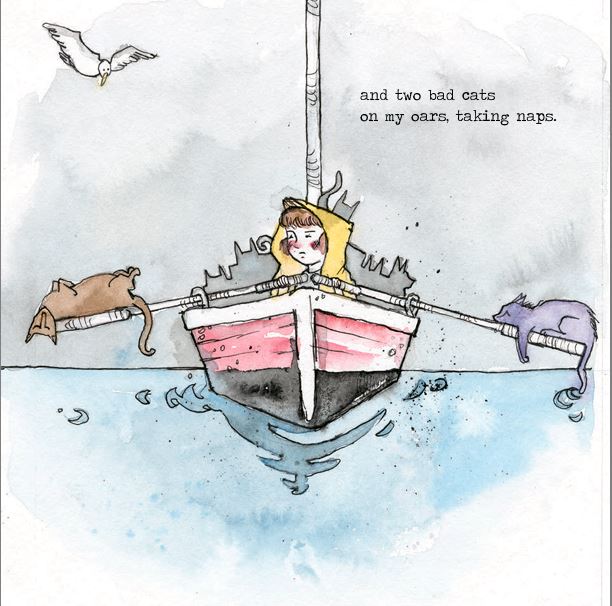
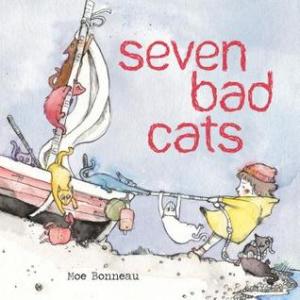 Seven Bad Cats by Monique Bonneau (2018): “Today I put on my boots and my coat, and seven bad cats jumped into my boat.” This is a terrific little rhyming book that counts up to seven and then back down to one with the help of some stowaway cats and their antics. (They come in colors that cats don’t normally come in, but that’s okay with me.) To start with they are incorrigibly lazy and mischievous, but when disaster is at hand they band together to help the little girl get back to shore safely. If only cats were so helpful in real life!
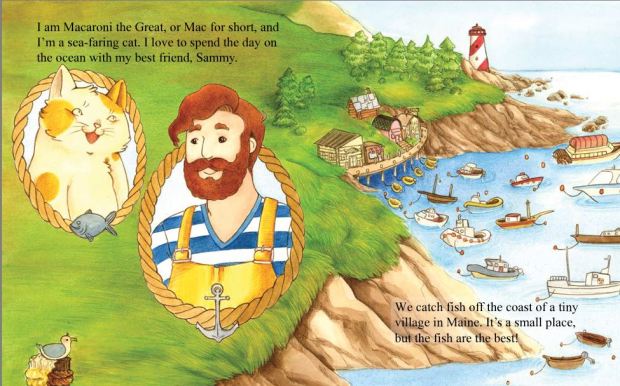
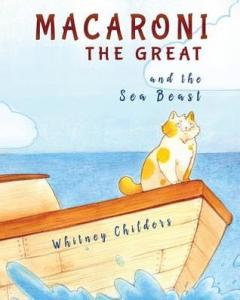 Macaroni the Great and the Sea Beast by Whitney Childers (2018): Macaroni the cat has an idyllic life by the coast of Maine with his hipster fisherman friend, Sammy. Sometimes he helps steer the fishing boat; sometimes he naps on the deck. But when a fearsome sea beast rears its head from the net one day, Mac is ready to fight back and save the day. From the colorfully nautical endpapers through to the peaceful last page, this is a great picture book for cat lovers to share with the little ones in their lives.
You don’t so often hear blokes talking about their cats, do you? That crazy cat lady stereotype dominates. But Tom Cox has written several memoirs about his life with cats.
 In Under the Paw: Confessions of a Cat Man (2008), Cox, who had previously published volumes of his journalism about music and sports, came out as a cat lover. By the end of the book he has SIX CATS, so this was not some passing fad but a deep and possibly worrying obsession. In essays and short list-based asides he traces his history with cats, reveals the wildly different personalities of his current pets, and wittily comments on cat behavior. I especially liked these entries from his “Cat Dictionary”: “ES Pee: The telepathic process that leads a cat to only get properly settled on its owner’s stomach in the moments when that owner is most desperate for the toilet” & “Muzzlewug: The state of bliss created by the perfect friction of an owner’s fingers on a fully extended chin.”
 The Good, the Bad and the Furry (2013) is another fairly entertaining book. Cat owners will recognize the ways in which a pet’s requirements impinge on their lives (but we wouldn’t have it any other way). Cox starts and ends the book with four cats, but – alas – goes down to three for a while in the middle, with visitors upping it to 3.5 sometimes. The Bear, Ralph and Shipley are the stalwarts, with The Bear described as “the only cat I’d ever seen who appeared to be almost permanently on the verge of tears.” He’s melancholy and philosophical, whereas Ralph (who says his own name when he meows) is vain and sullen. “The Ten Catmandments” was my favorite part: “Thou shalt not drink the water put out for thee by thy humans” and “Thou shalt ignore any toy thy human has bought for thee, especially the really expensive ones.” Includes lots of photographs of cats and kittens!
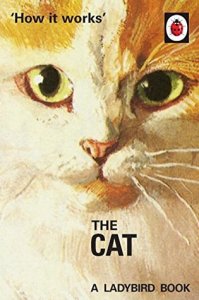 How It Works: The Cat (2016) is a Ladybird pastiche by Jason Hazeley and Joel Morris that we purchased as a bargain book from Aldi; it was published in the USA as The Fireside Book of the Cat. Tongue-in-cheek descriptions sit opposite 1950s-style drawings. Cat owners will certainly get a chuckle from lines like “Dogs have evolved to serve many sorts of human needs. And humans have evolved to serve many sorts of cat food.” (However, “It is a good idea to buy a lot of your cat’s favourite food. That way, you will have something to throw away when she changes her mind.”) Makes a good coffee table book for guests to smile at.
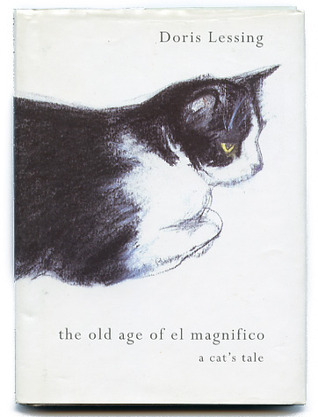 The Old Age of El Magnifico by Doris Lessing (2000): Pure cat lover’s delight. I wasn’t a big fan of Lessing’s Particularly Cats, which is surprisingly unsentimental and even brutal in places. This redresses the balance. It’s the bittersweet story of Butch, her enormous black and white cat, who was known by many additional nicknames including El Magnifico. At the age of 14 he was found to have a cancerous growth in his shoulder, and one entire front leg had to be removed. His habits, and even to an extent his personality, changed after the amputation, and Lessing regretted that she couldn’t let him know it was done for his good. She reflects on her duty towards the cats in her care, and on how pets encourage us to slow our pace and direct our attention fully to the present moment. Work? Chores? Worries? What could really be more important than sitting still and stroking a cat?
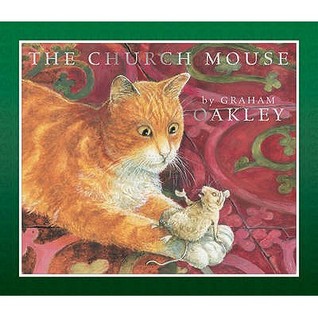 The Church Mouse by Graham Oakley: It is not good for a mouse to be alone. Arthur is lonely as the only mouse resident in the village church, but he has an idea: he proposes to the parson that if he will give all the local mice refuge in the church, they’ll undertake minor chores like flower arranging and picking up confetti. It seems like a good arrangement all around, but Sampson the church cat soon tires of the mice’s antics and creates something of a scene during a Sunday service. Luckily, he and the mice still work together to outwit a burglar who comes for the silver. There are quite a lot of words for a very small child to engage with, but older children should enjoy it very much. I find this whole series so charming. This was the first book of the 14, from 1972.
 Cats in May by Doreen Tovey (1959): The sequel is just as good as the original (Cats in the Belfry). Along with feline antics we get the adventures of Blondin the squirrel, whom Tovey and her husband adopted before they started keeping Siamese cats. (He was just as destructive as the pets that came after him, but I had to love his fondness for tea.) Solomon and Sheba appear on the BBC and object in the strongest possible terms when Doreen and Charles try to introduce a third Siamese, a kitten named Samson, to the household. The flu, visits from the rector’s grandson, and periodic troubles with their old farmhouse, including a chimney fire, round out this highly amusing story of life with pets.
Not all cat books are winners. Here are two that, alas, I cannot recommend:
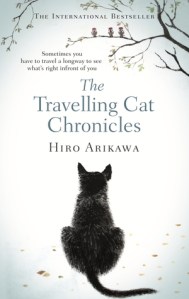 The Travelling Cat Chronicles by Hiro Arikawa (2017): This is the fable-like story of Satoru, a single man in his early thirties, and his cat, Nana (named for the shape of his tail, which resembles a Japanese 7). Satoru adopted Nana about five years ago when the cat, a local stray, was hit by a car. Now he needs to find a new owner for his beloved pet. No spoilers here, but really, there are only so many reasons why a young man would need to do this, and readers will likely work it out well before the “big reveal” over halfway through. We bounce between Nana’s perspective, which is quite cutely rendered, and third-person flashbacks to Satoru’s sad history. The author spells out and overstates everything. It’s pretty emotionally manipulative. Pet owners will appreciate Nana’s humor and loyalty (“I’m your cat till the bitter end!”), but I felt like I was being brow-beaten into crying – though I didn’t in the end.
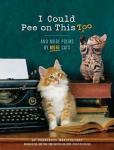
I Could Pee on This, Too: And More Poems by More Cats by Francesco Marciuliano (2016): Not a single memorable poem or line in the lot. Seriously. Stick with the original.
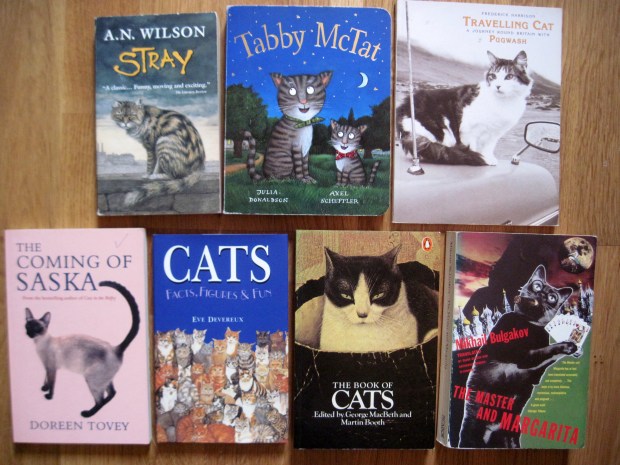
My next batch of cat books. Maybe I’ll try to write them up for a Christmas-tide treat.
Whether you are a cat lover or not, do any of these books appeal?
The Feather Thief by Kirk Wallace Johnson
 The Feather Thief is a delightful read that successfully combines many genres – biography, true crime, ornithology, history, travel and memoir – to tell the story of an audacious heist of rare bird skins from the Natural History Museum at Tring in 2009. Somehow I managed not to hear about it at the time, but it was huge news in terms of museum collections and endangered species crime. The tendrils of this thorny case wind around Victorian explorers, tycoons, and fashionistas through to modern obsessions with music, fly-fishing and refugees.
Author Kirk Wallace Johnson worked for USAID in Iraq, heading up the reconstruction of Fallujah, then founded a non-profit organization rehoming refugees in America. Plagued by PTSD, he turned to fly-fishing as therapy, and this was how he heard about the curious case of Edwin Rist, who stole the bird specimens from Tring to sell the bright feathers to fellow hobbyists who tie elaborate Victorian-style fishing flies.
Rist, from upstate New York, was a 20-year-old flautist studying at the Royal Academy of Music in London. Since age 11 he’d been fixated on fly-tying, especially old-fashioned salmon ties, which use exotic feathers or ordinary ones dyed to look like them. An online friend told him he should check out Tring – the museum Walter Rothschild’s financier father built for him as a twenty-first birthday present – when he got to London. In 2008 Rist scoped out the collection, pretending to be photographing the birds of paradise for a friend’s book.
A year later he took the train to Tring one summer night with an empty suitcase and a glass cutter, broke in through a window, stole 300 bird skins, and made it back to his flat without incident. The museum only discovered the crime a month later, by accident. Rist sold many feathers and whole birds via a fly-tying forum and on eBay. It was nearly another year and a half before the police knocked on his door, having been alerted by a former law enforcement officer who encountered a museum-grade bird skin at the Dutch Fly Fair and asked where it came from.

An interior shot showing some plates of fishing flies.
Here is where things get really interesting, at least for me. Rist confessed immediately, but a psychological evaluation diagnosed him with Asperger’s; on the strength of that mental health defense he was given a suspension and a large fine, but no jail time, so he graduated from the Royal Academy as normal and auditioned for jobs. The precedent was a case from 2000 in which a young man with Asperger’s who stole human remains from a Bristol graveyard was exonerated.
The book is in three parts: the first gives historical context about specimen collection and the early feather trade; the second is a blow-by-blow of Rist’s crime and the aftermath, including the trial; and the third goes into Wallace’s own investigation process. He started by attending a fly-tying symposium, where he felt like an outsider and even received vague threats: Rist was now a no-go subject for this community. But Wallace wasn’t going to be deterred. Sixty-four bird skins were still missing, and his quest was to track them down. He started by contacting Rist’s confirmed customers, then interviewed Rist himself in Germany and traveled to Norway to meet someone who might have been Rist’s accomplice – or fall guy.

From the back cover.
I happened to be a bit too familiar with the related history – I’ve read a lot of books that touch on Alfred Russel Wallace, whose specimens formed the core of the Tring collection, as well as a whole book on the feather trade for women’s hats and the movement against the extermination, which led to the formation of the Audubon Society (Kris Radish’s The Year of Necessary Lies). This meant that I was a little impatient with the first few chapters, but if you are new to these subjects you shouldn’t have that problem. For me the highlights were the reconstruction of the crime itself and Wallace’s inquiry into whether the Asperger’s diagnosis was accurate and a fair excuse for Rist’s behavior.
This whole story is stranger than fiction, which would make it a great selection for readers who don’t often pick up nonfiction, perhaps expecting it to be dry or taxing. Far from it. This is the very best sort of nonfiction: wide-ranging, intelligent and gripping.
My rating:
The Feather Thief was published in the UK by Hutchinson on April 26th. My thanks to Najma Finlay for the free copy for review.
Recommended June Releases
I have an all-female line-up for you this time, with selections ranging from a YA romance in verse to a memoir by a spiritual recording artist. There’s a very random detail that connects two of these books – look out for it!

In Paris with You by Clémentine Beauvais
[Faber & Faber, 7th]
 I don’t know the source material Beauvais was working with (Eugene Onegin, 1837), but still enjoyed this YA romance in verse. Eugene and Tatiana meet by chance in Paris in 2016 and the attraction between them is as strong as ever, but a possible relationship is threatened by memories of a tragic event from 10 years ago involving Lensky, Eugene’s friend and the boyfriend of Tatiana’s older sister Olga. I’m in awe at how translator Sam Taylor has taken the French of her Songe à la douceur and turned it into English poetry with the occasional rhyme. This is a sweet book that would appeal to John Green’s readers, but it’s more sexually explicit than a lot of American YA, so is probably only suitable for older teens. (Proof copy from Faber Spring Party)
Favorite lines:
“Her heart takes the lift / up to her larynx, / where it gets stuck / hammering against the walls of her neck.”
“an adult with a miniature attention span, / like everyone else, refreshing, updating, / nibbling at time like a ham baguette.”
“helium balloons in the shape of spermatozoa straining towards the dark sky.”
My rating:
Implosion: A Memoir of an Architect’s Daughter by Elizabeth W. Garber
[She Writes Press, 12th]
The author grew up in a glass house designed by her father, Modernist architect Woodie Garber, outside Cincinnati in the 1960s–70s. This and his other most notable design, Sander Hall, a controversial tower-style dorm at the University of Cincinnati that was later destroyed in a controlled explosion, serve as powerful metaphors for her dysfunctional family life. Woodie is such a fascinating, flawed figure. Manic depression meant he had periods of great productivity but also weeks when he couldn’t get out of bed. He and Elizabeth connected over architecture, like when he helped her make a scale model of Le Corbusier’s Villa Savoye for a school project, but it was hard for a man born in the 1910s to understand his daughter’s generation or his wife’s desire to go back to school and have her own career.
Mixed feelings towards a charismatic creative genius who made home life a torment and the way their fractured family kept going are reasons enough to read this book. But another is just that Garber’s life has been so interesting: she witnessed the 1968 race riots and had a black boyfriend when interracial relationships were frowned upon; she was briefly the librarian for the Oceanics School, whose boat was taken hostage in Panama; and she dropped out of mythology studies at Harvard to become an acupuncturist. Don’t assume this will be a boring tome only for architecture buffs. It’s a masterful memoir for everyone. (Read via NetGalley on Nook)
My rating: 
Florida by Lauren Groff
[William Heinemann (UK), 7th / Riverhead (USA), 5th]
My review is in today’s “Book Wars” column in Stylist magazine. Two major, connected threads in this superb story collection are ambivalence about Florida, and ambivalence about motherhood. The narrator of “The Midnight Zone,” staying with her sons in a hunting camp 20 miles from civilization, ponders the cruelty of time and her failure to be sufficiently maternal, while the woman in “Flower Hunters” is so lost in an eighteenth-century naturalist’s book that she forgets to get Halloween costumes for her kids. A few favorites of mine were “Ghosts and Empties,” in which the narrator goes for long walks at twilight and watches time passing through the unwitting tableaux of the neighbors’ windows; “Eyewall,” a matter-of-fact ghost story; and “Above and Below,” in which a woman slips into homelessness – it’s terrifying how precarious her life is at every step. (Proof copy)
Favorite lines:
“What had been built to seem so solid was fragile in the face of time because time is impassive, more animal than human. Time would not care if you fell out of it. It would continue on without you.” (from “The Midnight Zone”)
“The wind played the chimney until the whole place wheezed like a bagpipe.” (from “Eyewall”)
“How lonely it would be, the mother thinks, looking at her children, to live in this dark world without them.” (from “Yport”)
My rating:
The Most Beautiful Thing I’ve Seen: Opening Your Eyes to Wonder by Lisa Gungor
[Zondervan, 26th]
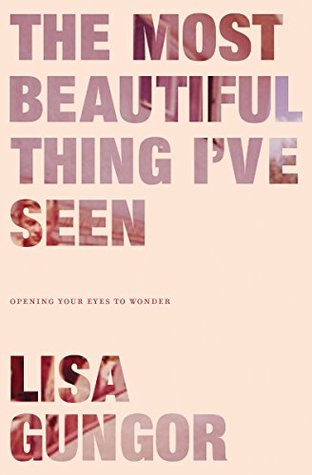 You’re most likely to pick this up if you enjoy Gungor’s music, but it’s by no means a band tell-all. The big theme of this memoir is moving beyond the strictures of religion to find an all-encompassing spirituality. Like many Gungor listeners, Lisa grew up in, and soon outgrew, a fundamentalist Christian setting. She bases the book around a key set of metaphors: the dot, the line, and the circle. The dot was the confining theology she was raised with; the line was the pilgrimage she and Michael Gungor embarked on after they married at 19; the circle was the more inclusive spirituality she developed after their second daughter, Lucie, was born with Down syndrome and required urgent heart surgery. Being mothered, becoming a mother and accepting God as Mother: together these experiences bring the book full circle. Barring the too-frequent nerdy-cool posturing (seven mentions of “dance parties,” and so on), this is a likable memoir for readers of spiritual writing by the likes of Sue Monk Kidd, Mary Oliver and Terry Tempest Williams. (Read via NetGalley on Kindle)
My rating:
 Orchid & the Wasp by Caoilinn Hughes
[Oneworld, 7th] – see my full review.
Ok, Mr Field by Katharine Kilalea
[Faber & Faber, 7th]
 Mr. Field is a concert pianist whose wrist was shattered in a train crash. With his career temporarily derailed, there’s little for him to do apart from wander his Cape Town house, a replica of Le Corbusier’s Villa Savoye, and the nearby coastal path. He also drives over to spy on his architect’s widow, with whom he’s obsessed. He’s an aimless voyeur who’s more engaged with other people’s lives than with his own – until a dog follows him home from a graveyard. This is a strangely detached little novel in which little seems to happen. Like Asunder by Chloe Aridjis and Leaving the Atocha Station by Ben Lerner, it’s about someone who’s been coasting unfeelingly through life and has to stop to ask what’s gone wrong and what’s worth pursuing. It’s so brilliantly written, with the pages flowing effortlessly on, that I admired Kilalea’s skill. Her descriptions of scenery and music are particularly good. In terms of the style, I was reminded of books I’ve read by Katie Kitamura and Henrietta Rose-Innes. (Proof copy from Faber Spring Party)
My rating:
This came out in the States (from Riverhead) back in early April, but releases here in the UK soon, so I’ve added it in as a bonus.
The Female Persuasion by Meg Wolitzer
[Chatto & Windus, 7th]
 An enjoyable story of twentysomethings looking for purpose and trying to be good feminists. To start with it’s a fairly familiar campus novel in the vein of The Art of Fielding and The Marriage Plot, but we follow Greer, her high school sweetheart Cory and her new friend Zee for the next 10+ years to see the compromises they make as ideals bend to reality. Faith Frank is Greer’s feminist idol, but she’s only human in the end, and there are different ways of being a feminist: not just speaking out from a stage, but also quietly living every day in a way that shows you value people equally. I have a feeling this would have meant much more to me a decade ago, and the #MeToo-ready message isn’t exactly groundbreaking, but I very much enjoyed my first taste of Wolitzer’s sharp, witty writing and will be sure to read more from her. This seems custom-made for next year’s Women’s Prize shortlist. (Free from publisher, for comparison with Florida in Stylist “Book Wars” column.)
My rating:
What June books do you have on the docket? Have you already read any that you can recommend?
Natural Causes by Barbara Ehrenreich & Human Errors by Nathan Lents
Two recent books about our flawed bodies and the ultimate pointlessness of trying to control them…
Natural Causes: Life, Death and the Illusion of Control by Barbara Ehrenreich
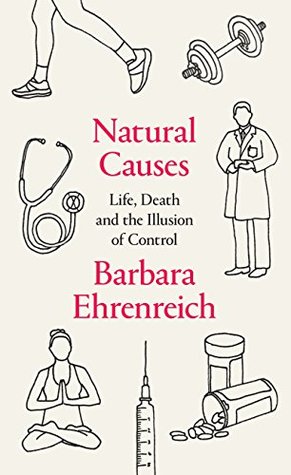 A decade ago, Barbara Ehrenreich discovered a startling paradox through a Scientific American article: the immune system assists the growth and spread of tumors, including in breast cancer, which she had in 2000. It was an epiphany for her, confirming that no matter how hard we try with diet, exercise and early diagnosis, there’s only so much we can do to preserve our health; “not everything is potentially within our control, not even our own bodies and minds.” I love Ehrenreich’s Smile or Die (alternate title: Bright-Sided), which is what I call an anti-self-help book refuting the supposed health benefits of positive thinking. In that book I felt like her skeptical approach was fully warranted, and I could sympathize with her frustration – nay, outrage – when people tried to suggest she’d attracted her cancer and limited her chances of survival through her pessimism.
However, Natural Causes is so relentlessly negative and so selective in the evidence it provides that, even though it’s sure to be considered for next year’s Wellcome Book Prize longlist, I would be unlikely to recommend it. In the first chapter, “Midlife Revolt,” which has been excerpted at Literary Hub and is worth reading, Ehrenreich writes of her decision to give up routine medical screening after a false positive mammogram caused undue stress. She decided once she passed 70 she was old enough to die without accepting a “medicalized life.” Moreover, she believes there’s an epidemic of “overdiagnosis,” especially in the USA, where there can be a profit motive behind testing. (This is certainly not the case in the UK, where the NHS doesn’t pester me about getting cervical smear tests to line any pockets; no, it’s about saving taxpayers money by catching cancer early and thus minimizing treatment costs.)
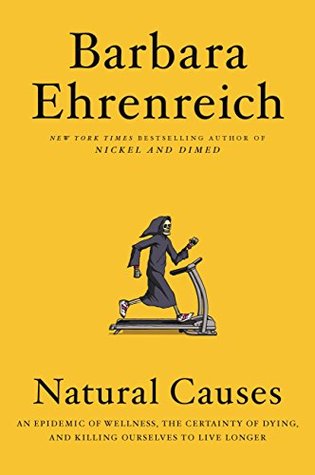
I love the U.S. cover. (Note the different subtitle.)
Ehrenreich goes on to argue that many medical procedures are simply rituals to establish patient trust, that cancer screening is invasive and ineffective, that there is little evidence that meditation does any good, and that fitness has become a collective obsession that probably doesn’t help us live any longer. It’s uncomfortable to hear her dismiss early detection techniques as worthless; no one whose doctor found cancer in the early stages would agree. The author also seems unwilling to confront her own personal prejudices (e.g. against yoga).
Although she uses plenty of statistics to back up her points, these usually come from newspapers and websites rather than peer-reviewed journals; only in two chapters about how macrophages ‘betray’ the body by abetting cancer does she consult the scientific literature, in keeping with her PhD in cellular immunology. Her most bizarre example of how our bodies aren’t evolutionarily fit for purpose is copious menstruation. Overall, the book is a strange mixture of hard science, social science, and, in later chapters, philosophy, as Ehrenreich asks about the nature of the self and the soul and what survives of us after death. As usual, her work is very readable, but this doesn’t match up to many other mind/body books I’ve read.
Favorite lines:
“The only cure for bad science is more science, which has to include both statistical analysis and some recognition that the patient is not ‘just a statistic,’ but a conscious, intelligent agent, just as the doctor is.”
“The objection raised over and over to any proposed expansion of health insurance was, in so many words: Why should I contribute to the care of those degenerates who choose to smoke and eat cheeseburgers? … we persist in subjecting anyone who dies at a seemingly untimely age to a kind of bio-moral autopsy: Did she smoke? Drink excessively? Eat too much fat and not enough fiber? Can she, in other words, be blamed for her own death?”
My rating: 
Natural Causes was published in the UK by Granta on April 12th. My thanks to the publisher for the free copy for review.
Human Errors: A Panorama of Our Glitches, from Pointless Bones to Broken Genes by Nathan H. Lents
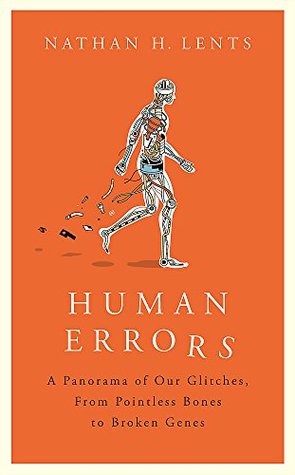 Lents is a biology professor at John Jay College, City University of New York, and in this, his second book, he explores the ways in which the human body is flawed. These errors come in three categories: adaptations to the way the world was for early humans (to take advantage of once-scarce nutrients, we gain weight quickly – but lose it only with difficulty); incomplete adaptations (our knees are still not fit for upright walking); and the basic limitations of our evolution (inefficient systems such as the throat handling both breath and food, and the recurrent laryngeal nerve being three times longer than necessary because it loops around the aorta). Consider that myopia rates are 30% or higher, the retina faces backward, sinuses drain upwards, there are 100+ autoimmune diseases, we have redundant bones in our wrist and ankle, and we can’t produce most of the vitamins we need. Put simply, we’re not a designer’s ideal. And yet this all makes a lot of sense for an evolved species.
My favorite chapter was on the inefficiencies of human reproduction compared to that of other mammals. Infertility and miscarriage rates are notably high, and gestation is shorter than it really needs to be: because otherwise their heads would get too big to pass through the birth canal, all babies are effectively born premature, so are helpless for much longer than other newborn mammals. I also especially liked the short section on cancer, which would eventually get us all if we only lived long enough. As it is, “evolution has struck an uneasy balance with cancer. Mutations cause cancer, which kills individuals, but it also brings diversity and innovation, which is good for the population.”
Lents writes in a good conversational style and usually avoids oversimplifying the science. In places his book reminded me of Kathryn Schulz’s Being Wrong and Mark O’Connell’s To Be a Machine. It’s a wry and gentle treatment of human weakness; the content never turns depressing or bitter. Recommended for all curious readers of popular science.
Favorite lines:
“While lithopedions [“stone babies”] and abdominal pregnancies are quite rare, they are also 100 percent the result of poor design. Any reasonable plumber would have attached the fallopian tube to the ovary, thereby preventing tragic and often fatal mishaps like these.”
“to call our immune system perfectly designed would be equally inaccurate. There are millions of people who once happily walked this planet only to meet their demise because their bodies simply self-sabotaged. When bodies fight themselves, there can be no winner.”
My rating:
Human Errors was published in the UK by Weidenfeld & Nicolson on May 3rd. My thanks to the publisher for the free copy for review.
Blog Tour Review: Why Do Birds Suddenly Disappear? by Lev Parikian
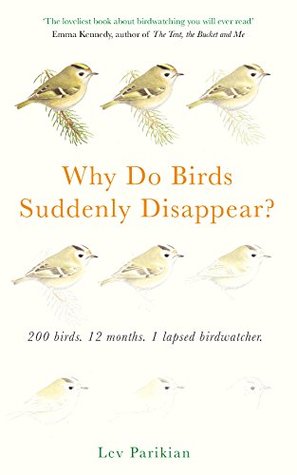 Lev Parikian was a keen birdwatcher when he was 11, but as an adult he barely remembered most of what he used to know about birds. He’d confidently declare that he’d seen a nightingale and then be too embarrassed to later admit it was actually a skylark. Also, he had to acknowledge that he hadn’t been completely honest as a preteen birder: No way had he seen a black redstart, for instance. Probably about 30% of his childhood sightings could be dismissed as cheats or downright lies. As the birdwatching bug bit again at the start of 2016, he decided it was time to set the record straight. His aim? To see 200 birds in a year, with no twitching (driving many miles to see a reported rarity) and no cheating.
Most of the book is a chronological tour through 2016, with each month’s new sightings totaled up at the end of the chapter. Being based in London isn’t the handicap one might expect – there’s a huge population of parakeets there nowadays, and the London Wetland Centre in Barnes is great for water birds – but Parikian also fills in his list through various trips around the country. He picks up red kites while in Windsor for a family wedding, and his list balloons in April thanks to trips to Minsmere and Rainham Marshes, where he finds additions like bittern and marsh harrier. The Isle of Wight, Scotland, Lindsifarne, North Norfolk… The months pass and the numbers mount until it’s the middle of December and his total is hovering at 196. Will he make it? I wouldn’t dare spoil the result for you!
I’ve always enjoyed ‘year-challenge’ books, everything from Julie Powell’s Julie and Julia to Nina Sankovitch’s Tolstoy and the Purple Chair, so I liked this memoir’s air of self-imposed competition, and its sense of humor. Having accompanied my husband on plenty of birdwatching trips, I could relate to the alternating feelings of elation and frustration. I also enjoyed the mentions of Parikian’s family history and career as a freelance conductor – I’d like to read more about this in his first book, Waving, Not Drowning (2013). This is one for fans of Alexandra Heminsley’s Leap In and Kyo Maclear’s Birds Art Life, or for anyone who needs reassurance that it’s never too late to pick up a new skill or return to a beloved hobby.
Lastly, I must mention what a beautiful physical object this book is. The good folk of Unbound have done it again. The cover image and endpapers reproduce Alan Harris’s lovely sketch of a gradually disappearing goldcrest, and if you lift the dustjacket you’re rewarded with the sight of some cheeky bird footprints traipsing across the cover.


Some favorite passages:
“Birders love a list. Day lists, week lists, month lists, year lists, life lists, garden lists, county lists, walk-to-work lists, seen-from-the-train lists, glimpsed-out-of-the-bathroom-window-while-doing-a-poo lists.”
“It’s one thing sitting in your favourite armchair, musing on the plumage differences between first- and second-winter black-headed gulls, but that doesn’t help identify the scrubby little blighter that’s just jigged into that bush, never to be seen again. And it’s no use asking them politely to damn well sit still blast you while I jot down the distinguishing features of your plumage in this notebook dammit which pocket is it in now where did I put the pencil ah here it is oh bugger it’s gone. They just won’t. Most disobliging.”
“There is a word in Swedish, gökotta, for the act of getting up early to listen to birdsong, but the knowledge that this word exists, while heartwarming, doesn’t make it any easier. It’s a bitter pill, this early rising, but my enthusiasm propels me to acts of previously unimagined heroism, and I set the alarm for an optimistic 5 a.m., before reality prompts me to change it to 5.15, no 5.30, OK then 5.45.”
My rating: 
Why Do Birds Suddenly Disappear? was published by Unbound on May 17th. My thanks to the publisher for the free copy for review.
I was delighted to be invited to participate in the blog tour for Why Do Birds Suddenly Disappear? See below for details of where other reviews and features have appeared or will be appearing soon (including on my hubby’s blog on Thursday!).
Two Memoirs of Women’s Freedom: Lara Feigel and Rebecca Loncraine
I have read some truly phenomenal memoirs this year, most of them by women. These two have rather different starting points – frustration with the constraints of marriage and motherhood, and breast cancer treatment – but I’ve paired them because both are journeys of self-discovery in which the author commits to determining how to live a free and true life.
Free Woman: Life, Liberation and Doris Lessing by Lara Feigel
It started with a spate of weddings one summer. Lara Feigel, a literature lecturer at King’s College London, found herself strangely irked at all this capitulation to marital convention, even though she herself had married in her twenties and had a young son. What did her mild outrage signify? At the same time, she was rereading the works of Doris Lessing, whom she found simultaneously admirable and vexing: Lessing lived by her ideals of free love and Communism, but it came at the price of abandoning her children. Feigel could identify with Lessing in some ways but not in others, and as she entered a rocky time in her mid-thirties – a miscarriage followed by IVF, which was a strain on her marriage; the death of a close friend; and ongoing worry over how motherhood might affect her academic career – she set out to find what Lessing could teach her about how to be free.
Throughout, Feigel holds up her own experiences of marriage and motherhood in parallel to Lessing’s. She maintains a delicate balance between biographical and autobiographical information and brings in references to other writers – everyone from Rachel Cusk to D.H. Lawrence – to explore various opinions on maternal ambivalence and sexual fulfillment. I could relate to the bookworm’s impulse to turn to literature for comfort and direction – “the most enduring novelists … illuminate our lives,” and “we live differently as a result of reading them,” Feigel insists. Lessing seemed to her the perfect “writer to discover in your thirties; a writer who wrote about the lives of grown-up women with an honesty and fullness I had not found in any novelist before or since.”
And yet a familiarity with or fondness of the works of Doris Lessing is not a prerequisite to enjoying this book. I’ve only ever read The Golden Notebook (1962) and Alfred and Emily (2008), a fictionalized biography of Lessing’s parents, both during my mid-twenties. The former I almost certainly read before I could fully appreciate it. It’s about the ways in which women compartmentalize their lives and the struggle to bring various strands into harmony; that’s what Free Woman is all about as well. Feigel often looks for clues in Lessing’s heavily autobiographical Martha Quest novels, which I’d like to read, and also travels to California to meet one of Lessing’s lovers and to Zimbabwe to see the farm where Lessing grew up.
Like Samantha Ellis’s How to Be a Heroine and Rebecca Mead’s My Life in Middlemarch, this is a richly satisfying hybrid of biography, literary criticism and memoir. I would also recommend it to readers of Alexandra Fuller’s Don’t Let’s Go to the Dogs Tonight, Nancy Horan’s Loving Frank, and Adrienne Rich’s Of Woman Born. Feigel’s is a particularly brave and forthright book. I feel proud of her in an oddly personal way: during my years as a library assistant at King’s, I saw her chair countless literature and life writing events. She seemed impossibly young for a professor type, and wore her navy blue shift dress and string of pearls like it was her grown-up’s uniform. I can tell that the years since, including the difficult experiences she recounts here, have both softened and toughened her, sandpapering away what she calls her “diffident angularity” and replacing it with womanly wisdom.
My rating:
Free Woman was published by Bloomsbury UK on March 8th. My thanks to the publisher for the free copy for review.
Skybound: A Journey in Flight by Rebecca Loncraine
In 2016 it was When Breath Becomes Air by Paul Kalanithi; in 2017 it was The Bright Hour by Nina Riggs. And now Skybound. Each year seems to bring one exquisite posthumous memoir about facing a death from cancer with dignity. For Rebecca Loncraine, after treatment for breast cancer in her early thirties, taking flying lessons in an unpowered glider was her way of rediscovering joy and experiencing freedom by facing her fears in the sky.
She was a freelance writer based on her parents’ farm in the Black Mountains of Wales, an area that’s familiar to me from trips to Hay-on-Wye and from my reading of Bruce Chatwin’s On the Black Hill. The history and geography of the region, as revealed from the air, weave through the book, as do childhood memories and recollections of chemotherapy. Loncraine discovered a particular love for flying alongside birds: the red kites in Wales, and later vultures in Nepal. The most remarkable passages of the book are the exhilarating descriptions of being thousands of feet up in the air and the reflections on why humans are drawn to flight and what it does for our bodies and spirits. She learned from a British Airways pilot that 500,000 people are airborne at any one moment! We take for granted what should still be acknowledged as a miraculous feat.
“There’s no road in the sky. Each individual glider pilot finds a new pathless way through the air, a unique scribble. We locate a bit of ridge lift, here; fly out to a thermal, there; we wind and manoeuvre over the curving land. We never take the same route twice, so flight offers me a new perspective each time I fly.”
“Influenced by the ancient seam of human thought that associates the sky with the imagination, weaving and circling in the sky begins to feel like sailing through the realm of the subconscious itself.”
This hobby-turned-obsession was not without its inconveniences and dangers. Even when it’s warm at ground level it’s frigid at 13,000 feet, so you have to bundle up. Meanwhile, the strength of the sun means you keep guzzling water and have to wear either a urine-collecting device or adult diapers. The earliest attempts at unpowered flight were generally fatal, and when Loncraine went to New Zealand for a bonus season of flying to replace the Welsh winter, one of her fellow flyers died in a crash. Her instructor told her she’d become fearless, even reckless. But when she met one of the pioneers of gliding, then in his nineties, in New Zealand he spoke an aphorism that perfectly captures the role flying played for Loncraine: “The antidote to fear is fascination.”
There’s a brief afterword by Loncraine’s mother, Trisha. Her daughter had virtually finished this manuscript when the cancer returned, and underwent another 14 grueling months of treatment before her death in September 2016. This is a simply wonderful book; what a shame that we won’t get another.
My rating: 
Skybound was published by Picador on April 19th. My thanks to the publisher for a proof copy for review.
Mini-Reviews of Three Recent Releases: Chariandy, Dean & Tallack
Brother by David Chariandy
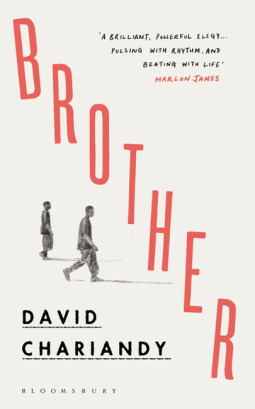 Canadian author David Chariandy’s second novel was longlisted for the Giller Prize and won the Rogers Writers’ Trust Fiction Prize. Narrator Michael and his older brother Francis grew up in the early 1980s in The Park, a slightly dodgy area of Toronto. Their single mother, Ruth, is a Trinidadian immigrant who worked long shifts as a cleaner to support the family after their father left early on. From the first pages we know that Francis is an absence, but don’t find out why until nearly the end of the book. The short novel is split between the present, as Michael and Ruth try to proceed with normal life, and vignettes from the past, culminating in the incident that took Francis from them 10 years ago.
The title is literal, of course, but also street slang for friends or comrades. Michael looked up to street-smart Francis, who fell in with a gang of “losers and neighbourhood schemers” and got expelled from school at age 18. Francis tried to teach his little brother how to carry himself: “You’ve got to be cooler about things, and not put everything out on your face all the time.” Yet the more we hear about Francis staying with friends at a barber shop and getting involved with preparations for a local rap DJ competition, the more his ideal of aloof masculinity starts to sound ironic, if not downright false.
I came into the book with pretty much no idea of what it was about. It didn’t fit my narrow expectations of Canadian fiction (sweeping prairie stories or hip city ones); instead, it reminded me of The Corner by David Simon, We, the Animals by Justin Torres, and Another Day in the Death of America by Gary Younge. It undoubtedly gives a powerful picture of immigrant poverty and complicated grief. Yet the measured prose somehow left me cold.
My rating:
Brother was published in the UK by Bloomsbury on March 8th. My thanks to the publisher for the free copy for review.
Sharp by Michelle Dean
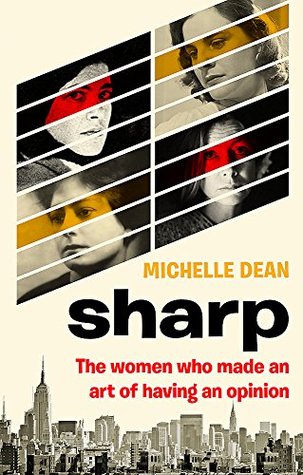 “People have trouble with women who aren’t ‘nice,’ … who have the courage to sometimes be wrong in public.” In compiling 10 mini-biographies of twentieth-century women writers and cultural critics who weren’t afraid to be unpopular, Dean (herself a literary critic) celebrates their feminist achievements and insists “even now … we still need more women like this.” Her subjects include Rebecca West, Mary McCarthy, Susan Sontag, Joan Didion, Nora Ephron and Renata Adler. She draws on the women’s correspondence and published works as well as biographies to craft concise portraits of their personal and professional lives.
You’ll get the most out of this book if a) you know nothing about these women and experience this as a taster session; or b) you’re already interested in at least a few of them and are keen to learn more. I found the Dorothy Parker and Hannah Arendt chapters most interesting because, though I was familiar with their names, I knew very little about their lives or works. Parker’s writing was pulled from a slush pile in 1914 and she soon replaced P.G. Wodehouse as Vanity Fair’s drama critic. Her famous zingers masked her sadness over her dead parents and addict husband. “This was her gift,” Dean writes: “to shave complex emotions down to a witticism that hints at bitterness without wearing it on the surface.”
Unfortunately, such perceptive lines are few and far between, and the book as a whole lacks a thesis. Chance meetings between figures sometimes provide transitions, but the short linking chapters are oddly disruptive. In one, by arguing that Zora Neale Hurston would have done a better job covering a lynching than Rebecca West, Dean only draws attention to the homogeneity of her subjects: all white and middle-class; mostly Jewish New Yorkers. I knew too much about Sontag and Didion to find their chapters interesting, but enjoyed reading more about Ephron. I’ll keep the book to refer back to when I finally get around to reading Mary McCarthy. It has a terrific premise, but I found myself asking what the point was.
My rating:
Sharp was published in the UK by Fleet on May 3rd. My thanks to the publisher for a proof copy for review.
The Valley at the Centre of the World by Malachy Tallack
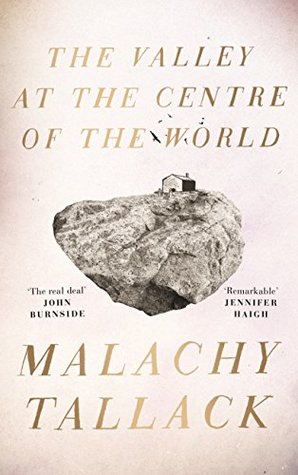 I’d previously enjoyed Malachy Tallack’s two nonfiction books, Sixty Degrees North and The Undiscovered Islands. In his debut novel he returns to Shetland, where he spent some of his growing-up and early adult years, to sketch out a small community and the changes it undergoes over about ten months. Sandy has lived in this valley for three years with Emma, but she left him the day before the action opens. Unsure what to do now, he sticks around to help her father, David, butcher the lambs. After their 90-year-old neighbor, Maggie, dies, Sandy takes over her croft. Other valley residents include Ryan and Jo, a troubled young couple; Terry, a single dad; and Alice, who moved here after her husband’s death and is writing a human and natural history of the place, The Valley at the Centre of the World. (This strand reminded me of Annalena McAfee’s Hame.)
The prose is reminiscent of the American plain-speaking style of books set in the South or Appalachia – Richard Ford, Walker Percy, Ron Rash and the like. We dive deep into this tight-knit community and its secrets. It’s an offbeat blend of primitive and modern: the minimalism of the crofting life contrasts with the global reach of Facebook, for instance. When Ryan and Jo host a housewarming party, all the characters are brought together at about the halfway point, and some relationships start to shift. Overall, though, this is a slow and meandering story. Don’t expect any huge happenings, just some touching reunions and terrific scenes of manual labor. David is my favorite character, an almost biblical patriarch who seems “to live in a kind of eternal present, looking neither forward nor backward but always, somehow, towards the land.”
Tallack has taken a risk by writing in phonetic Shetland dialect. David’s speech is particularly impenetrable. The dialect does rather intrude; the expository passages are a relief. I’ve been to Shetland once, in 2006. This quiet story of belonging versus being an outsider is one to reread there some years down the line: I reckon I’d appreciate it more on location.
My rating: 
The Valley at the Centre of the World was published by Canongate on May 3rd. My thanks to the publisher for the free copy for review.
The Language of Kindness: A Nurse’s Story by Christie Watson
After all that Wellcome Book Prize reading, I’ve given myself a break from the medical reads, right? No way! I’m already eagerly looking out for hopefuls for next year’s prize – I’ve amassed quite a nice little pile – and this is a particularly strong candidate, based on the 20 years that Watson spent as a nurse in England’s health system before leaving to write full-time. (Her debut, Tiny Sunbirds Far Away, won the Costa First Novel Award in 2011; she followed it up with Where Women Are Kings in 2013.) It taps into the widespread feeling that medicine is in desperate need of a good dose of compassion, and will ring true for anyone who spends time in hospitals, whether as a patient or a carer.
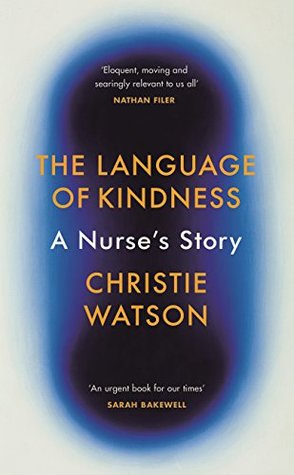 Watson presents her book as a roughly chronological tour through the stages of nursing – from pediatrics through to elderly care and the tending to dead bodies – but also through her own career, as she grows from a seventeen-year-old trainee who’s squeamish about blood to a broadly experienced nurse who can hardly be fazed by anything. The first chapter is set up like a tour of the hospital, describing everything she sees and hears as she makes her way up to her office, and the final chapter takes place on her very last day as a nurse, when, faced with a laboring mother in a taxi, she has to deliver the baby right there in the carpark.
In between we hear a series of vivid stories that veer between heartwarming and desperately sad. Watson sees children given a second shot at life. Aaron gets a heart–lung transplant to treat his cystic fibrosis and two-year-old Charlotte bounces back from sepsis – though with prosthetic limbs. But she also sees the ones who won’t get better: Tia, a little girl with a brain tumor; Mahesh, who has muscular dystrophy and relies on a breathing tube; and Jasmin, who is brought to the hospital after a house fire but doesn’t survive for long. She dies in the nurses’ arms as they’re washing the smoke smell out of her hair.
Although Watson specialized in children’s intensive care nursing, she trained in all branches of nursing, so we follow her into the delivery room, mental health ward, and operating theatre. As in Maggie O’Farrell’s I Am, I Am, I Am, we learn about her links to hospitals over the years, starting with her memories of being nursed as a child. She met her former partner, a consultant, at the hospital; they had a child together and adopted another before splitting 12 years later. And as her father was dying of lung cancer, she developed a new appreciation for what nurses do as she observed the dedicated care he received from his hospice nurse. She characterizes nursing as a career that requires great energy, skill and emotional intelligence, “that demands a chunk of your soul on a daily basis,” yet is all too often undervalued.

(The superior American cover.)
For me the weakest sections of Watson’s book are the snippets of history about hospitals and the development of the theory and philosophy of nursing. These insertions feel a little awkward and break up the flow of personal disclosure. The same applies to the occasional parenthetical phrase that seems to talk down to the reader, such as “women now receive medical help (IVF) to have their babies” and “obstetricians (doctors) run the show.” Footnotes or endnotes connected to a short glossary might have been a less obtrusive way of adding such explanatory information.
I would particularly recommend this memoir to readers of Kathryn Mannix’s With the End in Mind and Henry Marsh’s Admissions. But with its message of empathy for suffering and vulnerable humanity, it’s a book that anyone and everyone should read. I have it on good authority that there has recently been a copy on the desk of Jeremy Hunt, Health Secretary of the UK, which seems like an awfully good start.
A few favorite passages:
“I wanted to live many lives, to experience different ways of living. I didn’t know then that I would find exactly what I searched for: that both nursing and writing are about stepping into other shoes all the time.”
“What I thought nursing involved when I started: chemistry, biology, physics, pharmacology and anatomy. And what I now know to be the truth of nursing: philosophy, psychology, art, ethics and politics.”
“You get used to all sorts of smells, as a nurse. [An amazingly graphic passage!] But for all that I’ve seen and touched and smelled, and as difficult as it is at the time, there is a patient at the centre of it, afraid and embarrassed. … The horror of our bodies – our humanity, our flesh and blood – is something nurses must bear, lest the patient think too deeply, remember the lack of dignity that makes us all vulnerable. It is our vulnerability that unites us. Promoting dignity in the face of illness is one of the best gifts a nurse can give.”
My rating:
The Language of Kindness was published in the UK on May 3rd by Chatto & Windus. My thanks to the publisher for the free review copy. It is released today, May 8th, by Doubleday Canada and Tim Duggan Books in the States.
 Bookish Beck = Rebecca Foster. American transplant to England. Freelance proofreader and book reviewer.
 Bookish Beck