Bodily Harm and Stone Mattress by Margaret Atwood (#MARM)
It’s my sixth year participating in the annual Margaret Atwood Reading Month (#MARM), hosted by indomitable Canadian blogger Marcie of Buried in Print. In previous years, I’ve read Surfacing and The Edible Woman, The Robber Bride and Moral Disorder, Wilderness Tips, and The Door; and reread The Blind Assassin. Wish a happy belated birthday to MA, who turned 84 earlier this month. As it happens, today is my husband’s 40th birthday and I am tapping away at this in the passenger’s seat of the car as we hurtle through the freezing fog toward Slimbridge for some wintry birdwatching. I spent much of yesterday making his German chocolate cake (delicious but very involved) from a Hummingbird Bakery cookbook.

Bodily Harm (1982)
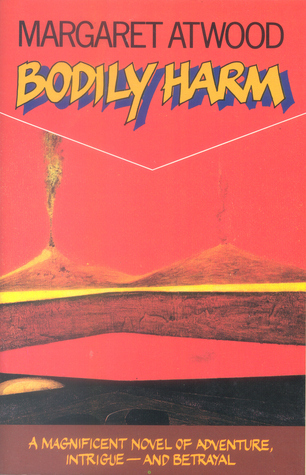 I had literally never heard of her fifth novel before I spotted it on the library catalogue and decided to have a go. The fact that nobody talks about it is evidence, I think, of an overbaked plot and more successful treatment of her trademark themes in other books. Nonetheless, it was perfectly readable and had its highlights. Renata Wilford, “Rennie,” is a journalist for hire from Ontario who has recently had her life turned upside down by breast cancer and the departure of her boyfriend, Jake. She flies to the Caribbean island nation of St. Antoine to write a travel piece, coinciding with the first elections since the British left. It’s a febrile postcolonial setting of shantytowns and shortages. Rennie tries to focus on boat trips, cocktails and beach lounging, but Dr. Minnow, who she met on the plane, is determined to show her the reality of his country – cold truths that include assassination and imprisonment.
Alongside the thriller plot are the more expected literary flashbacks to Rennie’s childhood, her life with Jake, and the cancer surgery and her crush on her surgeon. Her old friend Jocasta is an amusingly punky feminist and a counterpoint to Lora, the fellow Canadian and bad girl Rennie meets in St. Antoine. There are no speech marks in the sections set in the past, and there are some passages of direct monologue from Lora recounting her abusive upbringing. I felt Atwood was stretching to make points about cultural imperialism and violence, whereas the title is more applicable to the physical threats women face from illness and misogyny:
“The body, sinister twin, taking its revenge for whatever crimes the mind was supposed to have committed on it. Nothing had prepared her for her own outrage, the feeling that she’d been betrayed by a close friend. She’d given her body swimming twice a week, forbidden it junk food and cigarette smoke, allowed it a normal amount of sexual release. She’d trusted it. Why then had it turned against her?”
(University library) 
Stone Mattress (2014)
I was tempted to call this my first ever audiobook, but that is not technically true: 11 years ago, we had a David Attenborough book on in the car on the way to Cornwall. However, this definitely felt like a landmark. I’d long meant to catch up on Atwood’s last but one story collection, but my library had withdrawn the physical copy and only had the book on CD. How would I fit it into my life, I wondered? Others have told me they listen to audiobooks while commuting, cooking or cleaning … er, I don’t really do any of those! But I amassed a goodly list of tasks involving my hands but not much of my brain to complete while listening to the CDs through my PC speakers:
• Prepared two clothing recycling parcels (37 socks off to the London Sock Company’s Sock Amnesty programme; 3 shirts and 2 sets of pyjamas to Rapanui’s 100% cotton recycling scheme)
• Mended 13 socks, 4 shirts, 3 gloves, 2 cardigans, a shoulder bag strap, and a purse strap and lining
• Framed a photo for a Christmas gift
• Baked the aforementioned German chocolate cake
• Wrapped my husband’s birthday presents
• Wrote a couple of Christmas cards
 Nonetheless, I found it frustrating that it took so long to get through a story/disc, surely longer than I would have spent reading with my eyes (and so I have only managed 7.5 of 9 stories so far), and it was slightly harder for me to concentrate. It was also disorienting to not have visual cues, such that I had no idea how much of a story was remaining, and sometimes didn’t know how place or character names were spelt. One interesting novelty, though, was the reader voices. There are five different voice actors on this audiobook, three women (including MA herself on the title story) and two men. It is interesting to ponder how their intonation might affect my reaction to a story. For instance, Rob Delaney’s deadpan delivery really makes “The Freeze-Dried Groom,” a witty work of mild horror in which a fraudulent antiques dealer finds an entire wedding, complete with groom, abandoned in a storage unit.
As in a number of Atwood’s later works, recurring themes of ageing and the writer’s craft intertwine. I most enjoyed the opening linked trio of “Alphinland,” “Revenant” and “Dark Lady,” which orbit SFF writer Constance and her one-time lover, macho poet Gavin. The first story has Constance slipping between her fictional world and the real one, in which a winter storm is impending and her husband Ewan has been dead for four days. In “Revenant,” an elderly Gavin holds court as a scholar comes to interview him. Imagine his ire when he learns she is there to question him about Constance for her PhD research. “Dark Lady” brings the three major women from Gavin’s life into a face-off.
Funniest was “I Dream of Zenia with the Bright Red Teeth,” a The Robber Bride mini-sequel in which three ageing women fend off an interfering male with the help of a potential reincarnation of their late friend. I was reminded of the setup of Charlotte Wood’s The Weekend, not least for the presence of an annoying dog. Least engaging has been “The Dead Hand Loves You,” about Jack Dace, the author of an international horror classic who has always resented having to share his profits four ways with his early adulthood housemates because of his promise to catch up on his back rent from his creative earnings. I thought this one would never end. In general, though, this has been classic MA, mixing realism and fantasy in clever and witty ways. And I’m sure it won’t be my last audiobook. I was gifted an Audible book for my birthday by a blind friend, to start with. Now to store up some more busy work… (Public library audiobook) 
The Story Girl by L. M. Montgomery (1911) #ReadingStoryGirl
Six months after the Jane of Lantern Hill readalong, Canadian bloggers Naomi (Consumed by Ink) and Sarah Emsley have chosen an earlier work by Lucy Maud Montgomery, The Story Girl, and its sequel The Golden Road, for November buddy reading.
The book opens one May as brothers Felix and Beverley King are sent from Toronto to Prince Edward Island to stay with an aunt and uncle while their father is away on business. Beverley tells us about their thrilling six months of running half-wild with their cousins Cecily, Dan, Felicity, and Sara Stanley – better known by her nickname of the Story Girl, also to differentiate her from another Sara – and the hired boy, Peter. This line gives a sense of the group’s dynamic: “Felicity to look at—the Story Girl to tell us tales of wonder—Cecily to admire us—Dan and Peter to play with—what more could reasonable fellows want?”
Felicity is pretty and domestically inclined; Sara knows it would be better to be useful like Felicity, but all she has is her storytelling ability. Some are fantasy (“The Wedding Veil of the Proud Princess”); some are local tales that have passed into folk memory (“How Betty Sherman Won a Husband”). Beverley is in raptures over the Story Girl’s orations: “if voices had colour, hers would have been like a rainbow. It made words live. … we had listened entranced. I have written down the bare words of the story, as she told it; but I can never reproduce the charm and colour and spirit she infused into it. It lived for us.”

The cousins’ adventures are gently amusing and quite tame. They all write down their dreams in notebooks. Peter debates which church denomination to join and the boys engage in a sermon competition. Pat the cat has to be rescued from bewitching, and receives a dose of medicine in lard he licks off his paws and fur. The Story Girl makes a pudding with sawdust instead of cornmeal (reminding me of Anne Shirley and the dead mouse in the plum pudding). Life consistently teaches lessons in humility, as when they are all duped by Billy Robinson and his magic seeds, which he says will change whatever each one most resents – straight hair, plumpness, height; and there is a false alarm about the end of the world.
I found the novel fairly twee and realized at a certain point that I was skimming over more than I was reading. As was my complaint about Jane of Lantern Hill, there is a predictable near-death illness towards the end. The descriptions of Felicity and the Story Girl are purple (“when the Story Girl wreathed her nut-brown tresses with crimson leaves it seemed, as Peter said, that they grow on her—as if the gold and flame of her spirit had broken out in a coronal”); I had to remind myself that this reflects on Beverley more so than on Montgomery. From Naomi’s review of The Golden Road, I think that would be more to my taste because it has a clear plot rather than just stringing together pleasant but mostly forgettable anecdotes.
Still, it’s been fun to discover some of L. M. Montgomery’s lesser-known work, and there are sweet words about cats and the seasons:
“I am very good friends with all cats. They are so sleek and comfortable and dignified. And it is so easy to make them happy.”
“The beauty of winter is that it makes you appreciate spring.”
This effectively captures the long, magical summer days of childhood. I thought about when I was a kid and loved trips up to my mother’s hometown in upstate New York, where her brothers still lived. I was in awe of the Judd cousins’ big house, acres of lawn and untold luxuries such as Nintendo and a swimming pool. I guess I was as star-struck as Beverley. (University library)
The Booker Prize 2023 Ceremony
Yesterday evening Eleanor Franzen of Elle Thinks and I had the enormous pleasure of attending the Booker Prize awards ceremony at Old Billingsgate in London. I won tickets through “The Booker Prize Book Club” Facebook group, which launched just 10 or so weeks ago but has already garnered over 6000 members from around the world. They ran a competition for shortlist book reviews and probably did not attract nearly as many entries as they expected to. This probably worked to my advantage, but as it’s the only prize I can recall winning for my writing, I am going to take it as a compliment nonetheless! I submitted versions of my reviews of If I Survive You and Western Lane – the only shortlistees that I’ve read – and it was the latter that won us tickets.
We arrived at the venue 15 minutes before the doors opened, sheltering from the drizzle under an overhang and keeping a keen eye on arrivals (Paul Lynch and sodden Giller Prize winner Sarah Bernstein, her partner wearing both a kilt and their several-week-old baby). Elle has a gift for small talk and we had a nice little chat with Jonathan Escoffery and his 4th Estate publicist before they were whisked inside. His head was spinning from the events of the week, including being part of a Booker delegation that met Queen Camilla.


There was a glitzy atmosphere, with a photographer-surrounded red carpet and large banners for each shortlisted novel along the opposite wall, plus an exhibit of the hand-bound editions created for each book. We enjoyed some glasses of champagne and canapés (the haddock tart was the winner) and collared Eric Karl Anderson of Lonesome Reader. It was lovely to catch up with him and Eleanor and do plenty of literary celebrity spotting: Graeme Macrae Burnet, Eleanor Catton, judge Mary Jean Chan, Natalie Haynes, Alan Hollinghurst, Anna James, Jean McNeil, Johanna Thomas-Corr (literary editor of the Sunday Times) and Sarah Waters. Later we were also able to chat with Julianne Pachico, our Sunday Times Young Writer Award shadow panel winner from 2017. She has recently gotten married and released her third novel.

We were allocated to Table 11 in the front right corner. Also at our table were some Booker Prize editorial staff members, the other competition winner (for a video review) and her guest, an Instagram influencer, a Reading Agency employee, and several more people. The three-course dinner was of a very high standard for mass catering and the wine flowed generously. I thoroughly enjoyed my meal. Afterward we had a bit of time for taking red carpet photos and one of Eleanor with the banner for our predicted winner, Prophet Song.


Some of you may have watched the YouTube livestream, or listened to the Radio 4 live broadcast. Nazanin Zaghari-Ratcliffe’s speech was a highlight. She spoke about the secret library at the Iranian prison where she was held for six years. Doctor Thorne by Anthony Trollope, War and Peace by Leo Tolstoy, The Handmaid’s Tale by Margaret Atwood (there was a long waiting list among the prisoners and wardens, she said), and especially The Return by Hisham Matar meant a lot to her. From earlier on in the evening, I also enjoyed judge Adjoa Andoh’s dramatic reading of an excerpt from Possession in honour of the late Booker winner A.S. Byatt, and Shehan Karunatilaka’s tongue-in-cheek reflections on winning the Booker – he warned the next winner that they won’t write a word for a whole year.


There was a real variety of opinion in the room as to who would win. Earlier in the evening we’d spoken to people who favoured Western Lane, This Other Eden and The Bee Sting. But both Elle and I were convinced that Prophet Song would take home the trophy, and so it did. Despite his genuine display of shock, Paul Lynch was well prepared with an excellent speech in which he cited the apocrypha and Albert Camus. In a rapid-fire interview with host Samira Ahmed, he added that he can still remember sitting down and weeping after finishing The Mayor of Casterbridge, age 15 or 16, and hopes that his work might elicit similar emotion. I’m not sure that I plan on reading it myself, but from what I’ve heard it’s a powerfully convincing dystopian novel that brings political and social collapse home in a realistic way.
All in all, a great experience for which I am very grateful! (Thanks to Eleanor for all the photos.)
Have you read Prophet Song? Did you expect it to win the Booker Prize?
Love Your Library, November 2023
My thanks, as always, go to Elle for her participation in this monthly meme. Thanks also to Jana and Naomi for featuring some of their recent library reads.
Speaking of Eleanor, we had rather an exciting opportunity yesterday evening to attend one of the UK literary world’s biggest annual events. More on that in another post later today!
It’s crunch time for all the novellas and buddy reads I currently have on the go and intend to finish and write about before the end of November, which is approaching alarmingly rapidly. The 30th is also my husband’s 40th birthday, so it’s a busy week coming up!
*Note: Next month, instead of posting Love Your Library on the last Monday (Christmas), I will post one week before, on the 18th.
Lots of the below I have already reviewed for various other challenges, or will be reviewing soon.
Since last month:
READ
- Harriet Said… by Beryl Bainbridge
- The Garrick Year by Margaret Drabble

- Ferdinand, the Man with the Kind Heart by Irmgard Keun
- The Private Life of the Hare by John Lewis-Stempel

- Western Lane by Chetna Maroo
- The House of Doors by Tan Twan Eng
- Absolutely and Forever by Rose Tremain

- The Last House on Needless Street by Catriona Ward

CURRENTLY READING
- Bodily Harm by Margaret Atwood
- Stone Mattress by Margaret Atwood (on audiobook!)
- Bright Young Women by Jessica Knoll
- The Cancer Journals by Audre Lorde
- The Story Girl by L.M. Montgomery
CURRENTLY (NOT) READING
- The Absolutely True Diary of a Part-Time Indian by Sherman Alexie
- The Year of the Cat by Rhiannon Lucy Coslett
- Reproduction by Louisa Hall
- Findings by Kathleen Jamie (a re-read)
- Before the Light Fades by Natasha Walter
I started all of these weeks ago, but they have been languishing on various stacks and it will take a concerted effort to get back to and finish them.
RETURNED UNFINISHED
- Weyward by Emilia Hart – I read the first 48 pages. The setup is EXACTLY the same as in The Bass Rock by Evie Wyld (three women characters connected in similar ways, and set at three almost identical time periods). Unfortunately, that one’s amazing whereas this was pedestrian. I could never be bothered to pick it up.
- The Last Bookwanderer by Anna James – I read the first 36 pages and felt no impetus to read any more. The series went downhill after Book 3 in particular, but really never topped Book 1. Say no to series! Stand-alone books are fine!!
RETURNED UNREAD
- Land of Milk and Honey by C. Pam Zhang – Requested after me. Will try to get it back out another time.
What have you been reading or reviewing from the library recently?

Share a link to your own post in the comments. Feel free to use the above image. The hashtag is #LoveYourLibrary.
Ferdinand, the Man with the Kind Heart by Irmgard Keun (#NovNov23 and #GermanLitMonth)
My second contribution to German Literature Month, hosted by Lizzy Siddal, after Last House Before the Mountain by Monika Helfer. I spotted this in a display of new acquisitions at my library earlier in the year and was attracted by the pointillist-modernist style of its cover (Man with a Tulip by Robert Delaunay, 1906) featuring the image of a dandyish yet slightly melancholy young man. I had never heard of the author and assumed it was a man. In fact, Irmgard Keun (1905–82) was a would-be actress who wrote five novels and fled Germany when blacklisted by the Nazis. She was then, variously, a fugitive (returning to Germany only after a false report of her suicide in The Telegraph), a lover of Joseph Roth, a single mother, and an alcoholic. (I love it when a potted author biography reads like a mini-novel!)

Ferdinand (1950) was her last novel and is a curious confection, silly and sombre to equal degrees. It draws on her experiences living by her journalism in bombed-out postwar Cologne. Ferdinand Timpe is a former soldier and POW from a large, eccentric family. His tiny rented room is actually a corridor infested by his landlady Frau Stabhorn’s noisy grandchildren. He’s numb, stumbling from one unsuitable opportunity to another, never choosing his future but letting it happen to him. He once inherited a secondhand bookshop and ran it for a while (I wish we’d heard more about this). Now he’s been talked into writing articles for a weekly paper – it turns out the editor confused him with another Ferdinand. Later he’s hired as a “cheerful adviser” who mostly listens to women complain about their husbands. He is not quite sure how he acquired his own fiancée, Luise, but hopes to weasel out of the engagement.
Each chapter feels like a self-contained story, many of them focusing on particular relatives or friends. There’s his beautiful but immoral cousin, Johanna; his ruthless businessman cousin Magnesius; his lovely but lazy mother, Laura. His descriptions are hilarious, and Keun’s vocabulary really sparkles:
“Like many businesspeople, Magnesius is a jovial and generous party animal, only to emerge as even icier and stonier later. He damascenes himself. To heighten the mood, he has jammed a green monocle in one eye, and pulled a yellow silk stocking over his head. Just now I saw him kissing the hand of a woman unknown to me and offering to buy her a brand-new Mercedes.”
“Luise is a nice girl, and I’ve got nothing against her, but her presence has something oppressive about it for me. I have examined myself and established that this feeling of oppression is not love, and is no prerequisite for marriage, not even an unhappy one. I suppose I should tell her. But I can’t.”

Our antihero gets himself into ridiculous situations, like when he’s down on his luck and pays an impromptu visit to a former professor, Dr Muck, perhaps hoping for a handout; finding him away, he has to await his return for hours while the wife hosts a ladies’ poetry evening:
I was desperate not to fall asleep. Seven times I tiptoed out to the lavatory to take a sip from my flask. In the hall I walked into a sideboard and knocked over a large china ornament – I think it may have been a wood grouse. I broke off a piece of its beak. These things are always happening to me when I’m trying to be especially careful.
Hidden beneath Ferdinand’s hapless and frivolous exterior (he wears a jerkin made from a lady’s coat; Johanna says it makes him looks like “a hurdy-gurdy man’s monkey”), however, is psychological damage. “I feel so deep-frozen. I wonder if I’ll ever thaw out in this life. … Sometimes I feel like wandering on through the entire world. Maybe eventually I’ll run into a place or a person who will make me say yes, this is it, I’ll stay here, this is my home.” His feeling of purposelessness is understandable. Wartime hardship has dented his essential optimism, and external signs of progress – currency reform, denazification – can’t blot out the memory.
There’s a heartbreaking little sequence where he traces his rapid descent into poverty and desperation through cigarettes. He once shuddered at people saving their butts, but then started doing so himself. The same happened with salvaging strangers’ fag-ends from ashtrays. And then, worst of all, rescuing butts from the gutter. “So I never even noticed that one day there was no smoker in the world so degenerate that I could look down on him. I stood so low that no one could stand below me.”
I tend to lose patience with aimless picaresque plots, but this one was worth sticking with for the language and the narrator’s amusing view of the world. I’d happily read another book by Keun if I came across one. Her best known, from the 1930s, are Gilgi and The Artificial Silk Girl.
(Penguin Modern Classics series, 2021. Translated from the German by Michael Hofmann. Public library) [172 pages]

Harriet Said… by Beryl Bainbridge (#NovNov23 and #ReadingBeryl23)
Beryl Bainbridge Reading Week (hosted by Annabel) is a perfect chance to combine November challenges as most of Bainbridge’s works are under 200 pages. And today would have been the author’s birthday, too. Although Harriet Said… is the first book she wrote, it was rejected and not published until 1972, making it her third novel. I can see why publishers would have been wary of taking a risk on such a nasty little story from an unknown author. Even from an established writer this would be a hard one to stomach, subverting as it does the traditional notion of the innocence of childhood.

The title is also the first two words of the novel and tells us right away that the narrator (never named) is in thrall to her friend Harriet. The young teenager is on her summer holidays from boarding school, back in a Liverpool suburb. She lets Harriet set the agenda for their long, idle, unsupervised days: “she told me what to read, explained to me the things I read, told me what painters I should admire and why. I listened, I did as she said, but I did not feel much interest, at least not on my own, only when she was directing me.”
The girls dramatize their experiences in journal entries and make up stories for the people they meet on the local sand dunes, such as Peter Biggs, whom they dub Peter the Great or “the Tsar.” The narrator casts her relationship with him as a romance: “I wished I knew if I only imagined he cared for me, it seemed so strange the things I attributed to him. I did not know where the dream and the reality merged.” Together they decide to humble the Tsar.
{SPOILERS FOLLOW}
It’s uncomfortable for modern readers to encounter what is essentially a seduction plot between a teenager and a middle-aged man, but with the teen taking the active predator role. (And Harriet behind the scenes manipulating the interactions, rather like the Marquise de Merteuil in Dangerous Liaisons.) We’re fixated on the question of consent, but would the ultimate sex scene be classed as a rape? “‘Gerroff’, I wanted to shout, ‘Gerroff.’ But I did not want to hurt his feelings. … I was surprised how little discomfort I felt, apart from a kind of interior bruising, and how cheerful I was.” Harriet and the narrator both have a history of carrying on with grown men, and by peeping at windows see the Tsar having sex with Mrs Biggs on the couch. None of what they do seems accidental, or unfortunate, because they seem so determined to gravitate towards the smutty parts of life.
“What are little girls made of?
Sugar and spice,
And all that’s nice”
Fat chance!
“I tried to think what innocence meant and failed.”
“It was quite easy to bring myself to hurt him, he was such a fool.”
It’s not unexpected when the girls’ obsession leads to tragedy, but the exact form the collateral damage takes is a surprise. I’ve called this a ‘nasty little story’, but I mostly mean that in an admiring way, because it takes skill in plotting and characterization to make us keep reading even when all is so sordid.
Bainbridge has always reminded me of Penelope Fitzgerald in her concision, but I find Bainbridge less subtle and more edgy – a good combination, if you ask me. Harriet Said… feels like it falls on a continuum between, say, Barbara Comyns and Ottessa Moshfegh. I also wondered whether contemporary novelists like Eliza Clark (Penance) and Heather Darwent (The Things We Do to Our Friends) could have been influenced by the picture of teenage girls’ malevolence and the way that the action starts with hideous aftermath and then works backwards. This was a squirmy but memorable read. (Public library) [175 pages]
#NovNov23 Week 4, “The Short and the Long of It”: W. Somerset Maugham & Jan Morris
Hard to believe, but it’s already the final full week of Novellas in November and we have had 109 posts so far! This week’s prompt is “The Short and the Long of It,” for which we encourage you to pair a novella with a nonfiction book or novel that deals with similar themes or topics. The book pairings week of Nonfiction November is always a favourite (my 2023 contribution is here), so think of this as an adjacent – and hopefully fun – project. I came up with two pairs: one fiction and one nonfiction. In the first case, the longer book led me to read a novella, and it was vice versa for the second.

W. Somerset Maugham
The House of Doors by Tan Twan Eng (2023)
&
Liza of Lambeth by W. Somerset Maugham (1897)
I wasn’t a huge fan of The Garden of Evening Mists, but as soon as I heard that Tan Twan Eng’s third novel was about W. Somerset Maugham, I was keen to read it. Maugham is a reliably readable author; his books are clearly classic literature but don’t pose the stylistic difficulties I now experience with Dickens, Trollope et al. And yet I know that Booker Prize followers who had neither heard of nor read Maugham have enjoyed this equally. I’m surprised it didn’t make it past the longlist stage, as I found it as revealing of a closeted gay writer’s life and times as The Master (shortlisted in 2004) but wider in scope and more rollicking because of its less familiar setting, true crime plot and female narration.
The main action is set in 1921, as “Willie” Somerset Maugham and his secretary, Gerald, widely known to be his lover, rest from their travels in China and the South Seas via a two-week stay with Robert and Lesley Hamlyn at Cassowary House in Penang, Malaysia. Robert and Willie are old friends, and all three men fought in the First World War. Willie’s marriage to Syrie Wellcome (her first husband was the pharmaceutical tycoon) is floundering and he faces financial ruin after a bad investment. He needs a good story that will sell and gets one when Lesley starts recounting to him the momentous events of 1910, including a crisis in her marriage, volunteering at the party office of Chinese pro-democracy revolutionary Dr Sun Yat Sen, and trying to save her friend Ethel Proudlock from a murder charge.

It’s clever how Tan weaves all of this into a Maugham-esque plot that alternates between omniscient third-person narration and Lesley’s own telling. The glimpses of expat life and Asia under colonial rule are intriguing, and the scene-setting and atmosphere are sumptuous – worthy of the Merchant Ivory treatment. I was left curious to read more by and about Maugham, such as Selina Hastings’ biography. (Public library)
But for now I picked up one of the leather-bound Maugham books I got for free a few years ago. Amusingly, the novella-length Liza of Lambeth is printed in the same volume with the travel book On a Chinese Screen, which Maugham had just released when he arrived in Penang.
{SPOILERS AHEAD}
This was Maugham’s debut novel and drew on his time as a medical intern in the slums of London. In tone and content it falls almost perfectly between Dickens and Hardy, because on the one hand Liza Kemp and her neighbours are cheerful paupers even though they work in factories, have too many children and live in cramped quarters; on the other hand, alcoholism and domestic violence are rife, and the wages of sexual sin are death. All seems light to start with: an all-village outing to picnic at Chingford; pub trips; and harmless wooing as Liza rebuffs sweet Tom in favour of a flirtation with married Jim Blakeston.
 At the halfway point, I thought we were going full Tess of the d’Urbervilles – how is this not a rape scene?! Jim propositions her four times, ignoring her initial No and later quiet. “‘Liza, will yer?’ She still kept silence, looking away … Suddenly he shook himself, and closing his fist gave her a violent, swinging blow in the belly. ‘Come on,’ he said. And together they slid down into the darkness of the passage.” So starts their affair, which leads to Liza getting beaten up by Mrs Blakeston in the street and then dying of an infection after a miscarriage. The most awful character is Mrs Kemp, who spends the last few pages – while Liza is literally on her deathbed – complaining of her own hardships, congratulating herself on insuring her daughter’s life, and telling a blackly comic story about her husband’s corpse not fitting in his oak coffin and her and the undertaker having to jump on the lid to get it to close.
Liza isn’t entirely the stereotypical whore with the heart of gold, but she is a good-time girl (“They were delighted to have Liza among them, for where she was there was no dullness”) and I wonder if she could even have been a starting point for Eliza Doolittle in Pygmalion. Maugham’s rendering of the cockney accent is over-the-top –
“‘An’ when I come aht,’ she went on, ‘’oo should I see just passin’ the ’orspital but this ’ere cove, an’ ’e says to me, ‘Wot cheer,’ says ’e, ‘I’m goin’ ter Vaux’all, come an’ walk a bit of the wy with us.’ ‘Arright,’ says I, ‘I don’t mind if I do.’”
– but his characters are less caricatured than Dickens’s. And, imagine, even then there was congestion in London:
“They drove along eastwards, and as the hour grew later the streets became more filled and the traffic greater. At last they got on the road to Chingford, and caught up numbers of other vehicles going in the same direction—donkey-shays, pony-carts, tradesmen’s carts, dog-carts, drags, brakes, every conceivable kind of wheeled thing, all filled with people”
In short, this was a minor and derivative-feeling work that I wouldn’t recommend to those new to Maugham. He hadn’t found his true style and subject matter yet. Luckily, there’s plenty of other novels to try. (Free mall bookshop) [159 pages]
Jan Morris
Conundrum by Jan Morris (1974)
&
Jan Morris: Life from Both Sides, A Biography by Paul Clements (2022)

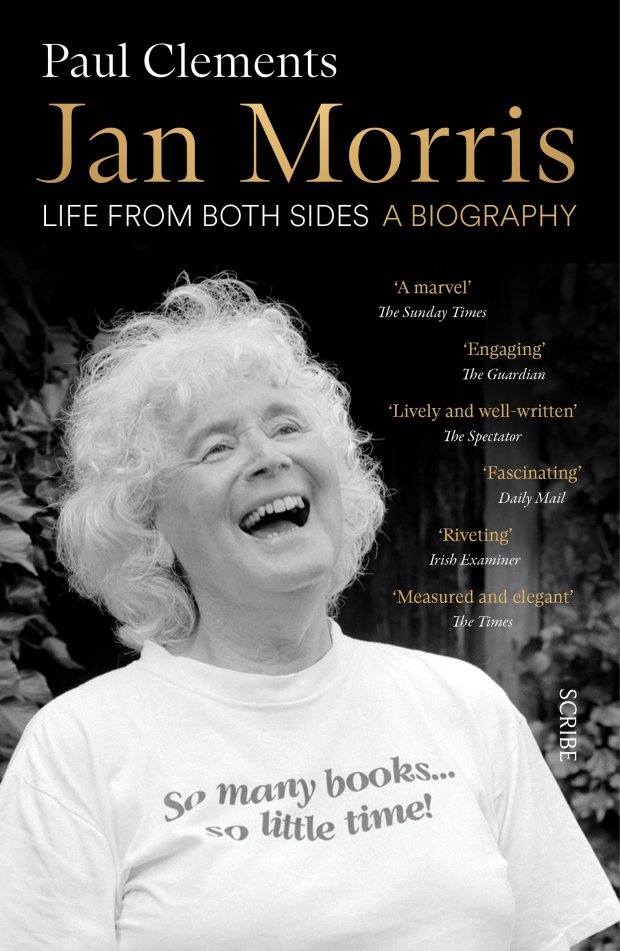
Back in 2021, I reread and reviewed Conundrum during Novellas in November. It’s a short memoir that documents her spiritual journey towards her true identity – she was a trans pioneer and influential on my own understanding of gender. In his doorstopper of a biography, Paul Clements is careful to use female pronouns throughout, even when this is a little confusing (with Morris a choirboy, a soldier, an Oxford student, a father, and a member of the Times expedition that first summited Everest). I’m just over a quarter of the way through the book now. Morris left the Times before the age of 30, already the author of several successful travel books on the USA and the Middle East. I’ll have to report back via Love Your Library on what I think of this overall. At this point I feel like it’s a pretty workaday biography, comprehensive and drawing heavily on Morris’s own writings. The focus is on the work and the travels, as well as how the two interacted and influenced her life.
#NovNov23 and #SciFiMonth: They by Kay Dick
To join the Week 3 theme of Novellas in November, “Broadening My Horizons,” with Science Fiction Month (celebrating a genre I still struggle with but occasionally enjoy), I decided to pick up a short rediscovered dystopian classic. Originally published in 1977, They: A Sequence of Unease was reissued by Faber Editions last year. I had never heard of its author, Kay Dick (1915–2001), a lesbian bookseller and publisher who lived in London and Brighton and wrote seven works of fiction and three biographies.
Although I can think of a few dystopian novels that I have loved, it’s not a mode I gravitate towards. This makes me out of step with the zeitgeist, I know, because dystopian stories are only rising in popularity as current events converge with premonitory visions of the future.
The specific problem I had with They is one I’ve had with some other speculative works: vagueness. I can’t stand it when allegorical books are set in a deliberate no-place, or a made-up country (I’ve not yet succeeded in reading a J.M. Coetzee or José Saramago novel, for instance). I gave up on the Giller Prize-winning Study for Obedience when its first ten pages gave no clear sense of its geographical or temporal setting. When there’s no detail to latch onto, disorientation usually leads me to turn to another more realist book in preference.
They is, in fact, set in an ironically idyllic Britain. There are lovely descriptions of the land during different seasons: roses, sunsets, wheat fields, birdsong. This is in contrast with the disquiet permeating the narrator’s everyday life. She is part of a dispersed, itinerant creative community whose members come and go, hiding their work and doing their best to avoid the nameless enforcers who patrol the country to destroy art and quash emotion and individual endeavours. Certain artists of her acquaintance have been maimed or disappeared. For all the public enshrinement of teamwork, the normies the book portrays seem purely mean-spirited: children torture animals for kicks.

A case could be made that Dick was aiming at universality – this could happen anywhere – but the combination of imprecision and flat, declarative sentences left me cold.
“We’re all frightened. We must live with it. Russell and Jane will be here tomorrow. They got through London. I’ll be sleeping in the room opposite yours tonight. You are over-tired; it’s the strain.”
“Subscribing to current social fashions, I gave a small party, inviting all my neighbours. They all talked at the same time. No one listened to anyone else. No one laughed. Only Tim and I smiled at each other. They felt uneasy because there was no television set.”
In terms of world-building, everything is either unexplained or revealed abruptly through unsubtle dialogue. I came away with no sense of the narrator or any of the many secondary characters, who are little more than a name. Funny that the most consistent presence is that of her dog, who is never given the dignity of a name. (It’s only ever “my dog,” when a creature so important to her would surely be referred to as a friend.) While the two authors were probably poles apart ideologically, I thought I spied the ghost of Ayn Rand in the awe surrounding individual achievement.
It’s comforting to try to believe what Hurst says about the persistence of art – “We can all add to the treasure, however short the time left may be. It can’t all be destroyed. Some of it will remain for those who come after us” – but this portrait of underground artists in a parallel modern Britain failed to move me. (New purchase at sale price from Faber website) [107 pages]
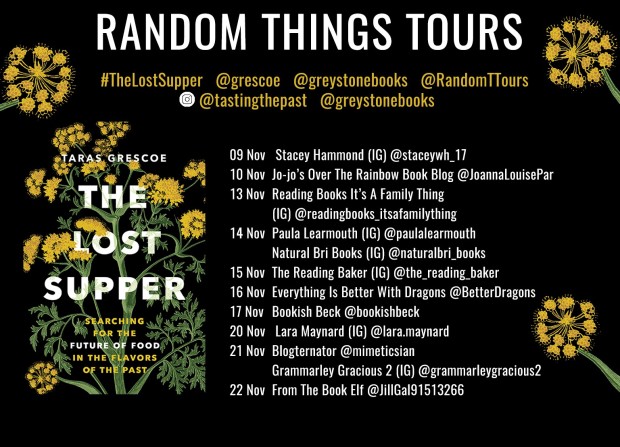
The Lost Supper by Taras Grescoe (Blog Tour)
“Searching for the Future of Food in the Flavors of the Past” is the instructive subtitle of this globe-trotting book of foodie exploration in the vein of A Cook’s Tour and The Omnivore’s Dilemma. With its firm grounding in history, it also reminded me of Twain’s Feast. Journalist Tara Grescoe is based in Montreal. Dodging Covid lockdowns, he managed to make visits to the homes of various traditional foods, such as the more nutritious emmer wheat that sustained the Çatalhöyük settlement in Turkey 8,500 years ago; the feral pigs that live on Ossabaw Island off of Georgia, USA: the Wensleydale cheese that has been made in Yorkshire for more than 700 years; the olive groves of Puglia; and the potato-like tuber called camas that is a staple for the Indigenous peoples of Vancouver Island.
One of the most fascinating chapters is about the quest to recreate “garum,” a fermented essence of salted fish (similar to modern-day Asian fish sauces) used ubiquitously by the Romans. Grescoe journeys to Cádiz, Spain, where the sauce is being made again in accordance with the archaeological findings at Pompeii. He experiences a posh restaurant tasting menu where garum features in every dish – even if just a few drops – and then has a go at making his own. “Garum seemed to subject each dish to the culinary equivalent of italicization,” he found, intensifying the existing flavours and giving an inimitable umami hit. I’m also intrigued by the possibilities of entomophagy (eating insects) so was interested in his hunt for water boatman eggs, “the caviar of Mexico”; and his outing to the world’s largest edible insect farm near Peterborough, Ontario.
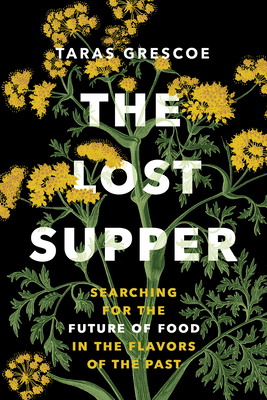
Grescoe seems to be, like me, a flexitarian, focusing on plants but indulging in occasional high-quality meat and fish. He advocates for eating as locally as you can, and buying from small producers whose goods reflect the care taken over the raising. “Everybody who eats cheap, factory-made meat is eating suffering,” he insists, having compared an industrial-scale slaughterhouse in North Carolina with small farms of heritage pigs. He acknowledges other ecological problems, too, however, such as the Ossabaw hogs eating endangered loggerhead turtles’ eggs and the overabundance of sheep in the Yorkshire Dales leading to a loss of plant diversity. This ties into the ecological conscience that is starting to creep into foodie lit (as opposed to a passé Bourdain eat-everything mindset), as witnessed by Dan Saladino’s Eating to Extinction winning the Wainwright Prize (Conservation) last year.
Another major theme of the book is getting involved in the food production process yourself, however small the scale (growing herbs or tomatoes on a balcony, for instance). “With every home food-making skill I acquired, I felt like I was tapping into some deep wellspring of self-sufficiency that connected me to my historic—and even prehistoric—ancestors,” Grescoe writes. He also cites American farmer-philosopher Wendell Berry’s seven principles for responsible eating, as relevant now as they were in the 1980s. The book went a little deeper into history and anthropology than I needed, but there was still plenty here to hold my interest. Readers may not follow Grescoe into grinding their own wheat or making their own cheese, but we can all be more mindful about where our food comes from, showing gratitude rather than entitlement. This was a good Nonfiction November and pre-Thanksgiving read!
With thanks to Random Things Tours and Greystone Books for the proof copy for review.
Buy The Lost Supper from Bookshop UK [affiliate link]
I was delighted to be part of the blog tour for The Lost Supper. See below for details of where other reviews have appeared or will be appearing soon.
Nonfiction November Book Pairings: Hardy’s Wives, Rituals, and Romcoms
Liz is hosting this week of Nonfiction November. For this prompt, the idea is to choose a nonfiction book and pair it with a fiction title with which it has something in common.

I came up with three based on my recent reading:
Thomas Hardy’s Wives
On my pile for Novellas in November was a tiny book I’ve owned for nearly two decades but not read until now. It contains some of the backstory for an excellent historical novel I reviewed earlier in the year.
Some Recollections by Emma Hardy
&
The Chosen by Elizabeth Lowry


The manuscript of Some Recollections is one of the documents Thomas Hardy found among his first wife’s things after her death in 1912. It is a brief (15,000-word) memoir of her early life from childhood up to her marriage – “My life’s romance now began.” Her middle-class family lived in Plymouth and moved to Cornwall when finances were tight. (Like the Bennets in Pride and Prejudice, you look at the house they lived in, and read about the servants they still employed, and think, “impoverished,” seriously?!) “Though trifling as they may seem to others all these memories are dear to me,” she writes. It’s true that most of these details seem inconsequential, of folk historical value but not particularly illuminating about the individual.
An exception is her account of her dealings with fortune tellers, who often went out of their way to give her good – and accurate – predictions, such as that she would marry a writer. It’s interesting to set this occult belief against the traditional Christian faith she espouses in her concluding paragraph, in which she insists an “Unseen Power of great benevolence directs my ways.” The other point of interest is her description of her first meeting with Hardy, who was sent to St. Juliot, where she was living with her parson brother-in-law and sister, as an architect’s assistant to begin repairs on the church. “I thought him much older than he was,” she wrote. As editor Robert Gittings notes, Hardy made corrections to the manuscript and in some places also changed the sense. Here Hardy gave proof of an old man’s continued vanity by adding “he being tired” after that line … but then partially rubbing it out. (Secondhand, Books for Amnesty, Reading, 2004) [64 pages]
The Chosen contrasts Emma’s idyllic mini memoir with her bitterly honest journals – Hardy read but then burned these, so Lowry had to recreate their entries based on letters and tone. But Some Recollections went on to influence his own autobiography, and to be published in a stand-alone volume by Oxford University Press. Gittings introduces the manuscript (complete with Emma’s misspellings and missing punctuation) and appends a selection of Hardy’s late poems based on his first marriage – this verse, too, is central to The Chosen.
Another recent nonfiction release on this subject matter that I learned about from a Shiny New Books review is Woman Much Missed: Thomas Hardy, Emma Hardy and Poetry by Mark Ford. I’d also like to read the forthcoming Hardy Women: Mother, Sisters, Wives, Muses by Paula Byrne (1 February 2024, William Collins).
Rituals
The Ritual Effect by Michael Norton
&
The Rituals by Rebecca Roberts


Last month I reviewed this lovely Welsh novel about a woman who is an independent celebrant, helping people celebrate landmark events in their lives or cope with devastating losses by commemorating them through secular rituals.
Coming out in April 2024, The Ritual Effect is a Harvard Business School behavioral scientist’s wide-ranging study of how rituals differ from habits in that they are emotionally charged and lift everyday life into something special. Some of his topics are rites of passage in different cultures; musicians’ and sportspeople’s pre-performance routines; and the rituals we develop around food and drink, especially at the holidays. I’m just over halfway through this for an early Shelf Awareness review and I have been finding it fascinating.
Romantic Comedy
(As also featured in my August Six Degrees post)
What I Was Doing While You Were Breeding by Kristin Newman
&
Romantic Comedy by Curtis Sittenfeld


Romantic Comedy is probably still the most fun reading experience I’ve had this year. Sittenfeld’s protagonist, Sally Milz, writes TV comedy, as does Kristin Newman (That ’70s Show, How I Met Your Mother, etc.). What I Was Doing While You Were Breeding is a lighthearted record of her sexual conquests in Amsterdam, Paris, Russia, Argentina, etc. (Newman even has a passage that reminds me of Sally’s “Danny Horst Rule”: “I looked like a thirty-year-old writer. Not like a twenty-year-old model or actress or epically legged songstress, which is a category into which an alarmingly high percentage of Angelenas fall. And, because the city is so lousy with these leggy aliens, regular- to below-average-looking guys with reasonable employment levels can actually get one, another maddening aspect of being a woman in this city.”) Unfortunately, it got repetitive and raunchy. It was one of my 20 Books of Summer but I DNFed it halfway.
 Bookish Beck = Rebecca Foster. American transplant to England. Freelance proofreader and book reviewer.
