Hay-on-Wye Trip & Book Haul (Plus a Little Life Complication)
Last week was our ninth time visiting Hay-on-Wye. Our previous trip was in October 2023 for my 40th birthday. Prompted by my overhaul post last month, I managed to finish a couple more of the 16 books I’d bought that time, taking me to 4 read and 1 skimmed; I’ve also read the first quarter of So Happy for You by Celia Laskey. Considering it was less than 18 months between visits, I’m going to call that an adequate showing. However, I will endeavour to be better about reading this latest book haul (below) in a timely fashion!
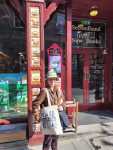 Because we were staying four nights, there was no need to rush through all the bookshops in a day or two, though that would be possible; instead, we parcelled them out and mixed up our shopping with walks, short outings in the car, and relaxing in the comfy cottage just over the English border in Cusop. I had work deadlines to meet within the first few days, but on another evening we took advantage of the place having Netflix to watch My Neighbor Totoro.
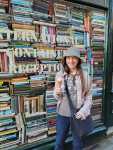 I’ve gotten secondhand book shopping in Hay down to a science over the years. Check on opening days and hours carefully or you can miss out. Thursday to Saturday is the best window to go: the Thursday market is excellent for local produce and crafts, and it’s nice to see the town bustling. (Though I’ve never seen it at Festival time, and wouldn’t want to!)


Start with the bargain options: the Little Free Library shelves by the river, where I scored Electricity by Victoria Glendinning; the sale area outside Hay Cinema Bookshop, the dedicated honesty shop beside Richard Booth’s Bookshop (new this trip), and the Book Passage beside Addyman Books – all £1/book; and the honesty shelves on the castle grounds, where it’s £2/book. Most of my purchases came from these areas. Just call me thrifty!

Next, the mid-priced options: Cinema, Broad Street Book Centre, Hay-on-Wye Booksellers, Clock Tower Books, and the new British Red Cross bookshop, which is not cheap for a charity shop but has a good selection of relatively recent stuff. (Oxfam, however, has moved away from books and primarily sells clothes, new products and bric-a-brac.) Cap it off with Addymans + Addyman Annexe, Cinema, Booth’s, the Poetry Bookshop and Green Ink Booksellers.
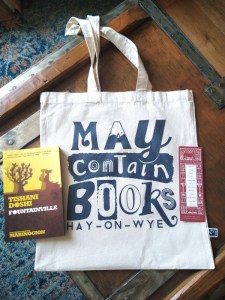 I had the best luck in Cinema this time, where I found two remainder books, three bargain books (one not pictured because it will be a gift) and the Howard Norman short stories – a particular thrill as his work is not often seen in the UK. Cinema and Booth’s are the greatest pleasure to browse. At Booth’s I bought my priciest book of the trip – Fountainville by Tishani Doshi, a retelling of stories from the Mabinogion – and indulged in a bookish tote bag (as if I needed another!). It was especially pleasing to find the Doshi and the Lewis in Hay as they are Welsh authors so will cover me for Reading Wales Month next year.
I wasn’t in the market for new books this time, not having any vouchers at my disposal, but those who are will also enjoy perusing Gay on Wye, North Books, and the large selection of new stock mixed in thematically at Booth’s. All told, that’s 15 places to shop for books.
Alas, The Bean Box, where you could get the best coffee in town, has now closed. We returned to Hay Distillery for delicious gin drinks and had Shepherd’s ice cream (a must) twice. New to us on this trip were nearby Talgarth and its excellent Mill café, the Burger Me (oh dear) restaurant at The Globe, a drink at Kilverts Inn, and an evening walk down the river to a nice shingle spit.


The weather was improbably warm and sunny – as in, I packed an umbrella and raincoat but never used them. I did need my woolly hat, scarf and gloves, but only on the first morning when we climbed up a hill. The rest of the time, it was blue skies and blossom, lambs in the fields, and 20 degrees C, for which, in early April, we could only be grateful – but also, as the lady on the till at Cinema rightly observed, it’s mildly disturbing.
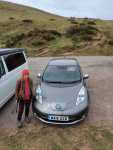
This was our first major trip with our secondhand electric car, which needs rather frequent charging. En route we broke the journey at Gloucester and toured its cathedral; on the way back, we plumped for usefulness over aesthetics by stopping at carparks in Ross-on-Wye and Cirencester. We now choose routes that avoid motorways, which makes for more leisurely and scenic touring.
-
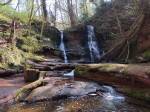
- Pwll y grach waterfall
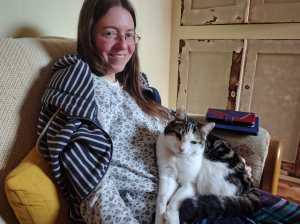
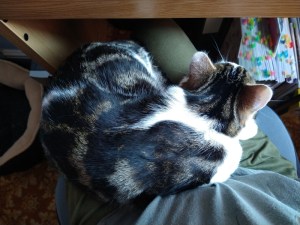
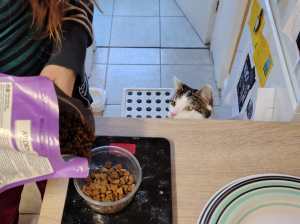
Two days after we bought the car from a local acquaintance, this creature entered our lives. I certainly didn’t intend to adopt another cat a shade under six weeks after Alfie’s death. (I haven’t even finished reading Grieving the Death of a Pet on my Kindle; I still haven’t brought myself to read your kind comments on my post about losing Alfie.) But we were deeply lonely in a way we hadn’t been expecting. I would object to the use of the word “replace” – there is no replacing Alfie; we still miss him for his predictability and dignity as well as all his own funny ways. I’ve come to realize that grief is ongoing, and all of a piece: mourning Alfie took me back to the same place of grief I inhabit for my mother, and missing them and others lost in recent years is tied into my helpless sadness over natural disasters, humanitarian crises, the state of affairs in my home country, the trajectory of the planet, and on and on.
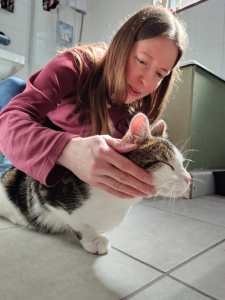
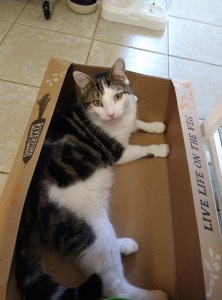
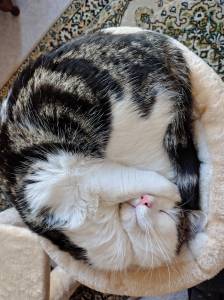
Any road, the adoption moved very quickly: from expressing interest on a Thursday to getting a call back on a Saturday to meeting and taking him home on a Sunday afternoon. Benny (“Tubbs” as was) is only a year old and full of energy. He came home with a tapeworm but got over it within a week after a targeted worming treatment. It’s been a big adjustment for us to have a cat who doesn’t sleep most of the day and can jump up onto any counter or piece of furniture. Benny considers every waking moment a chance for playtime and mischief. But he is also so sweet and affectionate. And we haven’t laughed this much in a long, long time.
We had booked the Hay trip long before we knew about Benny and were concerned it would be too soon to leave him. But we needn’t have worried; he was settled in here from Day One. Our regular cat sitter visited twice a day and he was absolutely fine. She sent us WhatsApp updates on him and cute photos, in most of which he is a blur chasing his toy snake!


So that’s what’s been going on with me. And of course, I’ve been frantically reading there in the background (36 books on the go at the moment): pre-release e-books for paid reviews, review copies I’ve been sent for the blog, new releases from the library, and the rest of the McKitterick Prize longlist – my shortlist choices are due on the 23rd, eek! I still hope to read a couple of novels from the Carol Shields Prize longlist before the winner is announced, too.
Hope everyone is having a happy spring!
Nine Days in France and What I Read
Who would have predicted that the South of France would be colder and rainier than the England we left behind? Nonetheless, we had a pleasant, low-key week at the Limousin–Dordogne border. We stayed in a gîte at Le Moulin de Pensol, a complex run by an English couple who keep horses, donkeys and chickens but are otherwise rewilding their land (similar to the Wild Finca project we visited in Spain two years ago). Their site is known for butterflies, including multiple almost indistinguishable fritillary species, so there was plenty of insect and bird watching for my husband in brief bursts of sunshine between showers. When it was too wet to go out, we played board games, drank wine and read books.
-
- Our gite. Photos by Chris Foster.
-
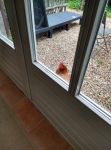
- The chickens wanted in!
-
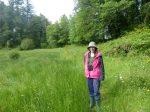
- Wandering the meadows
-
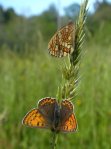
- Butterfly watching
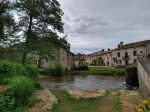
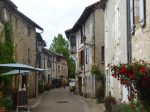
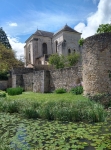
However, we did manage a few short outings: the Trou de Philippou gorge; a peek at a Saturday morning repair café (I’m a volunteer doing admin and publicity for our local repair café, which started in February) and its “recyclerie” charity shop in a nearby village; and St-Jean-de-Côle, “one of the loveliest villages in the Dordogne” according to the Rough Guide. We were taken by the main square’s church, castle and screaming swift parties – so much bigger than back home – which we’d likewise watched circling the château in the attractive medieval town of Saumur on the Loire, where we stopped for a night on the way down. There were also fresh cheeses and produce, including the most delicious strawberries ever (the “Charlotte” variety), from the two closest markets. Piégut’s is the largest market in southwest France but we had to use our imaginations as the downpour kept plenty of sellers away.


-
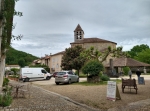
- St-Jean-de-Cole’s main square
-
- Photo by Chris Foster.
The highlight of the trip was a visit to Grotte de Villars, a cave network with spectacular stalactites and stalagmites. Less well known than Lascaux, which is now inaccessible to visitors except via a reproduction, it too has prehistoric cave paintings of horses and bison, and 20,000-year-old bear claw marks. The paintings are gradually disappearing behind the constant calcite-creating drips; I pondered whether they will vanish before the human race does. We were lucky to find it so quiet that we got a private English-language tour. Proprietors were also so kind as to speak English to us when we shopped at a nano-brewery and did a tasting at a cider and calvados producer in Normandy on our way back to the ferry. Otherwise, we muddled through with the bare minimum of French at shops and eateries.
-
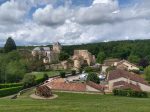
- Abbaye de Nouaillé-Maupertuis (lunch stop en route)
-
- (Photo at left by Chris Foster.)
-
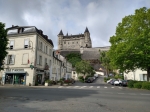
- Saumur castle
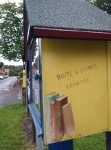
My other highlight was finding two Little Free Libraries, a walk-in one that we happened to pass in Saint-Martin-l’Ars on our initial drive down south and another in Abjat-sur-Bandiat. I felt slightly bad about taking a book at the first because of its insistence on returning or replacing once you’d read it, so I made up for it by donating Cold Spring Harbor to the book exchange box in Abjat when we returned to its crêperie for our one meal out of the holiday.
-
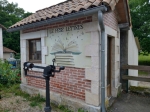
- Le Pese Lettres, Saint-Martin-l’Ars
-
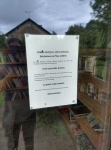
- Stricter than the usual LFL policy
-
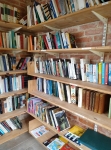
- Several English-language shelves
-
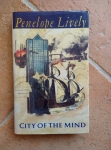
- My chosen book
-
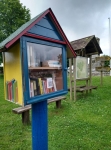
- Abjat-sur-Bandiat book exchange box
-
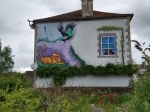
- Cute cat mural in Abjat
What I Read
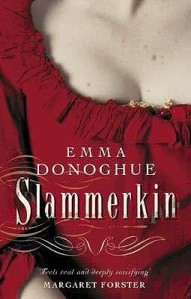 Slammerkin by Emma Donoghue (2000): A slammerkin was, in eighteenth-century parlance, a loose gown or a loose woman. Donoghue was inspired by the bare facts about Mary Saunders, a historical figure. In her imagining, Mary is thrown out by her family at age 14 and falls into prostitution in London. Within a couple of years, she decides to reform her life by becoming a dressmaker’s assistant in her mother’s hometown of Monmouth, but her past won’t let her go. The close third person narration shifts to depict the constrained lives of the other women in the household: the mistress, Mrs Jones, who has lost multiple children and pregnancies; governess Mrs Ash, whose initial position as a wet nurse was her salvation after her husband left her; and Abi, an enslaved Black woman. This was gripping throughout, like a cross between Alias Grace and The Crimson Petal and the White. The only thing that had me on the back foot was that, it being Donoghue, I expected lesbianism. (Secondhand purchase – Awesomebooks.com)
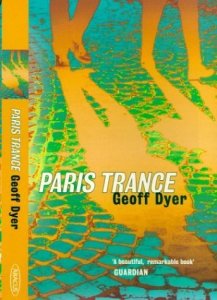 Paris Trance by Geoff Dyer (1998): Only my second novel from Dyer, an annoyingly talented author who writes whatever he wants, in any genre, inimitably. This reminded me of Jeff in Venice, Death in Varanasi for its hedonistic travels. Luke and Alex, twentysomething Englishmen, meet as factory workers in Paris and quickly become best mates. With their girlfriends, Nicole and Sahra, they form what seems an unbreakable quartet. The couples carouse, dance in nightclubs high on ecstasy, and have a lot of sex. A bit more memorable are their forays outside the city for Christmas and the summer. The first-person plural perspective resolves into a narrator who must have fantasized the other couple’s explicit sex scenes; occasional flash-forwards reveal that only one pair is destined to last. This is nostalgic for the heady days of youth in the same way as Sweetbitter. I was intrigued to learn that random lines were sampled from Fiesta; though it is lad lit, I wouldn’t have expected a Hemingway homage from the style. (Secondhand purchase – Awesomebooks.com)
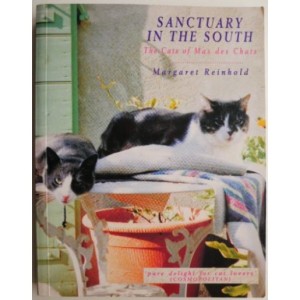 Sanctuary in the South: The Cats of Mas des Chats by Margaret Reinhold (1993): Reinhold (still alive at 96?!) is a South African psychotherapist who relocated from London to Provence, taking her two cats with her and eventually adopting another eight, many of whom had been neglected by owners in the vicinity. This sweet and meandering book of vignettes about her pets’ interactions and hierarchy is generally light in tone, but with the requisite sadness you get from reading about animals ageing, falling ill or meeting with accidents, and (in two cases) being buried on the property. “Les chats sont difficiles,” as a local shop owner observes to her. But would we cat lovers have it any other way? Reinhold often imagines what her cats would say to her. Like Doreen Tovey, whose books this closely resembles, she is as fascinated by human foibles as by feline antics. One extended sequence concerns her doomed attempts to hire a live-in caretaker for the cats. She never learned her lesson about putting a proper contract in place; several chancers tried the role and took advantage of her kindness. (Secondhand purchase – Community Furniture Project)
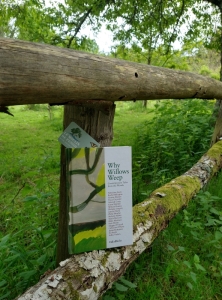
Why Willows Weep: Contemporary Tales from the Woods, ed. Tracy Chevalier and Simon Prosser (2011): These 19 short fictions, rather like Rudyard Kipling’s Just-So Stories, imagine how certain tree species developed their particular characteristics. I wasn’t expecting the fable setup and probably would have preferred a miscellany of essays and various fictional approaches. However, there is a run of great stories in the middle: from Susan Elderkin on “How the Blackthorn Got Its Flowers” to Terence Blacker on “Why Elms Die Young.” The stand-outs for me were by Rachel Billington and Maria McCann. It was a cute touch to have each author’s mini-bio end with their favourite tree, except, um, bamboo isn’t one (it’s a giant grass). I’ll probably keep this for the randomness of where I found it and the Leanne Shapton illustrations. (Secondhand purchase – La Monnerie recyclerie) 
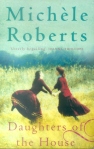 And the first two-thirds of Daughters of the House by Michèle Roberts (1993): Thérèse and Léonie are cousins: the one French and the other English but making visits to her relatives in Normandy every summer. In the slightly forbidding family home, the adolescent girls learn about life, loss and sex. Each short chapter is named after a different object in the house. That Thérèse seems slightly otherworldly can be attributed to her inspiration, which Roberts reveals in a prefatory note: Saint Thérèse, aka The Little Flower. Roberts reminds me of A.S. Byatt and Shena Mackay; her work is slightly austere and can be slow going, but her ideas always draw me in. (Secondhand – Newbury charity shop)
A DNF: Claudine at School by Colette (a free download), which was dull and in way too small a print on my e-reader.
Plus portions of: various e-books for paid reviews, two May review books, and several library books including Moominpappa at Sea by Tove Jansson and The Invention of Hugo Cabret by Brian Selznick.


I’m happy to be home with my cat and canal, the two things I miss most when we’re away.
Scottish Travels & Book Haul: Wigtown, Arran, Islay and Glasgow
When I was a kid, one-week vacations were rare and precious – Orlando or Raleigh for my dad’s church conferences, summer camp in Amish-country Pennsylvania, spring break with my sister in California – and I mourned them when they were over. As an adult, I find that after a week I’m ready to be home … and yet just days after we got back from Scotland, I’m already wondering why I thought everyday life was so great. Oh well. I like to write up my holidays because otherwise it’s all too easy to forget them. This one had fixed start and end points – several days of beetle recording in Galloway for my husband; meeting up with my sister and nephew in Glasgow one evening the next week – and we filled in the intervening time with excursions to two new-to-us Scottish islands; we’re slowly collecting them all.
First Stop, Wigtown
Hard to believe it had been over five years since our first trip to Wigtown. The sleepy little town had barely changed; a couple of bookshops had closed, but there were a few new ones I didn’t remember from last time. The weather was improbably good, sunny and warm enough that I bought a pair of cutoffs at the Community Shop. Each morning my husband set off for bog or beach or wood for his fieldwork and I divided the time until he got back between bits of paid reviewing, reading and book shopping. Our (rather spartan) Airbnb apartment was literally a minute’s walk into town and so was a perfect base.


I paced myself and parcelled out the eight bookshops and several other stores that happen to sell books across the three and a bit days that I had. It felt almost like living there – except I would have to ration my Reading Lasses visits, as a thrice-weekly coffee-and-cake habit would soon get expensive as well as unhealthy. (I spent more on books than on drinks and cakes over the week, though only ~25% more: £44 vs. £32.)


I also had the novelty of seeing my husband interact with his students when we were invited to a barbecue at one’s family home on the Mull of Galloway – and realizing that we’re almost certainly closer in age to the mum than to the student. Getting there required two rural bus journeys to the middle of nowhere, an experience all in itself.
‘Pro’ tips: New Chapter Books was best for bargains, with sections for 50p and £1 paperbacks and free National Geographics. Well-Read Books was good for harder-to-find fiction: among my haul were two Jane Urquhart novels, and the owner was knowledgeable and pleasant. Byre Books carries niche subjects and has scant opening hours, but I procured two poetry collections and a volume of Dorothy Wordsworth’s journals. The Old Bank Bookshop and The Bookshop are the two biggest shops; wander for an hour or more if you can. The Open Book tends to get castoffs from other shops and withdrawn library stock, but I still made two purchases and ended up being the first customer for the week’s hosts: Debbie and Jenny, children’s book authors and long-distance friends from opposite coasts of the USA. Overall, I was pleased with my novella, short story and childhood memoir acquisitions. A better haul than last time.

‘Celebrity’ sightings: On our walk down to the bird hide on the first evening, we passed Jessica Fox, an American expat who’s been influential in setting up the literary festival and The Open Book. She gave us a cheery “hello.” I also spotted Ben of The Bookshop Band twice, once in Reading Lasses and another time on his way to the afternoon school run. Both times he had the baby in tow and I decided not to bother him, not even to introduce myself as one of their Patreon supporters.
On our last morning in town, we lucked out and found Shaun Bythell behind the counter at The Bookshop. He’d just taken delivery of a book-print kilt his staff surprised him by ordering with his credit card, and Nicky (not as eccentric as she’s portrayed in Diary of a Bookseller; she’s downright genteel, in fact) had him model it. He posted a video to Facebook that includes The Open Book hosts on the 23rd, if you wish to see it, and his new cover photo shows him and his staff members wearing the jackets that match the kilt. I bought a few works of paperback fiction and then got him to sign my own copies of two of his books.


As last time, he was chatty and polite, taking an interest in our travels and exhorting us to come back sooner than five years next time. I congratulated him on his success and asked if we could expect more books. He said that depends on his publisher, who worry the market is saturated at the moment, though he has another SIX YEARS of diaries in draft form and the Remainders of the Day epilogue would be quite different if he wrote it now. Tantalizing!
Note to self: Next time, plan to be in town through a Friday evening – we left at noon, so I was sad to miss out on a Beth Porter (the other half of The Bookshop Band) children’s songs concert at Foggie Toddle Books at 3:00, followed by a low-key cocktail party at The Open Book at 5:30 – but not until a Monday, as pretty much everything shuts that day. How I hope someone buys Reading Lasses (the owner is retiring) and maintains the café’s high standard!
 Appropriate reading: I read the first third of Dorothy L. Sayers’s The Five Red Herrings because it’s set in the area (first line: “If one lives in Galloway, one either fishes or paints”), and found it entertaining, though not enough to care whodunnit. In general, I’m terrible for trying mystery series and DNFing or giving up after the first book. Lord Peter Wimsey seemed like he’d be an amusing detective in the Sherlock Holmes vein, but the rendering of Scottish accents was OTT and the case relied too much on details of train schedules and bicycles.
Arran
Our short jaunt to Arran started off poorly with a cancelled ferry sailing, leaving us stranded in Ardrossan (which Bythell had almost prophetically dubbed a “sh*thole” that morning!) for several hours until the next one, and we struggled with a leaky rear tyre and showery weather for much of the time, but we were still enamoured with this island that calls itself “Scotland in miniature.” That was particularly delightful for me because I come from the state nicknamed “America in miniature,” Maryland. This Airbnb was plush by comparison, we obtained excellent food from the Blackwater Bakehouse and a posh French takeaway, and we enjoyed walks at the Machrie stone circles and Brodick Castle as well as at the various bays (one with a fossilized dinosaur footprint) that we stopped off at on our driving tour.


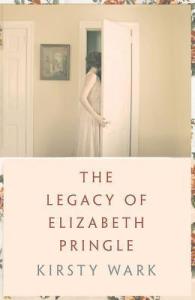 Appropriate reading: The Legacy of Elizabeth Pringle by Kirsty Wark, the only Arran-set novel on my library’s catalogue, is an enjoyable dual-timeline story linked by the Lamlash home of the title character. When she died in her nineties in 2006, she bequeathed her home to a kind woman who used to walk past on summer holidays with her daughter in a pram. Martha Morrison was that baby, and with her mother, Anna, suffering from dementia, it’s up to her to take possession and root out Elizabeth’s secrets. Every other chapter is a first-person fragment from Elizabeth’s memoir, cataloguing her losses of parents and lovers and leading ever closer to the present, when she befriended Saul, an American Buddhist monk based at Holy Island across the water, and Niall, a horticulturist at Brodick Castle. It’s a little too neat how the people in her life pair off (sub-Maggie O’Farrell; more Joanna Trollope, perhaps), but it was fun to be able to visualize the settings and to learn about Arran’s farming traditions and wartime history.
Islay
Islay is a tourist mecca largely because of its nine distilleries – what a pity we don’t care for whiskey! – but we sought it out for its wildlife and scenery, which were reminiscent of what we saw in the Outer Hebrides last year. Our B&B was a bit fusty (there was a rotary phone in the hall!), but we had an unbeatable view from our window and enjoyed visiting two RSPB reserves. The highlight for me was the walk to the Mull of Oa peninsula and the cow-guarded American Monument, which pays tribute to the troops who died in two 1918 naval disasters – a torpedoed boat and a shipwreck – and the heroism of locals who rescued survivors.


We spent a very rainy Tuesday mooching from one distillery shop to another. There are two gin-makers whose products we were eager to taste, but we also relished our mission to buy presents for two landmark birthdays, one of an American friend who’s a whiskey aficionado. Even having to get the tyre replaced didn’t ruin the day. There’s drink aplenty on Islay, but quality food was harder to acquire, so if we went back we’d plump for self-catering.


Incidental additional hauls: I found this 50th anniversary Virago tote bag under a bench at Bowmore harbour after our meal at Peatzeria. I waited a while to see if anyone would come back for it, but it was so sodden and sandy that it must have been there overnight. I cleaned it up and brought home additional purchases in it: two secondhand finds at a thrift store in Tarbert, the first town back on the mainland, and a Knausgaard book I got free with my card points from a Waterstones in Glasgow.


Glasgow
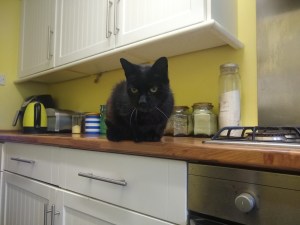 My 15-year-old nephew is currently on a school trip to Scotland and my sister went along as an unofficial chaperone. I couldn’t let them come to the UK without meeting up, so for months we’d pencilled in an evening in Glasgow. When we booked our Airbnb room in a suburb, it was because it was on a super-convenient train line … which happened to be closed for engineering works while we were there. Plan B: rail replacement buses, which were fine. We greatly enjoyed the company of Santos the Airbnb cat, who mugged us for scraps of our breakfasts.
With our one day in Glasgow, we decided to prioritize the Burrell Collection, due to the enthusiastic recommendations from Susan, our Arran hosts, and Bill Bryson in Notes on a Small Island (“Among the city’s many treasures, none shines brighter, in my view”). It’s a museum with a difference, housed in a custom-built edifice that showcases the wooded surroundings as much as the stunning objects. We were especially partial to the stained glass.


Our whistle-stop city tour also included a walk past the cathedral, a ramble through the Necropolis (where, pleasingly, I saw a grave for one Elizabeth Pringle), and the Tenement Museum, a very different sort of National Trust house that showed how one woman, a spinster and hoarder, lived in the first half of the 20th century. Then on to an exceptional seafood-heavy meal at Kelp, also recommended by Susan, and an all-too-brief couple of hours with my family at their hotel and a lively pub.


We keep returning to Scotland. Where next in a few years? Possibly the southern islands of the Outer Hebrides, which we didn’t have time for last year, or the more obscure of the Inner Hebrides, before planning return visits to some favourites. All the short ferry rides were smooth this time around, so I can cope with the thought of more.
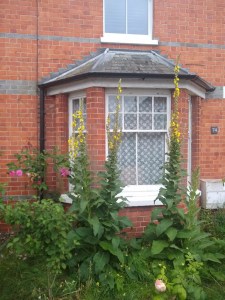
We got home to find our mullein plants attempting to take over the world.
Birthday Outing and Book Haul
I’m not quite sure why, but I’ve made it a habit of posting something about each birthday I’ve celebrated since I started blogging. Maybe because, otherwise, the years pass so quickly that I can’t remember from one to another what I did, ate, or received as presents! So, to follow on from my 2015, 2016, 2017, 2018, 2019, 2020, and 2021 posts, here’s this year’s rundown. (Oh dear, I realize I’ve read just one of the books I received last year!)
On Thursday, I treated myself to a charity shop crawl around Newbury (it’s a great place for thrift shopping, as is nearby Thatcham) and got two jumpers plus this small stack of secondhand books.

Then yesterday, my actual birthday, we took time off and went to Kelmscott Manor in West Oxfordshire/the Cotswolds (right on the border with Gloucestershire), where Victorian designer William Morris lived. We’re a fan of Morris’s floral-based wallpaper and textile designs and he was a progressive thinker, too, embracing socialism and environmentalism – I’ll get his utopian novel, News from Nowhere, out from the university library to read soon. Despite a drizzly start to the day, the place was packed with visitors. The tea shop’s cakes incorporate fruit from the manor’s own trees. Naturally, I had to sample two of their offerings, and still had room for a chocolate beetroot cupcake (with the requisite candle) once we got home.


On the way back, we stopped in Wantage for some secondhand book shopping. I’d found out about Regent market from Simon’s blog and he’s right – it’s huge, with an excellent stock and good prices (£2 or £2.50 for nearly everything I looked at, vs. when we were in Inverness I didn’t buy a thing at Leakey’s because even poor-condition paperbacks started at £4). I would happily have spent much longer there and acquired twice as much, but one must be restrained when there are further book hauls to come. I was pleased to find several books I’ve been interested in reading for a while, as well as a couple by authors I’ve enjoyed before.

 I requested a vegan Chinese feast, inspired by a recent cookbook I’ve reviewed for Shelf Awareness’s upcoming gift books feature, The Vegan Chinese Kitchen by Hannah Che. My husband made a special trip to an Asian grocery superstore in Reading and the recipes were fairly involved, but the results – cabbage rolls, wontons and bao buns, most featuring tofu and mushrooms – were worth waiting for. We have leftovers for the weekend, along with a banoffee cheesecake from Nigella Lawson’s Kitchen still to come. (When are complicated dishes for if not for birthdays?)


Here are the books I received as birthday gifts, with more to come, I expect, plus a significant amount of birthday money that I may well spend on books. Some good options for #NovNov22 in here!

Bookbarn Book Haul & More
 We’re back from our weekend in Bristol and Exeter to hang out with university friends and attend our goddaughter’s dedication service. On the way (ish) down, we stopped at Bookbarn International, one of my favorite places to look for secondhand books. The shop is always coming up with new ideas and ventures – a rare books room, a café, stationery and store-brand merchandise, new stock alongside the used books, and so on – and has recently been doing some renovating of the main shop space. I contributed to a crowdfunder for this and got to pick up my rewards while I was there, including the items at right and a £10 store voucher, which, along with the small balance of my vendor account, more than covered my purchases that day.
We arrived around noon so started with a café lunch of all-day veggie cooked breakfasts plus cakes and coffee. Delicious! Then it was time for some dedicated browsing. All of the books on the main shop floor are £1 each; they’re working on restocking this area after the refurbishment. I found 12 books here, and ordered another two (the Janet Frame biography and Gail Godwin’s nonfiction book Heart) from the warehouse for £2 each.

From my book haul, I’m particularly pleased with:
- The sequel to another Robertson Davies novel I own
- The Frame biography – I loved her three-part autobiography and have also been dipping into her fiction; it will be fascinating to learn the ‘truth’ behind how she presented her life in memoir and autofiction. This copy looks to be in new condition, too.
- The Tulip by Anna Pavord, which I’ve long meant to read
- Another Carolyn Parkhurst novel – I loved The Dogs of Babel and Harmony
- Another Wendy Perriam novel – I read my first last year and have been hoping to find more
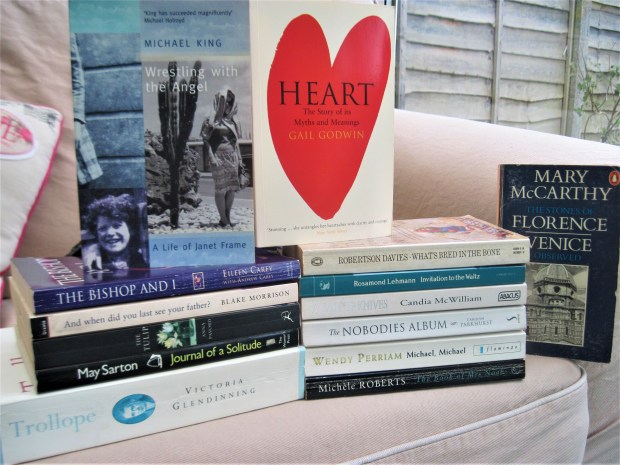
I also bought copies of two of my favorite memoirs, And When Did You Last See Your Father? and Journal of a Solitude (though I own a copy in America, I’d like it to be part of my rereading project this year). I now own two unread novels each by Candia McWilliam and Michèle Roberts and three by Rose Tremain, so I’ll need to be sure I read one from each author this year. I also have a bad habit of hoarding biographies but not reading them, so I want to at least read the Frame one before the year is out.
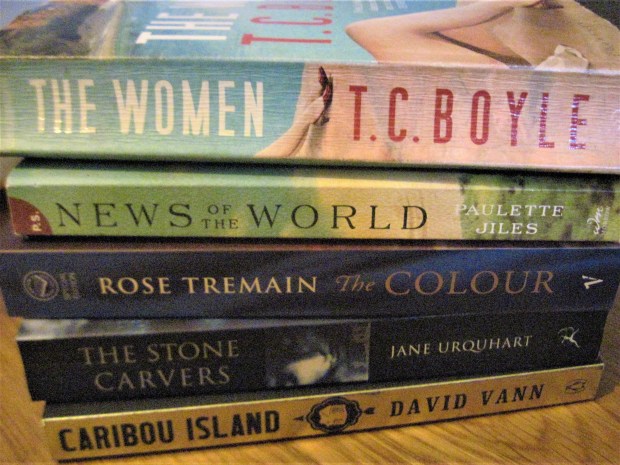
Between Bristol’s charity shops and Book-Cycle in Exeter, I bought another five novels during the weekend, including the Vann to reread and several by authors I want to increase my familiarity with. (Smug points for not buying the £2.50 copy of Boyle’s The Women at Bookbarn and then finding it at Book Cycle for 50 pence instead.) Total weekend spend on 19 books: £2.12.
Picked up any good secondhand bargains recently?
Out and About in Edinburgh
After going to Wigtown in April, I never expected I’d be back in Scotland this year. This was a fairly last-minute trip we booked so that my husband could attend a short rewilding workshop for PhD students. They all met up in Edinburgh and proceeded by bus into the Cairngorms to see sites of habitat restoration and potential future wildlife releases. I stayed behind at our Airbnb flat and kept up a reduced work load while enjoying the city break.
Day 1, Wednesday the 19th: A travel day. Our journey – two train rides plus a short walk at either end – should have taken just over 7 hours. Instead, it took 14. Recent storms had taken down wires at Durham and left debris on the line, so our original train was terminated at York. We managed to get a connection to Newcastle, queued outside for two hours for rail replacement buses that never came, and finally got a very delayed train through to Edinburgh. Our poor Airbnb hostess’s parents had to wait up for us until 12:40 a.m.
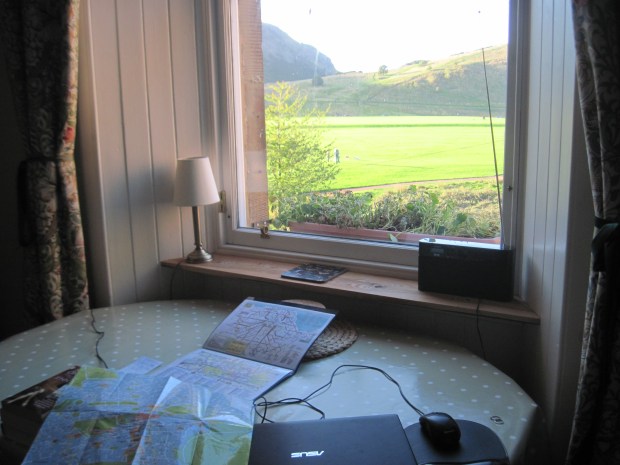
Day 2, Thursday the 20th: After just a few hours of sleep, we were up early so that Chris could leave by 7:15 for his meet-up on the Edinburgh campus. The props and sketches scattered about suggest that the flat owner is a theatre costume and set designer. The view overlooking Holyrood Park and Arthur’s Seat is spectacular – a great place to put in a few hours of proofreading before heading out to town after lunch.


On Clare’s recommendation I started with the Surgeons’ Hall Museums on the Royal College of Surgeons campus. They have several collections covering the history of surgery, dentistry, and pathology specimens. Many of the names and developments were familiar to me from Lindsey Fitzharris’s The Butchering Art. Joseph Lister’s frock coat is on display, and in one corner rare video footage plays of Sir Arthur Conan Doyle (who was initially a practicing physician) explaining how he based Sherlock Holmes on his university mentor, Joseph Bell.
 It’s not a place for the squeamish as there are mummified skeletons, details about Burke and Hare’s grave-robbing, surgical tools, and tumors and other anatomical deformities in jars everywhere. I found it all fascinating and spent a good two hours poking around. My favorite bits were the case full of foreign bodies removed from noses, stomachs and intestines and the temporary exhibition, “A Quest for Healing” by Zhang Yanzi, who had a residency at the museums in the summer of 2017. Her pieces included a 2D mountain made of pill packets, a cotton and gauze sculpture bristling with acupuncture needles, a matching hanging sculpture of capillaries, two surgical beds, and various silk screen panels.
The pathology museum, spread across two floors, was a little overwhelming and almost distressingly faceless – so many human beings reduced to the conditions that had defined and perhaps killed them. The most striking specimen for me, then, was one that actually included a face. I think it was a First World War soldier whose nose had been sewn back together, and what was so remarkable was that you could see his ginger whiskers and eyebrows, and his eyes were closed as if he was just taking a nap. (For ever. In a museum case.)

The sculpture outside is From Here Health by Denys Mitchell (1994).
There are only explanatory panels about a select few samples, so it can be hard to spot just what’s wrong with the organs unless you have specialist medical knowledge. I appreciated the few places where notes have been added along the lines of “see your doctor if…” There were four polycystic kidneys on display in various cases, so including mine there were at least six present in the building that day. “More lives would be saved if more people carried kidney donor cards,” one caption read. Amen.
Clare also recommended the university area for its charity shops. I had a good trawl around Nicolson Street and bought one book, but a lot of the shops are geared towards vintage and High Street fashion. I had better luck at the Salvation Army store on Forrest Road (near the National Museum), where I found three books and two classical CDs.


On to the Writers’ Museum, which commemorates Robert Burns, Sir Walter Scott and Robert Louis Stevenson. I was most interested in the Stevenson material, including memorabilia from his later life on Samoa, especially as I’m currently reading a novel about his relationship with the American divorcee Fanny Osbourne. By now I was museum-ed out and headed back to the flat for a leftovers dinner and some reading before an early bedtime.


Day 3, Friday the 21st: Another morning of work followed by an afternoon of wandering on foot between free attractions and charity shops and avoiding the drizzle. I visited the unusual Scottish Parliament building (which cost a cool £414 million) and saw inside the debating chamber. Four books from the Lothian Cat Rescue charity shop; quick jaunts around the Museum of Childhood, the Museum of Edinburgh, Canongate Kirk, the Music Museum, and the Central Library. When it came to it I couldn’t be bothered to pay £14 to go around Holyrood Palace, but I enjoyed a reasonably priced cappuccino and carrot cake at their café. Chris was back in the evening for a dinner of frozen pizza with local beer and cider.


Day 4, Saturday the 22nd: Our one full day in the City together. We weren’t feeling up to the Arthur’s Seat walk, so we did a gentle stroll up the Salisbury Crags and back instead. Then we caught a bus out to the Stockbridge area for more charity shopping (two more books) and a scrumptious brunch at The Pantry. This was a recommendation on chef David Lebovitz’s food blog and it more than lived up to expectations. It’s no wonder we had to wait half an hour for a table. I could have eaten anything on the menu, but in the end I had smoked salmon eggs Benedict followed by a cherry and Nutella brownie.


After a brief browse at Golden Hare Books, we went on along the Water of Leith to the lovely Royal Botanic Garden. It’s free to walk around, but we also paid to tour the Glasshouses, which recreate the flora of 10 different climates. The RBG is also home to the National Memorial for Organ and Tissue Donors, a peaceful circular space set back in the woods and marked out by a few benches and stone monuments. As I have organ donors to thank for the continued life and health of my mother and several other relatives, it was well worth a visit.


Back into town for gelato (I had a delicious poached plum and cinnamon sorbet) at Mary’s Milk Bar, which is on Grassmarket across from the Castle and was another Lebovitz recommendation. A quick circuit of the animal hall at the National Museum before it closed, a stroll along the Royal Mile, and a rest with tea and books back at the flat before going back out for a veggie curry.
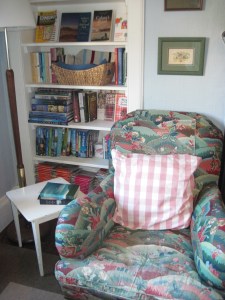
Airbnb bedroom reading nook
Day 5, Sunday the 23rd: Return travel day. No major issues, but still enough of a delay to apply for compensation – refunds from LNER and my husband’s work will have made the journey very cheap indeed.
I was sad to leave Edinburgh this time. I loved our Airbnb flat and felt very at home in it. If I had a bicycle to get into town a little faster, I could easily live there. The tourists would probably drive me mad, but Edinburgh is a wonderful place with so much to see and do and such incredible scenery within a short drive.
Thank you to everyone who offered suggestions of what to see and do. I managed to fit in most of what you recommended!
What I read:
The bulk of Unsheltered, Barbara Kingsolver’s bold new novel about distrust and displacement in America then (the 1870s) and now (during the rise of Trump), and Come to Me by Amy Bloom, a wonderful story collection about people who love who they shouldn’t love. More about this one in my upcoming round-up of short stories I’ve read this month. 
 A Ladder to the Sky by John Boyne is a delicious piece of literary suspense with a Tom Ripley-like hero you’ll love to hate: Maurice Swift, who wants nothing more than to be a writer but doesn’t have any ideas of his own, so steals them from other people. I loved how we see this character from several outside points of view – first Erich Ackerman, whose Nazi-era history provides the basis for Maurice’s first novel; then Gore Vidal, to whose Italian home Maurice pays a visit with his new mentor; and finally Maurice’s wife Edith, a celebrated author in her own right – before getting Maurice’s own perspective. By this point we know enough about him to understand just how unreliable a narrator he is. My one criticism is that I would have binned the whole subplot about Edith’s sister and brother-in-law. (A nice touch: at one point Maurice buys a reprint copy of Maude Avery’s Like to the Lark, which should ring a bell from The Heart’s Invisible Furies.)
 I also read over half of Jenny Diski’s Stranger on a Train, a memoir about two long train journeys she took across America in the late 1990s that also incorporates memories from a troubled adolescence – she started smoking at 14 and was in and out of mental hospitals at 15 – in which she loved nothing more than to read while riding the Circle line all day long. I’m a quarter of the way through both Nancy Horan’s Under the Wide and Starry Sky, about Stevenson and his wife, and Peter Hill’s Stargazing, a memoir about dropping out of art school to become a Scottish lighthouse keeper in 1973; he started on Pladda, a tiny island off of Arran. And on my Nook I read a good bit of All You Can Ever Know, Nicole Chung’s forthcoming memoir about being raised by adoptive white parents in Oregon and meeting members of her Korean family in her mid-twenties, just as she became a mother herself.
In Cambridge for “Nature Matters”
We spent a few days last week in Cambridge, England for New Networks for Nature’s interdisciplinary “Nature Matters” conference, this year on the theme of “In Touch with the Wild.” This is the fourth year my husband (a biologist with the University of Reading) has participated, and the third year in a row that I’ve attended for a day. While other years the gathering has been in the small town of Stamford, this year’s temporary move to Cambridge gave us the impetus to finally explore this world-famous city for the first time.
Arriving later than we meant to on a Thursday evening, checking into our noisy hostel and then having to dash out in time for my husband to make the first event (and making a futile attempt to find an open coffee shop where I could while away a couple hours)…this all meant our first impression of the city was not great. However, cheap, terrific Chinese street food on Friday after the conference, followed by a delicious glass of cider in a pub and a sunny day for exploring the bustling city center on Saturday created a more favorable overall feeling.
-
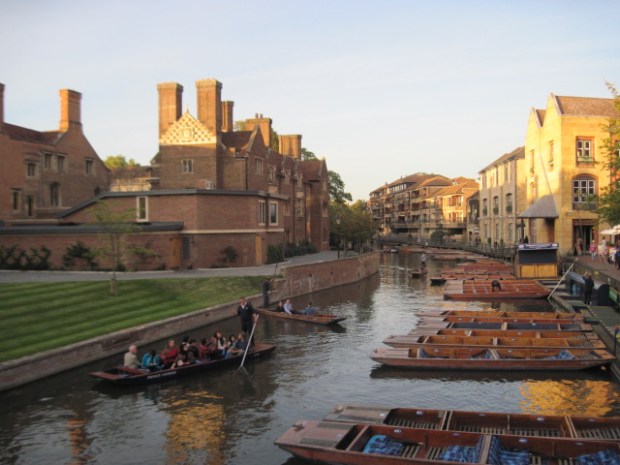
- Venice? No! Cambridge.

-
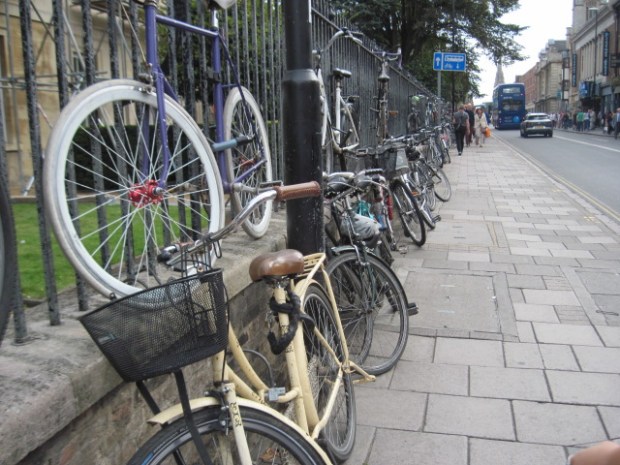
- Everyone cycles.
-

- King’s College.

-
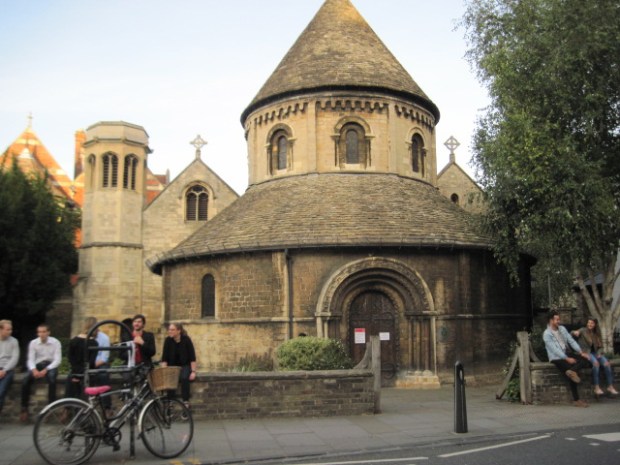
- The Church of the Holy Sepulchre, aka The Round Church.
Last year’s conference highlights for me were a debate about nature’s economic value and a panel on the purpose of nature poetry. This year’s sessions tackled personal connection with nature, rewilding (setting aside tracts of land for wilderness and reintroducing native species that have been driven out or gone locally extinct, such as wolves and wild boar), and coping with a sense of loss. With everyone from geographers to a singer and a painter involved on the day I attended, the conference succeeded in drawing in different fields from the sciences and the arts to provide commentary on ways we might reconnect with nature.
 The day’s first event brought together author William Fiennes, poet Alison Brackenbury, and Cambridge psychologist Laurie Parma. Fiennes spoke about writing an introduction to John Fowles’s long, curmudgeonly essay The Tree. Whereas Fowles denigrates Linnaeus, Fiennes thinks of him as a hero; like Adam in the Bible, Linnaeus knew the value of naming things. “In order to care about something, we first have to notice it,” Fiennes insisted; for him the noticing began when he was a child going round the garden with his father and learning plant names. Rather than thinking of names as a control mechanism, he suggested they can be a first step in “granting [a species] a place in your sensorium.”
 Brackenbury, who comes from four generations of Lincolnshire shepherds, recited from memory seven poems from her latest collection, Skies, several of which reflect on species’ extinctions or comebacks. “Look at them well before they go” is the broadly applicable piece of advice that closes “The Elms.” I especially liked one poem about a starling’s many songs.
Parma relayed the scientific evidence for green spaces mitigating stress and promoting happiness. At an event like this there’s an inevitable feeling that the speakers are preaching to the choir: we already know the personal value of time in nature, as well as the scale of environmental degradation. Still, this came home afresh in the following session as Dr. Stuart Butchart of BirdLife International spoke about the situation in Hawaii, where deforestation, non-native mosquitoes and other invasive animals are rapidly driving native birds to extinction. Photojournalist Toby Smith then questioned whether the nature photographer’s role should be to chronicle nature’s degradation or to celebrate what’s left. Many speakers acknowledged the difficult balance between mourning losses and applauding successes.
I spent most of Saturday scouring Cambridge’s charity shops and made out like a bandit, coming away with 15 books for £15.39. If you happen to find yourself in Cambridge and have seen all you need to of the colleges and the river (it doesn’t take very long), I can recommend Burleigh Street for charity shops but also Mill Road, a slightly more off-the-beaten-path student area of ethnic eateries and cheap stores. Books for Amnesty has an incredible selection; I took advantage of a couple James Lasdun books from their £1 poetry shelf. Best of all was the Salvation Army store, where all books were either 40 or 70 pence. I amassed a huge pile and then put half of it back when I remembered I would have to carry these books the mile or so back into town and then haul them around the whole rest of the day. I also did well at RSPCA’s two shops, one a dedicated bookshop on Mill Road.

Cambridge is certainly rich in secondhand book buying opportunities. Other shops I browsed but didn’t buy from included G. David Books and the tiny Sarah Key Books (also known as “The Haunted Bookshop” – I’d love to know why! – and included on a Guardian list of 10 of the best secondhand bookstores), both on St. Edward’s Passage, and the multi-floored emporium Heffers on St. John’s Street, which has a great selection of board games and gift items as well as new and used books.
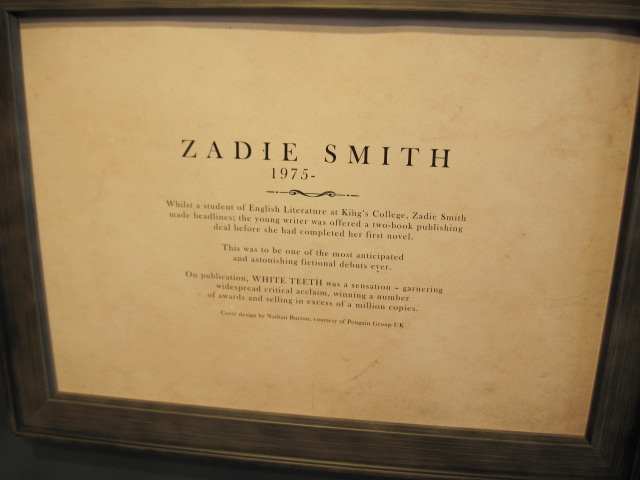
As a literary destination, Cambridge left a bit to be desired, though. There weren’t any literary graves for me to find, nor any notable houses or statues. Many of the college’s famous alumni are known for work in other fields. There’s Newton, Darwin and Hawking in the sciences, for instance – they all appear in this mural in the hostel dining room. Plenty of political figures attended, as well as lots of living authors (Wikipedia has an extensive list; the hostel wall featured Zadie Smith as a fairly recent example of a literary alumna).


So, overall, a nice enough city for a day trip but not somewhere you need to stay much longer. Granted, it was outside of term time so King’s College wasn’t running its usual chapel services, and I never did make it out to the Fitzwilliam Museum. Still, I reckon you’ll find much more to see and do in Oxford, a city I’ve visited again and again ever since my undergraduate study abroad days took me there for weekly theology tutorials.
 Bookish Beck = Rebecca Foster. American transplant to England. Freelance proofreader and book reviewer.
 Bookish Beck