Literary Wives Club: Recipe for a Perfect Wife by Karma Brown (2019)
{SPOILERS IN THIS REVIEW!}
Canadian author Karma Brown’s fifth novel features two female protagonists who lived in the same house in different decades. The dual timeline, which plays out in alternating chapters, contrasts the mid-1950s and late 2010s to ask 1) whether the situation of women has really improved and 2) if marriage is always and inevitably an oppressive force.
Nellie Murdoch loves cooking and gardening – great skills for a mid-twentieth-century housewife – but can’t stay pregnant, which provokes the anger of her abusive husband, Richard. To start with, Alice Hale can’t cook or garden for toffee and isn’t sure she wants a baby at all, but as she reads through Nellie’s unsent letters and recipes, interspersed with Ladies’ Home Journal issues in the boxes in the basement, she starts to not just admire Nellie but emulate her. She’s keeping several things from her husband Nate: she was fired from her publicist job after a pre-#MeToo scandal involving a handsy male author, she’s had an IUD fitted, and she’s made zero progress on the novel she’s supposed to be writing. But Nellie’s correspondence reveals secrets that inspire Alice to compose Recipe for a Perfect Wife.
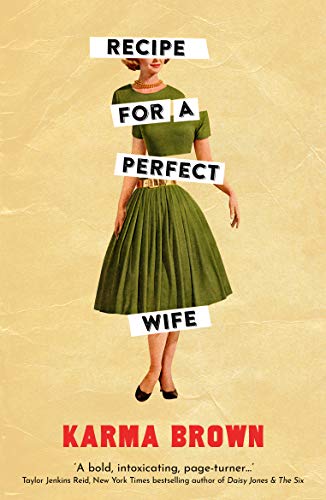
The chapter epigraphs, mostly from period etiquette and relationship guides for young wives, provide ironic commentary on this pair of not-so-perfect marriages. Brown has us wondering how closely Alice will mirror Nellie’s trajectory (aborting her pregnancy? poisoning her husband?). There were clichéd elements, such as Richard’s adultery, glitzy New York City publishing events, Alice’s quirky-funny friend, and each woman having a kindly elderly (maternal) neighbour who looks out for her and gives her valuable advice. I felt uncomfortable with how Nellie’s mother’s suicide makes it seem like Nellie’s radical acts are borne out of inherited mental illness rather than a determination to make her own path.
Often, I felt Brown was “phoning it in,” if that phrase means anything to you. In other words, playing it safe and taking an easy and previously well-trodden path. Parallel stories like this can be clever, or can seem too simple and coincidental. However, I can affirm that the novel is highly readable and has vintage charm. I always enjoy epistolary inclusions like letters and recipes, and it was intriguing to see how Nellie uses her garden herbs and flowers for pharmaceutical uses. Our first foxglove just came into flower – eek! (Kindle purchase) 
The main question we ask about the books we read for Literary Wives is:
What does this book say about wives or about the experience of being a wife?
- Being a wife does not have to mean being a housewife. (It also doesn’t have to mean being a mother, if you don’t want to be one.)
- Secrets can be lethal to a marriage. Even if they aren’t literally so, they’re a really bad idea.
This was, overall, a very bleak picture of marriage. In the 1950s strand there is a scene of marital rape – one of two I’ve read recently, and I find these particularly difficult to take. Alice’s marriage might not have blown up as dramatically, but still doesn’t appear healthy. She forced Nate to choose between her and the baby, and his job promotion in California. The fallout from that ultimatum is not going to make for a happy relationship. I almost thought that Nellie wields more power. However, both women get ahead through deception and manipulation. I think we are meant to cheer for what they achieve, and I did for Nellie’s revenge at Richard’s vileness, but Alice I found brattish and calculating.
See Kate’s, Kay’s and Naomi’s reviews, too!
Coming up next, in September: Their Eyes Were Watching God by Zora Neale Hurston.
20 Books of Summer, 15–17: Bill Buford, Kristin Newman, J. Courtney Sullivan
One last foodie selection for the summer: a chef’s memoir set mostly in Lyon, France. Plus a bawdy travel memoir I DNFed halfway through, and an engaging but probably overlong contemporary novel about finances, generational conflict and women’s relationships.
Dirt: Adventures in French Cooking by Bill Buford (2020)
 Buford’s Heat was one of the highlights of my foodie summer reading in 2020. This is a sequel insomuch as it tells you what he did next, after his Italian-themed apprenticeships. The short answer is that he went to Lyon to learn French cooking in similarly obsessive fashion. Without knowing a word of French. And this time he had a wife and twin toddlers in tow. He met several celebrated French chefs – Michel Richard, Paul Bocuse, Daniel Boulud – and talked his way into training at a famous cookery school and in Michelin-starred kitchens.
These experiences are discussed in separate essays, so I rather lost track of the timeline. It’s odd that it took the author so many years to get around to publishing about it all. You’d think his sons were still young, but in fact they’re now approaching adulthood. The other slightly unusual thing is the amount of space Buford devotes to his pet theory that French cuisine (up to ragout, at least) evolved from Italian. Unsurprisingly, the French don’t favour this idea; I didn’t particularly care one way or the other.
Nonetheless, I enjoyed reading about his encounters with French bureaucracy; the stress of working in busy (and macho) restaurants, where he’s eventually entrusted with cooking the staff lunch; and his discovery of what makes for good bread: small wheat-growing operations rather than industrially produced flour – his ideal was the 90-cent baguette from his local boulangerie. This could have been a bit more focused, and I’m still more likely to recommend Heat, but I am intrigued to go to Lyon one day. (Secondhand gift, Christmas 2022) 
What I Was Doing While You Were Breeding by Kristin Newman (2014)
 (DNF, 156/291 pages) As featured in my Six Degrees post earlier in the month. Newman is a comedy writer for film and television (That ’70s Show, How I Met Your Mother, etc.). I liked how the title unabashedly centres things other than couplehood and procreation. When she’s travelling, she can be spontaneous, open-to-experience “Kristin-adjacent,” who loves doing whatever it is that locals do. And be a party girl, of course (“If there is one thing that is my favorite thing in the world, it’s making out on a dance floor”). However, this chronological record of her sexual conquests in Amsterdam, Paris, Russia, Argentina, etc. gets repetitive and raunchy. I also felt let down when I learned that she married and had a child right after she published it. So this was just her “Pietra Pan” stage before she copied everyone else. Which is fine, but were her drunken shenanigans really worth commemorating? (Secondhand, Bas Books & Home)
Friends and Strangers by J. Courtney Sullivan (2020)
I got Emma Straub vibes from this big, juicy novel focusing on two women in upstate New York: Elisabeth, a married journalist who moved out of Brooklyn when she finally conceived via IVF; and Sam, a college art student who becomes her son Gil’s babysitter. Elisabeth misses her old crowd and doesn’t fit in with the middle-aged book club ladies in her suburban neighbourhood; Sam is almost her only friend, a confidante who’s also like a little sister (better, anyway, than Elisabeth’s real sister, who lives on tropical islands and models swimwear for inspirational Instagram posts). And Sam admires Elisabeth for simultaneously managing a career and motherhood with seeming aplomb.
 But fundamental differences between the two emerge, mostly to do with economics. Elisabeth comes from money and takes luxury products for granted, while Sam is solidly working-class and develops a surprising affinity with Elisabeth’s father-in-law, George, who is near bankruptcy after Uber killed off his car service business. His pet theory, “The Hollow Tree,” explains that ordinary Americans have been sold the lie that they are responsible for their own success, when really they are in thrall to corporations and the government doesn’t support them as it should. This message hits home for Sam, who is distressed about the precarious situation of the Latina dining hall employees she has met via her work study job. Both Elisabeth and Sam try to turn their privilege to the good, with varied results.
Although I remained engrossed in the main characters’ stories, which unfold in alternating chapters, I thought this could easily have been 300 pages instead of nearly 400. In particular, Sullivan belabours Sam’s uncertainty over her thirtysomething English fiancé, Clive, whom Elisabeth refers to as “sleazy-hot.” The red flags are more than obvious to others in Sam’s life, and to us as readers, yet we get scene after scene meant to cast shade on him. I also kept wondering if first person would have been the better delivery mode for one or both strands. Still, this was perfect literary cross-over summer reading. (Little Free Library) 
Books of Summer, 3–4: Anthony Bourdain and Meron Hadero
Back to the foodie lit. A chef’s memoir of adventurous travel and eating, and a short story collection about Ethiopian American immigrants – for some of whom learning how to cook traditional American food is a sign of integration.
A Cook’s Tour: In Search of the Perfect Meal by Anthony Bourdain (2001)
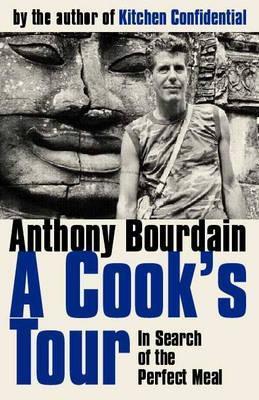 Anthony Bourdain also appeared on my summer reading list when I reviewed Kitchen Confidential in 2020; I have both books in an omnibus edition. The chef acknowledges there’s no such thing as a perfect dining experience as there are many subjective factors apart from the food, but a few of his meals here are pretty close to ideal. Others are horrific. But everywhere he goes, from England to Cambodia, he gives a fair try. Four interspersed chapters are set in Vietnam, a country he falls in love with, but the rest are like individual essays with a different destination each time: Spain, Russia, Morocco, Japan, Scotland…
Some places are chosen due to personal significance or professional connections. He goes back to where he spent childhood summers in France, but it doesn’t live up to expectations: “I’d thought everything would be instant magic. That the food would taste better because of all the memories. … But you can never be ten years old again.” His boss arranges a pig roast for him in Portugal; he travels to the state in Mexico where most of his kitchen staff come from. With several other chefs, he journeys to Thomas Keller’s The French Laundry in California for a 20-course tasting menu – the rundown of the dishes takes him several pages. The key ingredients of this and the other near-perfect meals seem to be excellent quality of food, innovative flavors, a variety of dishes, and a languid pace with the alcohol flowing.
Bourdain sheepishly confesses that his travels were documented for television; the Food Network made him agree to some filming opportunities he would otherwise have avoided. Vegetarians be warned: some of these involve slaughter, and/or eating exotic animals. Aside from the pig, there’s a whole lamb cooked over a fire in the desert in Morocco, a turkey he beheads, and rabbits he shoots. And while you might think he’d eat anything with pleasure, there are in fact a few meals that leave him feeling ill: iguana tamales, bird’s nest soup, and dishes that use up all parts of a cobra. A notorious vegetarian hater, he even agrees to attend a vegan potluck in Berkeley, but reports that “not one of them could cook a f***ing vegetable.”
This was fast-moving, brash and funny; just as good as Kitchen Confidential and something I’d recommend to anyone who enjoys cooking shows or stunt travel. (Free – swap shop)
A Down Home Meal for These Difficult Times by Meron Hadero (2022)
Debut author Hadero won the Restless Books Prize for New Immigrant Writing for this work in progress, many of whose stories had been published in periodicals in 2015–20. The 15 stories are roughly half in the first person and half in the third person, and apart from a couple whose place or character origins aren’t specified, I think all are about Ethiopians or Ethiopian Americans. Often, the protagonist is a recent immigrant. Yohannes, in “Medallion,” is recruited by his taxi driver almost immediately upon his arrival in Los Angeles, but finds that his American dream never comes through. In “The Thief’s Tale,” an old Ethiopian man who speaks no English is lost in Prospect Park. When the man who holds him up at knifepoint realizes there is no watch or wallet to take, he lets him call his daughter from a payphone and, as they wait, the two strangers share their stories of failure and regret.
Sometimes Ethiopia is the setting instead. “The Suitcase” has Saba getting ready to return to the USA after a one-month visit to Addis Ababa, her bag 10 kilograms too heavy because of everything people are sending back with her. In “The Street Sweep,” Getu hopes to impress a departing NGO worker enough at his leaving party at the Addis Sheraton that he’ll get a life-changing job offer. This one was a standout, though distressing for how it rests on misunderstanding.
 My favorites seem like they could be autobiographical for the author. “The Wall” is narrated by a man who immigrated to Iowa via Berlin at age 10 in the mid-1980s. At a potluck dinner, he met Professor Johannes Weill, who gave him free English lessons. Six years later, he heard of the Berlin Wall coming down and, though he’d lost touch with the professor, made a point of sending a note. The connection across age, race and country is touching. “Sinkholes” is a short, piercing one about the single Black student in a class refusing to be the one to write the N-word on the board during a lesson on Invisible Man. The teacher is trying to make a point about not giving a word power, but it’s clear that it does have significance whether uttered or not. “Swearing In, January 20, 2009” is a poignant flash story about an immigrant’s patriotic delight in Barack Obama’s inauguration, despite prejudice encountered.
The title story is the only foodie link, but it’s a sweet one. Two women who attend church Amharic classes in New York City admit that they can’t cook, but want to impress at the PTA bake sale, so go in search of a quintessential American cookbook, and in the years to come prepare dishes from The Good Housekeeping Illustrated Cookbook every time there is a crisis. “When Yeshi’s husband left her for a blonde waitress, they made Broiled Hamburg Steak, just the once. … When Jazarah’s credit cards were stolen and maxed out, they made trays of Corn Fritters.” Eventually, they start to make a living from their own food truck.
There were no bad stories here per se, but several too many, and not enough variety. I also didn’t warm to the couple of political satires involving manuscripts. “The Case of the Missing _______,” set in 2036 and counting backwards from Day 100, is a document full of erasure, produced by the Minnesota newspaper The Exile Gazeta and concerning an absent authoritarian leader. It made me think of Ella Minnow Pea, or perhaps novels by Jonathan Safran Foer and Hernan Diaz, and felt different to the rest, but not in a good way. It would be interesting to try a novel by Hadero someday. See also Liz’s review. (Other challenges this met: review catch-up, set-aside) 
With thanks to Canongate for the proof copy for review.
20 Books of Summer, 1: Small Fires by Rebecca May Johnson
So far I’m sticking to my vague plan and reading foodie lit, like it’s 2020 all over again. At the same time, I’m tackling a few books that I received as review copies last year but that have been on my set-aside pile for longer than I’d like to admit. Later in the summer I’ll branch out from the food theme, but always focusing on books I own and have been meaning to read.
Without further ado, my first of 20 Books of Summer:
Small Fires: An Epic in the Kitchen by Rebecca May Johnson (2022)
“I tried to write about cooking, but I wrote a hot red epic.”
Johnson’s debut is a hybrid work, as much a feminist essay collection as it is a memoir about the role that cooking has played in her life. She chooses to interpret apron strings erotically, such that the preparation of meals is not gendered drudgery or oppression but an act of self-care and love for others.
“The kitchen is a space for theorizing!”
While completing a PhD on the reception of The Odyssey and its translation history, Johnson began to think about dishes as translations, or even performances, of a recipe. In two central chapters, “Hot Red Epic” and “Tracing the Sauce Text,” she reckons that she has cooked the same fresh Italian tomato sauce, with nearly infinite small variations, a thousand times over ten years. Where she lived, what she looked like, who she cooked for: so many external details changed, but this most improvisational of dishes stayed the same.

Just a peek at the authors cited in her bibliography – not just the expected subjects like MFK Fisher and Nigella Lawson but also Goethe, Lorde, Plath, Stein, Weil, Winnicott – gives you an idea of how wide-ranging and academically oriented the book is, delving into the psychology of cooking and eating. Oh yes, there will be Freudian sausages. There are also her own recipes, of a sort: one is a personal prose piece (“Bad News Potatoes”) and another is in poetic notation, beginning “I made Mrs Beeton’s / recipe for frying sausages”.
“The recipe is an epic without a hero.”
I particularly enjoyed the essay “Again and Again, There Is That You,” in which Johnson determinedly if chaotically cooks a three-course meal for someone who might be a lover. The mixture of genres and styles is inventive, but a bit strange; my taste would call for more autobiographical material and less theory. The most similar work I’ve read is Recipe by Lynn Z. Bloom, which likewise pulled in some seemingly off-topic strands. I’d be likely to recommend Small Fires to readers of Supper Club. 
With thanks to Pushkin Press for the free copy for review.

20 Books of Summer, #19–20: Heat & The Gospel of Trees
Finishing off my summer reading project with a stellar biography-cum-travel book about Italian cuisine and a family memoir about missionary work in Haiti in the 1980s.
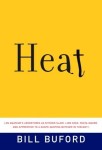
Heat by Bill Buford (2006)
(20 Books of Summer, #19) The long subtitle gives you an outline of the contents: “An Amateur’s Adventures as Kitchen Slave, Line Cook, Pasta-Maker, and Apprentice to a Dante-Quoting Butcher in Tuscany.” If Buford’s name sounds familiar, it’s because he was the founding editor of Granta magazine and publisher at Granta Books, but by the time he wrote this he was a staff writer for the New Yorker.
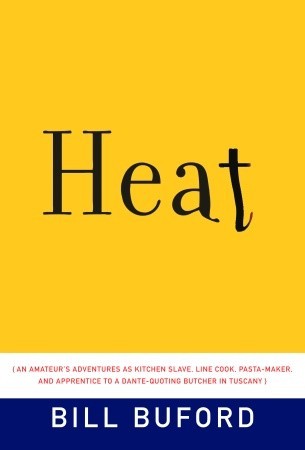 Mario Batali is the book’s presiding imp. In 2002–3, Buford was an unpaid intern in the kitchen of Batali’s famous New York City restaurant, Babbo, which serves fancy versions of authentic Italian dishes. It took 18 months for him to get so much as a thank-you. Buford’s strategy was “be invisible, be useful, and eventually you’ll be given a chance to do more.”
In between behind-the-scenes looks at frantic or dull sessions of food prep (“after you’ve made a couple thousand or so of these little ears [orecchiette pasta], your mind wanders. You think about anything, everything, whatever, nothing”), Buford traces Batali’s culinary pedigree through Italy and London, where Batali learned from the first modern celebrity chef, Marco Pierre White, and gives pen portraits of the rest of the kitchen staff. At first only trusted with chopping herbs, the author develops his skills enough that he’s allowed to work the pasta and grill stations, and to make polenta for 200 for a benefit dinner in Nashville.
Later, Buford spends stretches of several months in Italy as an apprentice to a pasta-maker and a Tuscan butcher. His obsession with Italian cuisine is such that he has to know precisely when egg started to replace water in pasta dough in historical cookbooks, and is distressed when the workers at the pasta museum in Rome can’t give him a definitive answer. All the same, the author never takes himself too seriously: he knows it’s ridiculous for a clumsy, unfit man in his mid-forties to be entertaining dreams of working in a restaurant for real, and he gives self-deprecating accounts of his mishaps in the various kitchens he toils in:
to stir the polenta, I was beginning to feel I had to be in the polenta. Would I finish cooking it before I was enveloped by it and became the darkly sauced meaty thing it was served with?
Compared to Kitchen Confidential, I found this less brash and more polished. You still get the sense of macho posturing from a lot of the figures profiled, but of course this author is not going to be in a position to interrogate food culture’s overweening masculinity. However, he does take a stand in support of small-scale food production:
Small food: by hand and therefore precious, hard to find. Big food: from a factory and therefore cheap, abundant. Just about every preparation I learned in Italy was handmade and involved learning how to use my own hands differently. … Food made by hand is an act of defiance and runs contrary to everything in our modernity. Find it; eat it; it will go.
This is exactly what I want from food writing: interesting nuggets of trivia and insight, a quick pace, humor, and mouthwatering descriptions. If the restaurant world lures you at all, you must read this one.
- Nice connections with my other summer reading: there are mentions of both Eric Asimov and Ruth Reichl visiting Babbo in their capacity as food critics for the New York Times.
- This also induced a weird case of reverse déjà vu: a book I reviewed last summer for BookBrowse, Hungry by Jeff Gordinier, is so similar that it must have been patterned on Heat: the punchy one-word title; a New York journalist follows an internationally known chef (in that case, René Redzepi) and surveys culinary trends.
 I was delighted to learn that this year Buford released a sequel of sorts, this one about French cuisine: Dirt. It’s on my wish list.
Source: From my dad
My rating: 
The Gospel of Trees by Apricot Irving (2018)
(20 Books of Summer, #20) Irving’s parents were volunteer missionaries to Haiti between 1982 and 1991, when she was aged six to 15. Her father, Jon, was trained as an agronomist, and his passion was for planting trees to combat the negative effects of deforestation on the island (erosion and worsened flooding). But in a country blighted by political unrest, AIDS and poverty, people can’t think long-term; they need charcoal to light their stoves, so they cut down trees.
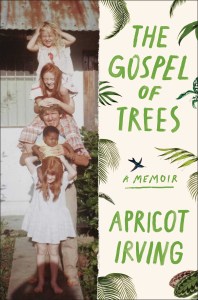 Along with an agricultural center, the American Baptist missionaries were closely associated with a hospital, Hôpital le Bon Samaritain, run by amateur archaeologist Dr. Hodges and his family. Although Apricot and her two younger sisters were young enough to adapt easily to life in a developing country, they were disoriented each time the family returned to California in between assignments. Their bonds were shaky due to her father’s temper, her parents’ rocky relationship, and the jealousy provoked over almost adopting a Haitian baby girl.
Irving drew on letters and cassette tape recordings, newsletters, and journals (her parents’ and her own) to recreate the decade in Haiti and the years since. This debut book was many years in the making – she started the project in 2001. “I inherited my father’s anger and his perfectionism. Haiti was a wound, an unhealed scab that I was afraid to pick open. But I knew that unless I faced that broken history, my own buried grief, like my father’s, would explode ways I couldn’t predict.”
She and her parents returned to the country after the 2010 earthquake: they were volunteers with a relief organization, while she reported for the This American Life radio program. I loved the ambivalent portrait of Haiti and, especially, of Jon, but couldn’t muster up much interest in secondary characters, hoped for more discussion of (loss of) faith, and thought the book about 80 pages too long. Irving writes wonderfully, though, especially when musing on Haiti’s pre-Columbian history; I’d gladly read a nature book about her life in Oregon, or a novel – in tone this reminded me of The Poisonwood Bible.
Some favorite lines:
If, like my father, you suffer from a savior complex, Haiti is a bleak assignment, but if you are able to enter it unguarded, shielded only by curiosity, you will find the sorrows entangled with a defiant joy.
My family had moved to Haiti to try to help, but instead, we learned our limitations. Failure can be a wise friend. We felt crushed at times; found it difficult to breathe; and yet the experience carved into each of us an understanding of loss, the weight of compassion. We learned how small we were when measured against the world’s great sorrow.
Source: Bargain book from Amazon last year
My rating: 
And a DNF:
 We Were the Mulvaneys by Joyce Carol Oates (oats!)
I gave up after 38 pages. I’ve long meant to try Oates, but her oeuvre is daunting. An Oprah’s Book Club selection seemed like a safe bet. I found the quirky all-American family saga approach somewhat similar to John Irving or Richard Russo, but Judd’s narration is annoyingly perky, and already I was impatient to find out what happened to his sister Marianne on Valentine’s Day 1976. I’ll give it a few years and try again. In the meantime, maybe I’ll try Oates in a different genre.
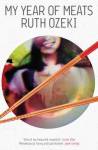
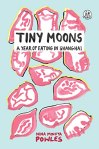
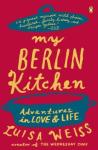
Looking back, Heat was the clear highlight of my 20 Books, closely followed by My Year of Meats by Ruth Ozeki. I also really enjoyed the foodoirs by Anthony Bourdain, Nina Mingya Powles and Luisa Weiss. It’s funny how much I love foodie lit given that I don’t cook. As Alice Steinbach puts it, “while we all like to eat, we like it more when someone else does the cooking.”
 Of course, not all of my selections were explicitly food-related; others simply had food words in their titles (or, as above, in the author’s name). Of these, my favorite was a reread, Ella Minnow Pea. Ideally, I would not have had to include my two skims and one partial read in the total, but I ran out of time in August to substitute in three more books. I’m happy enough with my showing this year, but next time I plan to build in more flexibility – or cheating, whichever you wish to call it – to ensure that I manage 20 solid reads.
I already have a color theme planned for 20 Books of Summer 2021! Here are 15 books that I own, mostly fiction, that would fit the bill:
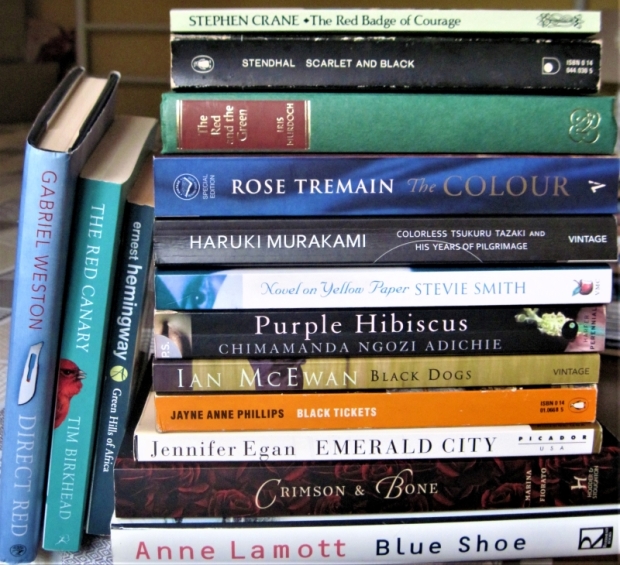
As wildcard selections and/or substitutes, I will also allow:
- Books with “light”, “dark”, or “bright” in the title
- Kindle or library books, though I’d like the focus to remain on print books I own.
- If I’m really stuck, book covers/jackets in a rainbow of colors. I’ll skip orange because Penguin paperbacks are too plentiful in my book collection, but I have some nice red, yellow, green, blue, purple and pink covers to choose from.
20 Books of Summer: Bourdain, Ozeki and More
Over halfway through the summer and my numbers are looking poor. It’s not that I’m not reading a ton – in general, I am – it’s just that I’m having trouble finishing any foodie books. I’m in the middle of two food-related memoirs plus Cakes and Ale by W. Somerset Maugham, and have recently started buddy-reading Mother’s Milk by Edward St Aubyn with Annabel, so more reviews will be along eventually, but I predict August will be a scramble.
Today I review an in-your-face tell-all about the life of a chef, and a novel set between Japan and the United States that exposes the seamy side of meat production. A lite road trip and an iffy California classic follow as bonuses.
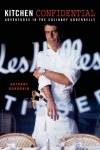
Kitchen Confidential: Adventures in the Culinary Underbelly by Anthony Bourdain (2000)
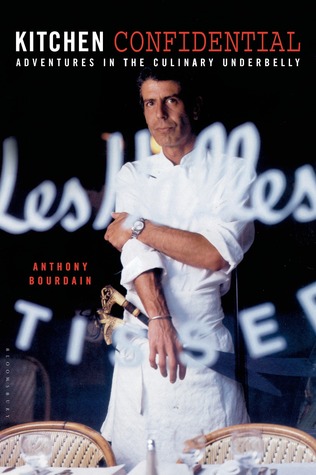 (20 Books of Summer, #5) “Get that dried crap away from my bird!” That random line about herbs is one my husband and I remember from a Bourdain TV program and occasionally quote to each other. It’s a mild curse compared to the standard fare in this flashy memoir about what really goes on in restaurant kitchens. His is a macho, vulgar world of sex and drugs. In the “wilderness years” before he opened his Les Halles restaurant, Bourdain worked in kitchens in Baltimore and New York City and was addicted to heroin and cocaine. Although he eventually cleaned up his act, he would always rely on cigarettes and alcohol to get through ridiculously long days on his feet.
From “Appetizer” to “Coffee and a Cigarette,” the book is organized like a luxury meal. Bourdain charts his development as a chef, starting with a childhood summer in France during which he ate vichyssoise and oysters for the first time and learned that food “could be important … an event” and describing his first cooking job in Provincetown and his time at the Culinary Institute of America. He also discusses restaurant practices and hierarchy, and home cook cheats and essentials. (I learned that you should never order fish in a restaurant on a Monday – it’ll be left over from Thursday’s order.) The pen portraits of his crazy sous-chef and baker are particularly amusing; other subjects include a three-star chef he envies and the dedicated Latino immigrants who are the mainstay of his kitchen staff.
My dad is not a reader but he is a foodie, and he has read Bourdain’s nonfiction (and watched all his shows), so I felt like I was continuing a family tradition in reading this. I loved my first taste of Bourdain’s writing: he’s brash, passionate, and hilariously scornful of celebrity chefs and vegetarianism (“the enemy of everything good and decent in the human spirit, an affront to all I stand for, the pure enjoyment of food”). Being in charge of a restaurant sounds manic, yet you can see why some would find it addictive. How ironic, though, to find a whole seven references to suicide in this book. Sometimes he’s joking; sometimes he’s talking about chefs he’s heard about who couldn’t take the pressure. Eighteen years after this came out, he, too, would kill himself.
(See also this article about rereading Bourdain in the 20th anniversary year of Kitchen Confidential.)
Source: Local swap shop (free)
My rating: 
(These two are linked by a late chapter in the Bourdain, “Mission to Tokyo,” in which he advises on a new Les Halles offshoot in Japan and gorges himself on seafood delights.)
My Year of Meats by Ruth Ozeki (1998)
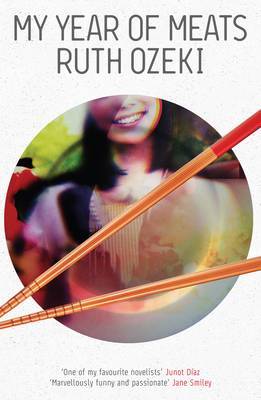 (20 Books of Summer, #6) I don’t know what took me so long to read another novel by Ruth Ozeki after A Tale for the Time Being, one of my favorite books of 2013. This is nearly as fresh, vibrant and strange. Set in 1991, it focuses on the making of a Japanese documentary series, My American Wife, sponsored by a beef marketing firm. Japanese American filmmaker Jane Takagi-Little is tasked with finding all-American families and capturing their daily lives – and best meat recipes. The traditional values and virtues of her two countries are in stark contrast, as are Main Street/Ye Olde America and the burgeoning Walmart culture.
There is a clear message here about cheapness and commodification, but Ozeki filters it through the wrenching stories of two women with fertility problems: Jane, whose reproductive system was damaged by DES, a synthetic estrogen her mother took during pregnancy to prevent a miscarriage; and Akiko, the wife of Jane’s boss, who struggles with an eating disorder and domestic violence.
Jane starts sneaking controversial subjects into her shoots: a lesbian couple, a family formed by interracial adoption, and a five-year-old who has already undergone puberty due to the hormones used on her family’s cattle feedlot. What is “natural,” and what gets branded alien or invasive? From the kudzu that strangles the South to a murdered Japanese exchange student, Ozeki probes the related issues of nativism and racism. Her two protagonists’ stories – one in the first person; the other in the third person – come together in a surprising manner as Jane decides that she has a more pressing obligation than creating a diverting television show.
This is a bold if at times discomforting novel. At first it brought to mind the exaggerated comedy of Julian Barnes’s England, England and Jane Smiley’s Moo, but as it grew darker it reminded me more of Han Kang’s The Vegetarian. It’s tricky, when a work of fiction tackles ethical or environmental matters, to balance storytelling and consciousness-raising, but Ozeki pulls it off with style. The only aspect that didn’t mean much to me, perhaps simply because of my unfamiliarity, was the excerpts from The Pillow Book of Shōnagon. How sad to think that I only have one more Ozeki awaiting me, All Over Creation. She averages a book every 5‒10 years; we can only hope that another is on the way soon.
Source: Charity shop
My rating: 
I picked up another two food-adjacent books that didn’t work for me, though I ended up skimming them to the end.
America Unchained: A Freewheeling Roadtrip in Search of Non-Corporate USA by Dave Gorman (2008)
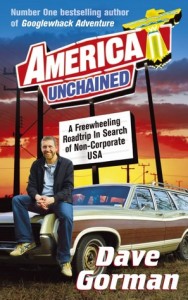 (20 Books of Summer, #7) I read the first couple of chapters, in which he plans his adventure, and then started skimming. I expected this to be a breezy read I would race through, but the voice was neither inviting nor funny. I also hoped to find more about non-chain supermarkets and restaurants – that’s why I put this on the pile for my foodie challenge in the first place – but, from a skim, it mostly seemed to be about car trouble, gas stations and fleabag motels. The only food-related moments are when Gorman (a vegetarian) downs three fast food burgers and orders of fries in 10 minutes and, predictably, vomits them all back up; and when he stops at an old-fashioned soda fountain for breakfast.
Source: Free bookshop
Tortilla Flat by John Steinbeck (1935)
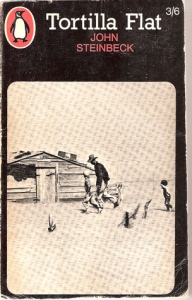 (20 Books of Summer, #8) I read the first 25 pages and then started skimming. This is a story of a group of friends – paisanos, of mixed Mexican, Native American and Caucasian blood – in Monterey, California. During World War I, Danny serves as a mule driver and Pilon is in the infantry. When discharged from the Army, they return to Tortilla Flat, where Danny has inherited two houses. He lives in one and Pilon is his tenant in the other (though Danny will never see a penny in rent). They’re a pair of loveable scamps, like Huck Finn all grown up, stealing wine and chickens left and right.
Steinbeck novels seem to fall into two camps for me. This is one of his inconsequential, largely unlikable novellas (like The Pearl and The Red Pony, which I studied in school – I’m lucky they didn’t put me off Steinbeck forever), whereas The Grapes of Wrath and East of Eden are masterful. It may also have something to do with the slight air of condescension towards characters of a different race: Steinbeck renders their speech with “thee” and “thou,” trying to imitate a Romance language’s informal pronouns, but it feels dated and alienating.
Source: Free bookshop
These Days
It’s mid-September and crunch time: my husband intends to hand in a complete draft of his PhD thesis next week. He’s been studying part time while working full time and technically has another year to submit, but this month is his self-imposed deadline before the frantic busyness of a new academic year. For weeks now, he’s been going to campus just once or twice a week, working mostly at home out of a makeshift office in our summer house, to which he reels an extension lead each morning so he can plug in his laptop and desk lamp. There’s no Internet signal that far from the house, so it’s a distraction-free zone – or at least the distractions are mostly pleasant ones like birdsong and the cat padding in and out. He’s been known to stay out there until well past 10 at night working on his writing and mapping.
It’s been nice for me to have a bit of company at home during the day (though it’s definitely for the best that we work in different spaces). We reconvene for morning coffee and afternoon tea and also break for lunch. Twice a day I’ll traipse out to the summer house with a tray of hot drinks and snacks and a tote bag of books over my shoulder to spend an hour or so relaxing before getting back to my proofreading or other work upstairs. I’ve tried to be kind and supportive through all the catastrophic announcements about the results being wrong, the statistics going screwy, and the project being basically impossible to finish.
On a practical level, I help out by preparing very simple meals – bean burgers from the freezer section at Aldi plus homemade coleslaw and corn-on-the-cob; fresh oven chips with a fried egg and steamed broccoli – or at least doing the sous chef chopping for complicated ones. My husband cooked for himself during his last two years of uni and enjoys improvising meals, so he’s done pretty much all the cooking for the 11+ years of our marriage. When I was in America I picked up a “Vidalia Chop Wizard” from Bed Bath & Beyond. Some will be thinking “what a pointless, cheaty device!” – but I knew without it I’d never get more involved in cooking, especially because I hate to have lingering savory smells on my fingers.

It’s been a stressful couple of months for my husband, and that stress has of course spilled over to me somewhat. Still, I’m trying not to wish these days away, even as I look forward to the relief of his thesis being finished. It’s never good to wish your life away. I even tried to do some peaceful sitting in nature (i.e., our garden) last week, which led to this short Guardian Country Diary-style piece. (However, you’d better believe I have plans for the post-PhD evenings and weekends. After all these weeks of letting my hubby off the hook, the chores have piled up. I envision a deep clean of the kitchen, tidying up all the little half-finished projects that are sitting around, gardening, banking, and much more.)
This past Saturday we gave ourselves the day off to attend Newbury Real Ale Festival. It’s held just across the canal from our house, so we could hardly pass up the opportunity to sample 146 beers and 118 ciders (my tipple of choice). The music was terrible but the weather stayed decent for much of the five hours we were there. Along with plenty of reading and snacking on crisps, I had the chance to try six ciders, which ranged from the almost undrinkable (beetroot and orange flavor sounded interesting!) to the sublime.


Appropriately enough, the best of the bunch was from Thistly Cross, a cider company based in Scotland: next Wednesday, to celebrate (we hope) the thesis being handed in, we’re off to Edinburgh for a long weekend. It’s something of a work trip for my husband – he’s traveling on to the Cairngorms for a two-day PhD student workshop while I stay behind at our Airbnb – but we’ll have a couple of days to enjoy the city together as well as two very long train rides on which to sink into books.
You’ll be unsurprised to learn that I started planning what books I’d pack weeks ago: some on a train theme; some by or about Scottish writers; some set in Scotland. I’ll also take at least one October review book (probably Barbara Kingsolver’s Unsheltered or Sarah Perry’s Melmoth) and one of the multiple library reservations that have arrived for me all at once (most likely John Boyne’s A Ladder to the Sky or Melissa Harrison’s All Among the Barley).

I’ve been to Edinburgh twice before, but both trips were brief and the most recent one was in 2005. What should I see and do? Where should I eat? (I’ll have to find at least one meal out in the city on my own.) I plan to visit the Writers’ Museum for the first time, and may drop into the National Gallery again. Since I was too skint to do so in my early twenties, I’ll probably also treat myself to a tour of the Castle (though, 17 quid – really?!). Any other recommendations of secondhand bookshops, cafés, free/inexpensive attractions and casual dining establishments will be much appreciated!
Rebecca Stott, Duke Special & More at Greenbelt 2018
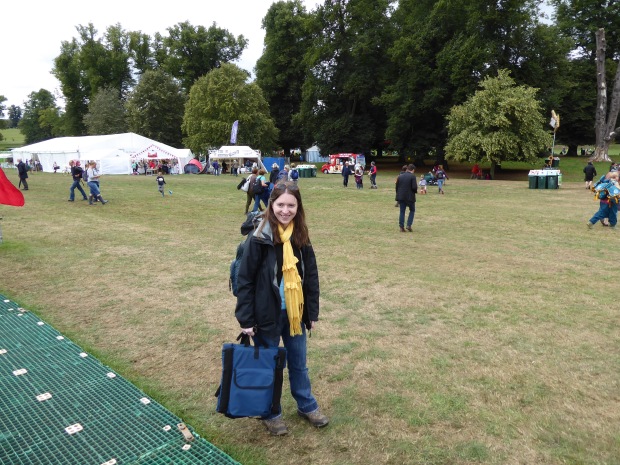
After five years away, we finally made it back to Greenbelt, a progressive Christian summer arts festival held on the grounds of Boughton House, on the Bank Holiday. The festival is a mixture of talks, music, performances and more, and given how much we’d paid and how far we’d traveled just for the one day, we tried to pack in as much as possible.

We started the day with “Beyond Forgiveness,” a presentation by Jo Berry and Pat Magee. Berry’s father, a Tory MP, was killed when the IRA bombed the Conservative Party conference in Brighton in 1984. Magee spent 14 years in prison for his role in the bombing. When he got out of jail, he met Berry at her request and they talked and listened to each other for several hours. For the first time, Magee said, he could see her father as a real person and realized that the IRA had been just as guilty of dehumanizing and misrepresenting people as the English were. Berry, too, felt that “I’d met my enemy and seen his humanity.” The two have now shared a stage more than 200 times, speaking about the value of empathy in healing broken relationships while also addressing imbalances of power that lead to violence.
To my surprise, cookery displays and musical comedy seemed to be the order of the day. A model kitchen is a new addition to the festival, giving celebrity chefs hour-long sessions to demonstrate a particular dish. Jack Monroe, promoting her new book Cooking on a Bootstrap, cooked a sausage lasagna. She made us all laugh with her idea of “the inverse sausage fallacy” – the cheaper a sausage is, the better it tastes because of all the salt, sugar and spices added to cheaper bits of meat. She started writing recipes when she was a single mother on the dole, and so she encouraged audience members to donate nice things you would like to eat, as well as everyday hygiene products, to food banks. For a “What Vegans Eat” session, Brett Cobley (aka EpiVegan) made a pea and asparagus risotto and answered questions about protein sources, egg replacements, plant milks and harder-to-find ingredients.
Uproarious musical comedy came in the form of Harry & Chris, who made up impromptu raps about New Year’s Day, the Teletubbies and phobias, and Flo & Joan, who sang about divorce statistics, unnecessary inventions for women, and sex robots (the show was fairly crude and came with an 18+ warning). The overall musical highlight of the day was Duke Special, a Greenbelt favorite we’ve seen play quite a number of times now. His pop combines his smooth Belfast tenor with music hall and Big Band stylings, and his songs are often drawn from poetry and 1920s–40s songbooks. His latest project, Hallow, is a beautiful set of Michael Longley poems set to music. He played “Another Wren” and “Emily Dickinson” from that album, various covers (including two bizarre ditties by Ivor Cutler), and crowd favorites “Last Night I Nearly Died,” “Freewheel” and “Our Love Goes Deeper than This.” We also sampled performances by Martyn Joseph, Wallis Bird and CC Smugglers.
Duke Special was a good bridge between music and literature. From the literature program I also saw Rabbi Jonathan Wittenberg speak on “Things My Dog Has Taught Me about Being a Better Human,” the title of his recent book. (His dog Mitzpah had a special dispensation to join him on stage; no animals are allowed on site otherwise!) The rabbi spoke about lessons in listening, attention, trust and seizing the moment. Mitzi and his previous dog Safi have also given him a connection with the rest of creation. Although he lives in the London suburbs and has an inner-city synagogue, they have accompanied him on long walks in Scotland and Germany. Wittenberg was a warm and witty speaker and I very much liked the sound of his book. It could make a good follow-up to The Power of Dog.
My other festival highlight was Rebecca Stott, in conversation with Radio 4 presenter Malcolm Doney. I read her Costa Prize-winning memoir In the Days of Rain: A daughter. A father. A cult in April and it’s been one of my stand-out reads of the year so far. The book conveys a huge amount of information about the Exclusive Brethren and Stott’s family history but never loses sight of what is most important: what it was like to be in a cult and have your life defined by its rules and its paranoia about the outside world. Stott remembers 6 a.m. Sunday communion services and her constant terror of being left behind in the Rapture.
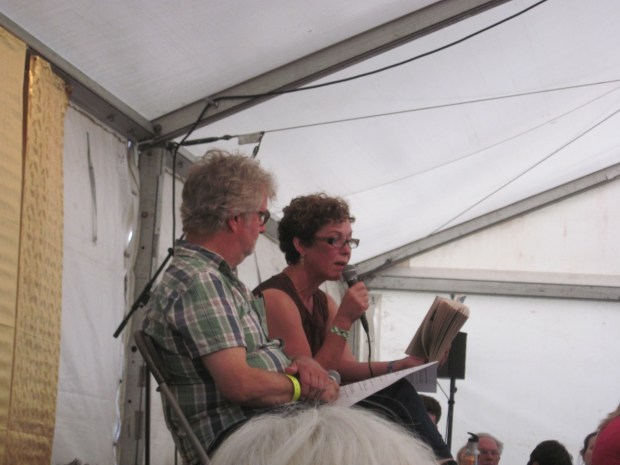
Rebecca Stott reading from In the Days of Rain.
Unfortunately, the talk didn’t add much to my experience of reading her book. The interviewer, catering to those who haven’t read the book yet, led her through her whole story bit by bit, and because I’d read it fairly recently it was all familiar. However, Stott spoke wonderfully and was full of wry compassion for her younger self. I was most interested to hear about the book’s aftermath: she’s received 300 letters from ex-Brethren that her daughter is transcribing to send to a Brethren Church archive in Manchester. When asked during a Q&A where she sees cult tendencies today, she mentioned Trump supporters!


Whereas I read In the Days of Rain from the library, I happen to own two Stott books I haven’t read yet, so I cheekily brought along my paperback of Ghostwalk for signing. She was intrigued to see the older cover design and told me she thinks the prose style in her debut novel is much richer than in Rain, and she hopes I’ll like it. I thanked her for the talk, told her how much I’d enjoyed her memoir, and recommended her two books vaguely about cults: Educated by Tara Westover, which she already knew well, having done some events with Westover, and The Incendiaries by R.O. Kwon, which was new to her (my blog tour review is coming up on Monday). I caught myself using the word “brilliant” three times in speaking about Stott’s work and these other books – nuance and vocabulary alike clearly go out the window when nervously speaking to admired authors!
Some readers of this blog would have been delighted by the event I rushed to straight after Stott’s talk: Jon McGregor giving readings from Reservoir 13, with Sigur Rós-esque backing and interlude music from Haiku Salut. I heard about the police reconstruction with actors from Manchester, and collecting bilberries on the heath in August. Unfortunately, I found it just as dull read aloud as I did when I tried the book last year, and I left early.
During bits of down time I pulled out a Katherine Mansfield story collection I found in a charity shop last week and read “Bank Holiday” and “The Garden Party.” The former is a very short piece whose carnival atmosphere rises to a note of indeterminate striving:
“And up, up the hill come the people, with ticklers and golliwogs, and roses and feathers. Up, up they thrust into the light and heat, shouting, laughing, squealing, as though they were being pushed by something, far below, and by the sun, far ahead of them – drawn up into the full, bright, dazzling radiance to…what?”
 It was my first time reading the famous “The Garden Party,” which likewise moves from a blithe holiday mood into something weightier. The Sheridans are making preparations for a lavish garden party dripping with flowers and food. Daughter Laura is dismayed when news comes that a man from the cottages has been thrown from his horse and killed, and thinks they should cancel the event. Everyone tells her not to be silly; of course it will go on as planned. The story ends when, after visiting his widow to hand over leftover party food, she unwittingly sees the man’s body and experiences an epiphany about the simultaneous beauty and terror of life. “Don’t cry,” her brother says. “Was it awful?” “No,” she replies. “It was simply marvellous.” Mansfield is especially good at first and last paragraphs. I’ll read more by her someday.
 Bookish Beck = Rebecca Foster. American transplant to England. Freelance proofreader and book reviewer.
 Bookish Beck