The Best Books from the First Half of 2021
Hard to believe we’ve already crossed the midpoint of the year. My top 20 releases of 2021 thus far, in alphabetical order within genre (fiction is dominating this year!), are below. I link to those I’ve already reviewed in full here or on Goodreads:
Fiction
 Under the Blue by Oana Aristide: Fans of Station Eleven, this one’s for you: the best dystopian novel I’ve read since Mandel’s. Aristide started writing in 2017, and unknowingly predicted a much worse pandemic than Covid-19. In July 2020, Harry and sisters Ash and Jessie are among mere thousands of survivors worldwide. Their plan is to flee England for Uganda, out of range of Europe’s at-risk nuclear reactors. An epic road trip ensues. A propulsive cautionary tale that also reminded me of work by Louisa Hall and Maja Lunde.
 The Push by Ashley Audrain: Blythe Connor, living alone with her memories, ponders what went wrong with her seemingly perfect family: a handsome architect husband, Fox, and their daughter Violet and baby son Sam. How much of what happened was because of Violet’s nature, and how much was Blythe’s fault for failing to be the mother the girl needed? The fact that her experience with Sam was completely different makes her feel ambivalent about motherhood. A cracking psychological thriller with an unreliable narrator.
 A Lie Someone Told You About Yourself by Peter Ho Davies: Davies’ minimalist approach – short sections skating over the months and years, wryly pulling out representative moment – crystallizes fatherhood, illuminating its daily heartaches and joys. The tone is just right in this novella, showing both sides of parenthood and voicing things you aren’t allowed to think, or at least not to admit to, starting with abortion, which would-be fathers aren’t expected to have strong feelings about. I loved the rumination on the role that chance plays in a life.
 The Living Sea of Waking Dreams by Richard Flanagan: Extinction, personal and global, is at the heart of this timely and enchanting story. It starts off as a family drama. Francie, the 86-year-old matriarch, is in a Tasmanian hospital after a brain bleed. Her three middle-aged children can’t bear to let her go. In an Australia blighted by bushfires, species loss mirrors Francie’s physical and mental crumbling. Smartphone addiction threatens meaningful connection. And then characters start to literally disappear, part by part…
 Mrs Death Misses Death by Salena Godden: Grief Is the Thing with Feathers meets Girl, Woman, Other would be my marketing shorthand for this one. Poet Salena Godden’s debut novel is a fresh and fizzing work, passionate about exposing injustice but also about celebrating simple joys, and in the end it’s wholly life-affirming despite a narrative stuffed full of deaths real and imagined. The novel balances the cosmic and the personal through Wolf’s family story. Unusual, musical, and a real pleasure to read.
 Early Morning Riser by Katherine Heiny: This tickled my funny bone. A cross between Kitchens of the Great Midwest and Olive Kitteridge, it’s built of five extended episodes, crossing nearly two decades in the lives of Jane and Duncan and lovingly portraying the hangers-on who compose their unusual family constellation in Boyne City, Michigan. All the characters are incorrigible but wonderful. Bad things happen, but there’s a core of love as Heiny explores marriage and parenting. A good-natured book that feels wise and bittersweet.
 No One Is Talking About This by Patricia Lockwood: This starts as a flippant skewering of modern life. A woman who became a social media star by tweeting quips like “Can a dog be twins?” reflects on life on “the portal” and under “the dictator.” Midway through the book, she gets a wake-up call when her mother summons her back to the Midwest for a family emergency. It’s the about-face that makes this novel, forcing readers to question the value of a digital existence based on glib pretence. Funny, but with an ache behind it.
 In by Will McPhail: Alternately laugh-out-loud funny and gentle. This debut graphic novel is a spot-on picture of modern life in a generic city. Nick never knows the right thing to say. The bachelor artist’s well-intentioned thoughts remain unvoiced; all he can manage is small talk. That starts to change when he meets Wren, a Black doctor who sees past his pretence. If only he can find the magic words that elicit honesty, he might make real connections with other human beings. A good old-fashioned story, with a wide emotional range.
 Detransition, Baby by Torrey Peters: A sparkling, sexy comedy with a tender heart beneath the zingers. Peters has set herself up as the Jane Austen of the trans community, tracing the ins and outs of relationships with verve and nuance. For me this was a valuable book simply for normalizing trans sexuality. The themes are universal, after all: figuring out who you are and what the shape of your life will be. I admire when authors don’t pander to readers by making things easy for those who are unfamiliar with a culture. Great lines abound.
 Brood by Jackie Polzin: Polzin’s debut is a quietly touching story of a woman in the Midwest raising chickens and coming to terms with the shape of her life. The unnamed narrator is Everywoman and no one at the same time. At one point she reveals, with no fanfare, that she miscarried four months into pregnancy in the bathroom of one of the houses she cleans. There is a bittersweet tone to this short work. It’s a low-key, genuine portrait of life in the in-between stages and how it can be affected by fate or by other people’s decisions.
Nonfiction
 The Circling Sky by Neil Ansell: Hoping to reclaim an ancestral connection, Ansell visited the New Forest some 30 times between January 2019 and January 2020, observing the unfolding seasons and the many uncommon and endemic species its miles house. He weaves together his personal story, the shocking history of forced Gypsy relocation into forest compounds starting in the 1920s, and the unfairness of land ownership in Britain. The New Forest is a model of both wildlife-friendly land management and freedom of human access.
 The Inevitable by Katie Engelhart: Engelhart spends time with doctors and patients who are caught up in the assisted dying argument, chiefly in Western Europe and the United States. Each case is given its own long chapter, like an extended magazine profile. The stories are wrenching, but compassionately told. The author explores the nuances of each situation, crafting expert portraits of suffering people and the medical professionals who seek to help them, and adding much in the way of valuable context. A voice of reason and empathy.
 The Screaming Sky by Charles Foster: A Renaissance man as well versed in law and theology as he is in natural history, Foster is obsessed with swifts and ashamed of his own species: for looking down at their feet when they could be watching the skies; for the “pathological tidiness” that leaves birds and other creatures no place to live. He delivers heaps of information on the birds but refuses to stick to a just-the-facts approach. The book quotes frequently from poetry and the prose is full of sharp turns of phrase and whimsy.
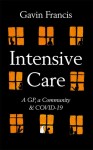 Intensive Care by Gavin Francis: Francis, an Edinburgh physician, reflects on “the most intense months I have known in my twenty-year career.” He journeys back through 2020, from the January day when he received a bulletin about a “novel Wuhan coronavirus” to November, when he learned of promising vaccine trials but also a rumored third wave and winter lockdown. An absorbing first-hand account of a medical crisis, it compassionately bridges the gap between experts and laymen. The best Covid chronicle so far.
 A Still Life by Josie George: Over a year of lockdowns, many of us became accustomed to spending most of the time at home. But for Josie George, social isolation is nothing new. Chronic illness long ago reduced her territory to her home and garden. The magic of A Still Life is in how she finds joy and purpose despite extreme limitations. Opening on New Year’s Day and travelling from one winter to the next, the book is a window onto George’s quiet existence as well as the turning of the seasons. (Reviewed for TLS.)
 Dusk, Night, Dawn by Anne Lamott: Lamott’s best new essays in nearly a decade. The central theme is how to have hope in God and in other people even when the news – Trump, Covid, and climate breakdown – only heralds the worst. One key thing that has changed for her is getting married for the first time, in her mid-sixties, to a Buddhist. In thinking of marriage, she writes about friendship, constancy, and forgiveness, none of which comes easy. Opportunities for maintaining quiet faith in spite of the circumstances arise all the time.
 A Braided Heart by Brenda Miller: Miller, a professor of creative writing, delivers a master class on the composition and appreciation of autobiographical essays. In 18 concise pieces, she tracks her development as a writer and discusses the “lyric essay”—a form as old as Seneca that prioritizes imagery over narrative. These innovative and introspective essays, ideal for fans of Anne Fadiman, showcase the interplay of structure and content. (Coming out on July 13th from the University of Michigan Press. My first review for Shelf Awareness.)
 Sanctuary by Emily Rapp Black: A continuation of The Still Point of the Turning World, about the author’s son Ronan, who died of Tay-Sachs disease at age three. In the months surrounding his death, she split from her husband and raced into another relationship that led to her daughter, Charlie. Rapp Black questions the sorts of words she got branded with: “brave,” “resilient.” Sanctuary is full of allusions and flashbacks, threading life’s disparate parts into a chaotic tapestry. It’s measured and wrought, taming fire into light and warmth.
Poetry
 Pilgrim Bell by Kaveh Akbar: An Iranian American poet imparts the experience of being torn between cultures and languages, as well as between religion and doubt, in this gorgeous collection of confessional verse. Food, plants, animals, and the body supply the book’s imagery. Wordplay and startling juxtapositions lend lightness to a wistful, intimate collection that seeks belonging and belief. (Coming out on August 3rd from Graywolf Press. Reviewed for Shelf Awareness.)
 Eat or We Both Starve by Victoria Kennefick: In this audacious debut collection, the body is presented as a battleground: for the brain cancer that takes the poet’s father; for disordered eating that entwines with mummy issues; for the restructuring of pregnancy. Families break apart and fuse into new formations. Cannibalism and famine metaphors dredge up emotional states and religious doctrines. There’s a pleasingly morbid cast to the book, but it also has its lighter moments. Rich with imagery and alliteration, this is just my kind of poetry.
What are some of the best books you’ve read so far this year?
What 2021 releases do I need to catch up on right away?
Three June Releases: Allen-Paisant, Cowen and Mosse
Two poetry offerings and a short memoir this month. A similar strategy is at work in both verse volumes: Jason Allen-Paisant contrasts Jamaica and England via the medium of trees, and Rob Cowen comments on current events through the prism of the natural world. In Kate Mosse’s first nonfiction book, she reflects on bereavement and caregiving.
Thinking with Trees by Jason Allen-Paisant
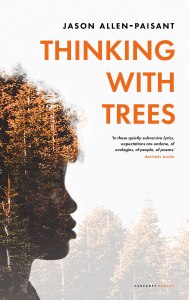 Allen-Paisant, from Jamaica and now based in Leeds, describes walking in the forest as an act of “reclamation.” For people of colour whose ancestors were perhaps sent on forced marches, hiking may seem strange, purposeless (the subject of “Black Walking”). Back in Jamaica, the forest was a place of utility rather than recreation:
In Porus life was un-
pastoral
The woodland was there
not for living in going for walks
or thinking
Trees were answers to our needs
not objects of desire
woodfire
But “I give myself permission / to go outside,” he writes, to notice the turning of the seasons, to commune with trees and birds, even if “there is nobody else like me / around here”. Explicitly calling into question Wordsworth’s model of privileged wandering, he injects a hint of threat into his interactions with nature. Most often this is symbolized by the presence of dogs. Even the most idyllic of scenes harbours the possibility of danger.
beware of spring
believe you are
a sprout of grass
and love all you see
but come out of the woods
before the white boys
with pitbulls
come
The poet cites George Floyd and Christian Cooper, the Central Park birder a white woman called the police on, as proof that being Black outdoors is inherently risky. There’s no denying this is an important topic, but I found the poems repetitive, especially the references to dogs. These felt like overkill. While there is some interesting enjambment, as in the first extended quote above, as well as internal and half-rhymes, I tend to prefer more formal poetry that uses more sonic techniques and punctuation. Still, I would be likely to direct fans of Kei Miller’s work to this collection.
With thanks to Carcanet Press for the free copy for review.
The Heeding by Rob Cowen
This poetry and art collaboration arose out of a “pact to pay attention” during a year of lockdown in the UK and record observations of nature, current events, and everyday life. Cowen is drawn to the moors near his home in Yorkshire, but also yearns to spend time with his friends again. He watches hawks and blue tits, notices the insects that fill his garden, and celebrates the way that allotment gardening brings together all sorts of people.
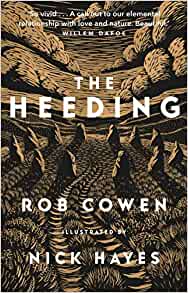 The emotional scope of the poems is broad: the author fondly remembers his brick-making ancestors and his honeymoon; he sombrely imagines the last moments of an old man dying in a hospital; he expresses guilt over accidentally dismembering an ant, yet divulges that he then destroyed the ants’ nest deliberately. There are even a couple of cheeky, carnal poems, one about a couple of teenagers he caught copulating in the street and one, “The Hottest Day of the Year,” about a longing for touch. “Matter,” in ABAB stanzas, is on the theme of racial justice by way of the Black Lives Matter movement.
My two favourites were “Sunday School,” about the rules for life he’s lived by since leaving religion behind, and “The End of This (Drinking Poem),” which serves as a good-riddance farewell to 2020: “Let me shake off / this year the way the otter / slips out of fast, rising water / and makes the holt just in time … / Let me rid my days of caution and fear, / these protocols and tiers / and Zoom funerals for people I love / and will never see again.” The book is worth the price of admission for the latter alone, and Nick Hayes’s black-and-white woodcut-style engravings are a plus.
However, in general I felt that the balance of current events and nature was off, especially compared to books like The Consolation of Nature, and ultimately I was not convinced that this needed to be in verse at all. “Starling,” especially, feels like a straight knockoff of Robert Macfarlane’s The Lost Words (“We forget that you once shimmered through frozen air, ripple bird. / Shape-shifter, dusk-dancer. Murmurer, sky-writer”). Judging from Cowen’s Common Ground, this would have been more successful as a book of short prose diary entries with a few poems dotted through.
With thanks to Elliott & Thompson for the proof copy for review.
An Extra Pair of Hands: A Story of Caring, Ageing and Everyday Acts of Love by Kate Mosse
Mosse’s parents and mother-in-law all moved in to live with her and her husband in their Chichester home when they reached old age. Her father had Parkinson’s and died in 2011, her mother survived him by a few years, and Granny Rosie is still going (reasonably) strong at the age of 90. This is a compact and relatable account of a daughter’s experiences of caregiving and grief, especially with the recent added complications of a pandemic.
 What came through particularly clearly for me was the older generation’s determination to not be a burden: living through the Second World War gave them a sense of perspective, such that they mostly did not complain about their physical ailments and did not expect heroic measures to be made to help them. (Her father knew his condition was “becoming too much” to deal with, and Granny Rosie would sometimes say, “I’ve had enough of me.”) In her father’s case, this was because he held out hope of an afterlife. Although Mosse does not share his religious beliefs, she is glad that he had them as a comfort.
The author recognizes the ways in which she has been lucky: as a full-time writer, she works from home and has the time and energy to devote to caring for elderly parents, whereas for many – generally middle-aged women, who may still have children at home – it is a huge struggle to balance caregiving with the rest of life. What is more, money is no issue for her. Repeating some of the statistics from Madeleine Bunting’s Labours of Love, she acknowledges that the situation is much more challenging for the average person.
I can see how this could serve as a great introduction for someone who hasn’t previously read much about bereavement, caregiving or old age, and I imagine it will especially appeal to existing fans of Mosse’s writing, whereas I was new to her work. I’ve read so much around these topics, including most of the works included in the bibliography, that the book did not offer me anything new, though it was a perfectly pleasant read.
Readalikes I have reviewed:
Notes on Grief by Chimamanda Ngozi Adichie
Be With by Mike Barnes
All Things Consoled by Elizabeth Hay
The Fragments of My Father by Sam Mills
With thanks to Profile Books/Wellcome Collection for the free copy for review.
What recent releases can you recommend?
An Embarrassment of Riches at the (Digital) Hay Festival 2021
There was a phenomenal program for this year’s digital Hay Festival. I signed up to a whopping eight events and enjoyed them all. If you missed watching live, it’s not too late to donate and catch up on the archived talks. For three of these, the host-cum-interviewer appeared in person on a studio stage, with the guest(s) joining, perhaps from thousands of miles away, on a large screen mounted on the wall behind them. I thought this was a neat hybrid approach. The rest of my sessions had interviewer and interviewee appearing remotely on a split screen. Let me know which, if any, events you attended and how you found them.
Richard Flanagan
Flanagan’s The Living Sea of Waking Dreams is my novel of 2021 so far (my review), so it was a delight to hear him say more (and in that fantastic accent) about it in the course of a conversation with Stephanie Merritt. Tasmania, where he lives, had always seemed like an ark for species, but now they are vanishing. Ninety percent of the kelp forest has disappeared within the last 20 years because of warming oceans; there are only 300 swift parrots remaining; and the bushfires of 2018–19 were unprecedented in severity. Although he had already roughed out the novel by the time of the fires, Flanagan said he rewrote it in response to the sense of accelerating environmental collapse.

The novel’s twin themes are species extinction and personal extinction, with an elderly family matriarch being kept alive at all costs. Flanagan spoke of the “evasions of the soul” that make us ignore the environmental losses around us and refuse to die – “the final avoidance of life.” He thinks the pandemic has forced people to rethink these ideas and ponder the meaning of life. At age 21, he nearly drowned while kayaking, and ever since he has been frightened not of death, but of the pain of dying. He is not optimistic per se, but hopeful because the world is still so beautiful – on the island he goes to for writing, he is surrounded by wild creatures.
Merritt asked about the novel’s magic realist element and how stylistically different his novels have been from each other. He was glad she found the book funny, as “life is tragicomic.” In an effort not to get stuck in a rut, he deliberately ‘breaks the mould’ after each book and starts over. This has not made him popular with his publisher!
Three take-aways:
- The one obligation of a writer? “Not to be boring.”
- Novels are not about messages; “that’s what Twitter is for.”
- “To despair is rational, but to hope is the very essence of what it means to be human.”
Rachel Clarke interviewing Jim Down and Michael Rosen
All three authors have written books about the coronavirus pandemic (I have reviewed Clarke’s Breathtaking and Rosen’s Many Different Kinds of Love). Clarke said that the belief foundational to the NHS is that all lives have equal value, but as an ICU doctor Down found that the question of who would benefit most from the use of ventilation was creeping in as there was a risk that there would be more patients than there was equipment to treat them with. With decisions needing to be made very quickly, his hospital adopted the “three wise people” collaborative method. The element that often felt lost, however, was the patient’s wishes, since they might be unresponsive and no family or other visitors were around.

Rosen, who contracted Covid-19 in March 2020 and was in an induced coma for six weeks, included letters from his medical team in his book to give a 360° view of NHS treatment. He thinks of the NHS as being almost in the role of parents, giving altruistic care and support. “Tell the truth about herd immunity” was his pithy message to the government. He read the poem “These Are the Hands,” which he wrote for the 60th anniversary of the NHS, to close.


Bryan Washington and Raven Leilani
 Last year’s Dylan Thomas Prize winner interviewed this year’s winner, and it was clear that the mutual admiration was strong. Though I had mixed feelings about Luster (my review), I was blown away by this high-level intellectual discussion. Both authors are invested in the debate around what it means to be a Black artist. Leilani said she did not want to make concessions in the form of Edie comporting herself better; this character is open about her wants, giving the novel a libidinal flavour. She said she almost envies her protagonist her autonomy, and thinks of the novel as a letter to her old self, granting permission and reassuring herself that “the mess has merit.”

Three take-aways:
- Writing offers Leilani a sanctuary or sense of control.
- While Washington sees works full of strife, grief, and malice as most likely to be considered the pinnacle of American literary fiction, he admires Luster for its theme of communion (especially via the character Akila).
- Leilani sees her novel as being in conversation with Queenie, Sula, The New Me, and Detransition, Baby.
Maggie Shipstead
 Shipstead (also a Dylan Thomas Prize winner) echoed something Leilani had said: that she starts a novel with questions, not answers. Such humility is refreshing, and a sure way to avoid being preachy in fiction. Her new novel, Great Circle, is among my most anticipated books of the year and tells the stories of a fictional female pilot from the golden age of aviation and the actress playing her in a biopic. The book was long in the gestation: In 2012 Shipstead saw a sculpture commemorating a female pilot in Auckland, and in 2014 she started researching. She came to appreciate the miracle of flight and read many books by and about female pilots. The book is dedicated to her brother, recently retired from 20 years in the Air Force. She told Sameer Rahim that, although she used to say this is not a love story, she has since changed her mind.

Three take-aways:
- Shipstead was a competitive show jumper and applied to a creative writing program on a whim.
- She has made a name for herself as a travel writer, too, often combining magazine assignments with her research for the novel (e.g., various trips to Antarctica).
- While she has appreciated the year off from Covid, she is looking forward to getting back to travelling; her first booking is a women’s wilderness experience in Alaska.
Patricia Lockwood
Lockwood is the only novelist to be included on the Atlantic’s roster of best tweets. She and Nina Stibbe, who interviewed her, agreed that 1) things aren’t funny when they try too hard and 2) the Internet used to be a taboo subject for fiction – producing time-stamped references that editors used to remove. “I had so many observations and I didn’t know where to put them,” Lockwood said, and it seems to her perverse to not write about something that is such a major part of our daily lives. The title of her Women’s Prize-shortlisted novel, No One Is Talking About This (my review), refers to many things, including this reticence to grant the Internet a place in our discourse.

Lockwood said she has been delighted by the high-quality literary pieces coming out about her book, often in comparison with Lauren Oyler’s Fake Accounts. The timing of the publication meant that her initial (U.S.) media interviews ended up being more about Trump than she would have liked. “I think I’m not a natural fiction writer,” she said; it’s true that the novel is so autobiographical it can only be described as autofiction – the second half is all true and all sincere, she was careful to point out – but it’s a gem.
Julianne Pachico
 Like Lockwood, Pachico was part of the “10 @ 10” series featuring debut novelists (though her first book, the linked story collection The Lucky Ones, was marketed as a novel in the USA). Her new book, The Anthill, another of my most anticipated books of the year, is about a young woman returning to Medellín, Colombia, where Pachico spent her formative years. Although she is not a citizen and only goes back on a tourist visa, it feels like going home each time. For her, writing fiction has been a way of sorting out her feelings about the place. She wrote 50,000 words of the novel at her sister’s apartment in Medellín. Pachico told Rosie Goldsmith that, though she considers herself part of the Latin American literary tradition, she is conscious of presenting the country to English-speaking readers: a politically divided place that has gentrified in pockets, but is still plagued by extreme poverty and hardship. She described The Anthill as “a ghost story without ghosts.” I can’t wait to dive into my copy.

Brit Bennett
 Speaking to Arifa Akbar about The Vanishing Half, Bennett admitted that she was worried a historical setting was a cop-out, but reassured herself that she was not writing out of nostalgia and that she did not allow readers a sense of distance – the characters are so ordinary that we know we’d do the same sorts of things. She thinks of passing as a distinctly American project of self-reinvention but acknowledged that we have no definitive statistics on it because, if someone succeeds, they disappear. Some of Stella’s psychology – a very interior character who makes decisions that are difficult to understand – came from her reading of Playing Dead by Elizabeth Greenwood. She loves writing about small towns because they force people to interact with each other. Akbar noted that passing is a double-edged sword, involving subterfuge but also offering liberation (e.g. for a trans character later in the book).

Three take-aways:
- “That’s the most exciting place to be, writing into a mystery.”
- “Race is a fiction, but racism is a reality.”
- An HBO adaptation is in the works, but Bennett doesn’t know if it will cast real twins, two actors, or meld separate people using CGI.
Rachel Cusk and Sheila Heti
 I’ve read more of and gotten on better with Heti’s work than Cusk’s, so this was a rare case of being perhaps more interested in interviewer than interviewee. Heti said that, compared with the Outline trilogy, Cusk’s new novel Second Place feels wilder and more instinctual. Cusk, speaking from the Greek island of Tinos, where she is researching marble quarrying, described her book in often vague yet overall intriguing terms: it’s about exile and the illicit, she said; about femininity and entitlement to speak; about the domestic space and how things are legitimized; about the adoption of male values and the “rightness of the artist.”

Ironically, given that Cusk initially hesitated over revealing her debt to Mabel Dodge Luhan’s memoir Lorenzo in Taos, much of the discussion ended up revolving around Luhan and D.H. Lawrence, about whom Cusk now considers herself an amateur scholar. In his personal writings he reserved special scorn for Luhan, with whom he stayed in New Mexico in the 1920s. This was something Cusk wanted to explore: misogyny and Luhan’s “voice of obscurity.” She hopes that her book will contribute to a better understanding of Luhan’s; not vice versa.
Three take-aways:
- A reviewer noted the use of exclamation points, counting 189 of them in the novel. Cusk equates an exclamation point to a laying down of arms – proof that someone (especially her protagonist, M) means to be nonthreatening.
- Cusk thinks of this book as being like a play: staged and in the moment.
- A woman observing but not being noticed is, like in the Outline trilogy, Cusk’s basic framework.
20 Books of Summer 2021 (Colour Theme) & Other Reading Plans
It’s my fourth year participating in Cathy’s 20 Books of Summer challenge. Three years ago, I read only books by women; two years ago, I did an animal theme; last year, all my choices were related to food and drink. This year it’s all about colour: the word colour, or one mentioned in a title or in an author’s name, or – if I get really stuck – a particularly vibrant one on a book cover. My options range from short stories to biography, with a couple of novels in translation and a couple of children’s classics to reread on the piles.
As usual, I will prioritize books from my own shelves, but this time I will also allow myself to include library and/or Kindle reads. For instance, I have a hold placed on Nothing but Blue Sky by Kathleen MacMahon, which was on the Women’s Prize longlist.
Here are the initial stacks I’m choosing from:

 One that’s not pictured but that I definitely plan to read and review over the summer is God Is Not a White Man by Chine McDonald, which came out earlier this month.
Tomorrow I’m flying out to the USA as my mother is getting remarried in mid-June. I’m not completely at ease about travelling, especially as on this occasion it has involved expensive private Covid testing and quarantine periods at either end, but I am looking forward to the fun aspects of travel, like downtime in an airport with nothing to do but read. For this purpose, the first two books for my challenge that I’ve packed are the novel Purple Hibiscus by Chimamanda Ngozi Adichie and the short story collection Emerald City by Jennifer Egan.


This week and next, the Hay Festival is taking place. I went nuts and booked myself onto eight different literary talks, three of which have already aired, with two more coming up this evening. Then there will be a few to keep me occupied during my first few days of quarantine next week. It’s a fantastic program and all the online events are free (though you can donate), so do take a look if you haven’t already. I’ll try to write up at least some of these events.

Liz’s Anne Tyler readalong is continuing throughout this year, and I happen to own one novel that’s scheduled for each of the next three months: Saint Maybe for June, A Patchwork Planet for July, and An Amateur Marriage for August. The last two I’ll be rescuing from boxes in my sister’s basement.
I always like reading with the seasons, so this is my summery stack:

I’ll start with Three Junes. Others I will contemplate getting out from the library include Heatstroke by Hazel Barkworth, The Summer before the Dark by Doris Lessing, and August by Callan Wink.
 In mid-June I’m on the blog tour for Mary Jane by Jessica Anya Blau, a novel that’s perfect for the season’s reading – nostalgic for a teen girl’s music-drenched 1970s summer, and reminiscent of Curtis Sittenfeld’s work.
I have also managed to amass a bunch of books about fathers and fatherhood, so I’ll do at least one “Three on a Theme” post to tie in with Father’s Day.
Are you joining in the summer reading challenge? What’s the first book on the docket?
Do you spy any favourites on my piles? Which ones should I be sure to read?
Recommended May Releases: Adichie, Pavey and Unsworth
Three very different works of women’s life writing: heartfelt remarks on bereavement, a seasonal diary of stewarding four wooded acres in Somerset, and a look back at postnatal depression.
Notes on Grief by Chimamanda Ngozi Adichie
This slim hardback is an expanded version of an essay Adichie published in the New Yorker in the wake of her father’s death in June 2020. With her large family split across three continents and coronavirus lockdown precluding in-person get-togethers, they had a habit of frequent video calls. She had seen her father the day before on Zoom and knew he was feeling unwell and in need of rest, but the news of his death still came as a complete shock.
 Adichie anticipates all the unhelpful platitudes people could and did send her way: he lived to a ripe old age (he was 88), he had a full life and was well respected (he was Nigeria’s first statistics professor), he had a mercifully swift end (kidney failure). Her logical mind knows all of these facts, and her writer’s imagination has depicted grief many times. Still, this loss blindsided her.
She’d always been a daddy’s girl, but the anecdotes she tells confirm how special he was: wise and unassuming; a liberal Catholic suspicious of materialism and with a dry humour. I marvelled at one such story: in 2015 he was kidnapped and held in the boot of a car for three days, his captors demanding a ransom from his famous daughter. What did he do? Correct their pronunciation of her name, and contradict them when they said that clearly his children didn’t love him. “Grief has, as one of its many egregious components, the onset of doubt. No, I am not imagining it. Yes, my father truly was lovely.” With her love of fashion, one way she dealt with her grief was by designing T-shirts with her father’s initials and the Igbo words for “her father’s daughter” on them.
I’ve read many a full-length bereavement memoir, and one might think there’s nothing new to say, but Adichie writes with a novelist’s eye for telling details and individual personalities. She has rapidly become one of my favourite authors: I binged on most of her oeuvre last year and now have just one more to read, Purple Hibiscus, which will be one of my 20 Books of Summer. I love her richly evocative prose and compassionate outlook, no matter the subject. At £10, this 85-pager is pricey, but I was lucky to get it free with Waterstones loyalty points.
Favourite lines:
“In the face of this inferno that is sorrow, I am callow and unformed.”
“How is it that the world keeps going, breathing in and out unchanged, while in my soul there is a permanent scattering?”
Deeper Into the Wood by Ruth Pavey
 In 1999 Ruth Pavey bought four acres of scrubland at auction, happy to be returning to her family’s roots in the Somerset Levels and hoping to work alongside nature to restore some of her land to orchard and maintain the rest in good health. Her account of the first two decades of this ongoing project, A Wood of One’s Own, was published in 2017.
In this sequel, she gives peaceful snapshots of the wood throughout 2019, from first snowdrops to final apple pressing, but also faces up to the environmental degradation that is visible even in this pocket of the countryside. “I am sure there has been a falling off in numbers of insects, smaller birds and rabbits on my patch,” she insists. Without baseline data, it is hard to support this intuition, but she has botanical and bird surveys done, and invites an expert in to do a moth-trapping evening. The resulting species lists are included as appendices. In addition, Pavey weaves a backstory for her land. She meets a daffodil breeder, investigates the source of her groundwater, and visits the head gardener at the Bishop’s Palace in Wells, where her American black walnut sapling came from. She also researches the Sugg family, associated with the land (“Sugg’s Orchard” on the deed) from the 1720s.
 Pavey aims to treat this landscape holistically: using sheep to retain open areas instead of mowing the grass, and weighing up the benefits of the non-native species she has planted. She knows her efforts can only achieve so much; the pesticides standard to industrial-scale farming may still be reaching her trees on the wind, though she doesn’t apply them herself. “One sad aspect of worrying about the state of the natural world is that everything starts to look wrong,” she admits. Starting in that year’s abnormally warm January, it was easy for her to assume that the seasons can no longer be relied on.
Compared with her first memoir, this one is marked by its intellectual engagement with the principles and practicalities of rewilding. Clearly, her inner struggle is motivated less by the sense of ownership than by the call of stewardship. While this book is likely be of most interest to those with a local connection or a similar project underway, it offers a universal model of how to mitigate our environmental impact. Pavey’s black-and-white sketches of the flora and fauna on her patch, reminiscent of Quentin Blake, are a highlight.
With thanks to Duckworth for the proof copy for review. The book will be published tomorrow, the 27th of May.
After the Storm: Postnatal Depression and the Utter Weirdness of New Motherhood by Emma Jane Unsworth
The author’s son was born on the day Donald Trump won the U.S. presidential election. Six months later, she realized that she was deep into postnatal depression and finally agreed to get help. The breaking point came when, with her husband* away at a conference, she got frustrated with her son’s constant fussing and pushed him over on the bed. He was absolutely fine, but the guilty what-ifs proliferated, making this a wake-up call for her.
 In this succinct, wry and hard-hitting memoir, Unsworth exposes the conspiracies of silence that lead new mothers to lie and pretend that everything is fine. Since her son’s traumatic birth (which I first read about in Dodo Ink’s Trauma anthology), she hadn’t been able to write and was losing her sense of self. To add insult to injury, her baby had teeth at 16 weeks and bit her as he breastfed. She couldn’t even admit her struggles to her fellow mum friends. But “if a woman is in pain for long enough, and denied sleep for long enough, and at the same time feels as though she has to keep going and put a ‘brave’ face on, she’s going to crack.”
The book’s titled mini-essays give snapshots into the before and after, but particularly the agonizing middle of things. I especially liked the chapter “The Weirdest Thing I’ve Ever Done in a Hotel Room,” in which she writes about borrowing her American editor’s room to pump breastmilk. Therapy, antidepressants and hiring a baby nurse helped her to ease back into her old life and regain some part of the party girl persona she once exuded – enough so that she was willing to give it all another go (her daughter was born late last year).
While Unsworth mostly writes from experience, she also incorporates recent research and makes bold statements of how cultural norms need to change. “You are not monsters,” she writes to depressed mums. “You need more support. … Motherhood is seismic. It cracks open your life, your relationship, your identity, your body. It features the loss, grief and hardship of any big life change.” I can imagine this being hugely helpful to anyone going through PND (see also my Three on a Theme post on the topic), but I’m not a mother and still found plenty to appreciate (especially “We have to smash the dichotomy of mums/non-mums … being maternal has nothing to do with actually physically being a mother”).
I’m attending a Wellcome Collection online event with Unsworth and midwife Leah Hazard (author of Hard Pushed) this evening and look forward to hearing more from both authors.
*It took me no time at all to identify him from the bare facts: Brighton + doctor + graphic novelist = Ian Williams (author of The Lady Doctor)! I had no idea. What a fun connection.
With thanks to Profile Books/Wellcome Collection for the free copy for review.
What recent releases can you recommend?
Recent BookBrowse & Shiny New Books Reviews, and Book Club Ado
Excerpts from and links to some of my recent online writing for other places:
BookBrowse
Three O’Clock in the Morning by Gianrico Carofiglio
 The quotation that gives Carofiglio’s tender novel its title is from F. Scott Fitzgerald’s The Crack-Up: “In a real dark night of the soul it is always three o’clock in the morning.” It lends an appropriate sense of time suspended, of earnest seeking and extreme circumstances: The main action of the book takes place over just a few days in June of 1983, when Italian teenager Antonio and his father are stranded in Marseilles while there for Antonio to be seen by an epilepsy specialist. The gift of this time outside of time allows them to get to know each other better, such that the memory of the trip will be precious to Antonio even decades later. I appreciated how the limited setting heightened this short novel’s emotions. Carofiglio invites readers to peer between the leisurely progression of events to see the bond that is being formed. (See my full review at BookBrowse. See also my related article on HarperVia, a new publishing imprint for international literature.)
The Dictionary of Lost Words by Pip Williams
 Inspired by the composition of the Oxford English Dictionary, this Australian debut novel explores the lives of the women on its fringes through the words that were omitted. The suffrage movement and World War I loom large as the storyline enters the 1910s. I most appreciated the relationships Esme has with the various women in her life. The main action spans the 40 years of the original composition of the OED. That scope means there is a lot of skipping forward in time. Especially in the first half, I longed for the narrative to slow down so I could spend more time with this character. Despite the first-person narration, I never felt I knew Esme very well. Women’s bonds and women’s words are strong themes in this forthrightly feminist novel that, despite its flaws, would make a great book club selection. (See my full review at BookBrowse. See also my reading list of books about dictionaries and lost words.)
Shiny New Books
Notes from Deep Time: The Hidden Stories of the Earth Beneath Our Feet by Helen Gordon
 To assess the place of humanity, we can look back to prehistory, but also forward to envision the “deep future.” (It was only in a late chapter on nuclear waste disposal sites and warning messages to the future that I found too much direct overlap with Footprints by David Farrier.) This engagingly blends both tactics, surveying the fields of geology and palaeontology and pondering the future traces of the Anthropocene. I most enjoyed the middle chapters, in which science meets wildlife and cultural studies. For instance, a chapter on ammonites leads into a profile of Mary Anning and the history of both fossil hunting and women in STEM careers. The prose is well pitched to the layman’s level. Interviews, travels, and snapshots from her own life generally keep the material from becoming too dry. An invigorating interdisciplinary tour. (See my full review at Shiny New Books.)
My book club has been meeting via Zoom since April 2020. This is a common state of affairs for book clubs around the world. Especially since we have 12 members (if everyone attends, which is rare), we haven’t been able to contemplate meeting in person as of yet. However, a subset of us meet midway between the monthly reads to discuss women’s classics like Marge Piercy’s Woman on the Edge of Time. For next week’s meeting on Mrs. Dalloway, we are going to attempt a six-person get-together in one member’s house.
 Anyway, a neat thing we did last month was a Zoom chat with the author: a BBC correspondent who happens to be the brother of one of our members. If you’re a news junkie in the UK, you may know the name Jon Sopel, though since I don’t have a telly or ever listen to radio, I hadn’t encountered him until this “in-person” meet-up. He has been the BBC’s North America Editor since 2014.
UnPresidented is the third book he wrote over the course of the Trump presidency. It started off as a diary of the 2020 election campaign, beginning in July 2019, but of course soon morphed into something slightly different: a chronicle of life in D.C. and London during Covid-19 and a record of the Trump mishandling of the pandemic. But as well as a farcical election process and a public health crisis, 2020’s perfect storm also included economic collapse and social upheaval – thanks to the murder of George Floyd and the subsequent Black Lives Matter protests worldwide plus isolated rioting.
UnPresidented served as a good reminder for me of the timeline of events and the full catalogue of outrages committed by Trump and his cronies. You just have to shake your head over the litany of ridiculous things he said and did, and got away with – any one of which might have sunk another president or candidate. The style is breezy and off-the-cuff, so the book reads quickly. There’s a good balance between world events and personal ones, with his family split across the UK and Australia. I appreciated the insight into differences from the British system. I thought it would be depressing reading back through the events of 2020, but for the most part the knowledge that everything turned out “right” allowed me to see the humour in it. Still, I found it excruciating reading about the four days following the election.

Sopel kindly gave us an hour of his time one Wednesday evening before he had to go on air and answered our questions about Biden, Harris, journalistic ethics, and more. He was charming and eloquent, as befits his profession.
Would any of these books interest you?
Spring Reading 2021: Birdsong, Cherry Blossom & More
It’s been a gorgeously sunny spring here – how about where you are? Although there have still been some frosty nights troubling the gardeners among us, it’s been warm in the daytime and the flowers and blossom are coming on apace.
Recently I’ve read a couple of books reflecting on the spring of 2020, specifically the opportunities it offered to reconnect with local nature at a time when we were isolated and couldn’t travel.
I’ve also been feeling nostalgic for Washington, D.C. and the Maryland suburbs, where I grew up. It’s been two years since my last trip back, but I’m holding out hope that I can make it over in June for a family wedding.
Rounding out my selection of “Spring” titles is an offbeat Japanese novella.
Looking back to the coronavirus spring:
On Thursday evening I watched “The Act of Nature Watching,” a special Earth Day Zoom talk for West Berkshire Libraries by local nature writer Nicola Chester, whose memoir is coming out in the autumn. The UK is one of the most nature-depleted countries, she lamented. We are hardwired to watch and love nature, she noted, yet have never been more alienated from it. Reading from her columns and anthology contributions (as well as the Lovatt, below) and giving tips on recognizing birdsong and mammal signs, she spoke of nature-watching as a form of mindfulness – an approach that chimed with the first three books I feature here.
Birdsong in a Time of Silence: An Awakening by Steven Lovatt (2021)
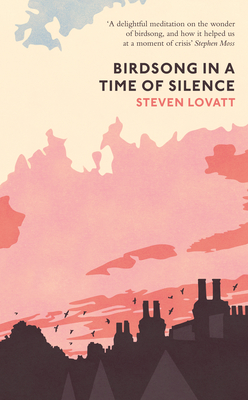 During the UK’s first lockdown, with planes grounded and cars stationary, many remarked on the quiet. All the better to hear birds going about their usual spring activities. For Lovatt, from Birmingham and now based in South Wales, it was the excuse he needed to return to his childhood birdwatching hobby. In between accounts of his spring walks, he tells lively stories of common birds’ anatomy, diet, lifecycle, migration routes, and vocalizations. (He even gives step-by-step instructions for sounding like a magpie.) Birdsong takes him back to childhood, but feels deeper than that: a cultural memory that enters into our poetry and will be lost forever if we allow our declining bird species to continue on the same trajectory.
Mentions of current events are sparse and subtle, so the spring feels timeless, as it should. I worried there might be too much overlap with A Sweet, Wild Note by Richard Smyth, but there’s room for both on your shelf. Lovatt’s writing is introspective and poetic, delighting in metaphors for sounds: “The song of a turtle dove is like the aural equivalent of a heat-haze, the gentlest corrugation of air, always just on the edge of your hearing.”
Skylarks with Rosie: A Somerset Spring by Stephen Moss (2021)
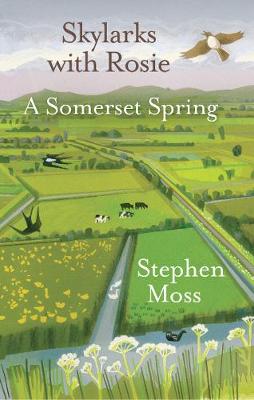 Lovatt must have been a pupil of Moss’s on the Bath Spa University MA degree in Travel and Nature Writing. The prolific Moss’s latest also reflects on the spring of 2020, but in a more overt diary format. Devoting one chapter to each of the 13 weeks of the first lockdown, he traces the season’s development alongside his family’s experiences and the national news. With four of his children at home, along with one of their partners and a convalescing friend, it’s a pleasingly full house. There are daily cycles or walks around “the loop,” a three-mile circuit from their front door, often with Rosie the Labrador; there are also jaunts to corners of the nearby Avalon Marshes. Nature also comes to him, with songbirds in the garden hedges and various birds of prey flying over during their 11:00 coffee breaks.
His speaking engagements and trips cancelled, Moss turns to online events instead. Twitter serves as a place for sharing outrage over UK politics and world events like George Floyd’s murder, but also as a welcoming community for sharing nature sightings. As the lockdown come to a close, he realizes that this time has had unexpected benefits: “Having to press the pause button … has made me rethink my life, in a good way.” He feels that, for once, he has truly appreciated the spring, “rediscovering the joys of wildlife-watching close to home”. This made for perfect reading in Somerset last week.
Also recommended: The Consolation of Nature by Marren, McCarthy and Mynott
Remembering springs back home:
Spring in Washington by Louis J. Halle (1947)
“The discovery of spring each year, after the winter’s hibernation, is like a rediscovery of the universe … knowledge of spring gives me the freedom of the world.”
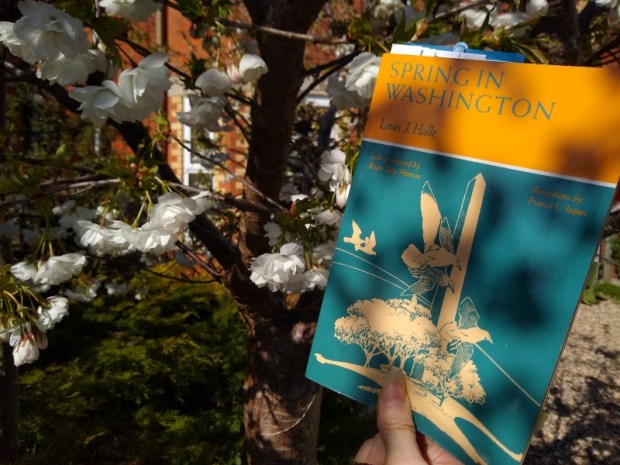 For Halle, who worked in the State Department, nature was an antidote to hours spent shuffling papers behind a desk. In this spring of 1945, there was plenty of wildfowl to see in central D.C. itself, but he also took long early morning bike rides along the Potomac or the C&O Canal, or in Rock Creek Park. From first migrant in February to last in June, he traces the spring mostly through the birds that he sees. More so than the specific observations of familiar places, though, I valued the philosophical outlook that makes Halle a forerunner of writers like Barry Lopez and Peter Matthiessen. He notes that those caught up in the rat race adapt the world to their comfort and convenience, prizing technology and manmade tidiness over natural wonders. By contrast, he feels he sees more clearly – literally as well as metaphorically – when he takes the long view of a landscape.
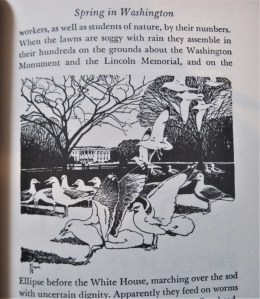 I marked so many passages of beautiful description. Halle had mastered the art of noticing. But he also sounds a premonitory note, one that was ahead of its time in the 1940s and needs heeding now more than ever: “When I see men able to pass by such a shining and miraculous thing as this Cape May warbler, the very distillate of life, and then marvel at the internal-combustion engine, I think we had all better make ourselves ready for another Flood.”
This was a lucky find at Hay Cinema Bookshop back in September. For me it was the ideal combination of thoughtful prose and vicarious travel, though I imagine it might not mean as much to those without a local connection. The black-and-white in-text illustrations by Francis L. Jaques are a particularly nice addition. 
Pussy cat, pussy cat, where have you been? I’ve been to Washington, and guess what I’ve seen… by Russell Punter and Dan Taylor (2019)
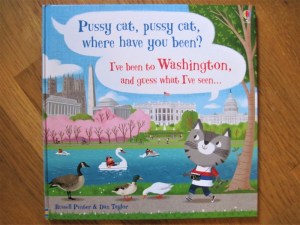 More cherry blossoms over tourist landmarks! This is part of a children’s series inspired by the 1805 English rhyme about London; other volumes visit New York City, Paris, and Rome. In rhyming couplets, he takes us from the White House to the Lincoln Memorial via all the other key sights of the Mall and further afield: museums and monuments, the Library of Congress, the National Cathedral, Arlington Cemetery, even somewhere I’ve never been – Theodore Roosevelt Island. Realism and whimsy (a kid-sized cat) together; lots of diversity in the crowd scenes. What’s not to like? (Titled Kitty cat, kitty cat… in the USA.)
And, as a bonus, some fiction in translation:
Spring Garden by Tomoka Shibasaki (2014; 2017)
[Translated from the Japanese by Polly Barton]
 Like a Murakami protagonist, Taro is a divorced man in his thirties, mildly interested in the sometimes peculiar goings-on in his vicinity. Rumor has it that his Tokyo apartment complex will be torn down soon, but for now the PR manager is happy enough here. “Avoiding bother was Taro’s governing principle.” But bother comes to find him in the form of a neighbor, Nishi, who is obsessed with a nearby house that was the backdrop for the art book Spring Garden, a collection of photographs of a married couple’s life. Her enthusiasm gradually draws Taro into the depicted existence of the TV commercial director and actress who lived there 25 years ago, as well as the young family who live there now. This Akutagawa Prize winner failed to hold my interest – like The Guest Cat, it’s oddly preoccupied with architectural detail, a Japanese fascination that doesn’t translate so well.
Have you been reading anything particularly appropriate for spring this year?
Recommended March Releases: Broder, Fuller, Lamott, Polzin
Three novels that range in tone from carnal allegorical excess to quiet, bittersweet reflection via low-key menace; and essays about keeping the faith in the most turbulent of times.
Milk Fed by Melissa Broder
Rachel’s body and mommy issues are major and intertwined: she takes calorie counting and exercise to an extreme, and her therapist has suggested that she take a 90-day break from contact with her overbearing mother. Her workdays at a Hollywood talent management agency are punctuated by carefully regimented meals, one of them a 16-ounce serving of fat-free frozen yogurt from a shop run by Orthodox Jews. One day it’s not the usual teenage boy behind the counter, but his overweight older sister, Miriam. Miriam makes Rachel elaborate sundaes instead of her usual abstemious cups and Rachel lets herself eat them even though it throws her whole diet off. She realizes she’s attracted to Miriam, who comes to fill the bisexual Rachel’s fantasies, and they strike up a tentative relationship over Chinese food and classic film dates as well as Shabbat dinners at Miriam’s family home.

If you’re familiar with The Pisces, Broder’s Women’s Prize-longlisted debut, you should recognize the pattern here: a deep exploration of wish fulfilment and psychological roles, wrapped up in a sarcastic and sexually explicit narrative. Fat becomes not something to fear but a source of comfort; desire for food and for the female body go hand in hand. Rachel says, “It felt like a miracle to be able to eat what I desired, not more or less than that. It was shocking, as though my body somehow knew what to do and what not to do—if only I let it.”
With the help of her therapist, a rabbi that appears in her dreams, and the recurring metaphor of the golem, Rachel starts to grasp the necessity of mothering herself and becoming the shaper of her own life. I was uneasy that Miriam, like Theo in The Pisces, might come to feel more instrumental than real, but overall this was an enjoyable novel that brings together its disparate subjects convincingly. (But is it hot or smutty? You tell me.)
With thanks to Bloomsbury for the proof copy for review.
Unsettled Ground by Claire Fuller
At a glance, the cover for Fuller’s fourth novel seems to host a riot of luscious flowers and fruit, but look closer and you’ll see the daisies are withering and the grapes rotting; there’s a worm exiting the apple and flies are overseeing the decomposition. Just as the image slowly reveals signs of decay, Fuller’s novel gradually unveils the drawbacks of its secluded village setting. Jeanie and Julius Seeder, 51-year-old twins, lived with their mother, Dot, until she was felled by a stroke. They’d always been content with a circumscribed, self-sufficient existence, but now their whole way of life is called into question. Their mother’s rent-free arrangement with the landowners, the Rawsons, falls through, and the cash they keep in a biscuit tin in the cottage comes nowhere close to covering her debts, let alone a funeral.

During the Zoom book launch event, Fuller confessed that she’s “incapable of writing a happy novel,” so consider that your warning of how bleak things will get for her protagonists – though by the end there are pinpricks of returning hope. Before then, though, readers navigate an unrelenting spiral of rural poverty and bad luck, exacerbated by illiteracy and the greed and unkindness of others. One of Fuller’s strengths is creating atmosphere, and there are many images and details here that build the picture of isolation and pathos, such as a piano marooned halfway to a derelict caravan along a forest track and Jeanie having to count pennies so carefully that she must choose between toilet paper and dish soap at the shop.
Unsettled Ground is set in a fictional North Wessex Downs village not far from where I live. I loved spotting references to local places and to folk music – Jeanie and Julius might not have book smarts or successful careers, but they inherited Dot’s love of music and when they pick up a fiddle and guitar they tune in to the ancient magic of storytelling. Much of the novel is from Jeanie’s perspective and she makes for an out-of-the-ordinary yet relatable POV character. I found the novel heavy on exposition, which somewhat slowed my progress through it, but it’s comparable to Fuller’s other work in that it focuses on family secrets, unusual states of mind, and threatening situations. She’s rapidly become one of my favourite contemporary novelists, and I’d recommend this to you if you’ve liked her other work or Fiona Mozley’s Elmet.
With thanks to Penguin Fig Tree for the proof copy for review.
Dusk, Night, Dawn: On Revival and Courage by Anne Lamott
These are Lamott’s best new essays (if you don’t count Small Victories, which reprinted some of her greatest hits) in nearly a decade. The book is a fitting follow-up to 2018’s Almost Everything in that it tackles the same central theme: how to have hope in God and in other people even when the news – Trump, Covid, and climate breakdown – only heralds the worst.
One key thing that has changed in Lamott’s life since her last book is getting married for the first time, in her mid-sixties, to a Buddhist. “How’s married life?” people can’t seem to resist asking her. In thinking of marriage she writes about love and friendship, constancy and forgiveness, none of which comes easy. Her neurotic nature flares up every now and again, but Neal helps to talk her down. Fragments of her early family life come back as she considers all her parents were up against and concludes that they did their best (“How paltry and blocked our family love was, how narrow the bandwidth of my parents’ spiritual lives”).

Opportunities for maintaining quiet faith in spite of the circumstances arise all the time for her, whether it’s a variety show that feels like it will never end, a four-day power cut in California, the kitten inexplicably going missing, or young people taking to the streets to protest about the climate crisis they’re inheriting. A short postscript entitled “Covid College” gives thanks for “the blessings of COVID: we became more reflective, more contemplative.”
The prose and anecdotes feel fresher here than in several of the author’s other recent books. I highlighted quote after quote on my Kindle. Some of these essays will be well worth rereading and deserve to become classics in the Lamott canon, especially “Soul Lather,” “Snail Hymn,” “Light Breezes,” and “One Winged Love.”
I read an advanced digital review copy via NetGalley. Available from Riverhead in the USA and SPCK in the UK.
Brood by Jackie Polzin

Polzin’s debut novel is a quietly touching story of a woman in the Midwest raising chickens and coming to terms with the shape of her life. The unnamed narrator is Everywoman and no one at the same time. As in recent autofiction by Rachel Cusk and Sigrid Nunez, readers find observations of other people (and animals), a record of their behaviour and words; facts about the narrator herself are few and far between, though it is possible to gradually piece together a backstory for her. At one point she reveals, with no fanfare, that she miscarried four months into pregnancy in the bathroom of one of the houses she cleans. There is a bittersweet tone to this short work. It’s a low-key, genuine portrait of life in the in-between stages and how it can be affected by fate or by other people’s decisions.
See my full review at BookBrowse. I was also lucky enough to do an interview with the author.
I read an advanced digital review copy via Edelweiss. Available from Doubleday in the USA. To be released in the UK by Picador tomorrow, April 1st.
What recent releases can you recommend?
Review Book Catch-Up: Fox, Le Riche, Nunez, and Thammavongsa
Today I have a book of poems about Covid lockdown and being autistic, a reprint of a vintage cookbook with a difference, the pinnacle of autofiction that I’ve found thus far, and a prize-winning collection of short stories about immigrants’ everyday challenges.
The Oscillations by Kate Fox (2021)
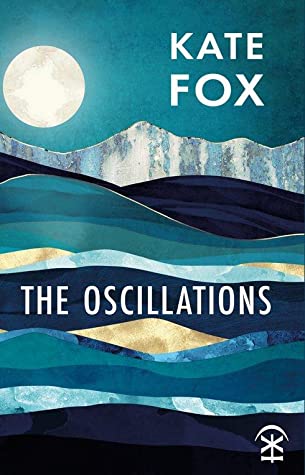 The first section, “After,” responds to the events of 2020; six of its poems were part of a “Twelve Days of Lockdown” commission. Fox remembers how sinister a cougher at a public event felt on 13th March and remarks on how quickly social distancing came to feel like the norm, though hikes and wild swimming helped her to retain a sense of possibility. I especially liked “Pharmacopoeia,” which opens the collection and looks back to the Black Death that hit Amsterdam in 1635 – “suddenly the plagues / are the most interesting parts / of a city’s history.” “Returns” plots her next trip to a bookshop (“The plague books won’t be in yet, / but the dystopia section will be well stocked / … I spend fifty pounds I no longer had last time, will spend another fifty next. / Feeling I’m preserving an ecology, a sort of home”), while “The Funerals” wryly sings the glories of a spring the deceased didn’t get to see.
The second section, “Before,” is more wide-ranging, responding to artworks, historical events, family situations, and more. Fox has been vocal about her ASD, which is the subject of “What Could Be Called Communication,” about some habits of the neurodivergent that you might recognize. I also liked “The Fruits,” which narrates the end of a pregnancy, and the closing poem, “Emergency” (“between us, / sometimes despite us / love spreads like a satellite signal, / like sea foam, / like spilt coffee on a counter top, / like home.”). That was one of the few places in the whole book where the language (alliteration and an end-rhyme) struck me; elsewhere, the themes felt more notable than the poetic techniques.
With thanks to Nine Arches Press for the proof copy for review.
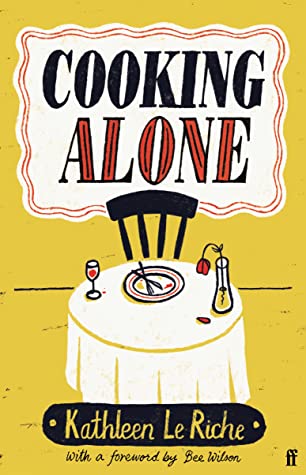
Eating Alone by Kathleen Le Riche (1954)
Recently reprinted as a facsimile edition by Faber, this was Le Riche’s third cookbook. It’s like no other cookbook I’ve read, though: It doesn’t list ingredients or, generally, quantities, and its steps are imprecise, more like suggestions. What it reads like is a set of short stories with incidental recipes. Le Riche had noted that people who live alone some or all of the time, for whatever reason, often can’t be bothered to cook for themselves properly. Through these old ladies, bachelors, career girls, and mothers with children off at school, she voices her ideas on shopping, food storage, simple cooking, and making good use of leftovers, but all through the medium of anecdote.
 For instance, “The Grass Widower,” while his wife is away visiting her mother, indulges his love of seafood and learns how to wash up effectively. A convalescent plans the uncomplicated meals she’ll fix, including lots of egg dishes and some pleasingly dated fare like “junket” and cherries in brandy. A brother and sister, students left on their own for a day, try out all the different pancakes and quick breads in their repertoire. The bulk of the actual meal ideas come in a chapter called “The Happy Potterer,” whom Le Riche styles as a friend of hers named Flora who wrote out all her recipes on cards collected in an envelope. I enjoyed some of the little notes to self in this section: appended to a recipe for kidney and mushrooms, “Keep a few back for mushrooms-on-toast next day for a mid-morning snack”; “Forgive yourself if you have to use margarine instead of butter for frying.”
I don’t think there are any recipes here that I would actually try to reproduce, though I may one day attempt the Grass Widower’s silver-polishing method (put a strip of aluminium foil and some “washing soda” (soda crystals?) in the sink and pour over some boiling water from the kettle; dip in the silver items, touching them to the foil, and watch the tarnish disappear like magic!). This was interesting as a cultural artefact, to see the meals and ingredients that were mainstays of the 1950s (evaporated milk, anyone?) and how people coped without guaranteed refrigeration. It’s also a good reminder to eat well no matter your circumstances.
With thanks to Faber for the free copy for review.
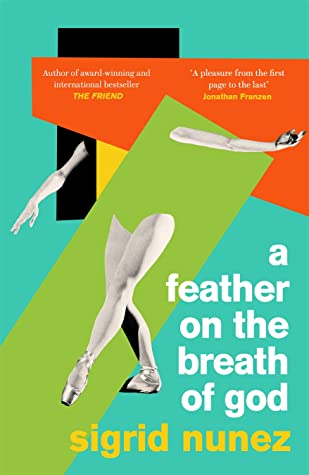
A Feather on the Breath of God by Sigrid Nunez (1995)
My third from Nunez, after The Friend and What Are You Going Through, and my most loved of her books thus far, cementing her as one of my favourite authors. Like the other two, it’s narrated by an unnamed woman who defines herself by the people she encounters and the experiences she has in an unforgiving but still somehow beautiful and funny old world. From the little I know of Nunez, this seems the closest to autofiction, especially in terms of her parental origins. The father, Chang, born in Panama and raised in China, immigrated to the USA at age 12. In Germany for war service, he met her mother, Christa, just after VE Day.
 Chang and Christa, the subjects of the book’s first two sections – accounting for about half the length – were opposites and had a volatile relationship. Their home in the New York City projects was an argumentative place the narrator was eager to escape. She felt she never knew her father, a humourless man who lost touch with Chinese culture. He worked on the kitchen staff of a hospital and never learned English properly. Christa, by contrast, was fastidious about English grammar but never lost her thick accent. An obstinate and contradictory woman, she resented her lot in life and never truly loved Chang, but was good with her hands and loved baking and sewing for her daughters.
Growing up, the narrator never knew quite what to make of her mixed, “exotic” background. For a time, she escaped into ballet, a tantalizingly female discipline that threw up a lot of issues: class pretensions, the eroticization of young girls and of pain, and eating disorders. When she went without solid food for days at a time, she felt she was approaching the weightlessness Saint Hildegard likened to being “a feather on the breath of God.” The final chapter, “Immigrant Love,” jumps ahead to when the narrator taught English as a foreign language and had an affair with Vadim, a married Russian taxi driver full of charisma but also of flaws. This finale is a brilliant twist on her parents’ situation, and a decision to teach English in China brings things full circle, promising a connection to her late father’s heritage.
The strategy of identifying the self by the key relationships and obsessions of a life struck me as spot on. This short novel punches above its weight, with profound observations on every page. Its specific situations are engaging, yet it speaks to the universals of how we cope with a troublesome past. “One wants a way of looking back without anger or bitterness or shame. One wants to be able to tell everything without blaming or apologizing,” Nunez writes, crystallizing her frank, wry approach. I’m eager to read all the rest of her oeuvre.
First published in the UK in 2021. With thanks to Virago Press for the free copy for review.
How to Pronounce Knife by Souvankham Thammavongsa (2020)
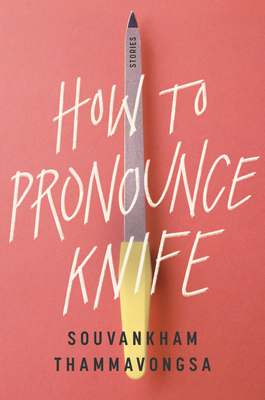 Thammavongsa pivoted from poetry to short stories and won Canada’s Giller Prize for this debut collection that mostly explores the lives of Laotian immigrants and refugees in a North American city. The 14 stories are split equally between first- and third-person perspectives, many of them narrated by young women remembering how they and their parents adjusted to an utterly foreign culture. The title story and “Chick-A-Chee!” are both built around a misunderstanding of the English language – the latter is a father’s approximation of what his children should say on doorsteps on Halloween. Television soaps and country music on the radio are ways to pick up more of the language. Farm and factory work are de rigueur, but characters nurture dreams of experiences beyond menial labour – at least for their children.
The stories are punchy: perfect snapshots of lives lived on the tightrope between expectation and despair. In “Mani Pedi,” Raymond is a former boxer who starts working at his sister’s nail salon and falls in love with a client. His sister warns him, “Don’t you be dreaming big now, little brother. Keep your dreams small. The size of a grain of rice.” In “Slingshot,” an older woman loses touch with her much younger lover, while in “The Gas Station,” Mary, a prim tax accountant, opens herself to love but ends up disappointed. The great-grandmother in “Ewwrrrkk” warns an eight-year-old that “I love you” pries open one’s legs like nothing else. “Randy Travis” and “Picking Worms” were probably my two overall favourites. Looking back, I have trouble remembering some of the individual stories. It’s not so much that they all blend into one, but that they form a cohesive whole. I’d recommend this even to readers who don’t normally pick up short stories, and will look out for more from this author.
Out in paperback on Thursday the 18th. With thanks to Bloomsbury for the free copy for review.
Would you be interested in reading one or more of these?
Recent Online Events: Melanie Finn, Church Times Festival, Gavin Francis
It’s coming up on the one-year anniversary of the first UK lockdown and here we are still living our lives online. The first hint I had of how serious things were going to get was when a London event with Anne Tyler I was due to attend in March 2020 with Eric and Laura T. was cancelled, followed by … everything else. Oh well.
This February was a bountiful month for online literary conversations. I’m catching up now by writing up my notes from a few more events (after Saunders and Ishiguro) that helped to brighten my evenings and weekends.
Melanie Finn in Conversation with Claire Fuller
(Exile in Bookville American online bookstore event on Facebook, February 2nd)
I was a big fan of Melanie Finn’s 2015 novel Shame (retitled The Gloaming), which I reviewed for Third Way magazine. Her new book, The Hare, sounds appealing but isn’t yet available in the UK. Rosie and Bennett, a 20-years-older man, meet in New York City. Readers soon enough know that he is a scoundrel, but Rosie doesn’t, and they settle together in Vermont. A contemporary storyline looking back at how they met contrasts the romantic potential of their relationship with its current reality.
 Fuller said The Hare is her favorite kind of novel: literary but also a page-turner. (Indeed, the same could be said of Fuller’s books.) She noted that Finn’s previous three novels are all partly set in Africa and have a seam of violence – perhaps justified – running through. Finn acknowledged that everyday life in a postcolonial country has been a recurring element in her fiction, arising from her own experience growing up in Kenya, but the new book marked a change of heart: there is so much coming out of Africa by Black writers that she feels she doesn’t have anything to add. The authors agreed you have to be cruel to your characters.
Finn believes descriptive writing is one of her strengths, perhaps due to her time as a journalist. She still takes inspiration from headlines. Now that she and her family (a wildlife filmmaker husband and twin daughters born in her forties) are rooted in Vermont, she sees more nature writing in her work. They recovered a clear-cut plot and grow their own food; they also forage in the woods, and a hunter shoots surplus deer and gives them the venison. Appropriately, she read a tense deer-hunting passage from The Hare. Finn also teaches skiing and offers much the same advice as about writing: repetition eventually leads to elegance.
I was especially interested to hear the two novelists compare their composition process. Finn races through a draft in two months, but rewriting takes her a year, and she always knows the ending in advance. Fuller’s work, on the other hand, is largely unplanned; she starts with a character and a place and then just writes, finding out what she’s created much later on. (If you’ve read her Women’s Prize-longlisted upcoming novel, Unsettled Ground, you, too, would have noted her mention of a derelict caravan in the woods that her son took her to see.) Both said they don’t really like writing! Finn said she likes the idea of being a writer, while Fuller that she likes having written – a direct echo of Dorothy Parker’s quip: “I hate writing. I love having written.” Their fiction makes a good pairing and the conversation flowed freely.
Church Times Festival of Faith and Literature, “Light in Darkness,” Part I
(February 20th)
I’d attended once in person, in 2016 (see my write-up of Sarah Perry and more), when this was still known as Bloxham Festival and was held at Bloxham School in Oxfordshire. Starting next year, it will take place in central Oxford instead. I attended the three morning events of Part I; there’s another virtual program taking place on Saturday the 17th of April.
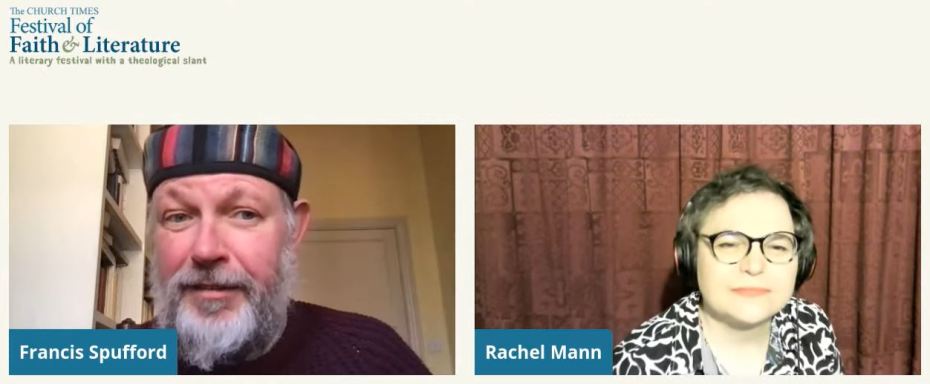
Rachel Mann on The Gospel of Eve
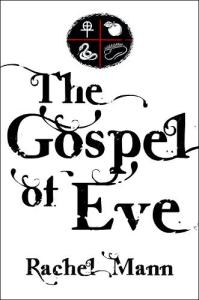 Mann opened with a long reading from Chapter 1 of her debut novel (I reviewed it here) and said it is about her “three favorite things: sex, death, and religion,” all of which involve a sort of self-emptying. Mark Oakley, dean of St John’s College, Cambridge, interviewed her. He noted that her book has been likened to “Dan Brown on steroids.” Mann laughed but recognizes that, though she’s a ‘serious poet’, her gift as a novelist is for pace. She’s a lover of thrillers and, like Brown, gets obsessed with secrets. Although she and her protagonist, Kitty, are outwardly similar (a rural, working-class background and theological training), she quoted Evelyn Waugh’s dictum that all characters should be based on at least three people. Mann argued that the Church has not dealt as well with desire as it has with friendship. She thinks the best priests, like novelists, are genuine and engage with other people’s stories.
Francis Spufford on Light Perpetual
Mann then interviewed Spufford about his second novel, which arose from his frequent walks to his teaching job at Goldsmiths College in London. A plaque on an Iceland commemorates a World War II bombing that killed 15 children in what was then a Woolworths. He decided to commit an act of “literary resurrection” – but through imaginary people in a made-up, working-class South London location. The idea was to mediate between time and eternity. “All lives are remarkable and exceptional if you look at them up close,” he said. The opening bombing scene is delivered in extreme slow motion and then the book jumps on in 15-year intervals, in a reminder of scale. He read a passage from the end of the book when Ben, a bus conductor who fell in love with a Nigerian woman who took him to her Pentecostal Church, is lying in a hospice bed. It was a beautiful litany of “Praise him” statements, a panorama of everyday life: “Praise him at food banks,” etc. It made for a very moving moment.
Mark Oakley on the books that got him through the pandemic
Oakley, in turn, was interviewed by Spufford – everyone did double duty as speaker and questioner! He mentioned six books that meant a lot to him during lockdown. Three of them I’d read myself and can also recommend: Vesper Flights by Helen Macdonald (my nonfiction book of 2020), Tongues of Fire by Seán Hewitt (one of my top five poetry picks from 2020), and Life’s Too Short to Pretend You’re Not Religious by David Dark. His top read of all, though, is a book I haven’t read but would like to: Featherhood by Charlie Gilmour (see Susan’s review). Rounding out his six were The Act of Living by Frank Tallis, about the psychology of finding fulfillment, and The Hunted by Gabriel Bergmoser, a bleak thriller set in the Outback. He read a prepared sermon-like piece on the books rather than just having a chat about them, which made it a bit more difficult to engage.
Spufford asked him if his reading had been about catharsis. Perhaps for some of those choices, he conceded. Oakley spoke of two lessons learned from lockdown. One is “I am an incarnational Christian” in opposition to the way we’ve all now been reduced to screens, abstract and nonmobile. And secondly, “Don’t be prosaic.” He called literalism a curse and decried the thinness of binary views of the world. “Literature is always challenging your answers, asking who you are when you get beyond what you’re good at.” I thought that was an excellent point, as was his bottom line about books: “It’s not how many you get through, but how many get through to you.”
Gavin Francis in Conversation with Louise Welsh
(Wellcome Collection event, February 25th)
 Francis, a medical doctor, wrote Intensive Care (I reviewed it here) month by month and sent chapters to his editor as he went along. Its narrative begins barely a year ago and yet it was published in January – a real feat given the usual time scale of book publishing. It was always meant to have the urgent feel of journalism, to be a “hot take,” as he put it, about COVID-19. He finds writing therapeutic; it helps him make sense of and process things as he looks back to the ‘before time’. He remembers first discussing this virus out of China with friends at a Burns Night supper in January 2020. Francis sees so many people using their “retrospecto-scopes” this year and asking what we might have done differently, if only we’d known.
He shook his head over the unnatural situations that Covid has forced us all into: “we’re gregarious mammals” and yet the virus is spread by voice and touch, so those are the very things we have to avoid. GP practices have had to fundamentally change how they operate, and he foresees telephone triage continuing even after the worst of this is over. He’s noted a rise in antidepressant use over the last year. So the vaccine, to him, is like “liquid hope”; even if not 100% protective, it does seem to prevent deaths and ventilation. Vaccination is like paying for the fire service, he said: it’s not a personal medical intervention but a community thing. This talk didn’t add a lot for me as I’d read the book, but for those who hadn’t, I’m sure it would have been an ideal introduction – and I enjoyed hearing the Scottish accents.
Bookish online events coming up soon: The Rathbones Folio Prize announcement on the 24th and Claire Fuller’s book launch for Unsettled Ground on the 25th.
 Bookish Beck = Rebecca Foster. American transplant to England. Freelance proofreader and book reviewer.
 Bookish Beck