Four (Almost) One-Sitting Novellas by Blackburn, Murakami, Porter & School of Life (#NovNov25)
I never believe people who say they read 300-page novels in a sitting. How is that possible?! I’m a pretty slow reader, I like to bounce between books rather than read one exclusively, and I often have a hot drink to hand beside my book stack, so I’d need a bathroom break or two. I also have a young cat who doesn’t give me much peace. But 100 pages or thereabouts? I at least have a fighting chance of finishing a novella in one go. Although I haven’t yet achieved a one-sitting read this month, it’s always the goal: to carve out the time and be engrossed such that you just can’t put a book down. I’ll see if I can manage it before November is over.
A couple of longish car rides last weekend gave me the time to read most of three of these, and the next day I popped the other in my purse for a visit to my favourite local coffee shop. I polished them all off later in the week. I have a mini memoir in pets, a surreal Japanese story with illustrations, an innovative modern classic about bereavement, and a set of short essays about money and commodification.
My Animals and Other Family by Julia Blackburn; illus. Herman Makkink (2007)
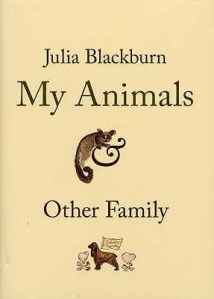 In five short autobiographical essays, Blackburn traces her life with pets and other domestic animals. Guinea pigs taught her the facts of life when she was the pet monitor for her girls’ school – and taught her daughter the reality of death when they moved to the country and Galaxy sired a kingdom of outdoor guinea pigs. They also raised chickens, then adopted two orphaned fox cubs; this did not end well. There are intriguing hints of Blackburn’s childhood family dynamic, which she would later write about in the memoir The Three of Us: Her father was an alcoholic poet and her mother a painter. It was not a happy household and pets provided comfort as well as companionship. “I suppose tropical fish were my religion,” she remarks, remembering all the time she devoted to staring at the aquarium. Jason the spaniel was supposed to keep her safe on walks, but his presence didn’t deter a flasher (her parents’ and a policeman’s reactions to hearing the story are disturbingly blasé). My favourite piece was the first, “A Bushbaby from Harrods”: In the 1950s, the department store had a Zoo that sold exotic pets. Congo the bushbaby did his business all over her family’s flat but still was “the first great love of my life,” Blackburn insists. This was pleasant but won’t stay with me. (New purchase – remainder copy from Hay Cinema Bookshop, 2025) [86 pages]
Super-Frog Saves Tokyo by Haruki Murakami; illus. Seb Agresti and Suzanne Dean (2000, 2001; this edition 2025)
[Translated from Japanese by Jay Rubin]
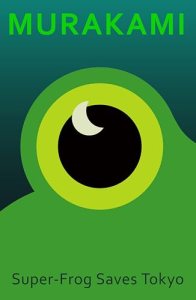 This short story first appeared in English in GQ magazine in 2001 and was then included in Murakami’s collection after the quake, a response to the Kobe earthquake of 1995. “Katigiri found a giant frog waiting for him in his apartment,” it opens. The six-foot amphibian knows that an earthquake will hit Tokyo in three days’ time and wants the middle-aged banker to help him avert disaster by descending into the realm below the bank and doing battle with Worm. Legend has it that the giant worm’s anger causes natural disasters. Katigiri understandably finds it difficult to believe what’s happening, so Frog earns his trust by helping him recover a troublesome loan. Whether Frog is real or not doesn’t seem to matter; either way, imagination saves the city – and Katigiri when he has a medical crisis. I couldn’t help but think of Rachel Ingalls’ Mrs. Caliban (one of my NovNov reads last year). While this has been put together as an appealing standalone volume and was significantly more readable than any of Murakami’s recent novels that I’ve tried, I felt a bit cheated by the it-was-all-just-a-dream motif. (Public library) [86 pages]
Grief Is the Thing with Feathers by Max Porter (2015)
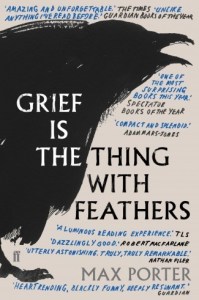 A reread – I reviewed this for Shiny New Books when it first came out and can’t better what I said then. “The novel is composed of three first-person voices: Dad, Boys (sometimes singular and sometimes plural) and Crow. The father and his two young sons are adrift in mourning; the boys’ mum died in an accident in their London flat. The three narratives resemble monologues in a play, with short lines often laid out on the page more like stanzas of a poem than prose paragraphs.” What impressed me most this time was the brilliant mash-up of allusions and genres. The title: Emily Dickinson. The central figure: Ted Hughes’s Crow. The setup: Edgar Allan Poe’s “The Raven” – while he’s grieving his lost love, a man is visited by a black bird that won’t leave until it’s delivered its message. (A raven cronked overhead as I was walking to get my cappuccino.) I was less dazzled by the actual writing, though, apart from a few very strong lines about the nature of loss, e.g. “Moving on, as a concept, is for stupid people, because any sensible person knows grief is a long-term project.” I have a feeling this would be better experienced in other media (such as audio, or the play version). I do still appreciate it as a picture of grief over time, however. Porter won the Sunday Times Young Writer of the Year Award as well as the Dylan Thomas Prize. (Secondhand – Gifted by a friend as part of a trip to Community Furniture Project, Newbury last year; I’d resold my original hardback copy – more fool me!) [114 pages]


My original rating (in 2015): 
My rating now: 
Why We Hate Cheap Things by The School of Life (2017)
 I’m generally a fan of the high-brow self-help books The School of Life produces, but these six micro-essays feel like cast-offs from a larger project. The title essay explores the link between the cost of an item or experience and how much we value it – with reference to pineapples and paintings. The other essays decry the fact that money doesn’t get fairly distributed, such that craftspeople and arts graduates often struggle financially when their work and minds are exactly what we should be valuing as a society. Fair enough … but any suggestions for how to fix the situation?! I’m finding Robin Wall Kimmerer’s The Serviceberry, which is also on a vaguely economic theme, much more engaging and profound. There’s no author listed for this volume, but as The School of Life is Alain de Botton’s brainchild, I’m guessing he had a hand. Perhaps he’s been cancelled? This raises a couple of interesting questions, but overall you’re probably better off spending the time with something more in depth. (Little Free Library) [78 pages]
Book Serendipity, August to September 2023
I call it “Book Serendipity” when two or more books that I read at the same time or in quick succession have something in common – the more bizarre, the better.
In Diary of a Tuscan Bookshop, Alba Donati remarks on this phenomenon: “Jung called these coincidences ‘synchronicities’, postulating that the universe possessed its own form of intelligence, which generated harmonies. A universe that detects and brings together the elements it feels are seeking each other in the endless swirl of life. Chance be damned.”
This is a regular feature of mine every couple of months. Because I usually have 20–30 books on the go at once, I suppose I’m more prone to such incidents. The following are in roughly chronological order.
- A memoir that opens with a little girl being injured in a bicycle accident: Some of Us Just Fall by Polly Atkin and Pharmakon by Almudena Sánchez.
- Telling stories through embroidery in Cross-Stitch by Jazmina Barrera and The Farmer’s Wife by Helen Rebanks.

- A small boy nicknamed “Willmouse” (real name: William) in Mary and the Birth of Frankenstein by Anne Eekhout and The Greengage Summer by Rumer Godden.
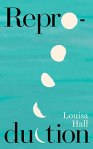
- An account of a routine sonogram that ends with the technician leaving the doctor to deliver bad news in Reproduction by Louisa Hall and The Unfamiliar by Kirsty Logan.
- Black dreadlocks/braid/ponytail being cut off in When We Were Birds by Ayanna Lloyd Banwo, The Wren, The Wren by Anne Enright, and Rebecca, Not Becky by Christine Platt and Catherine Wigginton Greene.

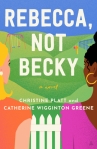
- Wondering how to arm a Black daughter against racist microaggressions in Rebecca, Not Becky by Christine Platt and Catherine Wigginton Greene and Ordinary Notes by Christina Sharpe.
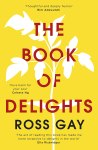
- Countering the commodification or romanticization of Black suffering in The Book of Delights by Ross Gay and Ordinary Notes by Christina Sharpe.

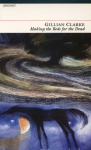
- An account of how the foot and mouth disease outbreak of 2001 affected the UK, especially northwest England, in Making the Beds for the Dead by Gillian Clarke and The Farmer’s Wife by Helen Rebanks.
- I encountered the quote from Elaine Scarry’s The Body in Pain about pain being inexpressible in Reproduction by Louisa Hall and The Invisible Kingdom by Meghan O’Rourke on the same day. It’s also referenced in Mary Jean Chan’s Bright Fear.
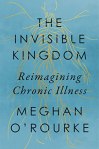
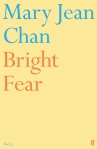
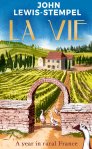
- A mention of eating frogs’ legs in The Book of Delights by Ross Gay and La Vie by John Lewis-Stempel.
- I read about the effects of heavy metal pollution on the body in The Invisible Kingdom by Meghan O’Rourke and Windswept by Annie Worsley in the same evening.
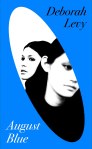
- Composer Erik Satie is mentioned in Making the Beds for the Dead by Gillian Clarke and August Blue by Deborah Levy.
- Stendhal syndrome and Florence are mentioned in The Wren, The Wren by Anne Enright and Pharmakon by Almudena Sánchez.
- Swallows nesting in an old Continental building in Diary of a Tuscan Bookshop by Alba Donati and La Vie by John Lewis-Stempel.
- France being all about the rules and a “Putain de merde” exclamation to bad news in Dirt by Bill Buford and La Vie by John Lewis-Stempel.

- A character named Nomi in Friends and Strangers by J. Courtney Sullivan and one called Noemi in Diary of a Tuscan Bookshop by Alba Donati.
- Epigenetics (trauma literally determining the genetic traits that are passed on) is discussed in The Invisible Kingdom by Meghan O’Rourke and Pharmakon by Almudena Sánchez.
- Women of a certain age in Tuscany in The Three Graces by Amanda Craig and Diary of a Tuscan Bookshop by Alba Donati.
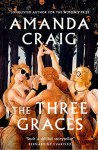
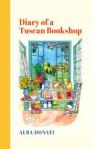
- Audre Lorde is quoted in Tremor by Teju Cole, Bibliomaniac by Robin Ince, The Invisible Kingdom by Meghan O’Rourke, Alone by Daniel Schreiber, and Ordinary Notes by Christina Sharpe.
- A Galway Kinnell poem is mentioned/quoted in The Dead Peasant’s Handbook by Brian Turner and Otherwise by Julie Marie Wade.
- The Bamiyan Buddhas are mentioned in Tremor by Teju Cole and The Dead Peasant’s Handbook by Brian Turner.


- Both The Three Graces by Amanda Craig and The Story of Lucy Gault by William Trevor open with a man shooting someone from his bedroom window.
- Linked short story collections about two children’s relationship with their Jamaican father, and mention of a devastating hurricane, in If I Survive You by Jonathan Escoffery and The Human Origins of Beatrice Porter and Other Essential Ghosts by Soraya Palmer. (Dual review coming up tomorrow!)
- Characters named Ben and Mara in The Whispers by Ashley Audrain and one story in Kate Doyle’s I Meant It Once.
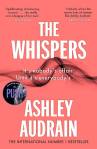
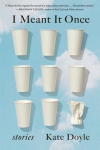
- Occasional uncut pages in my copies of I Meant It Once by Kate Doyle and The Unfamiliar by Kirsty Logan.
- A Florida setting and mention of the Publix supermarket chain in If I Survive You by Jonathan Escoffery and Arms and Legs by Chloe Lane.
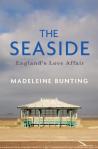
- A down-at-heel English seaside town near Scarborough features in The Seaside by Madeleine Bunting and Penance by Eliza Clark.

- A fictional northern town with “Crow” in the name: Crow-on-Sea in Penance by Eliza Clark and Crows Bank in Weyward by Emilia Hart.
- Claw-machine toys are mentioned in Penance by Eliza Clark and Directions to Myself by Heidi Julavits.
- Reading books by two Nobel Prize winners at the same time: Abdulrazak Gurnah (By the Sea) and Alice Munro (Hateship, Friendship, Courtship, Loveship, Marriage).
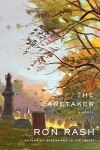
- Reading my second 2023 release featuring North Carolina ghost lights (after All of Us Together in the End by Matthew Vollmer, which I actually read last year): The Caretaker by Ron Rash.
- Reading my second 2023 release featuring a cat named Virginia Woolf (after Tell the Rest by Lucy Jane Bledsoe, which I actually read last year): one of the short stories in I Meant It Once by Kate Doyle.
- A character named Shay in Everyone but Myself by Julie Chavez, The Human Origins of Beatrice Porter and Other Essential Ghosts by Soraya Palmer and The Caretaker by Ron Rash.

What’s the weirdest reading coincidence you’ve had lately?
Doorstopper of the Month: The Crow Road by Iain Banks (1992)
This was a rare case of reading a novel almost entirely because of its famous first line: “It was the day my grandmother exploded.” I was familiar with the quote from the Bookshop Band song “Once Upon a Time” (video on bottom right here), which is made up of first lines from books, but had never read anything by the late Iain Banks, so when a copy of The Crow Road turned up in the free bookshop where I volunteered weekly in happier times, I snapped it up.
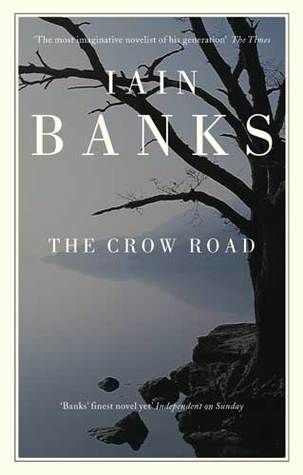 There’s a prosaic explanation for that magical-sounding opening: Grandma Margot had a pacemaker that the doctor forgot to remove before her cremation. Talk about going out with a bang! To go “away the crow road” is a Scottish saying for death, and on multiple occasions a sudden or unexplained death draws the McHoan clan together. As the book starts, Prentice McHoan, a slothful student of history at the university in Glasgow, is back in Gallanach (on the west coast of Scotland, near Oban), site of the family glassworks, for Margot’s funeral. He’ll be summoned several more times before the story is through.
Amid clashes over religion with his father Kenneth, a writer of children’s fantasy stories, plenty of carousing and whiskey-drinking, and a spot of heartbreak when his brother steals his love interest, Prentice gets drawn into the mystery of what happened to Uncle Rory, a travel writer who disappeared years ago. The bulk of the book is narrated by Prentice, but shifts into the third person indicate flashbacks. Many of these vignettes recount funny mishaps from Kenneth or Prentice’s growing-up years, but others – especially those in italics – reveal darker matters. As Prentice explores Uncle Rory’s files from a project called “Crow Road,” he stumbles on a secret that completely changes how he perceives his family history.
This reminded me of John Irving at his 1970s‒80s peak: a sprawling coming-of-age story, full of quirky people and events, that blends humor and pathos. In all honesty, I didn’t need the mystery element on top of the character study, but it adds direction to what is otherwise a pleasant if lengthy meander through the decades with the McHoans. I particularly appreciated how Prentice’s view of death evolves: at first he’s with Uncle Hamish, believing there has to be something beyond death – otherwise, what makes human life worthwhile? But Kenneth’s atheism seeps in thanks to the string of family deaths and the start of the Gulf War. “They were here, and then they weren’t, and that was all there was,” Prentice concludes; the dead live on only in memory, or in the children and work they leave behind. I can’t resist quoting this whole paragraph, my favorite passage from the novel:
Telling us straight or through his stories, my father taught us that there was, generally, a fire at the core of things, and that change was the only constant, and that we – like everybody else – were both the most important people in the universe, and utterly without significance, depending, and that individuals mattered before their institutions, and that people were people, much the same everywhere, and when they appeared to do things that were stupid or evil, often you hadn’t been told the whole story, but that sometimes people did behave badly, usually because some idea had taken hold of them and given them an excuse to regard other people as expendable (or bad), and that was part of who we were too, as a species, and it wasn’t always possible to know that you were right and they were wrong, but the important thing was to keep trying to find out, and always to face the truth. Because truth mattered.
That seems like a solid philosophy to me. I’ll try more by Banks. I also nabbed a free copy of The Wasp Factory, which I take it is very different in tone. Any recommendations after that? Could I even cope with his science fiction (published under the name Iain M. Banks)?
Page count: 501
My rating: 
Books of Summer #18–20: Alan Garner, Peter Matthiessen, Lorrie Moore
I’m sneaking in just in time here, on the very last day of the #20BooksofSummer challenge, with my final three reviews: two novellas, one of them a work of children’s fantasy; and a nature/travel classic that turns into something more like a spiritual memoir.
The Owl Service by Alan Garner (1967)
 I’d heard of Garner, a British writer of classic children’s fantasy novels, but never read any of his work until I picked this up from the free bookshop where I volunteer on a Friday. My husband remembers reading Elidor (also a 1990s TV series) as a boy, but I’m not sure Garner was ever well known in America. Perhaps if I’d discovered this right after the Narnia series when I was a young child, I would have been captivated. I did enjoy the rural Welsh setting, and to start with I was intrigued by the setup: curious about knocking and scratching overhead, Alison and her stepbrother Roger find a complete dinner service up in the attic of this house Alison inherited from her late father. Alison becomes obsessed with tracing out the plates’ owl pattern – which disappears when anyone else, like Nancy the cook, looks at them.
I gather that Garner frequently draws on ancient legend for his plots. Here he takes inspiration from Welsh myths, but the background was so complex and unfamiliar that I could barely follow along. This meant that the climactic ‘spooky’ scenes failed to move me. Instead, I mostly noted the period slang and the class difference between the English children and Gwyn, Nancy’s son, who’s forbidden from speaking Welsh (Nancy says, “I’ve not struggled all these years in Aber to have you talk like a labourer”) and secretly takes elocution lessons to sound less ‘common’.
Can someone recommend a Garner book I might get on with better?
My rating: 
The Snow Leopard by Peter Matthiessen (1978)
 For two months of 1973, from late September to late November, Matthiessen joined zoologist George Schaller on a journey from the Nepalese Himalayas to the Tibetan Plateau to study Himalayan blue sheep. Both also harbored a hope of spotting the elusive snow leopard.
Matthiessen had recently lost his partner, Deborah Love, to cancer, and left their children behind – at residential schools or with family friends – to go on this spirit-healing quest. Though he occasionally feels guilty, especially about the eight-year-old, his thoughts are usually on the practicalities of the mountain trek. They have sherpas to carry their gear, and they stop in at monasteries but also meet ordinary people. More memorable than the human encounters, though, are those with the natural world. Matthiessen watches foxes hunting and griffons soaring overhead; he marvels at alpine birds and flora.
The writing is stunning. No wonder this won a 1979 National Book Award (in the short-lived “Contemporary Thought” category, which has since been replaced by a general nonfiction award). It’s a nature and travel writing classic. However, it took me nearly EIGHTEEN MONTHS to read, in all kinds of fits and starts (see below), because I could rarely read more than part of one daily entry at a time. I struggle with travel narratives in general – perhaps I think it’s unfair to read them faster than the author lived through them? – but there’s also an aphoristic density to the book that requires unhurried, meditative engagement.

The mountains in their monolithic permanence remind the author that he will die. The question of whether he will ever see a snow leopard comes to matter less and less as he uses his Buddhist training to remind himself of tenets of acceptance (“not fatalism but a deep trust in life”) and transience: “In worrying about the future, I despoil the present”; what is this “forever getting-ready-for-life instead of living it each day”? I’m fascinated by Buddhism, but anyone who ponders life’s deep questions should get something out of this.
My rating: 
Who Will Run the Frog Hospital? by Lorrie Moore (1994)
Thanks to Cathy for reminding me about this one – I had intended to make it one of my novellas for November, but as I was scrambling around to find a last couple of short books to make up my 20 I thought, “Frog! hey, that fits”* and picked it up.
 Oddly, given that Moore is so well known for short stories, I’ve only ever read two of her novels (the other was A Gate at the Stairs). Berie Carr lives just over the border from Quebec in Horsehearts, a fictional town in upstate New York. She and her best friend Sils are teenagers at the tail end of the Vietnam War, and work at Storyland amusement park on the weekends and during the summer. When Sils gets into trouble, Berie starts pocketing money from the cash register to help her out, but it will only be so long until she gets caught and the course of her life changes.
Berie is recounting these pivotal events from adulthood, when she’s traveling in Paris with her husband, Daniel. There are some troubling aspects to their relationship that don’t get fully explored, but that seems to be part of the point: we are always works in progress, and never as psychologically well as we try to appear. I most enjoyed the book’s tone of gentle nostalgia: “Despite all my curatorial impulses and training, my priestly harborings and professional, courtly suit of the past, I never knew what to do with all those years of one’s life: trot around in them forever like old boots – or sever them, let them fly free?”
Moore’s voice here reminds me of Amy Bloom’s and Elizabeth McCracken’s, though I’ve generally enjoyed those writers more.
*There are a few literal references to frogs (as well as the understood slang for French people). The title phrase comes from a drawing Sils makes about their mission to find and mend all the swamp frogs that boys shoot with BB guns. Berie also remarks on the sound of a frog chorus, and notes that two decades later frogs seem to be disappearing from the earth. In both these cases frogs are metaphors for a lost innocence. “She has eaten the frog” is also, in French, a slang term for taking from the cash box.
(I can’t resist mentioning Berie and Sils’ usual snack: raw, peeled potatoes cut into quarters and spread with margarine and salt!)
My rating: 
A recap of my 20 Books of Summer:
- I enjoyed my animal theme, which was broad enough to encompass straightforward nature books but also a wide variety of memoirs and fiction. In most cases there was a literal connection between the animal in the title and the book’s subject.
- I read just nine of my original choices, plus two of the back-ups. The rest were a mixture of: books I brought back from America, review copies, books I’d started last year and set aside for ages, and ones I had lying around and had forgotten were relevant.
- I accidentally split the total evenly between fiction and nonfiction: 10 of each.
- I happened to read three novels by Canadian authors. The remainder were your usual British and American suspects.
- The clear stand-out of the 20 was Crow Planet by Lyanda Lynn Haupt, followed closely by The Snow Leopard (see above) and The Seafarers by Stephen Rutt – all nonfiction!
- In my second tier of favorites were three novels: Fifteen Dogs, The Unchangeable Spots of Leopards, and Crow Lake.

I also had three DNFs that I managed to replace in time.
Hollow Kingdom by Kira Jane Buxton [a review copy – and one of my Most Anticipated titles]
(I managed the first 36 pages.) Do you have a friend who’s intimidatingly sharp, whose every spoken or written line leaps from wordplay to a joke to an allusion to a pun? That’s how I felt about Hollow Kingdom. It’s so clever it’s exhausting.
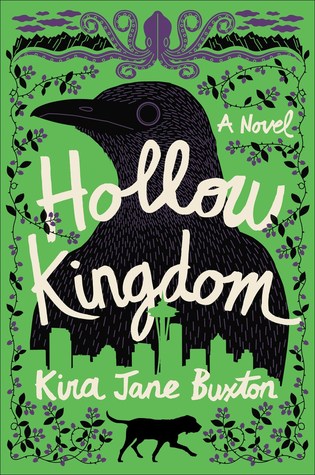 I wanted to read this because I’d heard it’s narrated by a crow. S.T. (Shit Turd) is an American Crow who lives with an electrician, Big Jim, in Seattle, along with Dennis the dumb bloodhound. One day Jim’s eyeball pops out and he starts acting crazy and spending all his time in the basement. On reconnaissance flights through the neighborhood, S.T. realizes that all the humans (aka “MoFos” or “Hollows”) are similarly deranged. He runs into a gang of zombies when he goes to the Walgreens pharmacy to loot medications. Some are even starting to eat their pets. (Uh oh.)
We get brief introductions to other animal narrators, including Winnie the Poodle and Genghis Cat. An Internet-like “Aura” allows animals of various species to communicate with each other about the crisis. I struggle with dystopian and zombie stuff, but I think I could make an exception for this. Although I do think it’s overwritten (one adverb and four adjectives in one sentence: “We left slowly to the gentle song of lugubrious paw pads and the viscous beat of crestfallen wings”), I’ll try it again someday.
 Gould’s Book of Fish: A Novel in Twelve Fish by Richard Flanagan: I read the first 164 pages last year before stalling; alas, I could make no more headway this summer. It’s an amusing historical pastiche in the voice of a notorious forger and counterfeiter who’s sentenced to 14 years in Van Diemen’s Land. I could bear only so much of this wordy brilliance, and no more.
 Tisala by Richard Seward Newton: I guess I read the blurb and thought this was unmissable, but I should have tried to read a sample or some more reviews of it. I got to page 6 and found it so undistinguished and overblown that I couldn’t imagine reading another 560+ pages about a whale.
For next year, I’m toying with the idea of a food and drink theme. Once again, this would include fiction and nonfiction that is specifically about food but also slightly more cheaty selections that happen to have the word “eats” or “ate” or a potential foodstuff in the title, or have an author whose name brings food to mind. I perused my shelf and found exactly 20 suitable books, so that seems like a sign! (The eagle-eyed among you may note that two of these were on my piles of potential reads for this summer, and two others on last summer’s. When will they ever actually get read?!)
Alternatively, I could just let myself have completely free choice from my shelves. My only non-negotiable criterion is that all 20 books must be ones that I own, to force me to get through more from my shelves (even if that includes review copies).


How did you fare with your summer reading?
My Most Anticipated Releases of the Second Half of 2019
Although over 90 books from the second half of the year are already on my radar, I’ve managed to narrow it down to the 15 July to November releases that I’m most excited about. I have access to a few of these already, and most of the rest I will try requesting as soon as I’m back from Milan. (These are given in release date order within thematic sections; the quoted descriptions are from the publisher blurbs on Goodreads.)
[By the way, here’s how I did with my most anticipated releases of the first half of the year:
- 16 out of 30 read; of those 9 were somewhat disappointing (i.e., 3 stars or below) – This is such a poor showing! Is it a matter of my expectations being too high?
- 10 I still haven’t managed to find
- 1 print review copy arrived recently
- 1 I have on my Kindle to read
- 1 I skimmed
- 1 I lost interest in]
Fiction
 The Lager Queen of Minnesota by J. Ryan Stradal [July 23, Pamela Dorman Books] Stradal’s Kitchens of the Great Midwest (2015) is one of my recent favorites. This one has a foodie theme again, and sounds a lot like Louise Miller’s latest – two sisters: a baker of pies and a founder of a small brewery. “Here we meet a cast of lovable, funny, quintessentially American characters eager to make their mark in a world that’s often stacked against them.”
 Hollow Kingdom by Kira Jane Buxton [August 6, Grand Central Publishing / Headline Review] As soon as I heard that this was narrated by a crow, I knew I was going to have to read it. (And the Seattle setting also ties in with Lyanda Lynn Haupt’s book.) “Humanity’s extinction has seemingly arrived, and the only one determined to save it is a foul-mouthed crow whose knowledge of the world around him comes from his TV-watching education.”
 Inland by Téa Obreht [August 13, Random House / Weidenfeld & Nicolson] However has it been eight years since her terrific debut novel?! “In the lawless, drought-ridden lands of the Arizona Territory in 1893, two extraordinary lives collide. … [L]yrical, and sweeping in scope, Inland subverts and reimagines the myths of the American West.” The synopsis reminds me of Eowyn Ivey’s latest.
 A Door in the Earth by Amy Waldman [August 27, Little, Brown and Company] I loved The Submission, Waldman’s 2011 novel about a controversial (imagined) 9/11 memorial. “Parveen Shamsa, a college senior in search of a calling, feels pulled between her charismatic and mercurial anthropology professor and the comfortable but predictable Afghan-American community in her Northern California hometown [and] travels to a remote village in the land of her birth to join the work of his charitable foundation.” (NetGalley download)
 Bloomland by John Englehardt [September 10, Dzanc Books] “Bloomland opens during finals week at a fictional southern university, when a student walks into the library with his roommate’s semi-automatic rifle and opens fire. In this richly textured debut, Englehardt explores how the origin and aftermath of the shooting impacts the lives of three characters.” (print review copy from publisher)
 The Dutch House by Ann Patchett [September 25, Harper / Bloomsbury UK] I’m more a fan of Patchett’s nonfiction, but will keep reading her novels thanks to Commonwealth. “At the end of the Second World War, Cyril Conroy combines luck and a single canny investment to begin an enormous [Philadelphia] real estate empire … Set over … five decades, The Dutch House is a dark fairy tale about two smart people who cannot overcome their past.”
Medical themes
 Will My Cat Eat My Eyeballs?: Big Questions from Tiny Mortals about Death by Caitlin Doughty [September 10, W.W. Norton / September 19, Weidenfeld & Nicolson] I’ve read Doughty’s previous books about our modern attitude towards mortality and death customs around the world. She’s wonderfully funny and iconoclastic. Plus, how can you resist this title?! Although it sounds like it’s geared towards children, I’ll still read the book. “Doughty blends her mortician’s knowledge of the body and the intriguing history behind common misconceptions … to offer factual, hilarious, and candid answers to thirty-five … questions.”
 The Undying: Pain, Vulnerability, Mortality, Medicine, Art, Time, Dreams, Data, Exhaustion, Cancer, and Care by Anne Boyer [September 17, Farrar, Straus and Giroux] “A week after her forty-first birthday, the acclaimed poet Anne Boyer was diagnosed with highly aggressive triple-negative breast cancer. … A genre-bending memoir in the tradition of The Argonauts, The Undying will … show you contemporary America as a thing both desperately ill and occasionally, perversely glorious.” (print review copy from publisher)

From the author’s Twitter page.
Breaking and Mending: A doctor’s story of burnout and recovery by Joanna Cannon [September 26, Wellcome Collection] I haven’t gotten on with Cannon’s fiction, but a memoir should hit the spot. “A frank account of mental health from both sides of the doctor-patient divide, from the bestselling author of The Trouble with Goats and Sheep and Three Things About Elsie, based on her own experience as a doctor working on a psychiatric ward.”
 The Body: A Guide for Occupants by Bill Bryson [October 3, Doubleday / Transworld] His last few books have been somewhat underwhelming, but I’d read Bryson on any topic. He’s earned a reputation for making history, science and medicine understandable to laymen. “Full of extraordinary facts and astonishing stories, The Body: A Guide for Occupants is a brilliant, often very funny attempt to understand the miracle of our physical and neurological makeup.”
 The Depositions: New and Selected Essays on Being and Ceasing to Be by Thomas Lynch [November 26, W.W. Norton] Lynch is such an underrated writer. A Michigan undertaker, he crafts essays and short stories about small-town life, the Irish-American experience and working with the dead. I discovered him through Greenbelt Festival some years back and have read three of his books. Some of what I’ve already read will likely be repeated here, but will be worth a second look anyway.
Other Nonfiction
 Confessions of a Bookseller by Shaun Bythell [August 29, Profile Books] The Diary of a Bookseller was a treat in 2017. I’ve read the first two-thirds of this already while in Milan, and I wish I was in Wigtown instead! This sequel picks up in 2015 and is very much more of the same – the daily routines of buying and selling books and being out and about in a small town – so it’s up to you whether that sounds boring or comforting. I’m finding it strangely addictive. (NetGalley download)
 We Are the Weather: Saving the Planet Begins at Breakfast by Jonathan Safran Foer [September 17, Farrar, Straus and Giroux / October 10, Hamish Hamilton] Foer’s Eating Animals (2009) was a hard-hitting argument against eating meat. In this follow-up he posits that meat-eating is the single greatest contributor to climate change. “With his distinctive wit, insight and humanity, Jonathan Safran Foer presents this essential debate as no one else could, bringing it to vivid and urgent life, and offering us all a much-needed way out.”
 Surfacing by Kathleen Jamie [September 19, Sort of Books] Jamie is a Scottish poet who writes exquisite essays about the natural world. I’ve read her two previous essay collections, Findings and Sightlines, as well as a couple of volumes of her poetry. “From the thawing tundra linking a Yup’ik village in Alaska to its hunter-gatherer past to the shifting sand dunes revealing the impressively preserved homes of neolithic farmers in Scotland, Jamie explores how the changing natural world can alter our sense of time.”
 Unfollow by Megan Phelps-Roper [October 8, Farrar, Straus and Giroux / riverrun] Ties in with my special interest in women’s religious memoirs. “In November 2012, at the age of twenty-six, [Phelps-Roper] left [Westboro Baptist Church], her family, and her life behind. Unfollow is a story about the rarest thing of all: a person changing their mind. It is a fascinating insight into a closed world of extreme belief, a biography of a complex family, and a hope-inspiring memoir of a young woman finding the courage to find compassion.”
Which of these do you want to read, too?
What other upcoming 2019 titles are you looking forward to?
20 Books of Summer, #1–4: Alexis, Haupt, Rutt, Tovey
I was slow to launch into my 20 Books of Summer reading, but have now finally managed to get through my first four books. These include two substitutes: a review copy I hadn’t realized fit in perfectly with my all-animals challenge, and a book I’d started earlier in the year but set aside and wanted to get back into. Three of the four were extremely rewarding; the last was somewhat insubstantial, though I always enjoy reading about cat antics. All have been illuminating about animal intelligence and behavior, and useful for thinking about our place in and duty towards the more-than-human world. Not all of my 20 Books of Summer will have such an explicit focus on nature – some just happen to have an animal in the title or pictured on the cover – but this first batch had a strong linking theme so was a great start.
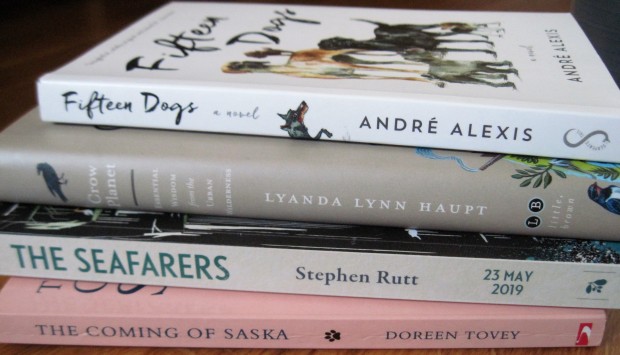
Fifteen Dogs by André Alexis (2015)
In this modern folk tale with elements of the Book of Job, the gods Apollo and Hermes, drinking in a Toronto tavern, discuss the nature of human intelligence and ponder whether it’s inevitably bound up with suffering. They decide to try an experiment, and make a wager on it. They’ll bestow human intelligence on a set of animals and find out whether the creatures die unhappy. Apollo is willing to bet two years’ personal servitude that they will be even unhappier than humans. Their experimental subjects are the 15 dogs being boarded overnight at a nearby veterinary clinic.
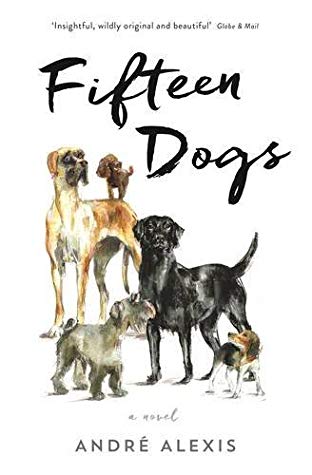 The setup means we’re in for an And Then There Were None type of picking-off of the 15, and some of the deaths are distressing. But strangely – and this is what the gods couldn’t foresee – knowledge of their approaching mortality gives the dogs added dignity. It gives their lives and deaths the weight of Shakespearean tragedy. Although they still do doggy things like establishing dominance structures and eating poop, they also know the joys of language and love. A mutt called Prince composes poetry and jokes. Benjy the beagle learns English well enough to recite the first paragraph of Vanity Fair. A poodle named Majnoun forms a connection with his owner that lasts beyond the grave. The dogs work out who they can trust; they form and dissolve bonds; they have memories and a hope that lives on.
It’s a fascinating and inventive novella, and a fond treatment of the relationship between dogs and humans. When I read in the Author’s Note that the poems all included dogs’ names, I went right back to the beginning to scout them out. I’m intrigued by the fact that this Giller Prize winner is a middle book in a series, and keen to explore the rest of the Trinidanian-Canadian author’s oeuvre.
These next two have a lot in common. For both authors, paying close attention to the natural world – birds, in particular – is a way of coping with environmental and mental health crises.
Crow Planet: Essential Wisdom from the Urban Wilderness by Lyanda Lynn Haupt (2009)
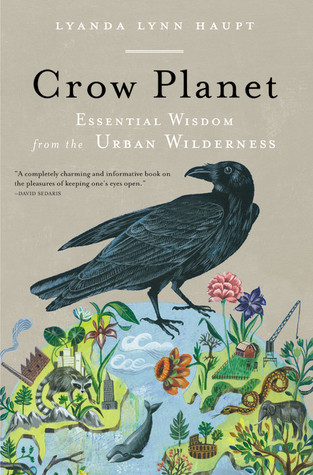 Lyanda Lynn Haupt has worked in bird research and rehabilitation for the Audubon Society and other nature organizations. (I read her first book, Rare Encounters with Ordinary Birds, quite a few years ago.) During a bout of depression, she decided to start paying more attention to the natural world right outside her suburban Seattle window. Crows were a natural place to start. From then on she took binoculars everywhere she went, even on walks to Target. She spent time watching crows’ behavior from a distance or examining them up close – devoting hours to studying a prepared crow skin. She even temporarily took in a broken-legged fledgling she named Charlotte and kept a close eye on the injured bird’s progress in the months after she released it.
Were this simply a charming and keenly observed record of bird behavior and one woman’s gradual reawakening to the joys of nature, I would still have loved it. Haupt is a forthright and gently witty writer. But what takes it well beyond your average nature memoir is the bold statement of human responsibility to the environment. I’ve sat through whole conference sessions that try to define what nature is, what the purpose of nature writing is, and so on. Haupt can do it in just a sentence, concisely and effortlessly explaining how to be a naturalist in a time of loss and how to hope even when in possession of all the facts. 
A few favorite passages:
“an intimate awareness of the continuity between our lives and the rest of life is the only thing that will truly conserve the earth … When we allow ourselves to think of nature as something out there, we become prey to complacency. If nature is somewhere else, then what we do here doesn’t really matter.”
“I believe strongly that the modern naturalist’s calling includes an element of activism. Naturalists are witnesses to the wild, and necessary bridges between ecological and political ways of knowing. … We join the ‘cloud of witnesses’ who refuse to let the more-than-human world pass unnoticed.”
“here we are, intricate human animals capable of feeling despair over the state of the earth and, simultaneously, joy in its unfolding wildness, no matter how hampered. What are we to do with such a confounding vision? The choices appear to be few. We can deny it, ignore it, go insane with its weight, structure it into a stony ethos with which we beat our friends and ourselves to death—or we can live well in its light.”
The Seafarers: A Journey among Birds by Stephen Rutt (2019)
 In 2016 Rutt left his anxiety-inducing life in London in a search for space and silence. He found plenty of both on the Orkney Islands, where he volunteered at the North Ronaldsay bird observatory for seven months. In the few years that followed, the young naturalist travelled the length and breadth of the British Isles – from Skomer to Shetland – courting encounters with seabirds. He’s surrounded by storm petrels one magical night at Mousa Broch; he runs from menacing skuas; he watches eider and terns and kittiwakes along the northeast coast; he returns to Orkney to marvel at gannets and fulmars. Whether it’s their beauty, majesty, resilience, or associations with freedom, such species are for him a particularly life-enhancing segment of nature to spend time around.
Discussion of the environmental threats that hit seabirds hardest, such as plastic pollution, makes for a timely tie-in to wider conservation issues. Rutt also sees himself as part of a long line of bird-loving travellers, including James Fisher and especially R.M. Lockley, whose stories he weaves in. This is one of the best nature/travel books I’ve read in a long time, especially enjoyable because I’ve been to a lot of the island locations and the elegantly evocative writing, making particularly effective use of varied sentence lengths, brought back to me just what it’s like to be in the far north of Scotland in the midst of an endless summer twilight, a humbled observer as a whole whirlwind of bird life carries on above you. 
A favorite passage:
“Gannets nest on the honeycombs of the cliff, in their thousands. They sit in pairs, pointing to the sky, swaying heads. They stir. The scent of the boat’s herring fills the air. They take off, tessellating in a sky that is suddenly as much bird as light. The great skuas lurk.”
My husband also reviewed this, from a birder’s perspective.
With thanks to Elliott & Thompson for the proof copy for review.
The Coming of Saska by Doreen Tovey (1977)
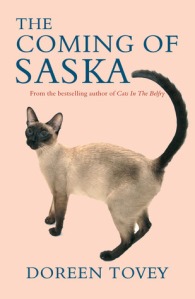 I’ve read four of Tovey’s quaint Siamese cat books now; this was the least worthwhile. It’s partially a matter of false advertising: Saska only turns up for the last 15 pages, as a replacement of sorts for Seeley, who disappeared one morning a year earlier and was never seen again. Over half of the book, in fact, is about a trip Tovey and her husband Charles took to Edmonton, Canada. The Canadian government sponsored them to come over for the Klondike Days festivities, and they also rented a camper and went looking for bears and moose. Mildly amusing mishaps, close shaves, etc. ensue. They then come back and settle into everyday life with their pair of Siamese half-siblings; Saska had the same father as Shebalu. Entertaining enough, but slight, and with far too many ellipses.
 Bookish Beck = Rebecca Foster. American transplant to England. Freelance proofreader and book reviewer.
 Bookish Beck