Last Love Your Library of 2025 & Another for #DoorstoppersInDecember
Thanks to Eleanor, Margaret and Skai for writing about their recent library reading! Marcie also joined in with a post about completing Toronto Public Library’s 2025 Reading Challenge with books by Indigenous authors.
I managed to fit in a few more 2025 releases before Christmas. My plan for January is to focus on reading from my own shelves (which includes McKitterick Prize submissions and perhaps also review copies to catch up on), so expect next month to be a lighter one.
My recent reading has featured many mentions of how much libraries mean, particularly to young women.
 In her autobiographical poetry collection Visitations (coming out in April), Julia Alvarez writes of how her family’s world changed when they moved to New York City from the Dominican Republic in the 1960s. “Waiting for My Father to Pick Me Up at the Library” adopts the tropes of Alice in Wonderland: as her future expands, her father’s life shrinks.
 In The Mercy Step by Marcia Hutchinson, the public library is a haven for Mercy, growing up in Bradford in the 1960s. She can hardly believe it’s free for everyone to use, even Black people. Greek mythology is her escape from an upbringing that involves domestic violence and molestation. “It’s peaceful and quiet in the Library. No one shouts or throws things or hits anyone. If anyone talks, the Librarian puts a finger to her mouth and tells them to shush.”
 The Serviceberry by Robin Wall Kimmerer affirms the social benefits of libraries: “I love bookstores for many reasons but revere both the idea and the practice of public libraries. To me, they embody the civic-scale practice of a gift economy and the notion of common property. … We don’t each have to own everything. The books at the library belong to everyone, serving the public with free books”.
 After Rebecca Knuth retired from an academic career in library and information science, she moved to London for a master’s degree in creative nonfiction and joined the London Library as well as the public library. But in her memoir London Sojourn (coming out in January), she recalls that she caught the library bug early: “Each weekday, I bused to school and, afterward, trudged to the library and then rode home with my geologist father. … Mostly, I read.”
 And in Joyride, Susan Orlean recounts the writing of each of her books, including The Library Book, which is about the 1986 arson at the Los Angeles Central Library but also, more widely, about what libraries have to offer and the oddballs often connected with them.
My library use over the last month:
(links are to any reviews of books not already covered on the blog)
READ
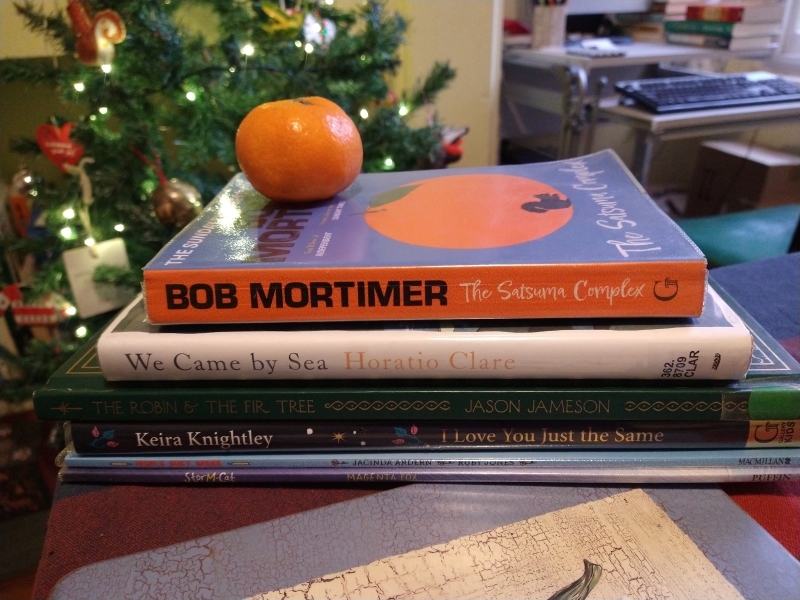
- Mum’s Busy Work by Jacinda Ardern; illus. Ruby Jones

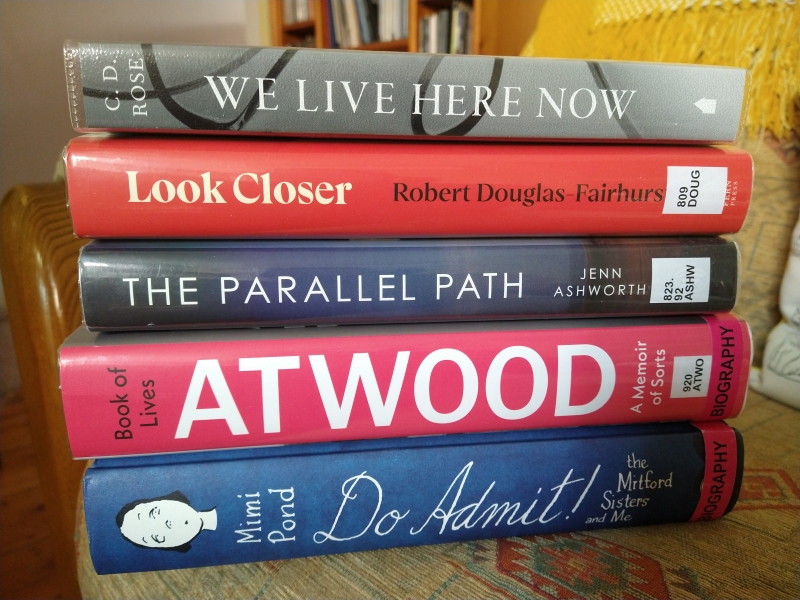
- Book of Lives: A Memoir of Sorts by Margaret Atwood

- Storm-Cat by Magenta Fox

- The Robin & the Fir Tree by Jason Jameson
- I Love You Just the Same by Keira Knightley – Proof that celebrities should not be writing children’s books. I would say the story and drawings were pretty good … if she were a college student.

- Winter by Val McDermid

- The Search for the Giant Arctic Jellyfish, The Search for Carmella, & The Search for Our Cosmic Neighbours by Chloe Savage
- Weirdo Goes Wild by Zadie Smith and Nick Laird; illustrated by Magenta Fox
- Murder Most Unladylike by Robin Stevens


+ A final contribution to #DoorstoppersInDecember
Do Admit: The Mitford Sisters and Me by Mimi Pond
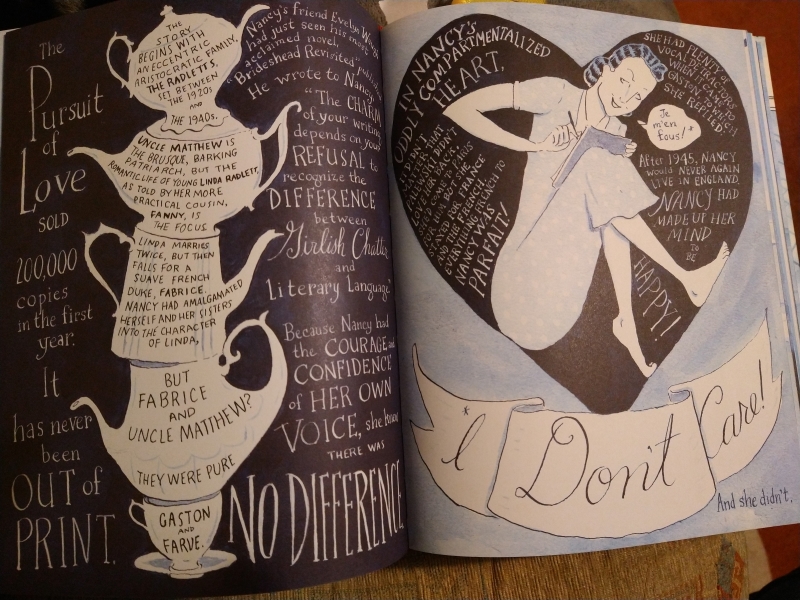
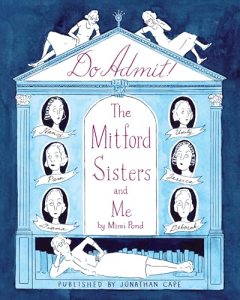 Truth really is stranger than fiction. Of the six Mitford sisters, two were fascists (Diana and Unity) and one was a communist (Jessica). Two became popular authors (Nancy and Jessica). One (Unity) was pals with Hitler and shot herself in the head when Britain went to war with Germany; she didn’t die then but nine years later of an infection from the bullet still stuck in her brain. This is all rich fodder for a biographer – the batshit lives of the rich and famous are always going to fascinate us peons – and Pond’s comics treatment is a great way of keeping history from being one boring event after another. Although she uses the same Prussian blue tones throughout, she mixes up the format, sometimes employing 3–5 panes but often choosing to create one- or two-page spreads focusing on a face, a particular setting or a montage. No two pages are exactly alike and information is conveyed through dialogue, documents and quotations. If just straight narrative, there are different typefaces or text colours and it is interspersed with the pictures in a novel way. Whether or not you know a thing about the Mitfords, the book intrigues with its themes of family dynamics, grief, political divisions, wealth and class. My only misgiving, really, was about the “and Me” part of the title; Pond appears in maybe 5% of the book, and the only personal connections I gleaned were that she wished she had sisters, wanted to escape, and envied privilege and pageantry. [444 pages]
CURRENTLY READING
- The Parallel Path: Love, Grit and Walking the North by Jenn Ashworth
- The Honesty Box by Lucy Brazier
- Of Thorn & Briar: A Year with the West Country Hedgelayer by Paul Lamb
- The Satsuma Complex by Bob Mortimer (for book club in January; I’m grumpy about it because I didn’t vote for this one, had no idea who the author [a TV comedian in the UK] was, and the writing is shaky at best)
- We Live Here Now by C.D. Rose
SKIMMED
- Look Closer: How to Get More out of Reading by Robert Douglas-Fairhurst
CHECKED OUT, TO BE READ
- It’s Not a Bloody Trend: Understanding Life as an ADHD Adult by Kat Brown
- We Came by Sea by Horatio Clare
ON HOLD, TO BE COLLECTED
- The Two Faces of January by Patricia Highsmith
- Arsenic for Tea by Robin Stevens
IN THE RESERVATION QUEUE
- Honour & Other People’s Children by Helen Garner
- Snegurochka by Judith Heneghan
- Ultra-Processed People by Dr. Chris van Tulleken (for book club in February)
RETURNED UNFINISHED
- Night Life: Walking Britain’s Wild Landscapes after Dark by John Lewis-Stempel
What have you been reading or reviewing from the library recently?

Share a link to your own post in the comments. Feel free to use the above image. The hashtag is #LoveYourLibrary.
#DoorstoppersInDecember: Book of Lives by Margaret Atwood & The End of Mr. Y by Scarlett Thomas
Later than intended, I’m reporting back on Margaret Atwood’s memoir, which I started in late November, and a long-neglected 500+-page novel I plucked from my shelves. Both offered page-turning intrigue and a blend of history, magic, and pure weirdness. Many thanks to Laura for hosting Doorstoppers in December, which encouraged me to pick them up!
Book of Lives: A Memoir of Sorts by Margaret Atwood (2025)
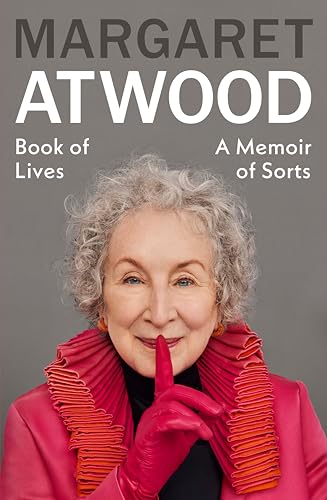 I gave some initial thoughts about the book here to tie in with Margaret Atwood Reading Month. What I said then proved true of the book as a whole: it’s delightful though dense with detail and historical context. I did get a little bogged down in the names and details of decades worth of publishing, but there is some tasty gossip, such as the fact that Margaret Laurence spread mean rumours about her (and was a drunk) but later changed her ways. It’s been a lucky window of time for Atwood to live through: she has known simplicity and the need for do-it-yourself practicality, but has also experienced privilege, even luxury (multiple homes and worldwide travel). Mostly, she had the good fortune of being at the start of Canada’s literary boom. In the early 1960s, only five Canadian novels were published per year. Through her involvement with literary magazines and House of Anansi Press and her books on Susanna Moodie and the tropes of Canadian literature, she helped create the scene.
There are frequent mentions of how people or events made their way into her fiction and poetry. Coyly, she writes, “I just have a teeming imagination. Also, like all novelists, I’m a kleptomaniac.” The page or two of context on each book is illuminating and it never becomes the tedious “I published this book … then I published this book” that she mentioned wanting to avoid in the introduction. Rather, these sections made me want to go reread lots of her books to appreciate them anew. I was also reminded how often she’s been ahead of her time, with topics and details that seem prophetic (she proposed Payback before the financial crisis hit, for instance). Some elements felt particularly timely: she experienced casual misogyny and an alarming number of near-misses – she says things like “I won’t give his name … you know who you are … though you’re probably dead” – and, through her involvement in bird conservation, she’s well aware of the disastrous environmental trajectory we’re on.
For a memoir, this is not especially forthcoming about the author’s inner life and emotions. Where it is, she masks the material in a layer of technique. So when she’s confessing to having an affair while married to Jim Polk (whom she met at Harvard), she writes it like a fairytale scene in which she went into the woods with a wolf. When she was fretting about Graeme Gibson’s reluctance to divorce her first wife and marry her, she imagines letters to her ‘inner advice columnist’. (Note: Gibson was her long-time partner and his sons were like her stepchildren but they never did marry – and he only ‘allowed’ her the one child, though she wanted two of her own. One ‘Jess Gibson’ has a speculative short story collection, The Good Eye, coming out in May 2026. No doubt her work will be compared with her mother’s, but bully for her for not using the name Atwood to try to ride her coattails.)
A cute pic from her Substack in November
One of the successful literary touches is the recurring “We Nearly Lose Graeme” segments about his risky behaviour and various mishaps. He had dementia and mini strokes before suffering a major one while in London with her for The Testaments tour; he died five days later. Her reflections on his death are poignant, but generic: “We can all believe three things simultaneously: The person is in the ground. The person is in the Afterlife. The person is in the next room. You keep expecting to see him. Even when you know it’s coming, a death is a shock.” At the crucial moment, she turns to the first-person plural and the second person.
I skimmed some of the bits about Graeme’s earlier life and the behind-the-scenes of publishing; I felt that he and many of her literary pals are more important to her than they are to readers. But that’s okay. The same goes for her earlier life; I noted that the account of her time as a summer camp counsellor felt more detailed than necessary. However, with her gift for storytelling, even the smallest incident can be rendered amusing. She looks for the humour, coincidence, or irony in any situation, and her summations and asides are full of dry humour. Some examples:
- “Spoiler: Jim and I eventually got married, one of the odder things to happen to both of us.”
- “After a while, the hand [at the window of her Harvard student accommodation] went away. It’s what you wish for in a disembodied hand.”
- “Eventually the iguana [inherited from her roommate] was given a new home at a zoo among other iguanas, where it was probably happier. Hard to tell.”
It’s not a book for the casual reader who kinda liked one or two Atwood novels; it’s more for the diehard fans among us, and offers a veritable trove of stories and photographs. But don’t expect a tell-all. Think of this more as a companion to her oeuvre. The title feels literal in that it’s as if she’s lived several lives: the wilderness kid, the literary ingénue, the family and career woman, the philanthropist and elder stateswoman. She doesn’t try to pull all of her incarnations into one, instead leaving all of the threads trailing into the beyond. If anything, “Peggy Nature” (her name from summer camp) is the role that has persisted. I probably liked the childhood material most, which makes sense as it’s what she’s looking back on with most fondness. Towards the close, Atwood mentions her heart condition and seems perfectly accepting of the fact that she won’t be around for much longer. But her body of work will endure. I’m so grateful for it and for the gift of this self-disclosure, however coy. (Can I be greedy and hope for another novel?) She leaves this message: “We scribes and scribblers are time travellers: via the magic page we throw our voices, not only from here to elsewhere, but also from now to a possible future. I’ll see you there.” [570 pages] (Public library) 
The End of Mr. Y by Scarlett Thomas (2006)
 This is a mash-up of the campus novel, the Victorian pastiche, and the time travel adventure. Ariel Manto is a PhD student working on thought experiments. Inciting incidents come thick and fast: her supervisor disappears, the building that houses her office partially collapses as it’s on top of an old railway tunnel, and she finds a copy of Thomas Lumas’s vanishingly rare The End of Mr. Y in a box of mixed antiquarian stock going for £50 at a secondhand bookshop. Rumour has it the book is cursed, and when Ariel realises that the key page – giving a Victorian homoeopathic recipe for entering the “Troposphere,” a dream/thought realm where one travels through time and space – has been excised, she knows the quest has only just begun. It will involve the book within a book, Samuel Butler novels, a theologian and a shrine, lab mice plus the God of Mice, and a train line whose destinations are emotions.
The plot is pretty bonkers and I’m not sure I can satisfactorily explain its internal logic now, but as is true of the best doorstoppers, it absorbed me completely. I read it very quickly (for me) and even read 120 pages in one sitting thanks to my cat pinning me to the sofa. It also felt prescient in discussing “machine consciousness” – a topic adjacent to artificial intelligence. Ariel is a Disaster Woman avant la lettre, living on noodles and cut-price wine. Her current ‘relationship’ consisting of rough sex with a married professor is the latest in a string of unhealthy connections. But time travel offers the possibility not just of reversing her own mistakes, but of going right back to the start of humanity. Verging on steampunk, this was much better than the other Thomas novels I’ve read, The Seed Collectors and Oligarchy. It was longlisted for the Orange (Women’s) Prize and would be a great choice for readers of Nicola Barker and Susanna Clarke. [502 pages] (Secondhand – Book-Cycle, Exeter; it’s been on my shelves since 2016!)
May Releases, Part II (Fiction): Le Blevennec, Lynch, Puchner, Stanley, Ullmann, and Wald
A cornucopia of May novels, ranging from novella to doorstopper and from Montana to Tunisia; less of a spread in time: only the 1980s to now. Just a paragraph on each to keep things simple. I’ll catch up soon with May nonfiction and poetry releases I read.
Friends and Lovers by Nolwenn Le Blevennec (2023; 2025)
[Translated from French by Madeleine Rogers]
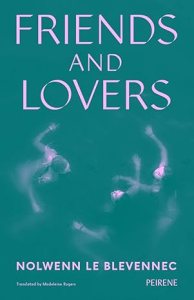 Armelle, Rim, and Anna are best friends – the first two since childhood. They formed a trio a decade or so ago when they worked on the same magazine. Now in their mid-thirties, partnered and with children, they’re all gripped by a sexual “great awakening” and long to escape Paris and their domestic commitments – “we went through it, this mutiny, like three sisters,” poised to blow up the “perfectly executed choreography of work, relationships, children”. The friends travel to Tunisia together in December 2014, then several years later take a completely different holiday: a disaster-prone stay in a lighthouse-keeper’s cottage on an island off the coast of Brittany. They used to tolerate each other’s foibles and infidelities, but now resentment has sprouted up, especially as Armelle (the narrator) is writing a screenplay about female friendship that’s clearly inspired by Rim and Anna. Armelle is relatably neurotic (a hilarious French blurb for the author’s previous novel is not wrong: “Woody Allen meets Annie Ernaux”) and this is wise about intimacy and duplicity, yet I never felt invested in any of the three women or sufficiently knowledgeable about their lives.
With thanks to Peirene Press for the free copy for review.
A Family Matter by Claire Lynch
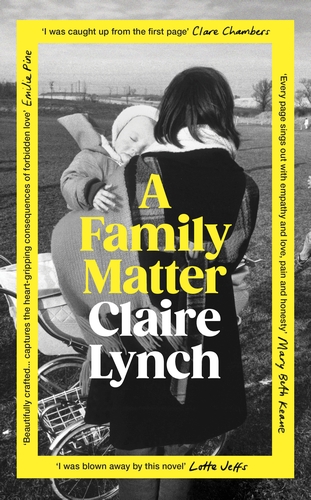 “The fluke of being born at a slightly different time, or in a slightly different place, all that might gift you or cost you.” At events for Small, Lynch’s terrific memoir about how she and her wife had children, women would speak up about how different their experience had been. Lesbians born just 10 or 20 years earlier didn’t have the same options. Often, they were in heterosexual marriages because that’s all they knew to do; certainly the only way they thought they could become mothers. In her research into divorce cases in the UK in the 1980s, Lynch learned that 90% of lesbian mothers lost custody of their children. Her aim with this earnest, delicate debut novel, which bounces between 2022 and 1982, is to imagine such a situation through close portraits of Heron, an ageing man with terminal cancer; his daughter, Maggie, who in her early forties bears responsibility for him and her own children; and Dawn, who loved Maggie desperately but felt when she met Hazel that she was “alive at last, at twenty-three.” How heartbreaking that Maggie knew only that her mother abandoned her when she was little; not until she comes across legal documents and newspaper clippings does she understand the circumstances. Lynch made the wise decision to invite sympathy for Heron from the start, so he doesn’t become the easy villain of the piece. Her compassion, and thus ours, is equal for all three characters. This confident, tender story of changing mores and steadfast love is the new Carol for our times. (Such a lovely but low-key novel was liable to make few ripples, so I’m delighted for Lynch that the U.S. release got a Read with Jenna endorsement.)
With thanks to Chatto & Windus (Penguin) for the proof copy for review.
Dream State by Eric Puchner
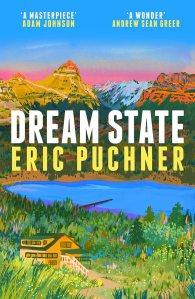 If it starts and ends with a wedding, it must be a comedy. If much of the in between is marked by heartbreak, betrayal, failure, and loss, it must be a tragedy. If it stretches towards 2050 and imagines a Western USA smothered in smoke from near-constant forest fires, it must be an environmental dystopian. Somehow, this novel is all three. The first 163 pages are pure delight: a glistening romantic comedy about the chaos surrounding Charlie and Cece’s wedding at his family’s Montana lake house in the summer of 2004. First half the wedding party falls ill with norovirus, then Charlie’s best friend, Garrett (who’s also the officiant), falls in love with the bride. Do I sound shallow if I admit this was the section I enjoyed the most? The rest of this Oprah’s Book Club doorstopper examines the fallout of this uneasy love triangle. Charlie is an anaesthesiologist, Cece a bookstore owner, and Garrett a wolverine researcher in Glacier National Park, which is steadily losing its wolverines and its glaciers. The next generation comes of age in a diminished world, turning to acting or addiction. There are still plenty of lighter moments: funny set-pieces, warm family interactions, private jokes and quirky descriptions. But this feels like an appropriately grown-up vision of idealism ceding to a reality we all must face. I struggled with a lack of engagement with the children, but loved Puchner’s writing so much on the sentence level that I will certainly seek out more of his work. Imagine this as a cross between Jonathan Franzen and Maggie Shipstead.
With thanks to Sceptre (Hodder) for the proof copy for review.
Consider Yourself Kissed by Jessica Stanley
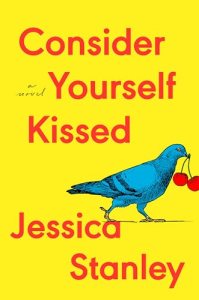 Coralie is nearing 30 when her ad agency job transfers her from Australia to London in 2013. Within a few pages, she meets Adam when she rescues his four-year-old, Zora, from a lake. That Adam and Coralie will be together is never really in question. But over the next decade of personal and political events, we wonder whether they have staying power – and whether Coralie, a would-be writer, will lose herself in soul-destroying work and motherhood. Adam’s job as a political journalist and biographer means close coverage of each UK election and referendum. As I’ve thought about some recent Jonathan Coe novels: These events were so depressing to live through, who would want to relive them through fiction? I also found this overlong and drowning in exclamation points. Still, it’s so likable, what with Coralie’s love of literature (the title is from The Group) and adjustment to expat life without her mother; and secondary characters such as Coralie’s brother Daniel and his husband, Adam’s prickly mother and her wife, and the mums Coralie meets through NCT classes. Best of all, though, is her relationship with Zora. This falls solidly between literary fiction and popular/women’s fiction. Given that I was expecting a lighter romance-led read, it surprised me with its depth. It may well be for you if you’re a fan of Meg Mason and David Nicholls.
With thanks to Hutchinson Heinemann for the proof copy for review.
Girl, 1983 by Linn Ullmann (2021; 2025)
[Translated from Norwegian by Martin Aitken]
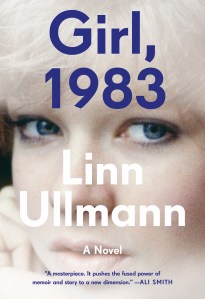 Ullmann is the daughter of actress Liv Ullmann and film director Ingmar Bergman. That pedigree perhaps accounts for why she got the opportunity to travel to Paris in the winter of 1983 to model for a renowned photographer. She was 16 at the time and spent the whole trip disoriented: cold, hungry, lost. Unable to retrace the way to her hotel and wearing a blue coat and red hat, she went to the only address she knew – that of the photographer, K, who was in his mid-forties. Their sexual relationship is short-lived and unsurprising, at least in these days of #MeToo revelations. Its specifics would barely fill a page, yet the novel loops around and through the affair for more than 250. Ullmann mostly pulls this off thanks to the language of retrospection. She splits herself both psychically and chronologically. There’s a “you” she keeps addressing, a childhood imaginary friend who morphs into a critical voice of conscience and then the self dissociated from trauma. And there’s the 55-year-old writer looking back with empathy yet still suffering the effects. The repetition made this something of a sombre slog, though. It slots into a feminist autofiction tradition but is not among my favourite examples.
With thanks to Hamish Hamilton (Penguin) for the proof copy for review.
The Bayrose Files by Diane Wald
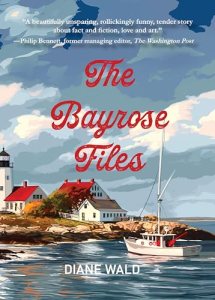 In the 1980s, Boston journalist Violet Maris infiltrates the Provincetown Home for Artists and Writers, intending to write a juicy insider’s exposé of what goes on at this artists’ colony. But to get there she has to commit a deception. Her gay friend Spencer Bayrose has a whole sheaf of unpublished short stories drawing on his Louisiana upbringing, and he offers to let her submit them as her own work to get a place at PHAW. Here Violet finds eccentrics aplenty, and even romance, but when news comes that Spence has AIDS, she has to decide how far she’ll go for a story and what she owes her friend. At barely over 100 pages, this feels more like a long short story, one with a promising setting and a sound plot arc, but not enough time to get to know or particularly care about the characters. I was reminded of books I’ve read by Julia Glass and Sara Maitland. It’s offbeat and good-natured but not top tier.
Published by Regal House Publishing. With thanks to publicist Jackie Karneth of Books Forward for the advanced e-copy for review.
A Family Matter was the best of the bunch for me, followed closely by Dream State.
Which of these do you fancy reading?
May Graphic Novels by Alison Bechdel, Peter Kuper & Craig Thompson
May has been chock-full of new releases for me! For this first batch of reviews, I’m featuring three fantastic graphic novels that have made it onto my Best of 2025 (so far) list. I don’t read graphic books as often as I’d like to – my library tends to major on superhero comics and manga, which aren’t my cup of tea – but I sometimes get a chance to access them for paid review purposes. (The first two below are ones I was sent for potential Shelf Awareness reviews, but I missed the deadlines.) Reading these took me back to the early 2010s when I worked for a university library in South London and would walk to Lambeth Library on my lunch breaks to borrow huge piles of books, mostly taking advantage of their excellent graphic novel selection. That was where my education and fascination began.
Spent: A Comic Novel by Alison Bechdel
 I’ve read all but one of Bechdel’s works now. Fun Home was among the first graphic books I read and is a great choice if you’re new to this form of storytelling. It’s a family memoir about her father’s funeral home business and closeted lifestyle, which emerged shortly after her own coming-out – and shortly before his accidental death. In Spent, Alison and her handy wife Holly live on a Vermont pygmy goat farm. Alison has writer’s block and is struggling financially despite her famous memoir about her taxidermist father having been made into a successful TV series, Death & Taxidermy. Mostly, she’s consumed with anxiety about the state of the world, what with the ongoing pandemic, her sister’s right-wing opinions, and the litany of awful headlines. “Who can draw when the world is burning?” she exclaims.
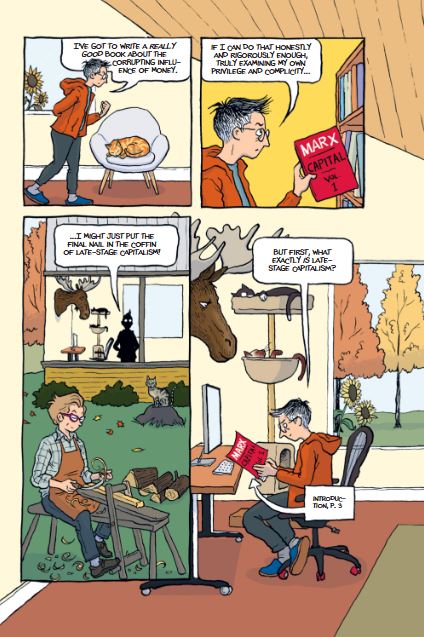
Then Alison has an idea for a book – or maybe a reality TV series – called $UM that will wean people off of capitalism. That creative journey is mirrored in Spent, which is composed of 12 “episodes” titled after Marxist terminology. Through Alison’s ageing hippie friends and their kids, Bechdel showcases alternative ways of living: a commune, a throuple, nonbinary identity, unpaid internships, Just Stop Oil demos, and the influencer lifestyle versus rejection of technology. It’s (auto)fiction exaggerated to the brink of absurdity, with details changed enough to mock but not enough to hide (e.g., she’s published by “Megalopub,” the hardware store is “Home Despot,” her show airs on “Schmamazon”).

Tiny details in the drawings reward close attention, such as Alison and Holly’s five cats’ antics during their morning routine, and a stuffed moose head rolling its eyes. It’s the funniest I can remember Bechdel being, with much broad humour derived from the outrageous screen mangling of her book – cannibalism, volcanoes and dragons come out of nowhere – and her middle-class friends’ hand-wringing over their liberal credentials. Even the throwaway phrases are hilarious. It’s a gleeful and zeitgeist-y satire, yet draws to a touching close as Alison has the epiphany that she can’t fix everything herself so must simply do what she can, “with a little help from her annoying, tender-hearted, and utterly luminous friends.”
Accessed as an e-book from Mariner Books. Published in the UK by Jonathan Cape (Penguin).
Insectopolis: A Natural History by Peter Kuper
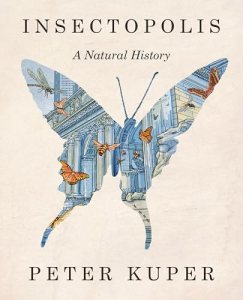 Nearly a decade ago, I reviewed Peter Kuper’s Ruins, which features monarch migration and has as protagonist a laid-off Natural History Museum entomologist. Here insects have even more of a starring role. The E. O. Wilson epigraph sets the stage: “If all mankind were to disappear, the world would regenerate back to the rich state of equilibrium that existed ten thousand years ago. If insects were to vanish, the environment would collapse into chaos.” We follow an African American brother-and-sister pair, the one dubious and the other eager, as they walk downtown to the New York Public Library. The sister, who holds a PhD in entomology, promises that its exhibition on insects is going to be amazing. But just before they reach the building, a red alert flashes up on every smartphone and sirens start blaring. A week later, the city is a ruin of overturned cabs and debris. Only insects remain and, group by group, they guide readers through the empty exhibit, interacting within and across species.


It’s a sly blend of science, history, stories and silliness. I loved the scenes of mosquitoes and ants railing against how they’ve been depicted as villainous, and dignified dung beetles resisting scatological jokes and standing up for their importance in ecosystems. There are interesting interludes about insects in literature (not just Kafka and Nabokov, but the Japanese graphic novel The Book of Human Insects by Osamu Tezuka), and unsung heroines of entomology get their moment in the sun. The pages in which Margaret Collins, an African American termite researcher in the 1950s, and Rachel Carson appear to a dragonfly as ghosts and tell their stories of being dismissed by male researchers were among my favourites. Informative and entertaining at once; what could be better? Welcome our insect overlords!
Accessed as an e-book from W. W. Norton & Company.
Ginseng Roots by Craig Thompson
 I’d read several of Thompson’s works and especially enjoyed his previous graphic memoir, Blankets, about his first love and loss of faith. When I read this blurb, I worried the niche subject couldn’t possibly sustain my attention for nearly 450 pages. But I was wrong; this is a vital book about everything, by way of ginseng. It begins with childhood summers working on American ginseng farms with his siblings in Marathon, Wisconsin. Theirs was a blue collar and highly religious family, but Thompson and his little brother Phil were allowed to spend their earnings from the back-breaking labour of weeding and picking rocks as they pleased. Each hour, each dollar, meant a new comic from the pharmacy. “Comics helped me survive my childhood. But what will help me survive my adulthood?” Thompson asks.

Together with Phil, he travels first to Midwest ginseng farms and festivals and then through China and Korea to learn about the plant’s history, cultivation practices, lore, and medicinal uses. As he meets producers – including a Hmong man whose early life mirrors his own – he feels sheepish about how he makes a living: “I carry this working-class guilt – what I do isn’t real work.” When his livelihood is threatened by worsening autoimmune conditions, he tries everything from acupuncture to psychotherapy to save his hands and his creativity.
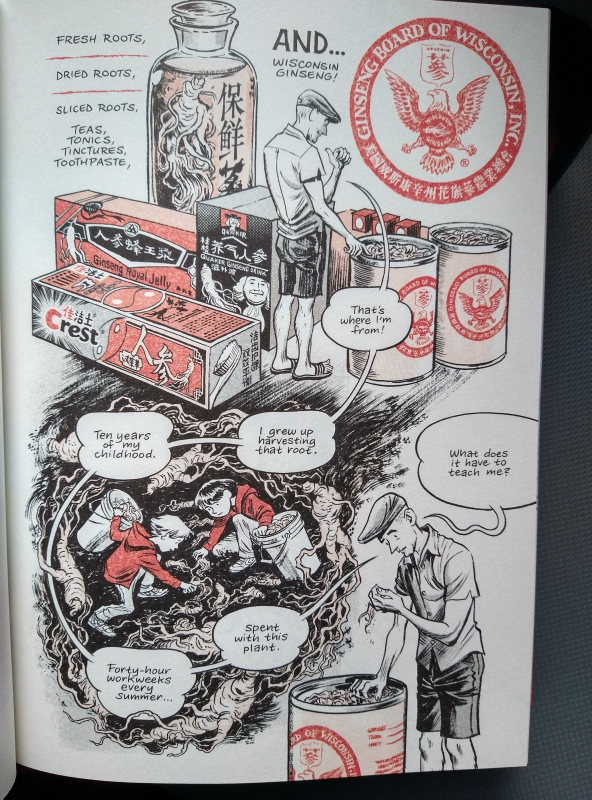
This chunky book has an appealing earth-tones palette and shifts smoothly between locations and styles, memories and research. When interviewing growers and Chinese medicine practitioners, the depictions are almost photorealistic, but there are also superhero pastiche panels and a cute ginseng mascot who pops up throughout the book. Like Spent, this pulls in class and economic issues in a lighthearted way and also explores its own composition process.
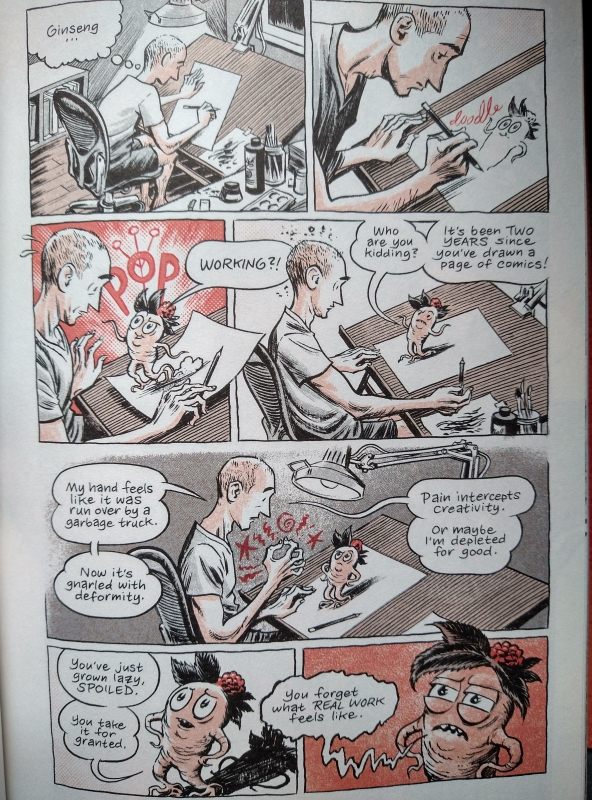
The story of ginseng is often sobering, involving the exploitation of immigrants (in the Notes, Thompson regrets that he was unable to speak with any of the Mexican migrant workers on whom the American ginseng harvest now depends), soil degradation, and pesticide pollution. The roots of the title are both literal and symbolic of the family story that unfolds in parallel. Both strands are captivating, but especially the autobiographical material: Thompson’s relationship with Phil, his new understanding but ongoing frustration with his parents, and the way all three siblings exhibit the damage of their upbringing – Phil’s marriage is crumbling; their sister Sarah, who has moved 26 times as an adult, wonders what she’s running from. A conversation with a Chinese herbal pharmacist gets to the heart of the matter: “I learned home is not WHERE I am. Home is HOW I am.”
Both expansive and intimate, this is a surprising gem from one of the best long-form graphic storytellers out there.
With thanks to Faber for the free copy for review. Published in the USA by Pantheon (Penguin).
20 Books of Summer, 10: Babel by R. F. Kuang (2022)
I substituted this in as my one doorstopper of the challenge after I failed with the new Persaud. It’s a bit of a cheat in that I actually started reading Babel in January, but I only just finished it this morning. I raced through the first 200 pages or so at the start of the year and loved all the geeky etymological footnotes and musings on translation. I thought I’d read it within a matter of days, which would have been a real feat for me. It’s hard to say why, instead, I stalled and found it difficult to regain sustained interest in the months that followed. Initially, it was a buddy read for me and my husband (his bookmark is still stranded at p. 178). His pithy comment, early on, was, “So, this is basically a woke Harry Potter?” And that’s actually a pretty apt summary. Four students at a magical academy – the Royal Institute of Translation at Oxford University, also known as Babel – find themselves questioning their responsibilities and loyalties as they confront the forces of evil, specifically colonialism.
When Robin Swift’s mother dies of cholera, he’s rescued from Canton by Professor Lovell and taken to England to train for entrance into Babel, a tower beside the Radcliffe Camera. He, Ramy (Indian), Victoire (Haitian) and Letty, the only white member of the quartet, are soon inseparable. While Victoire and Letty face prejudice for being female, it’s nothing to the experience of being racially other. Luckily, Babel values foreignness: intimate knowledge of other languages is an asset. In Kuang’s speculative 1830s setting, Britain’s economy is founded on a warped alchemy: silver is turned into energy to keep everyday life running smoothly in the industrializing nation. This is accomplished by harnessing the power of words. Silver bars are engraved with match-pairs – a phrase in a foreign language and its closest English counterpart – and the incantation of that untranslatable meaning sparks action. Spells keep bridges standing and traffic flowing; used for ill, they kill and destroy.
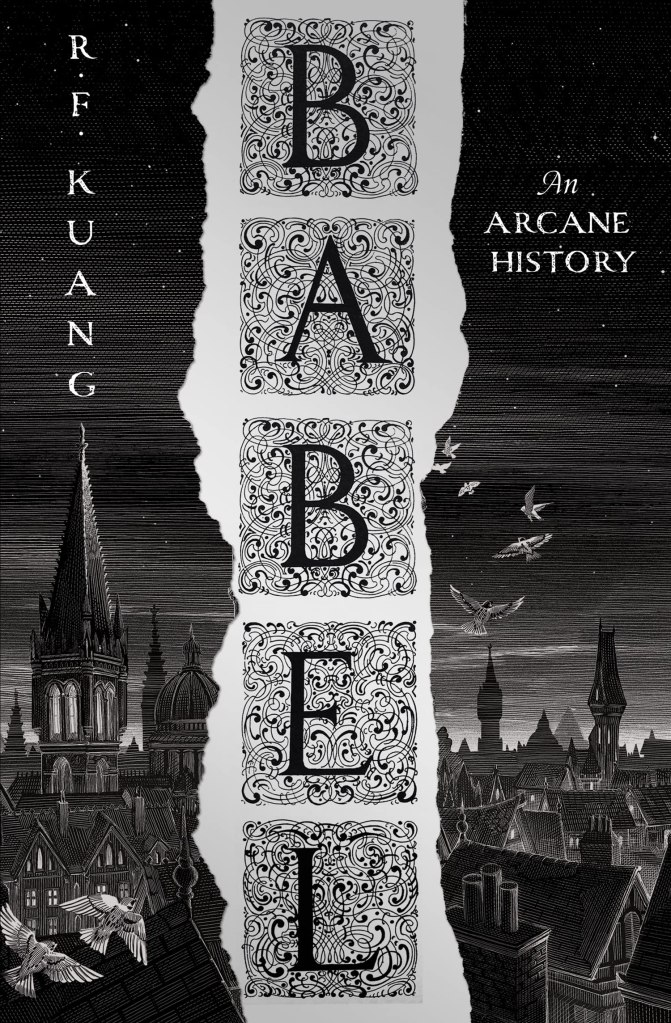
Robin and his friends gradually realise that their work at Babel is reinforcing mass poverty and the colonial system and, ultimately, fuelling future wars. “Truly, the only ones who seemed to profit from the silver industrial revolution were those who were already rich, and the select few others, who were cunning or lucky enough to make themselves so.” He becomes radicalized via the clandestine Hermes Society, which, Robin Hood-like, siphons silver resources away from where they are concentrated in Oxford to where they can help the oppressed. Surprised to learn who else is involved in Hermes, Robin (name not coincidental!) starts working behind the backs of his friends and professors, driven by conscience yet loath to give up the prospects he has through the tremendous privilege of being part of Babel. It goes from being an ivory tower of academia to being a hideaway for strikers and the besieged. And if you know your Bible stories, you’ll remember that Babel is destined to fall.
In faux-archaic fashion, Kuang has given her novel a lengthy subtitle: “Or: The Necessity of Violence – An Arcane History of the Oxford Translators’ Revolution.” The principle behind Hermes is that justice will never be achieved by negotiation; only by force. “Violence was the only thing that brought the colonizer to the table; violence was the only option.” Kuang published this fourth novel at age 26 and it manifests a certain youthful idealism. The sense of retrospective righteous anger is justified but also unsubtle; I felt similarly about Kuang’s Yellowface. Although there are exciting twists in the latter half of the book, I preferred the early semi-Dickensian atmosphere as Robin investigates his parentage and learns the joy of language and friendship. Kuang also adds a queer angle: an unrequited heterosexual crush comes to nothing because two same-sex friends are in love, even if they can never say. For as full-on and high-stakes as the plot becomes, I wished I could stay in this quieter mode.
Kuang has rendered the historical setting admirably and, though this is a typical adventure novel in that she has prioritized action over depth of characterization, one does get invested in the central characters and their interactions. The whole silver-working motif at first seems implausible but quickly becomes an accepted part of the background. Longstanding fantasy readers will probably have no problem reading this, but if you’re unsure and daunted by the 540-page length, ask yourself just how interested you are in word meanings and the history of colonialism and uprisings. (Little Free Library)
[P.S. OMG, have you seen her wedding photos from a few weeks ago?!]
Also two DNFs, argh!
 The Museum of Whales You Will Never See: Travels among the Collectors of Iceland by A. Kendra Greene (2020) – This sounded quirky and fun, but it turns out it was too niche for me. I read the first two “Galleries” (78 pp.) about the Icelandic Phallological Museum and one woman’s stone collection. Another writer might have used a penis museum as an excuse for lots of cheap laughs, but Greene doesn’t succumb. Still, “no matter how erudite or innocent you imagine yourself to be, you will discover that everything is funnier when you talk about a penis museum. … It’s not salacious. It’s not even funny, except that the joke is on you.” I think I might have preferred a zany Sarah Vowell approach to the material. (Secondhand – Bas Books and Home, Newbury)
 Because I Don’t Know What You Mean and What You Don’t by Josie Long (2023) – A free signed copy – and, if I’m honest, a cover reminiscent of Ned Beauman’s Glow – induced me to try an author I’d never heard of. She’s a stand-up comic, apparently, not that you’d know it from these utterly boring, one-note stories about unhappy adolescents and mums on London council estates. I read 108 pages but could barely tell you what a single story was about. Long is decent at voices, but you need compelling stories to house them. (Little Free Library)
Reading Ireland Month, Part II: Hughes, Kennedy, Murray
My second contribution to Reading Ireland Month after a first batch that included poetry and a novel.

Today I have a poetry collection based around science and travel, and two multi-award-winning novels, one set in the thick of the Troubles in Belfast and another about the crumbling of an ordinary suburban family.
Gathering Evidence by Caoilinn Hughes (2014)
 I bought this in the same order as Patricia Lockwood’s poetry collection, thinking a segue to another genre within an author’s oeuvre (I’d enjoyed Hughes’s 2018 debut novel, Orchid & the Wasp) might be a clever strategy. That worked out with Lockwood, but not as well here. A collection about scientific discoveries and medical advances seemed likely to be up my street. “The Moon Should Be Turned” is about the future of the HeLa cells harvested from Henrietta Lacks; poems are dedicated to the Curies and Johannes Kepler and one has Fermi as a main character. Russian nuclear force is a background menace. There are also some poems about growing up in Dublin and travels in the Andes. “Vagabond Monologue” stood out for its voice, “Marbles” for its description of childhood booty: “A netted bag of green glass marbles with aquamarine swirls / deep in the otherworld of spherical transparency (simultaneous opacity) / was the first thing I ever stole when I was three and far from the last.” Elsewhere, though, I found the precision vocabulary austere and offputting. (New purchase with Amazon voucher)
Trespasses by Louise Kennedy (2022)
Despite its many accolades, not least a shortlisting for the Women’s Prize, I couldn’t summon much enthusiasm for reading a novel about the Troubles. I don’t know why I tend to avoid this topic; perhaps it’s the insidiousness of fighting that’s not part of a war somewhere else, but ongoing domestic terrorism instead. Combine that with an affair – Cushla is a 24-year-old schoolteacher who starts sleeping with a middle-aged, married barrister she meets in her family’s pub – and it sounded like a tired, ordinary plot. But after this won last year’s McKitterick Prize (for debut authors over 40) and I was sent the whole shortlist in thanks for being a manuscript judge, I thought I should get over myself and give it a try.
 Little surprise that Kennedy’s writing – compassionate, direct, heart-rending – is what sets the book apart. With no speech marks, radio reports of everyday atrocities blend in with thoughts and conversations. We meet and develop fondness for characters across classes and the Catholic–Protestant divide: Cushla’s favourite pupil, Davy, whose father was assaulted in the street; her alcoholic mother, Gina, who knows more than she lets on, despite her inebriation; Gerry, a colleague who takes Cushla on friend dates and covers for her when she goes to see Michael. An Irish language learning circle introduces the 1970s bourgeoisie with their dinner parties and opinions.
This doesn’t read like a first novel at all, with each character fully realized and the plot so carefully constructed that I was as shocked as Cushla by a revelation four-fifths of the way through. Desire is bound up with guilt; can anyone ever be happy when violence is so ubiquitous and random? “Booby trap. Incendiary device. Gelignite. Nitroglycerine. Petrol bomb. Rubber bullets. Saracen. Internment. The Special Powers Act. Vanguard. The vocabulary of a seven-year-old child now.” But a brief framing episode set in 2015 gives hope of life beyond seemingly inescapable tragedy. (Free from the Society of Authors) 
The Bee Sting by Paul Murray (2023)
“The trouble is coming from inside; from his family. And unless something happens to stop it, it will keep billowing out, worse and worse”
Another great Irish novel I nearly missed out on, despite it being shortlisted for the Booker Prize and Writers’ Prize and winning the inaugural Nero Book Awards’ Gold Prize, this one because I was daunted by its doorstopper proportions. I’d gotten it in mind that it was all about money: Dickie Barnes’s car dealership is foundering and the straitened circumstances affect his whole family (wife Imelda, teenage daughter Cass, adolescent son PJ). A belated post-financial crash novel? Again, it sounded tired, maybe clichéd.
 But actually, this turned out to be just the kind of wry, multi-perspective dysfunctional family novel that I love, such that I was mostly willing to excuse a baggy midsection. Murray opens with long sections of close third person focusing on each member of the Barnes family in turn. Cass is obsessed with sad-girl poetry and her best friend Elaine, but self-destructive habits threaten her university career before it’s begun. PJ is better at making friends through online gaming than in real life because of his family’s plunging reputation, so concocts a plan to run away to Dublin. Imelda is flirting with Big Mike, who’s taking over the dealership, but holds out hope that Dickie’s wealthy father will bail them out. Dickie, under the influence of a weird handyman named Victor, has become fixated on eradicating grey squirrels and building a bunker to keep his family safe.
There are no speech marks throughout, and virtually no punctuation in Imelda’s sections. There are otherwise no clever tricks to distinguish the points-of-view, though. The voice is consistent. Murray doesn’t have to strain to sound like a teenage girl; he fully and convincingly inhabits each character (even some additional ones towards the end). I particularly liked the final “Age of Loneliness” section, which starts rotating between the perspectives more quickly, each one now in the second person. It all builds towards a truly thrilling yet inconclusive ending. I could imagine this as a TV miniseries for sure.
SPOILERS, if you’re worried about that sort of thing:
It was all the details I didn’t pick up from my pre-reading about The Bee Sting that made it so intricate and rewarding. Imelda’s awful upbringing in macho poverty and how it seemed that Rose, then Frank, might save her. The cruelty of Frank’s accidental death and the way that, for both Imelda and Dickie, being together seemed like the only way of getting over him, even if Imelda was marrying the ‘wrong’ brother. The recurrence of same-sex attraction for Dickie, then Cass. The irony of the bee sting that never was.
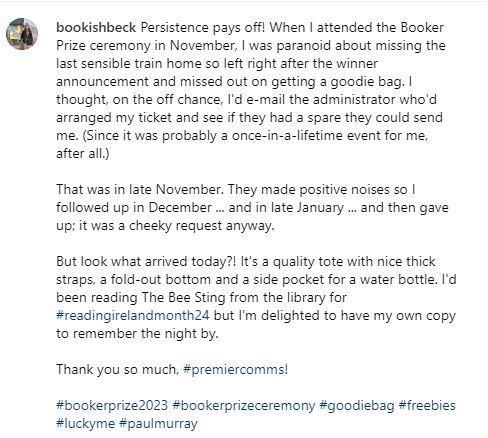
BUT. Yes, it’s too long, particularly Imelda’s central section. I had to start skimming to have any hope of making it through. Trim the whole thing by 200 pages and then we’re really talking. But I will certainly read Murray again, and most likely will revisit this book in the future to give it the attention it deserves. I read it from the library’s Bestsellers collection; the story of how I own a copy as of this week is a long one…

(Public library; free from the Booker Prize/Premier Comms)

I’ll be catching up on reviewing March releases in early April.
Happy Easter to those who celebrate!
Recent Releases by Nathan Hill, Hisham Matar, Sigrid Nunez and More
One key way in which 2024’s reading has already differed from previous years’ is that I no longer avoid doorstoppers. I now classify any book with over 400 pages as a doorstopper, and by that definition I have already gotten through three this year: The Tidal Year plus two of the below, with Wellness standing out as the true whopper at 597 small-print pages. January offered a set of releases full of variety: gritty yet funny flash fiction; a novel of big ideas and big empathy for its flawed characters; an exile’s elegant love letter to Libya from London; a coy pandemic-era reflection on connection and creation; and a tour of nature close to home.
Universally Adored and Other One Dollar Stories by Elizabeth Bruce
 This was a great collection of 33 stories, all of them beginning with the words “One Dollar” and most of flash fiction length. Bruce has a knack for quickly introducing a setup and protagonist. The voice and setting vary enough that no two stories sound the same. What is the worth of a dollar? In some cases, where there’s a more contemporary frame of reference, a dollar is a sign of desperation (for the man who’s lost house, job and wife in “Little Jimmy,” for the coupon-cutting penny-pincher whose unbroken monologue makes up the whole of “Grocery List”), or maybe just enough for a small treat for a child (as in “Mouse Socks” or “Boogie Board”). In the historical stories, a dollar can buy a lot more. It’s a tank of gas – and a lesson on the evils of segregation – in “Gas Station”; it’s a huckster’s exorbitant charge for a mocked-up relic in “The Grass Jesus Walked On.”
The tone ranges from black comedy (“Festus”) to high tragedy (“Votive Candle”), but the book mostly falls within the realm of dirty realism with the attention to working-class country folk, so I’d recommend the collection to fans of authors who perch on the lighter side of that subgenre, such as Barbara Kingsolver or Denis Johnson. A few of my favorite stories, in addition to the above, were “Ice-Cold Water,” which I appreciated for the Washington D.C. setting and the way that an assumption about who would be racist was overturned by a moment of simple compassion; “Dolores,” in which a slick humanitarian fundraiser meets a waitress who has his number; and “Boiling the Buggers,” a window onto Covid-exacerbated mental illness. (Read via BookSirens)
Wellness by Nathan Hill
Somehow nearly eight years have passed since Hill’s debut novel, The Nix, which I dubbed “a rich, multi-layered story about family curses and failure.” I admired it as much for its prose as for its ideas, and Wellness is just as effervescent and insightful. It’s a state-of-the-nation novel filtered through one Chicago family: experimental photographer and underperforming academic Jack; his wife Elizabeth, a placebo researcher at Wellness; and their YouTube-obsessed son Toby. They’ve recently invested their life savings in a new condo and are considering trendy features like open shelves and separate master bedrooms. It would be oversimplifying, but true, to say that this couple is experiencing midlife and marital crises. Their nineties college romance – and a time of life when everything felt open and possible – is so remote now. When Elizabeth suggests they join a friend at a swingers’ club and a patient of hers who’s also a parent at Toby’s school sees them outside, chaos ensues.
Some elements from The Nix carry over, such as campus politics, the American Midwest, and mother–son relationships, but also broader questions of authenticity, purpose and nurture. Is love itself a placebo? The novel spends time with Jack and Elizabeth at the dawn of their relationship and in the present day, but also looks back to their early careers and first years of parenthood. Hill is clearly fascinated with the sort of psychological experimentation Elizabeth engages in (there’s a whole bibliography of scientific papers consulted) but also turns it to humorous effect, as when Elizabeth subjects Toby to the marshmallow test. A lot of information is conveyed through dialogue, yet it never feels forced. A couple of long asides, on Elizabeth’s family history and the algorithms guiding Jack’s interactions with his conspiracy theorist father, tried my patience, but I loved a four-page chapter on a funeral supper where every sentence starts “There was.” Sooooo many quotable lines throughout.
The only fault in an addictive and spot-on novel (how did he know?! you’ll find yourself thinking about your own attitude to work/marriage/children) is that Hill is so committed to excavating these characters’ backstory of stunted emotion – Jack estranged from his religious Kansas farmer parents after a traumatic incident you feel right in the gut; Elizabeth glad to jettison her father’s wealth with his anger – that he hurries through the denouement. Still, this is sure to be a fiction highlight of my year. It’s one for readers of Jonathan Franzen, sure, but I also thought it reminiscent of Katherine Heiny’s Standard Deviation and Meg Wolitzer’s The Interestings.
With thanks to Picador for the proof copy for review.
My Friends by Hisham Matar
“Benghazi was the one place I longed for the most, it was also the place I most feared to return to.”
 Taking a long walk through London one day, Khaled looks back from midlife on the choices he and his two best friends have made. He first came to the UK as an eighteen-year-old student at Edinburgh University. Everything that came after stemmed from one fateful day. Matar places Khaled and his university friend Mustafa at a real-life demonstration outside the Libyan embassy in London in 1984, which ended in a rain of bullets and the accidental death of a female police officer. Khaled’s physical wound is less crippling than the sense of being cut off from his homeland and his family. As he continues his literary studies and begins teaching, he decides to keep his injury a secret from them, as from nearly everyone else in his life. On a trip to Paris to support a female friend undergoing surgery, he happens to meet Hosam, a writer whose work enraptured him when he heard it on the radio back home long ago. Decades pass and the Arab Spring prompts his friends to take different paths.
I’d previously only read Matar’s short nonfiction work A Month in Siena. The slow, meditative style I enjoyed so much there didn’t translate well into doorstopper length; by the 300-page mark I found myself skimming to see if anything else might happen. Despite the title, we come to know Mustafa and Hosam much less well than we do Khaled. I would happily have had the book’s plot and sentiment concentrated into a taut 200 pages. However, I’m still interested in trying other books by Matar. In the Country of Men is significantly shorter and available from the backroom storage area of my library, and his Folio Prize-winning memoir The Return, too, is on shelf and I reckon will be right up my street.
With thanks to Viking (Penguin) for the proof copy for review.
The Vulnerables by Sigrid Nunez
I’m a huge Nunez fan after reading The Friend, What Are You Going Through, and especially A Feather on the Breath of God. Her last three books have been very much of a piece: autofiction voiced by an unnamed woman who has a duty of care towards a friend or a friend’s pet and ponders, in wry meta fashion, the nature of autobiographical writing and the meaning of life and death at a time of climate breakdown. Alas, The Vulnerables seems like no more than a rehashing of The Friend, with flanking main characters chosen at random from central casting: a parrot named Eureka and a mentally ill college drop-out called Vetch. This quirky trio is thrown together in a lavish New York City apartment during lockdown and nothing much happens but conversation brings them closer.
 A second problem: Covid-19 stories feel dated. For the first two years of the pandemic I read obsessively about it, mostly nonfiction accounts from healthcare workers or ordinary people looking for community or turning to nature in a time of collective crisis. But now when I come across it as a major element in a book, it feels like an out-of-place artefact; I’m almost embarrassed for the author: so sorry, but you missed your moment. My disappointment may primarily be because my expectations were so high. I’ve noted that two blogger friends new to Nunez were enthusiastic about this (but so was Susan, who’d enjoyed her before). That’s not to say this wasn’t a pleasantly fluid and incisive read, even if its message of essential human vulnerability is an obvious one. Anyway, I’ll take Nunez musing on familiar subjects over most other contemporary writers any day:
“Never write ‘I don’t remember,’ Editor says; it undermines your authority. But write as if you remember everything and Reader will smell a rat.”
“You can start with fiction or start with documentary, according to Jean-Luc Goddard. Either way, you will inevitably find the other.”
“I like this clarification by the narrator of a book by Stendhal: ‘It is not out of egotism that I say “I”; it is simply the quickest way to tell the story.’)”
(À propos of the doorstoppers above)
“Does that mean a long novel is easier to write than a short one? / Um, no. But, to borrow from a certain critic, in almost every long book I read I see a short one shirking its job.”
With thanks to Virago for the proof copy for review.
And a bonus work of nonfiction:
Local: A Search for Nearby Nature and Wildness by Alastair Humphreys
Lev Parikian alerted me to this amiable record of weekly discoveries of the nature on one’s home turf. Humphreys has been an international adventure traveller and written many books about his exploits. Here, by contrast, he zooms the lens in about as far as it will go, ordering a custom-made 20-km-square OS map that has his house at the centre and choosing one surrounding grid square per week (so 52 out of a total of 400) to cycle to and explore. He’s chosen to leave his town unnamed so this can function as an Everyman’s journey through edgelands. And his descriptions and black-and-white photographs really do present an accurate microcosm of modern England: fields, woods, waterways, suburban streets.
 From one November to the next, he watches the seasons advance and finds many magical spaces with everyday wonders to appreciate. “This project was already beginning to challenge my assumptions of what was beautiful or natural in the landscape,” he writes in his second week. True, he also finds distressing amounts of litter, no-access signs and evidence of environmental degradation. But curiosity is his watchword: “The more I pay attention, the more I notice. The more I notice, the more I learn.”
Each week’s observations send him down a research rabbit hole, with topics including caves, land management, mudlarking, plant species, and much more. The nature of the short chapters means that there can only ever be a cursory look at huge issues like rewilding and veganism, but Humphreys is nimble in weaving in the brief, matter-of-fact discussions. His eagerness is irrepressible. “How you look, what you see, and the way all this makes you feel: a single map and the best of all possible worlds.” (See also: Paul’s review.)
With thanks to the author for the free copy for review.
This and That (The January Blahs)
The January blahs have well and truly arrived. The last few months of 2023 (December in particular) were too full: I had so much going on that I was always rushing from one thing to the next and worrying I didn’t have the time to adequately appreciate any of it. Now my problem is the opposite: very little to do, work or otherwise; not much on the calendar to look forward to; and the weather and house so cold I struggle to get up each morning and push past the brain fog to settle to any task. As I kept thinking to myself all autumn, there has to be a middle ground between manic busyness and boredom. That’s the head space where I’d like to be living, instead of having to choose between hibernation and having no time to myself.
At least these frigid January days are good for being buried in books. Unusually for me, I’m in the middle of seven doorstoppers, including King by Jonathan Eig (perfect timing as Monday is Martin Luther King Jr. Day), Wellness by Nathan Hill, and Babel by R.F. Kuang (a nominal buddy read with my husband).
Another is Carol Shields’s Collected Short Stories for a buddy rereading project with Marcie of Buried in Print. We’re partway through the first volume, Various Miracles, after a hiccup when we realized my UK edition had a different story order and, in fact, different contents – it must have been released as a best-of. We’ll read one volume per month in January–March. I also plan to join Heaven Ali in reading at least one Margaret Drabble book this year. I have The Waterfall lined up, and her Arnold Bennett biography lurking. Meanwhile, the Read Indies challenge, hosted by Karen and Lizzy in February, will be a great excuse to catch up on some review books from independent publishers.
Literary prize season will be heating up soon. I put all of the Women’s Prize (fiction and nonfiction!) dates on my calendar and I have a running list, in a file on my desktop, of all the novels I’ve come across that would be eligible for this year’s race. I’m currently reading two memoirs from the Nero Book Awards nonfiction shortlist. Last year it looked like the Folio Prize was set to replace the Costa Awards, giving category prizes and choosing an overall winner. But then another coffee chain, Caffè Nero, came along and picked up the mantle.
This year the Folio has been rebranded as The Writers’ Prize, again with three categories, which don’t quite overlap with the Costa/Nero ones. The Writers’ Prize shortlists just came out on Tuesday. I happen to have read one of the poetry nominees (Chan) and one of the fiction (Enright). I’m going to have a go at reading the others that I can source via the library. I’ll even try The Bee Sting given it’s on both the Nero and Writers’ shortlists (ditto the Booker) and I have a newfound tolerance of doorstoppers.
As for my own literary prize involvement, my McKitterick Prize manuscript longlist is due on the 31st. I think I have it finalized. Out of 80 manuscripts, I’ve chosen 5. The first 3 stood out by a mile, but deciding on the other 2 was really tricky. We judges are meeting up online next week.
I’m listening to my second-ever audiobook, an Audible book I was sent as a birthday gift: There Plant Eyes by M. Leona Godin. My routine is to find a relatively mindless data entry task to do and put on a chapter at a time.
There are a handful of authors I follow on Substack to keep up with what they’re doing in between books: Susan Cain, Jean Hannah Edelstein, Catherine Newman, Anne Boyd Rioux, Nell Stevens (who seems to have gone dormant?), Emma Straub and Molly Wizenberg. So far I haven’t gone for the paid option on any of the subscriptions, so sometimes I don’t get to read the whole post, or can only see selected posts. But it’s still so nice to ‘hear’ these women’s voices occasionally, right in my inbox.
My current earworms are from Belle and Sebastian’s Late Developers album, which I was given for Christmas. These lyrics from the title track – saved, refreshingly, for last; it’s a great strategy to end on a peppy song (an uplifting anthem with gospel choir and horn section!) instead of tailing off – feel particularly apt:
Live inside your head
Get out of your bed
Brush the cobwebs off
I feel most awake and alive when I’m on my daily walk by the canal. It’s such a joy to hear the birdsong and see whatever is out there to be seen. The other day there was a red kite zooming up from a field and over the houses, the sun turning his tail into a burnished chestnut. And on the opposite bank, a cuboid rump that turned out to belong to a muntjac deer. Poetry fragments from two of my bedside books resonated with me.
This is the earnest work. Each of us is given
only so many mornings to do it—
to look around and love
the oily fur of our lives,
the hoof and the grass-stained muzzle.
Days I don’t do this
I feel the terror of idleness
like a red thirst.
That is from “The Deer,” from Mary Oliver’s House of Light, and reminds me that it’s always worthwhile to get outside and just look. Even if what you’re looking at doesn’t seem to be extraordinary in any way…
Importance leaves me cold,
as does all the information that is classed as ‘news’.
I like those events that the centre ignores:
small branches falling, the slow decay
of wood into humus, how a puddle’s eye
silts up slowly, till, eventually,
the birds can’t bathe there. I admire the edge;
the sides of roads where the ragwort blooms
low but exotic in the traffic fumes;
the scruffy ponies in a scrubland field
like bits of a jigsaw you can’t complete;
the colour of rubbish in a stagnant leat.
There are rarest enjoyments, for connoisseurs
of blankness, an acquired taste,
once recognised, it’s impossible to shake,
this thirst for the lovely commonplace.
(from “Six Poems on Nothing,” III by Gwyneth Lewis, in Parables & Faxes)
This was basically a placeholder post because who knows when I’ll next finish any books and write about them … probably not until later in the month. But I hope you’ve found at least one interesting nugget!
What ‘lovely commonplace’ things are keeping you going this month?
My Most Anticipated Releases of 2024
I feel a sense of freedom and anticipation about the reading opportunities stretching out ahead of me and want to preserve that, so apart from participating in my usual challenges and trying to read more from my own shelves, I have no specific reading goals for the year. (My ever-growing set-aside shelf does make me feel guilty, though.)
Knowing myself, close to half of my reading will be current-year releases. I’ve already read 10 releases from 2024 (8 are written up here), and I’m also looking forward to new work from Julia Armfield, Tracy Chevalier, Matt Gaw, Garth Risk Hallberg, Sheila Heti, Ann Hood, Rachel Khong, Sarah Manguso, Tommy Orange, Francesca Segal, Joe Shute and J. Courtney Sullivan. If there’s a recurring theme here, it’s sophomore novels from authors whose debuts I loved. Only a few nonfiction releases are musts for me.
I’ve chosen the dozen below as my most anticipated titles that I know about so far. They are arranged in UK release date order, within sections by genre. (U.S. details given too/instead if USA-only.) Quotes are excerpts from the publisher blurbs, e.g., from Goodreads. I’ve noted if I have sourced a review copy already.
Fiction
 Wellness by Nathan Hill [Jan. 25, Picador; has been out since September from Knopf] Hill’s debut novel, The Nix, was fantastic. I’ve developed an allergy to doorstoppers over the past year, but am determined to read this anyway. “Moving from the gritty 90s Chicago art scene to a suburbia of detox diets and home renovation hysteria, Wellness mines the absurdities of modern technology and modern love to reveal profound, startling truths about intimacy and connection.” Has been likened to Egan, Franzen and Strout. (Print proof copy)
 The Vulnerables by Sigrid Nunez [Jan. 25, Virago; has been out since November from Riverhead] I’ve read and loved three of Nunez’s novels. I’m a third of the way into this, “a meditation on our contemporary era, as a solitary female narrator asks what it means to be alive at this complex moment in history … Humor, to be sure, is a priceless refuge. Equally vital is connection with others, who here include an adrift member of Gen Z and a spirited parrot named Eureka.” (Print proof copy)
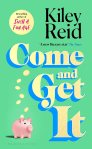 Come and Get It by Kiley Reid [Jan. 30, Bloomsbury / Jan. 9, G.P. Putnam’s] Such a Fun Age was a surprise hit with me, so I’m keen to try her second novel, set on a college campus. “It’s 2017 at the University of Arkansas. Millie Cousins, a senior resident assistant, wants to graduate, get a job, and buy a house. So when Agatha Paul, a [lesbian] visiting professor and writer, offers Millie an easy yet unusual opportunity, she jumps at the chance. But Millie’s starry-eyed hustle becomes jeopardised by odd new friends, vengeful dorm pranks and illicit intrigue.” (NetGalley download / public library reservation)
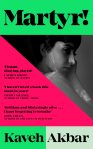 Martyr! by Kaveh Akbar [March 7, Picador /Jan. 23, Knopf] I’ve read Akbar’s two full-length poetry collections and particularly admired Pilgrim Bell. His debut novel sounds kind of unhinged, but I figure it’s worth a try. “When Cyrus’s obsession with the lives of the martyrs – Bobby Sands, Joan of Arc – leads him to a chance encounter with a dying artist, he finds himself drawn towards the mysteries of an uncle who rode through Iranian battlefields dressed as the Angel of Death; and toward his [late] mother, who may not have been who or what she seemed.” (NetGalley download)
 Memory Piece by Lisa Ko [March 7, Dialogue Books / March 19, Riverhead] Ko’s debut, The Leavers, was a favourite of mine from 2018, so it was great to hear that she is coming out with a new book. “Moving from the predigital 1980s to the art and tech subcultures of the 1990s to a strikingly imagined portrait of the 2040s, Memory Piece is an innovative and audacious story of three lifelong [female, Asian American] friends as they strive to build satisfying lives in a world that turns out to be radically different from the one they were promised.”
 The Paris Novel by Ruth Reichl [April 23, Random House] I’m reading this for an early Shelf Awareness review. It’s fairly breezy but enjoyable, with an expected foodie theme plus hints of magic but also trauma from the protagonist’s upbringing. “When her estranged mother dies, Stella is left with an unusual gift: a one-way plane ticket, and a note reading ‘Go to Paris’. But Stella is hardly cut out for adventure … When her boss encourages her to take time off, Stella resigns herself to honoring her mother’s last wishes.” (PDF review copy)
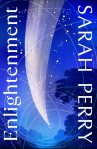 Enlightenment by Sarah Perry [May 2, Jonathan Cape / May 7, Mariner Books] “Thomas Hart and Grace Macauley are fellow worshippers at the Bethesda Baptist chapel in the small Essex town of Aldleigh. Though separated in age by three decades, the pair are kindred spirits – torn between their commitment to religion and their desire for more. But their friendship is threatened by the arrival of love.” Sounds a lot like The Essex Serpent (which is a very good thing) but with astronomy. (Print proof copy)
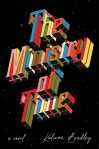 The Ministry of Time, Kaliane Bradley [May 7, Sceptre/Avid Reader Press] “A time travel romance, a speculative spy thriller, a workplace comedy, and an ingeniously constructed exploration of the nature of truth and power and the potential for love to change it. In the near future, a civil servant is offered the salary of her dreams and is, shortly afterward, told what project she’ll be working on. A recently established government ministry is gathering ‘expats’ from across history to establish whether time travel is feasible—for the body, but also for the fabric of space-time.” Promises to be zany and fun.
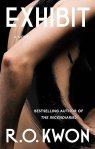 Exhibit by R.O. Kwon [May 21, Virago/Riverhead] I loved The Incendiaries and look forward to reading this next month for an early Shelf Awareness review. “At a lavish party in the hills outside of San Francisco, Jin Han meets Lidija Jung and nothing will ever be the same for either woman. A brilliant, young photographer, Jin is at a crossroads in her work, in her marriage to college sweetheart Phillip, in who she is and who she wants to be. Lidija is a glamorous, injured world-class ballerina on hiatus from her ballet company under mysterious circumstances. Drawn to each other by their intense artistic drives, the two women talk all night.” Bisexual rep from Kwon. (PDF review copy)
Nonfiction
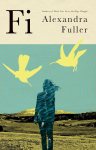 Fi: A Memoir of My Son by Alexandra Fuller [April 9, Grove Press] Fuller is one of the best memoirists out there (Don’t Let’s Go to the Dogs Tonight and Leaving Before the Rains Come), and I read pretty much every bereavement memoir I can get my hands on anyway. “It’s midsummer in Wyoming and Alexandra is barely hanging on. Grieving her father and pining for her home country of Zimbabwe, reeling from a midlife breakup, freshly sober and piecing her way uncertainly through a volatile new relationship with a younger woman, Alexandra vows to get herself back on even keel. And then – suddenly and incomprehensibly – her son Fi, at 21 years old, dies in his sleep.” (PDF review copy)
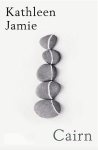 Cairn by Kathleen Jamie [June 13, Sort Of Books] Thanks to Paul (I link to his list below) for letting me know about this one. I’ll read anything Kathleen Jamie writes. “Cairn: A marker on open land, a memorial, a viewpoint shared by strangers. For the last five years … Kathleen Jamie has been turning her attention to a new form of writing: micro-essays, prose poems, notes and fragments. Placed together, like the stones of a wayside cairn, they mark a changing psychic and physical landscape.” Which leads nicely into…
Poetry
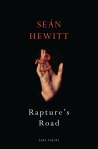 Rapture’s Road by Seán Hewitt [Jan. 11, Jonathan Cape] Hewitt’s debut collection, Tongues of Fire, was brilliant. This sounds like more of the same: “these poems forge their own unique path through the landscape. … Following the reciprocal relationship between queer sexuality and the natural world that he explored in [his previous book, the poet conjures us here into a trance: a deep delirium of hypnotic, hectic rapture where everything is called into question, until a union is finally achieved – a union in nature, with nature.”
Other lists for more ideas:
Electric Lit (all by women of color, as chosen by R.O. Kwon)
Kate – we overlap on a couple of our picks
Laura – we overlap on a few of our picks
Paul (mostly nonfiction)
What catches your eye here? What other 2024 titles do I need to know about?
#NovNov23 Week 4, “The Short and the Long of It”: W. Somerset Maugham & Jan Morris
Hard to believe, but it’s already the final full week of Novellas in November and we have had 109 posts so far! This week’s prompt is “The Short and the Long of It,” for which we encourage you to pair a novella with a nonfiction book or novel that deals with similar themes or topics. The book pairings week of Nonfiction November is always a favourite (my 2023 contribution is here), so think of this as an adjacent – and hopefully fun – project. I came up with two pairs: one fiction and one nonfiction. In the first case, the longer book led me to read a novella, and it was vice versa for the second.

W. Somerset Maugham
The House of Doors by Tan Twan Eng (2023)
&
Liza of Lambeth by W. Somerset Maugham (1897)
I wasn’t a huge fan of The Garden of Evening Mists, but as soon as I heard that Tan Twan Eng’s third novel was about W. Somerset Maugham, I was keen to read it. Maugham is a reliably readable author; his books are clearly classic literature but don’t pose the stylistic difficulties I now experience with Dickens, Trollope et al. And yet I know that Booker Prize followers who had neither heard of nor read Maugham have enjoyed this equally. I’m surprised it didn’t make it past the longlist stage, as I found it as revealing of a closeted gay writer’s life and times as The Master (shortlisted in 2004) but wider in scope and more rollicking because of its less familiar setting, true crime plot and female narration.
The main action is set in 1921, as “Willie” Somerset Maugham and his secretary, Gerald, widely known to be his lover, rest from their travels in China and the South Seas via a two-week stay with Robert and Lesley Hamlyn at Cassowary House in Penang, Malaysia. Robert and Willie are old friends, and all three men fought in the First World War. Willie’s marriage to Syrie Wellcome (her first husband was the pharmaceutical tycoon) is floundering and he faces financial ruin after a bad investment. He needs a good story that will sell and gets one when Lesley starts recounting to him the momentous events of 1910, including a crisis in her marriage, volunteering at the party office of Chinese pro-democracy revolutionary Dr Sun Yat Sen, and trying to save her friend Ethel Proudlock from a murder charge.

It’s clever how Tan weaves all of this into a Maugham-esque plot that alternates between omniscient third-person narration and Lesley’s own telling. The glimpses of expat life and Asia under colonial rule are intriguing, and the scene-setting and atmosphere are sumptuous – worthy of the Merchant Ivory treatment. I was left curious to read more by and about Maugham, such as Selina Hastings’ biography. (Public library) 
But for now I picked up one of the leather-bound Maugham books I got for free a few years ago. Amusingly, the novella-length Liza of Lambeth is printed in the same volume with the travel book On a Chinese Screen, which Maugham had just released when he arrived in Penang.
{SPOILERS AHEAD}
This was Maugham’s debut novel and drew on his time as a medical intern in the slums of London. In tone and content it falls almost perfectly between Dickens and Hardy, because on the one hand Liza Kemp and her neighbours are cheerful paupers even though they work in factories, have too many children and live in cramped quarters; on the other hand, alcoholism and domestic violence are rife, and the wages of sexual sin are death. All seems light to start with: an all-village outing to picnic at Chingford; pub trips; and harmless wooing as Liza rebuffs sweet Tom in favour of a flirtation with married Jim Blakeston.
 At the halfway point, I thought we were going full Tess of the d’Urbervilles – how is this not a rape scene?! Jim propositions her four times, ignoring her initial No and later quiet. “‘Liza, will yer?’ She still kept silence, looking away … Suddenly he shook himself, and closing his fist gave her a violent, swinging blow in the belly. ‘Come on,’ he said. And together they slid down into the darkness of the passage.” So starts their affair, which leads to Liza getting beaten up by Mrs Blakeston in the street and then dying of an infection after a miscarriage. The most awful character is Mrs Kemp, who spends the last few pages – while Liza is literally on her deathbed – complaining of her own hardships, congratulating herself on insuring her daughter’s life, and telling a blackly comic story about her husband’s corpse not fitting in his oak coffin and her and the undertaker having to jump on the lid to get it to close.
Liza isn’t entirely the stereotypical whore with the heart of gold, but she is a good-time girl (“They were delighted to have Liza among them, for where she was there was no dullness”) and I wonder if she could even have been a starting point for Eliza Doolittle in Pygmalion. Maugham’s rendering of the cockney accent is over-the-top –
“‘An’ when I come aht,’ she went on, ‘’oo should I see just passin’ the ’orspital but this ’ere cove, an’ ’e says to me, ‘Wot cheer,’ says ’e, ‘I’m goin’ ter Vaux’all, come an’ walk a bit of the wy with us.’ ‘Arright,’ says I, ‘I don’t mind if I do.’”
– but his characters are less caricatured than Dickens’s. And, imagine, even then there was congestion in London:
“They drove along eastwards, and as the hour grew later the streets became more filled and the traffic greater. At last they got on the road to Chingford, and caught up numbers of other vehicles going in the same direction—donkey-shays, pony-carts, tradesmen’s carts, dog-carts, drags, brakes, every conceivable kind of wheeled thing, all filled with people”
In short, this was a minor and derivative-feeling work that I wouldn’t recommend to those new to Maugham. He hadn’t found his true style and subject matter yet. Luckily, there’s plenty of other novels to try. (Free mall bookshop) [159 pages] 
Jan Morris
Conundrum by Jan Morris (1974)
&
Jan Morris: Life from Both Sides, A Biography by Paul Clements (2022)

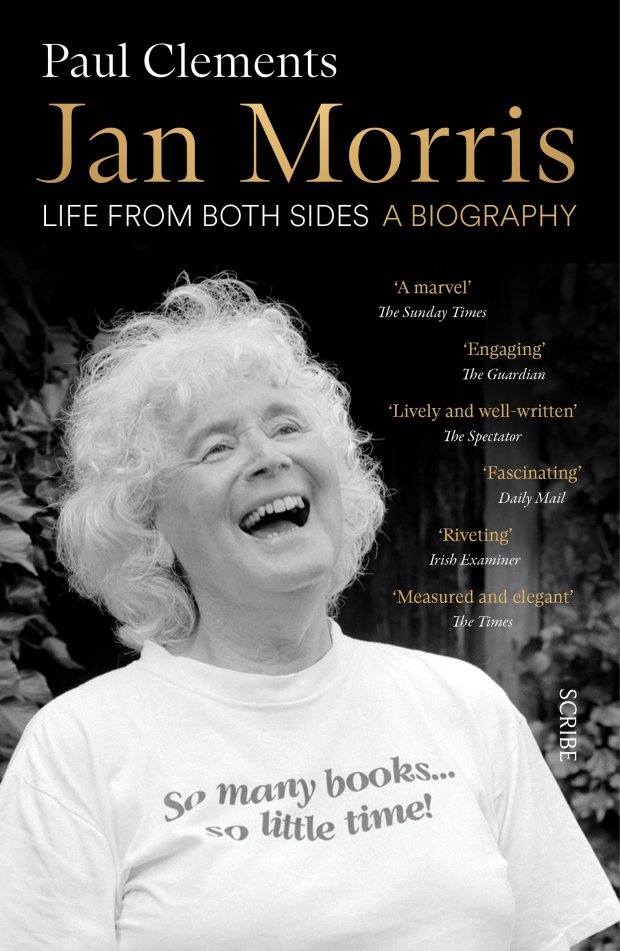
Back in 2021, I reread and reviewed Conundrum during Novellas in November. It’s a short memoir that documents her spiritual journey towards her true identity – she was a trans pioneer and influential on my own understanding of gender. In his doorstopper of a biography, Paul Clements is careful to use female pronouns throughout, even when this is a little confusing (with Morris a choirboy, a soldier, an Oxford student, a father, and a member of the Times expedition that first summited Everest). I’m just over a quarter of the way through the book now. Morris left the Times before the age of 30, already the author of several successful travel books on the USA and the Middle East. I’ll have to report back via Love Your Library on what I think of this overall. At this point I feel like it’s a pretty workaday biography, comprehensive and drawing heavily on Morris’s own writings. The focus is on the work and the travels, as well as how the two interacted and influenced her life.

 Bookish Beck = Rebecca Foster. American transplant to England. Freelance proofreader and book reviewer.
 Bookish Beck