All Souls’ Day Reading: Armitage, Campbell, Mah & Perry
Along with my Halloween-tide R.I.P. reading (here and here), I’ve been reading books about ancestors and the dead – appropriate for All Saints’ Day (yesterday) and All Souls’ Day (today). Both are in the Church calendar but less a part of popular culture.
My mind naturally turns toward the dead as October advances: on the 30th, it was three years since my mother’s death (plus the 25th marked a year since we started losing sweet Alfie). To allay dread at the impending anniversary, I booked myself a treat to look forward to that day. For some reason, Wantage Literary Festival included a Gin Tasting Extravaganza alongside its bookish events. I didn’t fancy any book talks but was keen to try 10 British Isles gins, 9 of which were new to me and 5 of which were ticks in my 101 Gins to Try before You Die book.


Beforehand, I did some secondhand book shopping. Regent is an excellent and enormous maze of a bookshop that I’d been to once before. It has an exhaustive selection and great prices (£2.50 paperbacks / £3–5 hardbacks) that haven’t changed in three years. I considered this return trip a chance for another birthday book haul and was delighted with my finds (the Gleeson was from a charity shop in the town).


My All Souls’ stack includes a poetry collection and three #NonfictionNovember reads.
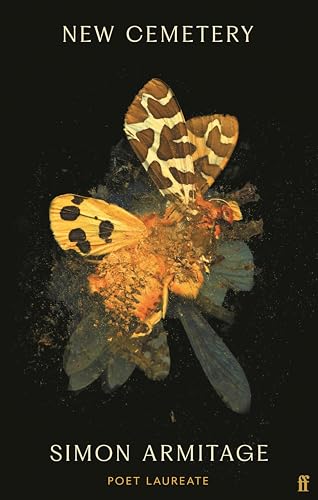
New Cemetery by Simon Armitage (2025)
Not far from the English Poet Laureate’s home in Huddersfield, some cow fields were recently converted into a municipal graveyard. I can’t do better than Armitage’s own description of the style in this collection: “short-lined tercets linked with/by intermittent rhymes and half-rhymes … like threading daisy chains.” Each one is titled in brackets after a species of moth, in a rather arbitrary way, as he acknowledges. The point was to – in a time of climate breakdown – include nature in the inevitable march of death and decay. I most liked the poems about the cemetery, whereas the majority of the book is about everyday moments from a writer’s life.
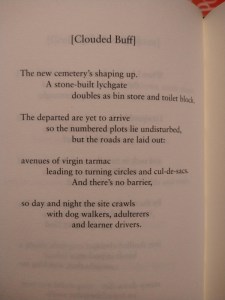
There are some amusing and poignant lines among the rest:
 I died and went
to Bristol Parkway
for my sins,
interchange
between soul and flesh
the whispered half-rhymes
of earth and death
on the spade’s tongue.
I also appreciated this haiku-like stanza: “Almond blossom / slash rotten confetti / clogging the church drains.” But there was little that struck me otherwise. I’ve tried to love Armitage’s poetry, but this third experience again leaves me unmoved. I’ve preferred his travel memoirs. Still, the book ends on the perfect note:
the dead are patiently
killing time
between visiting hours,
deaf, blind, mute
and numb,
unable to love
but capable still
of being loved.
(Public library) 
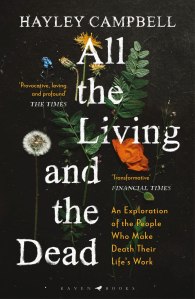 I’ve read the first two chapters of a long-neglected review copy of All the Living and the Dead by Hayley Campbell (2022), in which she shadows various individuals who work in the death industry, starting with a funeral director and the head of anatomy services for the Mayo Clinic in Minnesota. In Victorian times, corpses were stolen for medical students to practice on. These days, more people want to donate their bodies to science than can usually be accommodated. The Mayo Clinic receives upwards of 200 cadavers a year and these are the basis for many practical lessons as trainees prepare to perform surgery on the living. Campbell’s prose is journalistic, detailed and matter-of-fact, but I’m struggling with the very small type in my paperback. Upcoming chapters will consider a death mask sculptor, a trauma cleaner, a gravedigger, and more. If you’ve enjoyed Caitlin Doughty’s books, try this.
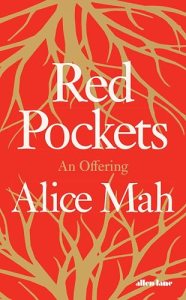 I’m halfway through Red Pockets: An Offering by Alice Mah (2025) from the library. I borrowed it because it was on the Wainwright Prize for Conservation Writing shortlist. During the Qingming Festival, the Chinese return to their hometowns to honour their ancestors. By sweeping their tombs and making offerings, they prevent the dead from coming back as hungry ghosts. When Mah, who grew up in Canada and now lives in Scotland, returns to South China with a cousin in 2017, she finds little trace of her ancestors but plenty of pollution and ecological degradation. Their grandfather wrote a memoir about his early life and immigration to Canada. In the present day, the cousins struggle to understand cultural norms such as gifting red envelopes of money to all locals. This is easy reading but slightly dull; it feels like Mah included every detail from her trips simply because she had the material, whereas memoirs need to be more selective. But I’m reminded of the works of Jessica J. Lee, which is no bad thing.
Death of an Ordinary Man by Sarah Perry (2025)
Perry recognises what a sacred privilege it was to witness her father-in-law’s death, which occurred just nine days after his diagnosis with oesophageal cancer. She concludes, like Simone de Beauvoir does of her mother in A Very Easy Death, that David’s end was as good as one might hope for. Viz., he was in his late seventies, remained at home, was looked after by his son and daughter-in-law, more or less maintained his mental capacity until the end, and showed minimal signs of pain or distress. Still, every death is fraught, to some degree, with bureaucracy, medical error and pangs of regret. There is a searing encounter here with an unfeeling GP; on the other hand, there is such kindness from nurses, relatives and a pastor.
The beauty of Perry’s memoir is its patient, clear-eyed unfolding of every stage of dying, a natural and inexorable process that in other centuries would have been familiar to anyone – having observed it with siblings, children, parents, neighbours, distant relatives and so on. She felt she was joining a specifically womanly lineage of ministering, a destiny so quotidian that she didn’t feel uncomfortable with any of the intimate care involved. I thought of my sister and her mother- and sister-in-law sitting vigil at my brother-in-law’s deathbed in 2015.
 Perry traces the physical changes in David as he moved with alarming alacrity from normal, if slowed, daily life to complete dependency to death’s door. At the same time, she is aware that this is only her own perspective on events, so she records her responses and emotional state and, to a lesser extent, her husband’s. Her quiver of allusions is perfectly chosen and she lands on just the right tone: direct but tender. Because of her and David’s shared upbringing, the points of reference are often religious, but not obtrusive. My only wish is to have gotten more of a sense of David alive. There’s a brief section on his life at the start, mirrored by a short “Afterlife” chapter at the end telling what succeeded his death. But the focus is very much on the short period of his illness and the days of his dying. During this time, he appears confused and powerless. He barely says anything beyond “I’m in a bit of a muddle,” to refer to anything from incontinence to an inability to eat. At first I thought this was infantilizing him. But I came to see it as a way of reflecting how death strips everything away.
As I read, I often had tears in my eyes, thinking of the deaths I have experienced at second hand and the many more that will come my way until my own. In this gift of a book, Perry captures the emotional poles of bearing witness, and the dignity and uniqueness of every life:
There was relief, and there was loss – it was the saddest thing we’d ever seen, and the best thing we had ever done – all these things existing together undiminished, and never cancelling each other out.
now I understand there are no ordinary lives – that every death is the end of a single event in time’s history: an event so improbable it represents a miracle, and irreplaceable in every particular.
(Public library) 
Death and grief are common topics in my stacks at all times of year. I see more books on dying and the dead in my immediate future, starting with two rereads for #NovNov – The Death of Ivan Ilych and Death in Venice, along with The Field by Robert Seethaler (narrated by the inhabitants of a cemetery), the latter two for #GermanLitMonth; and A Single Man by Christopher Isherwood.
Love Your Library, May 2025
Thanks to Eleanor and Skai for posting about their recent library reading! Marina Sofia also recently posted about public libraries in China.
My library had a display coinciding with Dying Matters Awareness Week (5–11 May), an initiative of Hospice UK. I read a lot around illness, death and dying and am pleased to see books on these topics featured. I hadn’t heard of this weeklong celebration before, but I hope that it and the library display will get people talking.

 I appreciated this quote from Women by Chloe Caldwell, whose narrator works in a library: “Books are like doctors and I am lucky to have unlimited access to them during this time. A perk of the library.” Bibliotherapy works!
My library use over the last month:
(links are to books not already reviewed on the blog)
READ
- Case Histories by Kate Atkinson (for book club)

- Women by Chloe Caldwell

- All Fours by Miranda July

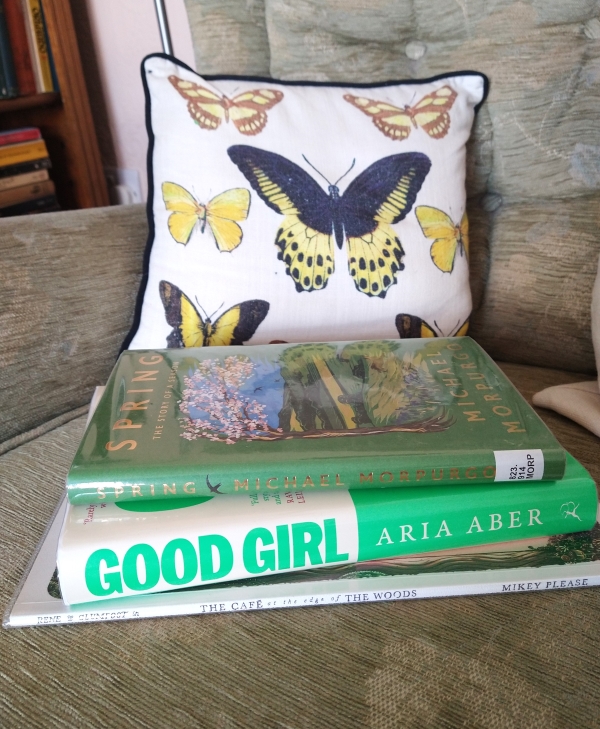
- The Cafe at the Edge of the Woods by Mikey Please
- Stoner by John Williams (a reread for book club)

SKIMMED
- Spring Is the Only Season: How It Works, What It Does and Why It Matters by Simon Barnes

CURRENTLY READING
- Good Girl by Aria Aber
- Bellies by Nicola Dinan
- May Day by Jackie Kay
- Spring: The Story of a Season by Michael Morpurgo
- The Secret Lives of Booksellers and Librarians: True Stories of the Magic of Reading by James Patterson & Matt Eversmann
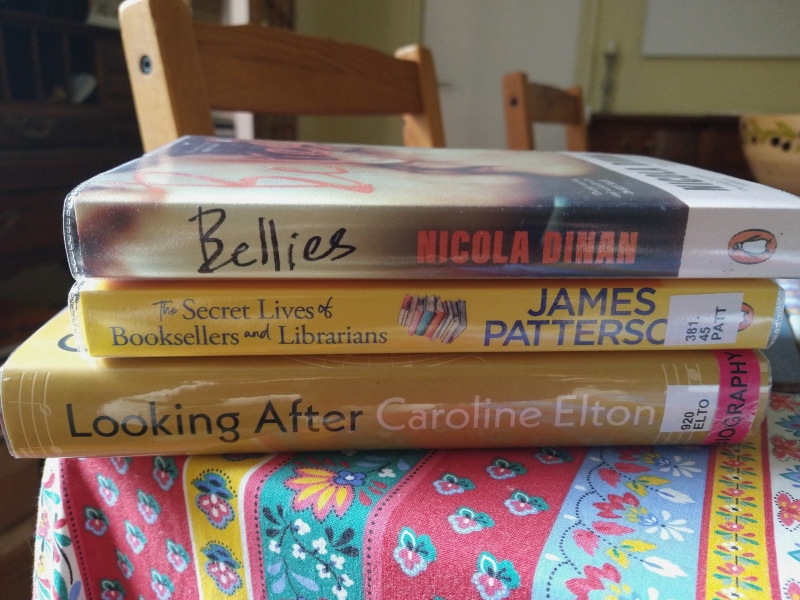
CHECKED OUT, TO BE READ
- The Honesty Box by Lucy Brazier
- Day by Michael Cunningham
- Looking After: A Portrait of My Autistic Brother by Caroline Elton
- Rebel Bodies: A Guide to the Gender Health Gap Revolution by Sarah Graham
- Period Power: Harness Your Hormones and Get Your Cycle Working for You by Maisie Hill
- Self-Portrait with Family by Amaan Hyder
- Adam by Gboyega Odubanjo
- The Forgotten Sense: The Nose and the Perception of Smell by Jonas Olofsson
- Horse by Rushika Wick
- Top Doll by Karen McCarthy Woolf
ON HOLD, TO BE PICKED UP
- Is a River Alive? by Robert Macfarlane
- The Persians by Sanam Mahloudji
IN THE RESERVATION QUEUE
- The Most by Jessica Anthony
- Don’t Forget We’re Here Forever: A New Generation’s Search for Religion by Lamorna Ash
- The Interpretation of Cats: And Their Owners by Claude Béata; translated by David Watson
- Fulfillment by Lee Cole
- A Sharp Scratch by Heather Darwent
- I Think I Like Girls by Rosie Day
- The Husbands by Holly Gramazio
- To the Edge of the Sea: Schooldays of a Crofter’s Child by Christina Hall
- The Blue Hour by Paula Hawkins
- Normally Weird and Weirdly Normal: My Adventures in Neurodiversity by Robin Ince
- The Homemade God by Rachel Joyce
- Shattered by Hanif Kureishi
- Enchanted Ground: Growing Roots in a Broken World by Steven Lovatt
- Whisky Galore by Compton Mackenzie
- Wife by Charlotte Mendelson
- Ripeness by Sarah Moss
- The Age of Diagnosis: Sickness, Health and Why Medicine Has Gone Too Far by Suzanne O’Sullivan
- Atmosphere by Taylor Jenkins Reid
- Three Weeks in July by Adam Wishart & James Nally
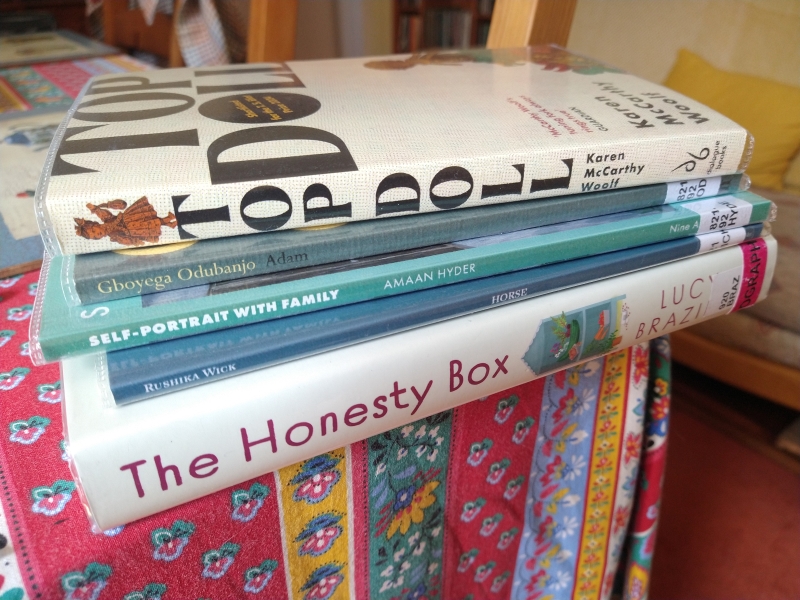
The top four books are from the Jhalak Poetry Prize shortlist.
RETURNED UNFINISHED
- The Meteorites: Encounters with Outer Space and Deep Time by Helen Gordon – I enjoyed her previous book well enough, but found I wasn’t interested enough in the subject matter here.
RETURNED UNREAD
- I Am Not a Tourist by Daisy J. Hung – The writing style was not enticing.
- Of Thorn & Briar: A Year with the West Country Hedgelayer by Paul Lamb – This was requested off of me but I will get it out another time.
What have you been reading or reviewing from the library recently?

Share a link to your own post in the comments. Feel free to use the above image. The hashtag is #LoveYourLibrary.
#NovNov24 Catch-Up, II: Ingalls; Boas, Lindbergh, Toth
Thanks for indulging me as I assemble a final catch-up of the novella-length works I started in November and didn’t manage to review until now. In fiction, I have a surreal modern classic. And in nonfiction, two books of open-hearted and witty writing on the approach of death, and a memoir with a unique framework.
Mrs Caliban by Rachel Ingalls (1982)
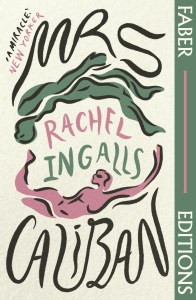 Dorothy Caliban is a California housewife whose unhappy marriage to Fred has been strained by the death of their young son (an allergic reaction during routine surgery) and a later miscarriage. When we read that Dorothy believes the radio has started delivering personalized messages to her, we can’t then be entirely sure if its news report about a dangerous creature escaped from an oceanographic research centre is real or a manifestation of her mental distress. Even when the 6’7” frog-man, Larry, walks into her kitchen and becomes her lover and secret lodger, I had to keep asking myself: is he ever independently seen by another character? Can these actions be definitively attributed to him? So perhaps this is a novella to experience on two levels. Take it at face value and it’s a lighthearted caper of duelling adulterers and revenge, with a pointed message about the exploitation of the Other. Or interpret it as a midlife fantasy of sexual rejuvenation and an attentive partner (“[Larry] said that he enjoyed housework. He was good at it and found it interesting”):
Dorothy still felt like a teenager. At the time when her hope and youth and adventurousness had left her, she had believed herself cheated of those early years when nothing had happened to her, although it might have. Later still, she realized that if she had made an effort, she herself could have made things happen. But now it didn’t matter. Here she was.
I thought of it as a waystation between Bear by Marian Engel and something like Melissa Broder’s novels or All Fours by Miranda July. I enjoyed it well enough but didn’t wholly see what the fuss was all about. (New bargain purchase from Faber) [117 pages]
A Beginner’s Guide to Dying by Simon Boas (2024)
 I hadn’t heard of the author but picked this up from the Bestseller display in my library. It’s a posthumous collection of writings, starting with a few articles Boas wrote for his local newspaper, the Jersey Evening Post, about his experience of terminal illness. Diagnosed late on with incurable throat cancer, Boas spent his last year smoking and drinking Muscadet. Looking back at the privilege and joys of his life, he knew he couldn’t complain too much about dying at 46. He had worked in charitable relief in wartorn regions, finishing his career as director of Jersey Overseas Aid. The articles are particularly witty. After learning his cancer had metastasized to his lungs, he wrote, “The prognosis is not quite ‘Don’t buy any green bananas’, but it’s pretty close to ‘Don’t start any long books’.” While I admired the perspective and equanimity of the other essays, most of their topics were overly familiar for me (gratitude, meditation, therapy, what (not) to do/say to the dying). His openness to religion and use of psychedelics were a bit more interesting. It’s hard to write anything original about dying, and his determined optimism – to the extent of downplaying the environmental crisis – grated. (Public library) [138 pages]
No More Words: A Journal of My Mother, Anne Morrow Lindbergh by Reeve Lindbergh (2001)
 I’ve reviewed one of Anne Morrow Lindbergh’s books for a previous NovNov: Gift from the Sea. She was also a poet and aviator. Reeve Lindbergh’s memoir focuses on the last year and a half of her mother’s life, 1999–2001. At this point she was in her early nineties and mostly nonverbal after a series of mini-strokes. She moved to live with her daughter on a Vermont farm and had carers to attend to her daily needs. It’s painful for the whole family to watch someone who was so fond of words gradually lose the ability to communicate. There are still moments of connection and possible memory, as when she reads her mother’s work aloud to her, and even humour, as they eat the messiest possible strawberry shortcake. It is an easy dying: her nurses are gentle and respectful, and she lives significantly longer than anyone predicted. Along the way, we get glimpses of the running of the farm, such as bottle-feeding an abandoned lamb, and of repeated tragedies from the family’s history: the Charles Lindberghs’ first child died in a botched kidnapping attempt at age one, and Reeve also lost a son at a similar age. “It is good just to sit next to my mother, whom I have known and loved for so long,” she writes. These low-key thoughts on age, infirmity and anticipatory grief were nicely done, but won’t likely stay with me. (Secondhand – Barter Books, 2024) [174 pages]
Leaning into the Wind: A Memoir of Midwest Weather by Susan Allen Toth (2003)
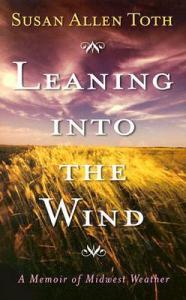 I was always going to read this because I’m a big fan of Susan Allen Toth’s work, including her trilogy of cosy travel books about Great Britain. I’m a memoir junkie in general, but I especially like ones that view the self through a particular filter, e.g., garments sewn (Bound by Maddie Ballard), houses lived in (My Life in Houses by Margaret Forster) and train journeys taken (The Lost Properties of Love by Sophie Ratcliffe). Toth grew up in Iowa and, barring stints on the coasts for her degrees, always lived in the Midwest, chiefly Minnesota. “The weather, I have happily discovered, does not grow old” – a perennial conversation starter and source of novel, cyclical experiences. She remembers huddling in a basement during tornado warnings and welcoming the peace of a first snow. Squalls seen out the window seemed to mirror her turbulent first marriage. She would fret over her daughter driving in thunderstorms until her safe arrival home. Fending off insects is a drawback to summer, and keeping a garden is an alloyed joy. I especially liked the essays on the metaphorical use of weather words and the temptation of ascribing meteorological events to divine activity. Not a squeak about climate change, though at the time the general public was aware of it; there could be an update chapter on shifts in seasonality and the increased frequency of extreme weather events. (Birthday gift from my wish list in 2021) [124 pages]
Final statistics
For this year’s Novellas in November, I reviewed a total of 30 short books, so I achieved my goal of reading the equivalent of one short book for each day of the month! The standouts were (nonfiction) Without Exception by Pam Houston and (fiction) On Chesil Beach by Ian McEwan, which was a reread for me. Other highlights included The House of Dolls by Barbara Comyns, Recognising the Stranger by Isabella Hammad, and Island by Julian Hanna. I also reviewed a film based on a novella, Small Things Like These.
It was great to get involved with Weatherglass Books in the inaugural year of their Novella Prize by attending their “The Future of the Novella” event in London, reviewing Astraea, and interviewing Neil Griffiths. I’ll review Aerth soon, too.
Collectively, we had 46 participants contributing 188 posts covering 160+ books. If you want to take a look back at the link parties, they’re all here. Another fantastic year – thank you again!

#WITMonth, Part I: de Beauvoir, Jansson, NDiaye
My first four reads for Women in Translation month were quite a varied selection: a sobering autobiographical essay about the loss of a mother, a characteristically impish children’s novel, a confoundingly elliptical family memoir, and a preview of a forthcoming Mexican novel about women’s friendships and handicraft. Another four coming up later in August.
A Very Easy Death by Simone de Beauvoir (1964; 1965)
[Translated from the French by Patrick O’Brian]
“When someone you love dies you pay for the sin of outliving her with a thousand piercing regrets.”
I’d read a lot about Simone de Beauvoir but not one of her own works until this reissue came my way. It was right up my street as a miniature bereavement memoir (just 84 pages) that doesn’t shy away from the physical details of decline or the emotional complications of a fraught mother–daughter relationship.
 In October 1963, de Beauvoir was in Rome when she got a call informing her that her mother had had an accident. Expecting the worst, she was relieved – if only temporarily – to hear that it was a fall at home, resulting in a broken femur. But when Françoise de Beauvoir got to the hospital, what at first looked like peritonitis was diagnosed as stomach cancer with an intestinal obstruction. Her daughters knew that she was dying, but she had no idea (from what I’ve read, this paternalistic notion that patients must be treated like children and kept ignorant of their prognosis is more common on the Continent, and continues even today).
Over the next month, de Beauvoir and her sister Poupette took turns visiting. Initially alarmed by their mother’s condition, they soon grew used to the deterioration. “I was not worried by her nakedness any more: it was no longer my mother, but a poor tormented body.” They found her in varying states of awareness and discomfort. “In this race between pain and death we most earnestly hoped that death would come first.” Some nurses were better than others. De Beauvoir makes tantalizing references to the standoff between her and her mother about the Catholic faith Simone left behind. (I’ll need to read Memoirs of a Dutiful Daughter for more on that.) Even the hope of heaven didn’t fully neutralize self-pity and physical suffering for the dying woman because she feared her daughters wouldn’t be joining her.
The title is what a nurse told the grieving daughters: that their mother’s had been a very easy death in the end (and an upper-class one, de Beauvoir adds). The word used in French for easy, douce, can also be translated as “gentle,” a tie-in to the epigraph from Dylan Thomas’s “Do not go gentle into that good night.” Is it better for a loved one to die suddenly, or protractedly? I’ve debated this with myself and a few others since my mother’s death from a stroke in October. Ultimately, it’s pointless to ask; any death is an affront, hard to accept and adjust to no matter how much warning is given. I appreciated how matter-of-factly and concisely de Beauvoir’s essay encapsulates the duties and feelings surrounding a death. Frank and unshowy yet potent, this is a classic of the subgenre. 
Published as Fitzcarraldo Editions Classics No. 2 in June. With thanks to the publisher for the free copy for review.
(Books of Summer, #10)
Finn Family Moomintroll by Tove Jansson (1948; 1950)
[Translated from the Swedish by Elizabeth Portch]
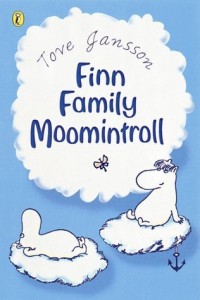 My sixth Moomins book, and ninth by Jansson overall. The novella’s gentle peril is set in motion by the discovery of the Hobgoblin’s Hat, which transforms anything placed within it. As spring moves into summer, this causes all kind of mild mischief until Thingumy and Bob, who speak in spoonerisms, show up with a suitcase containing something desired by both the Groke and the Hobgoblin, and make a deal that stops the disruptions.
As always, the creatures and events, conveyed by Jansson’s black-and-white drawings as much as by her words, are inventive and whimsical. There’s a cosy charm to the seasonal rituals, like the end-of-summer pancake party here. But what I value even more is the pointed accounts of the secondary characters’ neuroses. The Moomins are generally on a pretty even keel, though there is mention of Moominpappa’s sense of being hard done by because of childhood bullying and an enduring lack of respect. However, characters like the Muskrat and the Hemulen get a wry smile and shake of the head from me because their predicaments are so familiar: The Muskrat, terrified of mortifying situations, decides the life of a hermit might be preferable; the Hemulen gives up stamp collecting and switches to botanizing because there’s no joy in a finished quest, only in an ongoing search. The Moomins books offer the perfect combination of the familial and routine with the novel and adventurous. Even staid adults should give them a try. (Little Free Library)
Self-Portrait in Green by Marie NDiaye (2005; 2015)
[Translated from the French by Jordan Stump]
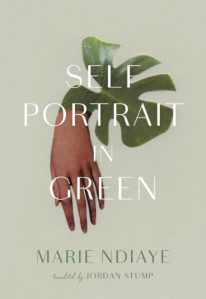 I tend to love a memoir that tries something new or experimental with the form (such as Constructing a Nervous System or In the Dream House), but this was a step too far for me; the self referred to in the title is almost wholly absent. NDiaye, a French–Senegalese author, opens in 2003 with the expected flooding of the Garonne in southwest France. Fragments of narrative from 2000–2003 chart her encounters with various women dressed in green, starting with one she thinks she sees under a banana tree (though her four children see nothing). Then there’s Katia Depetiteville, dead 10 years … NDiaye’s stepmother, once her childhood best friend; her friend Jenny’s rival for Ivan’s affection; and her mother, who now has a new family. What is a ‘woman in green’? The author explicitly associates the colour with cruelty, with presumably the usual connotation of jealousy as well. But it still feels arbitrary.
It’s all rather dreamlike, with poetic repetition, rhetorical questions and black-and-white photos that seem marginally relevant. “I’m saying to myself: Is all this really real?” NDiaye writes, and the reader will surely be asking the same. “I’m always interested in stories,” she adds, and while I’d agree, I need to know that they’re being told to build to some greater meaning. It was only in the last fifth of the book, when the author goes to a literary symposium in Ouagadougou and visits her father (a many-times-married former restaurateur and amateur architect now suffering from cataracts) and stepmother that I felt like there was a purpose: a bringing together of past and present for psychological clarity. I was relieved that this was only 112 pages. (Edelweiss) 
The 10th anniversary edition is being reissued by Two Lines Press next month.
And a bonus preview:
Cross-Stitch by Jazmina Barrera (2021; 2023)
[Translated from the Spanish by Christina MacSweeney]
 In the inventive debut novel by Mexican author Jazmina Barrera, a sudden death provokes an intricate examination of three young women’s years of shifting friendship. Their shared hobby of embroidery occasions a history of women’s handiwork, woven into a relationship study that will remind readers of works by Elena Ferrante and Deborah Levy. Citlali, Dalia, and Mila had been best friends since middle school. Mila, a writer with a young daughter, is blindsided by news that Citlali has drowned off Senegal. While waiting to be reunited with Dalia for Citlali’s memorial service, she browses her journal to revisit key moments from their friendship, especially travels in Europe and to a Mexican village. Cross-stitch becomes its own metaphorical language, passed on by female ancestors and transmitted across social classes. Reminiscent of Still Born and A Ghost in the Throat. (Edelweiss)
Coming out on 7 November from Two Lines Press. My full review for Shelf Awareness is pending.
Reviews: de Jongh, Eipe, Parker and Scull
Today’s roundup includes a graphic novel set during the U.S. Dust Bowl, a Dylan Thomas Prize-shortlisted poetry collection infused with Islamic imagery, a book about adaptive technologies for the disabled, and a set of testimonies from the elderly and terminally ill.
Days of Sand by Aimée de Jongh (2021; 2022)
[Translated from the Dutch by Christopher Bradley]
Dust can drive people mad.
 This terrific Great Depression-era story was inspired by the real-life work of photographers such as Dorothea Lange who were sent by the Farm Security Administration, a new U.S. federal agency, to document the privations of the Dust Bowl in the Midwest. John Clark, 22, is following in his father’s footsteps as a photographer, leaving New York City to travel to the Oklahoma panhandle. He quickly discovers that struggling farmers are believed to have brought the drought on themselves through unsustainable practices. Many are fleeing to California. The locals are suspicious of John as an outsider, especially when they learn that he is working to a checklist (“Orphaned children”, “Family packing car to leave”).
“The best photos have an instant impact. Right away, they grab our attention. They tell a story, or deliver a message. The question is: how do you make that happen?” one of his employers had asked. John grows increasingly uncomfortable with being part of what is essentially a propaganda campaign when he develops a personal fondness for Cliff, a little boy who offers to be his assistant, and Betty, a pregnant widow whose runaway horse he finds. The deprivation and death he sees at close hand bring back memories of his father’s funeral four years ago.
Whether a cityscape or the midst of a dust storm, de Jongh’s scenes are stark and evocative. Each chapter opens with a genuine photograph from the period (de Jongh travelled to the USA for archival and on-the-ground research thanks to a grant from the Dutch Foundation for Literature), and some panes mimic B&W photos the FSA team took. It’s rare for me to find the story and images equally powerful in a graphic novel, but that’s definitely the case here.


With thanks to SelfMadeHero for the free copy for review.
Auguries of a Minor God by Nidhi Zak/Aria Eipe (2021)
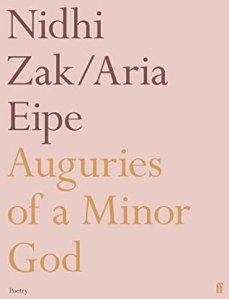 This debut poetry collection is on the Dylan Thomas Prize shortlist. I’ve noted that recent winners – such as Lot by Bryan Washington and Luster by Raven Leilani – have in common a distinctive voice and use of language, which chimes with what Thomas was known for (see my recent review of Under Milk Wood) and clarifies what the judges are looking for.
The placement of words on the page seems to be very important in this volume – spread out or bunched together, sometimes descending vertically, a few in grey. It’s unfortunate, then, that I read an e-copy, as most of the formatting was lost when I put it on my Nook. The themes of the first part include relationships, characterized by novelty or trauma; tokens of home experienced in a new land; myths; and nature. Section headings are in Malayalam.
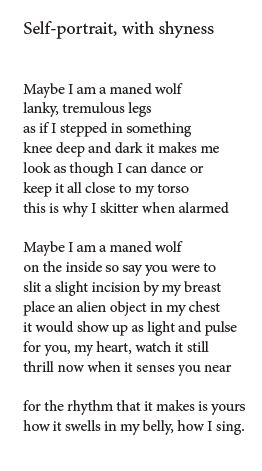
The book culminates in a lengthy, astonishingly nimble abecedarian in which a South Asian single father shepherds his children through English schooling as best he can while mired in grief over their late mother. This bubbles over in connection with her name, Noor, followed by a series of “O” apostrophe statements, some addressed to God and others exhorting fellow believers. Each letter section gets progressively longer. I was impressed at how authentically the final 30-page section echoes scriptural rhythms and content – until I saw in the endnotes that it was reproduced from a 1997 translation of the Quran, and felt a little cheated. Still, “A is for…” feels like enough to account for this India-born poet’s shortlisting. (The Prize winner will be announced on Thursday the 12th.)
With thanks to Midas PR for the free e-copy for review.
Hybrid Humans: Dispatches from the Frontiers of Man and Machine by Harry Parker (2022)
 I approached this as a companion to To Be a Machine by Mark O’Connell and that is precisely what I found, with Parker’s personal insight adding a different angle to the discussion of how technology corrects and transcends flawed bodies. Parker was a captain in the British Army in Afghanistan when an IED took his legs. Now he wears prostheses that make him roughly 12% machine. “Being a hybrid human means expensive kit – you have to pay for the privilege of leading a normal life.” He revisits the moments surrounding his accident and his adjustment to prostheses, and meets fellow amputees like Jack, who was part of a British medical trial on osseointegration (where titanium implants come out of the stump for a prosthesis to attach to) that enabled him to walk much better. Other vets they know had to save up and travel to Australia to have this done because the NHS didn’t cover it.
Travelling to the REHAB trade fair in Karlsruhe, Parker learns that disability, too, can be the mother of invention. Virtual reality and smartphone technology are invaluable, with an iPhone able to replace up to 11 single-purpose devices. Yet he also encounters disabled people who are happy with their lot and don’t look to tech to improve it, such as Jamie, who’s blind and relies only on a cane. And it’s not as if tools to compensate for disability are new; the book surveys medical technologies that have been with us for decades or even centuries: from glass eyes to contact lenses; iron lungs, cochlear implants and more.
Pain management, PTSD, phantom limbs, foreign body rejection, and deep brain stimulation for Parkinson’s disease are other topics in this wide-ranging study that is at the juncture of the personal and political. “A society that doesn’t look after the vulnerable isn’t looking after anyone – I’d learnt first-hand that we’re all just a moment from becoming vulnerable,” Parker concludes. I’ll hope to see this one on next year’s Barbellion Prize longlist.
With thanks to Profile Books/Wellcome Collection for the free copy for review.
Regrets of the Dying: Stories and Wisdom that Remind Us How to Live by Georgina Scull (2022)
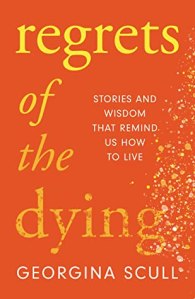 A medical crisis during pregnancy that had her minutes from death was a wake-up call for Scull, leading her to rethink whether the life she was living was the one she wanted. She spent the next decade interviewing people in her New Zealand and the UK about what they learned when facing death. Some of the pieces are like oral histories (with one reprinted from a blog), while others involve more of an imagining of the protagonist’s past and current state of mind. Each is given a headline that encapsulates a threat to contentment, such as “Not Having a Good Work–Life Balance” and “Not Following Your Gut Instinct.” Most of her subjects are elderly or terminally ill. She also speaks to two chaplains, one a secular humanist working in a hospital and the other an Anglican priest based at a hospice, who recount some of the regrets they hear about through patients’ stories.
Recurring features are not spending enough time with family and staying too long in loveless or unequal relationships. Two accounts that particularly struck me were Anthea’s, about the tanning bed addiction that gave her melanoma, and Millicent’s, guilty that she never went to the police about a murder she witnessed as a teenager in the 1930s (with a NZ family situation that sounds awfully like Janet Frame’s). Scull closes with 10 things she’s learned, such as not to let others’ expectations guide your life and to appreciate the everyday. These are readable narratives, capably captured, but there isn’t much here that rises above cliché.
With thanks to publicist Claire Morrison and Welbeck for the free copy for review.
Would you be interested in reading one or more of these?
The Inevitable: Dispatches on the Right to Die by Katie Engelhart
Why, she wanted to know, was I so interested in the subject?
“Why isn’t everyone?” I asked.
The fact that I read a lot more books about death than the average person is something I attribute not to some morbid curiosity, but to pragmatism. As the title of Canadian reporter and documentary filmmaker Katie Engelhart’s book makes clear, this is the one subject none of us can avoid indefinitely, so why not learn about and understand it as much as possible? The Inevitable focuses on the controversial matter of assisted dying, also known as assisted suicide, euthanasia, or physician-assisted death. It’s a topic that’s already come up in my reading a couple of times this year: in the Dutch context of That One Patient by Ellen de Visser, and as a key part of the narrative in Darke Matter by Rick Gekoski.

Engelhart spends time with doctors and patients who are caught up in the assisted dying argument, chiefly in Western Europe and the United States. Ten states plus Washington, D.C. have assisted dying laws, sparked by Oregon’s Death with Dignity Act in 1994. In California, the author follows Dr. Lonny Shavelson for a month, observing all the meticulous regulations surrounded a physician-assisted death: patients with a terminal diagnosis and less than six months to live have to complete multiple forms, give many signatures, deliver oral testimony, and be able to drink the fatal concoction by themselves (whereas in other countries doctors can administer lethal injections). And if, when the time comes, a patient is too far gone to give spoken consent, the procedure is cancelled.
Other chapters consider specific cases that are not generally covered by current legislation but can drive people to seek assisted suicide: the ravages of old age, chronic degenerative illnesses, dementia, and severe mental illness. Each of these is given its own long chapter, like an extended magazine profile.
- Meet Avril Henry, a former Exeter University professor in her eighties, now living alone with a failing body but no specific diagnosis that would qualify her for AD. Pain has long since outweighed pleasure in her life, so she illegally imports Nembutal from a veterinary supplier in Mexico and makes a careful plan for what will happen with her body, home, and possessions after she takes the drug in the bathtub.
- Meet Maia Calloway, a 39-year-old former filmmaker confined to a wheelchair by multiple sclerosis. Her medicines cost $65,000 a year, not all covered by Medicare, and she can no longer rely on the patience of her boyfriend, who acts as her carer. She decides to raise the money to travel from Taos to a Swiss assisted dying clinic.
- Meet Debra, a 65-year-old widow so rapidly declining with dementia that she knows she has to make her arrangements at once. She contacts the Final Exit Network, which gives advice and equipment (e.g. a nitrogen tank) that can make a death look unexplained or like a standard suicide.
- Meet Adam, a 27-year-old in daily distress from OCD, anxiety, and depersonalization disorder. Though he’s lobbied for the inclusion of mental illness, he doesn’t qualify for AD under Canada’s laws. In 2017 he starts a Facebook livestream from a hotel room, intending to take poison off-screen. He loses his nerve this time, but is determined to try again.
These stories are so wrenching, but so compassionately told. Engelhart explores the nuances of each situation, crafting expert portraits of suffering people and the medical professionals who seek to help them, and adding much in the way of valuable context. Hers is a voice of reason and empathy. She mostly stays in the background, as befits a journalist, but occasionally emotional responses or skepticism come through – Exit International’s Philip Nitschke, vilified as a “Dr. Death” like Jack Kevorkian, is too much of a maverick for her.
And while her sympathy for the AD cause is evident, she also presents opposing arguments: from hospice doctors, from those afraid that the disabled will be pushed into assisted suicide to free up resources, from the family members of her subjects, and from those who have witnessed abuses of the system. There are those who frame this as a question of rights, and others who recognize a rare privilege; some who scorn the notion of escape, and others who speak of dignity and the kindness one would show a dying pet. The book is a vital contribution to an ongoing debate, with human stories at its heart.
With thanks to Atlantic Books for the free copy for review. The Inevitable was published in the UK on March 11th and is available from St. Martin’s Press in the USA.
Book Serendipity, Mid-March to Early May 2021
In early April, the publisher Canongate ran a newsletter competition for one reader to win a stack of their recent releases. All you had to do was reply with your favourite word. On Twitter they gave a rundown of the most popular responses. Turning up several times each were petrichor, mellifluous, and oleaginous. Most frequent of all was serendipity: I was one of 15 to submit it! And one of those entries, but not mine, won. Anyway, fun little story there.
I call it Book Serendipity when two or more books that I read at the same time or in quick succession have something pretty bizarre in common. Because I have so many books on the go at once (usually 20‒30), I suppose I’m more prone to such incidents. I’ve realized that, of course, synchronicity is really the more apt word, but this branding has stuck.
The following are in roughly chronological order.
- A white peacock is mentioned in Indelicacy by Amina Cain and The Mermaid of Black Conch by Monique Roffey, both of which were on the 2021 Rathbones Folio Prize shortlist.

- Speaking of that Rathbones Folio Prize shortlist, four of the eight were paperbacks with French flaps.
- The main character takes ballet lessons in Indelicacy by Amina Cain and A Feather on the Breath of God by Sigrid Nunez.
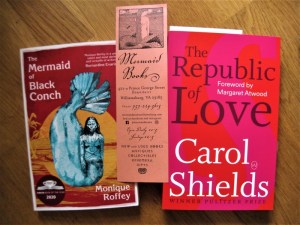
- Mermaids! A big theme in The Mermaid of Black Conch by Monique Roffey (of course) and The Republic of Love by Carol Shields, but they’re also mentioned in the opening story of The Office of Historical Corrections by Danielle Evans and are main characters in “The Pangs of Love” by Jane Gardam in the anthology Close Company.
- The Brothers Grimm story about brothers who have been transformed into swans and their sister who sews shirts out of nettles to turn them back is reworked in The Charmed Wife by Olga Grushin and used as a metaphor in Dusk, Night, Dawn by Anne Lamott.
- An electric carving knife is mentioned as a means of suicide (yipes!) in The Inevitable by Katie Engelhart and Woman on the Edge of Time by Marge Piercy.
- A discussion of the distinction between the fear of dying and the fear of being dead in This Party’s Dead by Erica Buist and The Inevitable by Katie Engelhart.
- Two novels in a row in which an older man is appalled by the squalor of his young girlfriend’s apartment, and she calls him “daddy” during sex (double yipes!), made the Dylan Thomas Prize shortlist: Luster by Raven Leilani and My Dark Vanessa by Kate Elizabeth Russell.


- Architect husbands in The Push by Ashley Audrain and The Art of Falling by Danielle McLaughlin (and, last year, in A Celibate Season by Blanche Howard and Carol Shields), as well as a female architect as a main character in The Living Sea of Waking Dreams by Richard Flanagan earlier this year.
- The next-to-last essay in the Trauma anthology quotes from The Bell Jar by Sylvia Plath, which I was also reading at the time.
- A mention of the eels in London absorbing cocaine from the Thames in the final essay in the Trauma anthology; I then moved right on to the last 40 pages of Nobody Is Talking About This by Patricia Lockwood and the same bizarre fact was mentioned. A week and a half later, there it was again, this time in Asylum Road by Olivia Sudjic.
- A mention of sailors’ habit of getting tattoos of swallows in The Circling Sky by Neil Ansell (who has a swallow tattoo, even though he’s not a sailor) and Birdsong in a Time of Silence by Steven Lovatt.

- A father and teenage child wander an unfamiliar city and enter a sex shop together (yipes yet again!) in Three O’Clock in the Morning by Gianrico Carofiglio and Ten Days by Austin Duffy.
- A mention of the same University of Virginia study in which people self-administered electric shocks to alleviate the boredom of sitting alone with their thoughts in Rooted by Lyanda Lynn Haupt and You’re Not Listening by Kate Murphy.
- Basho’s poetry and George Monbiot’s Feral are both cited in The Circling Sky by Neil Ansell and Rooted by Lyanda Lynn Haupt.
- A dead sister named Mattie in Consent by Annabel Lyon and Drowning Ruth by Christina Schwarz.

- A young Black female protagonist and the same family dynamic (the mother committed suicide and the father is in the Marines/Navy) in The Mothers by Brit Bennett and Luster by Raven Leilani.
- On the same night, I read about two pets encountering snow for the first time: a cat in Close Encounters of the Furred Kind by Tom Cox and a dog in Open Water by Caleb Azumah Nelson.
- A character is described as being as wide as they are tall in Mother for Dinner by Shalom Auslander and The Absolute Book by Elizabeth Knox.


- A character is known as Seventh in Mother for Dinner by Shalom Auslander and the story “The Pangs of Love” by Jane Gardam in the Close Company anthology. Plus, there’s Septimus in Mrs Dalloway by Virginia Woolf, which I’m reading concurrently with those two.
What’s the weirdest reading coincidence you’ve had lately?
Thinking about Dead Bodies with John Troyer (Hay Festival)
My second of three digital Hay Festival talks this year was by John Troyer, director of the interdisciplinary Centre for Death and Society at the University of Bath. Troyer is from Wisconsin (where he was speaking from, having been trapped there during a visit to his parents) and grew up with a father who owned a funeral home. This meant that he was aware of death from a young age: One of his earliest memories is of touching the hand of a dead woman when he went to visit his father at work.
 That’s not the only personal experience that went into his new book, Technologies of the Human Corpse, which I’m now keen to read. In 2018 his younger sister, Julie, died of brain cancer at age 43, so her illness and death became a late addition to the preface and also fed into a series of prose poems interspersed between the narrative chapters. She lived in Italy and her doctors failed to tell her that she was dying – that job fell to Troyer. (Unfortunately, this seems to be a persistent problem in Italy. In Dottoressa, her memoir of being an American doctor in Rome, which I read for a TLS review, Susan Levenstein writes of a paternalistic attitude among medical professionals: they treat their patients as children and might not even tell them about a cancer diagnosis; they just inform their family.)
Troyer discussed key moments that changed how we treat corpses. For instance, during the American Civil War there was a huge market for the new embalming technology; it was a way of preserving the bodies of soldiers so they could be returned home for funerals. Frauds also arose, however, and those taken in might find their loved one’s body arrived in a state of advanced decay. At around the same time, early photography captured corpses looking serene and sleeping. We might still take such photos, but we don’t tend to display them any more.
In the 1970s the “happy death” movement advocated for things like “natural death” and “death with dignity.” This piggybacked on the environmental and women’s movements and envisioned death as a taboo that had to be overcome. In recent decades a “necro-economy” based on the global trafficking of body parts (not organs for regulated transplant, Troyer clarified, but other tissue types) has appeared. While whole bodies may be worth just £2,000, “disarticulated” ones divided into their parts can net more like £100,000. Donating one’s body to science is, of course, a noble decision. Many people are also happy to donate their organs, though there remains a particular wariness about donating the eyes.
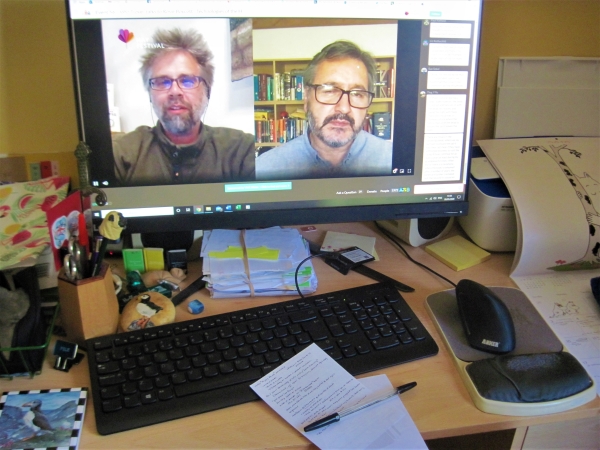
Troyer and Florence on my screen.
One section of Troyer’s book has become “uncannily resonant” in recent days, he noted. This is Chapter 3, on the AIDS corpse, an object of stigma. The biggest changes to death in the time of COVID-19 have been that family members are not able to be with a dying person in the ICU and that funerals cannot proceed as normal. In a viral pandemic, countries are producing a huge number of corpses that they aren’t prepared to deal with. (Indeed, the Washington, D.C. area is so overwhelmed with dead bodies that ice skating rinks have been requisitioned as makeshift morgues. The suburban Maryland rink I visited as a child is one such. Grim.)
Troyer spoke of the need for an everyday-ness to the discussion of death: talking with one’s next of kin, and encountering death in the course of a traditional education – he finds that even his final-year university students, studying in a related field, are very new to talking about death. A good way in that he recommends is simply to ask your loved ones what music they want played at their funerals, and the conversation can go from there.
We may not be able to commemorate the dead as we would like to at this time, but Troyer reminded the audience that funerals are for the living, whereas “the dead are okay with it – they know we’re doing our best.” The event was sensitively chaired by Peter Florence, the co-founder and director of Hay Festival (also responsible for last year’s controversial Booker Prize tie); the fact that Troyer got emotional talking about his sister only gave it more relevance and impact.
 I’ve read an abnormally large number of books about death, especially in the five years since my brother-in-law died of brain cancer (one reason why Troyer’s talk was so meaningful for me). Most recently, I read Bodies in Motion and at Rest (2000) by Thomas Lynch, a set of essays by the Irish-American undertaker and poet from Michigan. I saw him speak at Greenbelt Festival in 2012 and have read four of his books since then. His unusual dual career lends lyrical beauty to his writing about death. However, this collection was not memorable for me in comparison to his 1997 book The Undertaking, and I’d already encountered a shortened version of “Wombs” in the Wellcome Collection anthology Beneath the Skin. But this passage from “The Way We Are” stood out:
After years and years of directing funerals, I’ve come to the conclusion that seeing [the dead body] is the hardest and most helpful part. The truth, even when it hurts, has a healing in it, better than fiction or fantasy. When someone dies it is not them we fear seeing, it is them dead. It is the death. We fear that seeing will be believing. We fear not seeing too. We search the wreckage and the ruins, the battlefields and ocean floors. We must find our dead to let the loss be real.
Just for a bit of morbid fun, I decided to draw up my top 10 nonfiction books about death, dying and the dead. Many of these are personal accounts of facing death or losing a loved one. In contrast to the bereavement and cancer memoirs, the books by Doughty and Gawande are more like cultural studies, and Montross’s is about working with corpses. If you need a laugh, the Bechdel (a graphic memoir) and Doughty are best for black comedy.
 The Light of the World by Elizabeth Alexander
- Fun Home: A Family Tragicomic by Alison Bechdel (her father, too, was a funeral home director)
- Dear Life: A Doctor’s Story of Love and Loss by Rachel Clarke
- The Iceberg by Marion Coutts
- From Here to Eternity: Traveling the World to Find the Good Death by Caitlin Doughty
 Being Mortal: Medicine and What Matters in the End by Atul Gawande
- When Breath Becomes Air by Paul Kalanithi
- Body of Work: Meditations on Mortality from the Human Anatomy Lab by Christine Montross
- The Bright Hour: A Memoir of Living and Dying by Nina Riggs
- To Travel Hopefully: Journal of a Death Not Foretold by Christopher Rush
Wellcome Book Prize: Shortlist Recap
Tomorrow morning we will announce our Wellcome Book Prize 2018 shadow panel winner. Beforehand I wanted to do a quick recap of my reviews, especially for the two books that I read before the shortlist announcement. My full reviews are here:
Stay with Me by Ayobami Adebayo
To Be a Machine by Mark O’Connell
Mayhem by Sigrid Rausing
The Vaccine Race by Meredith Wadman
I give some extra thoughts on and favorite quotes from the other two below:
The Butchering Art by Lindsey Fitzharris
 This is a great blend of medical history and popular science that should draw in readers who wouldn’t normally gravitate to either topic – provided they aren’t too squeamish. Fitzharris has recently returned to Oxford as a visiting academic, and this has also been nominated for the Wolfson History Prize. Follow her on Instagram (@drlindseyfitzharris) for a steady stream of gruesomely fascinating photos (I wish The Butchering Art had been illustrated!). Her next book will be much of a muchness, it seems, documenting the early years of plastic surgery after World War I through the story of pioneering surgeon Harold Gillies.
In the days before Joseph Lister…
“Operating theaters were gateways to death. It was safer to have an operation at home than in a hospital, where mortality rates were three to five times higher than they were in domestic settings.”
“The surgeon was very much viewed as a manual labourer who used his hands to make his living, much like a key cutter or plumber today.”
See what the rest of the shadow panel has to say about this book:
Annabel’s review: “[A]n extremely readable account of a ground-breaking career which led to real advances in hospital medicine. I enjoyed the whole, but particularly the grisly bits!”
Laura’s review: “It’s easy for me to feel a bit impatient with popular histories of periods or subjects that I know well, but Fitzharris strikes exactly the right note, writing clearly and accessibly with no dumbing down.”
Paul’s review: “It is one of the better books that I have read on medical history[;] Fitzharris writes in an engaging way on a subject that is not going to appeal to everyone, but in amongst all the blood is the fascinating story of Joseph Lister.”
With the End in Mind by Kathryn Mannix
 “It’s time to talk about dying. This is my way of promoting the conversation,” Mannix writes in her introduction to this accessible and reassuring book about death. She believes we are afraid of death because of our misconception that it is inevitably painful and undignified. In her decades of working in hospice care, this has rarely been the case. (Thank goodness that, compared to the earlier nineteenth-century situation Fitzharris surveys, we have reliable pain control options.) Mannix sees the role of the hospice worker as being like a midwife for the dying, a helpful idea I first encountered in Henry Fersko-Weiss’s Caring for the Dying: The Doula Approach to a Meaningful Death.
Many of the stories in this book are of peaceful deaths the patient and family had time to prepare for. Others are sad stories of denial. One, though, is quite gruesome, yet magnificently described. Alex, a young man with testicular teratoma, has a massive GI bleed:
“Alex’s head is thrown back, almost as though it is a voluntary movement. A huge, dark-red python slithers rapidly out of his mouth, pushing his head backwards as it coils itself onto the pillow beside him; the python is wet and gleaming and begins to stain the pillowcase and sheets with its red essence as Alex takes one snoring breath, and then stops breathing. His mother screams as he realises that the python is Alex’s blood. Probably all of his blood.”
See what the rest of the shadow panel has to say about this book:
Annabel’s review: “[I]t is helping patients, and their families and loved ones, to understand the process of dying, and dispelling the taboos around it that make this book such a valuable and compelling read. I wish I’d read something like this book before my mum died.”
Clare’s review: “For me, this enlightening book is a strong potential winner for the Wellcome Book Prize and I hope it brings comfort and guidance for those who need it.”
Laura’s review: “[The book is] written from her own experiences as a specialist in palliative care, and this proved, for me, both its strength and its downfall. … Mannix writes particularly well on the characteristic patterns of somebody who is entering a gradual decline.”
Paul’s review: “Can highly recommend this moving book and I think it should be essential reading for anyone who has any concerns about death.”
I wouldn’t be at all surprised to see either of these win the Wellcome Book Prize on Monday. Stay tuned for tomorrow’s shadow panel winner announcement, and Sunday’s write-up of a shortlist event I’m attending in London.
The Violet Hour by Katie Roiphe
I don’t believe that you can learn how to die, or gain wisdom, or prepare, and the work I have done on this book has, if anything, confirmed that suspicion, but I do think you can look at a death and be less afraid.
 The subtitle – “Great Writers at the End” – gives you a hint of what to expect from this erudite, elegiac work of literary biography. In a larger sense, it is about coming to terms with the fear of death, one of the last enduring Western phobias.
Roiphe was a sickly, morbid child. After a serious, extended case of something like pneumonia, she had half a lung removed, and her chosen reading was books about Armenian genocide. Although she was convinced she was going to die at 12, it was only a blip; her next significant encounter with death was her father’s cardiac arrest at age 82. Once again, she was utterly unprepared. In investigating six great authors’ deaths, Roiphe is not so much looking for sage tour guides to the underworld as asking how one faces and narrates death.
To start with I was skeptical about Roiphe’s set of chosen writers. Between Susan Sontag, Sigmund Freud, John Updike, Dylan Thomas, Maurice Sendak and James Salter there’s no class or racial diversity, and the gender balance is poor. Yet as I read on I set these quibbles aside. There are literally hundreds, maybe thousands of subjects Roiphe could have chosen, so in a sense the particular authors discussed here are arbitrary. She’s eschewed more obvious candidates like Christopher Hitchens, probably because he wrote enough about his own impending mortality himself. The criteria were probably as plain as this: an author who meant something to Roiphe, left a lot of documentary evidence, preferably had some living descendants and colleagues to interview, and whose death was drawn out enough that s/he had time to wrestle with the thought of it in writing.
Starting each chapter with the vigil at an author’s deathbed in a hospital room or at home, Roiphe skips back and forth in time to pinpoint where illness and death cropped up in that author’s life and work. For Susan Sontag, dying at New York’s Sloan Kettering in 2004, it was her third bout with cancer. A final extreme intervention, a bone marrow transplant at Seattle, had recently failed. Still Sontag shirked the notion of death, refusing even to talk about it. Work was how she had always transcended the specter of death – by writing books like Illness as Metaphor and inserting scenes of false death into her fiction – and now it was all that kept her going. Perhaps, Roiphe theorizes, there was a kind of solipsism at the heart of Sontag’s denial of death: she just could not believe that anything would continue existing without her. Well before her first experience of cancer in the 1970s, she wrote in a notebook: “Too abstract: death. Too concrete: me.”

Susan Sontag’s grave at the Cimetière du Montparnasse, Paris. (By Wikimedia Commons / Mu (Own work), via Wikimedia Commons.)
One might expect Freud to have been more disciplined about the business of dying, what with his theory of Thanatos (the death drive) and his frequently professed acceptance. However, as Roiphe emphasizes, it is one thing to say you accept death, and quite another thing to actually accept it. In Freud’s case, his refusal to give up cigars despite painful throat cancer and 33 oral surgeries flew in the face of his otherwise rational methods. Cigars were his only vice, he shrugged. Is a cigar just a cigar, or are there overt sexual connotations? For Updike, sex was like Freud’s cigars: sensual evidence that life goes on. Adultery, a frequent theme in his fiction, was perhaps an unconscious strategy for ‘cheating’ death. It was only after his diagnosis with lung cancer that death replaced sex as the central obsession of his work. His last book, like his first, would be poetry: Endpoint, one last valiant effort before death.
![Freud with one of his beloved cigars, 1922. Max Halberstadt [Public domain], via Wikimedia Commons.](https://commons.wikimedia.org/wiki/File:Sigmund_Freud_LIFE.jpg)
Freud with one of his beloved cigars, 1922. Max Halberstadt [Public domain], via Wikimedia Commons.
Each chapter is its own microcosm. The author herself only appears in the prologue and epilogue; in between, although she obviously interviewed survivors (and Salter, who died before he could read the finished book), she edits herself out so we can be right there with the subject. There’s no distance at all. That sense of intimacy is clearest in the chapter-heading photographs of the authors’ (posthumously?) empty studies. These are haunting images. Look at Sendak’s desk covered in paints and drawings, slippers carefully waiting underneath; a cardigan on the back of the chair – there’s such a sense of life. The life continues in the work.
None of these authors got death perfectly right. Several of them fought it right to the end; several of them veered towards faith despite a lifelong antipathy to religion; several of them were ultimately taken aback by the simple realization that they, too, were mortal. Roiphe discovers no magic formula for how a writer should do death. Despite their contradictory approaches, though, all her subjects had the same destination:
here’s what I learned from the deaths in this book: You work. You don’t work. You resist. You don’t resist. You exert the consummate control. You surrender. You deny. You accept. You pray. You don’t pray. You read. You work. You take as many painkillers as you can. You refuse painkillers. You rage against death. You run headlong toward it.
In the end the deaths are the same. They all die. The world releases them.
This would be an ideal book for fans of Olivia Laing (see my review of The Lonely City) or Julian Barnes’s Nothing to Be Frightened of. What Roiphe observes of Sendak’s habit of drawing the dead and dying could equally be applied to The Violet Hour: it’s about seeing the beauty in what terrifies you. One of my top few nonfiction reads of 2016 so far.
With thanks to Grace Vincent of Virago for sending a review copy. The Violet Hour releases today in the UK; it was published on March 8th in the States by The Dial Press.
My rating: 
 Bookish Beck = Rebecca Foster. American transplant to England. Freelance proofreader and book reviewer.
 Bookish Beck