Literary Wives Club: Recipe for a Perfect Wife by Karma Brown (2019)
{SPOILERS IN THIS REVIEW!}
Canadian author Karma Brown’s fifth novel features two female protagonists who lived in the same house in different decades. The dual timeline, which plays out in alternating chapters, contrasts the mid-1950s and late 2010s to ask 1) whether the situation of women has really improved and 2) if marriage is always and inevitably an oppressive force.
Nellie Murdoch loves cooking and gardening – great skills for a mid-twentieth-century housewife – but can’t stay pregnant, which provokes the anger of her abusive husband, Richard. To start with, Alice Hale can’t cook or garden for toffee and isn’t sure she wants a baby at all, but as she reads through Nellie’s unsent letters and recipes, interspersed with Ladies’ Home Journal issues in the boxes in the basement, she starts to not just admire Nellie but emulate her. She’s keeping several things from her husband Nate: she was fired from her publicist job after a pre-#MeToo scandal involving a handsy male author, she’s had an IUD fitted, and she’s made zero progress on the novel she’s supposed to be writing. But Nellie’s correspondence reveals secrets that inspire Alice to compose Recipe for a Perfect Wife.
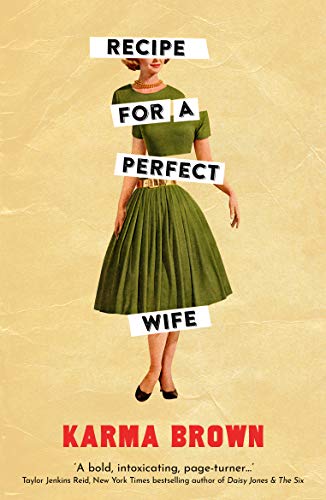
The chapter epigraphs, mostly from period etiquette and relationship guides for young wives, provide ironic commentary on this pair of not-so-perfect marriages. Brown has us wondering how closely Alice will mirror Nellie’s trajectory (aborting her pregnancy? poisoning her husband?). There were clichéd elements, such as Richard’s adultery, glitzy New York City publishing events, Alice’s quirky-funny friend, and each woman having a kindly elderly (maternal) neighbour who looks out for her and gives her valuable advice. I felt uncomfortable with how Nellie’s mother’s suicide makes it seem like Nellie’s radical acts are borne out of inherited mental illness rather than a determination to make her own path.
Often, I felt Brown was “phoning it in,” if that phrase means anything to you. In other words, playing it safe and taking an easy and previously well-trodden path. Parallel stories like this can be clever, or can seem too simple and coincidental. However, I can affirm that the novel is highly readable and has vintage charm. I always enjoy epistolary inclusions like letters and recipes, and it was intriguing to see how Nellie uses her garden herbs and flowers for pharmaceutical uses. Our first foxglove just came into flower – eek! (Kindle purchase) 
The main question we ask about the books we read for Literary Wives is:
What does this book say about wives or about the experience of being a wife?
- Being a wife does not have to mean being a housewife. (It also doesn’t have to mean being a mother, if you don’t want to be one.)
- Secrets can be lethal to a marriage. Even if they aren’t literally so, they’re a really bad idea.
This was, overall, a very bleak picture of marriage. In the 1950s strand there is a scene of marital rape – one of two I’ve read recently, and I find these particularly difficult to take. Alice’s marriage might not have blown up as dramatically, but still doesn’t appear healthy. She forced Nate to choose between her and the baby, and his job promotion in California. The fallout from that ultimatum is not going to make for a happy relationship. I almost thought that Nellie wields more power. However, both women get ahead through deception and manipulation. I think we are meant to cheer for what they achieve, and I did for Nellie’s revenge at Richard’s vileness, but Alice I found brattish and calculating.
See Kate’s, Kay’s and Naomi’s reviews, too!
Coming up next, in September: Their Eyes Were Watching God by Zora Neale Hurston.
Literary Wives Club: Sea Wife by Amity Gaige
My sixth read with the Literary Wives online book club (see also Kay’s and Naomi’s reviews), and favourite so far!
{SPOILERS}
Amity Gaige’s fourth novel, Sea Wife (2020), places the protagonists’ relationship in the ultimate pressure cooker: a small sailboat where they will live and travel with their two young children – Sybil, 7, and George, 2 – for one year. Michael and Juliet Partlow’s marriage was in trouble even before they set off for Panama in the yacht Juliet. The voyage seems equal parts second chance and doomed swan song.
Narration alternates between the spouses, as Juliet in the present day sits in a closet reading excerpts from Michael’s ship’s logbook. The latter are in bold font and right-aligned to distinguish them, though his voice would be enough to do so: Juliet is a cynical poet and failed PhD candidate, while Michael is a commonsense financier. Issues of money and politics have come between them. But Juliet’s trauma from childhood sexual abuse and subsequent estrangement from her mother, who disbelieved her, is the greater problem.
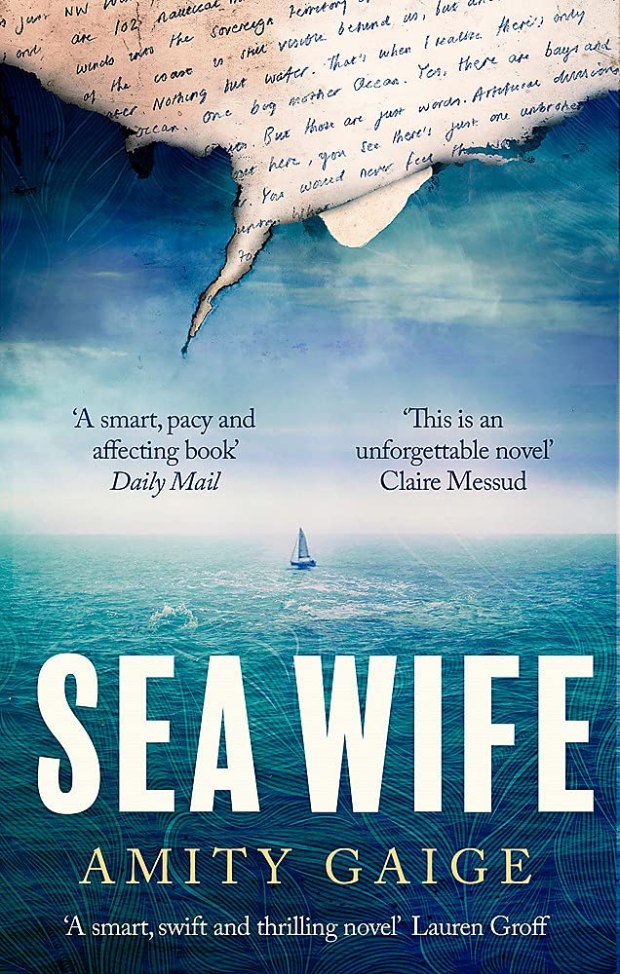
Gaige has rendered these two voices very effectively, and maintains tension about what will happen when the Partlows leave Colombia for Jamaica and storms brew. Early on, Michael is warned that changing a boat’s name is bad luck, and it doesn’t take long to confirm that maritime superstition. Michael may think he’s doing it as a sweet tribute to his wife, but you have to wonder if he’s actually replacing her, or admitting that he’s lost her in real life.
Enhancing the epistolary nature, Gaige includes transcripts from an interview and some of Sybil’s therapy sessions (in which she sounds too young; would a seven-year-old seriously say “loveded” as a past participle?), fragments of Juliet’s unfinished dissertation on Anne Sexton, and so on. I think I would have omitted the final section of documents, though. Still, this was a darn good read: literary but suspenseful, and fitting the Literary Wives brief perfectly for its claustrophobic focus on a marriage. (Birthday gift from my wish list) 
The main question we ask about the books we read for Literary Wives is:
What does this book say about wives or about the experience of being a wife?
A marriage changes a lot over the years. A project embarked on with the best of intentions can falter for any number of reasons. A person you once thought you could rely on might let you down. I feel Juliet internalized impossibly high standards for an ideal wife and mother that set her up for failure – it must be difficult for someone who has been a victim to do anything but go through life wounded.
Both protagonists explicitly reflect on their marriage and acknowledge that they have not known how to love or be there for each other, and so have felt alone.
Juliet: “I realized that the loneliness was not new at all. That, in fact, I had been lonely for a long time. Because my husband and I did not know each other. We did not know how to help each other or work together. And yet our fates were bound. By a theory. I mean our marriage. The arrangement was illogical.”
Michael: “Have I lied to her? Sure. I lied to her the moment I represented myself as someone she could count on for a lifetime. … We can’t seem to love each other in the same way at the same time.”
Next book: Hamnet by Maggie O’Farrell in December (a reread for me)
Winter Reads, Part I: Patrick Gale & Tove Jansson (#NordicFINDS23)
This winter has been a disappointment: it’s bloody cold, but with no snow. It’s impossible to keep our house warm, even with extra loft insulation and new double-glazed windows (home ownership is boring and overrated), so I’m ready for signs of spring. Maybe by the time I review a second batch of seasonal reads in February, winter will truly be on its way out.
A Place Called Winter by Patrick Gale (2015)
 This was our January book club read. We’d had good luck with Gale before: his Notes from an Exhibition received our joint highest rating ever. As he’s often done in his fiction, he took inspiration from family history: here, the story of his great-grandfather Harry Cane, who emigrated to the Canadian prairies to farm in the most challenging of conditions. Because there is some uncertainty as to what precipitated his ancestor’s resettlement, Gale has chosen to imagine that Harry, though married and the father of a daughter, was in fact gay and left England to escape blackmailing and disgrace after his affair with a man was discovered.
There are very evocative descriptions of the pioneer life, lightened for Harry by his relationship with his closest neighbours, siblings Petra and Paul. The novel covers the First World War and the start of the Spanish flu epidemic, which provide much fodder for melodrama, but somehow I don’t mind it from Gale. Harry himself is so diffident as to seem blank, but that means he is free to become someone else in a new land. My other main criticism would be that the villain is implausibly evil. Some of our book club members also thought there were too many coincidences. Gale really makes you feel for these characters and their suffering, though. Sexuality and mental health, both so misunderstood at that time, are the two main themes and he explores them beautifully. In that both are historical fiction where homosexuality is simply a fact of life, not a titillating novelty, this reminded me a lot of Days Without End by Sebastian Barry. (Free from mall bookshop)
A Winter Book: Selected Stories by Tove Jansson (2006)
[Translated from the Swedish by Silvester Mazzarella, David McDuff and Kingsley Hart]
 A brief second review for Nordic FINDS. It’s the third time I’ve encountered some of these autofiction stories: this was a reread for me, and 13 of the pieces are also in Sculptor’s Daughter, which I skimmed from the library a few years ago. And yet I remembered nothing; not a single one was memorable. Most of the pieces are impressionistic first-person fragments of childhood, with family photographs interspersed. In later sections, the protagonist is an older woman, Jansson herself or a stand-in. I most enjoyed “Messages” and “Correspondence,” round-ups of bizarre comments and requests she received from readers. Of the proper stories, “The Iceberg” was the best. It’s a literal object the speaker alternately covets and fears, and no doubt a metaphor for much else. This one had the kind of profound lines Jansson slips into her children’s fiction: “Now I had to make up my mind. And that’s an awful thing to have to do” and “if one doesn’t dare to do something immediately, then one never does it.” A shame this wasn’t a patch on The Summer Book. (Free from a neighbour)

Original rating in 2012: 
Rating now: 
Averaged rating: 
And a DNF:
Winter’s Tale by Mark Helprin (1983)
 Laila (Big Reading Life) and I attempted this as a buddy read, but we both gave up on it. I got as far as page 53 (in the 600+-page pocket paperback). The premise was alluring, with a magical white horse swooping in to rescue Peter Lake from a violent gang. I also appreciated the NYC immigration backstory, but not the adjective-heavy wordiness, the anachronistic exclamations (“Crap!” and “Outta my way, you crazy midget” – this is presumably set some time between the 1900s and 1920s) or the meandering plot. It was also disturbing to hear about Peter’s sex life when he was 12. From a Little Free Library (at Philadelphia airport) it came, and to a LFL (at the Bar Convent in York) it returned. Laila read a little further than me, enough to tell the library patron who recommended it to her that she’d given it a fair try.
Any snowy or icy reading (or weather) for you lately?
Letters and Papers from Prison by Dietrich Bonhoeffer (#NovNov22 and #GermanLitMonth)
I’m rounding out our nonfiction week of Novellas in November with a review that also counts towards German Literature Month, hosted by Lizzy Siddal.

Dietrich Bonhoeffer, a German pastor and theologian, was hanged at a Nazi concentration camp in 1945 for his role in the Resistance and in planning a failed 1944 assassination attempt on Adolf Hitler.
 The version I read (a 1959 Fontana reprint of the 1953 SCM Press edition) is certainly only a selection, as Bonhoeffer’s papers from prison in his Collected Works now run to 800 pages. After some letters to his parents, the largest section here is made up of “Letters to a Friend,” who I take it was the book’s editor, Eberhard Bethge, a seminary student of Bonhoeffer’s and his literary executor as well as his nephew by marriage.
Bonhoeffer comes across as steadfast and cheerful. He is grateful for his parents’ care packages, which included his latest philosophy and theology book requests as well as edible treats, and for news of family and acquaintances. To Bethge he expresses concern over the latter’s military service in Italy and delight at his marriage and the birth of a son named Dietrich in his honour. (Among the miscellaneous papers included at the end of this volume are a wedding sermon and thoughts on baptism to tie into those occasions.)
Maintaining a vigorous life of the mind sustained Bonhoeffer through his two years in prison. He downplays the physical challenges of his imprisonment, such as poor food and stifling heat during the summer, acknowledging that the mental toll is more difficult. The rhythm of the Church year is a constant support for him. In his first November there he writes that prison life is like Advent: all one can do is wait and hope. I noted many lines about endurance through suffering and striking a balance between defiance and acceptance:
Resistance and submission are both equally necessary at different times.
It is not some religious act which makes a Christian what he is, but participation in the suffering of God in the life of the world.
not only action, but also suffering is a way to freedom.
Bonhoeffer won over wardens who were happy to smuggle out his letters and papers, most of which have survived apart from a small, late selection that were burned so as not to be incriminating. Any references to the Resistance and the plot to kill Hitler were in code; there are footnotes here to identify them.
The additional non-epistolary material – aphorisms, poems and the abovementioned sermons – is a bit harder going. Although there is plenty of theological content in the letters to Bethge, much of it is comprehensible in context and one could always skip the couple of passages where he goes into more depth.
Reading the foreword and some additional information online gave me an even greater appreciation for Bonhoeffer’s bravery. After a lecture tour of the States in 1939, American friends urged him to stay in the country and not return to Germany. He didn’t take that easier path, nor did he allow a prison guard to help him escape. For as often as he states in his letters the hope that he will be reunited with his parents and friends, he must have known what was coming for him as a vocal opponent of the regime, and he faced it courageously. It blows my mind to think that he died at 39 (my age), and left so much written material behind. His posthumous legacy has been immense.
[Translated from the German by Reginald H. Fuller]
(Free from a fellow church member)
[187 pages]
Short Stories in September, Part I: Nam Le, Deesha Philyaw, Dan Rhodes
Part of my annual project to read as many short story collections as possible in September. Here’s the first three.
The Boat by Nam Le (2008)
Le, who was born in Vietnam and raised in Australia, won the Dylan Thomas Prize for this collection of seven stories. The opener, “Love and Honor and Pity and Pride and Compassion and Sacrifice” – the title being William Faulkner’s advice for what authors should write about – knocked my socks off. It’s a crisp slice of autofiction about his father coming to visit him while he is a student at the Iowa Writers’ Workshop. Nam (the character) is ambivalent about whether to write about his family’s history of escaping Vietnam by boat, but as a deadline looms he decides to go for it, no matter what his father might think. There’s a coy remark here from one of his friends: “you could just write about Vietnamese boat people all the time. … You could totally exploit the Vietnamese thing. But instead, you choose to write about lesbian vampires [not in this collection!] and Colombian assassins, and Hiroshima orphans—and New York painters with hemorrhoids.”
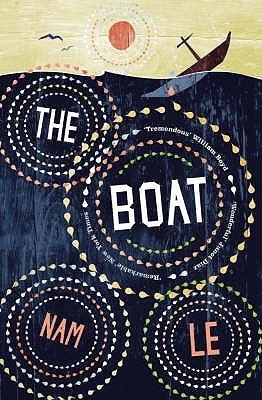 So there you have four of the story plots in a nutshell. “Cartagena” is an interesting enough inside look at a Colombian gang, but Le’s strategy for revealing that these characters would be operating in a foreign language is to repeatedly use the construction “X has Y years” for giving ages, which I found annoying. “Meeting Elise” is the painter-with-hemorrhoids one (though I would have titled it “A Big Deal”) and has Henry nervously awaiting his reunion with his teenage daughter, a cello prodigy. There’s a Philip Roth air to that one. “Hiroshima” is brief and dreamy, and works because of the dramatic irony between what readers know and the narrator does not. “The Boat,” the final story, is the promised Vietnam adventure, but took forever to get to. I skimmed/skipped two stories of 50+ pages, “Halflead Bay,” set among Australian teens, and “Tehran Calling.”
It’s a shame that the rest of the book didn’t live up to the first story. The settings and styles felt too disparate overall, with no linking theme. I know that authors are supposed to be able to write about whatever they want, rather than just sticking to their own heritage – a provincial attitude the above quote is mocking, surely – but I had to wonder why these stories mattered to the author, and thus why they should matter to me. As far as I can tell, this is all Le has published. He won another five awards for it, and landed on the National Book Foundation’s 5 under 35 list in 2008. What happened after that?? (Public library)
The Secret Lives of Church Ladies by Deesha Philyaw (2020)
I’d heard such good things about this collection after its U.S. release (it was a National Book Award finalist and won a Los Angeles Times Book Prize, PEN/Faulkner Award and more), so was delighted to learn that it was coming to the UK earlier this year. These nine stories, mostly set among Black women in the Southern USA, are bold and sexy. The opening pair is a particularly provocative one-two punch. In “Eula,” two friends with benefits meet up in a hotel on New Year’s Eve 2000, as they do every year; narrator Caroletta is committed to this relationship, while Eula is only killing time until she can marry a man as everyone expects. In “Not-Daniel,” a man and woman have sex in a car parked behind a hospice to try to forget that their mothers are dying inside.
 “How to Make Love to a Physicist,” told in the second person, is about an art teacher scared to embark on a relationship with a seemingly perfect man she meets at a conference. “Dear Sister,” in the form of a long, gossipy letter, is about a tangled set of half-siblings. “Jael” alternates a young teen’s diary entries and her great-grandmother’s fretting over what to do with her wild ward. (The biblical title takes on delicious significance later on.) Multiple characters clash with authority figures about church attendance, with the decision to leave the fold coinciding with claiming autonomy or rejecting hypocrisy.
“Peach Cobbler” and “Snowfall” were my two favourites. In the former, reminiscent of Tayari Jones’s Silver Sparrow, Olivia’s mother has been having a long-term affair with the pastor, for whom she bakes a special dessert she denies her own daughter (“I’m not going to raise [my child] to go through life expecting it to be sweet, when for her, it ain’t going to be”). The latter has Arletha and Rhonda suffering through a Midwest winter and dreaming of a Southern crab boil, but fearing they can never go home to mothers who stubbornly refuse to acknowledge their bond as anything other than friendship (“like a beautiful quilt in summertime, my mother’s love was the suffocating kind”).
The insight into familial and romantic relationships, the frank bisexuality, the allusions to scripture and churchgoing traditions, and the folksy foods and metaphors all made this stand out for me. The collection tails off with two unmemorable stories, but the previous seven are more than compelling enough for me to recommend this to your attention.
With thanks to Pushkin Press (the ONE imprint) for the proof copy for review.
Anthropology: and a Hundred Other Stories by Dan Rhodes (2000)
 I should have known, after reading When the Professor Got Stuck in the Snow (an obvious satire on Richard Dawkins’s atheism) in 2017, that Dan Rhodes’s humour wasn’t for me. However, I generally love flash fiction so thought I might as well give these 101 stories – all about 100 words, or one paragraph, long – a go when I found a copy in a giveaway box across the street. Each has a one-word title, proceeding alphabetically from A to W, and many begin “My girlfriend…” as an unnamed bloke reflects on a relationship. Most of the setups are absurd; the girlfriends’ names (Foxglove, Miracle, Nightjar) tell you so, if nothing else.
There’s a kind of ‘nothing sacred’ approach here, with death, disability, race and gender the fodder for any number of gags. For example, in the title story the ex-girlfriend “went to Mongolia to study the gays. … It breaks my heart to think of her herding those yaks in the freezing hills, … nothing but a handlebar moustache to keep her top lip warm.” Or “Taxidermy”: “Columbine broke her neck by mistake. I took her to the taxidermist, and they delivered to my house a fortnight later. When I unwrapped the package I found the wrong girl.” I marked out a couple that I liked, “Beauty” and “Eggs,” but 2/101 is a poor return. Flippant, repetitive and ridiculous; best avoided. (Free from a neighbour) 
Currently reading: The Dinner Party by Joshua Ferris, Delicate Edible Birds by Lauren Groff, Hearts & Bones by Niamh Mulvey
Up next: The Quarry by Ben Halls, The High Places by Fiona McFarlane, Birds of America by Lorrie Moore
Booker Prize Longlist Reading & Shortlist Predictions
I’ve polished off another four from the Booker Prize longlist (my initial reactions and excerpts from existing reviews are here), with one more coming up for me next month.
Trust by Hernan Diaz
“History itself is just a fiction—a fiction with an army. And reality? Reality is a fiction with an unlimited budget.”
My synopsis for Bookmarks magazine:
Set in the 1920s and 1930s, this expansive novel is about the early days of New York City high finance. It is told through four interlocking narratives. The first is Bonds, a novel by Harold Vanner, whose main character is clearly based on tycoon Andrew Bevel. Bevel, outraged at his portrayal as well as the allegation that his late wife, Mildred, was a madwoman, responds by writing a memoir—the book’s second part. Part 3 is an account by Ida Partenza, Bevel’s secretary, who helps him plot revenge on Vanner. In the final section, Mildred finally gets her say. Her journal caps off a sumptuous, kaleidoscopic look at American capitalism.
 Ghostwriter Ida’s section was much my favourite, for her voice as well as for how it leads you to go back to the previous part – some of it still in shorthand (“Father. Describe early memories of him. … MATH in great detail. Precocious talent. Anecdotes.”) and reassess its picture of Bevel. His short selling in advance of the Great Depression made him a fortune, but he defends himself: “My actions safeguarded American industry and business.” Mildred’s journal entries, clearly written through a fog of pain as she was dying from cancer, then force another rethink about the role she played in her husband’s decision making. With her genius-level memory, philanthropy and love of literature and music, she’s a much more interesting character than Bevel – that being the point, of course, that he steals the limelight. This is clever, clever stuff. However, as admirable as the pastiche sections might be (though they’re not as convincing as the first section of To Paradise), they’re ever so dull to read.
With thanks to Picador for the free copy for review.
Case Study by Graeme Macrae Burnet
 That GMB is quite the trickster. From the biographical sections, I definitely assumed that A. Collins Braithwaite was a real psychiatrist in the 1960s. A quick Google when I got to the end revealed that he only exists in this fictional universe. I enjoyed the notebooks recounting an unnamed young woman’s visits to Braithwaite’s office; holding the man responsible for her sister’s suicide, she books her appointments under a false name, Rebecca Smyth, and tries acting just mad (and sensual) enough to warrant her coming back. Her family stories, whether true or embellished, are ripe for psychoanalysis, and the more she inhabits this character she’s created the more she takes on her persona. (“And, perhaps on account of Mrs du Maurier’s novel, Rebecca had always struck me as the most dazzling of names. I liked the way its three short syllables felt in my mouth, ending in that breathy, open-lipped exhalation.” I had to laugh at this passage! I’ve always thought mine a staid name.) But the different documents don’t come together as satisfyingly as I expected, especially compared to His Bloody Project. (Public library)
Those two are both literary show-off stuff (the epistolary found documents strategy, metafiction): the kind of book I would have liked more in my twenties. I’m less impressed with games these days; I prefer the raw heart of this next one.
Nightcrawling by Leila Mottley
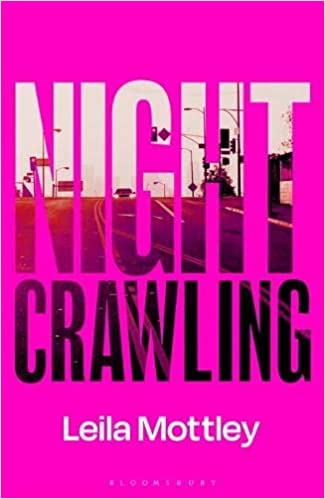 She may be only 20 years old, but Leila Mottley is the real deal. Her debut novel, laden with praise from her mentor Ruth Ozeki and many others, reminded me of Bryan Washington’s work. The first-person voice is convincing and mature as Mottley spins the (inspired by a true) story of an underage prostitute who testifies against the cops who have kept her in what is virtually sex slavery. At 17, Kiara is the de facto head of her household, with her father dead, her mother in a halfway house, and her older brother pursuing his dream of recording a rap album. When news comes of a rise in the rent and Kia stumbles into being paid for sex, she knows it’s her only way of staying in their Oakland apartment and looking after her neglected nine-year-old neighbour, Trevor.
I loved her relationships with Trevor, her best friend Alé (they crash funerals for the free food), and trans prostitute Camila, and the glimpses into prison life and police corruption. This doesn’t feel like misery for the sake of it, just realistic and compassionate documentation. There were a few places where I felt the joins showed, like a teacher had told her she needed to fill in some emotional backstory, and I noticed an irksome habit of turning adjectives into verbs or nouns (e.g., “full of all her loud,” “the sky is just starting to pastel”); perhaps this is an instinct from her start in poetry, but it struck me as precious. However, this is easily one of the more memorable 2022 releases I’ve read, and I’d love to see it on the shortlist and on other prize lists later this year and next. (Public library)
Oh William! by Elizabeth Strout
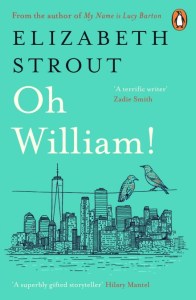 This was a DNF for me last year, but I tried again. The setup is simple: Lucy Barton’s ex-husband, William, discovers he has a half-sister he never knew about. William and Lucy travel from New York City to Maine in hopes of meeting her. For both of them, the quest sparks a lot of questions about how our origins determine who we are, and what William’s late mother, Catherine, was running from and to in leaving her husband and small child behind to forge a different life. Like Lucy, Catherine came from nothing; to an extent, everything that unfolded afterwards for them was a reaction against poverty and neglect.
The difficulty of ever really knowing another person, or even understanding oneself, is one of Strout’s recurring messages. There are a lot of strong lines and relatable feelings here. What I found maddening, though, is Lucy’s tentative phrasing, e.g. “And I cannot explain it except to say—oh, I don’t know what to say! Truly, it is as if I do not exist, I guess is the closest thing I can say.” She employs hedging statements like that all the time; it struck me as false that someone who makes a living by words would be so lacking in confidence about how to say what she means. So I appreciated the psychological insight but found Lucy’s voice annoying, even in such a short book. (Public library)
A Recap
I’ve read 6 of the 13 at this point, have imminent plans to read After Sappho for a Shelf Awareness review, and would still like to read the Mortimer if my library system acquires it. The others? Meh. I might consider catching up if they’re shortlisted.
My book group wasn’t chosen to shadow the Booker Prize this year, which is fair enough since we already officially shadowed the Women’s Prize earlier in the year (here are the six successful book clubs, if you’re interested). However, we have been offered the chance to send in up to five interview questions for the shortlisted authors. The Q&As will then be part of a website feature. And I was pleasantly surprised to see that my non-holiday snap of a Booker Prize nominee turned up in this round-up!
Here’s my (not particularly scientific) reasoning for what might make the shortlist:
A literary puzzle novel
Trust by Hernan Diaz or Case Study by Graeme Macrae Burnet
- Trust feels more impressive, and timely; GMB already had his chance.
A contemporary novel
Nightcrawling by Leila Mottley or Oh William! by Elizabeth Strout
- Oh William! is the weakest Strout novel I’ve read. Mottley’s is a fresh voice that deserves to be broadcast.

A satire
The Trees by Percival Everett or Seven Moons of Maali Almeida by Shehan Karunatilaka
- Without having read either, I’m going to hazard a guess that the Everett is too Ameri-centric/similar to The Sellout. The Booker tends to reward colourful Commonwealth books. [EDITED to add that I forgot to take into my considerations Glory by NoViolet Bulawayo; while it doesn’t perfectly fit this category, as a political allegory it’s close enough that I’ll include it here. I would not be at all surprised if it made the shortlist, along with the Karunatilaka.]

A couple of historical novels
Booth by Karen Joy Fowler or After Sappho by Selby Wynn Schwartz
and/or
A couple of Irish novels
Small Things Like These by Claire Keegan or The Colony by Audrey Magee
- I’m hearing such buzz about the Magee, and there’s such love out there for the Keegan, that I reckon both of these will make it through.


The odd one out?
Treacle Walker by Alan Garner or Maps of Our Spectacular Bodies by Maddie Mortimer
- Maybe nostalgia will spur the judges to give Garner a chance in his 80s.

My predicted shortlist:



On Tuesday evening we’ll find out if I got any of these right!
What have you read from the longlist? What do you most want to read, or see on the shortlist?
Review Catch-Up: Herreros, Onyebuchi and Tookey
Quick snapshot reviews as I work through a backlog.
One each today from fiction, nonfiction and poetry: a graphic novel about the life of Georgia O’Keeffe, a personal response to Chimamanda Ngozi Adichie’s Americanah, and a beautiful collection of place-centric verse.
Georgia O’Keeffe by Maria Herreros (2021; 2022)
[Translated from the Spanish by Lawrence Schimel]
 This is the latest in SelfMadeHero’s “Art Masters” series (I’ve also reviewed Gauguin, Munch and Vincent). Madrid-based illustrator Herreros renders O’Keeffe’s life story in an abstract style that feels in keeping with the artist’s own. The book opens in 1915 with O’Keeffe still living in her family home in Virginia and working as an art teacher. Before she ever meets Alfred Stieglitz, she is fascinated by his photography. They fall in love at a distance via a correspondence and later live together in New York City. Their relationship ebbs as she spends more and more time in New Mexico, a desert landscape that inspires many of her most famous paintings. Much of the narrative is provided by O’Keeffe’s own letters (with idiosyncrasies retained); the additional summary text is unfortunately generic, and the urge to cover many years leads to skating over long periods. Still, the erotic attention to detail and the focus on the subject’s dedication to independence made it worthwhile.

With thanks to SelfMadeHero for the free copy for review.
(S)kinfolk: Chimamanda Ngozi Adichie’s Americanah by Tochi Onyebuchi (2021)
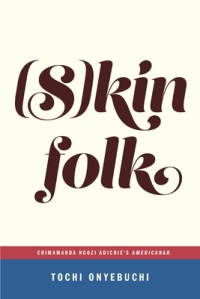 I’ve reviewed six previous releases from Fiction Advocate’s “Afterwords” series (on Blood Meridian, Fun Home, and The Year of Magical Thinking; My Struggle and Wild; and Middlesex). In these short monographs, “acclaimed writers investigate the contemporary classics,” weaving literary criticism into memoir as beloved works reverberate through their lives. Onyebuchi, a Nigerian American author of YA dystopian fiction, chose one of my favourite reads of recent years: Americanah. When he read the novel as a lawyer in training, it was the first time he sensed recognition of his own experiences in literature. He saw his immigrant mother’s situation, the collective triumph of Obama’s election, and his (re)discovery of Black beauty and spaces. Like Ifemelu: he was an outsider to African American identity and had to learn it gradually; and he makes a return trip to Nigeria at the end. I enjoyed this central thread but engaged less with asides about a 2013 visit to the West Bank (for a prisoners’ rights organization) and Frantz Fanon’s work on Algeria.
With thanks to Fiction Advocate for the free e-copy for review.
In the Quaker Hotel by Helen Tookey (2022)
 Tookey’s third collection brings its variety of settings – an austere hotel, Merseyside beaches and woods, the fields and trees of Southern France (via Van Gogh’s paintings), Nova Scotia (she completed a two-week residency at the Elizabeth Bishop House in 2019) – to life as vibrantly as any novel or film could. In recent weeks I’ve taken to pulling out my e-reader as I walk home along the canal path from library volunteering, and this was a perfect companion read for the sunny waterway stroll, especially the poem “Track.” Whether in stanzas, couplets or prose paragraphs, the verse is populated by meticulous images and crystalline musings.
not a loss
something like a clarifying
becoming something you can’t name
There are evanescent encounters (“Leapfrog”) and deep time (“Natural History”); playing with language (“Concession à Perpetuité”) and erasures (“Pool / Other Body”). You’ll find alliteration and ampersands (a trend in contemporary poetry?), close observation of nature, and no trace of cliché. Below are the opening stanzas of a couple of poems to give a flavour:

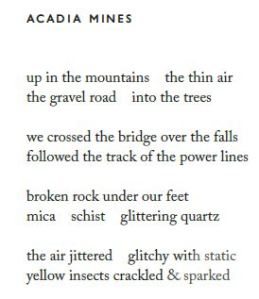
With thanks to Carcanet Press for the free e-copy for review.
Would you be interested in reading one or more of these?
What Lies Hidden: Secrets of the Sea House & Night Waking
When I read Kay’s review of Sarah Maine’s The House Between Tides, the book seemed so familiar I did a double take. A Scottish island in the Outer Hebrides … dual contemporary and historical story lines … the discovery of a skeleton. It sounded just like Night Waking by Sarah Moss (another Sarah M.!), which I was already planning on rereading on our trip to the Outer Hebrides. Kay then suggested a readalike that ended up being even more similar, Elisabeth Gifford’s The Sea House (U.S. title), one of whose plots was Victorian and the skeleton in which was a baby’s. I passed on the Maine but couldn’t resist finding a copy of the Gifford from the library so I could compare it with the Moss. Both: 
Secrets of the Sea House by Elisabeth Gifford (2013)
 Although nearly 130 years separate the two protagonists, they are linked by the specific setting – a manse on the island of Harris – and a belief that they are descended from selkies. In 1992, Ruth and her husband are converting the Sea House into a B&B and hoping to start a family. When they find the remains of a baby with skeletal deformities reminiscent of a mermaid under the floorboards, Ruth plunges into a search for the truth of what happened in their home. In 1860, Reverend Alexander Ferguson lived here and indulged his amateur naturalist curiosity about cetaceans and the dubious creatures announced as “mermaids” (often poor taxidermy crosses between a monkey and a fish, as in The Mermaid and Mrs. Hancock).
Ruth and Alexander trade off as narrators, but we get a more rounded view of mid-19th-century life through additional chapters voiced by the reverend’s feisty maid, Moira, a Gaelic speaker whose backstory reveals the cruelty of the Clearances – she won’t forgive the laird for what happened to her family. Gifford’s rendering of period prose wasn’t altogether convincing and there are some melodramatic moments: this could be categorized under romance, and I was surprised by the focus on Ruth’s traumatic upbringing in a children’s home after her mother’s death by drowning. Still, this was an absorbing novel and I actually learned a lot, including the currently accepted explanation for where selkie myths come from.
I also was relieved that Gifford uses real place names instead of disguising them (as Bella Pollen and Sarah Moss did). We passed through the tiny town of Scarista, where the manse is meant to be, on our drive. If I’d known ahead of time that it was a real place, I would have been sure to stop for a photo op (it must be this B&B!). We also stopped in Tarbert, a frequent point of reference, to visit the Harris Gin distillery. (Public library)
Night Waking by Sarah Moss (2011)
This was my first of Moss’s books and I have always felt guilty that I didn’t appreciate it more. I found the voice more enjoyable this time, but was still frustrated by a couple of things. Dr Anna Bennet is a harried mum of two and an Oxford research fellow trying to finish her book (on Romantic visions of childhood versus the reality of residential institutions – a further link to the Gifford) while spending a summer with her family on the remote island of Colsay, which is similar to St. Kilda. Her husband, Giles Cassingham, inherited the island but is also there to monitor the puffin numbers and track the effects of climate change. Anna finds a baby’s skeleton in the garden while trying to plant some fruit trees. From now on, she’ll snatch every spare moment (and trace of Internet connection) away from her sons Raph and Moth – and the builders and the police – to write her book and research what might have happened on Colsay.
 Each chapter opens with an epigraph from a classic work on childhood (e.g. by John Bowlby or Anna Freud). Anna also inserts excerpts from her manuscript in progress and fragments of texts she reads online. Adding to the epistolary setup is a series of letters dated 1878: May Moberley reports to her sister Allie and others on the conditions on Colsay, where she arrives to act as a nurse and address the island’s alarming infant mortality statistics. It took me the entire book to realize that Allie and May are the sisters from Moss’s 2014 novel Bodies of Light; I’m glad I didn’t remember, as there was a shock awaiting me.
According to Goodreads, I first read this over just four days in early 2012. (This was back in the days where I read only one book at a time, or at most two, one fiction and one nonfiction.) I remember feeling like I should have enjoyed its combination of topics – puffin fieldwork, a small island, historical research – much more, but I was irked by the constant intrusions of the precocious children. That is, of course, the point: they interrupt Anna’s life, sleep and research, and she longs for a ‘room of her own’ where she can be a person of intellect again instead of wiping bottoms and assembling sometimes disgusting meals. She loves her children, but hates the daily drudgery of motherhood. Thankfully, there’s hope at the end that she’ll get what she desires.
I had completely forgotten the subplot about the first family they rent out the new holiday cottage to (yet another tie-in to the Gifford, in which they’re preparing to open a guest house): a hot mess of alcoholic mother, workaholic father, and university-age daughter with an eating disorder. Zoe’s interactions with the boys, and Anna’s role as makeshift counsellor to her, are sweet, but honestly? I would have cut this story line entirely. Really, I longed for the novella length and precision of a later work like Ghost Wall. Still, I was happy to reread this, with Anna’s wry wit a particular highlight, and to discover for the first time (silly me!) that thread of connection with Bodies of Light / Signs for Lost Children. (Free from a neighbour)
Original rating:
My rating now:
I enjoyed the Gifford enough to immediately request the library’s copy of one of her newer novels, The Lost Lights of St. Kilda, so my connection to the Western Isles can at least continue through my reading. I also found a pair of children’s novels plus a mystery novel set on St. Kilda, and I was sent an upcoming novel set on an island off the west coast of Scotland, so I’ll be on this Scotland reading kick for a while!
Six Degrees of Separation: From Sorrow and Bliss to Weather
This month we begin with Sorrow and Bliss by Meg Mason. (See also Kate’s opening post.) This is my personal favourite from the Women’s Prize shortlist and couldn’t be a better pick for the Six Degrees starter this month because I’ll be skimming back through the novel this weekend in advance of my book club’s discussion of it on Monday. (We’re one of this year’s six book groups shadowing the Women’s Prize through a Reading Agency initiative, so we then have to give semi-official feedback on our experience of the book by Wednesday.)

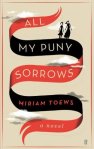 #1 Sorrow and Bliss is a terrific tragicomedy about sisterhood and mental health – as is All My Puny Sorrows by Miriam Toews, with which it shares a loaded title word as well.
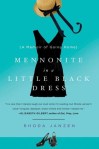 #2 Toews grew up in a Canadian Mennonite community, which leads me to my second choice, Mennonite in a Little Black Dress by Rhoda Janzen, a set of droll autobiographical essays that I read on a USA trip in 2017.
 #3 During the same trip, I read Dear American Airlines by Jonathan Miles, a witty novel about Bennie Ford’s rather miserable life, presented in the form of his longwinded complaint letter to the airline that has treated him to an unexpected overnight layover in Chicago.
 #4 Another laugh-out-loud book in the form of unlikely letters: Dear Committee Members by Julie Schumacher, in which Jason Fitger, an irascible middle-aged English professor in the Midwest, writes ambivalent letters of recommendation for students and colleagues.
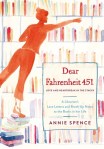 #5 One more “Dear” book of letters – I just can’t get enough of the epistolary form: Dear Fahrenheit 451 by Annie Spence. As the subtitle states, it’s a librarian’s love letters and breakup notes to books she’s adored and loathed. Casual and amusing, with good book recs.
 #6 I’ll finish with Weather by Jenny Offill, one of my favourites from 2020, which is also voiced by a librarian. Through Lizzie, Offill captures modern anxiety about Trump-era politics, the climate crisis and making meaningful use of time.
I have read all the books in this month’s chain (the links above are to my Goodreads reviews), and in a time of relentless bad news have chosen to prioritize humour and keep my descriptions short and light. These are all books that made me laugh, sometimes despite their weighty content, and half of them are built around letters. I’ve also looped from one Women’s Prize-shortlisted title to another.
Where will your chain take you? Join us for #6Degrees of Separation! (Hosted on the first Saturday of each month by Kate W. of Books Are My Favourite and Best.) Next month’s starting point will be Wintering by Katherine May – though it’s summer here, it’s winter where Kate is in Australia!
Have you read any of my selections? Tempted by any you didn’t know before?
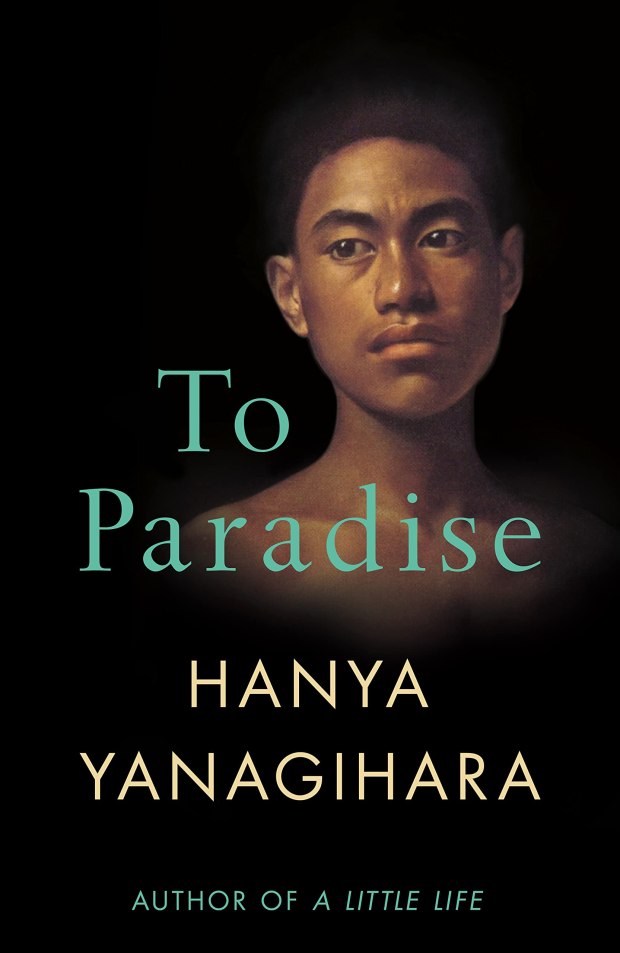
To Paradise by Hanya Yanagihara (Doorstopper of the Quarter)
When I expressed interest in Hanya Yanagihara’s To Paradise on Twitter, having loved A Little Life and tepidly admired The People in the Trees, I didn’t expect to be chosen to receive one of my most anticipated releases of the year. A proof arrived while I was in the States for Christmas. As soon as I got back, I started it – with a vision of doing little else but reading it for a few days and reviewing it early in January. Instead, I read about 30 pages and set it aside, the 700-page heft mocking me from my coffee table stack for the better part of two months. Finally, I forced myself to set a daily reading goal: first 30 pages, then 40, then 60; and on Friday I read the last 100 pages over a couple sessions in the summerhouse. That regimented approach was what it took for me to get through my first doorstopper of the year.
The novel is in three parts – discrete enough to feel like separate books – set largely in 1893, 1993, and 2093. New York City’s Washington Square, even one particular house, recurs as a setting in all three, with some references to the American West and South and with flashbacks to time in Hawaii linking Books II and III.
The overarching theme is the American project: is freedom, both individual and collective, a worthy and attainable goal? Or are the country’s schisms too deep to be overcome? Class, race, sexuality, and physical and mental illness are some of the differences that Yanagihara explores. Even when equality of treatment has been won in one time and scenario – same-sex marriage is de rigueur in her alternative version of the 1890s, where the USA is divided into several nations – there is always the threat of a taken-for-granted right being retracted.
In Book I, David Bingham, who is to inherit his grandfather’s Washington Square property, considers a family-approved arranged marriage with an older man, Charles, versus eloping with a lower-class male teacher, Edward, with whom he has fallen in love. Edward wants them to light out for California, where new opportunities await but homosexuality is outlawed. Can they live in freedom if they’re repressing an essential part of their identity? The austere, elegant tone is a pitch-perfect pastiche of Henry James or Edith Wharton. Although this section took me the longest to read, it was the one I most appreciated for its flawless evocation of the time period and a rigid class structure. As in The Underground Railroad, though, the alt-history angle wasn’t really the most memorable aspect.
In Book II, David Bingham, also known as Kawika, is a paralegal having a secret affair with Charles, a partner in his law firm. Various friends and former lovers in their circle have AIDS, but Charles’s best friend Peter is dying of cancer. Before Peter flies to Switzerland for an assisted death, Charles throws him one last dinner party. Meanwhile, David receives a long letter from his ill father recounting their descent from Indigenous nobility and his failed attempt to set up a self-sufficient farm on their inherited land in Hawaii. This strand is closest to Yanagihara’s previous novels, the gay friendship circle reminiscent of A Little Life and the primitive back-to-the-land story recalling The People in the Trees. I also thought of Mrs Dalloway – David wanted to get the flowers for the party himself – and of Three Junes.
 Book III is set in a dystopian future of extreme heat, rationing and near-constant pandemics. The totalitarian state institutes ever more draconian policies, with censorship, quarantine camps and public execution of insurgents. The narrator, intellectually disabled after a childhood illness, describes the restrictions with the flat affect of the title robot from Kazuo Ishiguro’s Klara and the Sun. When a stranger offers her the chance to escape, she is forced to weigh up freedom against safety. An alternating strand, based around letters sent by a Chinese Hawaiian character, traces how things got this bad, from the 2040s onwards.
While the closing speculative vision is all too plausible, two other literary/science fiction releases I’ve read this year, Sea of Tranquillity by Emily St. John Mandel and How High We Go in the Dark by Sequoia Nagamatsu, are more powerful and direct. Book III takes up half of the text and could stand alone, but the fact that it appears as a culmination of two other narratives creates false expectations that it can’t meet. The connections between the three are incidental – abandonment by a mother, a child raised by a grandparent, an arranged marriage, isolating illness – with recurring tactics like stories within stories and epistolary sections. The most overt cohesive strategy, the repeating of names across time periods, feels gimmicky and, again, sets readers up for a letdown by promising meaning that isn’t there.
Ultimately, the message seems to be: America’s problems are inherent, and so persist despite apparent progress. It takes a lot of words to build to that somewhat obvious point. I couldn’t suppress my disappointment that none of the storylines are resolved – this does, however, mean that one can choose to believe things will turn out happily for the characters. Their yearning for a more authentic life, even in a rotten state, makes it easy to empathize with their situations. I had high regard for the self-assured cross-genre prose (my interest waning only during the elder Kawika’s improbably long letter), but felt the ambition perhaps outshone the achievement.
As I learned when reviewing a recent book about American utopian projects, Heaven Is a Place on Earth, and interviewing its author, Adrian Shirk, an imagined utopia and a projected dystopia aren’t actually so different. Here was her response to one of my questions:
At one point you say, “utopia is never far from its opposite.” Dystopian novels are as popular as ever. To what extent do you think real-life utopias and fictional dystopias have the same aims?
I think real-life utopian experiments and fictional dystopias both offer warnings about the dangers of relying too much on ideology, and not enough on living, or choosing the person over the belief. So, in that way, real utopian experiments and fictional dystopian narratives are two sides of the same coin: a dystopia is a utopia that lost sight of—or never included—understanding itself as resistance to a violent empire, and thus starts to look like a violent empire itself.
Both start by diagnosing a societal sickness. The question is how we then get to paradise.
Page count: 701
Book I: 
Book II:
Book III: 
My overall rating:
With thanks to Picador for the proof copy for review.
 Bookish Beck = Rebecca Foster. American transplant to England. Freelance proofreader and book reviewer.
 Bookish Beck