Women’s Prize for Non-Fiction, Writers’ Prize & Young Writer of the Year Award Catch-Up
This time of year, it’s hard to keep up with all of the literary prize announcements: longlists, shortlists, winners. I’m mostly focussing on the Carol Shields Prize for Fiction this year, but I like to dip a toe into the others where I can. I ask: What do I have time to read? What can I find at the library? and Which books are on multiple lists so I can tick off several at a go??
Women’s Prize for Non-Fiction

(Shortlist to be announced on 27 March.)
Read so far: Intervals by Marianne Brooker, Matrescence by Lucy Jones
&
A Flat Place by Noreen Masud
Past: Sunday Times/Charlotte Aitken Young Writer of the Year Award shortlist
Currently: Jhalak Prize longlist
I also expect this to be a strong contender for the Wainwright Prize for nature writing, and hope it doesn’t end up being a multi-prize bridesmaid as it is an excellent book but an unusual one that is hard to pin down by genre. Most simply, it is a travel memoir taking in flat landscapes of the British Isles: the Cambridgeshire fens, Orford Ness in Suffolk, Morecambe Bay, Newcastle Moor, and the Orkney Islands.
 But flatness is a psychological motif as well as a physical reality here. Growing up in Pakistan with a violent Pakistani father and a passive Scottish mother, Masud chose the “freeze” option when in fight-or-flight situations. When she was 15, her father disowned her and she moved with her mother and sisters to Scotland. Though no particularly awful things happened, a childhood lack of safety, belonging and love left her with complex PTSD that still affects how she relates to her body and to other people, even after her father’s death.
Masud is clear-eyed about her self and gains a new understanding of what her mother went through during their trip to Orkney. The Newcastle chapter explores lockdown as a literal Covid-era circumstance but also as a state of mind – the enforced solitude and stillness suited her just fine. Her descriptions of landscapes and journeys are engaging and her metaphors are vibrant: “South Nuns Moor stretched wide, like mint in my throat”; “I couldn’t stop thinking about the Holm of Grimbister, floating like a communion wafer on the blue water.” Although she is an academic, her language is never off-puttingly scholarly. There is a political message here about the fundamental trauma of colonialism and its ongoing effects on people of colour. “I don’t want ever to be wholly relaxed, wholly at home, in a world of flowing fresh water built on the parched pain of others,” she writes.
What initially seems like a flat authorial affect softens through the book as Masud learns strategies for relating to her past. “All families are cults. All parents let their children down.” Geography, history and social justice are all a backdrop for a stirring personal story. Literally my only annoyance was the pseudonyms she gives to her sisters (Rabbit, Spot and Forget-Me-Not). (Read via Edelweiss) 
And a quick skim:
Doppelganger: A Trip into the Mirror World by Naomi Klein
Past: Writers’ Prize shortlist, nonfiction category
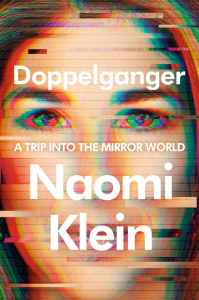 For years people have been confusing Naomi Klein (geography professor, climate commentator, author of No Logo, etc.) with Naomi Wolf (feminist author of The Beauty Myth, Vagina, etc.). This became problematic when “Other Naomi” espoused various right-wing conspiracy theories, culminating with allying herself with Steve Bannon in antivaxxer propaganda. Klein theorizes on Wolf’s ideological journey and motivations, weaving in information about the doppelganger in popular culture (e.g., Philip Roth’s novels) and her own concerns about personal branding. I’m not politically minded enough to stay engaged with this but what I did read I found interesting and shrewdly written. I do wonder how her publisher was confident this wouldn’t attract libel allegations? (Public library)
Predictions: Cumming (see below) and Klein are very likely to advance. I’m less drawn to the history or popular science/tech titles. I’d most like to read Some People Need Killing: A Memoir of Murder in the Philippines by Patricia Evangelista, Wifedom: Mrs Orwell’s Invisible Life by Anna Funder, and How to Say Babylon: A Jamaican Memoir by Safiya Sinclair. I’d be delighted for Brooker, Jones and Masud to be on the shortlist. Three or more by BIPOC would seem appropriate. I expect they’ll go for diversity of subject matter as well.
Writers’ Prize
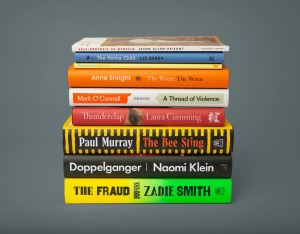
Last year I read most books from the shortlists and so was able to make informed (and, amazingly, thoroughly correct) predictions of the winners. I didn’t do as well this year. In particular, I failed with the nonfiction list in that I DNFed Mark O’Connell’s book and twice borrowed the Cumming from the library but never managed to make myself start it; I thought her On Chapel Sands overrated. (I did skim the Klein, as above.) But at least I read the poetry shortlist in full:
 Self-Portrait as Othello by Jason Allen-Paisant: I found more to sink my teeth into here than I did with his debut collection, Thinking with Trees (2021). Part I’s childhood memories of Jamaica open out into a wider world as the poet travels to London, Paris and Venice, working in snippets of French and Italian and engaging with art and literature. “I’m haunted as much by the character Othello as by the silences in the story.” Part III returns home for the death of his grandmother and a coming to terms with identity. [Winner: Forward Prize for Best Collection; Past: T.S. Eliot Prize shortlist] (Public library)
 The Home Child by Liz Berry: A novel in verse “loosely inspired,” as Berry puts it, by her great-aunt Eliza Showell’s experience: she was a 12-year-old orphan when, in 1908, she was forcibly migrated from the English Midlands to Nova Scotia. The scenes follow her from her home to the Children’s Emigration Home in Birmingham, on the sea voyage, and in her new situation as a maid to an elderly invalid. Life is gruelling and lonely until a boy named Daniel also comes to the McPhail farm. This was a slow and not especially engaging read because of the use of dialect, which for me really got in the way of the story. (Public library)
 & Bright Fear by Mary Jean Chan (Current: Dylan Thomas Prize shortlist)
Three category winners:
- The Wren, The Wren by Anne Enright (Fiction)
- Thunderclap by Laura Cumming (Nonfiction) (Current: Women’s Prize for Non-Fiction longlist)
- The Home Child by Liz Berry (Poetry)
Overall winner: The Home Child by Liz Berry
Observations: The academy values books that cross genres. It appreciates when authors try something new, or use language in interesting ways (e.g. dialect – there’s also some in the Allen-Paisant, but not as much as in the Berry). But my taste rarely aligns with theirs, such that I am unlikely to agree with its judgements. Based on my reading, I would have given the category awards to Murray, Klein and Chan and the overall award perhaps to Murray. (He recently won the inaugural Nero Book Awards’ Gold Prize instead.)
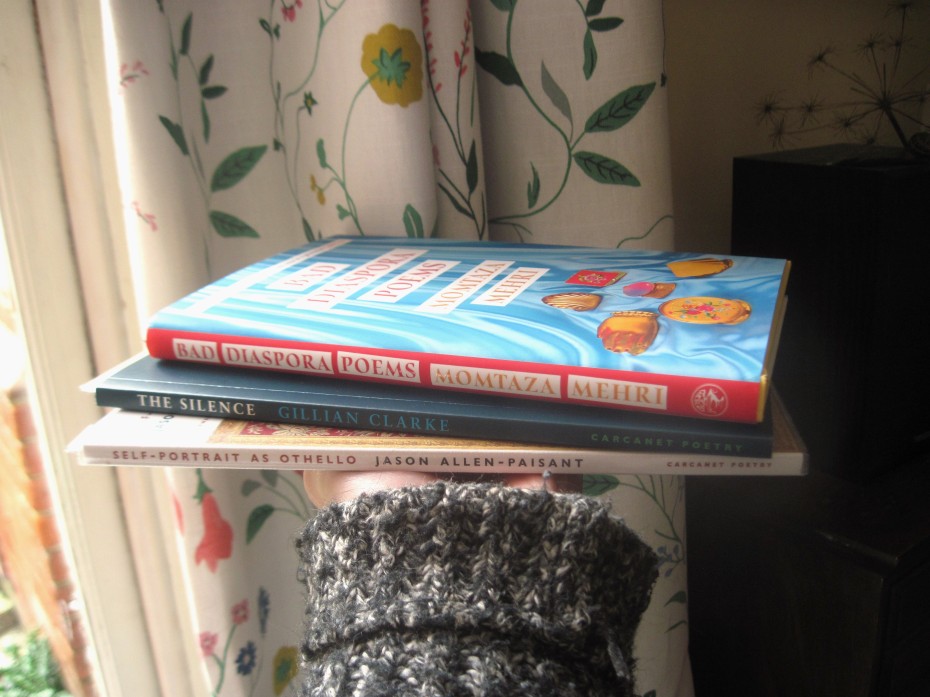
World Poetry Day stack last week
Young Writer of the Year Award
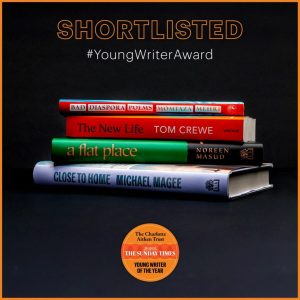
Shortlist:
- The New Life by Tom Crewe
 (Past: Nero Book Award shortlist, debut fiction)
 - Close to Home by Michael Magee (Winner: Nero Book Award, debut fiction category)
- A Flat Place by Noreen Masud (see above)
&
Bad Diaspora Poems by Momtaza Mehri
Winner: Forward Prize for Best First Collection
Nostalgia is bidirectional. Vantage point makes all the difference. Africa becomes a repository of unceasing fantasies, the sublimation of our curdled angst.
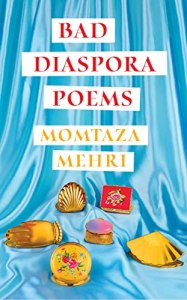 Crossing between Somalia, Italy and London and proceeding from the 1830s to the present day, this debut collection sets family history amid wider global movements. It’s peopled with nomads, colonisers, immigrants and refugees. In stanzas and prose paragraphs, wordplay and truth-telling, Mehri captures the welter of emotions for those whose identity is split between countries and complicated by conflict and migration. I particularly admired “Wink Wink,” which is presented in two columns and opens with the suspension of time before the speaker knew their father was safe after a terrorist attack. There’s super-clever enjambment in this one: “this time it happened / after evening prayer // cascade of iced tea / & sugared straws // then a line / break // hot spray of bullets & / reverb & // in less than thirty minutes we / they the land // lose twenty of our children”. Confident and sophisticated, this is a first-rate debut.
A few more favourite lines:
IX. Art is something we do when the war ends.
X. Even when no one dies on the journey, something always does.
(from “A Few Facts We Hesitantly Know to Be Somewhat True”)
You think of how casually our bodies are overruled by kin,
by blood, by heartaches disguised as homelands.
How you can count the years you have lived for yourself on one hand.
History is the hammer. You are the nail.
(from “Reciprocity is a Two-way Street”)
With thanks to Jonathan Cape (Penguin) for the free copy for review.
I hadn’t been following the Award on Instagram so totally missed the news of them bringing back a shadow panel for the first time since 2020. The four young female Bookstagrammers chose Mehri’s collection as their winner – well deserved.
Winner: The New Life by Tom Crewe
This was no surprise given that it was the Sunday Times book of the year last year (and my book of the year, to be fair). I’ve had no interest in reading the Magee. It’s a shame that a young woman of colour did not win as this year would have been a good opportunity for it. (What happened last year, seriously?!) But in that this award is supposed to be tied into the zeitgeist and honour an author on their way up in the world – as with Sally Rooney in my shadowing year – I do think the judges got it right.
Review Catch-Up: Capildeo, Castillo, Nagamatsu & Wedlich
A second catch-up for April. Today I have a sprightly poetry collection about history, language and nature; a linked short story collection that imagines funerary rituals and human meaning in a post-pandemic future; and a wide-ranging popular science book about the diverse connotations and practical uses of slime. As a bonus, I have a preview essay from a forthcoming collection about how reading promotes empathy and social justice.
Like a Tree, Walking by Vahni Capildeo (2021)
 Capildeo is a nonbinary Trinidadian Scottish poet and the current University of York writer in residence. Their fourth collection is richly studded with imagery of the natural world, especially birds and trees. “In Praise of Birds” makes a gorgeous start:
“In praise of high-contrast birds, purple bougainvillea thicketing the golden oriole. … In praise of grackles quarrelling on the lawn. / In praise of unbeautiful birds abounding in Old Norse, language of scavenging ravens, thought and memory, a treacherous duo”
and finds a late echo in “In Praise of Trees”: “If I could have translated piano practice into botany, the lichen is that Mozart phrase my left hand trialled endlessly.”
The title section (named after a moment from the book of Mark) draws on several numbered series – “Walk #2,” “Nocturne #1,” “Lullaby 4,” and so on – that appeared in a pamphlet they published last year. These are not uncomplicated idylls, though. Walks might involve dull scenery and asthma-inducing dust, as well as danger: “If nobody has abducted you, I’ll double back to meet you. … Before raper-man corner and the gingerbread house.” Lullabies wish for good sleep despite lawnmowers and a neighbour shooting his guns. There’s more bold defiance of expectations in phrases like “This is the circus for dead horses only”.
Language is a key theme, with translations from the French of Eugène Ionesco, and of Pierre de Ronsard into Trini patois. There are also dual-language erasure poems after Dame Julian of Norwich (Middle English) and Simone Weil (French). Much of the work is based on engagement with literature, or was written in collaboration with performers.
“Death is a thief in a stationery shop. He strolls out. The shopkeeper, a poor man, runs after, shouting. – I saw you! Give that back! – Give back what? Death says, strolling out. Hermes is a tram attendant who holds your coffee, helping you find the coin you dropped; it rolls underfoot.” (from “Odyssey Response”)
“Windrush Reflections” impresses for its research into the situation of Caribbean immigrants to Britain. It’s one of a number of long, multipart pieces, some of them prose poems. The verse relies mostly on alliteration and anaphora for its sonic qualities. Along with history, there is reflection on current events, as in “Plague Poems.” Experiences of casual racism fuel one of my favourite passages:
“the doorbell was ringing / the downstairs american oxford neighbours / wanted to check / by chatting on the intercom / if i was doing terrorism / i was doing transcriptions” (from “Violent Triage”)
Honorifics by Cynthia Miller, which I reviewed last week, had more personal resonance for me, but these are both powerful collections – alive to the present moment and revelling in language and in flora and fauna. However, only Capildeo progressed from the Jhalak Prize longlist onto the shortlist, which was announced yesterday.
With thanks to Carcanet Press for the free e-copy for review.
How High We Go in the Dark by Sequoia Nagamatsu (2022)
“Things are bad in every generation. But we still have to live our life.”
This linked short story collection was one of my most anticipated books of the year. Like two of its fellow entries on that list, Sea of Tranquility by Emily St. John Mandel and To Paradise by Hanya Yanagihara, it’s just the right blend of literary fiction and science fiction – an Octavia E. Butler level of the latter that I can handle. Opening in 2031 and stretching another 70 years into the future, it imagines how a pandemic reshapes the world and how communication and connection might continue after death. In the first story, Cliff is on the ground at the start of the Arctic plague, which emerges from a thawing Siberia (the same setup as in Under the Blue!), where his late daughter, Clara, had been part of a research group that discovered a 30,000-year-old Neanderthal girl they named Annie.
 The virus is highly transmissible and deadly, and later found to mostly affect children. In the following 13 stories (most about Asian Americans in California, plus a few set in Japan), the plague is a fact of life but has also prompted a new relationship to death – a major thread running through is the funerary rites that have arisen, everything from elegy hotels to “resomation.” In the stand-out story, the George Saunders-esque “City of Laughter,” Skip works at a euthanasia theme park whose roller coasters render ill children unconscious before stopping their hearts. He’s proud of his work, but can’t approach it objectively after he becomes emotionally involved with Dorrie and her son Fitch, who arrives in a bubble.
All but one of these stories are in the first person, so they feel like intimate testimonies of how a pandemic transforms existence. Almost all of the characters have experienced a bereavement, or are sick themselves. Relatives or acquaintances become protagonists in later stories. For instance, in “Pig Son,” Dorrie’s ex, David, is a scientist growing organs for transplantation. Bereavement coordinator Dennis and his doctor brother Bryan narrate #5 and #8, respectively. Six years on, Cliff’s wife Miki takes their granddaughter on a space mission. My other two favourites were “Through the Garden of Memory,” in which patients on a plague ward build a human pyramid and plot a sacrifice, and “Songs of Your Decay,” about a researcher at a forensic body farm who bonds with her one live donor over rock music.
Some stories are weaker or less original than others, but this is one case where the whole is definitely greater than the sum of its parts. The focus on illness and death, but also on the love that survives, made this a winner for me. I’d be especially likely to recommend it to fans of Kazuo Ishiguro and Karen Russell.
With thanks to Bloomsbury for the free copy for review.
Slime: A Natural History by Susanne Wedlich (2021)
[Translated from the German by Ayça Türkoğlu]
 This is just the sort of wide-ranging popular science book that draws me in. Like Entangled Life by Merlin Sheldrake, a work I’ve had many opportunities to recommend even to those who don’t normally pick up nonfiction, it incorporates many weird and wonderful facts about life forms we tend to overlook. Wedlich, a freelance science journalist in Germany, starts off at the Hunterian Museum in Glasgow, where she seeks a sample of the “primordial slime” collected by the HMS Challenger in 1876. “It seems to be an unwritten rule of horror: slime sells!” she remarks – from H. P. Lovecraft to Ghostbusters, it has provoked disgust. Jellyfish, snails, frogs and carnivorous plants – you’re in for a sticky tour of the natural world.
The technical blanket term for slimy substances is “hydrogels,” which are 99% water and held together by polymers. Biological examples have been inspiring new technologies, like friction reducers (e.g. in fire hoses) modelled on fish mucus, novel adhesives to repair organs and seal wounds, and glue traps to remove microplastics. Looking to nature to aid our lives is nothing new, of course: Wedlich records that slugs were once used to lubricate cart wheels.
The book branches off in a lot of directions. You’ll hear about writers who were spellbound or terrified by marine life (Patricia Highsmith kept snails, while Jean-Paul Sartre was freaked out by sea creatures), the Victorian fascination with underwater life, the importance of the microbiome and the serious medical consequences of its dysfunction, and animals such as amphibians that live between land and water. At times it felt like the narrative jumped from one topic to another, especially between the biological and the cultural, without following a particular plan, but there are enough remarkable nuggets to hold the interest.
With thanks to Granta for the free copy for review.
And a bonus:
 I was delighted to be sent a preview pamphlet containing the author’s note and title essay of How to Read Now by Elaine Castillo, coming from Atlantic in August. This guide to cultural criticism – how to read anything, not just a book – is alive to the biased undertones of everyday life. “Anyone who is perfectly comfortable with keeping the world just as it is now and reading it the way they’ve always read it … cannot be trusted”. Castillo writes that it is not the job of people of colour to enlighten white people (especially not through “the gooey heart-porn of the ethnographic” – war, genocide, tragedy, etc.); “if our stories primarily serve to educate, console and productively scold a comfortable white readership, then those stories will have failed their readers”. This is bold, provocative stuff. I’m sure to learn a lot.
Would you be interested in reading one or more of these?
Review Catch-Up: Jhalak and Women’s Prize Nominees, Etc.
Another in an ongoing series as I catch up on the current and previous year releases I’ve been sent for review. Today I have four books by women: a poetry collection about living between countries and languages, a magic realist novel about vengeful spirits in Vietnam, a memoir in verse about the disabled body and queer parenting, and a novel set in gentrifying Puerto Rican neighbourhoods of New York City.
From the Jhalak Prize longlist:
Honorifics by Cynthia Miller (2021)
Miller is a Malaysian American poet currently living in Edinburgh. Honorifics was also shortlisted for the Forward Prize for Best First Collection. Its themes resonate with poetry I’ve read by other Asian women like Romalyn Ante and Jenny Xie and with the works of mixed-race authors such as Jessica J. Lee and Nina Mingya Powles: living between two or more countries and feeling like an exile versus finding a sense of home.
Nightly, you rosary American synonyms for success learned the hard way: suburb – 10-year visa – promotion – carpool – mortgage – parent-teacher conference – nuclear family – assimilation … Homecoming is the last, hardest thing you’ll ask yourself to do.
(from “Homecoming”)
 “Loving v. Virginia” celebrates interracial love: “Look at us, improper. Look at us, indecent. Look at us, incandescent and loving.” Food is a vehicle for memory, as are home videos. Like Ante, Miller has a poem based on her mother’s voicemail messages. “Glitch honorifics” gives the characters for different family relationships, comparing Chinese and Hokkien. The imagery is full of colour and light, plants and paintings. A terrific central section called “Bloom” contains 10 jellyfish poems (“We bloom like nuclear hydrangea … I’m an unwound chandelier, / a 150-foot-long coil of cilia, // made up of a million gelatinous foxgloves.”).
Miller incorporates a lot of unusual structures, some of them traditional forms (“Sonnet with lighthouses,” “Moon goddess ghazal,” “Persimmon abecedarian”) and others freer forms like a numbered list, columns, dictionary definitions or prose paragraphs. Six of the poems cite an inspiration; I could particularly see the influence in “The Home Office after Caroline Bird” – an absurdist take on government immigration policy.
There’s much variety here, and so many beautiful lines and evocative images. “Malaysiana,” a tour through everything she loves about the country of her birth, was my single favourite poem, and a couple more passages I loved were “the heart measuring breaths like levelling sugar / for a batter, the heart saying / why don’t you come in from the cold.” (from “The impossible physiology of the free diver”) and the last two stanzas of “Lupins”: “Some days / their purple spines // are the only things / holding me up.” Flora and fauna references plus a consideration of the expat life meant this was custom made for me, but I’d recommend it to anyone looking to try out different styles of contemporary poetry.
With thanks to Nine Arches Press for the free copy for review.
From the Women’s Prize longlist:
Build Your House around My Body by Violet Kupersmith (2021)
 Back in 2014, I reviewed Kupersmith’s debut collection, The Frangipani Hotel, for BookBrowse. I was held rapt by its ghostly stories of Vietnam, so I was delighted to hear that she had written a debut novel, and it was one of my few correct predictions for the Women’s Prize nominees. The main action takes place between when Winnie – half white and half Vietnamese – arrives in Saigon to teach English in 2010, and when she disappears from the house she shared with her boyfriend of three months, Long, in March 2011. But the timeline darts about to tell a much more expansive story, starting with the Japanese invasion of Vietnam in the 1940s. Each date is given as the number of months or years before or after Winnie’s disappearance.
Winnie starts off living with a great-aunt and cousins, and meets a family friend, Dr. Sang, who’s been experimenting on a hallucinogenic drug made from cobra venom. Long and his brother, Tan, a policeman, were childhood friends with a fearless young woman named Binh – now a vengeful ghost haunting them both. Meanwhile, the Saigon Spirit Eradication Company, led by the Fortune Teller, is called upon to eradicate a ghost – which from time to time seems to inhabit a small dog – from a snake-infested highland estate. These strands are bound to meet, and smoke and snakes wind their way through them all.
I enjoyed Kupersmith’s energetic writing, which reminded me by turns of Nicola Barker, Ned Beauman, Elaine Castillo and Naoise Dolan, and the glimpses of Cambodia and Vietnam we get through meals and motorbike rides. What happens with Belly the dog towards the end is fantastic. But the chronology feels needlessly complex, with the flashbacks to colonial history and even to Binh’s story not adding enough to the narrative. While I’d still like to see Kupersmith make the shortlist, I can recommend her short stories that bit more highly.
With thanks to Oneworld for the free copy for review.
Handbook for the Newly Disabled: A Lyric Memoir by Allison Blevins (2022)
 Allison Blevins, a poet, has published five chapbooks or collections and has another forthcoming. Based in Missouri and the director of an indie press, she tells her story of chronic illness and queer parenting in 10 “chapters” composed of multi-part poems. She moves through brain fog and commemorates pain and desire, which cannot always coexist (as in “How to F**k a Disabled Body”).
I’ll never
ride a bike again, hike, carry my children. I’m learning to number what I’ve lost.
Because of the pills, I no longer fall into sleep, I stop. I used to hate queer at 19
when I was a dyke. I can’t be disabled. I need a better word. I need a body that floats—
translucent and liquid—to my daughter’s bed, to cover her like cotton-red quilted stars.
(from “Brain Fog”)
Sometimes the title is enough: “My Neurologist (Who Doesn’t Have MS) Explains Pain Is Not a Symptom of MS.” Other times, what is left out, or erased (as in “Five by Five”) is what matters the most. For instance, the Photo Illustrations promised in the titles of two chapters are replaced by Accessibility Notes. That strategy reminded me of one Raymond Antrobus has used. Alliteration, synesthesia and the language of the body express the complexities of a friend’s cancer, having a trans partner, and coming to terms with sexuality (“I think now that being queer was easy, easy as forgetting / being born”). A really interesting work and an author I’d like to read more from.
Published by BlazeVOX [books] on 22 March. With thanks to the author for the e-copy for review.
Olga Dies Dreaming by Xóchitl González (2022)
 This was on my radar thanks to a starred Kirkus review. It would have been a good choice for the Women’s Prize longlist, with its bold heroine, Latinx and gay characters, and blend of literary and women’s fiction. The Puerto Rican immigrant community and gentrifying neighbourhoods of New York City are appealing locales, and Olga is a clever, gutsy protagonist. As the novel opens in 2017, she’s working out how best to fleece the rich families whose progeny’s weddings she plans. Today it’s embezzling napkins for her cousin Mabel’s wedding. Next: stockpiling cut-price champagne. Olga’s brother Prieto, a slick congressman inevitably nicknamed the “Latino Obama,” is a closeted gay man. Their late father was a drug addict; their mother left to be part of a revolutionary movement back in PR and sends her children occasional chiding letters when they appear to be selling out.
The aftermath of Hurricane Maria coincides with upheaval in Olga’s and Prieto’s personal and professional lives. The ins and outs of Puerto Rican politics went over my head somewhat, and the various schemes and conspiracy theories get slightly silly. The thread that most engaged me was Olga’s relationship with Matteo, a hoarder. I hoped that, following the satire of earlier parts (“Olga realized she’d allowed herself to become distracted from the true American dream—accumulating money—by its phantom cousin, accumulating fame. She would never make that mistake again”), there might be a message about the emptiness of the pursuit of wealth. So I ended up a little disappointed by a late revelation about Matteo.
However, I did appreciate the picture of how Olga is up against it as both a woman and a person of colour (“no person of color serious about being taken seriously was ever late to meet white people”). This debut was perhaps a little unsure of what it wanted to be, but the novelty of the main elements was enough to make it worth reading.
With thanks to Fleet for the free copy for review.
Would you be interested in reading one or more of these?
Love Your Library, March 2022
Naomi has been reading a variety of books from the library, including middle grade fiction and Indigenous poetry. Rosemary and Laura posted photos of the books they’ve borrowed from their local libraries recently.


Like Laura, I’ve been sourcing prize nominees from various places. In April I hope to read two nonfiction books from the Jhalak Prize longlist (Things I Have Withheld by Kei Miller and Brown Baby by Nikesh Shukla) and two more novels from the Women’s Prize longlist (The Paper Palace by Miranda Cowley Heller and The Island of Missing Trees by Elif Shafak), and I’ve just started Colm Tóibín’s Folio Prize-winning The Magician.
All from the library: a great way to read new and critically acclaimed books without having to buy them!


 I’ve joined Kay, Lynn and Naomi for the Literary Wives online book club and our first read, coming up in June, will be The Sentence by Louise Erdrich, which will be doing double duty as part of the Women’s Prize longlist. I’m in the library holds queue and my copy should come in soon. My only other Erdrich so far, Love Medicine, was a 5-star read, so I have high hopes even though the premise for this one sounds a little iffy. (A bookshop ghost – magic realism being a common denominator on this year’s list – and a Covid lockdown setting.)
For those of you who like to plan ahead, here’s our schedule thereafter. I’ll be rereading two of them (Hornby and O’Farrell) and getting four out from the library (Feito, Hurston, Medie, O’Farrell). One I’ll request as a review copy (Lee), one was 99p on Kindle (Brown), and two more remain to be found secondhand (Gaige and Hunter). Maybe there’s one or more you’d like to join in with?
September 2022 Red Island House by Andrea Lee
December 2022 State of the Union by Nick Hornby
March 2023 His Only Wife by Peace Adzo Medie
June 2023 The Harpy by Megan Hunter
September 2023 Sea Wife by Amity Gaige
December 2023 Hamnet by Maggie O’Farrell
March 2024 Mrs. March by Virginia Feito
June 2024 Recipe for a Perfect Marriage by Karma Brown
September 2024 Their Eyes Were Watching God by Zora Neale Hurston
What have you been reading or reviewing from the library recently?

Do share a link to your own post in the comments, and feel free to use the above image. I’ve co-opted a hashtag that is already popular on Twitter and Instagram: #LoveYourLibrary.
Here’s a reminder of my ideas of what you might choose to post (this list will stay up on the project page):
- Photos or a list of your latest library book haul
- An account of a visit to a new-to-you library
- Full-length or mini reviews of some recent library reads
- A description of a particular feature of your local library
- A screenshot of the state of play of your online account
- An opinion piece about library policies (e.g. Covid procedures or fines amnesties)
- A write-up of a library event you attended, such as an author reading or book club.
If it’s related to libraries, I want to hear about it!
Too Much (to Do) and Never Enough (Time to Read)
Adapting a Mary Trump title there for a feeling I’m sure many of us have periodically. House hunting and purchasing have taken up a lot of time over the last six months. Now that we finally have keys to the new place, the work has only begun. The old chap who lived there as a tenant for decades before moving to a care home had been existing in some squalor (e.g., no shower or central heating). This past weekend we did a basic clean, including clearing out all the rubbish left in the outdoor bins. It almost felt like trauma cleaning. We haven’t yet had the fortitude to tackle the kitchen and bathroom, which are so greasy and grimy we might hire someone to clean them for us.
Much more fun has been the garden: we’ve transplanted some hedge plants from our rental garden, planted some trees, pruned the rose bushes, and made a plan for path, meadow and pond.

In the six weeks or so before we actually move in, there is so much to think about. We have a couple of tradespeople already booked, but there are lots of other renovations to research and get quotes for. So much to book, order, buy … we’re going to be bleeding money for the rest of this year. We will take on a few smaller projects ourselves, with neighbours’ help, but it is a very daunting prospect for people with no DIY skills. (And I just want to read instead.)
I should be ecstatic to own a home for the first time, and I do know how lucky I am to have somewhere to live and spare cash for improvements, but right now it all feels overwhelming. I’ve also been glum because I was denied the life insurance we applied for at the same time as a mortgage. I knew my genetic kidney disease would make a policy more expensive, but I wasn’t expecting to be declined outright – especially after the company strung me along for four months. The doctor’s reports they requested said only positive things about how stable my health was, how good my renal function, blood pressure under control. In the end they just looked at the condition name and said no. And that has made me feel a little worthless.
Still, chin up. It’s turned into a beautiful spring with fun outings such as a tour and tasting at a gin factory and folk gigs, including one by living legend Peggy Seeger.


I’m also genuinely enjoying the packing and culling process. Look at this vintage tech I found in a drawer! The Discman and Texas Instruments calculator still work, so I will continue using them.


Will I ever finish another book again?
Work has taken a slight backseat these days. I also feel like I’ll never finish another book again (though, actually, I’ll probably finish a poetry volume later today). It’s not that I’m in a slump. It’s that I’m currently reading 36 books, though the number I actually spend time with on a daily basis is more like 15–20. The rest languish in a pile next to the coffee table, or on my bedside stack. I’m working towards various projects, but my progress is at a slow crawl:
 Requested after me at the library: The Dangers of Smoking in Bed by Mariana Enríquez, If Not for You by Georgina Lucas, Wahala by Nikki May
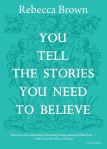
March releases: You Tell the Stories You Need to Believe by Rebecca Brown, Ghosts of Spring by Luis Carrasco, Groundskeeping by Lee Cole, Brainspotting by A.J. Lees
Reading Ireland Month: Dance Move by Wendy Erskine, After You’d Gone by Maggie O’Farrell, Vinegar Hill by Colm Tóibín
April’s book club books: Paradise by Toni Morrison & Mr Pye by Mervyn Peake
Spring titles: Damnation Spring by Ash Davidson, The Beginning of Spring by Penelope Fitzgerald, Spring by Karl Ove Knausgaard, Sowing by Leonard Woolf
 Jhalak Prize longlist: Honorifics by Cynthia Miller (with two more to start in April)
Women’s Prize longlist: Build Your House Around My Body by Violet Kupersmith, The Book of Form and Emptiness by Ruth Ozeki, The Final Revival of Opal & Nev by Dawnie Walton (with two more to start in April)
And so on.
That doesn’t count review books I’m trying to catch up on, a buddy read with my husband, a couple of e-books, and two other low-key thematic challenges I have in mind.
I’m inching towards my end-of-March targets for the current-month releases and Irish books. But most of my reading time has gone to one book I’ve been trying to read since January. By forcing myself to read a big chunk of Hanya Yanagihara’s To Paradise every day – first 40 pages, then 50, now 60 – I have finally passed the 500-page point and hope to finish and review it this weekend. Then I’ll rip up some nasty old carpets!
“People say that life is the thing, but I prefer reading.”
~Logan Pearsall Smith
Has there been more reading, or living, for you lately?
Recent Literary Awards & Online Events: Folio Prize and Claire Fuller
Literary prize season is in full swing! The Women’s Prize longlist, revealed on the 10th, contained its usual mixture of the predictable and the unexpected. I correctly predicted six of the nominees, and happened to have already read seven of them, including Claire Fuller’s Unsettled Ground (more on this below). I’m currently reading another from the longlist, Luster by Raven Leilani, and I have four on order from the library. There are only four that I don’t plan to read, so I’ll be in a fairly good place to predict the shortlist (due out on April 28th). Laura and Rachel wrote detailed reaction posts on which there has been much chat.
Rathbones Folio Prize
This year I read almost the entire Rathbones Folio Prize shortlist because I was lucky enough to be sent the whole list to feature on my blog. The winner, which the Rathbones CEO said would stand as the “best work of literature for the year” out of 80 nominees, was announced on Wednesday in a very nicely put together half-hour online ceremony hosted by Razia Iqbal from the British Library. The Folio scheme also supports writers at all stages of their careers via a mentorship scheme.
It was fun to listen in as the three judges discussed their experience. “Now nonfiction to me seems like rock ‘n’ roll,” Roger Robinson said, “far more innovative than fiction and poetry.” (Though Sinéad Gleeson and Jon McGregor then stood up for the poetry and fiction, respectively.) But I think that was my first clue that the night was going to go as I’d hoped. McGregor spoke of the delight of getting “to read above the categories, looking for freshness, for excitement.” Gleeson said that in the end they had to choose “the book that moved us, that enthralled us.”
All eight authors had recorded short interview clips about their experience of lockdown and how they experiment with genre and form, and seven (all but Doireann Ní Ghríofa) were on screen for the live announcement. The winner of the £30,000 prize, author of an “exceptional, important” book and teller of “a story that had to be told,” was Carmen Maria Machado for In the Dream House. I was delighted with this result: it was my first choice and is one of the most remarkable memoirs I’ve read. I remember reading it on my Kindle on the way to and from Hungerford for a bookshop event in early March 2020 – my last live event and last train ride in over a year and counting, which only made the reading experience more memorable.

I like what McGregor had to say about the book in the media release: “In the Dream House has changed me – expanded me – as a reader and a person, and I’m not sure how much more we can ask of the books that we choose to celebrate.”
There are now only two previous Folio winners that I haven’t read, the memoir The Return by Hisham Matar and the novel Lost Children Archive by Valeria Luiselli, so I’d like to get those two out from the library soon and complete the set.
Other literary prizes
 The following day, the Dylan Thomas Prize shortlist was announced. Still in the running are two novels I’ve read and enjoyed, Pew by Catherine Lacey and My Dark Vanessa by Kate Elizabeth Russell, and one I’m currently reading (Luster). Of the rest, I’m particularly keen on Kingdomtide by Rye Curtis, and I would also like to read Alligator and Other Stories by Dima Alzayat. I’d love to see Russell win the whole thing. The announcement will be on May 13th. I hope to participate in a shortlist blog tour leading up to it.
I also tuned into the Edward Stanford Travel Writing Awards ceremony (on YouTube), which was unfortunately marred by sound issues. This year’s three awards went to women: Dervla Murphy (Edward Stanford Outstanding Contribution to Travel Writing), Anita King (Bradt Travel Guides New Travel Writer of the Year; you can read her personal piece on Syria here), and Taran N. Khan for Shadow City: A Woman Walks Kabul (Stanford Dolman Travel Book of the Year in association with the Authors’ Club).
Other prize races currently in progress that are worth keeping an eye on:
- The Jhalak Prize for writers of colour in Britain (I’ve read four from the longlist and would be interested in several others if I could get hold of them)
- The Republic of Consciousness Prize for work from small presses (I’ve read two; Doireann Ní Ghríofa gets another chance – fingers crossed for her)
- The Walter Scott Prize for historical fiction (next up for me: The Dictionary of Lost Words by Pip Williams, to review for BookBrowse)
Claire Fuller
Yesterday evening, I attended the digital book launch for Claire Fuller’s Unsettled Ground (my review will be coming soon). I’ve read all four of her novels and count her among my favorite contemporary writers. I spotted Eric Anderson and Ella Berthoud among the 200+ attendees, and Claire’s agent quoted from Susan’s review – “A new novel from Fuller is always something to celebrate”! Claire read a passage from the start of the novel that introduces the characters just as Dot starts to feel unwell. Uniquely for online events I’ve attended, we got a tour of the author’s writing room, with Alan the (female) cat asleep on the daybed behind her, and her librarian husband Tim helped keep an eye on the chat.
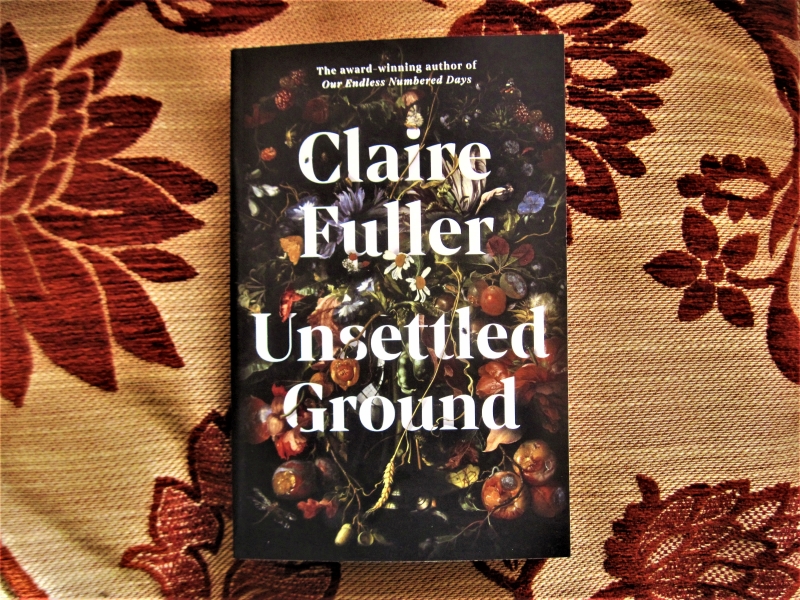
After each novel, as a treat to self, she buys a piece of art. This time, she commissioned a ceramic plate from Sophie Wilson with lines and images from the book painted on it. Live music was provided by her son Henry Ayling, who played acoustic guitar and sang “We Roamed through the Garden,” which, along with traditional folk song “Polly Vaughn,” are quoted in the novel and were Claire’s earworms for two years. There was also a competition to win a chocolate Easter egg, given to whoever came closest to guessing the length of the new novel in words. (It was somewhere around 89,000.)
Good news – she’s over halfway through Book 5!
 Bookish Beck = Rebecca Foster. American transplant to England. Freelance proofreader and book reviewer.
 Bookish Beck