Doorstopper of the Month: The Cider House Rules by John Irving (A Reread)
Next month will be all about the short books (#NovNov!), but first it was time to get this excessively long one out of the way. My husband’s and my reading tastes don’t overlap in many areas, but John Irving is our mutual favorite author. I first started The Cider House Rules (1985) on our second honeymoon – being from two different countries, we had two nuptial ceremonies and two honeymoons, one per continent – which was a road trip through New England. We drove from Maryland to Maine and back; I have a specific memory of reading the chunky Irving hardback at our B&B in Stowe, Vermont. I was a much less prolific reader in those days, so I had to return my American library copy partially read and then pay to reserve one from the Hampshire Libraries system once we were back in the UK.
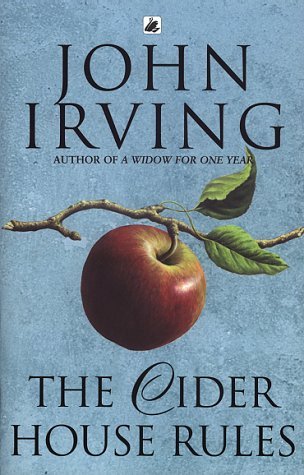
Thirteen years on, I remembered the orphanage and cider farm settings, the dynamic between Doctor Wilbur Larch and his protégé, Homer Wells, and Homer’s love for his best friend’s girl, Candy. I also remembered that this is a Trojan horse of a novel: it advocates, not very subtly, for abortion rights through pictures of women in desperate situations. Luckily, by the time I first read it I was no longer slavishly devoted to the American Religious Right. But this time I felt that even readers who consider themselves pro-choice might agree Irving over-eggs his argument. My memory of the 1999 film version is clearer. It severely condenses the book’s 40 years or so of action, cutting subplots and allowing Tobey Maguire and Charlize Theron to play the leads all the way through. A shorter timeframe also more neatly draws a line between Rose Rose’s experience and Homer’s change of heart about offering abortions.
I had a strong preference for the scenes set at St. Cloud’s orphanage in Maine. Dr. Larch is celibate and addicted to ether – all a result of his first sexual encounter with a prostitute. He has an ironclad conviction that he is doing the Lord’s work for the pregnant women who get off the train at St. Cloud’s, whether they come for an abortion or to leave a live baby behind. Homer Wells is the one orphan who never finds an adoptive home; he stays on and becomes Larch’s trainee in obstetrics, but vows that he won’t perform abortions. As a young adult, Homer is pulled away from the orphanage by his puppy love for Wally and Candy, a couple-in-trouble who come up from his family’s apple farm. Homer thinks he’ll go back with his new friends for a month or two, but instead he stays at Ocean View orchard for decades, his relationship with Candy changing when Wally goes off to war and comes back disabled.
I had forgotten the bizarre scenario Larch has to set up for the orphanage’s board of trustees to accept his chosen successor, and the far-fetched family situation Homer, Candy and Wally end up in. The orchard sections could feel endless, so I always thrilled to mentions of what was happening for Dr. Larch and the nurses back at St. Cloud’s.

Oktoberfest reading and snacking.
The Dickensian influence – lots of minor characters and threads tying up nicely by the end; quirks of speech and behavior – has generally been the aspect I like the most about Irving’s work, and while I loved the explicit references to David Copperfield here (a few kids get their names from it, it’s read aloud to the boy orphans every night, and its opening question about whether the protagonist will be the hero of his own life or not applies to Homer, too), I did find the novel awfully baggy this time. I even put in a slip of paper where I felt that things started to drift: page 450.
One further note to make about the film: it, rather unforgivably, eliminates Melony, a larger-than-life character and necessary counterpart to the book’s multiple passive females. She’s the de facto head of the girl orphans, as Homer is for the boys, and initiates Homer into sex. But her feelings for him are more of hero worship than of romantic love, and when he breaks his promise and leaves St. Cloud’s without her, she sets off to hunt him down. Her odyssey, delivered in parallel, is nearly as important as Homer’s (see what I/Irving did there?).
While I loved the medical history material and Dr. Larch’s moral fiber, this time I found Homer a little insipid and annoying (he answers nearly every question with “Right”), and the plot somewhat slack and obvious. In my memory this is probably #3 out of the Irving novels I’ve read, below A Prayer for Owen Meany and The World According to Garp – both of which I’d also like to reread to see if they’ve retained their power.
Page count: 731
My original rating (July–September 2007): 
My rating now: 
Done any rereading, or picked up any very long books, lately?
Six Degrees of Separation: From The Turn of the Screw to The Cider House Rules
This month we’re starting with The Turn of the Screw, a Gothic horror novella about a governess and her charges – and one of only two Henry James novels I’ve read (the other is What Maisie Knew; I’ve gravitated towards the short, atypical ones, and even in those his style is barely readable). Most of my links are based on title words this time, along with a pair of cover images.
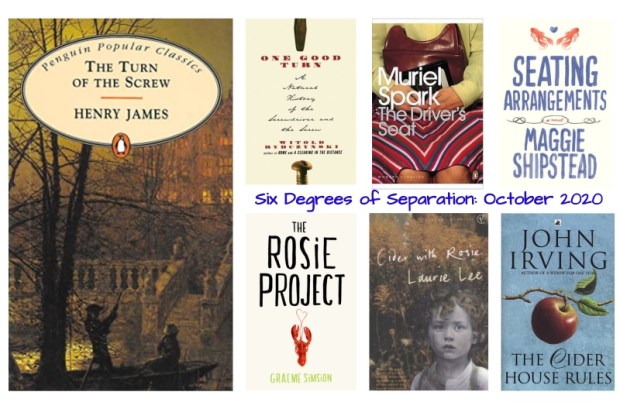
#1 On our trip to Hay-on-Wye last month, I was amused to see in a shop a book called One Good Turn: A Natural History of the Screwdriver and the Screw (2000) by Witold Rybczynski. A bit of a niche subject and nothing I can ever imagine myself reading, but it’s somehow pleasing to know that it exists.

#2 I’m keen to try Muriel Spark again with The Driver’s Seat (1970), a suspense novella with a seam of dark comedy. I remember reading a review of it on Heaven Ali’s blog and thinking that it sounded deliciously creepy. My plan is to get it out from the university library to read and review for Novellas in November.
#3 Seating Arrangements by Maggie Shipstead was one of my favorite debut novels of 2012. An upper-middle-class family prepares for their heavily pregnant daughter’s wedding weekend on an island off Connecticut. Shipstead is great at capturing social interactions. There’s pathos plus humor here; I particularly liked the exploding whale carcass. I’m still waiting for her to come out with a worthy follow-up (2014’s Astonish Me was so-so).

#4 The cover lobsters take me to The Rosie Project (2013) by Graeme Simsion, the first and best book in his Don Tillman trilogy. A (probably autistic) Melbourne genetics professor, Don decides at age 39 that it is time to find a wife. He goes about it in a typically methodical manner, drawing up a 16-page questionnaire, but still falls in love with the ‘wrong’ woman.
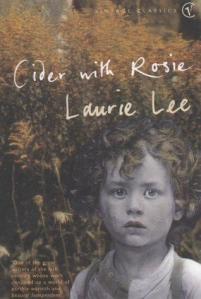
#5 Earlier in the year I reviewed Cider with Rosie (1959) by Laurie Lee as my classic of the month and a food-themed entry in my 20 Books of Summer. It’s a nostalgic, evocative look at a country childhood. The title comes from a late moment when Rosie Burdock tempts the adolescent Lee with alcoholic cider and kisses underneath a hay wagon.
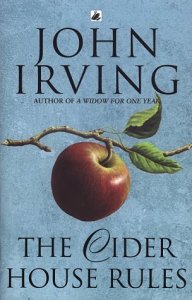
#6 My current reread is The Cider House Rules (1985), one of my favorite John Irving novels. Homer Wells is the one kid at the St. Cloud’s, Maine orphanage who never got adopted. Instead, he assists the director, Dr. Wilbur Larch, and later runs a cider factory. Expect a review in a few weeks – this will count as my Doorstopper of the Month.
Going from spooky happenings to apple cider, my chain feels on-brand for October!
Join us for #6Degrees of Separation if you haven’t already! (Hosted the first Saturday of each month by Kate W. of Books Are My Favourite and Best. Her introductory post is here.) Next month is a wildcard: start with a book you’ve ended a previous chain with.
Have you read any of my selections? Are you tempted by any you didn’t know before?
Doorstopper of the Month: The Crow Road by Iain Banks (1992)
This was a rare case of reading a novel almost entirely because of its famous first line: “It was the day my grandmother exploded.” I was familiar with the quote from the Bookshop Band song “Once Upon a Time” (video on bottom right here), which is made up of first lines from books, but had never read anything by the late Iain Banks, so when a copy of The Crow Road turned up in the free bookshop where I volunteered weekly in happier times, I snapped it up.
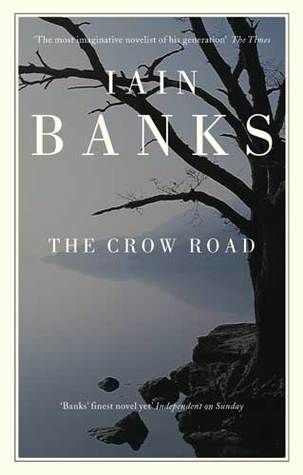 There’s a prosaic explanation for that magical-sounding opening: Grandma Margot had a pacemaker that the doctor forgot to remove before her cremation. Talk about going out with a bang! To go “away the crow road” is a Scottish saying for death, and on multiple occasions a sudden or unexplained death draws the McHoan clan together. As the book starts, Prentice McHoan, a slothful student of history at the university in Glasgow, is back in Gallanach (on the west coast of Scotland, near Oban), site of the family glassworks, for Margot’s funeral. He’ll be summoned several more times before the story is through.
Amid clashes over religion with his father Kenneth, a writer of children’s fantasy stories, plenty of carousing and whiskey-drinking, and a spot of heartbreak when his brother steals his love interest, Prentice gets drawn into the mystery of what happened to Uncle Rory, a travel writer who disappeared years ago. The bulk of the book is narrated by Prentice, but shifts into the third person indicate flashbacks. Many of these vignettes recount funny mishaps from Kenneth or Prentice’s growing-up years, but others – especially those in italics – reveal darker matters. As Prentice explores Uncle Rory’s files from a project called “Crow Road,” he stumbles on a secret that completely changes how he perceives his family history.
This reminded me of John Irving at his 1970s‒80s peak: a sprawling coming-of-age story, full of quirky people and events, that blends humor and pathos. In all honesty, I didn’t need the mystery element on top of the character study, but it adds direction to what is otherwise a pleasant if lengthy meander through the decades with the McHoans. I particularly appreciated how Prentice’s view of death evolves: at first he’s with Uncle Hamish, believing there has to be something beyond death – otherwise, what makes human life worthwhile? But Kenneth’s atheism seeps in thanks to the string of family deaths and the start of the Gulf War. “They were here, and then they weren’t, and that was all there was,” Prentice concludes; the dead live on only in memory, or in the children and work they leave behind. I can’t resist quoting this whole paragraph, my favorite passage from the novel:
Telling us straight or through his stories, my father taught us that there was, generally, a fire at the core of things, and that change was the only constant, and that we – like everybody else – were both the most important people in the universe, and utterly without significance, depending, and that individuals mattered before their institutions, and that people were people, much the same everywhere, and when they appeared to do things that were stupid or evil, often you hadn’t been told the whole story, but that sometimes people did behave badly, usually because some idea had taken hold of them and given them an excuse to regard other people as expendable (or bad), and that was part of who we were too, as a species, and it wasn’t always possible to know that you were right and they were wrong, but the important thing was to keep trying to find out, and always to face the truth. Because truth mattered.
That seems like a solid philosophy to me. I’ll try more by Banks. I also nabbed a free copy of The Wasp Factory, which I take it is very different in tone. Any recommendations after that? Could I even cope with his science fiction (published under the name Iain M. Banks)?
Page count: 501
My rating:
2020 Reading Goals and Anticipated Releases
Review copies have started to feel like an obligation I don’t want. Almost as soon as one comes through the door, I regret having asked for or accepted it. (Now I have to read the danged thing, and follow through with a review!) So I’m going to cut back severely this year. The idea is to wait until late in 2020 to figure out which are the really worthwhile releases, and then only read those instead of wading through a lot of mediocre stuff.
“Until one has some kind of professional relationship with books one does not discover how bad the majority of them are. In much more than nine cases out of ten the only objectively truthful criticism would be ‘This book is worthless,’ while the truth about the reviewer’s own reaction would probably be ‘This book does not interest me in any way, and I would not write about it unless I were paid to’. … The best practice, it has always seemed to me, would be simply to ignore the great majority of books and to give very long reviews … to the few that seem to matter.” (from “Confessions of a Book Reviewer” in Books v. Cigarettes by George Orwell)
These are the January to May 2020 releases I own so far, with perhaps a few more on the way. I acquired a lot of these in September through November, before I made the decision to cut down on review copies.

I’m also looking forward to new books by Sebastian Barry, Susanna Clarke, Stephanie Danler, Anne Enright, Yaa Gyasi, John Irving, Daisy Johnson, Daniel Kehlmann, Sue Monk Kidd, Rebecca Dinerstein Knight, Maya Shanbhag Lang, Helen Macdonald, Hilary Mantel, David Mitchell, Sarah Moss, Mark O’Connell, Maggie O’Farrell, Anne Tyler, Abraham Verghese, Raynor Winn and Molly Wizenberg.
I can still access new/pre-release books via my public library and NetGalley/Edelweiss, especially fiction to review for BookBrowse and nonfiction for Kirkus and the TLS.
This resolution is not about denying or punishing myself, as bloggers’ book-buying bans sometimes seem to be, so if an unmissable book (e.g. HAMNET) is offered on Twitter or via my blog, I won’t consider it cheating to say yes. FOMO will likely be a chronic condition for me this year, but ultimately I hope to do myself a favor.
With the reading time I’m saving, I plan to make major inroads into those 440 print books I own and haven’t read yet, and to do a lot of re-reading (I only managed one and a bit rereads in 2019). I might well blog less often and only feature those books that have been exceptional for me. I’ve set aside this shelf of mostly fiction that I think deserves re-reading soon:

“I do not think we go back to the exciting books,—they do not usually leave a good taste in the mouth; neither to the dull books, which leave no taste at all in the mouth; but to the quiet, mildly tonic and stimulating books,—books that have the virtues of sanity and good nature, and that keep faith with us.” (from “On the Re-Reading of Books” in Literary Values by John Burroughs)
I hope (as always) to read more classics, literature in translation and doorstoppers. Travel and biography are consistently neglected categories for me. Though I won’t set specific goals for these genres, I will aim to see measurable progress. I will also take advantage of the Wellcome Book Prize being on hiatus this year to catch up on some of the previous winners and shortlisted books that I’ve never managed to read.
Mostly, I want to avoid any situations that make me feel guilty or mean (so no more books received direct from the author, and any review books that disappoint will be quietly dropped), follow my whims, and enjoy my reading.
What are some of your goals (reading-related or otherwise) for 2020?
Reading Robertson Davies Week: Fifth Business
I’m grateful to Lory (of The Emerald City Book Review) for hosting this past week’s Robertson Davies readalong, which was my excuse to finally try him for the first time. Of course, Canadians have long recognized what a treasure he is, but he’s less known elsewhere. I do remember that Erica Wagner, one of my literary heroes (an American in England; former books editor of the London Times, etc.), has expressed great admiration for his work.
I started with what I had to hand: Fifth Business (1970), the first volume of The Deptford Trilogy. In the theatre world, the title phrase refers to a bit player who yet has importance to the outcome of a drama, and that’s how the narrator, Dunstan Ramsay, thinks of himself. I was reminded right away of the opening of Charles Dickens’s David Copperfield: “Whether I shall turn out to be the hero of my own life, or whether that station will be held by anybody else, these pages must show.” In the first line Ramsay introduces himself in relation to another person: “My lifelong involvement with Mrs. Dempster began at 5.58 o’clock p.m. on 27 December 1908, at which time I was ten years and seven months old.”

 Specifically, he dodged a snowball meant for him – thrown by his frenemy, Percy Boyd Staunton – and it hit Mrs. Dempster, wife of the local Baptist minister, in the back of the head, knocking her over and 1) sending her into early labor with Paul, who also plays a major role in the book; and 2) permanently compromising her mental health. Surprisingly, given his tepid Protestant upbringing, Ramsay becomes a historian of Christian saints, and comes to consider Mrs. Dempster part of his personal pantheon for a few incidents he thinks of as miracles – not least his survival during First World War service. And this is despite Mrs. Dempster being caught in a situation that seriously compromises her standing in Deptford.
The novel is presented as a long, confessional letter Ramsay writes, on the occasion of his retirement, to the headmaster of the boys’ school where he taught history for 45 years. Staunton, later known simply as “Boy,” becomes a sugar magnate and politician; Paul becomes a world-renowned illusionist known by various stage names. Both Paul and Ramsay are obsessed with the unexplained and impossible, but where Paul manipulates appearances and fictionalizes the past, Ramsay looks for miracles. The Fool, the Saint and the Devil are generic characters we’re invited to ponder; perhaps they also have incarnations in the novel?
Fifth Business ends with a mysterious death, and though there are clues that seem to point to whodunit, the fact that the story segues straight into a second volume, with a third to come, indicates that it’s all more complicated than it might seem. I was so intrigued that, thanks to my omnibus edition, I carried right on with the first chapter of The Manticore (1972), which is also in the first person but this time narrated by Staunton’s son, David, from Switzerland. Freudian versus Jungian psychology promises to be a major dichotomy in this one, and I’m sure that the themes of the complexity of human desire, the search for truth and goodness, and the difficulty of seeing oneself and others clearly will crop up once again.
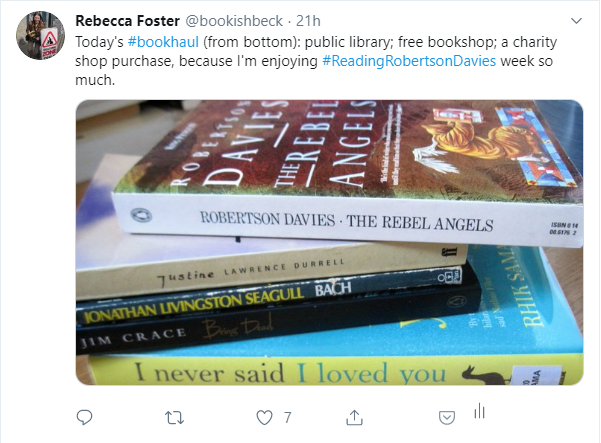
This was a very rewarding reading experience. I’d recommend Davies to those who enjoy novels of ideas, such as Iris Murdoch’s. I’ll carry on with at least the second volume of the trilogy for now, and I’ve also acquired the first volume of another, later trilogy to try.
My rating:
Some favorite lines:
“I cannot remember a time when I did not take it as understood that everybody has at least two, if not twenty-two, sides to him.”
“Forgive yourself for being a human creature, Ramezay. That is the beginning of wisdom; that is part of what is meant by the fear of God; and for you it is the only way to save your sanity.”
It’s also fascinating to see the contrast between how Ramsay sees himself, and how others do:
“it has been my luck to appear more literate than I really am, owing to a cadaverous and scowling cast of countenance, and a rather pedantic Scots voice”
vs.
“Good God, don’t you think the way you rootle in your ear with your little finger delights the boys? And the way you waggle your eyebrows … and those horrible Harris tweed suits you wear … And that disgusting trick of blowing your nose and looking into your handkerchief as if you expected to prophesy something from the mess. You look ten years older than your age.”
March’s Doorstopper: Cutting for Stone by Abraham Verghese (2009)
I’m squeaking in here on the 31st with the doorstopper I’ve been reading all month. I started Cutting for Stone in an odd situation on the 1st: We’d attempted to go to France that morning but were foiled by a fatal engine failure en route to the ferry terminal, so were riding in the cab of a recovery vehicle that was taking us and our car home. My poor husband sat beside the driver, trying to make laddish small talk about cars, while I wedged myself by the window and got lost in the early pages of Indian-American doctor Abraham Verghese’s saga of twins Marion and Shiva, born of an unlikely union between an Indian nun, Sister Mary Joseph Praise, and an English surgeon, Thomas Stone, at Missing Hospital in Addis Ababa in 1954.
 What with the flashbacks and the traumatic labor, it takes narrator Marion over 100 pages to get born. That might seem like a Tristram Shandy degree of circumlocution, but there was nary a moment when my interest flagged during this book’s 50-year journey with a medical family starting in a country I knew nothing about. I was reminded of Midnight’s Children, in that the twin brothers are born loosely conjoined at the head and ever after have a somewhat mystical connection, understanding each other’s thoughts even when they’re continents apart.
When Sister Mary Joseph Praise dies in childbirth and Stone absconds, the twins are raised by the hospital’s blunt obstetrician, Hema, and her husband, a surgeon named Ghosh. Both brothers follow their adoptive parents into medicine and gain knowledge of genitourinary matters. We observe a vasectomy, a breech birth, a C-section, and the aftermath of female genital mutilation. While Marion relocates to an inner-city New York hospital, Shiva stays in Ethiopia and becomes a world expert on vaginal fistulas. The novel I kept thinking about was The Cider House Rules, which is primarily about orphans and obstetrics, and I was smugly confirmed by finding Verghese’s thanks to his friend John Irving in the acknowledgments.
Ethiopia’s postcolonial history is a colorful background, with Verghese giving a bystander’s view of the military coup against the Emperor and the rise of the Eritrean liberation movement. Like Marion, the author is an Indian doctor who came of age in Ethiopia, a country he describes as a “juxtaposition of culture and brutality, this molding of the new out of the crucible of primeval mud.” Marion’s experiences in New York City and Boston then add on the immigrant’s perspective on life in the West in the 1980s onwards.
Naomi of Consumed by Ink predicted long ago that I’d love this, and she was right. Of course I thrilled to the accounts of medical procedures, such as an early live-donor liver transplant (this was shortlisted for the Wellcome Book Prize in 2009), but that wasn’t all that made Cutting for Stone such a winner for me. I can’t get enough of sprawling Dickensian stories in which coincidences abound (“The world turns on our every action, and our every omission, whether we know it or not”), minor characters have heroic roles to play, and humor and tragedy balance each other out, if ever so narrowly. (Besides Irving, think of books like The Heart’s Invisible Furies by John Boyne.) What I’m saying, as I strive to finish this inadequate review in the last hour of the last day of the month, is that this was just my sort of thing, and I hope I’ve convinced you that it might be yours, too.
Favorite lines:
Hema: “The Hippocratic oath is if you are sitting in London and drinking tea. No such oaths here in the jungle. I know my obligations.”
“Doubt is a first cousin to faith”
“A childhood at Missing imparted lessons about resilience, about fortitude, and about the fragility of life. I knew better than most children how little separate the world of health from that of disease, living flesh from the icy touch of the dead, the solid ground from treacherous bog.”
Page count: 667
My rating: 
Next month: Since Easter falls in April and I’ve been wanting to read it for ages anyway, I’ve picked out The Resurrection of Joan Ashby by Cherise Wolas to start tomorrow.
March Reading Plans and Books to Look out For
My apologies if you’ve already heard this story on social media: I was supposed to be in France this past weekend, but for the fourth time in a row we’ve been plagued by transport problems on a holiday: a flat tire in Wigtown, a cancelled train to Edinburgh, a cancelled flight to the States, and now car trouble so severe we couldn’t get on the ferry to Normandy. Though we made it all the way to the ferry port in Poole, our car was by then making such hideous engine noises that it would have been imprudent to drive it any further. We got a tow back to the auto shop where our car is usually serviced and currently await its prognosis. If it can be fixed, we may be able to reschedule our trip for this coming weekend.
The good news about our strange (non-)travel day: I got a jump on my Doorstopper of the Month, Cutting for Stone by Abraham Verghese, a terrific read that reminds me of a cross between Midnight’s Children and The Cider House Rules, and also started Priestdaddy by Patricia Lockwood – though my husband made me stop reading it because I couldn’t stop sniggering while he was trying to make important phone calls about the car. We ended up having a nice weekend at home anyway: going out for Nepalese food, gelato and a screening of The Favorite; doing some gardening and getting bits of work and writing done; and (of course) doing plenty of reading. Waking up with a purring cat on my legs and tucking into a stack of pancakes with maple syrup, I thought to myself, being home is pretty great, too.
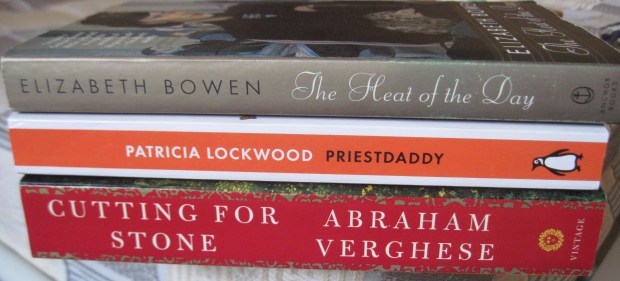
What I packed to read in France.
Reading Ireland Month 2019
This will be my second time participating in the annual challenge hosted by Cathy of 746 Books. I recently started The Heat of the Day by Elizabeth Bowen and I’m also currently reading two nonfiction books by Irish women: a review copy of Vagina: A Re-Education by Lynn Enright (which releases on March 7th) and the essay collection Notes to Self by Emilie Pine, on my Kindle. I have several other novels to choose from – two of which are set in Ireland rather than by Irish authors – plus a classic travel book by Dervla Murphy.
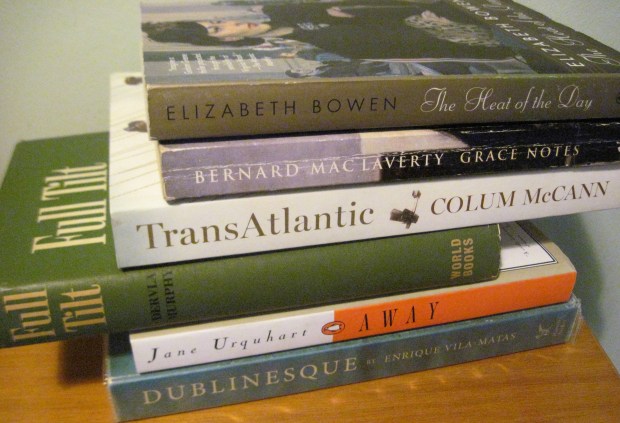
Irish selections.
Wellcome Book Prize
The second of my ‘assigned’ longlist reviews will be going up on Wednesday. I’m currently reading another three books from the longlist and will post some brief thoughts on them if I manage to finish them before the shortlist announcement on the 19th. At that point I will have read 10 out of the 12 books on the longlist, so should feel pretty confident about making predictions (or at least stating wishes) for what will go through to the next round.
Blog Tours
I have two blog tours coming up later in the month, including the official one that’s being run for the Dylan Thomas Prize longlist.
Review Books
I’ve got a pile-up of review copies that came out in February or are releasing early this month – 9, I think? Some I’ve already read and some are still in progress. So I will be doing my best to group these sensibly and write short reviews, but you may well notice a lot of posts from me.
Blog Anniversary
This Friday marks four years that I’ve been blogging about books!
Here are a few March releases I’ve read that you may want to look out for:
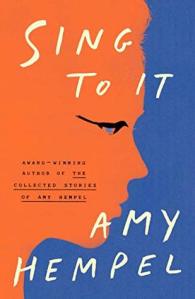 Sing to It: New Stories by Amy Hempel [releases on the 26th]: “When danger approaches, sing to it.” That Arabian proverb provides the title for Amy Hempel’s fifth collection of short fiction, and it’s no bad summary of the purpose of the arts in our time: creativity is for defusing or at least defying the innumerable threats to personal expression. Only roughly half of the flash fiction achieves a successful triumvirate of character, incident and meaning. The author’s passion for working with dogs inspired the best story, “A Full-Service Shelter,” set in Spanish Harlem. A novella, Cloudland, takes up the last three-fifths of the book and is based on the case of the “Butterbox Babies.” (Reviewed for the Pittsburgh Post-Gazette.)
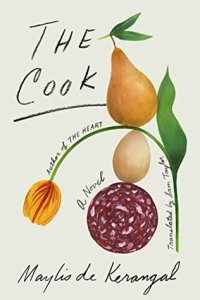 The Cook by Maylis de Kerangal (translated from the French by Sam Taylor) [releases on the 26th]: This is a pleasant enough little book, composed of scenes in the life of a fictional chef named Mauro. Each chapter picks up with the young man at a different point as he travels through Europe, studying and working in various restaurants. If you’ve read The Heart / Mend the Living, you’ll know de Kerangal writes exquisite prose. Here the descriptions of meals are mouthwatering, and the kitchen’s often tense relationships come through powerfully. Overall, though, I didn’t know what all these scenes are meant to add up to. Kitchens of the Great Midwest does a better job of capturing a chef and her milieu.
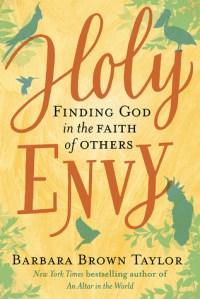 Holy Envy: Finding God in the Faith of Others by Barbara Brown Taylor [releases on the 12th]: After she left the pastorate, Taylor taught Religion 101 at Piedmont College, a small Georgia institution, for 20 years. This book arose from what she learned about other religions – and about Christianity – by engaging with faith in an academic setting and taking her students on field trips to mosques, temples, and so on. She emphasizes that appreciating other religions is not about flattening their uniqueness or looking for some lowest common denominator. Neither is it about picking out what affirms your own tradition and ignoring the rest. It’s about being comfortable with not being right, or even knowing who is right.
What’s on your reading docket for March?
35 Years, 35 Favorite Books
I love book lists: ticking off what I’ve read from newspaper and website selections, comparing my “best-of” choices and prize predictions with other people’s, and making up my own thematic inventories. Earlier in the year I spotted Desert Island-style 100-book lists on Annabookbel and A life in books, as well as Lonesome Reader’s reconsideration of the 100 favorite books he’d chosen half a lifetime ago. For my 35th birthday today, I’ve looked back at my “Absolute Favorites” shelf on Goodreads and picked the 35 titles that stand out the most for me: some are childhood favorites, some are books that changed my thinking, some I have read two or three times (an extreme rarity for me), and some are recent discoveries that have quickly become personal classics. I’ve listed these in rough chronological order of when I first read them, rather than ranking them, which would be nigh on impossible! Perhaps I’ll revisit the list on future significant birthdays and see how things change. Interesting to note that this works out as about two-thirds fiction and one-third nonfiction.
~
- Miss Rumphius by Barbara Cooney
- The Silver Chair by C.S. Lewis
- Watership Down by Richard Adams
- Anne of Green Gables by L.M. Montgomery
- David Copperfield by Charles Dickens
 The Scarlet Letter by Nathaniel Hawthorne
- Far from the Madding Crowd by Thomas Hardy
- Jane Eyre by Charlotte Brontë
- A Portrait of the Artist as a Young Man by James Joyce
- Possession by A.S. Byatt
- Flaubert’s Parrot by Julian Barnes
- Sixpence House by Paul Collins
 A History of God by Karen Armstrong
- Conundrum by Jan Morris
- The Heart of Christianity by Marcus Borg
- The Blind Assassin by Margaret Atwood
- My Family and Other Animals by Gerald Durrell
- On Beauty by Zadie Smith
- Heaven’s Coast by Mark Doty
 Secrets in the Dark by Frederick Buechner
- A Prayer for Owen Meany by John Irving
- American Wife by Curtis Sittenfeld
- Middlesex by Jeffrey Eugenides
- Caribou Island by David Vann
- To Travel Hopefully by Christopher Rush
- We, the Drowned by Carsten Jensen
 The Emperor of All Maladies by Siddhartha Mukherjee
- Leaving Alexandria by Richard Holloway
- An Exact Replica of a Figment of My Imagination by Elizabeth McCracken
- A Tale for the Time Being by Ruth Ozeki
- Want Not by Jonathan Miles
- Journal of a Solitude by May Sarton
- F by Daniel Kehlmann
 Dinner at the Homesick Restaurant by Anne Tyler
- March by Geraldine Brooks
Are any of these among your favorites, too?
December’s Doorstopper: The Heart’s Invisible Furies by John Boyne
The more I examined the architecture of my life, the more I realized how fraudulent were its foundations.
This is a book that wasn’t even on my radar until fairly late on in the year, when I noticed just how many of my Goodreads friends had read it and rated it – almost without fail – 5 stars. I knew John Boyne’s name only through the movie version of his Holocaust-set novel for younger readers, The Boy in the Striped Pajamas, and didn’t think I’d be interested in his work. But the fact that The Heart’s Invisible Furies was written in homage to John Irving (Boyne’s dedicatee) piqued my interest, and I’m so glad I gave it a try. It distills all the best of Irving’s tendencies while eschewing some of his more off-putting ones. Of the Irving novels I’ve read, this is most like The World According to Garp and In One Person, with which it shares, respectively, a strong mother–son relationship and a fairly explicit sexual theme.
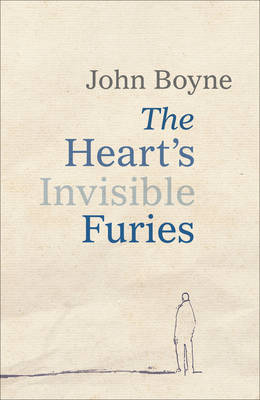 A wonderful seam of humor tempers the awfulness of much of what befalls Cyril Avery, starting with his indifferent adoptive parents, Charles and Maude. Charles is a wealthy banker and incorrigible philanderer occasionally imprisoned for tax evasion, while Maude is a chain-smoking author whose novels, to her great disgust, are earning her a taste of celebrity. Both are cold and preoccupied, always quick to remind Cyril that since he’s adopted he’s “not a real Avery”. The first bright spot in Cyril’s life comes when, at age seven, he meets Julian Woodbead, the son of his father’s lawyer. They become lifelong friends, though Cyril’s feelings are complicated by an unrequited crush. Julian is as ardent a heterosexual as Cyril is a homosexual, and sex drives them apart in unexpected and ironic ways in the years to come.
For Cyril, born in Dublin in 1945, homosexuality seems a terrible curse. It was illegal in Ireland until 1993, so assignations had to be kept top-secret to avoid police persecution and general prejudice. Only when he leaves for Amsterdam and the USA is Cyril able to live the life he wants. The structure of the novel works very well: Boyne checks in on Cyril every seven years, starting with the year of his birth and ending in the year of his death. In every chapter we quickly adjust to a new time period, deftly and subtly marked out by a few details, and catch up on Cyril’s life. Sometimes we don’t see the most climactic moments; instead, we see what happened just before and then Cyril remembers the aftermath for us years later. It’s an effective tour through much of the twentieth century and beyond, punctuated by the AIDS crisis and focusing on the status of homosexuals in Ireland – in 2015 same-sex marriage was legalized, which would have seemed unimaginable a few short decades before.
Boyne also sustains a dramatic irony that kept me reading eagerly: the book opens with the story Cyril’s birth mother told him of her predicament in 1945, and in later chapters Cyril keeps running into this wonderfully indomitable woman in Dublin – but neither of them realizes how intimately they’re connected. Thanks to the first chapter we know they eventually meet and all will be revealed, but exactly when and how is a delicious mystery.
Along with Irving, Dickens must have been a major influence on Boyne. I spotted traces of David Copperfield and Great Expectations in minor characters’ quirks as well as in Cyril’s orphan status, excessive admiration of a romantic interest, and frequent maddening failures to do the right thing. But there are several other recent novels – all doorstoppers – that are remarkably similar in their central themes and questions. In Donna Tartt’s The Goldfinch, Hanya Yanagihara’s A Little Life and Nathan Hill’s The Nix we also have absent or estranged mothers; friends, lovers and adoptive family who help cut through a life of sadness and pain; and the struggle against a fate that seems to force one to live a lie. Given a span of 500 pages or more, it’s easy to become thoroughly engrossed in the life of a flawed character.
The Heart’s Invisible Furies – a phrase Hannah Arendt used to describe the way W.H. Auden wore his experiences on his face – is an alternately heartbreaking and heartening portrait of a life lived in defiance of intolerance and tragedy. A very Irish sense of humor runs all through the dialogue and especially Maude’s stubborn objection to fame. I loved Boyne’s little in-jokes about the writer’s life (“It’s a hideous profession. Entered into by narcissists who think their pathetic little imaginations will be of interest to people they’ve never met”) and thanks to my recent travels I was able to picture a lot of the Dublin and Amsterdam settings. Although it’s been well reviewed on both sides of the Atlantic, I’m baffled that this novel doesn’t have the high profile it deserves. I am especially grateful to Sarah of Sarah’s Book Shelves for naming this her book of the year: knowing her discriminating tastes, I could tell I’d be in for something special. Look out for it on my Best Fiction of 2017 list tomorrow.
My rating:
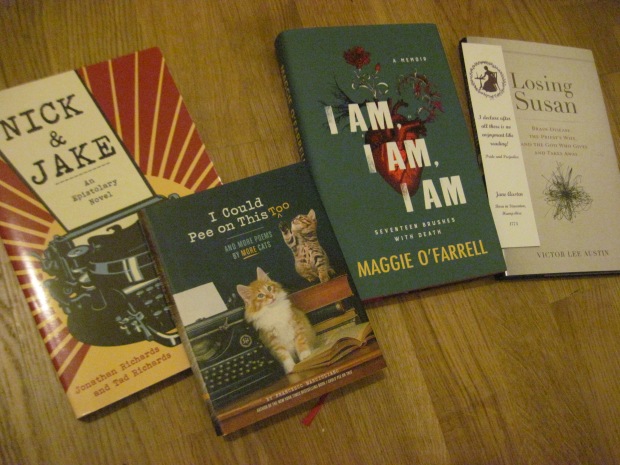
I got just four books for Christmas this year, but they’re all ones I’m very excited to read. I looked back at last year’s Christmas book haul photo and am impressed that I’ve actually read seven out of eight of them now – and the eighth is a cocktail cookbook one wouldn’t read all the way through anyway. All too often I let books sit around for years unread, but I will try to keep up this trend of reading books fairly soon after they enter my collection.
Two Recommended Nonfiction Reads for October
Two very different but equally enjoyable selections for you this month:
American Wolf: A True Story of Survival and Obsession in the West by Nate Blakeslee
(Coming from Crown on the 17th)
 By the 1920s, wolves had almost been eradicated from the Lower 48 states. In 1995–6, though, two rival packs were brought in from Canada to repopulate Yellowstone National Park. Blakeslee gives a panoramic overview of the reintroduction project and the recurring clashes between hunters and biologists about whether wolves should be a protected species. He keeps his account relatable by focusing on particular family groups of wolves and bringing out the animals’ individual personalities.
One important wolf pack was the Druids, which “were like the Kennedys, American royalty.” O-Six, an alpha female of the third generation so named because she was born in 2006, is one of the main animal characters here, with two central human characters being Rick McIntyre, a long-time National Park Service ranger and wolf expert, and Steven Turnbull (an alias), an elk hunter from Crandall, Wyoming.
The 2011 federal budget snuck in a rider removing wolves from the endangered species list in Montana and Idaho. The same followed for Wyoming, heralding an open hunting season on wolves for the first time in 50 years. Though his sympathies are clear, Blakeslee doesn’t demonize those who killed Yellowstone wolves that strayed beyond the park boundaries. He also emphasizes that the battle over this species reflects a wider struggle “over public land—what it should be used for and who should have the right to decide.”
It’s especially interesting to read about the animals’ behavior: a wolf uncle hanging around to help raise the pups, O-Six fighting off grizzlies near her den, showdowns between packs, and pups hunting mice and ravens for fun.
My rating:
With thanks to the publisher for the free review copy.
Love and Laughter in the Time of Chemotherapy by Manjusha Pawagi
(Coming from Second Story Press on the 10th)
 It’s a rare book that can wring both laughs and (mostly happy) tears out of a cancer ordeal. I read a lot of books about illness, death and dying – subjects I can appreciate aren’t for anyone. Nevertheless, I can heartily recommend this to you for the Everywoman perspective on the cancer experience and rebuilding life on the other side. Pawagi is a family court judge and mother of twin teenagers in Toronto. She was diagnosed with leukemia in April 2014, went through two intensive rounds of chemotherapy, and then had a stem cell transplant from a donor from the South Asian immigrant community six months later.
This is a warts-and-all account of the treatment process – if it hurt like hell, if she wept into her pillow at night, if she felt like crap, she says so. Though not entirely without self-pity, the book transforms such feelings through a wry, atheist’s “why not me?” approach. In the lovely last chapter, the author meets her donor, a young man in New York City, and his relatives two years after her transplant and realizes that she’s unwittingly acquired not just a blood brother but a whole new extended family.
They may be clichés but they’re completely true in this case: this is a heart-warming and life-affirming read, and with any luck will encourage more people to become blood and organ donors. (See also this interview with Pawagi from Foreword Reviews.)
Some favorite lines:
“I want to wake up and be a judge again, not an overgrown diapered baby.”
“Hell is other people…in the hospital bed next to yours.”
My rating:
I read an e-ARC via NetGalley.
I also won an advanced Goodreads giveaway copy of a novel that came out in the States in June and will be released in the UK by Borough Press on the 5th, but I’m not sure it’s one I’d wholeheartedly recommend…
Stephen Florida by Gabe Habash
 You might think of Stephen Florida as an heir to Alexander Portnoy and Holden Caulfield (“I guess I should describe myself. No, I don’t want to do that”). A senior at North Dakota’s Oregsburg College, he’s obsessed with becoming a champion wrestler for the 133 weight class. He’s a loner, and his every attempt at connection with others falters. Stephen acts and speaks like a crazed preacher, and the more he goes off the rails the harder it is to figure out exactly what’s going on and how much you can trust this narrator. This struck me as a very male story that doesn’t have the same crossover appeal as works by John Irving or Chad Harbach. I would have enjoyed a short story or novella about this character and his self-destructive single-mindedness, but spending a whole novel with him creeped me out.
My rating:

Two in-your-face carnivores were on my reading stack at the same time. What are the odds?!
Other October releases I’m planning to read:
- In Shock by Rana Awdish (St. Martin’s, 17th)
- A Glorious Freedom: Older Women Leading Extraordinary Lives by Lisa Congdon (Chronicle Books, 3rd)
- Eco-Dementia [poetry] by Janet Kauffman (Wayne State University Press, 2nd)
- Hug Everyone You Know: A Year of Community, Courage, and Cancer by Antoinette Truglio Martin (She Writes Press, 3rd)
 Bookish Beck = Rebecca Foster. American transplant to England. Freelance proofreader and book reviewer.
 Bookish Beck