#MoominWeek & #WITMonth, II: Moominpappa at Sea by Tove Jansson
My first two reads for Women in Translation month were Catalan and French novellas. With this third one I’m tying in with Moomin Week, hosted by Chris and Mallika in honour of Paula of Book Jotter. Happy nuptials to Paula! Not a blogger I’ve interacted with before, but I welcomed the excuse to finish a book I started a few months ago. I’ve actually reviewed five Moomin books here before: Moominvalley in November, Moominland Midwinter, Tales from Moominvalley, Moominsummer Madness, and Finn Family Moomintroll. (It’s also the third year in a row that I’ve reviewed something by Jansson for WIT Month.)

Appropriate reading at sea (on a ferry to France)
I didn’t grow up with the Moomins, but as an adult I’ve come to love the series for how it lovingly depicts everyday disasters and neuroses and, beneath the whimsical adventures, offers an extra level of thoughtfulness for adult readers. The setting of this one was particularly appropriate. Here’s the opening paragraph:
One afternoon at the end of August, Moominpappa was walking about in his garden feeling at a loss. He had no idea what to do with himself, because it seemed everything there was to be done had already been done or was being done by somebody else.
 The sense of being ‘all at sea’ persists for Pappa and the other characters even after they sail to ‘his’ island in the Gulf of Finland, drawn to see in person the lighthouse he has kept as a model on the shelf. They arrive to find the island mysteriously empty and the facilities derelict. Moomintroll goes exploring alone and meets intriguing “sea-horses” that look more equine than marine. Nature is alive and resistant to ‘improvements’ such as Moominmamma trying to tame the wildness with her rose bushes and apple trees. The forest also seems to be retreating from the sea; everything fears it, in fact. The sullen fisherman is no help, and the hulking Groke seems to be a metaphor for depression as well as a literal monster.
There is a sense of everything being awry, and by the close that’s only partially rectified. Pappa ends with conflicting feelings towards the island: proprietary yet timorous. I imagine this is based on Jansson’s own experiences living on a Finnish island (see also The Summer Book). This wasn’t among my favourite Moomin books, but I always appreciate the juxtaposition of the domestic and wild, the cosy and the melancholy. Just two more for me to find now (I’ve read them all in random order): The Moomins and the Great Flood and Moominpappa’s Memoirs.
[Translated from the Swedish by Kingsley Hart] (University library) 


20 Books of Summer, 14–16: Polly Atkin, Nan Shepherd and Susan Allen Toth
I’m still plugging away at the challenge. It’ll be down to the wire, but I should finish and review all 20 books by the 31st! Today I have a chronic illness memoir, a collection of poetry and prose pieces, and a reread of a cosy travel guide.
Some of Us Just Fall: On Nature and Not Getting Better by Polly Atkin (2023)
I was heartened to see this longlisted for the Wainwright Prize. It was a perfect opportunity to recognize the disabled/chronically ill experience of nature and the book achieves just what the award has recognised in recent years: the braiding together of life writing and place-based observation. (Wainwright has also done a great job on diversity this year: there are three books by BIPOC and five by women on the nature writing shortlist alone.)
 Polly Atkin knew something was different about her body from a young age. She broke bones all the time, her first at 18 months when her older brother ran into her on his bicycle. But it wasn’t until her thirties that she knew what was wrong – Ehlers-Danlos syndrome and haemochromatosis – and developed strategies to mitigate the daily pain and the drains on her energy and mobility. “Correct diagnosis makes lives bearable,” she writes. “It gives you access to the right treatment. It gives you agency.”
The book assembles long-ish fragments, snippets from different points of her past alternating with what she sees on rambles near her home in Grasmere. She writes in some depth about Lake District literature: Thomas De Quincey as well as the Wordsworths – Atkin’s previous book is a biography of Dorothy Wordsworth that spotlights her experience with illness. In describing the desperately polluted state of Windermere, Atkin draws parallels with her condition (“Now I recognise my body as a precarious ecosystem”). Although she spurns the notion of the “Nature Cure,” swimming is a valuable therapy for her.
Theme justifies form here: “This is the chronic life, lived as repetition and variance, as sedimentation of broken moments, not as a linear progression.” For me, there was a bit too much particularity; if you don’t connect to the points of reference, there’s no way in and the danger arises of it all feeling indulgent. Besides, by the time I opened this I’d already read two Ehlers-Danlos memoirs (All My Wild Mothers by Victoria Bennett and Floppy by Alyssa Graybeal) and another reference soon came my way in The Invisible Kingdom by Meghan O’Rourke. So overfamiliarity was a problem. And by the time I forced myself to pick this off of my set-aside shelf and finish it, I’d read Nina Lohman’s stellar The Body Alone. For those newer to reading about chronic illness, though, especially if you also have an interest in the Lakes, it could be an eye-opener.
With thanks to Sceptre (Hodder) for the free copy for review.
Selected Prose & Poetry by Nan Shepherd (2023)
 I’d read and enjoyed Shepherd’s The Living Mountain, which has surged in popularity as an early modern nature writing classic thanks to Robert Macfarlane et al. I’m not sure I’d go as far as the executor of the Nan Shepherd Estate, though, who describes her in the Preface as “Taylor Swift in hiking boots.” The pieces reprinted here are from her one published book of poems, In the Cairngorms, and the mixed-genre collection Wild Geese. There is also a 28-page “novella,” Descent from the Cross. After World War I, Elizabeth, a workers’ rights organiser for a paper mill, marries a shell-shocked veteran who wants to write a book but isn’t sure he has either the genius or the dedication. It’s interesting that Shepherd would write about a situation where the wife has the economic upper hand, but the tragedy of the sickly failed author put me in mind of George Gissing or D.H. Lawrence, so didn’t feel fresh. Going by length alone, I would have called this a short story, but I understand why it would be designated a novella, for the scope.
None of the miniature essays – field observations and character studies – stood out to me. About half of the book is given over to poetry. As with the nature writing, there is a feeling of mountain desolation. There are a lot of religious references and hints of the mystical, as in “The Bush,” which opens “In that pure ecstasy of light / The bush is burning bright. / Its substance is consumed away / And only form doth stay”. It’s a mixed bag: some feels very old-fashioned and sentimental, with every other line or, worse, every line rhyming, and some archaic wording and rather impenetrable Scots dialect. It could have been written 100 years before, by Robert Burns if not William Blake. But every so often there is a flash of brilliance. “Blackbird in Snow” is quite a nice one, and reminiscent of Thomas Hardy’s “The Darkling Thrush.” I even found the cryptic lines from “Real Presence” that inspired a song on David Gray’s Skellig. My favourite poem by far was:
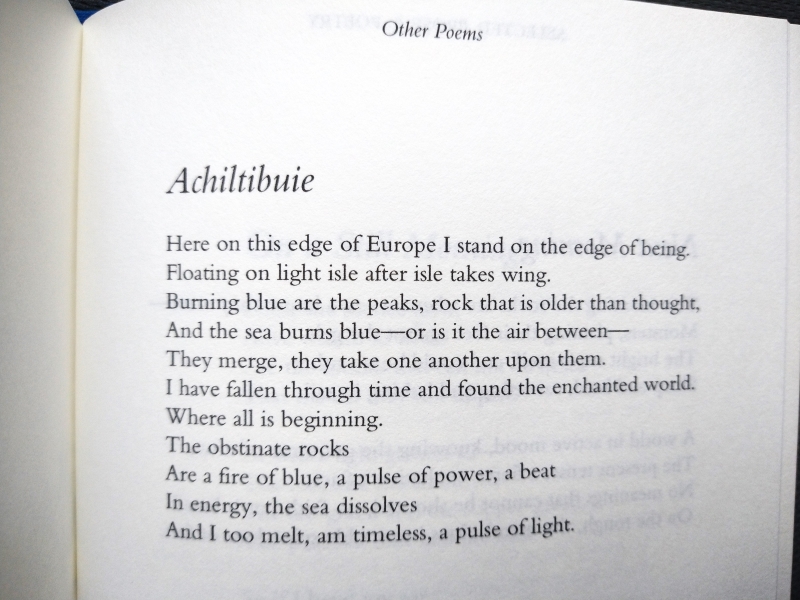
Overall, this didn’t engage me; it’s only for Shepherd fanatics and completists. (Won from Galileo Publishers in a Twitter giveaway)
England As You Like It: An Independent Traveler’s Companion by Susan Allen Toth (1995)
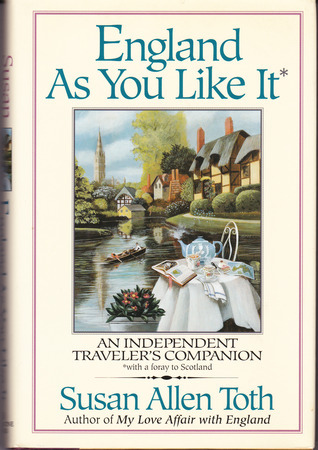 A reread. As I was getting ready to go overseas for the first time in the summer of 2003, Toth’s trilogy of memoirs whetted my appetite for travel in Britain. (They’re on my Landmark Books in My Life, Part II list.) This is the middle book and probably the least interesting in that it mostly recounts stays in particular favourite locations, such as Dorset, the Highlands, and various sites in Cornwall. However, I’ve never forgotten her “thumbprint theory,” which means staying a week or more in an area no larger than her thumb covers on a large-scale map, driving an hour or less for day trips. Not for her those cram-it-all-in trips where you race through multiple countries in a week (I have American friends who did Paris, London and Rome within six days, or five countries in eight days; blame it on stingy vacation policies, I guess). Instead, she wants to really bed into one place and have the time to make serendipitous discoveries such as an obscure museum or a rare opening of a private garden.
I most liked the early general chapters about how to make air travel bearable, her obsession with maps, her preference for self-catering, and her tendency to take home edible souvenirs. Of course, all the “Floating Facts” are hopelessly out-of-date. This being the early to mid-1990s, she had to order paper catalogues to browse cottage options (I still did this for honeymoon prep in 2006–7) and make international phone calls to book accommodation. She recommends renting somewhere from the National Trust or Landmark Trust. Ordnance Survey maps could be special ordered from the British Travel Bookshop in New York City. Entry fees averaged a few pounds. It’s all so quaint! An Anglo-American time capsule of sorts. I’ve always sensed a kindred spirit in Toth, and those whose taste runs toward the old-fashioned will probably also find her a charming tour guide. I’ve also reviewed the third book, England for All Seasons. (Free from The Book Thing of Baltimore)
Summery Reading, Part I: Heatwave, Summer Fridays
Here we are between short, bearable heat waves. As the climate changes, I’m more grateful than ever to live somewhere with reasonably mild and predictable weather; I don’t miss the swampy humidity of the Maryland summers I grew up with one bit. Today I have some brief thoughts on a first pair of summer-themed reads I picked up last month: a queasy coming-of-age novella about French teenagers’ self-destructive actions on a camping holiday; and a fun, nostalgic romance novel set in New York City at the turn of the millennium.
Heatwave by Victor Jestin (2019; 2021)
[Translated from the French by Sam Taylor]
 Victor Jestin was in his early twenties when he wrote this debut novella, which won the Prix Femina des Lycéens and was longlisted for the CWA Crime Fiction in Translation Dagger. It opens, memorably, with Leonard’s confession: “Oscar is dead because I watched him die and did nothing. He was strangled by the ropes of a swing … Oscar was not a child. At seventeen, you don’t die like that by accident.” A suicide, then: fitting given the other dangerous behaviours – drinking and promiscuity – rife among the gang of teenagers at this campsite in the South of France. What turns it into a crime is that Leonard, addled by alcohol and the heat, doesn’t report the death but buries Oscar in the sand and pretends nothing happened.
The rest of the book takes place over about 24 hours, the final day of a two-week vacation. Leo stumbles about as if in a trance, outwardly relating to his family, a male friend who seems to have a crush on him, and girls he’d like to sleep with, but all the while inwardly wondering what to do next. “I hadn’t made many stupid mistakes in my seventeen years of life. This one was difficult to understand. It all happened too fast; I felt powerless.” This is interesting enough if you like unreliable teenage narrators or are drawn by the critics’ comparisons to Françoise Sagan – accurate for the sense of sleepwalking toward disaster. One could easily breeze through the 104 pages during one hot afternoon. It didn’t stand out to me particularly, though. (Little Free Library)
Summer Fridays by Suzanne Rindell (2024)
 I was a big fan of Rindell’s first two stylish historical novels, The Other Typist and Three-Martini Lunch. She seemed to go off the boil with the next two, which I skipped, and now she’s back with an unexpected foray into romance, a genre I almost never read. The cover’s whimsical (nonexistent) birds and Ryan Gosling-like male figure make the novel seem frothier than it actually is, though we’re definitely in classic romcom territory here. The comparisons to You’ve Got Mail are apt in that the main character, Sawyer, strikes up a flirtation over e-mail and instant messaging. She’s a New York City publishing assistant whose ambitions threaten her day job when she has several poems accepted by The Paris Review. Nick, her correspondent, teases and cheers her on in equal measure. The complicated thing is that Sawyer is engaged to Charles, her college sweetheart, and Nick is dating Kendra. Nick and Sawyer initially became digital pen pals because they suspected that their partners, who work together at a law firm, were having an affair; they never expected sparks to fly.
It’s overlong and reasonably predictable, but I enjoyed the languid unfolding of the romance over the weeks of summer 1999. It was truly a simpler time when you had to dial up and wait for an inbox to load instead of having it in your pocket 24/7. Every Friday afternoon, Sawyer and Nick do touristy things like taste-test hotdogs and slushees, ride the Staten Island ferry back and forth all day, and visit little-known bars and restaurants Nick knows through his amateur rock band. They try to convince themselves that these are not dates. It’s like time outside of time for them, and a chance to sightsee in one’s own town. Eventually, though, Sawyer has to face reality. The 2001 framing story reflects the fact that, after the events of 9/11, many asked themselves what they really wanted out of life. This was cute but doesn’t quite live up to, e.g., Romantic Comedy. (Read via Edelweiss) 
Any “heat” or “summer” books for you this year?
Buddy Reads: Kilmeny of the Orchard by L.M. Montgomery & The Waterfall by Margaret Drabble
Buddy reading and other coordinated challenges are a good excuse to read the sort of books one doesn’t always get to, especially the more obscure classics. This was my third Lucy Maud Montgomery novel within a year and a bit, and my first contribution to Ali’s ongoing year with Margaret Drabble.
{SPOILERS IN BOTH OF THE FOLLOWING REVIEWS}
Kilmeny of the Orchard by L. M. Montgomery (1910)
I’ve participated in Canadian bloggers Naomi of Consumed by Ink and Sarah Emsley’s readalongs of three Montgomery works now. The previous two were Jane of Lantern Hill and The Story Girl. This sweet but rather outdated novella reminded me more of the latter (no surprise as it was published just a year before it) because of the overall sense of lightness and the male perspective, which isn’t what those familiar with the Anne and Emily books might expect from Montgomery.
 Eric Marshall travels to Prince Edward Island one May to be the temporary schoolmaster in Lindsay, filling in for an ill friend. At his graduation from Queenslea College, his cousin David Baker had teased him about his apparent disinterest in girls. He arrives on the island to an early summer idyll and soon wanders into an orchard where a beautiful young woman is playing a violin.
This is, of course, Kilmeny Gordon, her first name from a Scottish ballad by James Hogg, and it’s clear she will be the love interest. However, there are a couple of impediments to the romance. One is resistance from Kilmeny’s guardians, the strict aunt and uncle who have cared for her since her wronged mother’s death. But the greater obstacle is Kilmeny’s background – illegitimacy plus a disability that everyone bar Eric views as insuperable: she is mute (or, as the book has it, “dumb”). She hears and understands perfectly well, but communicates via writing on a slate.
There is interesting speculation as to whether her condition is psychological or magically inherited from her late mother, who had taken a vow of silence. Conveniently, cousin David is a doctor specializing in throat and voice problems, so assures Eric and the Gordons that nothing is physically preventing Kilmeny from speech. But she refuses to marry Eric until she can speak. The scene in which she fears for his life and calls out to save him is laughably contrived. The language around disability is outmoded. It’s also uncomfortable that the story’s villain, an adopted Gordon cousin, is characterized only by his Italian heritage.
Like The Story Girl, I found this fairly twee, with an unfortunate focus on beauty (“‘Kilmeny’s mouth is like a love-song made incarnate in sweet flesh,’ said Eric enthusiastically”), and marriage as the goal of life. But it was still a pleasant read, especially for the descriptions of a Canadian spring. (Downloaded from Project Gutenberg) #ReadingKilmeny
The Waterfall by Margaret Drabble (1969)
 This was Drabble’s fourth novel; I’ve read the previous three and preferred two of them to this (A Summer Bird-Cage is fab). The setup is similar to The Garrick Year, which I read last year for book club, in that the focus is on a young mother of two who embarks on an affair. When we meet Jane Gray she is awaiting the birth of her second child. Her husband, Malcolm, walked out a few weeks ago, but she has the midwife and her cousin Lucy to rely on. Lucy and her husband, James, trade off staying over with Jane as she recovers from childbirth. James is particularly solicitous and, one night, joins Jane in bed.
At this point there is a stark shift from third person to first person as Jane confesses that she’s been glossing over the complexities of the situation; sleeping with one’s cousin’s husband is never going to be without emotional fallout. “It won’t, of course, do: as an account, I mean, of what took place”; “Lies, lies, it’s all lies. A pack of lies.” The novel continues to alternate between first and third person as Jane gives us glimpses into her uneasy family-making. I found myself bored through much of it, only perking back up for the meta stuff and the one climactic event. In a way it’s a classic tale of free will versus fate, including the choice of how to frame what happens.
I am no longer capable of inaction – then I will invent a morality that condones me.
It wasn’t so, it wasn’t so. I am getting tired of all this Freudian family nexus, I want to get back to that schizoid third-person dialogue.
The narrative tale. The narrative explanation. That was it, or some of it. I loved James because he was what I had never had: because he drove too fast: because he belonged to my cousin: because he was kind to his own child
(What intriguing punctuation there!) The fast driving and obsession with cars is unsubtle foreshadowing: James nearly dies in a car accident on the way to the ferry to Norway. Jane and her children, Laurie and baby Bianca, are in the car but unhurt. This was the days when seatbelts weren’t required, apparently. “It would have been so much simpler if he had been dead: so natural a conclusion, so poetic in its justice.” The Garrick Year, too, has a near-tragedy involving a car. Like many an adultery story, both novels ask whether an affair changes everything, or nothing. Infidelity and the parenting of young children together don’t amount to the most scintillating material, but it is appealing to see Drabble experimenting with how to tell a story. See also Ali’s review. (Secondhand – Alnwick charity shopping)
Rereading Of Mice and Men for #1937Club
A year club hosted by Karen and Simon is always a great excuse to read more classics. Between my shelves and the library, I had six options for 1937. But I started reading too late, and had too many books on the go, to finish more than one – a reread. No matter; it was a good one I was glad to revisit, and I’ll continue with the other reread at my own pace.
Of Mice and Men by John Steinbeck
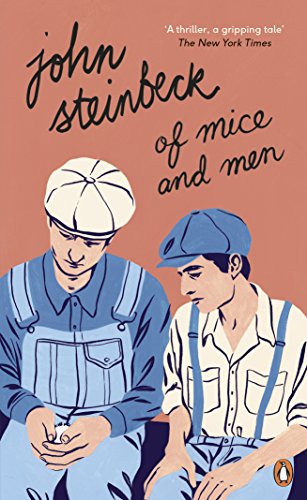 Are teenagers doomed to dislike the books they read in school? I think this must have been on the curriculum for 11th grade English. It was my third Steinbeck novella after The Red Pony and The Pearl, so to me it confirmed that he wrote contrived, depressing stuff with lots of human and animal suffering. Not until I read The Grapes of Wrath in college and East of Eden (THE Great American Novel) five years ago did I truly recognize Steinbeck’s greatness.
George and Lennie are itinerant farm workers in Salinas Valley, California. Lennie is a gentle giant, intellectually disabled and aware of his own strength when hauling sacks of barley but not when stroking mice and puppies. George looks after Lennie as a favour to Aunt Clara and they’re saving up to buy their own smallholding. This dream is repeated to the point of legend, somewhere between a bedtime story and scripture:
‘Someday—we’re gonna get the jack together and we’re gonna have a little house and a couple of acres an’ a cow and some pigs and—’ ‘An’ live off the fatta the lan’,’ Lennie shouted. ‘And have rabbits.’
They quickly settle in alongside the other ranch-hands and even convert two to their idyllic picture of independence. But the foreman, Curley, is a hothead and his bored would-be-starlet wife won’t stop roaming into the men’s quarters. No matter how much George tells Lennie to stay away from both of them, something is set in motion – an inevitable repeat of an incident from their previous employment that forced them to move on.
I remembered the main contours here but not the ultimate ending, and this time I appreciated the deliberate echoes and heavy foreshadowing (all that symbolism to write formulaic school essays about!): this is Shakespearean tragedy with the signs and stakes writ large against a limited background. Bar some paragraphs of scene-setting descriptions, it is like a play; no surprise it’s been filmed several times. (I wish I didn’t have danged John Malkovich in my head as Lennie; I can’t think of anyone else in that role, whereas Gary Sinise doesn’t necessarily epitomize George for me.) The characterization of the one Black character, Crooks, and the one woman are uncomfortably of their time. However, Crooks is given the dubious honour of conveying the bleak vision: “Nobody never gets to heaven, and nobody gets no land. It’s just in their head.” Like Hardy, Steinbeck knows what happens when the lower classes make the mistake of wanting too much. It’s a timeless tale of grit and desperation, the kind one can’t imagine not existing. (Public library)
Apposite listening: “The Great Defector” by Bell X1 (known for their quirky lyrics):
You’ve been teasing us farm boys
’til we start talking ’bout those rabbits, George
oh, won’t you tell us ’bout those rabbits, George?
Original rating (1999?):
My rating now: 


Currently rereading: The Hobbit by J.R.R. Tolkien – My father gave me this for Christmas when I was 10. I think I finally read it sometime in my later teens, about when the Lord of the Rings films were coming out. I’m on page 70 now. I’d forgotten just how funny Tolkien is about the set-in-his-ways Bilbo and his devotion to a cosy, quiet life. When he’s roped into a quest to reclaim a mountain hoard of treasure from a dragon – along with 13 dwarves and Gandalf the wizard – he realizes he has much discomfort and many a missed meal ahead of him.


 DNFed: Journey by Moonlight by Antal Szerb – My second attempt with Hungarian literature, and I found it curiously similar to the other novel I’d read (Embers by Sandor Márai) in that much of it, at least the 50 pages I read, is a long story told by one character to another. In this case, Mihály, on his Italian honeymoon, tells his wife about his childhood best friends, a brother and sister. I wondered if I was meant to sense homoerotic attachment between Mihály and Tamás, which would appear to doom this marriage right at its outset. (Secondhand – Edinburgh charity shop, 2018)
 Skimmed: Out of Africa by Karen Blixen – I enjoyed the prose style but could tell I’d need a long time to wade through the detail of her life on a coffee farm in Kenya, and would probably have to turn a blind eye to the expected racism of the anthropological observation of the natives. (Secondhand – Way’s in Henley, 2015)
Here’s hoping for a better showing next time!
(I’ve previously participated in the 1920 Club, 1956 Club, 1936 Club, 1976 Club, 1954 Club, 1929 Club, and 1940 Club.)
March Releases by Akbar, Bosker, García Márquez, and Wrenn
I’m catching up after a busy end to last month. Today I have an uneven debut novel from a poet whose work I’ve enjoyed before, a journalist’s jaunty submersion in the world of modern art, a posthumous novella from a famous Colombian author I’d not previously read, and a (literally) trippy memoir about C-PTSD, coral, climate breakdown, queerness and more. I can pinpoint a couple of elements that some or all of them have in common: beauty (whether in art or in nature) and dead mothers.
Martyr! by Kaveh Akbar
I’d read the Iranian American poet’s two full-length collections and particularly admired Pilgrim Bell, one of my favourite books of 2021. That was enough for me to put this on my Most Anticipated list for 2024, even though based on the synopsis I wrote: “His debut novel sounds kind of unhinged, but I figure it’s worth a try.” Here’s an excerpt from the publisher’s blurb: “When Cyrus’s obsession with the lives of the martyrs – Bobby Sands, Joan of Arc – leads him to a chance encounter with a dying artist, he finds himself drawn towards the mysteries of an uncle who rode through Iranian battlefields dressed as the Angel of Death; and toward his [late] mother, who may not have been who or what she seemed.”
 Cyrus Shams is an Iranian American aspiring poet who grew up in Indiana with a single father, his mother Roya having died in a passenger aircraft mistakenly shot down by a U.S. Navy missile cruiser (this really happened: Iran Air Flight 655, on 3 July 1988). He continues to lurk around the Keady University campus, working as a medical actor at the hospital, but his ambition is to write. During his shaky recovery from drug and alcohol abuse, he undertakes a project that seems divinely inspired: “Tired of interventionist pyrotechnics like burning bushes and locust plagues, maybe God now worked through the tired eyes of drunk Iranians in the American Midwest”. By seeking the meaning in others’ deaths, he hopes his modern “Book of Martyrs” will teach him how to cherish his own life.
This document, which we see in fragments, sets up hypothetical dialogues between figures real and imaginary, dead and living, and intersperses them with poems and short musings. But when a friend tells Cyrus about the Brooklyn Museum installation “DEATH-SPEAK,” which has terminally ill Iranian artist Orkideh living out her last days in public, he spies an opportunity to move the work beyond theory and into the physical realm. So he flies to New York City with his best friend (and occasional f**kbuddy), bartender Zee Novak, and visits Orkideh every day until the installation’s/artist’s end.
This is a wildly original but unruly novel with a few problems. One: Akbar has clung too obviously to his own story and manner of speaking with Cyrus (e.g., “I honestly actually do worry about that, no joke. Being a young Iranian man making a book about martyrdom, going around talking to people about becoming a martyr. It’s not inert, you know?”). Another is that the poems, and poetic descriptions, are much the best material. The only exception might be a zany scene where Zee and Cyrus chop wood while high. But the main issue I had is that the plot turns on a twist 50 pages from the end, a huge coincidence that feels unearned. I admire the ambition Akbar had for this – a seething, open-hearted enquiry into addiction, love, suicide and queerness – but look forward to him getting back to poetry.
With thanks to Picador for the proof copy for review.
Get the Picture: A Mind-Bending Journey among the Inspired Artists and Obsessive Art Fiends Who Taught Me How to See by Bianca Bosker
I was a big fan of Bosker’s Cork Dork (2017), her deep dive into the world of fine wine. Her second book is similarly constructed and equally fun: more personal than authoritative, light yet substantial, and accessible to the uninitiated as well as those with an existing interest in the subject. She begins as a complete novice, wondering if she’ll ever know what art is, let alone what it means and whether it’s any good (“the familiar feeling that everyone got the punch line except me”). By the end, she has discovered that, like the love of wine, art appreciation can be a way of expanding and savouring one’s life.
The aim was to get the broadest experience possible, generally through voluntary placements. She started out as an assistant at Jack Barrett’s 315 Gallery, where one of her tasks was to paint a wall white; she failed miserably to meet his expectations even for this simple task. He never lost his fundamental distrust of her, a writer and outsider, as one of “the enemy.” It was expected that she would attend as many art shows and openings as possible per week. “Talking shit was essentially a job requirement.” Bosker might not have known what to make of the art, but others were gossipy, snobbish and opinionated enough to make up for it. When she was tasked with writing a press release for an exhibit, a gallerist taught her the clichéd shorthand: “Every f**king artist allegedly transforms the familiar into the unfamiliar, or vice versa.”

In the course of the book, the New York City-based author also:
- attends the Art Basel Miami Beach contemporary art fair and sells photographs on behalf of Denny Dimin Gallery;
- befriends performance artist and “ass influencer” Mandy AllFIRE, who – ahem – sits on Bosker’s face as part of a temporary installment;
- serves as a studio assistant for French painter Julie Curtiss, whose work is selling for alarmingly high amounts at auction (not actually what a painter wants, as it tends to signal bad things for a career);
- meets a pair of North Dakota collectors known as “the Icy Gays”; and
- works as a Guggenheim Museum guard.
This last was my favourite episode. Forty-minute placements on particular ramps gave her time to focus on one chosen artwork – for instance, an abstract sculpture. She challenged herself to stay with it for that whole time, doing as one artist advised and simply noticing five things about the work. Before, her “default approach to art had just been to plant myself in front of a piece and wait for the epiphany to wash over me.” Now, she worked at it. In fact, she counsels newcomers to not read a caption because many people take a title at face value and an interpretation as gospel, and so don’t experience the art for themselves.
At times I found the book slightly scattered in the way that it zigzags from one challenge to another. There’s differing attention to various experiences; a week-long art school merits just one paragraph. And there’s no getting past the fact that some art she encounters sounds outlandish or just plain silly. (Is it any surprise that she mistakes part of a wall, and a mousetrap, for art pieces?) Ultimately, I think it’s best if you have at least a modicum of appreciation for modern art, which I don’t; whereas I do enjoy drinking wine even if I don’t have a trained palate.
Even so, Bosker’s writing has such verve (“artists were coyly evasive about their work and treated my questions like I was a cactus running after their balloon”; “a hazy daydream of an idea solidified into a yappy, un-shut-uppable chihuahua of want”) that you’ll be glad you went along for the ride. She concludes that taste is subjective, but “Beauty … pulls you close.” Art is valuable because it “knocks us off our well-worn pathways” into something uncharted, a tantalizing prospect.
With thanks to Allen & Unwin (Grove Press) for the free copy for review.
{SPOILERS IN THIS NEXT ONE}
Until August by Gabriel García Márquez
[Translated from the Spanish by Anne McLean]
A posthumous ‘lost’ novella was not a good place for me to have started with this celebrated author. García Márquez okayed the fifth draft of the text in 2004, 10 years before his death. By this time he was already suffering with memory loss that interfered with his creativity. His sons got the message that he didn’t think the book worked and should be destroyed. But they didn’t do his bidding and, revisiting the book nearly a decade on from his death, decided it wasn’t that bad, if not up to the standard of his best work, and that it should see the light of day after all.
Every August 16th, Ana Magdalena Bach travels to the island where her mother is buried to visit the grave and lay gladioli on it. (My review book came with a bag of three gladioli bulbs and a mini Colombian chocolate bar.) Each year she takes a different lover for the one night at a hotel. The first time, the man leaves her a $20 bill and she feels ashamed, but it doesn’t stop her doing the same thing again for the next four years in a row. Once it’s a long-ago school friend whom she runs into on the ferry. Another time, by golly, it’s a bishop.

It’s refreshing to have a woman in middle age as protagonist and for her to claim sexual freedom. However, the setup is formulaic and repetitive, the sex scenes are somewhat excruciating, and the hypocrisy of her gleefully having one-night stands while fretting over her husband’s potential infidelity is grating. I did like the ending – Ana hears that an anonymous elderly gentleman has been paying to have gladioli laid on her mother’s grave year-round and she wonders if she is in a sense following in her mother’s footsteps all along without knowing it; and decides she’s had enough and exhumes her mother’s remains, returning to her husband with a bag of bones (gruesome!).
But nothing about the plot or the writing – fluid enough bar one awkward sentence (“She listened to him worried that he meant it, but she had the strength not to appear as easy a woman as he might think”) – suggested to me a master at work. At best, this might be reminiscent of the late work of misogynist-leaning authors like Coetzee or Updike.
In my mind García Márquez is linked with magic realism, so I’d be better off trying one of his more representative works. I have several of his earlier novellas on the shelf (received as review copies as part of the same recent marketing push), and if I get on better with those then I’ll be sure to try one of the most famous full-length novels. 
With thanks to Viking (Penguin) for the free copy for review.
Mothership: A Memoir of Wonder and Crisis by Greg Wrenn
Wrenn is an associate English professor teaching environmental literature at James Madison University. He has also been exploring coral reefs for 25 years, with a love of marine wildlife sparked by growing up in Florida. But all along, he’s been trying (much like Cyrus Shams) to come to terms with addiction, queerness, suicidal inclinations, and especially his mother’s place in his life. She made him feel dirty, that he would never be good enough; she hit him with a wooden spoon and bathed him until he was 17. Though he never found out for sure, he suspects his mother was sexually abused by her father and repeated the cycle of molestation.
 This is the third C-PTSD memoir I’ve read (after What My Bones Know and A Flat Place), and has a lot in common with I’m Glad My Mom Died, which features a co-dependent relationship with an abusive mother. After Wrenn’s parents’ divorce, he and his mother remained close. “I had been her therapist, confessor, girlfriend, and punching bag.” He helped care for her after a stroke but eventually had to throw up his hands at her stubborn refusal to follow doctors’ orders. Drawing on the Greek etymology of ecology (oikos means house or family), Wrenn insists on a parallel between the personal and the environmental here: “What we’re facing amounts to global C-PTSD” as “Mother” Earth turns against us. On each trip to Raja Ampat, he knows the coral reef is dying, his carbon footprint only accelerating it.
There’s a lot in this short memoir. Even the summary had me shaking my head in disbelief. For me, though, the tone and style were too erratic. Wrenn can be wry, sorrowful, or campy; he includes scientific data, letters to Adrienne Rich and an imagined descendent, a chapter riffing on “Otters” (the animal and the gay stereotype), flashbacks, and E.T. metaphors. The final third of the book then takes a left turn as he experiments with therapeutic psychedelics via ayahuasca ceremonies in South America, and ditches dating apps and casual sex to try to find a long-term relationship. The drug literally alters his brain, allowing him to feel trust and love. Add on nature and a husband and that’s why he’s still here rather than dead by suicide.
Like Akbar, Wrenn published poetry before switching genre. Their books are both amazing in premise but wobbly in execution. Still, I’d say both authors are laudable for their effort to depict lives wrenched back from extremity. 
With thanks to Regalo Press (USA) for the proof copy for review.
#ReadIndies Catch-up: Ansell, Kinard, McNaught, Ponce, Toews and Vara
At last, my first dedicated selections for Read Indies month, two of which have been languishing on the shelf since 2022! A few more indie titles will appear in my February roundup tomorrow. I’ve got a huge variety here: an extended essay comparing life among the unhoused in London in the 1980s with the freedom of the open road and the island of Jura; gospel-saturated poems of queer African American life; an exposé of spiritual abuse in a Pentecostal church with branches in England and Nigeria; an Ecuadorian novella obsessed with bodies and sex; a funny yet heartbreaking novel about a zany family trying not to fall apart; and short stories about siblings, adolescence, memory, death and much more. I name the publishers and other books I have on the docket from each one.

Deer Island by Neil Ansell (2013)
 My last unread book by Ansell (whose Deep Country, The Last Wilderness, and The Circling Sky I’ve loved) and one that had been out of print for many years, so it was great to hear that Little Toller was reissuing it. Ansell has visited most countries; pressed for a favourite place, he names the Scottish isle of Jura. In memory he returns to a place he hadn’t been in over 20 years. In the early 1980s he lived in London and volunteered with The Simon Community, a homeless charity, for three years. Later that decade, he found himself in the same situation as those he served, squatting in chaotic multi-occupancy London properties. But in between he’d had a magical jaunt to Jura by hitchhiking and motorbike with a girlfriend. And later, when his only sentimental keepsake was stolen from his squat bedroom, he left that lifestyle behind and fled to Jura, haunt of golden eagles and otters; refuge for George Orwell, who experienced his fair share of squalor – Down and Out in Paris and London gets a mention, but Ansell doesn’t belabour a comparison he more than earns. It’s a shame this is so short, but it’s a carefully crafted slice of life, and illustrates a sobering truth: “Security is an illusion.”
With thanks to Little Toller Books for the free copy for review. Deer Island came out in paperback on 27 February.
Little Toller
Also read recently: brother. do. you. love. me. by Manni Coe
Currently reading: The Long Field by Pamela Petro
Orders of Service by Willie Lee Kinard III (2023)
 At a confluence of Southern, Black and gay identities, Kinard writes of matriarchal families, of congregations and choirs, of the descendants of enslavers and enslaved living side by side. The layout mattered more than I knew, reading an e-copy: often it is white text on a black page; words form rings or an infinity symbol; erasure poems gray out much of what has come before. “Boomerang” interludes imagine a chorus of fireflies offering commentary – just one of numerous insect metaphors. Mythology also plays a role. “A Tangle of Gorgons,” a sample poem I’d read before, wends its serpentine way across several pages. “Catalog of My Obsessions or Things I Answer to” presents an alphabetical list. For the most part, the poems were longer, wordier and more involved (four pages of notes on the style and allusions) than I tend to prefer, but I could appreciate the religious frame of reference and the alliteration.
Two favorite passages:
Ma taught me how to change a tire
the fall before it got real cold one October,
on the plot of dirt the pole beans we call Babel
spiral from, where our boozy station wagon
sat after hobbling home & passing out
in the backyard
(from “Work”)
I left before the door was closed.
I built myself of drowning hymns.
I stole every one to fly.
(from “Icarus Confesses”)
With thanks to Alice James Books for the advanced e-copy for review.
Alice James Books
Also read recently: Theophanies by Sarah Ghazal Ali
Immanuel by Matthew McNaught (2022)
 “Immanuel was the centre of the world once. Long after it imploded, its gravitational pull remains.” McNaught grew up in an evangelical church in Winchester, England, but by the time he left for university he’d fallen away. Meanwhile, some peers left for Nigeria to become disciples at charismatic preacher TB Joshua’s Synagogue Church of All Nations in Lagos. It’s obvious to outsiders that this was a cult, but not so to those caught up in it. It took years and repeated allegations for people to wake up to faked healings, sexual abuse, and the ceding of control to a megalomaniac who got rich off of duping and exploiting followers. This book won the inaugural Fitzcarraldo Editions Essay Prize. I admired its blend of journalistic and confessional styles: research, interviews with friends and strangers alike, and reflection on the author’s own loss of faith. He gets to the heart of why people stayed: “A feeling of holding and of being held. A sense of fellowship and interdependence … the rare moments of transcendence … It was nice to be a superorganism.” This gripped me from page one, but its wider appeal strikes me as limited. For me, it was the perfect chance to think about how I might write about traditions I grew up in and spurned.
With thanks to Fitzcarraldo Editions for the proof copy for review.
Fitzcarraldo Editions
Currently reading: Intervals by Marianne Brooker
Up next: Alphabetical Diaries by Sheila Heti
Blood Red by Gabriela Ponce (2020; 2024)
[Translated from the Spanish by Sarah Booker]
 Like other short works I’ve read by Hispanic women authors (Die, My Love, September and the Night, In Vitro), this Ecuadorian novella is intense, fragmentary, and obsessed with the female body and psyche. The unnamed narrator, a woman separated from her husband and freed from inhibitions, gives in to her substance and sex addictions – “For me, anything that isn’t falling in love has never merited much attention. That giddiness from proximity or bodies”. I was reminded of A Spy in the House of Love in that she flits compulsively from one lover to another, but Ponce is much more explicit than Nin. At least at the start, the sex scenes are almost constant and described in graphic detail. The narrator meets her lovers in warehouses and caves. Literal holes/orifices and blood are profuse, but also symbolically weighty, with fear of pregnancy also featuring heavily. I was impressed at how Booker rendered the stream-of-consciousness approach, which involves several-page paragraphs and metaphors of moths and moss. I wouldn’t say this was a pleasant book to spend time with, but the style and vocabulary made it worthy of note.
With thanks to Dead Ink for the free copy for review. Blood Red was first published in English by Restless Books in the USA in 2022.
Dead Ink
Up next: Sinking Bell by Bojan Louis
Fight Night by Miriam Toews (2022)
 I knew from All My Puny Sorrows that Canadian author Miriam Toews has a knack for combining humour and heartbreak. I can’t believe it took me since 2015 to read another of her novels. Once again, there seems to be a strong autobiographical element and suicide in the family is part of the backstory. Although abandonment and failure haunt these three female generations, we see everything through a child’s point-of-view, which turns life into a jolly adventure. Swiv’s mother, an underemployed actress, is heavily pregnant with “Gord”; her father is out of the picture. Swiv has been expelled, which gives her plenty of time with Grandma Elvira, who makes friends with everyone she meets but, alas, is crumbling physically. Luckily, Swiv knows just how to keep her going with nitro spray and compression socks and pills rescued from the floor. Before Gord arrives, Grandma wants one last adventure: a flight from Canada to Fresno, California to see her remaining family. Their trip is a disaster, in hilarious ways. Child narrators are tough to pull off, so kudos to Toews for making eight-year-old Swiv almost completely believable (though a bit too precocious). These characters are all foul-mouthed fighters, with a quick wit and the determination to make their stories matter. You’ll laugh and cry.
With thanks to Faber for the proof copy for review.
Faber
Also read recently: Happiness Falls by Angie Kim
Currently reading: Places I’ve Taken My Body by Molly McCully Brown
This Is Salvaged by Vauhini Vara (2023)
 The epigraph is from the two pages of laughter (“Ha!”) in “Real Estate,” one of the stories of Birds of America by Lorrie Moore. Vara shares Moore’s themes, which are the stuff of literary fiction generally – adolescence, friendship, ageing, memory, romantic relationships – but also her tone of dark comedy. The death of a sibling recurs. In “The Irates,” teenage Swati, whose brother died of cancer, and her friend Lydia get phone sales jobs through the Chinese restaurant where they go for egg rolls. In “I, Buffalo,” Sheila tries to hide her alcoholism when her sister Priya comes for a visit with Sheila’s brother-in-law and niece. “The girl” in “You Are Not Alone” is delighted to spend her eighth birthday in Florida with her estranged father, but less so when she learns there’s a stepmother figure in the picture. The women of “Sibyls” look after an elderly neighbour with dementia. The querulous child in “Unknown Unknowns” reminded me of Good Talk by Mira Jacob. My two favourites were the title story, about building a Noah’s Ark replica, and “What Next,” about a woman accompanying her teenage daughter to meet her father for the first time. A few stories didn’t stand out, and while I liked the writing, this didn’t necessarily feel like a cohesive collection.
With thanks to Grove Press UK for the free copy for review. This Is Salvaged came out in paperback in the UK on 1 February.
Grove Atlantic
Up next: Get the Picture by Bianca Bosker, Home/Land by Rebecca Mead, We Play Ourselves by Jen Silverman
Have you discovered any new-to-you independent publishers recently?
Ferdinand, the Man with the Kind Heart by Irmgard Keun (#NovNov23 and #GermanLitMonth)
My second contribution to German Literature Month, hosted by Lizzy Siddal, after Last House Before the Mountain by Monika Helfer. I spotted this in a display of new acquisitions at my library earlier in the year and was attracted by the pointillist-modernist style of its cover (Man with a Tulip by Robert Delaunay, 1906) featuring the image of a dandyish yet slightly melancholy young man. I had never heard of the author and assumed it was a man. In fact, Irmgard Keun (1905–82) was a would-be actress who wrote five novels and fled Germany when blacklisted by the Nazis. She was then, variously, a fugitive (returning to Germany only after a false report of her suicide in The Telegraph), a lover of Joseph Roth, a single mother, and an alcoholic. (I love it when a potted author biography reads like a mini-novel!)

Ferdinand (1950) was her last novel and is a curious confection, silly and sombre to equal degrees. It draws on her experiences living by her journalism in bombed-out postwar Cologne. Ferdinand Timpe is a former soldier and POW from a large, eccentric family. His tiny rented room is actually a corridor infested by his landlady Frau Stabhorn’s noisy grandchildren. He’s numb, stumbling from one unsuitable opportunity to another, never choosing his future but letting it happen to him. He once inherited a secondhand bookshop and ran it for a while (I wish we’d heard more about this). Now he’s been talked into writing articles for a weekly paper – it turns out the editor confused him with another Ferdinand. Later he’s hired as a “cheerful adviser” who mostly listens to women complain about their husbands. He is not quite sure how he acquired his own fiancée, Luise, but hopes to weasel out of the engagement.
Each chapter feels like a self-contained story, many of them focusing on particular relatives or friends. There’s his beautiful but immoral cousin, Johanna; his ruthless businessman cousin Magnesius; his lovely but lazy mother, Laura. His descriptions are hilarious, and Keun’s vocabulary really sparkles:
“Like many businesspeople, Magnesius is a jovial and generous party animal, only to emerge as even icier and stonier later. He damascenes himself. To heighten the mood, he has jammed a green monocle in one eye, and pulled a yellow silk stocking over his head. Just now I saw him kissing the hand of a woman unknown to me and offering to buy her a brand-new Mercedes.”
“Luise is a nice girl, and I’ve got nothing against her, but her presence has something oppressive about it for me. I have examined myself and established that this feeling of oppression is not love, and is no prerequisite for marriage, not even an unhappy one. I suppose I should tell her. But I can’t.”

Our antihero gets himself into ridiculous situations, like when he’s down on his luck and pays an impromptu visit to a former professor, Dr Muck, perhaps hoping for a handout; finding him away, he has to await his return for hours while the wife hosts a ladies’ poetry evening:
I was desperate not to fall asleep. Seven times I tiptoed out to the lavatory to take a sip from my flask. In the hall I walked into a sideboard and knocked over a large china ornament – I think it may have been a wood grouse. I broke off a piece of its beak. These things are always happening to me when I’m trying to be especially careful.
Hidden beneath Ferdinand’s hapless and frivolous exterior (he wears a jerkin made from a lady’s coat; Johanna says it makes him looks like “a hurdy-gurdy man’s monkey”), however, is psychological damage. “I feel so deep-frozen. I wonder if I’ll ever thaw out in this life. … Sometimes I feel like wandering on through the entire world. Maybe eventually I’ll run into a place or a person who will make me say yes, this is it, I’ll stay here, this is my home.” His feeling of purposelessness is understandable. Wartime hardship has dented his essential optimism, and external signs of progress – currency reform, denazification – can’t blot out the memory.
There’s a heartbreaking little sequence where he traces his rapid descent into poverty and desperation through cigarettes. He once shuddered at people saving their butts, but then started doing so himself. The same happened with salvaging strangers’ fag-ends from ashtrays. And then, worst of all, rescuing butts from the gutter. “So I never even noticed that one day there was no smoker in the world so degenerate that I could look down on him. I stood so low that no one could stand below me.”
I tend to lose patience with aimless picaresque plots, but this one was worth sticking with for the language and the narrator’s amusing view of the world. I’d happily read another book by Keun if I came across one. Her best known, from the 1930s, are Gilgi and The Artificial Silk Girl.
(Penguin Modern Classics series, 2021. Translated from the German by Michael Hofmann. Public library) [172 pages] 

Harriet Said… by Beryl Bainbridge (#NovNov23 and #ReadingBeryl23)
Beryl Bainbridge Reading Week (hosted by Annabel) is a perfect chance to combine November challenges as most of Bainbridge’s works are under 200 pages. And today would have been the author’s birthday, too. Although Harriet Said… is the first book she wrote, it was rejected and not published until 1972, making it her third novel. I can see why publishers would have been wary of taking a risk on such a nasty little story from an unknown author. Even from an established writer this would be a hard one to stomach, subverting as it does the traditional notion of the innocence of childhood.

The title is also the first two words of the novel and tells us right away that the narrator (never named) is in thrall to her friend Harriet. The young teenager is on her summer holidays from boarding school, back in a Liverpool suburb. She lets Harriet set the agenda for their long, idle, unsupervised days: “she told me what to read, explained to me the things I read, told me what painters I should admire and why. I listened, I did as she said, but I did not feel much interest, at least not on my own, only when she was directing me.”
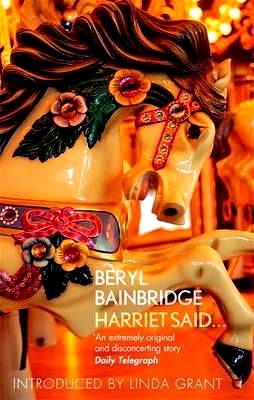
The girls dramatize their experiences in journal entries and make up stories for the people they meet on the local sand dunes, such as Peter Biggs, whom they dub Peter the Great or “the Tsar.” The narrator casts her relationship with him as a romance: “I wished I knew if I only imagined he cared for me, it seemed so strange the things I attributed to him. I did not know where the dream and the reality merged.” Together they decide to humble the Tsar.
{SPOILERS FOLLOW}
It’s uncomfortable for modern readers to encounter what is essentially a seduction plot between a teenager and a middle-aged man, but with the teen taking the active predator role. (And Harriet behind the scenes manipulating the interactions, rather like the Marquise de Merteuil in Dangerous Liaisons.) We’re fixated on the question of consent, but would the ultimate sex scene be classed as a rape? “‘Gerroff’, I wanted to shout, ‘Gerroff.’ But I did not want to hurt his feelings. … I was surprised how little discomfort I felt, apart from a kind of interior bruising, and how cheerful I was.” Harriet and the narrator both have a history of carrying on with grown men, and by peeping at windows see the Tsar having sex with Mrs Biggs on the couch. None of what they do seems accidental, or unfortunate, because they seem so determined to gravitate towards the smutty parts of life.
“What are little girls made of?
Sugar and spice,
And all that’s nice”
Fat chance!
“I tried to think what innocence meant and failed.”
“It was quite easy to bring myself to hurt him, he was such a fool.”
It’s not unexpected when the girls’ obsession leads to tragedy, but the exact form the collateral damage takes is a surprise. I’ve called this a ‘nasty little story’, but I mostly mean that in an admiring way, because it takes skill in plotting and characterization to make us keep reading even when all is so sordid.
Bainbridge has always reminded me of Penelope Fitzgerald in her concision, but I find Bainbridge less subtle and more edgy – a good combination, if you ask me. Harriet Said… feels like it falls on a continuum between, say, Barbara Comyns and Ottessa Moshfegh. I also wondered whether contemporary novelists like Eliza Clark (Penance) and Heather Darwent (The Things We Do to Our Friends) could have been influenced by the picture of teenage girls’ malevolence and the way that the action starts with hideous aftermath and then works backwards. This was a squirmy but memorable read. (Public library) [175 pages]
#NovNov23 and #SciFiMonth: They by Kay Dick
To join the Week 3 theme of Novellas in November, “Broadening My Horizons,” with Science Fiction Month (celebrating a genre I still struggle with but occasionally enjoy), I decided to pick up a short rediscovered dystopian classic. Originally published in 1977, They: A Sequence of Unease was reissued by Faber Editions last year. I had never heard of its author, Kay Dick (1915–2001), a lesbian bookseller and publisher who lived in London and Brighton and wrote seven works of fiction and three biographies.
Although I can think of a few dystopian novels that I have loved, it’s not a mode I gravitate towards. This makes me out of step with the zeitgeist, I know, because dystopian stories are only rising in popularity as current events converge with premonitory visions of the future.
The specific problem I had with They is one I’ve had with some other speculative works: vagueness. I can’t stand it when allegorical books are set in a deliberate no-place, or a made-up country (I’ve not yet succeeded in reading a J.M. Coetzee or José Saramago novel, for instance). I gave up on the Giller Prize-winning Study for Obedience when its first ten pages gave no clear sense of its geographical or temporal setting. When there’s no detail to latch onto, disorientation usually leads me to turn to another more realist book in preference.
They is, in fact, set in an ironically idyllic Britain. There are lovely descriptions of the land during different seasons: roses, sunsets, wheat fields, birdsong. This is in contrast with the disquiet permeating the narrator’s everyday life. She is part of a dispersed, itinerant creative community whose members come and go, hiding their work and doing their best to avoid the nameless enforcers who patrol the country to destroy art and quash emotion and individual endeavours. Certain artists of her acquaintance have been maimed or disappeared. For all the public enshrinement of teamwork, the normies the book portrays seem purely mean-spirited: children torture animals for kicks.

A case could be made that Dick was aiming at universality – this could happen anywhere – but the combination of imprecision and flat, declarative sentences left me cold.
“We’re all frightened. We must live with it. Russell and Jane will be here tomorrow. They got through London. I’ll be sleeping in the room opposite yours tonight. You are over-tired; it’s the strain.”
“Subscribing to current social fashions, I gave a small party, inviting all my neighbours. They all talked at the same time. No one listened to anyone else. No one laughed. Only Tim and I smiled at each other. They felt uneasy because there was no television set.”
In terms of world-building, everything is either unexplained or revealed abruptly through unsubtle dialogue. I came away with no sense of the narrator or any of the many secondary characters, who are little more than a name. Funny that the most consistent presence is that of her dog, who is never given the dignity of a name. (It’s only ever “my dog,” when a creature so important to her would surely be referred to as a friend.) While the two authors were probably poles apart ideologically, I thought I spied the ghost of Ayn Rand in the awe surrounding individual achievement.
It’s comforting to try to believe what Hurst says about the persistence of art – “We can all add to the treasure, however short the time left may be. It can’t all be destroyed. Some of it will remain for those who come after us” – but this portrait of underground artists in a parallel modern Britain failed to move me. (New purchase at sale price from Faber website) [107 pages]
 Bookish Beck = Rebecca Foster. American transplant to England. Freelance proofreader and book reviewer.
 Bookish Beck