#ReadIndies Catch-up: Ansell, Kinard, McNaught, Ponce, Toews and Vara
At last, my first dedicated selections for Read Indies month, two of which have been languishing on the shelf since 2022! A few more indie titles will appear in my February roundup tomorrow. I’ve got a huge variety here: an extended essay comparing life among the unhoused in London in the 1980s with the freedom of the open road and the island of Jura; gospel-saturated poems of queer African American life; an exposé of spiritual abuse in a Pentecostal church with branches in England and Nigeria; an Ecuadorian novella obsessed with bodies and sex; a funny yet heartbreaking novel about a zany family trying not to fall apart; and short stories about siblings, adolescence, memory, death and much more. I name the publishers and other books I have on the docket from each one.

Deer Island by Neil Ansell (2013)
 My last unread book by Ansell (whose Deep Country, The Last Wilderness, and The Circling Sky I’ve loved) and one that had been out of print for many years, so it was great to hear that Little Toller was reissuing it. Ansell has visited most countries; pressed for a favourite place, he names the Scottish isle of Jura. In memory he returns to a place he hadn’t been in over 20 years. In the early 1980s he lived in London and volunteered with The Simon Community, a homeless charity, for three years. Later that decade, he found himself in the same situation as those he served, squatting in chaotic multi-occupancy London properties. But in between he’d had a magical jaunt to Jura by hitchhiking and motorbike with a girlfriend. And later, when his only sentimental keepsake was stolen from his squat bedroom, he left that lifestyle behind and fled to Jura, haunt of golden eagles and otters; refuge for George Orwell, who experienced his fair share of squalor – Down and Out in Paris and London gets a mention, but Ansell doesn’t belabour a comparison he more than earns. It’s a shame this is so short, but it’s a carefully crafted slice of life, and illustrates a sobering truth: “Security is an illusion.”
With thanks to Little Toller Books for the free copy for review. Deer Island came out in paperback on 27 February.
Little Toller
Also read recently: brother. do. you. love. me. by Manni Coe
Currently reading: The Long Field by Pamela Petro
Orders of Service by Willie Lee Kinard III (2023)
 At a confluence of Southern, Black and gay identities, Kinard writes of matriarchal families, of congregations and choirs, of the descendants of enslavers and enslaved living side by side. The layout mattered more than I knew, reading an e-copy: often it is white text on a black page; words form rings or an infinity symbol; erasure poems gray out much of what has come before. “Boomerang” interludes imagine a chorus of fireflies offering commentary – just one of numerous insect metaphors. Mythology also plays a role. “A Tangle of Gorgons,” a sample poem I’d read before, wends its serpentine way across several pages. “Catalog of My Obsessions or Things I Answer to” presents an alphabetical list. For the most part, the poems were longer, wordier and more involved (four pages of notes on the style and allusions) than I tend to prefer, but I could appreciate the religious frame of reference and the alliteration.
Two favorite passages:
Ma taught me how to change a tire
the fall before it got real cold one October,
on the plot of dirt the pole beans we call Babel
spiral from, where our boozy station wagon
sat after hobbling home & passing out
in the backyard
(from “Work”)
I left before the door was closed.
I built myself of drowning hymns.
I stole every one to fly.
(from “Icarus Confesses”)
With thanks to Alice James Books for the advanced e-copy for review.
Alice James Books
Also read recently: Theophanies by Sarah Ghazal Ali
Immanuel by Matthew McNaught (2022)
 “Immanuel was the centre of the world once. Long after it imploded, its gravitational pull remains.” McNaught grew up in an evangelical church in Winchester, England, but by the time he left for university he’d fallen away. Meanwhile, some peers left for Nigeria to become disciples at charismatic preacher TB Joshua’s Synagogue Church of All Nations in Lagos. It’s obvious to outsiders that this was a cult, but not so to those caught up in it. It took years and repeated allegations for people to wake up to faked healings, sexual abuse, and the ceding of control to a megalomaniac who got rich off of duping and exploiting followers. This book won the inaugural Fitzcarraldo Editions Essay Prize. I admired its blend of journalistic and confessional styles: research, interviews with friends and strangers alike, and reflection on the author’s own loss of faith. He gets to the heart of why people stayed: “A feeling of holding and of being held. A sense of fellowship and interdependence … the rare moments of transcendence … It was nice to be a superorganism.” This gripped me from page one, but its wider appeal strikes me as limited. For me, it was the perfect chance to think about how I might write about traditions I grew up in and spurned.
With thanks to Fitzcarraldo Editions for the proof copy for review.
Fitzcarraldo Editions
Currently reading: Intervals by Marianne Brooker
Up next: Alphabetical Diaries by Sheila Heti
Blood Red by Gabriela Ponce (2020; 2024)
[Translated from the Spanish by Sarah Booker]
 Like other short works I’ve read by Hispanic women authors (Die, My Love, September and the Night, In Vitro), this Ecuadorian novella is intense, fragmentary, and obsessed with the female body and psyche. The unnamed narrator, a woman separated from her husband and freed from inhibitions, gives in to her substance and sex addictions – “For me, anything that isn’t falling in love has never merited much attention. That giddiness from proximity or bodies”. I was reminded of A Spy in the House of Love in that she flits compulsively from one lover to another, but Ponce is much more explicit than Nin. At least at the start, the sex scenes are almost constant and described in graphic detail. The narrator meets her lovers in warehouses and caves. Literal holes/orifices and blood are profuse, but also symbolically weighty, with fear of pregnancy also featuring heavily. I was impressed at how Booker rendered the stream-of-consciousness approach, which involves several-page paragraphs and metaphors of moths and moss. I wouldn’t say this was a pleasant book to spend time with, but the style and vocabulary made it worthy of note.
With thanks to Dead Ink for the free copy for review. Blood Red was first published in English by Restless Books in the USA in 2022.
Dead Ink
Up next: Sinking Bell by Bojan Louis
Fight Night by Miriam Toews (2022)
 I knew from All My Puny Sorrows that Canadian author Miriam Toews has a knack for combining humour and heartbreak. I can’t believe it took me since 2015 to read another of her novels. Once again, there seems to be a strong autobiographical element and suicide in the family is part of the backstory. Although abandonment and failure haunt these three female generations, we see everything through a child’s point-of-view, which turns life into a jolly adventure. Swiv’s mother, an underemployed actress, is heavily pregnant with “Gord”; her father is out of the picture. Swiv has been expelled, which gives her plenty of time with Grandma Elvira, who makes friends with everyone she meets but, alas, is crumbling physically. Luckily, Swiv knows just how to keep her going with nitro spray and compression socks and pills rescued from the floor. Before Gord arrives, Grandma wants one last adventure: a flight from Canada to Fresno, California to see her remaining family. Their trip is a disaster, in hilarious ways. Child narrators are tough to pull off, so kudos to Toews for making eight-year-old Swiv almost completely believable (though a bit too precocious). These characters are all foul-mouthed fighters, with a quick wit and the determination to make their stories matter. You’ll laugh and cry.
With thanks to Faber for the proof copy for review.
Faber
Also read recently: Happiness Falls by Angie Kim
Currently reading: Places I’ve Taken My Body by Molly McCully Brown
This Is Salvaged by Vauhini Vara (2023)
 The epigraph is from the two pages of laughter (“Ha!”) in “Real Estate,” one of the stories of Birds of America by Lorrie Moore. Vara shares Moore’s themes, which are the stuff of literary fiction generally – adolescence, friendship, ageing, memory, romantic relationships – but also her tone of dark comedy. The death of a sibling recurs. In “The Irates,” teenage Swati, whose brother died of cancer, and her friend Lydia get phone sales jobs through the Chinese restaurant where they go for egg rolls. In “I, Buffalo,” Sheila tries to hide her alcoholism when her sister Priya comes for a visit with Sheila’s brother-in-law and niece. “The girl” in “You Are Not Alone” is delighted to spend her eighth birthday in Florida with her estranged father, but less so when she learns there’s a stepmother figure in the picture. The women of “Sibyls” look after an elderly neighbour with dementia. The querulous child in “Unknown Unknowns” reminded me of Good Talk by Mira Jacob. My two favourites were the title story, about building a Noah’s Ark replica, and “What Next,” about a woman accompanying her teenage daughter to meet her father for the first time. A few stories didn’t stand out, and while I liked the writing, this didn’t necessarily feel like a cohesive collection.
With thanks to Grove Press UK for the free copy for review. This Is Salvaged came out in paperback in the UK on 1 February.
Grove Atlantic
Up next: Get the Picture by Bianca Bosker, Home/Land by Rebecca Mead, We Play Ourselves by Jen Silverman
Have you discovered any new-to-you independent publishers recently?
Ferdinand, the Man with the Kind Heart by Irmgard Keun (#NovNov23 and #GermanLitMonth)
My second contribution to German Literature Month, hosted by Lizzy Siddal, after Last House Before the Mountain by Monika Helfer. I spotted this in a display of new acquisitions at my library earlier in the year and was attracted by the pointillist-modernist style of its cover (Man with a Tulip by Robert Delaunay, 1906) featuring the image of a dandyish yet slightly melancholy young man. I had never heard of the author and assumed it was a man. In fact, Irmgard Keun (1905–82) was a would-be actress who wrote five novels and fled Germany when blacklisted by the Nazis. She was then, variously, a fugitive (returning to Germany only after a false report of her suicide in The Telegraph), a lover of Joseph Roth, a single mother, and an alcoholic. (I love it when a potted author biography reads like a mini-novel!)

Ferdinand (1950) was her last novel and is a curious confection, silly and sombre to equal degrees. It draws on her experiences living by her journalism in bombed-out postwar Cologne. Ferdinand Timpe is a former soldier and POW from a large, eccentric family. His tiny rented room is actually a corridor infested by his landlady Frau Stabhorn’s noisy grandchildren. He’s numb, stumbling from one unsuitable opportunity to another, never choosing his future but letting it happen to him. He once inherited a secondhand bookshop and ran it for a while (I wish we’d heard more about this). Now he’s been talked into writing articles for a weekly paper – it turns out the editor confused him with another Ferdinand. Later he’s hired as a “cheerful adviser” who mostly listens to women complain about their husbands. He is not quite sure how he acquired his own fiancée, Luise, but hopes to weasel out of the engagement.
Each chapter feels like a self-contained story, many of them focusing on particular relatives or friends. There’s his beautiful but immoral cousin, Johanna; his ruthless businessman cousin Magnesius; his lovely but lazy mother, Laura. His descriptions are hilarious, and Keun’s vocabulary really sparkles:
“Like many businesspeople, Magnesius is a jovial and generous party animal, only to emerge as even icier and stonier later. He damascenes himself. To heighten the mood, he has jammed a green monocle in one eye, and pulled a yellow silk stocking over his head. Just now I saw him kissing the hand of a woman unknown to me and offering to buy her a brand-new Mercedes.”
“Luise is a nice girl, and I’ve got nothing against her, but her presence has something oppressive about it for me. I have examined myself and established that this feeling of oppression is not love, and is no prerequisite for marriage, not even an unhappy one. I suppose I should tell her. But I can’t.”

Our antihero gets himself into ridiculous situations, like when he’s down on his luck and pays an impromptu visit to a former professor, Dr Muck, perhaps hoping for a handout; finding him away, he has to await his return for hours while the wife hosts a ladies’ poetry evening:
I was desperate not to fall asleep. Seven times I tiptoed out to the lavatory to take a sip from my flask. In the hall I walked into a sideboard and knocked over a large china ornament – I think it may have been a wood grouse. I broke off a piece of its beak. These things are always happening to me when I’m trying to be especially careful.
Hidden beneath Ferdinand’s hapless and frivolous exterior (he wears a jerkin made from a lady’s coat; Johanna says it makes him looks like “a hurdy-gurdy man’s monkey”), however, is psychological damage. “I feel so deep-frozen. I wonder if I’ll ever thaw out in this life. … Sometimes I feel like wandering on through the entire world. Maybe eventually I’ll run into a place or a person who will make me say yes, this is it, I’ll stay here, this is my home.” His feeling of purposelessness is understandable. Wartime hardship has dented his essential optimism, and external signs of progress – currency reform, denazification – can’t blot out the memory.
There’s a heartbreaking little sequence where he traces his rapid descent into poverty and desperation through cigarettes. He once shuddered at people saving their butts, but then started doing so himself. The same happened with salvaging strangers’ fag-ends from ashtrays. And then, worst of all, rescuing butts from the gutter. “So I never even noticed that one day there was no smoker in the world so degenerate that I could look down on him. I stood so low that no one could stand below me.”
I tend to lose patience with aimless picaresque plots, but this one was worth sticking with for the language and the narrator’s amusing view of the world. I’d happily read another book by Keun if I came across one. Her best known, from the 1930s, are Gilgi and The Artificial Silk Girl.
(Penguin Modern Classics series, 2021. Translated from the German by Michael Hofmann. Public library) [172 pages] 

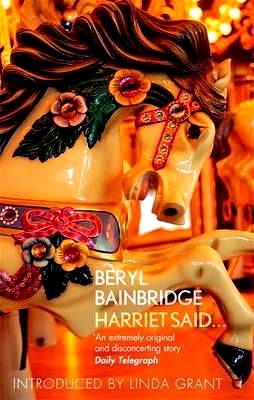
Harriet Said… by Beryl Bainbridge (#NovNov23 and #ReadingBeryl23)
Beryl Bainbridge Reading Week (hosted by Annabel) is a perfect chance to combine November challenges as most of Bainbridge’s works are under 200 pages. And today would have been the author’s birthday, too. Although Harriet Said… is the first book she wrote, it was rejected and not published until 1972, making it her third novel. I can see why publishers would have been wary of taking a risk on such a nasty little story from an unknown author. Even from an established writer this would be a hard one to stomach, subverting as it does the traditional notion of the innocence of childhood.

The title is also the first two words of the novel and tells us right away that the narrator (never named) is in thrall to her friend Harriet. The young teenager is on her summer holidays from boarding school, back in a Liverpool suburb. She lets Harriet set the agenda for their long, idle, unsupervised days: “she told me what to read, explained to me the things I read, told me what painters I should admire and why. I listened, I did as she said, but I did not feel much interest, at least not on my own, only when she was directing me.”
The girls dramatize their experiences in journal entries and make up stories for the people they meet on the local sand dunes, such as Peter Biggs, whom they dub Peter the Great or “the Tsar.” The narrator casts her relationship with him as a romance: “I wished I knew if I only imagined he cared for me, it seemed so strange the things I attributed to him. I did not know where the dream and the reality merged.” Together they decide to humble the Tsar.
{SPOILERS FOLLOW}
It’s uncomfortable for modern readers to encounter what is essentially a seduction plot between a teenager and a middle-aged man, but with the teen taking the active predator role. (And Harriet behind the scenes manipulating the interactions, rather like the Marquise de Merteuil in Dangerous Liaisons.) We’re fixated on the question of consent, but would the ultimate sex scene be classed as a rape? “‘Gerroff’, I wanted to shout, ‘Gerroff.’ But I did not want to hurt his feelings. … I was surprised how little discomfort I felt, apart from a kind of interior bruising, and how cheerful I was.” Harriet and the narrator both have a history of carrying on with grown men, and by peeping at windows see the Tsar having sex with Mrs Biggs on the couch. None of what they do seems accidental, or unfortunate, because they seem so determined to gravitate towards the smutty parts of life.
“What are little girls made of?
Sugar and spice,
And all that’s nice”
Fat chance!
“I tried to think what innocence meant and failed.”
“It was quite easy to bring myself to hurt him, he was such a fool.”
It’s not unexpected when the girls’ obsession leads to tragedy, but the exact form the collateral damage takes is a surprise. I’ve called this a ‘nasty little story’, but I mostly mean that in an admiring way, because it takes skill in plotting and characterization to make us keep reading even when all is so sordid.
Bainbridge has always reminded me of Penelope Fitzgerald in her concision, but I find Bainbridge less subtle and more edgy – a good combination, if you ask me. Harriet Said… feels like it falls on a continuum between, say, Barbara Comyns and Ottessa Moshfegh. I also wondered whether contemporary novelists like Eliza Clark (Penance) and Heather Darwent (The Things We Do to Our Friends) could have been influenced by the picture of teenage girls’ malevolence and the way that the action starts with hideous aftermath and then works backwards. This was a squirmy but memorable read. (Public library) [175 pages]
#NovNov23 and #SciFiMonth: They by Kay Dick
To join the Week 3 theme of Novellas in November, “Broadening My Horizons,” with Science Fiction Month (celebrating a genre I still struggle with but occasionally enjoy), I decided to pick up a short rediscovered dystopian classic. Originally published in 1977, They: A Sequence of Unease was reissued by Faber Editions last year. I had never heard of its author, Kay Dick (1915–2001), a lesbian bookseller and publisher who lived in London and Brighton and wrote seven works of fiction and three biographies.
Although I can think of a few dystopian novels that I have loved, it’s not a mode I gravitate towards. This makes me out of step with the zeitgeist, I know, because dystopian stories are only rising in popularity as current events converge with premonitory visions of the future.
The specific problem I had with They is one I’ve had with some other speculative works: vagueness. I can’t stand it when allegorical books are set in a deliberate no-place, or a made-up country (I’ve not yet succeeded in reading a J.M. Coetzee or José Saramago novel, for instance). I gave up on the Giller Prize-winning Study for Obedience when its first ten pages gave no clear sense of its geographical or temporal setting. When there’s no detail to latch onto, disorientation usually leads me to turn to another more realist book in preference.
They is, in fact, set in an ironically idyllic Britain. There are lovely descriptions of the land during different seasons: roses, sunsets, wheat fields, birdsong. This is in contrast with the disquiet permeating the narrator’s everyday life. She is part of a dispersed, itinerant creative community whose members come and go, hiding their work and doing their best to avoid the nameless enforcers who patrol the country to destroy art and quash emotion and individual endeavours. Certain artists of her acquaintance have been maimed or disappeared. For all the public enshrinement of teamwork, the normies the book portrays seem purely mean-spirited: children torture animals for kicks.

A case could be made that Dick was aiming at universality – this could happen anywhere – but the combination of imprecision and flat, declarative sentences left me cold.
“We’re all frightened. We must live with it. Russell and Jane will be here tomorrow. They got through London. I’ll be sleeping in the room opposite yours tonight. You are over-tired; it’s the strain.”
“Subscribing to current social fashions, I gave a small party, inviting all my neighbours. They all talked at the same time. No one listened to anyone else. No one laughed. Only Tim and I smiled at each other. They felt uneasy because there was no television set.”
In terms of world-building, everything is either unexplained or revealed abruptly through unsubtle dialogue. I came away with no sense of the narrator or any of the many secondary characters, who are little more than a name. Funny that the most consistent presence is that of her dog, who is never given the dignity of a name. (It’s only ever “my dog,” when a creature so important to her would surely be referred to as a friend.) While the two authors were probably poles apart ideologically, I thought I spied the ghost of Ayn Rand in the awe surrounding individual achievement.
It’s comforting to try to believe what Hurst says about the persistence of art – “We can all add to the treasure, however short the time left may be. It can’t all be destroyed. Some of it will remain for those who come after us” – but this portrait of underground artists in a parallel modern Britain failed to move me. (New purchase at sale price from Faber website) [107 pages]
Nonfiction November Book Pairings: Hardy’s Wives, Rituals, and Romcoms
Liz is hosting this week of Nonfiction November. For this prompt, the idea is to choose a nonfiction book and pair it with a fiction title with which it has something in common.

I came up with three based on my recent reading:
Thomas Hardy’s Wives
On my pile for Novellas in November was a tiny book I’ve owned for nearly two decades but not read until now. It contains some of the backstory for an excellent historical novel I reviewed earlier in the year.
Some Recollections by Emma Hardy
&
The Chosen by Elizabeth Lowry


The manuscript of Some Recollections is one of the documents Thomas Hardy found among his first wife’s things after her death in 1912. It is a brief (15,000-word) memoir of her early life from childhood up to her marriage – “My life’s romance now began.” Her middle-class family lived in Plymouth and moved to Cornwall when finances were tight. (Like the Bennets in Pride and Prejudice, you look at the house they lived in, and read about the servants they still employed, and think, “impoverished,” seriously?!) “Though trifling as they may seem to others all these memories are dear to me,” she writes. It’s true that most of these details seem inconsequential, of folk historical value but not particularly illuminating about the individual.
An exception is her account of her dealings with fortune tellers, who often went out of their way to give her good – and accurate – predictions, such as that she would marry a writer. It’s interesting to set this occult belief against the traditional Christian faith she espouses in her concluding paragraph, in which she insists an “Unseen Power of great benevolence directs my ways.” The other point of interest is her description of her first meeting with Hardy, who was sent to St. Juliot, where she was living with her parson brother-in-law and sister, as an architect’s assistant to begin repairs on the church. “I thought him much older than he was,” she wrote. As editor Robert Gittings notes, Hardy made corrections to the manuscript and in some places also changed the sense. Here Hardy gave proof of an old man’s continued vanity by adding “he being tired” after that line … but then partially rubbing it out. (Secondhand, Books for Amnesty, Reading, 2004) [64 pages] 
The Chosen contrasts Emma’s idyllic mini memoir with her bitterly honest journals – Hardy read but then burned these, so Lowry had to recreate their entries based on letters and tone. But Some Recollections went on to influence his own autobiography, and to be published in a stand-alone volume by Oxford University Press. Gittings introduces the manuscript (complete with Emma’s misspellings and missing punctuation) and appends a selection of Hardy’s late poems based on his first marriage – this verse, too, is central to The Chosen.
Another recent nonfiction release on this subject matter that I learned about from a Shiny New Books review is Woman Much Missed: Thomas Hardy, Emma Hardy and Poetry by Mark Ford. I’d also like to read the forthcoming Hardy Women: Mother, Sisters, Wives, Muses by Paula Byrne (1 February 2024, William Collins).
Rituals
The Ritual Effect by Michael Norton
&
The Rituals by Rebecca Roberts


Last month I reviewed this lovely Welsh novel about a woman who is an independent celebrant, helping people celebrate landmark events in their lives or cope with devastating losses by commemorating them through secular rituals.
Coming out in April 2024, The Ritual Effect is a Harvard Business School behavioral scientist’s wide-ranging study of how rituals differ from habits in that they are emotionally charged and lift everyday life into something special. Some of his topics are rites of passage in different cultures; musicians’ and sportspeople’s pre-performance routines; and the rituals we develop around food and drink, especially at the holidays. I’m just over halfway through this for an early Shelf Awareness review and I have been finding it fascinating.
Romantic Comedy
(As also featured in my August Six Degrees post)
What I Was Doing While You Were Breeding by Kristin Newman
&
Romantic Comedy by Curtis Sittenfeld


Romantic Comedy is probably still the most fun reading experience I’ve had this year. Sittenfeld’s protagonist, Sally Milz, writes TV comedy, as does Kristin Newman (That ’70s Show, How I Met Your Mother, etc.). What I Was Doing While You Were Breeding is a lighthearted record of her sexual conquests in Amsterdam, Paris, Russia, Argentina, etc. (Newman even has a passage that reminds me of Sally’s “Danny Horst Rule”: “I looked like a thirty-year-old writer. Not like a twenty-year-old model or actress or epically legged songstress, which is a category into which an alarmingly high percentage of Angelenas fall. And, because the city is so lousy with these leggy aliens, regular- to below-average-looking guys with reasonable employment levels can actually get one, another maddening aspect of being a woman in this city.”) Unfortunately, it got repetitive and raunchy. It was one of my 20 Books of Summer but I DNFed it halfway.
Last House Before the Mountain by Monika Helfer (#NovNov23 and #GermanLitMonth)
This Austrian novella, originally published in German in 2020, also counts towards German Literature Month, hosted by Lizzy Siddal. It is Helfer’s fourth book but first to become available in English translation. I picked it up on a whim from a charity shop.
“Memory has to be seen as utter chaos. Only when a drama is made out of it is some kind of order established.”
A family saga in miniature, this has the feel of a family memoir, with the author frequently interjecting to say what happened later or who a certain character would become, yet the focus on climactic scenes – reimagined through interviews with her Aunt Kathe – gives it the shape of autofiction.
Josef and Maria Moosbrugger live on the outskirts of an alpine village with their four children. The book’s German title, Die Bagage, literally means baggage or bearers (Josef’s ancestors were itinerant labourers), but with the connotation of riff-raff, it is applied as an unkind nickname to the impoverished family. When Josef is called up to fight in the First World War, life turns perilous for the beautiful Maria. Rumours spread about her entertaining men up at their remote cottage, such that Josef doubts the parentage of the next child (Grete, Helfer’s mother) conceived during one of his short periods of leave. Son Lorenz resorts to stealing food, and has to defend his mother against the mayor’s advances with a shotgun.

If you look closely at the cover, you’ll see it’s peopled with figures from Pieter Bruegel’s Children’s Games. Helfer was captivated by the thought of her mother and aunts and uncles as carefree children at play. And despite the challenges and deprivations of the war years, you do get the sense that this was a joyful family. But I wondered if the threats were too easily defused. They were never going to starve because others brought them food; the fending-off-the-mayor scenes are played for laughs even though he very well could have raped Maria.
Helfer’s asides (“But I am getting ahead of myself”) draw attention to how she took this trove of family stories and turned them into a narrative. I found that the meta moments interrupted the flow and made me less involved in the plot because I was unconvinced that the characters really did and said what she posits. In short, I would probably have preferred either a straightforward novella inspired by wartime family history, or a short family memoir with photographs, rather than this betwixt-and-between document.
(Bloomsbury, 2023. Translated from the German by Gillian Davidson. Secondhand purchase from Bas Books and Home, Newbury.) [175 pages]
R.I.P., Part I: Michel Faber, Rebecca Green and Lize Meddings
For my first installment of this year’s Readers Imbibing Peril challenge, I have a highly undemanding selection of a novella, a picture book, and a teen graphic novel. And nothing here is nearly as scary as proper horror-fiction readers might be expecting.
The Hundred and Ninety-Nine Steps by Michel Faber (2001)
 One of my reads in Hay was this suspenseful novella set in Whitby. Faber was invited by the then artist in residence at Whitby Abbey to write a story inspired by the English Heritage archaeological excavation taking place there in the summer of 2000. His protagonist, Siân, is living in a hotel and working on the dig. She meets Magnus, a handsome doctor, when he comes to exercise the dog he inherited from his late father on the stone steps leading up to the abbey. Siân had been in an accident and is still dealing with the physical and mental after-effects. Each morning she wakes from a nightmare of a man with large hands slitting her throat. When Magnus brings her a centuries-old message in a bottle from his father’s house for her to open and decipher, another layer of intrigue enters: the crumbling document appears to be a murderer’s confession.
At first I worried Faber would turn this into a simple, predictable ghost story and milk expected sources of trauma. But the plot twists kept surprising me. The focus on women’s bodies and sexuality is appropriate for the town that gave us Dracula. This had hidden depths and at 116 pages could easily be a one-sitting read. Hadrian the dog is a great character, too, and this is even in my favourite font, Mrs Eaves, one that Canongate uses often. [Unfortunate error: Faber twice refers to Whitby as being Northumbrian. Although it was in the historical kingdom of Northumbria, it is actually in North Yorkshire rather than Northumberland.] (Secondhand – Bookcase, Carlisle)
How to Make Friends with a Ghost by Rebecca Green (2017)
 Here Green proposes a ghost as a lifelong, visible friend. The book has more words and more advanced ideas than much of what I pick up from the picture book boxes. It’s presented as almost a field guide to understanding the origins and behaviours of ghosts, or maybe a new parent’s or pet owner’s handbook telling how to approach things like baths, bedtime and feeding. What’s unusual about it is that Green takes what’s generally understood as spooky about ghosts and makes it cutesy through faux expert quotes, recipes, etc. She also employs Rowling-esque grossness, e.g. toe jam served on musty biscuits. Perhaps her aim was to tame and thus defang what might make young children afraid. I enjoyed the art more than the sometimes twee words. (Public library)
The Sad Ghost Club by Lize Meddings (2021)
 This is the simplest of comics. Sam or “SG” goes around wearing a sheet – a tangible depression they can’t take off. (Again, ghosts aren’t really scary here, just a metaphor for not fully living.) Anxiety about school assignments and lack of friends is nearly overwhelming, but at a party SG notices a kindred spirit also dressed in a sheet: Socks. They’re awkward with each other until they dare to be vulnerable, stop posing as cool, and instead share how much they’re struggling with their mental health. Just to find someone who says “I know exactly what you mean” and can help keep things in perspective is huge. The book ends with SG on a quest to find others in the same situation. The whole thing is in black-and-white and the setups are minimalist (houses, a grocery store, a party, empty streets, a bench in a wooded area where they overlook the town). Not a whole lot of art skill required to illustrate this one, but it’s sweet and well-meaning. I definitely don’t need to read the sequels, though. The tone is similar to the later Heartstopper books and the art is similar to in Sheets and Delicates by Brenna Thummler, all of which are much more accomplished as graphic novels go. (Public library)
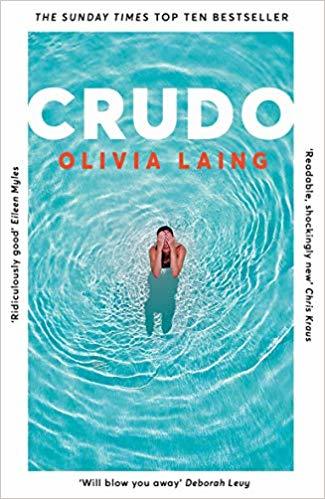
20 Books of Summer, 5: Crudo by Olivia Laing (2018)
Behind on the challenge, as ever, I picked up a novella. It vaguely fits with a food theme as crudo, “raw” in Italian, can refer to fish or meat platters (depicted on the original hardback cover). In this context, though, it connotes the raw material of a life: a messy matrix of choices and random happenings, rooted in a particular moment in time.
 This is set over four and a bit months of 2017 and steeped in the protagonist’s detached horror at political and environmental breakdown. She’s just turned 40 and, in between two trips to New York City, has a vacation in Tuscany, dabbles in writing and art criticism, and settles into married life in London even though she’s used to independence and nomadism.
For as hyper-real as the contents are, Laing is doing something experimental, even fantastical – blending biography with autofiction and cultural commentary by making her main character, apparently, Kathy Acker. Never mind that Acker died of breast cancer in 1997.
I knew nothing of Acker but – while this is clearly born of deep admiration, as well as familiarity with her every written word – that didn’t matter. Acker quotes and Trump tweets are inserted verbatim, with the sources given in a “Something Borrowed” section at the end.
Like Jenny Offill’s Weather, this is a wry and all too relatable take on current events and the average person’s hypocrisy and sense of helplessness, with the lack of speech marks and shortage of punctuation I’ve come to expect from ultramodern novels:
she might as well continue with her small and cultivated life, pick the dahlias, stake the ones that had fallen down, she’d always known whatever it was wasn’t going to last for long.
40, not a bad run in the history of human existence but she’d really rather it all kept going, water in the taps, whales in the oceans, fruits and duvets, the whole sumptuous parade
This is how it is then, walking backwards into disaster, braying all the way.
 I’ve somehow read almost all of Laing’s oeuvre (barring her essays, Funny Weather) and have found books like The Trip to Echo Spring, The Lonely City and Everybody wide-ranging and insightful. Crudo feels as faithful to life as Rachel Cusk’s autofiction or Deborah Levy’s autobiography, but also like an attempt to make something altogether new out of the stuff of our unprecedented times. No doubt some of the intertextuality of this, her only fiction to date, was lost on me, but I enjoyed it much more than I expected to – it’s funny as well as eminently quotable – and that’s always a win. (Little Free Library)
Literary Wives Club: The Harpy by Megan Hunter
(My fifth read with the Literary Wives online book club; see also Kay’s and Naomi’s reviews.)
Megan Hunter’s second novella, The Harpy (2020), treads familiar ground – a wife discovers evidence of her husband’s affair and questions everything about their life together – but somehow manages to feel fresh because of the mythological allusions and the hint of how female rage might reverse familial patterns of abuse.
Lucy Stevenson is a mother of two whose husband Jake works at a university. One day she opens a voicemail message on her phone from a David Holmes, saying that he thinks Jake is having an affair with his wife, Vanessa. Lucy vaguely remembers meeting the fiftysomething couple, colleagues of Jake’s, at the Christmas party she hosted the year before.
As further confirmation arrives and Lucy tries to carry on with everyday life (another Christmas party, a pirate-themed birthday party for their younger son), she feels herself transforming into a wrathful, ravenous creature – much like the harpies she was obsessed with as a child and as a Classics student before she gave up on her PhD.

Like the mythical harpy, Lucy administers punishment. At first, it’s something of a joke between her and Jake: he offers that she can ritually harm him three times. Twice it takes physical form; once it’s more about reputational damage. The third time, it goes farther than either of them expected. It’s clever how Hunter presents this formalized violence as an inversion of the domestic abuse of which Lucy’s mother was a victim.
Lucy also expresses anger at how women are objectified, and compares three female generations of her family in terms of how housewifely duties were embraced or rejected. She likens the grief she feels over her crumbling marriage to contractions or menstrual cramps. It’s overall a very female text, in the vein of A Ghost in the Throat. You feel that there’s a solidarity across time and space of wronged women getting their own back. I enjoyed this so much more than Hunter’s debut, The End We Start From. (Birthday gift from my wish list)
The main question we ask about the books we read for Literary Wives is:
What does this book say about wives or about the experience of being a wife?
“Marriage and motherhood are like death … no one comes back unchanged.”
So much in life can remain unspoken, even in a relationship as intimate as a marriage. What becomes routine can cover over any number of secrets; hurts can be harboured until they fuel revenge. Lucy has lost her separate identity outside of her family relationships and needs to claw back a sense of self.
I don’t know that this book said much that is original about infidelity, but I sympathized with Lucy’s predicament. The literary and magical touches obscure the facts of the ending, so it’s unclear whether she’ll stay with Jake or not. Because we’re mired in her perspective, it’s hard to see Jake or Vanessa clearly. Our only choice is to side with Lucy.
Next book: Sea Wife by Amity Gaige in September
From the Dylan Thomas Prize Shortlist: Seven Steeples & I’m a Fan
The Swansea University International Dylan Thomas Prize recognizes the best published work in the English language written by an author aged 39 or under. All literary genres are eligible, so the shortlist contains a poetry collection as well as novels and short stories.

I’ve read half of the shortlist (also including Warsan Shire’s poems) and would be interested in trying the rest if I can source the two short story collections; Limberlost is at my library. The winner will be announced at 8 p.m. BST on Thursday 11 May.
Seven Steeples by Sara Baume
Isabel and Simon arrive one January at a shabby rental house in coastal Ireland overlooked by a mountain, in the middle of nowhere. They’d been menial workers in Dublin and met climbing a mountain, but somehow never seem to get around to climbing their new local peak. In moving here, these “two solitary misanthropes” are essentially rejecting society and kin; Baume describes them as “post-family.” It appears that they’re post-employment as well – there is never a single reference to how they pay the rent and buy the hipster foods they favour. Could young people’s savings really fund eight years’ rural living?
It’s an appealingly anti-consumerist vision, anyway: They arrive with one van-load of stuff and their adopted dogs, Pip and Voss, and otherwise make do with a haphazard collection of secondhand belongings left by previous tenants or donated by their estranged families. The house starts to fall apart around them, but for the most part they adjust to the decay rather than do anything to reverse it. “They had become poor and shabby without noticing … accustomed to disrepair”; theirs is a “personalized squalor.”
 Bell and Sigh become increasingly hermit-like, with entrenched ways of doing things. Baume several times describes their compost bin, which struck me as a perfect image for how the stuff of daily life builds up and beds down into the foundation of personalities and a relationship. The fact that they only have each other (and the dogs) for company explains how they adopt each other’s mannerisms, develop a private language, and even conflate their separate memories. The starkest symbol of their refusal of societal norms comes when they miss a clock change and effectively live in their own time zone.
I recognized from Spill Simmer Falter Wither and handiwork several elements that reflect Baume’s interests: nature imagery, dogs, and daily routines. She gives a clear sense of time’s passage and the seasons’ turning, of repetition and attrition and ageing. I wearied of the descriptive passages and hoped that at some point there would be some action and dialogue to counterbalance them, but that is not what this novel is about. Occasional flashes from the point-of-view of a mouse in the house, or a spider in the van, tell you that Baume’s scope is wider. This is in fact an allegory about impermanence, from a mountain’s-eye view.
Although I was frustrated with the central characters’ jolly incompetence (“Just buy leashes and a tick twister, you idiots!” I felt like shouting at them after yet another mention of the dogs killing cats and rabbits; and of the difficulty of removing ticks from their coats), I recognized how easy it is to get stuck in lazy habits; how easy it is to live provisionally, as if all is temporary and not your real existence.
Baume spaces lines and paragraphs almost like hybrid poetry and indulges in overwriting in places. Because of the dearth of action, this was a slog of a months-long read for me, but I admired it in the end and enjoyed it more than the other two books of hers that I’ve read.
If you admire lyrical prose and are okay with little to no plot in a novel, you should get on fine with this one. Or it might be that it requires the right time or reading mood, when you’re after something quiet.
Having read more by Dylan Thomas now, I think this is exactly the sort of place-specific and playful, stylized prose that the prize named after him is looking for. So, I’ll predict Baume as the winner.

With thanks to Tramp Press for the free e-copy for review.
I’m a Fan by Sheena Patel
This was one of my correct predictions for the Women’s Prize longlist; I’d heard a lot about it from Best of 2022 roundups and it seemed like the kind of edgy title they might recognise. It’s also perfect for the Dylan Thomas Prize list because of how voice-driven it is. The unnamed narrator, a woman of colour in her early thirties, muses on art, entitlement, obsession, social media and sex in short titled sections ranging from one paragraph to a few pages long. The twin objects of her fanaticism are “the man I want to be with,” who is married and generally keeps her at arm’s length, and “the woman I am obsessed with,” a lifestyle influencer who, like herself, is one of this man’s girlfriends on the side. She stalks the woman via her impeccably curated Instagram images.
 The narrator has a boyfriend, in fact, a peculiarly perfect-sounding one even, but takes him for granted in her compulsive search for indiscriminate sexual experience (also including a female co-worker she calls “the Peach”). They end up parting ways and she moves back in with her parents, an ignominious retreat from attempted adulting.
She reminded me a bit of Bell and Sigh for her haplessness, but whereas the matter of having children literally never arises for them, the question of motherhood is a background niggle for her (“I thought I had the rest of my life to make this decision but I realise I am on a clock and it runs differently for me. I am female. There was never much time and I’ve wasted so much already”; “I want to gain immortality because of my brain and not because of the potential of my womb”). As the novella goes on, she even considers weaponising her fertility as a way of entrapping her crush.
I was reasonably engaged with the narrator’s deliberations about taste and autobiographical influences, but overall found this rather indulgent, slight and repetitive. Books about social media – this reminded me most of Adults by Emma Jane Unsworth – are in danger of becoming irrelevant all too quickly. The sexual frankness fell on the wrong side of unpleasant for me, and the format for referring to other characters leads to inelegant phrasing like “The man I want to be with’s work centres around conflict”. Something like Luster has that little bit more individuality and energy. (Secondhand – charity shop purchase)

 Bookish Beck = Rebecca Foster. American transplant to England. Freelance proofreader and book reviewer.
