February Releases by Nick Acheson, Charlotte Eichler and Nona Fernández (#ReadIndies)
Three final selections for Read Indies. I’m pleased to have featured 16 books from independent publishers this month. And how’s this for neat symmetry? I started the month with Chase of the Wild Goose and finish with a literal wild goose chase as Nick Acheson tracks down Norfolk’s flocks in the lockdown winter of 2020–21. Also appearing today are nature- and travel-filled poems and a hybrid memoir about Chilean and family history.

The Meaning of Geese: A thousand miles in search of home by Nick Acheson
I saw Nick Acheson speak at New Networks for Nature 2021 as the ‘anti-’ voice in a debate on ecotourism. He was a wildlife guide in South America and Africa for more than a decade before, waking up to the enormity of the climate crisis, he vowed never to fly again. Now he mostly stays close to home in North Norfolk, where he grew up and where generations of his family have lived and farmed, working for Norfolk Wildlife Trust and appreciating the flora and fauna on his doorstep.
 This was indeed to be a low-carbon initiative, undertaken on his mother’s 40-year-old red bicycle and spanning September 2021 to the start of the following spring. Whether on his own or with friends and experts, and in fair weather or foul, he became obsessed with spending as much time observing geese as he could – even six hours at a stretch. Pink-footed geese descend on the Holkham Estate in their thousands, but there were smaller flocks and rarer types as well: from Canada and greylag to white-fronted and snow geese. He also found perspective (historical, ethical and geographical) by way of Peter Scott’s conservation efforts, chats with hunters, and insight from the Icelandic researchers who watch the geese later in the year, after they leave the UK. The germane context is woven into a month-by-month diary.
The Covid-19 lockdowns spawned a number of nature books in the UK – for instance, I’ve also read Goshawk Summer by James Aldred, Birdsong in a Time of Silence by Steven Lovatt, The Consolation of Nature by Michael McCarthy, Jeremy Mynott and Peter Marren, and Skylarks with Rosie by Stephen Moss – and although the pandemic is not a major element here, one does get a sense of how Acheson struggled with isolation as well as the normal winter blues and found comfort and purpose in birdwatching.
Tundra bean, taiga bean, brent … I don’t think I’ve seen any of these species – not even pinkfeet, to my recollection – so wished for black-and-white drawings or colour photographs in the book. That’s not to say that Acheson is not successful at painting word pictures of geese; his rich descriptions, full of food-related and sartorial metaphors, are proof of how much he revels in the company of birds. But I suspect this is a book more for birders than for casual nature-watchers like myself. I would have welcomed more autobiographical material, and Wintering by Stephen Rutt seems the more suitable geese book for laymen. Still, I admire Acheson’s fervour: “I watch birds not to add them to a list of species seen; nor to sneer at birds which are not truly wild. I watch them because they are magnificent”.
With thanks to Chelsea Green Publishing for the free copy for review.
Swimming Between Islands by Charlotte Eichler
 Eichler’s debut collection was inspired by various trips to cold and remote places, such as to Lofoten 10 years ago, as she explains in a blog post on the Carcanet website. (The cover image is her painting Nusfjord.) British and Scandinavian islands and their wildlife provide much of the imagery and atmosphere. You can sink into the moss and fog, lulled by alliteration. A glance at some of the poem titles reveals the breadth of her gaze: “Brimstones” – “A Pheasant” (a perfect description in just two lines) – “A Meditation of Small Frogs” – “Trapping Moths with My Father.” There are also historical vignettes and pen portraits. The scenes of childhood, as in the four-part “What Little Girls Are Made Of,” evoke the freedom of curiosity about the natural world and feel autobiographical yet universal.
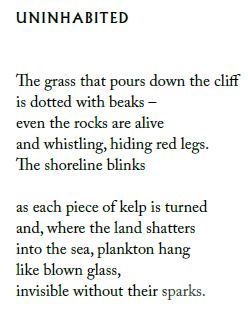
With thanks to Carcanet Press for the free copy for review.
Voyager: Constellations of Memory—A Memoir by Nona Fernández (2019; 2023)
[Translated from the Spanish by Natasha Wimmer]
Our archive of memories is the closest thing we have to a record of identity. … Disjointed fragments, a pile of mirror shards, a heap of the past. The accumulation is what we’re made of.
 When Fernández’s elderly mother started fainting and struggling with recall, it prompted the Chilean actress and writer to embark on an inquiry into memory. Astronomy provides the symbolic language here, with memory a constellation and gaps as black holes. But the stars also play a literal role. Fernández was part of an Amnesty International campaign to rename a constellation in honour of the 26 people “disappeared” in Chile’s Atacama Desert in 1973. She meets the widow of one of the victims, wondering what he might have been like as an older man as she helps to plan the star ceremony. This oblique and imaginative narrative ties together brain evolution, a medieval astronomer executed for heresy, Pinochet administration collaborators, her son’s birth, and her mother’s surprise 80th birthday party. NASA’s Voyager probes, launched in 1977, were intended as time capsules capturing something of human life at the time. The author imagines her brief memoir doing the same: “A book is a space-time capsule. It freezes the present and launches it into tomorrow as a message.”
With thanks to Daunt Books for the free copy for review.
Winter Reads, Part II: Elisa Shua Dusapin, Howard Norman & Picture Books
As hoped for in my first instalment of winter reads, the weather is warmer now and signs of spring are appearing in the form of cherry blossom, crocuses, daffodils, primroses and snowdrops. So I’m bidding a (perhaps premature) farewell to winter with these two novels featuring very chilly settings. I also borrowed from the library a big ol’ pile of wintry children’s books full of bears, rabbits, snowmen, snowballs and days off school.
Winter in Sokcho by Elisa Shua Dusapin (2016; 2020)
[Daunt Books Originals; translated from the French by Aneesa Abbas Higgins]
Another title doing double duty for #FrenchFebruary and #ReadIndies month. This was Dusapin’s debut and won the Prix Robert Walser and the Prix Régine-Deforges.
Our beaches are still waiting for the end of a war that’s been going on for so long people have stopped believing it’s real. They build hotels, put up neon signs, but it’s all fake, we’re on a knife-edge, it could all give way any moment. We’re living in limbo. In a winter that never ends.
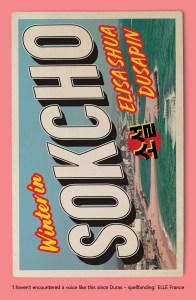 The protagonist is a young mixed-race woman working behind the reception desk at a hotel in Sokcho, a South Korean resort at the northern border. A tourist mecca in high season, during the frigid months this beach town feels down-at-heel, even sinister. The arrival of a new guest is a major event at the guesthouse. And not just any guest but Yan Kerrand, a French graphic novelist. Although she has a boyfriend and the middle-aged Kerrand is probably old enough to be her father – and thus an uncomfortable stand-in for her absent French father – the narrator is drawn to him. She accompanies him on sightseeing excursions but wants to go deeper in his life, rifling through his rubbish for scraps of work in progress.
The underemployed, self-sabotaging young woman is so familiar these days as to be a cliché (and I’d already met a very similar one, also Korean, in Ro from Sea Change by Gina Chung), but there is still something enticing about the atmosphere of this novella. I also enjoyed the narrator’s relationship with her mother, a fishmonger, which sets up for the entirely inconclusive and potentially very disturbing ending. Impossible to say more without spoilers, but I’d be interested to hear what others who have read it think will happen after the last page. (Birthday gift from my wish list) 
The Northern Lights by Howard Norman (1987)
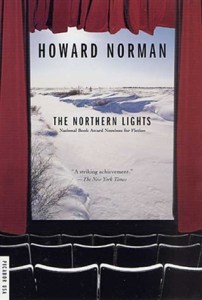 Norman is a really underrated writer and I’m a big fan of The Bird Artist and especially I Hate to Leave This Beautiful Place. This is a weird one; it’s his debut and you can see the autobiographical inspiration (per his Introduction) and the sorts of interests that would recur across his oeuvre, such as subarctic Canada and its Indigenous peoples, absent fathers and hotels (not the only reason this reminded me most of early John Irving).
The Canadian settings represent the two poles of isolation and the urban: Quill, Manitoba versus Toronto in 1959–60. The novel opens with the death of teenage Noah’s best friend, Pelly, who fell through a frozen lake while riding his unicycle. Noah’s family dynamic changes quickly, as his cousin Charlotte, orphaned by a factory disaster, comes to live with them and then his cartographer father leaves them to become a hermit in a remote cabin furnished with musical instruments. Noah stays with Pelly’s parents, Sam and Hettie (a Cree woman), to brave a harsh Quill winter –
January and February mornings you would get a crack of icy static in the nostrils when first stepping outside and have to shade your eyes against the harsh glint of snow, if the sun had worked its way through. Certain days neighbors were seen only on their way to their woodsheds. Chimney smoke was our windsocks. Enormous drifts had built up against the houses, sculpted in various shapes. Even brief walks were taken on snowshoes. Winter might be seven months long.
– while his mother, Mina, takes Charlotte to Toronto to run The Northern Lights, the movie theatre where she met her husband as a young woman. The previous alcoholic owner has run it into the ground; “the curtain smelled like a ten-thousand-year-old moose hide.”
At the time that Noah joins them, he’s never seen a movie before, but as “manager” of the theatre he soon sees The Magnificent Seven 15 times in quick succession. Norman does a peculiar thing here, which is to introduce a key character quite late on in the action. Noah hires Levon, a Cree man, to be the projectionist and he promptly moves his entire family into the building. Had Noah relocated to Toronto earlier, we might have seen more of these characters. Norman’s habit of mimicking broken speech from non-native speakers through overly frequent commas (indicating pauses, I suppose) irked me. There are lots of quirky elements here and I enjoyed the overall atmosphere, but felt the plot left something to be desired. I’d start elsewhere with Norman, but could still recommend this to readers of Robertson Davies and Elizabeth Hay. (Secondhand – 2nd & Charles)
And a DNF:
Snowflake, AZ by Marcus Sedgwick (2019): I wanted to try something else by the late Sedgwick (I’ve only read his nonfiction monograph, Snow) and this seemed ideal. I could have gotten onboard with the desert dystopia, but Ash’s narration was so unconvincing. Sedgwick was attempting a folksy American accent but all the “ain’t”s and “darned”s really don’t work from a teenage character. I only managed about 20 pages. (Public library)
Plus a whole bunch of children’s picture books:
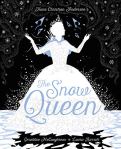 The Snow Queen by Hans Christian Andersen [adapted by Geraldine McCaughrean; illus. Laura Barrett] (2019): The whole is in the shadow painting style shown on the cover, with a black, white and ice blue palette. It’s visually stunning, but I didn’t like the language as much as in the original (or at least older) version I remember from a book I read every Christmas as a child.
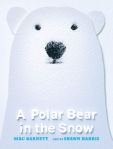 A Polar Bear in the Snow by Mac Barnett [art by Shawn Harris] (2020): From a grey-white background, a bear’s face emerges. The remaining pages are made of torn and cut paper that looks more three-dimensional than it really is. The bear passes other Arctic creatures and plays in the sea. Such simple yet intricate spreads.
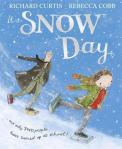 Snow Day by Richard Curtis [illus. Rebecca Cobb] (2014): When snow covers London one December, only two people fail to get the message that the school is closed: Danny Higgins and Mr Trapper, his nemesis. So lessons proceed. At first it feels like a prison sentence, but at break time Mr Trapper gives in to the holiday atmosphere. These two lonely souls play as if they were both children, making an army of snowmen and an igloo. And next year, they’ll secretly do it all again. Watch out for the recurring robin in a woolly hat.
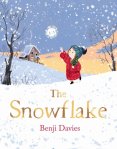 The Snowflake by Benji Davies (2020): I didn’t realize this was a Christmas story, but no matter. A snowflake starts her lonely journey down from a cloud; on Earth, Noelle hopes for snow to fall on her little Christmas tree. From motorway to town to little isolated house, Davies has an eye for colour and detail.
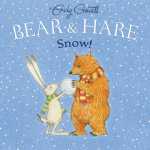 Bear and Hare: SNOW! by Emily Gravett (2014): Bear and Hare, wearing natty scarves, indulge in all the fun activities a blizzard brings: snow angels, building snow creatures, having a snowball fight and sledging. Bear seems a little wary, but Hare wins him over. The illustration style reminded me of Axel Scheffler’s work for Julia Donaldson.
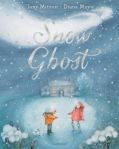 Snow Ghost by Tony Mitton [illus. Diana Mayo] (2020): Snow Ghost looks for somewhere she might rest, drifting over cities and through woods until she finds the rural home of a boy and girl who look ready to welcome her. Nice pastel art but twee couplets.
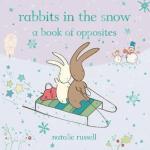 Rabbits in the Snow: A Book of Opposites by Natalie Russell (2012): A suite of different coloured rabbits explore large and small, full and empty, top and bottom, and so on. After building a snowman and sledging, they come inside for some carrot soup.
 The Snowbear by Sean Taylor [illus. Claire Alexander] (2017): Iggy and Martina build a snowman that looks more like a bear. Even though their mum has told them not to, they sledge into the woods and encounter danger, but the snow bear briefly comes alive and walks down the hill to save them. Delightful.
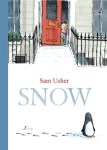
 Snow (2014) & Lost (2021) by Sam Usher: A cute pair from a set of series about a little ginger boy and his grandfather. The boy is frustrated with how slow and stick-in-the-mud his grandpa seems to be, yet he comes through with magic. In the former, it’s a snow day and the boy feels like he’s missing all the fun until zoo animals come out to frolic. There’s lots of white space to simulate the snow. In the latter, they build a sledge and help search for a lost dog. Once again, ‘wild’ animals come to the rescue. /
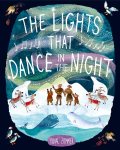 The Lights that Dance in the Night by Yuval Zommer (2021): I’ve seen Zommer speak as part of a conference panel on children’s nature writing. The Aurora Borealis unfolds across the sky above the creatures and people of the far north: “We sashayed for an Arctic fox. We swayed above an old musk ox.” I expected more anatomical accuracy (i.e., faces not flattened so that eyes appear to be next to each other on the same side of a face) but I loved how vivid and imaginative it all is.
Any snowy or icy reads (or weather) for you lately?
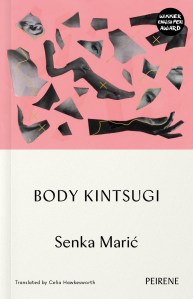
Body Kintsugi by Senka Marić: A Peirene Press Novella (#NovNov22)
This is my eleventh translated novella from Peirene Press* and, in my opinion, their best yet. It’s an intense work of autofiction about two years of hellish treatment for breast cancer, all the more powerful due to the second-person narration that displaces the pain from the protagonist and onto the reader.
This is a story about the body. Its struggle to feel whole while reality shatters it into fragments. The gash goes from the right nipple towards your back, and after five centimetres makes a gentle curve up and continues to your armpit. It’s still fresh and red.
How does the story crumbling under your tongue and refusing to take on a firm shape begin to be told?
You knew on that day, sixteen years ago, when your mother’s diagnosis was confirmed, that you’d get cancer?
Or
Ever since that day, sixteen years ago, when your mother’s diagnosis was confirmed, that you’d never get cancer?
Both are equally true.
 In 2014, just a couple of months after her husband leaves her – making her, in her early forties, a single mother to a son and a daughter – she discovers a lump in her right breast.
As she endures five operations, chemotherapy and adjuvant therapies, as well as endless testing and hospital stays, her mind keeps going back to her girlhood and adolescence, especially the moments when she felt afraid or ashamed. Her father, alcoholic and perpetually ill, made her feel like she was an annoyance to him.
Coming of age in a female body was traumatic in itself; now that same body threatens to kill her. Even as she loses the physical signs of femininity, she remains resilient. Her body will document what she’s been through: “Perfectly sculpted through all your defeats, and your victories. The scars scrawled on it are the map of your journey. The truest story about you, which words cannot grasp.”
As forthright as it is about the brutality of cancer treatment, the novella can also be creative, playful and even darkly comic.
Things you don’t want to think about:
Your children
Your boobs
Your cancer
Your bald head
Your death
Almost unbearable nausea delivers her into a new space: “Here, the only colours are black and red. You’re lost in a vast hotel. However hard you try, you can’t count the floors.” One snowy morning, she imagines she’s being visited by a host of Medusa-like women in long black dresses who minister to her. Whether it’s a dream or a medication-induced hallucination, it feels mystical, like she’s part of a timeless lineage of wise women. The themes, tone and style all came together here for me, though I can see how this book might not be for everyone. I have a college friend who’s going through breast cancer treatment right now. She’s only 40. She was diagnosed in the summer and has already had surgery and a few rounds of chemo. I wonder if this book is just what she would want to read right now … or the last thing she would want to think about. All I can do is ask.
(Translated from the Bosnian by Celia Hawkesworth) [165 pages] 
With thanks to Peirene Press for the free copy for review.
*Other Peirene Press novellas I’ve reviewed:
Mr. Darwin’s Gardener by Kristina Carlson
The Looking-Glass Sisters by Gøhril Gabrielsen
Ankomst by Gøhril Gabrielsen
Dance by the Canal by Kerstin Hensel
The Last Summer by Ricarda Huch
Snow, Dog, Foot by Claudio Morandini
Her Father’s Daughter by Marie Sizun
The Orange Grove by Larry Tremblay
The Man I Became by Peter Verhelst
Winter Flowers by Angélique Villeneuve

The Hero of This Book by Elizabeth McCracken (#NovNov22)
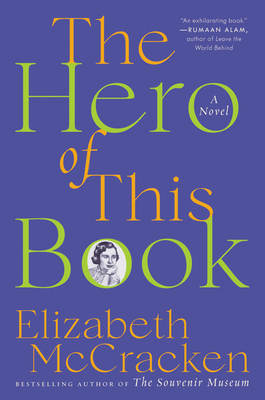
The hero of this book is Elizabeth McCracken’s mother, Natalie (1935–2018).
Is it autofiction or a bereavement memoir? Both and neither. It’s clear that the subject is her late mother, but less obvious that the first-person narrator must be McCracken or that the framework she has set up – an American writer wanders London, seeing the sights but mostly reminiscing about her mother – is other than fiction.
In August 2019, the writer rents a hotel room in Clerkenwell and plays the flaneuse around the city. Her tour takes in the London Eye, a ferry ride across the Thames from one Tate museum to another, a production of A Midsummer Night’s Dream, and so on. London had been a favourite destination for her and her mother, their final trip together falling just three years before. McCracken is so funny on the quirks of English terminology – and cuisine:
The least appetizing words in the world concern English food: salad cream, baps, butties, carvery, goujons.
Always, though, her thoughts return to her mother, whom she describes through bare facts and apt anecdotes. A twin born with cerebral palsy. A little disabled Jewish lady with unmanageable hair. An editor and writer based at Boston University. Opinionated, outspoken, optimistic; set in her ways. Delightful and maddening in equal measure – like all of us. (“All mothers are unknowable, being a subset of human beings.”)
The writer’s parents were opposites you never would have paired up. (Her father, too, is gone now, but his death is only an aside here.) Their declines were predictably hard to forecast. The New England family home has been emptied and is now on the market; an excruciating memory resurfaces from the auction of the contents.
As well as a tribute to a beloved mother and a matter-of-fact record of dealing with ageing parents and the aftermath of loss, this is a playful cross-examination of literary genres:
I hate novels with unnamed narrators. I didn’t mean to write one.
My mother was known to say with disgust, “Oh, those people who write memoirs about the worst thing that ever happened to them!” I said it, too. Some years later a terrible thing happened to me, and there was nothing to do but to write a memoir.
That was An Exact Replica of a Figment of My Imagination, about the stillbirth of her first child. As bereavement memoirs go, it’s one of the very best and still, 10 years after I read it, stands as one of my absolute favourite books, with some of the strongest last lines out there. McCracken has done it again, producing a book that, though very different in approach and style (this time reminding me most of Jenny Offill’s Weather), somehow achieves the same poignancy and earns a spot in my personal hall of fame, for the reasons you’ll see below…
The hero of this review is my mother, Carolyn (1947–2022).
I find it hard to believe that she’s been gone for three and a half weeks already. One week after her funeral, I was reading this book on my Kindle in London, waiting for a climate march to start. So many lines penetrated my numbness; all could pertain to my own mother:
[Of a bad time when her mother was in hospital with an infection] Those days were a dress rehearsal for my mother’s easy actual death seven years later.
My mother was a great appreciator. It was a pleasure to take her places, because she enjoyed herself so much and so audibly. That was her form of gratitude.
My mother all by herself was a holiday, very good at buying presents and exceptional at receiving them.
Quirky, somebody once called my mother. What a colossally condescending word: I hate it. It means you’ve decided that you don’t have to take that person seriously.
My mother’s last illness was a brain aneurysm.
The dead have no privacy left, is what I’ve decided.
The adrenaline of a busy week back in the States – meeting up with family members, writing and delivering a eulogy, packing up most of her belongings, writing thank-you notes, starting on paperwork (“sadmin”) – has long worn off and I’m back into my routines of work and volunteering and trying to make our house habitable as winter sets in. It would be easy to feel as if that middle-of-the-night phone call in late October, and everything that followed, was merely a vivid, horribly extended dream and that tomorrow she’ll pop back up in my inbox with some everyday gossip.
Reminders of her are everywhere if I look. Clothes she gave me, or I inherited from her, or she sent me the money to buy; a box of extra-strong Earl Grey teabags, left over from what we handed out along with memorial cards at the visitation; her well-worn Bible and delicate gold watch; the five boxes of journals in my sister’s basement – 150 volumes each carefully labelled with a number and date range. I have the first few and the last, incomplete one here with me now. What a trove of family stories, precious or painful, await me when I’m strong enough to read them.
With Thanksgiving coming up tomorrow – a whole holiday devoted to gratitude! nothing could more perfectly suit my mother – I’m grateful for all of those mementoes, and for the books that are getting me through. Starting with this one. [192 pages] (Read via Edelweiss)
A Contemporary Classic: Foster by Claire Keegan (#NovNov22)
This year for Novellas in November, Cathy and I chose to host one overall buddy read, Foster by Claire Keegan. I ended up reviewing it for BookBrowse. My full review is here and I also wrote a short related article on Keegan’s career and the unusual publishing history of this particular novella. Here are short excerpts from both:
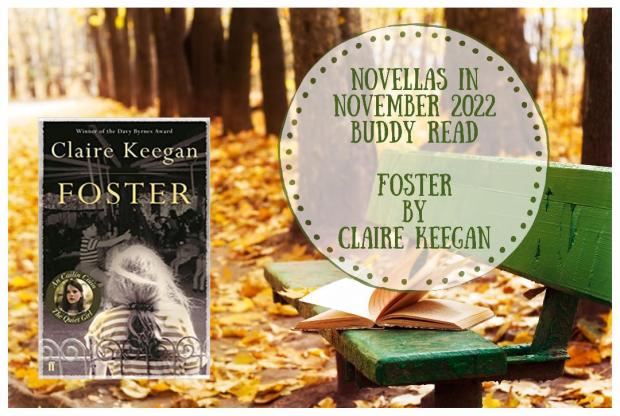
Claire Keegan’s delicate, heart-rending novella tells the story of a deprived young Irish girl sent to live with rural relatives for one pivotal summer. Although Foster feels like a timeless fable, a brief mention of IRA hunger strikers dates it to 1981. It bears all the hallmarks of a book several times its length: a convincing and original voice, rich character development, an evocative setting, just enough backstory, psychological depth, conflict and sensitive treatment of difficult themes like poverty and neglect. I finished the one-sitting read in a flood of tears, hoping the Kinsellas’ care might be enough to protect the girl from the harshness she may face in the rest of her growing-up years. Keegan unfolds a cautionary tale of endangered childhood, also hinting at the enduring difference a little compassion can make. [128 pages]
 Foster is now in print for the first time in the USA (from Grove Atlantic), having had an unusual path to publication. It first appeared in the New Yorker in 2010, but in abridged form. Keegan told the Guardian she felt the condensed version “was very well done but wasn’t the whole story. It had some of the layers taken out, but I think the heart was the same.” She herself has described Foster as a long short story; “It is definitely not a novella. It doesn’t have the pace of a novella.” Faber & Faber first published it as a standalone volume in the UK in 2010. A 2022 Irish-language film version of Foster, called The Quiet Girl (which names the main character Cait) became a favorite on the international film festival circuit.
[Edited on December 1st]
A number of you joined us in reading Foster this month:
Lynne at Fictionophile
Karen at The Simply Blog
Davida at The Chocolate Lady’s Book Reviews
Tony at Tony’s Book World
Brona at This Reading Life
Janet at Love Books Read Books
Jane at Just Reading a Book
Kate at Books Are My Favourite and Best
Carol at Reading Ladies
(Cathy also reviewed it last year.)
Our bloggers have been impressed with the spare, precise writing style and the emotional heft of this little tale. Their only complaint? The slight ambiguity of the ending. Read it yourself to find out what you think! If you’d still like to take part in the buddy read and have an hour or two free, remember you can access the original version of the story here.
The Heart of Things by Richard Holloway (#NovNov22 Nonfiction Week)
This was my sixth book by Holloway, a retired Bishop of Edinburgh whose perspective is maybe not what you would expect from a churchman – he focuses on this life and on practical and emotional needs rather than on the supernatural or abstruse points of theology. His recent work, such as Waiting for the Last Bus, also embraces melancholy in a way that many on the more evangelical end of Christianity might deem shamefully negative.
 Being a pessimist myself, though, I find that his outlook resonates. The title of this 2021 release, originally subtitled “An Anthology of Memory and Regret,” comes from Virgil’s Aeneid (“there are tears at the heart of things [sunt lacrimae rerum]”), and that context makes it clearer where he’s coming from. In the same paragraph in which he reveals that source, he defines melancholia as “sorrowing empathy for the constant defeats of the human condition.”
The book is in six thematic essays that plait Holloway’s own thoughts with lengthy quotations, especially from 19th- and 20th-century poetry: Passing – Mourning – Warring – Ruining – Regretting – Forgiving. The war chapter, though appropriate for it having just been Remembrance Day, engaged me the least, while the section on ruin sticks closely to the author’s Glasgow childhood and so seems to offer less universal value than the rest. I most appreciated the first two chapters and the one on regret, which features musings on Nietzsche’s “amor fati” and extended quotes from Borges, Housman and MacNeice.
We melancholics are prone to looking backwards, even when we know it’s not good for us; to dwelling on our losses and failures. The final chapter, then, is key, insisting on self-forgiveness because of the forgiveness modelled by Christ (in whatever way you understand that). Holloway believes in the edifying wisdom of poetry, which he calls “greater than the intention of its makers and [continuing] to reveal new meanings long after they are gone.” He’s created an unusual and pensive collection that will perform the same role.
[147 pages]
With thanks to Canongate for the free copy for review.
Being There by Jerzy Kosiński (#NovNov22 Short Classics Week)
I knew pretty much nothing about this when I went into it and that was for the best. Only after I’d finished reading it (in one sitting) did I remember that there’s a Peter Sellers film; I’m glad I wasn’t imagining him in my head the whole time.
If you keep in mind that this is a satire on certain American qualities – gullibility, the obsession with money and appearance – you can probably, like I did, excuse the thinness of the plot, the clichéd behaviour of the characters, and the sometimes dated feel (this is from 1970).
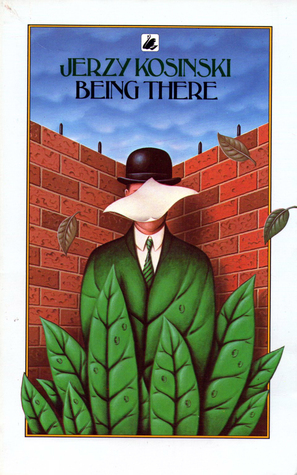 Chance is an utter innocent, an illiterate orphan; his whole history is a blank. Most of what he knows comes from television, which he watches devotedly. He lives in one half of a house; the Old Man in the other. Apart from one maid or another, he sees no one else and has never left the complex for any reason. Aside from TV, his only hobby is gardening. The house’s walled garden is his haven and his joy. When the Old Man dies, the lawyers can find no record of a hired gardener or other retainer so Chance, like Adam, is cast out of his Eden and into … suburban New York City. Where he’s promptly hit by a limo, then taken to recuperate at the home of the rich businessman’s wife who was riding in it, Elizabeth Eve (or EE) Rand.
With his gardening stories that everyone takes to be metaphorical, Chase soon wins over Wall Street and White House alike, and fields propositions from men and women just the same. He takes his cues for how to act in social situations from his extensive mental archive of TV programs. It all gets a bit silly, but the naïf at the heart of it is so sweet that I didn’t mind. He’s like Forrest Gump or any number of other simple characters who get drawn into current events (it seems like quite the Hollywood trope, in fact); just by going along with what people assume about him, he comes across as intelligent and wise. His name can’t be coincidental, with its connotations of risk, fate, or just seizing opportunities. Luckily, the satire doesn’t outstay its welcome. However, I felt that the book just stops, with no proper ending.
(Kosiński’s life story is its own stranger-than-fiction tale; the biographical essay in the back of my paperback is only about five pages long but there were many points where I wondered if it was a tongue-in-cheek appendix! The novella is autobiographical, it seems, in that the author was married to a rich American widow and moved in the kind of wealthy circles the Rands do.)
[105 pages] (Secondhand purchase)
Up at the Villa by W. Somerset Maugham (#NovNov22 Short Classics Week)
This was just what I want from a one-sitting read: surprising and satisfying, and in this case with enough suspense to keep the pages turning. When beautiful 30-year-old widow Mary Panton, staying in a villa in the hills overlooking Florence, receives two marriage proposals within the first 33 pages, I worried I was in for a boring, conventional story.
 However, things soon get much more interesting. Her suitors are Sir Edgar Swift of the Indian Civil Service, 24 years her senior and just offered a job as the governor of Bengal; and Rowley Flint, a notorious lady’s man. Edgar has to go away on business and will ask for her answer when he’s back in several days. He leaves her with a revolver to take with her if she goes out in the car. A Chekhov’s gun? Absolutely. And it’ll be up to Mary and Rowley to deal with the consequences.
I’ll avoid further details; it’s too much fun to discover those for yourself. I’ll just mention that some intriguing issues get brought in, such as political dissidence in the early days of WWII, charity vs. pity, and the double standard of promiscuity in men vs. women.
Compared to something like Of Human Bondage, sure, this 1941 novella is a minor work, but I found it hugely enjoyable and would recommend it to anyone looking for a short classic or wanting to try Maugham (from here advance to The Painted Veil and The Moon and Sixpence before trying one of the chunksters).
Some plot points are curiously similar to Downton Abbey seasons 1–3, leading me to wonder if this was actually a conscious or unconscious influence on Julian Fellowes. Mostly, though, this reminded me of The Talented Mr. Ripley. It’s a deliciously twisted little book where you find yourself rooting for people you might not sympathize with in real life.
And how’s this for a last line? “Darling, that’s what life’s for – to take risks.”
(See also Simon’s review.)
[120 pages] (Public library)
We Have Always Lived in the Castle (#NovNov22 Short Classics Week)
Novellas in November is here! Our first weekly theme is short classics. (Leave your links with Cathy, here.)
Left over from a planned second R.I.P. post that I didn’t get a chance to finish:
We Have Always Lived in the Castle by Shirley Jackson (1962)
 A few years ago for the R.I.P. challenge I read The Haunting of Hill House, which is a terrific haunted house/horror novel, a genre I almost never read. I was expecting this to be more of the same from Jackson, but instead it’s a brooding character study of two sisters isolated by their scandalous family history and the suspicion of the townspeople. Narrator Merricat (Mary Katherine Blackwood) tells us in the first paragraph that she is 18, but she sounds and acts more like a half-feral child of 10 who makes shelters in the woods for her and her cat Jonas; I wasn’t sure if I should understand her to be intellectually disabled, or willfully childish, or some combination thereof.
Her older sister Constance does everything for her and for wheelchair-bound Uncle Julian, the only family they have left after most of their relatives died of poisoning six years ago. Constance stood trial for their murder and was acquitted, but the locals haven’t let the incident go and even chant a cruel rhyme whenever Merricat comes into town for shopping: “Merricat, said Connie, would you like a cup of tea? / Oh, no, said Merricat, you’ll poison me.” Julian obsessively mulls over the details of the poisoning, building a sort of personal archive of tragedy, while in everyday life a curtain of dementia separates him from reality. When cousin Charles comes to visit, perhaps to get a share of the money they have hidden around the place, he threatens the idyll they’ve created, and Merricat starts joking about poisonous mushrooms…
I loved the offbeat voice and unreliable narration, and the way that the Blackwood house is both a refuge and a prison for the sisters. “Where could we go?” Merricat asks Constance when she expresses concern that she should have given the girl a more normal life. “What place would be better for us than this? Who wants us, outside? The world is full of terrible people.” As the novel goes on, you ponder who is protecting whom, and from what. There are a lot of great scenes, all so discrete that I could see this working very well as a play with just a few backdrops to represent the house and garden. It has the kind of small cast and claustrophobic setting that would translate very well to the stage.
Joyce Carol Oates’s afterword brings up an interesting point about how food is fetishized in Jackson’s fiction – I look forward to trying more of it. (Public library) 
Need some more ideas of short classics? Here’s a list of favourites I posted a couple of years ago, and a Book Riot list with only a couple of overlaps.
 This month I also hope to have a look through Great Short Books by Kenneth C. Davis, a selection of 58 classic and contemporary works (some of them perhaps a bit longer than our cutoff of 200 pages). It’s forthcoming from Scribner on the 22nd, but I have an e-copy via Edelweiss that I will skim.
20 Books of Summer, 8–10: Marram, Orchid Summer, and Bonsai
Halfway through my flora-themed reading challenge with less than half of the summer left to go. However, I’m actually partway through another seven relevant reads, so I’m confident I’ll get to 20. The sticking point for me, as always, is finishing what I’ve started!
Today I have brief responses to the two nature/travel quest memoirs I took with me to the Outer Hebrides, plus a forthcoming Chilean novella about how a relationship is to be memorialized.
Marram: Memories of Sea and Spider Silk by Leonie Charlton (2020)
I think I’d already downloaded this to my Kindle when I saw Charlton interviewed by the Bookshop Band on their breakfast-time variety show during the 2020 online Wigtown Book Festival. In 2017, Charlton and her friend Shuna undertook a three-week pony trek through the Outer Hebrides. Like many, they worked their way south to north, starting at Barra and finishing on Lewis (we travelled in the opposite direction on our recent trip).
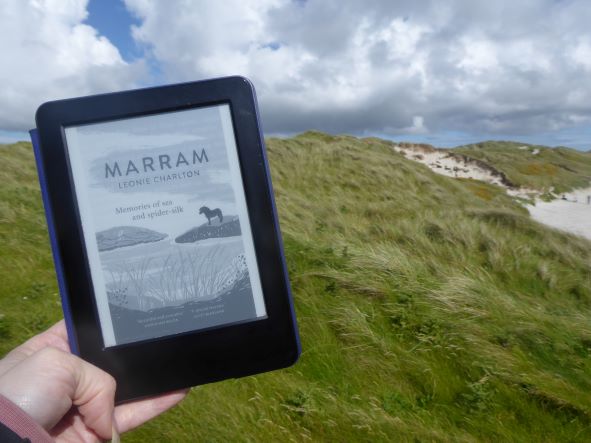
Marram grass on a Benbecula beach.
Although it was a low-key fundraising project for her daughter’s traditional music school, for Charlton there was another underlying reason. Her difficult mother, a jewellery maker, had died of brain cancer seven years before, and she had the idea of leaving beads from her mum’s collection (she’d actually nicknamed her daughter “Beady,” though for her eyes) along the route to lay her and their complicated relationship to rest. As one of her mother’s friends put it, “She was a nightmare, and wonderful, and totally impossible.”
I enjoyed the blend of topics – the amazing scenery, the rigours of the trail, the kindness of acquaintances and strangers who gave them places to camp and graze the ponies, and painful memories – and probably got more out of it because I was reading on location. Her regrets about her mother formed a larger part of the book than expected, but that wasn’t a problem for me; you might steer clear if this would be triggering, though. (Read via NetGalley)
Orchid Summer: In Search of the Wildest Flowers of the British Isles by Jon Dunn (2018)
Dunn saw all but one of Britain’s native species of orchid (51–55, depending on how you count; subspecies are still being debated) between the spring and autumn of 2016; only the ghost orchid eluded him. He alternates between his whistlestop travels, the backstory to his nature obsession, and the historical and cultural associations with orchids. “I was rapidly learning that orchids exert an influence unlike any other plant upon those who fall under their spell, he writes” (in that vein, I also recommend Susan Orlean’s The Orchid Thief).
I most enjoyed the chapters set in North Uist – where he goes to find the Hebridean marsh orchid – and his adopted home of Shetland; it’s always fun to read about somewhere I am or have been before (also including Lindisfarne). The number-driven quest seems like a peculiarly male undertaking, e.g. the similar The Butterfly Isles by Patrick Barkham, and orchids in particular are surrounded by secrecy – you have to be in the know to locate rarities, which often seem to be in roadside ditches. Dunn evades potential accusations of elitism or machismo, though, by recounting vulnerable moments: when he inadvertently strayed onto a golf course and got verbally abused; when some lads stopped their car to harass him.
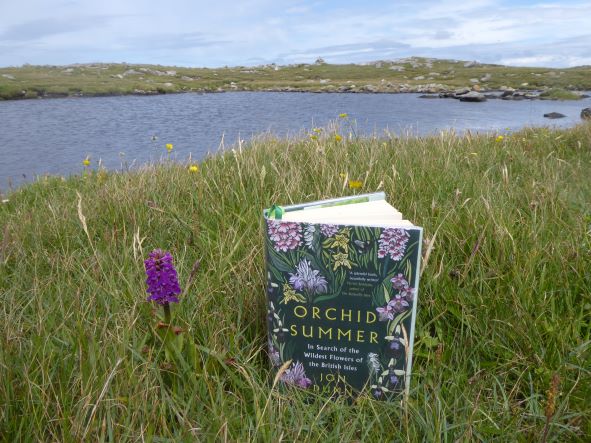
A marsh orchid at Balranald nature reserve, North Uist.
In general, this is denser with information than all but the keenest amateur botanists need, so I didn’t engage with it as much as his book about hummingbirds, The Glitter in the Green, but Dunn is a top-class nature and travel writer who really brings places and species to life on the page through his enthusiastic descriptions. Still, I wish this could have been illustrated with colour plates, as the author is an equally accomplished photographer. (Public library)
Bonsai by Alejandro Zambra (2006; 2022)
[Translated from the Spanish by Megan McDowell]
“In Emilia and Julio’s story … there are more omissions than lies, and fewer omissions than truths”
 These college students’ bond is primarily physical, with an overlay of intellectual pretentiousness: they read to each other from the likes of Proust before they go to bed. Zambra, a Chilean poet and fiction writer, zooms in and out to spotlight each one’s other connections with friends and lovers and presage how the past will lead to separate futures. Already we see Julio thinking about how this time-limited relationship will be remembered in memory and in writing. The plot of a story Zambra references in this allusion-heavy work, “Tantalia” by Macedonio Fernández, provides the title: a couple buy a small plant to signify their love, but realize that maybe wasn’t a great idea given that plants can die.
Tending a bonsai is like writing, thinks Julio. Writing is like tending a bonsai, Julio thinks.
At scarcely 60 pages, with plenty of blank space between sections, this feels most like a short story. Bonsai symbolism aside, I didn’t find much to latch onto. Zambra is playing literary games here – “Let’s say her name is or was Emilia and that his name is, was, and will be Julio,” he writes in the first paragraph – and indulging an appetite for metafiction. Drawing attention to the arbitrary nature of creation made this feel generic and soulless, like the author wasn’t committed to or fond of his characters and their story. This wasn’t my cup of tea, but fans of Open Water and Normal People who also love spare writing in translation might enjoy it.
With thanks to Fitzcarraldo Editions for the free copy for review. Bonsai will be published on August 17th.
 Bookish Beck = Rebecca Foster. American transplant to England. Freelance proofreader and book reviewer.
