May Releases, Part II (Fiction): Le Blevennec, Lynch, Puchner, Stanley, Ullmann, and Wald
A cornucopia of May novels, ranging from novella to doorstopper and from Montana to Tunisia; less of a spread in time: only the 1980s to now. Just a paragraph on each to keep things simple. I’ll catch up soon with May nonfiction and poetry releases I read.
Friends and Lovers by Nolwenn Le Blevennec (2023; 2025)
[Translated from French by Madeleine Rogers]
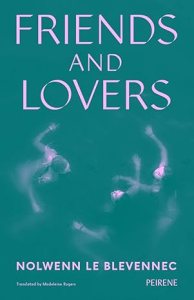 Armelle, Rim, and Anna are best friends – the first two since childhood. They formed a trio a decade or so ago when they worked on the same magazine. Now in their mid-thirties, partnered and with children, they’re all gripped by a sexual “great awakening” and long to escape Paris and their domestic commitments – “we went through it, this mutiny, like three sisters,” poised to blow up the “perfectly executed choreography of work, relationships, children”. The friends travel to Tunisia together in December 2014, then several years later take a completely different holiday: a disaster-prone stay in a lighthouse-keeper’s cottage on an island off the coast of Brittany. They used to tolerate each other’s foibles and infidelities, but now resentment has sprouted up, especially as Armelle (the narrator) is writing a screenplay about female friendship that’s clearly inspired by Rim and Anna. Armelle is relatably neurotic (a hilarious French blurb for the author’s previous novel is not wrong: “Woody Allen meets Annie Ernaux”) and this is wise about intimacy and duplicity, yet I never felt invested in any of the three women or sufficiently knowledgeable about their lives.
With thanks to Peirene Press for the free copy for review.
A Family Matter by Claire Lynch
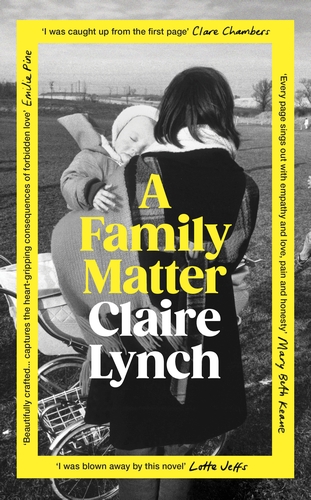 “The fluke of being born at a slightly different time, or in a slightly different place, all that might gift you or cost you.” At events for Small, Lynch’s terrific memoir about how she and her wife had children, women would speak up about how different their experience had been. Lesbians born just 10 or 20 years earlier didn’t have the same options. Often, they were in heterosexual marriages because that’s all they knew to do; certainly the only way they thought they could become mothers. In her research into divorce cases in the UK in the 1980s, Lynch learned that 90% of lesbian mothers lost custody of their children. Her aim with this earnest, delicate debut novel, which bounces between 2022 and 1982, is to imagine such a situation through close portraits of Heron, an ageing man with terminal cancer; his daughter, Maggie, who in her early forties bears responsibility for him and her own children; and Dawn, who loved Maggie desperately but felt when she met Hazel that she was “alive at last, at twenty-three.” How heartbreaking that Maggie knew only that her mother abandoned her when she was little; not until she comes across legal documents and newspaper clippings does she understand the circumstances. Lynch made the wise decision to invite sympathy for Heron from the start, so he doesn’t become the easy villain of the piece. Her compassion, and thus ours, is equal for all three characters. This confident, tender story of changing mores and steadfast love is the new Carol for our times. (Such a lovely but low-key novel was liable to make few ripples, so I’m delighted for Lynch that the U.S. release got a Read with Jenna endorsement.)
With thanks to Chatto & Windus (Penguin) for the proof copy for review.
Dream State by Eric Puchner
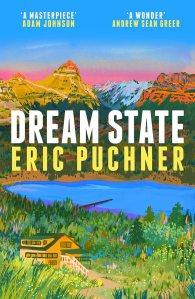 If it starts and ends with a wedding, it must be a comedy. If much of the in between is marked by heartbreak, betrayal, failure, and loss, it must be a tragedy. If it stretches towards 2050 and imagines a Western USA smothered in smoke from near-constant forest fires, it must be an environmental dystopian. Somehow, this novel is all three. The first 163 pages are pure delight: a glistening romantic comedy about the chaos surrounding Charlie and Cece’s wedding at his family’s Montana lake house in the summer of 2004. First half the wedding party falls ill with norovirus, then Charlie’s best friend, Garrett (who’s also the officiant), falls in love with the bride. Do I sound shallow if I admit this was the section I enjoyed the most? The rest of this Oprah’s Book Club doorstopper examines the fallout of this uneasy love triangle. Charlie is an anaesthesiologist, Cece a bookstore owner, and Garrett a wolverine researcher in Glacier National Park, which is steadily losing its wolverines and its glaciers. The next generation comes of age in a diminished world, turning to acting or addiction. There are still plenty of lighter moments: funny set-pieces, warm family interactions, private jokes and quirky descriptions. But this feels like an appropriately grown-up vision of idealism ceding to a reality we all must face. I struggled with a lack of engagement with the children, but loved Puchner’s writing so much on the sentence level that I will certainly seek out more of his work. Imagine this as a cross between Jonathan Franzen and Maggie Shipstead.
With thanks to Sceptre (Hodder) for the proof copy for review.
Consider Yourself Kissed by Jessica Stanley
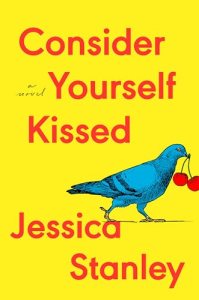 Coralie is nearing 30 when her ad agency job transfers her from Australia to London in 2013. Within a few pages, she meets Adam when she rescues his four-year-old, Zora, from a lake. That Adam and Coralie will be together is never really in question. But over the next decade of personal and political events, we wonder whether they have staying power – and whether Coralie, a would-be writer, will lose herself in soul-destroying work and motherhood. Adam’s job as a political journalist and biographer means close coverage of each UK election and referendum. As I’ve thought about some recent Jonathan Coe novels: These events were so depressing to live through, who would want to relive them through fiction? I also found this overlong and drowning in exclamation points. Still, it’s so likable, what with Coralie’s love of literature (the title is from The Group) and adjustment to expat life without her mother; and secondary characters such as Coralie’s brother Daniel and his husband, Adam’s prickly mother and her wife, and the mums Coralie meets through NCT classes. Best of all, though, is her relationship with Zora. This falls solidly between literary fiction and popular/women’s fiction. Given that I was expecting a lighter romance-led read, it surprised me with its depth. It may well be for you if you’re a fan of Meg Mason and David Nicholls.
With thanks to Hutchinson Heinemann for the proof copy for review.
Girl, 1983 by Linn Ullmann (2021; 2025)
[Translated from Norwegian by Martin Aitken]
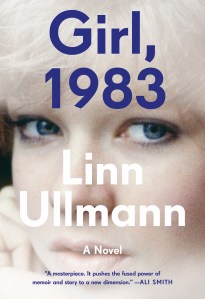 Ullmann is the daughter of actress Liv Ullmann and film director Ingmar Bergman. That pedigree perhaps accounts for why she got the opportunity to travel to Paris in the winter of 1983 to model for a renowned photographer. She was 16 at the time and spent the whole trip disoriented: cold, hungry, lost. Unable to retrace the way to her hotel and wearing a blue coat and red hat, she went to the only address she knew – that of the photographer, K, who was in his mid-forties. Their sexual relationship is short-lived and unsurprising, at least in these days of #MeToo revelations. Its specifics would barely fill a page, yet the novel loops around and through the affair for more than 250. Ullmann mostly pulls this off thanks to the language of retrospection. She splits herself both psychically and chronologically. There’s a “you” she keeps addressing, a childhood imaginary friend who morphs into a critical voice of conscience and then the self dissociated from trauma. And there’s the 55-year-old writer looking back with empathy yet still suffering the effects. The repetition made this something of a sombre slog, though. It slots into a feminist autofiction tradition but is not among my favourite examples.
With thanks to Hamish Hamilton (Penguin) for the proof copy for review.
The Bayrose Files by Diane Wald
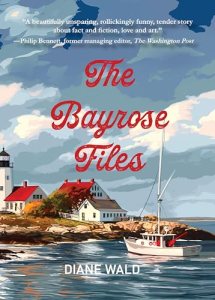 In the 1980s, Boston journalist Violet Maris infiltrates the Provincetown Home for Artists and Writers, intending to write a juicy insider’s exposé of what goes on at this artists’ colony. But to get there she has to commit a deception. Her gay friend Spencer Bayrose has a whole sheaf of unpublished short stories drawing on his Louisiana upbringing, and he offers to let her submit them as her own work to get a place at PHAW. Here Violet finds eccentrics aplenty, and even romance, but when news comes that Spence has AIDS, she has to decide how far she’ll go for a story and what she owes her friend. At barely over 100 pages, this feels more like a long short story, one with a promising setting and a sound plot arc, but not enough time to get to know or particularly care about the characters. I was reminded of books I’ve read by Julia Glass and Sara Maitland. It’s offbeat and good-natured but not top tier.
Published by Regal House Publishing. With thanks to publicist Jackie Karneth of Books Forward for the advanced e-copy for review.
A Family Matter was the best of the bunch for me, followed closely by Dream State.
Which of these do you fancy reading?
10 Days in the USA and What I Read (Plus a Book Haul)
On October 29th, I went to an evening drinks party at a neighbour’s house around the corner. A friend asked me about whether the UK or the USA is “home” and I replied that the States feels less and less like home every time I go, that the culture and politics are ever more foreign to me and the UK’s more progressive society is where I belong. I even made an offhand comment to the effect of: once my mother passed, I didn’t think I’d fly back there often, if at all. I was thinking about 5–10 years into the future; instead, a few hours after I got home from the party, we were awoken by the middle-of-the-night phone call saying my mother had suffered a nonrecoverable brain bleed. The next day she was gone.
I haven’t reflected a lot on the irony of that timing, probably because it feels like too much, but it turns out I was completely wrong: in fact, I’m now returning to the States more often. With our mom gone and our dad not really in our lives, my sister and I have gotten closer. Since October I’ve flown back twice and she’s visited here once. There are 7.5 years between us and we’ve always been at different stages of life, with separate preoccupations and priorities; I was also lazy and let my mom be the go-between, passing family news back and forth. Now there’s a sense that we are all we have, and we have to stick together.


So it was doubly important for me to be there for my sister’s graduation from nursing school last week. If we follow each other on Facebook or Instagram, you will have already seen that she finished at the top of her cohort and was one of just two students recognized for academic excellence out of the college’s over 200 graduates – and all of this while raising four children and coping with the disruption of Mom’s death seven months ago. There were many times when she thought she would have to pause or give up her studies, but she persisted and will start work as a hospice nurse soon. We’re all as proud as could be, on our mom’s behalf, too.
The trip was a mixture of celebratory moments and sad duties. We started the process of going through our mom’s belongings and culling what we can, but the files, photos and mementoes are the real challenge and had to wait for another time. There were dozens of books I’d given her for birthdays and holidays, mostly by her favourite gentle writers – Gerald Durrell, Jan Karon, Gervase Phinn – invariably annotated with her name, the date and occasion. I looked back through them and then let them go.


Between my two suitcases I managed to bring back the rest of her first box of journals (there are 150 of them in total, spanning 1989 to 2022), and I’m halfway through #4 at the moment. We moved out of my first home when I was nine, and I don’t have a lot of vivid memories of those early years. But as I read her record of everyday life it’s like I’m right back in those rooms. I get new glimpses of myself, my dad, my sister, but especially of her – not as my mother, but as a whole person. As a child I never realized she was depressed: distressed about her job situation, worried over conflicts with her siblings and my sister, coping with ill health (she was later diagnosed with fibromyalgia) and resisting ageing. For as strong as her Christian faith was, she was really struggling in ways I couldn’t appreciate then.

I hope that later journals will introduce hindsight, now that she’s not around to give a more circumspect view. In any case, they’re an incredible legacy, a chance for me to relive much of my life that I otherwise would only remember in fragments through photographs, and perhaps have a preview of what I can expect from the course of our shared kidney disease.
What I Read
 The Housekeepers by Alex Hay – A historical heist novel with shades of Downton Abbey, this comes out in July. Reviewed for Shelf Awareness.

Cowboys Are My Weakness by Pam Houston – Terrific: stark, sexy stories about women who live out West and love cowboys and hunters (as well as dogs and horses). Ten of the stories are in the first person, voiced by women in their twenties and thirties who are looking for romance and adventure and anxiously pondering motherhood (“by the time you get to be thirty, freedom has circled back on itself to mean something totally different from what it did at twenty-one”). The remaining two are in the second person, which I always enjoy. The occasional Montana setting reminded me of stories I’ve read by Maile Meloy and Maggie Shipstead, while the relationship studies made me think of Amy Bloom’s work. 

The Harpy by Megan Hunter – Read for Literary Wives club. Review coming up on Monday. 

The Lake Shore Limited by Sue Miller – A solid set of narratives alternating between the POVs of four characters whose lives converge around a play inspired by the playwright’s loss of her boyfriend on one of the hijacked planes on 9/11. Her mixed feelings about him towards the end of his life and about being shackled to his legacy as his ‘widow’ reverberate in other sections: one about the lead actor, whose wife has ALS; and one about a widower the playwright is being set up with on a date. Fitting for a book about a play, the scenes feel very visual. A little underpowered, but subtlety is to be expected from a Miller novel. She, Anne Tyler and Elizabeth Berg write easy reads with substance, just the kind of book I want to take on an airplane, as indeed I did with this one. I read the first 2/3 on my travel day (although with the 9/11 theme this maybe wasn’t the best choice!).
 For apposite plane reading, I also started Fly Girl by Ann Hood, her memoir of being a TWA flight attendant in the 1970s, the waning glory days of air travel. I’ve read 10 or so of Hood’s books before from various genres, but lost interest in the minutiae of her job applications and interviews. Another writer would probably have made a bigger deal of the inherent sexism of the profession, too. I read 30%.
 Hello Beautiful by Ann Napolitano – I knew I wanted to read this even before it was Oprah’s 100th book club pick. It’s a family story spanning three decades and focusing on the Padavanos, a working-class Italian American Chicago clan with four daughters: Julia, Sylvie, and twins Cecilia and Emeline. Julia meets melancholy basketball player William Waters while at Northwestern in the late 1970s and they marry and have a daughter; Sylvie, a budding librarian, makes out with boys in the stacks until her great romance comes along; Cecilia is an artist and Emeline loves babies and manages a nursery. More than once a character think of their collective story as a “soap opera,” and there’s plenty of melodrama here – an out-of-wedlock pregnancy, estrangements, a suicide attempt, a coming out, stealing another’s man – as well as far-fetched coincidences, including the two major deaths falling on the same day as a birth and a reconciliation.
There is such warmth and intensity to the telling, and brave reckoning with mental illness, prejudice and trauma, that I excused flaws such as dwelling overly much in characters’ heads through close third person narration, to the detriment of scenes and dialogue. I love sister stories in general, and the subtle echoes of Leaves of Grass and Little Women (the connections aren’t one to one and you’re kept guessing for most of the book who will be the Beth) add heft. I especially appreciated how a late parent is still remembered in daily life after 30 years have passed. This is, believe it or not, the second basketball novel I’ve loved this year, after Tell the Rest by Lucy Jane Bledsoe.
I always try to choose thematically appropriate reads, so I also started:
 Circling My Mother by Mary Gordon – A memoir she began after her nonagenarian mother’s death with dementia. Intriguingly, the structure is not chronological but topic by topic, built around key relationships: so far I’ve read “My Mother and Her Bosses” and “My Mother: Words and Music.”
Grave by Allison C. Meier – My sister and I made a day trip up to my mother’s grave for the first time since her burial. She has a beautiful spot in a rural cemetery dating back to the 1780s, but it’s in full sun and very dry, so we tried to cheer up the dusty plot with some extra topsoil and grass seed, marigolds, and a butterfly flag.


 Meier is a cemetery tour guide in Brooklyn, where she lives. In the third of the e-book I’ve read so far, she looks at American burial customs, the lack of respect for Black and Native American burial sites, and the rise of garden cemeteries such as Mount Auburn in Cambridge, Massachusetts. I’ve been reading death-themed books for over a decade and have delighted in exploring cemeteries (including Mount Auburn, as part of my New England honeymoon) for even longer, so this is right up my street and one of the better Object Lessons monographs.
What I Bought
I traded in most of my mother’s books at 2nd & Charles and Wonder Book and Video but, no surprise, promptly spent the store credit on more secondhand books. Thanks to clearance shelves at both stores, I only had to chip in another $12.25 for the below haul, which also covered two Dollar Tree purchases (I felt bad for Susan Minot having signed editions end up remaindered!). Some tried and true authors here, as well as novelties to test out, with a bunch of short stories and novellas to read later in the year.


20 Books of Summer, #19–20: Heat & The Gospel of Trees
Finishing off my summer reading project with a stellar biography-cum-travel book about Italian cuisine and a family memoir about missionary work in Haiti in the 1980s.
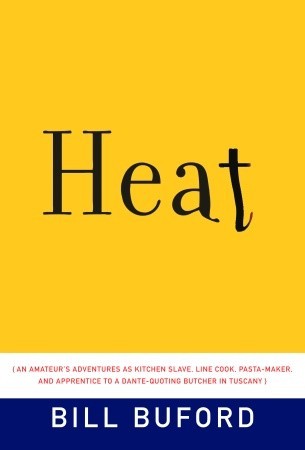
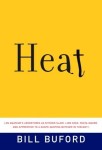
Heat by Bill Buford (2006)
(20 Books of Summer, #19) The long subtitle gives you an outline of the contents: “An Amateur’s Adventures as Kitchen Slave, Line Cook, Pasta-Maker, and Apprentice to a Dante-Quoting Butcher in Tuscany.” If Buford’s name sounds familiar, it’s because he was the founding editor of Granta magazine and publisher at Granta Books, but by the time he wrote this he was a staff writer for the New Yorker.
 Mario Batali is the book’s presiding imp. In 2002–3, Buford was an unpaid intern in the kitchen of Batali’s famous New York City restaurant, Babbo, which serves fancy versions of authentic Italian dishes. It took 18 months for him to get so much as a thank-you. Buford’s strategy was “be invisible, be useful, and eventually you’ll be given a chance to do more.”
In between behind-the-scenes looks at frantic or dull sessions of food prep (“after you’ve made a couple thousand or so of these little ears [orecchiette pasta], your mind wanders. You think about anything, everything, whatever, nothing”), Buford traces Batali’s culinary pedigree through Italy and London, where Batali learned from the first modern celebrity chef, Marco Pierre White, and gives pen portraits of the rest of the kitchen staff. At first only trusted with chopping herbs, the author develops his skills enough that he’s allowed to work the pasta and grill stations, and to make polenta for 200 for a benefit dinner in Nashville.
Later, Buford spends stretches of several months in Italy as an apprentice to a pasta-maker and a Tuscan butcher. His obsession with Italian cuisine is such that he has to know precisely when egg started to replace water in pasta dough in historical cookbooks, and is distressed when the workers at the pasta museum in Rome can’t give him a definitive answer. All the same, the author never takes himself too seriously: he knows it’s ridiculous for a clumsy, unfit man in his mid-forties to be entertaining dreams of working in a restaurant for real, and he gives self-deprecating accounts of his mishaps in the various kitchens he toils in:
to stir the polenta, I was beginning to feel I had to be in the polenta. Would I finish cooking it before I was enveloped by it and became the darkly sauced meaty thing it was served with?
Compared to Kitchen Confidential, I found this less brash and more polished. You still get the sense of macho posturing from a lot of the figures profiled, but of course this author is not going to be in a position to interrogate food culture’s overweening masculinity. However, he does take a stand in support of small-scale food production:
Small food: by hand and therefore precious, hard to find. Big food: from a factory and therefore cheap, abundant. Just about every preparation I learned in Italy was handmade and involved learning how to use my own hands differently. … Food made by hand is an act of defiance and runs contrary to everything in our modernity. Find it; eat it; it will go.
This is exactly what I want from food writing: interesting nuggets of trivia and insight, a quick pace, humor, and mouthwatering descriptions. If the restaurant world lures you at all, you must read this one.
- Nice connections with my other summer reading: there are mentions of both Eric Asimov and Ruth Reichl visiting Babbo in their capacity as food critics for the New York Times.
- This also induced a weird case of reverse déjà vu: a book I reviewed last summer for BookBrowse, Hungry by Jeff Gordinier, is so similar that it must have been patterned on Heat: the punchy one-word title; a New York journalist follows an internationally known chef (in that case, René Redzepi) and surveys culinary trends.
 I was delighted to learn that this year Buford released a sequel of sorts, this one about French cuisine: Dirt. It’s on my wish list.
Source: From my dad
My rating: 
The Gospel of Trees by Apricot Irving (2018)
(20 Books of Summer, #20) Irving’s parents were volunteer missionaries to Haiti between 1982 and 1991, when she was aged six to 15. Her father, Jon, was trained as an agronomist, and his passion was for planting trees to combat the negative effects of deforestation on the island (erosion and worsened flooding). But in a country blighted by political unrest, AIDS and poverty, people can’t think long-term; they need charcoal to light their stoves, so they cut down trees.
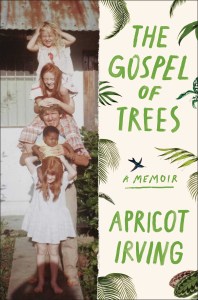 Along with an agricultural center, the American Baptist missionaries were closely associated with a hospital, Hôpital le Bon Samaritain, run by amateur archaeologist Dr. Hodges and his family. Although Apricot and her two younger sisters were young enough to adapt easily to life in a developing country, they were disoriented each time the family returned to California in between assignments. Their bonds were shaky due to her father’s temper, her parents’ rocky relationship, and the jealousy provoked over almost adopting a Haitian baby girl.
Irving drew on letters and cassette tape recordings, newsletters, and journals (her parents’ and her own) to recreate the decade in Haiti and the years since. This debut book was many years in the making – she started the project in 2001. “I inherited my father’s anger and his perfectionism. Haiti was a wound, an unhealed scab that I was afraid to pick open. But I knew that unless I faced that broken history, my own buried grief, like my father’s, would explode ways I couldn’t predict.”
She and her parents returned to the country after the 2010 earthquake: they were volunteers with a relief organization, while she reported for the This American Life radio program. I loved the ambivalent portrait of Haiti and, especially, of Jon, but couldn’t muster up much interest in secondary characters, hoped for more discussion of (loss of) faith, and thought the book about 80 pages too long. Irving writes wonderfully, though, especially when musing on Haiti’s pre-Columbian history; I’d gladly read a nature book about her life in Oregon, or a novel – in tone this reminded me of The Poisonwood Bible.
Some favorite lines:
If, like my father, you suffer from a savior complex, Haiti is a bleak assignment, but if you are able to enter it unguarded, shielded only by curiosity, you will find the sorrows entangled with a defiant joy.
My family had moved to Haiti to try to help, but instead, we learned our limitations. Failure can be a wise friend. We felt crushed at times; found it difficult to breathe; and yet the experience carved into each of us an understanding of loss, the weight of compassion. We learned how small we were when measured against the world’s great sorrow.
Source: Bargain book from Amazon last year
My rating: 
And a DNF:
 We Were the Mulvaneys by Joyce Carol Oates (oats!)
I gave up after 38 pages. I’ve long meant to try Oates, but her oeuvre is daunting. An Oprah’s Book Club selection seemed like a safe bet. I found the quirky all-American family saga approach somewhat similar to John Irving or Richard Russo, but Judd’s narration is annoyingly perky, and already I was impatient to find out what happened to his sister Marianne on Valentine’s Day 1976. I’ll give it a few years and try again. In the meantime, maybe I’ll try Oates in a different genre.
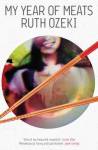
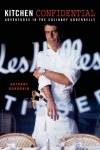
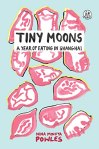
Looking back, Heat was the clear highlight of my 20 Books, closely followed by My Year of Meats by Ruth Ozeki. I also really enjoyed the foodoirs by Anthony Bourdain, Nina Mingya Powles and Luisa Weiss. It’s funny how much I love foodie lit given that I don’t cook. As Alice Steinbach puts it, “while we all like to eat, we like it more when someone else does the cooking.”
 Of course, not all of my selections were explicitly food-related; others simply had food words in their titles (or, as above, in the author’s name). Of these, my favorite was a reread, Ella Minnow Pea. Ideally, I would not have had to include my two skims and one partial read in the total, but I ran out of time in August to substitute in three more books. I’m happy enough with my showing this year, but next time I plan to build in more flexibility – or cheating, whichever you wish to call it – to ensure that I manage 20 solid reads.
I already have a color theme planned for 20 Books of Summer 2021! Here are 15 books that I own, mostly fiction, that would fit the bill:
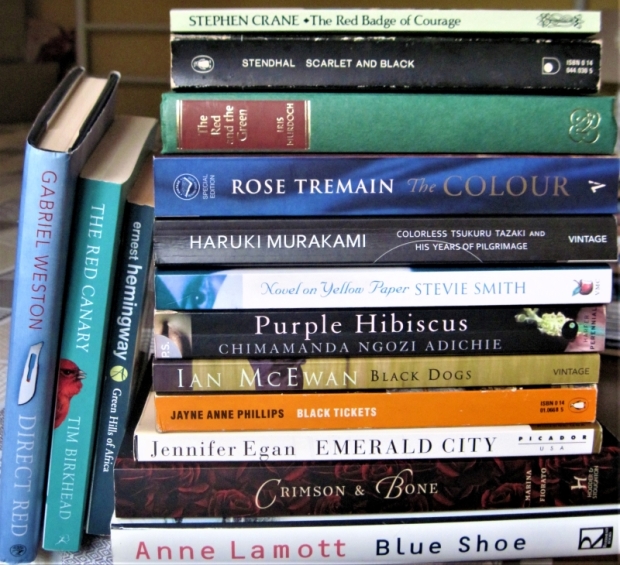
As wildcard selections and/or substitutes, I will also allow:
- Books with “light”, “dark”, or “bright” in the title
- Kindle or library books, though I’d like the focus to remain on print books I own.
- If I’m really stuck, book covers/jackets in a rainbow of colors. I’ll skip orange because Penguin paperbacks are too plentiful in my book collection, but I have some nice red, yellow, green, blue, purple and pink covers to choose from.
Four June Releases (Fiction & Poetry): Bennett, Gabrielsen, Kwek and Watts
(A rare second post in a day from me, to make way for tomorrow’s list of the best books of the first half of the year.) My four new releases for June are a novel about the complications of race and sexuality in 1950s–80s America, a novella in translation about a seabird researcher struggling through a time of isolation, and two new poetry books from Carcanet Press. As a bonus just in time for Pride Month, I finish with a mini write-up of The Book of Queer Prophets, an anthology of autobiographical essays that was published late last month.
The Vanishing Half by Brit Bennett
 Like some lost mid-career gem from Toni Morrison, this novel is meaty with questions of racial and sexual identity and seems sure to follow in the footsteps of Ruby and An American Marriage with a spot in Oprah’s book club and on Barack Obama’s summer reading list.
It’s the story of light-skinned African American twins Stella and Desiree Vignes, and how their paths divide in 1954. Both are desperate to escape from Mallard, Louisiana, where their father was lynched and their mother cleans white people’s houses. Desiree works in fingerprinting for the FBI in Washington, D.C., but in 1968 leaves an abusive marriage to return to Mallard with her dark-skinned daughter, Jude Winston. Stella, on the other hand, has been passing as white for over a decade. She was a secretary for the man who became her husband, Blake Sanders, and now lives a life of comfort in a Los Angeles subdivision.
The twins’ decisions affect the next generation, too. Both have one daughter. Jude goes to college in L.A., where she meets and falls in love with photographer Reese (born Therese), who is, in a different sense, “passing” until he can afford the surgery that will align his body with his gender. In a coincidence that slightly strains belief, Jude runs into Stella’s daughter, Kennedy, and over the next seven years the cousins – one a medical student; the other an actress – continue to meet occasionally, marvelling at how two family lines that started in Mallard, a tiny town that doesn’t even exist anymore, could have diverged so dramatically.
This is Bennett’s second novel, after The Mothers, which I’m keen to read. It’s perceptive and beautifully written, with characters whose struggles feel genuine and pertinent. Though its story line ends in the late 1980s, it doesn’t feel passé at all. The themes of self-reinvention and running from one’s past resonate. I expected certain characters to be forced into moments of reckoning, but the plot is a little messier than that – and that’s more like real life. A shoo-in for next year’s Women’s Prize list.
My rating: 
My thanks to Dialogue Books for the free copy for review.
Ankomst by Gøhril Gabrielsen (2017)
[Translated from the Norwegian by Deborah Dawkin]
 The unnamed narrator of Gabrielsen’s fifth novel is a 36-year-old researcher working towards a PhD on the climate’s effects on populations of seabirds, especially guillemots. During this seven-week winter spell in the far north of Norway, she’s left her three-year-old daughter behind with her ex, S, and hopes to receive a visit from her lover, Jo, even if it involves him leaving his daughter temporarily. In the meantime, they connect via Skype when signal allows. Apart from that and a sea captain bringing her supplies, she has no human contact.
Daily weather measurements and bird observations still leave too much time alone in a cramped cabin, and this starts to tell in the protagonist’s mental state: she’s tormented by sexual fantasies, by memories of her life with S, and by the thought of a local family, the Berthelsens, who experienced a disastrous house fire in 1870. More and more frequently, she finds herself imagining what happened to Olaf and Borghild Berthelsen. Solitude and this growing obsession with ghosts of the past make her start to lose her grip on reality.
I’d encountered an unreliable narrator and claustrophobic setting before from Gabrielsen with her second novel, The Looking-Glass Sisters. Extreme weather and isolation account for this being paired with Snow, Dog, Foot by Claudio Morandini as the first two books in Peirene’s 2020 “Closed Universe” trilogy. I was also reminded of Sarah Moss’s Night Waking. However, I found this novella’s metaphorical links – how seabirds and humans care for their young; physical and emotional threats; lowering weather and existential doom – too obvious.
My rating:
My thanks to Peirene Press for the free copy for review.
Moving House by Theophilus Kwek
 This is the first collection of the Chinese Singaporean poet’s work to be published in the UK. Infused with Asian history, his elegant verse ranges from elegiac to romantic in tone. Many of the poems are inspired by historical figures and real headlines. There are tributes to soldiers killed in peacetime training and accounts of high-profile car accidents; “The Passenger” is about the ghosts left behind after a tsunami. But there are also poems about the language and experience of love. I also enjoyed the touches of art and legend: “Monologues for Noh Masks” is about the Pitt-Rivers Museum collection, while “Notes on a Landscape” is about Iceland’s geology and folk tales. In most places alliteration and enjambment produce the sonic effects, but there are also a handful of rhymes and half-rhymes, some internal.
My individual favorite poems included “Prognosis,” “Sophia” (made up of two letters Sir Thomas Stamford Raffles writes home to his wife while surveying in Singapore), and “Operation Thunderstorm.” As an expat and something of a nomad, I especially loved the title poem, which comes last and explains the cover image: “every house has a skeleton – / while the body learns it must carry less / from place to place, a kind of tidiness / that builds, hardens. Some call it fear, // of change, or losing what we cannot keep. / Others, experience.” Recommended to fans of Mary Jean Chan, Nausheen Eusuf, Kei Miller and Ocean Vuong.
My rating:
My thanks to Carcanet Press for the PDF copy for review.
Red Gloves by Rebecca Watts
 I noted the recurring comparison of natural and manmade spaces; outdoors (flowers, blackbirds, birds of prey, the sea) versus indoors (corridors, office life, even Emily Dickinson’s house in Massachusetts). The style shifts from page to page, ranging from prose paragraphs to fragments strewn across the layout. Most of the poems are in recognizable stanzas, though these vary in terms of length and punctuation. Alliteration and repetition (see, as an example of the latter, her poem “The Studio” on the TLS website) take priority over rhymes. I was reminded of Elizabeth Bishop in places, while “Whereas” had me thinking of Stephen Dunn’s collection of that name (Layli Long Soldier also has a poetry book of the same title). A few of my individual favorite poems were “Surveillance,” “Building” and “Admission” (on a medical theme: “What am I afraid of? / The breaching of skin. / Violation of laws that / separate outside from in. / Liquidation of the thing / I call me.”).
My rating:
My thanks to Carcanet Press for the PDF copy for review.
And a bonus for Pride Month:
The Book of Queer Prophets: 24 Writers on Sexuality and Religion, edited by Ruth Hunt
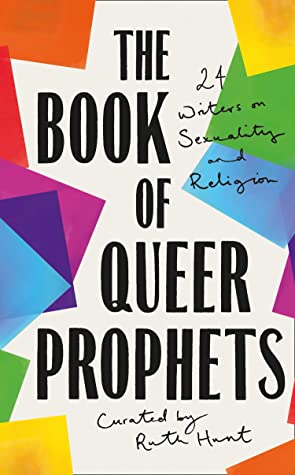 There isn’t, or needn’t be, a contradiction between faith and queerness, as the authors included in this anthology would agree. Many of them are stalwarts at Greenbelt, a progressive Christian summer festival – Church of Scotland minister John L. Bell even came out there, in his late sixties, in 2017. I’m a lapsed regular attendee, so a lot of the names were familiar to me, including those of poets Rachel Mann and Padraig O’Tuama.
Most of the contributors are Christian, then, including ordained priests like Desmond Tutu’s daughter, Mpho, and LGBT ally Kate Bottley, but we also hear from Michael Segalov, a gay Jewish man in London, and from Amrou Al-Kahdi (author of Unicorn: The Memoir of a Muslim Drag Queen), who describes the affirmation they found in the Sufi tradition. Dustin Lance Black tells of the exclusion LGBT Mormons still encounter.
Jarel Robinson-Brown addresses his lament on mistreatment to his nephew, as James Baldwin did in “My Dungeon Shook” (in The Fire Next Time). Tamsin Omond recounts getting married to Melissa on a London bridge in the middle of an Extinction Rebellion protest. Erin Clark, though bisexual, knows she can pass as straight because she’s marrying a man – so is she ‘gay enough?’ Two trans poets write of the way cathedrals drew them into faith. The only weaker pieces are by Jeanette Winterson (there’s nothing new if you’ve read her memoir) and Juno Dawson (entirely throwaway; ‘I’m an atheist, but it’s okay to be religious, too’).
Again and again, these writers voice the certainty that they are who God means them to be. A few of them engage with particular passages from the Bible, offering contextual critiques or new interpretations, but most turn to scripture for its overall message of love and justice. Self-knowledge is a key component of their search for truth. And the truth sets people free.
My rating:
I read an e-copy via NetGalley.
What recent releases can you recommend?
Doorstopper of the Month: A Reread of The Poisonwood Bible (1998)
“The fallen Congo came to haunt even our little family, we messengers of goodwill adrift on a sea of mistaken intentions.”
You may have gathered by now that I struggle with rereading. Often I find that on a second reading a book doesn’t live up to my memory of it – last year I reread just four books, and I rated each one a star lower than I had the first time. But that wasn’t the case with my September book club book, Barbara Kingsolver’s The Poisonwood Bible, which I’ve just flown through in 11 days. I first read it in the spring of 2002 or 2003, so maybe it’s that I’d allowed enough time to pass for it to be almost completely fresh – or that I was in a better frame of mind to appreciate its picture of harmful ideologies in a postcolonial setting. In any case, this time it struck me as a masterpiece, and has instantly leapt onto my favorites list.
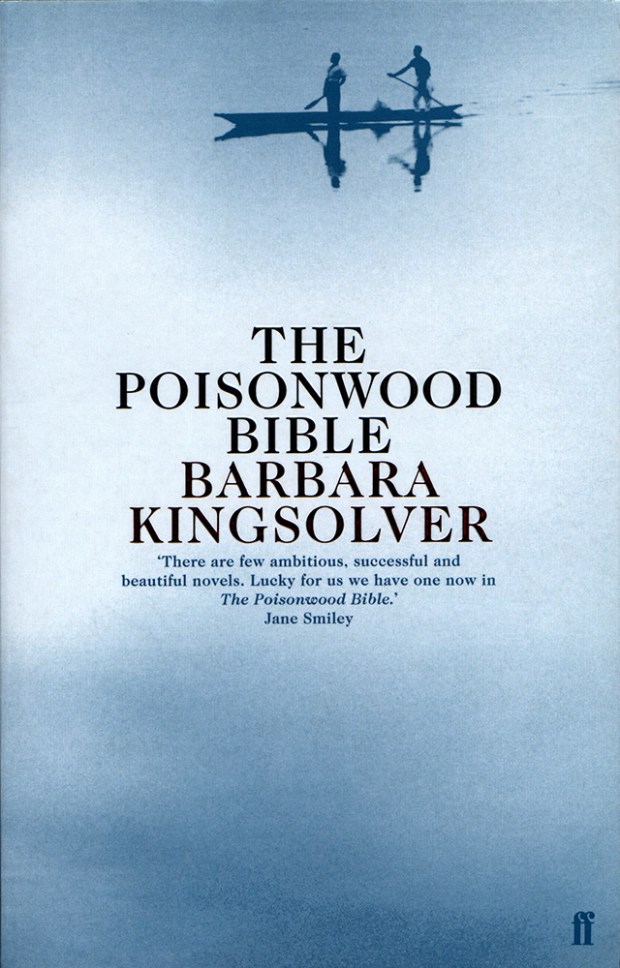
Here’s what I’d remembered about The Poisonwood Bible after the passage of 16–17 years:
- It’s about a missionary family in Africa, and narrated by the daughters.
- One of the sisters marries an African.
- The line “Nathan was made frantic by sex” (except I had it fixed incorrectly in my mind; it’s actually “Nathan was made feverish by sex”).
Everything else I’d forgotten. Here’s what stood out on my second reading:
- Surely one of the best opening lines ever? (Though technically there’s a prologue that comes before it.) “We came from Bethlehem, Georgia, bearing Betty Crocker cake mixes into the jungle.”
- The book is actually narrated in turns by the wife and four daughters of Southern Baptist missionary Nathan Price, who arrives in the Congo with his family in 1959. These five voices are a triumph of first-person narration, so distinct and arising organically from the characters’ personalities and experiences. The mother, Orleanna, writes from the future in despondent isolation – a hint right from the beginning that this venture is not going to end well. Fifteen-year-old Rachel is a selfish, ditzy blonde who speaks in malapropisms and period slang and misses everything about American culture. Leah, one of the 13-year-olds, is whip-smart and earnest; she idolizes their father and echoes his religious language. Her twin, Adah, who was born with partial paralysis, rarely speaks but has an intricate inner life she expresses through palindromes, cynical poetry and plays on words. And Ruth May, just five years old, sees more than she understands and sets it all across plainly but wittily.
- Nathan’s arrogant response to the ‘native customs’ is excruciating. His first prayer, spoken to bless the meal the people of Kilanga give in welcome, quickly becomes a diatribe against nakedness, and he later rails against polygamy and witch doctors and tries to enforce child baptism. When he refuses to take their housekeeper Mama Tataba’s advice on planting, all of the seeds he brought from home wash away in the first rainstorm. On a second attempt he meekly makes the raised beds she recommended, and keeps away from the poisonwood that made him break out in a nasty rash. This garden he plants is a metaphor for control versus adaptation.
- Brother Fowles, Nathan’s predecessor at the mission, is proof that Christianity doesn’t have to be a haughty rampage. He respects Africans enough to have married one, and his religion is a playful, elastic one built around love and working alongside creation.
- The King James Bible (plus Apocrypha, for which Nathan harbors a strange fondness) provides much of the book’s language and imagery, as well as the section headings. Many of these references come to have (sometimes mocking) relevance. Kingsolver also makes reference to classics of Africa-set fiction, like Chinua Achebe’s Things Fall Apart and Joseph Conrad’s Heart of Darkness.
- Africa is a place of many threats – malaria and dysentery, snakes in the chicken house, swarms of ants that eat everything in their path, corruption, political coups and assassinations – not least the risk of inadvertently causing grave cultural offense.
- The backdrop of the Congo’s history, especially the declaration of independence in 1960 and the U.S.-led “replacement” (by assassination) of its first prime minister, Patrice Lumumba, with the dictator Mobutu, is thorough but subtle, such that minimal to no Googling is required to understand the context. (Only in one place, when Leah and Rachel are arguing as adults, does Kingsolver resort to lecturing on politics through dialogue, as she does so noticeably in Unsheltered.)
- Names are significant, as are their changes. With the end of colonialism Congo becomes Zaire and all its cities and landmarks are renamed, but the change seems purely symbolic. The characters take on different names in the course of the book, too, through nicknames, marriage or education. Many African words are so similar to each other that a minor mispronunciation by a Westerner changes the meaning entirely, making for jokes or irony. And the family’s surname is surely no coincidence: we are invited to question the price they have paid by coming to Africa.
- We follow the sisters decades into the future. “Africa has a thousand ways to get under your skin,” Leah writes; “we’ve all ended up giving up body and soul to Africa, one way or another.” Three of the four end up staying there permanently, but disperse into different destinies that seem to fit their characters. Even those Prices who return to the USA will never outrun the shadow the Congo has left on their lives.
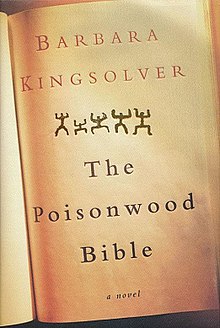 What an amazing novel about the ways that right and wrong, truth and pain get muddied together. Some characters are able to acknowledge their mistakes and move on, while others never can. As Adah concludes, “We are the balance of our damage and our transgressions.”
I worried it would be a challenge to reread this in time to hand it over for my husband to take on his week-long field course in Devon, but it turned out to be a cinch. That’s the mark of success of a doorstopper for me: it’s so engrossing you hardly notice how long the book is. I think this will make for our best book club discussion yet. I can already think of a few questions to ask – Is it fair that Nathan never gets to tell his side of the story? Which of the five voices is your favorite? Who changes and who stays the same over the course of the book? – and I’m sure I’ll find many more resources online since this was an Oprah’s Book Club pick too.
English singer-songwriter Anne-Marie Sanderson’s excellent Book Songs, Volume 1 EP includes the song “Poisonwood.” The excerpted lyrics are below, with direct quotes from the text in bold.

Our Father speaks for all of us
Our Father knows what’s best for us as well
He planted a garden where poisonwood grew
He cut down the orchids cos none of us knew
that the seeds that filled his pockets
would grow and grow without stopping
his beans, his Kentucky Wonders
played their part in tearing us asunder.
Our mother suffered through all of this
Our mother carried the guilt
Carry us, marry us, ferry us, bury us
Carry us, bury us with the poisonwood.
Page count: 615
My rating:
Polishing off My 20 Books of Summer with Hay, Jones & Markham
I finished off strong with a few books I’ve been meaning to read for months or years.
Late Nights on Air by Elizabeth Hay (2007)
 (This was a Twitter buddy read with Naomi of Consumed by Ink and Penny of Literary Hoarders.) I read my first novel by Hay, A Student of Weather, last year. It was wonderfully rewarding even though it took me a month to read. By contrast, I read the Giller Prize-winning Late Nights on Air in half that time. Most of it is set in 1975–7 in Yellowknife, a small city in Canada’s Northwest Territories. Here winter lasts for eight months and you can still meet with snow and frozen lakes in early July. A tight-knit cast gathers around the local radio station: Harry and Gwen, refugees from Ontario starting new lives; Dido, an alluring Dutch newsreader; Ralph, the freelance book reviewer; menacing Eddie; and pious Eleanor.
Everyone is in love with everyone else, so you get these layers of unrequited romance and a sense of exposure: not just to the elements, but to the vulnerabilities of admitting one’s feelings and risking professional failure. The novel is also about appearances and assumptions – “You don’t look anything like how you sound,” Gwen says to Harry – and the dangers of obsession. Four of the station employees set out one summer to recreate the six-week journey of Arctic explorer John Hornby, a trip that ends up being as wondrous as it is fraught. Hay’s foreshadowing is a bit heavy-handed, and I found the final chapters after the expedition a slight letdown, but overall this is a marvellous story of quiet striving and dislocation. I saw bits of myself in each of the characters, and I loved the extreme setting, both mosquito-ridden summer and bitter winter. I need to read the rest of Hay’s oeuvre stat.
Favorite passages:
Harry’s professional advice to Gwen: “Radio was like poetry, he told her. At its best it could be, while television was like a blockbuster novel: one made you think and feel, the other dulled your mind. … ‘To be any good you have to believe it’s hard. It’s called creative tension. … And you won’t be any good until you’re dedicated to something outside yourself.’ … I learned that a mistake is just something you go on from.”
“Something blossoms in an unlikely place. An oasis of trees miles above the treeline. An arctic river warmer than any other water they’d come upon. The four of them bathed in the waters of the Thelon, wading out into it, almost swimming. On shore they towelled themselves dry and dressed, and there was no feeling to equal the splendour of warm clothes on river-cold skin.”
My rating: 
I ran out of time for Half of a Yellow Sun by Chimamanda Ngozi Adichie so substituted in…
An American Marriage by Tayari Jones (2018)
(If it’s good enough for Barack Obama and Oprah Winfrey, it’s good enough for me!)
 The title feels like an echo of An American Tragedy. It’s both monolithic and generic, as if saying: Here’s a marriage; make of it what you will. Is it representative of the average American situation, or is it exceptional? Roy and Celestial only get a year of happy marriage before he’s falsely accused of rape and sentenced to 12 years in prison in Louisiana. Through their alternating first-person narration and their letters back and forth while Roy is incarcerated, we learn more about this couple: how their family circumstances shaped them, how they met, and how they drift apart as Celestial turns to her childhood friend, Andre, for companionship. When Roy is granted early release, he returns to Georgia to find Celestial and see what might remain of their marriage. I ached for all three main characters: It’s an impossible situation. The novel ends probably the only way it could, on a realistic yet gently optimistic note. Life goes on, if not how you expect, and there will be joys still to come.
This would make a great book club pick: there’s a lot to probe about the characters’ personalities and motivations, and about how they reveal or disguise themselves through their narration. I found it remarkable how the letters, which together make up not even one-fifth of the text, enhance the raw honesty of the book. There are other marriages on display besides Roy and Celestial’s, their range providing a snapshot of African-American lower-middle- and upper-middle-class life in the South. I especially liked the use of two totem objects, Roy’s tooth and the hickory tree outside Celestial’s childhood home (what you see on the cover).
Favorite lines:
Celestial: “I believed that our marriage was a fine-spun tapestry, fragile but fixable. We tore it often and mended it, always with a silken thread, lovely but sure to give way.”
Andre: “I don’t believe that blood makes a family; kin is the circle you create, hands held tight.”
Celestial: “Our marriage was a sapling graft that didn’t have time to take.”
Roy: “mostly my life is good, only it’s a different type of good from what I figured on.”
My rating:
An American Marriage was published in the UK by Oneworld on April 5th. My thanks to the publisher for the free copy for review.
West With the Night by Beryl Markham (1942)
 (Another Twitter buddy read, with Laila of Big Reading Life.) I’ve meant to pick this up ever since I read Paula McLain’s fantastic novel about Beryl Markham, Circling the Sun. I loved Markham’s memoir even more. She writes so vividly about the many adventures of her life in Africa: hunting lions, training race horses, and becoming one of the continent’s first freelance pilots, delivering mail and locating elephant herds.
It took me a while to get used to the structure – this is a set of discrete stories rather than a chronological narrative – but whether she’s reflecting on the many faces of Africa or the peculiar solitude of night flights, the prose is just stellar. Ernest Hemingway once asserted in a letter that Markham could “write rings around all of us who consider ourselves as writers,” and I certainly enjoyed this more than anything I’ve read by Hemingway.
The text is bookended by two momentous flights: it opens with Markham scrambling to deliver oxygen to an injured miner, and ends with her completing the first east–west solo flight across the Atlantic in 1936. Her engine cut out multiple times; it’s no less than a miracle that she survived to crash land in Nova Scotia. Laila and I agree that Markham’s life is so exciting it’s crying out for a movie version. In the meantime, I’d like to read some more about her circle – Denys Finch Hatton; and Baron von Blixen and his wife Karen (aka Danish writer Isak Dinesen, famous for Out of Africa). In my Circling the Sun review for BookTrib, I wrote that “Markham was the kind of real-life action adventure heroine you expect to find in Indiana Jones movies,” and that sense was only confirmed by her own account.
Favorite passages:
“to fly in unbroken darkness without even the cold companionship of a pair of ear-phones or the knowledge that somewhere ahead are lights and life and a well-marked airport is something more than just lonely. It is at times unreal to the point where the existence of other people seems not even a reasonable possibility. The hills, the forests, the rocks, and the plains are one with the darkness, and the darkness is infinite. The earth is no more your planet than is a distant star—if a star is shining; the plane is your planet and you are its sole inhabitant.”
“I saw how a man can be master of a craft, and how a craft can be master of an element. I saw the alchemy of perspective reduce my world, and all my other life, to grains in a cup. I learned to watch, to put my trust in other hands than mine. And I learned to wander. I learned what every dreaming child needs to know—that no horizon is so far that you cannot get above it or beyond it.”
My rating:
So how did I do on my first-ever #20BooksofSummer challenge? In that I read and reviewed (more than) 20 books by women that I owned in print, it was a smashing success. However, I only read 7 of the books I’d intended to, substituting in the rest from my review pile, books I owned in America, and others that grabbed my attention more than those I’d picked out in early June. Looks like I’m not great at sticking with the specific reading plans I set!
At any rate, as bonuses, here are the additional books by women that I read in print from my own shelves over the summer, not counting ones already reviewed on the blog (in chronological order, with ratings and links to any Goodreads reviews):
- Blue Horses, Mary Oliver

- The Egg and I, Betty Macdonald
- Eye of the Shoal: A Fish-watcher’s Guide to Life, the Ocean and Everything, Helen Scales
- The Partly Cloudy Patriot, Sarah Vowell
- Talk before Sleep, Elizabeth Berg
- The Incendiaries, R.O. Kwon [blog tour review coming on Monday]

- The Artist’s Way: A Spiritual Path to Higher Creativity, Julia Cameron
- Gross Anatomy: My Curious Relationship with the Female Body (The Top Half and the Bottom Half), Mara Altman [Glamour UK review coming soon]
- Questions of Travel, Elizabeth Bishop
- Writers & Company, Eleanor Wachtel
- Help Me!: One woman’s quest to find out if self-help really can change her life, Marianne Power
- Mrs Gaskell & Me: Two Women, Two Love Stories, Two Centuries Apart, Nell Stevens
I’d call that a result!
What have been the best books of the summer? Of the final 20, The Invisible Bridge by Julie Orringer was the winner, followed closely by The Life and Loves of Lena Gaunt by Tracy Farr, Late Nights on Air by Elizabeth Hay, and West With the Night by Beryl Markham. There were no real duds. I’m still very interested in all but one of the books I chose back in June, so I’ll see how many of the rest I can fit into this autumn and winter’s reading.
How was your summer of reading? Did you meet any goals you set?
20 Books of Summer #9–14: Alden, Colwin, Danticat, Kimmel, Lipman & Steinbach
I fly back to the UK later today after a fairly busy few weeks of packing, unpacking, and more packing as I got my mom settled into her new home and dealt with the substantial amount of stuff I still had in storage with my parents. I’ll post later in the week about book culling versus acquisitions. For now, here’s a quick look at the books by women I’ve been reading in print towards my summer challenge: everything from a memoir of infertility to a perfectly summery novel set at a Vermont lake resort.
Crossing the Moon by Paulette Bates Alden (1998)
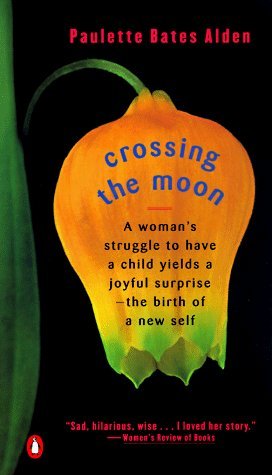 I first read this nearly four years ago (you can find my initial review in an early blog post that rounds up three of Alden’s works), and was moved to reread it this summer as a follow-up to Sheila Heti’s Motherhood. The book focuses on Alden’s uncertainty about having children all the way up to her late thirties, when she underwent three years of somewhat desperate, and ultimately unsuccessful, infertility treatment. “From the very start, I had seen writing and motherhood as mutually exclusive,” she writes, an attitude very similar to Heti’s. Yet she feared missing out on the meaning and love a child could bring to her life.
More broadly, the memoir is about the search to integrate the different aspects of a life – including family history and the fateful decisions that seem to have been made for you – into a realistic vision of the future. I didn’t find the book quite as profound this time around, but I noticed that I marked many of the same passages I did four years ago, about the dearth of childless role models and the struggle to accept the life that has become yours, even if it’s not what you predicted for yourself. That proves how influential and comforting it’s been for me.
Favorite lines:
“About the closest I can come to imagining what it would be like to have a child is with our cat, Cecil. For Cecil I feel the most delicious love, but also the most anxious responsibility.”
“It came to me that it really was a choice between two good things—having a child and not having a child. Our life without a child seemed good to me. I caught a glimpse that it was what was right for us, for the best. But who can say what is ‘best’? Maybe it’s possible to get to a place where what is best is simply what is.”
My rating:
Passion and Affect by Laurie Colwin (1974)
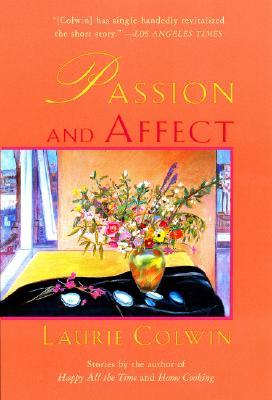 I mostly know Colwin as a food writer, but she also published fiction. This subtle story collection turns on quiet, mostly domestic dramas: people falling in and out of love, stepping out on their spouses and trying to protect their families. I didn’t particularly engage with the central two stories about cousins Vincent and Guido (characters from her novel Happy All the Time, which I abandoned a few years back), but the rest more than made up for them.
Several stories reveal the hidden depths of a character who’s only been a bit player in a protagonist’s life: a family friend who suddenly commits suicide, a Hispanic cook who has a rich boyfriend, a widowed piano teacher whose young student’s accomplishments buoy him up, and a supermarket employee whose ordinary life doesn’t live up to the fantasy background her manager, an art history PhD student, dreams up for her. In “The Water Rats” and “Wet,” water symbolizes all that we can’t control and understand, whether that’s our family’s safety or the inner life of a spouse.
Colwin writes funny, sharp descriptions, like “he was greeted by a young man wearing his hair in the manner of John Donne, a three-piece suit, and cowboy boots” and “she windowshopped, staring with rapt depression at rows of mannikins in glossy trousers.”
Favorite lines:
“She was three years married and when she looked at herself in the mirror, she did not see that she had become any more serious, any less young and heedless, or any more willing to get down to what Richard called ‘the things of life.’ He was right when he said that she had not made up her mind about anything.”
“He looked at his dissertation, or the heap that was to become his dissertation, and sighed again. He was of two minds about this Vermeer business, and he was of two minds about this supermarket business. That accounted for four minds in all, and it made life painful for him.”
My rating:
Breath, Eyes, Memory by Edwidge Danticat (1994)
 Like her protagonist, Sophie Caco, Danticat was raised by her aunt in Haiti and reunited with her parents in the USA at age 12. As Sophie grows up and falls in love with an older musician, she and her mother are both haunted by sexual trauma that nothing – not motherhood, not a long-awaited return to Haiti – seems to heal. I loved the descriptions of Haiti (“The sun, which was once god to my ancestors, slapped my face as though I had done something wrong. The fragrance of crushed mint leaves and stagnant pee alternated in the breeze” and “The stars fell as though the glue that held them together had come loose”), and the novel gives a powerful picture of a maternal line marred by guilt and an obsession with sexual purity. However, compared to Danticat’s later novel, Claire of the Sea Light, I found the narration a bit flat and the story interrupted – thinking particularly of the gap between ages 12 and 18 for Sophie. (Another Oprah’s Book Club selection.)
Favorite lines:
“She cannot stay out of duty. The things one does, one should do out of love.”
“I knew my hurt and hers were links in a long chain and if she hurt me, it was because she was hurt, too.”
My rating:
A Girl Named Zippy by Haven Kimmel (2001)
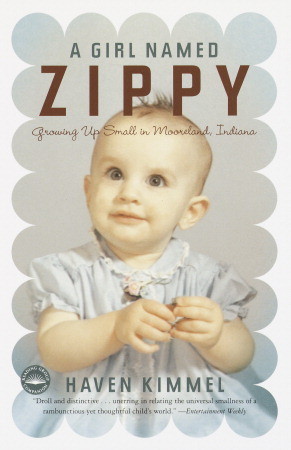 Maybe you grew up in or near a town like Mooreland, Indiana (population 300). Born in 1965 when her brother and sister were 13 and 10, Kimmel was affectionately referred to as an “Afterthought” and nicknamed “Zippy” for her boundless energy. Gawky and stubborn, she pulled every trick in the book to try to get out of going to Quaker meetings three times a week, preferring to go fishing with her father. The short chapters, headed by family or period photos, are sets of thematic childhood anecdotes about particular neighbors, school friends and pets. I especially loved her parents: her mother reading approximately 40,000 science fiction novels while wearing a groove into the couch, and her father’s love of the woods (which he called his “church”) and elaborate preparations for camping trips an hour away.
The tone is light-hearted despite hints of unpleasantness around town: open hostility towards people of color, a lecherous music teacher and a kid who abused animals. The more exaggerated stories are reminiscent of David Sedaris’s work – did she really cut hippies’ hair in exchange for an Irish Setter puppy?! Mostly, the book made me think about my mother’s small-town childhood versus my own suburban one, and how I would try to put all my early experiences together in a funny, nostalgic but honest way. It wouldn’t be easy at all, which makes Kimmel’s a noteworthy achievement.
Favorite lines:
“I figure heaven will be a scratch-and-sniff sort of place … I will ask for the smell of my dad’s truck, which was a combination of basic truck (nearly universal), plus his cologne (Old Spice), unfiltered Lucky Strikes, and when I was very lucky, leaded gasoline.”
“Mom used to say that my dad was a mountain man, which was obviously just a figure of speech, since most of Indiana is flat as a pancake. Her point was that Dad is a wild man, which was certainly true.”
My rating:
The Inn at Lake Devine by Elinor Lipman (1998)
 This was a breezy, delightful novel perfect for summer reading. In 1962 Natalie Marx’s family is looking for a vacation destination and sends query letters to various Vermont establishments. Their reply from the Inn at Lake Devine (proprietress: Ingrid Berry) tactfully but firmly states that the inn’s regular guests are Gentiles. In other words, no Jews allowed. The adolescent Natalie is outraged, and when the chance comes for her to infiltrate the Inn as the guest of one of her summer camp roommates, she sees it as a secret act of revenge.
In fact, in the years to come, after she trains as a chef, Natalie will become further entwined in the inn’s life, helping the family recover from a tragedy, falling in love with one of the Berry sons, and unwittingly contributing to a livelihood-threatening accident. Natalie’s voice drew me in right from the start. Lipman’s comedies of manners have been compared to Jane Austen’s, and you can see that likeness in the witty dialogue. I’ll certainly read more by her.
My rating:
Without Reservations: The Travels of an Independent Woman by Alice Steinbach (2000)
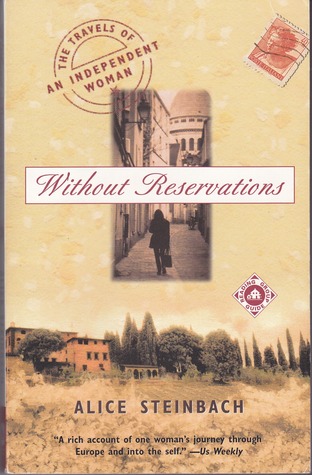 In 1993 Steinbach, then in her fifties, took a sabbatical from her job as a Baltimore Sun journalist to travel for nine months straight in Paris, England and Italy. As a divorcee with two grown sons, she no longer felt shackled to her Maryland home and wanted to see if she could recover a more spontaneous and adventurous version of herself and not be defined exclusively by her career. Her innate curiosity and experience as a reporter helped her to quickly form relationships with other English-speaking tourists, which was an essential for someone traveling alone.
I enjoyed spotting familiar sites I’ve visited, but I don’t think you need to know these countries or even have a particular interest in them to appreciate the book. Whether she’s attending a swanky party or nearly getting mugged, Steinbach is an entertaining and unpretentious tour guide. Her attitude is impressive, too: “I had surprised myself this year by jumping in to reshape my life before life stepped in to reshape it for me.” You might not be willing to give up your normal existence for nine months, but I suspect that this travel memoir might make you consider how you could be more daring in your daily life.
My rating:
20 Books of Summer, #5–8: Anderson, Cusk, Fitch & L’Engle
I’ve been reading a feminist memoir set on Cape Cod, a subtle novel about the inner life and outward experiences of a writer, a soapy literary thriller about a troubled mother and teen daughter, and a slightly melancholy reminiscence of an aged mother succumbing to dementia.
A Walk on the Beach: Tales of Wisdom from an Unconventional Woman by Joan Anderson (2004)
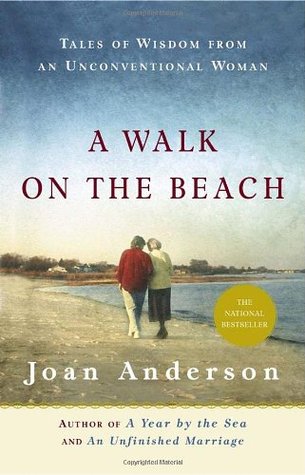 This is the third volume in a loose autobiographical trilogy about Anderson’s experiment with taking a break from her marriage and living alone in a Cape Cod cottage to figure out what she really wanted from the rest of her life. Specifically, this book is about the inspirational relationship she formed with Joan Erikson, who moved to the area in her eighties when her husband, the famous psychologist Erik Erikson, was admitted to a care home. Joanie was a thinker and author in her own right, publishing books on life’s stages, especially those of older age. She encouraged Anderson to have the confidence to write her own story, and to take up challenges like a trip to Peru and learning to weave on a loom. Joanie’s aphoristic advice is valuable, but there’s a fair bit of overlap between this book and A Year by the Sea, which I would recommend over this.
My rating:
Some of Joan Erikson’s words of wisdom:
“Doing something with your hands, rather than your head, is often the best route to clarity.”
“wisdom comes from life’s experiences well digested. Stop relying so much on your mind and get in touch with experience.”
“The struggle is to try and obtain a sense of participation in your life the whole way through. We must treasure old age, but not wallow in nostalgia.”
Transit by Rachel Cusk (2016)
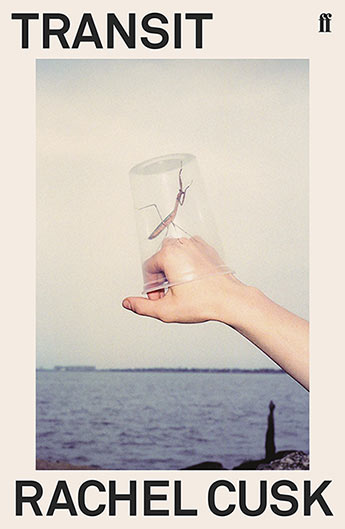 I finally made it through a Rachel Cusk book! (This was my third attempt; I made it just a few pages into Aftermath and 60 pages through Outline.) I suspected this would make a good plane read, and thankfully I was right. Each chapter is a perfectly formed short story, a snapshot of one aspect of Faye’s life and the relationships that have shaped her: a former lover she bumps into in London, a builder who tells her the flat she’s bought is a lost cause, the awful downstairs neighbors who hate her with a passion, the fellow writers (based on Edmund White and Karl Ove Knausgaard?) at a literary festival event who hog most of the time, the jolly Eastern European construction workers who undertake her renovations, a childless friend who works in fashion design, and a country cousin who’s struggling with his new blended family.
Like in Outline, the novel is based largely on the conversations Faye overhears or participates in (“I had found out more, I said, by listening than I had ever thought possible”), but I sensed more of her personality this time, and could relate to her questioning: Why do her neighbors hate her so? How much of her life is fated, and how much has she chosen? I doubt I’ll read another book by Cusk, but I ended up surprisingly grateful to have gotten hold of this one as a free proof copy of the new paperback edition from the Faber Spring Party.
My rating:
Some favorite lines:
“we examine least what has formed us the most, and instead find ourselves driven blindly to re-enact it.”
“Without children or partner, without meaningful family or a home, a day can last an eternity: a life without those things is a life without a story, a life in which there is nothing – no narrative flights, no plot developments, no immersive human dramas – to alleviate the cruelly meticulous passing of time.”
White Oleander by Janet Fitch (1999)
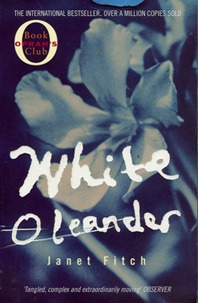 Man, that Oprah knows how to pick ’em! This was a terrific read; I’m not sure why I’d never gotten to it before. I read huge chunks during my travel to the States and then slowed down quite a bit, which was a shame because it meant I felt less connected to Astrid’s later struggles in the foster care system. It’s an atmospheric novel full of oppressive Los Angeles heat and a classic noir flavor that shades into gritty realism as it goes on, taking us from when Astrid is 12 to when she’s a young woman out in the world on her own.
Astrid’s mother Ingrid, an elitist poet, becomes obsessed with a lover who spurned her and goes to jail for his murder. Bouncing between foster homes and children’s institutions, Astrid is plunged into a world of sex, drugs, violence and short-lived piety. “Like a limpet I attached to anything, anyone who showed me the least attention,” she writes. Her role models change over the years, but always in the background is the icy influence of her mother, through letters and visits.
Fitch’s writing is sumptuous, as in a house “the color of a tropical lagoon on a postcard thirty years out of date, a Gauguin syphilitic nightmare.” I might have liked a tiny bit more of Ingrid in the book, but I can still recommend this one wholeheartedly as summer reading.
My rating:
Some favorite lines:
The knock-out opening two lines: “The Santa Anas blew in hot from the desert, shriveling the last of the spring grass into whiskers of pale straw. Only the oleanders thrived, their delicate poisonous blossoms, their dagger green leaves.”
“I couldn’t imagine my mother in prison. She didn’t smoke or chew on toothpicks. She didn’t say ‘bitch’ or ‘fuck.’ She spoke four languages, quoted T. S. Eliot and Dylan Thomas, drank Lapsang souchong out of a porcelain cup. She had never been inside a McDonald’s. She had lived in Paris and Amsterdam. Freiburg and Martinique. How could she be in prison?”
The Summer of the Great-Grandmother by Madeleine L’Engle (1974)
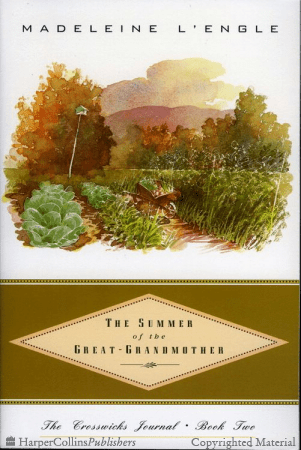 L’Engle is better known for children’s books, but wrote tons for adults, too. In this second volume of The Crosswicks Journal, she recounts her family history as a way of remembering on behalf of her mother, who at age 90 was slipping into dementia in her final summer. “I talked awhile, earlier this summer, about wanting my mother to have a dignified death. But there is nothing dignified about incontinence and senility.” L’Engle found herself in the unwanted position of being like her mother’s mother, and had to accept that she had no control over the situation. “This summer is practice in dying for me as well as for my mother.”
One of the reasons L’Engle was driven to write science fiction was because she couldn’t reconcile the idea of permanent human extinction with her Christian faith, but nor could she honestly affirm every word of the Creed. Hers is a more broad-minded, mystical spirituality that really appeals to me. (Her early life reminds me of May Sarton’s, as recounted in I Knew a Phoenix: both were born right around World War I, raised partially in Europe and sent to boarding school; a frequent theme in their nonfiction is the regenerative power of solitude and of the writing process itself.)
My rating:
Some favorite lines:
“I said [in a lecture] that the artist’s response to the irrationality of the world is to paint or sing or write, not to impose restrictive rules but to rejoice in pattern and meaning, for there is something in all artists which rejects coincidence and accident. And I went on to say that we must meet the precariousness of the universe without self-pity, and with dignity and courage.”
“Our lives are given a certain dignity by their very evanescence. If there were never to be an end to my quiet moments at the brook, if I could sit on the rock forever, I would not treasure these minutes so much. If our associations with the people we love were to have no termination, we would not value them as much as we do.”
20 Books of Summer 2018
This is my first year joining in with the 20 Books of Summer challenge run by Cathy of 746 Books. I’ve decided to put two twists on it. One: I’ve only included books that I own in print, to work on tackling my mountain of unread books (300+ in the house at last count). As I was pulling out the books that I was most excited to read soon, I noticed that most of them happened to be by women. So for my second twist, all 20 books are by women. Why not? I’ve picked roughly half fiction and half life writing, so over the next 12 weeks I just need to pick one or two from the below list per week, perhaps alternating fiction and non-. I’m going to focus more on the reading than the reviewing, but I might do a few mini roundup posts.
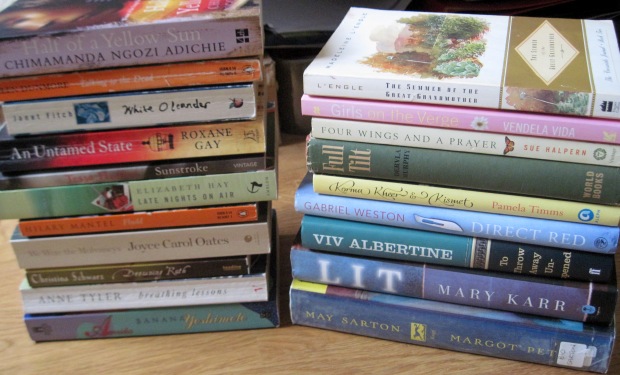
I’m doing abysmally with the goal I set myself at the start of the year to read lots of travel classics and biographies, so I’ve chosen one of each for this summer, but in general my criteria were simply that I was keen to read a book soon, and that it mustn’t feel like hard work. (So, alas, that ruled out novels by Elizabeth Bowen, Ursula K. LeGuin and Virginia Woolf.) I don’t insist on “beach reads” – the last two books I read on a beach were When Breath Becomes Air by Paul Kalanithi and Grief Cottage by Gail Godwin, after all – but I do hope that all the books I’ve chosen will be compelling and satisfying reads.
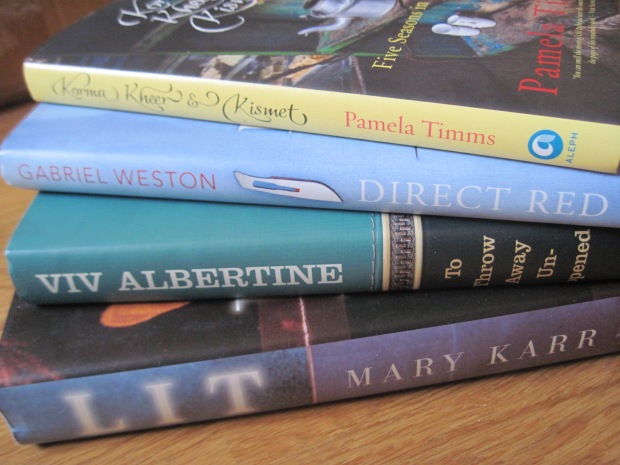
- To Throw Away Unopened by Viv Albertine – I picked up a copy from the Faber Spring Party, having no idea who Albertine was (guitarist of the all-female punk band The Slits). Everyone I know who has read this memoir has raved about it.
- Lit by Mary Karr – I’ve read Karr’s book about memoir, but not any of her three acclaimed memoirs. This, her second, is about alcoholism and motherhood.
- Korma, Kheer and Kismet: Five Seasons in Old Delhi by Pamela Timms – I bought a bargain copy at the Wigtown Festival shop earlier in the year. Timms is a Scottish journalist who now lives in India. This should be a fun combination of foodie memoir and travel book.
- Direct Red: A Surgeon’s Story by Gabriel Weston (a woman, honest!) – Indulging my love of medical memoirs here. I bought a copy at Oxfam Books earlier this year.
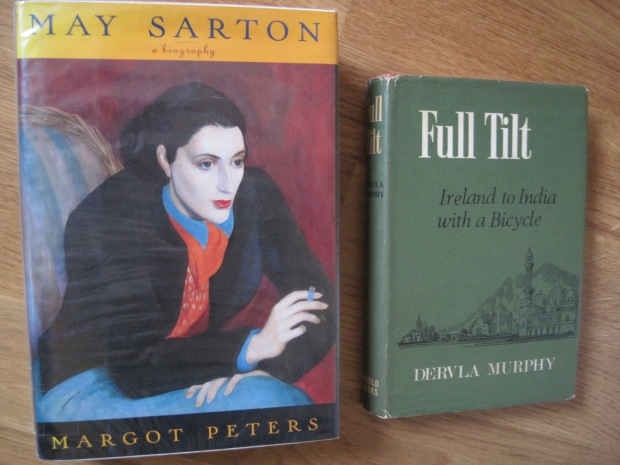 5. May Sarton by Margot Peters – I’ve been on a big May Sarton kick in recent years, so have been eager to read this 1997 biography, which apparently is not particularly favorable.
6. Full Tilt: Ireland to India with a Bicycle by Dervla Murphy – I bought this 1960s hardback from a charity shop in Cambridge a couple of years ago. It will at least be a start on that travel classics challenge.
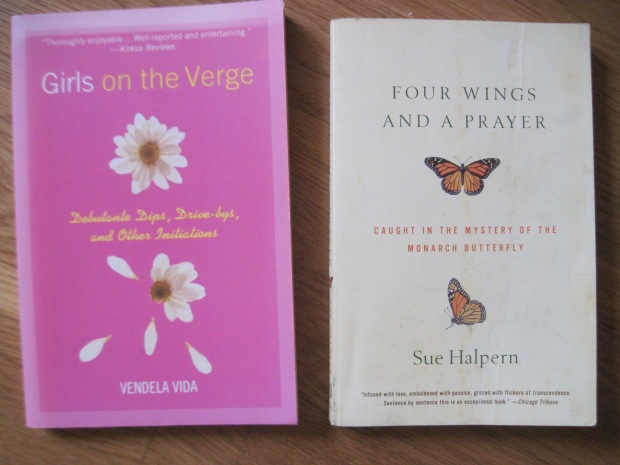
7. Girls on the Verge: Debutante Dips, Drive-bys, and Other Initiations by Vendela Vida – This was Vida’s first book. It’s about coming-of-age rituals for young women in America.
8. Four Wings and a Prayer: Caught in the Mystery of the Monarch Butterfly by Sue Halpern – Should fall somewhere between science and nature writing, with a travel element.
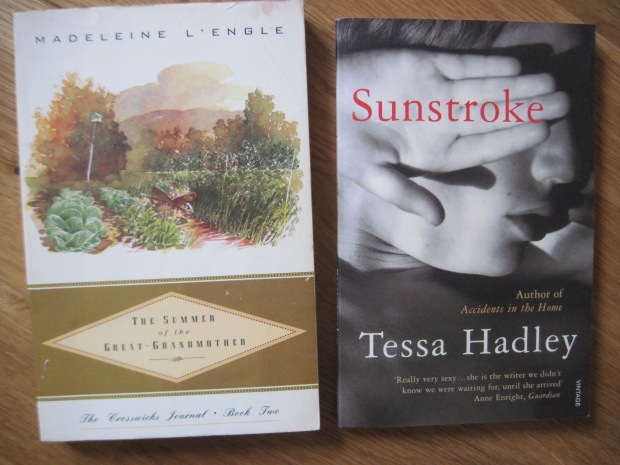
9. The Summer of the Great-Grandmother by Madeleine L’Engle – L’Engle is better known for children’s books, but she wrote tons for adults, too: fiction, memoirs and theology. I read the stellar first volume of the Crosswicks Journal, A Circle of Quiet, in September 2015 and have meant to continue the series ever since.
10. Sunstroke by Tessa Hadley – You know how I love reading with the seasons when I can. This slim 2007 volume of stories is sure to be a winner. Seven of the 10 originally appeared in the New Yorker or Granta.
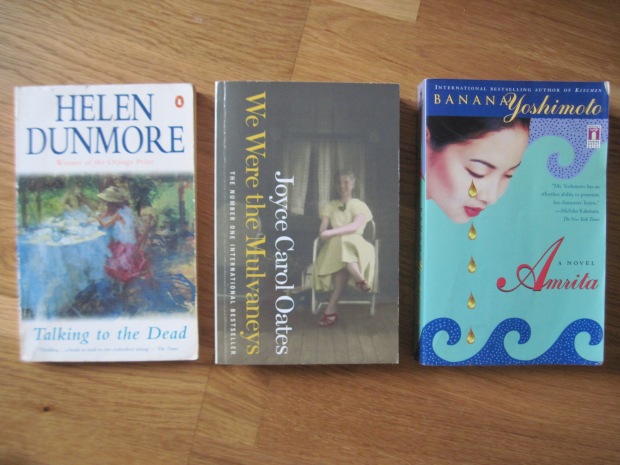
11. Talking to the Dead by Helen Dunmore – I’ve only ever read Dunmore’s poetry. It’s long past time to try her fiction. This one comes highly recommended by Susan of A life in books.
12. We Were the Mulvaneys by Joyce Carol Oates – Oates is intimidatingly prolific, but I’m finally going to jump in and give her a try.
13. Amrita by Banana Yoshimoto – A token lit in translation selection. “This is the story of [a] remarkable expedition through grief, dreams, and shadows to a place of transformation.” (Is it unimaginative to say that sounds like Murakami?)
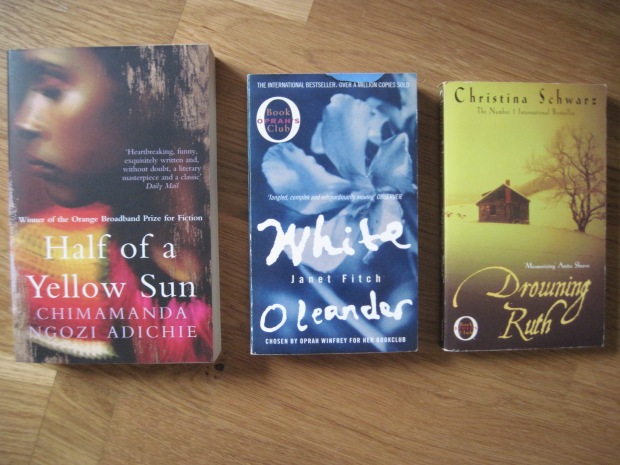
14. Half of a Yellow Sun by Chimamanda Ngozi Adichie – How have I not read any of her fiction yet?! This has been sitting on my shelf for years. I only vaguely remember the story line from the film, so it should be fairly fresh for me.
15. White Oleander by Janet Fitch – An Oprah’s Book Club selection from 1999. I reckon this would make a good beach or road trip read.
16. Drowning Ruth by Christina Schwarz – Another Oprah’s Book Club favorite from 2000. Set in Wisconsin in the years after World War I.
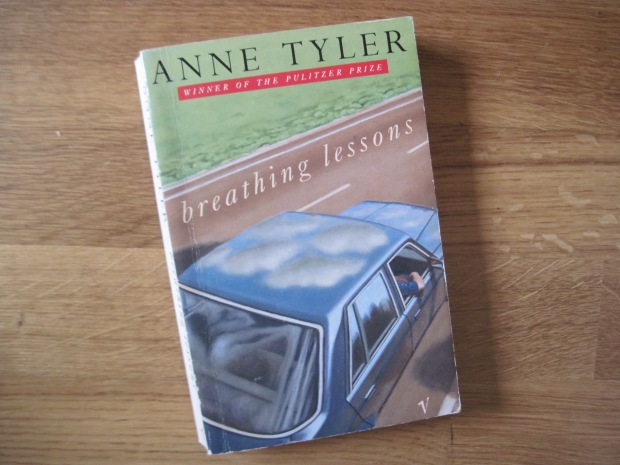
- Breathing Lessons by Anne Tyler – Tyler novels are a tonic. I have six unread on the shelf; the blurb on this one appealed to me the most. This summer actually brings two Tylers as Clock Dance comes out on July 12th – I’ll either substitute that one in, or read both!
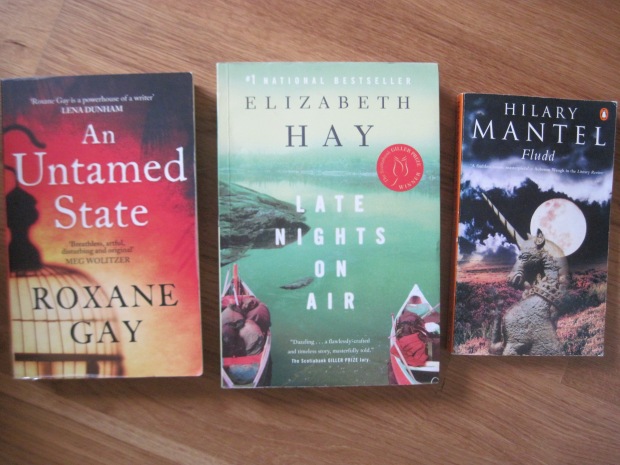
18. An Untamed State by Roxane Gay – I’ve only read Gay’s memoir, Hunger. She’s an important cultural figure; it feels essential to read all her books. I expect this to be rough.
19. Late Nights on Air by Elizabeth Hay – This has been on my radar for such a long time. After loving my first Hay novel (A Student of Weather) last year, what am I waiting for?
20. Fludd by Hilary Mantel – I haven’t read any Mantel in years, not since Bring Up the Bodies first came out. While we all await the third Cromwell book, I reckon this short novel about a curate arriving in a fictional town in the 1950s should hit the spot.
I’ll still be keeping up with my review books (paid and unpaid), blog tours, advance reads and library books over the summer. The aim of this challenge, though, is to make inroads into the physical TBR. Hopefully the habit will stick and I’ll keep on plucking reads from my shelves during the rest of the year.
Where shall I start? If I was going to sensibly move from darkest to lightest, I’d probably start with An Untamed State and/or Lit. Or I might try to lure in the summer weather by reading the two summery ones…
 Bookish Beck = Rebecca Foster. American transplant to England. Freelance proofreader and book reviewer.
 Bookish Beck