Advent Reading: In the Bleak Midwinter by Rachel Mann & More
Today marks 189 years since poet Christina Rossetti’s birth in 1830. You could hardly find better reading for Advent than poet–priest Rachel Mann’s new seasonal devotional, In the Bleak Midwinter, which journeys through Advent and the 12 days of Christmas via short essays on about 40 Rossetti poems.
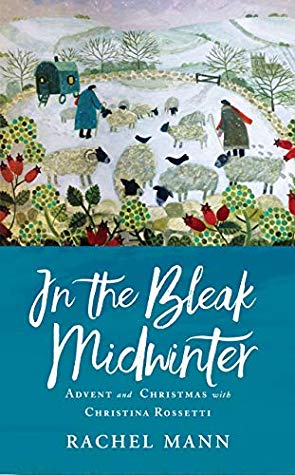 If your mental picture of Rossetti’s work is, like mine was, limited to twee repetition (“Snow had fallen, snow on snow, / Snow on snow,” as the title carol from 1872 goes), you’ll gain a new appreciation after reading this. Yes, Rossetti’s poetry may strike today’s readers as sentimental, with a bit too much rhyming and overt religion, but it is important to understand it as a product of the Victorian era.
Mann gives equal focus to Rossetti’s techniques and themes. Repetition is indeed one of her main tools, used “to build intensity and rhythm,” and some of her poems are psalm-like in their diction and emotion. I had no idea that Rossetti had written so much – and so much that’s specific to the Christmas season. She has multiple poems entitled “Advent” and “A Christmas Carol” (the technical title of “In the Bleak Midwinter”) or variations thereon.
The book’s commentary spins out the many potential metaphorical connotations of Advent: anticipation, hope, suffering, beginnings versus endings. Mann notes that Rossetti often linked Advent and apocalypse as times of change and preparation. Even as Christians await the birth of Christ, the poet seems to say, they should keep the end of all things in mind. Thus, some of the poems include surprisingly dark or premonitory language:
The days are evil looking back,
The coming days are dim;
Yet count we not His promise slack,
But watch and wait for Him. (from “Advent,” 1858)
Death is better far than birth,
You shall turn again to earth. (from “For Advent”)
 Along with that note of memento mori, Mann suggests other hidden elements of Rossetti’s poetry, like desire (as in the sensual vocabulary of “Goblin Market”) and teasing mystery (“Winter: My Secret,” which reminded me of Emily Dickinson). Not all of her work is devotional or sweet; those who feel overwhelmed or depressed at Christmastime will also find lines that resonate for them here.
Mann helped me to notice Rossetti’s sense of “divine time” that moves in cycles. She also makes a strong case for reading Rossetti to understand how we envision Christmas even now: “In some ways, ‘In the Bleak Midwinter’ offers the acme of our European cultural representations of this season.”
My rating: 
With thanks to Canterbury Press for the free copy for review.
(I also reviewed Mann’s poetry collection, A Kingdom of Love, earlier in the year.)
 For December I’m reading Do Nothing, the Advent booklet Stephen Cottrell (now the Bishop of Chelmsford; formerly Bishop of Reading) wrote in 2008 about a minimalist, low-stress approach to the holidays. I have to say, it’s inspiring me to cut way back on card-sending and gift-giving this year.
A few seasonal snippets spotted in my recent reading:
“December darkens and darkens, and the streets sprout forth their Christmas tinsel, and the Salvation Army brass band sings hymns and jingles its bells and stirs up its cauldron of money, and loneliness blows in the snowflurries”
(from The Robber Bride by Margaret Atwood)
“Fine old Christmas, with the snowy hair and ruddy face, had done his duty that year in the noblest fashion, and had set off his rich gifts of warmth and colour with all the heightening contrast of frost and snow.”
(from The Mill on the Floss by George Eliot)
A week to Christmas, cards of snow and holly,
Gimcracks in the shops,
Wishes and memories wrapped in tissue paper,
Trinkets, gadgets and lollipops
And as if through coloured glasses
We remember our childhood’s thrill
… And the feeling that Christmas Day
Was a coral island in time where we land and eat our lotus
But where we can never stay.
(from Autumn Journal by Louis MacNeice)


 I’m always on the lookout for books that seem to fit the season. Here are the piles I’ve amassed for winter (Early Riser imagines a human hibernation system for the winters), Christmas and snow. I’ll dip into these over the next couple of months. I plan to get more “winter,” “snow” and “ice” titles out from the library. Plus I have this review book (at left), newly in paperback, to start soon.
Have you read any Advent or wintry books recently?
Autumn Reading: Two Gems by MacNeice and Teale
With bare trees leading down to the canal and frosty temperatures forecast for the weekend, it’s starting to feel more like winter here. I journeyed through a fine autumn with two obscure classics that ended up being  gems.
gems.
Autumn Journal by Louis MacNeice (1939)
 MacNeice, a poet and man of letters from Northern Ireland, wrote this long verse narrative between August 1938 and the turn of the following year. It’s simultaneously about everything and nothing, about everyday life for the common worker and the political rumblings that suggest all is not right in the world. As summer fades and Christmas draws closer, he reflects on his disconnection from Ireland; and on fear, apathy and the longing for purpose.
Two in every four lines rhyme, but the rhyme scheme is so subtle that I was far into the book before I recognized it. I tend not to like prose poems, but this book offers a nice halfway house between complete sentences and a stanza form, and it voices the kinds of feelings we can all relate to. How can this possibly be 80 years old? It is so relevant to our situation now.
we think ‘This must be wrong, it has happened before,
Just like this before, we must be dreaming…’
now it seems futility, imbecility,
To be building shops when nobody can tell
What will happen next.
There are only too many who say ‘What difference does it make
One way or the other?
To turn the stream of history will take
More than a by-election.’
Still there are … the seeds of energy and choice
Still alive even if forbidden, hidden,
And while a man has voice
He may recover music.
The university library copy I borrowed smells faintly of incense, so reading it was rather like slipping into the back pew of an old church and pondering timelessness.
Autumn Across America by Edwin Way Teale (1950)
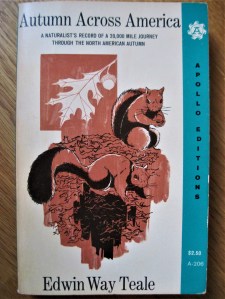 Teale is a lesser-known naturalist who specialized in insects and edited or introduced works by famous natural historians of a previous era like Thoreau, Fabre, Hudson and Muir. In the late 1940s he and his wife Nellie set out on a meandering 20,000-mile road trip from Cape Cod on the Atlantic coast to Point Reyes on the Pacific to track autumn from its first hints to its last gasp. It was the third of four seasonal journeys the Teales undertook in part to distract them from their grief over their son David, who was killed in Germany during WWII. Their route passes through about half the states and experiences nearly every landscape you can imagine, some that are familiar to me and others that would be totally new. They delve in rockpools; observe bird and monarch migration; cross desert, mountains and prairie; and watch sea otters at play.
Although there is a sense of abundance – they see a million ducks in one day, and pass dozens of roadkill jackrabbits – like Aldo Leopold, Teale was an early conservationist who sounded the alarm about flora and fauna becoming rarer: “So much was going even as we watched.” His descriptions of nature are simply gorgeous, while the scientific explanations of leaf color, “Indian summer” and animal communication are at just the right level for the average reader. This was a lucky find at the Book Thing of Baltimore this past spring, and if I ever get the chance, I will delight in reading the other three in the quartet.
Some favorite lines:
“The stars speak of man’s insignificance in the long eternity of time; the desert speaks of his insignificance right now.”
“Those to whom the trees, the birds, the wildflowers represent only ‘locked-up dollars’ have never known or really seen these things. They have never experienced an interest in nature for itself. Whoever stimulates a wider appreciation of nature, a wider understanding of nature, a wider love of nature for its own sake accomplishes no small thing.”
I’m also still reading Led by the Nose: A Garden of Smells by Jenny Joseph, a book about what you see and smell in the garden month by month. I only have the December chapter still to read, followed by some lists of plants set out by ‘when they smell’ and when you plant them. I’ve also been slowly working through A Country Year: Living the Questions by Sue Hubbell, another Book Thing find. After her divorce, Hubbell lived alone on her 90 acres in the Ozarks of Missouri, keeping bees and conscientiously rebuilding a life in communion with nature. I still have the final two sections, “Winter” and “Spring,” left to read.
How’s the weather where you are?
Have you read any “Autumn” books lately?
Five Nonfiction Review Books: Hammond, Iorio, Rault, Riley & Rutt
A diagnosis of motor neurone disease; a father’s dispiriting experience of censorship trials. An illustrated history of fonts; an essay on grief; a cold weather-appropriate record of geese-watching. I gear up for Nonfiction November by catching up on five nonfiction review books I’ve been sent over the last couple of months. You can’t say that I don’t read a variety, even within nonfiction! See if one or more of these tempts you.
A Short History of Falling: Everything I Observed about Love whilst Dying by Joe Hammond
 Hammond, a playwright, takes a wry, clear-eyed approach to his diagnosis of motor neurone disease (ALS) and the knowledge that his physical capacities will only deteriorate from here on out. “New items arrive almost daily and I am unexpectedly becoming the curator of the Museum of my own Decline.” Yet he also freezes funnier moments, like blowing his nose on a slice of bread because he couldn’t reach a tissue box, or spending “six hours of my fiftieth birthday sat on this hospice toilet, with a bottle of good Scotch wedged between my knees.”
Still, Hammond regrets that he’s become like a third small child for his wife Gill to look after, joining his sons Tom and Jimmy, and that he won’t see his boys grow up. (This book arose from an article he wrote for the Guardian in 2018 about making 33 birthday cards for his sons to open in the years after his death.) Although I wasn’t as interested in the details of Hammond’s earlier life, or his relationship with his narcissistic father, I appreciated his quiet acceptance of disability, help and impending death. 
Favorite lines:
“I’ve waited all my life to know this peace. To know that I am nothing more than this body.”
“my place in all of this is becoming smaller, historic and just the right size of important.”
With thanks to 4th Estate for the free copy for review.
An Author on Trial: The Story of a Forgotten Writer by Luciano Iorio
 The author’s father, Giuseppe Jorio, was a journalist and schoolteacher who wrote an infamous novel based on an affair he had in the 1930s. Using italicized passages from his father’s diary and letters to Tina, who was 19 when their affair started, Iorio reconstructs the sordid events and unexpected aftermath in fairly vivid detail. Tina fell pregnant and decided to abort the baby. Meanwhile, Giuseppe’s wife, Bruna, got the truth out of him and responded with more grace than might be expected. Giuseppe was devastated at the loss of his potential offspring, and realized he wanted to have a child with Bruna. He bid Tina farewell and the family moved to Rome, where the author was born in 1937.
Giuseppe’s novel inspired by the affair, Il Fuoco del Mondo (The Fire of the World) was rejected by all major publishers and accused of obscenity in a series of five trials that threatened his reputation and morale. It’s a less familiar echo of the Lady Chatterley’s Lover trial, and a poignant portrait of a man who felt he never lived up to his potential because of bad luck and societal disapproval. I enjoyed learning a bit about Italian literature. However, inconsistent use of tenses and shaky colloquial English (preposition issues, etc.) suggest that a co-writer or translator was needed to bring this self-published work up to scratch. 
With thanks to the publicist for the free copy to review as part of a blog tour.
ABC of Typography by David Rault
[Translated from the French by Edward Gauvin]
 From cuneiform to Gutenberg to Comic Sans, this history of typography is delightful. Graphic designer David Rault wrote the whole thing, but each chapter has a different illustrator, so the resulting book is like a taster course in comics styles. As such, I would highly recommend it to those who are fairly new to graphic novels and want to see whose work appeals to them, as well as to anyone who enjoyed Simon Garfield’s book about fonts, Just My Type.
I found it fascinating to explore the technical characteristics (serif vs. sans serif, etc.) and aesthetic associations of various fonts. For instance, I didn’t realize that my mainstay – Times New Roman – is now seen as a staid choice: “Highly readable, but overexposed in the early days of the Internet, it took on a reputation for drabness that it hasn’t shed since the ’90s.” Nowadays, some newspapers and brands pay typeface creators to make a font for their exclusive use. Can you name the typeface that is used on German road signs, or in Barack Obama’s campaign materials? (You’ll be able to after you read this.)


With thanks to SelfMadeHero for the free copy for review.
Time Lived, Without Its Flow by Denise Riley
 What Virginia Woolf’s essay “On Being Ill” does for sickness, this does for bereavement. Specifically, Riley, whose son Jake died suddenly of a heart condition, examines how the experience of time changes during grief. “I’ll not be writing about death, but about an altered condition of life,” she opens. In short vignettes written from two weeks to three years after her son’s death, she reflects on how her thinking and feelings have morphed over time. She never rests with an easy answer when a mystery will do instead. “What if” questions and “as if” imaginings proliferate. Poetry – she has also written an exquisite book of poems, Say Something Back, responding to the loss of Jake – has a role to play in the acceptance of this new reality: “rhyme may do its minute work of holding time together.”
Max Porter provides a fulsome introduction to this expanded version of Riley’s essay, which first appeared in 2012. This small volume meant a lot more to him than it did to me; I preferred Riley’s poetic take on the same events. Still, this is sure to be a comfort for the bereaved.
Favorite passages:
“I’ll try to incorporate J’s best qualities of easy friendliness, warmth, and stoicism, and I shall carry him on in that way. Which is the only kind of resurrection of the dead that I know about.”
“I don’t experience him as in the least dead, but simply as ‘away’. Even if he’ll be away for my remaining lifetime. My best hope’s to have a hallucination of his presence when I’m dying myself.”
With thanks to Picador for the free copy for review.
Wintering: A Season with Geese by Stephen Rutt
 Rutt’s The Seafarers: A Journey among Birds, one of my favorite recent nature/travel books, came out in May. What have we done to deserve another publication from this talented young author just four months later?! I didn’t enjoy this as much as The Seafarers, yet it does a lot of the same things well: it provides stunning word portraits of individual bird species, explores the interaction between nature and one’s mental state, and gathers evidence of the cultural importance of birds through legends and classical writings.
Here the focus is on geese, which the author had mostly overlooked until the year he moved to southern Scotland. Suddenly they were impossible to ignore, and as he became accustomed to his new home these geese sightings were a way of marking the seasons’ turn. Ethical issues like hunting, foie gras and down production come into play, and, perhaps ironically, the author eats goose for Christmas dinner!
Rutt’s points of reference include Paul Gallico (beware plot spoilers!), Aldo Leopold, Mary Oliver and Peter Scott. The writing in this short book reminded me most of Horatio Clare (especially The Light in the Dark) and Jim Crumley (who’s written many short seasonal and single-species nature books) this time around.
A favorite passage (I sympathize with the feelings of nomadism and dislocation):
“I envy the geese their certainty, their habits of home. I am forever torn between multiple places that feel like home. Scotland where I live or Suffolk, Essex, Norfolk: the flatlands of golden evenings and reeds, mud and water and sand. The distant horizon and all the space in between I grew up with, which seems to lurk somewhere, subconsciously calling me back.”
[Neat aside: My husband and I both got quotes (about The Seafarers) on the press release for this book!]

With thanks to Elliott & Thompson for the free copy.
Would you be interested in reading one or more of these?
“All to Do with the Moon”: Four Books with Moon in the Title
I happened to read two books with the word moon in their titles within a couple of weeks in September, which prompted me to ransack my shelves and find two more. While these four are in completely different genres – one women’s fiction, one poetry, one memoir and one Booker-winning literary novel – they are all by women (naturally more in touch with the moon?) and all worth reading. In the weeks that I was undertaking this mini reading project, I couldn’t get Krista Detor’s song “All to Do with the Moon” out of my head (on this video, a live recording of the entire “Night Light” suite of three songs, it starts at about 6:15). She’s one of our favorite singer-songwriters, though, so this was no problem.
The Pull of the Moon by Elizabeth Berg (1996)
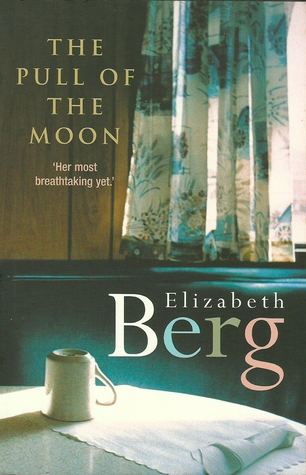 This is my second contemporary novel from Berg. I find her work effortlessly readable. She’s comparable to those other Elizabeths, McCracken and Strout, but also to Alice Hoffman and Anne Tyler. This one reminded me most of Tyler’s Ladder of Years in that both are about a middle-aged woman who takes a break from her marriage to figure out what she wants from life. Nan, “a fifty-year-old runaway,” takes off from her suburban Boston home and drives west, stopping at motels and cabins, eating at diners, and meeting the locals; eventually she gets as far as South Dakota. Her narration is in the form of letters to her husband, Martin, alternated with italicized passages from her journal. She reflects on everything that has made up her life – her upbringing, her marriage and other sexual encounters, raising her daughter, Ruthie – as well as on the small-town folk she meets in Iowa and Minnesota. The moon is a symbol of the femininity Nan fears she’s losing through menopause and hopes to reclaim on this journey.
The Moon Is Almost Full by Chana Bloch (2017)
 This was a lucky find in the clearance section at Blackwell’s on my Oxford day with Annabel. It’s a beautifully produced book from Autumn House, the small Pittsburgh press that released my favorite poetic work of last year: The Small Door of Your Death by Sheryl St. Germain. This was Bloch’s sixth and final book of poetry, published in the year of her death. She writes in the awareness that this cancer will be her end and doesn’t gloss over losses of function and dignity, but still finds delight in life through her family, writing and Jewish rituals: “Never forget / you were put on earth to gather joy // with melancholy hands” (from “Instructions for the Bridegroom”). A favorite poem was “The Will,” in which she imagines how the physical and intangible relics of her life will be distributed (“My plans and projects I hereby bequeath to the air / of which they were conceived. … Let the doctors pack up my heart / and keep it humming for the right customer.”).
Off-topic note: This was typeset in Mrs Eaves, which may well be one of my favorite fonts.
To the Moon and Back: A Childhood under the Influence by Lisa Kohn (2018)
 My special interest in women’s religious memoirs led me to list this among my most anticipated titles of 2018. I had it on my wish list for quite a while and then, when I saw it available for a bargain price online, snapped it up for myself. Lisa Kohn grew up in the New York City environs, the child of hippie parents she called Mimi and Danny rather than Mom and Dad. After their parents divorced, she and her brother lived in New Jersey with their mother and went into the City to visit their father, who was very lax about things like drugs. By the time Kohn was 10, her mother had gotten caught up in Reverend Moon’s Unification Church.
I knew next to nothing about the “Moonies,” so I found it fascinating to learn about this cult led by a South Korean reverend who let it be assumed that he was the new incarnation of Jesus Christ and the flourishing of his family on Earth would usher in God’s Kingdom. The Church became Kohn’s whole life until internal questioning set in during high school, and by the time she went to college she was adrift and into drugs instead. The book recreates scenes and dialogue well, but I found myself losing interest once the cult itself stopped being the main focus.
Readalikes: Small Fry by Lisa Brennan-Jobs and In the Days of Rain by Rebecca Stott
Moon Tiger by Penelope Lively (1987)
 Seventy-six-year-old Claudia Hampton, on her deathbed in a nursing home, determines to write a history of the world – or at least, the world as she’s seen it. She’s been an author of popular history books (one of which, on Mexico, was made into a film), but she’s also been a daughter, a sister, a lover and a mother. As the book shifts between the first person and the third person, the present and the past, we learn volumes about Claudia and how her memory has preserved the layers of her personal history. There are a couple of big reveals, about her relationship with her brother Gordon and her time as a Second World War correspondent in Egypt, but what’s more impressive than these plot surprises is how Lively packs the whole sweep of a life into just 200 pages, all with such rich, wry commentary on how what we remember constructs our reality.
I made the fine choice to start reading this on holiday at the Jurassic coast in Dorset, which was fitting because Claudia grew up in Dorset and uses ammonites and rock strata as recurring metaphors. This won a well-deserved Booker Prize and is the best of the five Lively books I’ve read. I wasn’t particularly taken with the first couple I read by her, so I’m glad I tried again this year (with Heat Wave and then this). It’s just a shame that the copy I found in the free bookshop where I volunteer has such a dreadfully inappropriate cover, making it look like contemporary chick lit rather than serious literature.
Some favorite lines:
“Argument, of course, is the whole point of history. Disagreement; my word against yours; this evidence against that. If there were such a thing as absolute truth the debate would lose its lustre. I, for one, would no longer be interested.”
“In life as in history the unexpected lies waiting, grinning from around corners. Only with hindsight are we wise about cause and effect.”
“Once it is all written down we know what really happened.”
A note on the title: From the context, it seems that a moon tiger was a special inflammatory device, maybe like a citronella candle, used to repel mosquitoes and other insects.
 Other ‘Moon’ books I have happened to review:
Crossing the Moon by Paulette Bates Alden
The Moon and Sixpence by W. Somerset Maugham
Recent and Upcoming Poetry Releases from Carcanet Press
Many thanks to the publisher for free print or e-copies of these three books for review.
In Nearby Bushes by Kei Miller
 “Are there stories you have heard about Jamaica? / Well here are the stories underneath.” The last two lines of “The Understory” reveal Miller’s purpose in this, his fifth collection of poetry. The title is taken from Jamaican crime reports, which often speak of a victim’s corpse being dumped in, or perpetrators escaping to, “nearby bushes.” It’s a strange euphemism that calls to mind a dispersed underworld where bodies are devalued. Miller persistently contrasts a more concrete sense of place with that iniquitous nowhere. Most of the poems in the first section open with the word “Here,” which is also often included in their titles and repeated frequently throughout Part I. Jamaica is described with shades of green: a fertile, feral place that’s full of surprises, like an escaped colony of reindeer.
As usual, Miller slips in and out of dialect as he reflects on the country’s colonial legacy and the precarious place of homosexuals (“A Psalm for Gay Boys” is a highlight). Although I enjoyed this less than the other books I’ve read by Miller, I highly recommend his work in general; the collection The Cartographer Tries to Map a Way to Zion is a great place to start.
Some favorite lines:
“Here that cradles the earthquakes; / they pass through the valleys // in waves, a thing like grief, / or groaning that can’t be uttered.” (from “Hush”)
“We are insufficiently imagined people from an insufficiently imagined place.” (from “Sometimes I Consider the Names of Places”)
“Cause woman is disposable as that, / and this thing that has happened is … common as stone and leaf and breadfruit tree. You should have known.” (from “In Nearby Bushes” XIII.III)
My rating:
In Nearby Bushes was published on 29th August.
So Many Rooms by Laura Scott
 Art, Greek mythology, the seaside, the work of Tolstoy, death, birds, fish, love and loss: there are lots of repeating themes and images in this debut collection. While there are a handful of end rhymes scattered through, what you mostly notice is alliteration and internal rhyming. The use of color is strong, and not just in the poems about paintings. A few of my favorites were “Mulberry Tree” (“My mother made pudding with its fruit, / white bread drinking / colour just as the sheets waited / for the birds to stain them purple.”), “Direction,” and “A Different Tune” (“oh my heavy heart how can I / make you light again so I don’t have to // lug you through the years and rooms?”). There weren’t loads of poems that stood out to me here, but I’ll still be sure to look out for more of Scott’s work.
My rating:
So Many Rooms was published on 29th August.
A Kingdom of Love by Rachel Mann
Rachel Mann, a transgender Anglican priest, was Poet-in-Residence at Manchester Cathedral from 2009 to 2017 and is now a Visiting Fellow in Creative Writing and English at Manchester Metropolitan University. Her poetry is full of snippets of scripture and liturgy (both English and Latin), and the cadence is often psalm-like. The final five poems are named after some of the daily offices, and “Christening” and “Extreme Unction” are two stand-outs that describe performing rituals for the beginning and end of life. The poet draws on Greek myth as well as on the language of Christian classics from St. Augustine to R.S. Thomas.
 Human fragility is an almost comforting undercurrent (“Be dust with me”), with the body envisioned as the site of both sin and redemption. A focus on words leads to a preoccupation with mouths and the physical act of creating and voicing language. There is surprisingly anatomical vocabulary in places: the larynx, the palate. Mann also muses on Englishness, and revels in the contradictions of ancient and modern life: Chaucer versus a modern housing development, “Reading Ovid on the Underground.” She undertakes a lot of train rides and writes of passing through stations, evoking the feeling of being in transit(ion).
You wouldn’t know the poet had undergone a sex change unless you’d already read about it in the press materials or found other biographical information, but knowing the context one finds extra meaning in “Dress,” about an eight-year-old coveting a red dress (“To simply have known it was mine / in those days”) and “Give It a Name,” about the early moments of healing from surgery.
This is beautiful, incantatory free verse that sparkles with alliteration and allusions that those of a religious background will be sure to recognize. It’s sensual as well as headily intellectual. Doubt, prayer and love fuel many of my favorite lines:
“Love should taste of something, / The sea, I think, brined and unsteady, / Of scale and deep and all we crawled out from.” (from “Collect for Purity”)
“I don’t know what ‘believe in’ means / In the vast majority of cases, / Which is to say I think it enough // To acknowledge glamour of words – / Relic, body, bone – I think / Mystery is laid in syllables, syntax” (from “Fides Quarens”)
“Offer the fact of prayer – a formula, / And more: the compromise of centuries / Made valid.” (from “A Kingdom of Love (2)”)
Particularly recommended for readers of Malcolm Guite and Christian Wiman.
My rating:
Official release date: September 26th – but already available from the Carcanet website.
Any recent poetry reads you’d recommend?
The Best Books from the First Half of 2019
My top 10 releases of 2019 thus far, in no particular order, are:

Not pictured: one more book read from the library; the Kindle represents two NetGalley reads.
General / Historical Fiction
 Stubborn Archivist by Yara Rodrigues Fowler: What a hip, fresh approach to fiction. Broadly speaking, this is autofiction: like the author, the protagonist was born in London to a Brazilian mother and an English father. The book opens with fragmentary, titled pieces that look almost like poems in stanzas. The text feel artless, like a pure stream of memory and experience. Navigating two cultures (and languages), being young and adrift, and sometimes seeing her mother in herself: there’s a lot to sympathize with in the main character.
 The Flight Portfolio by Julie Orringer: Every day the Emergency Rescue Committee in Marseille interviews 60 refugees and chooses 10 to recommend to the command center in New York City. Varian and his staff arrange bribes, fake passports, and exit visas to get celebrated Jewish artists and writers out of the country via the Pyrenees or various sea routes. The story of an accidental hero torn between impossible choices is utterly compelling. This is richly detailed historical fiction at its best. My top book of 2019 so far.
 Daisy Jones and The Six by Taylor Jenkins Reid: This story of the rise and fall of a Fleetwood Mac-esque band is full of verve and heart, and it’s so clever how Reid delivers it all as an oral history of pieced-together interview fragments, creating authentic voices and requiring almost no footnotes or authorial interventions. It’s pure California sex, drugs, and rock ’n roll, but there’s nothing clichéd about it. Instead, you get timeless rivalry, resentment, and unrequited or forbidden love; the clash of personalities and the fleeting nature of fame.
Victorian Pastiche
 Things in Jars by Jess Kidd: In the autumn of 1863 Bridie Devine, female detective extraordinaire, is tasked with finding the six-year-old daughter of a baronet. Kidd paints a convincingly stark picture of Dickensian London, focusing on an underworld of criminals and circus freaks. Surgery before and after anesthesia and mythology (mermaids and selkies) are intriguing subplots woven through. Kidd’s prose is spry and amusing, particularly in her compact descriptions of people but also in more expansive musings on the dirty, bustling city.
 The Doll Factory by Elizabeth Macneal: Iris Whittle dreams of escaping Mrs Salter’s Doll Emporium and becoming a real painter. Set in the early 1850s and focusing on the Great Exhibition and Pre-Raphaelite Brotherhood, this also reveals the everyday world of poor Londoners. It’s a sumptuous and believable fictional world, with touches of gritty realism. If some characters seem to fit neatly into stereotypes (fallen woman, rake, etc.), be assured that Macneal is interested in nuances. A terrific debut full of panache and promise.
Graphic Novel
 The Lady Doctor by Ian Williams: Dr. Lois Pritchard works at a medical practice in small-town Wales and puts in two days a week treating embarrassing ailments at the local hospital’s genitourinary medicine clinic. The tone is wonderfully balanced: there are plenty of hilarious, somewhat raunchy scenes, but also a lot of heartfelt moments as Lois learns that a doctor is never completely off duty and you have no idea what medical or personal challenge will crop up next. The drawing style reminds me of Alison Bechdel’s.
Medical Nonfiction
 Constellations by Sinéad Gleeson: Perfect for fans of I Am, I Am, I Am by Maggie O’Farrell, this is a set of trenchant autobiographical essays about being in a female body, especially one wracked by pain. Gleeson ranges from the seemingly trivial to life-and-death matters as she writes about hairstyles, blood types, pregnancy, the abortion debate in Ireland and having a rare type of leukemia. The book feels timely and is inventive in how it brings together disparate topics to explore the possibilities and limitations of women’s bodies.
 Hard Pushed: A Midwife’s Story by Leah Hazard: An empathetic picture of patients’ plights and medical professionals’ burnout. Visceral details of sights, smells and feelings put you right there in the delivery room. Excerpts from a midwife’s official notes – in italics and full of shorthand and jargon – are a neat window into the science and reality of the work. This is a heartfelt read as well as a vivid and pacey one, and it’s alternately funny and sobering. If you like books that follow doctors and nurses down hospital hallways, you’ll love it.
 Mother Ship by Francesca Segal: A visceral diary of the first eight weeks in the lives of her daughters, who were born by Caesarean section at 29 weeks in October 2015 and spent the next two months in the NICU. As well as portraying her own state of mind, Segal crafts twinkly pen portraits of the others she encountered in the NICU, including the staff but especially her fellow preemie mums. Female friendship is thus a subsidiary theme in this exploration of desperate love and helplessness.
Poetry
 Thousandfold by Nina Bogin: This is a lovely collection whose poems devote equal time to interactions with nature and encounters with friends and family. Birds – along with their eggs and feathers – are a frequent presence. Often a particular object will serve as a totem as the poet remembers the most important people in her life. Elsewhere Bogin greets a new granddaughter and gives thanks for the comforting presence of her cat. Gentle rhymes and half-rhymes lend a playful or incantatory nature. I recommend it to fans of Linda Pastan.
The three 4.5- or 5-star books that I read this year (and haven’t yet written about on here) that were not published in 2019 are:
 Girls Are Coming Out of the Woods by Tishani Doshi [poetry]
Faces in the Water by Janet Frame
Priestdaddy: A Memoir by Patricia Lockwood
What are some of the best books you’ve read so far this year?
What 2019 releases do I need to catch up on right away?
A Bouquet of Spring Reading
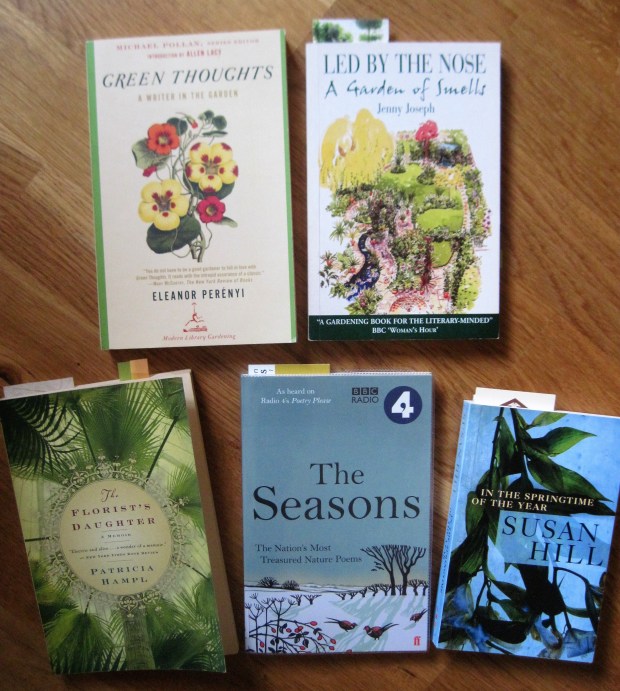
In March through May I often try to read a few gardening-themed books and/or ones with “spring” in the title. Here are some of the ones that I have on the go as occasional reading:
Flowers and gardens
The Florist’s Daughter by Patricia Hampl: Her mother’s final illness led Hampl to reflect on her upbringing in St. Paul, Minnesota as the daughter of an Irish Catholic library clerk and a Czech florist. I love how she writes about small-town life and helping out in her father’s flower shop:
“These apparently ordinary people in our ordinary town, living faultlessly ordinary lives … why do I persist in thinking—knowing—they weren’t ordinary at all? … Nostalgia is really a kind of loyalty”
“it was my father’s domain, but it was also marvelously other, this place heavy with the drowsy scent of velvet-petaled roses and Provençal freesias in the middle of winter, the damp-earth spring fragrance of just-watered azaleas and cyclamen”
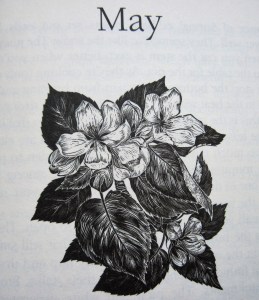 Led by the Nose: A Garden of Smells by Jenny Joseph: Joseph’s name might not sound familiar, but she was the author of the famous poem “Warning: When I Am an Old Woman I Shall Wear Purple” and died early last year. This is a pleasant set of short pieces about what you might see and sense in your garden month by month. “Gardeners do indeed look before and after, at the same time living, as no one else, in the now of the nose,” she maintains. I’m particularly fascinated by the sense of smell and how a writer can describe odors, so I was delighted to find this in a charity shop in Edinburgh last year and have been reading it a few pages at a time as a bedside book. I especially like the wood engravings by Yvonne Skargon that head each chapter.
Green Thoughts: A Writer in the Garden by Eleanor Perényi: A somewhat dense collection of few-page essays, arranged in alphabetical order, on particular plants, tools and techniques. I tried reading it straight through last year and only made it as far as “Beans.” My new strategy is to keep it on my bedside shelves and dip into whichever pieces catch my attention. I don’t have particularly green fingers, so it’s not a surprise that my eye recently alighted on the essay “Failure,” which opens, “Sooner or later every gardener must face the fact that certain things are going to die on him. It is a temptation to be anthropomorphic about plants, to suspect that they do it to annoy.”
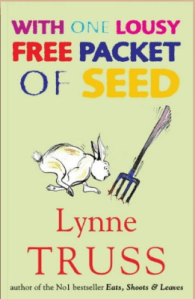 With One Lousy Free Packet of Seed by Lynne Truss (DNF at page 131 out of 210): A faltering gardening magazine is about to be closed down, but Osborne only finds out when he’s already down in Devon doing the research for his regular “Me and My Shed” column with a TV actress. Hijinks were promised as the rest of the put-out staff descend on Honiton, but by nearly the two-thirds point it all still felt like preamble, laying out the characters and their backstories, connections and motivations. My favorite minor character was Makepeace, a pugnacious book reviewer: “he used his great capacities as a professional know-all as a perfectly acceptable substitute for either insight or style.”
Spring
The Seasons, a Faber & Faber / BBC Radio 4 poetry anthology: From Chaucer and other Old English poets to Seamus Heaney (“Death of a Naturalist”) and Philip Larkin (“The Trees”), the spring section offers a good mixture of recent and traditional, familiar and new. A favorite passage was “May come up with fiddle-bows, / May come up with blossom, / May come up the same again, / The same again but different” (from “Nuts in May” by Louis MacNeice). Once we’re back from America I’ll pick up with the summer selections.
In the Springtime of the Year by Susan Hill: Early one spring, Ruth Bryce’s husband, Ben, dies in a forestry accident. They had only been married a year and here she is, aged twenty-one and a widow. Ben’s little brother, 14-year-old Jo, is a faithful visitor, but after the funeral many simply leave Ruth alone. I’m 100 pages in and still waiting for there to be a plot as such; so far it’s a lovely, quiet meditation on grief and solitude amid the rhythms of country life. Ben’s death is described as a “stone cast into still water,” and here at nearly the halfway point we’re seeing how some of the ripples spread out beyond his immediate family. I’m enjoying the writing more than in the three other Hill books I’ve read.
 Absent in the Spring by Mary Westmacott: (The title doesn’t actually have anything to do with the season; it’s a quotation from Shakespeare’s Sonnet 98: “From you have I been absent in the spring.”) From 1944, this is the third of six novels Agatha Christie published under the alias Mary Westmacott. Joan Scudamore, traveling back to London from Baghdad after a visit to her adult daughter, encounters bad weather and misses her train, which leaves her stranded in the desert for days that feel more like weeks. We’re led back through scenes from Joan’s earlier life and realize that she’s utterly clueless about what those closest to her want and think. Rather like Olive Kitteridge, Joan is difficult in ways she doesn’t fully acknowledge. Like a desert mirage, the truth of who she’s been and what she’s done is hazy, and her realization feels a little drawn out and obvious. Once she gets back to London, will she act on what she’s discovered about herself and reform her life, or just slip back into her old habits? This is a short and immersive book, and a cautionary tale to boot. It examines the interplay between duty and happiness, and the temptation of living vicariously through one’s children.
Have you been reading anything particularly appropriate for spring this year?
Rathbones Folio Prize Shortlist: The Perseverance by Raymond Antrobus
The Rathbones Folio Prize is unique in that nominations come from The Folio Academy, an international group of writers and critics, and any book written in English is eligible, so there’s nonfiction and poetry as well as fiction on this year’s varied shortlist of eight titles:
 Can You Tolerate This? by Ashleigh Young [essays]
- The Crossway by Guy Stagg [travel memoir]
- Mary Ann Sate, Imbecile by Alice Jolly [historical fiction]
- Milkman by Anna Burns [literary fiction]
- Ordinary People by Diana Evans [literary fiction]
- The Perseverance by Raymond Antrobus [poetry]
- There There by Tommy Orange [literary fiction]
- West by Carys Davies [historical fiction]

I’m helping to kick off the Prize’s social media tour by championing the debut poetry collection The Perseverance by Raymond Antrobus (winner of the 2018 Geoffrey Dearmer Award from the Poetry Society), issued by the London publisher Penned in the Margins last year. Antrobus is a British-Jamaican poet with an MA in Spoken Word Education who has held multiple residencies in London schools and works as a freelance teacher and poet. His poems dwell on the uneasiness of bearing a hybrid identity – he’s biracial and deaf but functional in the hearing world – and reflect on the loss of his father and the intricacies of Deaf history.
I was previously unaware of the difference between “deaf” and “Deaf,” but it’s explained in the book’s endnotes: Deaf refers to those who are born deaf and learn sign before any spoken language, so they tend to consider deafness part of their cultural identity; deaf means that the deafness was acquired later in life and is a medical consequence rather than a defining trait.
The opening poem, “Echo,” recalls how Antrobus’s childhood diagnosis came as a surprise because hearing problems didn’t run in the family.
I sat in saintly silence
during my grandfather’s sermons when he preached
The Good News I only heard
as Babylon’s babbling echoes.

Raymond Antrobus. Photo credit: Caleb Femi.
Nowadays he uses hearing aids and lip reading, but still frets about how much he might be missing, as expressed in the prose poem “I Move through London like a Hotep” (his mishearing when a friend said, “I’m used to London life with no sales tax”). But if he had the choice, would Antrobus reverse his deafness? As he asks himself in one stanza of “Echo,” “Is paradise / a world where / I hear everything?”
Learning how to live between two worlds is a major theme of the collection, applying not just to the Deaf and hearing communities but also to the balancing act of a Black British identity. I first encountered Antrobus through the recent Black British poetry anthology Filigree (I assess it as part of a review essay in an upcoming issue of Wasafiri literary magazine), which reprints his poem “My Mother Remembers.” A major thread in that volume is art as a means of coming to terms with racism and constructing an individual as well as a group identity. The ghazal “Jamaican British” is the clearest articulation of that fight for selfhood, reinforced by later poems on being called a foreigner and harassment by security staff at Miami airport.
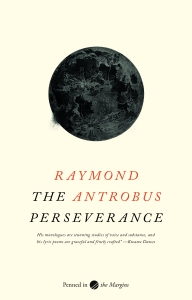 The title comes from the name of the pub where Antrobus’s father drank while his son waited outside. The title poem is an elegant sestina in which “perseverance” is the end word of one line per stanza. The relationship with his father is a connecting thread in the book, culminating in the several tender poems that close the book. Here he remembers caring for his father, who had dementia, in the final two years of his life, and devotes a final pantoum to the childhood joy of reading aloud with him.
A number of poems broaden the perspective beyond the personal to give a picture of early Deaf history. Several mention Alexander Graham Bell, whose wife and mother were both deaf, while in one the ghost of Laura Bridgeman (the subject of Kimberly Elkins’s excellent novel What Is Visible) warns Helen Keller about the unwanted fame that comes with being a poster child for disability. The poet advocates a complete erasure of Ted Hughes’s offensive “Deaf School” (sample lines: “Their faces were alert and simple / Like faces of little animals”; somewhat ironically, Antrobus went on to win the Ted Hughes Award last month!) and bases the multi-part “Samantha” on interviews with a Deaf Jamaican woman who moved to England in the 1980s. The text also includes a few sign language illustrations, including numbers that mark off section divisions.

The Perseverance is an issues book that doesn’t resort to polemic; a bereavement memoir that never turns overly sentimental; and a bold statement of identity that doesn’t ignore complexities. Its mixture of classical forms and free verse, the historical and the personal, makes it ideal for those relatively new to poetry, while those who enjoy the sorts of poets he quotes and tips the hat to (like Kei Miller, Danez Smith and Derek Walcott) will find a resonant postcolonial perspective.
A favorite passage from “Echo” (I’m a sucker for alliteration):
the ravelled knot of tongues,
of blaring birds, consonant crumbs
of dull doorbells, sounds swamped
in my misty hearing aid tubes.
The winner of the Rathbones Folio Prize will be announced on May 20th.
My thanks to the publisher for the free copy for review.
Under the Rock by Benjamin Myers: Paperback Giveaway
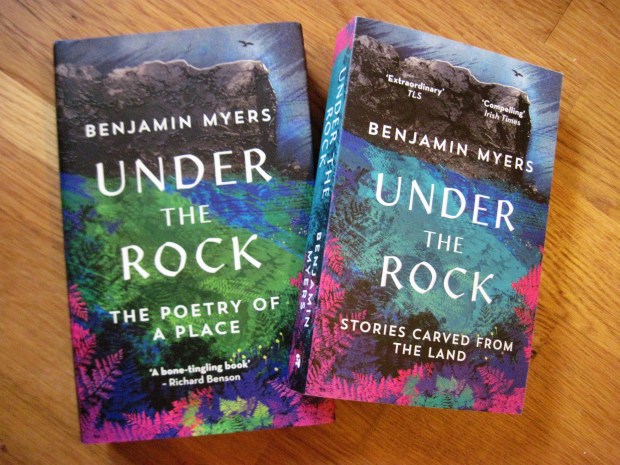
Benjamin Myers’s Under the Rock was my nonfiction book of 2018, so I’m delighted to be kicking off the blog tour for its paperback release on the 25th (with a new subtitle, “Stories Carved from the Land”). I’m reprinting my Shiny New Books review below, with permission, and on behalf of Elliott & Thompson I am also hosting a giveaway of a copy of the paperback. Leave a comment saying that you’d like to win and I will choose one entry at random at the end of the day on Tuesday the 30th. (Sorry, UK only.)
My review:
Benjamin Myers has been having a bit of a moment. In 2017 Bluemoose Books published his fifth novel, The Gallows Pole, which went on to win the Roger Deakin Award and the Walter Scott Prize for Historical Fiction and is now on its fourth printing. This taste of fame has brought renewed attention to his earlier work, including Beastings (2014), recipient of the Northern Writers’ Award. I’ve been interested in Myers’s work ever since I read an extract from the then-unpublished The Gallows Pole in Autumn, the Wildlife Trusts anthology edited by Melissa Harrison, but this is the first of his books that I’ve managed to read.
“Unremarkable places are made remarkable by the minds that map them,” Myers writes, and that is certainly true of Scout Rock, a landmark overlooking Mytholmroyd, near where the author lives in the Calder Valley of West Yorkshire. When he moved up there from London over a decade ago, he and his wife lived in a rental cottage built in 1640. He approached his new patch with admirable curiosity, and supplemented the observations he made from his study window with frequent long walks with his dog, Heathcliff (“Walking is writing with your feet”), and research into the history of the area. The result is a divagating, lyrical book that ranges from geology to true crime but has an underlying autobiographical vein.
Ted Hughes was born nearby, the Brontës not that much further away, and Hebden Bridge, in particular, has become a bastion of avant-garde artists and musicians. Myers also gets plenty of mileage out of his eccentric neighbours and postman. It’s a town that seems to attract oddballs and renegades, from the vigilantes who poisoned the fishing hole to an overdose victim who turns up beneath a stand of Himalayan balsam. A strange preponderance of criminals has come from the region, too, including sexual offenders like Jimmy Savile and serial killers such as the Yorkshire Ripper and Harold Shipman (‘Doctor Death’).
On his walks Myers discovers the old town tip, still full of junk that won’t biodegrade for hundreds more years, and finds traces of the asbestos that was dumped by Acre Mill, creating a national scandal. This isn’t old-style nature writing in search of a few remaining unspoiled places. Instead, it’s part of a growing literary interest in the ‘edgelands’ between settlement and the wild – places where the human impact is undeniable but nature is creeping back in. (Other recent examples would be Common Ground by Rob Cowen, Landfill by Tim Dee, Edgelands by Paul Farley and Michael Symmons Roberts, and Outskirts by John Grindrod.)
Under the Rock gives a keen sense of the seasons’ change and the seemingly inevitable melancholy that accompanies bad weather. A winter of non-stop rain left Myers nigh on delirious with flu; Storm Eva caused the Calder River to flood. He was a part of the effort to rescue trapped pensioners. Heartening as it is to see how the disaster brought people together – Sikh and Muslim charities and Syrian refugees were among the first to help – looting also resulted. One of the most remarkable things about this book is how Myers takes in such extremes of behaviour, along with mundanities, and makes them all part of a tapestry of life.
The book’s recurring themes tangle through all of the sections, even though it has been given a somewhat arbitrary four-part structure (Wood – Earth – Water – Rock). Interludes between these major parts transcribe Myers’s field notes, which are more like impromptu poems that he wrote in a notebook kept in his coat pocket. The artistry of these snippets of poetry is incredible given that they were written in situ, and their alliteration bleeds into his prose as well. My favourite of the poems was “On Lighting the First Fire”:
Autumn burns
the sky
the woods
the valley
death is everywhere
but beneath
the golden cloak
the seeds of
a summer’s
dreaming still sing.
The Field Notes sections are illustrated with Myers’s own photographs, which, again, are of enviable quality. I came away from this feeling like Myers could write anything – a thank-you note, a shopping list – and make it read as profound literature. Every sentence is well-crafted and memorable. There is also a wonderful sense of rhythm to his pages, with a pithy sentence appearing every couple of paragraphs to jolt you to attention.
“Writing is a form of alchemy,” Myers declares. “It’s a spell, and the writer is the magician.” I certainly fell under the author’s spell here. While his eyes are open to the many distressing political and environmental changes of the last few years, the ancient perspective of the Rock reminds him that, though humans are ultimately insignificant and individual lives are short, we can still rejoice in our experiences of the world’s beauty while we’re here.
From the publisher:
“Benjamin Myers was born in Durham in 1976. He is a prize-winning author, journalist and poet. His recent novels are each set in a different county of northern England, and are heavily inspired by rural landscapes, mythology, marginalised characters, morality, class, nature, dialect and post-industrialisation. They include The Gallows Pole, winner of the Walter Scott Prize for Historical Fiction, and recipient of the Roger Deakin Award; Turning Blue, 2016; Beastings, 2014 (Portico Prize for Literature & Northern Writers’ Award winner), Pig Iron, 2012 (Gordon Burn Prize winner & Guardian Not the Booker Prize runner-up); and Richard, a Sunday Times Book of the Year 2010. Bloomsbury will publish his new novel, The Offing, in August 2019.
As a journalist, he has written widely about music, arts and nature. He lives in the Upper Calder Valley, West Yorkshire, the inspiration for Under the Rock.”
Book Serendipity Incidents of 2019 (So Far)
I’ve continued to post my occasional reading coincidences on Twitter and/or Instagram. This is when two or more books that I’m reading at the same time or in quick succession have something pretty bizarre in common. Because I have so many books on the go at once – usually between 10 and 20 – I guess I’m more prone to such serendipitous incidents. (The following are in rough chronological order.)
What’s the weirdest coincidence you’ve had lately?
- Two titles that sound dubious about miracles: There Will Be No Miracles Here by Casey Gerald and The Unwinding of the Miracle: A Memoir of Life, Death, and Everything that Comes After by Julie Yip-Williams

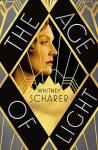
- Two titles featuring light: A Light Song of Light by Kei Miller and The Age of Light by Whitney Scharer
- Grey Poupon mustard (and its snooty associations, as captured in the TV commercials) mentioned in There Will Be No Miracles Here by Casey Gerald and Drinking: A Love Story by Caroline Knapp
 “I Wanna Dance with Somebody” (the Whitney Houston song) referenced in There Will Be No Miracles Here by Casey Gerald and Don’t Call Us Dead by Danez Smith
- Two books have an on/off boyfriend named Julian: Drinking: A Love Story by Caroline Knapp and Extinctions by Josephine Wilson
- There’s an Aunt Marjorie in When I Had a Little Sister by Catherine Simpson and Extinctions by Josephine Wilson


- Set (at least partially) in a Swiss chalet: This Sunrise of Wonder by Michael Mayne and Crazy for God by Frank Schaeffer
- A character named Kiki in The Sacred and Profane Love Machine by Iris Murdoch, The Age of Light by Whitney Scharer, AND Improvement by Joan Silber
 Two books set (at least partially) in mental hospitals: Mind on Fire by Arnold Thomas Fanning and Faces in the Water by Janet Frame
- Two books in which a character thinks the saying is “It’s a doggy dog world” (rather than “dog-eat-dog”): The Friend by Sigrid Nunez and The Octopus Museum by Brenda Shaughnessy
- Reading a novel about Lee Miller (The Age of Light by Whitney Scharer), I find a metaphor involving her in My Year of Rest and Relaxation by Ottessa Moshfegh: (the narrator describes her mother) “I think she got away with so much because she was beautiful. She looked like Lee Miller if Lee Miller had been a bedroom drunk.” THEN I come across a poem in Clive James’s Injury Time entitled “Lee Miller in Hitler’s Bathtub”

- On the same night that I started Siri Hustvedt’s new novel, Memories of the Future, I also started a novel that had a Siri Hustvedt quote (from The Blindfold) as the epigraph: Besotted by Melissa Duclos
- In two books “elicit” was printed where the author meant “illicit” – I’m not going to name and shame, but one of these instances was in a finished copy! (the other in a proof, which is understandable)
- Three books in which the bibliography is in alphabetical order BY BOOK TITLE! Tell me this is not a thing; it will not do! (Vagina: A Re-education by Lynn Enright; Let’s Talk about Death (over Dinner) by Michael Hebb; Telling the Story: How to Write and Sell Narrative Nonfiction by Peter Rubie)
 References to Gerard Manley Hopkins in Another King, Another Country by Richard Holloway, This Sunrise of Wonder by Michael Mayne and The Point of Poetry by Joe Nutt (these last two also discuss his concept of the “inscape”)
- Creative placement of words on the page (different fonts; different type sizes, capitals, bold, etc.; looping around the page or at least not in traditional paragraphs) in When Death Takes Something from You Give It Back by Naja Marie Aidt [not pictured below], How Proust Can Change Your Life by Alain de Botton, Stubborn Archivist by Yara Rodrigues Fowler, Alice Iris Red Horse: Selected Poems of Yoshimasu Gozo and Lanny by Max Porter

- Twin brothers fall out over a girl in Cutting for Stone by Abraham Verghese and one story from the upcoming book Meteorites by Julie Paul
- Characters are described as being “away with the fairies” in Lanny by Max Porter and Away by Jane Urquhart
 Schindler’s Ark/List is mentioned in In the Beginning: A New Reading of the Book of Genesis by Karen Armstrong and Telling the Story: How to Write and Sell Narrative Nonfiction by Peter Rubie … makes me think that I should finally pick up my copy!
 Bookish Beck = Rebecca Foster. American transplant to England. Freelance proofreader and book reviewer.
 Bookish Beck