#ReadIndies Nonfiction Catch-Up: Ansell, Farrier, Febos, Hoffman, Orlean and Stacey
These are all 2025 releases; for some, it’s approaching a year since I was sent a review copy or read the book. Silly me. At last, I’ve caught up. Reading Indies month, hosted by Kaggsy in memory of her late co-host Lizzy Siddal, is the perfect time to feature books from five independent publishers. I have four works that might broadly be classed as nature writing – though their topics range from birdsong and technology to living in Greece and rewilding a plot in northern Spain – and explorations of celibacy and the writer’s profession.
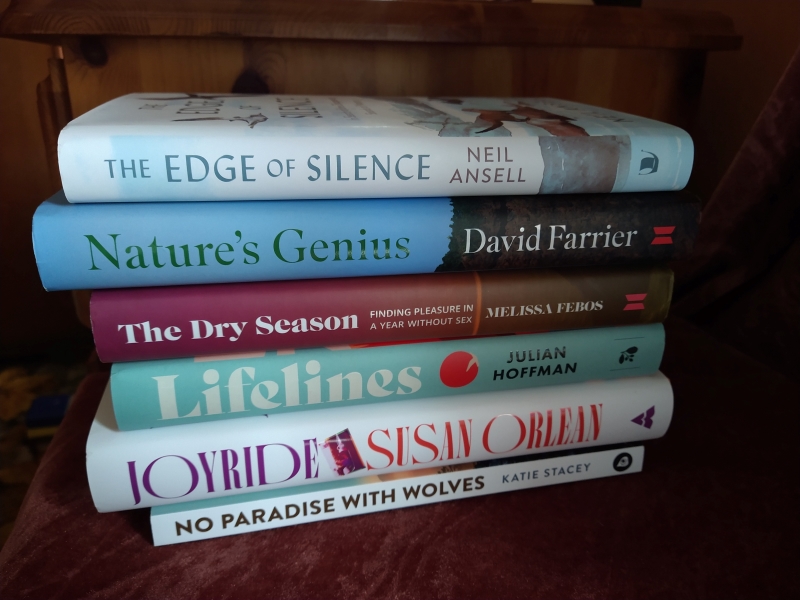
The Edge of Silence: In Search of the Disappearing Sounds of Nature by Neil Ansell
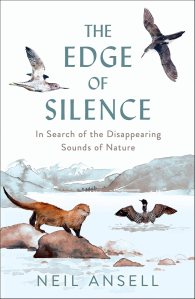 Ansell draws parallels between his advancing hearing loss and the biodiversity crisis. He puts together a wish list of species – mostly seabirds (divers, grebes), but also inland birds (nightjars) and a couple of non-avian representatives (otters) – that he wants to hear and sets off on public transport adventures to find them. “I must find beauty where I can, and while I still can,” he vows. From his home on the western coast of Scotland near the Highlands, this involves trains or buses that never align with the ferry timetables. Furthest afield for him are two nature reserves in northern England where his mission is to hear bitterns “booming” and natterjack toads croaking at night. There are also mountain excursions to locate ptarmigan, greenshank, and black grouse. His island quarry includes Manx shearwaters (Rum), corncrakes (Coll), puffins (Sanday), and storm petrels (Shetland).
Camping in a tent means cold nights, interrupted sleep, and clouds of midges, but it’s all worth it to have unrepeatable wildlife experiences. He has a very high hit rate for (seeing and) hearing what he intends to, even when they’re just on the verge of what he can decipher with his hearing aids. On the rare occasions when he misses out, he consoles himself with earlier encounters. “I shall settle for the memory, for it feels unimprovable, like a spell that I do not want to break.” I’ve read all of Ansell’s nature memoirs and consider him one of the UK’s top writers on the natural world. His accounts of his low-carbon travels are entertaining, and the tug-of-war between resisting and coming to terms with his disability is heartening. “I have spent this year in defiance of a relentless, unstoppable countdown,” he reflects. What makes this book more universal than niche is the deadline: we and all of these creatures face extinction. Whether it’s sooner or later depends on how we act to address the environmental polycrisis.
With thanks to Birlinn for the free copy for review.
Nature’s Genius: Evolution’s Lessons for a Changing Planet by David Farrier
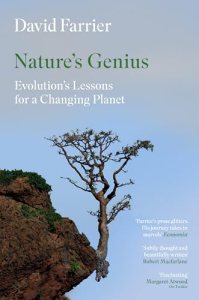 Farrier’s Footprints, which tells the story of the human impact on the Earth, was one of my favourite books of 2020. This contains a similar blend of history, science, and literary points of reference (Farrier is a professor of literature and the environment at the University of Edinburgh), with past changes offering a template for how the future might look different. “We are forcing nature to reimagine itself, and to avert calamity we need to do the same,” he writes. Cliff swallows have evolved blunter wings to better evade cars; captive breeding led foxes to develop the domesticated traits of pet dogs.
It’s not just other species that experience current evolution. Thanks to food abundance and a sedentary lifestyle, humans show a “consumer phenotype,” which superseded the Palaeolithic (95% of human history) and tends toward earlier puberty, autoimmune diseases, and obesity. Farrier also looks at notions of intelligence, language, and time in nature. Sustainable cities will have to cleverly reuse materials. For instance, The Waste House in Brighton is 90% rubbish. (This I have to see!)
There are many interesting nuggets here, and statements that are difficult to argue with, but I struggled to find an overall thread. Cool to see my husband’s old housemate mentioned, though. (Duncan Geere, for collaborating on a hybrid science–art project turning climate data into techno music.)
With thanks to Canongate for the free copy for review.
The Dry Season: Finding Pleasure in a Year without Sex by Melissa Febos
Febos considers but rejects the term “sex addiction” for the years in which she had compulsive casual sex (with “the Last Man,” yes, but mostly with women). Since her early teen years, she’d never not been tied to someone. Brief liaisons alternated with long-term relationships: three years with “the Best Ex”; two years that were so emotionally tumultuous that she refers to the woman as “the Maelstrom.” It was the implosion of the latter affair that led to Febos deciding to experiment with celibacy, first for three months, then for a whole year. “I felt feral and sad and couldn’t explain it, but I knew that something had to change.”
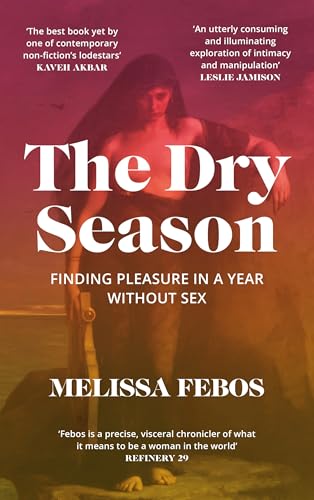 The quest involved some research into celibate movements in history, but was largely an internal investigation of her past and psyche. Febos found that she was less attuned to the male gaze. Having worn high heels almost daily for 20 years, she discovered she’s more of a trainers person. Although she was still tempted to flirt with attractive women, e.g. on an airplane, she consciously resisted the impulse to spin random meetings into one-night stands. (A therapist had stopped her short with the blunt observation, “you use people.”) With a new focus on the life of the mind, she insists, “My life was empty of lovers and more full than it had ever been.” (This reminded me of Audre Lorde’s writing on the erotic.) As Silvana Panciera, an Italian scholar on the beguines (a secular nun-like sisterhood), told her: “When you don’t belong to anyone, you belong to everyone. You feel able to love without limits.”
Intriguing that this is all a retrospective, reflecting on her thirties; Febos is now in her mid-forties and married to a woman (poet Donika Kelly). Clearly she felt that it was an important enough year – with landmark epiphanies that changed her and have the potential to help others – to form the basis for a book. For me, she didn’t have much new to offer about celibacy, though it was interesting to read about the topic from an areligious perspective. But I admire the depth of her self-knowledge, and particularly her ability to recreate her mindset at different times. This is another one, like her Girlhood, to keep on the shelf as a model.
With thanks to Canongate for the free copy for review.
Lifelines: Searching for Home in the Mountains of Greece by Julian Hoffman
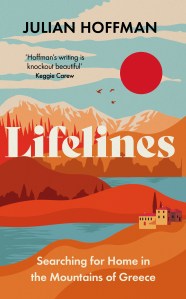 Hoffman’s Irreplaceable was my nonfiction book of 2019. Whereas that was a work with a global environmentalist perspective, Lifelines is more personal in scope. It tracks the author’s unexpected route from Canada via the UK to Prespa, a remote area of northern Greece that’s at the crossroads with Albania and North Macedonia. He and his wife, Julia, encountered Prespa in a book and, longing for respite from the breakneck pace of life in London, moved there in 2000. “Like the rivers that spill into these shared lakes, lifelines rarely flow straight. Instead, they contain bends, meanders and loops; they hold, at times, turns of extraordinary surprise.” Birdwatching, which Hoffman suggests is as “a way of cultivating attention,” had been their gateway into a love for nature developed over the next quarter-century and more, and in Greece they delighted in seeing great white and Dalmatian pelicans (which feature on the splendid U.S. cover. It would be lovely to have an illustrated edition of this.)
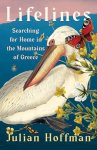 One strand of this warm and fluent memoir is about making a home in Greece: buying and renovating a semi-derelict property, experiencing xenophobia and hospitality from different quarters, and finding a sense of belonging. They’re happy to share their home with nesting wrens, who recur across the book and connect to the tagline of “a story of shelter shared.” In probing the history of his adopted country, Hoffman comes to realise the false, arbitrary nature of borders – wildlife such as brown bears and wolves pay these no heed. Everything is connected and questions of justice are always intersectional. The Covid pandemic and avian influenza (which devastated the region’s pelicans) are setbacks that Hoffman addresses honestly. But the lingering message is a valuable one of bridging divisions and learning how to live in harmony with other people – and with other species.
With thanks to Elliott & Thompson for the free copy for review.
Joyride by Susan Orlean
As a long-time staff writer for The New Yorker, Orlean has had the good fortune to be able to follow her curiosity wherever it leads, chasing the subjects that interest her and drawing readers in with her infectious enthusiasm. She grew up in suburban Ohio, attended college in Michigan, and lived in Portland, Oregon and Boston before moving to New York City. Her trajectory was from local and alternative papers to the most enviable of national magazines: Esquire, Rolling Stone and Vogue. Orlean gives behind-the-scenes information on lots of her early stories, some of which are reprinted in an appendix. “If you’re truly open, it’s easy to fall in love with your subject,” she writes; maintaining objectivity could be difficult, as when she profiled an Indian spiritual leader with a cult following; and fended off an interviewee’s attachment when she went on the road with a Black gospel choir.
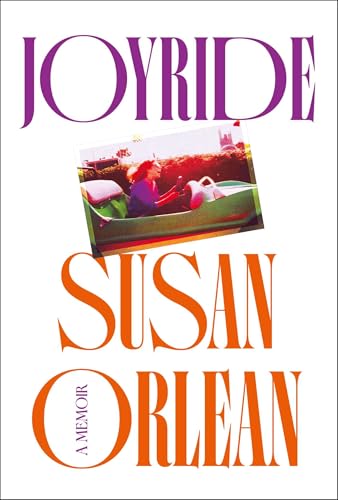 Her personal life takes a backseat to her career, though she is frank about the breakdown of her first marriage, her second chance at love and late motherhood, and a surprise bout with lung cancer. The chronological approach proceeds book by book, delving into her inspirations, research process and publication journeys. Her first book was about Saturday night as experienced across America. It was a more innocent time, when subjects were more trusting. Orlean and her second husband had farms in the Hudson Valley of New York and in greater Los Angeles, and she ended up writing a lot about animals, with books on Rin Tin Tin and one collecting her animal pieces. There was also, of course, The Library Book, about the wild history of the main Los Angeles public library. But it’s her The Orchid Thief – and the movie (not) based on it, Adaptation – that’s among my favourites, so the long section on that was the biggest thrill for me. There are also black-and-white images scattered through.
It was slightly unfortunate that I read this at the same time as Book of Lives – who could compete with Margaret Atwood? – but it is, yes, a joy to read about Orlean’s writing life. She’s full of enthusiasm and good sense, depicting the vocation as part toil and part magic:
“I find superhuman self-confidence when I’m working on a story. The bashfulness and vulnerability that I might otherwise experience in a new setting melt away, and my desire to connect, to observe, to understand, powers me through.”
“I like to do a gut check any time I dismiss or deplore something I don’t know anything about. That feels like reason enough to learn about it.”
“anything at all is worth writing about if you care about it and it makes you curious and makes you want to holler about it to other people”
With thanks to Atlantic Books for the free copy for review.
No Paradise with Wolves: A Journey of Rewilding and Resilience by Katie Stacey
I had the good fortune to visit Wild Finca, Luke Massey and Katie Stacey’s rewilding site in Asturias, while on holiday in northern Spain in May 2022, and was intrigued to learn more about their strategy and experiences. This detailed account of the first four years begins with their search for a property in 2018 and traces the steps of their “agriwilding” of a derelict farm: creating a vegetable garden and tending to fruit trees, but also digging ponds, training up hedgerows, and setting up rotational grazing. Their every decision went against the grain. Others focussed on one crop or type of livestock while they encouraged unruly variety, keeping chickens, ducks, goats, horses and sheep. Their neighbours removed brush in the name of tidiness; they left the bramble and gorse to welcome in migrant birds. New species turned up all the time, from butterflies and newts to owls and a golden fox.
Luke is a wildlife guide and photographer. He and Katie are conservation storytellers, trying to get people to think differently about land management. The title is a Spanish farmers’ and hunters’ slogan about the Iberian wolf. Fear of wolves runs deep in the region. Initially, filming wolves was one of the couple’s major goals, but they had to step back because staking out the animals’ haunts felt risky; better to let them alone and not attract the wrong attention. (Wolf hunting was banned across Spain in 2021.) There’s a parallel to be found here between seeing wolves as a threat and the mild xenophobia the couple experienced. Other challenges included incompetent house-sitters, off-lead dogs killing livestock, the pandemic, wildfires, and hunters passing through weekly (as in France – as we discovered at Le Moulin de Pensol in 2024 – hunters have the right to traverse private land in Spain).
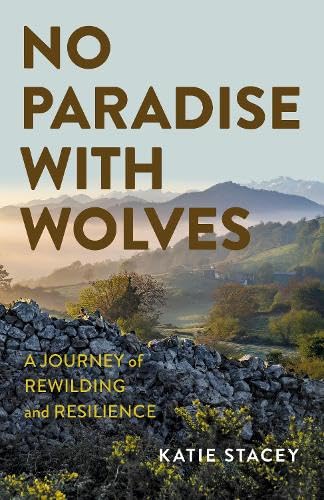
Luke and Katie hope to model new ways of living harmoniously with nature – even bears and wolves, which haven’t made it to their land yet, but might in the future – for the region’s traditional farmers. They’re approaching self-sufficiency – for fruit and vegetables, anyway – and raising their sons, Roan and Albus, to love the wild. We had a great day at Wild Finca: a long tour and badger-watching vigil (no luck that time) led by Luke; nettle lemonade and sponge cake with strawberries served by Katie and the boys. I was clear how much hard work has gone into the land and the low-impact buildings on it. With the exception of some Workaway volunteers, they’ve done it all themselves.
Katie Stacey’s storytelling is effortless and conversational, making this impassioned memoir a pleasure to read. It chimed perfectly with Hoffman’s writing (above) about the fear of bears and wolves, and reparation policies for farmers, in Europe. I’d love to see the book get a bigger-budget release complete with illustrations, a less misleading title, the thorough line editing it deserves, and more developmental work to enhance the literary technique – as in the beautiful final chapter, a present-tense recreation of a typical walk along The Loop. All this would help to get the message the wider reach that authors like Isabella Tree have found. “I want to be remembered for the wild spaces I leave behind,” Katie writes in the book’s final pages. “I want to be remembered as someone who inspired people to seek a deeper connection to nature.” You can’t help but be impressed by how much of a difference two people seeking to live differently have achieved in just a handful of years. We can all rewild the spaces available to us (see also Kate Bradbury’s One Garden against the World), too.
With thanks to Earth Books (Collective Ink) for the free copy for review.
Which of these do you fancy reading?
Review Catch-up: Matt Gaw, Sheila Heti, Liz Jensen (and a Pile of DNFs)
Today I have a travel book about appreciating nature in any weather, a sui generis memoir drawn from a decade of diaries, and an impassioned cry for the environment in the wake of a young adult son’s death.
I’m also bidding farewell to a whole slew of review books that have been hanging around, in some cases, for literal years – I think one is from 2021, and several others from 2022. Putting a book on my “set aside” shelf can be a kiss of death … or I can go back at a better time and end up loving it. It’s hard to predict which will occur. On these, alas, I have had to admit defeat and will pass the books on to other homes.
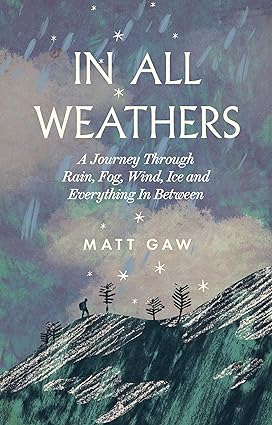
In All Weathers: A Journey through Rain, Fog, Wind, Ice and Everything in Between by Matt Gaw
Gaw’s two previous nature/travel memoirs, the enjoyable The Pull of the River and Under the Stars, involve gentle rambles through British landscapes, along with commentary on history, nature and science. The remit is much the same here. The book is split into four long sections: “Rain,” “Fog,” “Ice and Snow,” and “Wind.” The adventures always start from and end up at the author’s home in Suffolk, but he ranges as far as the Peak District, Cumbria and the Isle of Skye. Wild swimming is one way in which he experiences places. He notices a lot and describes it all in lovely and relatable prose.
 I was tickled by the definitions of, and statistics about, a “white Christmas”: in the UK, it counts if there’s even a single snowflake falling, whereas in the US there has to be 2.5 cm or more of standing snow. (Scotland is most likely to experience white Christmases; it has had 37 since 1960 vs. 26 in northern England. The English snow record is 43 cm, at Buxton and Malham Tarn in 1981 and 2009.) There’s underlying mild dread as he notes how weather patterns have changed and will likely continue changing, ever more dramatically, into his children’s future.
I find I don’t have much to say about this book because it is very nice but doesn’t do anything interesting or tackle anything that isn’t familiar from many other nature books (such as Rain by Melissa Harrison and Forecast by Joe Shute). It’s unfortunate for Gaw that his ideas often seem to have been done before – his book on night-walking, in particular, was eclipsed by several other works on that topic that came out at around the same time. I hope that the next time around he’ll get more editorial guidance to pursue original topics. It might take just a little push to get him to the next level where he could compete with top UK nature writers.
With thanks to Elliott & Thompson Books for the free copy for review.
Alphabetical Diaries by Sheila Heti
Heti put the contents of ten years of her diaries into a spreadsheet, alphabetizing each sentence (including articles), and then ruthlessly culled the results until she had a 25-chapter (no ‘X’) book. You could hardly call it a narrative, yet looking for one is so hardwired that every few sentences you are jolted out of what feels like a mini-story and into something new. Instead, you might think of it as an autobiographical mosaic. The recurring topics are familiar from the rest of Heti’s oeuvre, with obsessive cogitating about relationships, art and identity. But there are also the practicalities of trying to make a living as a woman in a creative profession. Tendrils of the everyday poke out here and there as she makes a meal, catches a plane, or buys clothes. Men loom large: explicit accounts of sex with Pavel and Lars (though also Fiona); advising her friend Lemons on his love life. There are also meta musings on what she is trying to achieve with her book projects and on what literature can be.
 Grammatically, the document is a lot more interesting than it could be – or than a similar experiment based on my diary would be, for instance – because Heti sometimes writes in incomplete sentences, dropping the initial pronoun; or intersperses rhetorical questions or notes to self in the imperative. So, yes, ‘I’ is a long chapter, but not only because of self-absorbed “I…” statements; there’s also plenty of “If…” and “It’s…” ‘H’ and ‘W’ are longer sections than might be expected because of the questioning mode. But it’s at the sentence level that the book makes the biggest impression: lines group together, complement or contradict each other, or flout coherence by being so merrily à propos of nothing. Here are a few passages to give a flavour:
Am I wasting my time? Am low on money. Am making noodles. Am reading Emma. Am tired and will go to sleep. Am tired today and I feel like I may be getting a cold. Ambivalence gives you something to do, something to think about.
Best not to live too emotionally in the future—it hardly ever comes to pass. Better to be on the outside, where you have always been, all your life, even in school, nothing changes. Better to look outward than inward. Blow jobs and tenderness. Books that fall in between the cracks of all aspects of the human endeavour.
It’s 2:34 every time I check the time these days. It’s 4 p.m. It’s 4:41 now. It’s a fantasy of being saved. It’s a stupid idea. It’s a yellow, cloudy sky. It’s amazing to me how life keeps going. It’s better to work, to go into the underground cave where there are books, than to fritter away time online. It’s crazy that I need all of these mental crutches in order to live. It’s fiction. It’s fine.
Scrambled eggs on toast at Yaddo. Second-guessing everything. Second, he said that no one is buying fiction. See the complexity. See the souls. See what kind of story the book can accommodate, if any. Seeing her for coffee was not so bad.
It’s surprising how much sense a text constructed so apparently haphazardly makes, perhaps because of the same subject and style throughout. Sometimes aphoristic, sometimes poetic (all that anaphora), the book is playful but overall serious about the capturing of a life on the page. Heti transcends the quotidian by exploding the one-thing-after-another tedium of chronology. Remarkably, the collage approach produces a more genuine, crystalline vision of the self than precise scenes and cause-and-effect chains ever could. A work of life writing like no other, it must be read in a manner all its own that it teaches you as you go along. I admire it enormously and hope I might write something even half as daring one day.
With thanks to Fitzcarraldo Editions for the free copy for review.
Your Wild and Precious Life: On grief, hope and rebellion by Liz Jensen
Jensen’s younger son, Raphaël Coleman, was just 25 when he collapsed while filming a documentary in South Africa and died of a previously undiagnosed heart condition. Raph had been involved in Extinction Rebellion and Jensen is a founding member of Writers Rebel. They both deemed activism “the best antidote to depression.” Her son had been obsessed with wildlife from a young age and was rewilding acres of their land in France, as well as making environmentalist films (he had achieved minor fame as a child actor in Nanny McPhee) and participating in direct action, such as at the Brazilian embassy in London.
 For Jensen, the challenge, especially after lockdown confined her to her Copenhagen flat, was to channel grief into further radicalism rather than retreating into herself or giving in to the lure of suicide. She tried to see personal grief as a reminder of ecogrief, and therefore as a spur. One way that she coped was turning towards the supernatural. She continued to hear and speak to Raph, in daily life as well as through a medium, and interpreted bird sightings as signs of his continued presence. An additional point of interest to me was that the author’s husband is Carsten Jensen, the writer of one of my favourite books, We, the Drowned.
This doesn’t particularly stand out among the dozens of bereavement memoirs I’ve read. (It was also remarkably similar to Alexandra Fuller’s Fi, which I’d read not long before.) Perhaps more years of reflection would have helped – Mary Karr advises seven – though I suspect Jensen felt, quite rightly, that given the current state of the environment we have no time to waste. And I have no doubt that the combination of a mother’s love and an ecological conscience will make this book meaningful to many readers.
With thanks to Canongate for the free copy for review.
And the DNFs…
there are more things, Yara Rodrigues Fowler – I loved Stubborn Archivist so much that I leapt at the chance to read her follow-up, but it was just too dull and involved about Brazilian versus UK politics. Nor did the stylistic tricks feel as novel this time around. I read 66 pages. (Fleet)
The Rabbit Hutch, Tess Gunty – Gunty dazzled critics and prize judges in the USA, winning a National Book Award. I was drawn to her debut novel for the composite picture of the residents of one Indiana apartment building and the strange connections that develop between them over one summer week, including perhaps a murder? Blandine, the central character, is a sort of modern-day mystic but hard to warm to (“She normally tries to avoid saying in which out loud, to minimize the number of people who find her insufferable”), as are all the characters. This felt like try-hard MFA writing. I read 85 pages. (Oneworld)
Eve: The Disobedient Future of Birth, Claire Horn – I usually get on well with Wellcome Collection books. I think the problem here was that there was too much material that was familiar to me from having read Womb by Leah Hazard – even the SF-geared stuff about artificial wombs. I read 45 pages. (Profile Books)
Blessings, Chukwuebuka Ibeh – This debut novel has a confident voice, buttressed by determination to reveal what life is like for queer people living in countries where homosexuality is criminalized. Obiefuna is cast out for having a crush on Aboy, his father’s apprentice, even though the two young men share nothing more physical than a significant gaze into each other’s eyes. The strict boarding school his father sends him to is a place of privation, hierarchy, hazing and, I suspect, same-sex experimentation. I found the writing capable but couldn’t get past a sense of dread about what was going to happen. Meanwhile, I didn’t think the alternating chapters from Obiefuna’s mother’s perspective added anything to the narrative. I read 62 pages. (Penguin Viking)
The War for Gloria, Atticus Lish – Lish’s debut novel, Preparation for the Next Life, was excellent, but I could never get stuck in to this follow-up, despite the appealing medical theme. When Gloria Goltz is diagnosed with ALS, her 15-year-old son Corey turns to his absent father and others for support. It was also unfortunate that Lish mentions the Ice Bucket Challenge: that was popularized in 2014, whereas the book is set in 2010. I read 75 pages. (Serpent’s Tail)
Snow Widows: Scott’s Fatal Antarctic Expedition through the Eyes of the Women They Left Behind, Katherine MacInnes – I seriously overestimated my interest in polar exploration narratives. MacInnes seems to have done quite a good job of creating novelistic scenes through research, though. I read 35 pages. (William Collins)
The Woodcock, Richard Smyth – I feel particularly bad about this one as I’ve read and enjoyed three of Smyth’s nature books and my husband and I are friendly with him on Twitter. Initially, I got Thomas Hardy, D.H. Lawrence and Sarah Perry (The Essex Serpent, anyway) vibes from this 1920s-set novel about the upheaval a naturalist and his wife experience when an American whaler and his daughters arrive in their small coastal English town. I read 90 pages. (Fairlight Books)
Better Broken than New: A Fragmented Memoir, Lisa St Aubin de Terán – I accepted this for review because I’d often seen the author’s name on spines in secondhand bookstores but didn’t know anything about her work. The précis of her globe-trotting life is stranger than fiction: marriage to a Venezuelan freedom fighter, managing a sugar plantation in the Andes, living in an Italian palace for 20 years, founding a charity in Mozambique. The vignettes in the early part of the book (e.g., skipping school and going on daytrips by train at age eight) are entertaining, if written with blithe disregard for a reader’s need for context or perspective. But the fragmented nature means it all feels as random as life, without the necessary authorial shaping. The publisher has done her a disservice as she seeks to relaunch her career by not proofreading properly: Many small errors slipped through the net, making this look like a sloppy manuscript. The worst happen to be other authors’ names: Jane ‘Austin’, ‘Kahil’ Gibran, Virginia ‘Wolfe’. Are you kidding me?! I read 53 pages. (Amaurea Press)
Review Book Catch-Up: Dennis, Galloway, Leland-St. John and Sampson
Capsule reviews today, of four books I am inexcusably late in reviewing. I have a record of personal experience with species reintroductions, a memoir about living among reindeer herders in the far north of Norway, a set of elegiac poems, and a biography of a Victorian woman poet who struggled with poor health for most of her life.
Restoring the Wild: Sixty Years of Rewilding Our Skies, Woods and Waterways by Roy Dennis
 Rewilding is a big buzz word in current nature and environmental writing. Few could be said to have played as major a role in the UK’s successful species reintroduction projects as Roy Dennis, who has been involved with the RSPB and other key organizations since the late 1950s. He trained as a warden at two of the country’s most famous bird observatories, Lundy Island and Fair Isle. Most of his later work was to focus on birds: white-tailed eagles, red kites, and ospreys. Some of these projects extended into continental Europe. He also writes about the special challenges posed by mammal reintroductions; beavers get a chapter of their own. Every initiative is described in exhaustive detail, full of names and dates, whereas I would have been okay with an overview. This feels like more of an insider’s history rather than a layman’s introduction. I have popped it on my husband’s bedside table in hopes that, with his degree in wildlife conservation, he’ll be more interested in the nitty-gritty.
Favourite lines:
“Tenacity and a long view to the future are important in wildlife conservation.”
“for every successful project that gets the go-ahead, there are others into which people put great effort but which then run up against problems.”
With thanks to William Collins for the free copy for review.
Dálvi: Six Years in the Arctic Tundra by Laura Galloway
 The title is the word for winter in the Northern Sámi language. Galloway, a journalist, traded in New York City for Arctic Norway after a) a DNA test told her that she had Sámi blood and b) she met and fell for Áilu, a reindeer herder, at a wedding. She enrolled in an intensive language learning course at university level and got used to some major cultural changes: animals were co-workers here rather than pets (like the two cats she brought with her); communal meals and drawn-out goodbyes were not the done thing; and shamans were still active (one helped them find a key she lost). Footwear neatly sums up the difference. The Prada heels she brought “just in case” ended up serving as hammers; instead, she helped Áilu’s mother make reindeer skins into boots. Two factors undermined my enjoyment: Alternating chapters about her unhappy upbringing in Indiana don’t add much of interest, and, after her relationship with Áilu ends, the book feels aimless. However, I appreciated her words about DNA not defining you, and family being what you make it.
With thanks to Atlantic Books for the free copy for review.
A Raga for George Harrison by Sharmagne Leland St.-John (2020)
 Native American poet Sharmagne Leland St.-John’s fifth collection is a nostalgic and bittersweet look at people and places from one’s past. There are multiple elegies for public figures – everyone from Janis Joplin to Virginia Woolf – as well as for some who aren’t household names but have important stories that should be commemorated, like Hector Pieterson, a 12-year-old boy killed during the Soweto Uprising for protesting enforced teaching of Afrikaans in South Africa in 1976. Many of the elegies are presented as songs. Personal sources of sadness, such as a stillbirth, disagreements with a daughter, and ageing, weigh as heavily as tragic world events.
Rhyming and alliteration create inviting rhythms throughout the book, and details of colour and fashion animate poems like “La Kalima.” Leland St.-John remembers meeting street children in Mexico, while bamboo calls to mind time spent in Japan. “Promised Land” is an ironic account of land being seized from natives and people of colour. I especially liked “Things I Would Have Given to My Mother Had She Asked” (some literal and some more abstract), which opens “A piece of my liberal mind. 5 more minutes of my time”, and the sombre “Cat’s Cradle” (“Drenched starlings perch on a cat’s cradle of telephone wires”).
You can read “I Said Coffee” and a few more of her poems online.
With thanks to the author for sending a free e-copy for review.
Two-Way Mirror: The Life of Elizabeth Barrett Browning by Fiona Sampson
 Coming in at under 260 pages, this isn’t your standard comprehensive biography. Sampson instead describes it as a “portrait,” one that takes up the structure of EBB’s nine-book epic poem, Aurora Leigh, and is concerned with themes of identity and the framing of stories. Elizabeth, as she is cosily called throughout the book, wrote poems that lend themselves to autobiographical interpretation – “her body of work creates a kind of looking glass in which, dimly, we make out the person who wrote it,” Sampson asserts.
Nicknamed “Ba,” Elizabeth was born in 1806 and brought up with 11 younger siblings at a Herefordshire estate, Hope End. Her father, Edward, had been born in Jamaica and the family fortune was based on sugar – and slavery. Sampson makes much of this inherited guilt, and also places an emphasis on EBB’s lifelong ill health, which involved headaches, back and side pain, and depression. She also suffered from respiratory complaints. The modern medically minded reader tries to come up with a concrete diagnosis. Tardive dystonia? Post-viral syndrome? The author offers many potential explanations, and notes that her subject was the very type of the Victorian female invalid. She would also suffer from miscarriages, but had one son, Pen. The Brownings were in the unusual position of the wife being the more famous partner.
Sampson draws heavily on correspondence and earnestly interrogates scenes and remembrances, but her use of the present tense is a bit odd for a historical narrative, and I found my casual curiosity about the Brownings wasn’t enough to sustain my interest. However, this did make me eager to try more of EBB’s poetry. I wonder if I still have that copy of Sonnets from the Portuguese in a box in the States?
Favourite lines:
“Within the continual process of reputation-making and remaking that is literary history, Elizabeth Barrett Browning remains a bellwether for the rising and sinking stock of women writers. … Elizabeth dramatizes the two-way creation of every writing self, from without and from within. That the life of the body both enables and limits the life of the mind is the paradox of the thinking self.”
With thanks to Profile Books for the free copy for review.
Would you be interested in reading one or more of these?
Recommended May Releases: Adichie, Pavey and Unsworth
Three very different works of women’s life writing: heartfelt remarks on bereavement, a seasonal diary of stewarding four wooded acres in Somerset, and a look back at postnatal depression.
Notes on Grief by Chimamanda Ngozi Adichie
This slim hardback is an expanded version of an essay Adichie published in the New Yorker in the wake of her father’s death in June 2020. With her large family split across three continents and coronavirus lockdown precluding in-person get-togethers, they had a habit of frequent video calls. She had seen her father the day before on Zoom and knew he was feeling unwell and in need of rest, but the news of his death still came as a complete shock.
 Adichie anticipates all the unhelpful platitudes people could and did send her way: he lived to a ripe old age (he was 88), he had a full life and was well respected (he was Nigeria’s first statistics professor), he had a mercifully swift end (kidney failure). Her logical mind knows all of these facts, and her writer’s imagination has depicted grief many times. Still, this loss blindsided her.
She’d always been a daddy’s girl, but the anecdotes she tells confirm how special he was: wise and unassuming; a liberal Catholic suspicious of materialism and with a dry humour. I marvelled at one such story: in 2015 he was kidnapped and held in the boot of a car for three days, his captors demanding a ransom from his famous daughter. What did he do? Correct their pronunciation of her name, and contradict them when they said that clearly his children didn’t love him. “Grief has, as one of its many egregious components, the onset of doubt. No, I am not imagining it. Yes, my father truly was lovely.” With her love of fashion, one way she dealt with her grief was by designing T-shirts with her father’s initials and the Igbo words for “her father’s daughter” on them.
I’ve read many a full-length bereavement memoir, and one might think there’s nothing new to say, but Adichie writes with a novelist’s eye for telling details and individual personalities. She has rapidly become one of my favourite authors: I binged on most of her oeuvre last year and now have just one more to read, Purple Hibiscus, which will be one of my 20 Books of Summer. I love her richly evocative prose and compassionate outlook, no matter the subject. At £10, this 85-pager is pricey, but I was lucky to get it free with Waterstones loyalty points.
Favourite lines:
“In the face of this inferno that is sorrow, I am callow and unformed.”
“How is it that the world keeps going, breathing in and out unchanged, while in my soul there is a permanent scattering?”
Deeper Into the Wood by Ruth Pavey
 In 1999 Ruth Pavey bought four acres of scrubland at auction, happy to be returning to her family’s roots in the Somerset Levels and hoping to work alongside nature to restore some of her land to orchard and maintain the rest in good health. Her account of the first two decades of this ongoing project, A Wood of One’s Own, was published in 2017.
In this sequel, she gives peaceful snapshots of the wood throughout 2019, from first snowdrops to final apple pressing, but also faces up to the environmental degradation that is visible even in this pocket of the countryside. “I am sure there has been a falling off in numbers of insects, smaller birds and rabbits on my patch,” she insists. Without baseline data, it is hard to support this intuition, but she has botanical and bird surveys done, and invites an expert in to do a moth-trapping evening. The resulting species lists are included as appendices. In addition, Pavey weaves a backstory for her land. She meets a daffodil breeder, investigates the source of her groundwater, and visits the head gardener at the Bishop’s Palace in Wells, where her American black walnut sapling came from. She also researches the Sugg family, associated with the land (“Sugg’s Orchard” on the deed) from the 1720s.
 Pavey aims to treat this landscape holistically: using sheep to retain open areas instead of mowing the grass, and weighing up the benefits of the non-native species she has planted. She knows her efforts can only achieve so much; the pesticides standard to industrial-scale farming may still be reaching her trees on the wind, though she doesn’t apply them herself. “One sad aspect of worrying about the state of the natural world is that everything starts to look wrong,” she admits. Starting in that year’s abnormally warm January, it was easy for her to assume that the seasons can no longer be relied on.
Compared with her first memoir, this one is marked by its intellectual engagement with the principles and practicalities of rewilding. Clearly, her inner struggle is motivated less by the sense of ownership than by the call of stewardship. While this book is likely be of most interest to those with a local connection or a similar project underway, it offers a universal model of how to mitigate our environmental impact. Pavey’s black-and-white sketches of the flora and fauna on her patch, reminiscent of Quentin Blake, are a highlight.
With thanks to Duckworth for the proof copy for review. The book will be published tomorrow, the 27th of May.
After the Storm: Postnatal Depression and the Utter Weirdness of New Motherhood by Emma Jane Unsworth
The author’s son was born on the day Donald Trump won the U.S. presidential election. Six months later, she realized that she was deep into postnatal depression and finally agreed to get help. The breaking point came when, with her husband* away at a conference, she got frustrated with her son’s constant fussing and pushed him over on the bed. He was absolutely fine, but the guilty what-ifs proliferated, making this a wake-up call for her.
 In this succinct, wry and hard-hitting memoir, Unsworth exposes the conspiracies of silence that lead new mothers to lie and pretend that everything is fine. Since her son’s traumatic birth (which I first read about in Dodo Ink’s Trauma anthology), she hadn’t been able to write and was losing her sense of self. To add insult to injury, her baby had teeth at 16 weeks and bit her as he breastfed. She couldn’t even admit her struggles to her fellow mum friends. But “if a woman is in pain for long enough, and denied sleep for long enough, and at the same time feels as though she has to keep going and put a ‘brave’ face on, she’s going to crack.”
The book’s titled mini-essays give snapshots into the before and after, but particularly the agonizing middle of things. I especially liked the chapter “The Weirdest Thing I’ve Ever Done in a Hotel Room,” in which she writes about borrowing her American editor’s room to pump breastmilk. Therapy, antidepressants and hiring a baby nurse helped her to ease back into her old life and regain some part of the party girl persona she once exuded – enough so that she was willing to give it all another go (her daughter was born late last year).
While Unsworth mostly writes from experience, she also incorporates recent research and makes bold statements of how cultural norms need to change. “You are not monsters,” she writes to depressed mums. “You need more support. … Motherhood is seismic. It cracks open your life, your relationship, your identity, your body. It features the loss, grief and hardship of any big life change.” I can imagine this being hugely helpful to anyone going through PND (see also my Three on a Theme post on the topic), but I’m not a mother and still found plenty to appreciate (especially “We have to smash the dichotomy of mums/non-mums … being maternal has nothing to do with actually physically being a mother”).
I’m attending a Wellcome Collection online event with Unsworth and midwife Leah Hazard (author of Hard Pushed) this evening and look forward to hearing more from both authors.
*It took me no time at all to identify him from the bare facts: Brighton + doctor + graphic novelist = Ian Williams (author of The Lady Doctor)! I had no idea. What a fun connection.
With thanks to Profile Books/Wellcome Collection for the free copy for review.
What recent releases can you recommend?
The Circling Sky & The Sleeping Beauties
I think I have another seven April releases on the go that kind publishers have sent my way, but I’m so slow at finishing books that these two are the only ones I’ve managed so far. (I see lots of review catch-up posts in my future!) For now I have a travel memoir musing on the wonders of the New Forest and the injustice of land ownership policies, and a casebook of medical mysteries that can all be classed as culturally determined psychosomatic illnesses.
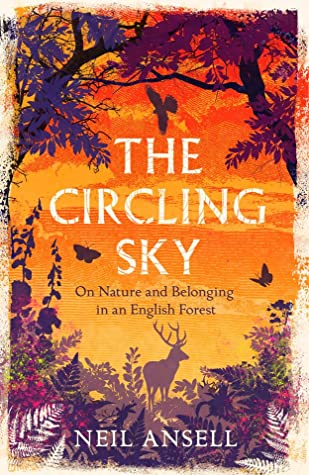
The Circling Sky: On Nature and Belonging in an Ancient Forest by Neil Ansell
After The Last Wilderness and especially Deep Country, his account of five solitary years in a Welsh cabin, Ansell is among my most-admired British nature writers. I was delighted to learn that his new book would be about the New Forest as it’s a place my Hampshire-raised husband and I have visited often and feel fond of. It has personal significance for Ansell, too: he grew up a few miles from Portsmouth. On Remembrance Sunday 1966, though, his family home burned down when a spark from a central heating wire sent the insulation up in flames. He can see how his life was shaped by this incident, making him a nomad who doesn’t accumulate possessions.
Hoping to reclaim a sense of ancestral connection, he returned to the New Forest some 30 times between January 2019 and January 2020, observing the unfolding seasons and the many uncommon and endemic species its miles house. The Forest has more than 1000 trees of over 400 years old, mostly oak and beech. Much of the rest is rare heath habitat, and livestock grazing maintains open areas. There are some plants only found in the New Forest, as well as a (probably extinct) cicada. He has close encounters with butterflies, a muntjac, and less-seen birds like the Dartford warbler, firecrest, goshawk, honey buzzard, and nightjar.
 But this is no mere ‘white man goes for a walk’ travelogue, as much of modern nature writing has been belittled. Ansell weaves many different themes into the work: his personal story (mostly relevant, though his mother’s illness and a trip to Rwanda seemed less necessary), the shocking history of forced Gypsy relocation into forest compounds starting in the 1920s, biomass decline, and especially the unfairness of land ownership in Britain. More than 99% of the country is in the hands of a very few, and hardly any is left as common land. There is also enduring inequality of access to what little there is, often along race and class lines. The have-nots have been taught to envy the haves: “We are all brought up to aspire to home ownership,” Ansell notes. As a long-term renter, it’s a goal I’ve come to question, even as I crave the security and self-determination that owning a house and piece of land could offer.
Ansell speaks of “environmental dread” as a “rational response to the way the world is turning,” but he doesn’t rest in that mindset of despair. He’s in favour of rewilding, which is not, as some might assume, about leaving land alone to revert to its original state, but about the reintroduction of native species and intentional restoration of habitat types. In extending these rewilded swathes, we would combat the tendency to think of nature as something kept ‘over there’ in small reserves while subjecting the rest of the land to intensive, pesticide-based farming and the exploitation of resources. The New Forest thus strikes him as an excellent model of both wildlife-friendly land management and freedom of human access.
I appreciated how Ansell concludes that it’s not enough to simply love nature and write about the joy of spending time in it. Instead, he accepts a mantle of responsibility: “nothing is more political than the way we engage with the world around us. … Nature writing may often be read for comfort and reassurance, but perhaps we need to allow a little room for anger, too, for the ability to rage at everything that has been taken from us, and taken by us.” The bibliography couldn’t be more representative of my ecologist husband’s and my reading interests and nature library. The title is from John Clare and the book is a poetic meditation as well as a forthright argument. It also got me hankering for my next trip to the New Forest.
My rating: 
With thanks to Tinder Press for the proof copy for review.
The Sleeping Beauties: And Other Stories of Mystery Illness by Suzanne O’Sullivan
O’Sullivan is a consultant at the National Hospital for Neurology and Neurosurgery. She won the Wellcome Book Prize for It’s All in Your Head, and The Sleeping Beauties picks up on that earlier book’s theme of psychosomatic illness – with the key difference being that this one travels around the world to investigate outbreaks of mass hysteria or sickness that have arisen in particular cultural contexts. An important thing to bear in mind is that O’Sullivan and other doctors in her field are not dismissing these illnesses as “fake”; they acknowledge that they are real and meaningful, yet there is clear evidence that they are not physical in origin – brain tests come back normal – but psychological with bodily manifestations.
 The case that gives the book its title appeared in Sweden in 2017. Child asylum seekers who had experienced trauma in their home country were falling into a catatonic state. O’Sullivan visited the home of sisters Nola and Helan, part of the Yazidi ethnic minority group from Iraq and Syria. The link between them and the other children affected was that they were all now threatened with deportation: Their hopelessness had taken on physical form, giving the illness the name resignation syndrome. “Predictive coding” meant their bodies did as they expected them to. She describes it as “a very effective culturally agreed means of expressing distress.”
In Texas, the author meets Miskito people from Nicaragua who combat the convulsions and hallucinations of “grisi siknis” in their community with herbs and prayers; shamans are of more use in this circumstance than antiepileptic drugs. A sleeping sickness tore through two neighbouring towns of Kazakhstan between 2010 and 2015, affecting nearly half of the population. As with the refugee children in Sweden, it was a stress response to being forced to move away – though people argued they were being poisoned by a local uranium mine. There is often a specific external factor that is blamed in these situations, as when mass hysteria and seizures among Colombian schoolgirls were attributed to the HPV vaccine.
This book was released on the 1st of April, and at times I felt I was the victim of an elaborate April Fool’s joke: the cases are just so bizarre, and we’re used to rooting out a physical cause. But she makes clear that, in a biopsychosocial understanding (as also discussed in Pain by Abdul-Ghaaliq Lalkhen), these illnesses are serving “a vital purpose” – just psychological and cultural. The first three chapters are the strongest; the book feels repetitive and somewhat aimless thereafter, especially in Chapter 4, which hops between different historical outbreaks of psychosomatic illness, like among the Hmong (cf. Anne Fadiman’s The Spirit Catches You and You Fall Down), and other patients she treated for functional disorders. The later example of “Havana syndrome” doesn’t add enough to warrant its inclusion.
Still, O’Sullivan does well to combine her interviews and travels into compelling mini-narratives. Her writing has really come on in leaps and bounds since her first book, which I found clunky. However, much my favourite of her three works is Brainstorm, about epilepsy and other seizure disorders of various origins.
My rating: 
With thanks to Picador for the proof copy for review.
What recent releases can you recommend?
Six Degrees of Separation: From Wolfe Island to Riverine
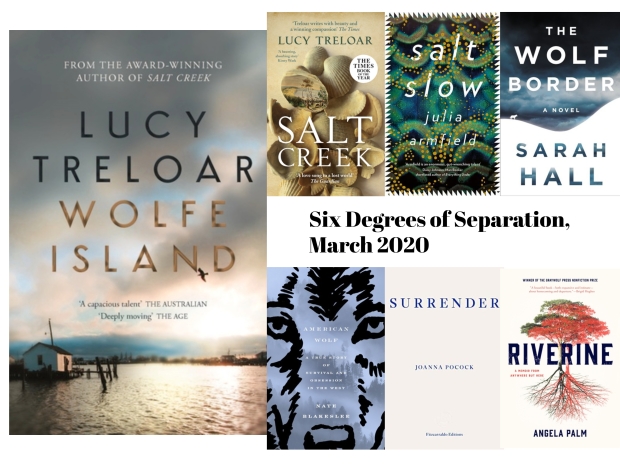
It’s my second month participating in Kate’s Six Degrees of Separation meme (see her introductory post). This time the challenge starts with Wolfe Island by Lucy Treloar. Alas, as far as I can tell this hasn’t yet been published outside of Australia. Which is such a shame, because I absolutely adored…
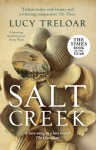
#1 Salt Creek, Treloar’s debut novel. I read it in 2018 and deemed it “one of the very best works of historical fiction I’ve read.” A widowed teacher settled in England looks back on the eight ill-fated years her family spent at an outpost in South Australia in the 1850s–60s. It’s a piercing story of the clash of cultures and the secret prejudices that underpin our beliefs.
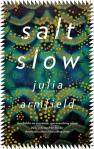
#2 I recently saw someone on Twitter remarking on the apparent trend for book titles to have the word “Salt” in them. Of the few examples he mentioned, I’ve read and enjoyed Salt Slow by Julia Armfield, which was on the Young Writer of the Year Award shortlist last year. The book’s nine short stories are steeped in myth and magic, but often have a realistic shell.
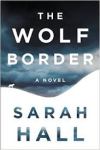
#3 One story in Salt Slow, “Formerly Feral,” is about a teenager who has a wolf for a stepsister. So, to get back to the literal wording of our starting point (a homonym, anyway; I didn’t know whether to take this in the Salt direction or the Wolf direction; now I’ve done both!), another work of fiction I read that incorporated wolves was The Wolf Border by Sarah Hall, a fantastic novel to which Scottish independence and rewilding form a backdrop.
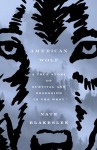
#4 The controversy over the reintroduction of wolves to Yellowstone National Park – and the decision to remove their endangered status, thus declaring open season for hunters – is at the heart of the nonfiction study American Wolf by Nate Blakeslee. “The West was caught up in a culture war, and for some people it was more than just a metaphor,” he writes.
#5 Wolves and rewilding in the American West also come into the memoir-in-essays Surrender by Joanna Pocock, about the two years of loss and change she spent in Missoula, Montana and her sense of being a foreigner both there and on her return to London.
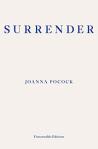
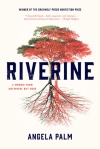
#6 A wonderful memoir-in-essays that was criminally overlooked in 2016 was Riverine by Angela Palm (my BookBrowse review). It has such a strong sense of place, revealing how traces of the past are still visible in the landscape and how our environment shapes who we are. Palm reflects on the winding course of her life in the Midwest and the people who meant most to her along the way, including a friend who was later sentenced to life in prison for murdering their elderly neighbors. In keeping with the watery imagery, there is a stream-of-consciousness element to the writing.
Join us for #6Degrees of Separation if you haven’t already!
Have you read any of my selections? Are you tempted by any you didn’t know before?
Review Books Roundup: Blackburn, Bryson, Pocock, Setterwall, Wilson
I’m attempting to get through all my 2019 review books before the end of the year, so expect another couple of these roundups. Today I’m featuring a work of poetry about one of Picasso’s mistresses, a thorough yet accessible introduction to how the human body works, a memoir of personal and environmental change in the American West, Scandinavian autofiction about the sudden loss of a partner, and a novel about kids who catch on fire. You can’t say I don’t read a variety! See if one or more of these tempts you.
The Woman Who Always Loved Picasso by Julia Blackburn
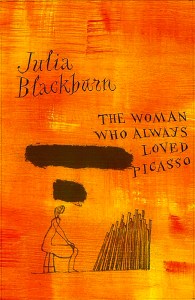 Something different from Blackburn: biographical snippets in verse about Marie-Thérèse Walter, one of Pablo Picasso’s many mistress-muses. When they met she was 17 and he was 46. She gave birth to a daughter, Maya – to his wife Olga’s fury. Marie-Thérèse’s existence was an open secret: he rented a Paris apartment for her to live in, and left his home in the South of France to her (where she committed suicide three years after his death), but unless their visits happened to overlap she was never introduced to his friends. “I lived in the time I was born into / and I kept silent, / acquiescing / to everything.”
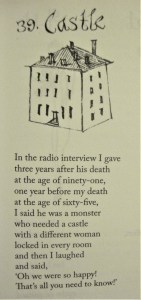 In Marie-Thérèse’s voice, Blackburn depicts Picasso as a fragile demagogue: in one of the poems that was a highlight for me, “Bird,” she describes how others would replace his caged birds when they died, hoping he wouldn’t notice – so great was his horror of death. I liked getting glimpses into a forgotten female’s life, and appreciated the whimsical illustrations by Jeffrey Fisher, but as poems these pieces don’t particularly stand out. (Plus, there are no page numbers! which doesn’t seem like it should make a big difference but ends up being annoying when you want to refer back to something. Instead, the poems are numbered.)
My rating:
With thanks to Carcanet Press for the free copy for review. Published today.
The Body: A Guide for Occupants by Bill Bryson
 Shelve this next to Being Mortal by Atul Gawande in a collection of books everyone should read – even if you don’t normally choose nonfiction. Bryson is back on form here, indulging his layman’s curiosity. As you know, I read a LOT of medical memoirs and popular science. I’ve read entire books on organ transplantation, sleep, dementia, the blood, the heart, evolutionary defects, surgery and so on, but in many cases these go into more detail than I need and I can find my interest waning. That never happens here. Without ever being superficial or patronizing, the author gives a comprehensive introduction to every organ and body system, moving briskly between engaging anecdotes from medical history and encapsulated research on everything from gut microbes to cancer treatment.
Bryson delights in our physical oddities, and his sense of wonder is infectious. He loves a good statistic, and while this book is full of numbers and percentages, they are accessible rather than obfuscating, and will make you shake your head in amazement. It’s a persistently cheerful book, even when discussing illness, scientists whose work was overlooked, and the inevitability of death. Yet what I found most sobering was the observation that, having conquered many diseases and extended our life expectancy, we are now overwhelmingly killed by lifestyle, mostly a poor diet of processed and sugary foods and lack of exercise.
My rating: 
With thanks to Doubleday for the free copy for review.
Surrender: Mid-Life in the American West by Joanna Pocock
 Prompted by two years spent in Missoula, Montana and the disorientation felt upon a return to London, this memoir-in-essays varies in scale from the big skies of the American West to the smallness of one human life and the experience of loss and change. Then in her late forties, Pocock had started menopause and recently been through the final illnesses and deaths of her parents, but was also mother to a fairly young daughter. She explores personal endings and contradictions as a kind of microcosm of the paradoxes of the Western USA.
It’s a place of fierce independence and conservatism, but also mystical back-to-the-land sentiment. For an outsider, so much of the lifestyle is bewildering. The author attends a wolf-trapping course, observes a Native American buffalo hunt, meets a transsexual rewilding activist, attends an ecosexuality conference, and goes foraging. All are attempts to reassess our connection with nature and ask what role humans can play in a diminished planet.
This is an elegantly introspective work that should engage anyone interested in women’s life writing and the environmental crisis. There are also dozens of black-and-white photographs interspersed in the text. In 2018 Pocock won the Fitzcarraldo Editions Essay Prize for this work-in-progress. It came to me as an unsolicited review copy and hung around on my shelves for six months before I picked it up; I’m glad I finally did.
My rating: 
With thanks to Fitzcarraldo Editions for the free copy for review.
Let’s Hope for the Best by Carolina Setterwall
[Trans. from the Swedish by Elizabeth Clark Wessel]
 Although this is fiction, it very closely resembles the author’s own life. She wrote this debut novel to reflect on the sudden loss of her partner and how she started to rebuild her life in the years that followed. It quickly splits into two parallel story lines: one begins in April 2009, when Carolina first met Aksel at a friend’s big summer bash; the other picks up in October 2014, after Aksel’s death from cardiac arrest. The latter proceeds slowly, painstakingly, to portray the aftermath of bereavement. In the alternating timeline, we see Carolina and Aksel making their life together, with her always being the one to push the relationship forward.
Setterwall addresses the whole book in the second person to Aksel. When the two story lines meet at about the two-thirds point, it carries on into 2016 as she moves house, returns to work and resumes a tentative social life, even falling in love. This is a wrenching story reminiscent of In Every Moment We Are Still Alive by Tom Malmquist, and much of it resonated with my sister’s experience of widowhood. There are many painful moments that stick in the memory. Overall, though, I think it was too long by 100+ pages; in aiming for comprehensiveness, it lost some of its power. Page 273, for instance (the first anniversary of Aksel’s death, rather than the second, where the book actually ends), would have made a fine ending.
My rating: 
With thanks to Bloomsbury UK for the proof copy for review.
Nothing to See Here by Kevin Wilson
 I’d read a lot about this novel while writing a synopsis and summary of critical opinion for Bookmarks magazine – perhaps too much, as it felt familiar and offered no surprises. Lillian, a drifting twentysomething, is offered a job as a governess for her boarding school roommate Madison’s stepchildren. Madison’s husband is a Tennessee senator in the running for the Secretary of State position, so it’s imperative that they keep a lid on the situation with his 10-year-old twins, Bessie and Roland.
You see, when they’re upset these children catch on fire; flames destroy their clothes and damage nearby soft furnishings, but leave the kids themselves unharmed. Temporary, generally innocuous spontaneous combustion? Okay. That’s the setup. Wilson writes so well that it’s easy to suspend your disbelief about this, but harder to see a larger point, except perhaps creating a general allegory for the challenges of parenting. This was entertaining enough, mostly thanks to Lillian’s no-nonsense narration, but for me it didn’t soar.
My rating:
With thanks to Text Publishing UK for the PDF for review. This came out in the States in October and will be released in the UK on January 30th.
Would you be interested in reading one or more of these?
Out and About in Edinburgh
After going to Wigtown in April, I never expected I’d be back in Scotland this year. This was a fairly last-minute trip we booked so that my husband could attend a short rewilding workshop for PhD students. They all met up in Edinburgh and proceeded by bus into the Cairngorms to see sites of habitat restoration and potential future wildlife releases. I stayed behind at our Airbnb flat and kept up a reduced work load while enjoying the city break.
Day 1, Wednesday the 19th: A travel day. Our journey – two train rides plus a short walk at either end – should have taken just over 7 hours. Instead, it took 14. Recent storms had taken down wires at Durham and left debris on the line, so our original train was terminated at York. We managed to get a connection to Newcastle, queued outside for two hours for rail replacement buses that never came, and finally got a very delayed train through to Edinburgh. Our poor Airbnb hostess’s parents had to wait up for us until 12:40 a.m.
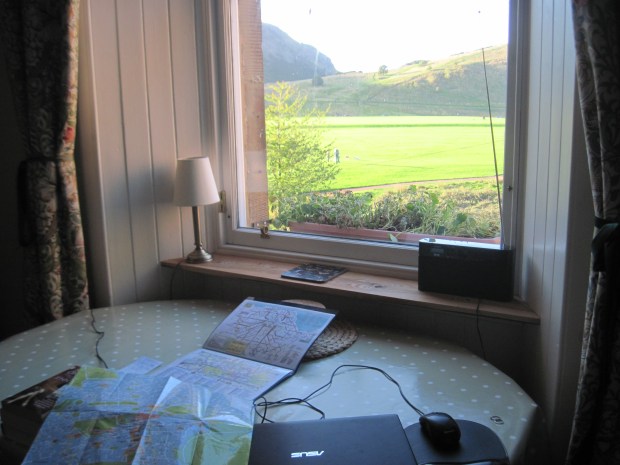
Day 2, Thursday the 20th: After just a few hours of sleep, we were up early so that Chris could leave by 7:15 for his meet-up on the Edinburgh campus. The props and sketches scattered about suggest that the flat owner is a theatre costume and set designer. The view overlooking Holyrood Park and Arthur’s Seat is spectacular – a great place to put in a few hours of proofreading before heading out to town after lunch.


On Clare’s recommendation I started with the Surgeons’ Hall Museums on the Royal College of Surgeons campus. They have several collections covering the history of surgery, dentistry, and pathology specimens. Many of the names and developments were familiar to me from Lindsey Fitzharris’s The Butchering Art. Joseph Lister’s frock coat is on display, and in one corner rare video footage plays of Sir Arthur Conan Doyle (who was initially a practicing physician) explaining how he based Sherlock Holmes on his university mentor, Joseph Bell.
 It’s not a place for the squeamish as there are mummified skeletons, details about Burke and Hare’s grave-robbing, surgical tools, and tumors and other anatomical deformities in jars everywhere. I found it all fascinating and spent a good two hours poking around. My favorite bits were the case full of foreign bodies removed from noses, stomachs and intestines and the temporary exhibition, “A Quest for Healing” by Zhang Yanzi, who had a residency at the museums in the summer of 2017. Her pieces included a 2D mountain made of pill packets, a cotton and gauze sculpture bristling with acupuncture needles, a matching hanging sculpture of capillaries, two surgical beds, and various silk screen panels.
The pathology museum, spread across two floors, was a little overwhelming and almost distressingly faceless – so many human beings reduced to the conditions that had defined and perhaps killed them. The most striking specimen for me, then, was one that actually included a face. I think it was a First World War soldier whose nose had been sewn back together, and what was so remarkable was that you could see his ginger whiskers and eyebrows, and his eyes were closed as if he was just taking a nap. (For ever. In a museum case.)

The sculpture outside is From Here Health by Denys Mitchell (1994).
There are only explanatory panels about a select few samples, so it can be hard to spot just what’s wrong with the organs unless you have specialist medical knowledge. I appreciated the few places where notes have been added along the lines of “see your doctor if…” There were four polycystic kidneys on display in various cases, so including mine there were at least six present in the building that day. “More lives would be saved if more people carried kidney donor cards,” one caption read. Amen.
Clare also recommended the university area for its charity shops. I had a good trawl around Nicolson Street and bought one book, but a lot of the shops are geared towards vintage and High Street fashion. I had better luck at the Salvation Army store on Forrest Road (near the National Museum), where I found three books and two classical CDs.


On to the Writers’ Museum, which commemorates Robert Burns, Sir Walter Scott and Robert Louis Stevenson. I was most interested in the Stevenson material, including memorabilia from his later life on Samoa, especially as I’m currently reading a novel about his relationship with the American divorcee Fanny Osbourne. By now I was museum-ed out and headed back to the flat for a leftovers dinner and some reading before an early bedtime.


Day 3, Friday the 21st: Another morning of work followed by an afternoon of wandering on foot between free attractions and charity shops and avoiding the drizzle. I visited the unusual Scottish Parliament building (which cost a cool £414 million) and saw inside the debating chamber. Four books from the Lothian Cat Rescue charity shop; quick jaunts around the Museum of Childhood, the Museum of Edinburgh, Canongate Kirk, the Music Museum, and the Central Library. When it came to it I couldn’t be bothered to pay £14 to go around Holyrood Palace, but I enjoyed a reasonably priced cappuccino and carrot cake at their café. Chris was back in the evening for a dinner of frozen pizza with local beer and cider.


Day 4, Saturday the 22nd: Our one full day in the City together. We weren’t feeling up to the Arthur’s Seat walk, so we did a gentle stroll up the Salisbury Crags and back instead. Then we caught a bus out to the Stockbridge area for more charity shopping (two more books) and a scrumptious brunch at The Pantry. This was a recommendation on chef David Lebovitz’s food blog and it more than lived up to expectations. It’s no wonder we had to wait half an hour for a table. I could have eaten anything on the menu, but in the end I had smoked salmon eggs Benedict followed by a cherry and Nutella brownie.


After a brief browse at Golden Hare Books, we went on along the Water of Leith to the lovely Royal Botanic Garden. It’s free to walk around, but we also paid to tour the Glasshouses, which recreate the flora of 10 different climates. The RBG is also home to the National Memorial for Organ and Tissue Donors, a peaceful circular space set back in the woods and marked out by a few benches and stone monuments. As I have organ donors to thank for the continued life and health of my mother and several other relatives, it was well worth a visit.


Back into town for gelato (I had a delicious poached plum and cinnamon sorbet) at Mary’s Milk Bar, which is on Grassmarket across from the Castle and was another Lebovitz recommendation. A quick circuit of the animal hall at the National Museum before it closed, a stroll along the Royal Mile, and a rest with tea and books back at the flat before going back out for a veggie curry.
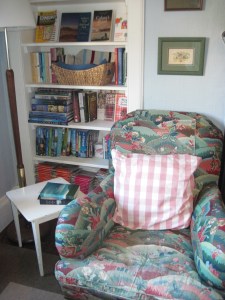
Airbnb bedroom reading nook
Day 5, Sunday the 23rd: Return travel day. No major issues, but still enough of a delay to apply for compensation – refunds from LNER and my husband’s work will have made the journey very cheap indeed.
I was sad to leave Edinburgh this time. I loved our Airbnb flat and felt very at home in it. If I had a bicycle to get into town a little faster, I could easily live there. The tourists would probably drive me mad, but Edinburgh is a wonderful place with so much to see and do and such incredible scenery within a short drive.
Thank you to everyone who offered suggestions of what to see and do. I managed to fit in most of what you recommended!
What I read:
The bulk of Unsheltered, Barbara Kingsolver’s bold new novel about distrust and displacement in America then (the 1870s) and now (during the rise of Trump), and Come to Me by Amy Bloom, a wonderful story collection about people who love who they shouldn’t love. More about this one in my upcoming round-up of short stories I’ve read this month. 
 A Ladder to the Sky by John Boyne is a delicious piece of literary suspense with a Tom Ripley-like hero you’ll love to hate: Maurice Swift, who wants nothing more than to be a writer but doesn’t have any ideas of his own, so steals them from other people. I loved how we see this character from several outside points of view – first Erich Ackerman, whose Nazi-era history provides the basis for Maurice’s first novel; then Gore Vidal, to whose Italian home Maurice pays a visit with his new mentor; and finally Maurice’s wife Edith, a celebrated author in her own right – before getting Maurice’s own perspective. By this point we know enough about him to understand just how unreliable a narrator he is. My one criticism is that I would have binned the whole subplot about Edith’s sister and brother-in-law. (A nice touch: at one point Maurice buys a reprint copy of Maude Avery’s Like to the Lark, which should ring a bell from The Heart’s Invisible Furies.)
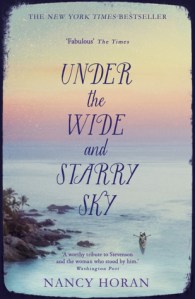 I also read over half of Jenny Diski’s Stranger on a Train, a memoir about two long train journeys she took across America in the late 1990s that also incorporates memories from a troubled adolescence – she started smoking at 14 and was in and out of mental hospitals at 15 – in which she loved nothing more than to read while riding the Circle line all day long. I’m a quarter of the way through both Nancy Horan’s Under the Wide and Starry Sky, about Stevenson and his wife, and Peter Hill’s Stargazing, a memoir about dropping out of art school to become a Scottish lighthouse keeper in 1973; he started on Pladda, a tiny island off of Arran. And on my Nook I read a good bit of All You Can Ever Know, Nicole Chung’s forthcoming memoir about being raised by adoptive white parents in Oregon and meeting members of her Korean family in her mid-twenties, just as she became a mother herself.
My Most Anticipated Releases of the Second Half of 2018
Here are 30 books that are on my radar for the months of July through November (I haven’t heard about any December titles yet), plus one bonus book that I’ve already read. This is by no means a full inventory of what’s coming out, or even of what I have available through NetGalley and Edelweiss; instead, think of it as a preview of the books I actually intend to read, in release date order. The quoted descriptions are from the publisher blurbs on Goodreads. If I already have access to the book in some way, I’ve noted that.
The first half of the year seemed to be all about plants. This time around I have plenty of memoirs, some medical and some bookish; birds and watery imagery; and some religious and philosophical themes.
[By the way, here’s how I did with my most anticipated releases of the first half of the year:
- 17 out of 30 read; of those 8 were at least somewhat disappointing (d’oh!)
- 5 unfinished
- 1 currently reading
- 1 lost interest in
- 1 I still intend to read
- 5 I didn’t manage to find]
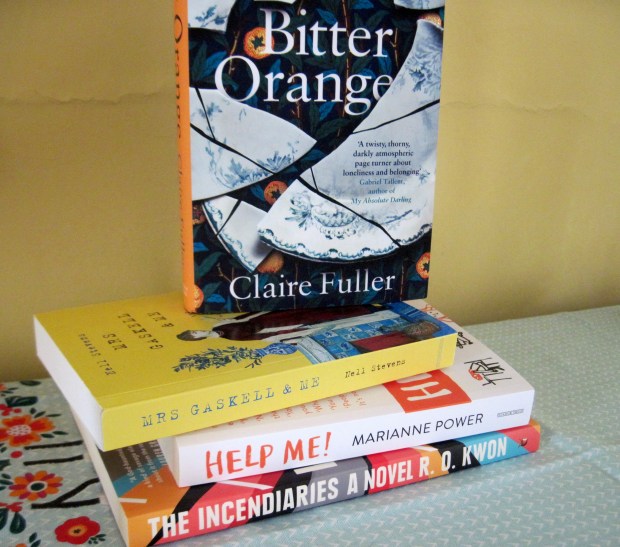
The upcoming titles I happen to own in print.
July
 No One Tells You This: A Memoir by Glynnis MacNicol [July 10, Simon & Schuster]: “If the story doesn’t end with marriage or a child, what then? This question plagued Glynnis MacNicol on the eve of her 40th birthday. … Over the course of her fortieth year, which this memoir chronicles, Glynnis embarks on a revealing journey of self-discovery that continually contradicts everything she’d been led to expect.” (NetGalley download)
 The Lost Chapters: Finding Recovery and Renewal One Book at a Time by Leslie Schwartz [July 10, Blue Rider Press]: “Leslie Schwartz’s powerful, skillfully woven memoir of redemption and reading, as told through the list of books she read as she served a 90-day jail sentence. … Incarceration might have ruined her, if not for the stories that comforted her while she was locked up.”
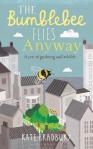 The Bumblebee Flies Anyway: Gardening and Surviving Against the Odds by Kate Bradbury [July 17, Bloomsbury Wildlife]: “Finding herself in a new home in Brighton, Kate Bradbury sets about transforming her decked, barren backyard into a beautiful wildlife garden. She documents the unbuttoning of the earth and the rebirth of the garden, the rewilding of a tiny urban space.”
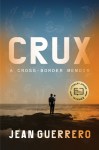 Crux: A Cross-Border Memoir by Jean Guerrero [July 17, One World]: “A daughter’s quest to find, understand, and save her charismatic, troubled, and elusive father, a self-mythologizing Mexican immigrant who travels across continents—and across the borders between imagination and reality; and spirituality and insanity—fleeing real and invented persecutors.”
 The Incendiaries by R.O. Kwon [July 31, Riverhead]: “A shocking novel of violence, love, faith, and loss, as a young woman at an elite American university is drawn into acts of domestic terrorism by a cult tied to North Korea. … The Incendiaries is a fractured love story and a brilliant examination of the minds of extremist terrorists, and of what can happen to people who lose what they love most.” (Print ARC for blog review at UK release on Sept. 6 [Virago])
August
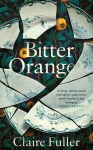 Bitter Orange by Claire Fuller [Aug. 2, Penguin Fig Tree]: I’ve loved Fuller’s two previous novels. This one is described as “a suspenseful story about deception, sexual obsession and atonement” set in 1969 in a run-down English country house. I don’t need to know any more than that; I have no doubt it’ll be brilliant in an Iris Murdoch/Gothic way. (Print ARC for blog review on release date)
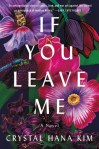 If You Leave Me by Crystal Hana Kim [Aug. 7, William Morrow]: “An emotionally riveting debut novel about war, family, and forbidden love—the unforgettable saga of two ill-fated lovers in Korea and the heartbreaking choices they’re forced to make in the years surrounding the civil war that continues to haunt us today.” This year’s answer to Pachinko? And another botanical cover to boot! (Edelweiss download)
 A River of Stars by Vanessa Hua [Aug. 14, Ballantine Books]: “In a powerful debut novel about motherhood, immigration, and identity, a pregnant Chinese woman makes her way to California and stakes a claim to the American dream. … an entertaining, wildly unpredictable adventure, told with empathy and wit” Sounds like The Leavers, which is a Very Good Thing.
 The Shakespeare Requirement by Julie Schumacher [Aug. 14, Doubleday]: A sequel to the very funny epistolary novel Dear Committee Members! “Now is the fall of his discontent, as Jason Fitger, newly appointed chair of the English Department of Payne University, takes aim against a sea of troubles, personal and institutional.” (Edelweiss download)
 Gross Anatomy: Dispatches from the Front (and Back) by Mara Altman [Aug. 21, G.P. Putnam’s Sons]: “By using a combination of personal anecdotes and fascinating research, Gross Anatomy holds up a magnifying glass to our beliefs, practices, biases, and body parts and shows us the naked truth—that there is greatness in our grossness.” (PDF from publisher; to review for GLAMOUR online)
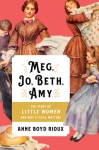 Meg, Jo, Beth, Amy: The Story of Little Women and Why It Still Matters by Anne Boyd Rioux [Aug. 21, W. W. Norton Company]: This is the bonus one I’ve already read, as part of my research for my Literary Hub article on rereading Little Women at its 150th anniversary. (That’s also the occasion for this charming book.) Rioux unearths Little Women’s origins in Alcott family history, but also traces its influence through to the present day. She also makes a strong feminist case for it. My short Goodreads review is here. (Edelweiss download)
September
 Lake Success by Gary Shteyngart [Sept. 4, Random House]: I read his memoir but am yet to try his fiction. “When his dream of the perfect marriage, the perfect son, and the perfect life implodes, a Wall Street millionaire takes a cross-country bus trip in search of his college sweetheart and ideals of youth. … [a] biting, brilliant, emotionally resonant novel very much of our times.” (Edelweiss download; for Pittsburgh Post-Gazette review)
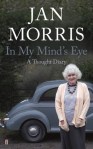 In My Mind’s Eye: A Thought Diary by Jan Morris [Sept. 6, Faber & Faber]: One of my most admired writers. “A collection of diary pieces that Jan Morris wrote for the Financial Times over the course of 2017.” I have never before in my life kept a diary of my thoughts, and here at the start of my ninth decade, having for the moment nothing much else to write, I am having a go at it. Good luck to me.
 Help Me!: One Woman’s Quest to Find Out if Self-Help Really Can Change Her Life by Marianne Power [Sept. 6, Picador]: “[F]or a year she vowed to test a book a month, following its advice to the letter, taking the surest road she knew to a perfect Marianne. As her year-long plan turned into a demented roller coaster where everything she knew was turned upside down, she found herself confronted with a different question: Self-help can change your life, but is it for the better?” (Print ARC)
 Normal People by Sally Rooney [Sept. 6, Faber & Faber]: Much anticipated follow-up to Conversations with Friends. “Connell and Marianne both grow up in the same town in rural Ireland. The similarities end there; they are from very different worlds. But they both get places to study at university in Dublin, and a connection that has grown between them despite the social tangle of school lasts long into the following years.”
 Mrs. Gaskell & Me by Nell Stevens [Sept. 6, Picador]: “In 2013, Nell Stevens is embarking on her PhD … and falling drastically in love with a man who lives in another city. As Nell chases her heart around the world, and as Mrs. Gaskell forms the greatest connection of her life, these two women, though centuries apart, are drawn together.” I was lukewarm on her previous book, Bleaker House, but I couldn’t resist the Victorian theme of this one! (Print ARC to review for Shiny New Books)
 Heart: A History by Sandeep Jauhar [Sept. 18, Farrar, Straus and Giroux]: “Deftly alternating between key historical episodes and his own work, Jauhar tells the colorful and little-known story of the doctors who risked their careers and the patients who risked their lives to know and heal our most vital organ. … Affecting, engaging, and beautifully written.” (Edelweiss download)
 To the Moon and Back: A Childhood under the Influence by Lisa Kohn [Sept. 18, Heliotrope Books]: “Lisa was raised as a ‘Moonie’—a member of the Unification Church, founded by self-appointed Messiah, Reverend Sun Myung Moon. … Told with spirited candor, [this] reveals how one can leave behind such absurdity and horror and create a life of intention and joy.”
 Ghost Wall by Sarah Moss [Sept. 20, Granta]: I’ve read Moss’s complete (non-academic) oeuvre; I’d read her on any topic. This novella sounds rather similar to her first book, Cold Earth, which I read recently. “Teenage Silvie is living in a remote Northumberland camp as an exercise in experimental archaeology. … Behind and ahead of Silvie’s narrative is the story of a bog girl, a sacrifice, a woman killed by those closest to her, and as the hot summer builds to a terrifying climax, Silvie and the Bog girl are in ever more terrifying proximity.” (NetGalley download)
 Time’s Convert (All Souls Universe #1) by Deborah Harkness [Sept. 25, Viking]: I was a sucker for Harkness’s A Discovery of Witches and its sequels, much to my surprise. (The thinking girl’s Twilight, you see. I don’t otherwise read fantasy.) Set between the American Revolution and contemporary London, this fills in the backstory for some of the vampire characters.
October
 All You Can Ever Know: A Memoir by Nicole Chung [Oct. 2, Catapult]: “Nicole Chung was born severely premature, placed for adoption by her Korean parents, and raised by a white family in a sheltered Oregon town. … With warmth, candor, and startling insight, Chung tells of her search for the people who gave her up, which coincided with the birth of her own child.” (Edelweiss download)
 Melmoth by Sarah Perry [Oct. 2, Serpent’s Tail]: Gothic fantasy / historical thriller? Not entirely sure. I just know that it’s the follow-up by the author of The Essex Serpent. (I choose to forget that her first novel exists.) Comes recommended by Eleanor Franzen and Simon Savidge, among others. (Edelweiss download)
 The Ravenmaster: Life with the Ravens at the Tower of London by Christopher Skaife [Oct. 2, 4th Estate]: More suitably Gothic pre-Halloween fare! “Legend has it that if the Tower of London’s ravens should perish or be lost, the Crown and kingdom will fall. … [A]fter decades of serving the Queen, Yeoman Warder Christopher Skaife took on the added responsibility of caring for these infamous birds.” I briefly met the author when he accompanied Lindsey Fitzharris to the Wellcome Book Prize ceremony.
 I Am Dynamite!: A Life of Friedrich Nietzsche by Sue Prideaux [Oct. 4, Faber & Faber]: “Friedrich Nietzsche’s work forms the bedrock of our contemporary thought, and yet a shroud of misunderstanding surrounds the philosopher behind these proclamations. The time is right for a new take on Nietzsche’s extraordinary life, whose importance as a thinker rivals that of Freud or Marx.” (For a possible TLS review?)
 Almost Everything: Notes on Hope by Anne Lamott [Oct. 16, Riverhead]: I haven’t been too impressed with Lamott’s recent stuff, but I’ll still read anything she publishes. “In this profound and funny book, Lamott calls for each of us to rediscover the nuggets of hope and wisdom that are buried within us that can make life sweeter than we ever imagined. … Almost Everything pinpoints these moments of insight as it shines an encouraging light forward.”
 The Library Book by Susan Orlean [Oct. 16, Simon & Schuster]: The story of a devastating fire at Los Angeles Public Library in April 1986. “Investigators descended on the scene, but over 30 years later, the mystery remains: Did someone purposefully set fire to the library—and if so, who? Weaving her life-long love of books and reading with the fascinating history of libraries and the sometimes-eccentric characters who run them, … Orlean presents a mesmerizing and uniquely compelling story as only she can.” (Edelweiss download)
 Unsheltered by Barbara Kingsolver [Oct. 18, Faber & Faber]: Kingsolver is another author I’d read anything by. “[T]he story of two families, in two centuries, who live at the corner of Sixth and Plum, as they navigate the challenges of surviving a world in the throes of major cultural shifts.” 1880s vs. today, with themes of science and utopianism – I’m excited! (Edelweiss download)
 Nine Pints: A Journey through the Money, Medicine, and Mysteries of Blood by Rose George [Oct. 23, Metropolitan Books]: “Rose George, author of The Big Necessity [on human waste], is renowned for her intrepid work on topics that are invisible but vitally important. In Nine Pints, she takes us from ancient practices of bloodletting to modern ‘hemovigilance’ teams that track blood-borne diseases.”
November
 The End of the End of the Earth: Essays by Jonathan Franzen [Nov. 13, Farrar, Straus and Giroux]: “[G]athers essays and speeches written mostly in the past five years … Whether exploring his complex relationship with his uncle, recounting his young adulthood in New York, or offering an illuminating look at the global seabird crisis, these pieces contain all the wit and disabused realism that we’ve come to expect from Franzen.”
 A River Could Be a Tree by Angela Himsel [Nov. 13, Fig Tree Books]: “How does a woman who grew up in rural Indiana as a fundamentalist Christian end up a practicing Jew in New York? … Ultimately, the connection to God she so relentlessly pursued was found in the most unexpected place: a mikvah on Manhattan’s Upper West Side. This devout Christian Midwesterner found her own form of salvation—as a practicing Jewish woman.”
 Becoming by Michelle Obama [Nov. 13, Crown]: “In her memoir, a work of deep reflection and mesmerizing storytelling, Michelle Obama invites readers into her world, chronicling the experiences that have shaped her—from her childhood on the South Side of Chicago to her years as an executive balancing the demands of motherhood and work, to her time spent at the world’s most famous address.”
Which of these do you want to read, too? What other upcoming 2018 titles are you looking forward to?
What Is Nature (Poetry) For?
I’ve been pondering this question thanks to an excellent conference my husband and I attended in Stamford in the middle of November: New Networks for Nature. This is the third year my husband (a teaching associate in the biology department at the University of Reading) has participated, and the second year in a row I’ve chosen one day to go. Last year I had the privilege of seeing some truly phenomenal nature writers. Dave Goulson spoke about his efforts to protect bumblebees; Helen Macdonald gave a reading from H is for Hawk; and Paul Evans and Mark Cocker were on a panel about being Guardian country diarists.
This year one of the conference highlights was a debate between Guardian journalist and rewilding proponent George Monbiot (Feral) and Tony Juniper (What Has Nature Ever Done for Us?), former head of Friends of the Earth. The topic: Is nature an economic resource or a thing of intrinsic value? Both gentlemen came out swinging and were at their most convincing.
Unless we make an economic case for preserving nature (pollinators, hydroelectric power, ecotourism), Juniper believes, we will lose it. If we reframe our approach to play on bastard politicians’ turf, Monbiot counters, we’ve already lost our integrity. Nature is worth saving for its own sake; the problem is not our arguments but our lack of power.
I tended to agree with Juniper: we aren’t winning the conservation debate in any other way, so why not introduce financial incentives? This doesn’t stop us from appreciating nature for aesthetic and spiritual reasons; it’s just another strategy.
I amused myself by imagining the opponents as a solitary noble knight waving the flag of idealism (Monbiot) and a new Noah packing nature into a money-papered Trojan horse to trick the pesky government (Juniper).
Male house sparrow. Courtesy of Chris Foster
If these two, in a roundabout way, pondered what nature is for, the previous session had asked more specifically what nature poetry is for. Led by Ruth Padel, one of my favorite poets, the roster also included Jo Shapcott and Pascale Petit. Each read from her work for 15 minutes and then together they answered audience questions as a panel.
I’d never heard of Petit but ended up loving her poems – they were the highlight of my day. One was about the piece of land her mother left her in France; she asked herself in what sense she could possess the place, and soon realized that it was really a pair of resident kingfishers who owned it. She writes around her difficult childhood, imagining a father who could never be cruel to birds – but then picturing him polishing off an ortolan bunting as his last meal, as Mitterrand was said to do. Along with birds, big cats provide many of the metaphors in her work, including Aramis, a black jaguar in the Paris Zoo, and the jaguar corridor in Belize.
Padel read “The Alligator’s Great Need and Great Desire,” followed by several poems from The Mara Crossing that she had written for members of the conference steering committee, such as one about storm petrels off the Skelligs and a snippet of biographical verse about Audubon. The lovely “Nocturne” commemorates nightly jellyfish migration, a “ghostly flotilla.”
She also read one that she said was the closest she gets to an angry poem: “The Forest, the Corrupt Official and a Bowl of Penis Soup” (from 2004’s The Soho Leopard), on the absurdity of killing rare animals – in this case the tiger – so their parts can be used in medicine or cuisine. Her final reading, from memory, was “Tiger Drinking at Forest Pool”; I nearly teared up when she spoke of “Sadness healed. Haven, in the mind, // To anyone hurt by littleness.”
Shapcott read two series of wildlife-themed poems. The first set, commissioned by Padel for the Zoological Society of London, was about the slender loris, which is also suffering from its use in traditional medicine as well as habitat loss. The second was a sequence about beekeeping, from the perspective of a woman who has just been left by a beekeeper. “Telling the Bees” reflects the folk belief that you have to inform bees of major events or they will leave; it ends “he’s gone, honeys; now you’re mine.” As the poem cycle continues, the hive becomes incorporated into her body until she can’t be separated from the bees.
Padel prefaced the discussion by asking how poetry should be in the face of extinctions and the destruction of the planet. She believes a sophistication of voice and expression is required; it’s not a matter of grabbing people by the lapels and saying “LOOK AT THIS,” but of putting the details together and being a witness.
Buff-tailed bumblebee. Courtesy of Chris Foster.
Shapcott echoed her with Heidegger’s query – what is the poet for in a desperate time? She reiterated that the poet should hold up key questions and let them resonate in people’s imaginations, not force-feed answers. Petit added that in her poetry birds are metaphors for the exploitation for the weak. All three agreed poetry is about embodiment, sensory response to the world – essential since we live least in our bodies of any species, Shapcott observed.
The theme of this year’s conference was “Place and Belonging,” and it struck me that all three poets were responding to the idea that nature belongs to us and can be used like any other possession. Instead, they reply, we should think about the places we belong to, and how we can serve rather than exploit nature. But the key is not to spell that out in polemic verse, but rather to speak of life’s particulars and hope that we manage to point to the universal.
I’ll end with part of a stanza from Padel’s “The Watcher” that seems to reinforce the personal, spiritual value of nature that so much of the conference suggested:
Quest for the sacred. And if I
could track that one stork down
on its winter ground, maybe I’d know
what has become of life and me
and where to go. I’d pour libations, follow
the omen, set up sacrifice
to the god of wayfarers, even pay a call
on the seer who decodes
the flight of birds. I’d prophesy.
 Bookish Beck = Rebecca Foster. American transplant to England. Freelance proofreader and book reviewer.
 Bookish Beck