Seven Final Novellas: Crumley, Morris, Rapp Black; Hunter, Johnson, Josipovici, Otsuka (#NovNov)
We’ll be wrapping up Novellas in November and giving final statistics on Tuesday. Today, I have mini reviews of another seven novellas I’ve been working on, some of them for the whole month. I’ll start with some short nonfiction and then move on to the fiction.
Nonfiction:
Barn Owl by Jim Crumley (2014)
[63 pages]
 I reviewed Kingfisher and Otter, two other titles from Crumley’s “Encounters in the Wild” series for the publisher Saraband, earlier in the month. Barn Owl follows the same pattern, traveling the Scottish islands in search of close encounters (with badgers and ospreys, too) but also stretching back to a childhood memory from 1950s Dundee, when there was an owl-occupied derelict farmstead a quarter-mile from his home. This is a lovely little full-circle narrative in that the book closes with “the barn owl, unlike all other night-flying owls, is the one that we can see in the dark … its inarguable beauty is layered with mystery, and …all of us have a place in our hearts and minds for mysterious beauty. I have known that to be an essential truth since I was about eight years old.” (Public library)
Conundrum by Jan Morris (1974)
[148 pages]
 A reread of a book that transformed my understanding of gender back in 2006. Morris (d. 2020) was a trans pioneer. Her concise memoir opens “I was three or perhaps four years old when I realized that I had been born into the wrong body, and should really be a girl.” Sitting under the family piano, little James knew it, but it took many years – a journalist’s career, including the scoop of the first summiting of Mount Everest in 1953; marriage and five children; and nearly two decades of hormone therapy – before a sex reassignment surgery in Morocco in 1972 physically confirmed it. I was struck this time by Morris’s feeling of having been a spy in all-male circles and taking advantage of that privilege while she could. She speculates that her travel books arose from “incessant wandering as an outer expression of my inner journey.” The focus is more on her unchanging soul than on her body, so this is not a sexual tell-all. She paints hers as a spiritual quest toward true identity and there is only joy at new life rather than regret at time wasted in the ‘wrong’ one. (Public library)
Frida Kahlo and My Left Leg by Emily Rapp Black (2021)
[145 pages]
 This was my third memoir by the author; I reviewed The Still Point of the Turning World and Sanctuary earlier in the year. Like Sinéad Gleeson does in Constellations, Rapp Black turns to Frida Kahlo as a role model for “translating … pain into art.” Polio, a streetcar accident, 32 operations, failed pregnancies and an amputated leg – Kahlo endured much suffering. It was this last particular that especially drew Rapp Black (who has had a prosthetic leg since early childhood) to her. On a visit to Kahlo’s Mexico City home, she can hardly bear the intimacy of seeing Kahlo’s prostheses and corsets. They plunge her back into her own memories: of passing as normal despite a disability, having an eating disorder, losing her son Ronan to Tay-Sachs disease, and starting over with a new marriage and baby. Rapp Black weaves this all together artfully as well as effectively, but for someone like me who is already conversant with her story, there wasn’t quite enough in the way of new material.
With thanks to Notting Hill Editions for the free e-copy for review.
Fiction:
These first two ended up having a major arc in common: desperate preservation of key family relationships against the backdrop of a believably falling-apart near-future world.
The End We Start From by Megan Hunter (2017)
[127 pages]
 A woman, her partner (R), and their baby son flee a flooded London in search of a place of safety, traveling by car and boat and camping with friends and fellow refugees. “How easily we have got used to it all, as though we knew what was coming all along,” she says. Her baby, Z, tethers her to the corporeal world. What actually happens? Well, on the one hand it’s very familiar if you’ve read any dystopian fiction; on the other hand it is vague because characters only designated by initials are hard to keep straight and the text is in one- or two-sentence or -paragraph chunks punctuated by asterisks (and dull observations): “Often, I am unsure whether something is a bird or a leaf. *** Z likes to eat butter in chunks. *** We are overrun by mice.” etc. It’s touching how Z’s early milestones structure the book, but for the most part the style meant this wasn’t my cup of tea. (Secondhand purchase)
My Monticello by Jocelyn Nicole Johnson (2021)
[For novella only: 182 pages?]
 Pick this up right away if you loved Danielle Evans’s The Office of Historical Corrections. After “the unraveling,” Da’Naisha and fellow escapees from racial violence in Charlottesville – including her former and current boyfriends, the one Black and the other white; and her ailing grandmother, MaViolet – shelter at Thomas Jefferson’s famous Virginia estate. At first they stay by the visitor’s center, but as weeks pass and they fear a siege, they retreat to the mansion itself. Da’Naisha, our narrator, becomes the de facto leader of the motley crew, spearheading a trip out for supplies. She harbors two major secrets, one about her heritage and one about her future. Although this is a bit too similar to Parable of the Sower, against which I judge just about any dystopian fiction, the setting and timeliness can’t be beat. I read the U.S. ebook edition, which includes five short stories that also explore race issues and employ the first person plural and second person to good effect; “Buying a House Ahead of the Apocalypse” encapsulated my whole autumn mood. (Read via Edelweiss)
The Cemetery in Barnes by Gabriel Josipovici (2018)
[101 pages]
 After reviewing Josipovici’s 100 Days earlier in the month, I wanted to get a taste of his fiction. The protagonist is a translator who has lived in London, Paris and now rural Wales. He’s been married twice but, whatever his living situation, he’s always prized the solitude and routine he needs for his work. Passages from Monteverdi’s opera L’Orfeo and Joachim du Bellay’s poetry – in the original language, sometimes but not always translated for us – drift through the novella, which also prioritizes the sort of repeated phrases that constitute a long-cohabitating couple’s domestic vocabulary. References to cemeteries and to du Bellay’s Regrets are hints of something hasn’t isn’t being revealed to us up front. I think I worked out what it was. Clever and interesting, but I’d like a bit more grounding detail. A favorite line: “for one’s life not living up to expectation there is no excuse, except for the paltry one that this is true of everybody’s life.” (University library)
When the Emperor Was Divine by Julie Otsuka (2002)
[145 pages]
 Otsuka’s The Buddha in the Attic, about Japanese mail order brides in early 1900s San Francisco, was one of my first encounters with the first person plural, which I’ve come to love. It also serves as a prequel to this, her debut novel. In Berkeley, California in 1942, a Japanese man is arrested as a potential enemy combatant. His wife, son and daughter are given just a matter of days to pack their things and evacuate to an internment camp in the desert. Otsuka takes us along on the train journey and to the camp, where small moments rather than climactic ones reveal the children’s sadness and the injustice of what they’re missing out on. I most enjoyed the last section, when they all return to their home after over three years away and start to piece life back together. I’d already read a few novels featuring Japanese internment (e.g. The Japanese Lover and Snow Falling on Cedars) but, more than that, Otsuka’s writing is a tad too subtle for me. (Secondhand purchase)
In total, I read 29 novellas this November – a new record for me! I didn’t set out to read the equivalent of nearly one per day, but it happened to pan out like that. Some of my selections were very short indeed, at under 100 pages; multiple volumes of Garfield comics also helped. Three were 5-star reads: The Cost of Living by Deborah Levy plus two rereads, Conundrum by Jan Morris (above) and our classics buddy read, Ethan Frome by Edith Wharton.
I also had a couple of DNFs:
Gone by Michael Blencowe: (45 pages) I made a second attempt on this essay collection about extinct species this month. Maybe I’ve just read too much around the topic recently. (Review copy)
Inside the Bone Box by Anthony Ferner: (50 pages) I loved the idea of a novella about a neurosurgeon, but mostly this concerns Nick’s fatness and his family members’ various dysfunctions. (New purchase)
Short Nature Books for #NovNov by John Burnside, Jim Crumley and Aimee Nezhukumatathil
#NovNov meets #NonfictionNovember as nonfiction week of Novellas in November continues!
Tomorrow I’ll post my review of our buddy read for the week, The Story of My Life by Helen Keller (free from Project Gutenberg, here).
Today I review four nature books that celebrate marvelous but threatened creatures and ponder our place in relation to them.
Aurochs and Auks: Essays on Mortality and Extinction by John Burnside (2021)
[127 pages]
 I’ve read a novel, a memoir, and several poetry collections by Burnside. He’s a multitalented author who’s written in many different genres. These four essays are rich with allusions and chewy with philosophical questions. “Aurochs” traces ancient bulls from the classical world onward and notes the impossibility of entering others’ subjectivity – true for other humans, so how much more so for extinct animals. Imagination and empathy are required. Burnside recounts an incident from when he went to visit his former partner’s family cattle farm in Gloucestershire and a poorly cow fell against his legs. Sad as he felt for her, he couldn’t help.
“Auks” tells the story of how we drove the Great Auk to extinction and likens it to whaling, two tragic cases of exploiting species for our own ends. The second and fourth essays stood out most to me. “The hint half guessed, the gift half understood” links literal species extinction with the loss of a sense of place. The notion of ‘property’ means that land becomes a space to be filled. Contrast this with places devoid of time and ownership, like Chernobyl. Although I appreciated the discussion of solastalgia and ecological grief, much of the material here felt a rehashing of my other reading, such as Footprints, Islands of Abandonment, Irreplaceable, Losing Eden and Notes from an Apocalypse. Some Covid references date this one in an unfortunate way, while the final essay, “Blossom Ruins,” has a good reason for mentioning Covid-19: Burnside was hospitalized for it in April 2020, his near-death experience a further spur to contemplate extinction and false hope.
The academic register and frequent long quotations from other thinkers may give other readers pause. Those less familiar with current environmental nonfiction will probably get more out of these essays than I did, though overall I found them worth engaging with.
With thanks to Little Toller Books for the proof copy for review.
Kingfisher and Otter by Jim Crumley (2018)
[59 pages each]
Part of Crumley’s “Encounters in the Wild” series for the publisher Saraband, these are attractive wee hardbacks with covers by Carry Akroyd. (I’ve previously reviewed his The Company of Swans.) Each is based on the Scottish nature writer’s observations and serendipitous meetings, while an afterword gives additional information on the animal and its appearances in legend and literature.


An unexpected link between these two volumes was beavers, now thriving in Scotland after a recent reintroduction. Crumley marvels that, 400 years after their kind could last have interacted with beavers, otters have quickly gotten used to sharing rivers – to him this “suggests that race memory is indestructible.” Likewise, kingfishers gravitate to where beaver dams have created fish-filled ponds.
Kingfisher was, marginally, my preferred title from the pair. It sticks close to one spot, a particular “bend in the river” where the author watches faithfully and is occasionally rewarded by the sight of one or two kingfishers. As the book opens, he sees what at first looks like a small brown bird flying straight at him, until the head-on view becomes a profile that reveals a flash of electric blue. As the Gerard Manley Hopkins line has it (borrowed for the title of Alex Preston’s book on birdwatching), kingfishers “catch fire.” Lyrical writing and self-deprecating honesty about the necessity of waiting (perhaps in the soaking rain) for moments of magic made this a lovely read. “Colour is to kingfishers what slipperiness is to eels. … Vanishing and theory-shattering are what kingfishers do best.”
In Otter, Crumley ranges a bit more widely, prioritizing outlying Scottish islands from Shetland to Skye. It’s on Mull that he has the best views, seeing four otters in one day, though “no encounter is less than unforgettable.” He watches them playing with objects and tries to talk back to them by repeating their “Haah?” sound. “Everything I gather from familiar landscapes is more precious as a beholder, as a nature writer, because my own constant presence in that landscape is also a part of the pattern, and I reclaim the ancient right of my own species to be part of nature myself.”
From time to time we see a kingfisher flying down the canal. Some of our neighbors have also seen an otter swimming across from the end of the gardens, but despite our dusk vigils we haven’t been so lucky as to see one yet. I’ve only seen a wild otter once, at Ham Wall Nature Reserve in Somerset. One day, maybe there will be one right here in my backyard. (Public library)
World of Wonders: In Praise of Fireflies, Whale Sharks and Other Astonishments by Aimee Nezhukumatathil (2020)
[160 pages]
 Nezhukumatathil, a professor of English and creative writing at the University of Mississippi, published four poetry collections before she made a splash with this beautifully illustrated collection of brief musings on species and the self – this was shortlisted for the Kirkus Prize. Some of the 28 pieces spotlight an animal simply for how head-shakingly wondrous it is, like the dancing frog or the cassowary. More often, though, a creature or plant is a figurative vehicle for uncovering an aspect of her past. An example: “A catalpa can give two brown girls in western Kansas a green umbrella from the sun. Don’t get too dark … our mother would remind us as we ambled out into the relentless midwestern light.”
The author’s Indian/Filipina family moved frequently for her mother’s medical jobs, and sometimes they were the only brown people around. Loneliness, the search for belonging and a compulsion to blend in are thus recurrent themes. As an adult, traveling for poetry residencies and sabbaticals exposes her to new species like whale sharks. Childhood trips back to India allowed her to spend time among peacocks, her favorite animal. In the American melting pot, her elementary school drawing of a peacock was considered unacceptable, but when she featured a bald eagle and flag instead she won a prize.
These pinpricks of the BIPOC experience struck me more powerfully than the actual nature writing, which can be shallow and twee. Talking to birds, praising the axolotl’s “smile,” directly addressing the reader – it’s all very nice, but somewhat uninformed; while she does admit to sadness and worry about what we are losing, her sunny outlook seemed out of touch at times. On the one hand, it’s great that she wanted to structure her fragments of memoir around amazing animals; on the other, I suspect that it cheapens a species to only consider it as a metaphor for the self (a vampire squid or potoo = her desire to camouflage herself in high school; flamingos = herself and other fragile long-legged college students; a bird of paradise = the guests dancing the Macarena at her wedding reception).

My favorite pieces were one on the corpse flower and the bookend duo on fireflies – she hits just the right note of nostalgia and warning: “I know I will search for fireflies all the rest of my days, even though they dwindle a little bit more each year. I can’t help it. They blink on and off, a lime glow to the summer night air, as if to say, I am still here, you are still here.”
With thanks to Souvenir Press for the free copy for review.
Any nature books on your reading pile?
Summer 2021 Reading, Part II & Transitioning into Autumn
In the past couple of weeks, we’ve taken advantage of the last gasp of summer with some rare chances at socializing, outdoors and in. Our closest friends came to visit us last weekend and accompanied us to a beer festival held in a local field, and this weekend we’ve celebrated birthdays with a formal-wear party at a local arts venue and a low-key family meal.


After my first installment of summer reads, I’ve also finished Klara and the Sun (a bust with me, alas) and the three below: a wildlife photographer’s memoir of lockdown summer spent filming in the New Forest, a record of searching for the summer’s remnants of snow in the Highlands, and an obscure 1950s novel about the psychological connections between four characters in one Irish summer. I close with a summer-into-autumn children’s book.
Goshawk Summer: A New Forest Season Unlike Any Other by James Aldred (2021)
My second nature book about the New Forest this year (after The Circling Sky by Neil Ansell) has only sharpened my hankering to get back there and have a good wander after many years away. In March 2020, Aldred had recently returned from filming cheetahs in Kenya when the UK went into its first national lockdown. He had the good fortune to obtain authorization from Forestry England that allowed him to travel regularly from his home in Somerset to the New Forest to gather footage for a documentary for the Smithsonian channel.
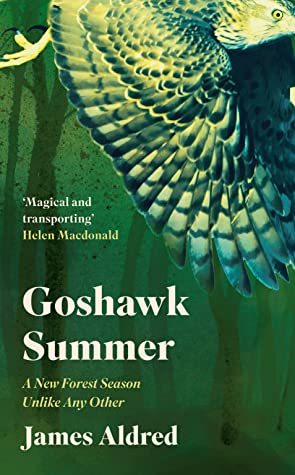 Zooming up on empty roads and staying in local cottages so he can start at 4 each morning, he marvels at the peace of a place when humans are taken out of the equation. His diary chronicles a few months of extraordinary wildlife encounters – not only with the goshawks across from whose nest he built a special treetop platform, but also with dragonflies, fox cubs, and rare birds like cuckoo and Dartford warbler. The descriptions of animal behaviour are superb, and the tone is well balanced: alongside the delight of nature watching is anger at human exploitation of the area after the reopening and despair at seemingly intractable declines – of 46 curlew pairs in the Forest, only three chicks survived that summer.
Despite the woe at nest failures and needless roadkill, Aldred is optimistic – in a similar way to Ansell – that sites like the New Forest can be a model of how light-handed management might allow animals to flourish. “I believe that a little space goes a long way and sometimes all we really need to do is take a step back to let nature do its thing. … It is nature’s ability to help itself, to survive in spite of us in fact, that gives me tentative hope”. (Unsolicited review copy)
With thanks to Elliott & Thompson for the free copy.
Among the Summer Snows by Christopher Nicholson (2017)
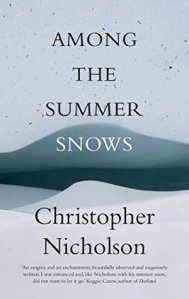 After the death from cancer of his wife Kitty, a botanical illustrator, Nicholson set off for Scotland’s Cairngorms and Ben Nevis in search of patches of snow that persist into summer. “Summer snow is a miracle, a piece of out-of-season magic: to see it is one thing, to make physical contact with it is another.” His account of his travels washed over me, leaving little impression. I appreciated the accompanying colour photographs, as the landscape is otherwise somewhat difficult to picture, but even in these it is often hard to get a sense of scale. I think I expected more philosophical reflection in the vein of The Snow Leopard, and, while Nicholson does express anxiety over what happens if one day the summer snows are no more, I found the books on snow by Charlie English and Marcus Sedgwick more varied and profound. (Secondhand, gifted)
A Shower of Summer Days by May Sarton (1952)
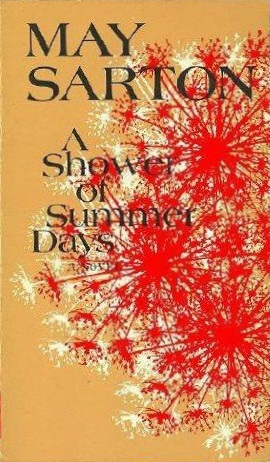 Although I’m more a fan of Sarton’s autobiographical material, especially her journals, I’ve also enjoyed exploring her fiction. This was my seventh of her novels. It’s set in Ireland at Dene’s Court, the grand house Violet inherited. She and her husband Charles have lived in Burma for two decades, but with the Empire on the wane they decide to settle in Violet’s childhood home. Gardening and dressing for dinner fill their languid days until word comes that Violet’s 20-year-old niece, Sally, is coming to stay.
The summer is meant to cure Sally of her infatuation with an actor named Ian. Violet reluctantly goes along with the plan because she feels so badly about the lasting rivalry with her sister, Barbara. Sally is a “bolt of life” shaking up Violet and Charles’s marriage, and when Ian, too, flies out from America, a curious love triangle is refashioned as a quadrilateral. The house remains the one constant as the characters wrestle with their emotional bonds (“the kaleidoscope of feelings was being rather violently shaken up”) and reflect on the transitory splendour of the season (“a kind of timelessness, the warm sun in the enclosed garden in the morning, the hum of bees, and the long slow twilights”). This isn’t one of my favourites from Sarton, but it has low-key charm. I saw it as being on a continuum from Virginia Woolf to Tessa Hadley (e.g. The Past) via Elizabeth Bowen. (Secondhand purchase from Awesomebooks.com)
And finally, one for the seasons’ transition:
Goodbye Summer, Hello Autumn by Kenard Pak (2016)
 A child and dog pair set out from home, through the woods, by a river, and into town, greeting other creatures and marking the signs of the season. “Hello!” the beavers reply. “We have no time to play because we’re making cozy nests and dens. It will be cold soon, and we want to get ready.” The quaint Americana setting and papercut-style illustrations reminded me of Vermont college towns and Jon Klassen’s work. I liked the focus on nature. (Free from a neighbour)
What books are accompanying you from summer into autumn this year?
BanksRead 2021: Espedair Street (1987)
The dead end just off Lonely Street
It’s where you go, after Desperation Row
Espedair Street
 I had my first taste of Iain Banks’s work last year with The Crow Road and was glad to have an excuse to read more by him for Annabel’s BanksRead challenge.
I chose Espedair Street, which was in surprisingly high demand at my local library: I was in the middle of a queue of five people waiting for a novel released nearly 35 years ago! Luckily, the system’s single copy came in for me in early April.
This was Banks’s fourth novel. I recognized the Glasgow and western Scotland settings and witty dialogue as recurring elements. The Scottish dialect and slang were somehow easier to deal with here than in books like Shuggie Bain. Daniel Weir (nicknamed “Weird”) is a former rock star, washed up though only in his early thirties and contemplating suicide. He has all the money he could ever want, but his relationships seem to have fizzled.
Dan takes us back to the start of his time with the band Frozen Gold in the 1970s. He acknowledges that he only ever had limited musical talent; although he can play the bass well enough, his real gift is for lyrics. Songwriting was mostly what he had to offer when he met bandmates Dave and Christine after their gig at the Union:
What am I doing here? I thought once more. They don’t need me, no matter how good the songs are. They’ll always be heading in different directions, moving in different circles, higher spheres. Jesus, this was life or death to me, my one chance to make the great working class escape. I couldn’t play football; what other hope was there to get into the supertax bracket?
Boldly, he told them that night that they were a good covers band but needed their own material, and he had sheaves of songs at the ready. From here, it was an unlikely road to a world tour in 1980, but a perhaps more predictable slide into the alcohol abuse and gratuitous displays of wealth that will leave Dan questioning what of true value he retains.
Dan’s voice, as in the passage above, is mischievous yet confessional. The sex, drugs, and rock ‘n’ roll theme made me think of Taylor Jenkins Reid’s Daisy Jones & the Six, a rather more enjoyable novel for its interview format and multiple perspectives, but both include pleasing made-up lyrics. Here Dan’s frequent use of ellipses threatened to drive me mad. It might seem a small thing but it’s one of my pet peeves.
I think I’ll make The Bridge my next from Banks – my library owns a copy, and he called it his favourite of his books.
Do check out all of Annabel’s coverage from the past week: she’s given a great sense of the breadth of Banks’s work, from science fiction to poetry.

Reading Ireland Month: Baume, Kennefick, Ní Ghríofa, O’Farrell
Reading Ireland Month is hosted each March by Cathy of 746 Books. This year I read works by four Irish women: a meditation on birds and craft, hard-hitting poems about body issues, autofiction that incorporates biography and translation to consider the shape of women’s lives across the centuries, and a novel that jets between Hong Kong and Scotland. Two of these were sent to me as part of the Rathbones Folio Prize shortlist. I have some Irish music lined up to listen to (Hallow by Duke Special, At Swim by Lisa Hannigan, Chop Chop by Bell X1, Magnetic North by Iain Archer) and I’m ready to tell you all about these four books.

handiwork by Sara Baume (2020)
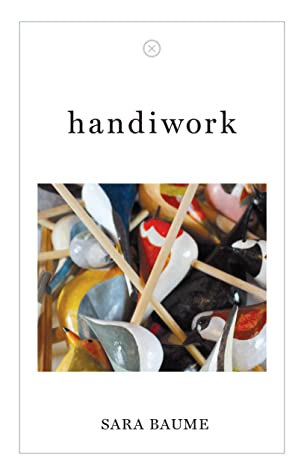 Back in February 2016, I reviewed Baume’s debut novel, Spill Simmer Falter Wither, for Third Way magazine. A dark story of a middle-aged loner and his adopted dog setting off on a peculiar road trip, it was full of careful nature imagery. “I’ve always noticed the smallest, quietest things,” the narrator, Ray, states. The same might be said of Baume, who is a visual artist as well as an author and put together this gently illuminating book over the course of 2018, at the same time as she was working on several sculptural installations. In short sections of a paragraph or two, or sometimes no more than a line, she describes her daily routines in her home workspaces: in the morning she listens to barely audible talk radio as she writes, while the afternoons are for carving and painting.
Working with her hands is a family tradition passed down from her grandfather and father, who died in the recent past – of lung cancer from particles he was exposed to at the sandstone quarry where he worked. Baume has a sense of responsibility for how she spends her time and materials. Concern about waste is at odds with a drive for perfection: she discarded her first 100 plaster birds before she was happy with the series used to illustrate this volume. Snippets of craft theory, family memories, and trivia about bird migration and behaviour are interspersed with musings on what she makes. The joy of holding a physical object in the hand somehow outweighs that of having committed virtual words to a hard drive.
Despite the occasional lovely line, this scattered set of reflections doesn’t hang together. The bird facts, in particular, feel shoehorned in for symbolism, as in Colum McCann’s Apeirogon. It’s a shame, as from the blurb I thought this book couldn’t be better suited to my tastes. Ultimately, as with Spill, Baume’s prose doesn’t spark much for me.
Favorite lines:
“Most of the time spent making is spent, in fact, in the approach.”
“I must stop once the boredom becomes intolerable, knowing that if I plunge on past this point I will risk arriving at resentment”
“What we all shared – me, my dad, his dad – was a suspicion of modern life, a loathing of fashion, a disappointment with the new technologies and a preference for the ad hoc contraptions of the past”
“The glorious, crushing, ridiculous repetition of life.”
With thanks to Tramp Press and FMcM Associates for the free copy for review. handiwork is on the Rathbones Folio Prize shortlist.
Eat or We Both Starve by Victoria Kennefick (2021)
 This audacious debut collection of fleshly poems is the best I’ve come across so far this year. The body is presented as a battleground: for the brain cancer that takes the poet’s father; for disordered eating that entwines with mummy issues; for the restructuring of pregnancy. Families break apart and fuse into new formations. Cannibalism and famine metaphors dredge up emotional states and religious doctrines.
Where did I start?
Yes, with the heart, enlarged,
its chambers stretched through caring.
[…]
Oh is it in defiance or defeat, I don’t know,
I eat it anyway, raw, still warm.
The size of my fist, I love it.
(from the opening poem, “Learning to Eat My Mother, where My Mother Is the Teacher”)
Meat avoidance goes beyond principled vegetarianism to become a phobia. Like the female saints, the speaker will deny herself until she achieves spiritual enlightenment.
The therapist taps my shoulders, my head, my knees,
tells me I was a nun once, very strict.
This makes sense; I know how cleanly I like
to punish myself.
(from “Alternative Medicine”)
The title phrase comes from “Open Your Mouth,” in which the god Krishna, as a toddler, nourishes his mother with clay. A child feeding its mother reverses the expected situation, which is described in one of the book’s most striking poems, “Researching the Irish Famine.” The site of an old workhouse divulges buried horrors: “Mothers exhausted their own bodies / to produce milk. […] The starving / human / literally / consumes / itself.”
Corpses and meals; body odour and graves. There’s a pleasingly morbid cast to this collection, but it also has its lighter moments: the sexy “Paris Syndrome,” the low-stakes anxiety over pleasing one’s mother in “Guest Room,” and the playful closer, “Prayer to Audrey Hepburn” (“O Blessed Audrey of the feline eye-flick, jutting / bones, slim-hipped androgyny of war-time rationing”). Rich with imagery and alliteration, this is just my kind of poetry. Verse readalikes would include The Air Year by Caroline Bird, Flèche by Mary Jean Chan, and Tongues of Fire by Seán Hewitt, while in prose I was also reminded of Milk Fed by Melissa Broder (review coming soon) and Sanatorium by Abi Palmer.
With thanks to Carcanet Press for the free copy for review. This comes out on the 25th.
A Ghost in the Throat by Doireann Ní Ghríofa (2020)
 “This is a female text.” In an elegant loop, Ní Ghríofa begins and ends with this line, and uses it as a refrain throughout. What is the text? It is this book, yes, as well as the 18th-century Irish-language poem that becomes an obsession for the author/narrator, “The Keen for Art Ó Laoghaire” by Eibhlín Dubh Ní Chonaill; however, it is also the female body, its milk and blood just as significant for storytelling as any ink.
Because the protagonist’s name is the same as the author’s, I took her experiences at face value. As the narrative opens in 2012, Ní Ghríofa and her husband have three young sons and life for her is a list of repetitive household tasks that must be completed each day. She donates pumped breast milk for premature babies as a karmic contribution to the universe: something she can control when so much around her she feels she can’t, like frequent evictions and another pregnancy. Reading Eibhlín Dubh’s lament for her murdered husband, contemplating a new translation of it, and recreating her life from paltry archival fragments: these tasks broaden her life and give an intellectual component to complement the bodily one.
My weeks are decanted between the twin forces of milk and text, weeks that soon pour into months, and then into years. I make myself a life in which whenever I let myself sit, it is to emit pale syllables of milk, while sipping my own dark sustenance from ink. […] I skitter through chaotic mornings of laundry and lunchboxes and immunisations, always anticipating my next session at the breast-pump, because this is as close as I get to a rest. To sit and read while bound to my insatiable machine is to leave my lists behind and stroll instead through doors opened by Eibhlín Dubh.
Ní Ghríofa remembers other times in her life in an impressionistic stream: starting a premed course at university, bad behaviour that culminated in suicidal ideation, a near-collision on a highway, her daughter’s birth by emergency C-section, finally buying a house and making it a home by adopting a stray kitten and planting a bee-friendly garden. You can tell from the precision of her words that Ní Ghríofa started off as a poet, and I loved how she writes about her own life. I had little interest in Eibhlín Dubh’s story, but maybe it’s enough for her to be an example of women “cast once more in the periphery of men’s lives.” It’s a book about women’s labour – physical and emotional – and the traces of it that remain. I recommend it alongside I Am, I Am, I Am by Maggie O’Farrell and Mother Ship by Francesca Segal.
With thanks to Tramp Press and FMcM Associates for the free copy for review. A Ghost in the Throat is on the Rathbones Folio Prize shortlist.
The Distance Between Us by Maggie O’Farrell (2004)
 This is the earliest work of O’Farrell’s that I’ve read – it was her third novel, following After You’d Gone and My Lover’s Lover (I finally found those two at a charity shop last year and I’m saving them for a rainy day). It took me a long time to get into this one. It’s delivered in bitty sections that race between characters and situations, not generally in chronological order. It’s not until nearly the halfway point that you get a sense of how it all fits together.
Although there are many secondary characters, the two main strands belong to Jake, a young white filmmaker raised in Hong Kong by a bohemian mother, and Stella, a Scottish-Italian radio broadcaster. When a Chinese New Year celebration turns into a stampede, Jake and his girlfriend narrowly escape disaster and rush into a commitment he’s not ready for. In the meantime, Stella gets spooked by a traumatic flash from her childhood and flees London for a remote Scottish hotel. She’s very close to her older sister, Nina, who was deathly ill as a child (O’Farrell inserts a scene I was familiar with from I Am, I Am, I Am, when she heard a nurse outside her room chiding a noisy visitor, “There’s a little girl dying in there”), but now it’s Nina who will have to convince Stella to take the chance at happiness that life is offering.
In the end, this felt like a rehearsal for This Must Be the Place; it has the myriad settings (e.g., here, Italy, Wales and New Zealand are also mentioned) but not the emotional heft. With a setup like this, you sort of know where things are going, don’t you? Despite Stella’s awful secret, she is as flat a character as Jake. Simple boy-meets-girl story lines don’t hold a lot of appeal for me now, if they ever did. Still, the second half was a great ride.
Also, I’ve tried twice over the past year, but couldn’t get further than page 80 in The Wild Laughter by Caoilinn Hughes (2020), a black comedy about two brothers whose farmer father goes bankrupt and gets a terminal diagnosis. It’s a strangely masculine book (though in some particulars very similar to Scenes of a Graphic Nature) and I found little to latch on to. This was a disappointment as I’d very much enjoyed Hughes’s debut, Orchid & the Wasp, and this second novel is now on the Dylan Thomas Prize longlist.
What have you been picking up for Reading Ireland Month?

Recent Online Events: Melanie Finn, Church Times Festival, Gavin Francis
It’s coming up on the one-year anniversary of the first UK lockdown and here we are still living our lives online. The first hint I had of how serious things were going to get was when a London event with Anne Tyler I was due to attend in March 2020 with Eric and Laura T. was cancelled, followed by … everything else. Oh well.
This February was a bountiful month for online literary conversations. I’m catching up now by writing up my notes from a few more events (after Saunders and Ishiguro) that helped to brighten my evenings and weekends.
Melanie Finn in Conversation with Claire Fuller
(Exile in Bookville American online bookstore event on Facebook, February 2nd)
I was a big fan of Melanie Finn’s 2015 novel Shame (retitled The Gloaming), which I reviewed for Third Way magazine. Her new book, The Hare, sounds appealing but isn’t yet available in the UK. Rosie and Bennett, a 20-years-older man, meet in New York City. Readers soon enough know that he is a scoundrel, but Rosie doesn’t, and they settle together in Vermont. A contemporary storyline looking back at how they met contrasts the romantic potential of their relationship with its current reality.
 Fuller said The Hare is her favorite kind of novel: literary but also a page-turner. (Indeed, the same could be said of Fuller’s books.) She noted that Finn’s previous three novels are all partly set in Africa and have a seam of violence – perhaps justified – running through. Finn acknowledged that everyday life in a postcolonial country has been a recurring element in her fiction, arising from her own experience growing up in Kenya, but the new book marked a change of heart: there is so much coming out of Africa by Black writers that she feels she doesn’t have anything to add. The authors agreed you have to be cruel to your characters.
Finn believes descriptive writing is one of her strengths, perhaps due to her time as a journalist. She still takes inspiration from headlines. Now that she and her family (a wildlife filmmaker husband and twin daughters born in her forties) are rooted in Vermont, she sees more nature writing in her work. They recovered a clear-cut plot and grow their own food; they also forage in the woods, and a hunter shoots surplus deer and gives them the venison. Appropriately, she read a tense deer-hunting passage from The Hare. Finn also teaches skiing and offers much the same advice as about writing: repetition eventually leads to elegance.
I was especially interested to hear the two novelists compare their composition process. Finn races through a draft in two months, but rewriting takes her a year, and she always knows the ending in advance. Fuller’s work, on the other hand, is largely unplanned; she starts with a character and a place and then just writes, finding out what she’s created much later on. (If you’ve read her Women’s Prize-longlisted upcoming novel, Unsettled Ground, you, too, would have noted her mention of a derelict caravan in the woods that her son took her to see.) Both said they don’t really like writing! Finn said she likes the idea of being a writer, while Fuller that she likes having written – a direct echo of Dorothy Parker’s quip: “I hate writing. I love having written.” Their fiction makes a good pairing and the conversation flowed freely.
Church Times Festival of Faith and Literature, “Light in Darkness,” Part I
(February 20th)
I’d attended once in person, in 2016 (see my write-up of Sarah Perry and more), when this was still known as Bloxham Festival and was held at Bloxham School in Oxfordshire. Starting next year, it will take place in central Oxford instead. I attended the three morning events of Part I; there’s another virtual program taking place on Saturday the 17th of April.
Rachel Mann on The Gospel of Eve
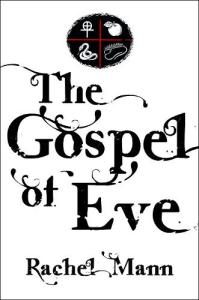 Mann opened with a long reading from Chapter 1 of her debut novel (I reviewed it here) and said it is about her “three favorite things: sex, death, and religion,” all of which involve a sort of self-emptying. Mark Oakley, dean of St John’s College, Cambridge, interviewed her. He noted that her book has been likened to “Dan Brown on steroids.” Mann laughed but recognizes that, though she’s a ‘serious poet’, her gift as a novelist is for pace. She’s a lover of thrillers and, like Brown, gets obsessed with secrets. Although she and her protagonist, Kitty, are outwardly similar (a rural, working-class background and theological training), she quoted Evelyn Waugh’s dictum that all characters should be based on at least three people. Mann argued that the Church has not dealt as well with desire as it has with friendship. She thinks the best priests, like novelists, are genuine and engage with other people’s stories.
Francis Spufford on Light Perpetual
Mann then interviewed Spufford about his second novel, which arose from his frequent walks to his teaching job at Goldsmiths College in London. A plaque on an Iceland commemorates a World War II bombing that killed 15 children in what was then a Woolworths. He decided to commit an act of “literary resurrection” – but through imaginary people in a made-up, working-class South London location. The idea was to mediate between time and eternity. “All lives are remarkable and exceptional if you look at them up close,” he said. The opening bombing scene is delivered in extreme slow motion and then the book jumps on in 15-year intervals, in a reminder of scale. He read a passage from the end of the book when Ben, a bus conductor who fell in love with a Nigerian woman who took him to her Pentecostal Church, is lying in a hospice bed. It was a beautiful litany of “Praise him” statements, a panorama of everyday life: “Praise him at food banks,” etc. It made for a very moving moment.
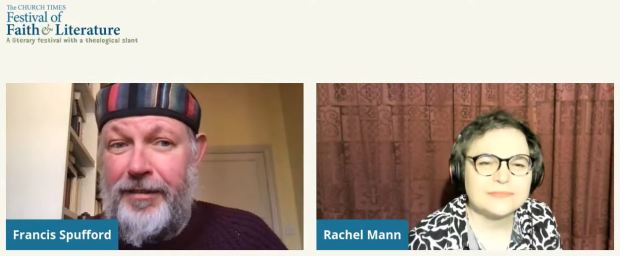
Mark Oakley on the books that got him through the pandemic
Oakley, in turn, was interviewed by Spufford – everyone did double duty as speaker and questioner! He mentioned six books that meant a lot to him during lockdown. Three of them I’d read myself and can also recommend: Vesper Flights by Helen Macdonald (my nonfiction book of 2020), Tongues of Fire by Seán Hewitt (one of my top five poetry picks from 2020), and Life’s Too Short to Pretend You’re Not Religious by David Dark. His top read of all, though, is a book I haven’t read but would like to: Featherhood by Charlie Gilmour (see Susan’s review). Rounding out his six were The Act of Living by Frank Tallis, about the psychology of finding fulfillment, and The Hunted by Gabriel Bergmoser, a bleak thriller set in the Outback. He read a prepared sermon-like piece on the books rather than just having a chat about them, which made it a bit more difficult to engage.
Spufford asked him if his reading had been about catharsis. Perhaps for some of those choices, he conceded. Oakley spoke of two lessons learned from lockdown. One is “I am an incarnational Christian” in opposition to the way we’ve all now been reduced to screens, abstract and nonmobile. And secondly, “Don’t be prosaic.” He called literalism a curse and decried the thinness of binary views of the world. “Literature is always challenging your answers, asking who you are when you get beyond what you’re good at.” I thought that was an excellent point, as was his bottom line about books: “It’s not how many you get through, but how many get through to you.”
Gavin Francis in Conversation with Louise Welsh
(Wellcome Collection event, February 25th)
 Francis, a medical doctor, wrote Intensive Care (I reviewed it here) month by month and sent chapters to his editor as he went along. Its narrative begins barely a year ago and yet it was published in January – a real feat given the usual time scale of book publishing. It was always meant to have the urgent feel of journalism, to be a “hot take,” as he put it, about COVID-19. He finds writing therapeutic; it helps him make sense of and process things as he looks back to the ‘before time’. He remembers first discussing this virus out of China with friends at a Burns Night supper in January 2020. Francis sees so many people using their “retrospecto-scopes” this year and asking what we might have done differently, if only we’d known.
He shook his head over the unnatural situations that Covid has forced us all into: “we’re gregarious mammals” and yet the virus is spread by voice and touch, so those are the very things we have to avoid. GP practices have had to fundamentally change how they operate, and he foresees telephone triage continuing even after the worst of this is over. He’s noted a rise in antidepressant use over the last year. So the vaccine, to him, is like “liquid hope”; even if not 100% protective, it does seem to prevent deaths and ventilation. Vaccination is like paying for the fire service, he said: it’s not a personal medical intervention but a community thing. This talk didn’t add a lot for me as I’d read the book, but for those who hadn’t, I’m sure it would have been an ideal introduction – and I enjoyed hearing the Scottish accents.
Bookish online events coming up soon: The Rathbones Folio Prize announcement on the 24th and Claire Fuller’s book launch for Unsettled Ground on the 25th.
Have you attended any online literary events recently?
Review: Intensive Care by Gavin Francis
I finally finished a book in 2021! And it’s one with undeniable ongoing relevance. The subtitle is “A GP, a Community & COVID-19.” Francis, a physician who is based at an Edinburgh practice and frequently travels to the Orkney Islands for healthcare work, reflects on what he calls “the most intense months I have known in my twenty-year career.” He draws all of his chapter epigraphs from Daniel Defoe’s A Journal of the Plague Year and journeys back through most of 2020, from the day in January when he and his colleagues received a bulletin about a “novel Wuhan coronavirus” to November, when he was finalizing the book and learned of promising vaccine trials but also a rumored third wave and winter lockdown.
In February, no one knew whether precautions would end up being an overreaction, so Francis continued normal life: attending a conference, traveling to New York City, and going to a concert, pub, and restaurant. By March he was seeing more and more suspected cases, but symptoms were variable and the criteria for getting tested and quarantining changed all the time. The UK at least seemed better off than Italy, where his in-laws were isolating. Initially it was like flu outbreaks he’d dealt with before, with the main differences being a shift to telephone consultations and the “Great Faff” of donning full PPE for home visits and trips to care homes. The new “digital first” model left him feeling detached from his patients. He had his own Covid scare in May, but a test was negative and the 48-hour bug passed.
 Through his involvement in the community, Francis saw the many ways in which coronavirus was affecting different groups of people. He laments the return of mental health crises that had been under control until lockdown. Edinburgh’s homeless, many in a perilous immigration situation thanks to Brexit, were housed in vacant luxury hotels. He visited several makeshift hostels, where some residents were going through drug withdrawal, and also met longtime patients whose self-harm and suicidal ideation were worsening.
Children and the elderly were also suffering. In June, he co-authored a letter begging the Scottish education secretary to allow children to return to school. Perhaps the image that will stick with me most, though, is of the confused dementia patients he met at care homes: “there was a crushing atmosphere of sadness among the residents … [they were] not able to understand why their families no longer came to visit. How do you explain social distancing to someone who doesn’t remember where they are, sometimes even who they are?”
Francis incorporates brief histories of vaccination and the discovery of herd immunity, and visits a hospital where a vaccine trial is underway. I learned some things about COVID-19 specifically: it can be called a “viral pneumonia”; it has two phases, virological (the virus makes you unwell) and immunological (the immune system misdirects messages and the lungs get worse); and it affects the blood vessels as well as the lungs, with one in five presenting with a rash and some developing chilblains in the summer. Amazingly, as the year waned, Francis only knew three patients who had died of Covid, with many more recovered. But in August, a city that should have been bustling with festival tourists was nearly empty.
Necessarily, the book ends in the middle of things; Francis has clear eyes but a hopeful heart. While this is not the first COVID-19 book I’ve encountered (that was Duty of Care by Dominic Pimenta) and will be far from the last – next up for me will be Rachel Clarke’s Breathtaking, out at the end of this month – it is an absorbing first-hand account of a medical crisis as well as a valuable memorial of a time like no other in recent history. A favorite line was “One of the few consolations of this pandemic is its grim camaraderie, a new fellowship among the fear.” Another consolation for me is reading books by medical professionals who can compassionately bridge the gap between expert opinion and everyday experience.
Intensive Care was published by the Wellcome Collection/Profile Books on January 7th. My thanks to the publisher for the free copy for review.
Gavin Francis’s other work includes:
Previously reviewed: Shapeshifters
Also owned: Adventures in Human Being
I’m keen to read: Empire Antarctica, about being the medical officer at the British research centre in Antarctica – ironically, this was during the first SARS pandemic. (In July 2020, conducting medical examinations on the next batch of scientists to ship out there, he envied them the chance to escape: “By the time they came home it would be 2022. Surely we’d have the virus under control by then?”)
New Networks for Nature 2020 (Online)
 It’s not November without a New Networks for Nature conference. Originally 2020’s was scheduled to take place in Norwich in July; it was then postponed to the usual November in hopes of an in-person meeting, but ultimately had to be online this year, like so much else. This was my sixth time taking part in this interdisciplinary gathering of authors, academics, and activists (I’ve also written about the 2015, 2016, 2018, and 2019 conferences). The UEA organizers, Jean McNeil and Jos Smith, with New Networks stalwart John Fanshawe, did an excellent job of creating three virtual events for people to engage with from home.
Two pre-recorded panels brought together writers from different fields to reflect on nature literature and the environmental crisis. First up was “New Perspectives on Nature Writing,” picking up on a perennial conference theme.
 I was delighted to hear Jessica J. Lee speak – I’ve reviewed both of her nature-infused memoirs, Turning and Two Trees Make a Forest, and in last year’s feedback I suggested her as a future speaker (I’m sure I’m not solely responsible!). After a PhD in environmental history, she moved into more personal writing. Questions of home, place, language, and identity were natural for her as a third-generation migrant. She initially felt alone as a person of colour in nature writing, but when she founded the Willowherb Review she quickly learned that it wasn’t that POC weren’t out there; it was that they did not have opportunities to publish – she has had 300+ submissions per issue to the online literary magazine, which welcomes work from all genres by authors of colour.

(Clockwise from top left) Smith, Arshi, McNeil, Lee.
Also on the panel were Mona Arshi, a Punjabi poet based in London, and McNeil, a creative writing professor. Arshi has been a human rights lawyer and is the current poet-in-residence at Cley Marshes, Norfolk, in association with the Wildlife Trusts and UEA. She has had to try to absorb the landscape via video and sound recordings since COVID-19 has limited her in-person visits. She read a sonnet she wrote about her last trip there in September. All three panellists spoke about land being in some ways beyond language, though.
 Jean McNeil’s Ice Diaries is a memoir of a year in residence with the British Antarctic Survey, a very male, scientific world. Antarctica is “no one’s country,” she remarked, though it’s the fifth-largest continent; it’s as if the land has no memory of people. She observed that it’s impossible to write about Antarctica without giving a sense of the journey (so she includes travel writing) and mentioning death. Raised without technology by back-to-the-land parents in Canada, McNeil has been active in the environmental movement in Brazil, Central America, and Africa (as a safari guide). Ice Diaries was already on my TBR, but I’m impressed by her breadth of experience and want to explore her varied work.
 The second panel, “States of Emergency,” included an academic, a playwright, the CEO of an environmental charity, and a philosopher and activist. I was intrigued by UEA’s Rebecca Tillett’s brief opening address about contemporary North American indigenous responses to climate change in fiction (her research speciality). Her primary example was the Moon of the Crusted Snow by Waubgeshig Rice, a postapocalyptic thriller in which the Wendigo, a figure from First Nations folklore, embodies capitalism as it consumes people with greed.

(Clockwise from top left) Waters , McNeil, Reed, Tillett, Thornton.
UEA-based playwright Steve Waters is planning outdoor theatre projects at nature reserves. James Thornton, the CEO of ClientEarth, spoke about starting with the science, the “grammar of the Earth.” His team has prevented new coal-fired stations in Europe and encouraged NGOs in China to sue polluting companies. Philosophy professor Rupert Reed was, until recently, an Extinction Rebellion spokesman. He noted that the climate emergency feels too slow and too long – a marathon, not a sprint; people don’t realize how profoundly our way of life and future are threatened. Alas, COVID-19 is not having the desired effect of turning people’s attention to the greater, ongoing emergency. He counselled acceptance and adaptation, stating that hope and action must go hand in hand. Thornton recalled the Dalai Lama telling him early in his career that he needed to get beyond anger because angry people don’t come up with viable solutions. The anger has to be turned into a positive vision.
There were live Q&A sessions for these two panels, but we weren’t able to watch. However, we did attend Saturday’s live keynote event featuring Tim Dee and Kathleen Jamie, two of the finest nature writers working today. Speaking from Cape Town, where he has been stranded since the start of the pandemic, Dee said that his current writing is about birds that are new to him but familiar to his neighbours. He explained that he admires and understands the world through birds, “who carry no bags or passports and are at home wherever they are.” In his work he explores how we are “made by places,” often returning to a place to reprocess his experiences there (e.g. Hungary in his latest book, Greenery). His notebooks, which are often just lists of birds seen, help him to “reinflate” a place when writing about it later.


Jamie agreed that her work also has this quality of “afterwardness” – finding the meaning of an experience long after the moment. She came across as down-to-earth, shrugging off McNeil’s question about transcendence and remarking that a sign above her desk reads “Nay narrative!” What is left for a lyric poet who loses faith in lyricism? For Jamie, the answer is prose poetry, as in “Tree on the Hill,” recently published in the LRB. Her poetry has always been local but her longform nonfiction has only ever come from other places, so while she’s been stuck in Fife she’s been unable to progress. But she never has any idea of what she’s writing, she said; she and her editor work out a theme once a whole book exists (for instance, the linking metaphor for Surfacing – unearthing archaeological evidence and memories).
Dee called himself a materialist – “no ideas but in things” – with language being what we clothe things in. He always double-checks his (sometimes elaborate) metaphors by putting them back onto a bird to ensure they fit. Jamie said she used to believe language was humans’ “fall” and would try to maintain a “pre-language state” for as long as possible every morning, but ultimately she changed her mind, accepting that language is what makes us human; it’s what we do. She acknowledges that nature writing like hers is not going to achieve things in the way that environmental activism can, but she hopes that bringing non-human creatures into the culture (as if it were an ark) can be a way of advocating for them all the same.

 A brilliant programme, capped off with some visual and musical delights: “Where Song Began,” a one-hour cello and violin response/accompaniment to Australian birdsong created by Simone Slattery and Anthony Albrecht in January; and a brief virtual tour of the Nature Writing Collection in the British Archive for Contemporary Writing at UEA, which includes the papers of the late Roger Deakin and of (alive and kicking!) Mark Cocker, a UEA graduate. The archive contains Deakin’s drafts and pitches (Waterlog’s working title was “The Waters of the Wondrous Isle,” and he imagined it as an aquatic Rural Rides), photos, and even his Speedo bathing suit; along with Cocker’s field notebooks and fan mail.
The two panels, musical event, and archive tour are freely available on the NNN website, and you can watch the Dee/Jamie discussion back here.
10 Favorite Nonfiction Novellas from My Shelves
What do I mean by a nonfiction novella? I’m not claiming a new genre like Truman Capote did for the nonfiction novel (so unless they’re talking about In Cold Blood or something very similar, yes, I can and do judge people who refer to a memoir as a “nonfiction novel”!); I’m referring literally to any works of nonfiction shorter than 200 pages. Many of my selections even come well under 100 pages.
I’m kicking off this nonfiction-focused week of Novellas in November with a rundown of 10 of my favorite short nonfiction works. Maybe you’ll find inspiration by seeing the wide range of subjects covered here: bereavement, social and racial justice, hospitality, cancer, nature, politics, poverty, food and mountaineering. I’d reviewed all but one of them on the blog, half of them as part of Novellas in November in various years.
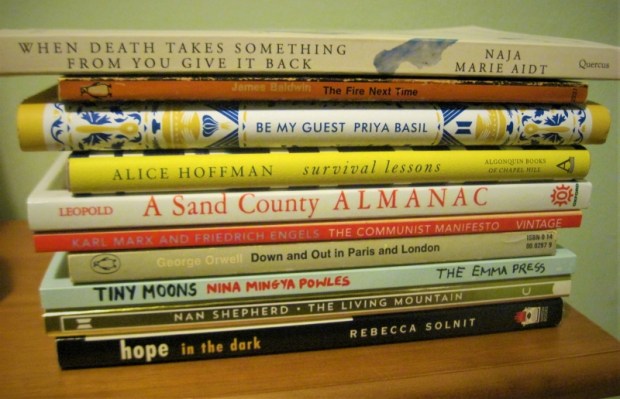
 When Death Takes Something from You Give It Back: Carl’s Book by Naja Marie Aidt [137 pages]: In March 2015 Aidt got word that her son Carl Emil was dead. The 25-year-old jumped out of his fifth-floor Copenhagen window after taking some mushrooms. The text is a collage of fragments: memories, dreams, dictionary definitions, journal entries, and quotations. The playful disregard for chronology and the variety of fonts, typefaces and sizes are a way of circumventing the feeling that grief has made words lose their meaning forever.
 The Fire Next Time by James Baldwin [89 pages]: A hard-hitting book composed of two essays: “My Dungeon Shook,” is a letter addressed to his nephew and namesake on the 100th anniversary of emancipation; and “Down at the Cross: Letter from a Region in My Mind,” which first appeared in the New Yorker and tells of a crisis of faith that hit Baldwin when he was a teenager and started to question to what extent Christianity of all stripes was upholding white privilege. This feels completely relevant, and eminently quotable, nearly 60 years later.
 Be My Guest: Reflections on Food, Community and the Meaning of Generosity by Priya Basil [117 pages]: A thought-provoking essay that reaches into many different topics. Part of an Indian family that has lived in Kenya and England, Basil is used to culinary abundance. However, living in Berlin increased her awareness of the suffering of the Other – hundreds of thousands of refugees have entered the EU to be met with hostility. Yet the Sikh tradition she grew up in teaches kindness to strangers. She asks how we can all cultivate a spirit of generosity.
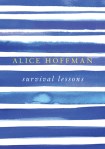 Survival Lessons by Alice Hoffman [83 pages]: Hoffman wrote this 15 years after her own experience of breast cancer to encourage anyone going through a crisis. Each chapter title begins with the word “Choose” – a reminder that, even when you can’t choose your circumstances, you can choose your response. This has been beautifully put together with blue-tinted watercolor-effect photographs and an overall yellow and blue theme (along with deckle edge pages – a personal favorite book trait). It’s a sweet little memoir with a self-help note.
 A Sand County Almanac by Aldo Leopold [92 pages]: Few know how much of our current philosophy of wilderness and the human impact on the world is indebted to Aldo Leopold. This was published in 1949, but so much rings true today: how we only appreciate wildlife if we can put an economic value on it, the troubles we get into when we eradicate predators and let prey animals run rampant, and the danger of being disconnected from the land that supplies our very life. And all this he delivers in stunning, incisive prose.
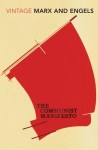 The Communist Manifesto by Karl Marx and Friedrich Engels [70 pages]: Maybe you, like me, had always assumed this was an impenetrable tome of hundreds of pages? But, as I discovered when I read it on the train to Manchester some years ago, it’s very compact. That’s not to say it’s an easy read; I’ve never been politically or economically minded, so I struggled to follow the argument at times. Mostly what I appreciated was the language. Like The Origin of Species, it has many familiar lines and wonderful metaphors.
 Down and Out in Paris and London by George Orwell [189 pages]: Orwell’s first book, published when he was 30, is an excellent first-hand account of the working and living conditions of the poor in two world cities. He works as a dishwasher and waiter in Paris hotel restaurants for up to 80 hours a week and has to pawn his clothes to scrape together enough money to ward off starvation. Even as he’s conveying the harsh reality of exhaustion and indignity, Orwell takes a Dickensian delight in people and their eccentricities.
 Tiny Moons: A Year of Eating in Shanghai by Nina Mingya Powles [85 pages]: This lovely pamphlet of food-themed essays arose from a blog Powles kept while in Shanghai on a one-year scholarship to learn Mandarin. From one winter to another, she explores the city’s culinary offerings and muses on the ways in which food is bound up with her memories of people and places. This is about how food can help you be at home. I loved how she used the senses – not just taste, but also smell and sight – to recreate important places in her life.
 The Living Mountain by Nan Shepherd [108 pages]: This is something of a lost nature classic. Composed during the later years of World War II but only published in 1977, it’s Shepherd’s tribute to her beloved Cairngorms, a mountain region of Scotland. But it’s not a travel or nature book in the way you might usually think of those genres. It’s a subtle, meditative, even mystical look at the forces of nature, which are majestic but also menacing. Shepherd dwells on the senses, the mountain flora and fauna, and the special quality of time and existence (what we’d today call mindfulness) achieved in a place of natural splendor and solitude.
 Hope in the Dark: Untold Histories, Wild Possibilities by Rebecca Solnit [143 pages]: Solnit believes in the power of purposeful individuals working towards social justice, even in the face of dispiriting evidence (e.g. the largest protests the world had seen didn’t stop the Iraq War). Instead of perfectionism, she advises flexibility and resilience; things could be even worse had we not acted. Her strong and stirring writing is a reminder that, though injustice is always with us, so is everyday heroism.
Keep in touch via Twitter (@bookishbeck / @cathy746books) and Instagram (@bookishbeck / @cathy_746books). We’ll add any of your review links in to our master posts. Feel free to use the terrific feature image Cathy made and don’t forget the hashtag #NovNov.

Any suitably short nonfiction on your shelves?
Wigtown Book Festival 2020: The Bookshop Band, Bythell, O’Connell & Stuart
During the coronavirus pandemic, we have had to take small pleasures where we can. One of the highlights of lockdown for me has been the chance to participate in literary events like book-themed concerts, prize shortlist announcements, book club discussions, live literary award ceremonies and book festivals that time, distance and cost might otherwise have precluded.
In May I attended several digital Hay Festival events, and this September to early October I’ve been delighted to journey back to Wigtown, Scotland – even if only virtually.
The Bookshop Band
The Bookshop Band have been a constant for me this year. After watching their 21 Friday evening lockdown shows on Facebook, as well as a couple of one-off performances for other festivals, I have spent so much time with them in their living room that they feel more like family than a favorite band. Add to that four of the daily breakfast chat shows from the Wigtown Book Festival and I’ve seen them play over 25 times this year already!
(The still below shows them with, clockwise from bottom left, guests Emma Hooper, Stephen Rutt and Jason Webster.)

Ben and Beth’s conversations with featured authors and local movers and shakers, punctuated by one song per guest, were pleasant to have on in the background while working. The songs they performed were, ideally, written for those authors’ books, but other times just what seemed most relevant; at times this was a stretch! I especially liked seeing Donal Ryan, about whose The Spinning Heart they’ve recently written a terrific song; Kate Mosse, who has been unable to write during lockdown so (re)read 200 books instead, including all of Agatha Christie, Ngaio Marsh et al.; and Ned Beauman, who is nearing the deadline for his next novel, a near-future story of two scientists looking for traces of the venomous lumpsucker (a made-up fish) in the Baltic Sea. Closer to science fiction than his previous work, it’s a funny take on extinctions, he said. I’ve read all of his published work, so I’m looking forward to this one.
Shaun Bythell
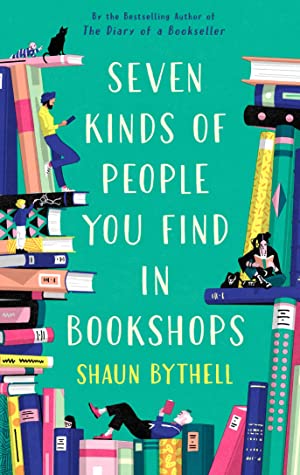 The opening event of the Festival was an in-person chat between Lee Randall and Shaun Bythell in Wigtown, rather than the split-screen virtual meet-ups that made up the rest of my viewing. Bythell, owner of The Book Shop, has become Wigtown’s literary celebrity through The Diary of a Bookseller and its sequel. In early November he has a new book coming out, Seven Kinds of People You Find in Bookshops. I’m halfway through it and it has more substance than its stocking-stuffer dimensions would imply. Within his seven categories are multiple subcategories, all given tongue-in-cheek Latin names, as if he’s naming species.
The Book Shop closed for 116 days during COVID-19: the only time in more than 40 years that it has been closed for longer than just over the Christmas holidays. He said that it has been so nice to see customers again; they’ve been a ray of sunshine for him, something the curmudgeon would never usually say! Business has been booming since his reopening, with Agatha Christie his best seller – it’s not just Mosse who’s turning to cozy mysteries. He’s also been touched by the kindness of strangers, such as one from Monaco who sent him £300, having read an article by Margaret Atwood about how hard it is for small businesses just now and hoping it would help the shop survive until they could get there in person.
(Below: Bythell on his 50th birthday, with Captain the cat.)

Randall and Bythell discussed a few of the types of customers he regularly encounters. One is the autodidact, who knows more than you and intends for you to know it. This is not the same, though, as the expert who actually helps you by sharing their knowledge (of a rare cover version on an ordinary-looking crime paperback, for instance). There’s also the occultists, the erotica browsers, the local historians and the young families – now that he has one of his own, he’s become a bit more tolerant.
Mark O’Connell
 Appearing from Dublin, Mark O’Connell was interviewed by Scottish writer and critic Stuart Kelly about his latest book, Notes from an Apocalypse (my review). He noted that, while all authors hope their books are timely, perhaps he overshot with this one! The book opens with climate change as the most immediate threat, yet now he feels that “has receded as the locus of anxiety.” O’Connell described the “flattened” experience of being alive at the moment and contrasted it with the existential awfulness of his research travels. For instance, he read a passage from the book about being at an airport Yo Sushi! chain and having a vision of horror at the rampant consumerism its conveyor belt seemed to represent.
Kelly characterized O’Connell’s personal, self-conscious approach to the end of the world as “brave,” while O’Connell said, “in terms of mental health, I should have chosen any other topic!” Having children creates both vulnerability and possibility, he contended, and “it doesn’t do you any good as a parent to indulge in those predilections [towards extreme pessimism].” They discussed preppers’ white male privilege, New Zealand and Mars as havens, and Greta Thunberg and David Attenborough as saints of the climate crisis.

O’Connell pinpointed Dr. Seuss’s The Lorax as the work he spends more time on in his book than any other; none of your classic nihilist literature here, and he deliberately avoided bringing up biblical references in his secular approach. In terms of the author he’s reached for most over the last few years, and especially during lockdown, it’s got to be Annie Dillard. Speaking of the human species, he opined, “it should not be unimaginable that we should cease to exist at some point.”
This talk didn’t add much to my experience of reading the book (vice versa would probably be true, too – I got the gist of Roman Krznaric’s recent thinking from his Hay Festival talk and so haven’t been engaging with his book as much as I’d like), but it was nice to see O’Connell ‘in person’ since he couldn’t make it to the 2018 Wellcome Book Prize ceremony.
Douglas Stuart
Glasgow-born Douglas Stuart is a fashion designer in New York City. Again the interviewer was Lee Randall, an American journalist based in Edinburgh – she joked that she and Stuart have swapped places. Stuart said he started writing his Booker-shortlisted novel, Shuggie Bain, 12 years ago, and kept it private for much of that time. Although he and Randall seemed keen to downplay how autobiographical the work is, like his title character, Stuart grew up in 1980s Glasgow with an alcoholic single mother. As a gay boy, he felt he didn’t have a voice in Thatcher’s Britain. He knew many strong women who were looked down on for being poor.
 It’s impossible to write an apolitical book about poverty (or a Glasgow book without dialect), Stuart acknowledged, yet he insisted that the novel is primarily “a portrait of two souls moving through the world,” a love story about Shuggie and his mother, Agnes. The author read a passage from the start of Chapter 2, when readers first meet Agnes, the heart of the book. Randall asked about sex as currency and postulated that all Agnes – or any of these characters; or any of us, really – wants is someone whose face lights up when they see you.
The name “Shuggie” was borrowed from a small-town criminal in his housing scheme; it struck him as ironic that a thug had such a sweet nickname. Stuart said that writing the book was healing for him. He thinks that men who drink and can’t escape poverty are often seen as loveable rogues, while women are condemned for how they fail their children. Through Agnes, he wanted to add some nuance to that double standard.
The draft of Shuggie Bain was 900 pages, single-spaced, but his editor helped him cut it while simultaneously drawing out the important backstories of Agnes and some other characters. He had almost finished his second novel by the time Shuggie was published, so he hopes it will be with readers soon.
[I have reluctantly DNFed Shuggie Bain at p. 100, but I’ll keep my proof copy on the shelf in case one day I feel like trying it again – especially if, as seems likely, it wins the Booker Prize.]
 Bookish Beck = Rebecca Foster. American transplant to England. Freelance proofreader and book reviewer.
 Bookish Beck