Miscellaneous for #ReadIndies: Grenville & Holman-Hunt, Trans History & Travel Poetry, Kathleen Jamie & Kristen Zory King
Squeaking in some more reviews on the last day of a challenge, as is my wont. Today I have mini-responses to a wide selection: a graphic novel companion to LGBTQ history, an exposé that will have you checking the ingredients lists on all your toiletries and other household cleaning products, a memoir of an eccentric Edwardian childhood, poems about modes of travel and the states of mind they produce, superb nature essays blending personal and environmental writing, and a mini collection of flash fiction about young women.
Trans History: From Ancient Times to the Present Day by Alex L. Combs and Andrew Eakett (2025)
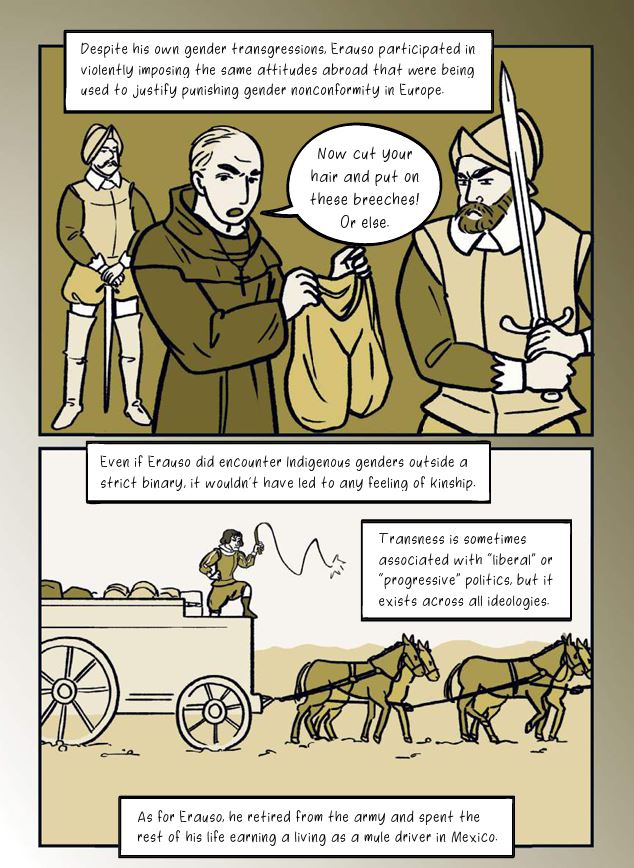
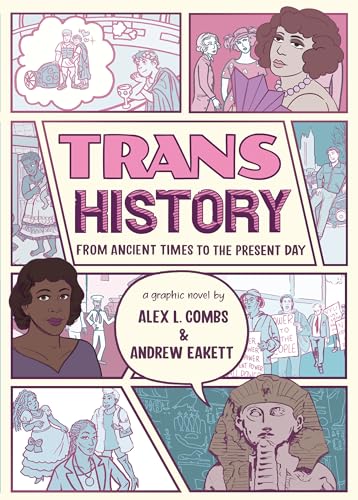 Queer people of all varieties have always been with us; they just might have understood their experience or talked about it in different terms. So while Combs and Eakett are careful not to apply labels retrospectively, they feature a plethora of people who lived as a different gender to that assigned at birth. Apart from a few familiar names like Lili Elbe and Marsha P. Johnson, most were new to me. For every heartening story of an emperor, monk or explorer who managed to live out their true identity in peace, there are three distressing ones of those forced to conform. Many Indigenous cultures held a special place for gender-nonconforming individuals; colonizers would have seen this as evidence of desperate need of civilizing. Even doctors who were willing to help with early medical transitions retained primitive ideas about gender and its connection to genitals. The structure is chronological, with a single colour per chapter. Panes reenact scenes and feature talking heads explaining historical developments and critical theory. A final section is devoted to modern-day heroes campaigning for trans rights and seeking to preserve an archive of queer history. This was a little didactic, but ideal for teens, I think, and certainly not just one for gender studies students.
Readalike: Meg-John Barker’s Sexuality: A Graphic Guide
 (Read via Edelweiss) [Candlewick Press]
The Case Against Fragrance by Kate Grenville (2017)
 File this with other surprising nonfiction books by well-known novelists. In 2015, Grenville started struggling while on a book tour: everything from a taxi’s air freshener and a hotel’s cleaning products to a fellow passenger’s perfume was giving her headaches. She felt like a diva for stipulating she couldn’t be around fragrances, but as she started looking into it she realized she wasn’t alone. I thought this was just going to be about perfume, but it covers all fragranced products, which can list “parfum” on their ingredients without specifying what that is – trade secrets. The problem is, fragrances contain any of thousands of synthetic chemicals, most of which have never been tested and thus are unregulated. Even those found to be carcinogens or endocrine disruptors in rodent studies might be approved for humans because it’s not taken into account how these products are actually used. Prolonged or repeat contact has cumulative effects. The synthetic musks in toiletries and laundry detergents are particularly bad, acting as estrogen mimics and likely associated with prostate and breast cancer. I tend to buy whatever’s on offer in Boots, but as soon as my Herbal Essences bottle is empty I’m going back to Faith in Nature (look for plant extracts). The science at the core of the book is a little repetitive, but eased by the social chapters to either side, and you can tell from the footnotes that Grenville really did her research.
Readalike: Chris van Tulleken’s Ultra-Processed People
 (Secondhand – gift from my wish list) [Text Publishing]
My Grandmothers and I by Diana Holman-Hunt (1960)
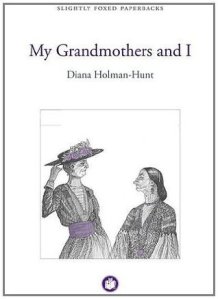 The author was the granddaughter of Pre-Raphaelite painter William Holman Hunt (The Light of the World et al.). While her father was away in India, she was shunted between two homes: Grandmother and Grandfather Freeman’s Sussex estate, and the mausoleum-cum-gallery her paternal grandmother, “Grand,” maintained in Kensington. The grandparents have very different ideas about the sorts of foodstuffs and activities that are suitable for little girls. Both households have servants, but Grand only has the one helper, Helen. Grand probably has a lot of money tied up in property and paintings but lives like a penniless widow. Grand encourages abstemious habits – “Don’t be ruled by Brother Ass, he’s only your body and a nuisance” – and believes in boiled milk and margarine. The single egg she has Helen serve Diana in the morning often smells off. “Food is only important as fuel; whether we like it or not is quite immaterial,” Grand insists. Diana might more naturally gravitate to the pleasures of the Freeman residence, but when it comes time to give a tour of the Holman Hunt oeuvre, she does so with pride. There are some funny moments, such as Diana asking where babies come from after one of the Freemans’ maids gives birth, but this felt so exaggerated and fictionalized – how could she possibly remember details and conversations at the distance of several decades? – that I lost interest by the midpoint.
Readalike: Gwen Raverat’s Period Piece
 (Secondhand – Community Furniture Project) [Slightly Foxed]
In Transit: Poems of Travel, ed. Sarah Jackson and Tim Youngs (2018)
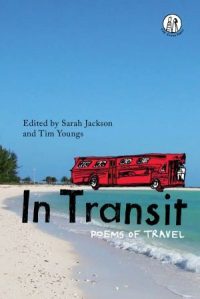 Some methods of transport are just more romantic than others. The editors’ introduction notes that “Trains were by far the most popular … followed by aeroplanes and then boats.” Walks and car journeys were surprisingly scarce, they observed, though there are a couple of poems about wandering in New York City. Often, the language is of maps, airports, passports and long flights; of trading one place for another as exile, expatriate or returnee. The collection circuits the globe: China, the Middle East, Greece, Scandinavia, the bayous of the American South. France and Berlin show up more than once. The Emma Press anthologies vary and this one had fewer standout entries than average. However, a few favourites were Nancy Campbell’s “Reading the Water,” about a boy launching out to sea in a kayak; Simon Williams’s “Aboard the Grey Ghost,” about watching for dolphins on a wartime voyage from England to the USA; and Vicky Sparrow’s “Dual Gauge,” which follows a train of thought – about humans as objects moving, perhaps towards death – during a train ride.
(New purchase from publisher) [The Emma Press]
Findings by Kathleen Jamie (2005)
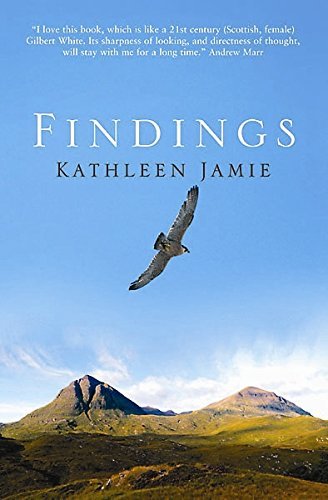 As I found when I reread Sightlines in 2022, Jamie’s topics couldn’t be better suited to my interests: Scottish islands, seabirds, medical history, and the meaning we derive from mortality. She visits the Orkney Islands just before the winter solstice, which draws a faithful few to the tomb of Maes Howe. From her attic room in Fife, she watches peregrine falcons on a cliff face. A gannet’s skull is her prized souvenir from a boat tour to an uninhabited Hebridean island. Vigilance pays off when she hears, then sees, corncrake on the Isle of Coll. Although she has a penchant for empty places, she also writes about cityscapes and hospitals. “Skylines” looks out over Edinburgh, also the setting for “Surgeons’ Hall,” about the pathology museum on the Royal College of Surgeons campus (my 2018 visit). In “Fever” her husband has a scary bout of pneumonia. Jamie is one of our wisest writers on nature and human culture. She asks whether any creatures are truly wild given the pervasiveness of human influence. Even as she seeks out the ancient, she knows we are all ephemeral. “Sabbath” is the best single essay, combining a visit to Lewis with her worry for her mother, who’s had a stroke, and her grandmother, who is to move into a care home. She explores the island “relishing the movement of my body, its own small continuing strength. It wouldn’t last forever – that was the truth of it – but today I could cycle along a road, to see where it led.”
(University library) [Sort Of Books]
My rating in 2012:
My rating now: 
Ladies, Ladies, Ladies by Kristen Zory King (2025)
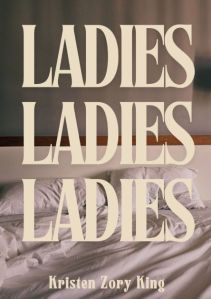 I’d never encountered “chapbook” being used for prose rather than poetry, but it’s an apt term for this 61-page paperback containing 18 stories. It’s remarkable how much King can pack into just a few pages: a voice, a character, a setting and situation, an incident, a salient backstory, and some kind of epiphany or resolution. Fifteen of the pieces focus on one named character, with another three featuring a set (“Ladies,” hence the title). Laura-Jean wonders whether it was a mistake to tell her ex’s mother what she really thinks about him in a Christmas card. A love of ice cream connects Margot’s past and present. A painting in a museum convinces Paige to reconnect with her estranged sister. Alice is sure she sees her double wandering around, and Mary contemplates stealing other people’s cats. The women are moved by rage or lust; stymied by loneliness or nostalgia. Is salvation to be found in scripture or poetry? Each story is distinctive, with no words wasted. I’ll look out for future work by King.
(Duplicate copy passed on by Marcie – thank you!) [Stanchion Books]
Which of these do you fancy reading?
Six more indie publishers spotlighted, for a total of 19 books and 18 publishers this month – job done!
Also covered:
Ansell, Farrier, Febos, Hoffman, Orlean, Stacey
Chevillard, Hopkins & Bateman, McGrath, Richardson
Victorian-Themed Novels by Annie Elliot and Livi Michael
There are plenty more indie books that I’m in the middle of, or picked out but didn’t get to in February. As much as possible, I’ll continue reading (indie) books from my shelves this year.
#DoorstoppersInDecember: Book of Lives by Margaret Atwood & The End of Mr. Y by Scarlett Thomas
Later than intended, I’m reporting back on Margaret Atwood’s memoir, which I started in late November, and a long-neglected 500+-page novel I plucked from my shelves. Both offered page-turning intrigue and a blend of history, magic, and pure weirdness. Many thanks to Laura for hosting Doorstoppers in December, which encouraged me to pick them up!
Book of Lives: A Memoir of Sorts by Margaret Atwood (2025)
 I gave some initial thoughts about the book here to tie in with Margaret Atwood Reading Month. What I said then proved true of the book as a whole: it’s delightful though dense with detail and historical context. I did get a little bogged down in the names and details of decades worth of publishing, but there is some tasty gossip, such as the fact that Margaret Laurence spread mean rumours about her (and was a drunk) but later changed her ways. It’s been a lucky window of time for Atwood to live through: she has known simplicity and the need for do-it-yourself practicality, but has also experienced privilege, even luxury (multiple homes and worldwide travel). Mostly, she had the good fortune of being at the start of Canada’s literary boom. In the early 1960s, only five Canadian novels were published per year. Through her involvement with literary magazines and House of Anansi Press and her books on Susanna Moodie and the tropes of Canadian literature, she helped create the scene.
There are frequent mentions of how people or events made their way into her fiction and poetry. Coyly, she writes, “I just have a teeming imagination. Also, like all novelists, I’m a kleptomaniac.” The page or two of context on each book is illuminating and it never becomes the tedious “I published this book … then I published this book” that she mentioned wanting to avoid in the introduction. Rather, these sections made me want to go reread lots of her books to appreciate them anew. I was also reminded how often she’s been ahead of her time, with topics and details that seem prophetic (she proposed Payback before the financial crisis hit, for instance). Some elements felt particularly timely: she experienced casual misogyny and an alarming number of near-misses – she says things like “I won’t give his name … you know who you are … though you’re probably dead” – and, through her involvement in bird conservation, she’s well aware of the disastrous environmental trajectory we’re on.
For a memoir, this is not especially forthcoming about the author’s inner life and emotions. Where it is, she masks the material in a layer of technique. So when she’s confessing to having an affair while married to Jim Polk (whom she met at Harvard), she writes it like a fairytale scene in which she went into the woods with a wolf. When she was fretting about Graeme Gibson’s reluctance to divorce her first wife and marry her, she imagines letters to her ‘inner advice columnist’. (Note: Gibson was her long-time partner and his sons were like her stepchildren but they never did marry – and he only ‘allowed’ her the one child, though she wanted two of her own. One ‘Jess Gibson’ has a speculative short story collection, The Good Eye, coming out in May 2026. No doubt her work will be compared with her mother’s, but bully for her for not using the name Atwood to try to ride her coattails.)
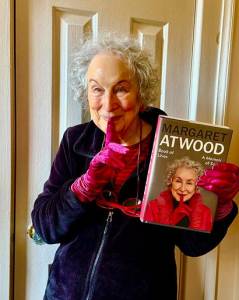
A cute pic from her Substack in November
One of the successful literary touches is the recurring “We Nearly Lose Graeme” segments about his risky behaviour and various mishaps. He had dementia and mini strokes before suffering a major one while in London with her for The Testaments tour; he died five days later. Her reflections on his death are poignant, but generic: “We can all believe three things simultaneously: The person is in the ground. The person is in the Afterlife. The person is in the next room. You keep expecting to see him. Even when you know it’s coming, a death is a shock.” At the crucial moment, she turns to the first-person plural and the second person.
I skimmed some of the bits about Graeme’s earlier life and the behind-the-scenes of publishing; I felt that he and many of her literary pals are more important to her than they are to readers. But that’s okay. The same goes for her earlier life; I noted that the account of her time as a summer camp counsellor felt more detailed than necessary. However, with her gift for storytelling, even the smallest incident can be rendered amusing. She looks for the humour, coincidence, or irony in any situation, and her summations and asides are full of dry humour. Some examples:
- “Spoiler: Jim and I eventually got married, one of the odder things to happen to both of us.”
- “After a while, the hand [at the window of her Harvard student accommodation] went away. It’s what you wish for in a disembodied hand.”
- “Eventually the iguana [inherited from her roommate] was given a new home at a zoo among other iguanas, where it was probably happier. Hard to tell.”
It’s not a book for the casual reader who kinda liked one or two Atwood novels; it’s more for the diehard fans among us, and offers a veritable trove of stories and photographs. But don’t expect a tell-all. Think of this more as a companion to her oeuvre. The title feels literal in that it’s as if she’s lived several lives: the wilderness kid, the literary ingénue, the family and career woman, the philanthropist and elder stateswoman. She doesn’t try to pull all of her incarnations into one, instead leaving all of the threads trailing into the beyond. If anything, “Peggy Nature” (her name from summer camp) is the role that has persisted. I probably liked the childhood material most, which makes sense as it’s what she’s looking back on with most fondness. Towards the close, Atwood mentions her heart condition and seems perfectly accepting of the fact that she won’t be around for much longer. But her body of work will endure. I’m so grateful for it and for the gift of this self-disclosure, however coy. (Can I be greedy and hope for another novel?) She leaves this message: “We scribes and scribblers are time travellers: via the magic page we throw our voices, not only from here to elsewhere, but also from now to a possible future. I’ll see you there.” [570 pages] (Public library) 
The End of Mr. Y by Scarlett Thomas (2006)
 This is a mash-up of the campus novel, the Victorian pastiche, and the time travel adventure. Ariel Manto is a PhD student working on thought experiments. Inciting incidents come thick and fast: her supervisor disappears, the building that houses her office partially collapses as it’s on top of an old railway tunnel, and she finds a copy of Thomas Lumas’s vanishingly rare The End of Mr. Y in a box of mixed antiquarian stock going for £50 at a secondhand bookshop. Rumour has it the book is cursed, and when Ariel realises that the key page – giving a Victorian homoeopathic recipe for entering the “Troposphere,” a dream/thought realm where one travels through time and space – has been excised, she knows the quest has only just begun. It will involve the book within a book, Samuel Butler novels, a theologian and a shrine, lab mice plus the God of Mice, and a train line whose destinations are emotions.
The plot is pretty bonkers and I’m not sure I can satisfactorily explain its internal logic now, but as is true of the best doorstoppers, it absorbed me completely. I read it very quickly (for me) and even read 120 pages in one sitting thanks to my cat pinning me to the sofa. It also felt prescient in discussing “machine consciousness” – a topic adjacent to artificial intelligence. Ariel is a Disaster Woman avant la lettre, living on noodles and cut-price wine. Her current ‘relationship’ consisting of rough sex with a married professor is the latest in a string of unhealthy connections. But time travel offers the possibility not just of reversing her own mistakes, but of going right back to the start of humanity. Verging on steampunk, this was much better than the other Thomas novels I’ve read, The Seed Collectors and Oligarchy. It was longlisted for the Orange (Women’s) Prize and would be a great choice for readers of Nicola Barker and Susanna Clarke. [502 pages] (Secondhand – Book-Cycle, Exeter; it’s been on my shelves since 2016!)
#NovNov25 and #GermanLitMonth: Kästner, Kehlmann & Kracht
Our trip to Germany in September whetted my appetite to read more German-language fiction, and November also being German Literature Month (hosted this year by Caroline of Beauty Is a Sleeping Cat and Tony of Tony’s Reading List) was a perfect excuse. K names only this year, please. (Perhaps next year I’ll make it S and finally get to those Sebald and Seethaler novels I have on the shelf.) These three works – a children’s classic, a set of linked short stories about the writer’s craft, and a mother–son spending spree – have coy metafictional touches, plus there’s a connection I wasn’t expecting between the Kehlmann and Kracht. All:
Emil and the Detectives by Erich Kästner (1929; 1931)
[Translated by Eileen Hall]
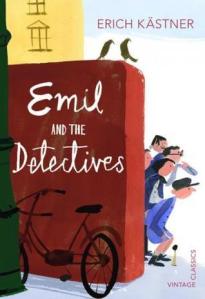 If only I’d realized this was set on a train to Berlin, I could have read it in the same situation! Instead, it was a random find while shelving in the children’s section of the library. Emil sets out on a slow train from Neustadt to stay with his aunt, grandmother and cousin in Berlin for a week’s holiday. His mother gives him £7 in an envelope he pins inside his coat for safekeeping. There are four adults in the carriage with him, but three get off early, leaving Emil alone with a man in a bowler hat. Much as he strives to stay awake, Emil drops off. No sooner has the train pulled into Berlin than he realizes the envelope is gone along with his fellow traveller. “There were four million people in Berlin at that moment, and not one of them cared what was happening to Emil Tischbein.” He’s sure he’ll have to chase the man in the bowler hat all by himself, but instead he enlists the help of a whole gang of boys, including Gustav who carries a motor-horn and poses as a bellhop, Professor with the glasses, and Little Tuesday who mans the phone lines. Together they get justice for Emil, deliver a wanted criminal to the police, and earn a hefty reward. This was a cute story and it was refreshing for children’s word to be taken seriously. There’s also the in-joke of the journalist who interviews Emil being Kästner. I’m sure as a kid I would have found this a thrilling adventure, but the cynical me of today deemed it unrealistic. (Public library) [153 pages]
Fame by Daniel Kehlmann (2009; 2010)
[Translated by Carol Brown Janeway]
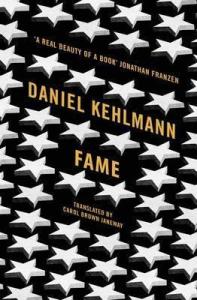 I’ve been equally enchanted by Kehlmann’s historical fiction (Measuring the World) and contemporary metafiction (F is one of my all-time favourites) in the past. These nine linked stories feature writers and their characters, actors and their look-alikes, and are about how life translates into – or is sometimes transformed by – art. Ralf Tanner starts to feel like he doesn’t exist when his calls gets diverted to someone else’s phone and an impersonator is more convincing at playing him than he is himself. Leo Richter’s new girlfriend is curiously similar to his most famous character, Lara Gaspard, a doctor working for a medical charity. Crime writer Maria Rubinstein takes Leo’s place on a cultural exchange to Central Asia and gets stuck in a Kafka-esque situation without a visa. Leo’s fan and Ralf’s call recipient are subjects of their own stories. References to Miguel Auristos Blanco’s spiritual self-help books recur and he, too, eventually becomes a character. I liked the pointed little jokes about what writers have to put up with (“Do you know how often I’ve been asked today where I get my ideas from? Fourteen. And nine times whether I work in the morning or the afternoon,” Leo complains). Mostly, these stories struck me as clever yet had me wondering what the point was. My favourite was “Rosalie Goes Off to Die,” in which Leo’s character travels to Zurich for an assisted death but he the writer decides to interfere before she can get her last wish. (Secondhand – Awesomebooks.com) [206 pages – but fairly large print]
Eurotrash by Christian Kracht (2021; 2024)
[Translated by Daniel Bowles]
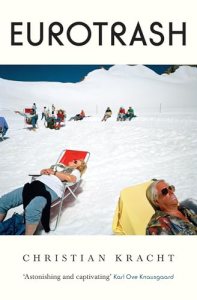 This was longlisted for the International Booker Prize and is the current Waterstones book of the month. The Swiss author’s seventh novel appears to be autofiction: the protagonist is named Christian Kracht and there are references to his previous works. Whether he actually went on a profligate road trip with his 80-year-old mother, who could say. I tend to think some details might be drawn from life – her physical and mental health struggles, her father’s Nazism, his father’s weird collections and sexual predilections – but brewed into a madcap maelstrom of a plot that sees the pair literally throwing away thousands of francs. Her fortune was gained through arms industry investment and she wants rid of it, so they hire private taxis and planes. If his mother has a whim to pick some edelweiss, off they go to find it. All the while she swigs vodka and swallows pills, and Christian changes her colostomy bags. I was wowed by individual lines (“This was the katabasis: the decline of the family expressed in the topography of her face”; “everything that does not rise into consciousness will return as fate”; “the glacial sun shone from above, unceasing and relentless, upon our little tableau vivant”) but was left chilly overall by the satire on the ultra-wealthy and those who seek to airbrush history. The fun connections: Like the Kehlmann, this involves arbitrary travel and happens to end in Africa. More than once, Kracht is confused for Kehlmann. (Little Free Library) [190 pages]
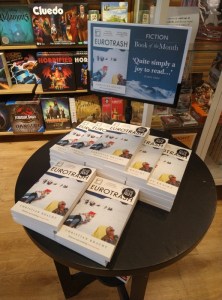
Spotted in my local Waterstones…

Nine Days in Germany and What I Read, Part I: Berlin
We’ve actually been back for more than a week, but soon after our return I was felled by a nasty cold (not Covid, surprisingly), which has left me with a lingering cough and ongoing fatigue. Finally, I’m recovered just about enough to report back.
This Interrail adventure was more low-key than the one we took in 2016. The first day saw us traveling as far as Aachen, just over the border from France. It’s a nice small city with Christian and culinary history: Charlemagne is buried in the cathedral; and it’s famous for a chewy, spicy gingerbread called printen. Before our night in a chain hotel, we stumbled upon the mayor’s Green Party rally in the square – there was to be an election the following day – and drank and dined well. The Gin Library, spotted at random on the map, is an excellent and affordable Asian-fusion cocktail bar. My “Big Ben,” for instance, featured Tanqueray gin, lemon juice, honey, fresh coriander, and cinnamon syrup. Then at Hanswurst – Das Wurstrestaurant (cue jokes about finding the “worst” restaurant in Aachen!), a superior fast-food joint, I had the vegetarian “Hans Berlin,” a scrumptious currywurst with potato wedges.


The next day it was off to Berlin with a big bag of bakery provisions. For the first time, we experienced the rail cancellations and delays that would plague us for much of the next week. We then had to brave the only supermarket open in Berlin on a Sunday – the Rewe in the Hauptbahnhof – before taking the S-Bahn to Alexanderplatz, the nearest station to our Airbnb flat.


It was all worth it to befriend Lemmy (the ginger one) and Roxanne. It’s a sweet deal the host has here: whenever she goes away, people pay her to look after her cats. At the same time as we were paying for a cat-sitter back home. We must be chumps!


I’ll narrate the rest of the trip through the books I read. I relished choosing relevant reads from my shelves and the library’s holdings – I was truly spoiled for choice for Berlin settings! – and I appreciated encountering them all on location.


As soon as we walked into the large airy living room of the fifth-floor Airbnb flat, I nearly laughed out loud, for there in the corner was a monstera plant. The trendy, minimalist décor, too, was just like that of the main characters’ place in…
Perfection by Vincenzo Latronico (2022; 2025)
[Translated from Italian by Sophie Hughes]
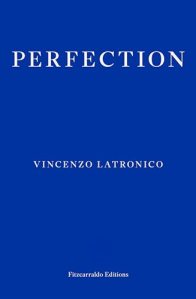 Anna and Tom are digital nomads from Southern Europe who offer up their Berlin flat as a short-term rental. In the listing photographs it looks pristine, giving no hint of the difficulties of the expatriate life such as bureaucracy and harsh winters. “Creative professionals” working in the fields of web development and graphic design, they are part of the micro-generation that grew up as the Internet was becoming mainstream, and they tailor their products and personal lives to social media’s preferences. They are lazy liberals addicted to convenience and materialism; aspiring hedonists who like the idea of sex clubs but don’t enjoy them when they actually get there. When Berlin loses its magic, they try Portugal and Sicily before an unforeseen inheritance presents them with the project of opening their own coastal guesthouse. “What they were looking for must have existed once upon a time, back when you only had to hop onto a train or a ferry to reach a whole other world.” This International Booker Prize shortlistee is a smart satire about online posturing and the mistaken belief that life must be better elsewhere. There are virtually no scenes or dialogue but Latronico gets away with the all-telling style because of the novella length. Were it not for his note in the Acknowledgements, I wouldn’t have known that this is a tribute to Things by Georges Perec. (Read via Edelweiss)
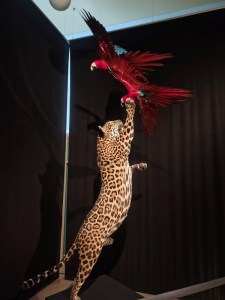 We got to pretend to be hip locals for four days, going up the Reichstag tower, strolling through the Tiergarten, touring the Natural History Museum (which has some excellent taxidermy as at left), walking from Potsdam station through Park Sanssouci and ogling the castles and windmill, chowing down on hand-pulled noodles and bao buns at neighbourhood café Wen Cheng, catching an excellent free lunchtime concert at the Philharmonic, and bringing back pastries or vegan doughnuts to snack on while hanging out with the kitties. The S-Bahn was included on our Interrail passes but didn’t go everywhere we needed, so we were often on the handy U-Bahn and tram system instead. Graffiti is an art form rather than an antisocial activity in Berlin; there is so much of it, everywhere.
-

- Reichstag (Photos 1, 2 and 4 by Chris Foster)
-

- Reichstag tower designed by Norman Foster
-

- The Philharmonic
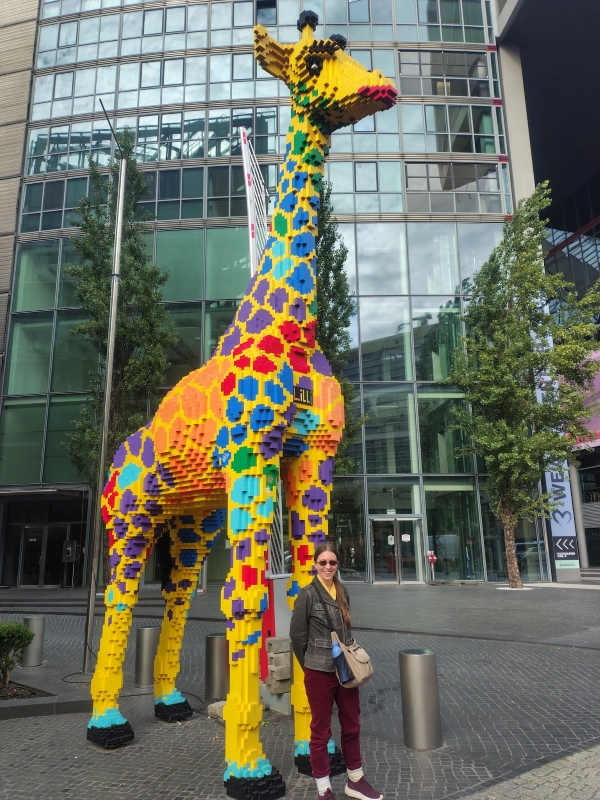
-
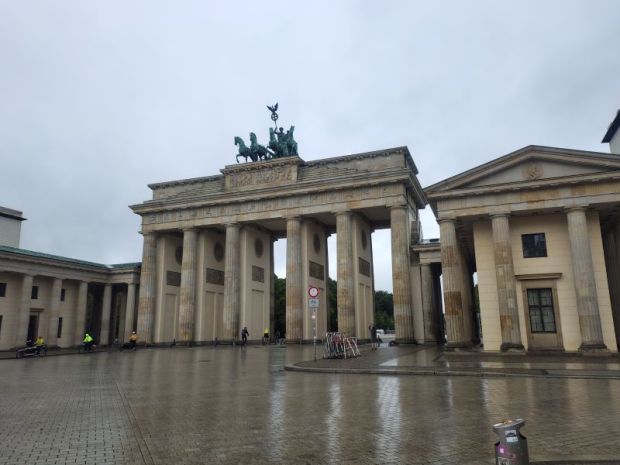
- Brandenburg Gate (Photos 1-3 by Chris Foster)
-
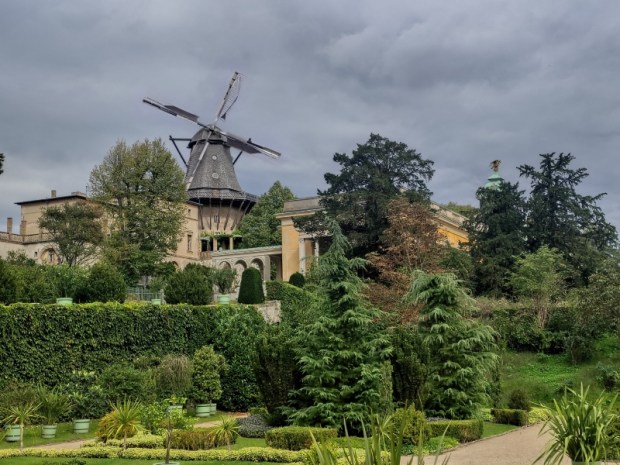
- Postdam’s Park Sanssouci
-
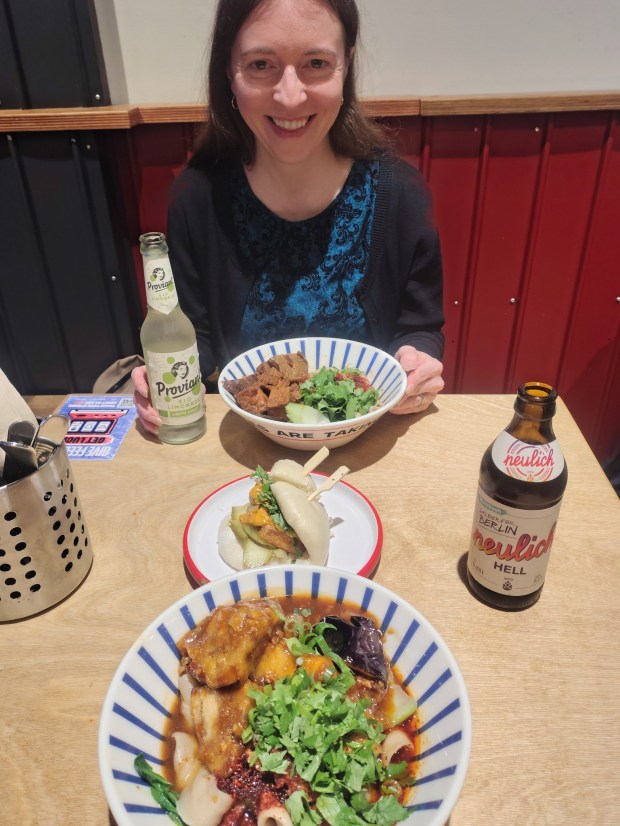
- Wen Cheng noodles
-

- Brammibal’s vegan doughnuts
I brought along another novella that proved an apt companion for our explorations of the city. Even just spotting familiar street and stop names in it felt like reassurance.
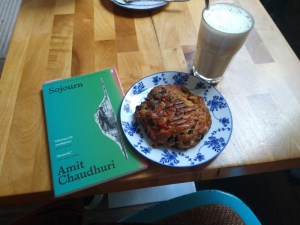
Sojourn by Amit Chaudhuri (2022)
 The narrator of this spare text is a Böll Visiting Professor experiencing disorientation yet resisting gestures of familiarity. Like a Teju Cole or Rachel Cusk protagonist, his personality only seeps in through his wanderings and conversations. After his first talk, he meets a fellow Indian from the audience, Faqrul Haq, who takes it upon himself to be his dedicated tour guide. The narrator isn’t entirely sure how he feels about Faqrul, yet meets him for meals and seeks his advice about the best place to buy warm outerwear. An expat friend is a crutch he wishes he could refuse, but the bewilderment of being somewhere you don’t speak the language at all is such that he feels bound to accept. Meanwhile, there is the possibility of another academic admirer, Birgit, becoming his lover. Strangely, his relationship with his cleaning lady, who addresses him only in German, seems the healthiest one on offer. As the book goes on, the chapters get shorter and shorter, presaging some kind of mental crisis. “I keep walking – in which direction I’m not sure; Kreuzberg? I’ve lost my bearings – not in the city; in its history. The less sure I become of it, the more I know my way.” This was interesting, even admirable, but I wanted more story. (Public library)
We spent a drizzly and slightly melancholy first day and final morning making pilgrimages to Jewish graveyards and monuments to atrocities, some of them nearly forgotten. I got the sense of a city that has been forced into a painful reckoning with its past – not once but multiple times, perhaps after decades of repression. One morning we visited the claustrophobic monument to the Murdered Jews of Europe, and, in the Tiergarten, the small memorials to the Roma and homosexual victims of the Holocaust. The Nazis came for political dissidents and the disabled, too, as I was reminded at the Topography of Terrors, a free museum where brutal facts are laid bare. We didn’t find the courage to go in as the timeline outside was confronting enough. I spotted links to the two historical works I was reading during my stay (Stella the red-haired Jew-catcher in the former and Magnus Hirschfeld’s institute in the latter). As I read both, I couldn’t help but think about the current return of fascism worldwide and the gradual erosion of rights that should concern us all.


Aimée and Jaguar: A Love Story, Berlin 1943 by Erica Fischer (1994; 1995)
[Translated from German by Edna McCown]
 Elisabeth “Lilly” Wust was a good German: the estranged wife of a Nazi and mother of four young sons. She met Felice Schragenheim via her new domestic helper, Inge Wolf. Lilly (aka Aimée) was slow to grasp that Inge and Felice were part of a local lesbian milieu, and didn’t realize Felice (aka Jaguar) was a “U-boat” (Jew living underground) until they’d already become lovers. They got nearly a year and a half together, living almost as a married couple – they had rings engraved and everything – before Felice was taken into Gestapo custody. You know from the outset that this story won’t end well, but you keep hoping – just like Lilly did. It’s not a usual or ‘satisfying’ tragedy, though, because there is no record of what happened to Felice. She was declared legally dead in 1948 but most likely shared the fate of Anne and Margot Frank, dying of typhus at Bergen-Belsen. It’s heartbreaking that Felice, the orphaned daughter of well-off dentists, had multiple chances to flee Berlin – via her sister in London, their stepmother in Palestine, an uncle in America, or friends escaping through Switzerland – but chose to remain.
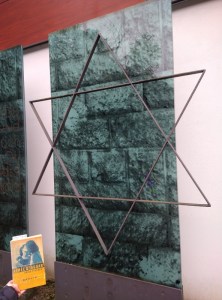 The narrative incorporates letters, diaries and interviews, especially with Lilly, who clearly grieved Felice for the rest of her life. The book is unsettling, though, in that Fischer doesn’t let it stand as a simple Juliet & Juliet story; rather, she undermines Lilly by highlighting Felice’s promiscuity (so she likely would not have remained faithful) and Lilly’s strange postwar behaviour: desperately trying to reclaim Felice’s property, and raising her sons as Jewish. This was a time capsule, a wholly absorbing reclamation of queer history, but no romantic vision. (Secondhand purchase – Community Furniture Project)
[A similar recent release: Milena and Margarete: A Love Story in Ravensbrück by Gwen Strauss]
The Lilac People by Milo Todd (2025)
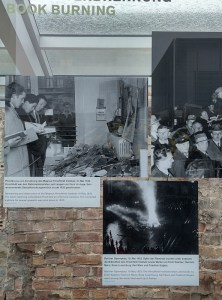 This was illuminating, as well as upsetting, about the persecution of trans people in Nazi Germany. Todd alternates between the gaiety of early 1930s Berlin – when trans man Bertie worked for Magnus Hirschfeld’s Institute of Sexual Science and gathered with friends at the Eldorado Club for dancing and singing their anthem, “Das Lila Lied” – and 1945 Ulm, where Bert and his partner Sofie have been posing as an older farming couple. At the novel’s start, a runaway from Dachau, a young trans man named Karl, joins their household. Ironically, it is at this point safer to be Jewish than to be different in any other way; even with the war over, rumour has it the Allies are rounding up queer people and putting them in forced labour camps, so the trio pretend to be Jews as they ponder a second round of escapes.
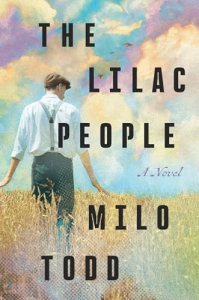 While this is slow to start with, and heavy on research throughout, it does gather pace. The American officer, Ward, is something of a two-dimensional villain who keeps popping back up. Still, the climactic scenes are gripping and the dual timeline works well. Todd explores survivor guilt and gives much valuable context. He is careful to employ language in use at that time (transvestites, transsexuals, “inverts,” “third sex”) and persuasively argues that, in any era, how we treat the vulnerable is the measure of our humanity. (Read via Edelweiss)
[A similar recent release: Under the Pink Triangle by Katie Moore (set in Dachau)]
We might have been at the Eldorado in the early 1930s on the evening when we ventured out to the bar Zosch for a “New Orleans jazz” evening. The music was superb, the German wine tasty, the whole experience unforgettable … but it sure did feel like being in a bygone era. We’re so used to the indoor smoking ban (in force in the UK since 2007) that we didn’t expect to find young people chain-smoking rollies in an enclosed brick basement, and got back to the flat with our clothes reeking and our lungs burning.


It was good to see visible signs of LGTBQ support in Berlin, though they weren’t as prevalent as I perhaps expected.


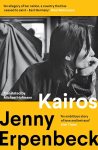 For a taste of more recent German history, I’ve started Kairos by Jenny Erpenbeck, which is set in the 1980s not long before the Berlin Wall came down. Unfortunately, my library hold didn’t arrive until too late to take it with me. We made a point of seeing the wall remnants and Checkpoint Charlie on our trip.


Other Berlin highlights: a delicious vegetarian lunch at the canteen of an architecture firm, the Ritter chocolate shop, and the pigeons nesting on the flat balcony – the chicks hatched on our final morning!


And a belated contribution to Short Story September:
Touchy Subjects by Emma Donoghue (2006)
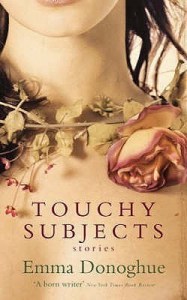 I seem to pluck one or two books at random from Donoghue’s back catalogue per year. I designated this as reliable train reading. The 19 contemporary stories fall into thematic bundles: six about pregnancy or babies, several about domestic life, a few each on “Strangers” and “Desire,” and a final set of four touching on death. The settings range around Europe and North America. It’s impressive how Donoghue imagines herself into so many varied situations, including heterosexual men longing for children in their lives and rival Louisiana crawfishermen setting up as tour-boat operators. The attempts to write Black characters in “Lavender’s Blue” and “The Welcome” are a little cringey, and the latter felt dated with its ‘twist’ of a character being trans. She’s on safer ground writing about a jaded creative writing tutor or football teammates who fall for each other. I liked a meaningful encounter between a tourist and an intellectually disabled man in a French cave (“The Sanctuary of Hands”), an Irishwoman’s search for her missing brother in Los Angeles (“Baggage”) and a contemporary take on the Lazarus myth (“Necessary Noise”), but my two favourites were “The Cost of Things,” about a lesbian couple whose breakup is presaged by their responses to their cat’s astronomical vet bill; and “The Dormition of the Virgin,” in which a studious young traveller to Florence misses what’s right under his nose. There are some gems here, but the topics are so scattershot the collection doesn’t cohere. (Secondhand – Awesomebooks.com)
Trip write-up to be continued (tomorrow, with any luck)…
Reading Ireland Month, Part II: Barrett, More Donoghue, O’Farrell x 2
My second set of contributions to Cathy’s Reading Ireland Month. Emma Donoghue also appeared in my first instalment of reviews. Today I’m featuring her latest novel, published just a couple of weeks ago, and taking a quick look at a few other Irish books I’ve read recently: a light-hearted debut featuring small-town criminals, and two by Maggie O’Farrell: a reread of her only nonfiction work to date (for book club), and her newest children’s book.
Wild Houses by Colin Barrett (2024)
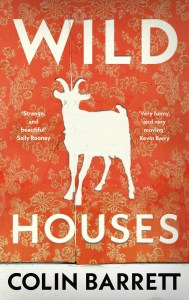 When Doll English is kidnapped by the Ferdia brothers in revenge for a huge loss on a drug deal, his girlfriend, mother and brother must go to unexpected lengths to set him free. There’s plenty of cursing and violence in this small-town crime caper, yet Barrett has a light touch; the dialogue, especially, is funny. The dialect is easy enough to decipher. Nicky, Doll’s girlfriend, lost both parents young and works in a hotel bar. She’s a strong character reminiscent of the protagonist in Trespasses. Overall, I felt that this was nicely written but that Barrett’s talent was somewhat wasted on a thin story. I’ve encountered similar plots in better books by Paul Murray and Donal Ryan. (Free from the publisher)
The Paris Express by Emma Donoghue
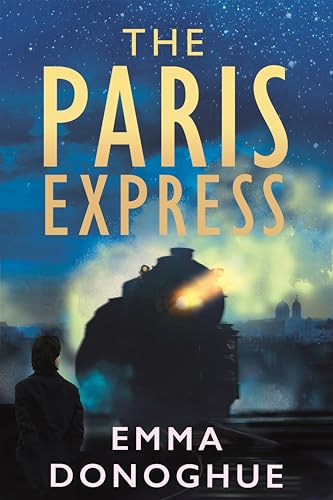 Inspired by a real-life disaster involving a train on the approach to Paris’s Montparnasse station in 1895. The Author’s Note at the end reveals the blend of characters included: people known to have been on that particular train, whether as crew or passengers; those who might have journeyed on it because they spent time in Paris at around that period (such as Irish playwright John Millington Synge); and those made up from scratch. It’s a who’s-who of historical figures, many of whom represent different movements or social issues, such as a woman medical student and an African American painter who can pass as white in certain circumstances. Donoghue clearly intends to encompass the entire social hierarchy, from a maid to a politician with a private carriage. She also crafts a couple of queer encounters.
The premise is appealing: a train hurtling toward catastrophe is in a sense a locked room, seeding much drama and intrigue. A young female radical is on board with a bomb, so all along you speculate about whether she’ll set it off and when. While I found the general thrust engaging, it was harder to develop interest in the large cast of characters. I also found the passages personifying the train (she “carries death in her belly”) hokey and thought that, as has sometimes been the case with Donoghue’s historical work, there’s too much research that’s there just for the sake of it, because she came across a fact she found fascinating and couldn’t bear to leave out (“These days every public building has three rubbish bins—one for the reclaiming of paper and cloth, the next for glass, ceramics, and oyster shells, and the last for perishables, which is where she drops the handkerchief.”). So this was enjoyable enough but not among her best.
With thanks to Picador for the proof copy for review.
I Am, I Am, I Am: Seventeen Brushes with Death by Maggie O’Farrell (2017)
 This was a reread for book club, and oh how brilliant it is. I’m more convinced than ever that the memoir-in-essays is a highly effective form because it focuses on themes or moments of great intensity and doesn’t worry about accounting for all the boring intermediate material. A few of these pieces feel throwaway, but together they form a vibrant picture of a life and also inspire awe at what the human body can withstand. No doubt on Wednesday we will each pick out different essays that resonated the most with us, perhaps because they run very close to our own experience. I imagine our discussion will start there – and with sharing our own NDEs. Stylistically, the book has a lot in common with O’Farrell’s fiction, which often employs the present tense and a complicated chronology. The present tense and a smattering of second person make the work immediate and invite readers to feel their way into her situations. Otherwise, my thoughts are as before – the last two essays are the pinnacle.
My original review from 2018:
We are, all of us, wandering about in a state of oblivion, borrowing our time, seizing our days, escaping our fates, slipping through loopholes, unaware of when the axe may fall.
O’Farrell captures fragments of her life through 17 essays on life-threatening illnesses and other narrow escapes she’s experienced. The pieces aren’t in chronological order and aren’t intended to be comprehensive. Instead, they crystallize the fear and pain of particular moments in time, and are rendered with the detail you’d expect from a scene in one of her novels. (Indeed, you can spot a lot of the real-life influences on her fiction, particularly This Must Be the Place – travels in China and Chile; eczema and stammering.)
She’s been mugged at machete point, has nearly drowned several times, had a risky first labour, and was almost the victim of a serial killer. (My life feels awfully uneventful by comparison!) But the best section of the book is its final quarter: an essay about her childhood encephalitis and its lasting effects, followed by another about her daughter’s extreme allergies. Only now, as a mother, can she understand how terrifying it must have been for her parents to wait at her side during days when she might not have survived. O’Farrell depicts parenthood better than any other author I can think of – letting those of us who haven’t experienced it do so vicariously. (Gift from my wish list)
My original rating (2018): 
My rating now: 
When the Stammer Came to Stay by Maggie O’Farrell (2024)
 This is actually her third children’s book, after Where Snow Angels Go (2020) and The Boy Who Lost His Spark (2022). All are illustrated by Daniela Jaglenka Terrazzini, who has a richly colourful and slightly old-fashioned style; she makes kids look as dignified as adults. The books are intended for slightly older children in that they’re on the longer side, have more words than pictures, and are more serious than average. They all weave in gentle magic as a way of understanding and coping with illness, a mental health challenge, or a disability.
When the Stammer Came to Stay is a perfect follow-on to I Am, I Am, I Am because it, too, draws on O’Farrell’s personal struggles. It’s the fable-like story of two sisters, Bea and Min, who share an attic room. The one is perfectly tidy; the other is a messy tomboy. When the stammer, pictured as a blob of silver ectoplasm above the shoulder, starts stealing Min’s words, they gather advice from their parents and the lodgers about how she can accept her new reality instead of fighting it or closing herself off by not speaking at all. The mycologist’s symbiosis metaphor is perhaps a bit too neat, but it contrasts with the impish connotations of the dibbuk, another useful parallel the girls discover. With this I’ve now read O’Farrell’s complete published works!
On Trying to Keep Still (Post-Northumberland Holiday)
What’s the point of going on vacation? Expanding your cultural horizons, seeing new things and places, treating yourself to fun experiences you don’t have in the everyday, and relaxing could all be good answers. Relaxation isn’t our strong suit when we go away; we often return from a holiday wishing that we had a few recovery days before resuming work. Some combination of developing a bad cold in the last few days of the trip, coming back to non-stop rain, worrying about our cat’s ongoing health issues, and my husband already having a manically busy start to the term has left me feeling like staying put for the foreseeable.
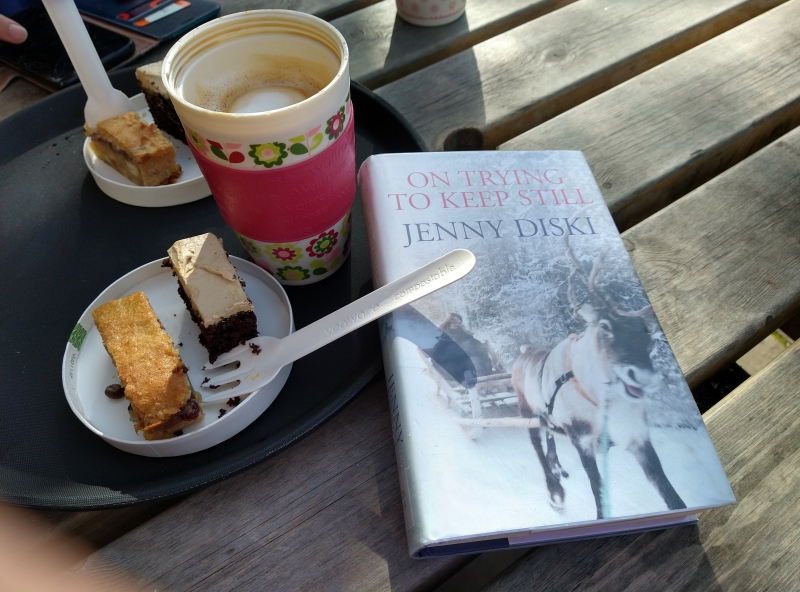
Apt reading for a coffee stop on Lindisfarne.
Jenny Diski understood that. Her collection of travel pieces, On Trying to Keep Still, was the one book I read in its entirety on our trip (along with parts of novels, poetry collections and many, many short story volumes). Essays and short stories were perfect reading for a public transport trip: ideal for taking out on a train or bus and reading one or a few. I’d earmarked the Diski for 20 Books of Summer but found a better setting for it after all. A couple of pieces touch on her traumatic childhood and time spent in a mental hospital as a teenager, which I vaguely remembered from her other autobiographical work. The essay “On Anatomy,” which doesn’t really fit with the others but may have been my favourite, matter-of-factly recounts her rape at 14, and her midlife diagnosis of Freiberg’s disease. Her doctor’s dismissive response to her debilitating foot pain was her first experience of age-related discrimination.
Diski expresses how troubled she is to have become known as a travel writer – through the two books of hers I’d previously read, Skating to Antarctica and Stranger on a Train – because, for the most part, she much prefers to stay at home and do nothing. Ironically, she ends up writing a travel feature on Lapland for the Observer, even though what she actually proposed was spending a few days in the polar dark. But the paper talked her into undertaking all sorts of uncomfortable adventures like a reindeer-drawn sleigh ride and sleeping in a tent – and this for someone who specifically hated being cold.
This is the stuff of Part Three. In Part One, she speaks at a book festival in New Zealand and resists the compulsion to skydive; in the long Part Two, she courts solitude by renting a cottage on a Somerset farm for two months. She holes up with a mini-library of silence- and seclusion-themed reads and shows her face only often enough so the owner won’t fret about her. (It took me a little while to work out that the farmer was Janet White, author of The Sheep Stell – quite a neat connection. Diski also lived with Doris Lessing as a teenager.) Here, too, Diski is delighted to eschew outings and exercise and just stay in comfort. The fact that she brought pristine Prada hiking boots tells you she’s no outdoorswoman. By the book’s end, she’s concluded it’s best to save the money and effort and just research or imagine your way to places instead. Tongue-in-cheek advice, perhaps, but the tone of cheerful indolence appealed to me. (Secondhand – Awesomebooks.com)
Sprinting to make buses, hours-long bone-shaking rides, heavy luggage: we were out of practice at using public transport, sure, but the rigours of this trip were a bit much for me. It can’t just be age, though at nearly 41 I do long for my own bed on any stay away from home. It’s partly a matter of accepting that chronic illness means I will have limitations. Much as we wanted to do the right thing by not driving, travelling by car is so much more practical and comfortable. Trips to the Continent may still be doable by train as European services seem reliable. But within the UK? Unless it’s a short city break, I’m not sure.
All that said, we did have a nice time. Our cottage in Berwick-upon-Tweed was spacious and we had unexpectedly glorious weather for daytrips to Bamburgh Castle, the Farne islands and Lindisfarne, Alnwick and Alnmouth, and especially the fishing town of Dunbar in Scotland. If you ever find yourself in Berwick, do walk the medieval walls (plus try a charcuterie platter at Atelier wine bar, sample the sweet or savoury offerings at Northern Soul Kitchen, and find time for a drink or two at The Curfew micro-pub). Speaking of drinks, we also enjoyed our time with friends in York, not least an afternoon at the annual beer festival.


Bookishness included a return trip to Barter Books, where my store credit got me a free book and badge; Berwick’s Berrydin Books and Slightly Foxed, as well as several charity shops; the “Books by the Sea” Little Free Library network; and the John Muir birthplace museum and trail in Dunbar. Muir was a forefather of modern environmentalism involved in the inception of the U.S. national parks system. I’ll have to seek out his memoir of childhood.


My modest book haul (compared to our previous trip to Northumberland, anyway) of 12 books is testament to great restraint; had we been traveling by car, I probably would have acquired more books at each stop. I majored on short story collections and novella-length works. And I’ve started reading several already!


Other reading experiences, on a rail replacement bus and on the nearly empty Bamburgh and Dunbar beaches:


If you had to choose, would it be far-flung adventuring or the comforts of home?
Bill Bryson’s Notes from a Small Island: Reread and Stage Production
Bill Bryson, an American author of humorous travel and popular history or science books, is considered a national treasure in his adopted Great Britain. He is a particular favourite of my husband and in-laws, who got me into his work back in the early to mid-2000s. As I, too, was falling in love with the country, I found much to relate to in his travel-based memoirs of expatriate life and temporary returns to the USA. Sometimes it takes an outsider’s perspective to see things clearly.

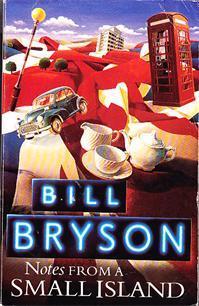 When we heard that Notes from a Small Island (1995), his account of a valedictory tour around Britain before returning to live in the States for the first time in 20 years, had been adapted into a play by Tim Whitnall and would be performed at our local theatre, the Watermill, we thought, huh, it never would have occurred to us to put this particular book on stage. Would it work? we wondered. The answer is yes and no, but it was entertaining and we were glad that we went. We presented tickets as my in-laws’ Christmas present and accompanied them to a mid-February matinee before supper at ours.
A few members of my book club decided to see the show later in the run and suggested we read – or reread, as was the case for several of us – the book in March. I started my reread before attending the play and had gotten through the first 50 pages, which is mostly about his first visit to England in 1973 (including a stay in a Dover boarding-house presided over by the infamously officious “Mrs Smegma”). This was ideal as the first bit contains the funniest stuff and, with the addition of some autobiographical material from later in the book plus his 2006 memoir The Life and Times of the Thunderbolt Kid, made up the entirety of the first act.

Photos are screenshots from the Watermill website.
Bryson traveled almost exclusively by public transport, so the set had the brick and steel walls of a generic terminal, and a bus shelter and benches were brought into service as the furnishing for most scenes. The problem with frontloading the play with hilarious scenes is that the second act, like the book itself on this reread, became rather a slog of random stops, acerbic observations, finding somewhere to stay and something to eat (often curry), and then doing it all over again.
Mark Hadfield, in the starring role, had the unenviable role of carrying the action and remembering great swathes of text lifted directly from the book. That’s all well and good as a strategy for giving a flavour of the writing style, but the language needed to be simplified; the poor man couldn’t cope and kept fluffing his lines. There were attempts to ease the burden: sections were read out by other characters in the form of announcements, letters or postcards; some reflections were played as if from Bryson’s Dictaphone. It was best, though, when there were scenes rather than monologues against a projected map, because there was an excellent ensemble cast of six who took on the various bit parts and these were often key occasions for humour: hotel-keepers, train-spotters, unintelligible accents in a Glasgow pub.

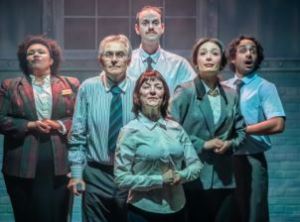
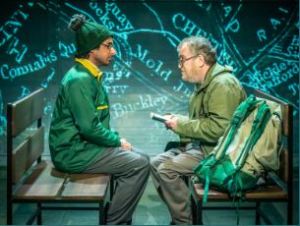
The trajectory was vaguely southeast to northwest – as far as John O’Groats, then back home to the Yorkshire Dales – but the actual route was erratic, based on whimsy as much as the availability of trains and buses. Bryson sings the praises of places like Salisbury and Durham and the pinnacles of coastal walks, and slates others, including some cities, seaside resorts and tourist traps. Places of personal significance make it onto his itinerary, such as the former mental asylum at Virginia Water, Surrey where he worked and met his wife in the 1970s. (My husband and I lived across the street from it for a year and a half.) He’s grumpy about having to pay admission fees that in today’s money sound minimal – £2.80 for Stonehenge!
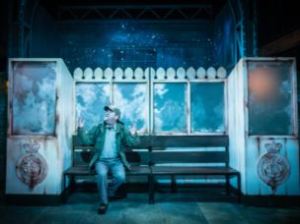 The main interest for me in both book and play was the layers of recent history: the nostalgia for the old-fashioned country he discovered at a pivotal time in his own young life in the 1970s; the disappointments but still overall optimism of the 1990s; and the hindsight the reader or viewer brings to the material today. At a time when workers of every type seem to be on strike, it was poignant to read about the protests against Margaret Thatcher and the protracted printers’ strike of the 1980s.
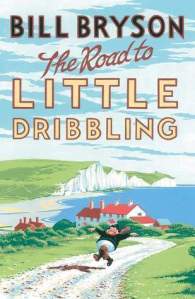 The central message of the book, that Britain has an amazing heritage that it doesn’t adequately appreciate and is rapidly losing to homogenization, still holds. Yet I’m not sure the points about the at-heart goodness and politeness of the happy-with-their-lot British remain true. Is it just me or have general entitlement, frustration, rage and nastiness taken over? Not as notable as in the USA, but social divisions and the polarization of opinions are getting worse here, too. One can’t help but wonder what the picture would have been post-Brexit as well. Bryson wrote a sort-of sequel in 2015, The Road to Little Dribbling, in which the sarcasm and curmudgeonly persona override the warmth and affection of the earlier book.
Indeed, my book club noted that a lot of the jokes were things he couldn’t get away with saying today, and the theatre issued a content warning: “This production includes the use of very strong language, language reflective of historical attitudes around Mental Health, reference to drug use, sexual references, mention of suicide, flashing lights, pyrotechnics, loud sound effect explosions, and haze. This production is most suitable for those aged 12+.”
So, yes, an amusing journey, but a bittersweet one to revisit, and an odd choice for the stage.
A favourite line I’ll leave you with: “To this day, I remain impressed by the ability of Britons of all ages and social backgrounds to get genuinely excited by the prospect of a hot beverage.”
Book:
Original rating (c. 2004): 
My rating now: 
Play:
Have you read anything by Bill Bryson? Are you a fan?
Adventuring (and Reading) in the Outer Hebrides
Islands are irresistible for the unique identities they develop through isolation, and the extra effort that it often takes to reach them. Over the years, my husband and I have developed a special fondness for Britain’s islands – the smaller and more remote the better. After exploring the Inner Hebrides in 2005 and Orkney and Shetland in 2006, we always intended to see more of Scotland’s islands; why ever did we leave it this long?

From Wikimedia Commons. By Kelisi.
Rail strikes and cancelled trains threatened our itinerary more than once, so it was a relief that we were able to go, even at extra cost. Our back-up plan left us with a spare day in Inverness, which we filled with coffee and pastries outside the cathedral, browsing at Leakey’s bookshop, walking along the River Ness and in the botanical gardens, and a meal overlooking the 19th-century castle.


Then it was on to the Outer Hebrides at last, via a bus ride and then a ferry to Stornoway in Lewis, the largest settlement in the Western Isles. Here we rented a car for a week to allow us to explore the islands at will. We were surprised at how major a town Stornoway is, with a big supermarket and slight suburban sprawl – yet it was dead on the Saturday morning we went in to walk around; not until 11:30 was there anything like the bustle we expected.
We’d booked three nights in a tiny Airbnb house 15 minutes from the capital. First up on our tourist agenda was Callanish stone circle, which we had to ourselves (once the German coach party left). Unlike at Stonehenge, you can walk in among the standing stones. The rest of our time on Lewis went to futile whale watching, the castle grounds, and beach walks.


This post threatens to become a boring rundown, so I’ll organize the rest thematically, introduced by songs by Scottish artists.
“I’ll Always Leave the Light On” by Kris Drever
Long days: The daylight lasts longer so far north, so each day we could plan activities not just for the morning and afternoon but late into the evening. At our second stop – three nights in another Airbnb on North Uist – we took walks after dinner, often not coming back until 10 p.m., at which point there was still another half-hour until sunset.
“Why Does It Always Rain on Me?” by Travis
Weather: We got a mixture of sun and clouds. It rained at least a bit on most days, and we got drenched twice, walking out to an eagle observatory on Harris (where we saw no eagles, as they are too sensible to fly in the rain) and dashing back to the car from a coastal excursion. I was doomed to wearing plastic bags around my feet inside my disintegrating hiking boots for the rest of the trip. There was also a strong wind much of the time, which made it feel colder than the temperature suggested – I often wore my fleece and winter hat.

A witty approach to weather forecasting. (Outside the shop/bistro on Berneray.)
“St Kilda Wren” by Julie Fowlis
 Music and language: Julie Fowlis is a singer from North Uist who records in English and Gaelic. (This particular song is in Gaelic, but the whole Spell Songs album was perfect listening on our drives because of the several Scottish artists involved and the British plants and animals sung about.) There is a strong Gaelic-speaking tradition in the Western Isles. We heard a handful of people speaking it, all road signs give place names in Gaelic before the English translation, and there were several Gaelic pages in the free newspaper we picked up.
Wildlife: The Outer Hebrides is a bastion for some rare birds: the corncrake, the red-necked phalarope, and both golden and white-tailed eagles. Thanks to intel gleaned from Twitter, my husband easily found a phalarope swimming in a small roadside loch. Corncrakes hide so well they are virtually impossible to see, but you will surely hear their rasping calls from the long grass. Balranald is the westernmost RSPB reserve and a wonderful place to hear corncrakes and see seabirds flying above the machair (wildflower-rich coastal grassland). No golden eagles, but we did see a white-tailed eagle flying over our accommodation on our last day, and short-eared owls were seemingly a dime a dozen. We were worried we might see lots of dead birds on our trip due to the avian flu raging, but there were only five – four gannets and an eider – and a couple looked long dead. Still, it’s a distressing situation.


We also attended an RSPB guided walk to look for otters and did indeed spot one on a sea loch. It happened to be the Outer Hebrides Wildlife Festival week. Our guide was knowledgeable about the geography and history of the islands as well.

Badges make great, cheap souvenirs!
St. Kilda: This uninhabited island really takes hold of the imagination. It can still be visited, but only via a small boat through famously rough seas. We didn’t chance it this time. I might never get there, but I enjoy reading about it. There’s a viewing point on North Uist where one can see out to St. Kilda, but it was only the vaguest of outlines on the hazy day we stopped.
“Traiveller’s Joy” by Emily Smith
Additional highlights:
- An extended late afternoon tea at Mollans rainbow takeaway shed on Lewis. Many of the other eateries we’d eyed up in the guidebook were closed, either temporarily or for good – perhaps an effect of Covid, which hit just after the latest edition was published.


- A long reading session with a view by the Butt of Lewis, which has a Stevenson lighthouse.
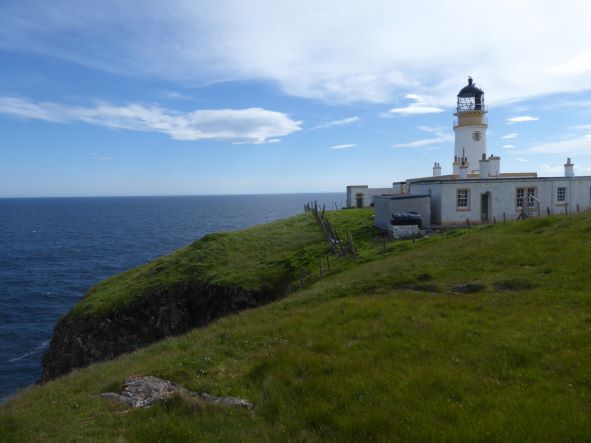
- Watching mum and baby seals playing by the spit outside our B&B window on Berneray.
- Peat smoked salmon. As much of it as I could get.
- A G&T with Harris gin (made with kelp).
“Dear Prudence” (Beatles cover) by Lau
Surprises:
- Gorgeous, deserted beaches. This is Luskentyre on Harris.

- No midges to speak of. The Highlands are notorious for these biting insects, but the wind kept them away most of the time we were on the islands. We only noticed them in the air on one still evening, but they weren’t even bad enough to deploy the Avon Skin So Soft we borrowed from a neighbour.
- People still cut and burn peats for fuel. Indeed, when we stepped into the Harris gin distillery for a look around, I was so cold and wet that I warmed my hands by a peat fire! Even into the 1960s, people lived in primitive blackhouses, some of which have now been restored as holiday rentals. The one below is run as a museum.

- Not far outside Stornoway is the tiny town of Tong. We passed through it each day. Here Mary Anne MacLeod was born in 1912. If only she’d stayed on Lewis instead of emigrating to New York City, where she met Fred Trump and had, among other children, a son named Donald…
- Lord Leverhulme, founder of Unilever, bought Lewis in 1918 and part of Harris the next year. He tried to get crofters to work in his businesses, but all his plans met with resistance and his time there was a failure, as symbolized by this “bridge to nowhere” (Garry Bridge). His legacy is portrayed very differently here compared to in Port Sunlight, the factory workers’ town he set up in Merseyside.

- The most far-flung Little Free Library I’ve ever visited (on Lewis).

- Visits from Lulu the cat at our North Uist Airbnb.

“Wrapped Up in Books” by Belle and Sebastian
What I read: I aimed for lots of relevant on-location reads. I can’t claim Book Serendipity: reading multiple novels set on Scottish islands, it’s no surprise if isolation, the history of the Clearances, boat rides, selkies and seabirds recur. However, the coincidences were notable for one pair, Secrets of the Sea House by Elisabeth Gifford and Night Waking by Sarah Moss, a reread for me. I’ll review these two together, as well as The Summer of the Bear by Bella Pollen (inspired by a real incident that occurred on North Uist in 1980), in full later this week.

I also read about half of Sightlines by Kathleen Jamie, a reread for me; its essays on gannets and St. Kilda chimed with the rest of my reading. Marram, Leonie Charlton’s memoir of pony trekking through the Outer Hebrides, will form part of a later 20 Books of Summer post thanks to the flora connection, as will Jon Dunn’s Orchid Summer, one chapter of which involves a jaunt to North Uist to find a rare species.


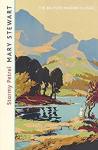 Stormy Petrel by Mary Stewart: My selection for the train journey up. I got Daphne du Maurier vibes from this short novel about a holiday Dr Rose Fenemore, an English tutor at Cambridge, takes to Moila, a (fictional) small island off of Mull in the Inner Hebrides. It’s a writing retreat for her: she’s working on a book of poetry, but also on the science fiction she publishes under a pseudonym. Waiting for her brother to join her, she gets caught up in mild intrigue when two mysterious men enter her holiday cottage late one stormy night. Each has a good excuse cooked up, but who can she trust? I enjoyed the details of the setting but found the plot thin, predictable and slightly silly (“I may be a dish, but I am also a don”). This feels like it’s from the 1950s, but was actually published in 1991. I might try another of Stewart’s.
I also acquired four books on the trip: one from the Little Free Library and three from Inverness charity shops.

I started reading all three in the bottom pile, and read a few more books on my Kindle, two of them for upcoming paid reviews. The third was:
 Tracy Flick Can’t Win by Tom Perrotta: A sequel to Election, which you might remember as a late-1990s Reese Witherspoon film even if you don’t know Perrotta’s fiction. Tracy Flick was the goody two-shoes student who ran for school president and had her campaign tampered with. Now in her forties, she’s an assistant principal at a high school and a single mother. Missing her late mother and wishing she’d completed law school, she fears she’ll be passed over for the top job when the principal retires. This is something of an attempt to update the author’s laddish style for the #MeToo era. Interspersed with the third-person narration are snappy first-person testimonials from Tracy, the principal, a couple of students, and the washed-up football star the school chooses to launch its new Hall of Fame. I can’t think of any specific objections, but nor can I think of any reason why you should read this.
On my recommendation, my husband read Love of Country by Madeleine Bunting and The Frayed Atlantic Edge by David Gange, two excellent nonfiction books about Britain’s islands and coastline.
“Other Side of the World” by KT Tunstall
General impressions: We weren’t so taken with Lewis on the whole, but absolutely loved what we saw of Harris on our drive to the ferry to Berneray and wished we’d allotted it more time. While we only had one night on Berneray and mostly saw it in the rain, we thought it a lovely little place. It only has the one shop, which doubles as the bistro in the evenings – warned by the guidebook that this is the only place to eat on the island, we made our dinner reservation many weeks in advance. The following morning, as we ate our full Scottish cooked breakfast, I asked the B&B owner what led him to move from England to “the ends of the earth.” He took mild objection to my tossed-off remark and replied that the islands are more like “the heart of it all.” Thanks to fast Internet service, remote working is no issue.


We are more than half serious when we talk about moving to Scotland one day. We love Edinburgh, though the tourists might drive us mad, and enjoyed our time in Wigtown four years ago. I’d like to think we could even cope with island life in Orkney or the Hebrides. We imagine them having warm, tight-knit communities, but would newcomers feel welcome? With only one major supermarket in the whole Western Isles, would we find enough fresh fruit and veg? And however would one survive the bleakness of the winters?
North Uist captivated us right away, though. Within 15 minutes of driving onto the island via a causeway, we’d seen three short-eared owls and three red deer stags, and we got great views of hen harriers and other raptors. One evening we found ourselves under what seemed to be a raven highway. It felt unlike anywhere else we’d been: pleasingly empty of humans, and thus a wildlife haven.
The long journey home: The public transport nightmares of our return trip put something of a damper on the end of the holiday. We left the islands via a ferry to Skye, where we caught a bus. So far, so good. Our second bus, however, broke down in the middle of nowhere in the Highlands and the driver plus we five passengers were stuck for 3.5 hours awaiting a taxi we thought would never come. When it did, it drove the winding road at terrifying speed through the pitch black.
Grateful to be alive, we spent the following half-day in Edinburgh, bravely finding brunch, the botanic gardens and ice cream with our heavy luggage in tow. The final leg home, alas, was also disrupted when our overcrowded train to Reading was delayed and we missed the final connection to Newbury, necessitating another taxi – luckily, both were covered by the transport operators, and we’ll also reclaim for our tickets. Much as we believe in public transport and want to support it, this experience gave us pause. Getting to and around Spain by car was so much easier, and that trip ended up a lot cheaper, too. Ironic!

Guarding the bags in Edinburgh
“Take Me Back to the Islands” by Idlewild
Next time: On this occasion we only got as far south as Benbecula (which, pleasingly, is pronounced Ben-BECK-you-luh). In the future we’d think about starting at the southern tip and seeing Barra, Eriskay and South Uist before travelling up to Harris. We’ve heard that these all have their own personalities. Now, will we get back before many more years pass?
20 Books of Summer, 4–5: Roy Dennis & Sophie Pavelle
The next two entries in my flora-themed summer reading are books I read for paid reviews, so I only give extracts from my thoughts below. These are both UK-based environmentalist travel memoirs and counted because of their titles, but do also feature plants in the text. I have various relevant books of my own and from the library on the go toward this challenge. Despite the complications of a rail strike and two cancelled trains, we have persisted in finding workarounds and making new bookings, so our trip to the Outer Hebrides is going ahead – whew! I’ll schedule a few posts for while I’m away and hope to share all that was seen and done (and read) when I’m back in early July.
Mistletoe Winter: Essays of a Naturalist throughout the Year by Roy Dennis (2021)
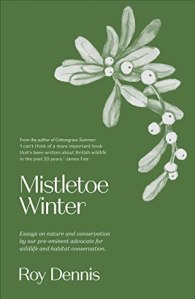 Dennis is among the UK’s wildlife conservation pioneers, particularly active in reintroducing birds of prey such as ospreys and white-tailed eagles (see also my response to his Restoring the Wild). In this essay collection, his excitement about everyday encounters with the natural world matches his zeal for momentous rewilding projects. The book entices with the wonders that can be experienced through close attention, like the dozen species’ worth of tracks identified on a snowy morning’s walk. Dennis is sober about wildlife declines witnessed in his lifetime. Practical and plain-speaking, he does not shy away from bold proposals. However, some of the pieces feel slight or dated, and it’s unclear how relevant the specific case studies will prove elsewhere. (Full review forthcoming for Foreword Reviews.)
Forget Me Not: Finding the forgotten species of climate-change Britain by Sophie Pavelle (2022)
 A late-twenties science communicator for Beaver Trust, Pavelle is enthusiastic and self-deprecating. Her nature quest takes in insects like the marsh fritillary and bilberry bumblebee and marine species such as seagrass and the Atlantic salmon. Travelling between lockdowns in 2020–1, she takes low-carbon transport wherever possible and bolsters her trip accounts with context, much of it gleaned from Zoom calls and e-mail correspondence with experts from museums and universities. Refreshingly, half the interviewees are women, and her animal subjects are never obvious choices. The snappy writing – full of extended sartorial or food-related metaphors, puns and cheeky humour (the dung beetle chapter is a scatological highlight) – is a delight. (Full review forthcoming for the Times Literary Supplement.)
With thanks to Bloomsbury Wildlife for the free copy for review.
Mrs. Shields & Me: (Re)reading Carol Shields in 2020
It’s pure happenstance that I started reading Carol Shields’s work in 2006.

2005: When I first returned to England for my MA program at Leeds, I met a PhD student who was writing a dissertation on contemporary Canadian women writers. At that point I could literally name only one – Margaret Atwood – and I hadn’t even read anything by her yet.
2006: Back in the States after that second year abroad, living with my parents and killing time until my wedding, I got an evening job behind the circulation desk of the local community college library. A colleague passed on four books to me one day. By tying them up in a ribbon, she made a gift out of hand-me-downs: The Giant’s House, The Secret History, and two by Shields: Happenstance and The Stone Diaries. I’ve gone on to read most or all of the books by these authors, so I’m grateful to this acquaintance I’ve since lost touch with.
The inspiration for my post title.
Starting in June this year, I joined Marcie of Buried in Print in reading or rereading six Shields novels. She’s been rereading Shields for many years, and I benefited from her insight and careful attention to connections between the works’ characters and themes during our buddy reads. I’d treated myself to a secondhand book binge in the first lockdown, including copies of three Shields novels I’d not read before. We started with these.
Small Ceremonies (1976)
Shields’s debut ended up being my surprise favorite. A flawless novella, it brings its many elements to a satisfying conclusion and previews the author’s enduring themes in 180 pages. Judith is working on a third biography, of Susanna Moodie, and remembering the recent sabbatical year that she and her husband, a Milton scholar, spent with their two children in Birmingham. High tea is a compensating ritual she imported from a dismal England. She also brought back an idea for a novel. Meanwhile family friend Furlong Eberhardt, author of a string of twee, triumphantly Canadian novels, is casting around for plots.
 What ensues is something of a sly academic comedy à la David Lodge, laced with Shields’s quiet wisdom on marriage, parenting, the writer’s vocation, and the difficulty of ever fully understanding another life. Specific links to her later work include a wonderful dinner party scene with people talking over each other and a craft project.
The Box Garden (1977)
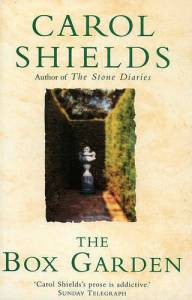 The companion novel to Small Ceremonies is narrated by Judith’s sister Charleen, a poet and single mother who lives in Vancouver and produces the National Botanical Journal. I imagined the sisters representing two facets of Shields, who had previously published poetry and a Moodie biography. Charleen is preparing to travel to Toronto for their 70-year-old mother’s wedding to Louis, an ex-priest. Via flashbacks and excruciating scenes at the family home, we learn how literally and emotionally stingy their mother has always been. If Charleen’s boyfriend Eugene’s motto is to always assume the best of people, her mother’s modus operandi is to assume she’s been hard done by.
The title comes from the time when a faithful Journal correspondent, the mysterious Brother Adam, sent Charleen some grass seed to grow in a window box – a symbol of thriving in spite of restrictive circumstances. I thought the plot went off in a silly direction, but loved the wedding reception. Specific links to Shields’s later work include a botanical hobby, a long train journey, and a final scene delivered entirely in dialogue.
A Celibate Season (1991)
“We’re suffering a communication gap, that’s obvious.”
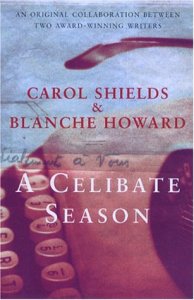 This epistolary novel was a collaboration: Blanche Howard wrote the letters by Jocelyn (“Jock”), who’s gone to Ottawa to be the legal counsel for a commission looking into women’s poverty, while Shields wrote the replies from her husband Charles (“Chas”), an underemployed architect who’s keeping the home fire burning back in Vancouver. He faces challenges large and small: their daughter’s first period versus meal planning (“Found the lentils. Now what?”). The household starts comically expanding to include a housekeeper, Chas’s mother-in-law, a troubled neighbor, and so on.
Both partners see how the other half lives. The misunderstandings between them become worse during their separation. Howard and Shields started writing in 1983, and the book does feel dated; they later threw in a jokey reference to the unreliability of e-mail to explain why the couple are sending letters and faxes. Two unsent letters reveal secrets Jock and Chas are keeping from each other, which felt like cheating. I remained unconvinced that so much could change in 10 months, and the weird nicknames were an issue for me. Plus, arguing about a solarium building project? Talk about First World problems! All the same, the letters are amusing.
Rereads
Happenstance (1980/1982)
 This was the first novel I read by Shields. My Penguin paperback gives the wife’s story first and then you flip it over to read the husband’s story. But the opposite reflects the actual publishing order: Happenstance is Jack’s story; two years later came Brenda’s story in A Fairly Conventional Woman. The obvious inheritor of the pair is A Celibate Season with the dual male/female narratives, and the setups are indeed similar: a man is left at home alone with his teenage kids, having to cope with chores and an unexpected houseguest.
What I remembered beforehand: The wife goes to a quilting conference; an image of a hotel corridor and elevator.
Happenstance
Jack, a museum curator in Chicago, is writing a book about “Indian” trading practices (this isn’t the word we’d use nowadays, but the terminology ends up being important to the plot). He and his best friend Bernie, who’s going through a separation, are obsessed with questions of history: what gets written down, and what it means to have a sense of the past (or not). I loved all the little threads, like Jack’s father’s obsession with self-help books, memories of Brenda’s vivacious single mother, and their neighbor’s failure as Hamlet in a local production. I also enjoyed an epic trek in the snow in a final section potentially modeled on Ulysses.
A Fairly Conventional Woman
“Aside from quiltmaking, pleasantness was her one talent. … She had come to this awkward age, forty, at an awkward time in history – too soon to be one of the new women, whatever that meant, and too late to be an old-style woman.”
Brenda is in Philadelphia for a quilting conference. Quilting, once just a hobby, is now part of a modern art movement and she earns prizes and hundreds of dollars for her pieces. The hotel is overbooked, overlapping with an International Society of Metallurgists gathering, and both she and Barry from Vancouver, an attractive metallurgist in a pinstriped suit whom she meets in the elevator, are driven from their shared rooms by roommates bringing back one-night stands. This doesn’t add anything to the picture of a marriage in Jack’s story and I only skimmed it this time. It’s a wonder I kept reading Shields after this, but I’m so glad I did! 
I reviewed these last two earlier this year. They were previously my joint favorites of Shields’s work, linked by a gardening hobby, the role of chance, and the unreliability of history and (auto)biography. They remain in my top three.
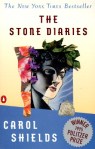 The Stone Diaries (1995)
What I remembered beforehand: a long train ride, a friend who by the feeling ‘down there’ thought that someone had had sex with her the night before, and something about the Orkney Islands.
 Larry’s Party (1997)
What I remembered beforehand: a food poisoning incident (though I’d thought it was in one of Shields’s short stories), a climactic event involving a garden maze, a chapter entitled “Larry’s Penis,” and the closing dinner party scene.

Looking back: Fortunately, in the last 15 years I’ve done something to redress my ignorance, discovering Canadian women writers whom I admire greatly: Elizabeth Hay, Margaret Laurence, Mary Lawson and especially Margaret Atwood and Carol Shields.
Looking out: “I am watching. My own life will never be enough for me. It is a congenital condition, my only, only disease in an otherwise lucky life. I am a watcher, an outsider whether I like it or not, and I’m stuck with the dangers that go along with it. And the rewards.”
- That’s Judith on the last page of Small Ceremonies. It’s also probably Shields. And, to an extent, it seems like me. A writer, but mostly a reader, absorbing other lives.
Looking forward: I’m interested in rereading Shields’s short stories and Mary Swann (to be reissued by World Editions in 2021). And, though I’ve read 13 of her books now, there are still plenty of unread, lesser-known ones I’ll have to try to find secondhand one day. Her close attention to ordinary lives and relationships and the way we connect to the past makes her work essential.
 Bookish Beck = Rebecca Foster. American transplant to England. Freelance proofreader and book reviewer.
 Bookish Beck