Eleventh Blog Anniversary (& International Women’s Day)
Bookish Beck launched 11 years ago today. I find that hard to believe as I still feel like a newbie in the blogging world compared to veterans like Annabel, Kim, Laura, Liz and Simon; imposter syndrome (Imposter Foster!) strikes again. And yet I can’t really remember what it was like before I had a blog, nor can I imagine life without one.

Pratyya Ghosh, CC BY-SA 4.0 <https://creativecommons.org/licenses/by-sa/4.0>, via Wikimedia Commons
This is my 1594th post, which means I’m maintaining an average of 2.8 posts per week. I feel like I’m posting less often these days, with most of my reviews clumping around the end of a month as I scramble to report back on library reads and finish everything I’ve started towards particular challenges.
It’s also International Women’s Day, a coincidence I would have been unaware of when I started the blog. The Women’s Prize longlist is always announced at around this time of year, with the Carol Shields Prize longlist to follow on Tuesday. I’ve read three of the Women’s Prize nominees (Castillo, Hutchinson and King) and skimmed another (Choi). I’m currently reading Wendy Erskine’s The Benefactors, which is also just right for Reading Ireland Month.
To mark the day, I’ll reproduce my review of one of the best books I’ve read by a woman recently. It’s one of my early favourites for the year.
Brawler by Lauren Groff
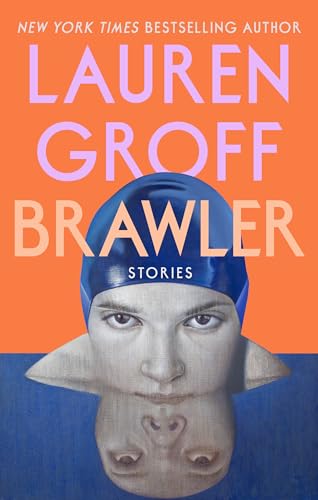 The nine short stories in Lauren Groff’s exceptional eighth book profile women in states of desperation and probe legacies of loss and violence.
Most of the stories employ third-person narration and originally appeared in the New Yorker. Often, inherited trauma binds mothers and daughters. The title character is high school swimmer Sara, who shoplifts and fights in frustration at her mother’s incurable illness. In “Under the Wave,” set after a natural disaster, a woman adopts an orphan as a replacement for her dead child—despite their racial differences. The title of “The Wind” symbolizes women’s fear and rage after an attempted escape from an abusive patriarch. Accidental harm and imagery of the Madonna and Child link the three mother–daughter pairs in “Annunciation.”
Themes of midlife reinvention and latent queerness (cf. Matrix) recur. Bisexuality is a secret between a dying woman and her friend in “Birdie.” In “Between the Shadow and the Soul,” a woman finds new hobbies following early retirement. Although she flirts with her female gardening teacher, she realizes her desire is not to leave her husband but to “brush up against the dazzling future again.”
“Such Small Islands” is a startling Jamesian fable; “To Sunland” a 1950s Southern gothic black comedy that would do Flannery O’Connor proud; and the masterful “What’s the Time, Mr. Wolf?” a suspenseful, novella-length examination of privilege and obsession.
The prose is stellar and the endings breathtaking. Groff is a first-rate novelist, but her short stories are truly peerless.
(Reposted with permission from Shelf Awareness.)
Thanks to all who support my blog by reading and commenting. You’re stars!
Love Your Library, September 2025
Thanks, as always, to Eleanor for posting about her recent library reading! And thank you to Skai for joining in again.
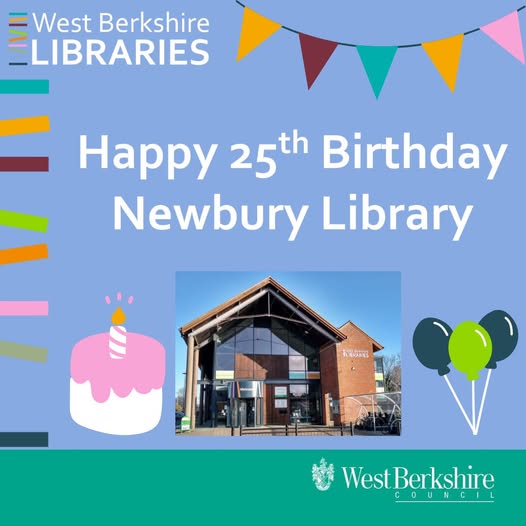
Somehow over the summer I forgot to mark two anniversaries: my library’s 25th birthday (July), and five years of me volunteering there (August). When I first started as a volunteer, Covid was still a raging unknown and the library was closed to the public. I shelved returns in an empty building. It was blissful, in all honesty. But I know it’s perverse to be nostalgic about the pandemic. I still enjoy my Tuesday morning sessions of hunting for reservations, even when it’s (too) busy and noisy during the school holidays.
Early in the month, my husband and I went to an evening event at the library with Jasper Fforde. C is a fan, having read five of his novels, whereas I read The Eyre Affair during graduate school and found it silly – in the same way I can’t really get on with Douglas Adams or Terry Pratchett. But with tickets just £5, I thought why not go and support the library.
Fforde considers himself an “accidental author” for two reasons: one, he was seen as a stupid child who would never achieve anything – his dyslexia wasn’t diagnosed until he was in his fifties; and two, he wanted to work on films, and indeed did for a time. In 1988 he sat down to write a short story treatment of his intended film script and fell in love with the process of writing. He described it as being like a jigsaw where the words just fell into place. Thirteen years of hard work later, he made the New York Times bestseller list.
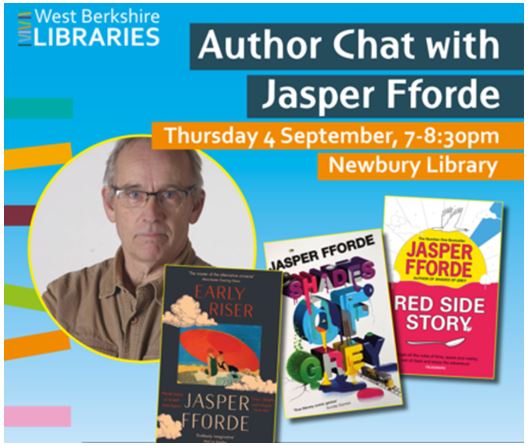
I didn’t realize that Fforde has lived fairly locally and set novels in Reading and Swindon – comic in itself because these are very unlovely towns. His first two series, nursery rhyme crime novels and the Thursday Next books (the eighth and last, Dark Reading Matter, is due out in September 2026), were about “moving the furniture around in people’s heads,” taking existing classic stories and twisting them. When he tried making things up, as with the Shades of Grey and Red Side Story duology and The Last Dragonslayer children’s books, the results were not as commercially successful. During the question time he reflected on the irony of his book getting confused with the blockbuster Fifty Shades of Grey. He joked that some probably bought his book by mistake and then wondered where the bondage was.
The evening was a conversation with the library staff member who seems to organise all the events. She asked him a lot of questions about his process. He listed a few tenets he lives by: “the narrative dare” (come up with a random idea and then figure out how to pull it off), “the path less-trodden,” and “the no-plan plan” (he makes it up as he goes along). His mind works like a drift net, he said, saving bits and pieces up to use another time, such as snippets of conversation overheard on a bus. For instance, “Oh my goodness, they’ve trodden on the gibbon!” and “They say haddock is making a comeback.” He also leaves himself “off-ramps” he can take up later if he ends up writing a sequel.
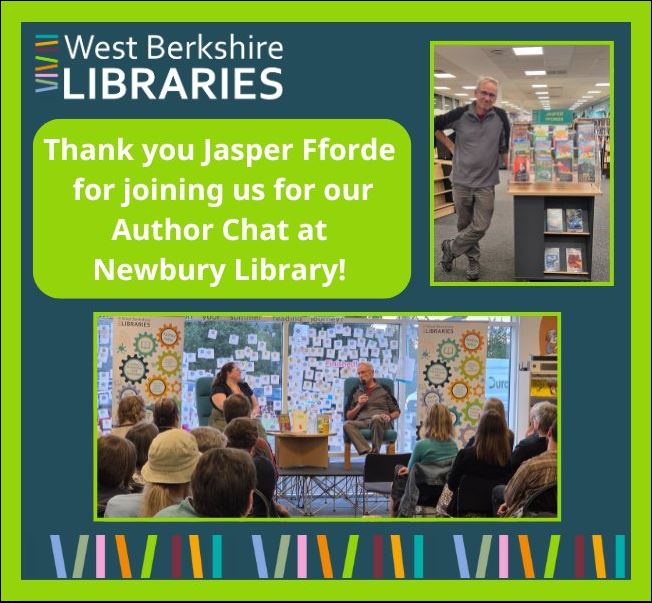
(C is at the bottom right of the second photo.)
Fforde was very personable and self-deprecating and I got more out of the event than I might have expected to.
My library use over the last month:
(links are to books not already reviewed on the blog)
READ
- The Most by Jessica Anthony

- Sojourn by Amit Chaudhuri

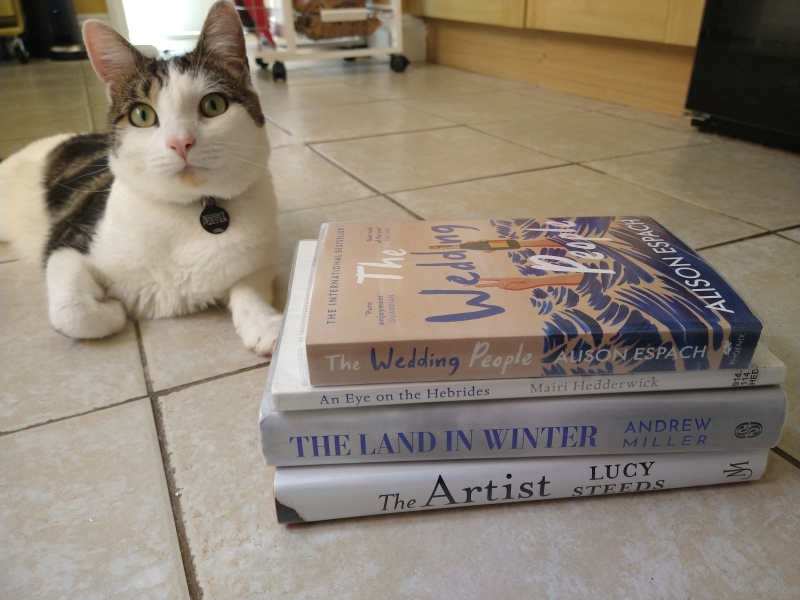
- The Wedding People by Alison Espach
- Of All that Ends, Günter Grass

- The Summer I Turned Pretty by Jenny Han

- Seascraper by Benjamin Wood

SKIMMED
- Wild City by Ben Hoare
- The Land in Winter by Andrew Miller – The chilly writing and atmosphere suit the subject matter, but didn’t draw me in or make me care about the central characters.
- Cuddy by Benjamin Myers (for book club)
CURRENTLY READING
- Kairos by Jenny Erpenbeck
- Of Thorn & Briar: A Year with the West Country Hedgelayer by Paul Lamb
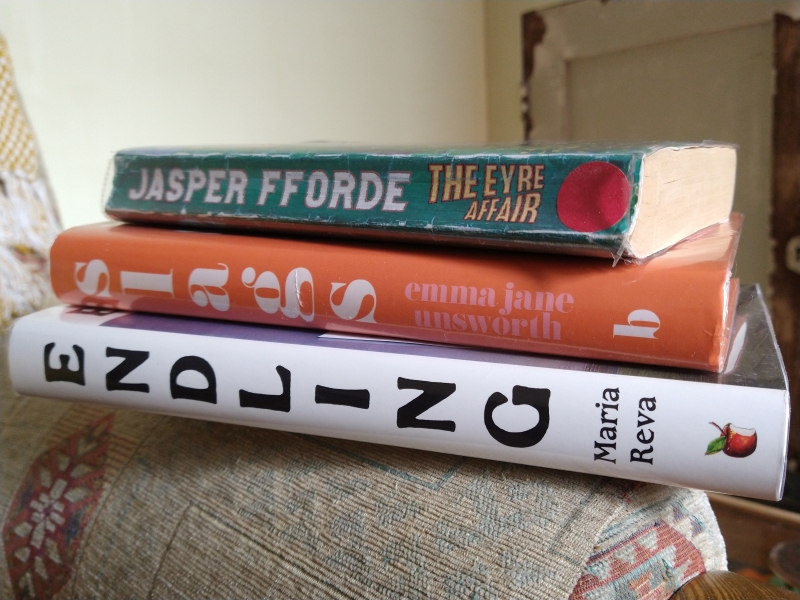
- Endling by Maria Reva
CHECKED OUT, TO BE READ
- The Penelopiad by Margaret Atwood (for book club)
- Red Pockets: An Offering by Alice Mah
- Death in Venice and Other Stories by Thomas Mann
- Opt Out by Carolina Setterwall
- Slags by Emma Jane Unsworth
ON HOLD, TO BE COLLECTED
- The Two Roberts by Damian Barr
- All the Way to the River by Elizabeth Gilbert
- The Haunted Wood: A History of Childhood Reading by Sam Leith
- Buckeye by Patrick Ryan
- A Long Winter by Colm Tóibín
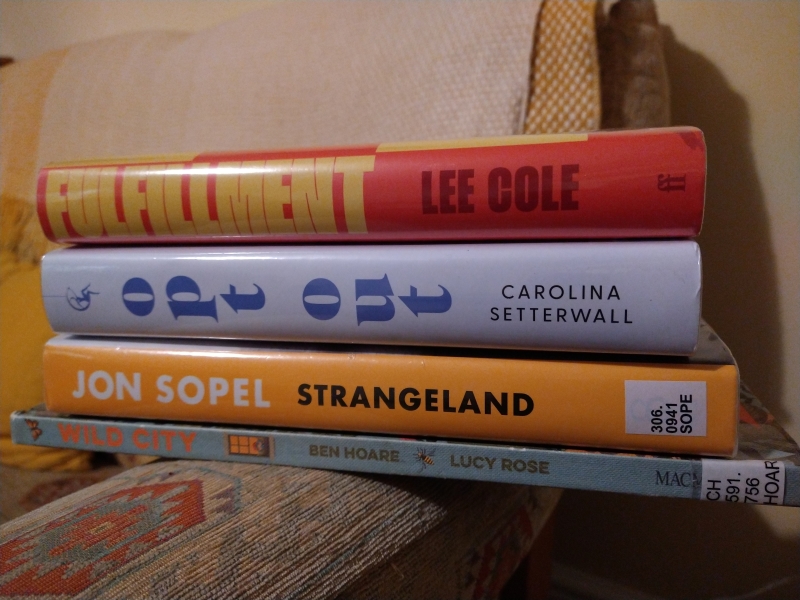
C will read the Sopel for book club, but I have to miss that meeting for a Repair Cafe committee meeting.
IN THE RESERVATION QUEUE
- New Cemetery by Simon Armitage
- Book of Lives: A Memoir of Sorts by Margaret Atwood
- It’s Not a Bloody Trend: Understanding Life as an ADHD Adult by Kat Brown
- Flashlight by Susan Choi
- The Perimenopause Survival Guide: A Feel-Like-Yourself-Again Roadmap for Every Woman over 35 by Heather Hirsch
- Queen Esther by John Irving
- The Matchbox Girl by Alice Jolly
- Heart the Lover by Lily King
- Misery by Stephen King
- The Rest of Our Lives by Benjamin Markovits
- What We Can Know by Ian McEwan
- The Eights by Joanna Miller
- Mexican Gothic by Silvia Moreno-Garcia
- Super-Frog Saves Tokyo by Haruki Murakami
- Rainforest by Michelle Paver
- Death of an Ordinary Man by Sarah Perry
- The Lamb by Lucy Rose
- Flesh by David Szalay
RETURNED UNREAD
- Fulfillment by Lee Cole – Argh, this keeps being requested off me!
- An Eye on the Hebrides by Mairi Hedderwick
- Love in Five Acts by Daniela Krien
- The Artist by Lucy Steeds
I missed the moment on the last three but may try another time.
- The Eyre Affair by Jasper Fforde – I thought about giving him another try after the event, but … no.
RETURNED UNFINISHED
- The Mermaid Chair by Sue Monk Kidd – I read about 45 pages. The setup was interesting but the narrative voice did not captivate.
- The Names by Florence Knapp – Ditto, but only 25 pages. The writing was just not very good.
What have you been reading or reviewing from the library recently?

Share a link to your own post in the comments. Feel free to use the above image. The hashtag is #LoveYourLibrary.
Get Ready for Novellas in November!
Novellas: “all killer, no filler”
~Joe Hill

Hard to believe, but it’s nearly that time again. Autumn is drawing in. For the SIXTH year in a row, Cathy of 746 Books and I are co-hosting Novellas in November as a month-long blogging and social media challenge celebrating the art of the short book. A novella technically contains 20,000 to 40,000 words, but to keep things simple we will define it as any work of under 200 pages.
This year we have two buddy reads, a 2025 fiction release and an older work of nonfiction:
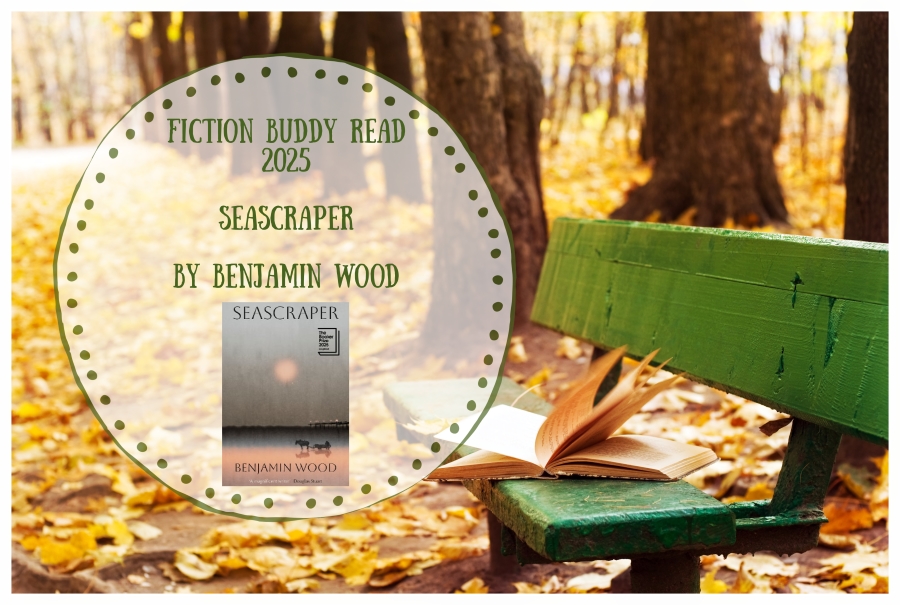
Seascraper by Benjamin Wood is set in the early 1960s and features a young man who lives with his mother in northwest England and carries on the family tradition of fishing for shrimp. He longs for a bigger and more creative life, which he hopes he might achieve through his folk music hobby – or his chance encounter with an American filmmaker. On one pivotal day, his fortunes might just change. Check out this interview with Wood to whet your appetite. Last year our buddy read, Orbital, won the Booker Prize, auguring good things for novellas in the public sphere. Seascraper is on the longlist! In this Q&A on the Booker Prize website, Wood talks about the unusual situation in which he wrote it. (160 pages)

Sister Outsider by Audre Lorde is a 1984 collection of short pieces by the late Black lesbian feminist. I’ve only read Lorde’s The Cancer Journals, so I’m looking forward to this. From the Penguin website: “The revolutionary writings of Audre Lorde gave voice to those ‘outside the circle of this society’s definition of acceptable women’. Uncompromising, angry and yet full of hope, this collection of her essential prose – essays, speeches, letters, interviews – explores race, sexuality, poetry, friendship, the erotic and the need for female solidarity, and includes her landmark piece ‘The Master’s Tools Will Never Dismantle the Master’s House’.” A great opportunity to tie into Nonfiction November. (190 pages)
Please join us in reading one or both books any time between now and the end of November!
You might like to start off the month with a My Year in Novellas retrospective looking at any novellas you have read since last year’s NovNov, and then finish with a New to My TBR list based on what short books others have tempted you with.
It’s always a busy month in the blogging world with Nonfiction November, German Literature Month, Margaret Atwood Reading Month and SciFi Month. Why not search your shelves and/or local library for novellas that could count towards multiple challenges?
From early October a link-up post will be pinned to my site so you can add your planning posts or reviews. Keep in touch via Bluesky (@bookishbeck.bsky.social / @cathybrown746.bsky.social) and Instagram (@bookishbeck / @cathy_746books) and feel free to use the terrific feature images Cathy has made plus our new hashtag, #NovNov25.
The 2025 McKitterick Prize Winner & SoA Awards Ceremony
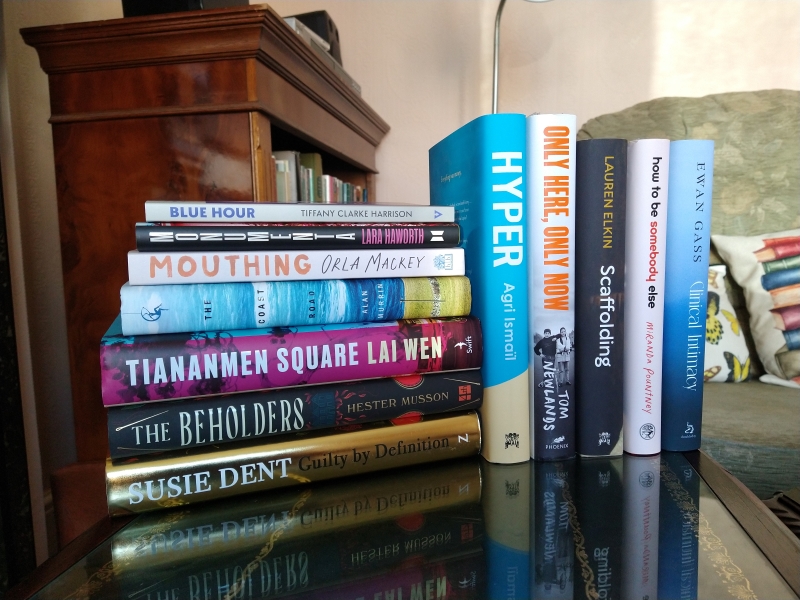
Yesterday the Society of Authors’ awards were announced and the prizes handed out at a ceremony in London. As a McKitterick Prize judge, I was asked last month to give a 50-word blurb on the shortlist as a whole—
Each of these six novels has a fully realized style. So confident and inviting are they that it’s hard to believe they are debuts. With nuanced characters and authentic settings and dilemmas, they engage the mind and delight the emotions. I will be following these authors’ careers with keen interest.
—and on each individual shortlisted title:
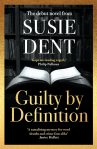 Etymology and Shakespeare studies are the keys to solving a cold case in Susie Dent’s clever, engrossing mystery, Guilty by Definition.
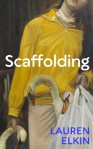 Psychoanalysis, motherhood, and violence against women are resounding themes in Lauren Elkin’s Scaffolding. As history repeats itself one sweltering Paris summer, the personal and political structures undergirding the protagonists’ parallel lives come into question. This fearless, sophisticated work ponders what to salvage from the past—and what to tear down.
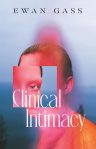 Clinical Intimacy’s mysterious antihero comes to life through interviews with his family, friends and clients. The brilliant oral history format builds a picture of isolation among vulnerable populations, only alleviated by care and touch—especially during Covid-19. Ewan Gass’s intricate story reminds us of the ultimate unknowability of other people.
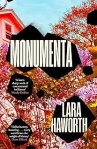
In Monumenta, Lara Haworth braids satire, magic realism, and metafiction into a compact and surprising meditation on how we seek to memorialise the tragedies of history.
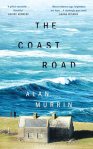
Set in small-town Ireland, The Coast Road is a subtle, compassionate novel in which the characters learn to write their own stories rather than bow to convention and fate. Alan Murrin is a must-read author for fans of Claire Keegan, Louise Kennedy, and Colm Tóibín.
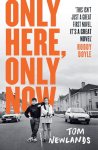 Only Here, Only Now is bursting with vitality. With her broken heart and fizzing brain, Cora Mowat vows to escape her grim Fife town. Tom Newlands’s evocation of the 1990s—and of his teenage narrator—is utterly convincing. Soaring above grief, poverty, and substance abuse, Cora’s voice is pure magic.
Our winner was Tom Newlands for Only Here, Only Now and our runner-up was Lauren Elkin for Scaffolding. (What an honour to have my blurb for the former used in the winners press release, the ceremony programme, and social media publicity.)


Newlands was also a runner-up for the ADCI Literary Prize “for a disabled or chronically ill writer, for an outstanding novel containing a disabled or chronically ill character or characters.” Here’s an excerpt from his statement for the press release:
To have my debut novel recognised in these two categories is particularly meaningful for me because they are linked by my experience. I didn’t start writing until the age of 40, in large part because growing up neurodivergent I didn’t feel my thought processes or methods of working were compatible with the production of a novel. There were no role models out there publishing stories like mine, and in the end, I wrote Only Here, Only Now because I couldn’t find the novel I wanted to read – a warm, vivid and funny story that examined poverty, disability and belonging, and that featured characters rarely found in British fiction.
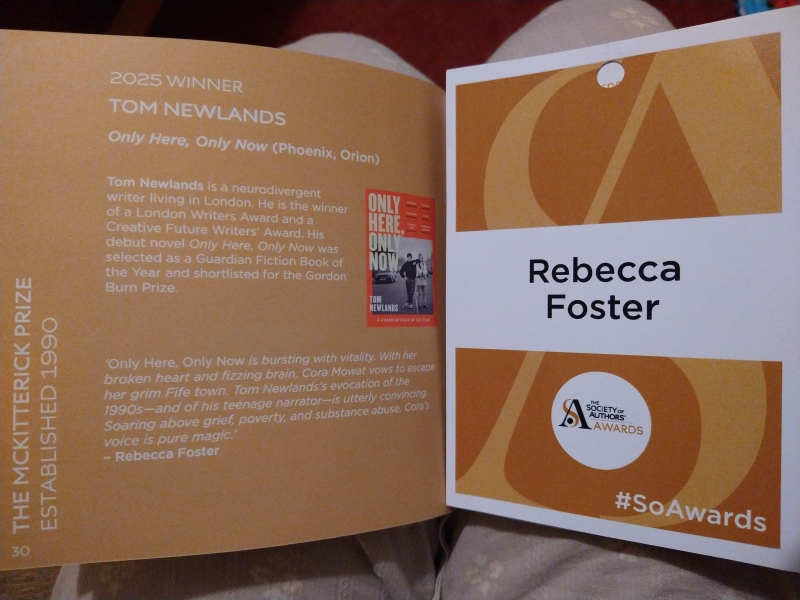
Looking back to early on in this prize journey (which started back in November) … here was some of my early reading:
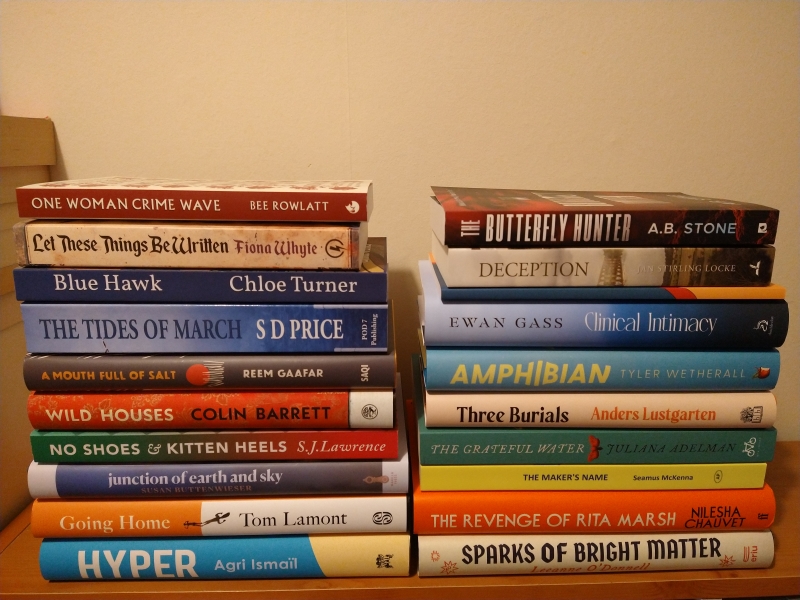
And our longlist:
A couple of my favourite books from my reading that didn’t make the shortlist were:
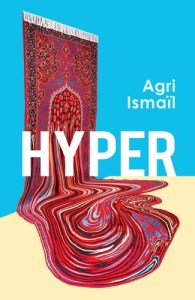 Hyper by Agri Ismaïl [I longlisted it – and then shortlisted it – but was outvoted]
Following a Kurdish family across several decades, this is a zeitgeist-y story that examines questions of national and personal autonomy. With its Dubai, Baghdad, London, and New York settings, it sets the second generation’s luxury, high finance, and fully online worlds against their parents’ bitter experience of exile after a failed independence movement. With its themes of dysfunction and failures and the long view of how we got here from there, it reminded me of Jonathan Franzen’s body of work.
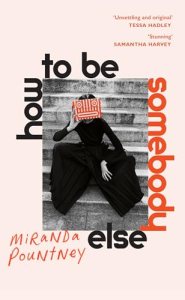 How to Be Somebody Else by Miranda Pountney [It had two votes to make the shortlist, but because it was so similar to Scaffolding in its basics (a thirtysomething woman in a big city, the question of motherhood, and pregnancy loss) we decided to cut it.]
This is the addictively readable story of Dylan, a late-thirties English woman who gives up her New York City advertising job and ponders authorship and motherhood while house-sitting an acquaintance’s apartment—and carrying on an affair with the married downstairs neighbour. As we see her interact with family and friends, we come to appreciate her not as some stereotypical ‘sad girl’ or ‘disaster woman’, but as an Everywoman seeking the time and space to become herself. It’s a sharp and witty novel for fans of Sally Rooney.
For the first time, I got to attend the SoA Awards ceremony in person yesterday. It was a hot day to be travelling in London, and after the oven of the Bakerloo line I was grateful to escape into the cool of Southwark Cathedral and its grounds. It was such a juxtaposition between the sleek City architecture and the ancient refuge of a church.
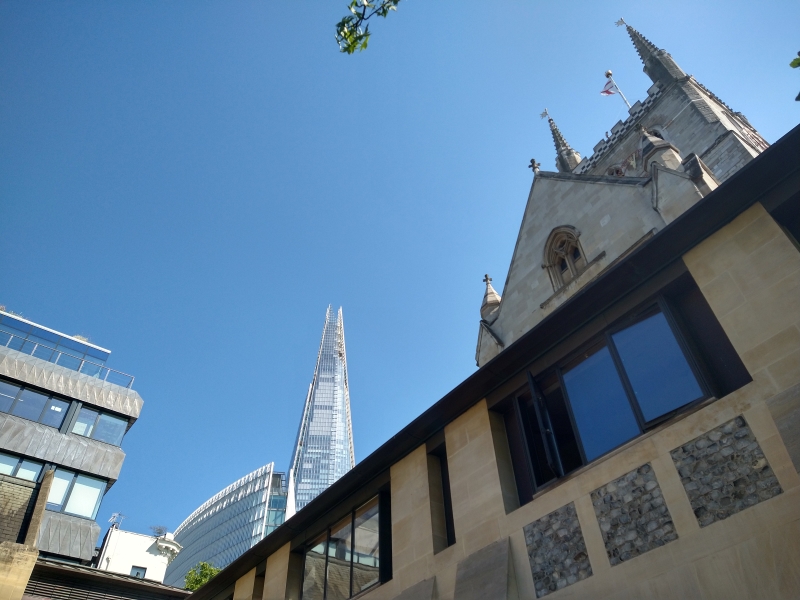
I worried that on such a warm and then busy day Hodge the cathedral cat wouldn’t show himself, but as I picked up my name badge he was asking to be let inside from the courtyard. He didn’t seem interested in strokes so I followed him at a respectful distance and let him settle in for a watchful rest.


Nominated authors and judges were treated to an exceptional afternoon tea, followed by the ceremony and drinks reception. It was lovely to meet my fellow judges Anietie Isong and Kathy O’Shaughnessy (author of the fantastic In Love with George Eliot, which won the SoA’s Paul Torday Memorial Prize) in the flesh as I’d only met them on Zoom before. We chatted a good bit with Lara Haworth, one of our shortlistees, and with Anne Booth, one of the Queen’s Knickers Award (children’s books) nominees, and also got to briefly meet Tom Newlands when he arrived for the ceremony. I always look out for literary ‘celebrities’ at such events and yesterday spotted Naomi Alderman, Caroline Bird, Joanne Harris and Alice Jolly.
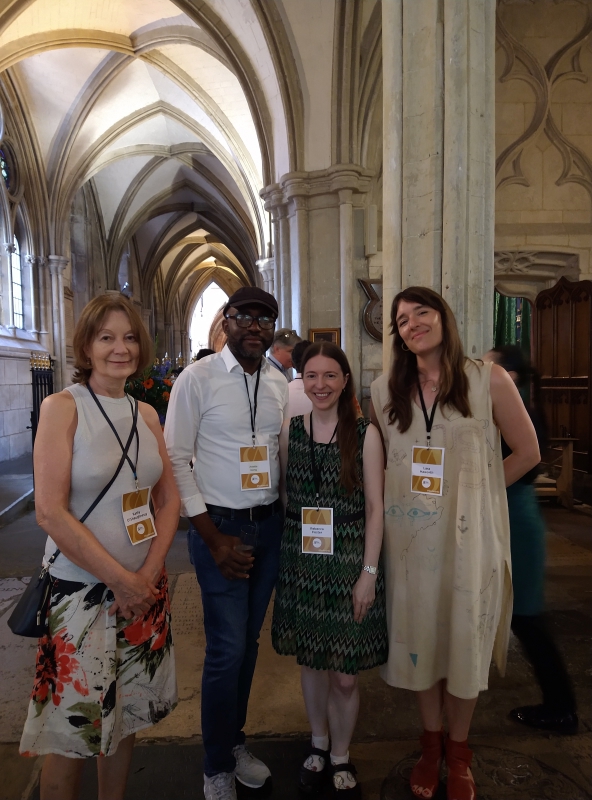


Dean Rev. Mark Oakley gave a welcome address via video, praising authors for bringing “resonance” rather than just “relevance.” He exhorted us, in the words of David Copperfield, to “read as if for life.” Joseph Coelho then gave a terrific keynote speech celebrating words written by humans (as opposed to an inaccurate AI-written bio of himself that he once encountered) and encouraging shortlistees, especially, to take time to bask in their achievement. Rejection is an ongoing, annual thing for him even at this stage of his career – he still remembers the £50 poetry gigs, changing in library toilets and school staff rooms; and the 12 years he spent trying to get published – even after he became the youngest-ever children’s laureate in 2022. “Wait for no one,” he challenged us: no one is going to give you permission or come save you, so go out there and do what you’re meant to do.
What an all-round fantastic experience this was! I’m so grateful to the Society of Authors for the opportunity.
Other notable winners announced yesterday included:
- Ashani Lewis (the only double winner): the Betty Trask Prize and Somerset Maugham award for Winter Animals
- Hisham Matar & Elif Shafak: the Gordon Bowker Volcano Prize (for a novel focusing on the experience of travel away from home), joint winners for My Friends and There Are Rivers in the Sky
Novellas in November Possibility Piles! (#NovNov24)
Less than two weeks to go now until Novellas in November (#NovNov24) begins! Cathy and I are getting geared up and making plans for what we’re going to read. As I mentioned in my announcement post, this year it’s my challenge to self to read mostly books of 150 pages or under. I gathered all my potential reads at home and in the library for photo shoots. Although we’re not having the below as themes this year, I’ve grouped my options in rough categories:
Short Classics (pre-1980)
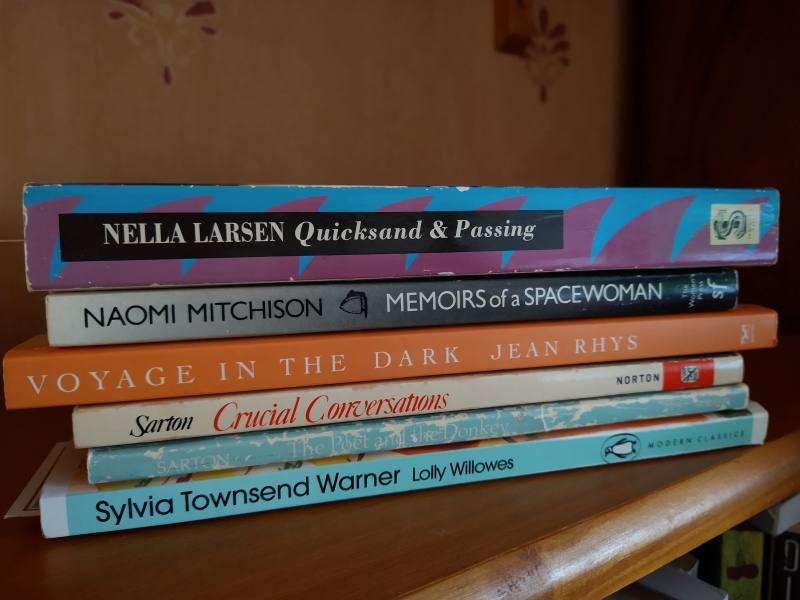
*Memoirs of a Spacewoman would do double duty for SciFi Month. I have already read Passing, so would just be reading Quicksand from the Nella Larsen omnibus.
Novellas in Translation
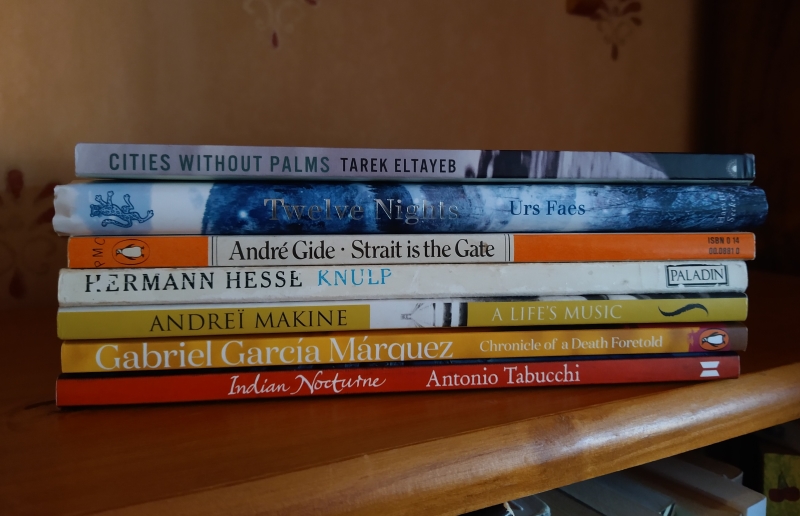
*Knulp, from the Little Free Library, would do double duty for German Literature Month.
Contemporary Novellas
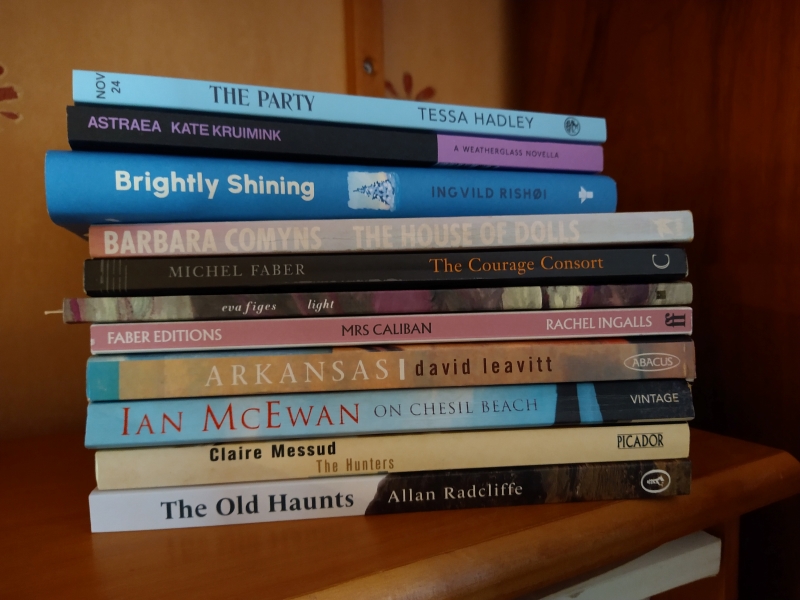
(With three review copies perched on the top.)
Library Haul


I can’t wait to get started on our buddy read, Orbital by Samantha Harvey!
Short Nonfiction
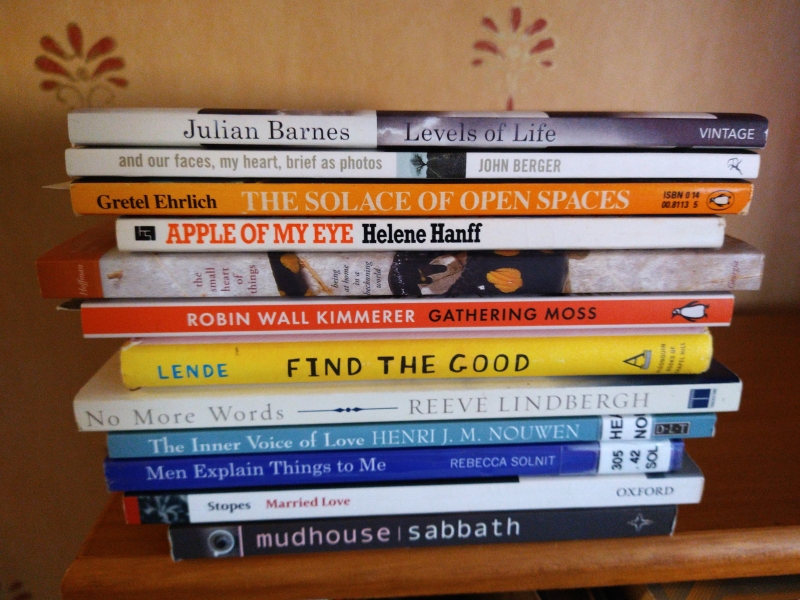
(And the right-hand Library Haul photo above.) On Wednesday I’ll post some ideas for how to link Novellas in November with Nonfiction November – there are various great series that only publish short nonfiction.
In 2021–2023, I read 29, 24 and 27 novellas, respectively. I wonder how many I’ll manage this year… Maybe I’ll aim for 30+, or an average of 1+ per day!
Spy any favourites or a particularly appealing title in my piles? Give me a recommendation for what I should be sure to try to get to.
The link-up is now open for you to share your planning posts!
Thanks to Cathy of What Cathy Read Next for starting us off.

Have any novellas lined up to read next month?
Eve Smith Event & Absurd Person Singular
Two literary events I attended recently…
On Friday afternoon I volunteered on stewarding and refreshments for an author chat held at my local public library. It was our first such event since before Covid! I’d not heard of Eve Smith, who is based outside Oxford and writes speculative – not exactly dystopian, despite the related display below – novels inspired by scientific and medical advancements encountered in the headlines. Genetics, in particular, has been a recurring topic in The Waiting Rooms (about antibiotic resistance), Off Target (gene editing of embryos), One (a one-child policy introduced in climate-ravaged future Britain) and The Cure (forthcoming in April 2025; transhumanism or extreme anti-ageing measures).


Smith used to work for an environmental organization and said that she likes to write about what scares her – which tends not to be outlandish horror but tweaked real-life situations. Margaret Atwood has been a big influence on her, and she often includes mother–daughter relationships. In the middle of the interview, she read from the opening of her latest novel, One. I reckon I’ll give her debut, The Waiting Rooms, a try. (I was interested to note that the library has classed it under Science Fiction but her other two novels with General Fiction.)
Then last night we went to see my husband’s oldest friend (since age four!) in his community theatre group’s production of Absurd Person Singular, a 1972 play by Alan Ayckbourn. I’ve seen and read The Norman Conquests trilogy plus another Ayckbourn play and was prepared for a suburban British farce, but perhaps not for how dated it would feel.
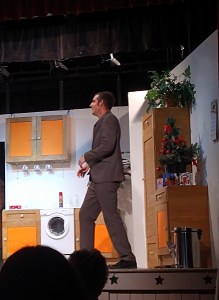 The small cast consists of three married couples. Ronald Brewster-Wright is a banker with an alcoholic wife, Marion. Sidney Hopcroft (wife: Jane) is a construction contractor and rising property tycoon and Geoffrey Jackson is a philandering architect with a mentally ill wife, Eva. Weaving all through is the prospect of a business connection between the three men: “you scratch my back, I’ll scratch yours,” as Sidney puts it to Ronald several times. After one of Geoffrey’s buildings suffers a disastrous collapse, he has to consider humbling himself enough to ask Sidney for work.
The three acts take place in each of their kitchens on subsequent Christmas Eves; the period kitchen fittings and festive decorations were a definite highlight. First, the Hopcrofts stress out over hosting the perfect cocktail party – which takes place off stage, with characters retreating in twos and threes to debrief in the kitchen. The next year, the jilted Eva makes multiple unsuccessful suicide attempts while her oblivious friends engage in cleaning and DIY. Finally, we’re at the Brewster-Wrights’ and the annoyingly cheerful Hopcrofts cajole the others, who aren’t in the Christmas spirit at all, into playing a silly musical chairs-like game.


With failure, adultery, alcoholism and suicidal ideation as strong themes, this was certainly a black comedy. Our friend Dave decided not to let his kids (10 and 7) come see it. He was brilliant as Sidney, not least because he genuinely is a DIY genius and has history of engaging people in dancing. But the mansplaining, criticism of his poor wife, and “Oh dear, oh dear” exclamations were pure Sidney. The other star of the show was Marion. Although the actress was probably several decades older than Ayckbourn’s intended thirtysomething characters, she brought Norma Desmond-style gravitas to the role. But it did mean that a pregnancy joke in relation to her and the reference to their young sons – the Brewster-Wrights are the only couple with children – felt off.
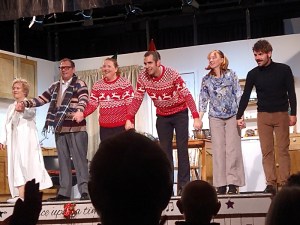 The director chose to give a mild content warning, printed in the program and spoken before the start: “Please be aware that this play was written in the 1970s and reflects the language and social attitudes of its time and includes themes of unsuccessful suicide attempts.” So the play was produced as is, complete with Marion’s quip about the cycles on Jane’s new washing machine: “Whites and Coloreds? It’s like apartheid!” The depiction of mental illness felt insensitive, although I like morbid comedy as much as the next person.
I can see why the small cast, silliness, and pre-Christmas domestic setting were tempting for amateur dramatics. There was good use of sound effects and the off-stage space, and a fun running gag about people getting soaked. I certainly grasped the message about not ignoring problems in hopes they’ll go away. But with so many plays out there, maybe this one could be retired?
Richard Rohr at Greenbelt Festival (Online) & The Naked Now Review
Back in late August, I attended another online talk that really chimed with the one by Richard Holloway, this time as part of Greenbelt Festival, a progressive Christian event we used to attend annually but haven’t been to in many years now.
Not just as a Covid holdover but also in a conscious sustainability effort, Greenbelt hosted a “fly-free zone” where overseas speakers appeared on a large screen instead of travelling thousands of miles. So Richard Rohr, who appeared old and frail to me – no wonder, as he is now 81 and has survived five unrelated cancers (doctors literally want to do a genetic study on him) – appeared from the communal lounge of his Center for Action and Contemplation in New Mexico to introduce his upcoming book The Tears of Things, due in March 2025. The title is from the same Virgil quote as Holloway’s The Heart of Things. It’s about the Old Testament prophets’ shift from rage to lamentation to doxology (“the great nevertheless,” he called it): a psychological journey we all must make as part of becoming spiritually mature.
From reading his Falling Upward, I was familiar with Rohr’s central teaching of life being in two halves: the first, ego-led, is about identity and argumentation; the second is about transcending the self to tap into a universal consciousness. “It’s a terrible burden to carry your own judgementalism,” he declared. A God encounter provokes the transformation, and generally it comes through suffering, he said; you can’t take a shortcut. Anger is a mark of “incomplete” prophets such as John the Baptist, he explained. Rage might seem to empower, but it’s unrefined and only gives people permission to be nasty to others, he said. We can’t preach about a wrathful God or we will just produce wrathful people, he insisted; instead, we have to teach mercy.
When Rohr used to run rites of passage for young men, he would tell them that they weren’t actually angry, they were sad. There are tears that come from God, he said: for Gaza, for Ukraine. We know that Jesus wept at least twice, as recorded in scripture: once for Jerusalem (the collective) and once for his dead friend Lazarus (the individual). Doing the “grief work” is essential, he said. A parallel to that anger to sadness to praise trajectory is order to disorder to reorder, a paradigm he takes from the Bible’s wisdom literature. Brian McLaren’s recent work is heavily influenced by these ideas, too.
During the question time, Rohr was drawn out on the difference between Buddhism and Christianity (the latter gives reality a personal and benevolent face, he said) and how he understands hope – it is participation in the life of God, he said, and it certainly doesn’t come from looking at the data. He lauded Buddhism for its insistence on non-dualism or unitive consciousness, which he also interprets as the “mind of Christ.” The love of God is the Absolute, he said, and although he has experienced it throughout his life, he has known it especially when (as now) he was weak and poor.
Non-dualism is the theme that led me to go back to a book that had been on my bedside table, partly read, for months.
The Naked Now: Learning to See as the Mystics See (2009)
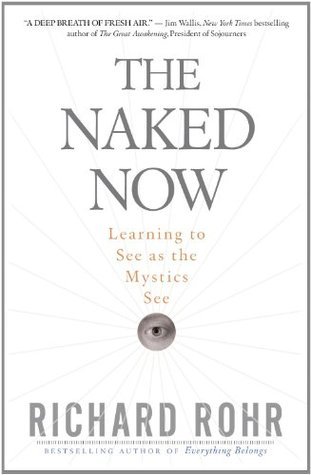 This was my fourth book by Rohr, and as with The Universal Christ, I feel at a loss trying to express how wise and earth-shaking it is. The kernel of the argument is simple. Dualistic thinking is all or nothing, us and them. The mystical view of life involves nonduality; not knowing the right things but “knowing better” through contemplation. It’s an opening of the heart that then allows for a change of mind. And yes, as he said at Greenbelt, it mostly comes about through great suffering – or great love. Jesus embodies nonduality by being not human or divine, but both, as does God through the multiplicity of the Trinity.
The book completely upends the fundamentalist Christianity I grew up with. Its every precept is based on Bible quotes or Christian tradition. It’s only 160 pages long, very logical and readable; I only went through it so slowly because I had to mark out and reread brilliant passages every few pages.
You can tell adult and authentic faith by people’s ability to deal with darkness, failure, and nonvalidation of the ego—and by their quiet but confident joy!
[I’ve met people who are like this.]
If your religious practice is nothing more than to remain sincerely open to the ongoing challenges of life and love, you will find God — and also yourself.
[This reminded me of “God is change,” the doctrine in Parable of the Sower by Octavia E. Butler.]
If you can handle/ignore a bit of religion, I would recommend Rohr to readers of Brené Brown, Susan Cain (thinking of Bittersweet in particular) and Anne Lamott, among other self-help and spirituality authors – e.g., he references Eckhart Tolle. Rohr is also known for being one of the popularizers of the Enneagram, a personality tool similar to the Myers-Briggs test but which in its earliest form dates back to the Desert Father Evagrius Ponticus. 
Three on a Theme: Trans Poetry for National Poetry Day
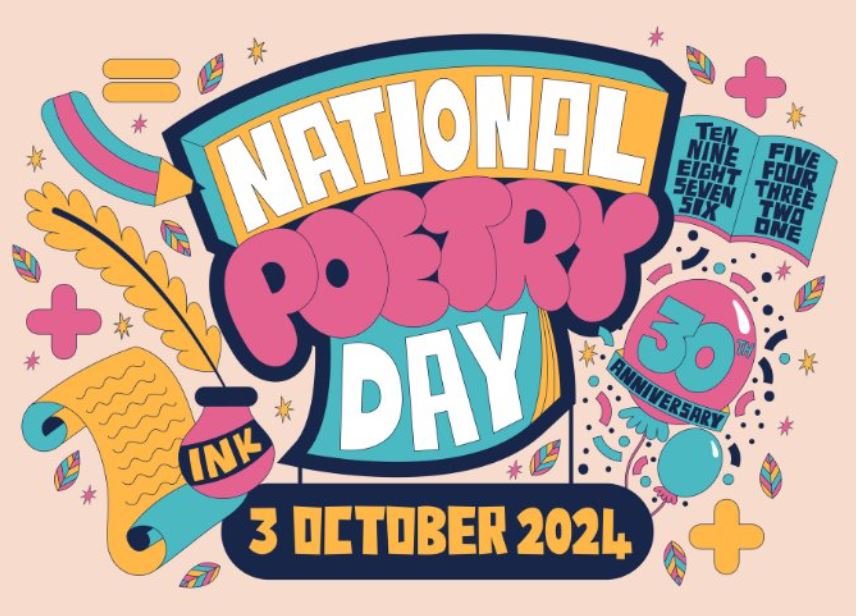
Today is National Poetry Day here in the UK. Alfie and I spent part of the chilly early morning reading from Pádraig Ó Tuama’s super Poetry Unbound, an anthology of 50 poems to which he’s devoted personal introductions and exploratory essays. He describes poetry as “like a flame: helping us find our way, keeping us warm.”

Poetry Unbound is also the name of his popular podcast; both were recommended to me by Sara Beth West, my fellow Shelf Awareness reviewer, in this interview we collaborated on back in April (National Poetry Month in the USA) about reading and reviewing poetry. I’ve been a keen reader of contemporary poetry for 15 years or so, but in the 3.5 years that I’ve been writing for Shelf I’ve really ramped up. Most months, I review a couple poetry collections for that site, and another one or more on here.
Two of my Shelf poetry reviews from the past 10 months highlight the trans experience; when I recently happened to read another collection by a trans woman, I decided to gather them together as a trio. All three pair the personal – a wrestling over identity – with the political, voicing protest at mistreatment.
Transitory by Subhaga Crystal Bacon (2023)
In her Isabella Gardner Award-winning fourth collection, queer poet Subhaga Crystal Bacon commemorates the 46 trans and gender-nonconforming people murdered in the United States and Puerto Rico in 2020—an “epidemic of violence” that coincided with the Covid-19 pandemic.
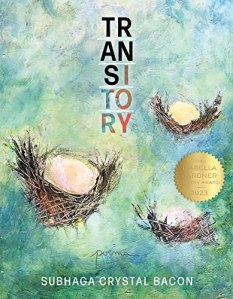 The book arose from a workshop Bacon attended on writing “formal poems of social protest.” Among the forms employed here are acrostics and erasures performed on news articles—ironically appropriate for reversing trans erasure. She devotes one elegy to each hate-crime victim, titling it with their name and age as well as the location and date of the killing, and sifting through key details of their life and death. Often, trans people are misgendered or deadnamed in prison, by ambulance staff, or after death, so a crucial element of the tributes is remembering them all by chosen name and gender.
The statistics Bacon conveys are heartbreaking: “The average life expectancy of a Black trans woman is 35 years of age”; “Half of Black trans women spend time in jail”; “Trans people are anywhere/ between eleven and forty percent/ of the homeless population.” She also draws on her own experience of gender nonconformity: “A little butch./ A little femme.” She recalls of visiting drag bars in the 1980s: “We were all/ trying on gender.” And she vows: “No one can say a life is not right./ I have room for you in me.” Her poetic memorial is a valuable exercise in empathy.
Published by BOA Editions. Reprinted with permission from Shelf Awareness.
I was interested to note that the below poets initially published under both female and male, new and dead names, as shown on the book covers. However, a look at social media makes it clear that the trans women are now going exclusively by female names.
I Don’t Want to Be Understood by Jennifer Espinoza (2024)
In Espinoza’s undaunted fourth poetry collection, transgender identity allows for reinvention but also entails fear of physical and legislative violence.
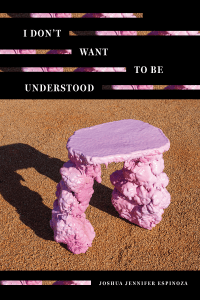 Two poems, both entitled “Airport Ritual,” articulate panic during a security pat-down on the way to visit family. In the first, a woman quells her apprehension by imagining a surreal outcome: her genitals expand infinitely, “tearing through her clothes and revealing an amorphous blob of cosmic energy.” In the second, the speaker chants the reassuring mantra, “I am not afraid.” “Makeup Ritual” vacillates between feminism and conformity; “I don’t even leave the house unless/ I’ve had time to build a world on my face/ and make myself palatable/ for public consumption.” Makeup is “your armor,” Espinoza writes in “You’re Going to Die Today,” as she describes the terror she feels toward the negative attention she receives when she walks her dog without wearing it. The murders of trans people lead the speaker to picture her own in “Game Animal.” Violence can be less literal and more insidious, but just as harmful, as in a reference to “the day the government announced another plan to strip a few/ more basic rights from trans people.”
Words build into stanzas, prose paragraphs, a zigzag line, or cross-hatching. Espinoza likens the body to a vessel for traumatic memories: “time is a body full of damage// that is constantly trying to forget.” Alliteration and repetition construct litanies of rejection but, ultimately, of hope: “When I call myself a woman I am praying.”
Published by Alice James Books. Reprinted with permission from Shelf Awareness.
Transgenesis by Ava Winter (2024)
“The body is holy / and is made holy in its changing.”
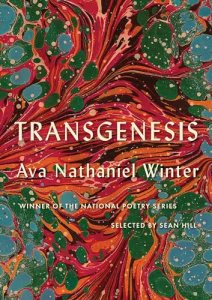 Winter’s debut full-length collection, selected by Sean Hill for the National Poetry Series, reckons with Jewishness as much as with gender identity. The second half of the title references any beginning, but specifically the scriptural account of creation and the lives of the matriarchs and patriarchs of the Abrahamic faiths. Poems are entitled “Torah Study” and “Midrash” (whence the above quote), and two extended sections, “Archived Light” and “Playing with the Jew,” reflect on Polish paternal family members’ arrival at Auschwitz and the dubious practice of selling Holocaust and Nazi memorabilia as antiques. Pharmaceuticals and fashion alike are tokens of transformation –
Let me greet now,
with warm embrace,
the small blue tablets
I place beneath my tongue each morning.
Oh estradiol,
daily reminder
of what our bodies
have always known:
the many forms of beauty that might be made
flesh by desire, by chance, by animal action.
(from “Transgenesis”)
The first time I wore a dress in public without a hint of irony—a Max Mara wrap adorned with Japanese lilies that framed my shoulders perfectly—I was still thin but also thickly bearded and men on the train whispered to me in a conspiratorial tone, as if they hoped the dress were a joke I might let them in on.
(from “WWII SS Wiking Division Badge, $55”)
– and faith grants affirmation that “there is beauty in such queer and fruitless bodies,” as the title poem insists, with reference to the saris (nonbinary person) acknowledged by the Talmudic rabbis. “Lament with Cello Accompaniment” provides an achingly gorgeous end to the collection:
I do not choose the sound of the song
In my mouth, the fading taste of what I still live through, but I choose this future, as I bury a name defined by grief, as I enter the silence where my voice will take shape.
Winter teaches English and Women’s and Gender Studies at the University of Nebraska–Lincoln. I’ll look out for more of her work.
Published by Milkweed Editions. (Read via Edelweiss)
More trans poetry I have read:
A Kingdom of Love & Eleanor Among the Saints by Rachel Mann
By nonbinary/gender-nonconforming poets, I have also read:
Surge by Jay Bernard
Like a Tree, Walking by Vahni Capildeo
Some Integrity by Padraig Regan
Don’t Call Us Dead by Danez Smith
Divisible by Itself and One by Kae Tempest
Binded by H Warren
Extra goodies for National Poetry Day:
Follow Brian Bilston to add a bit of joy to your feed.
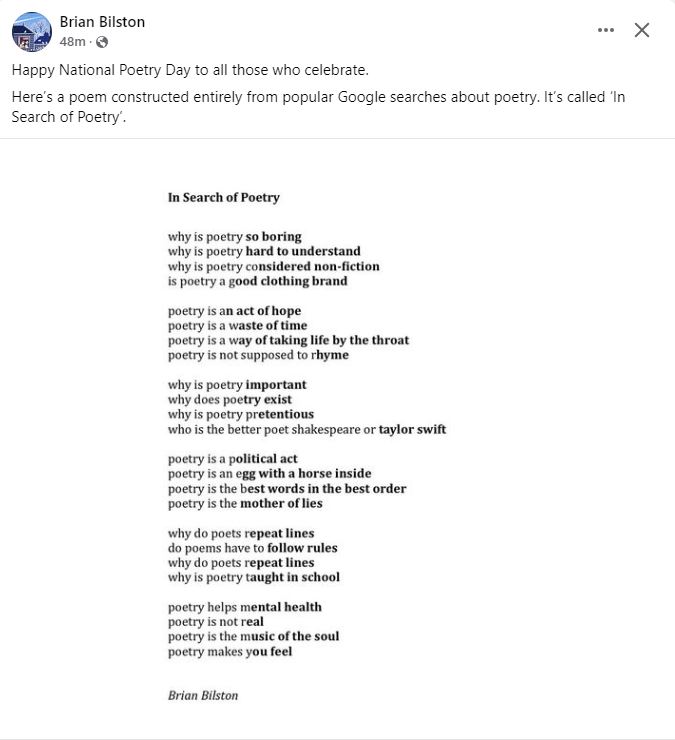
Editor Rosie Storey Hilton announces a poetry anthology Saraband are going to be releasing later this month, Green Verse: Poems for our Planet. I’ll hope to review it soon.
Two poems that have been taking the top of my head off recently (in Emily Dickinson’s phrasing), from Poetry Unbound (left) and Seamus Heaney’s Field Work:


Get Ready for Novellas in November!
Novellas: “all killer, no filler,” as Joe Hill said. Hard to believe, but it’s now the FIFTH year that Cathy of 746 Books and I have been co-hosting Novellas in November as a month-long blogger/social media challenge celebrating the art of the short book. A novella is a book of 20,000 to 40,000 words, but because that’s hard for a reader to gauge, we tend to say anything under 200 pages (even nonfiction). I’m going to make it a personal challenge to limit myself to books of ~150 pages or less.
We’re keeping it simple this year with just the one buddy read, Orbital by Samantha Harvey. (Though we chose it weeks ago, its shortlisting for the Booker Prize is all the more reason to read it!) The UK hardback has 144 pages. Here’s part of the blurb to entice you:
“Six astronauts rotate in their spacecraft above the earth. … Together they watch their silent blue planet, circling it sixteen times, spinning past continents and cycling through seasons, taking in glaciers and deserts, the peaks of mountains and the swells of oceans. Endless shows of spectacular beauty witnessed in a single day. Yet although separated from the world they cannot escape its constant pull. News reaches them of the death of a mother, and with it comes thoughts of returning home. … They begin to ask, what is life without earth? What is earth without humanity?”

Please join us in reading it at any time between now and the end of November!
We won’t have any official themes or prompts, but you might want to start off the month with a My Year in Novellas retrospective looking at any novellas you have read since last NovNov, and finish it with a New to My TBR list based on what novellas others have tempted you to try in the future.
It’s always a busy month in the blogging world, what with Nonfiction November, German Literature Month, Margaret Atwood Reading Month and SciFi Month. Why not search your shelves and/or local library for novellas that could count towards multiple challenges?
From 1 November there will be a pinned post on my site from which you can join the link-up. Keep in touch via Twitter (@bookishbeck / @cathy746books) and Instagram (@bookishbeck / @cathy_746books), and feel free to use the terrific feature images Cathy has made plus our new hashtag, #NovNov24.
“The Future of the Novella”
On the 11th, at Foyles in London, I attended a perfect event to get me geared up for Novellas in November. Indie publisher Weatherglass Books and judge Ali Smith introduced us to the two winners she chose for the inaugural Weatherglass Novella Prize: Kate Kruimink’s Astraea (set on a 19th-century Australian convict ship), out now, and Deborah Tomkins’ Aerth (a sci-fi novella in flash set on alternative earths), coming out in January.

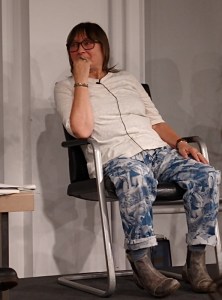
Ali Smith
We heard readings from both novellas, and Neil Griffiths and Damian Lanigan of Weatherglass told us some more about what they publish and the process of reading the prize submissions (blind!). Lanigan called the novella “a form for our times” and put this down not just to modern attention spans but to focus – the glimpse of something essential. He and Smith mentioned F. Scott Fitzgerald, Claire Keegan, Françoise Sagan and Muriel Spark as some of the masters of the novella form.
The effortlessly cool Smith spoke about the delight of spending weekend mornings – she writes during the week but gives herself the weekends off to read – in bed with a pot of coffee and a Weatherglass novella. She particularly enjoyed going into each book from the shortlist without any context and lamented that blurbs mean the story has to be, to some extent, given away to the reader. She said the ending of a novella has to land “like a cat, on its feet” (Griffiths then appended that it must also be ambiguous).
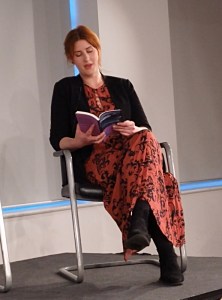
Kate Kruimink
Kruimink, who edits short stories for a magazine, explained that she thinks of Astraea as a long short story. She wrote it especially for this prize, within two months and for Ali Smith, as it were (she mentioned how formative How to Be Both was for her as a writer). Due to time and word limit constraints, she deliberately crafted a small character arc and didn’t do loads of research, though she had been looking into ships’ surgeons’ journals at the time. She has Irish convict ancestry but noted that this is not uncommon in Tasmania. Astraea is a “sneaky prequel” to her first novel, which has been published in Australia.
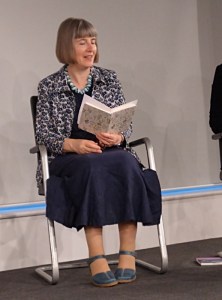
Deborah Tomkins
Aerth was originally titled First, Do No Harm, which had the potential to confuse those looking for a medical read. Aerth and Urth are different planets with parallels to our own. The novella tells the story of Magnus, an Everyman on a deeply forested planet heading into an Ice Age. Tomkins first wrote it for the Bath Prize in 2018 and was longlisted, then added to it. She initially sent the book to sci-fi publishers but was told it was not ‘sci-fi enough’.
Griffiths remarked that the shortlist was all-female and that the two winners show how a novella can do many different things: Astraea is at the low end of the word count at 22,000 words and takes place over just 36 hours; Aerth is towards the upper limit at 36,000 words and spans about 40 years.
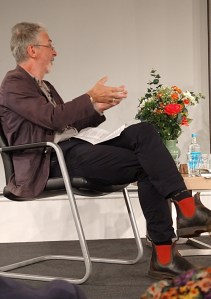
Neil Griffiths
All the panellists dismissed the idea of a hierarchy with the full-length novel at the top. Griffiths said that the constraints of the novella, to need to discard and discard, make it stand out.
A further title from the 2024 shortlist, We Hexed the Moon by Mollyhall Seeley, will also be published by Weatherglass next year, and submissions are now open for the Weatherglass Novella Prize 2025.
Many thanks for my free ticket to a great event. Weatherglass has also kindly offered to send Cathy and me copies of the two novellas to review over the course of #NovNov. I’m looking forward to reading both winners!
Edinburgh Book Festival 2024 (Online): Richard Holloway’s On Reflection
Thanks to Kate for making me aware that the Edinburgh Book Festival was running in hybrid format this year, allowing people hundreds or thousands of miles away to participate. It felt like a return to the good old days of coronavirus lockdown – yes, I know it was very bad for very many people, but one consolation, especially for a thrifty introvert like me, was the chance to attend a plethora of literary and musical events online without leaving my sofa. I donated to live-stream two talks, one by Olivia Laing last week (more on that in an upcoming post on three recent gardening-themed reads) and this one by Richard Holloway on Sunday.
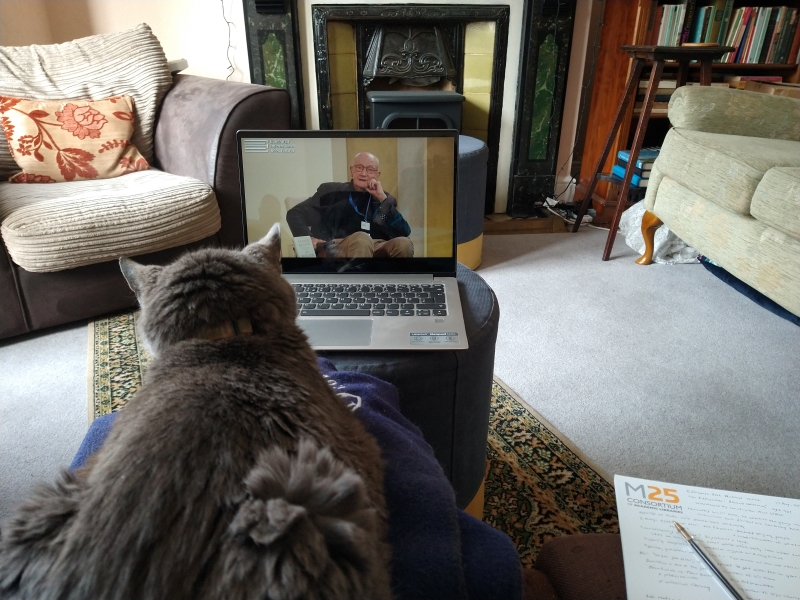
Alfie was rapt, too, of course.
I’ve reviewed several of his books here before (The Way of the Cross, Waiting for the Last Bus and The Heart of Things) and it would be fair to call him one of my most-admired spiritual gurus. At age ninety, he is not just lucid but quick-witted and naughty (I wasn’t expecting two F-bombs from a former bishop). While I have not read his latest book, On Reflection, it sounds like it’s quite similar to The Heart of Things: composed of memories and philosophical musings, with lashings of 20th-century poetry and Scottish history.
Interviewer Alan Little, a broadcaster who is stepping down as Festival chair after a decade, drew Holloway out on topics including faith, poetry, the Scottish reformation, and mortality. Little joked, “as you get older, you’re supposed to get more set in your ways!” while Holloway appears to become ever more liberal. He referred to himself as a “non-believing Christian” who is still steeped in religious culture and language but has adopted a “serene, gracious agnosticism,” which is “as much as the universe affords us.”
Holloway recently reread his first book and, while he admired that young man’s enthusiasm, he disliked the hectoring tone. The opposite of faith isn’t doubt, he remarked, but certainty. Two things prompted him to leave the ministry: the Church’s hatred of gay people and its subordination of women. His guiding principle is simple (reminiscent of Jan Morris’s): let’s be kind to each other and look after one another while we’re here. More existentially, he frames it as: let’s live as if life has meaning, even though he’s not sure that it does. In fact, he theorizes that religion arose from death, because we are the only species that is aware of our mortality and we can’t bear the thought of nothingness.
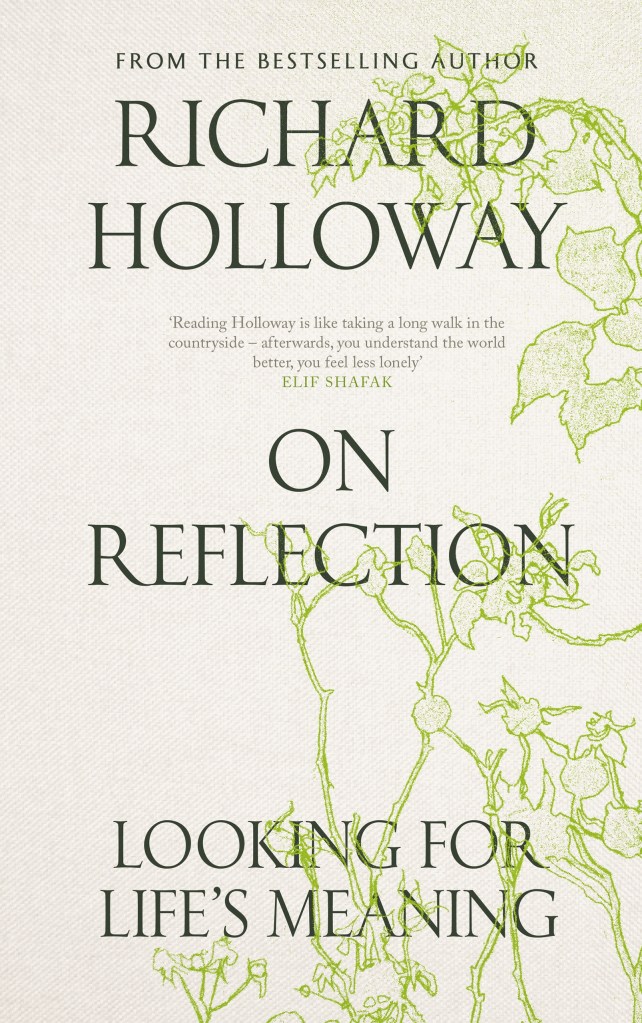
Holloway seems to live and breathe poetry. He expressed his love for W. H. Auden, whom he described as almost “priestly” in his brokenness, struggles, mysticism, and doing of good by stealth (he cared for war orphans and left them money at his death). Although I sometimes feel that Holloway is overly reliant on quotation in his recent books, I appreciate his fervour for poetry. His summation of what it does for him rang true for me as well: “poetry feeds me because it notices things in a particular way.” He added, “at its best, religion is a kind of realized poetry,” exclaiming, if only we could value it as such and not turn it into doctrine.
I wasn’t as interested in the discussion of John Knox and Scottish Presbyterianism, but obviously it was appropriate for the Edinburgh setting. Holloway said that it saddens him that Scotland is losing “the kirk” – as a tradition and in the form of buildings, many of which stand derelict. He read a long passage about Knox’s unfortunate hatred of images (his movement removed or concealed all sacred paintings) and how that rejection comes from the desert religions, which associate emptiness with otherness and the Transcendent.
During the Q&A time, one audience member said that he was heading to a Handel performance next, and hoped for a transcendent experience – but, he asked, being agnostic like Holloway, “what will I transcend to?” The two men seemed to agree that the experience itself is enough. Culture as transmitted by learning is the most distinctive thing about humans, Holloway observed, and Little also spoke passionately about the arts’ role in reconciliation. Several times, Holloway expressed his enduring wonder at the fact that there is something instead of nothing. It still staggers him not just that we’re here, but that we are capable of pondering the meaning of our own existence through events such as this one. That humility, even after his many decades as a respected public thinker, was beautiful to see.
 Bookish Beck = Rebecca Foster. American transplant to England. Freelance proofreader and book reviewer.
 Bookish Beck