#NovNov25 and #GermanLitMonth: Kästner, Kehlmann & Kracht
Our trip to Germany in September whetted my appetite to read more German-language fiction, and November also being German Literature Month (hosted this year by Caroline of Beauty Is a Sleeping Cat and Tony of Tony’s Reading List) was a perfect excuse. K names only this year, please. (Perhaps next year I’ll make it S and finally get to those Sebald and Seethaler novels I have on the shelf.) These three works – a children’s classic, a set of linked short stories about the writer’s craft, and a mother–son spending spree – have coy metafictional touches, plus there’s a connection I wasn’t expecting between the Kehlmann and Kracht. All: 

Emil and the Detectives by Erich Kästner (1929; 1931)
[Translated by Eileen Hall]
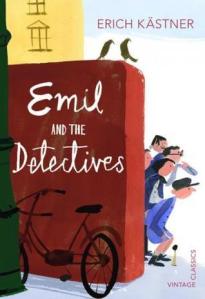 If only I’d realized this was set on a train to Berlin, I could have read it in the same situation! Instead, it was a random find while shelving in the children’s section of the library. Emil sets out on a slow train from Neustadt to stay with his aunt, grandmother and cousin in Berlin for a week’s holiday. His mother gives him £7 in an envelope he pins inside his coat for safekeeping. There are four adults in the carriage with him, but three get off early, leaving Emil alone with a man in a bowler hat. Much as he strives to stay awake, Emil drops off. No sooner has the train pulled into Berlin than he realizes the envelope is gone along with his fellow traveller. “There were four million people in Berlin at that moment, and not one of them cared what was happening to Emil Tischbein.” He’s sure he’ll have to chase the man in the bowler hat all by himself, but instead he enlists the help of a whole gang of boys, including Gustav who carries a motor-horn and poses as a bellhop, Professor with the glasses, and Little Tuesday who mans the phone lines. Together they get justice for Emil, deliver a wanted criminal to the police, and earn a hefty reward. This was a cute story and it was refreshing for children’s word to be taken seriously. There’s also the in-joke of the journalist who interviews Emil being Kästner. I’m sure as a kid I would have found this a thrilling adventure, but the cynical me of today deemed it unrealistic. (Public library) [153 pages]
Fame by Daniel Kehlmann (2009; 2010)
[Translated by Carol Brown Janeway]
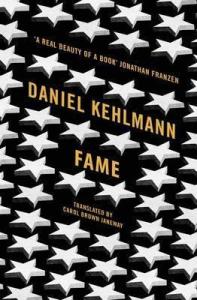 I’ve been equally enchanted by Kehlmann’s historical fiction (Measuring the World) and contemporary metafiction (F is one of my all-time favourites) in the past. These nine linked stories feature writers and their characters, actors and their look-alikes, and are about how life translates into – or is sometimes transformed by – art. Ralf Tanner starts to feel like he doesn’t exist when his calls gets diverted to someone else’s phone and an impersonator is more convincing at playing him than he is himself. Leo Richter’s new girlfriend is curiously similar to his most famous character, Lara Gaspard, a doctor working for a medical charity. Crime writer Maria Rubinstein takes Leo’s place on a cultural exchange to Central Asia and gets stuck in a Kafka-esque situation without a visa. Leo’s fan and Ralf’s call recipient are subjects of their own stories. References to Miguel Auristos Blanco’s spiritual self-help books recur and he, too, eventually becomes a character. I liked the pointed little jokes about what writers have to put up with (“Do you know how often I’ve been asked today where I get my ideas from? Fourteen. And nine times whether I work in the morning or the afternoon,” Leo complains). Mostly, these stories struck me as clever yet had me wondering what the point was. My favourite was “Rosalie Goes Off to Die,” in which Leo’s character travels to Zurich for an assisted death but he the writer decides to interfere before she can get her last wish. (Secondhand – Awesomebooks.com) [206 pages – but fairly large print]
Eurotrash by Christian Kracht (2021; 2024)
[Translated by Daniel Bowles]
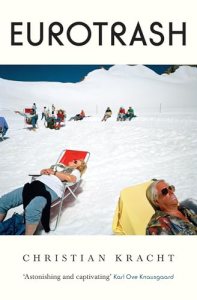 This was longlisted for the International Booker Prize and is the current Waterstones book of the month. The Swiss author’s seventh novel appears to be autofiction: the protagonist is named Christian Kracht and there are references to his previous works. Whether he actually went on a profligate road trip with his 80-year-old mother, who could say. I tend to think some details might be drawn from life – her physical and mental health struggles, her father’s Nazism, his father’s weird collections and sexual predilections – but brewed into a madcap maelstrom of a plot that sees the pair literally throwing away thousands of francs. Her fortune was gained through arms industry investment and she wants rid of it, so they hire private taxis and planes. If his mother has a whim to pick some edelweiss, off they go to find it. All the while she swigs vodka and swallows pills, and Christian changes her colostomy bags. I was wowed by individual lines (“This was the katabasis: the decline of the family expressed in the topography of her face”; “everything that does not rise into consciousness will return as fate”; “the glacial sun shone from above, unceasing and relentless, upon our little tableau vivant”) but was left chilly overall by the satire on the ultra-wealthy and those who seek to airbrush history. The fun connections: Like the Kehlmann, this involves arbitrary travel and happens to end in Africa. More than once, Kracht is confused for Kehlmann. (Little Free Library) [190 pages]
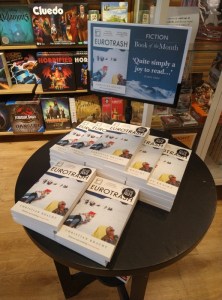
Spotted in my local Waterstones…

#1925Club: The Heart of a Dog by Mikhail Bulgakov
Simon and Kaggsy’s classics reading weeks always get me picking up older books. I found this unusual Russian novella on a giveaway pile a few years ago and it’s been on my #NovNov possibility shelf ever since, but now turned out to be the perfect time for it. This review also fits into the Hundred Years Hence challenge.

Sharik is an abused stray dog, living on scraps on the snowy streets of Moscow until Professor Philip Philipovich Preobrazhensky takes him in. The professor is a surgeon renowned for his rejuvenation procedures – implanting monkey ovaries into a middle-aged lady, for instance – and he has designs on the mutt. His new strategy is to take the pituitary gland and testicles of a just-deceased young man and transplant them into Sharik. The central chapter is composed of medical notes taken by Preobrazhensky’s assistant, Dr. Bormenthal. Gradually, a transformation is achieved: The dog’s bark becomes more of a human groan and his fur and tail fall off. Soon the new man is fully convincing: eating, dressing and conversing. Even in a matter-of-fact style, the doctor’s clinical observations are hilarious. “The dog[,] in the presence of Zina and myself, had called Prof. Preobrazhensky a ‘bloody bastard’. … Heard to ask for ‘another one, and make it a double.’” The scientists belatedly look into the history of the man whose glands they harvested and discover to their horror that he was an alcoholic petty thief who died in a bar fight. Sharikov follows suit as an inebriated boor who pesters women, wants to be known as Poligraph Poligraphovich – and still chases cats. Is it too late to reverse a Frankenstein-esque trial gone wrong?
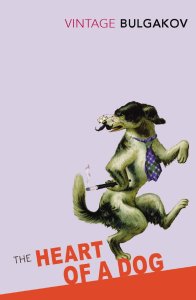 This was a fairly entertaining fable-like story, with whimsical fragments of narration from Sharik himself at the start and close. The blurb inside the jacket of my 1968 Harvill Press hardback suggests “The Heart of a Dog can be enjoyed solely as a comic story of splendid absurdity; it can also be read as a fierce parable about the Russian Revolution.” The allegorical meaning could easily have passed me by, being less overt than in Animal Farm. Reading a tiny bit of external information, I see that this has been interpreted as a satire on the nouveau riche during the Bolshevik era: Sharikov complains about how wealthy the professor is and proposes that he sacrifice some of his apartment-cum-office’s many rooms to others who have nowhere to live. But yes, I mostly stayed at the surface level and found an amusing mad-scientist cautionary tale. I’ll read more by Bulgakov – I’ve had a copy of The Master and Margarita for ages. Next year’s Reading the Meow week might be my excuse.
[Translated from Russian by Michael Glenny, 1968]
(Free from a neighbour, formerly part of Scarborough Public Library stock)
I also intended to read An American Tragedy by Theodore Dreiser from the university library, having a dim memory of a black-and-white film version starring Montgomery Clift (A Place in the Sun). But the catalogue’s promised 400-some pages was a lie; there are two volumes in one, totaling 840 pages. So that was a nonstarter.
But here are some other famous 1925 titles that I’ve read (I’m now at 7 out of the top 15 on the Goodreads list of the most popular books published in 1925):
The Great Gatsby by F. Scott Fitzgerald
The Trial by Franz Kafka
The Painted Veil by W. Somerset Maugham
Emily Climbs by L.M. Montgomery
Carry On, Jeeves by P.G. Wodehouse
Mrs. Dalloway by Virginia Woolf
I’ve previously participated in the 1920 Club, 1956 Club, 1936 Club, 1976 Club, 1954 Club, 1929 Club, 1940 Club, 1937 Club, 1970 Club, and 1952 Club.
20 Books of Summer, 11–12 (Victoriana): Edward Carey & George Grossmith
Neither of these appeared on my initial list, but I thought a middle-grade novel and a classic would be good for variety. Though I have an MA in Victorian Literature, I don’t often read from the period anymore because I’m allergic to wordy triple-deckers, so it was a delight to encounter something short and lighthearted. I’ve always been partial to a contemporary Victorian pastiche, though.
Heap House (Iremonger, #1) by Edward Carey (2013)
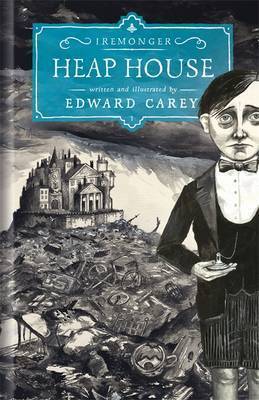 The Iremonger family wealth came from salvaging treasure from the rubbish heaps surrounding their London mansion. Every Iremonger has a birth object (like a daemon?) associated with them. Clodius Iremonger, adolescent descendant of the great family, has a special skill: he hears each birth object speaking its name. His own bath plug, for instance, cries out, “James Henry Hayward.” These objects house enchanted souls; people can change back into objects and vice versa. The narration alternates between Clod and plucky Lucy Pennant, who arrives from a local orphanage to work as a house servant. All staff and heap-workers are called “Iremonger,” but Lucy refuses to cede her identity and wants justice for the oppressed workers. She and Clod form a bond against the odds and there’s an upstairs–downstairs tinge to their ensuing adventures in the house and on the heaps.
Carey’s trademark twisted combination of Dickensian charm and Gothic gloom is certainly on display here. All the other names are slightly off-kilter: Rosamud, Moorcus, Aliver, Pinalippy and so on. I laughed out loud at a passage about the dubious purpose of doilies. Little truly won me over, but all my experiences with Carey’s work since then (also including The Swallowed Man, B: A Year in Plagues and Pencils, and Edith Holler) have been a slight letdown. This was highly readable and I galloped through the midsection, but I found the whole thing overlong; I’m undecided about reading the other books, though they do have higher average ratings on Goodreads. I got the second, Foulsham, from the Little Free Library and it’s significantly shorter. Shall I continue? (Secondhand – Awesomebooks.com) 
The Diary of a Nobody by George Grossmith; illus. Weedon Grossmith (1892)
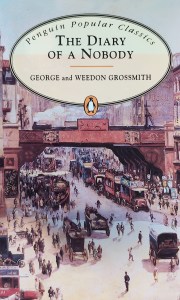 It must be rare for a fictional character to be memorialized in the dictionary. I was vaguely aware of the word “Pooterism” but thought it referred to small-minded, pompous, fussy individuals, so my preconception of City clerk Charles Pooter was probably more negative than is warranted. (In fact, “Pooterish” means taking oneself too seriously.) He’s actually a lovable, hapless Everyman who tries desperately to keep up with middle-class society but often gets it wrong. He can’t handle his champagne; and he wants so much to be funny – his are definite dad jokes avant la lettre – but only sometimes pulls it off. He regularly offends tradesmen, servants and neighbours alike, and tries but fails to ingratiate himself with his betters. Luckily, his mistakes are mild and just leave him out of favour – or pocket.

Charles and Lupin Pooter, as depicted by
Weedon Grossmith. Public domain, via Wikimedia Commons.
Originally serialized in Punch, the book is in short entries of one paragraph to a few pages, recounting the Pooters’ first 15 months in their new home. Events range from the mundane – home repairs and decoration – to the great excitement of being invited to the mayor’s ball. Charles and Carrie’s young adult son, Lupin (surely a partial inspiration for Roger Mortimer’s Dear Lupin and its sequels?), who comes back to live with them partway through, is a feckless bounder always being taken in by new money-making schemes and unsuitable ladies. Charles hopes to find Lupin steady employment and steer him away from his infatuation with Daisy Mutlar.
It’s well worth reading for its own sake, but also for the window onto daily Victorian life, including things that aren’t always recorded, such as fashion and slang. And it’s clever how Pooter’s pretensions get punctured by the others around him: longsuffering Carrie (“He tells me his stupid dreams every morning nearly”), insolent Lupin (“Look here, Guv.; excuse me saying so, but you’re a bit out of date”), and testy Gowing – that’s right, the neighbours are named Cummings and Gowing (“I would add, you’re a bigger fool than you look, only that’s absolutely impossible”). All very amusing. (Free from mall bookshop c. 2020) 

Never fear, I’m still on track to finish the challenge by the 31st!
The Single Hound by May Sarton (1938)
I spotted that the 30th anniversary of May Sarton’s death was coming up, so decided to read an unread book of hers from my shelves in time to mark the occasion. Today’s the day: she died on July 16, 1995 in York, Maine. Marcie of Buried in Print joined me for a buddy read (her review). I was drawn by the title, which comes from an Emily Dickinson quote. It’s the ninth Sarton novel I’ve read and, while in general I find her nonfiction more memorable than her fiction, this impressionistic debut novel was a solid read. It was clearly inspired by Virginia Woolf’s work and based on Sarton’s memories of her time on the fringes of the Bloomsbury Group.
 In Part I we are introduced to “the Little Owls,” three dear friends and winsome spinsters in their sixties – Doro, Annette and Claire – who teach and live above their schoolroom in Ghent, Belgium. (I couldn’t help but think of the Brontë sisters’ time in Belgium.) Doro, a poet, seems likely to be a stand-in for the author. I loved the gentle pace of this section; although the novel was published when she was only 26, Sarton was already displaying insight into friendship and ageing and appreciation of life’s small pleasures, elements that would recur in her later autobiographical work.
the three together made a complete world.
Was this life? This slow penetration of experience until nothing had been left untasted, unexplored, unused — until the whole of one’s life became a fabric, a tapestry with a pattern? She could not see the pattern yet.
tea was opium to them both, the time when the past became a soft pleasant country of the imagination, lost its bitterness, ceased to devour, and in some tea-inspired way nourished them.
Part II felt to me like a strange swerve into the story of Mark Taylor, an aspiring English writer who falls in love with a married painter named Georgia Manning. Their flirtation, as soon through the eyes of a young romantic like Mark, is monolithic, earth-shattering, but to readers is more of a clichéd subplot. In the meantime, Mark sticks to his vow of going on a pilgrimage to Belgium to meet Jean Latour, the poet whose work first inspired him. Part III brings the two strands together in an unexpected way, as Mark gains clarity about his hero and his potential future with Georgia, though cleverer readers than I may have been able to predict it – especially if they heeded the Brontë connection.
It was rewarding to spot the seeds of future Sarton themes here, such as discovering the vocation of teaching (The Small Room) and young people meeting their elder role models and soliciting words of wisdom on how to live (Mrs. Stevens Hears the Mermaids Singing). Through Doro, Sarton also expresses trust in poetry’s serendipitous power. “This is why one is a poet, so that some day, sooner or later, one can say the right thing to the right person at the right time.” I enjoyed my time with the Little Owls but mostly viewed this as a dress rehearsal for later, more mature work. (Secondhand – Awesomebooks.com) 
#1952Club: Patricia Highsmith, Paul Tillich & E.B. White
Simon and Karen’s classics reading weeks are always a great excuse to pick up some older books. I assembled an unlikely trio of lesbian romance, niche theology, and an animal-lover’s children’s classic.

Carol by Patricia Highsmith
Originally published as The Price of Salt under the pseudonym Claire Morgan, this is widely considered the first lesbian novel with a happy ending (it’s more open-ended, really, but certainly not tragic; suicide was a common consequence in earlier fiction). Therese, a 19-year-old aspiring stage designer in New York City, takes a job selling dolls in a department store one Christmas season. Her boyfriend, Richard, is a painter and has promised to take her to Europe, but she’s lukewarm about him and the physical side of their relationship has never interested her. One day, a beautiful blonde woman in a fur coat – “Mrs. H. F. Aird” (Carol) – comes to her counter to order a doll and have it sent to her out in New Jersey. Therese sends a Christmas card to the same address, and the women start meeting up for drinks and meals.
 It takes time for them to clarify their feelings to themselves, let alone to each other. “It would be almost like love, what she felt for Carol, except that Carol was a woman,” Therese thinks early on. When she first visits Carol’s home, a mothering dynamic prevails. Carol is going through a divorce and worries about its effect on her daughter, Rindy. The older woman tucks Therese into bed and brings her warm milk. Scenes like this have symbolic power but aren’t overdone; another has Therese and Richard out flying kites. She brings up homosexuality as a theoretical (“Did you ever hear of it? … I mean two people who fall in love suddenly with each other, out of the blue. Say two men or two girls”) and he cuts her kite strings.
The second half of the book has Carol and Therese setting out on a road trip out West. It should be an idyllic consummation, but they realize they’re being trailed by a private detective collecting evidence for Carol’s husband Harge to use against her in a custody battle. I was reminded of the hunt for Humbert Humbert and his charge in Lolita; “the whole world was ready to be their enemy,” Therese realizes, and to consider their relationship “sordid and pathological,” as Richard describes it in a letter.
The novel is a beautiful and subtle romance that unfolds despite the odds against it. I’d read five of Highsmith’s mysteries and thought them serviceable but nothing special (I don’t read crime in general). This does, however, share their psychological intensity and the suspense about how things will play out. Highsmith gives details about Therese’s early life and Carol’s previous intimate friendship that help to explain some things but never reduce either character to a diagnosis or a tendency. Neither of them wanted just anyone, some woman; it was this specific combination of souls that sparked at first sight. (Secondhand from a charity shop that closed long ago, so I know I’d had it on my shelf unread since 2016!) 
The Courage to Be by Paul Tillich
 Tillich is a theologian who left Nazi Germany for the USA in 1933. I had to read selections from his work as part of my Religion degree (during the Pauline Theology tutorial I took in Oxford during my year abroad, I think). This book is based on a lecture series he delivered at Yale University. He posits that in an age of anxiety, which “becomes general if the accustomed structures of meaning, power, belief and order disintegrate” – certainly apt for today! – it is more important than ever to develop the courage to be oneself and to be “as a part.” The individual and the collective are of equal importance, then. Tillich discusses various philosophers and traditions, from the Stoics to Existentialism. I have to admit that I barely got anything out of this, I found it so jargon-filled, repetitive and elliptical. It’s been probably 15 years or more since I’ve read any proper theology. I adopted that old student skimming trick of reading the first paragraph of each chapter, followed by the topic sentence of each paragraph, but that left me mostly none the wiser. Anyway, I believe his conclusion is that, when assailed by doubt, we can rely on “the God above the God of theism” – by which I take it he means the ground of all being rather than the deity envisioned by any specific religious system. (University library)
Charlotte’s Web by E.B. White
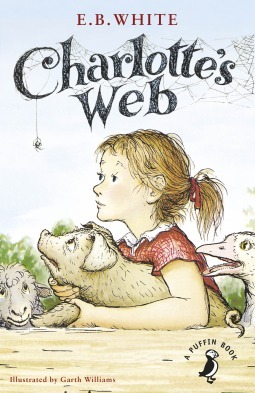 My library has a small section of the children’s department called “Family Matters” that includes the labels “First Time” (starting school, etc.), “Family” (divorce, new baby), “Health” (autism, medical conditions) and “Death.” I have the feeling Charlotte’s Web is not at all well known in the UK, whereas it’s a standard in the USA alongside L.M. Montgomery and Laura Ingalls Wilder. Were it more familiar to British children, it would be a great addition to that “Death” shelf. (Don’t read the Puffin Modern Classics introduction if you don’t want spoilers!) Wilbur is a doubly rescued pig. First, Fern Arable hand-rears him when he’s the doomed runt of the litter. When he’s transferred to Uncle Homer Zuckerman’s farm and an old sheep explains he’ll be fattened up for slaughter, his new friend Charlotte intervenes.
Charlotte is a fine specimen of a barn spider, well spoken and witty. She puts her mind to saving Wilbur’s bacon by weaving messages into her web, starting with “Some Pig.” He’s soon a county-wide spectacle, certain to survive the chop. But a farm is always, inevitably, a place of death. White fashions such memorable characters, including Templeton the gluttonous rat, and captures the hope of new life returning as the seasons turn over. Talking animals aren’t difficult to believe in when Fern can hear every word they say. The black-and-white line drawings are adorable. And making readers care about invertebrates? That’s a lasting achievement. I’m sure I read this several times as a child, but I appreciated it all the more as an adult. (Little Free Library)

I’ve previously participated in the 1920 Club, 1956 Club, 1936 Club, 1976 Club, 1954 Club, 1929 Club, 1940 Club, 1937 Club, and 1970 Club.
#NovNov24 and #GermanLitMonth: Knulp by Hermann Hesse (1915)
My second contribution to German Literature Month (hosted by Lizzy Siddal) after A Simple Intervention by Yael Inokai. This was my first time reading the German-Swiss Nobel Prize winner Hermann Hesse (1877–1962). I had heard of his novels Siddhartha and Steppenwolf, of course, but didn’t know about any of his shorter works before I picked this up from the Little Free Library last month. Knulp is a novella in three stories that provide complementary angles on the title character, a carefree vagabond whose rambling years are coming to an end.
“Early Spring” has a first-person plural narrator, opening “Once, early in the nineties, our friend Knulp had to go to hospital for several weeks.” Upon his discharge he stays with an old friend, the tanner Rothfuss, and spends his time visiting other local tradespeople and casually courting a servant girl. Knulp is a troubadour, writing poems and songs. Without career, family, or home, he lives in childlike simplicity.
He had seldom been arrested and never convicted of theft or mendicancy, and he had highly respected friends everywhere. Consequently, he was indulged by the authorities very much, as a nice-looking cat is indulged in a household, and left free to carry on an untroubled, elegant, splendidly aristocratic and idle existence.
 “My Recollections of Knulp” is narrated by a friend who joined him as a tramp for a few weeks one midsummer. It wasn’t all music and jollity; Knulp also pondered the essential loneliness of the human condition in view of mortality. “His conversation was often heavy with philosophy, but his songs had the lightness of children playing in their summer clothes.”
In “The End,” Knulp encounters another school friend, Dr. Machold, who insists on sheltering the wayfarer. They’re in their forties but Knulp seems much older because he is ill with tuberculosis. As winter draws in, he resists returning to the hospital, wanting to die as he lived, on his own terms. The book closes with an extraordinary passage in which Knulp converses with God – or his hallucination of such – expressing his regret that he never made more of his talents or had a family. ‘God’ speaks these beautiful words of reassurance:
Look, I wanted you the way you are and no different. You were a wanderer in my name and wherever you went you brought the settled folk a little homesickness for freedom. In my name, you did silly things and people scoffed at you; I myself was scoffed at in you and loved in you. You are my child and my brother and a part of me. There is nothing you have enjoyed and suffered that I have not enjoyed and suffered with you.
I struggle with episodic fiction but have a lot of time for the theme of spiritual questioning. The seasons advance across the stories so that Knulp’s course mirrors the year’s. Knulp could almost be a rehearsal for Stoner: a spare story of the life and death of an Everyman. That I didn’t appreciate it more I put down to the piecemeal nature of the narrative and an unpleasant conversation between Knulp and Machold about adolescent sexual experiences – as in the attempted gang rape scene in Cider with Rosie, it’s presented as boyish fun when part of what Knulp recalls is actually molestation by an older girl cousin. I might be willing to try something else by Hesse. Do give me recommendations! (Little Free Library) 
Translated from the German by Ralph Manheim.
[125 pages]


Mini playlist:
- “Ramblin’ Man” by Lemon Jelly
- “I’ve Been Everywhere” by Johnny Cash
- “Rambling Man” by Laura Marling
- “Ballad of a Broken Man” by Duke Special
- “Railroad Man” by Eels
 I have also recently read a 2025 release that counts towards these challenges, The Café with No Name by Robert Seethaler (Europa Editions; translated by Katy Derbyshire; 192 pages). The protagonist, Robert Simon [Robert S., eh? Coincidence?], is not unlike Knulp, though less blithe, or the unassuming Bob Burgess from Elizabeth Strout’s novels (e.g., Tell Me Everything). Robert takes over the market café in Vienna and over the next decade or so his establishment becomes a haven for the troubled. The Second World War still looms large, and disasters large and small unfold. It’s all rather melancholy; I admired the chapters that turn the customers’ conversation into a swirling chorus. In my review, pending for Foreword Reviews, I call it “a valedictory meditation on the passage of time and the bonds that last.”
#1970Club: Desperate Characters & I’m the King of the Castle
Simon and Karen’s classics reading weeks are always a great excuse to pick up some older books. I found on my shelves a chilly Brooklyn-set novella that has been praised to the skies by the likes of Jonathan Franzen, and then borrowed a short and unsettling novel about warring English schoolboys from the library.

Desperate Characters by Paula Fox
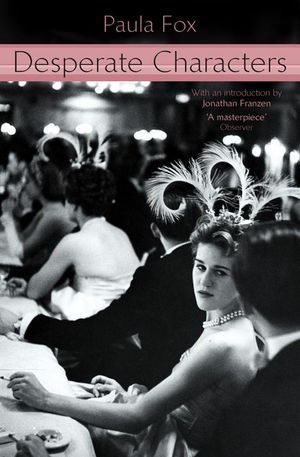 Other covers feature a cat, which is probably why this was on my radar. Don’t expect a cat lover’s book, though. The cat simply provides the opening incident. Sophie Bentwood is a forty-year-old underemployed translator; she doesn’t really need to work because her lawyer husband Otto keeps them in comfort. Feeding a feral cat, she is bitten savagely on the hand and over the next several days puts off seeking medical attention, wanting to stay in uncertainty rather than condemn herself to rounds of shots – and the cat to possible euthanasia. Both she and Otto live in this state of inertia. They were never able to have children but couldn’t take the step of adopting; Sophie had an affair but couldn’t leave Otto to commit elsewhere.
The cat bite seems to set off a chain of mishaps, culminating with the Bentwoods discovering that their house in the country has been vandalized. In the meantime, not a lot happens. The couple goes to a party and Sophie sneaks out for late-night drinks with her husband’s ex-partner, to whom she confides her affair. In Jonathan Franzen’s introduction, he compares to Bellow, Roth and Updike – but thinks Fox surpasses them all. The book explicitly references the Thoreau quote about people living lives of quiet desperation. I could sympathize with the midlife malaise depicted. As stagnant marriage stories go, this reminded me of what I’ve read by Richard Yates, just with a little less drinking. It would have made a good Literary Wives selection. In general, though, I can’t summon much enthusiasm. Given the cult classic status, I expected more. (Secondhand – Community Furniture Project, Newbury)
I’m the King of the Castle by Susan Hill
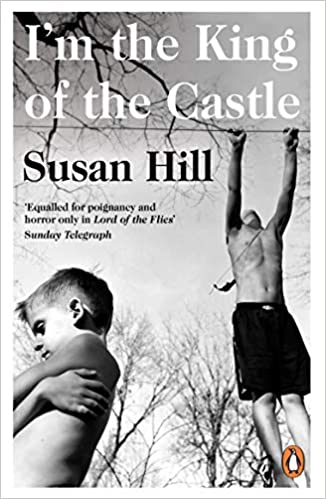 I’m almost tempted to mark this as an R.I.P. read, because it’s very dark indeed. Like The Woman in Black, it takes place in an ominous English mansion and its environs. Other scenes take place in a creepy forest and at castle ruins, adding to the Gothic atmosphere. Edmund Hooper and his father move into Warings after his grandparents’ death. Soon his father makes an unwelcome announcement: he’s hired a housekeeper, Helena Kingshaw, who will be moving in with her son, Charles, who is the same age as Edmund. Hooper writes Kingshaw (as the boys are called throughout the book, probably to replicate how they were known at their boarding schools) a note: “I DIDN’T WANT YOU TO COME HERE.”
That initial hostility erupts into psychological, and sometimes physical, abuse. Kingshaw quickly learns not to trust Hooper. “He thought, I mustn’t let Hooper know what I truly think, never, not about anything.” He tries running away to the woods but Hooper follows him; he makes friends with a local farm boy but it’s little comfort when he’ll soon be starting at Hooper’s school and it looks as if their lonely widowed parents might marry. The boys learn each other’s weaknesses and exploit them. At climactic moments, they have the opportunity to be gracious but retreat from every potential truce.
Heavy on dialogue and description, the book moves quickly with its claustrophobic scenes of nightmares come to life. Referring to the boys by surname makes them seem much older than 10 going on 11. Their antagonism is no child’s play – as the title ironically suggests – or harmless bullying. Is it evil? The reader feels for Kingshaw, the more passive one, yet what he does in revenge is nearly as bad. I was reminded somewhat of Harriet Said… by Beryl Bainbridge. It’s a deeply uncomfortable story, not least for how nature (pecking crows, cases of dead moths) is portrayed as equally menacing. (Public library)
Another 15 books from 1970 that I’ve read:
Jonathan Livingston Seagull by Richard Bach (in the running for worst book I’ve ever read)
Are You There, God? It’s Me, Margaret by Judy Blume
Runaway Ralph by Beverly Cleary
Fifth Business by Robertson Davies
84, Charing Cross Road by Helene Hanff
If Only They Could Talk by James Herriot
Ripley Under Ground by Patricia Highsmith
Crow by Ted Hughes
Moominvalley in November by Tove Jansson
Being There by Jerzy Kosiński
The Bluest Eye by Toni Morrison
Sing Down the Moon by Scott O’Dell
Love Story by Erich Segal
The Driver’s Seat by Muriel Spark
The Trumpet of the Swan by E.B. White
(Lots of children’s books there! Clearly they were considered modern classics during my 1980s childhood.)
I’ve previously participated in the 1920 Club, 1956 Club, 1936 Club, 1976 Club, 1954 Club, 1929 Club, 1940 Club and 1937 Club.
#WITMonth, Part I: Novellas by Eva Baltasar and Françoise Sagan
I’m starting off my Women in Translation month coverage with mini responses to two novellas: one Catalan and one French; both about disaffected women trying to work out what they want from life.
Mammoth by Eva Baltasar (2022; 2024)
[Translated from the Catalan by Julia Sanches]
 I’d been vaguely attracted by descriptions of the Spanish poet’s novels Permafrost and Boulder, which are also about lesbians in odd situations. Mammoth is the third book in a loose trilogy. Its 24-year-old narrator is so desperate for a baby that she’s decided to have unprotected sex with men until a pregnancy results. In the meantime, her sociology project at nursing homes comes to an end and she moves from Barcelona to a remote farm where she develops subsistence skills and forms an interdependent relationship with the gruff shepherd. “I’d been living in a drowning city, and I need this – the restorative silence of a decompression chamber. … my past is meaningless, and yet here, in this place, there is someone else’s past that I can set up and live in awhile.” For me this was a peculiar combination of distinguished writing (“The city pounces on the still-pale light emerging from the deep sea and seizes it with its lucrative forceps”) but absolutely repellent story, with a protagonist whose every decision makes you want to throttle her. An extended scene of exterminating feral cats certainly didn’t help matters. I’d be wary of trying Baltasar again.
With thanks to And Other Stories for the proof copy for review.
Aimez-vous Brahms… by Françoise Sagan (1959; 1960)
[Translated from the French by Peter Wiles]
 At age 39, divorced interior decorator Paule is “passionately concerned with her beauty and battling with the transition from young to youngish woman”. (Ouch. But true.) It’s an open secret that her partner Roger is always engaged in a liaison with a young woman; people pity her and scorn Roger for his infidelity. But when Paule has a dalliance with a client’s son, 25-year-old lawyer Simon, a double standard emerges: “they had never shown her the mixture of contempt and envy she was going to arouse this time.” Simon is an idealist, accusing her of “letting love go by, of neglecting your duty to be happy”, but he’s also indolent and too fond of drink. Paule wonders if she’s expected too much from an affair. “Everyone advised a change of air, and she thought sadly that all she was getting was a change of lovers: less bother, more Parisian, so common”.
I was by turns reminded of Chéri by Colette, In a Summer Season by Elizabeth Taylor, and even The Graduate (“Mrs. Robinson,” anyone?). Simon asks the title question to invite Paule to a concert; that she has to ponder it carefully tells her she’s “losing herself, losing track of herself”. But it’s all too easy for the status quo to be reinstated after a brave act. Middle-aged woman makes bid for freedom but ultimately nothing changes: same plot as The Funeral Cryer and any number of other books, but this was so much better. How did Sagan manage such insight at age 24 (and this was her fourth book)?! While not quite as memorable as Bonjour Tristesse, this is another incisive slice of fiction that has aged well apart from using “sodomite” and “Negress” as matter-of-fact terms for bit players. I’d read anything else I can find by Sagan. (Secondhand – Community Furniture Project, Newbury)

Rereading Of Mice and Men for #1937Club
A year club hosted by Karen and Simon is always a great excuse to read more classics. Between my shelves and the library, I had six options for 1937. But I started reading too late, and had too many books on the go, to finish more than one – a reread. No matter; it was a good one I was glad to revisit, and I’ll continue with the other reread at my own pace.
Of Mice and Men by John Steinbeck
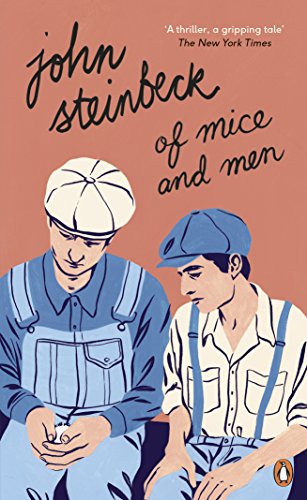 Are teenagers doomed to dislike the books they read in school? I think this must have been on the curriculum for 11th grade English. It was my third Steinbeck novella after The Red Pony and The Pearl, so to me it confirmed that he wrote contrived, depressing stuff with lots of human and animal suffering. Not until I read The Grapes of Wrath in college and East of Eden (THE Great American Novel) five years ago did I truly recognize Steinbeck’s greatness.
George and Lennie are itinerant farm workers in Salinas Valley, California. Lennie is a gentle giant, intellectually disabled and aware of his own strength when hauling sacks of barley but not when stroking mice and puppies. George looks after Lennie as a favour to Aunt Clara and they’re saving up to buy their own smallholding. This dream is repeated to the point of legend, somewhere between a bedtime story and scripture:
‘Someday—we’re gonna get the jack together and we’re gonna have a little house and a couple of acres an’ a cow and some pigs and—’ ‘An’ live off the fatta the lan’,’ Lennie shouted. ‘And have rabbits.’
They quickly settle in alongside the other ranch-hands and even convert two to their idyllic picture of independence. But the foreman, Curley, is a hothead and his bored would-be-starlet wife won’t stop roaming into the men’s quarters. No matter how much George tells Lennie to stay away from both of them, something is set in motion – an inevitable repeat of an incident from their previous employment that forced them to move on.
I remembered the main contours here but not the ultimate ending, and this time I appreciated the deliberate echoes and heavy foreshadowing (all that symbolism to write formulaic school essays about!): this is Shakespearean tragedy with the signs and stakes writ large against a limited background. Bar some paragraphs of scene-setting descriptions, it is like a play; no surprise it’s been filmed several times. (I wish I didn’t have danged John Malkovich in my head as Lennie; I can’t think of anyone else in that role, whereas Gary Sinise doesn’t necessarily epitomize George for me.) The characterization of the one Black character, Crooks, and the one woman are uncomfortably of their time. However, Crooks is given the dubious honour of conveying the bleak vision: “Nobody never gets to heaven, and nobody gets no land. It’s just in their head.” Like Hardy, Steinbeck knows what happens when the lower classes make the mistake of wanting too much. It’s a timeless tale of grit and desperation, the kind one can’t imagine not existing. (Public library)
Apposite listening: “The Great Defector” by Bell X1 (known for their quirky lyrics):
You’ve been teasing us farm boys
’til we start talking ’bout those rabbits, George
oh, won’t you tell us ’bout those rabbits, George?
Original rating (1999?):
My rating now: 


Currently rereading: The Hobbit by J.R.R. Tolkien – My father gave me this for Christmas when I was 10. I think I finally read it sometime in my later teens, about when the Lord of the Rings films were coming out. I’m on page 70 now. I’d forgotten just how funny Tolkien is about the set-in-his-ways Bilbo and his devotion to a cosy, quiet life. When he’s roped into a quest to reclaim a mountain hoard of treasure from a dragon – along with 13 dwarves and Gandalf the wizard – he realizes he has much discomfort and many a missed meal ahead of him.


 DNFed: Journey by Moonlight by Antal Szerb – My second attempt with Hungarian literature, and I found it curiously similar to the other novel I’d read (Embers by Sandor Márai) in that much of it, at least the 50 pages I read, is a long story told by one character to another. In this case, Mihály, on his Italian honeymoon, tells his wife about his childhood best friends, a brother and sister. I wondered if I was meant to sense homoerotic attachment between Mihály and Tamás, which would appear to doom this marriage right at its outset. (Secondhand – Edinburgh charity shop, 2018)
 Skimmed: Out of Africa by Karen Blixen – I enjoyed the prose style but could tell I’d need a long time to wade through the detail of her life on a coffee farm in Kenya, and would probably have to turn a blind eye to the expected racism of the anthropological observation of the natives. (Secondhand – Way’s in Henley, 2015)
Here’s hoping for a better showing next time!
(I’ve previously participated in the 1920 Club, 1956 Club, 1936 Club, 1976 Club, 1954 Club, 1929 Club, and 1940 Club.)
The Story Girl by L. M. Montgomery (1911) #ReadingStoryGirl
Six months after the Jane of Lantern Hill readalong, Canadian bloggers Naomi (Consumed by Ink) and Sarah Emsley have chosen an earlier work by Lucy Maud Montgomery, The Story Girl, and its sequel The Golden Road, for November buddy reading.
The book opens one May as brothers Felix and Beverley King are sent from Toronto to Prince Edward Island to stay with an aunt and uncle while their father is away on business. Beverley tells us about their thrilling six months of running half-wild with their cousins Cecily, Dan, Felicity, and Sara Stanley – better known by her nickname of the Story Girl, also to differentiate her from another Sara – and the hired boy, Peter. This line gives a sense of the group’s dynamic: “Felicity to look at—the Story Girl to tell us tales of wonder—Cecily to admire us—Dan and Peter to play with—what more could reasonable fellows want?”
Felicity is pretty and domestically inclined; Sara knows it would be better to be useful like Felicity, but all she has is her storytelling ability. Some are fantasy (“The Wedding Veil of the Proud Princess”); some are local tales that have passed into folk memory (“How Betty Sherman Won a Husband”). Beverley is in raptures over the Story Girl’s orations: “if voices had colour, hers would have been like a rainbow. It made words live. … we had listened entranced. I have written down the bare words of the story, as she told it; but I can never reproduce the charm and colour and spirit she infused into it. It lived for us.”

The cousins’ adventures are gently amusing and quite tame. They all write down their dreams in notebooks. Peter debates which church denomination to join and the boys engage in a sermon competition. Pat the cat has to be rescued from bewitching, and receives a dose of medicine in lard he licks off his paws and fur. The Story Girl makes a pudding with sawdust instead of cornmeal (reminding me of Anne Shirley and the dead mouse in the plum pudding). Life consistently teaches lessons in humility, as when they are all duped by Billy Robinson and his magic seeds, which he says will change whatever each one most resents – straight hair, plumpness, height; and there is a false alarm about the end of the world.
I found the novel fairly twee and realized at a certain point that I was skimming over more than I was reading. As was my complaint about Jane of Lantern Hill, there is a predictable near-death illness towards the end. The descriptions of Felicity and the Story Girl are purple (“when the Story Girl wreathed her nut-brown tresses with crimson leaves it seemed, as Peter said, that they grow on her—as if the gold and flame of her spirit had broken out in a coronal”); I had to remind myself that this reflects on Beverley more so than on Montgomery. From Naomi’s review of The Golden Road, I think that would be more to my taste because it has a clear plot rather than just stringing together pleasant but mostly forgettable anecdotes.
Still, it’s been fun to discover some of L. M. Montgomery’s lesser-known work, and there are sweet words about cats and the seasons:
“I am very good friends with all cats. They are so sleek and comfortable and dignified. And it is so easy to make them happy.”
“The beauty of winter is that it makes you appreciate spring.”
This effectively captures the long, magical summer days of childhood. I thought about when I was a kid and loved trips up to my mother’s hometown in upstate New York, where her brothers still lived. I was in awe of the Judd cousins’ big house, acres of lawn and untold luxuries such as Nintendo and a swimming pool. I guess I was as star-struck as Beverley. (University library) 
 Bookish Beck = Rebecca Foster. American transplant to England. Freelance proofreader and book reviewer.
 Bookish Beck