Classics of the Month: Cold Comfort Farm and Crossing to Safety
These were terrific reads. A comic novel set on a Sussex farm and a look back at banner years in the friendship of two couples. Both: 
Cold Comfort Farm by Stella Gibbons (1932)
 I’d heard so much about this over the years. It was one I had to be in just the right mood for, though – I’d picked up my secondhand copy and read the first few pages on four different occasions before it finally took. If you recognize the phrase “something nasty in the woodshed” or know of a fictional plant called sukebind, you’ll appreciate the extent to which the story has entered into popular culture.
When Flora Poste’s parents die of the “influenza or Spanish Plague” (oh dear), she’s left an orphan at age 20. Her best option seems to be moving in with relatives she’s never met: Aunt Ada Doom and the Starkadder cousins of Cold Comfort Farm in Howling, Sussex. They’re a delightful collection of eccentrics: mad Aunt Ada shut away in her room; her son Amos, a fire-and-brimstone preacher; cousin Seth, with his movie star looks and multiple children by the servant girl; cousin Elfine, a fey innocent in a secret relationship with the local landowner’s son, who’s dumb but rich; and so on.
Relying on her London sophistication and indomitable optimism, Flora sets out to improve everything and everyone at the crumbling farm. The blurb calls this a “parody of the melodramatic rural novels of the time,” but I thought of it more as a skewering of Victorian stereotypes, not least in that the farming folk speak like Thomas Hardy’s rustics (Reuben: “‘I ha’ scranleted two hundred furrows come five o’clock down i’ the bute.’ It was a difficult remark, Flora felt, to which to reply. Was it a complaint?”). Meanwhile, Mr. Mybug, with his obsession with sex, is a caricature of a D.H. Lawrence protagonist.
It may take a little while to adjust to the book’s sense of humor, which struck me as surprisingly edgy for its time. Gibbons expresses no great outrage about Seth’s illegitimate offspring, for instance; instead, the babies’ grandmother has the enterprising idea of training them up to be a jazz band. There is also plenty of pure silliness, like the cows being named Graceless, Pointless, Feckless and Aimless and one of them spontaneously losing legs. I especially liked that Flora’s London friend Mrs. Smiling collects brassieres and that Flora always samples novels to make sure they don’t contain a childbirth scene. This non sequitur also amused me at the same time as it puzzled me: Flora “liked Victorian novels. They were the only kind of novel you could read while you were eating an apple.”
Crossing to Safety by Wallace Stegner (1987)
 (A buddy read with Laila of Big Reading Life for her Classics Club challenge.) Right from the start, I was thoroughly invested in this lovely, bittersweet story of two faculty couples, Larry and Sally Morgan and Sid and Charity Lang. Much of the action is split between Wisconsin in the 1930s and Vermont in the 1970s, the novel’s present day. Larry, the narrator, had a brief academic career in Madison but moved on to write novels. Sid longed to be a poet but didn’t have the skill, so remained in academia despite a tiny publication record.
Charity is the quartet’s stubborn mother hen, organizing everyone and tailoring everything to her own plans (don’t we all have a friend like that?). The Langs have wealth and class on their side, whereas the Morgans are described as having the intellect and talent. I found it odd that Stegner gave Charity such an obviously metaphorical name – starting with a big dinner party, the Langs lavish gifts and money on the Morgans in the name of friendship.
The novel sets up various counterparts and doubles, so Sally’s polio in the 1930s finds a parallel in the 1970s story line, when a terminally ill Charity is orchestrating her grand farewell. For all its challenges, Larry describes that first year in Madison as an idyllic time with “Two Adams and two Eves, an improvement on God’s plan.” Later on they all take a glorious sabbatical year together in Florence, too. New England, the Midwest and Italy make for an attractive trio of settings. There are also some great sequences that happen to reveal a lot about the friends’ dynamic, including an ill-fated sailboat outing and a hiking trip.
Nostalgic and psychologically rich, this is a quiet, beautifully written character study that would suit fans of Elizabeth Hay and May Sarton (though she was writing a decade and more earlier, this reminded me a lot of her small-town novel Kinds of Love and, eventually, A Reckoning). I’ll try more by Stegner.
Favorite lines:
“a chilly Octoberish smell of cured leaves rose from the ground, the indescribable smell of fall and football weather and the new term that is the same almost everywhere in America.”
Sid and Charity as “the people who above any other two on earth made us feel good, wanted, loved, important, and happy.”
“she was the same old Charity. She saw objectives, not obstacles, and she did not let her uncomplicated confidence get clouded by other people’s doubts, or other people’s facts, or even other people’s feelings.”
See also Susan’s review.
Japanese Literature Challenge: Murakami’s A Wild Sheep Chase (1982)
 I was utterly entranced by my first two Haruki Murakami novels, The Wind-Up Bird Chronicle and Kafka on the Shore; both are so richly layered, dreamlike and bizarre. For Japanese Literature Challenge 13, run by Meredith of Dolce Belezza, I decided to pick up another of his books. First I tried Norwegian Wood, but, ironically, it was so normal (from the little I read, a standard, nostalgic coming-of-age novel set on a college campus) that I felt disoriented and set it down after 20 pages – I’ll keep it on the shelf for some other time. Instead I read A Wild Sheep Chase, a fairly short one for Murakami at just under 300 pages.
I loved the zany premise: the unnamed narrator, who works for a small advertising firm, gets a threatening visit one day. A PR bulletin his company created happens to feature a photo his friend The Rat sent him of a traditional Hokkaido landscape with sheep, among which is visible one particular sheep – “the third sheep from the right in the front row” – with a distinctive brown star-shaped birthmark. “The Boss” and his emissary give the narrator an ultimatum: he has two months to find this sheep, or he’ll be driven out of business.
So, along with his girlfriend, who has psychic powers and unbelievably seductive ears, he sets off by train in search of typical mountains-and-fields scenery. She chooses, seemingly at random, a hotel that turns out to be the former headquarters of the Hokkaido Ovine Association; its owner’s father, who lives like a hermit upstairs, is the Sheep Professor. Not just an expert on sheep, he believes he was at one time possessed by the star-marked sheep.
 As the narrator makes his way to The Rat’s mountain hideaway, an hour and a half from the nearest town, he’s moving further from rational explanations and deeper into solitude and communion with ghosts. There’s some trademark Murakami strangeness, but the book is too short to give free rein to the magic realist plot, and I felt like there were too many loose ends after his return from The Rat’s, especially around his girlfriend’s disappearance.
Also, after just three and a bit of his novels (I DNFed Killing Commendatore in 2018), I’m already noticing a lazy reliance on the same setup: a directionless thirtysomething man whose marriage has recently fallen apart starts a new and pretty peculiar life. There are also a couple of specific failings that I’m noticing for the second or third time now: a slow, pointless start (the first 40 pages here could easily be shaved off) and slight misogyny: “Women with their clothes off have a frightening similarity. Always throws me for a loop.”
I appreciate the imagination that went into this, and enjoyed some specific witty metaphors (“the effect was unpalatable. Like serving sherbet and broccoli on the same silver platter” and “The elevator shook like a large dog with lung disease”) and observant lines (“Age certainly hasn’t conferred any smarts on me. Character maybe, but mediocrity is a constant”), but overall the novel was a letdown. Can anyone recommend me another surefire Murakami?
My rating: 
Note: This was Murakami’s first novel to be translated into English, in 1989. I had no idea that it’s actually the third book out of four in a series called “The Rat.”
Some Books about Marriage
My pre-Valentine’s Day reading involved a lot of books with “love”, “heart”, “romance”, etc. in the title (here’s the post that resulted). I ended up with a number of leftovers, plus some incidental reads from late in 2019, that focused on marriage – whether it’s happy or troubled, or not technically a marriage at all.
Marriage: A Duet by Anne Taylor Fleming (2003)
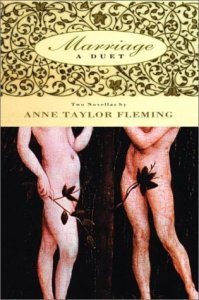 Two novellas in one volume. In “A Married Woman,” Caroline Betts’s husband, William, is in a coma after a stroke or heart attack. As she and her adult children visit him in the hospital and ponder the decision they will have to make, she remains haunted by the affair William had with one of their daughter’s friends 15 years ago. Although at the time it seemed to destroy their marriage, she stayed and they built a new relationship.
I fully expected the second novella, “A Married Man,” to give William’s perspective (like in Carol Shields’s Happenstance), but instead it’s a separate story with different characters, though still set in California c. 2000. Here the dynamic is flipped: it’s the wife who had an affair and the husband who has to try to come to terms with it. David and Marcia Sanderson start marriage therapy at New Beginnings and, with the help of Prozac and Viagra, David hopes to get past his bitterness and give in to his wife’s romantic overtures.
Fleming is a careful observer of how marriages change over time and in response to shocks, but overall I found the tone of these tales abrasive and the language slightly raunchy. 
Not quite about a marriage, but a relationship so lovely that I can’t resist including it…
Our Souls at Night by Kent Haruf (2015)
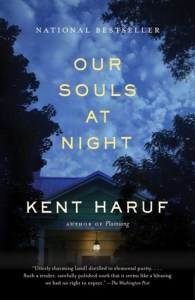 Understated, bittersweet, realistic. Perfect. I’d long meant to try Kent Haruf’s work and even had the first two Plainsong trilogy books on the shelf, but this novella, picked up secondhand at a bargain price from a charity warehouse, demanded to be read first. Fans of Elizabeth Strout’s work will find in Haruf’s Holt, Colorado an echo of her Crosby, Maine – fictional towns where ordinary folk live out their quiet triumphs and sorrows. From the first line, which opens in medias res, Haruf draws you in, making you feel as if you’ve known these characters forever: “And then there was the day when Addie Moore made a call on Louis Waters.” She has a proposal for her neighbor. She’s a widow; he’s a widower. They’re both lonely and prone to melancholy thoughts about how they could have done better by their families (“life hasn’t turned out right for either of us, not the way we expected,” Louis says). Would he like to come over to her house at nights to talk and sleep? Just two ageing creatures huddling together for comfort; no hanky-panky expected or desired.
So that’s just what they do. Before long, though, they come up against the disapproval of locals and family, especially when Addie’s grandson comes to stay and they join Louis to make a makeshift trio. The matter-of-fact prose, delivered without speech marks, belies a deep undercurrent of emotion in this story about the everyday miracle of human connection. There’s even a neat little reference to Haruf’s Benediction at the start of Chapter 34 (again like Strout, who peppered Olive, Again with cameo appearances from characters introduced in her earlier books). I also loved that the characters live on Cedar Street – I grew up on a Cedar Street. This gets my highest recommendation. 
State of the Union: A Marriage in Ten Parts by Nick Hornby (2019)
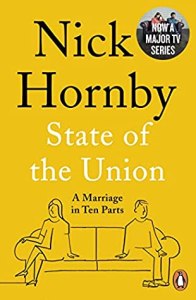 Hornby has been making quite a name for himself in film and television. State of the Union is also a TV series, and reads a lot like a script because it’s composed mostly of the dialogue between Tom and Louise, an estranged couple who each week meet up for a drink in the pub before their marriage counseling appointment. There’s very little descriptive writing, and much of the time Hornby doesn’t even need to add speech attributions because it’s clear who’s saying what in the back and forth.
The crisis in this marriage was precipitated by Louise, a gerontologist, sleeping with someone else after her sex life with Tom, an underemployed music writer, dried up. They rehash their life together, what went wrong, and what might happen next in 10 snappy chapters that are funny but also cut close to the bone. What married person hasn’t wondered where the magic went as midlife approaches? (Tom: “I hate to be unromantic, but convenient placement is pretty much the definition of marital sex.”)
Two-Part Invention: The Story of a Marriage by Madeleine L’Engle (1988)
 The fourth and final volume of the autobiographical Crosswicks Journal. This one focuses on L’Engle’s 40-year marriage to Hugh Franklin, an actor best known for his role as Dr. Charles Tyler in All My Children between 1970 and 1983. In the book’s present day, the summer of 1986, she’s worried about Hugh when his bladder cancer, which starts off seeming treatable, leads to every possible complication and deterioration. Her days are divided between home, work (speaking engagements; teaching workshops at a writers’ conference) and the hospital.
Drifting between past and present, she remembers how she and Hugh met in the 1940s NYC theatre world, their early years of marriage, becoming parents to Josephine and Bion and then, when close friends died suddenly, adopting their goddaughter, and taking on the adventure of renovating Crosswicks farmhouse in Connecticut and temporarily running the local general store. As usual, L’Engle writes beautifully about having faith in a time of uncertainty. (The title refers not just to marriage, but also to Bach pieces that she, a devoted amateur piano player, used for practice.)
A wonderful passage about marriage:
“Our love has been anything but perfect and anything but static. Inevitably there have been times when one of us has outrun the other and has had to wait patiently for the other to catch up. There have been times when we have misunderstood each other, demanded too much of each other, been insensitive to the other’s needs. I do not believe there is any marriage where this does not happen. The growth of love is not a straight line, but a series of hills and valleys. I suspect that in every good marriage there are times when love seems to be over. Sometimes these desert lines are simply the only way to the next oasis, which is far more lush and beautiful after the desert crossing than it could possibly have been without it.”
The Wife by Meg Wolitzer (2003)
 My latest book club read. On a flight to Finland, where her supposed genius writer of a husband, Joe Castleman, will accept the prestigious Helsinki Prize, Joan finally decides to leave him. When she first met Joe in 1956, she was a student at Smith College and he was her (married) creative writing professor, even though he’d only had a couple of stories published in middling literary magazines. Joan was a promising author in her own right, but when Joe left his first wife for her and she dropped out of college, she willingly took up a supporting role instead, and has remained in it for decades.
Ever since his first novel, The Walnut, a thinly veiled account of leaving Carol for Joan, Joe has produced books “populated by unhappy, unfaithful American husbands and their complicated wives.” Add on the fact that he’s Jewish and you have a Saul Bellow or Philip Roth type, a serial womanizer who’s publicly uxorious.
Alternating between the trip to Helsinki and telling scenes from earlier in their marriage, this short novel is deceptively profound. The setup may feel familiar, but Joan’s narration is bitingly funny and the points about the greater value attributed to men’s work are still valid. There’s also a juicy twist I never saw coming, as Joan decides what role she wants to play in perpetuating Joe’s literary legacy. My second by Wolitzer; I’ll certainly read more. 
Plus a DNF:
The Story of a Marriage by Andrew Sean Greer (2008)
 In 1953 in San Francisco, Pearlie Cook learns two major secrets about her husband Holland after his old friend shows up at their door. Greer tries to present another fact about the married couple as a big surprise, but had planted so many clues, starting on page 9, that I’d already guessed it and wasn’t shocked at the end of Part I as I was supposed to be. Greer writes perfectly capably, but I wasn’t able to connect with this one and didn’t love Less as much as most people did. I don’t think I’ll be trying another of his books. (I read 93 pages out of 195.)
Have you read any books about marriage recently?
Reading Ireland Month 2020: Nuala O’Faolain and More
It feels like the whole world has changed in the past week, doesn’t it? I hope you all are keeping well and turning to books for comfort and escape. Reading Ireland Month is run each March by Cathy of 746 Books. I’m wishing you a happy (if subdued) St. Patrick’s Day with this post on the Irish books I’ve been perusing recently. Even before this coronavirus situation heated up, I’d been struggling with my focus, so only one of these was a proper read, while the rest ended up being skims. In the meantime, I’m trying out a new blog design and have been working to create more intuitive menu headings and helpful intro pages.

Are You Somebody? The Accidental Memoir of a Dublin Woman by Nuala O’Faolain (1996)
 Before writing this landmark memoir, O’Faolain was a TV documentary producer and Irish Times columnist. Her upbringing in poverty is reminiscent of Frank McCourt’s: one of nine children, she had a violent father and an alcoholic mother who cheated on each other and never seemed to achieve happiness. Educated at a convent school and at university in Dublin (until she dropped out), she was a literary-minded romantic who bounced between relationships and couldn’t decide whether marriage or a career should be her highest aim. Though desperate not to become her mother – a bitter, harried woman who’d wanted to be a book reviewer – she didn’t want to miss out on a chance for love either.
O’Faolain feels she was born slightly too early to benefit from the women’s movement. “I could see sexism in operation everywhere in society; once your consciousness goes ping you can never again stop seeing that. But I was quite unaware of how consistently I put the responsibility for my personal happiness off onto men.” Chapter 16 is a standout, though with no explanation (all her other lovers were men) it launches into an account of her 15 years living with Nell McCafferty, “by far the most life-giving relationship of my life.”
Although this is in many respects an ordinary story, the geniality and honesty of the writing account for its success. It was an instant bestseller in Ireland, spending 20 weeks at number one, and made the author a household name. I especially loved her encounters with literary figures. For instance, on a year’s scholarship at Hull she didn’t quite meet Philip Larkin, who’d been tasked with looking after her, but years later had a bizarre dinner with him and his mother, both rather deaf; and David Lodge was a friend. The boarding school section reminded me of The Country Girls. Two bookish memoirs I’d recommend as readalikes are Ordinary Dogs by Eileen Battersby and Leave Me Alone, I’m Reading by Maureen Corrigan.
Skims (all: )
Actress by Anne Enright (2020)
 The Green Road is among my most memorable reads of the past five years, so I was eagerly awaiting Enright’s new novel, which is on the Women’s Prize longlist. I read the first 30 pages and found I wasn’t warming to the voice or main characters. Norah is a novelist who, prompted by an interviewer, realizes the story she most needs to tell is her mother’s. Katherine O’Dell was “a great fake,” an actress who came to epitomize Irishness even though she was actually English. Her slow-burning backstory is punctuated by trauma and mental illness. “She was a great piece of anguish, madness and sorrow,” Norah concludes. I could easily see this making the Women’s Prize shortlist and earning a Booker nomination as well. It’s the sort of book I’ll need to come back to some years down the line to fully appreciate.
Cal by Bernard MacLaverty (1983)
 As Catholics, Cal McCluskey and his father are a rarity in their community and fear attacks on their home. Resistant to join his father in working at the local abattoir, Cal spends his days doing odd jobs and lurking around the public library – he has a crush on a married librarian named Marcella. Aimless and impressionable, he’s easily talked into acting as a driver for Crilly and Skeffington, the kind of associates who have gotten him branded as “Fenian scum.” The novella reflects on the futility of cycles of violence (“If you’re not part of the solution, you’re part of the problem,” Crilly says, to which Cal replies, “But it all seems so pointless”), but is definitely a period piece. Cal is not the most sympathetic of protagonists. I didn’t enjoy this as much as the two other books I’ve read by MacLaverty.
Full Tilt: Ireland to India with a Bicycle by Dervla Murphy (1965)
 Murphy and her bike “Roz” set out on an epic Fermor-like journey in the first six months of 1963. She covered 60 to 100 miles a day, facing sunburn, punctured tires and broken ribs. She was relieved she brought a gun: it came in handy for fending off wolves, deterring a would-be rapist, and preventing bike thieves. For some reason travel books are slow, painstaking reads for me. I never got into the flow of this one, and was troubled by snap judgments about groups of people – “I know instinctively the temper of a place, after being five minutes with the inhabitants. … the Afghans are, on balance, much dirtier in clothes, personal habits and dwellings than either the Turks or Persians.” Murphy does have a witty turn of phrase, though, e.g. “I suppose I’ll get used to it but at the moment I wouldn’t actually say that camel’s milk is my favourite beverage.”
My Father’s Wake: How the Irish Teach Us to Live, Love and Die by Kevin Toolis (2017)
 Toolis is a journalist and filmmaker from Dookinella, on an island off the coast of County Mayo. His father Sonny’s pancreatic cancer prompted him to return to the ancestral village and reflect on his own encounters with death. As a young man he had tuberculosis and stayed on a male chest ward with longtime smokers; despite a bone marrow donation, his older brother Bernard died from leukemia.
As a reporter during the Troubles and in Malawi and Gaza, Toolis often witnessed death, but at home in rural Ireland he saw a model for how it should be: accepted, and faced with the support of a whole community. People made a point of coming to see Sonny as he was dying. Keeping the body in the home and holding a wake are precious opportunities to be with the dead. Death is what’s coming for us all, so why not make its acquaintance? Toolis argues.
I’ve read so much around the topic that books like this don’t stand out anymore, and while I preferred the general talk of death to the family memoir bits, it also made very familiar points. At any rate, his description of his mother’s death is just how I want to go: “She quietly died of a heart attack with a cup of tea and a biscuit on a sunny May morning.”
What have you been picking up for Reading Ireland Month?
Farewell to Winter with Some Snowy and Icy Reads
Although we got plenty of cold, damp weather and gray skies, it feels like we were cheated out of winter in my part of England this year. We had just one snow flurry on the 27th of February; that will have to suffice as my only taste of proper winter for the year. Not to worry, though: I’ve been getting my fix of snow and ice through my reading, starting with two animal tales and moving on to a few travel and adventure books.
Fiction:
The Snow Goose by Paul Gallico (1941)
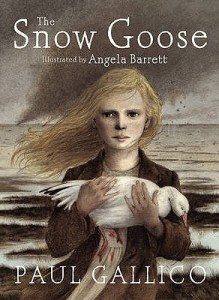 Philip Rhayader is a lonely bird artist on the Essex marshes by an abandoned lighthouse. “His body was warped, but his heart was filled with love for wild and hunted things. He was ugly to look upon, but he created great beauty.” One day a little girl, Fritha, brings him an injured snow goose and he puts a splint on its wing. The recovered bird becomes a friend to them both, coming back each year to spend time at Philip’s makeshift bird sanctuary. As Fritha grows into a young woman, she and Philip fall in love (slightly creepy), only for him to leave to help with the evacuation of Dunkirk. This is a melancholy and in some ways predictable little story. It was originally published in the Saturday Evening Post in 1940 and became a book the following year. I read a lovely version illustrated by Angela Barrett. It’s the second of Gallico’s animal fables I’ve read; I slightly preferred The Small Miracle.
The Snow Cat by Holly Webb (2016)

Most twee cover ever?
My second from Holly Webb, and while I enjoyed it a lot, if not quite as much as Frost, I probably don’t need to read any more by her now because these two were so similar as to reveal a clear formula: a young girl of about nine years old who plays alone (because she’s an only child or left out of her siblings’ games) goes for an outdoor adventure and meets a cute animal who leads her back into the past. For a time it’s unclear whether she’s dreaming or really experiencing the history, but at the end there’s some physical token that proves she has been time travelling.
In this case, Bel goes to play in the snowy garden of her grandmother’s retirement complex and meets a white cat named Snow who belongs to Charlotte, the daughter of the family who owned this manor house 150 years ago. Bel has to protect Snow from a threatening dog so the cat can be brought in to visit Charlotte’s sister Lucy, who lies ill with influenza. For me the Victorian setting wasn’t quite as authentic or interesting as the seventeenth-century frost fair was in Frost, but I can see how it’s a good way of introducing kids to what was different in the past: everything from clothing and speech to the severity of illness. 
Nonfiction:
The Snow Tourist by Charlie English (2008)
 “A Search for the World’s Purest, Deepest Snowfall” reads the subtitle on the cover. English set out from his home in London for two years of off-and-on travel in snowy places, everywhere from Greenland to Washington State. In Jericho, Vermont, he learns about Wilson Bentley, an amateur scientist who was the first to document snowflake shapes through microscope photographs. In upstate New York, he’s nearly stranded during the Blizzard of 2006. He goes skiing in France and learns about the deadliest avalanches – Britain’s worst was in Lewes in 1836. In Scotland’s Cairngorms, he learns how those who work in the ski industry are preparing for the 60–80% reduction of snow predicted for this century. An appendix dubbed “A Snow Handbook” gives some technical information on how snow forms, what the different crystal shapes are called, and how to build an igloo, along with whimsical lists of 10 snow stories (I’ve read six), 10 snowy films, etc.
I found all of the science and history interesting, but especially liked a chapter on depictions of snow in art, such as Pieter Bruegel the Elder’s The Hunters in the Snow. The author also subtly threads in his own story, noting that this quest probably began with the 1960s photograph of himself on skis at a snowy Austrian resort that his father gave him a few weeks before he committed suicide. Twelve years later, it feels like this book doesn’t go far enough in cautioning about all that will be lost with climate change. I was left with the sense that nature is majestic and unpredictable, and we pay the price for not respecting it.

Hunters in the Snow. Pieter Bruegel the Elder / Public domain.
[Breaking from alphabetical order to include this one as a footnote to the previous book.]
The Library of Ice by Nancy Campbell (2018)
 This has a very similar format and scope to The Snow Tourist, with Campbell ranging from Greenland and continental Europe to the USA in her search for the science and stories of ice. For English’s chapter on skiing, substitute a section on ice skating. I only skimmed this one because – in what I’m going to put down to a case of reader–writer mismatch – I started it three times between November 2018 and now and could never get further than page 60. See these reviews from Laura and Liz for more enthusiasm.
My thanks to Scribner UK for the free copy for review.
Winterdance: The Fine Madness of Running the Iditarod by Gary Paulsen (1994)
Paulsen’s name was familiar to me from his children’s books – a tomboy, I spent my childhood fascinated by Native American culture, survival skills and animals, and Hatchet was one of my favorite novels. I had no idea he had written books for adults, including this travelogue of competing in the Iditarod sled dog race across the frozen Alaska wilderness. Nearly half the book is devoted to his preparations, before he ever gets to Alaska. He lived in Minnesota and took time assembling what he thought of as a perfect team of dogs, from reliable Cookie, his lead dog, to Devil, whose name says it all. He even starts sleeping in the kennel with the dogs to be fully in tune with them.
 The travails of his long trial runs with the dogs – the sled flipping over, having to walk miles after losing control of the dogs, being sprayed in the face by multiple skunks – sound bad enough, but once the Iditarod begins the misery ramps up. The course is nearly 1200 miles, over 17 days. It’s impossible to stay warm or get enough food, and a lack of sleep leads to hallucinations. At one point he nearly goes through thin ice. At another he’s run down by a moose. He also watches in horror as a fellow contestant kicks a dog to death.
Paulsen concludes that you would have to be insane to run the Iditarod, and there’s an appropriately feverish intensity running through the book. The way he describes the bleak beauty of the landscape, you can see how attractive and forbidding it was all at the same time. This is just the kind of adventurous armchair traveling I love (see also This Cold Heaven) – someone else did this, so now I don’t have to!
(Note: The author completed two races and was training for his third when a diagnosis of coronary heart disease ended his Iditarod career in his mid-forties. More than the obsession, more than the competition, he knows that he’ll miss the constant company of dogs. In fact, his last line is “How can it be to live without the dogs?”)
See also these recent releases:
- Snow, Dog, Foot by Claudio Morandini, an avalanche novel set in the Italian Alps
 Two nonfiction books entitled Wintering: Katherine May’s is about depression and Stephen Rutt’s is about geese
And a snowy passage from Winter Journal by Paul Auster:
Snow, so much snow these past days and weeks that fifty-six inches have fallen on New York in less than a month. Eight storms, nine storms, you have lost track by now, and all through January the song heard most often in Brooklyn has been the street music made by shovels scraping against sidewalks and thick patches of ice. Intemperate cold (three degrees one morning), drizzles and mizzles, mist and slush, ever-aggressive winds, but most of all the snow, which will not melt, and as one storm falls on top of another, the bushes and trees in your back garden are all wearing ever-longer and heavier beards of snow. Yes, it seems to have turned into one of those winters, but in spite of the cold and discomfort and your useless longing for spring, you can’t help admiring the vigor of these meteorological dramas, and you continue to look at the falling snow with the same awe you felt when you were a boy.
Did you read any particularly wintry books this season?
Five Early March Releases: Jami Attenberg, Tayari Jones and More
Last week was one of the biggest weeks in the UK’s publishing year. Even though I’ve cut down drastically on the number of review books I’m receiving in 2020, I still had six on my shelf with release dates last week. Of course, THE biggest title out on the 5th was The Mirror and the Light, the final volume in Hilary Mantel’s Thomas Cromwell trilogy, which I’m eagerly awaiting from the library – I’m #3 in a holds queue of 34 people, but there are three copies, all showing as “Received at HQ,” so mine should come in any day now.
But for those who are immune to Mantel fever, or just seeking other material, there’s plenty to keep you busy. I give short reviews of five books today: a couple of dysfunctional family stories, two very different graphic novels and some feminist nonfiction.
All This Could Be Yours by Jami Attenberg
(Published by Serpent’s Tail on the 5th; came out in the USA from Houghton Mifflin in October)
Most of the action in Attenberg’s seventh book takes place on one day, as 73-year-old Victor Tuchman, struck down by a heart attack, lies on his deathbed in a New Orleans hospital. There’s more than a whiff of Trump about Victor, who has a shadowy mobster past and was recently hit with 11 sexual harassment charges. Forced to face the music for the first time, he fled Connecticut with his wife Barbra, citing the excuse of wanting to live closer to their son Gary in Louisiana. Victor had been abusive to Barbra throughout their marriage, and was just as violent in his speech: he could crush their daughter Alex with one remark on her weight.
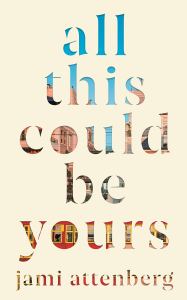 So no one is particularly sad to see Victor dying. Alex goes through the motions of saying goodbye and telling her father she forgives him, knowing she doesn’t mean a word. Meanwhile, Gary is AWOL on a work trip to California, leaving his wife Twyla to take his place at Victor’s bedside. Twyla’s newfound piety is her penance for a dark secret that puts her at the heart of the family’s breakdown.
Attenberg spends time with each family member on this long day supplemented by flashbacks, following Alex from bar to bar in downtown New Orleans as she tries to drown her sorrows and exploring other forms of addiction through Barbra (redecorating; not eating or ageing) and Twyla – in a particularly memorable scene, she heaps a shopping cart full of makeup at CVS and makes it all the way to the checkout before she snaps out of it. There’s also an interesting pattern of giving brief glimpses into the lives of the incidental characters whose paths cross with the family’s, including the EMT who took Victor to the hospital.
This is a timely tragicomedy, realistic and compassionate but also marked by a sardonic tone. Although readers only ever see Victor through other characters’ eyes, any smug sense of triumph they may feel about seeing the misbehaving, entitled male brought low is tempered by the extreme sadness of what happens to him after his death. I didn’t love this quite as much as The Middlesteins, but for me it’s a close second out of the four Attenberg novels I’ve read. She’s a real master of the dysfunctional family novel.
My thanks to the publisher for the free copy for review.
Silver Sparrow by Tayari Jones (2011)
(Published for the first time in the UK by Oneworld on the 5th)
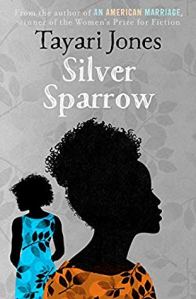 Speaking of messed-up families … Growing up in 1980s Atlanta, Dana and Chaurisse both call James Witherspoon their father – but Chaurisse’s mother doesn’t even know that Dana exists. Dana’s mother, however, has always been aware of her husband’s other family. That didn’t stop her from agreeing to a quick marriage over the state line. Jones establishes James’s bigamy in the first line; the rest of the novel is mostly in two long sections, the first narrated by Dana and the second by Chaurisse. Both girls recount how their parents met, as well as giving a tour through their everyday life of high school and boyfriends.
I was eager to read this after enjoying Jones’s Women’s Prize winner, An American Marriage, so much. Initially I liked Dana’s narration as she elaborates on her hurt at being in a secret family. The scene where she unexpectedly runs into Chaurisse at a science fair and discovers their father bought them matching fur coats is a highlight. But by the midpoint the book starts to drag, and Chaurisse’s voice isn’t distinct enough for her narration to add much to the picture. A subtle, character-driven novel about jealousy and class differences, this failed to hold my interest. Alternating chapters from the two girls might have worked better?
My thanks to the publisher for the proof copy for review.
New graphic novels from SelfMadeHero:
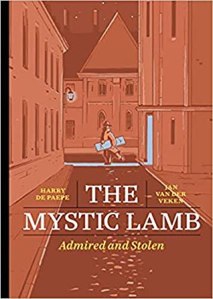 The Mystic Lamb: Admired and Stolen by Harry De Paepe and Jan Van Der Veken
[Translated by Albert Gomperts]
I’ve been to Ghent, Belgium twice. Any visitor will know that one of the city’s not-to-be-missed sights is the 15th-century altarpiece in St Bavo’s Cathedral, Jan van Eyck’s Adoration of the Mystic Lamb. On our first trip we bought timed tickets to see this imposing and vibrantly colored multi-paneled artwork, which depicts various figures and events from the Bible as transplanted into a typically Dutch landscape. De Paepe gives a comprehensive account of the work’s nearly six-century history.

Ghent altarpiece (Jan van Eyck / Public domain)
It’s been hidden during times of conflict or taken away as military spoils; it’s been split into parts and sold or stolen; it narrowly escaped a devastating fire. Overall, there was much more detail here than I needed, and far fewer illustrations than I expected. If you have a special interest in art history, you may well enjoy this. Just bear in mind that, although marketed as a graphic novel, it is mostly text.
Thoreau and Me by Cédric Taling
[Translated by Edward Gauvin]
 I can’t seem to get away from Henry David Thoreau in my recent reading. Last year I reviewed for the TLS two memoirs that consciously appropriated the 19th-century environmentalist’s philosophy and language; the other night I found mentions of Thoreau in a Wallace Stegner novel, a new nature book by Lucy Jones, and travel books by Nancy Campbell and Charlie English. So I knew I had to read this debut graphic novel (but is it a memoir or autofiction?) about a Paris painter who is plagued by eco-anxiety and plans to build his own off-grid home in the woods.
Cédric and his middle-class friends are assailed by “white hipster guilt.” A brilliant sequence has a dinner party discussion descend into a cacophony of voices as they list the ethical minefields they face. Though Cédric wishes he were a prepared alpha male with advanced survival skills that could save his family, his main strategy seems to be panic buying cold-weather gear. Thoreau, depicted sometimes as a wolf or faun and always with a thin, tubular mosquito’s nose (like a Socratic gadfly?), comes to him as an invisible friend and guru, with quotes from Walden and his journal appearing in jagged speech bubbles. This was a good follow-up to Jenny Offill’s Weather with its themes of climate-related angst and perceived helplessness. I enjoyed the story even though I found the drawing style slightly grotesque.

My thanks to the publisher for the free copies for review.
And one extra:
 The Home Stretch: Why It’s Time to Come Clean about Who Does the Dishes by Sally Howard
(Published by Atlantic Books on the 5th)
I only gave this feminist book about the domestic labor gap a quick skim as, unfortunately, it repeats a lot of the examples and statistics that were familiar to me from works like Invisible Women by Caroline Criado-Pérez (e.g. the Iceland women’s strike in the 1970s) and Fair Play by Eve Rodsky. The only chapter that stood out for me somewhat was about the “yummy mummy” stereotype perpetuated by the likes of Jools Oliver and Gwyneth Paltrow.
My thanks to the publisher for the proof copy for review.
What recent releases can you recommend?
Dylan Thomas Prize Blog Tour: Things We Say in the Dark by Kirsty Logan
It’s an honour to be kicking off the official Swansea University International Dylan Thomas Prize 2020* blog tour with a post introducing and giving an excerpt from one of this year’s longlisted titles, the short story collection Things We Say in the Dark by Kirsty Logan.

Many of these 20 stories twist fairy tale imagery into nightmarish scenarios, enumerating fears of bodies and pregnancies going wrong. Body parts are offered as tokens of love or left behind as the sole evidence of an abduction. Ghosts and corpses are frequent presences. I also recognized some of the same sorts of Celtic sea legends that infuse Logan’s debut novel, The Gracekeepers.
Some stories are divided into multiple parts by headings or point-of-view changes. Others are in unusual formats like footnotes, a questionnaire, bullet-pointed lists, or a couple’s contrasting notes on house viewings. The titles can be like mini-tales in their own right, e.g. “Girls Are Always Hungry when All the Men Are Bite-Size” and “The Only Thing I Can’t Tell You Is Why.”
In between the stories are italicized passages that seem to give context on Logan’s composition process, including her writing retreat in Iceland – but it turns out that this is a story, too, split into pieces and shading from autobiography into fiction.
Full of magic realism and gentle horror, this is a book for fans of Salt Slow and The Doll’s Alphabet.
My favourite story was “Things My Wife and I Found Hidden in Our House,” about a series of objects Rain and her wife Alice find in the derelict house Alice’s granny has left them. Here’s an excerpt from the story to whet your appetite:
- A KNIFE
I wasn’t surprised when Alice and I found the long thin silver knife wrapped in blackened grot beneath the floorboards. It wasn’t easy: to find it we’d had to pull up just about every rotting, stinking board in the house, our hands slick with blood and filth. Alice had told me that a silver knife through the heart is the only way to kill a kelpie, so if Alice’s gran really had killed it, the knife was likely to be there somewhere. Her mistake, her haunting, was in keeping the thing. As proof? A memento? We’d never know. Then again, we knew that her bathtub drowning was due to a stroke. So I guess you can never really know anything.
Alice and I gathered up the ring and the paper and the horse and the pearls and the hair and the glass jar and the knife, and we put them all in a box. We drove for hours until we got to the coast, to the town where Alice’s gran and her grandad and the first wife had all lived, and we climbed to the highest cliff and we threw all the things into the sea.
Together we drove back to the house, holding hands between the front seats. A steady calm grew in our hearts; we knew that it was over, that we had cleansed the house and ourselves, that we had proven women’s love was stronger than women’s hate.
- MORE
Approaching the front door, key outstretched, hands still held, hearts grown sweet, Alice and I stopped. Our hands unlinked. The doorknob was wrapped all around with layers of long black hair.
My thanks to Midas PR for the free copy for review, and to Harvill Secker for permission to reprint an excerpt.
*The Swansea University International Dylan Thomas Prize recognizes the best published work in the English language written by an author aged 39 or under. All literary genres are eligible, so there are poetry collections nominated as well as novels and short stories. The other 11 books on this year’s longlist are:
- Surge, Jay Bernard
- Flèche, Mary Jean Chan (my review)
- Exquisite Cadavers, Meena Kandasamy
- Black Car Burning, Helen Mort
- Virtuoso, Yelena Moskovich
- Inland, Téa Obreht
- Stubborn Archivist, Yara Rodrigues Fowler (my review)
- If All the World and Love Were Young, Stephen Sexton
- The Far Field, Madhuri Vijay
- On Earth We’re Briefly Gorgeous, Ocean Vuong
- Lot, Bryan Washington
The official blog tour runs this month and into April, with multiple bloggers covering each book. At the end of March, I’ll also be reviewing the poetry collection by Stephen Sexton.
Adventures in Rereading: Julian Barnes and Jennifer Egan
My last two rereads ended up being as good as or better than they had been the first time around; these two, however, failed to live up to my memory of them, one of them dramatically so. My increased literary experience and/or the advance of years meant these works felt less fresh than they did the first time around.
Flaubert’s Parrot by Julian Barnes (1984)
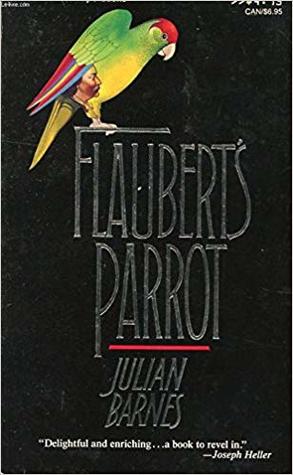 Barnes is in my trio of favorite authors, along with A. S. Byatt and David Lodge. He’s an unapologetic intellectual and a notable Francophile who often toggles between England and France, especially in his essays and short stories. This was his third novel and riffs on the life and works of Gustave Flaubert, best known for Madame Bovary.
Odd-numbered chapters build a straightforward narrative as Geoffrey Braithwaite, a widower, retired doctor and self-described “senile amateur scholar,” travels to Rouen for five days to see the sites associated with Flaubert and becomes obsessed with determining which of two museum-held stuffed parrots Flaubert used as his inspiration while writing the story “A Simple Heart.” Even-numbered chapters, however, throw in a variety of different formats: a Flaubert chronology, a bestiary, an investigation of the contradictory references to Emma Bovary’s eye color, a dictionary of accepted ideas, an examination paper, and an imagined prosecutor’s case against the writer.
There are themes and elements here that recur in much of Barnes’s later work:
- History – what remains of a life? (“He died little more than a hundred years ago, and all that remains of him is paper.”)
- Love versus criticism of one’s country (“The greatest patriotism is to tell your country when it is behaving dishonourably, foolishly, viciously.”)
- Time and its effects on relationships and memory
- How life is transmuted into art
- Languages and wordplay
- Bereavement
Indeed, I was most struck by Chapter 13, “Pure Story,” in which Dr. Braithwaite finally comes clean about his wife’s death and the complications of their relationship. Barnes writes about grief so knowingly and with such nuance, yet his own wife, Pat Kavanagh, didn’t die until 2008. Much of what he’s published since then has dwelt on loss, but more than two decades earlier he was already able to inhabit that experience in his imagination.
As a 22-year-old graduate student, I gobbled this up even though I knew very little about French literature and history and hadn’t yet read any Flaubert. I wasn’t quite as dazzled by the literary and biographical experimentation this time. While I still admired the audacity of the novel, I wouldn’t call it a personal favorite any longer. I think others of Barnes’s works will resonate for me more on a reread.
My original rating (c. 2006):
My rating now:
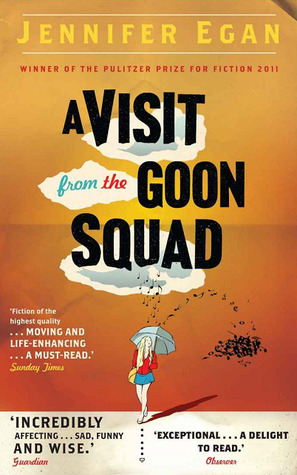
A Visit from the Goon Squad by Jennifer Egan (2010)
This makes up a pleasing pair as it shares Barnes’s experimentation with form and meditation on time. Before my reread I only remembered that it was about washed-up musicians and that there was one second-person chapter and another told as a PowerPoint presentation. Looking back at my original review, I see I was impressed by how Egan interrogated “society’s obsession with youth and celebrity, the moments of decision that can lead to success or to downfall … and the way time (the ‘goon’ of the title) and failure can wear away at one’s identity.” Back then I called the Pulitzer Prize-winning novel “achingly fresh, contemporary and postmodern. It is, in fact, so up-to-the-minute that one wonders how long that minute can last.” I was right to question its enduring appeal: this time I found the book detached, show-offy and even silly in places, and the characterization consistently left me cold.
 This was probably the first linked short story collection I ever read (now a favorite subgenre), and the first time I’d encountered second-person narration in fiction, so it’s no wonder I was intrigued. “Each chapter involves a very clever shift in time period and point of view,” I noted in 2011. This time, though, I found the 1970s–2020s timeline unnecessarily diffuse, and I was so disinterested in most of the characters – kleptomaniac PA Sasha, post-punk music producer Bennie, musician turned janitor turned children’s performer Scotty, a disgraced journalist, a starlet, and so on – that I didn’t care to revisit them.
The chapter in which Scotty catches a fish and takes it into Bennie’s office was a favorite, along with the PowerPoint presentation Sasha’s daughter puts together on the great pauses of rock music (while also revealing a lot about her family dynamic), but I found the segment on PR attempts to burnish an African general’s reputation far-fetched and ended up mostly skimming five of the last six chapters.
This was a buddy read with Laura T. (see her review); we came to similar conclusions: this may have felt fresh and even prescient about technology in 2010–11, but it didn’t stand up to a reread; still, we’ll keep our copies if just for the 75-page PowerPoint presentation.
Note: Egan has said that her next project is a companion piece to Goon Squad that uses a similar structure and follows some of its peripheral characters into new territory. Based on this rereading experience, I don’t think I’ll seek out the sequel.
My original rating (June 2011):
My rating now:
To reread next: Everything Is Illuminated by Jonathan Safran Foer and On Beauty by Zadie Smith
Done any rereading lately?
Four February Releases: Napolitano, Offill, Smyth, Sprackland
Much as I’d like to review books in advance of their release dates, that doesn’t seem to be how things are going this year. I hope readers will find it useful to learn about recent releases they might have missed. This month I’m featuring a post-plane crash scenario, a reflection on modern anxieties, an essay about the human–birds relationship, and a meditation on graveyards.
Dear Edward by Ann Napolitano
(Published by Penguin/Viking on the 20th; came out in USA from Dial Press last month)
 June 2013: a plane leaves Newark Airport for Los Angeles, carrying 192 passengers. Five hours after takeoff, it crashes in the flatlands of northern Colorado, a victim to stormy weather and pilot error. Only 12-year-old Edward Adler is found alive in the wreckage. In alternating storylines, Napolitano follows a select set of passengers (the relocating Adler family, an ailing tycoon, a Wall Street playboy, an Afghanistan veteran, a Filipina clairvoyant, a pregnant woman visiting her boyfriend) in their final hours, probing their backstories to give their soon-to-end lives context (and meaning?), and traces the first six years of the crash’s aftermath for Edward.
While this is an expansive and compassionate novel that takes seriously the effects of trauma and the difficulty of accepting random suffering, I found that I dreaded returning to the plane every other chapter – I have to take regular long-haul flights to see my family, and while I don’t fear flying, I also don’t need anything that elicits catastrophist thinking. I would read something else by Napolitano (she’s written a novel about Flannery O’Connor, for instance), but I can’t imagine ever wanting to open this up again.
I picked up a proof copy at a Penguin Influencers event.
Weather by Jenny Offill
(Published by Knopf [USA] on the 11th and Granta [UK] on the 13th)
 Could there be a more perfect book for 2020? A blunt, unromanticized but wickedly funny novel about how eco-anxiety permeates everyday life, Weather is written in the same aphoristic style as Offill’s Dept. of Speculation but has a more substantial story to tell. Lizzie Benson is married with a young son and works in a New York City university library. She takes on an informal second job as PA to Sylvia, her former professor, who runs a podcast on environmental issues and travels to speaking engagements.
Set either side of Trump’s election, the novel amplifies many voices prophesying doom, from environmentalists to Bible-thumpers (like Lizzie’s mother) to those who aren’t sure they’ll even make it past tomorrow (like her brother, a highly unstable ex-addict who’s having a baby with his girlfriend). It’s a wonder it doesn’t end up feeling depressing. Lizzie’s sardonic narration is an ideal way of capturing relatable feelings of anger and helplessness, cringing fear and desperate hope. Don’t expect to come away with your worries soothed, though there is some comfort to be found in the feeling that we’re all in this together.
Favorite lines:
“Young person worry: What if nothing I do matters? Old person worry: What if everything I do does?”
“Once sadness was considered one of the deadly sins, but this was later changed to sloth. (Two strikes then.)”
“My husband is reading the Stoics before breakfast. That can’t be good, can it?”
I read an e-ARC via Edelweiss.
An Indifference of Birds by Richard Smyth
(Published by Uniformbooks on the 14th)
 Birds have witnessed the whole of human history, sometimes profiting from our behavior – our waste products provide them with food, our buildings can be handy nesting and hunting platforms, and our unintentional wastelands and demilitarized zones turn into nature reserves – but more often suffering incidental damage. That’s not even considering our misguided species introductions and the extinctions we’ve precipitated. Eighty percent of bird species are now endangered. For as minimal as the human fossil record will be, we have a lot to answer for.
From past to future, archaeology to reintroduction and de-extinction projects, this is a wide-ranging essay that still comes in at under 100 pages. It’s a valuable shift in perspective from human-centric to bird’s-eye view. The prose is not at all what I’ve come to expect from nature writing (earnest, deliberately lyrical); it’s more rhetorical and inventive, a bit arch but still passionate – David Foster Wallace meets Virginia Woolf? The last six paragraphs, especially, soar into sublimity. A niche book, but definitely recommended for bird-lovers.
Favorite lines:
“They must see us, watch us, from the same calculating perspective as they did two million years ago. We’re still galumphing heavy-footed through the edgelands, causing havoc, small life scattering wherever we tread.”
“Wild things lease these places from a capricious landlord. They’re yours, we say, until we need them back.”
I pre-ordered my copy directly from the publisher.
These Silent Mansions: A life in graveyards by Jean Sprackland
(Published by Jonathan Cape on the 6th)
 I’m a big fan of Sprackland’s beachcombing memoir, Strands, and have also read some of her poetry. Familiarity with her previous work plus a love for graveyards induced me to request a copy of her new book. In it she returns to the towns and cities she has known, wanders through their graveyards, and researches and imagines her way into the stories of the dead. For instance, she finds the secret burial place of persecuted Catholics in Lancashire, learns about a wrecked slave ship in a Devon cove, and laments two dead children whose bodies were sold for dissections in 1890s Oxford. She also remarks on the shifts in her own life, including the fact that she now attends more funerals than weddings, and the displacement involved in cremation – there is no site she can visit to commune with her late mother.
I most enjoyed the book’s general observations: granite is the most prized headstone material, most graves go unvisited after 15 years, and a third of Britons believe in angels despite the country’s overall decline in religious belief. I also liked Sprackland’s list of graveyard charms she has seen. While I applaud any book that aims to get people thinking and talking about death, I got rather lost in the historical particulars of this one.
Favorite lines:
“This is the paradox at the heart of our human efforts to remember and memorialise: the wish to last forever, and the knowledge that we are doomed to fail.”
“Life, under such a conscious effort of remembering, sometimes resembles a series of clumsy jump-cuts rather than one continuous narrative.”
My thanks to the publisher for the free copy for review.
What recent releases can you recommend?
Paul Auster Reading Week: Oracle Night and Report from the Interior
Paul Auster Reading Week continues! Be sure to check out Annabel’s excellent post on why you should try Auster. On Monday I reviewed Winter Journal and the New York Trilogy. Adding in last year’s review of Timbuktu, I’ve now read six of Auster’s books and skimmed another one (the sequel to Winter Journal). It’s been great to have this project as an excuse to get more familiar with his work and start to recognize some of the recurring tropes.
Oracle Night (2003)
This reminded me most of The Locked Room, the final volume of the New York Trilogy. There’s even a literal locked room in a book within the book by the narrator, a writer named Sidney Orr. It’s 1982 and Orr is convalescing from a sudden, life-threatening illness. At a stationer’s shop, he buys a fine blue notebook from Portugal, hoping its beauty will inspire him to resume his long-neglected work. When he and his wife Grace go to visit John Trause, Grace’s lifelong family friend and a fellow novelist, Orr learns that Trause uses the same notebooks. Only the blue ones, mind you. No other color fosters the same almost magical creativity.
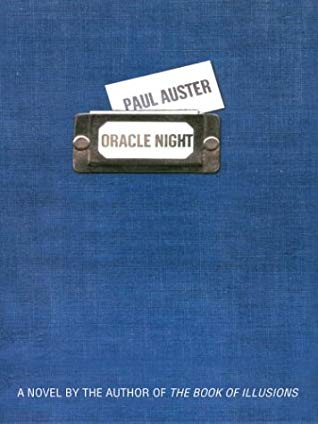 For long stretches of the novel, Orr is lost in his notebook (“I was there, fully engaged in what was happening, and at the same time I wasn’t there—for the there wasn’t an authentic there anymore”), writing in short, obsessive bursts. In one project, a mystery inspired by an incident from The Maltese Falcon, Nick Bowen, a New York City editor, has a manuscript called Oracle Night land on his desk. Spooked by a near-death experience, he flees to Kansas City, where he gets a job working on a cabdriver’s phone book archive, “The Bureau of Historical Preservation,” which includes a collection from the Warsaw ghetto. But then he gets trapped in the man’s underground bunker … and Orr has writer’s block, so leaves him there. Even though it’s fiction (within fiction), I still found that unspeakably creepy.
In the real world, Orr’s life accumulates all sorts of complications over just nine September days. Some of them are to do with Grace and her relationship with Trause’s family; some of them concern his work. There’s a sense in which what he writes is prescient. “Maybe that’s what writing is all about, Sid,” Trause suggests. “Not recording events from the past, but making things happen in the future.” The novel has the noir air I’ve come to expect from Auster, while the layering of stories and the hints of the unexplained reminded me of Italo Calvino and Haruki Murakami. I even caught a whiff of What I Loved, the novel Auster’s wife Siri Hustvedt published the same year. (It wouldn’t be the first time I’ve spotted similar themes in husband‒wife duos’ work – cf. Jonathan Safran Foer and Nicole Krauss; Zadie Smith and Nick Laird.)
This is a carefully constructed and satisfying novel, and the works within the work are so absorbing that you as the reader get almost as lost in them as Orr himself does. I’d rank this at the top of the Auster fiction I’ve read so far, followed closely by City of Glass.
Report from the Interior (2013)
This sequel to Winter Journal came out a year later. Again, the autobiographical rendering features second-person narration and a fragmentary style. I had a ‘been there, done that’ feeling about the book and only gave it a quick skim. It might be one to try another time.
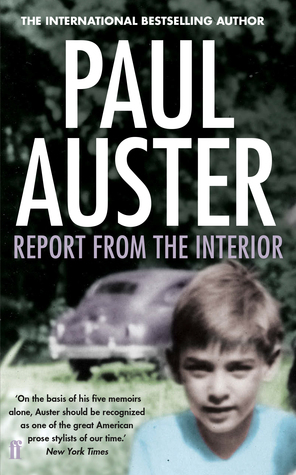 In the first 100-page section Auster highlights key moments from the inner life of a child. For instance, he remembers that the epiphany that a writer can inhabit another mind came while reading Robert Louis Stevenson’s poetry, and he emulated RLS in his own first poetic attempts. The history and pop culture of the 1950s, understanding that he was Jewish, and reaping the creative rewards of boredom are other themes. I especially liked a final anecdote about smashing his seventh-grade teacher’s reading challenge and being driven to tears when the man disbelieved that he’d read so many books and accused him of cheating.
Other sections give long commentary on two films (something he also does in Winter Journal with 10 pages on the 1950 film D.O.A.), select from letters he wrote to his first wife in the late 1960s while living in Paris, and collect an album of black-and-white period images such as ads, film stills and newspaper photographs. There’s a strong nostalgia element, such that the memoir would appeal to Auster’s contemporaries and those interested in learning about growing up in the 1950s.
Ultimately, though, this feels unnecessary after Winter Journal. Auster repeats a circular aphorism he wrote at age 20: “The world is in my head. My body is in the world. You will stand by that paradox, which was an attempt to capture the strange doubleness of being alive, the inexorable union of inner and outer”. But I’m not sure that body and mind can be so tidily separated as these two works posit. I got more of an overall sense of Auster’s character from the previous book, even though it was ostensibly focused on his physical existence.
The library at the university where my husband works holds another four Auster novels, but I’ll wait until next year to dive back into his work. After reading other people’s reviews, I’m now most keen to try The Brooklyn Follies, Invisible and In the Country of Last Things.
 Bookish Beck = Rebecca Foster. American transplant to England. Freelance proofreader and book reviewer.
 Bookish Beck