Winter Reading, Part II: “Snow” Books by Coleman, Rice & Whittell
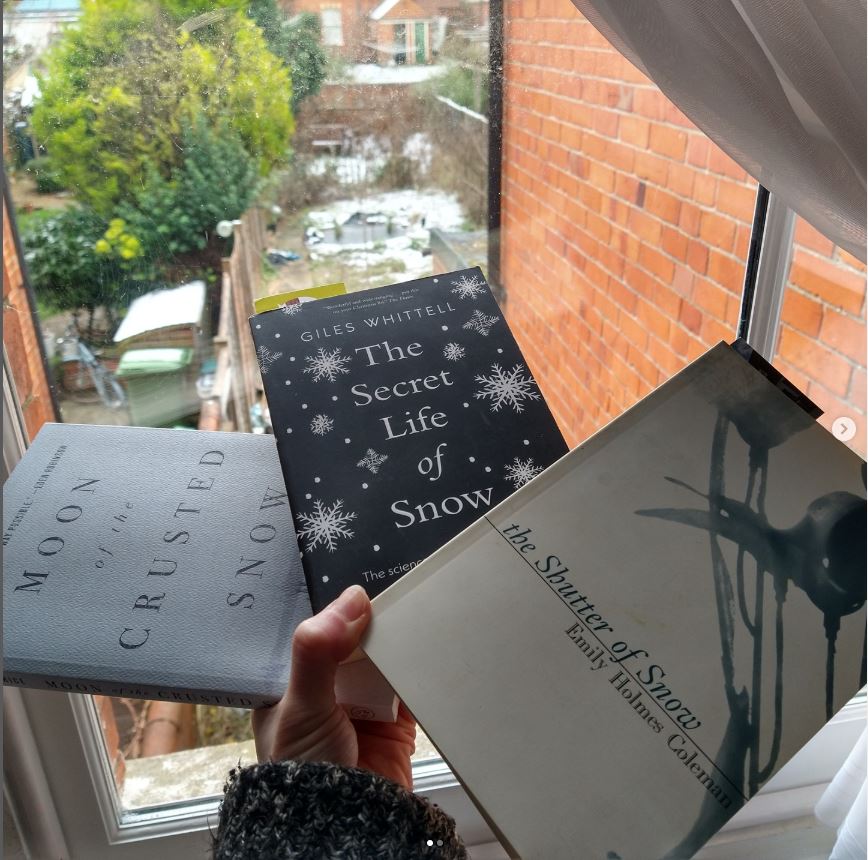
Here I am squeaking in on the day before the spring equinox – when it’s predicted to be warmer than Ibiza here in southern England, as headlines have it – with a few snowy reads that have been on my stack for much of the winter. I started reading this trio when we got a dusting back in January, in case (as proved to be true) it was our only snow of the year. I have an arresting work of autofiction that recreates a period of postpartum psychosis, a mildly dystopian novel by a First Nations Canadian, and a snow-lover’s compendium of science and trivia.
 As it happens, I’ll be starting the spring in the middle of We Do Not Part by Han Kang, which is austerely beautiful and eerily snowy: its narrator traverses a blizzard to rescue her friend’s pet bird; and the friend’s mother recalls a village massacre that left piles of snow-covered corpses. Here Kang muses on the power of snow:
Snow had an unreality to it. Was this because of its pace or its beauty? There was an accompanying clarity to snow as well, especially snow, drifting snow. What was and wasn’t important were made distinct. Certain facts became chillingly apparent. Pain, for one.
The Shutter of Snow by Emily Holmes Coleman (1930)
 Coleman (1899–1974), an expatriate American poet, was part of the Paris literary milieu in the 1920s and then the London scene of the 1930s. (She worked with T.S. Eliot on editing Djuna Barnes’s Nightwood, for instance.) This novella, her only published work of fiction, was based on her experience of giving birth to her son in 1924, suffering from puerperal fever and a mental breakdown, and being incarcerated in Rochester State Hospital. Although the portrait of Marthe Gail is in the omniscient third person, the stream-of-consciousness style – no speech marks or apostrophes, minimal punctuation – recalls unreliable first-person narration. Marthe believes she is Jesus Christ. Her husband Christopher visits occasionally, hoping she’ll soon be well enough to come home to their baby. It’s hard to believe this was written a century ago; I could imagine it being published tomorrow. It is absolutely worth rediscovering. While I admired the weird lyrical prose (“in his heart was growing a stern and ruddy pear … He would make of his heart a stolen marrow bone and clutch snow crystals in the night to his liking”; “This earth is made of tar and every morsel is stuck upon it to wither … there were orange peelings lying in the snow”), the interactions between patients, nurses and doctors got tedious. (Secondhand – Community Furniture Project, Newbury)
Moon of the Crusted Snow by Waubgeshig Rice (2018)
 A mysterious total power outage heralds not just the onset of winter or a temporary crisis but the coming of a new era. For this Anishinaabe community, it will require a return to ancient nomadic, hunter-gatherer ways. I was expecting a sinister dystopian; while there are rumours of a more widespread collapse, the focus is on adaptation versus despair, internal resilience versus external threats. Rice reiterates that Indigenous peoples have often had to rebuild their worlds: “Survival had always been an integral part of their culture. It was their history. The skills they needed to persevere in this northern terrain … were proud knowledge held close through the decades of imposed adversity.” As an elder remarks, apocalypse is nothing new. I was more interested in these ideas than in how they played out in the plot. Evan works snow-ploughs until, with food running short and many falling ill, he assumes the grim task of an undertaker. I was a little disappointed that it’s a white interloper breaks their taboos, but it is interesting how he is compared to the mythical windigo in a dream sequence. As short as this novel is, I found it plodding, especially in the first half. It does pick up from that point (and there is a sequel). I was reminded somewhat of Sherman Alexie. It was probably my first book by an Indigenous Canadian, which was reason enough to read it, though I wonder if I would warm more to his short stories. (Birthday gift from my wish list last year)
The Secret Life of Snow: The science and the stories behind nature’s greatest wonder by Giles Whittell (2018)
 This is so much like The Snow Tourist by Charlie English it was almost uncanny. Whittell, an English journalist who has written history and travel books, is a snow obsessive and hates that, while he may see a few more major snow events in his lifetime, his children probably won’t experience any in their adulthood. Topics in the chatty chapters include historical research into snowflakes, meteorological knowledge then and now and the ongoing challenge of forecasting winter storms, record-breaking snowfalls and the places still most likely to have snow cover, and the depiction of snow in medieval paintings (like English, he zeroes in on Bruegel) and Bond films. There’s a bit too much on skiing for my liking: it keeps popping up in segments on the Olympics, avalanches, and how famous snow spots are reckoning with their uncertain economic future. It’s a fun and accessible book with many an eye-popping statistic, but, coming as it did a decade after English’s, does sound the alarm more shrilly about the future of snow. As in, we’ll get maybe 15 more years (until 2040), before overall warming means it will only fall as rain. “That idea, like death, is hard to think about without losing your bearings, which is why, aware of my cowardice and moral abdication, I prefer to think of the snowy present and recent past rather than of the uncertain future.” (Secondhand – Community Furniture Project, Newbury)
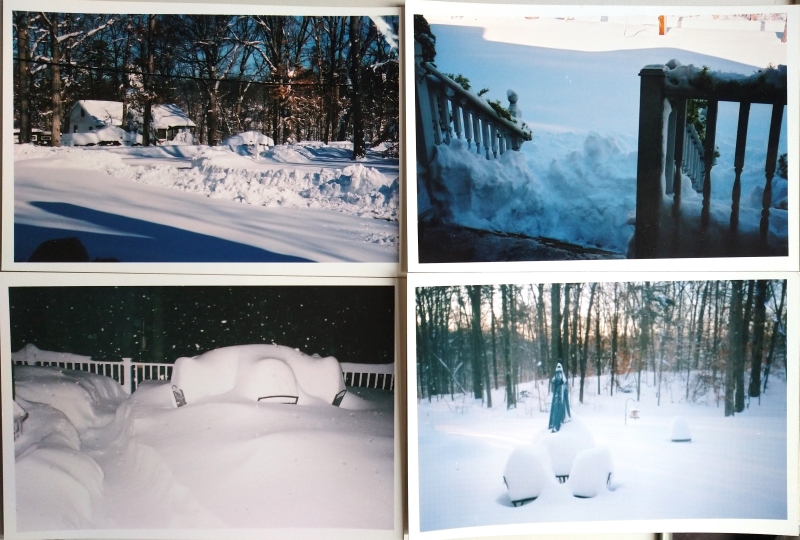
Whittell’s mention of the U.S. East Coast “Snowmaggedon” of February 2010 had me digging out photos my mother sent me of the aftermath at our family home of the time.
Any wintry reading (or weather) for you lately? Or is it looking like spring?
Reading Ireland Month, I: Donoghue, Longley, Tóibín
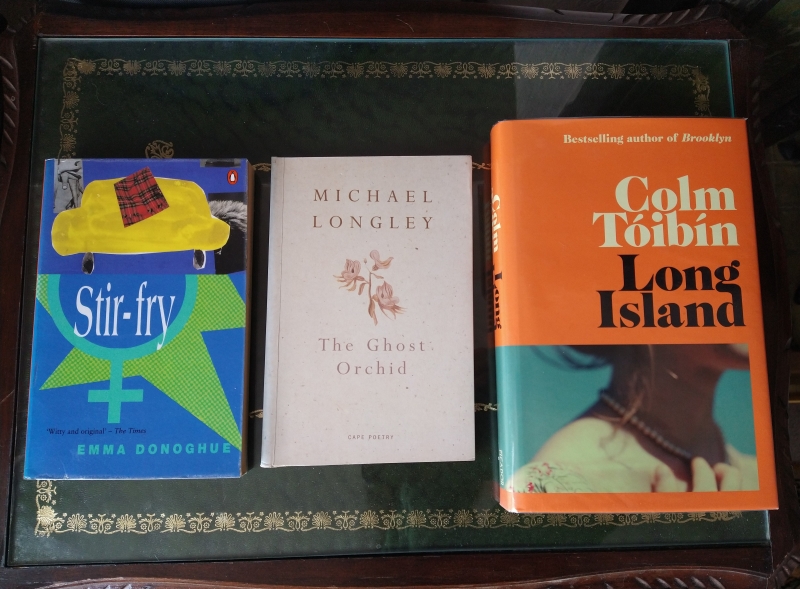
St. Patrick’s Day is a good occasion to compile my first set of contributions to Cathy’s Reading Ireland Month. Today I have an early novel by a favourite author, a poetry collection inspired by nature and mythology, and a sequel that I read for book club.
Stir-Fry by Emma Donoghue (1994)
After enjoying Slammerkin so much last year, I decided to catch up on more of Donoghue’s way-back catalogue. She tends to alternate between contemporary and historical settings. I have a slight preference for the former, but she can excel at both; it really depends on the book. I reckon this was edgy for its time. Maria (whose name rhymes with “pariah”) arrives in Dublin for university at age 17, green in every way after a religious upbringing in the countryside. In response to a flat-share advert stipulating “NO BIGOTS,” she ends up living with Ruth and Jael (pronounced “Yale”), two mature students. Ruth is the mother hen, doing all the cooking and fretting over the others’ wellbeing; Jael is a wild, henna-haired 30-year-old prone to drinking whisky by the mug-full. Maria attends lectures, takes a job cleaning office buildings, and finds a friend circle through her backstage student theatre volunteering. She’s mildly interested in American exchange student Galway and then leather-clad Damien (until she realizes he has a boyfriend), but nothing ever goes further than a kiss.
 It’s obvious to readers that Ruth and Jael are a couple, but Maria doesn’t work it out until a third of the way into the book. At first she’s mortified, but soon the realization is just one more aspect of her coming of age. Maria’s friend Yvonne can’t understand why she doesn’t leave – “how can you put up with being a gooseberry?” – but Maria insists, “They really don’t make me feel left out … I think they need me to absorb some of the static. They say they’d be fighting like cats if I wasn’t around to distract them.” Scenes alternate between the flat and the campus, which Donoghue depicts as a place where radicalism and repression jostle for position. Ruth drags Maria to a Tuesday evening Women’s Group meeting that ends abruptly: “A porter put his greying head in the door to comment that they’d have to be out in five minutes, girls, this room was booked for the archaeologists’ cheese ’n’ wine.” Later, Ruth’s is the Against voice in a debate on “That homosexuality is a blot on Irish society.”
Mostly, this short novel is a dance between the three central characters. The Irish-accented banter between them is a joy. Jael’s devil-may-care attitude contrasts with Ruth and Maria’s anxiety about how they are perceived by others. Ruth and Jael are figures in the Hebrew Bible and their devotion/boldness dichotomy is applicable to the characters here, too. The stereotypical markers of lesbian identity haven’t really changed, but had Donoghue written this now I think she would at least have made Maria a year older and avoided negativity about Damien and Jael’s bisexuality. At heart this is a sweet romance and an engaging picture of early 1990s feminism, but it doesn’t completely steer clear of predictability and I would have happily taken another 50–70 pages if it meant she could have fleshed out the characters and their interactions a little more. [Guess what was for my lunch this afternoon? Stir fry!] (Secondhand – Awesomebooks.com) 
The Ghost Orchid by Michael Longley (1995)
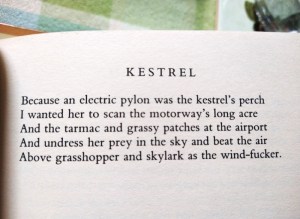
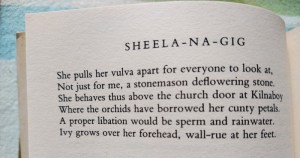
 Longley’s sixth collection draws much of its imagery from nature and Greek and Roman classics. Seven poems incorporate quotations and free translations of the Iliad and Odyssey; elsewhere, he retells the story of Baucis and Philemon and other characters from Ovid. The Orient and the erotic are also major influences; references to Hokusai bookend poems about Chinese artefacts. Poppies link vignettes of the First and Second World Wars. Longley’s poetry is earthy in its emphasis on material objects and sex. Alliteration and slant rhymes are common techniques and the vocabulary is always precise. This was the third collection I’ve read by the late Belfast poet, and with its disparate topics it didn’t all cohere for me. My two favourite poems are naughty indeed:
(Secondhand – Green Ink Booksellers, Hay-on-Wye)
Long Island by Colm Tóibín (2024)
{SPOILERS in this one}
 I read Brooklyn when it first came out and didn’t revisit it (via book or film) before reading this. While recent knowledge of the first book isn’t necessary, it probably would make you better able to relate to Eilis, who is something of an emotional blank here. She’s been married for 20 years to Tony, a plumber, and is a mother to two teenagers. His tight-knit Italian American family might be considered nurturing, but for her it is more imprisoning: their four houses form an enclave and she’s secretly relieved when her mother-in-law tells her she needn’t feel obliged to join in the Sunday lunch tradition anymore.
When news comes that Tony has impregnated a married woman and the cuckolded husband plans to leave the baby on the Fiorellos’ doorstep when the time arrives, Eilis checks out of the marriage. She uses her mother’s upcoming 80th birthday as an excuse to go back to Ireland for the summer. Here Eilis gets caught up in a love triangle with publican Jim Farrell, who was infatuated with her 20 years ago and still hasn’t forgotten her, and Nancy Sheridan, a widow who runs a fish and chip shop and has been Jim’s secret lover for a couple of years. Nancy has a vision of her future and won’t let Eilis stand in her way.
I felt for all three in their predicaments but most admired Nancy’s pluck. Ironically given the title, the novel spends more of its time in Ireland and only really comes alive there. There’s also a reference to Nora Webster – cute that Tóibín is trying out the Elizabeth Strout trick of bringing multiple characters together in the same fictional community. But, all told, this was just a so-so book. I’ve read 10 or so works by Tóibín now, in all sorts of genres, and with its plain writing this didn’t stand out at all. It got an average score from my book club, with one person loving it, a couple hating it, and most fairly indifferent. (Public library)
Another batch will be coming up before the end of the month!
Making Plans for a Return to Hay-on-Wye & A Book “Overhaul”
I was last in Hay-on-Wye for my 40th birthday (write-up here). We’ve decided 18 months is a decent length between visits such that we can go back and find enough turnover in the bookshops and changes around the town. The plan is to spend four nights there in early April, in a holiday cottage we’ve not stayed in before. It’s in Cusop, just back over the border into England, which means a pleasant (if not pouring with rain) walk over the fields into the town. Normally we go for just a night or two, so this longer ninth trip to Hay will allow us time to do more local exploring besides thoroughly trawling all the bookshops and rediscovering the best eateries on offer.
An Overhaul of Last Trip’s Book Purchases
Simon of Stuck in a Book has a regular blog feature he calls “The Overhaul,” where he revisits a book haul from some time ago and takes stock of what he’s read, what he still owns, etc. (here’s the most recent one). With his permission, I occasionally borrow the title and format to look back at what I’ve bought. Previous overhaul posts have covered pre-2020 Hay-on-Wye purchases, birthdays, the much-lamented Bookbarn International, and Northumberland. It’s been a good way of holding myself accountable for what I’ve purchased and reminding myself to read more from my shelves.
So, earlier this week I took a look back at the 16 new and secondhand books I acquired in Hay in October 2023. I was quickly dismayed: 18 months might seem like a long time, but as far as my shelves go it is more like the blink of an eye.
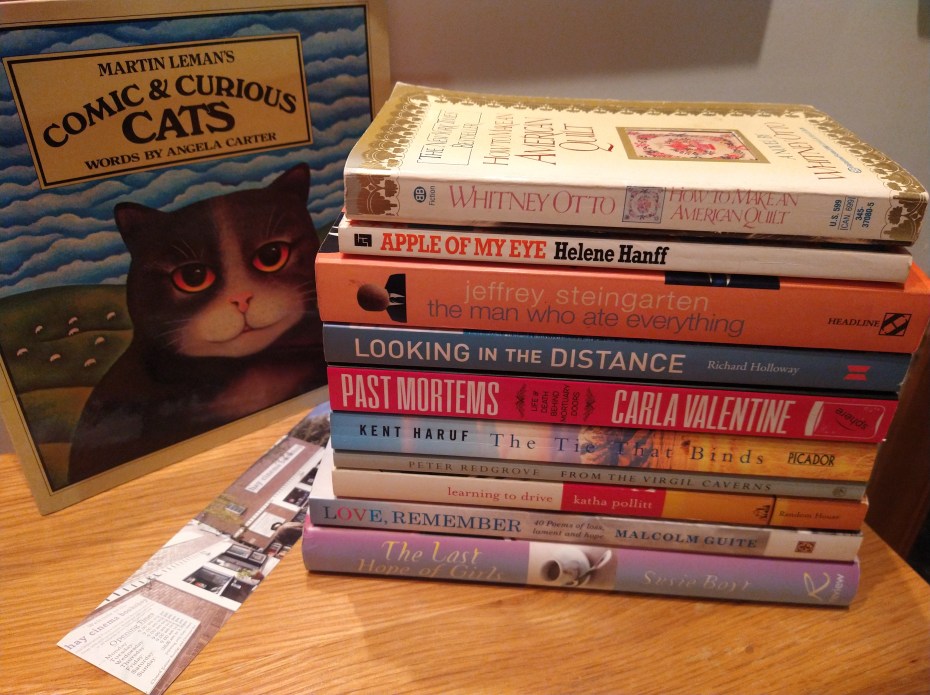
Read: Only 1 – Uh oh…
- Learning to Drive by Katha Pollitt
But also:
Partially read: 4
- A God at the Door by Tishani Doshi – Doshi is awesome. This is only my second of her poetry collections. I’ll finish it this month for Dewithon.
- Looking in the Distance by Richard Holloway – The problem with Holloway is that all of his books of recent decades are about the same – a mixture of mediations and long quotations from poetry – and I have one from last year on the review catch-up pile already. But I’m sure I’ll finish this at some point.
- The Ghost Orchid by Michael Longley – No idea why I set this one aside, but I’ve put it back on a current stack.
- The Enduring Melody by Michael Mayne – I have this journal of his approaching death as one of my bedside books and read a tiny bit of it at a time. (Memento mori?)
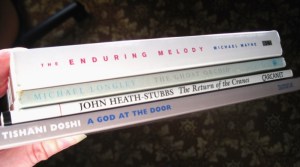
Skimmed: 1
- Love, Remember: 40 Poems of Loss, Lament and Hope by Malcolm Guite – I enjoyed the poetry selection well enough but didn’t find that the author’s essays added value, so I’m donating this to my church’s theological library.
That left 10 still to read. Eager to make some progress, I picked up a quick win, Comic & Curious Cats, illustrated in an instantly recognizable blocky folk art style by Martin Leman (I also have his Twelve Cats for Christmas, a stocking present I gave my husband this past year) and with words by Angela Carter. Yes, that Angela Carter! It’s picture book size but not really, or not just, for children. Each spread of this modified abecedarian includes a nonsense poem that uses the letter as much as possible: the cat’s name, where they live, what they eat, and a few choice adjectives. I had to laugh at the E cat being labelled “Elephantine.” Who knows, there might be some good future cat names in here: Basil and Clarissa? Francesca and Gordon? Wilberforce? “I love my cat with an XYZ [zed] … There is really nothing more to be said.” Charming. (Secondhand purchase – Hay-on-Wye Booksellers)


Total still unread: 9
Luckily, I’m still keen to read all of them. I’ll start with the two I purchased new, So Happy for You by Celia Laskey, a light LGBTQ thriller about a wedding (from Gay on Wye with birthday money from friends, a sweet older lesbian couple – so it felt appropriate to use their voucher there!), and Past Mortems by Carla Valentine, a memoir set at a mortuary (remainder copy from Addymans); as well as a secondhand novel, The Tie that Binds by Kent Haruf (Hay-on-Wye Booksellers) and the foodie essays of The Man Who Ate Everything by Jeffrey Steingarten (Cinema).
Then, if I still haven’t read them before the trip (who am I kidding…), I’ll pack for the car a few small volumes that will fit neatly into my handbag: Apple of My Eye by Helene Hanff, How to Make an American Quilt by Whitney Otto, and one of the poetry collections.
Literary Wives Club: Lessons in Chemistry by Bonnie Garmus (2022)
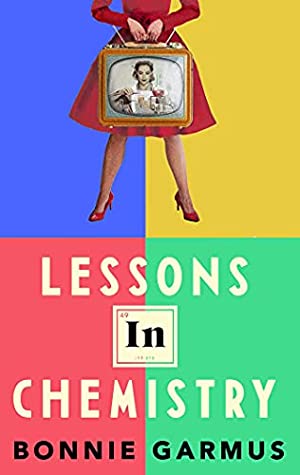
Like pretty much every other woman over 30 on the planet, I read Lessons in Chemistry when it first came out. I was happy for my book club to select it for a later month when I was away; it made a decent selection but I had no need to revisit it, then or now. I think it still holds the record for the longest reservation queue in my library system. I enjoyed this feel-good feminist story well enough but found certain elements hokey, such as Six-Thirty the dog’s preternatural intelligence and Elizabeth Zott’s neurodivergent-like bluntness and lack of sentimentality.
My original review: Elizabeth Zott is a scientist through and through, applying a chemist’s mindset to her every venture, including cooking, rowing and single motherhood in the 1950s. When she is fired from her job in a chemistry lab and gets a gig as a TV cooking show host instead, she sees it as her mission to treat housewives as men’s intellectual equals, but there are plenty of people who don’t care for her unusual methods and free thinking. I was reminded strongly of The Atomic Weight of Love and The Rosie Project, as well as novels by Katherine Heiny and especially John Irving with the deep dive into backstory and particular pet subjects, and the orphan history for Zott’s love interest. This was an enjoyable tragicomedy. You have to cheer for the triumphs she and other female characters win against the system of the time. However, the very precocious child (and dog) stretch belief, and the ending was too pat for me. (Public library)
The main question we ask about the books we read for Literary Wives is:
What does this book say about wives or about the experience of being a wife?
Elizabeth is deeply in love with Calvin Evans yet refuses to be his wife. She spurns marriage because she correctly intuits that it will limit her prospects, this being the 1960s. “I’m going to be a scientist. Successful women scientists don’t marry,” she tells her mother. Forasmuch as she assumes her television audience to be traditional housewives, she rejects their situation for herself. A single mother, a minor celebrity, a scientific researcher: none of these roles would be compatible with marriage. (Though there’s another ultimate reason why she stays unmarried.)
A supporting character, her neighbour Harriet, offers a counterpoint or cautionary tale. She’s trapped in a marriage to an odious man she despises. “Because while she was stuck forever being Mrs. Sloane—she was a Catholic—she never wanted to turn into a Mr. Sloane.”
Almost all of the books we read for the club, whether contemporary or historical, present marriage in at least a somewhat negative light, or warn that there are many things that can go wrong…
See Kate’s, Kay’s and Naomi’s reviews, too!
Coming up next, in June: The Constant Wife by W. Somerset Maugham. This is the first play we’ve done and my first Maugham in a while, so I’m looking forward to it.
#ReadIndies Wrap-Up: February Releases (Jukes, Spence) & Review Catch-Up (Buttery, Foust)
Good riddance to February, which added insult to injury on its final day when my in-laws’ neighbour reversed into the car we were borrowing from a book club friend and smashed the driver’s-side window. The blue skies and crocuses of recent days have been most welcome. The best I can say for the month just departed is that I managed to review 15 books for Kaggsy and Lizzy Siddal’s Reading Independent Publishers Month challenge. These came from 10 splendid publishers: Atlantic Books, Backbone Press, Carcanet Press, Counterpoint, Elliott & Thompson, The Emma Press, Faber, Icon Books, Saraband and Sort Of Books.
Mother Animal by Helen Jukes
When she found out she was pregnant, Jukes (author of A Honeybee Heart Has Five Openings) lost herself in research, looking for parallels in the natural world. A friend had told her that “childbirth puts you more in touch with your animal side.” Her daughter was born at the start of the pandemic and so early motherhood was perhaps more than usually isolated and emotionally challenging for her. She had an unexpected C-section after the placenta failed to nourish her daughter sufficiently, and then struggled to breastfeed. “I was, I realised, a little afraid of the baby. I’d expected to feel a sense of recognition – to see in her face some sign of familiarity,” but that wasn’t the case. “She was so … other.”
The long thematic chapters present Jukes’s experiences in parallel to those of other mothering creatures with pregnancy, birth, lactation, making a home (nesting) and enlisting the help of the community. Peppered throughout are trivia she shares with boyfriend, baby and readers. Such as that burying beetles lay eggs on a carcass so their babies feed on carrion from day one. That bonobo females attend births, acting as midwives for each other. That Madrid’s storks have started eating and lining their nests with what they find in landfill instead of migrating to Africa. The “Did you know?” litany quickly becomes precious. The details are not that interesting in themselves, and not sufficiently synthesized to be meaningful. The same factoid about leopard tree iguanas is repeated seven pages apart. A significant amount of information comes from Bitch by Lucy Cooke, which I would recommend instead.
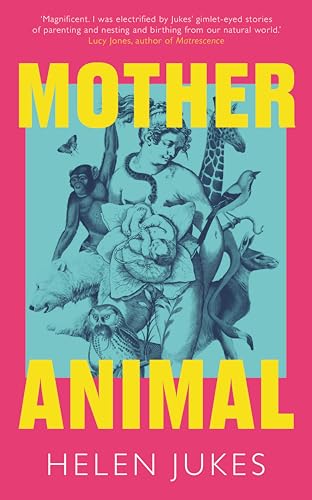
As hybrid scientific memoirs of motherhood go, Lucy Jones’s Matrescence can’t be beat. For its social and political engagement, Jennifer Case’s We Are Animals is a valuable companion. Jukes’s offering pales by comparison because her story – not having the delivery she wanted, struggling to connect with her baby, her relationship with the father falling apart – is all too common, and she doesn’t have the scientific bona fides for readers to accept her as a valid source of zoological facts.
I would make an exception, though, for the central chapter, “Forever Milk,” which might be condensed and published in a big-name newspaper as a Rachel Carson-like exposé about endocrine disruptors and forever chemicals. Like any mother, Jukes wants nothing more than to protect her daughter, but how can she when household products (waterproof clothing, non-stick pans, cleaning sprays) contain toxic chemicals and her breastmilk is sure to be contaminated? Add in microplastics and the situation is bleak. We don’t know singly, let alone collectively, what these pollutants are doing to species in the long term, but most likely they interfere with reproduction and alter behaviour. The central message of this chapter, and the book as a whole, is that animals are amazing but vulnerable. “What is this world if nowhere is separate – nowhere safe?” If you think about this stuff much, you can’t bear it. Yet it’s a truth we all have to live with. It’s a brave author who dares sit with the unthinkable.
With thanks to Elliott & Thompson for the free copy for review.
Daughter of the Sun by Rachel Spence
 The Emma Press has published poetry pamphlets before, but this is their inaugural full-length work. Rachel Spence’s second collection is in two parts: first is “Call & Response,” a sonnet sequence structured as a play and considering her relationship with her mother. Act 1 starts in 1976 and zooms forward to key moments when they fell out and then reversed their estrangement. The next section finds them in the new roles of patient and carer. “Your final check-up. August. Nimbus clouds / prised open by Delft blue. Waiting is hard.” In Act 3, death is near; “in that quantum hinge, we made / an alphabet from love’s ungrammared stutter.” The poems of the last act are dated precisely, not just to a month and year as earlier but down to the very day, hour and minute. Whether in Ludlow or Venice, Spence crystallizes moments from the ongoingness of grief, drawing images from the natural world.
The second part of the book, “Medea’s Song,” is looser in style and more dispersed across the page. It’s a feminist reinterpretation that refuses to make of Medea a simple murderess, instead redeeming her as a wise woman. “Do not call them seers or sisters // They are the owls of history // nightfliers outliers”. I’m not drawn to Greek myth updates but I expect this would be rewarding for fans of similar projects by Fiona Benson and Anne Carson. Some of the specific vocabulary from the first section recurs, linking the two in a satisfying way.
With thanks to The Emma Press for the free copy for review.
I’m also catching up on two 2024 releases from indie publishers that I was sent for review:
Knead to Know: A History of Baking by Neil Buttery
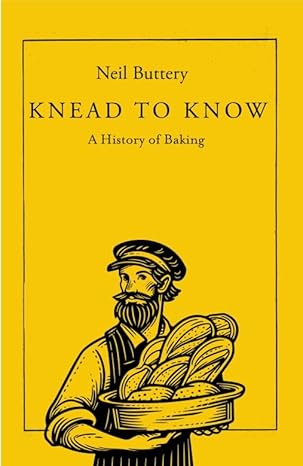 Not only the pun-tastic title, but also the excellent nominative determinism of chef and food historian Dr Neil Buttery’s name, earned this a place in my 2024 Superlatives post. In not quite 240 pages, it achieves the improbable, producing an exhaustive history of baked goods through miniature essays about every conceivable subcategory. Although the focus is on British baking, the story begins in ancient times with the first grains and the earliest cooking technique of making griddlecakes on a hearthstone. (Speaking of which, make sure you’re prepared for Pancake Day, aka Shrove Tuesday, this week!) Across multi-part chapters about bread, biscuits and cakes, pies and puddings, and patisserie, Buttery spotlights regional specialties, many of them familiar (Cornish pasties and Eccles cakes); a few have fallen into obscurity (Gloucester pancakes and Yorkshire Christmas pyes). Some dishes’ origin stories are apocryphal, while others can be traced back to historical cookbooks.
I was fascinated by the evolution of traditional holiday bakes. “The long tapering shape of the stollen is supposed to represent the infant Christ wrapped in His swaddling.” In general, there is just the right amount of chemistry, and while in places the writing is shaky or at least poorly edited (“populous” instead of populace!), there are good quips, too: “dried fruit haters do have a miserable time at Christmas to be fair.” I read the book in bites across a number of months, which felt appropriate because it’s more a reference text for the kitchen shelf than a narrative to read straight through. Good for picking up now and then over a cup of tea.
With thanks to Icon Books for the free copy for review.
You Are Leaving the American Sector: Love Poems by Rebecca Foust
 Foust’s fifth collection – at 41 pages, the length of a long chapbook – is in conversation with the language and storyline of 1984. George Orwell’s classic took on new prescience for her during Donald Trump’s first presidential term, a period marked by a pandemic as well as by corruption, doublespeak and violence. “Rally Insurrection” is a clever erasure poem illustrating how a propagandist might rebrand the storming of the Capitol on 6 January 2021: instead of “a mob came to Washington to / disrupt the peaceful transfer of power,” the Ministry of Truth bulletin would read “a crowd came to Washington to fight / for their country”. “Language Matters” insists that “language / is the most dangerous weapon in any totalitarian arsenal” and warns “A dictator / might do these things, but surely not // a president.” How much more strongly does this resonate in 2025.
The second and third sections engage directly with the story of Julia and Winston – the collection takes its seemingly inapt subtitle from Foust’s appreciation of 1984’s “idea of love as a subversive act affirming free will, expression, and personal privacy”. Her bold verse also confronts the repeal of abortion rights (“Breaking News”) and toxic masculinity (“Consent: A Primer”). There are some internal rhymes and slant rhymes, as well as a few end rhymes all the more striking for their rarity. I only wish this had been published a few years sooner, when its message might have seemed timelier – though, unfortunately, it is still apropos.
Some favorite lines:
“How can a future exist if we can erase or revise the past?”
“2016, dark year / of the ascension / of our Lord the Mad Clown”
“It’s happening now, / somewhere. Not here, // not yet. But so long as Big Brother is out there— / & he will always be out there—it could, // & one day, maybe it will.”
Published by Backbone Press in the USA. With thanks to the author for the e-copy for review.
Which of these appeal to you? What indie publishers have you read from recently?
The Moomins and the Great Flood (#Moomins80) & Poetry (#ReadIndies)
To mark the 80th anniversary of Tove Jansson’s Moomins books, Kaggsy, Liz et al. are doing a readalong of the whole series, starting with The Moomins and the Great Flood. I received a copy of Sort Of Books’ 2024 reissue edition for Christmas, so I was unknowingly all set to take part. I also give quick responses to a couple of collections I read recently from two favourite indie poetry publishers in the UK, The Emma Press and Carcanet Press. These are reads 9–11 for Kaggsy and Lizzy Siddal’s Reading Independent Publishers Month challenge.
The Moomins and the Great Flood by Tove Jansson (1945; 1991)
[Translated from the Swedish by David McDuff]
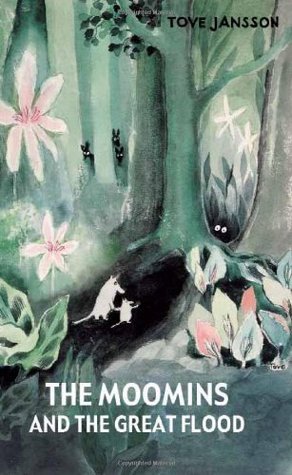 Moomintroll and Moominmamma are the only two Moomins who appear here. They’re nomads, looking for a place to call home and searching for Moominpappa, who has disappeared. With them are “the creature” (later known as Sniff) and Tulippa, a beautiful flower-girl. They encounter a Serpent and a sea-troll and make a stormy journey in a boat piloted by the Hattifatteners. My favourite scene has Moominmamma rescuing a cat and her kittens from rising floodwaters. The book ends with the central pair making their way to the idyllic valley that will be the base for all their future adventures. Sort Of and Frank Cottrell Boyce, who wrote an introduction, emphasize how (climate) refugees link Jansson’s writing in 1939 to today, but it’s a subtle theme. Still, one always worth drawing attention to.
I read my first Moomins tale in 2011 and have been reading them out of order and at random ever since; only one remains unread. Unfortunately, I did not find it rewarding to go right back to the beginning. At barely 50 pages (padded out by the Cottrell-Boyce introduction and an appendix of Jansson’s who’s-who notes), this story feels scant, offering little more than a hint of the delightful recurring characters and themes to come. Jansson had not yet given the Moomins their trademark rounded hippo-like snouts; they’re more alien and less cute here. It’s like seeing early Jim Henson drawings of Garfield before he was a fat cat. That just ain’t right. I don’t know why I’d assumed the Moomins are human-size. When you see one next to a marabou stork you realize how tiny they are; Jansson’s notes specify 20 cm tall. (Gift)
The Emma Press Anthology of Homesickness and Exile, ed. by Rachel Piercey and Emma Wright (2014)
 This early anthology chimes with the review above, as well as more generally with the Moomins series’ frequent tone of melancholy and nostalgia. A couple of excerpts from Stephen Sexton’s “Skype” reveal a typical viewpoint: “That it’s strange to miss home / and be in it” and “How strange home / does not stay as it’s left.” (Such wonderfully off-kilter enjambment in the latter!) People are always changing, just as much as places – ‘You can’t go home again’; ‘You never set foot in the same river twice’ and so on. Zeina Hashem Beck captures these ideas in the first stanza of “Ten Years Later in a Different Bar”: “The city has changed like cities do; / the bar where we sang has closed. / We have changed like cities do.”
Departures, arrivals; longing, regret: these are classic themes from Ovid (the inspiration for this volume) onward. Holly Hopkins and Rachel Long were additional familiar names for me to see in the table of contents. My two favourite poems were “The Restaurant at One Thousand Feet” (about the CN Tower in Toronto) by John McCullough, whose collections I’ve enjoyed before; and “The Town” by Alex Bell, which personifies a closed-minded Dorset community – “The town wraps me tight as swaddling … When I came to the town I brought things with me / from outside, and the town took them / for my own good.” Home is complicated – something one might spend an entire life searching for, or trying to escape. (New purchase from publisher)
Gold by Elaine Feinstein (2000)
 I’d enjoyed Feinstein’s poetry before. The long title poem, which opens the collection, is a monologue by Lorenzo da Ponte, a collaborator of Mozart. Though I was not particularly enraptured with his story, there were some great lines here:
I wanted to live with a bit of flash and brio,
rather than huddle behind ghetto gates.
The last two stanzas are especially memorable:
Poor Mozart was so much less fortunate.
My only sadness is to think of him, a pauper,
lying in his grave, while I became
Professor of Italian literature.
Nobody living can predict their fate.
I moved across the cusp of a new age,
to reach this present hour of privilege.
On this earth, luck is worth more than gold.
Politics, manners, morals all evolve
uncertainly. Best then to be bold.
Best then to be bold!
Of the discrete “Lyrics” that follow, I most liked “Options,” about a former fiancé (“who can tell how long we would have / burned together, before turning to ash?”) and “Snowdonia,” in which she’s surprised when a memory of her father resurfaces through a photograph. Talking to the Dead was more consistently engaging. (Secondhand purchase – Bridport Old Books, 2023)
Adventures in Rereading: The History of Love by Nicole Krauss for Valentine’s Day
Special Valentine’s edition. Every year I say I’m really not a Valentine’s Day person and yet manage a themed post featuring one or more books with “Love” or “Heart” in the title. This is the ninth year in a row, in fact – after 2017, 2018, 2019, 2020, 2021, 2022, 2023, and 2024!
 Leopold Gursky is an octogenarian Holocaust survivor, locksmith and writer manqué; Alma Singer is a misfit teenager grieving her father. What connects them? A philosophical novel called The History of Love, lost for years before being published in Spanish. Alma’s late father saw it in a bookshop window in Buenos Aires and bought it for his love. They adored it so much they named their daughter after the heroine. Now his widow is translating it into English on commission for a covert client. Leo and Alma’s distinctive voices, wry but earnest, really make this sparkle. Alma’s sections are numbered fragments from a diary and there are also excerpts from the book within the book. My only critique would be that she sounds young for her age; her precocity makes her seem closer to 10 than 15. But her little brother Bird, who thinks he may be the messiah, is a delight. The array of New York City locales includes a life drawing class, a record office, and a Central Park bench. A gentle air of mystery circulates as we work out who Leo’s son is and how Alma tracks down the author. It’s a bittersweet story that insists on love as an equivalent to loss. Complex but accessible, bookish and heartfelt, it’s one to recommend to my book club in the future. (Little Free Library)
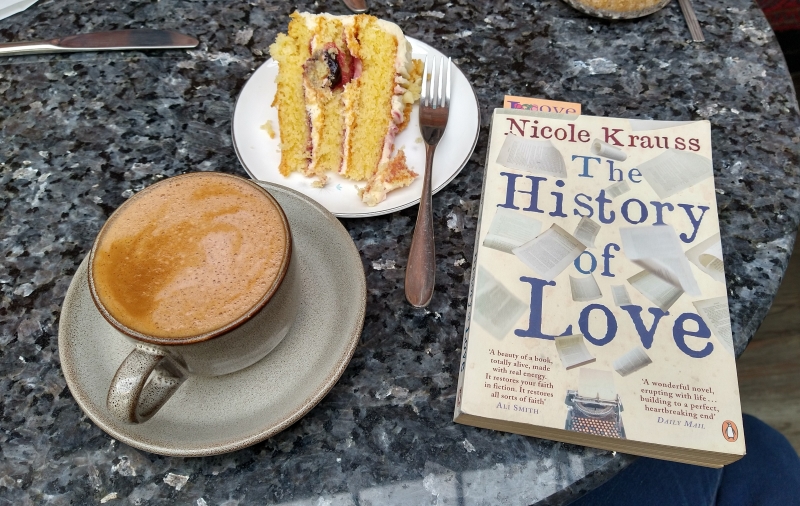
Finishing my reread during a coffee date in Hungerford this morning.
My original rating (2011):
When I first read this, I mostly considered it in comparison to Krauss’s former husband Jonathan Safran Foer’s work. (I’ve long since read everything by both of them.) I noted then that it
has a lot of elements in common with Everything is Illuminated, such as a preoccupation with Eastern European and Jewish ancestry, quirky methods of narration including multiple voices, and a sweet humour that lies alongside such heart-rending stories of family and loss that tears are never far from your eyes. Leo Gursky and Alma Singer are delightful and distinct characters. I wasn’t sure about the missing/plagiarized/mistaken The History of Love itself; the ruined copies, the different translations, the way the manuscript was constantly changing hands – all this was intriguing, but the book itself was a postmodern jumble of magic realism and pointless meanderings of thought.
Dang, I was harsh! But admirably pithy about the plot. It’s intriguing that I’ve successfully reread Krauss but failed with Foer when I attempted Everything is Illuminated again in 2020. Reading the first, 9/11-set section of Confessions by Catherine Airey, I’ve also been recalling his Extremely Loud and Incredibly Close and thinking it probably wouldn’t stand up to a reread either. I suspect I’d find it mawkish, especially with its child narrator. Alma evades that trap, perhaps by being that little bit older, though she sounds young because of how geeky and sheltered she is.
Winter Reads, I: Michael Cunningham & Helen Moat
It’s been feeling springlike in southern England with plenty of birdsong and flowers, yet cold weather keeps making periodic returns. (For my next instalment of wintry reads, I’ll try to attract some snow to match the snowdrops by reading three “Snow” books.) Today I have a novel drawing on a melancholy Hans Christian Andersen fairy tale and a nature/travel book about learning to appreciate winter.
The Snow Queen by Michael Cunningham (2014)
 It was among my favourite first lines encountered last year: “A celestial light appeared to Barrett Meeks in the sky over Central Park, four days after Barrett had been mauled, once again, by love.” Barrett is gay and shares an apartment with his brother, Tyler, and Tyler’s fiancée, Beth. Beth has cancer and, though none of them has dared to hope that she will live, Barrett’s epiphany brings a supernatural optimism that will fuel them through the next few years, from one presidential election autumn (2004) to the next (2008). Meanwhile, Tyler, a stalled musician, returns to drugs to try to find inspiration for his wedding song for Beth. The other characters in the orbit of this odd love triangle of sorts are Liz, Beth and Barrett’s boss at a vintage clothing store, and Andrew, Liz’s decades-younger boyfriend. It’s a peculiar family unit that expands and contracts over the years.
Of course, Cunningham takes inspiration, thematically and linguistically, from Hans Christian Andersen’s tale about love and conversion, most obviously in an early dreamlike passage about Tyler letting snow swirl into the apartment through the open windows:
He returns to the window. If that windblown ice crystal meant to weld itself to his eye, the transformation is already complete; he can see more clearly now with the aid of this minuscule magnifying mirror…
I was most captivated by the early chapters of the novel, picking it up late one night and racing to page 75, which is almost unheard of for me. The rest took me significantly longer to get through, and in the intervening five weeks or so much of the detail has evaporated. But I remember that I got Chris Adrian and Julia Glass vibes from the plot and loved the showy prose. (And several times while reading I remarked to people around me how ironic it was that these characters in a 2014 novel are so outraged about Dubya’s re-election. Just you all wait two years, and then another eight!)
I fancy going on a mini Cunningham binge this year. I plan to recommend The Hours for book club, which would be a reread for me. Otherwise, I’ve only read his travel book, Land’s End. I own a copy of Specimen Days and the library has Day, but I’d have to source all the rest secondhand. Simon of Stuck in a Book is a big fan and here are his rankings. I have some great stuff ahead! (Secondhand – Awesomebooks.com)
While the Earth Holds Its Breath: Embracing the Winter Season by Helen Moat (2024)
 Like many of us, Moat struggles with mood and motivation during the darkest and coldest months of the year. Over the course of three recent winters overlapping with the pandemic, she strove to change her attitude. The book spins short autobiographical pieces out of wintry walks near her Derbyshire home or further afield. Paying closer attention to the natural spectacles of the season and indulging in cosy food and holiday rituals helped, as did trips to places where winters are either a welcome respite (Spain) or so much harsher as to put her own into perspective (Lapland and Japan). My favourite pieces of all were about sharing English Christmas traditions with new Ukrainian refugee friends.
There were many incidents and emotions I could relate to here – a walk on the canal towpath always makes me feel better, and the car-heavy lifestyle I resume on trips to America feels unnatural.
Days are where we must live, but it didn’t have to be a prison of house and walls. I needed the rush of air, the slap of wind on my cheeks. I needed to feel alive. Outdoors.
I’d never liked the rain, but if I were to grow to love winters on my island, I had to learn to love wet weather, go out in it.
What can there be but winter? It belongs to the circle of life. And I belonged to winter, whether I liked it or not. Indoors, or moving from house to vehicle and back to house again, I lost all sense of my place on this Earth. This world would be my home for just the smallest of moments in the vastness of time, in the turning of the seasons. It was a privilege, I realised.
However, the content is repetitive such that the three-year cycle doesn’t add a lot and the same sorts of pat sentences about learning to love winter recur. Were the timeline condensed, there might have been more of a focus on the more interesting travel segments, which also include France and Scotland. So many have jumped on the Wintering bandwagon, but Katherine May’s book felt fresh in a way the others haven’t.
With thanks to Saraband for the free copy for review.
Any wintry reading (or weather) for you lately?
Paul Auster Reading Week, II: Baumgartner & Travels in the Scriptorium (#AusterRW25 #ReadIndies)
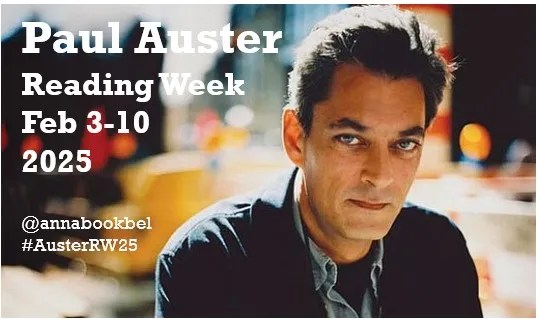
It’s the final day of Annabel’s Paul Auster Reading Week and, after last week’s reviews of Invisible and Siri Hustvedt’s The Blindfold, I’m squeaking in with a short review of his final novel, Baumgartner, which Annabel chose as the buddy read and Cathy also wrote about. I paired it at random with another of his novellas and found that the two have a similar basic setup: an elderly man being let down by his body and struggling to memorialize what is important from his earlier life. They also happen to feature a character named Anna Blume, and other character names recur from his previous work. I wonder how fair it would be to say that most of Auster’s novels have the same autofiction-inspired protagonist, and are part of the same interlocking universe (à la David Mitchell and Elizabeth Strout)?
Baumgartner (2023)
Sy Baumgartner is a Princeton philosophy professor nearing retirement. The accidental death of his wife, Anna Blume, a decade ago, is still a raw loss he compares to a phantom limb. Only now can he bring himself to consider 1) proposing marriage to his younger colleague and longtime casual girlfriend, Judith Feuer, and 2) allowing a PhD student to sort through reams of Anna’s unpublished work, including poetry, translations and unfinished novels. The book includes a few of her autobiographical fragments, as well as excerpts from his writings, such as an account of a trip to Ukraine to explore his heritage (elsewhere we learn his mother’s name was Ruth Auster) and a précis of his book about car culture.
 Baumgartner’s past is similar to Auster’s (and Adam Walker’s from Invisible – the two characters have a mutual friend in writer James Freeman), but not identical. His childhood memories and the passion and companionship he found with Anna are quite sweet. But I was somewhat thrown by the tone in sections that have this grumpy older man experiencing pseudo-comic incidents such as tumbling down the stairs while showing the meter reader the way. To my relief, the book doesn’t take the tragic turn the last pages seem to augur, instead leaving readers with a nicely open ending.
It’s not this that makes Baumgartner feel incomplete so much as the fact that any of its threads might have been expanded into a full-length novel. Maybe Auster had various projects on the go at the time of his final illness and combined them. That could explain the mishmash. I also had the odd sense that there were unconscious pastiches of other authors. Baumgartner reminds me a lot of James Darke, the curmudgeonly widower in Rick Gekoski’s pair of novels. When Baumgartner speaks to his dead wife on the telephone, I went hunting through my notes because I knew I’d encountered that specific plot before (the short story “The Telephone” by Mary Treadgold, collected in Fear, edited by Roald Dahl). The Ukraine passage might have come from Everything Is Illuminated by Jonathan Safran Foer. So, for me, this was less distinctive as Auster works go. However, it’s gently readable and not formally challenging so it’s a pleasant valedictory volume if not the best representative of his oeuvre. (Public library)
Travels in the Scriptorium (2006)
 This is very much in the vein of The Locked Room and Oracle Night and indeed makes reference to characters from those earlier books (Sophie Fanshawe and Peter Stillman from the former; John Trause from the latter). Mr. Blank lives in a sparse room containing manuscript pages and a stack of photographs. He is tended by a nurse named Anna Blume and given a rainbow of pharmaceuticals. Whether the pills help or keep him pacified is unclear. The haziness of his memory could be due to age or the drugs. He receives various visitors he feels he should recognize but can’t, and from the comments they make he fears he is being punished for dangerous missions he spearheaded. Even Anna, object of his pitiable sexual desires, is somehow his moral superior. Everyday self-care is struggle enough for him, but he does end up reading and adding to the partial stories on the table, including a dark Western set in an alternative 19th-century USA. Whatever he’s done in the past, he’s now an imprisoned writer and this is a day in his newly constrained life. The novella is a deliberate assemblage of typical Auster tropes and characters; there’s a puppet-master here, but no point. An indulgent minor work. But that’s okay as I still have plenty of appealing books from his back catalogue to read. [Interestingly, the American cover has a white horse in the centre of the room, an embodiment of Mr. Blank’s childhood memory of a white rocking-horse he called Whitey.] (Public library)
Faber, Auster’s longtime publisher, counts towards Reading Independent Publishers Month.
Paul Auster Reading Week: Invisible (#ReadIndies) & Siri Hustvedt’s The Blindfold (#AusterRW25)
The first time Annabel ran a Paul Auster Reading Week, in 2020, it was a great excuse for me to read six of his books (Winter Journal and The New York Trilogy were amazing; I also really enjoyed Oracle Night). I won’t manage so many this time, but maybe three, as well as one by his widow, Siri Hustvedt. Auster would have been 78 today but died of lung cancer in 2024. As a buddy read, Annabel is inviting people to read his final novel, Baumgartner. I’m partway through that and have another of his novellas waiting in the wings in case I find time.
For now, I’m focusing on a novel that exemplifies some recurring elements of his fiction: a book within a book, fragmented narratives, differing perspectives, cryptic events and the inscrutability of memory and language. I’m pairing it with Hustvedt’s debut novel, which is – not coincidentally, I should think – similarly intricate, weird and unsettling.
Invisible (2009)
To start with, I thought we were in autofiction territory, but Auster swiftly adopts a more typical metafictional approach. Adam Walker is a 20-year-old would-be poet studying at Columbia University in 1967. At a party he meets Rudolf Born, a visiting international affairs professor from Paris, and it seems a good omen: Born invests generously in Adam’s literary magazine and also seems open to sharing his beautiful girlfriend, Margot. But when the men are caught up in an attempted mugging, Adam turns against his idol.
 That’s at the heart of Part I (“Spring”). Across four sections, the perspective changes and the narrative is revealed to be 1967, a manuscript Adam began while dying of cancer. “Summer,” in the second person, shines a light on his relationship with his sister, Gwyn. “Fall,” adapted from Adam’s third-person notes by his college friend and fellow author, Jim Freeman, tells of Adam’s study abroad term in Paris. Here he reconnected with Born and Margot with unexpected results. Jim intends to complete the anonymized story with the help of a minor character’s diary, but the challenge is that Adam’s memories don’t match Gwyn’s or Born’s.
I can’t say more about the themes without giving too much away, but this is a provocative novel that makes you question how truth is created or preserved. Who has the right to tell the story, and will justice be done? I wouldn’t say I enjoyed it, but I certainly admired how it was constructed. Auster conjures such a sense of unease, and I always felt like I had no idea what might happen next. With no speech marks, it all flows together in a compulsively readable way. (Secondhand purchase – Awesomebooks.com)
Faber, Auster’s longtime publisher, counts towards Reading Independent Publishers Month.
The Blindfold by Siri Hustvedt (1992)
“Strange, I thought. Everything is strange.”
I read Hustvedt (The Blazing World) well before I ever tried Auster, and wouldn’t have realized then how similar their books are; they almost seem part of the same body of work. Was Hustvedt a fan or a student of his before they married? I don’t actually know and am loath to dispel the mystery for myself by looking into it. Anyway, there are striking connections between this and Invisible: the narrator is fairly autobiographical and a Columbia University student, the novel is in four loosely connected parts, and the sordid content culminates in a sudden, odd ending. (There’s also the little Easter egg here of “I heard someone shout the name Paul.”) But overall, this is more reminiscent of The New York Trilogy in its surreal randomness and subtly symbolic naming (e.g., the landlord is Mr. Then).
 Iris Vegan (Hustvedt’s mother’s surname), like many an Auster character, is bewildered by what happens to her. An impoverished graduate student in literature, she takes on peculiar jobs. First Mr. Morning hires her to make audio recordings meticulously describing artefacts of a woman he’s obsessed with. Iris comes to believe this woman was murdered and rejects the work as invasive. Next she’s a photographer’s model but hates the resulting portrait and tries to take it off display. Then she’s hospitalized for terrible migraines and has upsetting encounters with a fellow patient, old Mrs. O. Finally, she translates a bizarre German novella and impersonates its protagonist, walking the streets in a shabby suit and even telling people her name is Klaus.
I worked out that the chronological order of the parts is 2 – 4 – 3 – 1, with 1 including a recap of the others. The sections feel like separate vignettes, perhaps reflecting Hustvedt’s previous experience with the short story form, and make a less than satisfying whole. I was most engaged with the segment on working for Mr. Morning and thought that might recur, but it doesn’t. Many of the secondary characters are grotesque, whereas Iris is the intellectual waif trying to make her way in the cruel city, almost like a Dickens or Gissing (anti)hero.
It’s refreshing to get a female take on the Bildungsroman and a little bit of gender-bending with the cross-dressing. (Iris reminds me of Lauren Elkin’s Flaneuse.) The title felt like an enigma to me until close to the end, when it’s revealed to be a tool of sexual sadism. Indeed, each of the sections, in its own way, addresses male exploitation of and violence against women. Disappointingly, Iris remains defined by her relationships with men. She deserves better. Heck, she deserves a sequel! It’s interesting to see where Hustvedt got her start, but I didn’t warm to this as I did to later novels including What I Loved. (Secondhand purchase – Community Furniture Project, Newbury)
 Bookish Beck = Rebecca Foster. American transplant to England. Freelance proofreader and book reviewer.
 Bookish Beck