Talking to the Dead x 2: Helen Dunmore and Elaine Feinstein
My fourth title-based dual review post this year (after Ex Libris, The Still Point and How Not to Be Afraid), with Betty vs. Bettyville to come in December if I can manage them both. Today I have an early Helen Dunmore novel about the secrets binding a pair of sisters and an Elaine Feinstein poetry collection written after the loss of her husband. Their shared title seemed appropriate as Halloween approaches. Both: 
Talking to the Dead by Helen Dunmore (1996)
 Nina, a photographer, has travelled to stay with her sister in Sussex after the birth of Isabel’s first child, Antony. A house full of visitors, surrounded by an unruly garden, is perfect for concealment. A current secret trades off with one from deep in the sisters’ childhood: their baby brother Colin’s death, which they remember differently. Antony and Colin function like doubles, with the sisters in subtle competition for ownership of the past and present. This was a delicious read: as close as literary fiction gets to a psychological thriller, dripping with sultry summer atmosphere and the symbols of aphrodisiac foods and blowsy flowers. From the novel’s title and opening pages, you have an inkling of what’s to come, but it still hits hard when it does. Impossible to say more about the plot without spoiling it, so just know that it’s a suspenseful story of sisters with Tessa Hadley, Maggie O’Farrell and Polly Samson vibes. I hadn’t much enjoyed my first taste of Dunmore’s fiction (Exposure), but I’m very glad that Susan’s enthusiasm spurred me to pick this up. (Secondhand purchase, Honesty bookshop outside the Castle, Hay-on-Wye)
Talking to the Dead by Elaine Feinstein (2007)
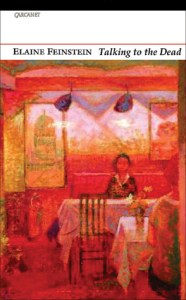 Much like Margaret Atwood’s Dearly, my top poetry release of last year, this is a tender and playful response to a beloved spouse’s death. The short verses are in stanzas and incorporate the occasional end rhyme and spot of alliteration as Feinstein marshals images and memories to recreate her husband’s funeral and moments from their marriage and travels beforehand and her widowhood afterwards – including moving out of their shared home. The poems flow so easily and beautifully from one to another; I’d happily read much more from Feinstein. This was her 13th poetry collection; before her death in 2019, she also wrote many novels, stories, biographies and translations. I’ll leave you with a poem suitable for the run-up to the Day of the Dead. (Secondhand purchase, Minster Gate Bookshop, York)
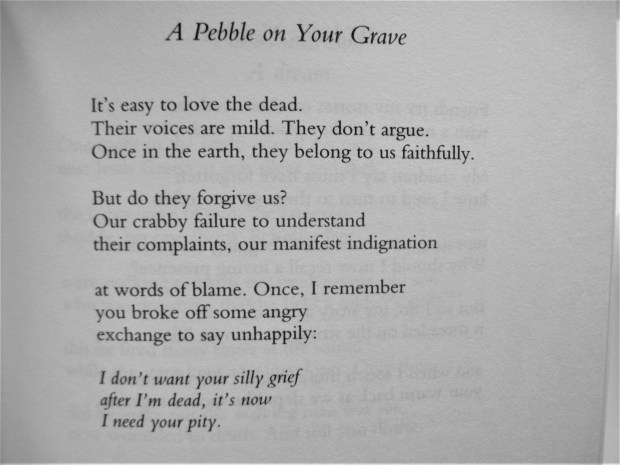
Does one or both of these appeal to you?
How Not to Be Afraid (of Everything): Gareth Higgins and Jane Wong
I’ve done a couple of other dual review posts this year (and I have another planned for Friday) where the books’ titles are so similar that I couldn’t resist discussing them together, even if the books themselves were extremely different. First I featured two books called Ex Libris; later I reviewed The Still Point with The Still Point of the Turning World. This time I have two 2021 releases: How Not to Be Afraid, Gareth Higgins’s self-help/theology book about resisting despair and living in faith; and Chinese American poet Jane Wong’s collection How to Not Be Afraid of Everything, which draws on her family history. Together the titles seemed like a perfect antidote to R.I.P. (more coming up for that on Halloween!).
How Not to Be Afraid: Seven Ways to Live When Everything Seems Terrifying by Gareth Higgins
 I saw Higgins at the online Church Times Festival of Faith and Literature in April, after which I promptly ordered all the speakers’ books; I’m still reading the other three. He grew up in Northern Ireland in the waning days of the Troubles and has been involved in peacemaking projects as well as in artistic expressions of progressive Christianity such as Wild Goose Festival, which he co-founded, and The Porch, an online magazine he edits. Fear was ingrained in him from his upbringing and reinforced by the bullying he experienced over his sexuality. He writes that it took him decades to learn that fear is a story, one often based on false assumptions about our powerlessness, and that we can change the story.
There’s a psychological/self-help bent to the book as Higgins invites readers, through the exercises at the end of each chapter, to ponder what myths about the true self and its possibilities are limiting their lives. The “seven” of the subtitle actually refers to seven main types of fear, each addressed in turn, such as “fear of having done something that can’t be fixed,” “fear of not having enough,” and “fear of a meaningless life.” There’s a good mix of memoir, theory, anecdotes and therapy speak (though it’s never jargon-y), and while the perspective is Christian, the content is not so religious as to turn off anyone – unless they’re dead set against faith. Many passages hit me right in the solar plexus and made me long to work out how my life can be bigger and part of telling a better story. Particularly recommended to fans of Barbara Brown Taylor, Brian McLaren and Richard Rohr. (New purchase) 
How to Not Be Afraid of Everything by Jane Wong
 Wong is an assistant professor of creative writing at Western Washington University. The centerpiece of her second collection is “When You Died,” a 20-page epic about her grandparents’ experience during China’s “Great Leap Forward,” a 1950s–60s Maoist campaign of agricultural reform that led to severe famine. Her grandfather survived it and her mother was born at the tail end of it. Wong was born to immigrant parents in New Jersey and the atmosphere and imagery she uses to describe her living situation there reminded me of Qian Julie Wang’s in her memoir Beautiful Country.
Foodstuffs provide the figurative palette, with decay never far behind. I most enjoyed the multi-part poem “The Frontier” (“The frontier arranges itself / around me like a moat. / The frontier drops fruit / upon my head. I break open, / hot cantaloupe in winter. / I wobble around, spilling fruit / everywhere. All day, fruit flies / pay their respects.”) and “The Cactus,” about her spiky self-preservation instincts. This is the theme of the title poem as well:
How to not punch everyone in the face.
How to not protect everyone’s eyes from
my own punch. I have been practicing
my punch for years, loosening my limbs.
My jaw unhinged creates a felony I refuse
to go to court for.
There are many unusual metaphors and word choices, and a lot of the alliteration I love. Opening poem “Mad” is playfully set up like a Mad Libs game with all the key words as blanks. But at the same time, there are loads of prose poems – never my favourite thing to come across in a collection – and some long ones that I kept getting lost in. 
Released by Alice James Books on the 12th. With thanks to Nectar Literary for the free e-copy for review.
September Poetry & Nonfiction: Antrobus, Benning, Carey; Bowler, Lister
September is a major month for new releases. I’ve already reviewed two fiction titles that came out this month: Blank Pages and Other Stories by Bernard MacLaverty and Bewilderment by Richard Powers. I’m still working through the 500+ pages of Ruth Ozeki’s new novel, The Book of Form and Emptiness, and hope to report back on it before too long.
Today I have poetry volumes reckoning with race and disability and with modern farming on the Canadian prairie, as well as a centuries-spanning anthology; and, in nonfiction, memoirs of living with advanced cancer and adjusting to widowhood in one’s thirties.
All the Names Given by Raymond Antrobus
 Antrobus, a British-Jamaican poet, won the Rathbones Folio Prize, the Ted Hughes Award, and the Sunday Times Young Writer of the Year Award for his first collection, The Perseverance. I reviewed it for the Folio Prize blog tour in 2019 and was in attendance at the Young Writer ceremony when he won. Its themes carry over into this second full-length work: again, he reflects on biracial identity, deafness, family divisions, and the loss of his father. Specifically, he is compelled to dive into the history of his English mother’s ancient surname, Antrobus: associated with baronets, owners of Stonehenge, painters – and slavers.
Tell me if I’m closer
to the white painter
with my name than I am
to the black preacher,
his hands wide to the sky,
the mahogany rot
of heaven. Sorry,
but you know by now
that I can’t mention trees
without every shade
of my family
appearing and disappearing. (from “Plantation Paint”)
Other poems explore police and prison violence against Black and deaf people, and arise from his experiences teaching poetry to students and inmates. Captions in square brackets are peppered throughout, inspired by the work of Deaf sound artist Christine Sun Kim. These serve as counterparts to the sign language illustrations in The Perseverance. There are also unsentimental love poems written for his wife, Tabitha. This didn’t captivate me in the same way as his first book, but I always enjoy experiencing the work of contemporary poets and would recommend this to readers of Jason Allen-Paisant, Caleb Femi and Kei Miller.
With thanks to Picador for the free copy for review.
Field Requiem by Sheri Benning
Benning employs religious language to give structure to her solemn meditations on the degraded landscape of Saskatchewan, a place where the old ways have been replaced by impersonal, industrial-scale farming. Poems are titled “Plainsong,” “Minor Doxology,” “Intercession” and “Compline.” You can hear the rhythms of psalms and the echoes of the requiem mass in her verse.
 There’s a prophetic tone behind poems about animal casualties due to pesticides, with “We were warned” used as a refrain in “1 Zephaniah”:
Everything swept away.
Everything consumed. Sky bled dry
of midges. Locusts, bees, neurons frayed.
Antiseptic silence of canola
fields at dusk, muted
grasshopper thrum.
Alliteration pops out from the lists of crops and the prairie species their cultivation has pushed to the edge of extinction. This is deeply place based writing, with the headings of multipart poems giving coordinates. Elegies tell the stories behind the names in a local graveyard, including Ukrainian immigrants. Many of these are tragic tales of failure: “neck in the noose of profit margins and farm credit” (from “NE 10 36 22 W2ND”). Benning and her sister, Heather, who took the Ansel Adams-like black-and-white photographs that illustrate the book, toured derelict farms and abandoned homes:
pull yourself through the kitchen window,
glass shot out decades ago. Breathe the charnel reek,
the cracked-open casket of the nation’s turn-of-the-century bullshit-
promises, adipose gleam of barley and wheat. (from “SW 26 36 22 W2ND”)
I attended the online launch event last night and enjoyed hearing Benning read from the book and converse with Karen Solie about its origins. Benning’s parents were farmers up until the late 1990s, then returned to diversified farming in the late 2000s. Solie aptly referred to the book as “incantatory.” With its ecological conscience, personal engagement and liturgical sound, this is just my kind of poetry. If you’ve been thinking about the issues with land use and food production raised by the likes of Wendell Berry and James Rebanks, you shouldn’t miss it.
With thanks to Carcanet Press for the free copy for review.
100 Poets: A Little Anthology by John Carey
John Carey is among the UK’s most respected literary critics. I’ve read several of his books over the years, including his outstanding memoir, The Unexpected Professor. This anthology, a sort of follow-up to his A Little History of Poetry (2020), chooses 100 top poets and then opines on what he considers their best work. The book is organized chronologically, proceeding from Homer to Maya Angelou. Sticking mostly to English-language and American, British or Commonwealth poets (with just a handful of Continental selections, like Charles Baudelaire and Rainer Maria Rilke, in translation), Carey delivers mini-essays with biographical information and historical background.
 There is some inconsistency in terms of the amount of context and interpretation given, however. For some poets, there may be just a line or two of text, followed by a reprinted poem (Richard Wilbur, Les Murray); for others, there are paragraphs’ worth of explanations, interspersed with excerpts (Andrew Marvell, Thomas Gray). Some choices are obvious; others are deliberately obscure (e.g., eschewing Robert Frost’s and Philip Larkin’s better-known poems in favour of “Out, Out” and “The Explosion”). The diversity is fairly low, and you can see Carey’s age in some of his introductions: “Edward Lear was gay, and felt a little sad when friends got married”; “Alfred Edward Housman was gay, and he thought it unjust that he should be made to feel guilty about something that was part of his nature.” There’s way too much First and Second World War poetry here. And can a poet really be one of the 100 greatest ever when I’ve never heard of them? (May Wedderburn Cannan, anyone?)
Unsurprisingly, I was most engaged with the pieces on Victorian and Modernist poets since those are the periods I studied at university and still love the most, but there were a few individual poems I was glad to discover, such as Ben Jonson’s “On My First Sonne,” written upon his death from bubonic plague, and Edward Thomas’s “Old Man,” as well as many I was happy to encounter again. This would be a good introduction for literature students as well as laypeople wanting to brush up on their poetry.
With thanks to Yale University Press, London for the proof copy for review.
Nonfiction
No Cure for Being Human (And Other Truths I Need to Hear) by Kate Bowler
(Below is my Shelf Awareness review, reprinted with permission.)
 In her bittersweet second memoir, a religion professor finds the joys and ironies in a life overshadowed by advanced cancer.
When Kate Bowler, an associate professor at Duke Divinity School, was diagnosed with advanced colon cancer at age 35, her chances of surviving two years were just 14%. In No Cure for Being Human, her wry, touching follow-up to her 2018 memoir Everything Happens for a Reason (And Other Lies I’ve Loved) and its associated podcast, she continues to combat unhelpful religious/self-help mantras as she ponders what to do with the extra time medical breakthroughs have given her.
After multiple surgeries, a promising immunotherapy drug trial gave Bowler hope that she would live to see her 40th birthday and her young son starting kindergarten. Working on her bucket list, she found that small moments outshined large events: on a trip to the Grand Canyon, what stood out was a chapel in the ponderosa pinewoods where she added a prayer to those plastering the walls. In the Church calendar, “Ordinary Time” is where most of life plays out, so she encourages readers to live in an “eternal present.”
The chapters function like stand-alone essays, some titled after particular truisms (like “You Only Live Once”). The book’s bittersweet tone finds the humor as well as the tragedy in a cancer diagnosis. Witty recreated dialogue and poignant scenes show the type-A author learning to let go: “I am probably replaceable,” she acknowledges, but here in the shadow of death “the mundane has begun to sparkle.” These dispatches from the “lumpy middle” of life and faith are especially recommended to fans of Anne Lamott.
(If you’ve read her previous book, Everything Happens for a Reason, you may find, as I did, that there is a little too much repetition about her diagnosis and early treatment. The essays could also probably be structured more successfully. But it’s still well worth reading.)
With thanks to Rider Books for the free copy for review.
The Elements: A Widowhood by Kat Lister
 This story hit all too close to home to me: like Kat Lister, my sister was widowed in her thirties, her husband having endured gruelling years of treatment for brain cancer that caused seizures and memory loss. Lister’s husband, Pat Long, was a fellow journalist. Cancer was with them for the entire span of their short marriage, and infertility treatment didn’t succeed in giving them the children they longed for.
Although it moves back and forth in time, the memoir skims over the happy before and the torturous middle, mostly shining a light on the years after Pat died in 2018. Lister probes her emotional state and the ways in which she met or defied people’s expectations of a young widow. Even when mired in grief, she was able to pass as normal: to go to work, to attend social functions wearing leopard print. She writes of a return trip to Mexico, where she’d gone with Pat, and in some detail of the sexual reawakening she experienced after his death. But everyday demands could threaten to sink her even when life-or-death moments hadn’t.
Writing helped her process her feelings, and the Wellcome Library was a refuge where she met her predecessors in bereavement literature. While some of the literary points of reference are familiar (Joan Didion, Elisabeth Kübler-Ross, C.S. Lewis), others are unexpected, and the overall Fire–Water–Earth–Air structure creates thematic unity in a similar way as the constellations do in Molly Wizenberg’s The Fixed Stars. Giving shape and dignity to grief, this is a lovely, comforting read.
A favourite passage:
When I talk of my husband, I often speak of disparate worlds. Mine is inside time, his is supertemporal. I continue to age whilst my husband stays fixed in a past I am drifting further away from with every sentence that I type. And yet, like those luminous balls of plasma in the sky, we are still connected together, for all time is cyclical. I hold the elements within me.
With thanks to Icon Books for the free copy for review.
What recent releases can you recommend?
Review Book Catch-Up: Motherhood, Nature Essays, Pandemic, Poetry
July slipped away without me managing to review any current-month releases, as I am wont to do, so to those three I’m adding in a couple of other belated review books to make up today’s roundup. I have: a memoir-cum-sociological study of motherhood, poems of Afghan women’s experiences, a graphic novel about a fictional worst-case pandemic, seasonal nature essays from voices not often heard, and poetry about homosexual encounters.
(M)otherhood: On the choices of being a woman by Pragya Agarwal
“Mothering would be my biggest gesture of defiance.”
 Growing up in India, Agarwal, now a behavioural and data scientist, wished she could be a boy for her father’s sake. Being the third daughter was no place of honour in society’s eyes, but her parents ensured that she got a good education and expected her to achieve great things. Still, when she got her first period, it felt like being forced onto a fertility track she didn’t want. There was a dearth of helpful sex education, and Hinduism has prohibitions that appear to diminish women, e.g. menstruating females aren’t permitted to enter a temple.
Married and unexpectedly pregnant in 1996, Agarwal determined to raise her daughter differently. Her mother-in-law was deeply disappointed that the baby was a girl, which only increased her stubborn pride: “Giving birth to my daughter felt like first love, my only love. Not planned but wanted all along. … Me and her against the world.” No element of becoming a mother or of her later life lived up to her expectations, but each apparent failure gave a chance to explore the spectrum of women’s experiences: C-section birth, abortion, divorce, emigration, infertility treatment, and finally having further children via a surrogate.
While I enjoyed the surprising sweep of Agarwal’s life story, this is no straightforward memoir. It aims to be an exhaustive survey of women’s life choices and the cultural forces that guide or constrain them. The book is dense with history and statistics, veers between topics, and needed a better edit for vernacular English and smoothing out academic jargon. I also found that I wasn’t interested enough in the specifics of women’s lives in India.
With thanks to Canongate for the free copy for review.
Forty Names by Parwana Fayyaz
“History has ungraciously failed the women of my family”
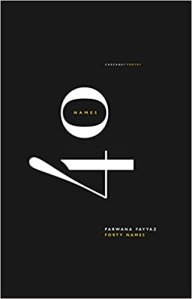 Have a look at this debut poet’s journey: Fayyaz was born in Kabul in 1990, grew up in Afghanistan and Pakistan, studied in Bangladesh and at Stanford, and is now, having completed her PhD, a research fellow at Cambridge. Many of her poems tell family stories that have taken on the air of legend due to the translated nicknames: “Patience Flower,” her grandmother, was seduced by the Khan and bore him two children; “Quietude,” her aunt, was a refugee in Iran. Her cousin, “Perfect Woman,” was due to be sent away from the family for infertility but gained revenge and independence in her own way.
Fayyaz is bold to speak out about the injustices women can suffer in Afghan culture. Domestic violence is rife; miscarriage is considered a disgrace. In “Roqeeya,” she remembers that her mother, even when busy managing a household, always took time for herself and encouraged Parwana, her eldest, to pursue an education and earn her own income. However, the poet also honours the wisdom and skills that her illiterate mother exhibited, as in the first three poems about the care she took over making dresses and dolls for her three daughters.
As in Agarwal’s book, there is a lot here about ideals of femininity and the different routes that women take – whether more or less conventional. “Reading Nadia with Eavan” was a favourite for how it brought together different aspects of Fayyaz’s experience. Nadia Anjuman, an Afghan poet, was killed by her husband in 2005; many years later, Fayyaz found herself studying Anjuman’s work at Cambridge with the late Eavan Boland. Important as its themes are, I thought the book slightly repetitive and unsubtle, and noted few lines or turns of phrase – always a must for me when assessing a poetry collection.
With thanks to Carcanet Press for the free copy for review.
Resistance by Val McDermid; illus. Kathryn Briggs
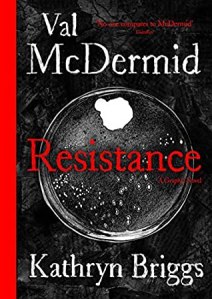 The second 2021 release I read in quick succession in which all but a small percentage of the human race (here, 2 million people) perishes in a pandemic – the other was Under the Blue. Like Aristide’s novel, this story had its origins in 2017 (in this case, on BBC Radio 4’s “Dangerous Visions”) but has, of course, taken on newfound significance in the time of Covid-19. McDermid imagines the sickness taking hold during a fictional version of Glastonbury: Solstice Festival in Northumberland. All the first patients, including a handful of rockstars, ate from Sam’s sausage sandwich van, so initially it looks like food poisoning. But vomiting and diarrhoea give way to a nasty rash, listlessness and, in many cases, death.
Zoe Beck, a Black freelance journalist who conducted interviews at Solstice, is friends with Sam and starts investigating the mutated swine disease, caused by an Erysipelas bacterium and thus nicknamed “the Sips.” She talks to the festival doctor and to a female Muslim researcher from the Life Sciences Centre in Newcastle, but her search for answers takes a backseat to survival when her husband and sons fall ill.
The drawing style and image quality – some panes are blurry, as if badly photocopied – let an otherwise reasonably gripping story down; the best spreads are collages or borrow a frame/backdrop (e.g. a medieval manuscript, NHS forms, or a 1910s title page).


SPOILER
{The ending, which has an immune remnant founding a new community, is VERY Parable of the Sower.}
With thanks to Profile Books/Wellcome Collection for the free copy for review.
Gifts of Gravity and Light: A Nature Almanac for the 21st Century, ed. Anita Roy and Pippa Marland
I hadn’t heard about this upcoming nature anthology when a surprise copy dropped through my letterbox. I’m delighted the publisher thought of me, as this ended up being just my sort of book: 12 autobiographical essays infused with musings on landscapes in Britain and elsewhere; structured by the seasons to create a gentle progression through the year, starting with the spring. Best of all, the contributors are mostly female, BIPOC (and Romany), working class and/or queer – all told, the sort of voices that are heard far too infrequently in UK nature writing. In momentous rites of passage, as in routine days, nature plays a big role.
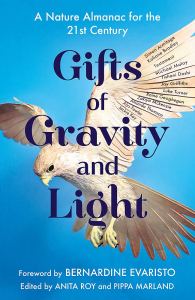 A few of my favourite pieces were by Kaliane Bradley, about her Cambodian heritage (the Wishing Dance associated with cherry blossom, her ancestors lost to genocide, the Buddhist belief that people can be reincarnated in other species); Testament, a rapper based in Leeds, about capturing moments through photography and poetry and about the seasons feeling awry both now and in March 2008, when snow was swirling outside the bus window as he received word of his uni friend’s untimely death; and Tishani Doshi, comparing childhood summers of freedom in Wales with growing up in India and 2020’s Covid restrictions.
Most of the authors hold two places in mind at the same time: for Michael Malay, it’s Indonesia, where he grew up, and the Severn estuary, where he now lives and ponders eels’ journeys; for Zakiya McKenzie, it’s Jamaica and England; for editor Anita Roy, it’s Delhi versus the Somerset field her friend let her wander during lockdown. Trees lend an awareness of time and animals a sense of movement and individuality. Alys Fowler thinks of how the wood she secretly coppices and lays on park paths to combat the mud will long outlive her, disintegrating until it forms the very soil under future generations’ feet.
A favourite passage (from Bradley): “When nature is the cuddly bunny and the friendly old hill, it becomes too easy to dismiss it as a faithful retainer who will never retire. But nature is the panic at the end of a talon, and it’s the tree with a heart of fire where lightning has struck. It is not our friend, and we do not want to make it our enemy.”
Also featured: Bernardine Evaristo (foreword), Raine Geoghegan, Jay Griffiths, Amanda Thomson, and Luke Turner.
With thanks to Hodder & Stoughton for the free copy for review.
Records of an Incitement to Silence by Gregory Woods
 Woods is an emeritus professor at Nottingham Trent University, where he was appointed the UK’s first professor of Gay & Lesbian Studies in 1998. Much of his sixth poetry collection is composed of unrhymed sonnets in two stanzas (eight lines, then six). The narrator is often a randy flâneur, wandering a city for homosexual encounters. One assumes this is Woods, except where the voice is identified otherwise, as in “[Walt] Whitman at Timber Creek” (“He gives me leave to roam / my idle way across / his prairies, peaks and canyons, my own America”) and “No Title Yet,” a long, ribald verse about a visitor to a stately home.
Other times the perspective is omniscient, painting a character study, like “Company” (“When he goes home to bed / he dare not go alone. … This need / of company defeats him.”), or of Frank O’Hara in “Up” (“‘What’s up?’ Frank answers with / his most unseemly grin, / ‘The sun, the Dow, my dick,’ / and saunters back to bed.”). Formalists are sure to enjoy Woods’ use of form, rhyme and meter. I enjoyed some of the book’s cheeky moments but had trouble connecting with its overall tone and content. That meant that it felt endless. I also found the end rhymes, when they did appear, over-the-top and silly (Demeter/teeter, etc.).
Two favourite poems: “An Immigrant” (“He turned away / to strip. His anecdotes / were innocent and his / erection smelled of soap.”) and “A Knot,” written for friends’ wedding in 2014 (“make this wedding supper all the sweeter / With choirs of LGBT cherubim”).
With thanks to Carcanet Press for the free copy for review.
Would you be interested in reading one or more of these?
Northumberland Trip, Book Haul, and Reading & 20 Books #9 Emerald
We spent the first 11 days of July on holiday in Northumberland (via stays with friends in York on the way up and back) – our longest spell of vacation since 2016, and our longest UK break since 2013. The trip also happened to coincide with our 14th anniversary. It was a fantastic time of exploring England’s northeast corner, a region new to me. I loved the many different types of landscape, from sandy beaches and rocky coasts and islands to moorland and lovely towns. It’s the county for you if you like castles. We joined the National Trust so we could make stops at lots of stately homes and other historic sites. Some highlights were:
- Cherryburn, the off-the-beaten-track home of engraver Thomas Bewick.
- A cheap and delicious meal of authentic Mexican street food in Hexham, of all places (at Little Mexico).
- Walking along a tiny fraction of Hadrian’s Wall from Housesteads Roman Fort.


- Cragside, the over-the-top home of a Victorian inventor (and the first international arms dealer – whoops), nestled in a plantation of pines and rhododendrons.
- A boat trip to the Farne Islands with a landing on Inner Farne, giving close-up views of puffins, other seabirds, and grey seals. We also sailed past the lighthouse made famous by Grace Darling’s rescue of shipwreck victims in 1838. (Relevant song by Duke Special, by way of a Michael Longley poem.)
- Whiling away a rainy morning in Barter Books, one of Britain’s largest secondhand bookshops (located in an old Victorian railway station), and the charity shops of Alnwick.
- An adventurous (and very wet) walk along the coast to the Dunstanburgh Castle ruin.


- Searching the dunes for rare orchids on Holy Island, followed by a delicious and largely vegan lunch at Pilgrims Coffee House.
- Another seabird-filled boat trip, this one round Coquet Island. Sightings included roseate terns and the Duke of Northumberland.
- Our second Airbnb, The Lonnen (near Rothbury), was a rural idyll shared mostly with sheep and gray wagtails. We were spoiled by Ruth’s excellent interior décor and cooked breakfasts. You can get a feel for the place via her Instagram.
- Coffee and snacks at Corbridge Larder’s Heron Café – so good we made a second trip.


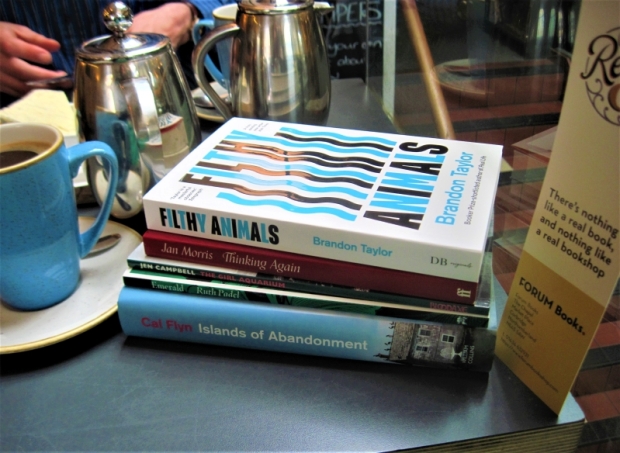
It was also, half unexpectedly, a week filled with book shopping. First up was Forum Books in Corbridge, a lovely independent bookshop. I don’t often buy new books, so enjoyed the splurge here. The Flyn and Taylor were two of my most anticipated releases of 2021. It felt appropriate to pick up a Bloodaxe poetry title as the publisher is based in nearby Hexham.
Next came a bounteous charity shop haul in Hexham.

On the Tuesday we holed up in Barter Books for hours while it rained – and the queue lengthened – outside. I was surprised and delighted that the nine antiquarian books I resold to Barter more than paid for my purchases, leaving me in credit to spend another time (online if, as seems likely, I don’t get back up in person anytime soon).


Alnwick also has a number of charity shops. I had the most luck at the Lions bookshop.

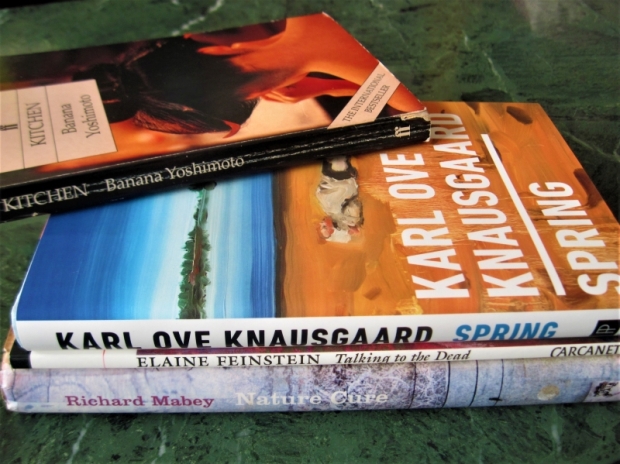
I seemed to keep finding books wherever I went. Kitchen came from a bookshelf in a shop/café on Holy Island. A secondhand/remainders shop near York Minster was the source of the other three.
What I Read:
The holiday involved significant car journeys as Northumberland is a big county with an hour or more between destinations. Alongside my navigating and DJ duties, I got a lot of reading done during the days, as well as in the evenings.
Finished second half or so of:
 Phosphorescence by Julia Baird – An intriguing if somewhat scattered hybrid: a self-help memoir with nature themes. Many female-authored nature books I’ve read recently (Wintering, A Still Life, Rooted) have emphasized paying attention and courting a sense of wonder. To cope with recurring abdominal cancer, Baird turned to swimming at the Australian coast and to faith. Indeed, I was surprised by how deeply she delves into Christianity here. She was involved in the campaign for the ordination of women and supports LGBTQ rights.
 Open House by Elizabeth Berg – When her husband leaves, Sam goes off the rails in minor and amusing ways: accepting a rotating cast of housemates, taking temp jobs at a laundromat and in telesales, and getting back onto the dating scene. I didn’t find Sam’s voice as fresh and funny as Berg probably thought it is, but this is as readable as any Oprah’s Book Club selection and kept me entertained on the plane ride back from America and the car trip up to York. It’s about finding joy in the everyday and not defining yourself by your relationships.
 Site Fidelity by Claire Boyles – I have yet to review this for BookBrowse, but can briefly tell you that it’s a terrific linked short story collection set on the sagebrush steppe of Colorado and featuring several generations of strong women. Boyles explores environmental threats to the area, like fracking, polluted rivers and an endangered bird species, but never with a heavy hand. It’s a different picture than what we usually get of the American West, and the characters shine. The book reminded me most of Love Medicine by Louise Erdrich.
 Every Minute Is a Day by Robert Meyer, MD and Dan Koeppel – The Bronx’s Montefiore Medical Center serves an ethnically diverse community of the working poor. Between March and September 2020, it had 6,000 Covid-19 patients cross the threshold. Nearly 1,000 of them would die. Unfolding in real time, this is an emergency room doctor’s diary as compiled from interviews and correspondence by his journalist cousin. (Coming out on August 3rd. Reviewed for Shelf Awareness.)
 Virga by Shin Yu Pai – Yoga and Zen Buddhism are major elements in this tenth collection by a Chinese American poet based in Washington. She reflects on her family history and a friend’s death as well as the process of making art, such as a project of crafting 108 clay reliquary boxes. “The uncarved block,” a standout, contrasts the artist’s vision with the impossibility of perfection. The title refers to a weather phenomenon in which rain never reaches the ground because the air is too hot. (Coming out on August 1st.)
Read most or all of:
 The Other Black Girl by Zakiya Dalila Harris – I feel like I’m the last person on Earth to read this buzzy book, so there’s no point recounting the plot, which initially is reminiscent of Luster by Raven Leilani but morphs into its own thing as Nella realizes her rivalry with Hazel, her new Black colleague at Wagner Books, is evidence of a wider social experiment. The prose is hip, bringing to mind Queenie and Such a Fun Age. It was a fun road trip read for me, but I could have done without the silliness of magical hair care products.
 Heartstopper, Volume 1 by Alice Oseman – It’s well known at Truham boys’ school that Charlie is gay. Luckily, the bullying has stopped and the others accept him. Nick, who sits next to Charlie in homeroom, even invites him to join the rugby team. Charlie is smitten right away, but it takes longer for Nick, who’s only ever liked girls before, to sort out his feelings. This black-and-white YA graphic novel is pure sweetness, taking me right back to the days of high school crushes. I raced through and placed holds on the other three volumes.
 The Vacationers by Emma Straub – Perfect summer reading; perfect holiday reading. Like Jami Attenberg, Straub writes great dysfunctional family novels featuring characters so flawed and real you can’t help but love and laugh at them. Here, Franny and Jim Post borrow a friend’s home in Mallorca for two weeks, hoping sun and relaxation will temper the memory of Jim’s affair. Franny’s gay best friend and his husband, soon to adopt a baby, come along. Amid tennis lessons, swims and gourmet meals, secrets and resentment simmer.
 Kitchen by Banana Yoshimoto – A pair of poignant stories of loss and what gets you through. In the title novella, after the death of the grandmother who raised her, Mikage takes refuge with her friend Yuichi and his mother (once father), Eriko, a trans woman who runs a nightclub. Mikage becomes obsessed with cooking: kitchens are her safe place and food her love language. Moonlight Shadow, half the length, repeats the bereavement theme but has a magic realist air as Satsuki meets someone who lets her see her dead boyfriend again.
I also made a good start on a few of my other purchases from the trip: Islands of Abandonment, No Time to Spare, Filthy Animals, and Female Friends.
Alas, most of the in-demand library books I brought along with me – Great Circle by Maggie Shipstead, Malibu Rising by Taylor Jenkins Reid, and Still Life by Sarah Winman – didn’t hit the spot, so I’ve returned them unread and will borrow them at another point later in the year (except Malibu Rising, which felt soapy and insubstantial).
It’s been a struggle getting back into the routines of work and writing since we got back, but I’ve managed to review one more of my 20 Books of Summer. This is #9, slipped in from my Forum Books pile, and I’m currently working on books #10–13.
Emerald by Ruth Padel (2018)
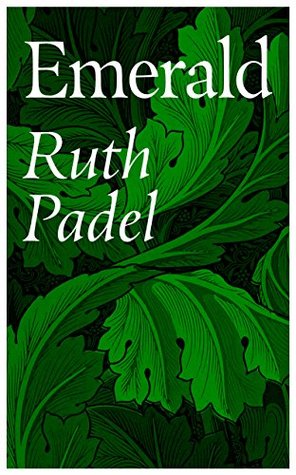 This was my 11th book from Padel; I’ve read a mixture of her poetry, fiction, narrative nonfiction and poetry criticism. Emerald consists mostly of poems in memory of her mother, Hilda, who died in 2017 at the age of 97. The book pivots on her mother’s death, remembering the before (family stories, her little ways, moving her into sheltered accommodation when she was 91, sitting vigil at her deathbed) and the letdown of after. It made a good follow-on to one I reviewed last month, Kate Mosse’s An Extra Pair of Hands.
Emerald, the hue and the gemstone, recurs frequently in ornate imagery of verdant outdoor scenes and expensive art objects. Two favourites were travel-based: “Jaipur,” about the emerald-cutters of India, where Padel guiltily flew while her mother was ill; and “Salon Noir,” about a trip down into prehistoric caves of France the summer after Hilda’s death. Overall, I expected the book to resonate with me more than it did. The bereavement narrative never broke through to touch me; it remained behind a silk screen of manners and form.
Two favourite stanzas:
“Your voice is your breath.
The first thing that’s yours
and the last.” (from “Fragile as Breath”)
“that’s all of us
sifting the dark
in our anonymities and hope.” (from “Above is the Same as Below”)
My rating:
Next books in progress: The Glitter in the Green by Jon Dunn and Nothing but Blue Sky by Kathleen MacMahon
The Best Books from the First Half of 2021
Hard to believe we’ve already crossed the midpoint of the year. My top 20 releases of 2021 thus far, in alphabetical order within genre (fiction is dominating this year!), are below. I link to those I’ve already reviewed in full here or on Goodreads:
Fiction
 Under the Blue by Oana Aristide: Fans of Station Eleven, this one’s for you: the best dystopian novel I’ve read since Mandel’s. Aristide started writing in 2017, and unknowingly predicted a much worse pandemic than Covid-19. In July 2020, Harry and sisters Ash and Jessie are among mere thousands of survivors worldwide. Their plan is to flee England for Uganda, out of range of Europe’s at-risk nuclear reactors. An epic road trip ensues. A propulsive cautionary tale that also reminded me of work by Louisa Hall and Maja Lunde.
 The Push by Ashley Audrain: Blythe Connor, living alone with her memories, ponders what went wrong with her seemingly perfect family: a handsome architect husband, Fox, and their daughter Violet and baby son Sam. How much of what happened was because of Violet’s nature, and how much was Blythe’s fault for failing to be the mother the girl needed? The fact that her experience with Sam was completely different makes her feel ambivalent about motherhood. A cracking psychological thriller with an unreliable narrator.
 A Lie Someone Told You About Yourself by Peter Ho Davies: Davies’ minimalist approach – short sections skating over the months and years, wryly pulling out representative moment – crystallizes fatherhood, illuminating its daily heartaches and joys. The tone is just right in this novella, showing both sides of parenthood and voicing things you aren’t allowed to think, or at least not to admit to, starting with abortion, which would-be fathers aren’t expected to have strong feelings about. I loved the rumination on the role that chance plays in a life.
 The Living Sea of Waking Dreams by Richard Flanagan: Extinction, personal and global, is at the heart of this timely and enchanting story. It starts off as a family drama. Francie, the 86-year-old matriarch, is in a Tasmanian hospital after a brain bleed. Her three middle-aged children can’t bear to let her go. In an Australia blighted by bushfires, species loss mirrors Francie’s physical and mental crumbling. Smartphone addiction threatens meaningful connection. And then characters start to literally disappear, part by part…
 Mrs Death Misses Death by Salena Godden: Grief Is the Thing with Feathers meets Girl, Woman, Other would be my marketing shorthand for this one. Poet Salena Godden’s debut novel is a fresh and fizzing work, passionate about exposing injustice but also about celebrating simple joys, and in the end it’s wholly life-affirming despite a narrative stuffed full of deaths real and imagined. The novel balances the cosmic and the personal through Wolf’s family story. Unusual, musical, and a real pleasure to read.
 Early Morning Riser by Katherine Heiny: This tickled my funny bone. A cross between Kitchens of the Great Midwest and Olive Kitteridge, it’s built of five extended episodes, crossing nearly two decades in the lives of Jane and Duncan and lovingly portraying the hangers-on who compose their unusual family constellation in Boyne City, Michigan. All the characters are incorrigible but wonderful. Bad things happen, but there’s a core of love as Heiny explores marriage and parenting. A good-natured book that feels wise and bittersweet.
 No One Is Talking About This by Patricia Lockwood: This starts as a flippant skewering of modern life. A woman who became a social media star by tweeting quips like “Can a dog be twins?” reflects on life on “the portal” and under “the dictator.” Midway through the book, she gets a wake-up call when her mother summons her back to the Midwest for a family emergency. It’s the about-face that makes this novel, forcing readers to question the value of a digital existence based on glib pretence. Funny, but with an ache behind it.
 In by Will McPhail: Alternately laugh-out-loud funny and gentle. This debut graphic novel is a spot-on picture of modern life in a generic city. Nick never knows the right thing to say. The bachelor artist’s well-intentioned thoughts remain unvoiced; all he can manage is small talk. That starts to change when he meets Wren, a Black doctor who sees past his pretence. If only he can find the magic words that elicit honesty, he might make real connections with other human beings. A good old-fashioned story, with a wide emotional range.
 Detransition, Baby by Torrey Peters: A sparkling, sexy comedy with a tender heart beneath the zingers. Peters has set herself up as the Jane Austen of the trans community, tracing the ins and outs of relationships with verve and nuance. For me this was a valuable book simply for normalizing trans sexuality. The themes are universal, after all: figuring out who you are and what the shape of your life will be. I admire when authors don’t pander to readers by making things easy for those who are unfamiliar with a culture. Great lines abound.
 Brood by Jackie Polzin: Polzin’s debut is a quietly touching story of a woman in the Midwest raising chickens and coming to terms with the shape of her life. The unnamed narrator is Everywoman and no one at the same time. At one point she reveals, with no fanfare, that she miscarried four months into pregnancy in the bathroom of one of the houses she cleans. There is a bittersweet tone to this short work. It’s a low-key, genuine portrait of life in the in-between stages and how it can be affected by fate or by other people’s decisions.
Nonfiction
 The Circling Sky by Neil Ansell: Hoping to reclaim an ancestral connection, Ansell visited the New Forest some 30 times between January 2019 and January 2020, observing the unfolding seasons and the many uncommon and endemic species its miles house. He weaves together his personal story, the shocking history of forced Gypsy relocation into forest compounds starting in the 1920s, and the unfairness of land ownership in Britain. The New Forest is a model of both wildlife-friendly land management and freedom of human access.
 The Inevitable by Katie Engelhart: Engelhart spends time with doctors and patients who are caught up in the assisted dying argument, chiefly in Western Europe and the United States. Each case is given its own long chapter, like an extended magazine profile. The stories are wrenching, but compassionately told. The author explores the nuances of each situation, crafting expert portraits of suffering people and the medical professionals who seek to help them, and adding much in the way of valuable context. A voice of reason and empathy.
 The Screaming Sky by Charles Foster: A Renaissance man as well versed in law and theology as he is in natural history, Foster is obsessed with swifts and ashamed of his own species: for looking down at their feet when they could be watching the skies; for the “pathological tidiness” that leaves birds and other creatures no place to live. He delivers heaps of information on the birds but refuses to stick to a just-the-facts approach. The book quotes frequently from poetry and the prose is full of sharp turns of phrase and whimsy.
 Intensive Care by Gavin Francis: Francis, an Edinburgh physician, reflects on “the most intense months I have known in my twenty-year career.” He journeys back through 2020, from the January day when he received a bulletin about a “novel Wuhan coronavirus” to November, when he learned of promising vaccine trials but also a rumored third wave and winter lockdown. An absorbing first-hand account of a medical crisis, it compassionately bridges the gap between experts and laymen. The best Covid chronicle so far.
 A Still Life by Josie George: Over a year of lockdowns, many of us became accustomed to spending most of the time at home. But for Josie George, social isolation is nothing new. Chronic illness long ago reduced her territory to her home and garden. The magic of A Still Life is in how she finds joy and purpose despite extreme limitations. Opening on New Year’s Day and travelling from one winter to the next, the book is a window onto George’s quiet existence as well as the turning of the seasons. (Reviewed for TLS.)
 Dusk, Night, Dawn by Anne Lamott: Lamott’s best new essays in nearly a decade. The central theme is how to have hope in God and in other people even when the news – Trump, Covid, and climate breakdown – only heralds the worst. One key thing that has changed for her is getting married for the first time, in her mid-sixties, to a Buddhist. In thinking of marriage, she writes about friendship, constancy, and forgiveness, none of which comes easy. Opportunities for maintaining quiet faith in spite of the circumstances arise all the time.
 A Braided Heart by Brenda Miller: Miller, a professor of creative writing, delivers a master class on the composition and appreciation of autobiographical essays. In 18 concise pieces, she tracks her development as a writer and discusses the “lyric essay”—a form as old as Seneca that prioritizes imagery over narrative. These innovative and introspective essays, ideal for fans of Anne Fadiman, showcase the interplay of structure and content. (Coming out on July 13th from the University of Michigan Press. My first review for Shelf Awareness.)
 Sanctuary by Emily Rapp Black: A continuation of The Still Point of the Turning World, about the author’s son Ronan, who died of Tay-Sachs disease at age three. In the months surrounding his death, she split from her husband and raced into another relationship that led to her daughter, Charlie. Rapp Black questions the sorts of words she got branded with: “brave,” “resilient.” Sanctuary is full of allusions and flashbacks, threading life’s disparate parts into a chaotic tapestry. It’s measured and wrought, taming fire into light and warmth.
Poetry
 Pilgrim Bell by Kaveh Akbar: An Iranian American poet imparts the experience of being torn between cultures and languages, as well as between religion and doubt, in this gorgeous collection of confessional verse. Food, plants, animals, and the body supply the book’s imagery. Wordplay and startling juxtapositions lend lightness to a wistful, intimate collection that seeks belonging and belief. (Coming out on August 3rd from Graywolf Press. Reviewed for Shelf Awareness.)
 Eat or We Both Starve by Victoria Kennefick: In this audacious debut collection, the body is presented as a battleground: for the brain cancer that takes the poet’s father; for disordered eating that entwines with mummy issues; for the restructuring of pregnancy. Families break apart and fuse into new formations. Cannibalism and famine metaphors dredge up emotional states and religious doctrines. There’s a pleasingly morbid cast to the book, but it also has its lighter moments. Rich with imagery and alliteration, this is just my kind of poetry.
What are some of the best books you’ve read so far this year?
What 2021 releases do I need to catch up on right away?
Three June Releases: Allen-Paisant, Cowen and Mosse
Two poetry offerings and a short memoir this month. A similar strategy is at work in both verse volumes: Jason Allen-Paisant contrasts Jamaica and England via the medium of trees, and Rob Cowen comments on current events through the prism of the natural world. In Kate Mosse’s first nonfiction book, she reflects on bereavement and caregiving.
Thinking with Trees by Jason Allen-Paisant
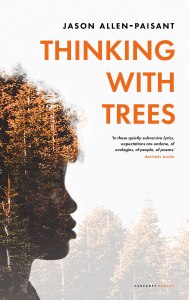 Allen-Paisant, from Jamaica and now based in Leeds, describes walking in the forest as an act of “reclamation.” For people of colour whose ancestors were perhaps sent on forced marches, hiking may seem strange, purposeless (the subject of “Black Walking”). Back in Jamaica, the forest was a place of utility rather than recreation:
In Porus life was un-
pastoral
The woodland was there
not for living in going for walks
or thinking
Trees were answers to our needs
not objects of desire
woodfire
But “I give myself permission / to go outside,” he writes, to notice the turning of the seasons, to commune with trees and birds, even if “there is nobody else like me / around here”. Explicitly calling into question Wordsworth’s model of privileged wandering, he injects a hint of threat into his interactions with nature. Most often this is symbolized by the presence of dogs. Even the most idyllic of scenes harbours the possibility of danger.
beware of spring
believe you are
a sprout of grass
and love all you see
but come out of the woods
before the white boys
with pitbulls
come
The poet cites George Floyd and Christian Cooper, the Central Park birder a white woman called the police on, as proof that being Black outdoors is inherently risky. There’s no denying this is an important topic, but I found the poems repetitive, especially the references to dogs. These felt like overkill. While there is some interesting enjambment, as in the first extended quote above, as well as internal and half-rhymes, I tend to prefer more formal poetry that uses more sonic techniques and punctuation. Still, I would be likely to direct fans of Kei Miller’s work to this collection.
With thanks to Carcanet Press for the free copy for review.
The Heeding by Rob Cowen
This poetry and art collaboration arose out of a “pact to pay attention” during a year of lockdown in the UK and record observations of nature, current events, and everyday life. Cowen is drawn to the moors near his home in Yorkshire, but also yearns to spend time with his friends again. He watches hawks and blue tits, notices the insects that fill his garden, and celebrates the way that allotment gardening brings together all sorts of people.
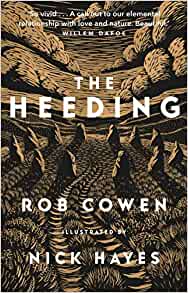 The emotional scope of the poems is broad: the author fondly remembers his brick-making ancestors and his honeymoon; he sombrely imagines the last moments of an old man dying in a hospital; he expresses guilt over accidentally dismembering an ant, yet divulges that he then destroyed the ants’ nest deliberately. There are even a couple of cheeky, carnal poems, one about a couple of teenagers he caught copulating in the street and one, “The Hottest Day of the Year,” about a longing for touch. “Matter,” in ABAB stanzas, is on the theme of racial justice by way of the Black Lives Matter movement.
My two favourites were “Sunday School,” about the rules for life he’s lived by since leaving religion behind, and “The End of This (Drinking Poem),” which serves as a good-riddance farewell to 2020: “Let me shake off / this year the way the otter / slips out of fast, rising water / and makes the holt just in time … / Let me rid my days of caution and fear, / these protocols and tiers / and Zoom funerals for people I love / and will never see again.” The book is worth the price of admission for the latter alone, and Nick Hayes’s black-and-white woodcut-style engravings are a plus.
However, in general I felt that the balance of current events and nature was off, especially compared to books like The Consolation of Nature, and ultimately I was not convinced that this needed to be in verse at all. “Starling,” especially, feels like a straight knockoff of Robert Macfarlane’s The Lost Words (“We forget that you once shimmered through frozen air, ripple bird. / Shape-shifter, dusk-dancer. Murmurer, sky-writer”). Judging from Cowen’s Common Ground, this would have been more successful as a book of short prose diary entries with a few poems dotted through.
With thanks to Elliott & Thompson for the proof copy for review.
An Extra Pair of Hands: A Story of Caring, Ageing and Everyday Acts of Love by Kate Mosse
Mosse’s parents and mother-in-law all moved in to live with her and her husband in their Chichester home when they reached old age. Her father had Parkinson’s and died in 2011, her mother survived him by a few years, and Granny Rosie is still going (reasonably) strong at the age of 90. This is a compact and relatable account of a daughter’s experiences of caregiving and grief, especially with the recent added complications of a pandemic.
 What came through particularly clearly for me was the older generation’s determination to not be a burden: living through the Second World War gave them a sense of perspective, such that they mostly did not complain about their physical ailments and did not expect heroic measures to be made to help them. (Her father knew his condition was “becoming too much” to deal with, and Granny Rosie would sometimes say, “I’ve had enough of me.”) In her father’s case, this was because he held out hope of an afterlife. Although Mosse does not share his religious beliefs, she is glad that he had them as a comfort.
The author recognizes the ways in which she has been lucky: as a full-time writer, she works from home and has the time and energy to devote to caring for elderly parents, whereas for many – generally middle-aged women, who may still have children at home – it is a huge struggle to balance caregiving with the rest of life. What is more, money is no issue for her. Repeating some of the statistics from Madeleine Bunting’s Labours of Love, she acknowledges that the situation is much more challenging for the average person.
I can see how this could serve as a great introduction for someone who hasn’t previously read much about bereavement, caregiving or old age, and I imagine it will especially appeal to existing fans of Mosse’s writing, whereas I was new to her work. I’ve read so much around these topics, including most of the works included in the bibliography, that the book did not offer me anything new, though it was a perfectly pleasant read.
Readalikes I have reviewed:
Notes on Grief by Chimamanda Ngozi Adichie
Be With by Mike Barnes
All Things Consoled by Elizabeth Hay
The Fragments of My Father by Sam Mills
With thanks to Profile Books/Wellcome Collection for the free copy for review.
What recent releases can you recommend?
Review Book Catch-Up: Dennis, Galloway, Leland-St. John and Sampson
Capsule reviews today, of four books I am inexcusably late in reviewing. I have a record of personal experience with species reintroductions, a memoir about living among reindeer herders in the far north of Norway, a set of elegiac poems, and a biography of a Victorian woman poet who struggled with poor health for most of her life.
Restoring the Wild: Sixty Years of Rewilding Our Skies, Woods and Waterways by Roy Dennis
 Rewilding is a big buzz word in current nature and environmental writing. Few could be said to have played as major a role in the UK’s successful species reintroduction projects as Roy Dennis, who has been involved with the RSPB and other key organizations since the late 1950s. He trained as a warden at two of the country’s most famous bird observatories, Lundy Island and Fair Isle. Most of his later work was to focus on birds: white-tailed eagles, red kites, and ospreys. Some of these projects extended into continental Europe. He also writes about the special challenges posed by mammal reintroductions; beavers get a chapter of their own. Every initiative is described in exhaustive detail, full of names and dates, whereas I would have been okay with an overview. This feels like more of an insider’s history rather than a layman’s introduction. I have popped it on my husband’s bedside table in hopes that, with his degree in wildlife conservation, he’ll be more interested in the nitty-gritty.
Favourite lines:
“Tenacity and a long view to the future are important in wildlife conservation.”
“for every successful project that gets the go-ahead, there are others into which people put great effort but which then run up against problems.”
With thanks to William Collins for the free copy for review.
Dálvi: Six Years in the Arctic Tundra by Laura Galloway
 The title is the word for winter in the Northern Sámi language. Galloway, a journalist, traded in New York City for Arctic Norway after a) a DNA test told her that she had Sámi blood and b) she met and fell for Áilu, a reindeer herder, at a wedding. She enrolled in an intensive language learning course at university level and got used to some major cultural changes: animals were co-workers here rather than pets (like the two cats she brought with her); communal meals and drawn-out goodbyes were not the done thing; and shamans were still active (one helped them find a key she lost). Footwear neatly sums up the difference. The Prada heels she brought “just in case” ended up serving as hammers; instead, she helped Áilu’s mother make reindeer skins into boots. Two factors undermined my enjoyment: Alternating chapters about her unhappy upbringing in Indiana don’t add much of interest, and, after her relationship with Áilu ends, the book feels aimless. However, I appreciated her words about DNA not defining you, and family being what you make it.
With thanks to Atlantic Books for the free copy for review.
A Raga for George Harrison by Sharmagne Leland St.-John (2020)
 Native American poet Sharmagne Leland St.-John’s fifth collection is a nostalgic and bittersweet look at people and places from one’s past. There are multiple elegies for public figures – everyone from Janis Joplin to Virginia Woolf – as well as for some who aren’t household names but have important stories that should be commemorated, like Hector Pieterson, a 12-year-old boy killed during the Soweto Uprising for protesting enforced teaching of Afrikaans in South Africa in 1976. Many of the elegies are presented as songs. Personal sources of sadness, such as a stillbirth, disagreements with a daughter, and ageing, weigh as heavily as tragic world events.
Rhyming and alliteration create inviting rhythms throughout the book, and details of colour and fashion animate poems like “La Kalima.” Leland St.-John remembers meeting street children in Mexico, while bamboo calls to mind time spent in Japan. “Promised Land” is an ironic account of land being seized from natives and people of colour. I especially liked “Things I Would Have Given to My Mother Had She Asked” (some literal and some more abstract), which opens “A piece of my liberal mind. 5 more minutes of my time”, and the sombre “Cat’s Cradle” (“Drenched starlings perch on a cat’s cradle of telephone wires”).
You can read “I Said Coffee” and a few more of her poems online.
With thanks to the author for sending a free e-copy for review.
Two-Way Mirror: The Life of Elizabeth Barrett Browning by Fiona Sampson
 Coming in at under 260 pages, this isn’t your standard comprehensive biography. Sampson instead describes it as a “portrait,” one that takes up the structure of EBB’s nine-book epic poem, Aurora Leigh, and is concerned with themes of identity and the framing of stories. Elizabeth, as she is cosily called throughout the book, wrote poems that lend themselves to autobiographical interpretation – “her body of work creates a kind of looking glass in which, dimly, we make out the person who wrote it,” Sampson asserts.
Nicknamed “Ba,” Elizabeth was born in 1806 and brought up with 11 younger siblings at a Herefordshire estate, Hope End. Her father, Edward, had been born in Jamaica and the family fortune was based on sugar – and slavery. Sampson makes much of this inherited guilt, and also places an emphasis on EBB’s lifelong ill health, which involved headaches, back and side pain, and depression. She also suffered from respiratory complaints. The modern medically minded reader tries to come up with a concrete diagnosis. Tardive dystonia? Post-viral syndrome? The author offers many potential explanations, and notes that her subject was the very type of the Victorian female invalid. She would also suffer from miscarriages, but had one son, Pen. The Brownings were in the unusual position of the wife being the more famous partner.
Sampson draws heavily on correspondence and earnestly interrogates scenes and remembrances, but her use of the present tense is a bit odd for a historical narrative, and I found my casual curiosity about the Brownings wasn’t enough to sustain my interest. However, this did make me eager to try more of EBB’s poetry. I wonder if I still have that copy of Sonnets from the Portuguese in a box in the States?
Favourite lines:
“Within the continual process of reputation-making and remaking that is literary history, Elizabeth Barrett Browning remains a bellwether for the rising and sinking stock of women writers. … Elizabeth dramatizes the two-way creation of every writing self, from without and from within. That the life of the body both enables and limits the life of the mind is the paradox of the thinking self.”
With thanks to Profile Books for the free copy for review.
Would you be interested in reading one or more of these?
Review Book Catch-Up: Ante, Evans, Foster and White
Today I have a book of poems about the Filipinx experience in the UK, a collection of short stories reflecting on racial injustice, a monograph on a bird that spells summer for many of us, and a biographical investigation into a little-understood medical condition.
Antiemetic for Homesickness by Romalyn Ante
I was drawn to this debut collection by the terrific title and cover, but also by the accolades it received: it was on the Dylan Thomas Prize longlist and the Jhalak Prize shortlist. I hope we’ll see it on the Sunday Times Young Writer of the Year Award shortlist, too. Ante grew up in the Philippines but at age 16 joined her mother in the UK, where she had moved years before to work as a nurse in the NHS. She has since followed in her mother’s footsteps as a nurse – indeed, overseas Filipinx workers (Jamaicans, too) are a mainstay of the NHS.
 Ante remembers the years when her mother was absent but promised to send for the rest of the family soon: “You said all I needed to do was to sleep and before I knew it, / you’d be back. But I woke to the rice that needed rinsing, / my siblings’ school uniforms that needed ironing.” The medical profession as a family legacy and noble calling is a strong element of these poems, especially in “Invisible Women,” an ode to the “goddesses of caring and tending” who walk the halls of any hospital. Hard work is a matter of survival, and family – whether physically present or not – bolsters weary souls. A series of short, untitled poems are presented as tape recordings made for her mother.
Food is inextricably entwined with memory (reminding me of Nina Mingya Powles’s approach in Tiny Moons) and provides some of the standout metaphors, especially in “Patis” and “Ode to a Pot Noodle.” Ante uses a lot of alliteration and adapts various forms. I especially liked “Tagay!”, a traditional drinking song, and “Mateo,” printed in the shape of a pound sign. The nuanced look at the immigrant experience reminded me of Jenny Xie’s Eye Level. Movement entails losses as well as benefits. The focus on the Filipinx experience also made me think of America Is Not the Heart. My favourite single poem was “The Making of a Smuggler,” which opens “Wherever we travel, we carry / the whole country with us – // our rice terraces are folded garments, / we have pillars of trees, a rainforest // on a hairbrush.”
Favourite lines:
“Gone are the nights he steals / the moon with a mango picker / and swaps it for her pocket mirror”
“The yellow admission papers in my hands escaped / flustering at my face into a flight of orioles.”
“I am halved in order to be whole – / I rebuild by leaving / everything I love.”
With thanks to Chatto & Windus for the free copy for review.
The Office of Historical Corrections by Danielle Evans
To boil these six stories and a novella down to the topic of race in America risks painting them as solemn or strident – more concerned with meaning than with art – when the truth is that they are playful and propulsive even though they keep cycling back to bereavement and injustice. Several of the protagonists are young Black women coming to terms with a loss.
 In “Happily Ever After,” Lyssa works in the gift shop of a Titanic replica and is cast as an extra in a pop star’s music video. Mythical sea monsters are contrasted with the real dangers of her life, like cancer and racism. “Anything Could Disappear” was a favourite of mine, though it begins with that unlikely scenario of a single woman acquiring a baby as if by magic. What starts off as a burden becomes a bond she can’t bear to let go. A family is determined to clear the name of their falsely imprisoned ancestor in “Alcatraz.” In “Richard of York Gave Battle in Vain” (a mnemonic for the colours of the rainbow), photojournalist Rena is wary about attending the wedding of a friend she met when their plane was detained in Africa some years ago. The only wedding she’s been in is her sister’s, which ended badly.
Mistakes and deceit seem to follow these characters. In the title novella that closes the book, Cassie and her colleagues combat fake news, going around putting correction labels on plaques that whitewash history. When she and her former colleague meet up in Wisconsin to find the truth behind a complex correction case, a clash with a white supremacist group quickly turns pedantry into a matter of life and death. The story I’d heard the most about beforehand was “Boys Go to Jupiter,” about a college girl who dons a Confederate flag bikini, not caring what message it sends to others in her dorm. It turns out she has history with a Black family, but has chosen to airbrush this experience out of her life.
There was only one story I didn’t care for, “Why Won’t Women Just Say What They Want,” about a celebrity who turns apologizing into performance art. Overall, this is a very strong collection I would recommend to readers of Brit Bennett and Raven Leilani, with some stories also reminding me of recent work by Curtis Sittenfeld and Mary South. I’ll be sure to seek out Evans’s previous book (also short stories), too.
With thanks to Picador for the proof copy for review.
The Screaming Sky by Charles Foster
The other week I was volunteering at our local community garden and looked up to see a dozen common swifts wheeling over the Kennet & Avon canal and picking off insects among the treetops. I hope this fellow Foster (for whom my husband was once confused on a nature conference attendee list) would be proud of me for pausing to gaze at the birds for a while. My impression of the author is as a misanthropic eccentric. A Renaissance man as well versed in law and theology as he is in natural history, he’s obsessed with swifts and ashamed of his own species: for looking down at their feet when they could be watching the skies; for the “pathological tidiness” that leaves swifts and so many other creatures no place to live.
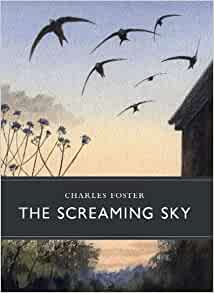 The obsession began when he was eight years old and someone brought him a dead swift fledgling for his taxidermy hobby. Ever since, he’s dated the summer by their arrival. “It is always summer for them,” though, as his opening line has it. This monograph is structured chronologically. Much like Tim Dee does in Greenery, Foster follows the birds for a year: from their winter territory in Africa to the edges of Europe in spring and then to his very own Oxford street in high summer. When they leave, he’s bereft and ready to book a flight back to Africa.
Along the way, Foster delivers heaps of information: the fossil evidence of swifts, how they know where to migrate (we have various theories but don’t really know), their nesting habits and lifespan, and the typical fates of those individuals that don’t survive. But, thumbing his nose at his “ex-friend” (a closed-minded biologist he repeatedly, and delightfully, rails against), he refuses to stick to a just-the-facts approach. Acknowledging the risks of anthropomorphizing, he speaks of swifts as symbols of aspiration, of life lived with intensity. He believes that we can understand animal emotions analogously through our own, so that, inappropriate as such words might seem, we can talk about what birds hope and plan for. He scorns reductive ecosystem services lingo that defines creatures by what we get out of them.
Also like Dee, Foster quotes frequently from poetry. His prose is full of sharp turns of phrase and moments of whimsy and made me eager to try more of his work (I know the most about but have not yet read Being a Beast).
Swifts know the roar of lions better than the roar of the M25, the piping of hornbills better than the Nunc Dimittis of parish Evensong … Are memories of our eaves spiralling high above the Gulf of Guinea? … They don’t seem to prevaricate. One moment they’re there, the next they’re off, diving straight into the journey. It’s the way we should run into cold water.
 As I’ve found with a number of Little Toller releases now (On Silbury Hill, Snow, Landfill), knowledge meets passion to create a book that could make an aficionado of the most casual of readers. Towards the close I was also reminded of Richard Smyth’s An Indifference of Birds: “When Homo sapiens has gone there will be lots of ideal swift holes in the decaying buildings we’ll leave behind.” It’s comforting to think of natural cycles continuing after we’re gone … but let’s start making the space for them now. Jonathan Pomroy’s black-and-white illustrations of swift behaviour only add to this short book’s charms.
With thanks to Little Toller Books for the free copy for review.
Waiting for Superman: One Family’s Struggle to Survive – and Cure – Chronic Fatigue Syndrome by Tracie White
Like Suzanne O’Sullivan’s books (most recently, The Sleeping Beauties), this is presented as an investigation into a medical mystery. White, a Stanford Medicine journalist, focuses on one family that has been indelibly changed by chronic fatigue syndrome – now linked with myalgic encephalomyelitis and termed ME/CFS for short. Whitney Dafoe was a world traveller and promising photographer before, in 2010, a diagnosis of ME/CFS explained his exhaustion and gastrointestinal problems. By the time White first met the family in 2016, the thirtysomething was bedbound in his parents’ home with a feeding tube, only able to communicate via gestures and rearranging Scrabble tiles. He couldn’t bear loud noises, or to be touched. At times he was nearly comatose.
 Whitney’s father, Ron Davis, is a Stanford geneticist whose research has contributed to the Human Genome Project. He has devoted himself to studying ME/CFS, which affects 20 million people worldwide yet receives little research funding; he calls it “the last major disease we know nothing about.” Testing his son’s blood, he found a problem with the citric acid cycle that produces ATP, essential fuel for the body’s cells – proof that there was a physiological reason for Whitney’s condition. Frustratingly, though, a Stanford colleague who examined Whitney prescribed a psychological intervention. This is in line with the current standard of care for ME/CFS: a graded exercise regime (nigh on impossible for someone who can’t get out of bed) and cognitive behavioural therapy.
White delves into Whitney’s past, looking for clues to what could have triggered his illness (having mono in high school? a parasite he picked up in India?). She also goes back to the mid-1980s to consider the Lake Tahoe outbreak of ME/CFS, whose victims “looked too healthy to be sick and were repeatedly disbelieved.” The media called it “yuppie flu,” downplaying the extreme fatigue involved. White also meets Laura Hillenbrand, author of Seabiscuit, who suffers from ME/CFS and managed to write her bestselling books from bed. Like Whitney, she only has a certain allotment of energy and mustn’t use it up too fast.
- A neat connection: Stephanie Land, author of Maid, was Whitney’s ex-girlfriend when he was 19 and living in Alaska; she wrote a Longreads article about their relationship.
- The title is from a Flaming Lips lyric and expresses Whitney’s trust in his dad’s ability to cure him; the U.S. title is The Puzzle Solver and the working title was The Invisible Patient.
With thanks to Atlantic Books for the free copy for review.
Would you be interested in reading one or more of these?
Rathbones Folio Prize 2021 Shortlist Reviews & Prediction
I’ve nearly managed to read the whole Rathbones Folio Prize shortlist before the prize is announced on the evening of Wednesday the 24th. (You can sign up to watch the online ceremony here.) I reviewed the Baume and Ní Ghríofa as part of a Reading Ireland Month post on Saturday, and I’d reviewed the Machado last year in a feature on out-of-the-ordinary memoirs. This left another five books. Because they were short, I’ve been able to read and/or review another four over the past couple of weeks. (The only one unread is As You Were by Elaine Feeney, which I made a false start on last year and didn’t get a chance to try again.)
Nominations come from the Folio Academy, an international group of writers and critics, so the shortlisted authors have been chosen by an audience of their peers. Indeed, I kept spotting judges’ or fellow nominees’ names in the books’ acknowledgements or blurbs. I tried to think about the eight as a whole and generalize about what the judges were impressed by. This was difficult for such a varied set of books, but I picked out two unifying factors: A distinctive voice, often with a musicality of language – even the books that don’t include poetry per se are attentive to word choice; and timeliness of theme yet timelessness of experience.
Poor by Caleb Femi
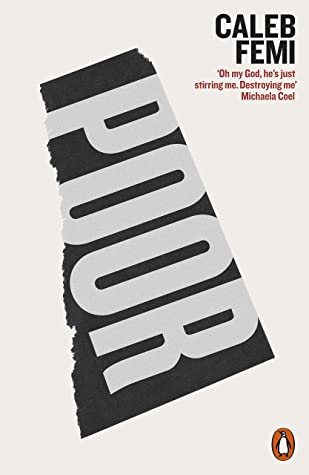 Femi brings his South London housing estate to life through poetry and photographs. This is a place where young Black men get stopped by the police for any reason or none, where new trainers are a status symbol, where boys’ arrogant or seductive posturing hides fear. Everyone has fallen comrades, and things like looting make sense when they’re the only way to protest (“nothing was said about the maddening of grief. Nothing was said about loss & how people take and take to fill the void of who’s no longer there”). The poems range from couplets to prose paragraphs and are full of slang, Caribbean patois, and biblical patterns. I particularly liked Part V, modelled on scripture with its genealogical “begats” and a handful of portraits:
The Story of Ruthless
Anyone smart enough
to study the food chain
of the estate knew exactly
who this warrior girl was;
once she lined eight boys
up against a wall,
emptied their pockets.
Nobody laughed at the boys.
Another that stood out for me was the two-part “A Designer Talks of Home / A Resident Talks of Home,” a found poem partially constructed from dialogue from a Netflix documentary on interior design. It ironically contrasts airy aesthetic notions with survival in a concrete wasteland. If you loved Surge by Jay Bernard, this should be next on your list.
My Darling from the Lions by Rachel Long
 I first read this when it was on the Costa Awards shortlist. As in Femi’s collection, race, sex, and religion come into play. The focus is on memories of coming of age, with the voice sometimes a girl’s and sometimes a grown woman’s. Her course veers between innocence and hazard. She must make her way beyond the world’s either/or distinctions and figure out how to be multiple people at once (biracial, bisexual). Her Black mother is a forceful presence; “Red Hoover” is a funny account of trying to date a Nigerian man to please her mother. Much of the rest of the book failed to click with me, but the experience of poetry is so subjective that I find it hard to give any specific reasons why that’s the case.
The Mermaid of Black Conch by Monique Roffey
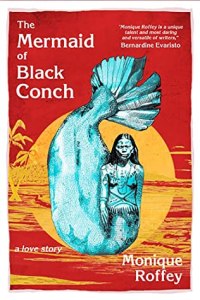 After the two poetry entries on the shortlist, it’s on to a book that, like A Ghost in the Throat, incorporates poetry in a playful but often dark narrative. In 1976, two competitive American fishermen, a father-and-son pair down from Florida, catch a mermaid off of the fictional Caribbean island of Black Conch. Like trophy hunters, the men take photos with her; they feel a mixture of repulsion and sexual attraction. Is she a fish, or an object of desire? In the recent past, David Baptiste recalls what happened next through his journal entries. He kept the mermaid, Aycayia, in his bathtub and she gradually shed her tail and turned back into a Taino indigenous woman covered in tattoos and fond of fruit. Her people were murdered and abused, and the curse that was placed on her runs deep, threatening to overtake her even as she falls in love with David. This reminded me of Ernest Hemingway’s The Old Man and the Sea and Lydia Millet’s Mermaids in Paradise. I loved that Aycayia’s testimony was delivered in poetry, but this short, magical story came and went without leaving any impression on me.
Indelicacy by Amina Cain
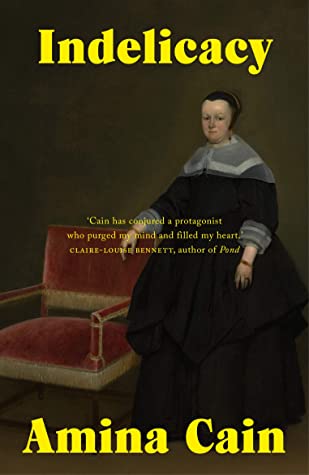 Having heard that this was about a cleaner at an art museum, I expected it to be a readalike of Asunder by Chloe Aridjis, a beautifully understated tale of ghostly perils faced by a guard at London’s National Gallery. Indelicacy is more fable-like. Vitória’s life is in two halves: when she worked at the museum and had to forego meals to buy new things, versus after she met her rich husband and became a writer. Increasingly dissatisfied with her marriage, she then comes up with an escape plot involving her hostile maid. Meanwhile, she makes friends with a younger ballet student and keeps in touch with her fellow cleaner, Antoinette, a pregnant newlywed. Vitória tries sex and drugs to make her feel something. Refusing to eat meat and trying to persuade Antoinette not to baptize her baby become her peculiar twin campaigns.
The novella belongs to no specific time or place; while Cain lives in Los Angeles, this most closely resembles ‘wan husks’ of European autofiction in translation. Vitória issues pretentious statements as flat as the painting style she claims to love. Some are so ridiculous they end up being (perhaps unintentionally) funny: “We weren’t different from the cucumber, the melon, the lettuce, the apple. Not really.” The book’s most extraordinary passage is her husband’s rambling, defensive monologue, which includes the lines “You’re like an old piece of pie I can’t throw away, a very good pie. But I rescued you.”
It seems this has been received as a feminist story, a cheeky parable of what happens when a woman needs a room of her own but is trapped by her social class. When I read in the Acknowledgements that Cain took lines and character names from Octavia E. Butler, Jean Genet, Clarice Lispector, and Jean Rhys, I felt cheated, as if the author had been engaged in a self-indulgent writing exercise. This was the shortlisted book I was most excited to read, yet ended up being the biggest disappointment.
On the whole, the Folio shortlist ended up not being particularly to my taste this year, but I can, at least to an extent, appreciate why these eight books were considered worthy of celebration. The authors are “writers’ writers” for sure, though in some cases that means they may fail to connect with readers. There was, however, some crossover this year with some more populist prizes like the Costa Awards (Roffey won the overall Costa Book of the Year).
The crystal-clear winner for me is In the Dream House by Carmen Maria Machado, her memoir of an abusive same-sex relationship. Written in the second person and in short sections that examine her memories from different angles, it’s a masterpiece and a real game changer for the genre – which I’m sure is just what the judges are looking for.

The only book on the shortlist that came anywhere close to this one, for me, was A Ghost in the Throat by Doireann Ní Ghríofa, an elegant piece of feminist autofiction that weaves in biography, imagination, and poetry. It would be a fine runner-up choice.
(On the Rathbones Folio Prize Twitter account, you will find lots of additional goodies like links to related articles and interviews, and videos with short readings from each author.)
My thanks to the publishers and FMcM Associates for the free copies for review.
 Bookish Beck = Rebecca Foster. American transplant to England. Freelance proofreader and book reviewer.
 Bookish Beck