Help Me! by Marianne Power: A Self-Help Quest
 Outwardly Marianne Power’s life was fine, but deep down she felt unhappy and unfulfilled. An Irish freelance journalist living in London, she was 36 and single. “There has to be more than just working and paying bills and buying crap we don’t need,” she felt. She’d been an obsessive reader of self-help books for years – Feel the Fear and Do It Anyway inspired her to leave her temp job at age 24 – but she realized that she’d never implemented most of the books’ lessons. So instead of just reading self-help, she set out to do self-help, one book per month, for a year (though it ended up being longer) to see if she could truly change her life.
January was a baptism of fire. Jumping in with that old favorite, Jeffers’s Feel the Fear, Power listed things she was afraid of and then did one per day: an outdoor swim on New Year’s Day, nude modeling for an art class, parallel parking, standup comedy, and skydiving. In subsequent months she tackled her disastrous finances (Money, A Love Story), tested out the law of attraction (The Secret), practiced lots of rejection therapy, worked on relinquishing control (F**k It), attended a Tony Robbins “Unleash the Power Within” seminar, and imagined what she’d want said at her funeral (The Seven Habits of Highly Effective People).
There came a point in the year when Power had to admit she was physically rundown and emotionally shattered. Months spent focusing on herself had alienated her from friends and family – even her mum, a wonderfully matter-of-fact character who believes in just getting on with life instead of moaning about it. A trio of truly useful books (The Power of Now by Eckhart Tolle, Daring Greatly by Brené Brown and You Can Heal Your Life by Louise Hay) started to turn the tide, helping Power counter negative thoughts with positive affirmations and reminding her that self-help is futile because you can never go it alone. Being with other people who understand you, volunteering and exercise: these are the things that really help.
I have a particular weakness for year-challenge books, and Power’s is written in an easy, chatty style, as if Bridget Jones had given over her diary to testing self-help books for 16 months (“Do a budget, make a plan. Two phrases that made me break into a cold sweat”). If I have one tiny complaint, it’s that I might have liked a little more context on the books she chose. Help Me! is self-deprecating and relatable, with some sweary Irish swagger thrown in. I can recommend it to self-help junkies and skeptics alike.
My rating: 
Favorite passage:
“The dangerous expectation that can be created by self-help books is that if you’re not walking around like a cross between Mary Poppins, Buddha and Jesus every day you’re doing it wrong. You must try harder. … The higher I was setting my standards the more I was feeling like a failure.”
(I also loved the pep talk from a taxi driver who got depressed when doing a PhD on Thomas Hardy!)
Full disclosure: Marianne and I are Facebook friends and she arranged for me to be sent a proof copy of Help Me! The finished book was released by Picador on September 6th.
These Days
It’s mid-September and crunch time: my husband intends to hand in a complete draft of his PhD thesis next week. He’s been studying part time while working full time and technically has another year to submit, but this month is his self-imposed deadline before the frantic busyness of a new academic year. For weeks now, he’s been going to campus just once or twice a week, working mostly at home out of a makeshift office in our summer house, to which he reels an extension lead each morning so he can plug in his laptop and desk lamp. There’s no Internet signal that far from the house, so it’s a distraction-free zone – or at least the distractions are mostly pleasant ones like birdsong and the cat padding in and out. He’s been known to stay out there until well past 10 at night working on his writing and mapping.
It’s been nice for me to have a bit of company at home during the day (though it’s definitely for the best that we work in different spaces). We reconvene for morning coffee and afternoon tea and also break for lunch. Twice a day I’ll traipse out to the summer house with a tray of hot drinks and snacks and a tote bag of books over my shoulder to spend an hour or so relaxing before getting back to my proofreading or other work upstairs. I’ve tried to be kind and supportive through all the catastrophic announcements about the results being wrong, the statistics going screwy, and the project being basically impossible to finish.
On a practical level, I help out by preparing very simple meals – bean burgers from the freezer section at Aldi plus homemade coleslaw and corn-on-the-cob; fresh oven chips with a fried egg and steamed broccoli – or at least doing the sous chef chopping for complicated ones. My husband cooked for himself during his last two years of uni and enjoys improvising meals, so he’s done pretty much all the cooking for the 11+ years of our marriage. When I was in America I picked up a “Vidalia Chop Wizard” from Bed Bath & Beyond. Some will be thinking “what a pointless, cheaty device!” – but I knew without it I’d never get more involved in cooking, especially because I hate to have lingering savory smells on my fingers.

It’s been a stressful couple of months for my husband, and that stress has of course spilled over to me somewhat. Still, I’m trying not to wish these days away, even as I look forward to the relief of his thesis being finished. It’s never good to wish your life away. I even tried to do some peaceful sitting in nature (i.e., our garden) last week, which led to this short Guardian Country Diary-style piece. (However, you’d better believe I have plans for the post-PhD evenings and weekends. After all these weeks of letting my hubby off the hook, the chores have piled up. I envision a deep clean of the kitchen, tidying up all the little half-finished projects that are sitting around, gardening, banking, and much more.)
This past Saturday we gave ourselves the day off to attend Newbury Real Ale Festival. It’s held just across the canal from our house, so we could hardly pass up the opportunity to sample 146 beers and 118 ciders (my tipple of choice). The music was terrible but the weather stayed decent for much of the five hours we were there. Along with plenty of reading and snacking on crisps, I had the chance to try six ciders, which ranged from the almost undrinkable (beetroot and orange flavor sounded interesting!) to the sublime.


Appropriately enough, the best of the bunch was from Thistly Cross, a cider company based in Scotland: next Wednesday, to celebrate (we hope) the thesis being handed in, we’re off to Edinburgh for a long weekend. It’s something of a work trip for my husband – he’s traveling on to the Cairngorms for a two-day PhD student workshop while I stay behind at our Airbnb – but we’ll have a couple of days to enjoy the city together as well as two very long train rides on which to sink into books.
You’ll be unsurprised to learn that I started planning what books I’d pack weeks ago: some on a train theme; some by or about Scottish writers; some set in Scotland. I’ll also take at least one October review book (probably Barbara Kingsolver’s Unsheltered or Sarah Perry’s Melmoth) and one of the multiple library reservations that have arrived for me all at once (most likely John Boyne’s A Ladder to the Sky or Melissa Harrison’s All Among the Barley).

I’ve been to Edinburgh twice before, but both trips were brief and the most recent one was in 2005. What should I see and do? Where should I eat? (I’ll have to find at least one meal out in the city on my own.) I plan to visit the Writers’ Museum for the first time, and may drop into the National Gallery again. Since I was too skint to do so in my early twenties, I’ll probably also treat myself to a tour of the Castle (though, 17 quid – really?!). Any other recommendations of secondhand bookshops, cafés, free/inexpensive attractions and casual dining establishments will be much appreciated!
Certain American States: Stories by Catherine Lacey
The loneliness of certain American states is enough to kill a person if you look too closely
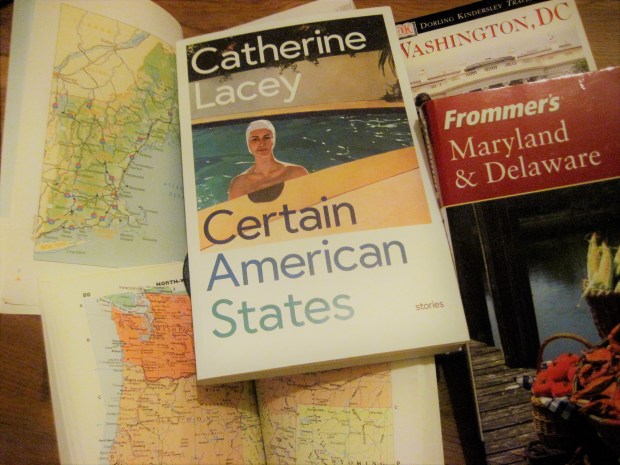
I come from a certain American state: Maryland. Before I first came to England 15 years ago, I’d never lived anywhere else. It’s the ninth-smallest state but has a little bit of everything – mountains, lakes and farmland; coast and bayfront; rough cities and pleasant towns; plus proximity to the nation’s capital – which is why it’s nicknamed “America in Miniature.” Brits say Merry-Land (it’s more like the name Marilyn, with a faint D on the end) and more than once when asked where I’m from I’ve heard in reply,“like the cookies?” No, not like the cookies!

Anyway, the characters in Catherine Lacey’s short story collection move through various states – Texas, North Dakota, Virginia, Montana – but the focus is more on their emotional states. Ten of the 12 stories are in the first person, giving readers a deep dive into the psyches of damaged or bereaved people. I particularly liked “ur heck box,” in which the narrator, troubled by the death of her brother and wary of her mother joining her in New York City, starts getting garbled messages from a deaf man. Whether a result of predictive text errors or mental illness, these notes on his phone echo her confusion at what’s become of her life.
 Two other favorites were “Touching People,” in which a sixty-something woman takes a honeymooning couple to see her ex-husband’s grave, and “Small Differences,” about a woman who’s cat-sitting for her on-and-off boyfriend and remembers the place faith used to have in her life. Both dramatize the divide between youth and age; in the latter the cat is named Echo, a reminder that the past still resonates. Another standout is “Learning,” about a painting teacher with a crumbling house and marriage whose deadbeat college friend has become a parenting guru. (This one reminded me of Curtis Sittenfeld’s “The Prairie Wife.”)
Many of the stories question the possibility of ‘getting over’ what’s happened and posit, instead of total healing, a stoic determination to just keep going. In the title story, the narrator goes to see her godfather, Leonard, on his deathbed. She still doesn’t like him much; the trip isn’t about achieving closure but doing the right thing when you can. The same is true in “Family Physics”: Bridget had an explosive falling-out with her family when they came to see her accept her college Physics Award. Now that she’s back in touch with them everything isn’t perfect, but she sees how family life is always a mixture of entropy and rebuilding.

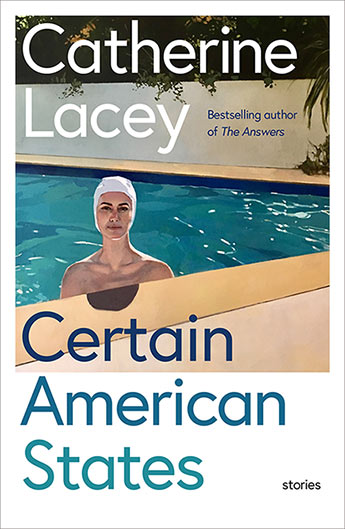
I prefer this U.S. cover. How about you?
There isn’t as much variety to the narration as I often like from a set of stories, but Lacey uses a range of storytelling techniques (or gimmicks, if one was being unkind) to keep things interesting. The first story, “Violations,” about a man whose ex-wife has published a story drawing on their life together, features run-on sentences that go over the page; “ur heck box” nests parentheses inside parentheses, up to three layers; “Because You Have To,” about a woman who’s counting her blessings even though she’s newly single and surrounded by feral pets, is in short sections separated by asterisks; and “The Four Immeasurables and Twenty New Immeasurables,” narrated by a woman who’s sleeping with a Buddhist monk, is in list form. Lacey also uses no speech marks, setting out dialogue in italics instead.
It can be tough to assess a story collection as a whole because the parts can range from hard-hitting to instantly forgettable. I didn’t always feel that each of the parts was necessary here; perhaps I would have been better off just sampling a few of the best stories? The problem, of course, is that you never know which those would be for you before you open up the book. There were quite a number of lines that rang true for me in Lacey’s work, but no more than a few stories that I can imagine myself recalling or ever going back to in the future. The book feels very much of the moment, though. If you’ve enjoyed recent work by Julie Buntin, R. O. Kwon, Sally Rooney or Sittenfeld, you might want to spend time in Certain American States.
Favorite lines:
“I don’t know what to do now, a state I am so familiar with it feels like my only true home.” (from “Because You Have To”)
“Anyone can visit a graveyard, no matter what they think, and every graveyard has been seen so many times there is nothing left in them for anyone to see and that is why we all must go and look, to see again what’s been seen again” (from “Touching People”)
“I no longer understand the state I was in back then (heartsick over the idea of Jesus the way that other girls were heartsick over the idea of River Phoenix)” (from “Small Differences”)
My rating: 
Certain American States was published in the UK by Granta on September 6th; it came out in the USA on August 7th from Farrar, Straus and Giroux. My thanks to the publisher for the free copy for review.
Roald Dahl Day Blog Tour: “Boy” & More
 Like so many children on both sides of the Atlantic, I grew up with Roald Dahl’s classic tales: James and the Giant Peach, Charlie and the Chocolate Factory, and Matilda. I was aware that he had published work for adults, too, but hadn’t experienced any of it until I was asked to join this blog tour in advance of Roald Dahl Day on September 13th.
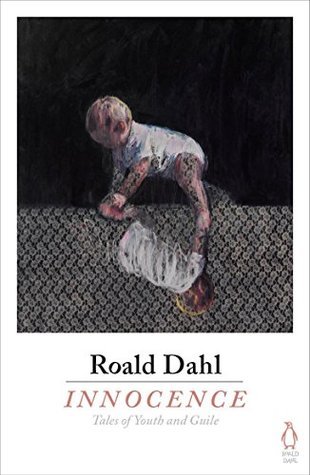
Last year Penguin brought out an eight-volume paperback set of Dahl’s short stories, grouped thematically. I focused on Innocence: Tales of Youth and Guile, which opens with a reprint of Boy (1984), the closest thing to an autobiography that Dahl wrote. That’s in spite of his prefatory disclaimer:
An autobiography is a book a person writes about his own life and it is usually full of all sorts of boring details. This is not an autobiography. … throughout my young days at school and just afterwards a number of things happened to me that I have never forgotten. … Some are funny. Some are painful. … All are true.
Dahl’s father was a one-armed shipbroker who’d moved from Norway to Wales for the coal. His mother, Harald’s second wife, was also from Norway, so Dahl was a full-blooded Norwegian. After his father’s early death he attended Llandaff Cathedral School and then boarding school and public school in England. Sofie Dahl, quietly tough, tended her brood of six children and stepchildren, giving them magical summers on a Norwegian island and keeping her cool during the car accident in which Dahl’s nose was almost severed.
Any time they were separated, Dahl wrote to his mother once a week, without fail. The book includes facsimile excerpts from some of these letters, along with black-and-white family photographs and drawings. This is more of a scrapbook than a straightforward chronological memoir, especially in the way that it moves between playful and disturbing vignettes from Dahl’s school days. It’s particularly delightful to spot incidents that inspired his children’s books, such as a plot to plant a dead mouse in the mean sweet shop lady’s gobstopper jar and the boxes of new-recipe Cadbury’s chocolates that would arrive at Repton School for testing by eager boys.
Pranks and larks and holidays: these are all here. But so is crushing homesickness and a bitter sense of injustice at being at the mercy of sadistic adults. Dahl had his adenoids removed without anesthesia, and at school he received and witnessed many a vicious caning. Aware that such scenes are accumulating uncomfortably, he addresses the topic directly:
By now I am sure you will be wondering why I lay so much emphasis upon school beatings in these pages. The answer is that I cannot help it. All through my school life I was appalled by the fact that masters and senior boys were allowed literally to wound other boys, and sometimes quite severely. I couldn’t get over it. I never have got over it.
When he graduated, instead of going to Oxford or Cambridge, he wanted to see the world and have adventures, so he spent the summer of 1934 exploring Newfoundland and joined the Shell Company at age 18. His first placement was to East Africa for three years; soon afterwards he would become a fighter pilot in the Second World War. In the short years he spent as a London commuter, he realized how easy a 9-to-5 office job is compared to making a living as a writer. (I could sympathize.)
The life of a writer is absolute hell compared with the life of a businessman. The writer has to force himself to work. He has to make his own hours and if he doesn’t go to his desk at all there is nobody to scold him. If he is a writer of fiction he lives in a world of fear. Each new day demands new ideas and he can never be sure whether he is going to come up with them or not. … A person is a fool to become a writer. His only compensation is absolute freedom. He has no master except his own soul.
I don’t often like reading books from a child’s perspective (particularly novels with a child narrator) because I find that the voice can ring false. Not so here. Nearly 60 years later, Dahl could use memory and imagination to fully inhabit his childhood self and give a charming survey of the notable events of his life up to age 20. I’d highly recommend Boy to fiction and nonfiction readers alike.
My rating: 
 I also dipped into Trickery: Tales of Deceit and Cunning and particularly liked “The Wish,” in which a boy imagines a carpet is a snakepit and then falls into it, and “Princess Mammalia,” a Princess Bride-style black comedy about a royal who decides to wrest power from her father but gets her mischief turned right back on her. I’ll also pick up Fear, Dahl’s curated set of ghost stories by other authors, during October for the R.I.P. challenge.
My thanks to the publisher for free copies of four volumes of the tales.
Ladders to Heaven: The Secret History of Fig Trees
 A whole book about fig trees? That’s right! If you’re a voracious nonfiction reader like me, you’ll find freelance journalist Mike Shanahan’s history of fig trees unexpectedly fascinating. It opens with him atop a series of ladders in a national park in Borneo, reaching past a venomous snake to pick some figs. He did many such exciting things in his research towards a PhD in rainforest ecology, but that 1998 encounter was significantly more intrepid than his earliest experience with the genus: he remembers a potted weeping fig in the hallway of his childhood home.
From that little tree to the largest banyans, Ficus encompasses 750+ species and has had a major place in human culture for millennia. Fig trees turn up in Greek origin myths and are sacred to Hindus. Romulus and Remus were rescued from drowning in the Tiber by fig tree roots. The tree the Buddha sat under to meditate? A fig. The fruit Adam and Eve ate in the Garden of Eden? More likely a fig than an apple given the Middle Eastern climate and the fact that they then sew fig leaves together to cover their nakedness. (The confusion may have come about because in Latin malum means either “apple” or “evil”.)
Figs offer some biological surprises. For one thing, the plants have no apparent flowers. That’s because the flowers are internal: a fig is not technically a fruit but a hollow ball lined with tiny flowers that must be pollinated by two-millimeter-long fig-wasps. Strangler figs colonize a host tree, starting as a seed in the canopy and enveloping it in long tangled roots. Many tropical birds and mammals rely on figs, including monkeys and hornbills. Figs were, Shanahan writes, the “original superfood” for our primate ancestors.
The habitats where fig trees thrive face severe challenges, including drought, forest fires and poaching. However, history offers encouraging examples of how fig species can be key to tropical forest restoration. After a volcano erupted on Papua New Guinea in 1660, for example, the razed land was fairly quickly recolonized by Ficus species from seeds dropped by birds and bats – a prerequisite for wildlife returning. Similarly, fig trees were all that remained of the forest on Krakatoa after its famous volcanic eruption in 1883.
Building on this precedent, the Forest Restoration Research Unit, based in Thailand, now uses fig species to kickstart the restitution of tropical landscapes; one in every five of their plantings is a fig. Likewise, figs can be used to restore post-mining landscapes and lock up carbon. Researchers are looking into using drones to collect and deposit the seeds.
I’d never realized how often figs show up in the historical record, or how dependent on them we and other creatures have been. “Look after fig trees and they will look after you. It’s a lesson we have all but forgotten, but one we could learn again,” Shanahan concludes. Have a look at the bibliography and you’ll see just how much information is synthesized into this short, engaging book. It’s another gorgeous design from Unbound, too: the colorful cover was what first attracted me, and the author’s black-and-white pointillist illustrations adorn the text.

Nowadays I tend to think of figs as an exotic, luxury food. Every year we add some dried figs to our Christmas cake, creating caramel bursts of crunchy seeds. When my husband and I lived in Reading, we briefly had a LandShare arrangement to look after an established garden. Hidden behind a suburban fence, it was a secret paradise overflowing with fruit: plum, greengage and apple trees plus a fruit cage containing berries, currants, and – in one corner – a small fig. I remember one glorious late summer when we were inundated with more ripe figs than I’d ever seen before. We would heat them in the oven and serve them split open and oozing with goat’s cheese and runny honey. Our very own taste of Eden.
My rating:
Ladders to Heaven was first published by Unbound in 2016 and releases in paperback today, September 6th. My thanks to the publisher for the free copy for review.
Blog Tour Review: The Incendiaries by R. O. Kwon
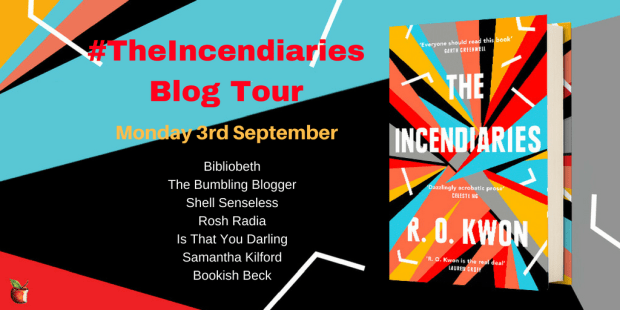
 The Incendiaries is a sophisticated, unsettling debut novel about faith and its aftermath, fractured through the experience of three people coming to terms with painful circumstances. Will Kendall left his California Bible college when he lost his faith. Soon after transferring to Edwards in upstate New York, he falls for Phoebe Lin at a party. Although he’s working in a restaurant to pay his way, he hides his working-class background to fit in with Phoebe and her glitzy, careless friends. Phoebe is a failed piano prodigy who can’t forgive herself: her mother died in a car Phoebe was driving. John Leal, a half-Korean alumnus, worked with refugees in China and was imprisoned in North Korea. Now he’s started a vaguely Christian movement called Jejah (Korean for “disciple”) that involves forced baptisms, intense confessions and self-flagellation. It’s no coincidence his last name rhymes with zeal.
Much of the book is filtered through Will’s perspective; even sections headed “Phoebe” and “John Leal” most often contain his second-hand recounting of Phoebe’s words, or his imagined rendering of Leal’s thoughts – bizarre and fervent. Only in a few spots is it clear that the “I” speaking is actually Phoebe. This plus a lack of speech marks makes for a somewhat disorienting reading experience, but that is very much the point. Will and Phoebe’s voices and personalities start to merge until you have to shake your head for some clarity. The irony that emerges is that Phoebe is taking the opposite route to Will’s: she is drifting from faithless apathy into radical religion, drawn in by Jejah’s promise of atonement.
As in Celeste Ng’s novels, we know from the very start the climactic event that powers the whole book: the members of Jejah set off a series of bombs at abortion clinics, killing five. The mystery, then, is not so much what happened but why. In particular, we’re left to question how Phoebe could be transformed so quickly from a vapid party girl to a religious extremist willing to suffer for her beliefs.
Kwon spent 10 years writing this book, and that time and diligence come through in how carefully honed the prose is: such precise images; not a single excess word. I can see how some might find the style frustratingly oblique, but for me it was razor sharp, and the compelling religious theme was right up my street. It’s a troubling book, one that keeps tugging at your elbow. Recommended to readers of Sweetbitter and Shelter.
Favorite lines:
“This has been the cardinal fiction of my life, its ruling principle: if I work hard enough, I’ll get what I want.”
“People with no experience of God tend to think that leaving the faith would be a liberation, a flight from guilt, rules, but what I couldn’t forget was the joy I’d known, loving Him.”
My rating: 
The Incendiaries will be published by Virago Press on September 6th. My thanks to the publisher for the free copy for review.
Note: An excerpt from The Incendiaries appeared in The Best Small Fictions 2016 (ed. Stuart Dybek), which I reviewed for Small Press Book Review. I was interested to look back and see that, at that point, her work in progress was entitled Heroics.
I was delighted to be invited to participate in the blog tour. See below for details of where other reviews are appearing today.
Polishing off My 20 Books of Summer with Hay, Jones & Markham
I finished off strong with a few books I’ve been meaning to read for months or years.
Late Nights on Air by Elizabeth Hay (2007)
 (This was a Twitter buddy read with Naomi of Consumed by Ink and Penny of Literary Hoarders.) I read my first novel by Hay, A Student of Weather, last year. It was wonderfully rewarding even though it took me a month to read. By contrast, I read the Giller Prize-winning Late Nights on Air in half that time. Most of it is set in 1975–7 in Yellowknife, a small city in Canada’s Northwest Territories. Here winter lasts for eight months and you can still meet with snow and frozen lakes in early July. A tight-knit cast gathers around the local radio station: Harry and Gwen, refugees from Ontario starting new lives; Dido, an alluring Dutch newsreader; Ralph, the freelance book reviewer; menacing Eddie; and pious Eleanor.
Everyone is in love with everyone else, so you get these layers of unrequited romance and a sense of exposure: not just to the elements, but to the vulnerabilities of admitting one’s feelings and risking professional failure. The novel is also about appearances and assumptions – “You don’t look anything like how you sound,” Gwen says to Harry – and the dangers of obsession. Four of the station employees set out one summer to recreate the six-week journey of Arctic explorer John Hornby, a trip that ends up being as wondrous as it is fraught. Hay’s foreshadowing is a bit heavy-handed, and I found the final chapters after the expedition a slight letdown, but overall this is a marvellous story of quiet striving and dislocation. I saw bits of myself in each of the characters, and I loved the extreme setting, both mosquito-ridden summer and bitter winter. I need to read the rest of Hay’s oeuvre stat.
Favorite passages:
Harry’s professional advice to Gwen: “Radio was like poetry, he told her. At its best it could be, while television was like a blockbuster novel: one made you think and feel, the other dulled your mind. … ‘To be any good you have to believe it’s hard. It’s called creative tension. … And you won’t be any good until you’re dedicated to something outside yourself.’ … I learned that a mistake is just something you go on from.”
“Something blossoms in an unlikely place. An oasis of trees miles above the treeline. An arctic river warmer than any other water they’d come upon. The four of them bathed in the waters of the Thelon, wading out into it, almost swimming. On shore they towelled themselves dry and dressed, and there was no feeling to equal the splendour of warm clothes on river-cold skin.”
My rating: 
I ran out of time for Half of a Yellow Sun by Chimamanda Ngozi Adichie so substituted in…
An American Marriage by Tayari Jones (2018)
(If it’s good enough for Barack Obama and Oprah Winfrey, it’s good enough for me!)
 The title feels like an echo of An American Tragedy. It’s both monolithic and generic, as if saying: Here’s a marriage; make of it what you will. Is it representative of the average American situation, or is it exceptional? Roy and Celestial only get a year of happy marriage before he’s falsely accused of rape and sentenced to 12 years in prison in Louisiana. Through their alternating first-person narration and their letters back and forth while Roy is incarcerated, we learn more about this couple: how their family circumstances shaped them, how they met, and how they drift apart as Celestial turns to her childhood friend, Andre, for companionship. When Roy is granted early release, he returns to Georgia to find Celestial and see what might remain of their marriage. I ached for all three main characters: It’s an impossible situation. The novel ends probably the only way it could, on a realistic yet gently optimistic note. Life goes on, if not how you expect, and there will be joys still to come.
This would make a great book club pick: there’s a lot to probe about the characters’ personalities and motivations, and about how they reveal or disguise themselves through their narration. I found it remarkable how the letters, which together make up not even one-fifth of the text, enhance the raw honesty of the book. There are other marriages on display besides Roy and Celestial’s, their range providing a snapshot of African-American lower-middle- and upper-middle-class life in the South. I especially liked the use of two totem objects, Roy’s tooth and the hickory tree outside Celestial’s childhood home (what you see on the cover).
Favorite lines:
Celestial: “I believed that our marriage was a fine-spun tapestry, fragile but fixable. We tore it often and mended it, always with a silken thread, lovely but sure to give way.”
Andre: “I don’t believe that blood makes a family; kin is the circle you create, hands held tight.”
Celestial: “Our marriage was a sapling graft that didn’t have time to take.”
Roy: “mostly my life is good, only it’s a different type of good from what I figured on.”
My rating:
An American Marriage was published in the UK by Oneworld on April 5th. My thanks to the publisher for the free copy for review.
West With the Night by Beryl Markham (1942)
 (Another Twitter buddy read, with Laila of Big Reading Life.) I’ve meant to pick this up ever since I read Paula McLain’s fantastic novel about Beryl Markham, Circling the Sun. I loved Markham’s memoir even more. She writes so vividly about the many adventures of her life in Africa: hunting lions, training race horses, and becoming one of the continent’s first freelance pilots, delivering mail and locating elephant herds.
It took me a while to get used to the structure – this is a set of discrete stories rather than a chronological narrative – but whether she’s reflecting on the many faces of Africa or the peculiar solitude of night flights, the prose is just stellar. Ernest Hemingway once asserted in a letter that Markham could “write rings around all of us who consider ourselves as writers,” and I certainly enjoyed this more than anything I’ve read by Hemingway.
The text is bookended by two momentous flights: it opens with Markham scrambling to deliver oxygen to an injured miner, and ends with her completing the first east–west solo flight across the Atlantic in 1936. Her engine cut out multiple times; it’s no less than a miracle that she survived to crash land in Nova Scotia. Laila and I agree that Markham’s life is so exciting it’s crying out for a movie version. In the meantime, I’d like to read some more about her circle – Denys Finch Hatton; and Baron von Blixen and his wife Karen (aka Danish writer Isak Dinesen, famous for Out of Africa). In my Circling the Sun review for BookTrib, I wrote that “Markham was the kind of real-life action adventure heroine you expect to find in Indiana Jones movies,” and that sense was only confirmed by her own account.
Favorite passages:
“to fly in unbroken darkness without even the cold companionship of a pair of ear-phones or the knowledge that somewhere ahead are lights and life and a well-marked airport is something more than just lonely. It is at times unreal to the point where the existence of other people seems not even a reasonable possibility. The hills, the forests, the rocks, and the plains are one with the darkness, and the darkness is infinite. The earth is no more your planet than is a distant star—if a star is shining; the plane is your planet and you are its sole inhabitant.”
“I saw how a man can be master of a craft, and how a craft can be master of an element. I saw the alchemy of perspective reduce my world, and all my other life, to grains in a cup. I learned to watch, to put my trust in other hands than mine. And I learned to wander. I learned what every dreaming child needs to know—that no horizon is so far that you cannot get above it or beyond it.”
My rating:
So how did I do on my first-ever #20BooksofSummer challenge? In that I read and reviewed (more than) 20 books by women that I owned in print, it was a smashing success. However, I only read 7 of the books I’d intended to, substituting in the rest from my review pile, books I owned in America, and others that grabbed my attention more than those I’d picked out in early June. Looks like I’m not great at sticking with the specific reading plans I set!
At any rate, as bonuses, here are the additional books by women that I read in print from my own shelves over the summer, not counting ones already reviewed on the blog (in chronological order, with ratings and links to any Goodreads reviews):
- Blue Horses, Mary Oliver

- The Egg and I, Betty Macdonald
- Eye of the Shoal: A Fish-watcher’s Guide to Life, the Ocean and Everything, Helen Scales
- The Partly Cloudy Patriot, Sarah Vowell
- Talk before Sleep, Elizabeth Berg
- The Incendiaries, R.O. Kwon [blog tour review coming on Monday]

- The Artist’s Way: A Spiritual Path to Higher Creativity, Julia Cameron
- Gross Anatomy: My Curious Relationship with the Female Body (The Top Half and the Bottom Half), Mara Altman [Glamour UK review coming soon]
- Questions of Travel, Elizabeth Bishop
- Writers & Company, Eleanor Wachtel

- Help Me!: One woman’s quest to find out if self-help really can change her life, Marianne Power
- Mrs Gaskell & Me: Two Women, Two Love Stories, Two Centuries Apart, Nell Stevens
I’d call that a result!
What have been the best books of the summer? Of the final 20, The Invisible Bridge by Julie Orringer was the winner, followed closely by The Life and Loves of Lena Gaunt by Tracy Farr, Late Nights on Air by Elizabeth Hay, and West With the Night by Beryl Markham. There were no real duds. I’m still very interested in all but one of the books I chose back in June, so I’ll see how many of the rest I can fit into this autumn and winter’s reading.
How was your summer of reading? Did you meet any goals you set?
Three Reads for Women in Translation Month 2018
An offer of the latest Latin American import from Charco Press prompted me to scour my shelves and see what other books I might add for #WITMonth. I dug out two novella-length books I’d bought secondhand over the past year to make it a trio. My rating for all: 
The Lost Daughter by Elena Ferrante
[Translated from the Italian by Ann Goldstein]
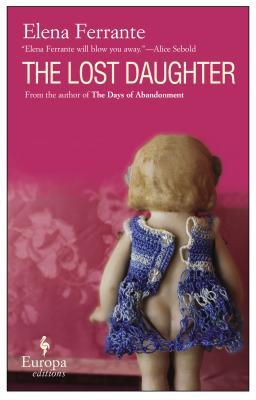 Leda is a 47-year-old teacher on holiday in southern Italy. She mostly sits on the beach, minding her own business, but still gets drawn into the minor daily dramas of a large Neapolitan family. One woman is pregnant; another has a small child named Elena who is devastated at losing her doll. Their mother–daughter dynamic takes Leda back to the time when she abandoned her own daughters and didn’t see them for three years. She temporarily found it impossible to reconcile motherhood with her career and her general sense of herself. Leda sees herself as part of a “chain of mute or angry women” – “I seemed to be falling backward toward my mother, my grandmother.”
I was definitely on board for the memories of motherly guilt. Where Ferrante lost me was when Leda steals the doll the child left behind and takes it up to her room to care for it – washing it, buying it new clothes, etc. Every time she sets out to give the doll back or at least leave it somewhere it will be found, she finds another excuse to put it off. Leda herself is unsure why she’s fixated on the doll; “The hardest things to talk about are the ones we ourselves can’t understand,” she says early on.
Most likely the doll could be interpreted as a symbol of Leda’s desire to be part of a functional family, to get a second chance at perfection with her daughters. But the book was a little too strange for me, and I never really engaged with the Neapolitan characters. After this and a skim of My Brilliant Friend a couple years back, I doubt I’ll pick up anything else by Ferrante. The themes and style of this one reminded me of Rachel Cusk’s Outline trilogy, A Separation by Katie Kitamura, and Hot Milk by Deborah Levy.
Favorite passage:
“Life can have an ironic geometry. Starting from the age of thirteen or fourteen I had aspired to a bourgeois decorum, proper Italian, a good life, cultured and reflective. Naples had seemed a wave that would drown me. I didn’t think the city could contain life forms different from those I had known as a child, violent or sensually lazy, tinged with sentimental vulgarity or obtusely fortified in defense of their own wretched degradation. I didn’t even look for them, those forms, in the past or in a possible future. I had run away like a burn victim who, screaming, tears off the burned skin, believing that she is tearing off the burning itself.”
Fish Soup by Margarita García Robayo
[Translated from the Spanish by Charlotte Coombe]
 Fish Soup contains two novellas (one of them, Sexual Education, was previously unpublished) separated by a set of seven short stories, and marks the first time the Colombian author Margarita García Robayo’s work has appeared in English. I especially liked the title story, in which a widower starts to smell his dead wife Helena’s fish soup in the bar that he owns and goes to investigate, all the while mixing up his dreams and memories with what’s really happening.
My other favorite piece was the opening novella, Waiting for a Hurricane, in which the narrator longs for escape from her seaside home, wanting nothing more than to be a “foreigner.” She starts a law degree but gives it up to become an air hostess, making flights to and from Miami and elsewhere. From her childhood onward, Gustavo has been a major presence in her life, teaching her to prepare fish and telling her stories, but there’s an uncomfortable element to their relationship that’s never really addressed. The mixture of quirky happenings and darker material reminded me of Swallowing Mercury, while the cancer theme of the story “Like a Pariah” recalls Hair Everywhere.
One of my frequent issues with short fiction is a preponderance of inconclusive endings that make you wonder what the point could be. I experienced that a few times with this collection, especially at the close of Waiting for a Hurricane. Judging by the title, though, the main message I drew from the novella is that you can’t just go around waiting for momentous things to happen to you, for your ‘real’ life to start; you have to recognize that this is life, here and now: in storytelling, in spicy stews, in everyday moments with friends and family.
With thanks to Charco Press for the free copy for review.
Sky Burial: An Epic Love Story of Tibet by Xinran
[Translated from the Chinese by Julia Lovell and Esther Tyldesley]
 In 1994 Xinran, a Chinese journalist who later moved to London, met a woman whose story captured her imagination. Shu Wen received word that her husband, Kejun, had died just months into their marriage. A doctor in the People’s Liberation Army, he’d been sent into Tibet in the 1960s after its ‘liberation’. With no details or body to confirm his demise, though, Wen refused to believe Kejun was gone, and traveled to Tibet to find him. She stayed there for over 30 years – more than half her life – living with a Tibetan family and adjusting to their culture and rituals as she sought word of her husband. The gender roles surprised her: men did the sewing and women had multiple husbands. It was a land of lamas and temples; “the whole of Tibet was one great monastery,” she felt.
Wen does eventually learn the truth of what happened to her husband (whew!), and after decades of living as a superstitious Buddhist in primitive conditions has to readjust to life in a new China, having completely missed the Cultural Revolution. She clings to words of wisdom from a military official: “Whatever happens, remember one thing: just staying alive is a victory” and “Writing can be a source of strength.” He then gave her a diary that she filled with letters to Kejun over the years.
It’s a pleasant, short book made up of layers of tales: the legends and history lessons Wen hears from Tibetans; what she conveys to Xinran during their two intense days together; and the resulting narrative Xinran spent nearly a decade imagining herself into. Kejun’s fate is worth waiting around to hear about (but if you know what the title refers to you might consider it a spoiler), though this is something of a thin story overall. I’ve seen it referred to as a novel, though I consider it more of a stylized biography.
Did you do any special reading for Women in Translation month this year?
The Way of All Flesh by Ambrose Parry
This historical novel set in Edinburgh in 1847 has one of the best opening paragraphs I’ve come across in a while:
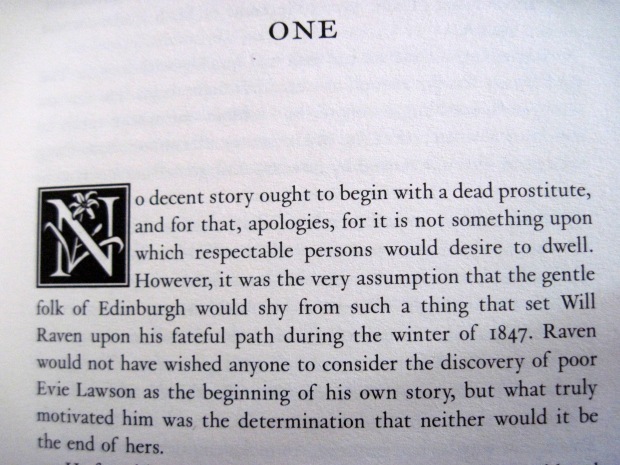
That immediately sets the tone: realistic, sly, and somewhat seedy. If the title sounds familiar, it’s because it’s borrowed from Samuel Butler’s gloomy 1903 meditation on sin and salvation in several generations of a Victorian family. I remember trudging through it on a weekend break to Strasbourg during my year abroad.
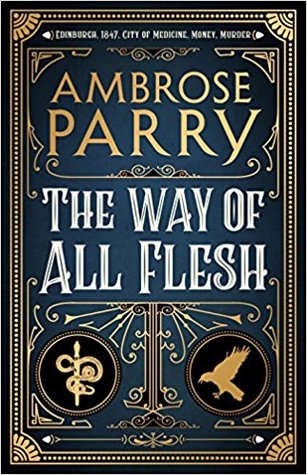 Parry (a pseudonym for husband–wife duo Chris Brookmyre and Marisa Haetzman) uses the allusion to highlight the hidden sins of the Victorian period and hint at the fleshy concerns of their book, which contains somewhat gruesome scenes of childbirth and surgery. Ether and chloroform were recent introductions and many were still apprehensive about them or even opposed to their use on religious grounds, as Haetzman, a consultant anesthetist, learned while researching for her Master’s degree in the History of Medicine.
Into this milieu enters Will Raven, the new apprentice to Dr. Simpson, a professor of midwifery. Will is troubled by the recent loss of his friend Evie Lawson, the dead prostitute of the first paragraph, and wonders if she could have been poisoned by some bad moonshine. Only as he hears rumors about a local abortionist – no better than a serial killer – who’s been giving women quack pills and potions, followed by rudimentary operations that leave them to die of peritonitis, does he begin to wonder if Evie could have been pregnant when she died.
The novel peppers in lots of period slang and details about homeopathy, phrenology and early photography. Best of all, it has a surprise heroine: the Simpsons’ maid, Sarah Fisher, who keeps shaming Will with her practical medical know-how and ends up being something of a sidekick in his investigations. She wants to work as a druggist’s assistant, but the druggist insists that only a man can do the job. Dr. Simpson recognizes that the housemaid’s role is rather a waste of Sarah’s talents and expresses his hope that she’ll seek to be part of a widespread change for women.
The Way of All Flesh is sure to appeal to readers of Michel Faber’s The Crimson Petal and the White and Steven Price’s By Gaslight. It’s not quite as rewarding as the former, but the length and style make it significantly more engaging than the latter. It also serves as a good fictional companion to Lindsey Fitzharris’s The Butchering Art; for that reason, I wouldn’t be surprised to see it appear on next year’s Wellcome Book Prize longlist.

Victorian Edinburgh on the endpapers.
Favorite lines:
“That was Edinburgh for you: public decorum and private sin, city of a thousand secret selves.”
“‘Simpson likes to think of medicine as more than pure science,’ [Raven] countered. ‘There must also be empathy, concern, a human connection.’ ‘I suggest that both elements are required,’ offered Henry. ‘Scientific principles married to creativity. Science and art.’ If it is an art, it is at times a dark one, Raven thought, though he chose to keep this observation to himself.”
My rating: 
The Way of All Flesh comes out today, August 30th, in the UK. It was published in the States by HarperCollins on the 28th. My thanks to Canongate for sending a free copy for review.
Rebecca Stott, Duke Special & More at Greenbelt 2018
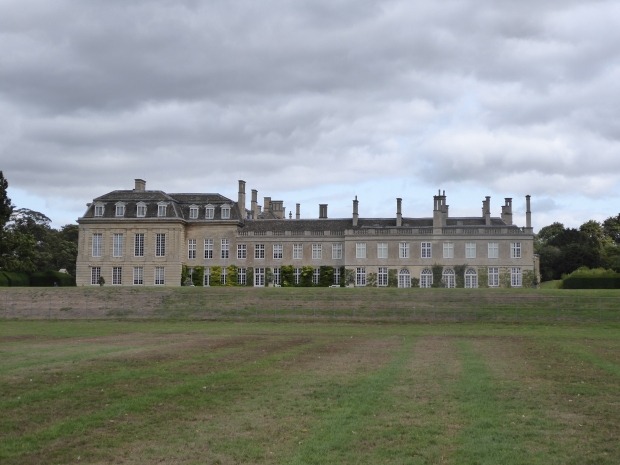
After five years away, we finally made it back to Greenbelt, a progressive Christian summer arts festival held on the grounds of Boughton House, on the Bank Holiday. The festival is a mixture of talks, music, performances and more, and given how much we’d paid and how far we’d traveled just for the one day, we tried to pack in as much as possible.
We started the day with “Beyond Forgiveness,” a presentation by Jo Berry and Pat Magee. Berry’s father, a Tory MP, was killed when the IRA bombed the Conservative Party conference in Brighton in 1984. Magee spent 14 years in prison for his role in the bombing. When he got out of jail, he met Berry at her request and they talked and listened to each other for several hours. For the first time, Magee said, he could see her father as a real person and realized that the IRA had been just as guilty of dehumanizing and misrepresenting people as the English were. Berry, too, felt that “I’d met my enemy and seen his humanity.” The two have now shared a stage more than 200 times, speaking about the value of empathy in healing broken relationships while also addressing imbalances of power that lead to violence.
To my surprise, cookery displays and musical comedy seemed to be the order of the day. A model kitchen is a new addition to the festival, giving celebrity chefs hour-long sessions to demonstrate a particular dish. Jack Monroe, promoting her new book Cooking on a Bootstrap, cooked a sausage lasagna. She made us all laugh with her idea of “the inverse sausage fallacy” – the cheaper a sausage is, the better it tastes because of all the salt, sugar and spices added to cheaper bits of meat. She started writing recipes when she was a single mother on the dole, and so she encouraged audience members to donate nice things you would like to eat, as well as everyday hygiene products, to food banks. For a “What Vegans Eat” session, Brett Cobley (aka EpiVegan) made a pea and asparagus risotto and answered questions about protein sources, egg replacements, plant milks and harder-to-find ingredients.
Uproarious musical comedy came in the form of Harry & Chris, who made up impromptu raps about New Year’s Day, the Teletubbies and phobias, and Flo & Joan, who sang about divorce statistics, unnecessary inventions for women, and sex robots (the show was fairly crude and came with an 18+ warning). The overall musical highlight of the day was Duke Special, a Greenbelt favorite we’ve seen play quite a number of times now. His pop combines his smooth Belfast tenor with music hall and Big Band stylings, and his songs are often drawn from poetry and 1920s–40s songbooks. His latest project, Hallow, is a beautiful set of Michael Longley poems set to music. He played “Another Wren” and “Emily Dickinson” from that album, various covers (including two bizarre ditties by Ivor Cutler), and crowd favorites “Last Night I Nearly Died,” “Freewheel” and “Our Love Goes Deeper than This.” We also sampled performances by Martyn Joseph, Wallis Bird and CC Smugglers.
Duke Special was a good bridge between music and literature. From the literature program I also saw Rabbi Jonathan Wittenberg speak on “Things My Dog Has Taught Me about Being a Better Human,” the title of his recent book. (His dog Mitzpah had a special dispensation to join him on stage; no animals are allowed on site otherwise!) The rabbi spoke about lessons in listening, attention, trust and seizing the moment. Mitzi and his previous dog Safi have also given him a connection with the rest of creation. Although he lives in the London suburbs and has an inner-city synagogue, they have accompanied him on long walks in Scotland and Germany. Wittenberg was a warm and witty speaker and I very much liked the sound of his book. It could make a good follow-up to The Power of Dog.
My other festival highlight was Rebecca Stott, in conversation with Radio 4 presenter Malcolm Doney. I read her Costa Prize-winning memoir In the Days of Rain: A daughter. A father. A cult in April and it’s been one of my stand-out reads of the year so far. The book conveys a huge amount of information about the Exclusive Brethren and Stott’s family history but never loses sight of what is most important: what it was like to be in a cult and have your life defined by its rules and its paranoia about the outside world. Stott remembers 6 a.m. Sunday communion services and her constant terror of being left behind in the Rapture.
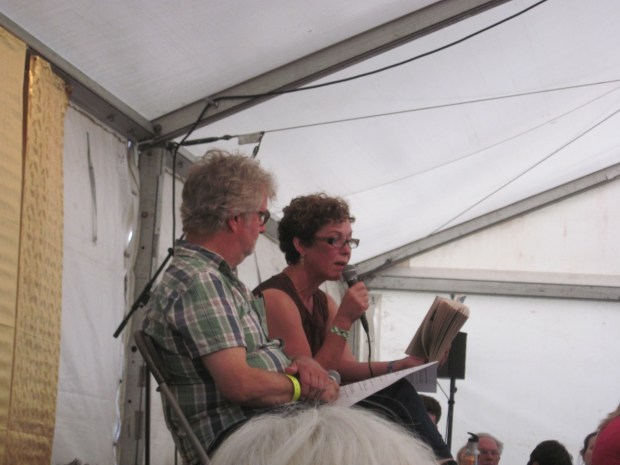
Rebecca Stott reading from In the Days of Rain.
Unfortunately, the talk didn’t add much to my experience of reading her book. The interviewer, catering to those who haven’t read the book yet, led her through her whole story bit by bit, and because I’d read it fairly recently it was all familiar. However, Stott spoke wonderfully and was full of wry compassion for her younger self. I was most interested to hear about the book’s aftermath: she’s received 300 letters from ex-Brethren that her daughter is transcribing to send to a Brethren Church archive in Manchester. When asked during a Q&A where she sees cult tendencies today, she mentioned Trump supporters!


Whereas I read In the Days of Rain from the library, I happen to own two Stott books I haven’t read yet, so I cheekily brought along my paperback of Ghostwalk for signing. She was intrigued to see the older cover design and told me she thinks the prose style in her debut novel is much richer than in Rain, and she hopes I’ll like it. I thanked her for the talk, told her how much I’d enjoyed her memoir, and recommended her two books vaguely about cults: Educated by Tara Westover, which she already knew well, having done some events with Westover, and The Incendiaries by R.O. Kwon, which was new to her (my blog tour review is coming up on Monday). I caught myself using the word “brilliant” three times in speaking about Stott’s work and these other books – nuance and vocabulary alike clearly go out the window when nervously speaking to admired authors!
Some readers of this blog would have been delighted by the event I rushed to straight after Stott’s talk: Jon McGregor giving readings from Reservoir 13, with Sigur Rós-esque backing and interlude music from Haiku Salut. I heard about the police reconstruction with actors from Manchester, and collecting bilberries on the heath in August. Unfortunately, I found it just as dull read aloud as I did when I tried the book last year, and I left early.
During bits of down time I pulled out a Katherine Mansfield story collection I found in a charity shop last week and read “Bank Holiday” and “The Garden Party.” The former is a very short piece whose carnival atmosphere rises to a note of indeterminate striving:
“And up, up the hill come the people, with ticklers and golliwogs, and roses and feathers. Up, up they thrust into the light and heat, shouting, laughing, squealing, as though they were being pushed by something, far below, and by the sun, far ahead of them – drawn up into the full, bright, dazzling radiance to…what?”
 It was my first time reading the famous “The Garden Party,” which likewise moves from a blithe holiday mood into something weightier. The Sheridans are making preparations for a lavish garden party dripping with flowers and food. Daughter Laura is dismayed when news comes that a man from the cottages has been thrown from his horse and killed, and thinks they should cancel the event. Everyone tells her not to be silly; of course it will go on as planned. The story ends when, after visiting his widow to hand over leftover party food, she unwittingly sees the man’s body and experiences an epiphany about the simultaneous beauty and terror of life. “Don’t cry,” her brother says. “Was it awful?” “No,” she replies. “It was simply marvellous.” Mansfield is especially good at first and last paragraphs. I’ll read more by her someday.
 Bookish Beck = Rebecca Foster. American transplant to England. Freelance proofreader and book reviewer.
 Bookish Beck