Three Out-of-the-Ordinary Memoirs: Kalb, Machado, McGuinness
Recently I have found myself drawn to memoirs that experiment with form. I’ve read so many autobiographical narratives at this point that, if it’s to stand out for me, a book has to offer something different, such as a second-person point-of-view or a structure of linked essays. Here are a few such that I’ve read this year but not written about yet. All have strong themes of memory and the creation of the self or the family.
Nobody Will Tell You This But Me: A True (As Told to Me) Story by Bess Kalb (2020)
 You know from the jokes: Jewish (grand)mothers are renowned for their fiercely protective, unconditional love, but also for their tendency to nag. Both sides of a stereotypical matriarch are on display in this funny and heartfelt family memoir, narrated in the second person – as if straight to Kalb from beyond the grave – by her late grandmother, Barbara “Bobby” Bell.
Bobby gives her beloved Bessie a tour through four generations of strong women, starting with her own mother, Rose, and her lucky escape from a Belarus shtetl. The formidable émigré ended up in a tiny Brooklyn apartment, where she gave birth to five children on the dining room table. Bobby and her husband, a real estate entrepreneur and professor, had one daughter, Robin, who in turn had one daughter, Bess. Bobby and Robin had a fraught relationship, but Bess’s birth seemed to reset the clock. Grandmother and granddaughter had a special bond: Bobby was the one to take her to preschool and wait outside the door until she was sure she’d be okay, and always the one to pick her up from sleepovers gone wrong.
Kalb is a Los Angeles-based writer for Jimmy Kimmel Live! With her vivid scene-setting and comic timing, you can see why she’s earned a Writers Guild Award and an Emmy nomination. But she also had great material to work with: Bobby’s e-mails and verbatim voicemail messages are hilarious. Kalb dots in family photographs and recreates in-person and phone conversations, with her grandmother forthrightly questioning her fashion choices and non-Jewish boyfriend. As the title phrase shows, Bobby felt she was the only one who would come forward with all this (unwanted but) necessary advice. Kalb keeps things snappy, alternating between narrative chapters and the conversations and covering a huge amount of family history in just 200 pages. It gets a little sentimental towards the end, but with her grandmother’s death still fresh you can forgive her that. This was a real delight.
My rating: 
My thanks to Zoe Hood and Kimberley Nyamhondera of Little, Brown (Virago) for the free PDF copy for review.
In the Dream House: A Memoir by Carmen Maria Machado (2019)
I’m stingy with 5-star ratings because, for me, giving a book top marks means a) it’s a masterpiece, b) it’s a game/mind/life changer, and/or c) it expands the possibilities of its particular genre. In the Dream House fits all three criteria. (Somewhat to my surprise, given that I couldn’t get through more than half of Machado’s acclaimed story collection, Her Body and Other Parties, and only enjoyed it in parts.)
Much has been written about this memoir of an abusive same-sex relationship since its U.S. release in November. I feel I have little to add to the conversation beyond my deepest admiration for how it prioritizes voice, theme and scenes; gleefully does away with the chronology and (not directly relevant) backstory – in other words, the boring bits – that most writers would so slavishly detail; and engages with history, critical theory and the tropes of folk tales to constantly interrogate her experiences and perceptions.
 Most of the book is, like the Kalb, in the second person, but in this case the narration is not addressing a specific other person; instead, it’s looking back at the self that was caught in this situation (“If, one day, a milky portal had opened up in your bedroom and an older version of yourself had stepped out and told you what you know now, would you have listened?”), as well as – what the second person does best – putting the reader right into the narrative.
The “Dream House” is the Victorian house where Machado lived with her ex-girlfriend in Bloomington, Indiana for two years while she started an MFA course. It was a paradise until it wasn’t; it was a perfect relationship until it wasn’t. No one, least of all her, would have believed the perky little blonde writer she fell for would turn sadistic. A lot of it was emotional manipulation and verbal and psychological abuse, but there was definitely a physical element as well. Fear and self-doubt kept her trapped in a fairy tale that had long since turned into a nightmare. Writing it all out seven years later, the trauma was still there. Yet there was no tangible evidence (a police report, a restraining order, photos of bruises) to site her abuse anywhere outside of her memory. How fleeting, yet indelible, it had all been.
The book is in relatively short sections headed “Dream House as _________” (fill in the blank with everything from “Time Travel” to “Confession”), and the way that she pecks at her memories from different angles is perfect for recreating the spiral of confusion and despair. She also examines the history of our understanding of queer domestic violence: lesbian domestic violence, specifically, wasn’t known about until 30-some years ago.
The story has a happy ending in that Machado is now happily married. The bizarre twist, though, is that her wife, YA author Val Howlett, was the girlfriend of the woman in the Dream House when they first met. To start with, it was an “open relationship” (or at least the blonde told her so) that Machado reluctantly got in the middle of, before Val drifted away. That the two of them managed to reconnect, and got past their mutual ex, is truly astonishing. (See some super-cute photos from their wedding here.)
Some favorite lines:
“Clarity is an intoxicating drug, and you spent almost two years without it, believing you were losing your mind”
“That there’s a real ending to anything is, I’m pretty sure, the lie of all autobiographical writing. You have to choose to stop somewhere. You have to let the reader go.”
My rating: 
I read an e-copy via NetGalley.
Other People’s Countries: A Journey into Memory by Patrick McGuinness (2014)
This is a wonderfully atmospheric tribute to Bouillon, Belgium, a Wallonian border town with its own patois. However, it’s chiefly a memoir about the maternal side of the author’s family, which had lived there for generations. McGuinness grew up spending summers in Bouillon with his grandparents and aunt. Returning to the place as an adult, he finds it half-derelict but still storing memories around every corner.
 It is as much a tour through memory as through a town, reflecting on how our memories are bound up with particular sites and objects – to the extent that I don’t think I would find McGuinness’s Bouillon even if I went back to Belgium. “When I’m asked about events in my childhood, about my childhood at all, I think mostly of rooms. I think of times as places, with walls and windows and doors,” he writes. The book is also about the nature of time: Bouillon seems like a place where time stands still or moves more slowly, allowing its residents (including his grandfather, and Paprika, “Bouillon’s laziest man, who held a party to celebrate sixty years on the dole”) a position of smug idleness.
The book is in short vignettes, some as short as a paragraph; each is a separate piece with a title that remembers a particular place, event or local character. Some are poems, and there are also recipes and an inventory. The whole is illustrated with frequent period or contemporary black-and-white photographs. It’s an altogether lovely book that overcomes its narrow local interest to say something about how the past remains alive for us.
Some favorite lines:
“that hybrid long-finished but real-time-unfolding present tense … reflects the inside of our lives far better than those three stooges, the past, present and future”
a fantastic last line: “What I want to say is: I misremember all this so vividly it’s as if it only happened yesterday.”
My rating:
I read a public library copy.
Other unusual memoirs I’ve loved and reviewed here:
 Notes Made while Falling by Jenn Ashworth (essays, experimental structures)
Winter Journal by Paul Auster (second person)
This Really Isn’t about You by Jean Hannah Edelstein (nonchronological)
Traveling with Ghosts by Shannon Leone Fowler (short sections and time shifts)
The Lost Properties of Love by Sophie Ratcliffe (nonchronological essays)
Any offbeat memoirs you can recommend?
Adventures in Rereading: The Sixteenth of June by Maya Lang
Last year I reviewed Tenth of December by George Saunders on its title date; this year I couldn’t resist rereading one of my favorites from 2014 for today’s date (which just so happens to be Bloomsday, made famous by James Joyce’s Ulysses), The Sixteenth of June.
I responded to the novel at length when it first came out. No point in reinventing the wheel, so here are mildly edited paragraphs of synopsis from my review for The Bookbag:
 Maya Lang’s playful and exquisitely accomplished debut novel, set on the centenary of the original Bloomsday, transplants many characters and set pieces from Ulysses to near-contemporary Philadelphia. Don’t fret, though – even if, like me, you haven’t read Ulysses, you’ll have no trouble following the thread. In fact, Lang dedicates her book to “all the readers who never made it through Ulysses (or haven’t wanted to try).” (Though if you wish to spot parallels, pull up any online summary of Ulysses; there is also a page on Lang’s website listing her direct quotations from Joyce.)
On June 16, 2004, brothers Leopold and Stephen Portman have two major commitments: their grandmother Hannah’s funeral is happening at the local synagogue in the morning; and their parents’ annual Bloomsday party will take place at their opulent Delancey Street home in the evening. Around those two thematic poles – the genuine emotions of grief and regret on the one hand, and the realm of superficial entertainment on the other – the novel expands outward to provide a nuanced picture of three ambivalent twenty-something lives.
The third side of this atypical love triangle is Nora, Stephen’s best friend from Yale – and Leo’s fiancée. Nora, a trained opera singer, is still reeling from her mother’s death from cancer one year ago. She’s been engaging in self-harming behavior, and Leo – a macho, literal-minded IT consultant – just wants to fix her. Nora and Stephen, by contrast, are sensitive, artistic souls who seem better suited to each other. Stephen, too, is struggling to find a meaning in death, but also to finish his languishing dissertation on Virginia Woolf.
Literature is almost as potent a marker of upper-class status as money here: some of the Portmans might not have even read Joyce’s masterpiece, but that doesn’t stop them name-dropping and maintaining the pretense of being well-read. While Lang might not mimic the extremes of Joyce’s stream-of-consciousness style, she prioritizes interiority over external action by using a close third-person voice that shifts between her main characters’ points of view. Their histories and thoughts are revealed mostly through interior monologues and conversations. Lang’s writing is full of mordant shards of humor; one of my favorite lines was “No one in a eulogy ever said, She watched TV with the volume on too loud.”
During my rereading, I was captivated more by the portraits of grief than by the subtle intellectual and class differences. I appreciated the characterization and the Joycean peekaboo, and the dialogue and shifts between perspectives still felt fresh and effortless. I could relate to Stephen and Nora’s feelings of being stuck and unsure how to move on in life. And the ending, which I’d completely forgotten, was perfect. I didn’t enjoy this quite as much the second time around, but it’s still a treasured signed copy on my shelf.
My original rating (June 2014):
My rating now:
Readalikes: Writers & Lovers by Lily King and The Emperor’s Children by Claire Messud (my upcoming Doorstopper of the Month).
(See also my review of Lang’s recent memoir, What We Carry.)
Alas, I’ve also had a couple of failed rereading attempts recently…
Everything Is Illuminated by Jonathan Safran Foer (2002)
 I remembered this as a zany family history quest turned into fiction. A Jewish-American character named Jonathan Safran Foer travels to (fictional) Trachimbrod, Ukraine to find the traces of his ancestors and, specifically, the woman who hid his grandfather from the Nazis. I had totally forgotten about the comic narration via letters from Jonathan’s translator/tour guide, Alexander, who fancies himself a ladies’ man and whose English is full of comic thesaurus use (e.g. “Do not dub me that,” “Guilelessly yours”). This was amusing, but got to be a bit much. I’d also forgotten about the dense magic realism of the historical sections. As with A Visit from the Goon Squad, what felt dazzlingly clever on a first read (in January 2011) failed to capture me a second time. [35 pages]
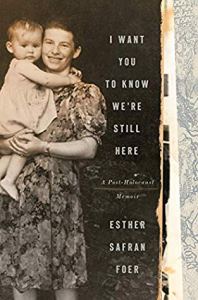 Interestingly, Foer’s mother, Esther, released a memoir earlier this year, I Want You to Know We’re Still Here. It’s about the family history her son turned into quirky autofiction: a largely fruitless trip he took to Ukraine to research his maternal grandfather’s life for his Princeton thesis, and a more productive follow-up trip she took with her older son in 2009. Esther Safran Foer was born in Poland and lived in a German displaced persons camp until she and her parents emigrated to Washington, D.C. in 1949. Her father committed suicide in 1954, making him almost a belated victim of the Holocaust. The stories she hears in Ukraine – of the slaughter of entire communities; of moments of good luck that allowed her parents to, separately, survive and find each other – are remarkable, but the book’s prose, while capable, never sings. Plus, she references her son’s novel so often that I wondered why someone would read her book when they could read his instead.
On Beauty by Zadie Smith (2005)
 This was an all-time favorite when it first came out. I remembered a sophisticated homage to E.M. Forster’s Howards End, featuring a biracial family in Cambridge, Mass. I remembered no specifics beyond a giant music store and (embarrassingly) an awkward sex scene. Howard Belsey’s long-distance rivalry with a fellow Rembrandt scholar gets personal when the Kipps family relocates from London to the Boston suburbs for Monty to be the new celebrity lecturer at the same college. Howard is in the doghouse with his African-American wife, Kiki, after having an affair. The Belsey boy and Kipps girl have an awkward romantic history. Zora Belsey is smitten with a lower-class spoken word poet she meets after a classical concert in the park when they pick up each other’s Discmans by accident (so dated!). All of the portraits felt like stereotypes to me, and there was so much telling, so much backstory, so many unnecessary secondary characters. Before I would have said this was my obvious Women’s Prize winner of winners, but now I have no idea what I’ll vote for. [107 pages]
Currently rereading: Watership Down by Richard Adams, Ella Minnow Pea by Mark Dunn, Dreams from My Father by Barack Obama
To reread soon: Heaven’s Coast by Mark Doty & Animal, Vegetable, Miracle by Barbara Kingsolver
Done any rereading lately?
Recent Writing for BookBrowse, Shiny New Books and the TLS
A peek at the bylines I’ve had elsewhere so far this year.
BookBrowse
 A Good Neighborhood by Therese Anne Fowler: In Fowler’s sixth novel, issues of race and privilege undermine a teen romance and lead to tragedy in a seemingly idyllic North Carolina neighborhood. A Good Neighborhood is an up-to-the-minute story packed with complex issues including celebrity culture, casual racism, sexual exploitation, and environmental degradation. It is narrated in a first-person plural voice, much like the Greek chorus of a classical tragedy. If you loved Tayari Jones’s An American Marriage, this needs to be next on your to-read list. It is a book that will make you think, and a book that will make you angry; I recommend it to socially engaged readers and book clubs alike.
 Pew by Catherine Lacey: Lacey’s third novel is a mysterious fable about a stranger showing up in a Southern town in the week before an annual ritual. Pew’s narrator, homeless, mute and amnesiac, wakes up one Sunday in the middle of a church service, observing everything like an alien anthropologist. The stranger’s gender, race, and age are entirely unclear, so the Reverend suggests the name “Pew”. The drama over deciphering Pew’s identity plays out against the preparations for the enigmatic Forgiveness Festival and increasing unrest over racially motivated disappearances. Troubling but strangely compelling; recommended to fans of Shirley Jackson and Flannery O’Connor. [U.S. publication pushed back to July 21st]
Shiny New Books
 Losing Eden: Why Our Minds Need the Wild by Lucy Jones: While nature’s positive effect on human mental health is something we know intuitively and can explain anecdotally, Jones was determined to investigate the scientific mechanism behind it. She set out to make an empirical enquiry and discovered plenty of evidence in the scientific literature, but also attests to the personal benefits that nature has for her and explores the spiritual connection that many have found. Losing Eden is full of both common sense and passion, cramming masses of information into 200 pages yet never losing sight of the big picture. Just as Silent Spring led to real societal change, let’s hope Jones’s work inspires steps in the right direction.
[+ Reviews of 4 more Wainwright Prize (for nature writing) longlistees on the way!]
 The Bass Rock by Evie Wyld: While it ranges across the centuries, the novel always sticks close to the title location. Just as the louring rock is inescapable in the distance if you look out from the Edinburgh hills, there’s no avoiding violence for the women and children of the novel. It’s a sobering theme, certainly, but Wyld convinced me that hers is an accurate vision and a necessary mission. The novel cycles through its three strands in an ebb and flow pattern that seems appropriate to the coastal setting and creates a sense of time’s fluidity. The best 2020 novel I’ve read, memorable for its elegant, time-blending structure as well as its unrelenting course – and set against that perfect backdrop of an indifferent monolith.
Times Literary Supplement
 I Am an Island by Tamsin Calidas: A record of a demoralizing journey into extreme loneliness on a Scottish island, this offers slivers of hope that mystical connection with the natural world can restore a sense of self. In places the narrative is a litany of tragedies and bad news. The story’s cathartic potential relies on its audience’s willingness to stick with a book that can be – to be blunt –depressing. The writing often tends towards the poetic, but is occasionally marred by platitudes and New Age sentiments. As with Educated, it’s impossible not to marvel at all the author has survived. Admiring Calidas’s toughness, though, doesn’t preclude relief at reaching the final page. (Full review in May 29th issue.)
 We Swim to the Shark: Overcoming fear one fish at a time by Georgie Codd: Codd’s offbeat debut memoir chronicles her quest to conquer a phobia of sea creatures. Inspired by a friend’s experience of cognitive behavioral therapy to cure arachnophobia, she crafted a program of controlled exposure. She learned to scuba dive before a trip to New Zealand, returning via Thailand with an ultimate challenge in mind: her quarry was the whale shark, a creature even Jacques Cousteau only managed to sight twice. The book has a jolly, self-deprecating tone despite its exploration of danger and dread. A more directionless second half leads to diminished curiosity about whether that elusive whale shark will make an appearance. (Full review in a forthcoming issue.)
 Dottoressa: An American Doctor in Rome by Susan Levenstein: In the late 1970s, Levenstein moved from New York City to Rome with her Italian husband and set up a private medical practice catering to English-speaking expatriates. Her light-hearted yet trenchant memoir highlights the myriad contrasts between the United States and Italy revealed by their health care systems. Italy has a generous national health service, but it is perennially underfunded and plagued by corruption and inefficiency. The tone is conversational and even-handed. In the pandemic aftermath, though, Italian sloppiness and shortages no longer seem like harmless matters to shake one’s head over. (Full review coming up in June 19th issue.)
Do any of these books (all by women, coincidentally) interest you?
A Hundred Million Years and a Day by Jean-Baptiste Andrea
 Stanislas Armengol remembers finding his first trilobite at the age of six. His fossils and his dog were his best friends during a lonely childhood dominated by a violent father nicknamed “The Commander.” Now, in the summer of 1954, Stan is a 52-year-old paleontologist embarking on the greatest project of his career. He sold his apartment in Paris to finance this expedition to the French/Italian Alps in search of a “dragon” (perhaps a diplodocus) said to be buried in a glacier between three mountain peaks.
“A scientist does not unquestioningly swallow a tall tale without demanding some proof, some concrete detail,” Stan insists. “Doubt is our religion.” But he’s seen a promising bone fragment from the region, and his excitement soon outweighs his uncertainty. This is his chance to finally make a name for himself. Arriving from Turin to join Stan are his friend and former assistant Umberto, and Umberto’s assistant, Peter. Gio, a local, will be their guide. It’s a tough climb requiring ropes and harnesses. As autumn approaches, and then winter, the hunt for the fossil becomes more frantic. The others are prepared to come back next year if it’s no longer sensible to continue, but Stan has staked everything on the venture and won’t quit.
Stan’s obsession puts him in touch with deep time – he’s “someone whose profession forces him to think in terms of millions of years” – but his thoughts keep returning to moments of joy or distress from his childhood. Although she died when he was nine years old, his beloved mother still looms large in his memory. Even as the realities of cold and hunger intensify, his past comes to seem more vivid than his present.
This French bestseller was shortlisted for the Grand Prix de l’Académie Française last year. Sam Taylor’s translation is flawless, as always (I only noted one tiny phrase that felt wrong for the time period – “honestly, what a brat” – though for all I know it’s off in the original, too). However, I found the novella uncannily similar to Snow, Dog, Foot by Claudio Morandini, which is about a hermit in the Italian Alps whose mental illness is exacerbated by snowy solitude. I found Morandini’s witty, macabre story more memorable. Although A Hundred Million Years and a Day is well constructed, there’s something austere about it that meant my admiration never quite moved into fondness.
My rating:
A Hundred Million Years and a Day will be published in the UK tomorrow, the 11th. My thanks to Gallic Books for the free copy for review.
I was delighted to be invited to participate in the blog tour. See below for details of where other reviews and features have appeared or will be appearing soon.

Thinking about the Future with David Farrier & Roman Krznaric (Hay Festival)
My last of three digital Hay Festival* talks this year was by Roman Krznaric, a School of Life philosopher with a background in politics and gardening. I discovered him through Greenbelt Festival eight years ago and have since enjoyed several of his books on the topics of empathy, finding purposeful work, and models for living well. His talk on his upcoming book, The Good Ancestor: How to Think Long Term in a Short Term World, was an ideal follow-up to one of the top three 2020 nonfiction works I’ve read so far:
Footprints: In Search of Future Fossils by David Farrier
Look on my Works, ye Mighty, and despair!
Nothing beside remains. Round the decay
Of that colossal Wreck, boundless and bare
The lone and level sands stretch far away.
~from “Ozymandias” by Percy Bysshe Shelley
In May 2013 a set of fossil human footprints was found at Happisburgh in Norfolk. At 850,000 years old, they were the oldest outside of Africa. In the same month, atmospheric CO2 passed 400 ppm for the first time. It’s via such juxtapositions of past and future, and longevity versus precariousness, that Farrier’s book – a sophisticated lattice of human and planetary history, environmental realism and literary echoes – tells the story of the human impact on the Earth.
Unusually, Farrier is not a historian or a climate scientist, but a senior lecturer in English literature at the University of Edinburgh specializing in nature and place writing, especially in relation to the Anthropocene. That humanities focus allowed him to craft a truly unique, interdisciplinary work in which the canon both foreshadows and responds to environmental collapse. On a sabbatical in Australia, he also gets to hold an ice core taken by an icebreaker, swim above coral reefs and visit a uranium mine exempted from protection in a national park.
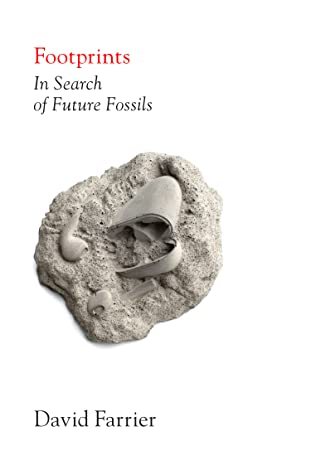 He travels not just through space, but also through time, tracing a plastic bottle from algal bloom to oil to factory to river/landfill to ocean; he thinks about how cultural memory can preserve vanished landscapes; he imagines propitiatory rites arising around radioactive waste to explain poisoned lakes and zinc-lined coffins; and he wonders how to issue appropriate warnings to the future when we don’t even know if English, or language in general, will persist (a nuclear waste storage site in Carlsbad uses a combination of multilingual signs, symbols, monoliths and planned oral tradition, while one in Finland is unmarked).
Each chapter is an intricate blend of fact, experience and story. For example, “The Insatiable Road” is about cars and the concrete landscapes they zip through – all made possible by oil. Farrier wins a chance to be among the first to cross the new Forth Bridge on foot and finds himself awed by the human achievement. Yet he knows that, in a car, the bridge will be crossed in seconds and soon taken for granted. Whether as a driver or a passenger, we have become detached from the journey and from the places we are travelling through. The road trip, a standard element of twentieth-century art and literature, has lost its lustre. “Really, we have conceded so much,” he writes. “Most of us live and wander only where road networks permit us to, creeping along their edges and lulled into deafness by their constant roar.” Ben Okri’s legend provides the metaphor of a famished road that swallows all in its path.
What will the human species leave behind? “The entire atmosphere now bears the marks of our passage … Perhaps no one will be around to read our traces, but nonetheless we are, everywhere, constantly, and with the most astonishing profligacy, leaving a legacy that will endure for hundreds of thousands or even hundreds of millions of years to come.” That legacy includes the concrete foundations of massive road networks, the remnants of megacities on coastal plains, plastics that will endure for many centuries, carbon and methane locked up in permafrost, the 2300-km fossil of the dead Great Barrier Reef, nuclear waste in isolation plants, jellyfish-dominated oceans and decimated microbial life.
Thinking long term doesn’t come naturally. In the same way that multiple books of 2019 (Time Song, Surfacing, Underland) helped us think about the place of humanity in reference to deep time, Footprints offers an invaluable window onto the deep future. Its dichotomies of hubris and atonement, and culpability versus indifference, are essential to ponder. It was always going to be sobering to read about how we have damaged our only home, but I never found this to be a needlessly depressing book; it is clear-eyed and forthright, but also meditative and beautifully constructed. Life on the planet continues in spite of our alterations, but all the diminishment was unavoidable, and perhaps some of it is remediable still.
My rating:
 Related reading: Notes from an Apocalypse by Mark O’Connell. I’m only up to page 36 and at the moment it’s just him watching loads of crackpot preppers’ videos on YouTube, but already I think that Footprints should have had this book’s spot on the Wainwright Prize for Writing on Global Conservation longlist (a new prize run in addition to the standard UK nature writing one) for being more directly engaged with conservation issues rather than just humorously commenting on the end-of-the-world mindset.
Roman Krznaric at Hay Festival
 Krznaric’s discussion of being a “good ancestor” resonated in connection with the long-term thinking of Farrier’s book. “This is the age of the tyranny of the now,” he began, but “humankind has colonized the future” as well, treating it as a tempus nullius where we can dump our ecological waste and tech failures. Yet long-termism is needed more than ever as a way of planning for environmental challenges (and pandemics and the like). Future generations have no say in the decisions we make now that will affect them. To put this in perspective, he showed an image of three spheres, proportionally sized: one represented the 100 billion dead, one was the 7.7 billion currently living, and one was the 6.75 trillion in unborn generations (if the current birth rate continues).
It was Jonas Salk, creator of the polio vaccine, who asked, “Are we being good ancestors?” Krznaric invited the audience to come up with examples (in the chat window on the sidebar) of long-term projects through which people are trying to help future generations, such as the Svalbard Seed Depository, the Green New Deal, the 10,000-Year Clock (inside a mountain in the Texas desert), the Long Play piece of music to last 1,000 years, rewilding, archives and libraries, and tree planting. He had also opened the talk with his own modest contribution: he and his partner ‘gave’ their 11-year-old twins their votes in the latest election.
Krznaric elaborated on four of his book’s six ways of thinking about the future: 1) Rethink human nature by using the “acorn brain” (long-term thinking) rather than the “marshmallow brain” (instant gratification). 2) Embark on projects with long time horizons (“cathedral thinking”). 3) Think in terms of legacies, whether familial or transcendent – leaving a gift to the citizens of the future (e.g. The Future Library of 100 books not published or read until 2114). 4) Create a politics for the future, e.g. the citizen assembly movement.
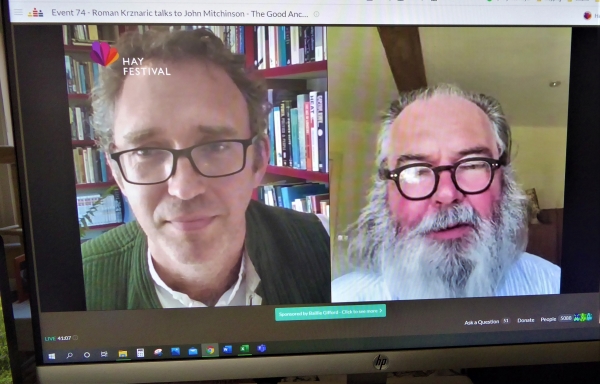
Roman Krznaric at the digital Hay Festival. Q&A led by John Mitchinson (right).
In the case of the UK, Krznaric advocates abolishing the House of Lords, replacing it with a citizens’ assembly and a Minister for the Future, and establishing legal rights for future generations. He noted that globally we’re at a “devil’s fork” where there’s a danger of authoritarian regulations continuing around the world after quarantine ends, endangering the future of social democracy. Instead, we need grassroots activism and “doughnut economics.” He pictures devolution of power away from central governments, with progressive cities becoming new loci of power. Individual actions like vowing not to fly and installing solar panels can inspire peers, but only collective action can tackle environmental breakdown.
 Related reading: I’ll be reviewing Eric Holthaus’s forthcoming book The Future Earth: A Radical Vision for What’s Possible in the Age of Warming for BookBrowse later this month. The meteorologist and science journalist fleshes out some of Krznaric’s ideas, such as a citizen assembly and the cyclical economy, in his proposal for the drastic changes needed over the next three decades.
*You can access the recorded Hay Festival talks by paying a £10 annual subscription here.
Have you read anything about the deep future?
Six Degrees of Separation: From Normal People to The Bass Rock
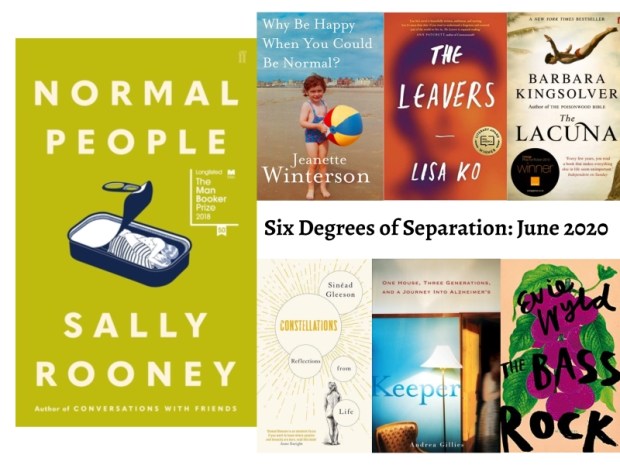
I’m a #6Degrees regular now: this is my fifth time participating. This month (see Kate’s introductory post) we start with Sally Rooney’s Normal People (2018). I loved Conversations with Friends but wasn’t so enamored with Rooney’s second novel (see my review), so I haven’t been tempted to watch the television adaptation; I don’t have a TV anyway.
#1 Picking out one of the words from the book title, and echoing the question that Rooney’s characters seem to be asking themselves, I’ll hop over to a memoir I enjoyed a lot in late 2011, Why Be Happy When You Could Be Normal? by Jeanette Winterson. Adopted into a strict religious household, Winterson had to hide her sexuality. Here you get the full story behind her autobiographical debut novel, Oranges Are Not the Only Fruit.

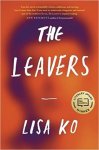
#2 Adoption is my link to The Leavers by Lisa Ko. When he’s abandoned by his mother, an undocumented Chinese immigrant in the USA, Daniel is adopted by a pair of white professors. This is an achingly beautiful story of searching for a mother and a sense of belonging. It won the 2016 PEN/Bellwether Prize for Socially Engaged Fiction.
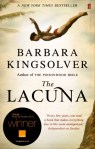
#3 Barbara Kingsolver created and funds the biennial Bellwether Prize for unpublished fiction that addresses issues of social justice. I have vague ambitions to read as many Bellwether and Women’s Prize winners as I can. While it’s not one of my favorites by Kingsolver, The Lacuna (2009) won her the (then) Orange Prize. A historical novel, it’s largely set in the household of Diego Rivera and Frida Kahlo.
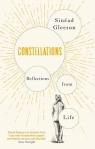
#4 Frida Kahlo is my link to Constellations by Sinéad Gleeson, autobiographical essays about the female body in pain. Kahlo is one of Gleeson’s gurus in that she turned her chronic pain and pregnancy loss into art – “making wounds the source of inspiration.” Constellations was our Not the Wellcome Prize winner during this hiatus year for the official prize.
#5 The first winner of the Wellcome Book Prize, in 2009, was Keeper by Andrea Gillies, a memoir of her mother-in-law Nancy’s struggle with Alzheimer’s disease. I also intend to read as many WBP winners and nominees as possible, so I recently ordered a secondhand copy of this and read the introduction before setting it aside for another time. Already I can tell it will be an engaging if harrowing book; Gillies pulls no punches in her depiction of the misery of the years when Nancy lived with her family and then in an institution.


[#5.5 Another book called Keeper, this one by Jessica Moor, provides my cheaty half-step. I found this debut novel to be a gripping and grimly fascinating story of why women stay with their abusers and what finally drives them to leave.]
#6 Violence against women is also the theme of The Bass Rock by Evie Wyld, my novel of 2020 so far. While it ranges across the centuries, it always sticks close to the title location, an uninhabited island off the east coast of Scotland. It cycles through its three strands in an ebb and flow pattern that is appropriate to the coastal setting and creates a sense of time’s fluidity. This is not a puzzle book where everything fits together. Instead, it is a haunting echo chamber where elements keep coming back, stinging a little more each time. A must-read, especially for fans of Claire Fuller, Sarah Moss and Lucy Wood. (See my full Shiny New Books review.)
I’ve featured only books by women this month, and there have been quite a number of prize winners in here, too.
Join us for Six Degrees of Separation if you haven’t already!
Have you read any of my selections? Are you tempted by any you didn’t know before?
The Seafarers by Stephen Rutt (Paperback Release)
It’s the paperback release date for The Seafarers: A Journey among Birds by Stephen Rutt, one of my highlights from last year’s summer reading and ultimately one of my top 5 nonfiction reads of 2019.
I’ve been asked to repost my review, and you get a bonus: I’m also posting part of the review my husband wrote for his blog last year, which opens with memories of seabird-rich trips he and I have taken. (Chris is a lecturer in animal ecology at the University of Reading, a Newbury Town councillor, and an off-and-on nature blogger.)
Rebecca’s review:
 In 2016 Rutt left his anxiety-inducing life in London in a search for space and silence. He found plenty of both on the Orkney Islands, where he volunteered at the North Ronaldsay bird observatory for seven months. In the few years that followed, the young naturalist travelled the length and breadth of the British Isles – from Skomer to Shetland – courting encounters with seabirds. He’s surrounded by storm petrels one magical night at Mousa Broch; he runs from menacing skuas; he watches eider and terns and kittiwakes along the northeast coast; he returns to Orkney to marvel at gannets and fulmars. Whether it’s their beauty, majesty, resilience, or associations with freedom, such species are for him a particularly life-enhancing segment of nature to spend time around.
Discussion of the environmental threats that hit seabirds hardest, such as plastic pollution, make for a timely tie-in to wider conservation issues. Rutt also sees himself as part of a long line of bird-loving travellers, including James Fisher and especially R. M. Lockley, whose stories he weaves in. This is one of the best nature/travel books I’ve read in a long time, especially enjoyable because I’ve been to a lot of the island locations and the elegantly evocative writing, making particularly effective use of varied sentence lengths, brought back to me just what it’s like to be in the far north of Scotland in the midst of an endless summer twilight, a humbled observer as a whole whirlwind of bird life carries on above you.
A favorite passage:
“Gannets nest on the honeycombs of the cliff, in their thousands. They sit in pairs, pointing to the sky, swaying heads. They stir. The scent of the boat’s herring fills the air. They take off, tessellating in a sky that is suddenly as much bird as light. The great skuas lurk.”
Chris’s review
Scotland, 2005. That’s the trip I always cite as my ‘conversion experience’ as a birder. Perhaps the most memorable element was a boat trip out to the seabird colonies of the Treshnish Isles. Puffins were the draw, but other memories are more vivid. The sudden appearance of a great skua, powering through at low level causing consternation among other birds and excitement among birdwatchers. A minke whale blowing spray near the boat. The dark eye of a shag up close, inscrutably ancient, a pterodactyl that somehow survived to the present.

Puffins at Hermaness, Shetland. Photo by Chris Foster.
Captivated by the peace and isolation of Scottish islands and the incredible sights, sounds and smells of seabirds we did it all again the following year, heading farther north. We started on mainland Orkney, travelling overland by train before catching the ferry from Thurso. During a few days on Westray we experienced a small island community, intriguing to a child of English suburbia, though mostly I remember the rain and superb traybakes in the village café. Finally on to Shetland, making our way up to Hermaness, the very northern end of Britain on the island of Unst. Towering skua-ruled cliffs with the most inquisitive, trusting puffins I have ever known, no land between us and the North Pole. Some four years later we visited Skomer in Pembrokeshire, another famed seabird destination, but since then our visits to Britain’s seabird islands have, alas, largely dried up. I’ve caught up with seabirds on and off since but perhaps let the full wonder of seabirds and the magic of islands drift out of my life.
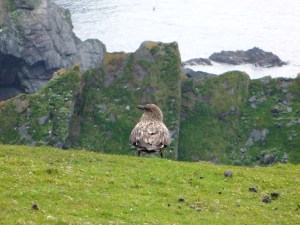
Great skua at Hermaness, Shetland. Photo by Chris Foster.
In that respect The Seafarers was a timely read. It takes the reader, via a series of personal journeys, through the major groups of ocean-going birds that visit Britain while also introducing a significant seabird location in each chapter. It’s an appealing blend of travel, descriptive nature writing, popular science and biography. Author Stephen Rutt balances a highly personal account of what seabirds have meant for him with some solid seabird facts which are well explained, detailed but not at all dense. Rutt is a young birder, naturalist and writer. Since I too am a bearded, balding young (though not nearly so young as he) birder who is not fond of crowds I was probably predisposed to enjoy his voice, and I did, but I also admired its freshness. He successfully avoids the ‘lone white male’ cliché often accused of dominating nature writing. The writing is accomplished throughout and Rutt’s prose is distinctive, concise yet poetic. The life-affirming, simple joy of birding shines through.
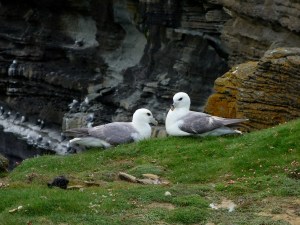
Fulmars on Westray, Orkney Islands. Photo by Chris Foster.
The particularly well-crafted short chapter on vagrant birds may be one of those rare pieces of writing to actually change my mind. Where I have lately been inclined toward the view that twitching exotic vagrants is “a morbid act, a premature wake for a waif that won’t last out the day,” as Rutt puts it, I was won over by his “faith in the wondrous, sense-defying, thrilling capacity that birds have of being lost and making that seem … OK.”
The Seafarers follows just two years after Adam Nicolson’s The Seabird’s Cry. The latter is the more complete (and global) treatment of seabirds, what we know about them and why they matter, but that’s not really a criticism of Rutt’s book. The Seafarers is as much an autobiographical account of the transformative power of birding as it is a compilation of seabird lore. What they have in common is that both books are love letters to this extraordinary group of animals.
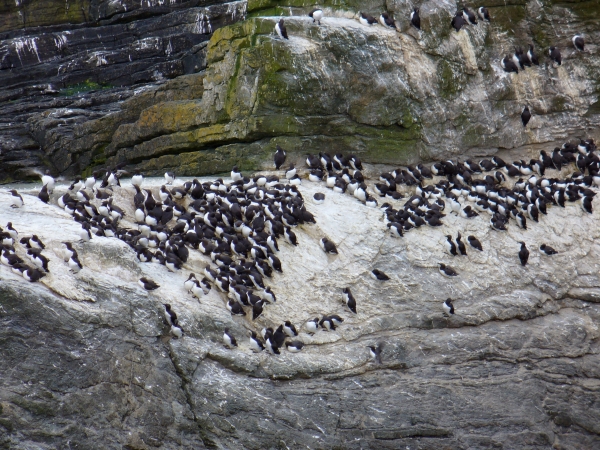
Guillemots at Sumburgh Head, Shetland. Photo by Chris Foster.
Rutt has added his own unique chapter to the shared history of people and seabirds on these islands, as well as establishing himself as a writer with real promise. I look forward to seeing what he turns his thoughts to next.
[The answer was geese; see my review of Rutt’s second 2019 publication, Wintering.]
Note: The Seafarers won the Saltire First Book of the Year award and was longlisted for the Highland Book Prize 2019.
(Order from your local independent bookstore, Hive or Waterstones.)
Thinking about Dead Bodies with John Troyer (Hay Festival)
My second of three digital Hay Festival talks this year was by John Troyer, director of the interdisciplinary Centre for Death and Society at the University of Bath. Troyer is from Wisconsin (where he was speaking from, having been trapped there during a visit to his parents) and grew up with a father who owned a funeral home. This meant that he was aware of death from a young age: One of his earliest memories is of touching the hand of a dead woman when he went to visit his father at work.
 That’s not the only personal experience that went into his new book, Technologies of the Human Corpse, which I’m now keen to read. In 2018 his younger sister, Julie, died of brain cancer at age 43, so her illness and death became a late addition to the preface and also fed into a series of prose poems interspersed between the narrative chapters. She lived in Italy and her doctors failed to tell her that she was dying – that job fell to Troyer. (Unfortunately, this seems to be a persistent problem in Italy. In Dottoressa, her memoir of being an American doctor in Rome, which I read for a TLS review, Susan Levenstein writes of a paternalistic attitude among medical professionals: they treat their patients as children and might not even tell them about a cancer diagnosis; they just inform their family.)
Troyer discussed key moments that changed how we treat corpses. For instance, during the American Civil War there was a huge market for the new embalming technology; it was a way of preserving the bodies of soldiers so they could be returned home for funerals. Frauds also arose, however, and those taken in might find their loved one’s body arrived in a state of advanced decay. At around the same time, early photography captured corpses looking serene and sleeping. We might still take such photos, but we don’t tend to display them any more.
In the 1970s the “happy death” movement advocated for things like “natural death” and “death with dignity.” This piggybacked on the environmental and women’s movements and envisioned death as a taboo that had to be overcome. In recent decades a “necro-economy” based on the global trafficking of body parts (not organs for regulated transplant, Troyer clarified, but other tissue types) has appeared. While whole bodies may be worth just £2,000, “disarticulated” ones divided into their parts can net more like £100,000. Donating one’s body to science is, of course, a noble decision. Many people are also happy to donate their organs, though there remains a particular wariness about donating the eyes.
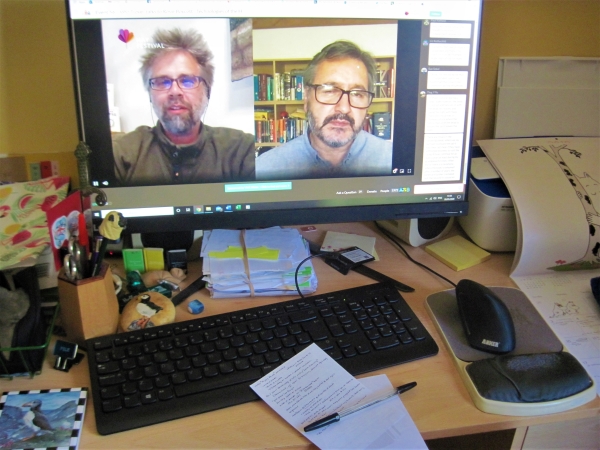
Troyer and Florence on my screen.
One section of Troyer’s book has become “uncannily resonant” in recent days, he noted. This is Chapter 3, on the AIDS corpse, an object of stigma. The biggest changes to death in the time of COVID-19 have been that family members are not able to be with a dying person in the ICU and that funerals cannot proceed as normal. In a viral pandemic, countries are producing a huge number of corpses that they aren’t prepared to deal with. (Indeed, the Washington, D.C. area is so overwhelmed with dead bodies that ice skating rinks have been requisitioned as makeshift morgues. The suburban Maryland rink I visited as a child is one such. Grim.)
Troyer spoke of the need for an everyday-ness to the discussion of death: talking with one’s next of kin, and encountering death in the course of a traditional education – he finds that even his final-year university students, studying in a related field, are very new to talking about death. A good way in that he recommends is simply to ask your loved ones what music they want played at their funerals, and the conversation can go from there.
We may not be able to commemorate the dead as we would like to at this time, but Troyer reminded the audience that funerals are for the living, whereas “the dead are okay with it – they know we’re doing our best.” The event was sensitively chaired by Peter Florence, the co-founder and director of Hay Festival (also responsible for last year’s controversial Booker Prize tie); the fact that Troyer got emotional talking about his sister only gave it more relevance and impact.
 I’ve read an abnormally large number of books about death, especially in the five years since my brother-in-law died of brain cancer (one reason why Troyer’s talk was so meaningful for me). Most recently, I read Bodies in Motion and at Rest (2000) by Thomas Lynch, a set of essays by the Irish-American undertaker and poet from Michigan. I saw him speak at Greenbelt Festival in 2012 and have read four of his books since then. His unusual dual career lends lyrical beauty to his writing about death. However, this collection was not memorable for me in comparison to his 1997 book The Undertaking, and I’d already encountered a shortened version of “Wombs” in the Wellcome Collection anthology Beneath the Skin. But this passage from “The Way We Are” stood out:
After years and years of directing funerals, I’ve come to the conclusion that seeing [the dead body] is the hardest and most helpful part. The truth, even when it hurts, has a healing in it, better than fiction or fantasy. When someone dies it is not them we fear seeing, it is them dead. It is the death. We fear that seeing will be believing. We fear not seeing too. We search the wreckage and the ruins, the battlefields and ocean floors. We must find our dead to let the loss be real.
Just for a bit of morbid fun, I decided to draw up my top 10 nonfiction books about death, dying and the dead. Many of these are personal accounts of facing death or losing a loved one. In contrast to the bereavement and cancer memoirs, the books by Doughty and Gawande are more like cultural studies, and Montross’s is about working with corpses. If you need a laugh, the Bechdel (a graphic memoir) and Doughty are best for black comedy.
 The Light of the World by Elizabeth Alexander
- Fun Home: A Family Tragicomic by Alison Bechdel (her father, too, was a funeral home director)
- Dear Life: A Doctor’s Story of Love and Loss by Rachel Clarke
- The Iceberg by Marion Coutts
- From Here to Eternity: Traveling the World to Find the Good Death by Caitlin Doughty
 Being Mortal: Medicine and What Matters in the End by Atul Gawande
- When Breath Becomes Air by Paul Kalanithi
- Body of Work: Meditations on Mortality from the Human Anatomy Lab by Christine Montross
- The Bright Hour: A Memoir of Living and Dying by Nina Riggs
- To Travel Hopefully: Journal of a Death Not Foretold by Christopher Rush
20 Books of Summer 2020 (Food & Drink Theme): #1 Tiny Moons
It’s my third year participating in Cathy’s 20 Books of Summer challenge. Two years ago I read only books by women; last year I did an animal theme. This year, my 20 books will all tie into a food and drink theme. This includes recognizable foodie lit, memoirs and travel books that have a food element (such as Dave Gorman seeking out non-chain restaurants in America Unchained and Alice Steinbach taking French cooking lessons in Educating Alice), and fiction or nonfiction works that just happen to have a food word in the title. To avoid being grisly, I’ll try not to include any animal books left over from last year!


I have around 30 books to choose from, including these slightly cheaty selections whose authors’ names bring food to mind.

The one constant in my three summers’ selections is that all the books have to be from my own shelves – it’s my way of trying to tackle my hundreds-strong physical TBR. I also have a few classics and two rereads (Dunn and Kingsolver) in the mix here, which would contribute to other ongoing reading goals.
I’m kicking off #20BooksofSummer20 with a quick win, only 85 pages long and read in a single sitting this morning. It was a great start to the project and had my mouth watering for elevenses two hours early…
Tiny Moons: A Year of Eating in Shanghai by Nina Mingya Powles (2020)
This lovely pamphlet of food-themed essays arose from a blog Powles kept while in Shanghai on a one-year scholarship to learn Mandarin. She’d lived in the city as a teen, attending an international high school, so it was somewhat familiar – yet she struggled with homesickness. From one winter to another, she explores the city’s culinary offerings and muses on the ways in which food is bound up with her memories of people and places.
As a child in a mixed-race household in New Zealand, she only knew food words in her Malaysian Chinese mother’s native languages. “My earliest childhood impressions are ones where I am just about to eat something,” she writes. That something might have been Western or Asian food – they coexist in the book (most delightfully on a long-distance train ride she takes: you can buy noodles and dried chicken feet, but also Oreos and Pringles).

As a student in Shanghai, she has dumplings and soup for lunch almost every day. She could live off of spring onion oil noodles and pineapple buns (named for their cross-hatched top rather than their flavour). Messy foods, greasy foods, comfort foods – “It is tiring to be a woman who loves to eat in a society where hunger is something not to be satisfied but controlled.” She and her classmates know that their time here is limited, and they’re going to make the most of these flavours you can’t find every day.
Two sets of cooking lessons add dishes like sticky rice dumplings and stir-fried aubergines to her repertoire. She learns about the traditional foods associated with Chinese festivals, and about the country’s north/south divides: wheat noodles versus rice and thick-skinned dumplings versus thin ones. Street food and snacks abound, including savoury and sweet buns, filled pancakes, tofu bowls and mooncakes.
This is a book about how food can help you be at home, despite loneliness or a language barrier: “In any city anywhere, if there’s a Chinatown I’ll feel at home,” Powles concludes. I love how she uses the senses – not just taste, but also smell and sight – to recreate important places in her life. A fresh banana fritter eaten at her grandparents’ home in Borneo brings it all back, with the senses mingling synaesthetically: “I taste tropical heat. I can taste the slow hours spent in the back garden beneath the mango tree … I taste the fierce sun on my neck”.
My rating:
Readalikes: Shark’s Fin and Sichuan Pepper: A Sweet-Sour Memoir of Eating in China by Fuchsia Dunlop & Two Trees Make a Forest: On Memory, Migration and Taiwan by Jessica J. Lee
Note: Last year Nina Mingya Powles won the inaugural Nan Shepherd Prize for underrepresented voices in nature writing, earning a publishing contract with Canongate for a nature/travel memoir that will be released in August 2021. I’m looking forward to it already.
Tiny Moons was published on February 27th. My thanks to Emma Dai’an Wright of The Emma Press, a small press based in Birmingham, UK, for the free copy for review. (Emma also illustrated the book!)
Are you joining in the summer reading challenge? What’s the first book on the docket?
Do you spy any favorites on my piles? Which ones should I be sure to read?
Three May Releases: Climate Change, a Son’s Elegy, and Sexual Fluidity
I’m still averaging four new releases per month: a nicely manageable number. In addition to Lily King’s Writers & Lovers, in May I’ve read a novel about eco-anxiety and marital conflict, a memoir of losing a mother to grief and dementia, and an account of a shift in sexuality. I had a somewhat mixed reaction to all three books, but see if one or more catches your eye anyway.
When the Lights Go Out by Carys Bray
Perhaps if this had come out two or three years ago, it could have felt fresh. As it is, it felt like a retread of familiar stories about eco-grief and -anxiety among the middle classes (such as Weather and Unsheltered). Emma Abram is an average suburban mother of two in the north of England, upcycling fabrics and doing her best with other little green initiatives around the house since she got laid off from her job when the local library closed. She feels guilty a lot of the time, but what else can she do?
Nero fiddled while Rome burned; she will sew while the polar ice melts and the seas surge.
She couldn’t un-birth the children, un-earth the disposable nappies or un-plumb the white goods.
 Such sentiments also reminded me of the relatable, but by no means ground-breaking, contents of Letters to the Earth.
Emma’s husband Chris, though, has taken things to an extreme: as zealous as he once was about his childhood faith, he now is about impending climate change. One day, a week or so before Christmas, she is embarrassed to spot him by the roadside in town, holding up a signboard prophesying environmental doom. “In those days, Chris had been spreading the Good News. Now he is spreading the Bad News.” He thinks cold-weather and survivalist gear makes appropriate gifts; he raises rabbits for meat; he makes Emma watch crackpot documentaries about pandemic preparation. (Oh, the irony! I was sent this book in December.)
Part of the problem was to do with my expectations: from the cover and publicity materials I thought this was going to be a near-future speculative novel about a family coping with flooding and other literal signs of environmental apocalypse. Instead, it is a story about a marriage in crisis. (I cringed at how unsubtly this line put it: “The climate of her marriage [has] been changing, and she has been in denial about it for a long time.”) It is also, like Unless, about how to relate to a family member who has, in your opinion, gone off the rails.
Nothing wrong with those themes, of course, but my false assumptions meant that I spent well over 200 pages waiting for something to happen, thinking that everything I had read thus far was backstory and character development that, in a more eventful novel, would have been dispatched within, say, the first 40 pages. I did enjoy the seasonal activity leading up to Christmas Eve, and the portrayal of Chris’s widowed, pious mother. But compared to A Song for Issy Bradley, one of my favorite books of 2014, this was a disappointment.
My thanks to Hutchinson for the proof copy for review. This came out in e-book and audio on May 7th but the print edition has been delayed until November 12th.
Mother: A Memoir by Nicholas Royle
“A memoir is about what survives. But it is also about what is enigmatic and irretrievable. Cryptic and unknown.”
 A few years ago I read Royle’s An English Guide to Birdwatching, one of the stranger novels I’ve ever come across (it brings together a young literary critic’s pet peeves, a retired couple’s seaside torture by squawking gulls, the confusion between the two real-life English novelists named Nicholas Royle, and bird-themed vignettes). It was joyfully over-the-top, full of jokes and puns as well as trenchant observations about modern life.
I found that same delight in the vagaries of language and life in Mother: A Memoir. Royle’s mother, Kathleen, had Alzheimer’s and died in 2003. At least to start with, she was aware of what was happening to her: “I’m losing my marbles,” she pronounced one day in the kitchen of the family home in Devon. Yet Royle pinpoints the beginning of the end nearly two decades earlier, when his younger brother, Simon, died of a rare cancer. “From that death none of us recovered. But my mother it did for. She it by degrees sent mad.”
In short, titled sections that function almost like essays, Royle traces his mother’s family history and nursing career, and brings to life her pastimes and mannerisms. She passed on to Royle, a professor of English and creative writing at the University of Sussex, a love of literature and of unusual words and sayings. She was often to be found with a crossword puzzle in front of her, she devoured books (devoting a whole summer to the complete works to date of Doris Lessing, for instance), and she gave advice on her son’s early stories.
The narrative moves back and forth in time and intersperses letters, lists and black-and-white photographs. Royle often eschews punctuation and indulges in wordplay. “These details matter. The matter of my mater. Matador killing metaphor.” I found that I remained at arm’s length from the book – admiring it rather than becoming as emotionally engaged with it as I wanted to be – but it’s certainly not your average memoir, and it’s always refreshing to find (auto)biographical work that does something different.
My thanks to Myriad Editions for the free copy for review.
The Fixed Stars by Molly Wizenberg
Wizenberg is the author of two terrific food-themed memoirs. I particularly loved A Homemade Life, which chronicles the death of her father Burg from cancer, her time living in Paris, building a new life in Seattle, starting her famous food blog (Orangette), and meeting her husband, Brandon. Her follow-up, Delancey, was about the ups and downs of them opening a pizza restaurant and bar in Seattle while she was pregnant with June.
By contrast, The Fixed Stars was an uncomfortable read in more ways than one. For one thing, it unpicks the fairy tale of what had looked like a pretty ideal marriage and entrepreneurial partnership. It turns out Wizenberg wasn’t wholly on board with their little restaurant empire and found the work overwhelming. It was all Brandon’s dream, not hers. (She admits to these facts in Delancey, but it was the success, not the doubt, that I remembered.)
And then, in the summer of 2015, Wizenberg was summoned for jury duty and found herself fascinated by one of the defense attorneys, a woman named Nora who wore a man’s suit and a butch haircut. The author had always considered herself straight, had never been attracted to a woman before, but this crush wouldn’t go away. She and Brandon tried an open marriage so that she could date Nora and he could see other people, too, but it didn’t work out. Brandon didn’t want her to fall in love with anyone else, but that was just what was happening.
 Wizenberg announced her coming-out and her separation from Brandon on her blog, so I was aware of all this for the last few years and via Instagram followed what came next. I knew her new spouse is a non-binary person named Ash who was born female but had top surgery to remove their breasts. (At first I was assumed Nora was an alias for Ash, but they are actually different characters. After things broke down with Nora, a mutual friend set her up with Ash.) The other source of discomfort for me here was the explicit descriptions of her lovemaking with Nora – her initiation into lesbian sex – though she draws a veil over this with Ash.
I’m not sure if the intimate details were strictly necessary, but I reminded myself that a memoir is a person’s impressions of what they’ve done and what has happened to them, molded into a meaningful shape. Wizenberg clearly felt a need to dig for the why of her transformation, and her answers range from her early knowledge of homosexuality (an uncle who died of AIDS) to her frustrations about her life with Brandon (theirs really was a happy enough marriage, and a markedly amicable divorce, but had its niggles, like any partnership).
I appreciated that, ultimately, Wizenberg leaves her experience unlabeled. She acknowledges that hers is a messy story, but an honest one. While she entertains several possibilities – Was she a closeted lesbian all along? Or was she bisexual? Can sexual orientation change? – she finds out that sexual fluidity is common in women, and that all queer families are unique. An obvious comparison is with Maggie Nelson’s The Argonauts, which is a bit more profound and original. But the mourning for her marriage and the anguish over what she was doing to her daughter are strong elements alongside the examination of sexuality. The overarching metaphor of star maps is effective and reminded me of Constellations by Sinéad Gleeson.
There were points in the narrative where I was afraid the author would resort to pat answers about what was ‘meant to be’ or to depicting villains versus heroic actions, but instead she treats this all just as something that happened and that all involved coped with as best they could, hopefully making something better in the end. It’s sensitively told and, while inevitably different from her other work, well worth reading for anyone who’s been surprised where life has led.
I read an advanced e-copy from Abrams Press via Edelweiss. A Kindle edition came out on May 12th, but the hardback release has been pushed back to August 4th.
 Bookish Beck = Rebecca Foster. American transplant to England. Freelance proofreader and book reviewer.
