Book Serendipity, Mid-November–Early January
This is a short set but I’ll post it now to keep things ticking over. I’ve lost nearly a week to the upper respiratory virus from hell, and haven’t felt up to sitting at my computer for any extended periods of time. I had to request extensions on a few of my work deadlines; I’ll hope to be back to normal blogging next week, too.
I call it “Book Serendipity” when two or more books that I read at the same time or in quick succession have something in common – the more bizarre, the better. This is a regular feature of mine every couple of months. Because I usually have 20–30 books on the go at once, I suppose I’m more prone to such incidents. People frequently ask how I remember all of these coincidences. The answer is: I jot them down on scraps of paper or input them immediately into a file on my PC desktop; otherwise, they would flit away! Feel free to join in with your own.
The following are in roughly chronological order.
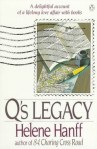
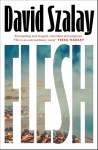
- Ayot St Lawrence as a setting in Q’s Legacy by Helene Hanff and Flesh by David Szalay.
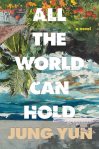
- A man who has panic attacks in Pan by Michael Clune and All the World Can Hold by Jung Yun.
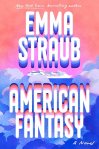
- Two of my Shelf Awareness PRO (early) reviews in a row were of 2026 novels set on a celebrity/reunion cruise: All the World Can Hold by Jung Yun, followed by American Fantasy by Emma Straub. In both, the narrative alternates between three main characters, the cruise is to celebrate a milestone birthday for a passenger’s relative, and there’s a celebrity who’s in AA.
- A teacher–student relationship develops into a friendship in The Irish Goodbye by Beth Ann Fennelly (with Molly McCully Brown, whose Places I’ve Taken My Body I’ve reviewed) and Lessons from My Teachers by Sarah Ruhl (with Max Ritvo, about whom she wrote a whole book).
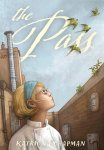 Someone becomes addicted to benzodiazepines in The Pass by Katriona Chapman and All the World Can Hold by Jung Yun (both 2026 releases).
- A New York City event scheduled to occur on September 15 or 16, 2001 is postponed because of 9/11 in Joyride by Susan Orlean (her wedding) and All the World Can Hold by Jung Yun (a cruise departure – it’s moved to Boston).
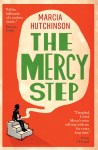
- A 1960s attempted suicide by putting one’s head in a gas oven in The Mercy Step by Marcia Hutchinson and The Soul of Kindness by Elizabeth Taylor.
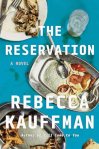
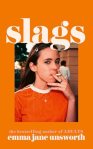
- A plan to eat cheese to induce dreams in The Reservation by Rebecca Kauffman and Slags by Emma Jane Unsworth.
- An author is (at least initially) aghast at the liberties taken with an adaptation of her book in Spent by Alison Bechdel and Joyride by Susan Orlean (the film Adaptation, one of my favourites, bears little relation to her nonfiction work The Orchid Thief, which I also love).
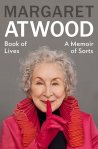
- A North American author meets her British publishers, André Deutsch and Diana Athill, in Book of Lives by Margaret Atwood and Q’s Legacy by Helene Hanff. (Atwood also mentions Sir Arthur Quiller-Couch, the title reference in the Hanff.)
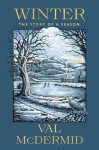
- An older white woman feels compelled to add, as an aside after a memory of slightly dodgy behaviour observed, that cultural appropriation was not a thing in those days in Book of Lives by Margaret Atwood and Winter by Val McDermid.
- I read two books in 2025 with a title taken from a Christian Wiman poem: A Truce that Is Not Peace by Miriam Toews, then Some Bright Nowhere by Ann Packer.
- A special trip undertaken for a younger sister’s milestone birthday: a road trip through Scotland in a campervan in Slags by Emma Jane Unsworth for a 40th; and a boy band reunion cruise to the Bahamas for a 45th in American Fantasy by Emma Straub.
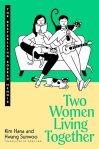
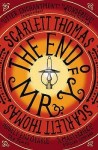
- A reference to Sartre’s “hell is other people” line (paraphrased) in Two Women Living Together by Kim Hana and Hwang Sunwoo and The End of Mr Y by Scarlett Thomas.
- The clock-drawing test as a shorthand for assessing a loved one’s dementia in Book of Lives by Margaret Atwood (her partner Graeme) and Joyride by Susan Orlean (her mother).
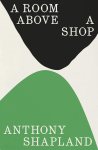 A sexual encounter between two men is presaged by them relieving themselves side by side at urinals in A Room Above a Shop by Anthony Shapland and The End of Mr Y by Scarlett Thomas.
- An older man who knows he’s having a stroke just wants to sit quietly in a chair and not be taken to hospital in Book of Lives by Margaret Atwood (her partner Graeme) and The Boy from the Sea by Garrett Carr.
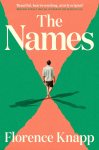
- A man who’s gone through Alcoholics Anonymous gets dangerously close to falling off the wagon: picks up a bottle of gin in a shop in The Names by Florence Knapp / buys a drink at a bar in All the World Can Hold by Jung Yun.
- I was reading two nonfiction books with built-in red ribbon bookmarks at the same time: Book of Lives by Margaret Atwood and Robin by Stephen Moss.
- Homoeopathy is an element in The Names by Florence Knapp and The End of Mr Y by Scarlett Thomas.
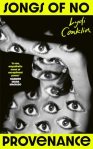
- A character named Sparrow in Spent by Alison Bechdel and Songs of No Provenance by Lydi Conklin.

- A mention of special celebrations for a Korean mother’s 70 birthday in Two Women Living Together by Kim Hana and Hwang Sunwoo and All the World Can Hold by Jung Yun.
- Some kinky practices in Songs of No Provenance by Lydi Conklin and Mr Norris Changes Trains by Christopher Isherwood.
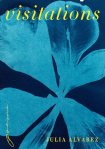
- A girl from an immigrant family reads Greek mythology for escape in Visitations by Julia Alvarez and The Mercy Step by Marcia Hutchinson.
- “View halloo” (originally a fox-hunting term) is used as a greeting in Talking It Over by Julian Barnes and Arsenic for Tea by Robin Stevens.
What’s the weirdest reading coincidence you’ve had lately?
Three Days in June vs. Three Weeks in July
Two very good 2025 releases that I read from the library. While they could hardly be more different in tone and particulars, I couldn’t resist linking them via their titles.
Three Days in June by Anne Tyler
(From my Most Anticipated list.) A delightful little book that I loved more than I expected to, for several reasons: the effective use of a wedding weekend as a way of examining what goes wrong in marriages and what we choose to live with versus what we can’t forgive; Gail’s first-person narration, a rarity for Tyler* and a decision that adds depth to what might otherwise have been a two-dimensional depiction of a woman whose people skills leave something to be desired; and the unexpected presence of a cat who brings warmth and caprice back into her home. (I read this soon after losing my old cat, and it was comforting to be reminded that cats and their funny ways are the same the world over.)
From Tyler’s oeuvre, this reminded me most of The Amateur Marriage and has a surprise Larry’s Party-esque ending. The discussion of the outmoded practice of tapping one’s watch is a neat tie-in to her recurring theme of the nature of time. And through the lunch out at a chic crab restaurant, she succeeds at making the Baltimore setting essential rather than incidental, more so than in much of her other work.
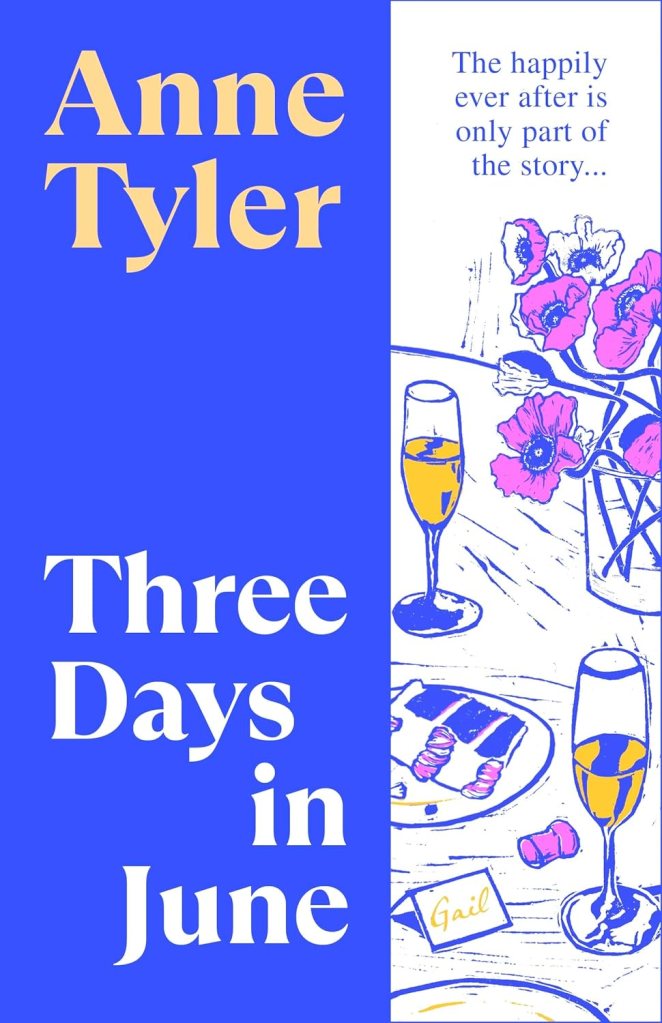
Gail is in the sandwich generation with a daughter just married and an old mother who’s just about independent. I appreciated that she’s 61 and contemplating retirement, but still feels as if she hasn’t a clue: “What was I supposed to do with the rest of my life? I’m too young for this, I thought. Not too old, as you might expect, but too young, too inept, too uninformed. How come there weren’t any grownups around? Why did everyone just assume I knew what I was doing?”
My only misgiving is that Tyler doesn’t quite get it right about the younger generation: women who are in their early thirties in 2023 (so born about 1990) wouldn’t be called Debbie and Bitsy. To some degree, Tyler’s still stuck back in the 1970s, but her observations about married couples and family dynamics are as shrewd as ever. Especially because of the novella length, I can recommend this to readers wanting to try Tyler for the first time. 
*I’ve noted it in Earthly Possessions. Anywhere else?
Three Weeks in July: 7/7, The Aftermath, and the Deadly Manhunt by Adam Wishart and James Nally
July 7th is my wedding anniversary but before that, and ever since, it’s been known as the date of the UK’s worst terrorist attack, a sort of lesser 9/11 – and while reading this I felt the same way that I’ve felt reading books about 9/11: a sort of awed horror. Suicide bombers who were born in the UK but radicalized on trips to Islamic training camps in Pakistan set off explosions on three Underground trains and one London bus. I didn’t think my memories of 7/7 were strong, yet some names were incredibly familiar to me (chiefly Mohammad Sidique Khan, the leader of the attacks; Jean Charles de Menezes, the innocent Brazilian electrician shot dead on a Tube train when confused with a suspect in the 21/7 copycat plot – police were operating under a new shoot-to-kill policy and this was the tragic result).
 Fifty-two people were killed that day, ranging in age from 20 to 60; 20 were not UK citizens, hailing from everywhere from Grenada to Mauritius. But a total of 770 people were injured. I found the authors’ recreation of events very gripping, though do be warned that there is a lot of gruesome medical and forensic detail about fatalities and injuries. They humanize the scale of events and make things personal by focusing on four individuals who were injured, even losing multiple limbs in some cases, but survived and now work in motivational speaking, disability services or survivor advocacy.
What really got to me was thinking about all the hundreds of people who, 20 years on, still live with permanent pain, disability or grief because of the randomness of them or their loved ones getting caught up in a few misguided zealots’ plot. One detail that particularly struck me: with the Tube tunnels closed off at both ends while searchers recovered bodies, the temperature rose to 50 degrees C (122 degrees F), only exacerbating the stench. The book mostly avoids cliches and overwriting, though I did find myself skimming in places. It is based on the research done for a BBC documentary series and synthesizes a lot of material in an engaging way that does justice to the victims. 
Have you read one or both of these?
Could you see yourself picking one of them up?
Book Serendipity, Mid-April to Mid-June
I call it “Book Serendipity” when two or more books that I read at the same time or in quick succession have something in common – the more bizarre, the better. This is a regular feature of mine every couple of months. Because I usually have 20–30 books on the go at once, I suppose I’m more prone to such incidents. People frequently ask how I remember all of these coincidences. The answer is: I jot them down on scraps of paper or input them immediately into a file on my PC desktop; otherwise, they would flit away!
The following are in roughly chronological order.
- Raising a wild animal but (mostly) calling it by its species rather than by a pet name (so “Pigeon” and “the leveret/hare”) in We Should All Be Birds by Brian Buckbee and Raising Hare by Chloe Dalton.
- Eating hash cookies in New York City in Women by Chloe Caldwell and How to Be Somebody Else by Miranda Pountney.
- A woman worries she’s left underclothes strewn about a room she’s about to show someone in one story of Single, Carefree, Mellow by Katherine Heiny and Days of Light by Megan Hunter.
 The dialogue is italicized in Women by Chloe Caldwell and Days of Light by Megan Hunter.
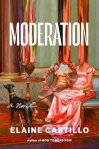
- The ‘you know it when you see it’ definition (originally for pornography) is cited in Moderation by Elaine Castillo and Bookish by Lucy Mangan.
- Women (including the protagonist) weightlifting in a gym in Moderation by Elaine Castillo and All Fours by Miranda July.
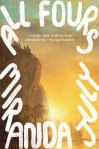
- Miranda July, whose All Fours I was also reading at the time, was mentioned in Chinese Parents Don’t Say I Love You by Candice Chung.
- A sibling story and a mystical light: late last year into early 2025 I read The Snow Queen by Michael Cunningham, and then I recognized this type of moment in Days of Light by Megan Hunter.
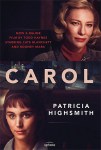
- A lesbian couple with a furniture store in Carol [The Price of Salt] by Patricia Highsmith and one story of Are You Happy? by Lori Ostlund.

- Not being able to see the stars in Las Vegas because of light pollution was mentioned in The Wild Dark by Craig Childs, then in Moderation by Elaine Castillo.
- A gynaecology appointment scene in All Fours by Miranda July and How to Be Somebody Else by Miranda Pountney.
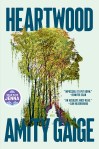
- An awkwardly tall woman in Heartwood by Amity Gaige, How to Be Somebody Else by Miranda Pountney, and Stoner by John Williams.
- The 9/11 memorial lights’ disastrous effect on birds is mentioned in The Wild Dark by Craig Childs and How to Be Somebody Else by Miranda Pountney.
- A car accident precipitated by an encounter with wildlife is key to the denouement in the novellas Women by Chloe Caldwell and Wild Boar by Hannah Lutz.
- The plot is set in motion by the death of an older brother by drowning, and pork chops are served to an unexpected dinner guest, in Bug Hollow by Michelle Huneven and Days of Light by Megan Hunter, both of which I was reading for Shelf Awareness review.
- Kids running around basically feral in a 1970s summer, and driving a box of human ashes around in Case Histories by Kate Atkinson and Bug Hollow by Michelle Huneven.
- A character becomes a nun in Case Histories by Kate Atkinson and Days of Light by Megan Hunter.
- Wrens nesting just outside one’s front door in Lifelines by Julian Hoffman and Little Mercy by Robin Walter.

- ‘The female Woody Allen’ is the name given to a character in Women by Chloe Caldwell and then a description (in a blurb) of French author Nolwenn Le Blevennec.
- A children’s birthday party scene in Single, Carefree, Mellow by Katherine Heiny and Friends and Lovers by Nolwenn Le Blevennec. A children’s party is also mentioned in Case Histories by Kate Atkinson and A Family Matter by Claire Lynch.
- A man who changes his child’s nappies, unlike his father – evidence of different notions of masculinity in different generations, in Case Histories by Kate Atkinson, What My Father and I Don’t Talk About, edited by Michele Filgate, and one piece in Beyond Touch Sites, edited by Wendy McGrath.
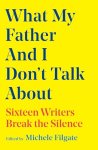
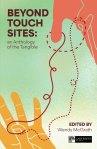
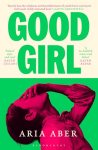
- What’s in a name? Repeated names I came across included Pansy (Case Histories by Kate Atkinson and Days of Light by Megan Hunter), Olivia (Case Histories by Kate Atkinson and A Family Matter by Claire Lynch), Jackson (Case Histories by Kate Atkinson and So Far Gone by Jess Walter), and Elias (Good Girl by Aria Aber and Dream State by Eric Puchner).
- The old wives’ tale that you should run in zigzags to avoid an alligator appeared in Alligator Tears by Edgar Gomez and then in The Girls Who Grow Big by Leila Mottley, both initially set in Florida.
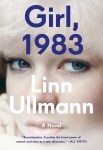
- A teenage girl is groped in a nightclub in Good Girl by Aria Aber and Girl, 1983 by Linn Ullmann.
- Discussion of the extinction of human and animal cultures and languages in both Nature’s Genius by David Farrier and Lifelines by Julian Hoffman, two May 2025 releases I was reading at the same time.
- In Body: My Life in Parts by Nina B. Lichtenstein, she mentions Linn Ullmann – who lived on her street in Oslo and went to the same school (not favourably – the latter ‘stole’ her best friend!); at the same time, I was reading Linn Ullmann’s Girl, 1983! And then, in both books, the narrator recalls getting a severe sunburn.
 On the same day, I read about otter sightings in Lifelines by Julian Hoffman and Spring by Michael Morpurgo. The next day, I read about nesting swallows in both books.
- The Salish people (Indigenous to North America) are mentioned in Lifelines by Julian Hoffman, Dream State by Eric Puchner (where Salish, the town in Montana, is also a setting), and So Far Gone by Jess Walter.
- Driving into a compound of extremists, and then the car being driven away by someone who’s not the owner, in Dream State by Eric Puchner and So Far Gone by Jess Walter.
- A woman worries about her (neurodivergent) husband saying weird things at a party in The Honesty Box by Lucy Brazier and Normally Weird and Weirdly Normal by Robin Ince.
- Shooting raccoons in Ginseng Roots by Craig Thompson and So Far Gone by Jess Walter. (Raccoons also feature in Dream State by Eric Puchner.)
- A graphic novelist has Hollywood types adding (or at least threatening to add) wholly unsuitable supernatural elements to their plots in Spent by Alison Bechdel and Ginseng Roots by Craig Thompson.
- A novel in which a character named Dawn has to give up her daughter in the early 1980s, one right after the other: A Family Matter by Claire Lynch, followed by Love Forms by Claire Adam.
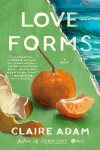
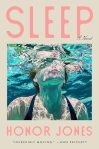
- A girl barricades her bedroom door for fear of her older brother in Love Forms by Claire Adam and Sleep by Honor Jones.
- A scene of an only child learning that her mother had a hysterectomy and so couldn’t have any more children in Dream Count by Chimamanda Ngozi Adichie and Other People’s Mothers by Julie Marie Wade.
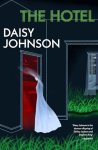
- An African hotel cleaner features in Dream Count by Chimamanda Ngozi Adichie and The Hotel by Daisy Johnson.

- Annie Dillard’s essay “Living Like Weasels” is mentioned in Nature’s Genius by David Farrier and The Dry Season by Melissa Febos.
- A woman assembles an inventory of her former lovers in Dream Count by Chimamanda Ngozi Adichie and The Dry Season by Melissa Febos.
What’s the weirdest reading coincidence you’ve had lately?
Book Serendipity, Mid-December 2024 to Mid-February 2025
I call it “Book Serendipity” when two or more books that I read at the same time or in quick succession have something in common – the more bizarre, the better. This is a regular feature of mine every couple of months. Because I usually have 20–30 books on the go at once, I suppose I’m more prone to such incidents. People frequently ask how I remember all of these coincidences. The answer is: I jot them down on scraps of paper or input them immediately into a file on my PC desktop; otherwise, they would flit away!
The following are in roughly chronological order.
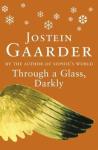
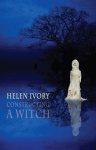
- The angel Ariel appears in Through a Glass Darkly by Jostein Gaarder and Constructing a Witch by Helen Ivory.
- The protagonist’s surname is English in Wild Houses by Colin Barrett and The Cannibal Owl by Aaron Gwyn.
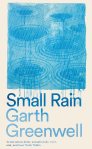
- I read scenes of grief over a tree being cut down / falling next to one’s house in Dispersals by Jessica J. Lee and Small Rain by Garth Greenwell, one right after the other.
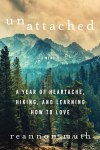
- A mother who does kundalini yoga in All Fours by Miranda July and Unattached by Reannon Muth.
- The idea that happiness (unlike anxiety and sorrow) leaves no trace in writing or in life appeared for me on the same day in Memorial Days by Geraldine Brooks and Small Rain by Garth Greenwell.
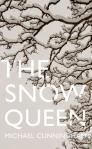
- Someone considers suicide by falling but realizes that at the current height they would injure themself but not die in Wild Houses by Colin Barrett, The Snow Queen by Michael Cunningham, and The Courage Consort by Michel Faber.
- The homosexual “bear” stereotype appears in The Snow Queen by Michael Cunningham and Small Rain by Garth Greenwell.
- A William Blake epigraph in Open, Heaven by Seán Hewitt and one of the poems included in Poetry Unbound by Pádraig Ó Tuama.
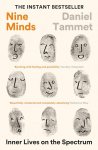
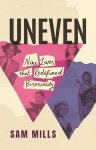
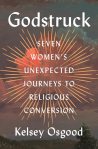
- A group biography including nine pen portraits (plus the author): Nine Minds by Daniel Tammet, followed in quick succession by Uneven by Sam Mills. (Similar, but with just seven subjects, is a book I’m currently reading about women’s religious conversions, Godstruck by Kelsey Osgood.)
- A book–life serendipity moment: in All Fours by Miranda July there is mention of an elderly cat named Alfie who needs to be given medication several times a day. Snap!
- By chance, I started reading Myself and Other Animals, a posthumous collection of short autobiographical pieces by Gerald Durrell, on his centenary (7 January 2025).
- Guilt over destroying a bird’s nest in The Book of George by Kate Greathead and I’ll Come to You by Rebecca Kauffman.
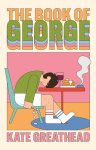
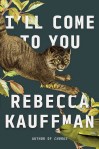
- The main female character has a birthmark in The Book of George by Kate Greathead and The Blindfold by Siri Hustvedt.
- Reading two novels at the same time that open with a new family having to be found for a little boy because his mentally ill mother is presumed to have died by suicide: Unexpected Lessons in Love by Bernardine Bishop and Going Home by Tom Lamont.
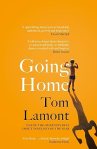 The protagonist is mistaken for a two-year-old boy’s father in The Book of George by Kate Greathead and Going Home by Tom Lamont.
- The mother is named Ellen in The Book of George by Kate Greathead and I’ll Come to You by Rebecca Kauffman.
- An ailing elderly father named Vic in Going Home by Tom Lamont and The God of the Woods by Liz Moore.
- A mother is sent to a mental hospital after the loss of her young son in Invisible by Paul Auster and The God of the Woods by Liz Moore.
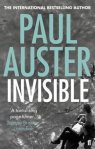
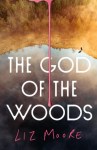
- A brother and sister share a New York City apartment in Invisible by Paul Auster and The Book of George by Kate Greathead.
- A mention of the Japanese artist Hokusai in While the Earth Holds Its Breath by Helen Moat and The Secret Life of Snow by Giles Whittell.
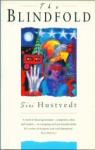 Adults dressing up for Halloween in The Blindfold by Siri Hustvedt and I’ll Come to You by Rebecca Kauffman.
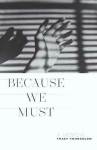
- A second husband named Tim in Unexpected Lessons in Love by Bernardine Bishop and Because We Must by Tracy Youngblom.
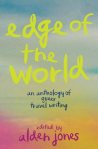
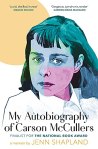
- The idea that ‘queers find each other’ in Edge of the World: An Anthology of Queer Travel Writing edited by Alden Jones and My Autobiography of Carson McCullers by Jenn Shapland.
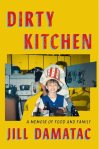
- Experiencing 9/11 as a freshman in college (just like me!) in Dirty Kitchen by Jill Damatac and The Book of George by Kate Greathead. (There is also a 9/11 section in Confessions by Catherine Airey.)
- An intense poker game in I’ll Come to You by Rebecca Kauffman and Going Home by Tom Lamont.
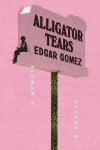 The main character is expelled on false drug possession charges in Invisible by Paul Auster and Alligator Tears by Edgar Gomez.
- Missing the chance to say goodbye before a father’s death, and a parent wondering aloud to their son whether they’ve been a good parent in The Book of George by Kate Greathead and The Remains of the Day by Kazuo Ishiguro.
- Someone departs suddenly, leaving her clothes and books behind, in Invisible by Paul Auster and My Autobiography of Carson McCullers by Jenn Shapland.
- Mentions of DACA (Deferred Action for Childhood Arrivals, an Obama-era U.S. immigration policy) and “Two-Buck Chuck” (a nickname for the Charles Shaw bargain wine sold at Trader Joe’s) in Dirty Kitchen by Jill Damatac and Alligator Tears by Edgar Gomez.
- A City Hall wedding in New York City in Baumgartner by Paul Auster and Dirty Kitchen by Jill Damatac.
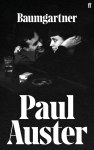
- Polish Jewish heritage and a parent who died of pancreatic cancer in Baumgartner by Paul Auster and The History of Love by Nicole Krauss.
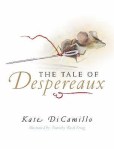
- In Because We Must by Tracy Youngblom, she reads The Tale of Despereaux by Kate DiCamillo aloud to her son while he is recovering in hospital. I was reading Despereaux at the same time! (Also, in real-life serendipity, Youngblom and I both have a sister named Trish.)
- A code of 1–3 knocks is used in Confessions by Catherine Airey and The History of Love by Nicole Krauss.
 A scene of a teacup breaking in Junction of Earth and Sky by Susan Buttenwieser and The Möbius Book by Catherine Lacey.
What’s the weirdest reading coincidence you’ve had lately?
Summery Reading, Part I: Heatwave, Summer Fridays
Here we are between short, bearable heat waves. As the climate changes, I’m more grateful than ever to live somewhere with reasonably mild and predictable weather; I don’t miss the swampy humidity of the Maryland summers I grew up with one bit. Today I have some brief thoughts on a first pair of summer-themed reads I picked up last month: a queasy coming-of-age novella about French teenagers’ self-destructive actions on a camping holiday; and a fun, nostalgic romance novel set in New York City at the turn of the millennium.
Heatwave by Victor Jestin (2019; 2021)
[Translated from the French by Sam Taylor]
 Victor Jestin was in his early twenties when he wrote this debut novella, which won the Prix Femina des Lycéens and was longlisted for the CWA Crime Fiction in Translation Dagger. It opens, memorably, with Leonard’s confession: “Oscar is dead because I watched him die and did nothing. He was strangled by the ropes of a swing … Oscar was not a child. At seventeen, you don’t die like that by accident.” A suicide, then: fitting given the other dangerous behaviours – drinking and promiscuity – rife among the gang of teenagers at this campsite in the South of France. What turns it into a crime is that Leonard, addled by alcohol and the heat, doesn’t report the death but buries Oscar in the sand and pretends nothing happened.
The rest of the book takes place over about 24 hours, the final day of a two-week vacation. Leo stumbles about as if in a trance, outwardly relating to his family, a male friend who seems to have a crush on him, and girls he’d like to sleep with, but all the while inwardly wondering what to do next. “I hadn’t made many stupid mistakes in my seventeen years of life. This one was difficult to understand. It all happened too fast; I felt powerless.” This is interesting enough if you like unreliable teenage narrators or are drawn by the critics’ comparisons to Françoise Sagan – accurate for the sense of sleepwalking toward disaster. One could easily breeze through the 104 pages during one hot afternoon. It didn’t stand out to me particularly, though. (Little Free Library) 
Summer Fridays by Suzanne Rindell (2024)
 I was a big fan of Rindell’s first two stylish historical novels, The Other Typist and Three-Martini Lunch. She seemed to go off the boil with the next two, which I skipped, and now she’s back with an unexpected foray into romance, a genre I almost never read. The cover’s whimsical (nonexistent) birds and Ryan Gosling-like male figure make the novel seem frothier than it actually is, though we’re definitely in classic romcom territory here. The comparisons to You’ve Got Mail are apt in that the main character, Sawyer, strikes up a flirtation over e-mail and instant messaging. She’s a New York City publishing assistant whose ambitions threaten her day job when she has several poems accepted by The Paris Review. Nick, her correspondent, teases and cheers her on in equal measure. The complicated thing is that Sawyer is engaged to Charles, her college sweetheart, and Nick is dating Kendra. Nick and Sawyer initially became digital pen pals because they suspected that their partners, who work together at a law firm, were having an affair; they never expected sparks to fly.
It’s overlong and reasonably predictable, but I enjoyed the languid unfolding of the romance over the weeks of summer 1999. It was truly a simpler time when you had to dial up and wait for an inbox to load instead of having it in your pocket 24/7. Every Friday afternoon, Sawyer and Nick do touristy things like taste-test hotdogs and slushees, ride the Staten Island ferry back and forth all day, and visit little-known bars and restaurants Nick knows through his amateur rock band. They try to convince themselves that these are not dates. It’s like time outside of time for them, and a chance to sightsee in one’s own town. Eventually, though, Sawyer has to face reality. The 2001 framing story reflects the fact that, after the events of 9/11, many asked themselves what they really wanted out of life. This was cute but doesn’t quite live up to, e.g., Romantic Comedy. (Read via Edelweiss)
Any “heat” or “summer” books for you this year?
Recent Poetry Releases by Anderson, Godden, Gomez, Goodan, Lewis & O’Malley
Nature, social engagement, and/or women’s stories are linking themes across these poetry collections, much as they vary in their particulars. After my brief thoughts, I offer one sample poem from each book.
And I Will Make of You a Vowel Sound by Morag Anderson
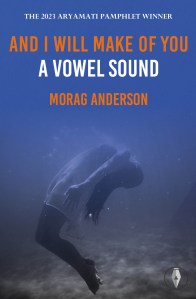 Morag Anderson was the 2023 Makar of the Federation of Writers in Scotland. She won the Aryamati Pamphlet Prize for this second chapbook of 25 poems. Her subjects are ordinary people: abandoned children, a young woman on a council estate, construction workers, and a shoplifter who can’t afford period products. The verse is rich with alliteration, internal rhymes and neologisms. Although sub/urban settings predominate, there are also poems dedicated to birds and to tracking the seasons’ march along a river. There is much sibilance to “Little Wren,” while “Cormorant Speaks” enchants with its fresh compound words: “Barefoot in mudslick streambeds I pathpick over rotsoft limbs, wade neckdeep in suncold loch”. “No Ordinary Tuesday, 2001” is about 9/11 and “None of the Nine Were There” expresses feminist indignation at the repeal of Roe v. Wade: “all nine were busy / stitching rules into the seams / of bleeding wombs.” A trio of poems depicts the transformation of matrescence: “Long after my shelterbody shucks / her reluctant skull / from my shell, // her foetal cells— / rosefoamed in my core— / migrate to mend my flensed heart.” Impassioned and superbly articulated. A confident poet whose work I was glad to discover.

With thanks to Fly on the Wall Press for the free copy for review.
With Love, Grief and Fury by Salena Godden
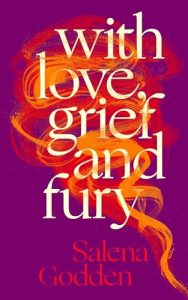 “In a time of apathy, / hope is a revolutionary act”. I knew Godden from her hybrid novel Mrs Death Misses Death, but this was my first taste of the poetry for which she is better known. The title gives a flavour of the variety in tone. Poems arise from environmental anxiety; feminist outrage at discrimination and violence towards women; and personal experiences of bisexuality, being childfree (“Book Mother” and “Egg and Spoon Race”), and entering perimenopause (“Evergreen Tea”). Solidarity and protest are strategies for dispelling ignorance about all of the above. Godden also marks the rhythms of everyday life for a single artist, and advises taking delight in life’s small pleasures. The social justice angle made it a perfect book for me to read portions of on the Restore Nature Now march through London in June …

… and while volunteering as an election teller at a polling station last week. It contains 81 poems (many of them overlong prose ones), making for a much lengthier collection than I would usually pick up. The repetition, wordplay and run-on sentences are really meant more for performance than for reading on the page, but if you’re a fan of Hollie McNish or Kae Tempest, you’re likely to enjoy this, too.
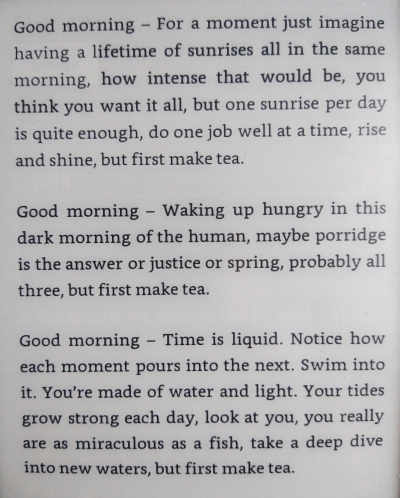
An excerpt from “But First Make Tea”
(Read via NetGalley) Published in the UK by Canongate Press.
Inconsolable Objects by Nancy Miller Gomez
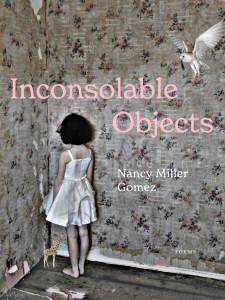 Nancy Miller Gomez’s debut collection recalls a Midwest girlhood of fairground rides and lake swimming; tornadoes and cicadas. But her remembered Kansas is no site of rose-tinted nostalgia. “Missing History” notes how women’s stories, such as her grandmother’s, are lost to time. A pet snake goes missing and she imagines it haunting her mother. In “Tilt-A-Whirl,” her older sister’s harmless flirtation with a ride operator turns sinister. “Mothering,” likewise, eschews the cosy for images of fierce protection. The poet documents the death of her children’s father and abides with a son enduring brain scans and a daughter in recovery from heroin addiction. She also takes ideas from the headlines, with poems about the Ukraine invasion and species extinction. There is a prison setting in two in a row – she has taught Santa Cruz County Jail poetry workshops. The alliteration and slant rhymes are to die for, and I love the cover (Owl Collage by Alexandra Gallagher) and frequent bird metaphors. This also appeared on my Best Books from the First Half of 2024 list. [My full review is on Goodreads.]

With thanks to publicist Sarah Cassavant (Nectar Literary) and YesYes Books for the e-copy for review.
In the Days that Followed by Kevin Goodan
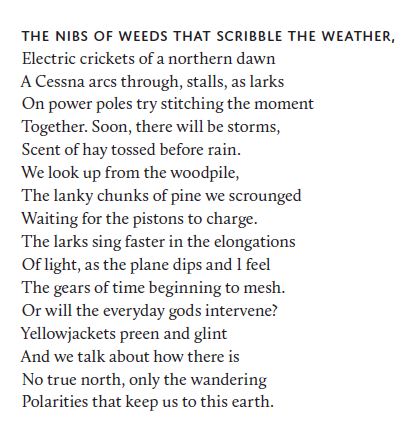
 These 41 poems, each limited to one stanza and one page, are named for their first lines, like hymns. With their old-fashioned lyricism and precise nature vocabulary, they are deeply rooted in place and animated by frequent rhetorical questions. Birds and fields, livestock and wildfires: Goodan marks where human interest and the natural world meet, or sometimes clash. He echoes Emily Dickinson (“After great patience, a small bird comes”) and also reminds me of Keith Taylor, whose upcoming collection I’ve reviewed for Shelf Awareness. The pages are rain-soaked and ghost-haunted, creating a slightly melancholy atmosphere. Unusual phrasing and alliteration stand out: “on the field / A fallow calm falls / Leaving the soil / To its feraling.” He’s a new name for me though this is his seventh collection; I’d happily read more. [After I read the book I looked at the blurb on Goodreads. I got … none of that from my reading, so be aware that it’s very subtle.]
With thanks to Alice James Books for the e-copy for review.
From Base Materials by Jenny Lewis
 This nicely ties together many of the themes covered by the other collections I’ve discussed: science and nature imagery, ageing, and social justice pleas. But Lewis adds in another major topic: language itself, by way of etymology and translation. “Another Way of Saying It” gives the origin of all but incidental words in parentheses. The “Tales from Mesopotamia” are from a commissioned verse play she wrote and connect back to her 2014 collection Taking Mesopotamia, with its sequence inspired by The Epic of Gilgamesh. There are also translations from the Arabic and a long section paraphrases the Rubaiyat of Omar Khayyam, which recalls the books of Ecclesiastes and Job with its self-help aphorisms. Other poems are inspired by a mastectomy, Julian of Norwich, Japanese phrases, and Arthurian legend. The title phrase comes from the Rubaiyat and refers to the creation of humanity from clay. There’s such variety of subject matter here, but always curiosity and loving attention.
“On Translation”
The trouble with translating, for me, is that
when I’ve finished, my own words won’t come;
like unloved step-children in a second marriage,
they hang back at table, knowing their place.
While their favoured siblings hold forth, take
centre stage, mine remain faint, out of ear-shot
like Miranda on her island shore before the boats
came near enough, signalling a lost language;
and always the boom of another surf – pounding,
subterranean, masculine, urgent – makes my words
dither and flit, become little and scattered
like flickering shoals caught up in the slipstream
of a whale, small as sand crabs at the bottom of a bucket,
harmless; transparent as zooplankton.
With thanks to Carcanet Press for the e-copy for review.
The Shark Nursery by Mary O’Malley
 This was my first time reading Irish poet Mary O’Malley. Nature looms large in her tenth collection, as in several of the other books I’ve reviewed here, with poems about flora and fauna. “Late Swallow” is a highlight (“your loops and dives leave ripples in the air, / a winged Matisse, painting with scissors”) and the title’s reference is to dogfish – what’s in a name, eh? The meticulous detail in her descriptions made me think of still lifes, as did a mention of an odalisque. Other verse is stimulated by Greek myth, travel to Lisbon, and the Gaelic language. Sections are devoted to pandemic experiences (“Another Plague Season”) and to technology. “The Dig” imagines what future archaeologists will make of our media. I noted end and internal rhymes in “April” and the repeated sounds and pattern of stress of “clean as a quiver of knives.” O’Malley has a light touch but leaves a big impression.
“Holy”
The days lengthen, the sky quickens.
Something invisible flows in the sticks
and they blossom. We learn to let this
be enough. It isn’t; it’s enough to go on.
Then a lull and a clip on my phone
of a small girl playing with a tennis ball
her three-year-old face a chalice brimming
with life, and I promise when all this is over
I will remember what is holy. I will say
the word without shame, and ask if God
was his own fable to help us bear absence,
the cold space at the heart of the atom.
With thanks to Carcanet Press for the e-copy for review.
20 Books of Summer, 11–12: Gillian Clarke Poetry and Ross Gay Essays
It might not look like I’ll finish the 20 Books of Summer challenge in time, but I’ve got it all planned out and should be reviewing the last few on the final day! My initial foodie idea has turned into a micro-theme that joins only about six of the titles in total. I’ve swapped in various other things along the way, such as a couple of poetry collections and novellas (note to self: always include at least a few very short books!), but the focus has been on getting through stuff from my own shelves, especially recent acquisitions and work by women.
Today I have an excellent poetry collection infused with the language of gardening and geology and reflecting on two crises of the early 2000s, and a book of mini-essays about noticing the small pleasures that make life worth living.
Making the Beds for the Dead by Gillian Clarke (2004)
 I look out for black-and-white Carcanet spines whenever I’m scanning the poetry section in a secondhand bookshop. Clarke’s was a new name for me (the National Poet of Wales from 2008 to 2016, she’s now 86) but the blurb attracted me and this ended up being exactly the sort of poetry I love: full of colours and nature imagery, profuse with alliteration and slant rhymes, relishing its specialist terminology, and taking on the serious subject matter of manmade disasters. Several medium-length sequences are devoted to gardening (“The Middleton Poems” and “Nine Green Gardens”) and geology (“The Stone Poems”); some earlier pieces are ekphrastic, or dedicated to particular poets.
Clarke remembers the delight she took as a child in the unfamiliar vocabulary of the Bible, “a narrative of spells / in difficult columns on those moth-thin pages, / words to thrill the heart with a strange music.” The book teems with animals – though, alas, many of them are dead (as in “Adders” and “Taxidermy”). The title sequence, indeed is about the foot and mouth disease outbreak that decimated the UK livestock population in 2001. Farmers were forced to cull their flocks and news footage showed mountains of carcasses burning. She hovers over the catastrophe, imagining herself into the minds of family farmers, gossiping onlookers, and a traumatized vet. Just as one crisis was coming to an end, September 11 came – another unforgettable tragedy, commemorated with “The Fall.” A very affecting collection, all told. I’ll be sure to read more by Clarke. (Secondhand – Bridport Old Books, 2023) 
A favourite passage, from “The Yew Tunnel in Winter”:
Listen to sap rise, unstoppable flood,
for all the centuries as the tap-roots grew,
pumping through branches to the stirring bud
from deepest earth. In graveyards they say a yew
sends a root into the mouths of all the dead.
Here, sense all that power snowed in and still,
shut in the dream of winter and history
at the end of a muffled lane
The Book of Delights by Ross Gay (2019)
“Perhaps delight is like after the great cosmic finger has pointed at something, and that something … appears.”
Gay is better known as a poet, with several collections to his name, and teaches at Indiana University. This book project started as a challenge to self to write a daily essay about something that was good in his life, quickly and longhand. He started on his 42nd birthday (August 1) and continued for a full year; there are 102 micro-essays here, so he managed one every few days. They are about everything or nothing much, depending on how you look at it: an adored foodstuff or piece of music, a dream, a surprise encounter with a stranger, what was growing in his garden at the time, etc.
 One essay is titled “The Jenky,” about the crooked and makeshift. Gay watches the birds enjoying a dead tree in his (deliberately neglected) yard, and notes a sign reading “Caution: Bees on Bridge” and thereby making space for nature. A few of the more memorable incidents involve plane travel. One time he flies with a tomato seedling in his lap and finds that people treat him more kindly. He gets an unexpectedly enthusiastic response from a security guard when he mentions that he’s on his way to read poems and realizes later that, by some quirk of regional American accents, the man thought he’d said “reading palms.”
Although I enjoyed the book more as I went along, something held me back from loving it. There weren’t enough sentiments that I recognized, and the loose, informal style wasn’t always for me. While you get glimpses into his upbringing and travels, I tend to prefer a memoir. It may also be that Gay and I are just different personalities. The delight he takes in other people’s oddities suggests he might be an extrovert; he truly enjoys being spoken to, or even touched (on the shoulder, for instance), by strangers, whereas I don’t particularly. Part of this is about minority group bonding for him: he writes of the “Negreeting” exchanged between Black people passing each other on a street. There were also a few too many mentions of him peeing into bottles or in his car.
So I liked this, but maybe not enough to try more by Gay, though I should probably see what his verse is like. I was glad to have read it, especially when I realized I can only think of about 20 books I’ve read by Black men. Ever. Yikes. (New – Christmas gift, 2022) 
10 Days in the USA and What I Read (Plus a Book Haul)
On October 29th, I went to an evening drinks party at a neighbour’s house around the corner. A friend asked me about whether the UK or the USA is “home” and I replied that the States feels less and less like home every time I go, that the culture and politics are ever more foreign to me and the UK’s more progressive society is where I belong. I even made an offhand comment to the effect of: once my mother passed, I didn’t think I’d fly back there often, if at all. I was thinking about 5–10 years into the future; instead, a few hours after I got home from the party, we were awoken by the middle-of-the-night phone call saying my mother had suffered a nonrecoverable brain bleed. The next day she was gone.
I haven’t reflected a lot on the irony of that timing, probably because it feels like too much, but it turns out I was completely wrong: in fact, I’m now returning to the States more often. With our mom gone and our dad not really in our lives, my sister and I have gotten closer. Since October I’ve flown back twice and she’s visited here once. There are 7.5 years between us and we’ve always been at different stages of life, with separate preoccupations and priorities; I was also lazy and let my mom be the go-between, passing family news back and forth. Now there’s a sense that we are all we have, and we have to stick together.


So it was doubly important for me to be there for my sister’s graduation from nursing school last week. If we follow each other on Facebook or Instagram, you will have already seen that she finished at the top of her cohort and was one of just two students recognized for academic excellence out of the college’s over 200 graduates – and all of this while raising four children and coping with the disruption of Mom’s death seven months ago. There were many times when she thought she would have to pause or give up her studies, but she persisted and will start work as a hospice nurse soon. We’re all as proud as could be, on our mom’s behalf, too.
The trip was a mixture of celebratory moments and sad duties. We started the process of going through our mom’s belongings and culling what we can, but the files, photos and mementoes are the real challenge and had to wait for another time. There were dozens of books I’d given her for birthdays and holidays, mostly by her favourite gentle writers – Gerald Durrell, Jan Karon, Gervase Phinn – invariably annotated with her name, the date and occasion. I looked back through them and then let them go.


Between my two suitcases I managed to bring back the rest of her first box of journals (there are 150 of them in total, spanning 1989 to 2022), and I’m halfway through #4 at the moment. We moved out of my first home when I was nine, and I don’t have a lot of vivid memories of those early years. But as I read her record of everyday life it’s like I’m right back in those rooms. I get new glimpses of myself, my dad, my sister, but especially of her – not as my mother, but as a whole person. As a child I never realized she was depressed: distressed about her job situation, worried over conflicts with her siblings and my sister, coping with ill health (she was later diagnosed with fibromyalgia) and resisting ageing. For as strong as her Christian faith was, she was really struggling in ways I couldn’t appreciate then.

I hope that later journals will introduce hindsight, now that she’s not around to give a more circumspect view. In any case, they’re an incredible legacy, a chance for me to relive much of my life that I otherwise would only remember in fragments through photographs, and perhaps have a preview of what I can expect from the course of our shared kidney disease.
What I Read
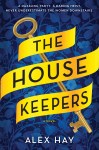 The Housekeepers by Alex Hay – A historical heist novel with shades of Downton Abbey, this comes out in July. Reviewed for Shelf Awareness.

Cowboys Are My Weakness by Pam Houston – Terrific: stark, sexy stories about women who live out West and love cowboys and hunters (as well as dogs and horses). Ten of the stories are in the first person, voiced by women in their twenties and thirties who are looking for romance and adventure and anxiously pondering motherhood (“by the time you get to be thirty, freedom has circled back on itself to mean something totally different from what it did at twenty-one”). The remaining two are in the second person, which I always enjoy. The occasional Montana setting reminded me of stories I’ve read by Maile Meloy and Maggie Shipstead, while the relationship studies made me think of Amy Bloom’s work. 

The Harpy by Megan Hunter – Read for Literary Wives club. Review coming up on Monday. 

The Lake Shore Limited by Sue Miller – A solid set of narratives alternating between the POVs of four characters whose lives converge around a play inspired by the playwright’s loss of her boyfriend on one of the hijacked planes on 9/11. Her mixed feelings about him towards the end of his life and about being shackled to his legacy as his ‘widow’ reverberate in other sections: one about the lead actor, whose wife has ALS; and one about a widower the playwright is being set up with on a date. Fitting for a book about a play, the scenes feel very visual. A little underpowered, but subtlety is to be expected from a Miller novel. She, Anne Tyler and Elizabeth Berg write easy reads with substance, just the kind of book I want to take on an airplane, as indeed I did with this one. I read the first 2/3 on my travel day (although with the 9/11 theme this maybe wasn’t the best choice!).
 For apposite plane reading, I also started Fly Girl by Ann Hood, her memoir of being a TWA flight attendant in the 1970s, the waning glory days of air travel. I’ve read 10 or so of Hood’s books before from various genres, but lost interest in the minutiae of her job applications and interviews. Another writer would probably have made a bigger deal of the inherent sexism of the profession, too. I read 30%.
 Hello Beautiful by Ann Napolitano – I knew I wanted to read this even before it was Oprah’s 100th book club pick. It’s a family story spanning three decades and focusing on the Padavanos, a working-class Italian American Chicago clan with four daughters: Julia, Sylvie, and twins Cecilia and Emeline. Julia meets melancholy basketball player William Waters while at Northwestern in the late 1970s and they marry and have a daughter; Sylvie, a budding librarian, makes out with boys in the stacks until her great romance comes along; Cecilia is an artist and Emeline loves babies and manages a nursery. More than once a character think of their collective story as a “soap opera,” and there’s plenty of melodrama here – an out-of-wedlock pregnancy, estrangements, a suicide attempt, a coming out, stealing another’s man – as well as far-fetched coincidences, including the two major deaths falling on the same day as a birth and a reconciliation.
There is such warmth and intensity to the telling, and brave reckoning with mental illness, prejudice and trauma, that I excused flaws such as dwelling overly much in characters’ heads through close third person narration, to the detriment of scenes and dialogue. I love sister stories in general, and the subtle echoes of Leaves of Grass and Little Women (the connections aren’t one to one and you’re kept guessing for most of the book who will be the Beth) add heft. I especially appreciated how a late parent is still remembered in daily life after 30 years have passed. This is, believe it or not, the second basketball novel I’ve loved this year, after Tell the Rest by Lucy Jane Bledsoe.
I always try to choose thematically appropriate reads, so I also started:
 Circling My Mother by Mary Gordon – A memoir she began after her nonagenarian mother’s death with dementia. Intriguingly, the structure is not chronological but topic by topic, built around key relationships: so far I’ve read “My Mother and Her Bosses” and “My Mother: Words and Music.”
Grave by Allison C. Meier – My sister and I made a day trip up to my mother’s grave for the first time since her burial. She has a beautiful spot in a rural cemetery dating back to the 1780s, but it’s in full sun and very dry, so we tried to cheer up the dusty plot with some extra topsoil and grass seed, marigolds, and a butterfly flag.


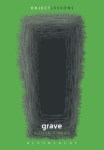 Meier is a cemetery tour guide in Brooklyn, where she lives. In the third of the e-book I’ve read so far, she looks at American burial customs, the lack of respect for Black and Native American burial sites, and the rise of garden cemeteries such as Mount Auburn in Cambridge, Massachusetts. I’ve been reading death-themed books for over a decade and have delighted in exploring cemeteries (including Mount Auburn, as part of my New England honeymoon) for even longer, so this is right up my street and one of the better Object Lessons monographs.
What I Bought
I traded in most of my mother’s books at 2nd & Charles and Wonder Book and Video but, no surprise, promptly spent the store credit on more secondhand books. Thanks to clearance shelves at both stores, I only had to chip in another $12.25 for the below haul, which also covered two Dollar Tree purchases (I felt bad for Susan Minot having signed editions end up remaindered!). Some tried and true authors here, as well as novelties to test out, with a bunch of short stories and novellas to read later in the year.


Solidarity with Ukraine
I don’t think I realized how serious the Russian invasion of Ukraine was until I heard a neighbour who is in the Royal Navy speak of it in the same breath as 9/11.
It is so hard to predict the end game. Wars can last years, even decades, and a situation like this could draw many more countries in. Like with Covid, there could be much longer term effects than we’re currently expecting.
I attended a candlelit vigil for Ukraine in the town square on Friday.
I donated to the Disasters Emergency Committee’s Ukraine Humanitarian Appeal at church yesterday morning, and will donate more. (Those in other countries might choose to send money through Doctors Without Borders, the Red Cross, or UNICEF.)
And I was prompted by a friend’s post to assemble this “Solidarity Stack” on Instagram over the weekend:
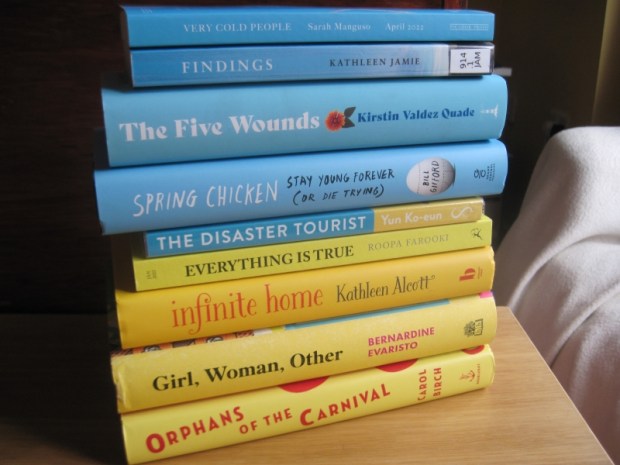
But I still feel like I have done so little.
I can hardly bear to keep up with the news; we don’t have a television or get a newspaper and I never listen to the radio, but I do see the headlines through my Facebook and Twitter feeds. Some heartening stories, but mostly horrible ones.
I wish I knew more about Ukraine. The only books I can think of that I’ve read by Ukrainians and Ukrainian Americans are Deaf Republic by Ilya Kaminsky, Death and the Penguin by Andrey Kurkov*, and My Dead Parents by Anya Yurchyshyn. There is a Ukraine setting to The Summer Guest by Alison Anderson, and Henry Marsh goes on medical missions to Ukraine in Do No Harm. Everything Is Illuminated by Jonathan Safran Foer is about his Ukrainian Jewish heritage (as is his mother Esther’s I Want You to Know We’re Still Here); The Reason Why by Cecil Woodham-Smith and The Rose of Sebastopol by Katharine McMahon are about the Crimean War.
Over the past couple of weeks a number of Ukrainian reading lists have come out, like this one from Book Riot. Ron Charles (of the Washington Post) also put me onto I Will Die in a Foreign Land by Kalani Pickhart, which is about the 2014 revolution in Ukraine (when Putin tried to annex the Crimea). A portion of her proceeds will be donated to the Ukrainian Red Cross.
*Apparently on a most wanted list for his vocal opposition to Putin; his work has been banned in Russia since 2014.
Any other thoughts on what we can do to help, understand, and work for the good?
My Most Memorable Backlist Reads of 2021
Like many bloggers, I’m irresistibly drawn to the new books released each year. However, I consistently find that many of my most memorable reads were published years or decades ago. These 19 selections, in alphabetical order within genre, together with my Best of 2021 posts (fiction and nonfiction), make up the top 15% of my reading for the year. Three of the below were rereads.

(The three books not pictured were read electronically or from the library.)
Fiction
 America Is Not the Heart by Elaine Castillo: Set in the early 1990s in the Filipino immigrant neighbourhoods of the Bay Area in California, this is a complex, confident debut novel that throws you into an unfamiliar culture at the deep end. The characters shine and the dialogue feels utterly authentic in this fresh immigration story.
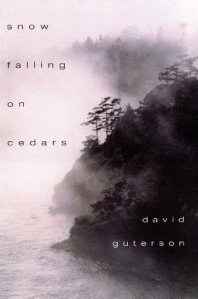
 Snow Falling on Cedars by David Guterson: The mystery element held me completely gripped – readers are just as in the dark as jurors until close to the end – but this is mostly a powerful picture of the lasting effects of racism. I was instantly immersed, whether in a warm courtroom with a snowstorm swirling outside or on a troop ship entering the Pacific Theater.
 Nothing but Blue Sky by Kathleen MacMahon: David is back on Spain’s Costa Brava, where he and his wife Mary Rose holidayed every summer for 20 years. This is a quiet novel about what goes unsaid in any marriage, and a deeply touching look at loss and what comes next. Grief, memory, fate: some of my favourite themes, elegantly treated.
 A Feather on the Breath of God by Sigrid Nunez: From the little I know of Nunez, this seems close to autofiction, especially in terms of her parents. Identifying the self by the key relationships and obsessions of a life makes sense, and this speaks to the universals of how we cope with a troublesome past. It cemented her as one of my favourite authors.
 Woman on the Edge of Time by Marge Piercy: An unusual and fascinating novel with hints of science fiction, but still grounded in the real world, this contrasts utopian and dystopian scenes experienced by a Latina woman who’s been confined to a mental hospital. It’s an intense cultural commentary from a writer ahead of her time on gender roles and the environment.
 My Dark Vanessa by Kate Elizabeth Russell: Obsessed with Lolita since she was a teenager, Russell decided to tell the teenage girl’s side of the story. She uses a dual timeline to great effect, creating an utterly immersive novel – as good a first-person narrative as anything Curtis Sittenfeld has ever written, and the ultimate #MeToo story.
 Saint Maybe by Anne Tyler: Ian Bedloe joins the puritanical Church of the Second Chance and drops out of college to help his parents raise his late brother’s three children. Anyone will be able to find themselves and their family in this story of the life chosen versus the life fallen into, and the difficult necessity of moving past regrets in the search for meaning.
 The Amateur Marriage by Anne Tyler: Unique in her oeuvre for how it bridges historical fiction and her more typical contemporary commentary. The Antons muddle their way through a volatile marriage for decades without figuring out how to change anything for the better. There is deep compassion for their foibles and how they affect the next generation.
 Lot by Bryan Washington: The musical equivalent might be a mixtape blasted from an open-top Corvette while touring the streets of Houston, Texas. Drug dealers, careworn immigrants, and prostitutes: Even the toughest guys have tender hearts in these 13 stories. Washington’s prose is earthy and slang-filled. The matter-of-fact phrasing made me laugh.
 Ethan Frome by Edith Wharton: I was so impressed by this condensed tragedy and the ambiance of a harsh New England winter. It struck me even more on a reread as a flawless parable of a man imprisoned by circumstance and punished for wanting more. A perfect example of how literature can encapsulate the human condition.
Poetry
 The Air Year by Caroline Bird: I read this with a big smile on my face, delighting in the clever and playful poems. The impermanence of relationships is a recurring theme. Dreams and miscommunication are also common elements, and lists grow increasingly absurd. I particularly liked where structure creates meaning, e.g. the mise en abyme of “Dive Bar.”
Nonfiction
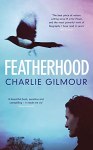 Featherhood by Charlie Gilmour: As an aimless twentysomething, Gilmour tried to rekindle a relationship with his unreliable poet father. Meanwhile, he was raising Benzene, a magpie that fell out of its nest. He makes elegant use of connections and metaphors; he’s so good at scenes, dialogue, and emotion – a truly natural writer.
 Spring in Washington by Louis J. Halle: From first migrant in February to last in June, the author traced the D.C. spring of 1945 mostly through the birds that he saw. More so than the specific observations of familiar places, though, I valued the philosophical outlook. For me this was an ideal combination of thoughtful prose and vicarious travel.
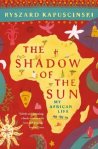 The Shadow of the Sun by Ryszard Kapuściński: This collection of essays spans decades and lots of African countries, yet feels like a cohesive narrative. Kapuściński saw many places right on the cusp of independence or in the midst of coup d’états. I appreciated how he never resorts to stereotypes or flattens differences. One of the few best travel books I’ve read.
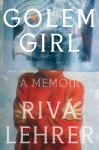 Golem Girl by Riva Lehrer: Lehrer has endured dozens of surgeries for spina bifida. Her touching family memoir is delivered in short, essay-like chapters, most named after books or films. It is also a primer in Disability theory and a miniature art gallery, filled with reproductions of her paintings. This inaugural Barbellion Prize winner is not to be missed.
 The Cost of Living by Deborah Levy: This sparse volume, the middle in an autobiographical trilogy, has Levy searching for the intellectual and physical freedom needed to reinvent her life after divorce. It is made up of conversations and memories; travels and quotations that have stuck with her. Each moment is perfectly chosen to reveal the self.
 Conundrum by Jan Morris: Morris was a trans pioneer; this transformed my understanding of gender when I first read it in 2006. Born James, Morris knew by age four that she was really a girl. A journalism career, marriage, five children, and two decades of hormone therapy preceded sex reassignment surgery. She paints hers as a spiritual quest toward her true identity.
 You’re Not Listening: What You’re Missing and Why It Matters by Kate Murphy: We all fail to listen properly sometimes, for various reasons. A New York Times journalist, Murphy does a lot of listening to her interview subjects. She also talks with representatives of so-called listening careers. This is a short, interesting, and genuinely helpful self-help book.
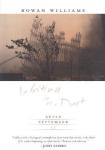 Writing in the Dust: After September 11 by Rowan Williams: Williams, then Archbishop of Wales, was in New York City on 9/11, just a few blocks from the World Trade Center. In the months that followed he pondered suffering, peacemaking, and the ways of God. He cautions against labelling the Other as Evil and responding with retribution. A superb book-length essay.
And if I really had to limit myself to just two favourites – my very best fiction and nonfiction reads of the year – they would be Snow Falling on Cedars and The Cost of Living.

What were your best backlist reads this year?
Merry Christmas!
(I’ll be back on the 27th with Love Your Library, then I have various year-end superlatives and statistics posts going through the 31st.)
 Bookish Beck = Rebecca Foster. American transplant to England. Freelance proofreader and book reviewer.
 Bookish Beck