#NovNov25 and #GermanLitMonth: Kästner, Kehlmann & Kracht
Our trip to Germany in September whetted my appetite to read more German-language fiction, and November also being German Literature Month (hosted this year by Caroline of Beauty Is a Sleeping Cat and Tony of Tony’s Reading List) was a perfect excuse. K names only this year, please. (Perhaps next year I’ll make it S and finally get to those Sebald and Seethaler novels I have on the shelf.) These three works – a children’s classic, a set of linked short stories about the writer’s craft, and a mother–son spending spree – have coy metafictional touches, plus there’s a connection I wasn’t expecting between the Kehlmann and Kracht. All: 
Emil and the Detectives by Erich Kästner (1929; 1931)
[Translated by Eileen Hall]
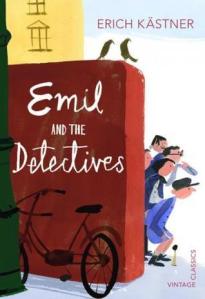 If only I’d realized this was set on a train to Berlin, I could have read it in the same situation! Instead, it was a random find while shelving in the children’s section of the library. Emil sets out on a slow train from Neustadt to stay with his aunt, grandmother and cousin in Berlin for a week’s holiday. His mother gives him £7 in an envelope he pins inside his coat for safekeeping. There are four adults in the carriage with him, but three get off early, leaving Emil alone with a man in a bowler hat. Much as he strives to stay awake, Emil drops off. No sooner has the train pulled into Berlin than he realizes the envelope is gone along with his fellow traveller. “There were four million people in Berlin at that moment, and not one of them cared what was happening to Emil Tischbein.” He’s sure he’ll have to chase the man in the bowler hat all by himself, but instead he enlists the help of a whole gang of boys, including Gustav who carries a motor-horn and poses as a bellhop, Professor with the glasses, and Little Tuesday who mans the phone lines. Together they get justice for Emil, deliver a wanted criminal to the police, and earn a hefty reward. This was a cute story and it was refreshing for children’s word to be taken seriously. There’s also the in-joke of the journalist who interviews Emil being Kästner. I’m sure as a kid I would have found this a thrilling adventure, but the cynical me of today deemed it unrealistic. (Public library) [153 pages]
Fame by Daniel Kehlmann (2009; 2010)
[Translated by Carol Brown Janeway]
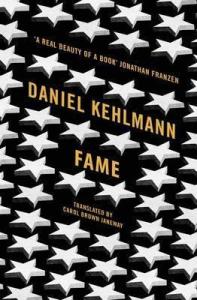 I’ve been equally enchanted by Kehlmann’s historical fiction (Measuring the World) and contemporary metafiction (F is one of my all-time favourites) in the past. These nine linked stories feature writers and their characters, actors and their look-alikes, and are about how life translates into – or is sometimes transformed by – art. Ralf Tanner starts to feel like he doesn’t exist when his calls gets diverted to someone else’s phone and an impersonator is more convincing at playing him than he is himself. Leo Richter’s new girlfriend is curiously similar to his most famous character, Lara Gaspard, a doctor working for a medical charity. Crime writer Maria Rubinstein takes Leo’s place on a cultural exchange to Central Asia and gets stuck in a Kafka-esque situation without a visa. Leo’s fan and Ralf’s call recipient are subjects of their own stories. References to Miguel Auristos Blanco’s spiritual self-help books recur and he, too, eventually becomes a character. I liked the pointed little jokes about what writers have to put up with (“Do you know how often I’ve been asked today where I get my ideas from? Fourteen. And nine times whether I work in the morning or the afternoon,” Leo complains). Mostly, these stories struck me as clever yet had me wondering what the point was. My favourite was “Rosalie Goes Off to Die,” in which Leo’s character travels to Zurich for an assisted death but he the writer decides to interfere before she can get her last wish. (Secondhand – Awesomebooks.com) [206 pages – but fairly large print]
Eurotrash by Christian Kracht (2021; 2024)
[Translated by Daniel Bowles]
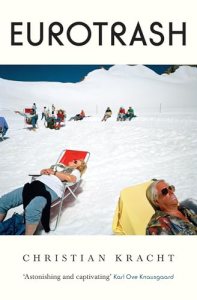 This was longlisted for the International Booker Prize and is the current Waterstones book of the month. The Swiss author’s seventh novel appears to be autofiction: the protagonist is named Christian Kracht and there are references to his previous works. Whether he actually went on a profligate road trip with his 80-year-old mother, who could say. I tend to think some details might be drawn from life – her physical and mental health struggles, her father’s Nazism, his father’s weird collections and sexual predilections – but brewed into a madcap maelstrom of a plot that sees the pair literally throwing away thousands of francs. Her fortune was gained through arms industry investment and she wants rid of it, so they hire private taxis and planes. If his mother has a whim to pick some edelweiss, off they go to find it. All the while she swigs vodka and swallows pills, and Christian changes her colostomy bags. I was wowed by individual lines (“This was the katabasis: the decline of the family expressed in the topography of her face”; “everything that does not rise into consciousness will return as fate”; “the glacial sun shone from above, unceasing and relentless, upon our little tableau vivant”) but was left chilly overall by the satire on the ultra-wealthy and those who seek to airbrush history. The fun connections: Like the Kehlmann, this involves arbitrary travel and happens to end in Africa. More than once, Kracht is confused for Kehlmann. (Little Free Library) [190 pages]
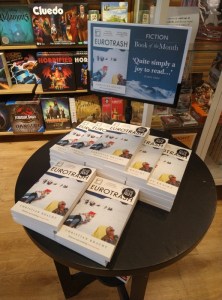
Spotted in my local Waterstones…

The Best Books from the First Half of 2024
Hard to believe, but it’s that time of year already! It’s the eighth year in a row that I’ve been making a first-half superlatives list. It remains to be seen how many of these will make it onto my overall best-of year rundown, but for now, these are my 18 favourite 2024 releases that I’ve read so far (representing the top 20% of my current-year reading). One is a bonus in that it won’t actually be published until August; six happen to be books I reviewed for Shelf Awareness. Pictured below are the ones I read in print; all the others were e-copies. Links are to my full reviews where available.


Fiction
 The Ministry of Time by Kaliane Bradley: This nuanced debut novel alternately goes along with and flouts the tropes of spy fiction and time travel sci-fi, making clever observations about how we frame stories of empire and progress. The narrator is a “bridge” helping to resettle a Victorian polar explorer in near-future London. You just have to suspend disbelief and go with it. Bradley’s descriptive prose is memorable but never quirky for the sake of it. I haven’t had so much fun with a book since Romantic Comedy. A witty, sexy, off-kilter gem.
 Behind You Is the Sea by Susan Muaddi Darraj: Darraj’s second novel-in-stories is a shimmering composite portrait of a Palestinian American community in Baltimore. Across nine stellar linked stories, she explores the complex relationships between characters divided by—or connected despite—class, language, and traditional values. Each of the stories (four in the first person, five in the third person) spotlights a particular character. The book depicts the variety of immigrant and second-generation experience, especially women’s.
 Piglet by Lottie Hazell: The protagonist works for a cookbook publisher, loves to cook, and has a history of overeating during psychological distress. When her fiancé blindsides her with a confession 13 days before their wedding, she returns to binge eating, dress fittings be damned. Food is also a sign of her education and class pretensions. Uncomfortable themes, but I kept reading in fascinated horror because Hazell writes absolutely incredible scenes. This is also about what women are allowed to want, and how they are expected to settle.
 Wellness by Nathan Hill: A state-of-the-nation novel filtered through one Chicago family experiencing midlife and marital crises: underperforming academic Jack; his wife Elizabeth, a placebo researcher at Wellness; and their YouTube-obsessed son Toby. They’ve recently invested their life savings in a new condo. The addictive and spot-on novel asks questions about authenticity, purpose, and nurture. Is love itself a placebo? Hill is clearly fascinated with psychological experimentation but also turns it to humorous effect.
 Happiness Falls by Angie Kim: Over 2.5 days in June 2020, a Korean American family (mother Hannah and 20-year-old twins Mia and John, home from college for the lockdown) investigates, on their own and with the help of police and tip-offs, what happened to the father, Adam, who’d been at River Falls Park with the severely disabled 14-year-old son, Eugene, who is autistic and has mosaic Angelman syndrome. Mia narrates, and it’s a pleasure spending time with her quick, systematic brain as she considers each theory and red herring.
 Company by Shannon Sanders: This energetic debut novel in 13 linked stories traces several generations of the Collins clan, whose experiences at once exemplify African American gentrification and evoke timeless patterns of parental legacy and sibling jealousy. Sisters Cassandra, Fay, Lee and Suzette grew up at their parents’ Atlantic City jazz club before going their separate ways. We revisit relatives at different points in their lives, mostly between the 1990s and the present day. Celebration scenes make for memorable moments.
 Lunar New Year Love Story by Gene Luen Yang (illus. LeUyen Pham): A super-cute teen story with gorgeous illustrations, including lots of pink and red to suit the theme. We follow Vietnamese-American Valentina through high school as she plays host to an internal debate between cynicism and romanticism. Ever since her mother left, she’s longed to believe in romance but feared that love is a doomed prospect for her family. The Asian community of Oakland, California and a new hobby of lion dancing provide engrossing cultural detail.
Nonfiction
 Intervals by Marianne Brooker: An extended essay about her mother’s protracted death with multiple sclerosis and the issues it brought up around disability, poverty, and inequality of access to medical care and services. Brooker decries the injustice of the wealthy having the option of travelling to Dignitas in Switzerland for an assisted death, whereas her single mother had so such relief in sight. Brooker’s description of the vigil of the last days, like her account of her vivacious mother’s life, is both tender and unflinching.
 Grief Is for People by Sloane Crosley: A bereavement memoir like no other. Heart-wrenching yet witty, it bears a unique structure and offers fascinating glimpses into the New York City publishing world. Crosley’s Manhattan apartment was burgled exactly a month before the suicide of her best friend and former boss, Russell. Throughout the book, the whereabouts of her family jewelry is as much of a mystery as the reason for Russell’s death, and investigating the stolen goods in parallel serves as a displacement activity for her.
 First Love: Essays on Friendship by Lilly Dancyger: Poignant interlocking essays about female friendship. Love and death coexist here. Dancyger’s first best friend was her cousin Sabina, who was raped and murdered at age 20. “Sad Girls” takes on Sylvia Plath fandom. Dancyger also maps her bisexuality and ponders whether to have a child. She is nostalgic for the freedom of being young and unsupervised in New York City and Europe. A sensitive interrogation of women’s relationships, perfect for fans of Melissa Febos and Emma Straub.
 Alphabetical Diaries by Sheila Heti: Heti put 10 years of diary contents into a spreadsheet, alphabetizing each sentence, and then ruthlessly culled the results. The recurring topics are familiar from the rest of her oeuvre: obsessive cogitating about relationships, art and identity, but also the practicalities of trying to make a living as a woman in a creative profession. Heti transcends the quotidian by exploding chronology. Remarkably, the collage approach produces a genuine, crystalline vision of the self. A sui generis work of life writing.

Others Like Me: The Lives of Women without Children by Nicole Louie: This impassioned auto/biographical collage combines the strengths of oral history, group biography and a fragmented memoir. “Motherhood as the epicentre of women’s lives was all I’d ever witnessed” via her mother and grandmother, Louie writes, so finding examples of women living differently was key. As readers, we watch her life, her thinking and the book all take shape. It’s intimate and empathetic, with layers of stories that reflect diversity of experience.
 The Age of Loneliness: Essays by Laura Marris: A perceptive, moving collection of nine braided essays linking personal experience of loss with the climate crisis. “Cancerine” is a strong example. Cancer, the sign of the crab, was her father’s cause of death; horseshoe crabs were ground into fertilizer in the 19th century, and their blood is still harvested for biomedical testing. Driven by curiosity and environmental conscience, these reflective pieces reminiscent of Helen Macdonald’s longform journalism ponder human responsibility and resilience. [Graywolf Press, 6 August]
 Knife: Meditations after an Attempted Murder by Salman Rushdie: I’ve not had much success with Rushdie’s fiction, but this is excellent, with intriguing side tendrils and lots of quotable lines. It traces lead-up and aftermath; unexpected echoes, symbolism and ironies. Although Rushdie goes into some medical detail about his recovery, you get the sense of him more as an unchanging mind and a resolute will. The most remarkable section imagines dialogues between him and his imprisoned assailant, probing his beliefs and motivations.
Poetry
 Theophanies by Sarah Ghazal Ali: In this poised debut collection by a Muslim poet, spiritual enlightenment is a female, embodied experience, mediated by the matriarchs of the Abrahamic faiths. Ali’s poems hymn women’s bodies, desire, and motherhood. She blurs the line between human and divine with her allusions to the Quran. Ambivalence towards faith is clear in the alliteration-laden verse that recalls Kaveh Akbar’s. Wordplay, floral metaphors, and multiple ghazals make for dazzling language.
 Baby Schema by Isabel Galleymore: A slant-wise look at environmental crisis and an impending decision about motherhood. The title comes from Konrad Lorenz’s identification of features that invite nurture. Galleymore edges towards the satirical fantasies of Caroline Bird or Patricia Lockwood as she imagines alternative scenarios of caregiving. What is worthy of maternal concern? Does cuteness merit survival? Extinction and eco-grief on the one hand, yes, but the implacability of biological cycles on the other. Sardonic yet humane.
 Inconsolable Objects by Nancy Miller Gomez: This debut collection recalls a Midwest girlhood of fairground rides and lake swimming, tornadoes and cicadas. But her Kansas isn’t all rose-tinted nostalgia; there’s an edge of sadness and danger. “Missing History” notes how women’s stories, such as her grandmother’s, are lost to time. In “Tilt-A-Whirl,” her older sister’s harmless flirtation with a ride operator turns sinister. She also takes inspiration from headlines. The alliteration and slant rhymes are to die for. (Full review to come.)
 Egg/Shell by Victoria Kennefick: Motherhood and the body are overarching themes. The speaker experiences multiple miscarriages and names her lost children after plants. Becoming a mother is a metamorphosis all its own, while the second long section is about her husband transitioning. Bird metaphors are inescapable. The structure varies throughout: columns, stanzas; a list, a recipe. Amid the sadness, there is dark humour and one-line rejoinders. If you’re wondering how life can be captured in achingly beautiful poetry, look no further.
Two of the novels above were among my Most Anticipated books of the year. I’ve now read 10 of the 12 on that list and DNFed another (the Sarah Perry), which just leaves Memory Piece by Lisa Ko to find – though others’ responses make me think it might not be worthwhile to do so. I sometimes wonder if designating a book as anticipated or a priority is a kiss of death, as I was at least somewhat disappointed with over half of my choices this time.
In the second part of the year, I’m looking forward to new releases from Rachel Clarke, Sarah Manguso, Charlotte Mendelson, Richard Powers, Sally Rooney, Elizabeth Strout and Evie Wyld.
What 2024 releases should I catch up on? What’s in your sights for the rest of the year?
20 Books of Summer, 3–4: Cheri & All Things Are Too Small
A cancer story that treads the line between biography and fiction, and a set of high-brow essays about popular culture and modern life.
Cheri by Jo Ann Beard (2023)
{SPOILERS IN THIS ONE}
Claire Keegan helped popularize the trend of publishing stand-alone stories as small hardback volumes. It was my first time reading Beard, and her style does in fact remind me of Keegan, along with Denis Johnson and Ann Patchett. This originally appeared in the literary magazine Tin House in 2002. It is the life story of Cheri Tremble, a real woman who was born in 1950 and died in 1997 via an illegal assisted suicide conducted by Dr. Jack Kevorkian. I’d heard a lot about Cheri, but his name was never mentioned – to avoid spoilers, of course, yet it’s key.
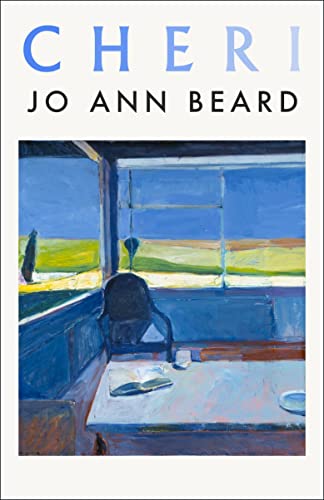 Cheri is an Amtrak ticket-taker who’s diagnosed with breast cancer in her mid-forties. After routine reconstructive surgery goes wrong and she’s left disabled, she returns to the Midwest and buys a home in Iowa. Here she’s supported by her best friends Linda and Wayne, and visited by her daughters Sarah and Katy. “Others have lived. She won’t be one of them. She feels it in her bones, quite literally.” When she hears the cancer has metastasized, she refuses treatment and starts making alternative plans. She’s philosophical about it; “Forty-six years is a long time if you look at it a certain way. Ursa is her seventh dog.”
Beard recounts all of this matter-of-factly (“the diminished lung capacity, the clangorous pain”), drawing on what is known of Cheri Tremble’s life and only adding her own stamp by making up memories that fuel flashbacks as Cheri drifts through pain-filled half-waking. One of these, of falling through the ice on a frozen pond as a child, appears early in the book and recurs at her moment of death. Beard also contrasts onlookers’ compassion or lack thereof.
It’s a potent portrait of everyday suffering and heroism and, in its way, an argument for assisted dying, which mustn’t be cloaked in secrecy as it was for Cheri – “They leave under cover of darkness, like duck hunters or criminals” to meet ‘Dr. Death’ in another state. I finished the story feeling underwhelmed; maybe I’ve simply read too much around the topic, but I couldn’t see how granting the subject interiority (which is what fiction is all about, yes, though the best biographies can do it, too) was enough to set it apart. (New purchase with birthday voucher, Hungerford Bookshop)
All Things Are Too Small: Essays in Praise of Excess by Becca Rothfeld (2024)
 Rothfeld, the Washington Post’s nonfiction book reviewer, is on hiatus from a philosophy PhD at Harvard. Her academic background is clear from her vocabulary. The more accessible essays tend to be ones that were previously published in periodicals. Although the topics range widely – decluttering, true crime, consent, binge eating, online stalking – she’s assembled them under a dichotomy of parsimony versus indulgence. And you know from the title that she errs on the side of the latter. Luxuriate in lust, wallow in words, stick two fingers up to minimalism and mindfulness and be your own messy self. You might boil the message down to: Love what you love, because that’s what makes you an individual. And happy individuals – well, ideally, in an equal society that gives everyone the same access to self-fulfillment and art – make for a thriving culture. That, with some Barthes and Kant quotes.
The writing has verve, from the alliterative word choice to the forcefulness of Rothfeld’s opinions. But in places her points of reference (from classic cinema, especially) are so obscure that I had no way in and the pieces felt like they would never end. My two favourites were “More Is More,” in which she’s as down on fragmentary autofiction (Jenny Offill et al.) as she is on Marie Kondo; and “Normal Novels,” about how she finds Sally Rooney’s self-deprecation and communism problematic. I knew the subject matter well enough to follow the arguments here, even if I ultimately disagreed with them.
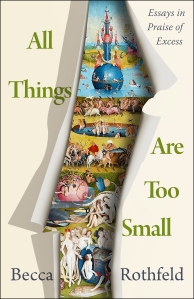
The U.S. cover featuring a Bosch painting is so much better!
Rothfeld is worth reading as a cultural critic, at least in small doses. She is clearly not interested in being a personal essayist, however, as the intimacy she keeps discussing in theory is almost completely absent. A piece on mental health, “Wherever You Go, You Could Leave,” opens with one tantalizing autobiographical line – “My first year of college, I attempted suicide and was promptly hastened home by an ominously smiling administrator” – then proceeds to poke fun at meditation for most of its 40 pages. It was interesting to see her fan-girl over her favourite novel, which I would even try if it wasn’t 480 pages: “I want to be reading Mating [by Norman Rush] constantly; I want to have been reading Mating forever, but always for the first time; I want everything in my life to be Mating and nothing but Mating”. Keep an eye out for the sequel: Actually, Moderation Is Cool: How I Learned to Temper My Expectations.
With thanks to Virago Press for the free copy for review.
Assisted Dying: Intervals by Marianne Brooker; Wendy Mitchell; and a Local Panel Discussion
Intervals by Marianne Brooker is on the longlist for the inaugural Women’s Prize for Non-Fiction, which my book club has applied to shadow. I’ve now read three of the nominees, the others being Matrescence and A Flat Place (review coming up tomorrow). Unsurprisingly, I’ve gravitated towards the ones based around a personal narrative – although all three are also political and incorporate research and cultural critique. Brooker’s is an extended essay about her mother’s protracted death with multiple sclerosis and the issues it brought up around disability, poverty, and inequality of access to medical care and services.

Specifically, Brooker decries the injustice of the wealthy having the option of travelling to Dignitas in Switzerland for an assisted death (current cost: £15,000), whereas her single mother, who lived in rented accommodation and had long been disabled and unable to work, apart from crafting and reading tarot, had so such relief in sight. Instead, she resorted to refusing life-sustaining nourishment. VSED, or voluntarily stopping eating and drinking, was a topic much on my mind anyway because of Wendy Mitchell’s death last month.
 Mitchell was diagnosed with early-onset Alzheimer’s in her fifties and was an energetic campaigner for dementia education and research for the last decade of her life. With a co-author, she wrote three books that give a valuable insider’s view of life with dementia: Somebody I Used to Know, What I Wish People Knew About Dementia, and One Last Thing, in which she specifically discusses VSED. She was determined to live independently. For her, a dignified life was being able to meet her own daily physical needs. She did not want to be in a care home, or to exist past the point where she could no longer recognise her daughters. So when, in January, she fell and broke both wrists, giving her a taste of dependency and derailing her plans to travel to Dignitas, she knew that the time had come. VSED was her way out. You can read her farewell message here.
Is wilful starvation a good death? I don’t really know. It’s peaceful, at least; a person simply gets weaker and weaker, spending more and more time asleep until they fade out, at home. But it can take two weeks to die in this way. Should loved ones have to watch this process?
Denied a liveable life and a legal right to die, my mum made a choice within and between the lines of the law. A decade after her diagnosis, when she was forty-nine and I was twenty-six, she decided to stop eating and drinking to end her suffering and her life. Her MS symptoms were barely treatable and certainly incurable: severe pain, incontinence, fatigue, the gradual but intensifying loss of mobility, vision and speech. But these medical symptoms were compounded by social conditions: isolation, stress, debt and fear of a future in which she would not be able to live or die in her chosen home. We were caught in a perfect storm.
Brooker’s description of the vigil of these last days, like her account of her vivacious mother’s life, is both tender and unflinching. It’s almost like a counterpoint to Simone de Beauvoir’s A Very Easy Death, but with the same incisive attention and emotional transfer between mother and daughter. The book also incorporates political commentary and quotations from psychologists and cultural critics. This somewhat distances the reader; it feels less like a bereavement memoir and more like an impassioned, personally inspired treatise. But that’s not to say there isn’t some levity. She remembers good times from their earlier life together, and reckons with her new role as her mother’s memorial and archivist in a way that really rang true for me. I wish the title was more evocative so as to draw the right readers to this book. 
With thanks to Fitzcarraldo Editions for the free copy for review.
Also on this topic, I have read In Love by Amy Bloom, That One Patient by Ellen de Visser, The Inevitable by Katie Engelhart, Darke Matter by Rick Gekoski, and Wild and Precious Life by Deborah Ziegler.
Last night I attended a local panel discussion put on by the Campaign for Dignity in Dying. It wasn’t a debate in that 3.5 of the 4 members on the panel were pro-assisted dying, and I would guess more than four-fifths of the audience as well. In fact, the only anti- voice of the evening was from a young Catholic man during question time. I knew about the event because one panelist attends my church: George Carey, a former archbishop of Canterbury.
The Anglican Church’s line – the religious response in general – is to uphold the sanctity of life and thus to oppose assisted suicide, so for Lord Carey to do otherwise is noteworthy. He changed his mind in 2014, he explained, after the high-profile case of Tony Nicklinson, who was paralysed after a stroke and lost his appeal over the right to die. “There is no theological contradiction between valuing life and wanting a good death,” Carey insisted. Jesus showed mercy to the ill and dying, and so should we. (He also, more facetiously, described King Saul’s mercy killing by an enemy soldier in 2 Samuel as an assisted death.)
The other panelists were a lawyer, a retired doctor, and a Member of Parliament. Lawyer Graham Wood noted that the 1961 Suicide Act, under which anyone who assists a suicide can be prosecuted, would have to be abolished, and that there would also need to be a negotiation regarding Article 2 of the European Convention on Human Rights, which protects the “right to life.” He was the most wary of the speakers, warning of the danger of undue influence being exerted by relatives when money and assets are involved – he said he sees the worst of humanity in his line of work.

Dr Barry Newman pinned his support for assisted dying to compassion and autonomy, two overriding values of a liberal society. He acknowledged the current professional risk for doctors, and noted that the UK’s main medical bodies remain neutral. However, he brought up a loophole, “double effect,” administering a medication that might end life but whose intent is to alleviate suffering, e.g., a high dose of morphine to an end-stage cancer patient.
Kit Malthouse, Conservative MP for northwest Hampshire, co-chairs a group on end-of-life and has campaigned for assisted dying. (American readers may be surprised by a conservative politician having liberal views on an ethical matter. In the UK, morality is not in lockstep with religions and/or political parties as it is in the USA. This was something it took me a while to get used to: I have Christian friends who vote for four different political parties.) He was disappointed that a members’ bill on assisted dying failed in 2015, but has hope that multiple recent cases (e.g., Esther Rantzen) will put it back on the agenda and believes support in the Commons is sufficient to push legislation through in six months.
“It’s coming,” he assured, not least because many of the UK’s European neighbours and other allies have introduced assisted dying. The UK bill does not go as far as the Dutch legislation, about which all the panelists expressed doubt, and can be tailored to this country’s health system. The status quo, Malthouse cautioned, is people suffering. We know from Oregon that the current proposal will work well, he said; there is vanishingly little abuse of the system in any of the places that have instituted assisted dying legislation.
It was all preaching to the choir as far as I was concerned. Indeed, the spontaneous applause and affirming subvocalizations reminded me of a Pentecostal church service. Clearly, many from the audience had witnessed loved ones dying in horrible ways (a few of these stories came out during question time, such as a woman whose husband went to Dignitas and another who had to fight for her terminally ill sister’s wishes when she was mistakenly resuscitated by paramedics after a suicide attempt). Malthouse observed that supporters of assisted dying have often been through horrific experiences with relatives or spouses.
I was already firmly in support so last night didn’t sway me in any way, but I was encouraged that so many people are thinking and talking about these issues. Maybe by the time I face such a crisis myself, or on someone else’s behalf, a compassionate law will be in place.
Books of Summer, 6–8: Elizabeth Berg, Patricia Lockwood & Wendy Mitchell
Although I have foodie lit as a background theme for the summer’s reading, my main goal is simply to read books that I own, especially recent acquisitions and long-time shelf-sitters (whereas last year, in slavish conformity to a theme, I substituted in a bunch of library books, review books and e-books). My latest batch includes a slightly twee novel, an outlandish poetry collection, and an uneven nonfiction swan song.
The Year of Pleasures by Elizabeth Berg (2005)
 From the cover, I was expecting this to be more foodie than it was. The protagonist does enjoy cooking for other people and reading cookbooks, though. Betta Nolan, 55 and recently widowed by cancer, drives from Boston to the Midwest and impulsively purchases a house in a Chicago suburb, something she and her late husband had fantasized about doing in retirement. It’s the kind of sweet little town where the only realtor is a one-woman operation and Betta as a newcomer automatically gets invited onto the local radio show. She also reconnects with her college roommates, tries dating, and mulls over her dream of opening a women’s boutique that sells silk scarves, handmade journals, essential oils and brownies.
While Berg is true to the shifting emotions that accompany grief, and gives Betta plenty of cute opportunities to make friends across the generations – with Lydia, the nonagenarian former owner of her house, now in a nursing home; Matthew, the fickle young man who does some odd jobs for her; and Benny, the next-door neighbor’s nine-year-old boy – I found the subplot about Matthew’s messy house and relationships silly, and Betta’s “What a Woman Wants” shop idea is so stereotyping I could feel myself rolling my eyes. Still, Berg’s novels, of which this was my fifth, are always reliably light and pleasant reads in an Anne Tyler vein. (Secondhand – 2nd & Charles) 
Motherland Fatherland Homelandsexuals by Patricia Lockwood (2014)
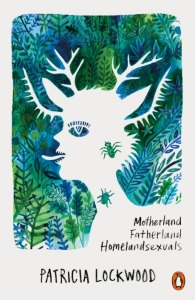 One of the more bizarre books I’ve ever read. I loved both Priestdaddy and No One Is Talking About This, but had no idea what to expect from Lockwood’s poems. They’re somewhere between absurdist monologues and thought experiments, often choosing an object or abstraction to animate (“A Recent Transformation Tries to Climb the Stairs”) and generally sexualized to the max (“Nessie Wants to Watch Herself Doing It”). Though they’re in stanzas, they aren’t heavy on poetic techniques. Some tangential topics are Bambi, Canada, basketball, waterfalls, King Kong adaptations, American poetry, Shirley Temple, and childhood hobbies like Animorphs, Egyptology and Magic Eye puzzles.
But really, her poetry is only “about” things in the loosest sense; the repetition, wordplay and snark are paramount. If you’ve heard of one, it’s likely to be the lengthy “Rape Joke,” which went as viral as it’s possible for a poem to and is, ironically, probably the sincerest entry here. Presumably based on her own bad experience with a teenage boyfriend, it is heartbreakingly banal: “The rape joke is that he was your father’s high school student … The rape joke is that come on, you should have seen it coming. … The rape joke is that you asked why he did it. The rape joke is he said he didn’t know, like what else would a rape joke say?”
A couple of my favourites were “List of Cross-Dressing Soldiers” and “He Marries the Stuffed-Owl Exhibit at the Indiana Welcome Center”; “The Father and Mother of American Tit-Pics,” in which a resurrected Emily Dickinson and Walt Whitman swap genders, had some of the more outrageous lines: “Walt Whitman is the Number Two Beach Body every year, because look at the way he snapped back into shape only months after giving birth to American Poetry.” Not really like any other poetry I’ve ever read. (New purchase with Christmas money) 
One Last Thing: Conversations on Life, Death and Assisted Dying by Wendy Mitchell with Anna Wharton (2023)
“We talk so often about prolonging life, but we are actually prolonging death by not discussing the suffering part of it.”
Wendy Mitchell’s first two books, Somebody I Used to Know and What I Wish People Knew About Dementia, are valuable peeks into daily life with young-onset Alzheimer’s. She has been a dedicated activist and educator in the nine years since her diagnosis, and I admire the work she’s done to get dementia services into the public eye.
 The problem with her final book is that I’ve read so much about preparations for dying and the question of assisted suicide and she doesn’t bring much new to the discussion – apart from the specific viewpoint of someone deciding when and how to end their life when they don’t know what the future course of their illness looks like. Mitchell believes people should have this choice, but current UK law does not allow for assisted dying. A loophole is voluntarily stopping eating and drinking (VSED), which she deems her best option. She stopped attending assessments in 2017 and has filed forms with her GP refusing treatment – her nightmare situation is being reliant on care in hospital and she doesn’t want to become that future, dependent Wendy.
Like Henry Marsh’s farewell book, And Finally, this gives the impression of having been written in a hurry and rushed into print, and so could have been edited more. As it is, it’s fairly scattered, repetitive and unpolished. The interviews could all be streamlined and tidied up, and the one with Kathryn Mannix is split up in a confusing way.
For readers new to the topic, however, this could be a useful introduction to the issues. It’s up-to-date in that Mitchell attends a Death Café, meets an end-of-life doula, and talks through the different forms (power of attorney, advance directive and so on) with experts. I also thought the epilogue was a lovely touch: after going for a ‘wing walking’ airplane adventure, she imagines that, having taken a bus into York, she sees her pre-diagnosis self and tells her everything she would want her to know, good and bad, about the challenges to come. (Proof copy from Hungerford Bookshop Summer Reading Celebration) [Different subtitle on finished edition?] 
Recommended March Releases by Jane Aldous, Danielle Evans, Katherine May & Genanne Walsh
Sonnets, short stories, nature-fuelled wonder, and an autobiographical essay about a father’s death … from postwar Edinburgh to modern-day San Francisco and from fiction about young African American women to pilgrimages along the English coast, I have a real variety to recommend this month. (And coming up in a separate post: Womb by Leah Hazard.)
More Patina than Gleam by Jane Aldous
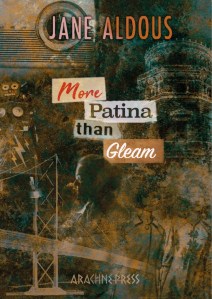 This was my second Arachne Press collection after Routes by Rhiya Pau. Intriguingly, it’s a story composed of 70 sonnets, untraditional in that they do not follow a particular rhyme scheme apart from the odd couplet. There is scant punctuation, with within-line spaces separating the phrases. Aldous, who has recently been featured in a Guardian article on debut authors over 60, imagines a sort of alternative future for her mother had she run away with her when she was a baby. Here, Linda escapes her abusive common-law husband, Vernon, and travels from England to Edinburgh with her 11-year-old daughter, Angie. They settle with an eccentric older woman named Elsie Datlow, who hires Linda as a lady’s companion and keeps her on as a housekeeper when financial struggles force her to accept paying guests. It’s impressive how much Aldous fits into comparatively little text, including Angie’s coming of age, the ups and downs of the Datlows’ picture restoring business, and transgressive romance as both Elsie and Linda fall in love across accepted gender or racial boundaries. This was a pleasant surprise that called to mind works by Muriel Spark and Sarah Waters.
With thanks to Arachne Press for the free copy for review.
Before You Suffocate Your Own Fool Self by Danielle Evans (2010)
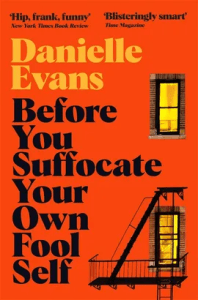 A couple of years ago I reviewed Evans’s second short story collection, The Office of Historical Corrections. This was her first book but has only just been published in the UK. Six of the eight stories are in the first person, the other two in third person. The protagonists tend to be young African American women in moments of transition or clinging to unhealthy relationships. In “Virgins,” 15-year-old Erica and Jasmine want to shed their innocence but can’t necessarily control how it happens. “Snakes” has Tara, a transracial adoptee, spending her ninth summer with her white cousin, Allison, down at their grandmother’s home in Florida. The response to a series of accidents makes it clear to her who is valued in this family. The college girls in “Harvest” consider a variety of reproductive experiences, from selling their eggs to abortion. In “The King of a Vast Empire,” a brother and sister decide to track down a survivor of a car accident their family had when they were children. “Jellyfish” sees a father and daughter meeting for lunch in Harlem and pondering their separate futures.
Many settings were familiar to me from the Delmarva area where I grew up. Here on the cusp of the South, Confederate sympathy still exists, as high schoolers Crystal and Geena discover in “Robert E. Lee Is Dead.” The best friends collaborate on pranks, but Crystal’s grades point to a promising future whereas everyone has given up on Geena, including herself. Along with that one, my two favourites were “Someone Ought to Tell Her There’s Nowhere to Go” and “Wherever You Go, There You Are.” In the former, military veteran Georgie tries to ingratiate himself with his ex-girlfriend by treating her daughter to a princess experience; in the latter, Carla takes her would-be-sexpot 14-year-old niece, Chrissie, on a road trip to North Carolina to meet her ex’s fiancée. Both are exemplary of the assets of the whole collection: strong characters, natural dialogue, and subtle treatment of themes of class and race. I’d proffer this for fans of Sidik Fofana, and as a better option than Dantiel Moniz’s stories.
With thanks to Picador for the proof copy for review.
Enchantment: Reawakening wonder in an exhausted age by Katherine May
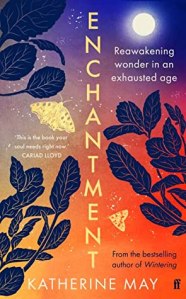 I was a big fan of Katherine May’s Wintering, which published just before the pandemic and, as if presciently, offers strategies for coping with seasons of depression. Coming after a few years of upheaval and disconnection, this follow-up voices May’s longing for rituals of the transcendent that will allow her to live in harmony and close attention to the world around her. Her usual way of communing with nature and other people was group swims in the sea, but that temporarily stopped with lockdown. She sought alternatives, such as visiting a sacred well with a friend, beekeeping, cultivating a wild garden, and chasing a meteor shower. The Earth – Water – Fire – Air structure is sometimes forced, and the content sparse; like Raynor Winn, May, I feel, was pressured to capitalize on the success of her previous work and quickly publish unfinished and rather nebulous material. It’s all surprisingly woo-woo from an English author. Yet May’s writing is unfailingly lovely and this went down easy a chapter at a time. It’s a comparable read to Wanderland by Jini Reddy.
With thanks to Faber for the proof copy for review.
Eggs in Purgatory by Genanne Walsh
I reviewed Genanne Walsh’s novel Twister as part of my summer reading in 2018. This autobiographical essay, recently published by WTAW Press and a finalist in their Alcove Chapbook Series Open, tells the story of the last few months of her father’s life. Aged 89, he lived downstairs from Walsh and her wife in San Francisco. He was quite the character: idealist, stubborn, outspoken; a former Catholic priest influenced by A Course in Miracles and convinced of the oneness of everything. Although he had no terminal conditions, he was sick of old age and its indignities and ready to exit. (“He wanted to be put on an ice floe and pushed offshore. The problem was, I lived above him on the iceberg and would be tasked with shoving him off.”) However, there was confusion about California state laws and whether doctors could help him with this, and at one point the police showed up at the door.
 The title refers to a Middle Eastern dish (see this Nigella Lawson recipe) I’ve known as shakshuka. It was the last proper meal her father ate, Christmas morning 2017 with her and her wife, before he went on his final hunger strike. Later Walsh writes, “Mourning is a kind of purgatory. You exist between worlds. For a long time I walked through, not fully feeling the world of the living or the world of the dead but aware of both.”
The task of a memoir is to fully mine the personal details of a situation but make of it something universal, and that’s just what she does here. Her father’s past with her mother (who died decades before, following a stroke) renders the family dynamic a backdrop to a final pyrrhic battle. Aware that she doesn’t come out of this a saint, Walsh admits to contradictory feelings, including “my life will be so much easier when he dies.” The prediction, no less than its reality, makes her feel guilty. Though she has no faith as such, she senses her father’s influence in her very desire to keep communing with him after his death.
This stunning little book met me at a deep place and I can highly recommend it, especially if you were a fan of In Love by Amy Bloom and All Things Consoled by Elizabeth Hay. (See also The Inevitable – one of its case studies reminded me of this.)
With thanks to the author for the free e-copy for review.
And one dud:
 Birnam Wood by Eleanor Catton – This year’s Klara and the Sun for me: I have trouble remembering why I was so excited about Catton’s third novel that I put it on my Most Anticipated list for 2023, especially given my decidedly mixed feelings about The Luminaries. I’d read a lot about Birnam Wood so its plot held no surprises for me. An American tech billionaire is up to no good on a New Zealand nature reserve; though the members of a guerrilla gardening group summon courage to fight back, his drones see all.
From early on I had little interest in the cast and their doings, especially the buzzword-filled dialogues, and skimmed the rest. Literary fiction usually distinguishes itself from commercial genre fiction by its focus on character depth (and prose quality), but in Catton’s case that was achieved through endless backstory. Her attempt at edginess entails adding at least one F-word to each spoken sentence. (The Bookshop Band, usually so mild-mannered, reflected this by dropping an F-bomb in their song based on the book – see the music video, which cleverly employs a derelict greenhouse and drones.) I’d heard that the ending was a knockout, so I skipped ahead and did find the last 40 pages gripping and the gruesome final tableau worthy of the Shakespearean allusions, but there’s a lot of blah to wade through before that.
With thanks to Granta for the free copy for review.
Would you be interested in reading one or more of these?
And Finally by Henry Marsh & Sinkhole by Juliet Patterson
As I mentioned about my first batch of September releases, the nonfiction was on two broad themes: books about books (two still to come), and books about death (with What Remains? by Rupert Callender still to come). Here’s two from the latter camp.
And Finally: Matters of Life and Death by Henry Marsh
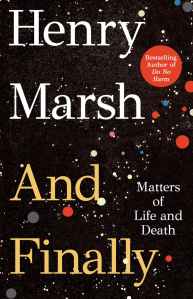 Marsh is a retired brain surgeon and the author of Do No Harm, one of the very best medical memoirs out there, as well as Admissions. As he was turning 70 a couple of years ago, two specific happenings prompted this third book. One: he volunteered for a brain scan as part of a medical study and, though he was part of a healthy cohort, was appalled at the degeneration his results showed. The other was that, after years of ignoring symptoms, he was diagnosed with advanced prostate cancer and a someday, far-off mortality started to seem a lot closer. The pandemic amplified his health worries and sense of isolation, so he threw himself into various domestic projects like clearing his loft, home renovations, and remodelling his daughter’s dollhouse to give to his beloved granddaughters.
As in Admissions, the book flits between topics: the hypoxia he experienced on a trip to Nepal, surgical mistakes made (he once operated on the wrong side of the neck), balcony gardens he created on his hospital’s neurosurgery wards, a potter friend who died of a brain tumour, and so on. Along with details of his cancer treatment, he discusses its typical course and waxes lyrical about the meaning of dreams, what we know about consciousness, and the fairy stories he made up to tell his granddaughters over Zoom during lockdown. He acknowledges his own limitations – he was conned not once but twice by cowboy builders, and declined to operate on a young Ukrainian doctor, leaving it to a colleague – and speaks out against technologies to extend the human lifespan and in favour of assisted dying.
In general, the book feels quite scattered and repetitious. However, I appreciated Marsh’s usual candour and could see how he would want to finish this quickly and get it out into the world, even if it would have benefited from further editing to make each chapter a more polished stand-alone essay. The good news is that his scan results were promising as of spring 2022 and I’ve seen on Twitter that he’s now in Ukraine with Rachel Clarke to speak at the Lviv BookForum. Is it selfish to hope we’ll get another book from him? 
With thanks to Jonathan Cape for the free copy for review.
Sinkhole: A Legacy of Suicide by Juliet Patterson
In December 2008, poet Juliet Patterson’s father died by suicide, hanging himself from a bridge near his Minnesota home in the middle of the night. When the news came, Patterson was recovering from a car accident the week before and in the middle of debates with her partner Rachel about whether they would have a child. Her father had been in his late seventies, in fine health and with full mental capacity; he left his affairs ship-shape, and his suicide note was mostly practicalities about insurance, bank accounts and car ownership.
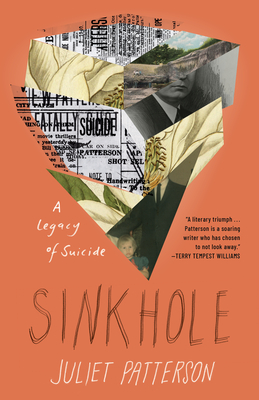 On the face of it, he wasn’t an obvious candidate, not someone you would worry about. Yet there was family history: both of Patterson’s parents lost their fathers to suicide. And there was a bizarre direct connection between their two Kansas-based families: her maternal grandmother’s best friend became her paternal grandfather’s secretary and mistress.
Patterson returns to Kansas on research trips to unearth her grandfathers’ lives: William a pottery manager who later struck it rich through Gulf Oil and Edward a New Deal Democratic congressman who lost his second bid for re-election. She pairs archival evidence – photographs and newspaper clippings – with skillfully imagined accounts of what each of her three ancestors did and felt on the day of his suicide. Her thinking is guided especially by the work of Edwin Shneidman, a psychologist who studied suicide notes.
Throughout, sinkholes, which are common in Kansas due to coal mining (one even opened up near her grandmother’s house), are both reality and metaphor for the chasm a suicide leaves. This gorgeously written family memoir approaches its difficult subject matter with brave tenderness and is one of my nonfiction favorites from the year so far.
Published by Milkweed Editions in the USA. With thanks to Nectar Literary for the advanced e-copy for review.
Review Catch-Up: The Swimmers, Black Butterflies, Bi, and On the Scent
I have a preposterous backlog of review copies to finish and write about (I’m going to go ahead and blame buying a house, moving and DIY for my lack of focus and diminished time, as I have done most of this year), but I’ve decided to get on top of it by pulling a quartet off of my set-aside shelf each week for short responses. I always like to feature a variety, so here I have two fiction and two nonfiction selections: novels about assisted dying and the Bosnian War that are a lot funnier and more life-affirming than you might expect, and books about bisexuality and the sense of smell – and the effect of its loss.
The Swimmers by Chloe Lane (2020; 2022)
 Erin Moore has returned to her family’s rural home for Queen’s Birthday (now a dated reference, alas!), a long weekend in New Zealand’s winter. Not a time for carefree bank holiday feasting, this; Erin’s mother has advanced motor neurone disease and announces that she intends to die on Tuesday. Aunty Wynn has a plan for obtaining the necessary suicide drug; it’s up to Erin to choreograph the rest. “I was the designated party planner for this morbid final frolic, and the promise of new failures loomed. … The whole thing was looking more and more like the plot of a French farce, except it wasn’t funny.”
Lane renders a potentially maudlin situation merely bittersweet through black comedy. Erin isn’t the most endearing narrator because, Disaster Woman-like, she keeps undertaking weird acts of self-sabotage – at 26, she’s blown her first gallery curation opportunity by sleeping with her boss. Still, the picture of a different sort of dysfunctional family and the contrast between an illustrious past (Erin comes from a line of semi-pro swimmers: Aunty Wynn qualified to compete in the Commonwealth Games) and an iffy future make this fairly memorable, if not so much so as the other 2022 The Swimmers – Julie Otsuka’s.
Readalikes: Sorrow and Bliss by Meg Mason, What Are You Going Through by Sigrid Nunez, The Inland Sea by Madeleine Watts, The Weekend by Charlotte Wood
With thanks to Gallic Books for the proof copy for review.
Black Butterflies by Priscilla Morris (2022)
 Drawing on her own family history, Morris has crafted an absorbing story set in Sarajevo in 1992, the first year of the Bosnian War. Zora, a middle-aged painter, has sent her husband, Franjo, and elderly mother off to England to stay with her daughter, Dubravka, confident that she’ll see out the fighting in the safety of their flat and welcome them home in no time. But things rapidly get much worse than she is prepared for. Phone lines are cut off, then the water, then the electricity. “We’re all refugees now, Zora writes to Franjo. We spend our days waiting for water, for bread, for humanitarian handouts: beggars in our own city.”
When even the haven of her studio is taken away from her, she’s reduced to the bare bones of existence, with just a few beloved neighbours to keep her spirits up. Her painting, more an obsession than a hobby, keeps her human as she awaits space on a Red Cross convoy. The title has heartrending significance: ‘black butterflies’ are fragments of paper carried on the breeze after the burning of the National Library of Sarajevo, 30 years ago last month. It was especially poignant to be reading this during the war in Ukraine and think about the sorts of daily dangers and deprivation that people face in conflict zones. The pages turned quickly and I was reminded of Girl at War, one of my absolute favourites, as well as The Pianist.
With thanks to Duckworth for the proof copy for review.
Bi: The hidden culture, history, and science of bisexuality by Julia Shaw (2022)
I’m tying this in with today’s celebration of Bi Visibility Day. Shaw is a criminal psychologist; her third book is a departure for her thematically, but means a lot to her personally. Bisexuality is the largest minority sexuality group, yet bisexuals are less likely to be out because of misconceptions and stereotypes – there are fewer outward signals and less group identification – which can sometimes result in poor mental health. Shaw realized how tricky bi identity was when a German TV show wanted to base a character on her but didn’t know how to make her sexuality obvious to viewers (lingering glances/flirtations involving both men and women? a backstory about a previous relationship with a woman?), and when trying to figure out what to wear to gay bars.
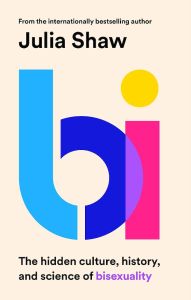 The book aims to situate bisexuality historically and scientifically. The term “bisexual” has been around since the 1890s, with the Kinsey Scale and the Klein Grid early attempts to add nuance to a binary view. Shaw delights in the fact that the mother of the Pride movement in the 1970s, Brenda Howard, was bisexual. She also learns that “being behaviourally bisexual is commonplace in the animal kingdom,” with many species engaging in “sociosexual” behaviour (i.e., for fun rather than out of reproductive instinct). It’s thought that 83% of bisexuals are closeted, mostly due to restrictive laws or norms in certain parts of the world – those seeking asylum may be forced to “prove” bisexuality, which, as we’ve already seen, is a tough ask. And bisexuals can face “double discrimination” from the queer community.
It felt odd to me that a final chapter on bisexual relationships ended up being mostly about threesomes, such that my main question (as she puts it: “what are the problems with the assumed link between bisexuality and non-monogamy?”) only merited four pages. A valuable book, certainly, but one to read for information rather than entertainment or thoughtful prose.
With thanks to Canongate for the free copy for review.
On the Scent: Unlocking the mysteries of smell – and how its loss can change your world by Paola Totaro and Robert Wainwright (2022)
Totaro (co-author Wainwright is her husband) contracted COVID-19 in March 2020 and temporarily lost the ability to smell, prompting her to embark on this investigation into a 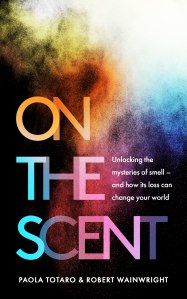 less-understood sense. One in 10,000 people have congenital anosmia, but many more than that experience it at some point in life (e.g., due to head trauma, or as an early sign of Parkinson’s disease), and awareness has shot up since it’s been acknowledged as a symptom of Covid. For some, it’s parosmia instead – smell distortions – which can almost be worse, with people reporting a constant odour of smoke or garbage, or that some of their favourite aromas, like coffee, were now smelling like faeces instead. Such was the case for Totaro.
She visits fascinating places like the Smell and Taste clinic in Dresden and the University of Reading Flavour Centre. “Sniffin’ sticks” are used to put people’s sense of smell to the test, but it’s notoriously difficult, even for those who haven’t had their senses compromised by illness, to name a smell out of context; people generally don’t score over 50%. That’s one of the major questions the book asks: why it is quite so difficult to identify smells, or describe them in words. Totaro also considers perfume-making, the associations of particular smells (bleach, pine or lemon, depending on your country) with cleanliness, and the potential for multisensory experiences, such as releasing odours during film showings. Lots of interesting topics and stories here, but not as compelling on the whole as The Smell of Fresh Rain.
With thanks to Elliott & Thompson for the proof copy for review.
Best of the 4: Black Butterflies
Would you be interested in reading one or more of these?
The Best Books from the First Half of 2022
Yes, it’s that time of year already! At first I thought I wouldn’t have enough 2022-released standouts to fill a post, but the more I looked through my list the more I realized that, actually, it has been a pretty good reading year. It remains to be seen, of course, how many of these will make it onto my overall best-of year list, but for now, these are my highlights. I made it up to an even 20 by including one that doesn’t release until July. Fiction is winning thus far! I give review excerpts below and link to the full text here or elsewhere.
Fiction
 Our Wives under the Sea by Julia Armfield: Miri is relieved to have her wife back when Leah returns from an extended deep-sea expedition. Something went wrong with the craft when it was too late to evacuate, though. Chapters alternate between Miri describing their new abnormal and Leah recalling the voyage. As Miri tries to tackle life admin for both of them, she feels increasingly alone. This is a sensitive study of love, grief and dependency. Armfield gives an increasingly eerie story line a solid emotional foundation.
 These Days by Lucy Caldwell: A beautiful novel set in Belfast in April 1941. We see the Second World War mostly through the eyes of the Bell family – especially daughters Audrey, engaged to be married to a young doctor, and Emma, in love with a fellow female first aider. The evocation of a time of crisis is excellent. The lack of speech marks, fluid shifting between perspectives, and alternation between past and present tense keep the story from seeming too familiar or generic. All of the female characters have hidden depths.
 Groundskeeping by Lee Cole: In Cole’s debut novel, two aspiring writers meet on a Kentucky college campus and form a romantic connection despite very different backgrounds. There are stereotypes to be overcome as Owen introduces Alma to Kentucky culture and slang. Trump’s election divides families and colleagues. The gentle satire on the pretensions of writing programs is another enjoyable element. Three-dimensional characters, vivid scenes ripe for the Netflix treatment, timely themes and touching relationships: alright!
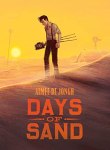 Days of Sand by Aimée de Jongh: This Great Depression-era story was inspired by the work of photographers such as Dorothea Lange. John Clark is following in his father’s footsteps as a photographer, leaving NYC for the Oklahoma panhandle. Locals are suspicious of John as an outsider, especially when they learn he is working to a checklist. Whether a cityscape or the midst of a dust storm, de Jongh’s scenes are stark and evocative. It’s rare for me to find the story and images equally powerful in a graphic novel, but that’s definitely the case here.
 Dance Move by Wendy Erskine: The 11 stories in Erskine’s second collection do just what short fiction needs to: dramatize an encounter, or a moment, that changes life forever. Her characters are ordinary, moving through the dead-end work and family friction that constitute daily existence, until something happens, or rises up in the memory, that disrupts the tedium. Erskine being from Belfast, evidence of the Troubles is never far away. Her writing is blunt and edgy, with no speech marks plus flat dialogue and slang.
 Antipodes by Holly Goddard Jones: Riveting stories of contemporary life in the American South and Midwest. Some have pandemic settings; others are gently magical. All are true to the anxieties of modern careers, marriage and parenthood. Endings elicit a gasp, particularly the audacious inconclusiveness of “Exhaust,” a tense tale of a quarreling couple driving through a blizzard. Worry over environmental crises fuels “Ark,” about a pyramid scheme for doomsday preppers. Nickolas Butler and Lorrie Moore fans will find much to admire.
 Sea of Tranquility by Emily St. John Mandel: This dazzlingly intricate novel blends historical fiction, up-to-the-minute commentary and science-fiction predictions. In 2401, the Time Institute hires Gaspery-Jacques Roberts to investigate a recurring blip in time. Fans of The Glass Hotel will recognize some characters, and those familiar with Station Eleven will find similarities in a pandemic plot that resonates with the Covid-19 experience. How does Mandel do it? One compulsively readable hit after another.
 Very Cold People by Sarah Manguso: The aphoristic style of some of Manguso’s previous books continues here as discrete paragraphs and brief vignettes build to a gloomy portrait of Ruthie’s archetypical affection-starved childhood in the fictional Massachusetts town of Waitsfield in the 1980s and 90s. The depiction of Ruthie’s narcissistic mother is especially acute. So much resonated with me. This is the stuff of girlhood – if not universally, then certainly for the (largely pre-tech) American 1990s as I experienced them.
 How High We Go in the Dark by Sequoia Nagamatsu: Just the right blend of literary fiction and science fiction. Opening in 2031 and stretching another 70 years into the future, this linked short story collection imagines how a pandemic reshapes the world and how communication and connection might continue after death. All but one story are in the first person, so they feel like personal testimonies. The whole is greater than the sum of the parts. The focus on illness and bereavement, but also on the love that survives, made this a winner.
 The Swimmers by Julie Otsuka: Otsuka’s third novel of the Japanese American experience again employs the first-person plural, as well as the second person – rarer perspectives that provide stylistic novelty. The first two chapters are set at a pool that, for the title swimmers, serves as a locus of escape and safety. On the first page we’re introduced to Alice, whose struggle with dementia becomes central. I admired Otsuka’s techniques for moving readers through the minds of the characters, alternating range with profundity and irony with sadness.
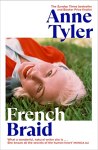 French Braid by Anne Tyler: My 17th from Tyler, and easily her best new work in 18 years. It joins my other favourites such as Dinner at the Homesick Restaurant which reveal a dysfunctional family’s quirks through a close look, in turn, at the various members. Mercy is a painter and essentially moves into her studio, but without announcing it, and her husband Robin spends the next 25+ years pretending they still share a home. Other surprises from Tyler this time: a mild sex scene and a gay character. A return to form. Brava!
Nonfiction
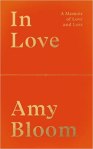 In Love by Amy Bloom: Bloom’s husband, Brian Ameche, was diagnosed with early-onset Alzheimer’s in his mid-60s, having exhibited mild cognitive impairment for several years. Brian quickly resolved to make a dignified exit while he still, mostly, had his faculties. This achieves the perfect tone, mixing black humour with teeth-gritted practicality as Bloom chronicles their relationship, the final preparations, his assisted suicide at Dignitas in Switzerland, and the aftermath. An essential, compelling read.
 Everything Is True by Roopa Farooki: Second-person, present-tense narration drops readers right into the life of a junior doctor. In February 2020, Farooki’s sister Kiron died of breast cancer. During the first 40 days of the initial UK lockdown, she continues to talk to Kiron. Grief opens the door for magic realism. There is also wry humour, wordplay, slang and cursing. A hybrid work that reads as fluidly as a novel while dramatizing real events, this is sure to appeal to people who wouldn’t normally pick up a bereavement or medical memoir.
 Body Work by Melissa Febos: A boldly feminist essay collection that explores how autobiographical writing can help one face regrets and trauma and extract meaning from the “pliable material” of memory. “In Praise of Navel Gazing” affirms the importance of women airing their stories of abuse and thereby challenging the power structures that aim to keep victims silent. “A Big Shitty Party” warns of the dangers of writing about real people. “The Return” employs religious language for the transformation writing can achieve.
 All Down Darkness Wide by Seán Hewitt: This poetic memoir about love and loss in the shadow of mental illness blends biography, queer history and raw personal experience. The book opens, unforgettably, in a Liverpool graveyard where Hewitt has assignations with anonymous men. His secret self, suppressed during teenage years in the closet, flies out to meet other ghosts: of his college boyfriend; of men lost to AIDS during his 1990s childhood; of English poet George Manley Hopkins; and of a former partner who was suicidal. (Coming out on July 12th from Penguin/Vintage (USA) and July 14th from Jonathan Cape (UK). My full review is forthcoming for Shelf Awareness.)
Poetry
 Thorpeness by Alison Brackenbury: This tenth collection features abundant imagery of animals and the seasons. Alliteration is prominent, but there is also a handful of rhymes. Family history and the perhaps-idyllic rural underpin the verse set in Lincolnshire and Gloucestershire as Brackenbury searches for ancestral graves and delivers elegies. I especially loved “Aunt Margaret’s Pudding,” a multipart poem about her grandmother’s life. There are also playful meetings between historical figures.
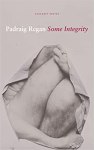 Some Integrity by Padraig Regan: The sensual poems in this debut collection are driven by curiosity, hunger and queer desire. Flora and foods are described as teasing mystery, with cheeky detail. An unusual devotion to ampersands; an erotic response to statuary; alternating between bold sexuality and masochism to the point of not even wanting to exist; a central essay on the Orlando nightclub shooting and videogames – the book kept surprising me. I loved the fertile imagery, and appreciated Regan’s exploration of a nonbinary identity.
 Love Poems in Quarantine by Sarah Ruhl: Having read Ruhl’s memoir Smile, I recognized the contours of her life and the members of her family. Cooking and laundry recur: everyday duties mark time as she tries to write and supervises virtual learning for three children. “Let this all be poetry,” she incants. Part 2 contains poems written after George Floyd’s murder, the structure mimicking the abrupt change in focus for a nation. Part 3’s haiku and tanka culminate in a series on the seasons. A welcome addition to the body of Covid-19 literature.
 Rise and Float by Brian Tierney: Although it tackles heavy subjects like grief and mental health, the collection’s candor and stunning images transform the melancholy into the sublime. Much of the verse is in the first person, building an intimate portrait of the poet and his relationships. A family history of mental illness and electroshock treatment occasions a visit to a derelict psychiatric hospital. Recurring metaphors of holes dramatize a struggle against the void. Tierney’s close attention lends beauty to bleak scenes.
 Vinegar Hill by Colm Tóibín: I didn’t realize when I started that this was Tóibín’s debut collection; so confident is his verse, I assumed he’d been publishing poetry for decades. There’s a wide range of tone, structures and topics. Bereavements and chemotherapy are part of a relatable current events background. Irish-Catholic nostalgia animates a witty sequence from “The Nun” to “Vatican II.” Come along on armchair travels. Poems are based around anecdotes or painterly observations. The line breaks are unfailingly fascinating.
What are some of the best books you’ve read so far this year?
What 2022 releases do I need to catch up on right away?
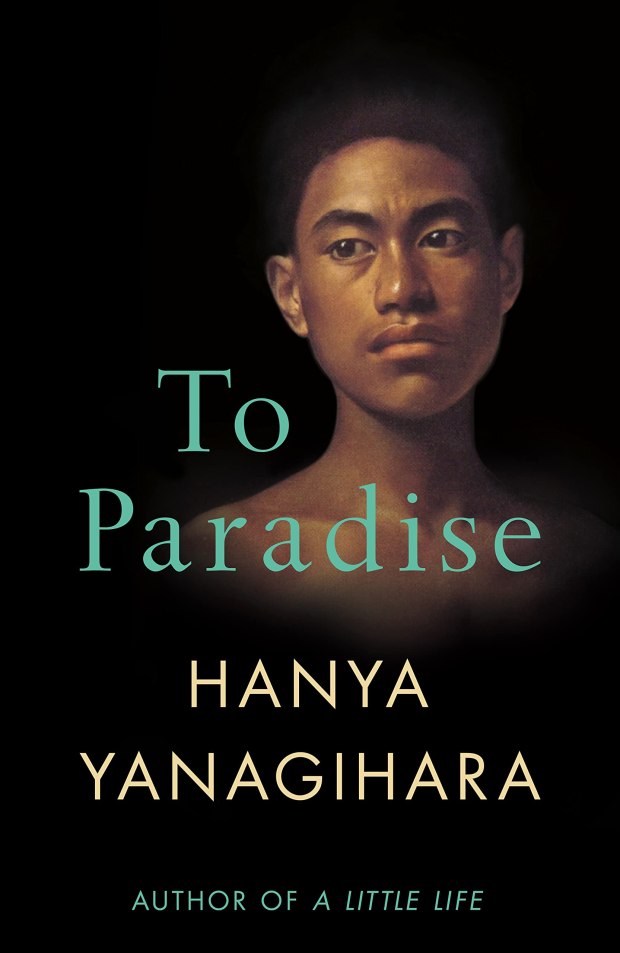
To Paradise by Hanya Yanagihara (Doorstopper of the Quarter)
When I expressed interest in Hanya Yanagihara’s To Paradise on Twitter, having loved A Little Life and tepidly admired The People in the Trees, I didn’t expect to be chosen to receive one of my most anticipated releases of the year. A proof arrived while I was in the States for Christmas. As soon as I got back, I started it – with a vision of doing little else but reading it for a few days and reviewing it early in January. Instead, I read about 30 pages and set it aside, the 700-page heft mocking me from my coffee table stack for the better part of two months. Finally, I forced myself to set a daily reading goal: first 30 pages, then 40, then 60; and on Friday I read the last 100 pages over a couple sessions in the summerhouse. That regimented approach was what it took for me to get through my first doorstopper of the year.
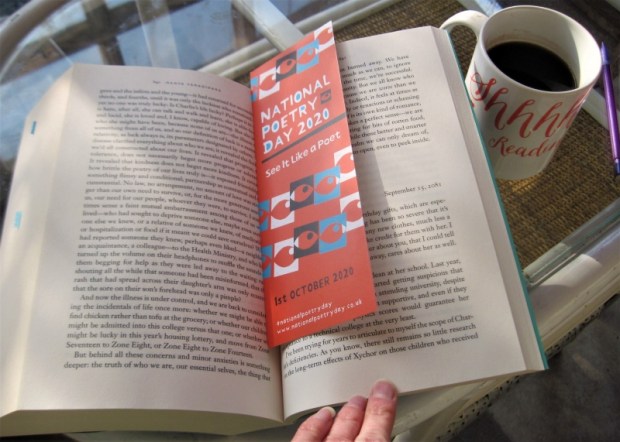
The novel is in three parts – discrete enough to feel like separate books – set largely in 1893, 1993, and 2093. New York City’s Washington Square, even one particular house, recurs as a setting in all three, with some references to the American West and South and with flashbacks to time in Hawaii linking Books II and III.
The overarching theme is the American project: is freedom, both individual and collective, a worthy and attainable goal? Or are the country’s schisms too deep to be overcome? Class, race, sexuality, and physical and mental illness are some of the differences that Yanagihara explores. Even when equality of treatment has been won in one time and scenario – same-sex marriage is de rigueur in her alternative version of the 1890s, where the USA is divided into several nations – there is always the threat of a taken-for-granted right being retracted.
In Book I, David Bingham, who is to inherit his grandfather’s Washington Square property, considers a family-approved arranged marriage with an older man, Charles, versus eloping with a lower-class male teacher, Edward, with whom he has fallen in love. Edward wants them to light out for California, where new opportunities await but homosexuality is outlawed. Can they live in freedom if they’re repressing an essential part of their identity? The austere, elegant tone is a pitch-perfect pastiche of Henry James or Edith Wharton. Although this section took me the longest to read, it was the one I most appreciated for its flawless evocation of the time period and a rigid class structure. As in The Underground Railroad, though, the alt-history angle wasn’t really the most memorable aspect.
In Book II, David Bingham, also known as Kawika, is a paralegal having a secret affair with Charles, a partner in his law firm. Various friends and former lovers in their circle have AIDS, but Charles’s best friend Peter is dying of cancer. Before Peter flies to Switzerland for an assisted death, Charles throws him one last dinner party. Meanwhile, David receives a long letter from his ill father recounting their descent from Indigenous nobility and his failed attempt to set up a self-sufficient farm on their inherited land in Hawaii. This strand is closest to Yanagihara’s previous novels, the gay friendship circle reminiscent of A Little Life and the primitive back-to-the-land story recalling The People in the Trees. I also thought of Mrs Dalloway – David wanted to get the flowers for the party himself – and of Three Junes.
 Book III is set in a dystopian future of extreme heat, rationing and near-constant pandemics. The totalitarian state institutes ever more draconian policies, with censorship, quarantine camps and public execution of insurgents. The narrator, intellectually disabled after a childhood illness, describes the restrictions with the flat affect of the title robot from Kazuo Ishiguro’s Klara and the Sun. When a stranger offers her the chance to escape, she is forced to weigh up freedom against safety. An alternating strand, based around letters sent by a Chinese Hawaiian character, traces how things got this bad, from the 2040s onwards.
While the closing speculative vision is all too plausible, two other literary/science fiction releases I’ve read this year, Sea of Tranquillity by Emily St. John Mandel and How High We Go in the Dark by Sequoia Nagamatsu, are more powerful and direct. Book III takes up half of the text and could stand alone, but the fact that it appears as a culmination of two other narratives creates false expectations that it can’t meet. The connections between the three are incidental – abandonment by a mother, a child raised by a grandparent, an arranged marriage, isolating illness – with recurring tactics like stories within stories and epistolary sections. The most overt cohesive strategy, the repeating of names across time periods, feels gimmicky and, again, sets readers up for a letdown by promising meaning that isn’t there.
Ultimately, the message seems to be: America’s problems are inherent, and so persist despite apparent progress. It takes a lot of words to build to that somewhat obvious point. I couldn’t suppress my disappointment that none of the storylines are resolved – this does, however, mean that one can choose to believe things will turn out happily for the characters. Their yearning for a more authentic life, even in a rotten state, makes it easy to empathize with their situations. I had high regard for the self-assured cross-genre prose (my interest waning only during the elder Kawika’s improbably long letter), but felt the ambition perhaps outshone the achievement.
As I learned when reviewing a recent book about American utopian projects, Heaven Is a Place on Earth, and interviewing its author, Adrian Shirk, an imagined utopia and a projected dystopia aren’t actually so different. Here was her response to one of my questions:
At one point you say, “utopia is never far from its opposite.” Dystopian novels are as popular as ever. To what extent do you think real-life utopias and fictional dystopias have the same aims?
I think real-life utopian experiments and fictional dystopias both offer warnings about the dangers of relying too much on ideology, and not enough on living, or choosing the person over the belief. So, in that way, real utopian experiments and fictional dystopian narratives are two sides of the same coin: a dystopia is a utopia that lost sight of—or never included—understanding itself as resistance to a violent empire, and thus starts to look like a violent empire itself.
Both start by diagnosing a societal sickness. The question is how we then get to paradise.
Page count: 701
Book I: 
Book II:
Book III: 
My overall rating:
With thanks to Picador for the proof copy for review.
 Bookish Beck = Rebecca Foster. American transplant to England. Freelance proofreader and book reviewer.
 Bookish Beck