#NovNov25 Catch-Up: Dodge, Garner, O’Collins, Sagan and A. White
As promised, I’m catching up on five novella-length works I finished in November. In fiction, I have an odd duck of a family story, a piece of autofiction about caring for a friend with cancer, a record of an affair, and a tale of settling two new cats into home life in the 1950s. And in nonfiction, a short book about the religious approach to midlife crisis.
Fup by Jim Dodge (1983)
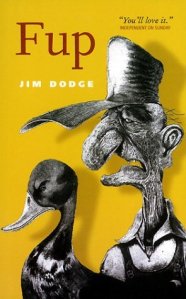 I’d never heard of this but picked it up because of my low-key project of reading books from my birth year. After his daughter died in a freak accident, Grandaddy Jake Santee adopted his grandson “Tiny.” With that touch of backstory dabbed in, we’re in the northern California hills in 1978 with grandfather and grandson – now 99 and 22, respectively. Tiny builds fences, while Grandaddy is famous for his incredibly strong, home-distilled whiskey, “Ol’ Death Whisper.” One day, Tiny rescues a filthy creature from a posthole where it’s been chased by their nemesis, Lockjaw the wild boar. It turns out to be a duckling that grows into a hen mallard named Fup Duck (it’s a spoonerism…) who eats so much she’s too heavy to fly. Grandaddy plans to continue drinking and gambling indefinitely, but the hunt for Lockjaw – who he thinks may be a reincarnation of his Native American friend, Seven Moons – breaks the household apart. This was very weird: it starts out a mixture of grit (those grotesque Harry Horse drawings!) and Homer Hickam schmaltz and then goes full Jonathan Livingston Seagull. (Secondhand – Community Furniture Project, Newbury) [89 pages]
The Spare Room by Helen Garner (2008)
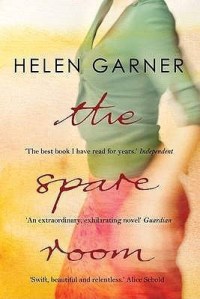 Who knew there was such a market for novels about helping a friend through cancer treatment? Or maybe it’s just that I love them so much I home right in on them. As a work of autofiction – the no-nonsense narrator, Helen, gives her old friend Nicola a place to stay in Melbourne for several weeks while she undergoes experimental procedures – this is most like What Are You Going Through by Sigrid Nunez (but I also had in mind Talk Before Sleep by Elizabeth Berg, We All Want Impossible Things by Catherine Newman, and Some Bright Nowhere by Ann Packer). Helen thinks The Theodore Institute peddles quack medicine, whereas Nicola is willing to shell out thousands of dollars for its coffee enemas and vitamin C infusions, even though they leave her terrifyingly fragile. Nicola is the only character who doesn’t acknowledge that her case is terminal. The pages turn effortlessly as Helen covers her frustration with Nicola, Nicola’s essential optimism, and the realities of living while dying. “Oh, I loved her for the way she made me laugh. She was the least self-important person I knew, the kindest, the least bitchy. I couldn’t imagine the world without her.” I’ll read more by Garner for sure. (Secondhand – Awesomebooks.com) [195 pages]
Second Journey: Spiritual Awareness and the Mid-Life Crisis by Gerald O’Collins SJ (1978; 1995)
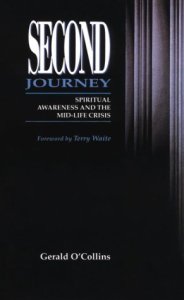 O’Collins, a Jesuit priest, sought a more constructive term than “midlife crisis” for the unease and difficult decisions that many face in their forties. He chooses instead the language of journeys, specifically one embarked upon because a previous way of life was no longer working. There are several types of triggers that O’Collins illustrates through brief case studies of famous individuals or anonymous acquaintances. The shift might be prompted by a sense of failure (John Wesley, Jimmy Carter), by literal exile (Dante), by falling in love (someone who left the priesthood to marry), by experiencing severe illness (John Henry Newman) or fighting in a war (Ignatius of Loyola), or simply by a longing for “something more” (Mother Teresa). But there are only two end points, O’Collins offers: a new place or situation; or a fresh appreciation of the old one – he quotes Eliot’s “to arrive where we started / And know the place for the first time.” This is practical and relatable, but light on actual advice. It also pales by comparison to Richard Rohr’s more recent work on spirituality in the different stages of life (especially in Falling Upward). (Free from a church member’s donations) [100 pages]
A Certain Smile by Françoise Sagan (1956)
[Translated from French by Irene Ash]
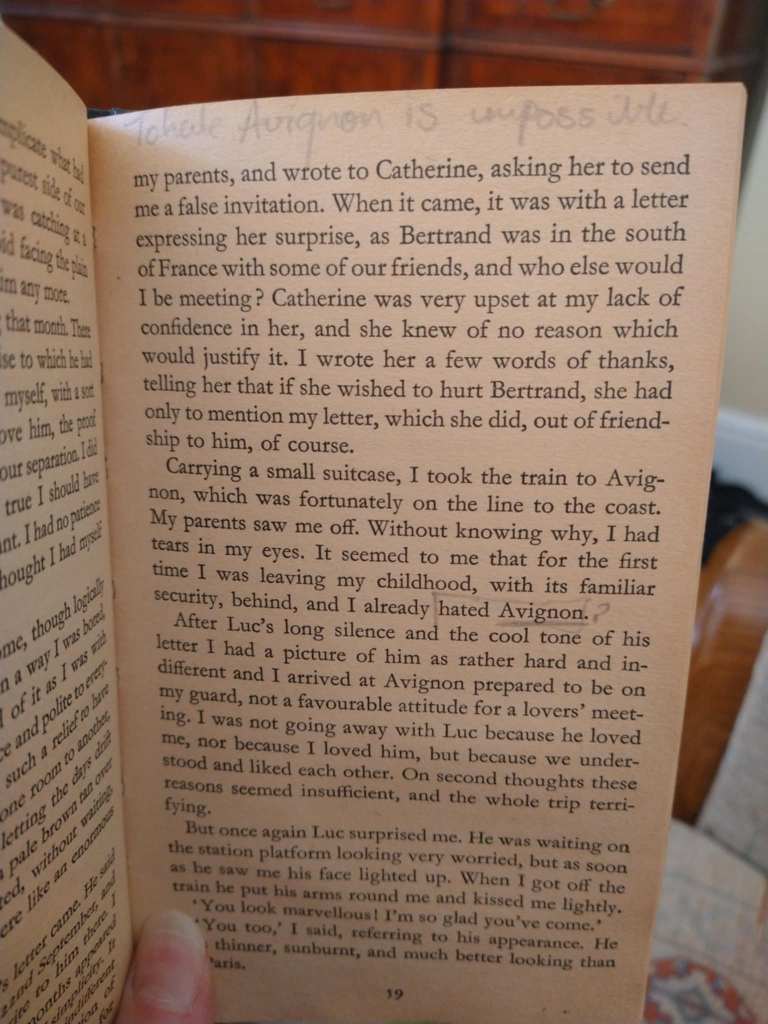
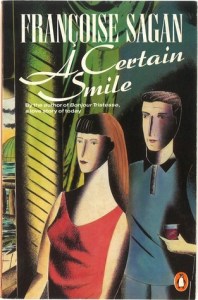 Law student Dominique is lukewarm on her boyfriend Bertrand and starts seeing his married uncle, Luc, instead. The high point is when they manage to go on a ‘honeymoon’ trip of several weeks to Avignon. Both Bertrand and Luc’s wife, Françoise, eventually find out, but everyone is very grown-up about it. The struggle is never external so much as within Dominique to accept that she doesn’t mean as much to Luc as he does to her, and that the relationship will only be a little blip in her early adulthood. I found this a disappointment compared to Bonjour Tristesse and Aimez-Vous Brahms – it really is just the story of an affair; nothing more – but Sagan is always highly readable. I read this in two days, a big section of it on a chilly beach in Devon. In its frank, cool assessment of relationship dynamics, this felt like a model for Sally Rooney. I had to laugh at the righteously angry and rather ungrammatical marginalia below (“To hate Avignon is unpossible”). (University library) [112 pages]
Minka and Curdy by Antonia White; illus. Janet and Anne Johnstone (1957)
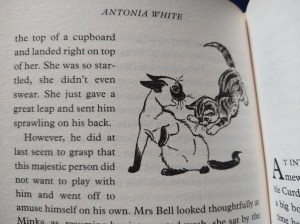
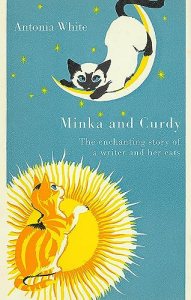 After Mrs Bell’s formidable cat Victoria dies, she hankers to get a new kitten to keep her company – she works at home as a writer. She finds herself greeting all the neighbourhood cats and, in her enthusiasm to help a ‘stray’, accidentally overfeeds someone else’s pet with fresh fish. Her heart is set on a marmalade kitten, so she reserves one from an impending litter in Kent. But then the opportunity to take on a beautiful young female Siamese cat, for free, comes her way, and though she feels guilty about the ginger tom she’s been promised, she adopts Minka anyway. When Coeur de Lion (“Curdy”) arrives a few weeks later, her challenge is to get the kitties to coexist peacefully in her London flat. This reminded me so much of myself back in February and March, when I was so glum over losing Alfie that we rushed into adopting a giant kitten who has been a bit much for us. But we’re already contemplating getting Benny a little sister or two, so I read with interest to see how she made it happen. Well, this is fiction, so it starts out fraught but then is somewhat magically fine. No matter – White writes about cats’ antics and personalities with all the warmth and delight of Derek Tangye, Doreen Tovey and the like, and this 2023 Virago reprint is adorable. (Secondhand – Awesomebooks.com) [113 pages]
I also had a few DNFs last month:
- The Book of Colour by Julia Blackburn (1995) seemed a good bet because I’ve enjoyed some of Blackburn’s nonfiction and it was on the Orange Prize shortlist. But after 60 pages I still had no idea what was going on amid the Mauritius-set welter of family history and magic realism. (Secondhand – Bas Books charity shop, 2022)
- A Single Man by Christopher Isherwood (1964) lured me because I’d so loved Goodbye to Berlin and I remember liking the Colin Firth film. But this story of an Englishman secretly mourning his dead partner while trying to carry on as normal as a professor in Los Angeles was so dreary I couldn’t persist. (Public library)
- Night Life: Walking Britain’s Wild Landscapes after Dark by John Lewis-Stempel (2025) – JLS could write one of these mini nature volumes in his sleep. (Maybe he did with this one, actually?) I’d rather one full-length book from him every few years than bitty, redundant ones annually. (Public library)
- Aunts Aren’t Gentlemen by P.G. Wodehouse (1974) – I’ve read one Jeeves & Wooster book before and enjoyed it well enough. This felt inconsequential, so as I already had way too many novellas on the go I sent it back whence it came. (Little Free Library)
Final statistics for #NovNov25 coming up tomorrow!
A Return to the Outer Hebrides & What I Read (Including 20 Books of Summer, 4–5)
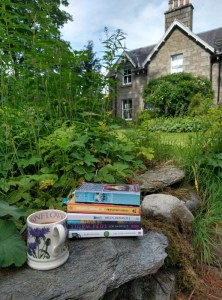
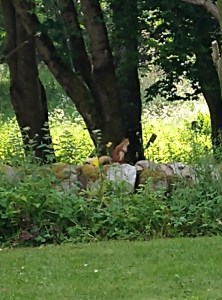
Three summers ago, we first explored the Outer Hebrides, moving south from Lewis through Harris to North Uist and Benbecula. It took longer than expected to make it back to the Western Isles. (It’s also taken longer than expected to write up a trip we took in late June. My excuse is we’ve been having work done in the house for a couple of weeks and it’s thrown off routines, plus we’re now away again on a short break.) We kept our word and completed the southern half of the chain this year, staying on South Uist and journeying via Eriskay to Barra and Vatersay. As last time, we combined public transport and car rental. Unlike last time, we had no major transport disasters. We took the train up to Edinburgh, where we rented a car and headed first of all to the edge of the Cairngorms. The village had little to offer apart from riverside scenery, so while my husband did beetle-collecting fieldwork nearby, I spent my time reading in the idyllic B&B grounds. Here the wildlife came to me: seven stags and a red squirrel! I’ve substituted in two of my relevant trip reads to my 20 Books of Summer roster.

20 Books of Summer, #4
The Cone-Gatherers by Robin Jenkins (1955)
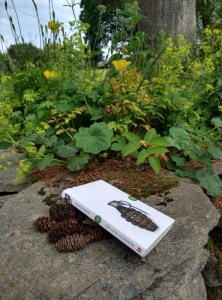
 Rightly likened to Of Mice and Men, this is an engrossing short novel about two brothers, Neil and Calum, tasked with climbing trees and gathering the pinecones of a wealthy Scottish estate. They will be used to replant the many woodlands being cut down to fuel the war effort. Calum, the younger brother, is physically and intellectually disabled but has a deep well of compassion for living creatures. He has unwittingly made an enemy of the estate’s gamekeeper, Duror, by releasing wounded rabbits from his traps. Much of the story is taken up with Duror’s seemingly baseless feud against the brothers – though we’re meant to understand that his bedbound wife’s obesity and his subsequent sexual frustration may have something to do with it – as well as with Lady Runcie-Campbell’s class prejudice. Her son, Roderick, is an unexpected would-be hero and voice of pure empathy. I read this quickly, with grim fascination, knowing tragedy was coming but not quite how things would play out. The introduction to Canongate’s Canons Collection edition is by actor Paul Giamatti, of all people. (Secondhand – Community Furniture Project, Newbury)
Then it was a several-hour drive to Oban to take our rescheduled ferry over to Lochboisdale in South Uist for the holiday proper to begin. With a six-night Airbnb stay booked in the home of a local woman, we relaxed into an unhurried pace of life. It’s more about the landscape than any particular indoor attractions here; during rainy spells we toured the excellent museum, tasted gin and rum at the North Uist (Downpour) and Benbecula (MacMillan Spirits) distilleries, took advantage of 5 for £1 books and CDs at the Benbecula thrift shop, and tried a couple of cafes, but for the most part we just made a few short excursions per day.


-
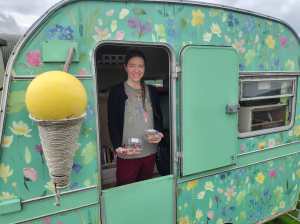
- Honesty box with cakes
-

- Photos by Chris Foster
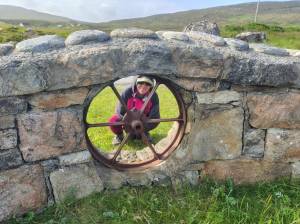
We saw acres of machair (wildflower-rich fields), sand dunes undermined by an empire of rabbits, deserted beaches, and rare patches of woodland. We successfully staked out white-tailed sea eagles, red-throated divers, and a red-necked phalarope; watched cuckoos and short-eared owls (who are active in the daytime) as much as possible; and stared at every likely sea loch but failed to find an otter. Each evening we’d heat up a simple supper – pouches of curry and rice; ravioli with tomato sauce – using the microwave and hob. In quite a contrast to the heatwave-mired south of England, we had 12–16 degrees C (54–61 degrees F) most days, with light rain and high winds. The radiators and Rayburn (a big stove like an Aga) were on most of the time.


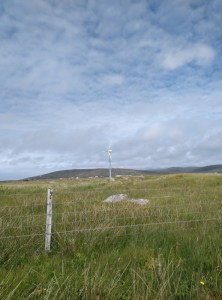

20 Books of Summer, #5
The Inn at the Edge of the World by Alice Thomas Ellis (1990)
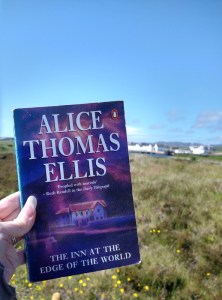 Eric and Mabel moved from the Midlands to run a hotel on a remote Scottish island. He places an advertisement in select London periodicals to lure in some Christmas-haters for the holidays and attracts a motley group: a bereaved former soldier writing a biography of General Gordon, a pair of actors known only for commercials, a psychoanalyst, and a department store buyer looking for a novel sweater pattern. Mabel decides she’s had enough and flees the island just as the guests start arriving. One guest is stalking another; one has history on the island. And all along, there are hints that this is a site of major selkie activity. I found it jarring how the novella moved from Shena Mackay-like social comedy into magic realism and doubt I’ll read more by Ellis (I’d already read one volume of Home Life), though this was light and enjoyable enough. (Secondhand – Awesomebooks.com)
I was pleased that I managed to find two relevant hyperlocal reads. It was so neat to encounter the same place names out the car window and in my books:
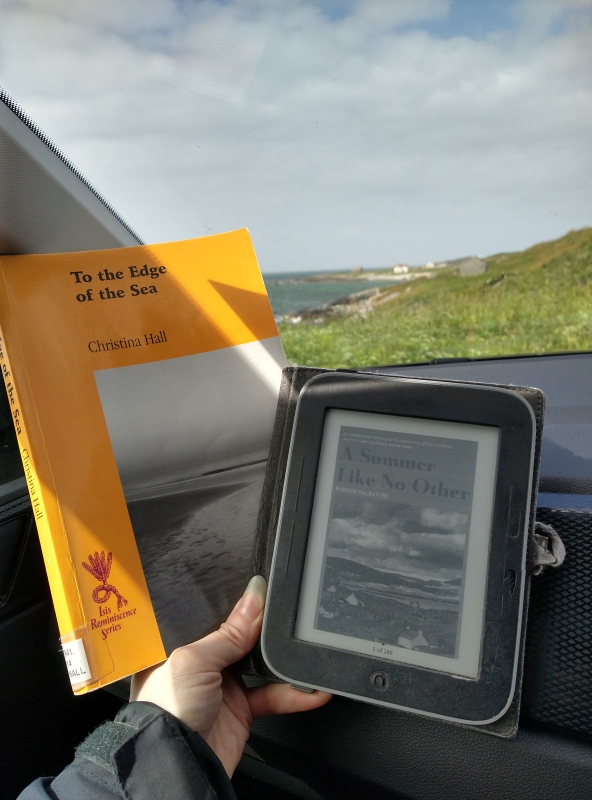
To the Edge of the Sea: Schooldays of a Crofter’s Child by Christina Hall (1995)
Hall’s father inherited a South Uist croft and the family struggled so much financially that she was sent to live with her schoolteacher aunts on Benbecula and then Barra. Some things haven’t changed on the islands, such as the rabbits on the machair and the notoriously choppy ferry rides back to the mainland, where she attended a convent school at Fort William. There are some enjoyable pen portraits, such as of an Irish peddler. The most memorable incident was when she ran away from the aunts’ to attend a family wedding on Benbecula. The tone is pleasant, reminiscent of early Diana Athill and Doreen Tovey, but this isn’t one to pick up unless you have a particular interest in the places described. (Public library)
A Summer Like No Other by Martin MacIntyre (2018; 2025)
As World Cup fever ramps up in the summer of 1978, aimless 20-year-old Colin Quinn breaks from his university studies to shadow his uncle, Dr. Ruairidh Gillies, during his locum on South Uist. Between the home medical visits and recording folktales and songs by an eighty-something bard and several other members of the community, Colin gets to know almost everyone – but the person he knows the least well is himself. His involvement with the bard’s great-niece and her abusive husband will change the tenor of the summer for him, and have lasting consequences that only become clear decades later.
 The many Gaelic phrases, defined in footnotes, help to create the atmosphere. The chapter epigraphs from the legend of Oisín (son of Fionn Mac Cumhaill) and Tír Na nÓg, the land of eternal youth, heighten the contrast between Colin’s idealism and the reality of this life-changing season. I think this is the first book I’ve read that was originally published in Gaelic and I hope it will find readers far beyond its island niche. (BookSirens)
There’s Something about Mary
My husband would like it known that he was the clever clogs who spotted a theme to our trip: Mary.
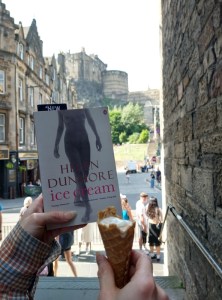 1) Our transit through Edinburgh was brief and muggy, but we made sure to leave just enough time to queue for cones at Mary’s Milk Bar, which has the most interesting flavours you’ll find anywhere. Pictured, though half eaten, are my one scoop of Earl Grey and peach sorbet and one scoop of fig and cardamom ice cream. When we returned to Edinburgh to return the car at the end of our trip, I took the train home by myself but C stayed on for a conference, during which he treated himself to another round at Mary’s.
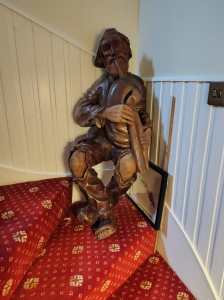
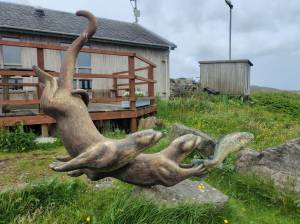
A piper statue at the Airbnb that continually frightened us on the stairs.
2) Our South Uist host was Mary MacInnes, a major mover and shaker in the local Gaelic-speaking community. (Her Alexa even obeyed Gaelic commands.) She is a retired head teacher of one of the schools and had various grandchildren popping in and out. Thanks to her heads-up, we had a unique cultural experience: a local arts venue’s lunchtime ceilidh of live music that was being filmed for BBC Scotland. Between her and others, we heard a lot of spoken Gaelic and got further into the mood by finding Julie Fowlis’s Gaelic-language albums online and playing them in our rental car. Each morning, Mary served us breakfast. We made the mistake of answering “Yes” to the question “D’ye take porridge?” on the first morning and had to slog through a stodgy bowl for five of the next six days. However, she also produced fresh-baked scones on two days and that made up for it. Triangular and baked in a cast-iron skillet, they tasted more like soda bread and were a perfect snack with jam.
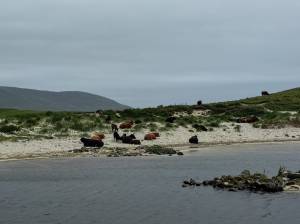
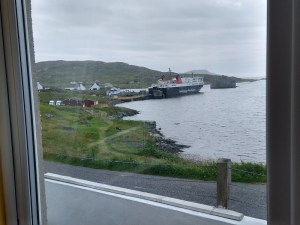
3) The final full day of our trip was spent on Barra, a quick hop from South Uist. Whereas Lewis and Harris are staunchly Protestant, the southern islands are Catholic. We’d found a roadside shrine on South Uist, and on this late June day we devoted a couple of hours to climbing up Heaval, Barra’s highest hill as far as the statue of Mary, Star of the Sea. We were taken with this round, rugged island of secluded coves and beach-lounging cows; I can imagine going back to spend more time there. (I’d also like to see a bit more of Eriskay, from which our ferry departed and where the shipwreck that inspired Whisky Galore – one to read next time – took place.) Our hostel room overlooked the harbour where our ferry for the mainland was docked, which was handy as we had to be in the queue by 6:10 the next morning.

My additional reasonably local or otherwise relevant reading:
Four Ducks on a Pond: A Highland Memory by Nicholas the Cat with Annabel Carothers (2010)
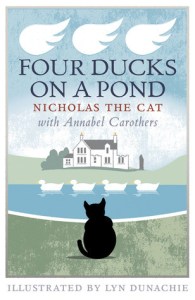 A quaint short memoir set in the 1950s on the island of Mull (which we sailed past on our way to and from the Outer Hebrides). It’s narrated in tongue-in-cheek fashion by Nicholas the Cat, who pals around with the farm’s dogs, horse and goats and comments on the doings of its human inhabitants, such as “Puddy” (Carothers), a war widow, and her daughter Fionna, who goes away to school. “We understand so much about them, yet they understand so little about us,” he opines. Indeed, the animals are all observant and can communicate with each other. Corrieshellach is a fine horse taken to compete in shows. The goats are lucky to escape with their lives after a local outbreak of foot-and-mouth disease among livestock. Nicholas grows fat on rabbits and fathers several litters. He voices some traditional views (the Clearances: bad but the Empire: good; crows: bad); then again, cats would certainly be C/conservatives. A sweet Blyton-esque read for precocious children or sentimental adults, this passed the time nicely on a long drive. It could do with a better title, though; the ducks only play a tiny role. (Favourite aside: “that beverage which humans find so comforting when things aren’t right. Tea.”) (Secondhand – Benbecula thrift shop)
Katie Morag’s Island Stories by Mairi Hedderwick (1995)
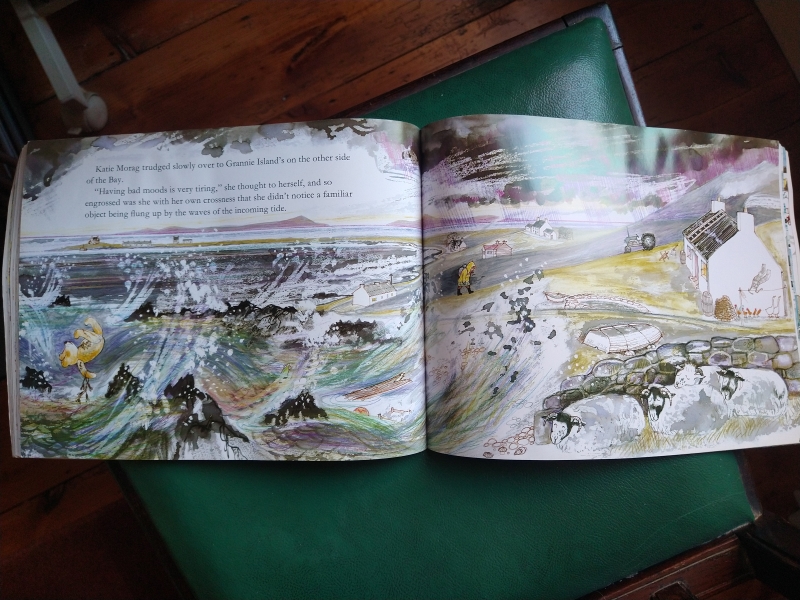
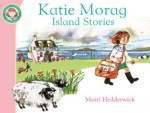 I read half of this large-format paperback before our trip and the rest afterward. It collects four of Hedderwick’s picture books, which are all set on the Isle of Struay, a kind of Hebridean composite that reproduces the islands’ wildlife and scenery beautifully. Katie Morag’s parents run the shop and post office and her mother always seems to be producing another little brother. In Katie Morag Delivers the Mail, the little red-haired girl causes chaos by delivering parcels at random. Sophisticated Granma Mainland and practical Grannie Island are the stars of Katie Morag and the Two Grandmothers. Katie Morag learns to deal with her anger and with being punished, respectively, in …and the Tiresome Ted and …and the Big Boy Cousins. Cute stories with useful lessons, but the illustrations are the main attraction. I’ll get the rest of the books out from the library. (Little Free Library)
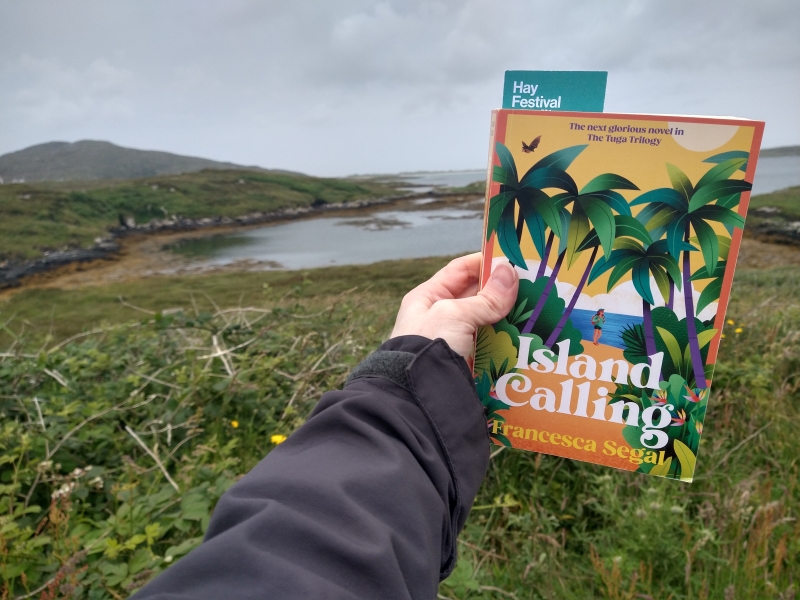
Island Calling by Francesca Segal (2025)
The sequel to Welcome to Glorious Tuga, which I reviewed for Shelf Awareness last year. Charlotte Walker is a tortoise researcher who becomes the default veterinarian on this remote South Atlantic island that combines a 1950s English ethos with a cosmopolitan heritage from sailors and settlers. In this volume, Charlotte resolves her troubled love triangle and cements her understanding of her father’s identity. But the main thing that happens is that her posh and entitled mother, Lucinda Compton-Neville, takes a break from her busy job as a QC to travel to the island and demand that Charlotte return to London with her. Motherhood is a strong theme throughout: Natalie Lindo, already a mother of four, has to decide what to do about a high-risk pregnancy; half-feral Annie Goss rejects her mother’s affection, and so on. Some of the characters are lovably quirky, but overall I find the cliché-laden series lackluster, a pointless and indulgent side-track and thus a real waste of talent by Segal (after The Innocents and Mother Ship, especially). If you enjoy romance novels or escapist beach reads, you might feel differently. But I won’t bother reading the third volume.
With thanks to Chatto & Windus (Penguin) for the proof copy for review.
I also made good progress on Storm Pegs by Jen Hadfield, a memoir of life in Shetland – different islands with their own character, but still fitting the hardy Scottish spirit.
I’d finished my first 7 Books of Summer by the end of June, so I was on track as of then. (Reviews of two more coming up on Friday.) I’m in the middle of some designated reads, but it’ll be ages before I finish any. I’ll hope to review another batch by the end of July.
#ReadingtheMeow2025, Part II: Books by Mayo, Reinhold, Taylor and More
This year’s Reading the Meow challenge is drawing to a close. I’m adding to my first set of reviews with these selections: a novelty book about women and cats, an autobiographical sequel about an animal-lover’s menagerie in Provence, and a travel book about Scottish wildcats – plus a one-off essay that drew me in for its title and one more children’s book.
Behind Every Great Woman Is a Great Cat (2019)
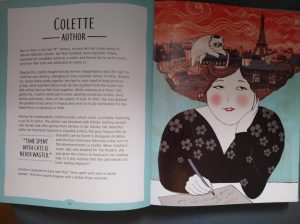
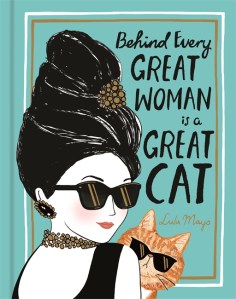 The only name on the cover is Lulu Mayo, who does the illustrations. That’s your clue that the text (by Justine Solomons-Moat) is pretty much incidental; this is basically a YA mini coffee table book. I found it pleasant enough to read bits of at bedtime but it’s not about to win any prizes. (I mean, it prints “prolificate” twice; that ain’t a word. Proliferate is.) Among the famous cat ladies given one-page profiles are Georgia O’Keeffe, Jacinda Ardern, Vivien Leigh, and Anne Frank. I hadn’t heard of the Scottish Fold cat breed, but now I know that they’ve become popular thanks Taylor Swift. The few informational interludes are pretty silly, though I did actually learn that a cat heads straight for the non-cat person in the room (like our friend Steve) because they find eye contact with strangers challenging so find the person who’s ignoring them the least threatening. I liked the end of the piece on Judith Kerr: “To her, cats were symbols of home, sources of inspiration and constant companions. It’s no wonder that she once observed, ‘they’re very interesting people, cats.’” (Christmas gift, secondhand)
Watchers in the Sun: Life at Mas des Chats by Margaret Reinhold (1994)
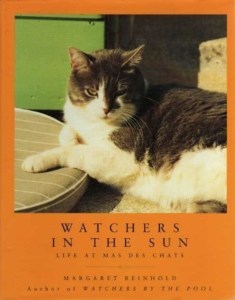 Last year I read the previous book, Sanctuary in the South (also titled Watchers by the Pool) on holiday. This is more of the same: pleasant stories about the personalities and interactions of a rotating cast of cats, some of whom she’d brought with her from England to Provence, others who transformed from strays she fed outdoors to part of the indoor hierarchy. Lily is the grande dame with private quarters upstairs; Monsieur le Gris is the top cat, bullying several younger cats but forming strong bonds with others. Most of the time Reinhold seems to hit a natural limit of nine, but that’s with several dying and being replaced by cats who wandered in or kittens people brought her. She also has two dogs and at one point rescues an old, deaf spaniel from drowning. Her French neighbours seem (to her, and probably us readers) strangely unsentimental about their pets by comparison. I enjoyed this a bit less than the first book because it was so similar – again with the Doreen Tovey-like anecdotes about the local humans – and because with the former I had the benefit of reading it on location in the South of France. The photographs by William Gooddy are a quaint reminder of the days when you shot a roll of film and had no idea how your photos had turned out until you got it developed. Even if some were blurry or underexposed, you used them because that was the best you had! (Secondhand purchase – Awesomebooks.com)
Tracking the Highland Tiger: In Search of Scottish Wildcats by Marianne Taylor (2019)
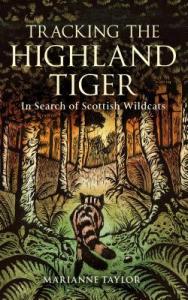 A perfect segue from Reading the Meow to our Scotland holiday coming up on Friday. I’d not heard of Taylor although she’s a prolific natural history writer. Such species quest narratives have become very common. The contextual information about the world’s cat species and the difference between Scottish wildcats and domestic cats, including the example of a half-feral cat she adopted, is fairly interesting, but the way she separates it from her trips to Speyside and Ardnamurchan to look for wildcats in 2013–18, which are each given their own chapter, feels odd. A similar book being published today would have blended the travel, research, and autobiographical information better. There’s plenty of habitat in the Scottish mountains for wildcats; the problem they face is hybridization with domestic cats. There’s no such thing as a purebred anymore. Captive breeding and reintroductions are the only way the species is likely to survive. “Timing a trip to look for Scottish wildcats is difficult in a way, but in another way it’s not: no matter what time you go, you’re almost guaranteed not to see one.” (At least she’s self-deprecating about it.) For most of the way through, you’re convinced the author will never find one. But you’ve got to keep hoping…
[I got this from a Little Free Library on Lewis, probably the most remote one I’ve ever frequented. Alas, it’s the only one in the Outer Hebrides and there aren’t any others that we’ll pass by on our travels in the Highlands.]
And a couple of bonus books:
 The Mousehole Cat by Antonia Barber; illus. Nicola Bayley (1990) – The town of Mousehole in Cornwall (the far southwest of England) relies on fishing. Old Tom brings some of his catch home every day for his cat Mowzer; they have a household menu with a different fishy dish for each day of the week. One winter a storm prevents the fishing boats from leaving the cove and the people – and kitties – start to starve. Tom decides he’ll go out in his boat anyway, and Mowzer goes along to sing and tame the Great Storm-Cat. This story of bravery was ever so cute, words and pictures both, and I especially liked how Mowzer considers Tom her pet. (Free from a neighbour)
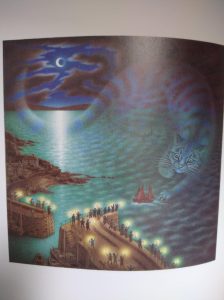
“A Conversation with a Cat” from A Conversation with a Cat and Others by Hilaire Belloc (1931) – I have no idea how I came across this but I had to borrow it for the title. Alas, only the six-page opening story is actually about a cat; the rest is, I suspect, light essays in the vein of Jerome K. Jerome. In the title piece, a man stops for a beer at a railway station bar and a beautiful long-haired cat jumps up onto his lap. “If it be true that nations have the cats they deserve, then the English people deserve well in cats, for there are none so prosperous or friendly in the world,” he thinks. He considers himself chosen and names the cat “Amathea.” He monologues to her about how comforting her presence is (“there is not a man living who knows better than I that the four charms of a cat lie in its closed eyes, its long and lovely hair, its silence, and even its affected love”) and how wonderful it is that she knows nothing of mortality. “You will never leave me. I will respect your sleep and we will sit here together through all uncounted time,” he vows. At which point she, of course, hops down and promptly approaches another patron for attention. Just like a cat. (University library)


I also enjoyed this page from Awkward Family Photos by Mike Bender and Doug Chernack, which I perused from the Little Free Library:

I’ve had such fun with Reading the Meow this year! Thanks again to Mallika for hosting it. My favourite read of the challenge was Poets Square, followed by Mornings without Mii. The Mousehole Cat was great, too. (All are pictured below apart from Mii, which I read on Kindle.)

#ReadingtheMeow2025, Part I: Books by Gustafson, Inaba, Tomlinson and More
It’s the start of the third annual week-long Reading the Meow challenge, hosted by Mallika of Literary Potpourri! For my first set of reviews, I have two lovely memoirs of life with cats, and a few cute children’s books.
Poets Square: A Memoir in Thirty Cats by Courtney Gustafson (2025)
This was on my Most Anticipated list and surpassed my expectations. Because I’m a snob and knew only that the author was a young influencer, I was pleasantly surprised by the quality of the prose and the depth of the social analysis. After Gustafson left academia, she became trapped in a cycle of dead-end jobs and rising rents. Working for a food bank, she saw firsthand how broken systems and poverty wear people down. She’d recently started feeding and getting veterinary care for the 30 feral cats of a colony in her Poets Square neighbourhood in Tucson, Arizona. They all have unique personalities and interactions, such as Sad Boy and Lola, a loyal bonded pair; and MK, who made Georgie her surrogate baby. Gustafson doled out quirky names and made the cats Instagram stars (@PoetsSquareCats). Soon she also became involved in other local trap, neuter and release initiatives.
That the German translation is titled “Cats and Capitalism” gives an idea of how the themes are linked here: cat colonies tend to crop up where deprivation prevails. Stray cats, who live short and difficult lives, more reliably receive compassion than struggling people for whom the same is true. TNR work takes Gustafson to places where residents are only just clinging on to solvency or where hoarding situations have gotten out of control. I also appreciated a chapter that draws a parallel between how she has been perceived as a young woman and how female cats are deemed “slutty.” (Having a cat spayed so she does not undergo constant pregnancies is a kindness.) She also interrogates the “cat mom” stereotype through an account of her relationship with her mother and her own decision not to have children.
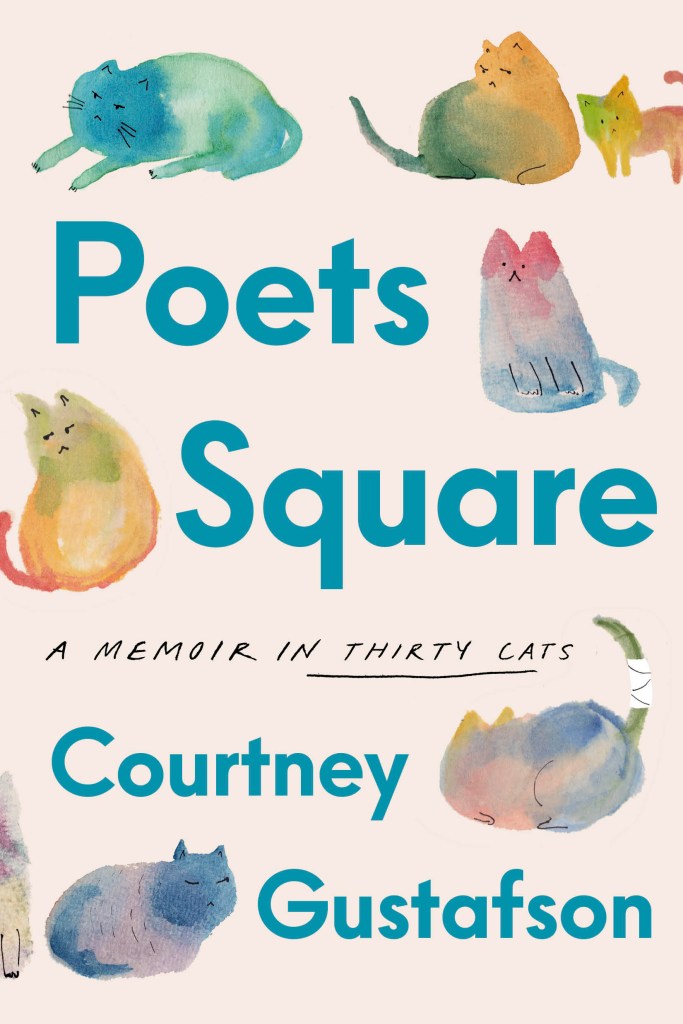
Gustafson knows how lucky she is to have escaped a paycheck-to-paycheck existence. Fame came seemingly out of nowhere when a TikTok video she posted about preparing a mini Thanksgiving dinner for the cats went viral. Social media and cat rescue work helped a shy, often ill person be less lonely, giving her “a community, a sense of rootedness, a purpose outside myself.” (Moreover, her Internet following literally ensured she had a place to live: when her rental house was being sold out from under her, a crowdfunding campaign allowed her to buy the house and save the cats.) However, they have also made her aware of a “constant undercurrent of suffering.” There are multiple cat deaths in the book, as you might expect. The author has become inured over time; she allows herself five minutes to cry, then moves on to help other cats. It’s easy to be overwhelmed or succumb to despair, but she chooses to focus on the “small acts of care by people trying hard” that can reduce suffering.
With its radiant portraits of individual cats and its realistic perspective on personal and collective problems, this is both a cathartic memoir and a probing study of how we build communities of care in times of hardship.
With thanks to Fig Tree (Penguin) for the proof copy for review.
Mornings without Mii by Mayumi Inaba (1999; 2024)
[Translated from Japanese by Ginny Tapley Takemori]
Inaba (1950–2014) was an award-winning novelist and poet. I can’t think why it took 25 years for this to be translated into English but assume it was considered a minor work of hers and was brought out to capitalize on the continuing success of cat-themed Japanese literature from The Guest Cat onward. Interestingly, it’s titled Mornings with Mii in the UK, which shifts the focus and is truer to the contents. Yes, by the end, Inaba is without Mii and dreading the days ahead, but before that she got 20 years of companionship. One day in the summer of 1977, Inaba heard a kitten’s cries on the breeze and finally located it, stuck so high in a school fence that someone must have left her there deliberately. The little fleabitten calico was named after the sound of her cry and ever after was afraid of heights.
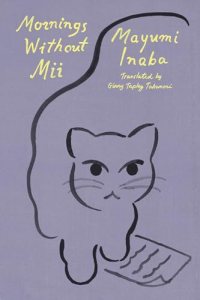 Inaba traces the turning of the seasons and the passing of the years through the changes they brought for her and for Mii. When she separated, moved to a new part of Tokyo, and started devoting her evenings to writing in addition to her full-time job, Mii was her closest friend. The new apartment didn’t have any green space, so instead of wandering in the woods Mii had to get used to exercising in the corridors. There were some scares: a surprise pregnancy nearly killed her, and once she went missing. And then there was the inevitable decline. Mii’s intestinal issues led to incontinence. For four years, Inaba endured her home reeking of urine. Many readers may, like me, be taken aback by how long Inaba kept Mii alive. She manually assisted the cat with elimination for years; 20 days passed between when Mii stopped eating and when she died. On the plus side, she got a “natural” death at home, but her quality of life in these years is somewhat alarming. I cried buckets through these later chapters, thinking of the friendship and intimate communion I had with Alfie. I can understand why Inaba couldn’t bear to say goodbye to Mii any earlier, especially because she’d lived alone since her divorce.
This memoir really captures the mixture of joy and heartache that comes with loving a pet. It’s an emotional connection that can take over your life in a good way but leave you bereft when it’s gone. There is nostalgia for the good days with Mii, but also regret and a heavy sense of responsibility. A number of the chapters end with a poem about Mii, but the prose, too, has haiku-like elegance and simplicity. It’s a beautiful book I can strongly recommend. (Read via Edelweiss)
let’s sleep
So as not to hear your departing footsteps
She won’t be here next year I know
I know we won’t have this time again
On this bright afternoon overcome with an unfathomable sadness
The greenery shines in my cat’s gentle eyes
I didn’t have any particular faith, but the one thing I did believe in was light. Just being in warm light, I could be with the people and the cat I had lost from my life. My mornings without Mii would start tomorrow. … Mii had returned to the light, and I would still be able to meet her there hundreds, thousands of times again.
The Cat Who Wanted to Go Home by Jill Tomlinson (1972)
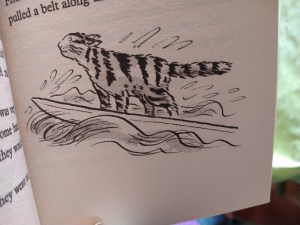
 Suzy the cat lives in a French seaside village with a fisherman and his family of four sons. One day, she curls up to sleep in a basket only to wake up airborne – it’s a hot air balloon, taking her to England! Here the RSPCA place her with old Auntie Jo, who feeds her well, but Suzy longs to get back home. “Chez-moi” is her constant cry, which everyone thinks is an awfully funny way to say miaow (“She purred in French, [too,] but purring sounds the same all over the world”). Each day she hops into the basket of Auntie Jo’s bike for a ride to town to try a new route over the sea: in a kayak, on a surfboard, paddling alongside a Channel swimmer, and so on. Each attempt fails and she returns to her temporary lodgings: shared with a parrot named Biff and comfortable, yet not quite right. Until one day… This is a sweet little story (a 77-page paperback) for new readers to experience along with a parent, with just enough repetition to be soothing and a reassuring message about the benevolence of strangers. Susan Hellard’s illustrations are charming. (Secondhand – local library book sale)
And a couple of other children’s books:
 Mittens for Kittens and Other Rhymes about Cats, ed. Lenore Blegvad; illus. Erik Blegvad (1974) – A selection of traditional English and Scottish nursery rhymes, a few of them true to the nature of cats but most of them just nonsensical. You’ve got to love the drawings, though. (Secondhand – Hay Castle honesty shelves)


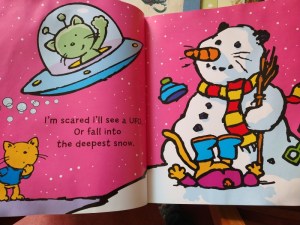
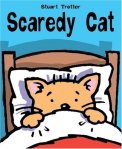 Scaredy Cat by Stuart Trotter (2007) – Rhyming couplets about everyday childhood fears and what makes them better. I thought it unfortunate that the young cat is afraid of other creatures; to be afraid of dogs is understandable, but three pages about not liking invertebrates is the wrong message to be sending. (Little Free Library)
Making Plans for a Return to Hay-on-Wye & A Book “Overhaul”
I was last in Hay-on-Wye for my 40th birthday (write-up here). We’ve decided 18 months is a decent length between visits such that we can go back and find enough turnover in the bookshops and changes around the town. The plan is to spend four nights there in early April, in a holiday cottage we’ve not stayed in before. It’s in Cusop, just back over the border into England, which means a pleasant (if not pouring with rain) walk over the fields into the town. Normally we go for just a night or two, so this longer ninth trip to Hay will allow us time to do more local exploring besides thoroughly trawling all the bookshops and rediscovering the best eateries on offer.
An Overhaul of Last Trip’s Book Purchases
Simon of Stuck in a Book has a regular blog feature he calls “The Overhaul,” where he revisits a book haul from some time ago and takes stock of what he’s read, what he still owns, etc. (here’s the most recent one). With his permission, I occasionally borrow the title and format to look back at what I’ve bought. Previous overhaul posts have covered pre-2020 Hay-on-Wye purchases, birthdays, the much-lamented Bookbarn International, and Northumberland. It’s been a good way of holding myself accountable for what I’ve purchased and reminding myself to read more from my shelves.
So, earlier this week I took a look back at the 16 new and secondhand books I acquired in Hay in October 2023. I was quickly dismayed: 18 months might seem like a long time, but as far as my shelves go it is more like the blink of an eye.
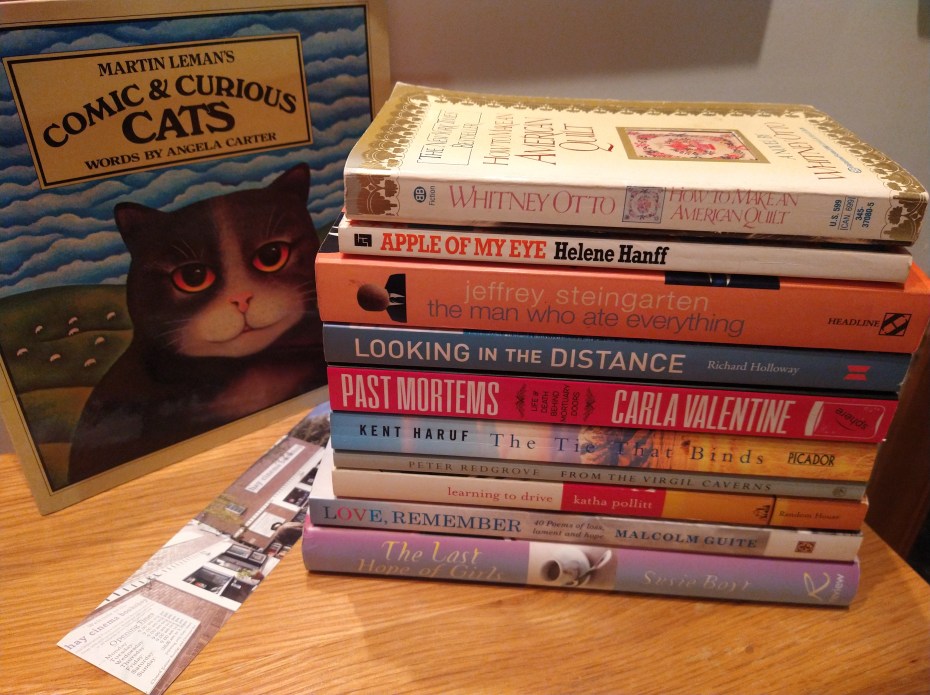
Read: Only 1 – Uh oh…
- Learning to Drive by Katha Pollitt
But also:
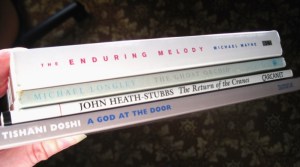
Partially read: 4
- A God at the Door by Tishani Doshi – Doshi is awesome. This is only my second of her poetry collections. I’ll finish it this month for Dewithon.
- Looking in the Distance by Richard Holloway – The problem with Holloway is that all of his books of recent decades are about the same – a mixture of mediations and long quotations from poetry – and I have one from last year on the review catch-up pile already. But I’m sure I’ll finish this at some point.
- The Ghost Orchid by Michael Longley – No idea why I set this one aside, but I’ve put it back on a current stack.
- The Enduring Melody by Michael Mayne – I have this journal of his approaching death as one of my bedside books and read a tiny bit of it at a time. (Memento mori?)
Skimmed: 1
- Love, Remember: 40 Poems of Loss, Lament and Hope by Malcolm Guite – I enjoyed the poetry selection well enough but didn’t find that the author’s essays added value, so I’m donating this to my church’s theological library.
That left 10 still to read. Eager to make some progress, I picked up a quick win, Comic & Curious Cats, illustrated in an instantly recognizable blocky folk art style by Martin Leman (I also have his Twelve Cats for Christmas, a stocking present I gave my husband this past year) and with words by Angela Carter. Yes, that Angela Carter! It’s picture book size but not really, or not just, for children. Each spread of this modified abecedarian includes a nonsense poem that uses the letter as much as possible: the cat’s name, where they live, what they eat, and a few choice adjectives. I had to laugh at the E cat being labelled “Elephantine.” Who knows, there might be some good future cat names in here: Basil and Clarissa? Francesca and Gordon? Wilberforce? “I love my cat with an XYZ [zed] … There is really nothing more to be said.” Charming. (Secondhand purchase – Hay-on-Wye Booksellers)


Total still unread: 9
Luckily, I’m still keen to read all of them. I’ll start with the two I purchased new, So Happy for You by Celia Laskey, a light LGBTQ thriller about a wedding (from Gay on Wye with birthday money from friends, a sweet older lesbian couple – so it felt appropriate to use their voucher there!), and Past Mortems by Carla Valentine, a memoir set at a mortuary (remainder copy from Addymans); as well as a secondhand novel, The Tie that Binds by Kent Haruf (Hay-on-Wye Booksellers) and the foodie essays of The Man Who Ate Everything by Jeffrey Steingarten (Cinema).
Then, if I still haven’t read them before the trip (who am I kidding…), I’ll pack for the car a few small volumes that will fit neatly into my handbag: Apple of My Eye by Helene Hanff, How to Make an American Quilt by Whitney Otto, and one of the poetry collections.
Reading the Meow, Part II: Books by Bernardine Bishop and Matt Haig
This is my second contribution to the Reading the Meow challenge, hosted by Mallika of Literary Potpourri, after yesterday’s review of Sleeping with Cats by Marge Piercy. One of the below novels is obviously cat-themed; the other less so, but the cover and blurb convinced me to take a chance on a new-to-me author and I discovered a hidden gem.

The Street by Bernardine Bishop (2015)
Prices are so cheap at my local charity warehouse (3/£1 paperbacks) that I recently did something I almost never do: bought a book I’d never heard of, by an author I’d never heard of, and then (something I definitely never do!) read it almost right away instead of letting it gather dust on my shelves for years. Bishop’s biography is wild. As a new Cambridge graduate, she was the youngest witness in the Lady Chatterley trial in 1960, then published two novels in her early twenties. She married twice, had two sons and a psychotherapy career, and returned to writing fiction after 50 years – prompted by a cancer diagnosis. Unexpected Lessons in Love was shortlisted for the Costa Novel Award in 2013, while this and Hidden Knowledge were both published posthumously, after Bishop’s death in 2015.
So: there is a cat on the cover and the blurb mentions it, too: “a beloved cat achieves immortality.” (I should have realized that was a euphemism, but never mind.) The novel opens with news of the death at 90 of formidable Brenda Byfleet, who’d been a Greenham Common woman and taken part in peace protests right into old age. Neighbours quickly realize someone will need to care for her cat Benn (named for Tony Benn), and the duty falls to Anne and Eric, who have also taken in their grandson while his parents are in Canada.
 What follows is a low-key ensemble story that moves with ease between several key residences of Palmerston Street, London, introducing us to a couple struggling with infertility, a war veteran with dementia, an underemployed actor who rescues his wife from her boss’s unwanted attentions, and so on. Most touching is the relationship between Anne and Georgia, a lesbian snail researcher who paints Anne’s portrait. Their friendship shades into quiet, middle-aged love.
There are secrets and threats and climactic moments here, but always the reassuring sense that neighbours are a kind of second family and so someone will be there for you to rely on no matter what you face. (I can think of a certain soap opera theme that expresses a similar sentiment…) Bishop’s style reminds me most of Tessa Hadley’s. She is equally skilled at drawing children and the elderly, and clearly feels love and compassion for her flawed characters: “Everything and everyone in the street was bathed in a blessed ordinariness.”
From Brenda onward, Georgia’s rhetorical question hangs over the short novel: “What is a life?” The implied partial answer is: what is remembered by those left behind. The opening paragraph is perfect –
“Sometimes it is impossible to turn even a short London street into a village. But sometimes it can be easily done. It all depends on one or two personalities.”
… and the last page has kittens. This was altogether a lovely read. Dangit, why didn’t I also buy the other Bishop novel that was on shelf at the charity warehouse?! I’ll have to hope it’s still around the next time I go there. (Secondhand – Community Furniture Project, Newbury) 
To Be a Cat by Matt Haig (2012)
 This was a reasonably cute middle-grade fantasy and careful-what-you-wish-for cautionary tale. On his twelfth birthday, Barney Willow thinks life couldn’t get worse. His parents are divorced, his dad has recently disappeared, he’s bullied by Gavin Needle, and evil head teacher Miss Whipmire seems to have a personal vendetta against him. His only friend is Rissa Fairweather, who lives on a barge. Little does he know that an idle wish to switch places with a cat he pets on the street will set a dangerous adventure in motion. Now he’s a cat and Maurice the cat has his body. Soon Barney realizes there’s a whole subset of cats who are former humans (alongside “swipers,” proper fighting street cats; and “firesides,” who prefer to stay indoors), including Miss Whipmire, who used to be a Siamese cat and has an escape plan that involves Barney. I felt the influence of Roald Dahl and Terry Pratchett, but Haig doesn’t have their writing chops. Apart from Rissa, the characterization is too clichéd. I’m sure I would have enjoyed this at age eight, though. (Little Free Library)
#ReadingtheMeow2024 and 20 Books of Summer, 2: Sleeping with Cats by Marge Piercy
Reviews of books about cats have been a standard element on my blog over the years, and the second annual Reading the Meow challenge, hosted by Mallika of Literary Potpourri, was a good excuse to pick up some more. Tomorrow I’ll review two cat-themed novels; today I have a 2002 memoir that I have been meaning to read for ages.
I discovered Piercy through her poetry, then read Woman on the Edge of Time, a feminist classic that contrasts utopian and dystopian views of the future. Like May Sarton (whom Piercy knew), she devotes equal energy to both fiction and poetry and is an inveterate cat lady. Piercy is still publishing and blogging at 88; I have much to catch up on from her back catalogue. A précis of her life is almost stranger than fiction: she grew up in poverty in Detroit, joining a teen gang and discovering her sexuality first with other girls (“The first time I had an orgasm—I was eleven—I was astonished and also I had a feeling of recognition. Of course, that’s it. As if that was what I had been expecting or looking for”) then with men; had a couple abortions, including one self-administered, then got sterilized; honed her writing craft at college; married three times – briefly to a Frenchman, an unhappy open arrangement, and now for 40+ years to fellow writer Ira Wood; and wrote like a dervish yet has remained on the periphery of the literary establishment and thus struggled financially.
Political activism has been a constant for Piercy, whether protesting the Vietnam War or supporting women’s reproductive rights. She and Wood also nurtured a progressive Jewish community around their Cape Cod home. Again like Sarton, she has always embraced the term feminist but been more resistant to queerness. A generational thing, perhaps; nowadays we would surely call Piercy bisexual or at least sexually fluid, but she’s more apt to dismiss her teen girlfriends and her later affairs with women as a phase. The personal life and career mesh here, though there is more of a focus on the former, such that I haven’t really gotten a clear idea of which of her novels I might want to try. Each chapter ends with one of her poems (wordy, autobiographical free verse), giving a flavour of her work in other genres. She portrays herself as a nomad who wandered various cities before settling into an unexpectedly homely and seasonal existence: “I am a stray cat who has finally found a good home.”

I admired Piercy’s self-knowledge here: her determination to write (including to keep her late mother alive in her) and to preserve the solitude necessary to her work –
I know I am an intense, rather angular passionate woman, not easy to like, not easy to live with, even for myself. Convictions, causes jostle in me. My appetites are large. I have learned to protect my work time and my privacy fiercely. I have been a better writer than a person, and again and again I made that choice. Writing is my core. I do not regret the security I have sacrificed to serve it.
and her conviction that motherhood was not for her –
I did not want children. I never felt I would be less of a woman, but I feared I would be less of a writer if I reproduced. I didn’t feel anything special about my genetic composition warranted replicating it. … I liked many of my friends’ children as they grew older: I was a good aunt. But I never desired to possess them or have one of my own. … I have never regretted staying childless. My privacy, my time for work … are precious. I feel my life is full enough.
“There were no role models for a woman like me,” she felt at the end of college, but she can in her turn be a role model of the female artist’s life, socially engaged and willing to take risks.
As to the title: There is, of course, special delight here for cat lovers. Piercy has had cats since she was a child, and in the Cape Cod era has usually kept a band of five or so. In the interludes we meet some true characters: Arofa the Siamese, Cho-Cho who lived to 21, mother and son Dinah and Oboe, alpha male Jim Beam, and many more. Of course, they age and fall ill and there are some goodbye scenes. She mostly describes these unsentimentally – if you’ve read Doris Lessing on cats, I’d say the attitude is similar. There are extremes of both love and despair: she licks a kitten to bond with her; she euthanizes one beloved cat herself. She wrote this memoir at 65 and felt that her cats were teaching her how to age.
There is a sadness to living with old cats; also a comfort and pleasure, for you know each other thoroughly and the trust is almost absolute. … The knowledge of how much I will miss them is always with me, but so is the sense of my own time flowing out, my life passing and the necessity to value it as I value them. Old cats are precious.
Even those unfamiliar with Piercy’s work might enjoy reading a perspective on the radical movements of the 1960s and 70s. This was right up my street because of her love of cats, her defence of the childfree life, and her interest in identity and memory. Because she doesn’t talk in depth about her oeuvre, you needn’t have read anything else of hers to appreciate reading this. I hope you have a cat who will nap on your lap as you do so. (Secondhand, a gift from my wish list)
Nine Days in France and What I Read
Who would have predicted that the South of France would be colder and rainier than the England we left behind? Nonetheless, we had a pleasant, low-key week at the Limousin–Dordogne border. We stayed in a gîte at Le Moulin de Pensol, a complex run by an English couple who keep horses, donkeys and chickens but are otherwise rewilding their land (similar to the Wild Finca project we visited in Spain two years ago). Their site is known for butterflies, including multiple almost indistinguishable fritillary species, so there was plenty of insect and bird watching for my husband in brief bursts of sunshine between showers. When it was too wet to go out, we played board games, drank wine and read books.
-

- Our gite. Photos by Chris Foster.
-
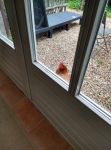
- The chickens wanted in!
-

- Wandering the meadows
-
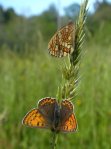
- Butterfly watching
However, we did manage a few short outings: the Trou de Philippou gorge; a peek at a Saturday morning repair café (I’m a volunteer doing admin and publicity for our local repair café, which started in February) and its “recyclerie” charity shop in a nearby village; and St-Jean-de-Côle, “one of the loveliest villages in the Dordogne” according to the Rough Guide. We were taken by the main square’s church, castle and screaming swift parties – so much bigger than back home – which we’d likewise watched circling the château in the attractive medieval town of Saumur on the Loire, where we stopped for a night on the way down. There were also fresh cheeses and produce, including the most delicious strawberries ever (the “Charlotte” variety), from the two closest markets. Piégut’s is the largest market in southwest France but we had to use our imaginations as the downpour kept plenty of sellers away.


-

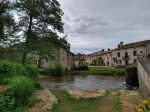
- St-Jean-de-Cole’s main square
-
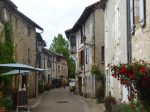
- Photo by Chris Foster.
The highlight of the trip was a visit to Grotte de Villars, a cave network with spectacular stalactites and stalagmites. Less well known than Lascaux, which is now inaccessible to visitors except via a reproduction, it too has prehistoric cave paintings of horses and bison, and 20,000-year-old bear claw marks. The paintings are gradually disappearing behind the constant calcite-creating drips; I pondered whether they will vanish before the human race does. We were lucky to find it so quiet that we got a private English-language tour. Proprietors were also so kind as to speak English to us when we shopped at a nano-brewery and did a tasting at a cider and calvados producer in Normandy on our way back to the ferry. Otherwise, we muddled through with the bare minimum of French at shops and eateries.
-

- Abbaye de Nouaillé-Maupertuis (lunch stop en route)
-

- (Photo at left by Chris Foster.)
-

- Saumur castle
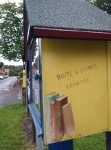
My other highlight was finding two Little Free Libraries, a walk-in one that we happened to pass in Saint-Martin-l’Ars on our initial drive down south and another in Abjat-sur-Bandiat. I felt slightly bad about taking a book at the first because of its insistence on returning or replacing once you’d read it, so I made up for it by donating Cold Spring Harbor to the book exchange box in Abjat when we returned to its crêperie for our one meal out of the holiday.
-
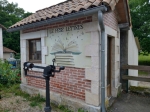
- Le Pese Lettres, Saint-Martin-l’Ars
-
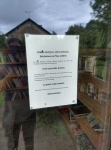
- Stricter than the usual LFL policy
-
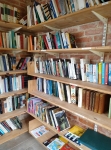
- Several English-language shelves
-
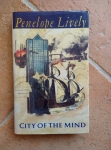
- My chosen book
-
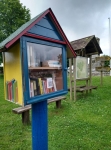
- Abjat-sur-Bandiat book exchange box
-
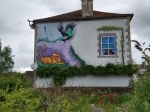
- Cute cat mural in Abjat
What I Read
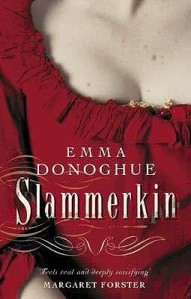 Slammerkin by Emma Donoghue (2000): A slammerkin was, in eighteenth-century parlance, a loose gown or a loose woman. Donoghue was inspired by the bare facts about Mary Saunders, a historical figure. In her imagining, Mary is thrown out by her family at age 14 and falls into prostitution in London. Within a couple of years, she decides to reform her life by becoming a dressmaker’s assistant in her mother’s hometown of Monmouth, but her past won’t let her go. The close third person narration shifts to depict the constrained lives of the other women in the household: the mistress, Mrs Jones, who has lost multiple children and pregnancies; governess Mrs Ash, whose initial position as a wet nurse was her salvation after her husband left her; and Abi, an enslaved Black woman. This was gripping throughout, like a cross between Alias Grace and The Crimson Petal and the White. The only thing that had me on the back foot was that, it being Donoghue, I expected lesbianism. (Secondhand purchase – Awesomebooks.com)
 Paris Trance by Geoff Dyer (1998): Only my second novel from Dyer, an annoyingly talented author who writes whatever he wants, in any genre, inimitably. This reminded me of Jeff in Venice, Death in Varanasi for its hedonistic travels. Luke and Alex, twentysomething Englishmen, meet as factory workers in Paris and quickly become best mates. With their girlfriends, Nicole and Sahra, they form what seems an unbreakable quartet. The couples carouse, dance in nightclubs high on ecstasy, and have a lot of sex. A bit more memorable are their forays outside the city for Christmas and the summer. The first-person plural perspective resolves into a narrator who must have fantasized the other couple’s explicit sex scenes; occasional flash-forwards reveal that only one pair is destined to last. This is nostalgic for the heady days of youth in the same way as Sweetbitter. I was intrigued to learn that random lines were sampled from Fiesta; though it is lad lit, I wouldn’t have expected a Hemingway homage from the style. (Secondhand purchase – Awesomebooks.com)
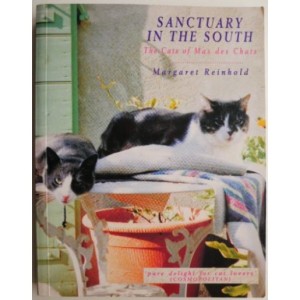 Sanctuary in the South: The Cats of Mas des Chats by Margaret Reinhold (1993): Reinhold (still alive at 96?!) is a South African psychotherapist who relocated from London to Provence, taking her two cats with her and eventually adopting another eight, many of whom had been neglected by owners in the vicinity. This sweet and meandering book of vignettes about her pets’ interactions and hierarchy is generally light in tone, but with the requisite sadness you get from reading about animals ageing, falling ill or meeting with accidents, and (in two cases) being buried on the property. “Les chats sont difficiles,” as a local shop owner observes to her. But would we cat lovers have it any other way? Reinhold often imagines what her cats would say to her. Like Doreen Tovey, whose books this closely resembles, she is as fascinated by human foibles as by feline antics. One extended sequence concerns her doomed attempts to hire a live-in caretaker for the cats. She never learned her lesson about putting a proper contract in place; several chancers tried the role and took advantage of her kindness. (Secondhand purchase – Community Furniture Project)
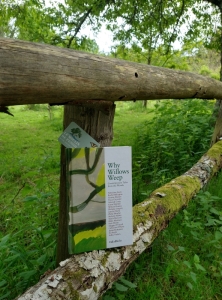
Why Willows Weep: Contemporary Tales from the Woods, ed. Tracy Chevalier and Simon Prosser (2011): These 19 short fictions, rather like Rudyard Kipling’s Just-So Stories, imagine how certain tree species developed their particular characteristics. I wasn’t expecting the fable setup and probably would have preferred a miscellany of essays and various fictional approaches. However, there is a run of great stories in the middle: from Susan Elderkin on “How the Blackthorn Got Its Flowers” to Terence Blacker on “Why Elms Die Young.” The stand-outs for me were by Rachel Billington and Maria McCann. It was a cute touch to have each author’s mini-bio end with their favourite tree, except, um, bamboo isn’t one (it’s a giant grass). I’ll probably keep this for the randomness of where I found it and the Leanne Shapton illustrations. (Secondhand purchase – La Monnerie recyclerie)
 And the first two-thirds of Daughters of the House by Michèle Roberts (1993): Thérèse and Léonie are cousins: the one French and the other English but making visits to her relatives in Normandy every summer. In the slightly forbidding family home, the adolescent girls learn about life, loss and sex. Each short chapter is named after a different object in the house. That Thérèse seems slightly otherworldly can be attributed to her inspiration, which Roberts reveals in a prefatory note: Saint Thérèse, aka The Little Flower. Roberts reminds me of A.S. Byatt and Shena Mackay; her work is slightly austere and can be slow going, but her ideas always draw me in. (Secondhand – Newbury charity shop)
A DNF: Claudine at School by Colette (a free download), which was dull and in way too small a print on my e-reader.
Plus portions of: various e-books for paid reviews, two May review books, and several library books including Moominpappa at Sea by Tove Jansson and The Invention of Hugo Cabret by Brian Selznick.


I’m happy to be home with my cat and canal, the two things I miss most when we’re away.
Reading about Mothers and Motherhood: Cosslett, Cusk, Emma Press Poetry, Heti, and Pachico
It was (North American) Mother’s Day at the weekend, an occasion I have complicated feelings about now that my mother is gone. But I don’t think I’ll ever stop reading and writing about mothering. At first I planned to divide my recent topical reads (one a reread) into two sets, one for ambivalence about becoming a mother and the other for mixed feelings about one’s mother. But the two are intertwined – especially in the poetry anthology I consider below – such that they feel more like facets of the same experience. I also review two memoirs (one classic; one not so much) and two novels (autofiction vs. science fiction).

The Year of the Cat: A Love Story by Rhiannon Lucy Cosslett (2023)
This was on my Most Anticipated list last year. A Covid memoir that features adopting a cat and agonizing over the question of whether to have a baby sounded right up my street. And in the earlier pages, in which Cosslett brings Mackerel the kitten home during the first lockdown and interrogates the stereotype of the crazy cat lady from the days of witches’ familiars onwards, it indeed seemed to be so. But the further I got, the more my pace through the book slowed to a limp; it took me 10 months to read, in fits and starts.
 I’ve struggled to pinpoint what I found so off-putting, but I have a few hypotheses: 1) By the time I got hold of this, I’d tired of Covid narratives. 2) Fragmentary narratives can seem like profound reflections on subjectivity and silences. But Cosslett’s strategy of bouncing between different topics – worry over her developmentally disabled brother, time working as an au pair in France, PTSD from an attempted strangling by a stranger in London and being in Paris on the day of the Charlie Hebdo terrorist attack – with every page or even every paragraph, feels more like laziness or arrogance. Of course the links are there; can’t you see them?
3) Cosslett claims to reject clichéd notions about pets being substitutes for children, then goes right along with them by presenting Mackerel as an object of mothering (“there is something about looking after her that has prodded the carer in me awake”) and setting up a parallel between her decision to adopt the kitten and her decision to have a child. “Though I had all these very valid reasons not to get a cat, I still wanted one,” she writes early on. And towards the end, even after she’s considered all the ‘very valid reasons’ not to have a baby, she does anyway. “I need to find another way of framing it, if I am to do it,” she says. So she decides that it’s an expression of bravery, proof of overcoming trauma. I was unconvinced. When people accuse memoirists of being navel-gazing, this is just the sort of book they have in mind. I wonder if those familiar with her Guardian journalism would agree. (Public library)
A Life’s Work: On Becoming a Mother by Rachel Cusk (2001)
 When this was first published, Cusk was vilified for “hating” her child – that is, for writing honestly about the bewilderment and misery of early motherhood. We’ve moved on since then. Now women are allowed to admit that it’s not all cherubs and lullabies. I suspect what people objected to was the unemotional tone: Cusk writes like an anthropologist arriving in a new land. The style is similar to her novels’ in that she can seem detached because of her dry wit, elevated diction and frequent literary allusions.
I understand that crying, being the baby’s only means of communication, has any number of causes, which it falls to me, as her chief companion and link to the world, to interpret.
Have you taken her to toddler group, the health visitor enquired. I had not. Like vaccinations and mother and baby clinics, the notion instilled in me a deep administrative terror.
We [new parents] are heroic and cruel, authoritative and then servile, cleaving to our guesses and inspirations and bizarre rituals in the absence of any real understanding of what we are doing or how it should properly be done.
She approaches mumsy things as an outsider, clinging to intellectualism even though it doesn’t seem to apply to this new world of bodily obligation, “the rambling dream of feeding and crying that my life has become.” By the end of the book, she does express love for and attachment to her daughter, built up over time and through constant presence. But she doesn’t downplay how difficult it was. “For the first year of her life work and love were bound together, fiercely, painfully.” This is a classic of motherhood literature, and more engaging than anything else I’ve read by Cusk. (Secondhand purchase – Awesomebooks.com)
The Emma Press Anthology of Motherhood, ed. by Rachel Piercey and Emma Wright (2014)
There’s a great variety of subject matter and tone here, despite the apparently narrow theme. There are poems about pregnancy (“I have a comfort house inside my body” by Ikhda Ayuning Maharsi), childbirth (“The Tempest” by Melinda Kallismae) and new motherhood, but also pieces imagining the babies that never were (“Daughters” by Catherine Smith) or revealing the complicated feelings adults have towards their mothers.
“All My Mad Mothers” by Jacqueline Saphra depicts a difficult bond through absurdist metaphors: “My mother was so hard to grasp: once we found her in a bath / of olive oil, or was it sesame, her skin well-slicked / … / to ease her way into this world. Or out of it.” I also loved her evocation of a mother–daughter relationship through a rundown of a cabinet’s contents in “My Mother’s Bathroom Armoury.”
 In “My Mother Moves into Adolescence,” Deborah Alma expresses exasperation at the constant queries and calls for help from someone unconfident in English. “This, then, is how you should pray” by Flora de Falbe cleverly reuses the structure of the Lord’s Prayer as she sees her mother returning to independent life and a career as her daughter prepares to leave home. “I will hold you / as you held me / my mother – / yours are the bathroom catalogues / and the whole of a glorious future.”
I connected with these perhaps more so than the poems about becoming a mother, but there are lots of strong entries and very few unmemorable ones. Even within the mothers’ testimonials, there is ambivalence: the visceral vocabulary in “Collage” by Anna Kisby is rather morbid, partway to gruesome: “You look at me // like liver looks at me, like heart. You are familiar as innards. / In strip-light I clean your first shit. I’m not sure I do it right. / It sticks to me like funeral silk. … There is a window // guillotined into the wall. I scoop you up like a clod.”
A favourite pair: “Talisman” by Anna Kirk and “Grasshopper Warbler” by Liz Berry, on facing pages, for their nature imagery. “Child, you are grape / skins stretched over fishbones. … You are crab claws unfurling into cabbage leaves,” Kirk writes. Berry likens pregnancy to patient waiting for an elusive bird by a reedbed. (Free copy – newsletter giveaway)
Motherhood by Sheila Heti (2018)
I first read this nearly six years ago (see my original review), when I was 34; I’m now 40 and pretty much decided against having children, but FOMO is a lingering niggle. Even though I already owned it in hardback, I couldn’t resist picking up a nearly new paperback I saw going for 50 pence in a charity shop, if only for the Leanne Shapton cover – her simple, elegant watercolour style is instantly recognizable. Having a different copy also provided some novelty for my reread, which is ongoing; I’m about 80 pages from the end.
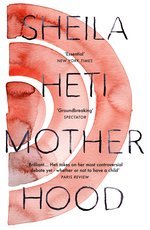 I’m not finding Heti’s autofiction musings quite as profound this time around, and I can’t deny that the book is starting to feel repetitive, but I’ve still marked more than a dozen passages. Pondering whether to have children is only part of the enquiry into what a woman artist’s life should be. The intergenerational setup stands out to me again as Heti compares her Holocaust survivor grandmother’s short life with her mother’s practical career and her own creative one.
For the past month or so, I’ve also been reading Alphabetical Diaries, so you could say that I’m pretty Heti-ed out right now, but I do so admire her for writing exactly what she wants to and sticking to no one else’s template. People probably react against Heti’s work as self-indulgent in the same way I did with Cosslett’s, but the former’s shtick works for me. (Secondhand purchase – Bas Books & Home, Newbury)
A few of the passages that have most struck me on this second reading:
I think that is how childbearing feels to me: a once-necessary, now sentimental gesture.
I don’t want ‘not a mother’ to be part of who I am—for my identity to be the negative of someone else’s positive identity.
The whole world needs to be mothered. I don’t need to invent a brand new life to give the warming effect to my life I imagine mothering will bring.
I have to think, If I wanted a kid, I already would have had one by now—or at least I would have tried.
Jungle House by Julianne Pachico (2023)
{BEWARE SPOILERS}
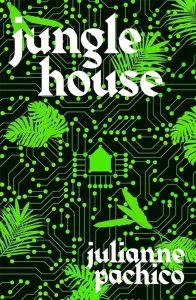 Pachico’s third novel is closer to sci-fi than I might have expected. Apart from Lena, the protagonist, all the major characters are machines or digital recreations: AI, droids, a drone, or a holograph of the consciousness of a dead girl. “Mother” is the AI security system that controls Jungle House, the Morel family’s vacation home in a country that resembles Colombia, where Pachico grew up and set her first two books. Lena, as the human caretaker, is forever grateful to Mother for rescuing her as a baby after the violent death of her parents, who were presumed rebels.
Mother is exacting but mercurial, strict about cleanliness yet apt to forget or overlook things during one of her “spells.” Lena pushes the boundaries of her independence, believing that Mother only wants to protect her but still longing to explore the degraded wilderness beyond the compound.
Mother was right, because Mother was always right about these kinds of things. The world was a complicated place, and Mother understood it much better than she did.
In the house, there was no privacy. In the house, Mother saw all.
Mother was Lena’s world. And Lena, in turn, was hers. No matter how angry they got at each other, no matter how much they fought, no matter the things that Mother did or didn’t do … they had each other.
It takes a while to work out just how tech-reliant this scenario is, what the repeated references to “the pit bull” are about, and how Lena emulated and resented Isabella, the Morel daughter, in equal measure. Even creepier than the satellites’ plan to digitize humans is the fact that Isabella’s security drone, Anton, can fabricate recorded memories. This reminded me a lot of Klara and the Sun. Tech themes aren’t my favourite, but I ultimately thought of this as an allegory of life with a narcissistic mother and the child’s essential task of breaking free. It’s not clinical and contrived, though; it’s a taut, subtle thriller with an evocative setting. (Public library)
See also: “Three on a Theme: Matrescence Memoirs”
Does one or more of these books take your fancy?
The 2024 Releases I’ve Read So Far
I happen to have read eight pre-release books so far, all of them for paid review; mostly for Shelf Awareness, with one for Foreword. (I also have proof copies of upcoming novels by Tania James, Margot Livesey, Sigrid Nunez and Sarah Perry on the shelf, but haven’t managed to start on them yet.) I’ve given review excerpts, links where available, and ratings below to try to pique your interest. Early in January I’ll follow up with a list of my dozen Most Anticipated titles for the coming year.
My top recommendations so far:
(in alphabetical order)
 Theophanies by Sarah Ghazal Ali [Jan. 16, Alice James Books]: In this poised debut collection by a Muslim poet, spiritual enlightenment is a female, embodied experience, mediated by matriarchs. Ali’s ambivalence towards faith is clear in alliteration-laden verse that recalls Kaveh Akbar’s. Wordplay, floral metaphors, and multiple ghazals make for dazzling language.
 Grief Is for People by Sloane Crosley [Feb. 27, MCD]: A bereavement memoir like no other. Heart-wrenching yet witty, it bears a unique structure and offers fascinating glimpses into the New York City publishing world. Crosley’s apartment was burgled exactly a month before the suicide of her best friend and former boss. Investigating the stolen goods in parallel serves as a displacement activity for her.
 Behind You Is the Sea by Susan Muaddi Darraj [Jan. 16, HarperVia]: Darraj’s second novel-in-stories is a sparkling composite portrait of a Palestinian American community in Baltimore. Across nine stellar linked stories, she explores the complex relationships between characters divided by—or connected despite—class, language, and traditional values. The book depicts the variety of immigrant and second-generation experience, especially women’s.
 The Ritual Effect by Michael Norton [April 9, Scribner]: Many use the words “habit” and “ritual” interchangeably, but the Harvard Business School behavioral scientist argues convincingly that they are very different. While a habit is an automatic, routine action, rituals are “emotional catalysts that energize, inspire, and elevate us.” He presents an engaging and commonsense précis of his research, making a strong case for rituals’ importance in the personal and professional spheres as people mark milestones, form relationships, or simply “savor the experiences of everyday life.”
Other 2024 releases I’ve read:
(in publication date order)
 House Cat by Paul Barbera [Jan. 2, Thames & Hudson]: The Australian photographer Paul Barbera’s lavish art book showcases eye-catching architecture and the pets inhabiting these stylish spaces. Whether in a Revolutionary War-era restoration or a modernist show home, these cats preside with a befitting dignity. (Shelf Awareness review forthcoming)
 The Fox Wife by Yangsze Choo [Feb. 13, Henry Holt/Quercus]: Choo’s third novel is steeped in Chinese folklore, like her previous work, this time with a focus on tantalizing stories related to foxes, which were often worshiped at village shrines in China. Two tandem searches ramp up the level of suspense: in the winter of 1908 in Manchuria, in northeast China, a detective investigates a series of unexplained deaths; at the same time, a fox-woman masquerading as a servant plots vengeance against the man who murdered her child.
 The Only Way Through Is Out by Suzette Mullen [Feb. 13, University of Wisconsin Press]: A candid, inspirational memoir traces the events leading to her midlife acceptance of her lesbian identity and explores the aftermath of her decision to leave her marriage and build “a life where I would choose desire over safety.” The book ends on a perfect note as Mullen attends her first Pride festival aged 56. “It’s never too late” is the triumphant final line. (Foreword review forthcoming)
 36 Ways of Writing a Vietnamese Poem by Nam Le [March 5, Knopf]: A fearless poetry debut prioritizes language and voice to explore inherited wartime trauma and expose anti-Asian racism. Each poem is titled after a rhetorical strategy or analytical mode. Anaphora is one sonic technique used to emphasize the points. Language and race are intertwined. This is a prophet’s fervent truth-telling. High-concept and unapologetic, this collection from a Dylan Thomas Prize winner pulsates. (Shelf Awareness review forthcoming)
Currently reading:
(in release date order; all for Shelf Awareness review)
 God Gave Rock and Roll to You: A History of Contemporary Christian Music by Leah Payne [Jan. 4, Oxford University Press]: “traces the history and trajectory of CCM in America and, in the process, demonstrates how the industry, its artists, and its fans shaped—and continue to shape—conservative, (mostly) white, evangelical Protestantism.”
 Raised by Wolves: Fifty Poets on Fifty Poems, A Graywolf Anthology [Jan. 23, Graywolf Press]: “Graywolf poets have selected fifty poems by Graywolf poets, offering insightful prose reflections on their selections. What arises is a choral arrangement of voices and lineages across decades, languages, styles, and divergences, inspiring a shared vision for the future.”
 The Paris Novel by Ruth Reichl [April 30, Random House]: “When her estranged mother dies, Stella is left with an unusual gift: a one-way plane ticket, and a note reading ‘Go to Paris’. But Stella is hardly cut out for adventure … When her boss encourages her to take time off, Stella resigns herself to honoring her mother’s last wishes.”
Will you look out for one or more of these?
Any other 2024 reads you can recommend?
That’s it for me until later next week when I start in on my year-end round-ups (DNFs, miscellaneous superlatives, books of the year, and final statistics). Merry Christmas!
 Bookish Beck = Rebecca Foster. American transplant to England. Freelance proofreader and book reviewer.
 Bookish Beck