2025 Releases Read So Far, Including a Review of Aerth by Deborah Tomkins
I’ve gotten to 22 books with a 2025 publication date so far, most of them for paid reviews for Foreword Reviews or Shelf Awareness. I give review excerpts, links where available, and ratings below to pique your interest. (I’ll follow up on Friday with a list of my 25 Most Anticipated titles for the first half of the year!) First, though, it’s time to introduce you to the joint winner of the inaugural Weatherglass Novella Prize, as chosen by Ali Smith – I reviewed the other winner, Astraea by Kate Kruimink, as part of Novellas in November.
Aerth by Deborah Tomkins
At Weatherglass Books’ “The Future of the Novella” event in September (my write-up is here), I was intrigued to learn about this sci-fi novella in flash set on alternative Earths. The draft title was “First, Do No Harm,” referring to one of the five mantras for life on Aerth, a peaceful matriarchal planet that has been devastated by a pandemic. Magnus, the Everyman protagonist, is his parents’ only surviving offspring after their first nine children died of the virus. We meet Magnus in what seems an idyllic childhood of seasonal celebrations and his mother’s homemade cakes. But the weight of his parents’ expectations is too much, and after his relationship with Tilly disintegrates, he decides to fulfil a long-held ambition of becoming an astronaut and travelling to Urth. Here he starts off famous – a sought-after talking head in the media with the ear of the prime minister – but public opinion eventually turns against him.

Urth could be modelled on contemporary London: polluted, capitalist and celebrity-obsessed. But it would be oversimplifying to call Aerth a pre-industrial foil; although at first its lifestyle seems more wholesome, later revelations force us to question why it developed in this way. The planets are twins with potentially parallel environmental and societal trajectories and some exact counterparts; the hints about this “mirrorverse” are eerie. It all could have added up to an unsubtle allegory in which Aerth represents what we should aspire to and Urth symbolizes what we must resist, but Tomkins makes it more nuanced than that. Magnus’s homesickness when he fears he’s trapped on Urth is a heart-rending element, and the diverse styles and formats (such as lists, documents, and second-person sections) keep things interesting. The themes of parenting and loneliness are particularly potent.
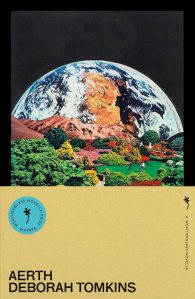 Tomkins first wrote this for the Bath Prize in 2018 and was longlisted. She initially sent the book out to science fiction publishers but was told that it wasn’t ‘sci-fi enough’. I can see how it could fall into the gap between literary fiction and genre fiction: though it’s set on other planets and involves space travel, its speculative nature is understated; it feels more realist. A memorable interrogation of longing and belonging, this novella ponders the value of individuals and their choices in the midst of inexorable planetary trajectories.
(Wowee, Aerth made it onto Eric of Lonesome Reader’s Top Ten list for 2024!)
With thanks to Weatherglass Books for the free copy for review. Aerth will be released on 25 January.
My top recommendations so far for 2025:
(in alphabetical order) All: 
 Save Me, Stranger by Erika Krouse (Flatiron Books, January 21): These 12 first-person narratives are voiced by people in crisis, for whom encounters with strangers tender the possibility of transformation. In the title story, the narrator is taken hostage in a convenience store hold-up. Krouse frequently focuses on young women presented with dilemmas. In “The Pole of Cold,” Vera meets Theo, the son of the American weather researchers who died in the same Siberian plane crash that killed her reindeer herder father. Travel is a recurring element, with stories set in Thailand and Japan as well as various U.S. states. The book exhibits tremendous range, imagining a myriad places, minds, and situations. Krouse often eschews tidy endings, leaving characters on the brink and allowing readers to draw inferences about what they will decide. Fans of Danielle Evans and Lauren Groff have a treat in store.
 Immemorial by Lauren Markham (Transit Books, February 4): This outstanding book-length essay compares language, memorials, and rituals as strategies for coping with climate anxiety and grief. The dichotomies of the physical versus the abstract and the permanent versus the ephemeral are explored; the past, present, and future dance through the text. With language not changing at the pace of the climate, Markham turns to the “Bureau of Linguistical Reality” for help coining a new term for anticipatory ecological grief. The title is one candidate, “premation” another. Forthright, wistful, and determined, the book treats grief as a positive, as “fuel” or a “portal.” Hope is not theoretical in this setup, but solidified in action. In Markham’s case, becoming a parent embodied her trust in the future. Immemorial is an elegant meditation on memory and impermanence in an age of climate crisis.
 Y2K: How the 2000s Became Everything (Essays on the Future that Never Was) by Colette Shade (out today from Dey Street Books!): Shade’s debut collection contains 10 perceptive essays that contrast the promise and political pitfalls of “the Y2K Era” (1997–2008). The author was an adolescent at the turn of the millennium and recalls the thrill of early Internet use and celebrity culture. Consumerism was a fundamental doctrine but the financial crash prompted a loss of faith in progress. It’s a feast of millennial nostalgia but also a hard-hitting work of cultural criticism.
 Show Don’t Tell by Curtis Sittenfeld (Random House, February 25; Transworld, 27 February): Sittenfeld’s second collection features characters negotiating principles and privilege in midlife. The 12 stories spotlight everyday marital and parenting challenges. Dual timelines offer opportunities for hindsight on the events of decades ago. College and boarding school experiences, in particular, remain pivotal. The arbitrary nature of wealth and celebrity is a central theme. Warm, witty, and insightful.
Other 2025 releases:
(in publication date order)
 How Isn’t It Going? Conversations after October 7 by Delphine Horvilleur [trans. from the French by Lisa Appignanesi] (out today from Europa Editions!): There is by turns a stream of consciousness or folktale quality to the narrative as Horvilleur enacts 11 dialogues – some real and others imagined – with her late grandparents, her children, or even abstractions. She draws on history, scripture and her own life, wrestling with thoughts that come during insomniac early mornings. It’s a lament for the Jewish condition, and a warning of the continuing and insidious nature of antisemitism. But it’s not all mourning; there is sometimes a wry sense of humour that feels very Jewish.
 Cold Kitchen: A Year of Culinary Travels by Caroline Eden (Out in UK since May 2024; U.S. release: Bloomsbury, January 14): Eden cooks and writes in the basement kitchen of her Edinburgh apartment. When wanderlust strikes, she revisits favorite places via their cuisine. Her sumptuous fourth book journeys across Central Asia and Eastern Europe, harvesting memories and recipes. (Plus my Shelf Awareness interview)
 North of Ordinary by John Rolfe Gardiner (Bellevue Literary Press, January 14): I read 5 of 10 stories about young men facing life transitions and enjoyed the title one set at a thinly veiled Liberty University but found the rest dated in outlook; all have too-sudden endings.
 If Nothing by Matthew Nienow (Alice James Books, January 14): Straightforward poems about giving up addiction and seeking mental health help in order to be a good father.
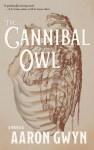 The Cannibal Owl by Aaron Gwyn (Belle Point Press, January 28): An orphaned boy is taken in by the Comanche in 1820s Texas in a brutal novella for fans of Cormac McCarthy.
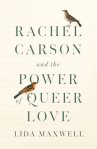 Rachel Carson and the Power of Queer Love by Lida Maxwell (Stanford University Press, January 28): Maxwell’s enthusiastic academic study reappraises scientist Rachel Carson’s motivations in light of ecological crisis and queer studies.
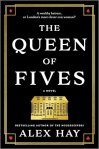 The Queen of Fives by Alex Hay (Graydon House, January 21; Headline, 30 January): Quinn Le Blanc, the latest in a dynasty of London con artists, resolves to pose as a debutante and marry a duke for his fortune – all in just five days in 1898. Like The Housekeepers, it’s a playful romp featuring strong female characters.
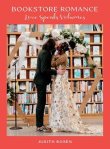 Bookstore Romance: Love Speaks Volumes by Judith Rosen (Brandeis University Press, February 1): A bibliophile’s time capsule and an enduring record of love and literary obsessions, this is a swoon-worthy coffee table book about couples who formalized their relationships in bookstores.
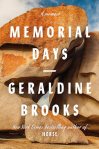 Memorial Days by Geraldine Brooks (Viking, February 4): This elegant bereavement memoir chronicles the sudden death of Brooks’s husband (journalist Tony Horwitz) in 2019 and her grief retreat to Flinders Island, Australia.
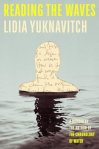 Reading the Waves by Lidia Yuknavitch (Riverhead, February 4): Yuknavitch’s bold memoir-in-essays focuses on pivotal scenes and repeated themes from her life as she reckons with trauma and commemorates key relationships. (A little too much repeated content from The Chronology of Water for me.)
 The Book of Flaco: The World’s Most Famous Bird by David Gessner (Blair, February 11): Gessner’s engaging nature book tells the story of the escaped Central Park Zoo Eurasian eagle-owl. It’s a touching tribute and a subtle challenge to reconsider human effects on wildlife.
 We Would Never by Tova Mirvis (Avid Reader Press, February 11): Mirvis’s fourth novel, inspired by real-life headlines, tells the taut story of an acrimonious divorce case gone horribly wrong. It explores the before and after of a murder, as the victim’s soon-to-be-ex-wife comes under suspicion and her family huddles around to protect her.
 The Café with No Name by Robert Seethaler [trans. from the German by Katy Derbyshire] (Europa Editions, 25 February): Set in 1960s and 1970s Vienna, where World War II still reverberates, this tender novel about a restaurateur’s interactions with acquaintances and customers meditates on the passage of time and bonds that last.
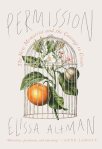 Permission: The New Memoirist and the Courage to Create by Elissa Altman (David R. Godine, March 4): Full of stories drawn from Altman’s life and other authors’ experience, this is an inspirational guide to defusing shame through self-disclosure and claiming the time and focus to write.
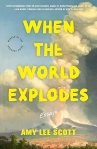 When the World Explodes: Essays by Amy Lee Scott (Mad Creek Books, March 6): Eleven inquisitive pieces set personal crises alongside natural disasters and gun violence. Scott was adopted as a baby from Korea; motherhood and adoption are potent themes across the book.
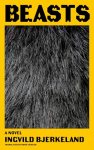 Beasts by Ingvild Bjerkeland [trans. from the Norwegian by Rosie Hedger] (Levine Querido, April 1): In this chilling young adult novella, a teenager tries to keep his little sister safe and reunite with their father in a hazardous postapocalyptic world.
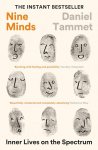 Nine Minds: Inner Lives on the Spectrum by Daniel Tammet (Out in UK since July 2024; U.S. release: The Experiment, April 1): A biographical mosaic of neurodivergence built of stories of individuals whose struggles and achievements defy the clichés surrounding autism. (Notable inclusions: actor Dan Aykroyd, novelist Naoise Dolan.)
Will you look out for one or more of these?
Any other 2025 reads you can recommend?
A Bookshop of One’s Own by Jane Cholmeley (Blog Tour)
Silver Moon, one of the Charing Cross Road bookshops, was a London institution from 1984 until its closure in 2001. “Feminism and business are strange bedfellows,” Jane Cholmeley soon realised, and this book is her record of the challenges of combining the two. On the spectrum of personal to political, this is much more manifesto than memoir. She dispenses with her own story (vicar’s tomboy daughter, boarding school, observing racism on a year abroad in Virginia, secretarial and publishing jobs, meeting her partner) via a 10-page “Who Am I?” opening chapter. However, snippets of autobiography do enter into the book later on; in one of my favourite short chapters, “Coming Out,” Cholmeley recalls finally telling her mother that she was a lesbian after she and Sue had been together nearly a decade.
The mid-1980s context plays a major role: Thatcherite policies (Section 28 outlawing the “promotion of homosexuality”), negotiations with the Greater London Council, and trying to share the landscape with other feminist bookshops like Sisterwrite and Virago. Although there were some low-key rivalries and mean-spirited vandalism, a spirit of camaraderie generally prevailed. Cholmeley estimates that about 30% of the shop’s customers were men, but the focus here was always on women. The events programme featured talks by an amazing who’s-who of women authors, Cholmeley was part of the initial roundtable discussions in 1992 that launched the Orange Prize for Fiction (now the Women’s Prize), and the café was designated a members’ club so that it could legally be a women-only space.

I’ve always loved reading about what goes on behind the scenes in bookshops (The Diary of a Bookseller, Diary of a Tuscan Bookshop, The Sentence, The Education of Harriet Hatfield, The Little Bookstore of Big Stone Gap, and so on), and Cholmeley ably conveys the buzzing girl-power atmosphere of hers. There is a fun sense of humour, too: “Dyke and Doughnut” was a potential shop name, and a letter to one potential business partner read, “you already eat lentils, and ride a bicycle, so your standard of living hasn’t got much further to fall, we happen to like you an awful lot, and think we could all work together in relative harmony”.
However, the book does not have a narrative per se; the “A Day in the Life of… (1996)” chapter comes closest to what those hoping for a bookseller memoir might be expecting, in that it actually recreates scenes and dialogue. The rest is a thematic chronicle, complete with lists, sales figures, profitability charts, and excerpted documents, and I often got lost in the detail. The fact that this gives the comprehensive history of one establishment makes it a nostalgic yearbook that will appeal most to readers who have a head for business, were dedicated Silver Moon customers, and/or hold a particular personal or academic interest in the politics of the time and the development of the feminist and LGBT movements.
With thanks to Random Things Tours and Mudlark for the free copy for review.
Buy A Bookshop of One’s Own from Bookshop.org [affiliate link]
I was happy to be part of the blog tour for the release of this book. See below for details of where other reviews have appeared or will be appearing soon.

My Best Backlist Reads of the Year
Like many bloggers, I’m irresistibly drawn to the new books released each year. However, I consistently find that many of my more memorable reads were published earlier – most of these happen to have been published between one and a few years ago, with the ‘oldest’ being from 2004. These dozen selections – alphabetical within genre but in no particular rank order – together with my Best of 2023 post (coming up tomorrow), make up about the top 10% of my year’s reading.

Fiction
 Loved and Missed by Susie Boyt: The heart-wrenching story of a woman who adopts her granddaughter because of her daughter’s drug addiction. The prose is stunning as Boyt traces the history of this complicated, makeshift family. The title has a wry double meaning, but also connotations of anticipatory grief. There can be love even where there is estrangement, or eternal separation. That is one of the enduring messages of this gem of a short novel.
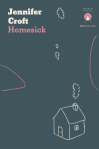 Homesick by Jennifer Croft: Each vignette – some just a paragraph long – is perfectly chosen to reveal a family dynamic and a moment in American history. What Croft does so brilliantly is to chart the accretion of ordinary and landmark events that form a life. In the end it didn’t matter whether this was presented as memoir or autofiction, so true was it to the experience of 1990s girlhood, as well as to sisterhood and coming of age.
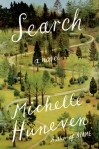 Search by Michelle Huneven: When middle-aged restaurant critic Dana Potowski is invited to be on the search committee to appoint the next minister for her California Unitarian church, she reluctantly agrees but soon wonders whether the experience could be interesting fodder for a new book… The setup might seem niche but will resonate with anyone who’s had a brush with bureaucracy. Pure pleasure; lit fic full of gossip and good food.
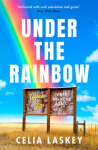 Under the Rainbow by Celia Laskey: Researchers identified Big Burr, Kansas as the most homophobic town in America. An Acceptance Across America task force descends on the rural backwater for a two-year program promoting education and friendship. Each chapter in the linked short story collection is a first-person, present-tense confession from a local or a queer visitor, whose stories interlock. Laskey inhabits all 11 with equal skill and compassion.
 The Chosen by Elizabeth Lowry: This utterly immersive novel examines Thomas Hardy’s relationship with his first wife, Emma Gifford. It opens on the morning of her death. The couple had long been estranged, but Hardy was instantly struck with grief – and remorse, his guilt compounded by what he found in her journals. A universal tale of waning romance, loss, and regret. Beautifully understated; perfectly convincing for the period but also timeless.
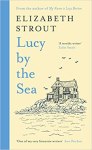 Lucy by the Sea by Elizabeth Strout: As Covid hits, William whisks Lucy from her NYC apartment to a house at the Maine coast. She’s an Everywoman recounting the fear and confusion of the early pandemic. Isolation has benefits: the first ‘room of her own’ she’s ever had, and time to ponder her childhood trauma and what went wrong in her marriage. Astute on American politics and writers’ inspirations; an effortless voice and emotional intelligence.
Nonfiction
 Bibliomaniac by Robin Ince: Ince was meant to undertake a stadium tour in Autumn 2021, but a Covid resurgence put paid to that. Not one for sitting around at home, he formulated Plan B: 100+ events, most of them in independent bookshops, over the course of two months, criss-crossing Britain and hitting many of my favourites. He’s not just a speaker at them but, invariably, a customer. I sensed a kindred spirit in so many lines. Witty and open-minded.
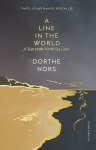 A Line in the World by Dorthe Nors: Nors lives in rural Jutland along the west coast of Denmark – little visited and largely unknown to foreigners. This can be both good and bad. Tourists feel they’re discovering somewhere new, but the residents are insular. Local legends and traditions, bird migration, reliance on the sea, wanderlust, maritime history, a visit to church frescoes, and more. Gorgeous writing and atmosphere, despite the bleakness.
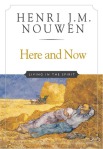 Here and Now by Henri Nouwen: This collection of micro-essays under themed headings like “Living in the Present” and “Suffering” is a perfect introduction to the Dutch Catholic priest’s theology. I marked out many reassuring or thought-provoking passages. I was taken by his ideas that the life of compassion is one of “downward mobility” and that inner freedom comes when you don’t judge anyone. Peaceful and readable; a good bedside devotional.
Poetry
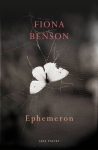 Ephemeron by Fiona Benson: Exquisite poems about the ephemeral, whether that be insect lives, boarding school days, primal emotions or moments from her children’s early years. The book is in four discrete corresponding sections but themes and language bleed from one into another and the whole is shot through with astonishing corporeality and eroticism. The form varies but the alliteration, slant rhymes and unexpected metaphors make each poem glisten.
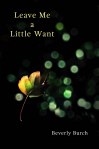 Leave Me a Little Want by Beverly Burch: Burch’s fourth collection juxtaposes the cosmic and the mundane, marvelling at the behind-the-scenes magic that goes into one human being born but also making poetry of an impatient wait in a long post office queue. Beset by environmental anxiety and the scale of bad news during the pandemic, she pauses in appreciation of the small and gradual.
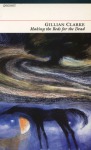 Making the Beds for the Dead by Gillian Clarke: Full of colour and nature imagery, profuse with alliteration and slant rhymes, relishing its specialist terminology, and taking on the serious subject matter of manmade disasters. Several sequences are devoted to gardening and geology; some pieces are ekphrastic, or dedicated to particular poets. The title sequence tackles the 2001foot and mouth disease outbreak. “The Fall” is on 9/11. Very affecting stuff.
My overall favourites were: in novels, Search and The Chosen (one contemporary and one historical) and in poetry, Ephemeron.
What were your best backlist reads this year?
Review Catch-Up: Monica, Bibliomaniac, Family Meal, Fudge & More
I’m catching up with reviews of the many October releases I read, including these four sent by publishers…
- a genre-bending, Technicolor graphic novel in the form of short comics
- a book-addict’s memoir of an ambitious Covid-times tour of Britain’s bookshops
- an understated novel about queer men of colour coping with death and mental illness
- and a quirky contemporary poetry collection I read in one sitting.
Followed by a bonus list of October books I reviewed for Shelf Awareness, similarly varied in genre: autofiction, flash fiction, horror-tinged historical fiction, graphic memoirs and more.
Monica by Daniel Clowes
 Daniel Clowes is a respected American graphic novelist best known for Ghost World, which was adapted into a 2001 film starring Scarlett Johansson. I’m not sure what I was expecting of Monica. Perhaps something closer to a quiet life story like Alison by Lizzy Stewart? In any case, not this jumble of 1970s nostalgia and supernatural horror. The book is in nine loosely connected stories that make the head spin with their genre and tonal shifts; one thing that stays constant is Clowes’s drawing style, which combines vibrant, campy colour with exaggerated faces and blunt haircuts.
At first it seems there will be a straightforward linear narrative: the prologue, “Foxhole,” has two soldiers dreaming of what life will be like Vietnam, with the one looking forward to a simple life with his fiancée Penny. “Pretty Penny” shatters those illusions as we see that Penny has fully embraced sexual liberation while he’s been away. She rejects her mother and, in a countercultural decision, keeps the baby when she gets pregnant. Young Monica has a sequence of stepfather figures before Penny dumps her with her parents and goes AWOL.
To an extent, the rest of the book is about Monica’s search for her parents. We see her as a young college student communicating with her dead grandfather via a radio, as a successful entrepreneur selling candles, and as an older woman caretaking for a California Airbnb. But in between there are bizarre sci-fi/folk horror interludes – “The Glow Infernal” and “The Incident” – about unconnected characters, and Monica’s involvement with a cult inevitably turns strange. I couldn’t get past the distasteful story lines or grotesque style. Mostly, I wasn’t convinced that Clowes liked or cared about any of his own characters, so why should I? (This might be Tom Cox’s dream book, but not mine.) I suppose I might try a classic work by Clowes one day, but only if I can be assured that it has more plot and heart.
With thanks to Jonathan Cape (Penguin) for the free copy for review.
Bibliomaniac: An Obsessive’s Tour of the Bookshops of Britain by Robin Ince
Do you know anyone who can buy just one book? Do you know anyone who leaves a bookshop only with what they walked in to buy?
I understand that Robin Ince is a radio personality and comedian who, though holding no formal qualifications, often delivers presentations about science. He was meant to undertake a stadium tour with Professor Brian Cox in the autumn of 2021, but a Covid resurgence put paid to that. Not one for sitting around at home – he comes across as driven, antsy; positively allergic to boredom – he formulated Plan B: 100+ events, most of them in independent bookshops (the oddest venue was a Chinese restaurant; he was speaking to the Plymouth Humanists), over the course of two months, criss-crossing Britain and hitting many favourite places such as Hay-on-Wye, Hungerford (my local indie) and Wigtown. The topic of his previous book was curiosity, which gave him free rein to feature anything that interested him, so no two talks were the same and he incorporated lots of ad hoc book recommendations.
 Ince is not just a speaker at the bookshops but, invariably, a customer – as well as at just about every charity shop in a town. Even when he knows he’ll be carrying his purchases home in his luggage on the train, he can’t resist a browse. And while his shopping basket would look wildly different to mine (his go-to sections are science and philosophy, the occult, 1960s pop and alternative culture; alongside a wide but utterly unpredictable range of classic and contemporary fiction and antiquarian finds), I sensed a kindred spirit in so many lines:
“A bookshop with a proximity to an interesting graveyard is a fine combination.”
“I like charity bookshops, because I can delude myself into believing that I am committing an altruistic act by purchasing too many books. I am not satisfying my consumer lust – I am digging a well in Uganda.”
“This is one of the wonders of books: the delight of being a species that can chronicle and preserve. I pick up a book from a shelf, and someone who is no more than ash or bone can still change me.”
He’s also refreshingly open-minded, determined not to become a white male dinosaur: he once spent a wonderful year reading only women authors, and gratefully accepts the gift of a Black queer feminist work – at which he knows a younger version of himself would have scoffed. I took lots of notes on shops I hadn’t heard of, but also appreciated the witty asides on British ways and on the rigours and coincidences of the tour. If you liked White Spines, this will be right up your street, though to me this was universal where the Royle was too niche. And it didn’t matter a jot that I was previously unfamiliar with Ince as a public figure.
Bibliomaniac came out in paperback on 5 October. My thanks to Atlantic Books for the free copy for review.
Family Meal by Bryan Washington
After the verve of his linked short stories (Lot, which won the Dylan Thomas Prize) and the offbeat tenderness of his debut novel, Memorial, I couldn’t wait for Bryan Washington’s next book. While it’s set in the multicultural Houston of his first book and similarly peopled by young queer men of colour, Family Meal shares the more melancholy edge of Memorial with its focus on bereavement and the habits and relationships that help the characters to cope.
Cam has moved back to Houston from Los Angeles after the untimely death of his boyfriend Kai, who had a budding career as a translator and spent part of each year in Japan. Cam works in a failing gay bar, crashes with his boss and has mostly stopped eating. Although he still loves cooking Asian food for others, he rarely tastes it himself; his overpowering appetite now is for pills and sex, leading him to arrange as many as four hook-ups per day. Kai still appears and communicates to him. “Easier to spend time dwelling on death than it is to live, says Kai.” Is it to escape this spectre, or the memory of what happened to Kai, that Cam descends into his addictions? Meanwhile, his estranged friend TJ, with whom Cam grew up at TJ’s Korean American family’s bakery after the death of Cam’s parents, has his own history of loss and unhealthy relationships. But a connection with the bakery’s new nonbinary employee, Noel, seems like it might be different.
If you’ve read Washington before, you’ll know what to expect: no speech marks, obscenity-strewn dialogue, sexually explicit scenes that seem to be there for the sake of it (because sex is part of life, rather than because they particularly advance the plot). An issue I had here, like with Memorial, is that having multiple first-person narrators doesn’t add anything; Kai and TJ sound so much like Cam, who narrates roughly the first half, that it’s hard to tell their affectless accounts apart. Such interchangeable voices two books running suggests to me that Washington hasn’t yet managed to fully imagine himself outside of his own personality.

The novel has much to convey about found family, food as nurture, and how we try to fill the emptiness in our lives with things that aren’t good for us. However, it often delivers these messages through what wise secondary characters say, which struck me as unsubtle.
“You don’t have to do this alone, says TJ.”
(Kai:) “My mother would say, Cooking is care. The act is the care.”
“Love can be a lot of things though, says Noel. Right? It’s pleasure but it’s also washing the dishes and sorting medication and folding the laundry. It’s picking out what to eat for dinner three nights in a row, even if you don’t want to. And it’s knowing when to speak up, and when to stay quiet, and when, I think, to move on. But also when to fight for it.”
“Sometimes the best we can do is live for each other, she [Kai’s sister] says. It’s enough. Even if it seems like it isn’t.”
There’s no doubting how heartfelt this story is. It brought tears to my eyes at the beginning and end, but in between did not captivate me as much as I hoped. While intermittently poignant on the subject of bereavement, it is so mired in the characters’ unhealthy coping mechanisms that it becomes painful to read.
In my mind Washington and Brandon Taylor are in the same basket, though that may be reductive or unimaginative of me (young, gay Black authors from the American South who have published three books and tend to return to the same themes and settings). Before this year I would have said Taylor had the edge, but The Late Americans was so disappointingly similar to his previous work that Washington has taken the lead. I just hope that with his next work he challenges himself instead of coasting along in the groove he’s created thus far.
I wish I could get a copy of this into the hands of Sufjan Stevens…
With thanks to Atlantic Books for the free copy for review.
Fudge by Andrew Weatherhead
 I read this over a chilled-out coffee at the Globe bar in Hay-on-Wye (how perfect, then, to come across the lines “I know the secret of life / Is to read good books”). Weatherhead mostly charts the rhythms of everyday existence in pandemic-era New York City, especially through a haiku sequence (“The blind cat asleep / On my lap—and coffee / Just out of reach” – a situation familiar to any cat owner). His style is matter-of-fact and casually funny, juxtaposing random observations about hipster-ish experiences. From “Things the Photoshop Instructor Said and Did”: “Someone gasped when he increased the contrast / I feel like everyone here is named Taylor.”
The central piece, “Poem While on Hold with NBA League Pass Customer Support Nov. 17, 2018,” descends into the absurd, but his four hours lost on the phone are reclaimed through his musings on a sport he once played (“I had begun to find meaning in art and music / I was always too cerebral a player anyways … That feeling—of perfect grace and equanimity— / must be what we’re all searching for in this life”) and on life in general. This is poetry that doesn’t feel like poetry, if that makes sense. I have a hunch that it might appeal to readers of David Foster Wallace.
Published by Publishing Genius. With thanks to publicist Lori Hettler for the e-copy for review.
Reviewed for Shelf Awareness:
(Links to full text)
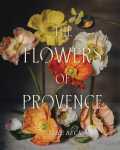
The Flowers of Provence by Jamie Beck (Gift books feature): A gorgeous book of photographs, perfect for gardeners, romantics, and armchair travelers. Her still lifes are as detailed and colorful as medieval paintings.
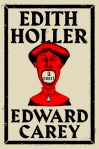
Edith Holler by Edward Carey (forthcoming): A dark fairy tale about a precocious girl confined to her family’s theatre in Norwich, England yet driven to reveal the truth behind her city’s child disappearances. Reminiscent of Dahl, Dickens, and Shakespeare at their goriest.
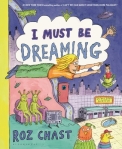
I Must Be Dreaming by Roz Chast: A laugh-out-loud-funny tour through her dream journal as well as a brief introduction to dream theory. Delightfully captures the randomness of dream topics and dialogues.

Tremor by Teju Cole: A kaleidoscopic work of autofiction that journeys between the US and Nigeria as it questions the ownership and meaning of Black art. The sophisticated structure is a highlight of this elegant study of art criticism, suffering, and subjectivity.
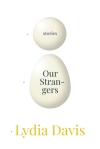
Our Strangers by Lydia Davis (Review and Q&A): In her ninth collection of mostly flash-length stories (a whopping 143 of them), an overarching theme is the mystery of human communication and connection. A real cornucopia of genres, structures, and voices. [Only available via Bookshop.org and independent bookstores.]
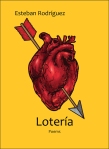
Lotería by Esteban Rodríguez: Lotería is a traditional Mexican game of chance. Each Spanish-language card is allotted a one-page poem in a creative, poignant recounting of his Mexican American family history.
Glass Half Empty by Rachael Smith: The British comics artist third graphic memoir is a refreshingly candid account of her recovery from alcoholism after her father’s death. In some panes, her adult self appears alongside her younger self, offering advice.


The Dead Peasant’s Handbook by Brian Turner: The final installment – after The Wild Delight of Wild Things and The Goodbye World Poem – in an intimate, autobiographical trilogy. Love is presented as the key to surviving bereavement and wartime trauma.
Happy Birthday & Bookshop Day
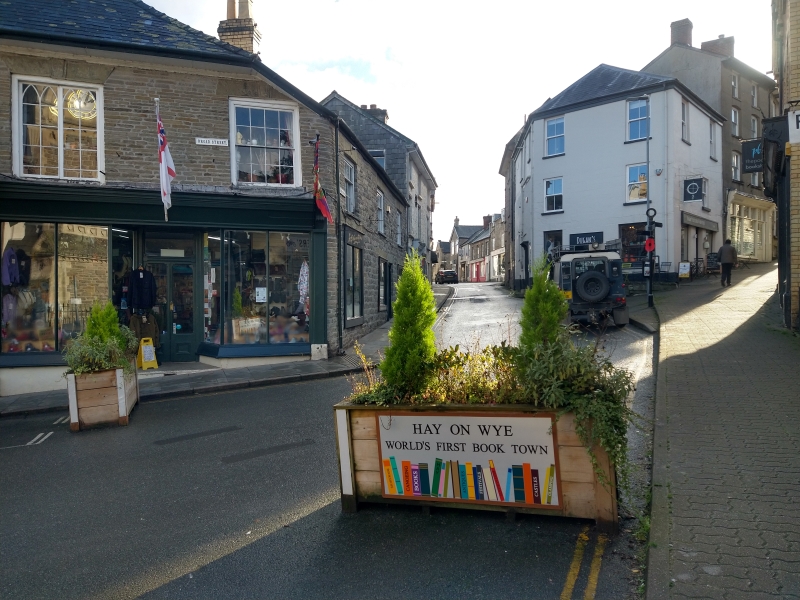
Happy Bookshop Day from Hay-on-Wye (and its newest bookshop, Gay on Wye)!


Today is my 40th birthday and I have been spending the weekend book shopping, reading, eating and drinking. What more could I ask for?


Before we left for Wales, I had my book club over for birthday cakes and bubbles. My husband made me a chocolate Guinness cake (vegan so everyone could share it) and pumpkin chai cupcakes; both recipes were from Hummingbird Bakery cookbooks.


I’ll report back on Monday with my book haul and trip highlights.
For now, here are some sweet lines from a children’s book I read this morning, about cats named Tom and Mot who discover that friendship and imagination are the greatest gifts, and that present has a double meaning: the now that must be appreciated.
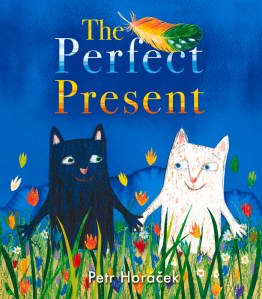
“And then it was time for a hot drink and the cake. The cake tasted like the BEST birthday cake in the world. … ‘Today was the best present in the world,’ said Tom. ‘The perfect present!’”
A May Sarton Birthday Celebration
These days I consider May Sarton one of my favourite authors, but I’ve only been reading her for about nine years, since I picked up Journal of a Solitude on a whim. (Ten years prior, when I was a senior in college working in a used bookstore on evenings and weekends, a customer came up and asked me if we had anything by May Sarton. I had never heard of her so said no, only later discovering that we shelved her in with Classic literature. Huh. I can only apologize to that long-ago customer for my ignorance and negligence.)
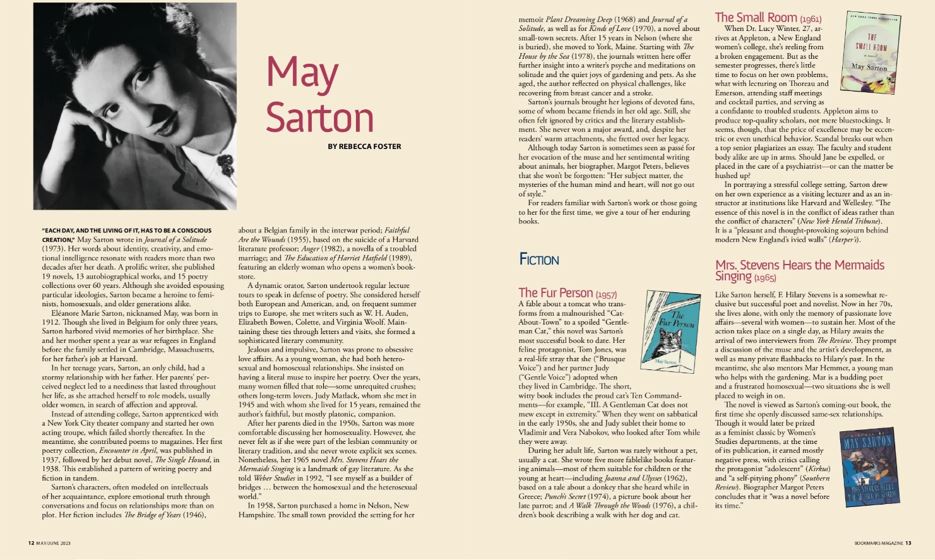
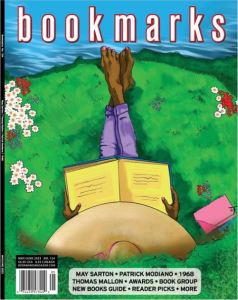 A general-interest article I wrote on May Sarton’s life and work appears in the May/June 2023 issue of Bookmarks magazine, for which I am an associate editor. I submitted this feature back in August 2019, so it’s taken quite some time for it to see the light of day, but I’m pleased that the publication happened to coincide with the anniversary of her birth. In fact, today, May 3rd, would have been her 111th birthday. For the article, I covered a selection of Sarton’s fiction and nonfiction, and gave a brief discussion of her poetry (which the magazine doesn’t otherwise cover).
The two below, a journal and a novel, are works I’ve read more recently. Both were secondhand purchases, I think from Awesomebooks.com.
Encore: A Journal of the Eightieth Year (1993)
 Sarton is one of those reasonably rare authors who published autobiography, fiction AND poetry. I know I’m not alone in thinking that the journals and memoirs are where she really shines. (She herself was proudest of her poetry, and resented the fact that publishers only seemed to be interested in novels because they were what sold.) I came to her through her journals, which she started writing in her sixties, and I love them for how frankly they come to terms with ageing and the ill health and loss it inevitably involves. They are also such good, gentle companions in that they celebrate seasonality and small joys: her beautiful New England homes, her gardening hobby, her pets, and her writing routines and correspondence.
Encore was the only journal I had left unread; soon it will be time to start rereading my top few. When Sarton wrote this in 1991–2, she was recovering from a spell of illness and assumed it would be her final journal. (In fact, At Eighty-Two would appear two years later.) Although she still struggles with pain and low energy, the overall tone is of gratitude and rediscovery of wonder. Whereas a few of the later journals can get a bit miserable because she’s so anxious about her health and the state of the world, here there is more looking back at life’s highlights. Perhaps because Margot Peters was in the process of researching her biography (which would not appear until after her death), she was nudged into the past more often. I especially appreciated a late entry where she lists “peak experiences,” ranging from her teen years to age 80. What a positive way of thinking about one’s life!
For many months I kept this as a bedside book and read just an entry or two a night. When I started reading it more quickly and straight through, I did note some repetition, which Sarton worried would result from her dictating into a recording device. But I don’t think this detracts significantly. In this volume, events of note include a trip to London and commemorative publications plus a conference all to mark her 80th birthday. She’s just as pleased with tiny signs of her success, though, such as a fan letter saying The House by the Sea inspired the reader to put up a bird feeder. 
The Education of Harriet Hatfield (1988)
This is my eighth Sarton novel. In general, I’ve had less success with her fiction as it can be formulaic: characters exist to play stereotypical roles and/or serve as mouthpieces for the author’s opinions. That’s certainly true of Harriet Hatfield, who, like the protagonist of Mrs. Stevens Hears the Mermaids Singing, is fairly similar to Sarton. After the death of her long-time partner, Vicky, who ran a small publishing house, sixty-year-old Harriet decides to open a women’s bookstore in a Boston suburb. She has no business acumen, just enthusiasm (and money, via the inheritance from Vicky). College girls, housewives, nuns and older feminists all become regulars, but Hatfield House also attracts unwanted attention in this dodgy neighbourhood, especially after a newspaper outs Harriet: graffiti, petty theft and worse. The police are little help, but Harriet’s brothers and a local gay couple promise to look out for her.
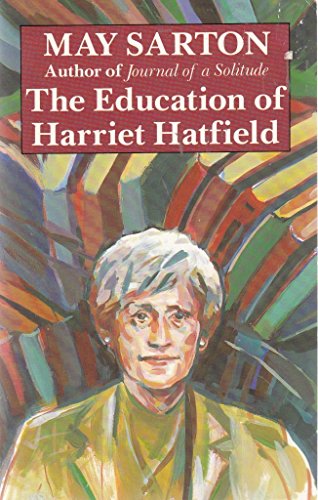 The central struggle for Harriet is whether she will remain a private lesbian – as one customer says to her, “you are old and respectable and no one would ever guess”; that is, she can pass as straight – or become part of a more audible, visible movement toward equal rights. It’s cringe-worthy how unsubtly Sarton has Harriet recognize (the “Education” the title speaks of) her privilege and accept her parity with other minorities through friendships with a Black mother, a battered wife who gets an abortion, and a man whose partner is dying of AIDS. Harriet’s brother, too, comes out to her as gay, and I was uneasy with the portrayal of him and the AIDS patient as promiscuous to the point of bringing any suffering on themselves.
Still, when I consider that Sarton was in her late seventies at the time she was writing this, and that public knowledge of AIDS would have been poor at best, I think this was admirably edgy. Harriet’s dilemma reflects Sarton’s own identity crisis, as expressed in Encore: “I do not wish to be labeled as a lesbian and do not wish to be labeled as a woman writer but consider myself a universal writer who is writing for human beings.” Nowadays, though, what Harriet deems discretion comes across as cowardice and priggishness.
While there are elements of Harriet Hatfield that have not aged well, if you focus on the Bythell-esque bookshop stuff (“I find that the people I love best are those who come in to browse, the silent shy ones, who are hungry for books rather than for conversation”) rather than the consciousness-raising or the mystery subplot, you might enjoy it as much as I did. Kudos for the first and last lines, anyway: “How rarely is it possible for anyone to begin a new life at sixty!” and “It’s the real world and I am fully alive in it.” 
Women’s Prize Longlist Reviews (Erdrich, Mendelson, Ozeki) & Predictions
Tomorrow the Women’s Prize shortlist will be revealed. I’ve become much more invested in this prize over the past few years and will be following the 2022 race especially closely – look out for a related announcement soon. In recent years the nominees have tended to cluster thematically, which can feel redundant. This longlist has a notably high ghost quotient. Two novels I review below feature unquiet spirits, an appearance by the author, and the magical powers of books. The third is a straightforward contemporary dysfunctional family story.
The Sentence by Louise Erdrich
My second from Erdrich (I gave Love Medicine, her first novel, 5 stars in 2020). I will be revisiting this in June because it is our first pick for my tenure in the Literary Wives online book club. For that post I’ll focus on the relationship between Tookie and Pollux, which I won’t mention in this more general response. I was worried that a take on very recent events – this is set in Minneapolis between 2019 and 2020 and covers the first six months of the pandemic plus local protests following George Floyd’s murder – would seem either rushed or dated. I’m still unsure how I feel about encountering Covid-19 in fiction (vs. I’ve read 20 or more nonfiction records now), but I think this novel functions as a sturdy time capsule.
 Tookie, the narrator, has a tough exterior but a tender heart. When she spent 10 years in prison for a misunderstanding-cum-body snatching, books helped her survive, starting with the dictionary. Once she got out, she translated her love of words into work as a bookseller at Birchbark Books, Louise Erdrich’s Minnesota independent bookshop (Louise herself is an occasional character). Bibliophiles are sure to enjoy the mentions of the books she presses into customers’ hands; there’s also a fun appendix of recommendations on particular topics.
However, the central mystery about Flora, a dead customer who haunts the store until Tookie figures out why she died and how to exorcise her, struck me as silly. I only appreciated this storyline to the extent that it explores authenticity (Flora may have fabricated her Native heritage) and the inescapability of history. I preferred real life: Tookie getting locked down with her stepdaughter and baby grandson and filling book orders from a closed shop.
Erdrich weaves in Indigenous customs naturally and the banter between the characters, including young shop employees, makes this hip and lighthearted, even as it deals with serious subjects. I smiled at the bookish lingo, like Tookie’s division of her reading into a Lazy Stack and a Hard Stack (“books I would avoid reading until some wellspring of mental energy was uncapped” – my occasional and set-aside titles could comprise the latter) and the “cowbirds,” self-published titles secreted on the shelves that aren’t found until inventory day. There’s also an excellent passage on novellas that I’ll be bringing out in November.
Like a vintage armchair, this is a little overstuffed, but so comfortable you’ll want to stay a while. (See also Laura’s review.) (Public library)
The Exhibitionist by Charlotte Mendelson
~SPOILERS IN THIS ONE~
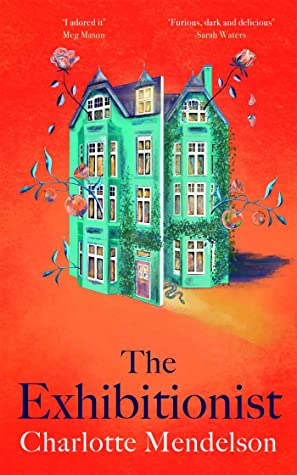 Artists, dysfunctional families, and limited settings (here, one crumbling London house and its environs; and about two days across one weekend) are irresistible elements for me, and I don’t mind a work being peopled with mostly unlikable characters. That’s just as well, because the narrative orbits Ray Hanrahan, a monstrous narcissist who insists that his family put his painting career above all else. His wife, Lucia, is a sculptor who has always sacrificed her own art to ensure Ray’s success. But now Lucia, having survived breast cancer, has the chance to focus on herself. She’s tolerated his extramarital dalliances all along; why not see where her crush on MP Priya Menon leads? What with fresh love and the offer of her own exhibition in Venice, maybe she truly can start over in her fifties.
Ray and Lucia’s three grown children, Leah, Patrick and Jess, are all home for Ray’s new exhibition. They’re mere sketches: Leah is Ray’s staunchest supporter and is infatuated with the no-show caterer; Patrick’s mental health is shaky, interfering with his job prospects; Jess, a teacher in Edinburgh, is pregnant but not sure she’s committed to her boyfriend long term. I wanted more depth from all the characters, but especially the offspring. I also expected a climactic late scene on Hampstead Heath to come to more.
Still, the build-up to the exhibit (followed by a laughably pitiful reveal) and Lucia’s inner life form an adequately strong foundation for Mendelson’s sardonic prose. The dialogue, full of interruptions, is true to life. This is her fifth novel and called to mind Jami Attenberg’s and Claire Fuller’s work. (Liz found shades of Iris Murdoch. Susan loved it, too.) I wouldn’t say I’m compelled to seek out more by Mendelson, but this was a solid read. (Public library)
The Book of Form and Emptiness by Ruth Ozeki
A Tale for the Time Being is one of my favourite novels of the century (and one of my most popular Goodreads reviews ever), My Year of Meats was a terrific backlist read a couple of summers ago, and I’m eager to catch up on All Over Creation. So I’d built up this fourth Ozeki novel in my head, thinking a library setting and magic realist elements presaged something deliciously Murakami-esque.
 What I actually found, having limped through it off and on for seven months, was something of a disappointment. A frank depiction of the mental health struggles of the Oh family? Great. A paean to how books and libraries can save us by showing us a way out of our own heads? A-OK. The problem is with the twee way that The Book narrates Benny’s story and engages him in a conversation about fate versus choice.
When Kenji Oh, a jazz musician, is run over by a chicken truck, Annabelle finds herself a single mother to Benny, a troubled teen who starts to hear everyday objects speaking to him. His voices and Annabelle’s hoarding habit jeopardize the viability of their household: Benny spends time on a psychiatric hospital ward for minors and Annabelle is threatened with eviction. For Benny, the library and the acquaintances he makes there – a fellow pedi-psych patient named Alice who calls herself The Aleph, an Eastern European philosopher who goes by The Bottleman (= Slavoj Žižek?), even the Ozeki figure tapping away on her laptop – may be his salvation; for Annabelle, it could be the book Tidy Magic (modelled on Marie Kondo’s work), written by a Buddhist nun. But until then, their stories get very dark indeed.
Concern for the principal pair and their relationship kept me reading even though this is too long and I wearied of Ozeki’s habit of literalizing metaphors (books speaking to people; being crushed by one’s belongings; crows playing a protective role). I’m still sympathetic to Ozeki’s aims, even if she doesn’t quite pull it all off here. If I pit the rather similar The Sentence and The Book of Form and Emptiness against each other, Erdrich comes out ahead. 
With thanks to Canongate for the proof copy for review.
I’ve gotten to six books from the longlist so far and have a few more on order at the library. The others I’ve read, with ratings and links to my reviews, are:
Build Your House around My Body by Violet Kupersmith
Sorrow and Bliss by Meg Mason
I’m also partway through The Final Revival of Opal & Nev by Dawnie Walton, which is enjoyable enough but, alas, suffers in comparison to Daisy Jones and the Six, whose format (a composite oral history of a fictional 1960s/70s musical act) it repeats. The addition of the race issue doesn’t feel sufficient to call it original.
I’ve also DNFed a few from the longlist, two of them multiple times, so I have my fingers crossed that they don’t advance!
- The Paper Palace by Miranda Cowley Heller
- The Island of Missing Trees by Elif Shafak
- Great Circle by Maggie Shipstead
My attitude to the rest of the longlist is…
- The Bread the Devil Knead by Lisa Allen-Agostini – No plans to read.
- Salt Lick by Lulu Allison – I might read this from the library. I’m leery of dystopias, but I’m there for a chorus of cows.
- Careless by Kirsty Capes – No plans to read.
- Remote Sympathy by Catherine Chidgey – I would happily read it if it’s shortlisted, but at over 500 pages I fear it’ll be too dense.
- Flamingo by Rachel Elliott – Maybe. Sounds like pretty standard Sarah Winman-type stuff, but it could go down well with a book club.
- This One Sky Day by Leone Ross – No plans to read.
- Creatures of Passage by Morowa Yejidé – I was actually pretty keen to read this one, so I have it on reserve at the library. Egyptian mythology makes a change from the overdone Greeks, and the Washington, D.C. setting is a big draw. Laura’s review has tempered my expectations, but I might still give it a go.
My ideal shortlist (a wish list based on my reading and what I still want to read):
The Sentence by Louise Erdrich
Build Your House around My Body by Violet Kupersmith
Sorrow and Bliss by Meg Mason
The Exhibitionist by Charlotte Mendelson
The Final Revival of Opal & Nev by Dawnie Walton
Creatures of Passage by Morowa Yejidé
vs.
My predicted shortlist:
Remote Sympathy by Catherine Chidgey
The Sentence by Louise Erdrich
Sorrow and Bliss by Meg Mason
The Exhibitionist by Charlotte Mendelson
This One Sky Day by Leone Ross
The Island of Missing Trees by Elif Shafak
An overall winner? Gosh, it’s too early to tell. But maybe The Sentence, Sorrow and Bliss or The Island of Missing Trees.
See also Laura’s shortlist predictions.
What have you read from the longlist so far?
Which of these books are calling to you?
Sad Souvenirs: Defunct Bookshops’ Bookmarks
I’m a dedicated bookmark user and probably have at least 120–150 that I rotate through, matching marker to book subject matter or reading location whenever possible. A sorry subset of my collection commemorates bookshops (secondhand and/or new stock) that no longer exist. I was a customer at a couple of these, but only know of the others through bookmarks that I found at random, e.g. in secondhand purchases from other stores. Through Google Earth, I tracked down what you’ll find where these shops used to be.
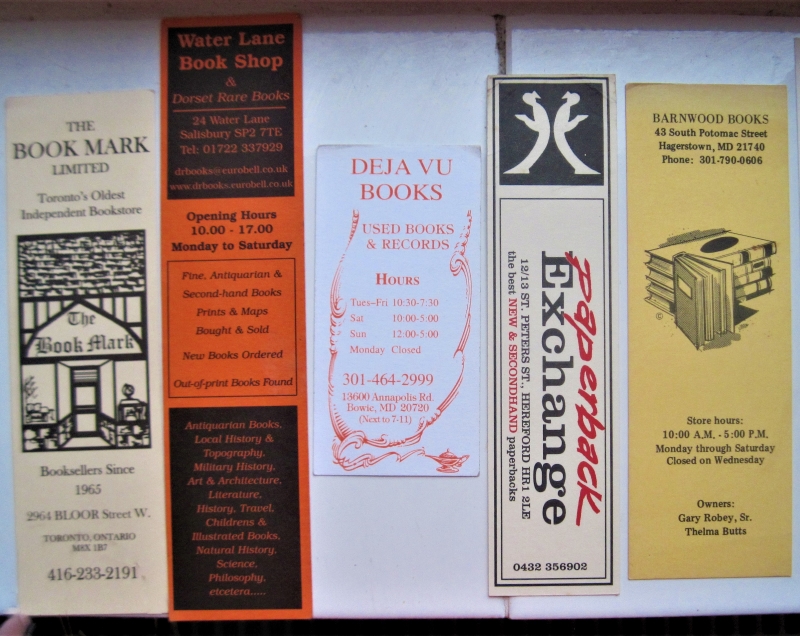
Shops I visited:
Déjà Vu Books (Bowie, Maryland)
This was my local secondhand bookshop when I was a teenager. I would wheedle occasional visits out of my mother until my friends and I got our driving licenses and could go by ourselves. My friend Rachael and I would stop there after karate on a Saturday morning.
What I remember purchasing there: A near-complete set of Dickens’s works, blue/green cloth hardbacks, early 20th century, for $30; an Agatha Christie omnibus I gave to my mother.
What it is now: Chi Bella Natural Hair Boutique
Water Lane Book Shop (Salisbury, England)
My husband is a Hampshire lad. Salisbury was a relatively nearby town we would explore when I went to visit him while we were dating or engaged. An average daytrip would include touring the cathedral, having tea at the Polly Tearooms, and – in a waterside location just along from the cathedral square – having a nose through the well-stocked shelves of this compact shop.
What I remember purchasing there: Lots of my secondhand David Lodge paperbacks.
What it is now: A private residence (it had just sold as of Streetview in June 2018)
Others I only learned about through their orphan bookmarks:
Barnwood Books (Hagerstown, Maryland)
The bookmark looks old enough that I had to ask myself whether the shop might have been supplanted by Wonder Book & Video, a small chain I first discovered as a young teen. It has branches in Frederick (where I went to college; I worked there part-time in my senior year) and Hagerstown, and most recently opened in Gaithersburg. At the least, Wonder Book probably absorbed their stock when they closed.
What it is now: An empty storefront between a gastropub and a home fashions store (as of October 2019)
The Book Mark (Toronto, Canada)
I found this bookmark inside a secondhand book I bought from the Frederick Wonder Book & Video. I assumed the shop was still extant, but I checked in with Marcie (Buried in Print) and she sent me an article explaining that it was priced out of the neighbourhood and closed in 2012. It had been the oldest independent bookstore in Toronto. (This article gives more information.)
What it is now: Nails on Bloor, a nails and waxing parlour
Paperback Exchange (Hereford, England)
I can’t recall where I found this bookmark, but I wish a shop with this policy still existed! From the reverse: “The Paperback Exchange system: up to HALF the purchase price of books bought from us, against further purchases; up to a QUARTER on good quality paperbacks bought elsewhere.”
What it is now: On the June 2018 Streetview, it’s either the closed-down charity shop or the school uniform shop.
A nice postscript:
Royal Oak Bookshop (Front Royal, Virginia)
The bookmark I found in a used book looked so old I wasn’t sure if the shop would still exist. I was going to include it in the post as one of the defunct ones. But just to be sure, I decided to try hunting it down through the website…


Do you commemorate any deceased bookshops through their memorabilia?
Bookbarn Book Haul & More
 We’re back from our weekend in Bristol and Exeter to hang out with university friends and attend our goddaughter’s dedication service. On the way (ish) down, we stopped at Bookbarn International, one of my favorite places to look for secondhand books. The shop is always coming up with new ideas and ventures – a rare books room, a café, stationery and store-brand merchandise, new stock alongside the used books, and so on – and has recently been doing some renovating of the main shop space. I contributed to a crowdfunder for this and got to pick up my rewards while I was there, including the items at right and a £10 store voucher, which, along with the small balance of my vendor account, more than covered my purchases that day.
We arrived around noon so started with a café lunch of all-day veggie cooked breakfasts plus cakes and coffee. Delicious! Then it was time for some dedicated browsing. All of the books on the main shop floor are £1 each; they’re working on restocking this area after the refurbishment. I found 12 books here, and ordered another two (the Janet Frame biography and Gail Godwin’s nonfiction book Heart) from the warehouse for £2 each.
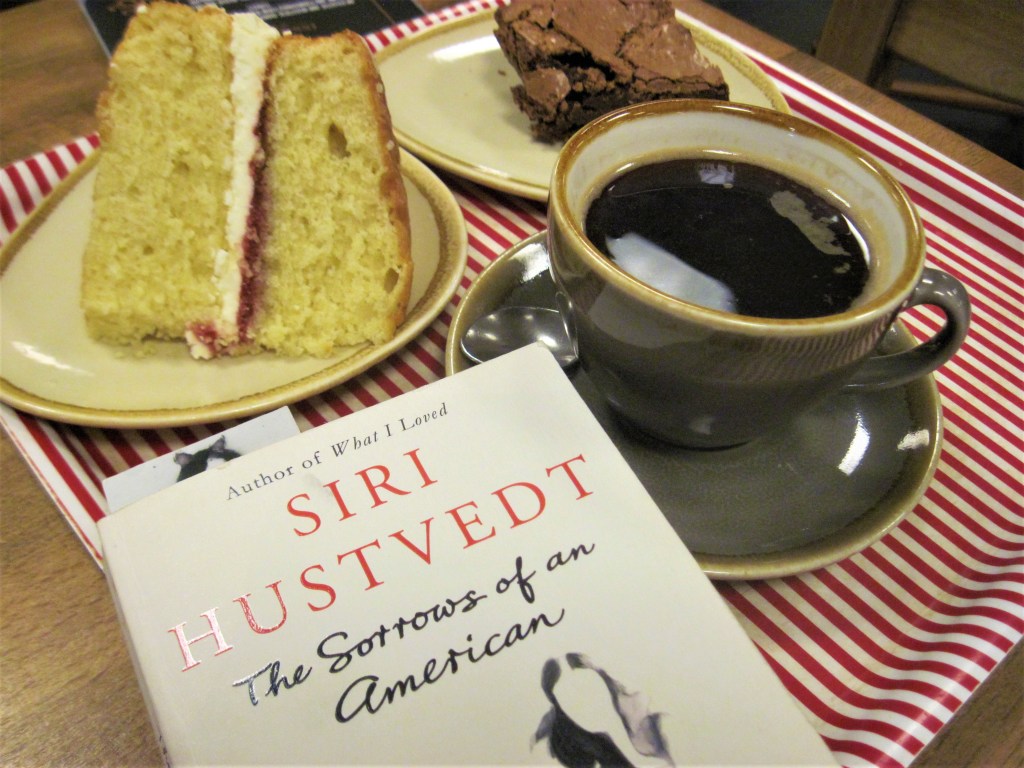
From my book haul, I’m particularly pleased with:
- The sequel to another Robertson Davies novel I own
- The Frame biography – I loved her three-part autobiography and have also been dipping into her fiction; it will be fascinating to learn the ‘truth’ behind how she presented her life in memoir and autofiction. This copy looks to be in new condition, too.
- The Tulip by Anna Pavord, which I’ve long meant to read
- Another Carolyn Parkhurst novel – I loved The Dogs of Babel and Harmony
- Another Wendy Perriam novel – I read my first last year and have been hoping to find more

I also bought copies of two of my favorite memoirs, And When Did You Last See Your Father? and Journal of a Solitude (though I own a copy in America, I’d like it to be part of my rereading project this year). I now own two unread novels each by Candia McWilliam and Michèle Roberts and three by Rose Tremain, so I’ll need to be sure I read one from each author this year. I also have a bad habit of hoarding biographies but not reading them, so I want to at least read the Frame one before the year is out.

Between Bristol’s charity shops and Book-Cycle in Exeter, I bought another five novels during the weekend, including the Vann to reread and several by authors I want to increase my familiarity with. (Smug points for not buying the £2.50 copy of Boyle’s The Women at Bookbarn and then finding it at Book Cycle for 50 pence instead.) Total weekend spend on 19 books: £2.12.
Picked up any good secondhand bargains recently?
The Secret Life of Books by Tom Mole
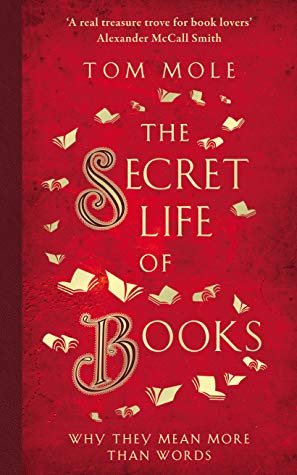 If you’re like me and author Tom Mole, the first thing you do in any new acquaintance’s house is to scrutinize their bookshelves, whether openly or surreptitiously. You can learn all kinds of surprising things about what someone is interested in, and holds dear, from the books on display. (And if they don’t have any books around, should you really be friends?)
Mole runs the Centre for the History of the Book at the University of Edinburgh, where he is a professor of English Literature and Book History. His specialist discipline and this book’s subtitle – “Why They Mean More than Words” – are clues that here he’s concerned with books more as physical and cultural objects than as containers of knowledge and stories:
“reading them is only one of the things we do with books, and not always the most significant. For a book to signal something about you, you don’t necessarily need to have read it.”
From the papyrus scroll to the early codex, from a leather-bound first edition to a mass-market paperback, and from the Kindle to the smartphone reading app, Mole asks how what we think of as a “book” has changed and what our different ways of accessing and possessing books say about us. He examines the book as a basis of personal identity and relationships with other people. His learned and digressive history of the book contains many pleasing pieces of trivia about authors, libraries and bookshops, making it a perfect gift for bibliophiles. I also enjoyed the three “interludes,” in which he explores three paintings that feature books.
There are a lot of talking points here for book lovers. Here are a few:
- Are you a true collector, or merely an “accumulator” of books? (Mole is the latter, as am I. “I have a few modest antiquarian volumes, but most of my books are paperbacks … I was the first in my immediate family to go to university, and I suspect the books on my shelves reassure me that I really have learned something along the way.”)
- In Anne Fadiman’s scheme, are you a “courtly” or a “carnal” reader? The former keeps a book pristine, while the latter has no qualms about cracking spines or dog-earing pages. (I’m a courtly reader, with the exception that I correct all errors in pencil.)
- Is a book a commercial product or a creative artifact? (“This is why authors quite often cross out the printed version of their name when they sign. Their action negates the book’s existence as a product of industry or commerce and reclaims it as the product of their own artistic effort.”)
- How is the experience of reading an e-book, or listening to an audiobook, different from reading a print book? (There is evidence that we remember less when we read on a screen, because we don’t have the physical cues of a book in our hand, plus “most people could in theory fit a lifetime’s reading on a single e-reader.”)
I would particularly recommend this to readers who have enjoyed Anne Fadiman’s Ex Libris, Alberto Manguel’s various books on libraries, and Tim Parks’s Where I’m Reading From.
A personal note: I was delighted to come across a mention of one of the visiting professors on my Master’s course in Victorian Literature at the University of Leeds, Matthew Rubery. In the autumn term of 2005, he taught one of my seminars, “The Reading Revolution in the Victorian Period,” which had a Book History slant and included topics like serial publication, anonymity and the rise of the media. A few years ago Rubery published an academic study of audiobooks, The Untold Story of the Talking Book, which Mole draws on for his discussion.
Two more favorite passages:
“when I’m reading, I’m not just spending time with a book, but investing time in cultivating a more learned version of myself.”
“A library is an argument. An argument about who’s in and who’s out, about what kinds of things belong together, about what’s more important and what’s less so. The books that we choose to keep, the ones that we display most prominently, and the ones that we shelve together make an implicit claim about what we value and how we perceive the world.”
My rating:
The Secret Life of Books will be published by Elliott & Thompson on Thursday 19th September. My thanks to Alison Menzies for arranging my free copy for review.
 Bookish Beck = Rebecca Foster. American transplant to England. Freelance proofreader and book reviewer.
 Bookish Beck