The Stone Diaries by Carol Shields (Blog Tour Review)
Is it possible to capture the complete course of a life, whether looking from the outside or telling it from the inside? What is set in stone and what is fleeting? These are questions Carol Shields addresses in her 1995 Pulitzer Prize winner, which plays with perspective and forms of storytelling as it conveys the extra/ordinary life of Daisy Stone Goodwill Flett. What with the family tree and section of black-and-white photographs, you might expect this to be a family saga; with the chronological chapters proceeding from “Birth” in 1905 to “Death” in the 1990s, you might expect an objective faux-biography. But The Stone Diaries is neither.
 The facts are these. Daisy’s mother, Mercy, dies giving birth to her in rural Manitoba. Raised by a neighbor, Daisy later moves to Indiana with her stonecutter father, Cuyler. After a disastrously short first marriage, Daisy returns to Canada to marry Barker Flett. Their three children and Ottawa garden become her life. She temporarily finds purpose in her empty-nest years by writing a “Mrs. Green Thumb” column for a local newspaper, but her retirement in Florida is plagued by illness and the feeling that she has missed out on what matters most.
What makes this surprising life story so remarkable is its unpicking of (auto)biographical authenticity: Shields switches between the first and third person, between Daisy’s point of view and a feigned omniscience. Some sections foreground others’ opinions: Chapter 6 is composed entirely of letters Daisy receives, while Chapter 7 collects short first-person narratives from her children and friends as they speculate on why she has fallen into a depression.
As in Shields’s Happenstance and Larry’s Party, which I’ve also reread this year, I was struck by the role that chance plays in any life:
History indeed! As though this paltry slice of time deserves such a name. Accident, not history, has called us together, and what an assembly we make. What confusion, what a clamor of inadequacy and portent.
Talk of bias, gaps and unreliability undermines the narrative:
Well, a childhood is what anyone wants to remember of it. It leaves behind no fossils, except perhaps in fiction. Which is why you want to take Daisy’s representation of events with a grain of salt, a bushel of salt.
Daisy herself almost disappears from the parts of the book where she is voiceless, consumed by her roles – by the end she is universally known as “Grandma Flett.” This meant that other characters stood out as more memorable to me: Cuyler for his obsessive building of stone monuments and streams of words, Barker for his love of plants and long-deferred sexual fulfillment, Daisy’s friend Fraidy Hoyt for her careful chronicling of fast living, and Magnus, Barker’s father, who lives long past his 100th birthday after his return to the Orkney Islands.
 As in Moon Tiger, one of my absolute favorites, the author explores how events and memories turn into artifacts. The meta approach also, I suspect, tips the hat to other works of Canadian literature: in her introduction, Margaret Atwood mentions that the poet whose story inspired Shields’s Mary Swann had a collection entitled A Stone Diary, and surely the title’s similarity to Margaret Laurence’s The Stone Angel (1964) can’t be pure coincidence.
Experiencing the novel again after 14 years, I was impressed by the experimentation but ultimately somewhat detached from the story. It was admiration rather than love; I enjoyed earlier chapters more than the last few. But isn’t that just like life, to keep going past the point where it’s fun? And isn’t that the point, that the meaning you long for may not be there at all?
Marcie (Buried in Print) and I have reread – or, in my case for half of them, read for the first time – six Shields novels together in 2020. I hope I’ll find time to respond to the rest of them in the next few weeks. It has been so rewarding to observe how her themes recur and interlock. How heartening to see that, 17 years after her death, Shields is still being read and remembered, through the World Editions reissues (three more are coming in 2021) and through the Carol Shields Prize for Fiction, a new $100,000 annual award for North American women’s writing.
The Stone Diaries was reissued in the UK by World Editions on December 3rd. My thanks to the publisher for the free copy for review.
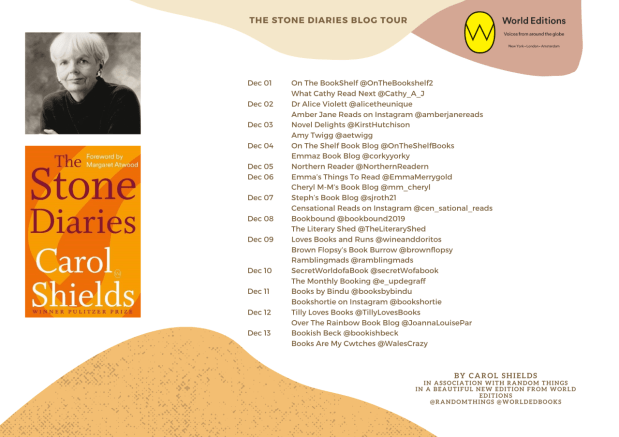
I was delighted to be invited to help close out the blog tour for The Stone Diaries. See below for details of where other reviews have appeared.
Completing the Women’s Prize Winners Reading Project and Voting
In this 25th anniversary year of the Women’s (previously Orange/Baileys) Prize, people have been encouraged to read all of the previous winners. I duly attempted to catch up on the 11 winners I hadn’t yet read, starting with Fugitive Pieces by Anne Michaels; Half of a Yellow Sun by Chimamanda Ngozi Adichie and A Crime in the Neighborhood by Suzanne Berne as part of a summer reading post; and When I Lived in Modern Times by Linda Grant, Property by Valerie Martin and Larry’s Party by Carol Shields (a reread) in this post.
This left just four for me to read before voting for my all-time favorite in the web poll. I managed two as recent buddy reads but had to admit defeat on the others, giving them just the barest skim before sending them back to the library.
The Idea of Perfection by Kate Grenville (1999; 2001 prize)
(Buddy read with Laura T.; see her review here)
 This is essentially an odd-couple romance, but so awkward I don’t think any of its scenes could accurately be described as a meet-cute. Harley Savage, a thrice-married middle-aged widow, works for the Applied Arts Museum in Sydney. The tall, blunt woman is in Karakarook, New South Wales to help the little town launch a heritage museum. Douglas Cheeseman is a divorced engineer tasked with tearing down a local wooden bridge and building a more suitable structure in its place. Their career trajectories are set to clash, but the novel focuses more on their personal lives. From the moment they literally bump into each other outside Douglas’ hotel, their every meeting is so embarrassing you have to blush – she saves him from some angry cows, while he tends to her after a bout of food poisoning.
Grenville does well to make the two initially unappealing characters sympathetic, primarily by giving flashes of backstory. Douglas is the posthumous child of a war hero, but has never felt he’s a proper (macho) Australian man. In fact, he has a crippling fear of heights, which is pretty inconvenient for someone who works on tall bridges. Harley, meanwhile, is haunted by the scene of her last husband’s suicide and is also recovering from a recent heart attack.
The title is, I think, meant to refer to how the protagonists fail to live up to ideals or gender stereotypes. However, it more obviously applies to the subplot about Felicity Porcelline, a stay-at-home mother who has always sought to be flawless – a perfect pregnancy, an ageless body (“Sometimes she thought she would rather be dead than old”), the perfect marriage – but gets enmired in a dalliance with the town butcher. I was never convinced Felicity’s storyline was necessary. Without it, the book might have been cut from 400 pages to 300.
Still, this was a pleasant narrative of second chances and life’s surprises. The small-town setting reminded Laura of Olive Kitteridge in particular, and I also thought frequently of Anne Tyler and her cheerfully useless males (“There was a lot to be said for being boring, and it was something [Douglas] was good at”). But I suspect the book won’t remain vivid in my memory, especially with its vague title that doesn’t suggest the contents. I enjoyed Grenville’s writing, though, so will try her again. In my mind she’s more known for historical fiction. I have a copy of The Secret River, so will see if she lives up to that reputation.
My rating: 
How to Be Both by Ali Smith (2014)
(Buddy read with Marcie of Buried in Print.)
 A book of two halves, one of which I thoroughly enjoyed; the other I struggled to engage with. I remembered vaguely as I was reading it that this was published in two different versions. As it happened, my library paperback opened with the contemporary storyline.
New Year’s Day marks the start of George’s first full year without her mother, a journalist who died at age 50. Her mother’s major project was “Subvert,” which used Internet pop-ups to have art to comment on politics and vice versa. George remembers conversations with her mother about the nature of history and art, and a trip to Italy. She’s now in therapy, and has a flirty relationship with Helena (“H”), a mixed-race school friend.
Smith’s typical wordplay comes through in the book’s banter, especially in George and H’s texts. George is a whip-smart grammar pedant. Her story was, all in all, a joy to read. There is even a hint of mystery here – is it possible that her mother was being monitored by MI5? When George skips school to gaze at her mother’s favorite Francesco del Cossa painting in the National Gallery, she thinks she sees Lisa Goliard, her mother’s intense acquaintance, who said she was a bookbinder but acted more like a spy…
The second half imagines a history for Francesco del Cossa, who rises from a brick-making family to become a respected portrait and fresco painter. The artist shares outward similarities with George, such as a dead mother and homoerotic leanings. There are numerous tiny connections, too, some of which I will have missed as my attention waned. The voice felt all wrong for the time period; I sensed that Smith wasn’t fully invested in the past, so I wasn’t either. (In dual-timeline novels, I pretty much always prefer the contemporary one and am impatient to get back to it; at least in books like Unsheltered and The Liar’s Dictionary there are alternate chapters to look forward to if the historical material gets tedious.)
An intriguing idea, a very promising first half, then a drift into pretension. Or was that my failure to observe and appreciate? Smith impishly mocks: “If you notice, it changes everything about the picture.” With her format and themes, she questions accepted binaries. There are interesting points about art, grief and gender, even without the clever links across time. But had the story opened with the other Part 1, I may never have gotten anywhere.
My rating: 
Skims
I made the mistake of leaving the three winners that daunted me the most stylistically – McBride, McInerney and Smith – for last. I eventually made it through the Smith, though the second half was quite the slog, but quickly realized these two were a lost cause for me.
 A Girl Is a Half-formed Thing by Eimear McBride: I’d glanced at the first few pages in a shop before and found the style immediately off-putting. When I committed to this #ReadingWomen project, I diligently requested a copy from the university library even though I seriously doubted I’d have the motivation to read it. It turns out my first impression was correct: I would have to be paid much more than I’ve ever been paid for writing about a book just to get through this one. From the first paragraph on, it’s deliberately impenetrable in a sub-Joycean way. Ron Charles, the Washington Post book critic and one of my literary heroes/gurus, found the subject matter relentlessly depressing and the obfuscating style elitist. (Might it work as an audiobook? I can’t say; I’ve never listened to one.)
 The Glorious Heresies by Lisa McInerney: Not as stylistically difficult as expected, though there is mild dialect and long passages in italics (one of my reading pet peeves). But I’m not drawn to gangster stories, and after a couple of chapters didn’t feel like pushing myself through the book. I did enjoy the setup of Maureen killing an intruder with a holy stone, eliciting this confession: “I crept up behind him and hit him in the head with a religious ornament. So first I suppose God would have to forgive me for killing one of his creatures and then he’d have to forgive me for defiling one of his keepsakes.” For Anna Burns and Donal Ryan fans, perhaps?
It’s been many years since I’ve read some of these novels, such that all I have to go on is my vague memories and Goodreads ratings, and there are a handful there towards the bottom that I couldn’t get through at all, but I still couldn’t resist having a go at ranking the 25 winners, from best to least. My completely* objective list:
(*not at all)
Larry’s Party by Carol Shields
Half of a Yellow Sun by Chimamanda Ngozi Adichie
We Need to Talk about Kevin by Lionel Shriver
An American Marriage by Tayari Jones
The Tiger’s Wife by Téa Obreht
On Beauty by Zadie Smith
Home Fire by Kamila Shamsie
A Crime in the Neighborhood by Suzanne Berne
The Road Home by Rose Tremain
When I Lived in Modern Times by Linda Grant
The Idea of Perfection by Kate Grenville
Fugitive Pieces by Anne Michaels
The Lacuna by Barbara Kingsolver
Bel Canto by Ann Patchett
May We Be Forgiven by A.M. Homes
Property by Valerie Martin
Small World by Andrea Levy
Home by Marilynne Robinson
How to Be Both by Ali Smith
The Power by Naomi Alderman
Hamnet by Maggie O’Farrell
A Spell of Winter by Helen Dunmore
The Glorious Heresies by Lisa McInerney
The Song of Achilles by Madeline Miller
A Girl Is a Half-formed Thing by Eimear McBride
You can see the arbitrary nature of prizes at work here: some authors I love have won for books I don’t consider their best (Adichie, Kingsolver, O’Farrell, Patchett), while some exceptional female authors have been nominated but never won (Toni Morrison, Elizabeth Strout, Anne Tyler). Each year the judges are different, and there are no detailed criteria for choosing the winner, so it will only ever be the book that five people happen to like the best.
As she came out top of the heap with what is, coincidentally, the only one of the winning novels that I have managed to reread, my vote goes to Carol Shields for Larry’s Party. (People’s memory for prize winners is notoriously short, so I predict that one of the last two years’ winners, Tayari Jones or Maggie O’Farrell, will win the public’s best of the best vote.)

You have until midnight GMT on Sunday November 1st to vote for your favorite winner at this link. That’s less than a week away now, so get voting!
Note: If you’re interested in tracking your Women’s Prize reading over the years, check out Rachel’s extremely helpful list of all the nominees. It comes in spreadsheet form for you to download and fill out. I have read 138 nominees (out of 477) and DNFed another 19 so far.
Who gets your vote?
R.I.P. Reads, Part I: Magrs Buddy Read; Hynes, Johnson, Oates
This is my third year participating in R.I.P. (Readers Imbibing Peril), now in its 15th year. I read my first novel by Paul Magrs as a buddy read with Liz of Adventures in reading, running and working from home, and coincidentally had Daisy Johnson’s creepy second novel out from the library. Rounding out this first post are a novella by James Hynes and a short story by Joyce Carol Oates, by whom I still haven’t managed to read a whole book. For my planned Part II, I’m working on historical suspense novels by Michelle Paver (a constant on my R.I.P. lists, it seems) and Laura Purcell, and trying my first Henning Mankell.

666 Charing Cross Road by Paul Magrs (2011)
 Apart from Dracula, my only previous experience of vampire novels was Deborah Harkness’s books. My first book from Paul Magrs ended up being a great choice because it’s pretty lighthearted and as much about the love of books as it is about supernatural fantasy – think of a cross between Jasper Fforde and Neil Gaiman. The title is a tongue-in-cheek nod to Helene Hanff’s memoir, 84 Charing Cross Road. Like Hanff, Aunt Liza sends letters and money to a London bookstore in exchange for books that suit her tastes. A publisher’s reader in New York City, Liza has to read new stuff for work but not-so-secretly prefers old books, especially about the paranormal – a love she shares with her gay bookseller friend, Jack.
One day the bookstore (actual address: 66b) sends a gruesome treasure, a grimoire soaked in vampire blood. In the wrong hands, it returns the vampiric spirit to life and sets off a chain reaction as each victim bites and infects others. I couldn’t help but think of the pandemic; indeed, Magrs uses the word “disease” at one point. Vampirism always has erotic overtones, though, making it seem more like an STD. As it happens, the vampires’ New York leader is Liza’s niece Shelley’s boyfriend, Daniel. Meanwhile, the star exhibit at the Museum of Outsider Art where Shelley works, a Scottish Bride effigy nicknamed Bessie, has come to life. Bessie leads Liza and Jack to London in the fight against Daniel and his kind.
Set between Halloween and Christmas, this is a pacy and quick-witted story that is easy to follow even as it gets more complicated and adds in ever more secondary characters. Hints about Liza’s past experience of the supernatural and an open ending leave room for a prequel or sequel. There were a few melodramatic moments and I wasn’t always convinced by Liza’s New Yawk accent. (I also wanted to stick up for Liza and another character about her age, Consuela – Magrs often refers to one or both as “the old woman,” when in the context they can’t be far past 60!) But these are minor niggles about a book that was so much fun to read. I’ll try something else by Magrs, probably Exchange and/or one of the Brenda and Effie series – who could resist that premise of the Bride of Frankenstein running a B&B in Whitby? (See also Liz’s review.)
My rating:
The rest…
Queen of the Jungle (from Publish and Perish: Three Tales of Tenure and Terror) by James Hynes (1997)
 I read the first of this volume’s three suspense novellas and will save the others for future years of R.I.P. or Novellas in November. At 95 pages, it feels like a complete, stand-alone plot with solid character development and a believable arc. Paul and Elizabeth are academics marooned at different colleges: Paul is finishing up his postdoc and teaches menial classes at an English department in Iowa, where they live; Elizabeth commutes long-distance to spend four days a week in Chicago, where she’s on track for early tenure at the university.
The couple’s cat, Charlotte, starts acting up, peeing in random places around the apartment. The animal psychic they hire says it’s because a woman keeps coming and going, disturbing the cat’s routines. Elizabeth assumes it’s her fault, feels terrible, and redoubles her efforts to get her boss to offer Paul a job on the basis of his bizarre literary/pop culture mash-up thesis chapters. But readers soon learn the real reason for the cat’s unease: Paul is carrying on an affair with Kymberly, a graduate student from the communications department. Charlotte is preternaturally determined to terrorize Kym and broadcast Paul’s secret. It’s an amusing battle of wills that comes to have greater stakes. Mentions of computer and telephone technology made this seem slightly dated, but I liked Hynes’s writing.
My rating:
Sisters by Daisy Johnson (2020)
 Teenagers September and July were born just 10 months apart, with July always in thrall to her older sister. September can pressure her into anything, no matter how risky or painful, in games of “September Says.” But one time things went too far. That was the day they went out to the tennis courts to confront the girls at their Oxford school who had bullied July.
For much of this short novel, Johnson keeps readers guessing about what happened that day and why the girls’ mother, Sheela, took them away to Settle House, her late husband’s family home in the North York Moors. Despite the new setting, July finds it impossible to shrug off her sister’s influence. Their psychic connection is such that she feels she’s losing her own virginity as she watches September have sex with a local boy on the beach. September’s is so much the dominant personality that July admits she feels like no more than “an appendage.”
Emotionally used and physically harmed, July starts to doubt her sanity. This was most evident for me in the scene where she goes up to a soggy-looking wall of Settle House and puts a hand through it, hearing “the rustle and gurgle of motion, the shuttering of thousands of wings.” (Presuming that’s a deliberate word choice and not a typo for shuddering.) Ants start pouring out of the wall, followed by a bird. But when she goes back to look at the wall later that day, it’s intact. I was reminded of The Haunting of Hill House, with its picture of a malevolent house preying on its inhabitants’ fears.

Sisters is a book that depends entirely on its late twist, so I shall say no more. About halfway through, I had a vague idea of what the surprise might be, but convinced myself I was wrong. “What if? … Nah, couldn’t be.” I wonder how early you’ll catch on. I adore the U.S. cover, but the UK cover contains more of a hint. I think I liked Everything Under, Johnson’s Booker-shortlisted debut novel, that little bit more, but my bottom line for that one goes for this, too: “As mesmerizing as it is unsettling.” Johnson is such a talented young author, and she also has the best author photo out there at the moment, a black-and-white image of her reflected in a train window.
My rating: 
“The Woman in the Window” (from Night-Gaunts and Other Tales of Suspense) by Joyce Carol Oates (2018)
 Oates was inspired by Edward Hopper’s 1926 painting, Eleven A.M. (The striking cover image is from a photographic recreation by Richard Tuschman. Very faithful except for the fact that Hopper’s armchair was blue.) A secretary pushing 40 waits in the New York City morning light for her married lover to arrive. She’s tired of him using her and keeps a sharp pair of sewing shears under her seat cushion. We bounce between the two characters’ perspectives as their encounter nears. He’s tempted to strangle her. Will today be that day, or will she have the courage to plunge those shears into his neck before he gets a chance? In this room, it’s always 11 a.m. The tension is well maintained, but the punctuation kind of drove me crazy. I might try the rest of the book next year.
Have you been reading anything fantastical or spooky this October?
Women’s Prize Winners Reading Project: Grant, Martin, Shields et al.
In this 25th anniversary year of the Women’s Prize, readers are being encouraged to catch up on all the previous winners. I’d read 14 of them (including Hamnet) as of mid-April and have managed five more since then – plus a reread, a DNF and a skim. I recently reviewed Fugitive Pieces by Anne Michaels, and Half of a Yellow Sun by Chimamanda Ngozi Adichie and A Crime in the Neighborhood by Suzanne Berne as part of this summer reading post. This leaves just four more for me to read before voting for my all-time favorite in November.
When I Lived in Modern Times by Linda Grant (2000)
 Some settings have been done to death, but here’s one I don’t think I’d ever encountered before: Israel in the final year before statehood. Grant dramatizes the contrast between Palestine, a doomed British colony, and the Jewish hope of a homeland. In 1946 twenty-year-old Evelyn Sert leaves her home in London, masquerading as a Gentile tourist (though she has Latvian Jewish ancestry) so as to jump ahead of thousands of displaced persons awaiting entry visas. With her mother recently dead of a stroke, she takes advice and money from her mother’s married boyfriend, “Uncle Joe,” a Polish Jew and Zionist, and heads to Palestine.
After six weeks on a kibbutz, Evelyn sets out to make her own life in Tel Aviv as a hairdresser and falls in with Johnny, a Jew who fought for the British. It’s safer to be part of the colonial structure here, so she once again passes as Gentile, dyeing her hair blonde and going by Priscilla Jones. In a land where all kinds of people have been thrown together by the accident of their ethnicity and the suffering it often entailed, one man’s terrorist is another’s freedom fighter. For Evelyn, who’s never known anywhere apart from suburban London and arrived in Palestine a virgin, the entire year is a journey of discovery. Will a place of ancient religious significance embrace modern architecture, technology and government? Grant really captures this period of transition for an individual and for a nascent nation of exiles. I loved the supporting characters and the nostalgic look back from half a century on.
Favorite passages:
In a country with its face turned towards the future, our stories sat on our shoulders like a second head, facing the way we had come from. We were the tribe of Janus, if there is such a thing.
With hindsight it always seems easy to do the right thing, but we were trying to decide something in those days that people don’t often get a chance to have a say in and it was this: would we be a free nation after two thousand years of wandering or would we always be a subject race? Would we be ghetto Jews or new Jews?
Property by Valerie Martin (2003)
 A compact study of slavery that unfolds through the relationship between a New Orleans plantation owner’s wife and her husband’s mistress. Manon Gaudet has never been happy in her marriage, but when their slave girl, Sarah, bears her husband a second child, she decides she has had enough of silently condoning his behavior. A slave uprising and cholera and yellow fever outbreaks provide some welcome drama, but the bulk of this short novel is an examination of the psyche of a woman tormented by hatred and jealousy. Ownership of another human being is, if not technically impossible, certainly not emotionally tenable. Manon’s situation is also intolerable because she has no rights as a woman in the early nineteenth century: any property she inherits will pass directly to her husband. Though thoroughly readable, for me this didn’t really add anything to the corpus of slavery fiction.
A reread (as well as a buddy read with Buried in Print):
Larry’s Party by Carol Shields (1997)
“The whole thing about mazes is that they make perfect sense only when you look down on them from above.”
 Larry Weller is an Everyman: sometimes hapless and sometimes purposeful; often bewildered with where life has led him, but happy enough nonetheless. From the start, Shields dwells on the role that “mistakes” have played in making Larry who he is, like a floral arts catalogue coming in the mail from the college instead of one on furnace repair and meeting Dorrie at a Halloween party he attended with a different girl. Before he knows it he and a pregnant Dorrie are getting married and he’s been at his flower shop job for 12 years. A honeymoon tour through England takes in the Hampton Court Palace maze and sparks an obsession that will change the course of Larry’s life, as he creates his first maze at their Winnipeg home and gradually becomes one of a handful of expert maze-makers.
The sweep of Larry’s life, from youth to middle age, is presented roughly chronologically through chapters that are more like linked short stories: they focus on themes (family, friends, career, sex, clothing, health) and loop back to events to add more detail and new insight. I found the repetition of basic information about Larry somewhat off-putting in that it’s as if we start over with this character with each chapter – the same might be said of Olive Kitteridge, but that book’s composition was drawn out and it involves a multiplicity of perspectives, which explains the slight detachment from Olive. Here the third-person narration sticks close to Larry but gives glimpses into other points of view, tiny hints of other stories – a man with AIDS, a woman trying to atone for lifelong selfishness, and so on.
From my first reading I remembered a climactic event involving the Winnipeg maze; a ribald chapter entitled “Larry’s Penis,” about his second marriage to a younger woman and more; and the closing dinner party, a masterful sequence composed almost entirely of overlapping dialogue (like the final wedding reception scene in her earlier novel, The Box Garden) as Larry hosts his two ex-wives, his current girlfriend, his sister and his partner, and a colleague and boss. What is it like to be a man today? someone asks, and through the responses Shields suggests a state of uneasiness, of walking on eggshells and trying not to be a chauvinist in a world whose boundaries are being redrawn by feminism. That process has continued in the decades since, though with predictable backlash from those who consider women a threat.
It seems slightly ironic that Shields won the Women’s Prize for this episodic fictional biography of a man, but I found so much to relate to in Larry’s story – the “how did I get here?” self-questioning, the search for life’s meaning, “the clutter of good luck and bad” – that I’d say Larry is really all of us.
One of Shields’s best, and quite possibly my winner of winners.
My original rating (2008?):
My rating now: 
Currently rereading: Gilead by Marilynne Robinson
A skim:
A Spell of Winter by Helen Dunmore (1995)
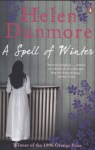 An annoying thing happened with this one: the back cover blurb gave away a central theme. It’s one I’m keen to avoid yet feel I have encountered disproportionately often in fiction, especially recently (I won’t name any titles as that would give it away instantly). Dunmore writes nicely – from my quick skim of this one it seemed very atmospheric – but I am not particularly drawn to her plots. I’ve read Exposure for book club and own two more of her novels, Talking to the Dead and Zennor in Darkness, so by the time I’ve read those I will have given her a solid try. So far I’ve preferred her poetry – I’ve read three of her collections.
A favorite passage:
“It is winter in the house. This morning the ice on my basin of water is so thick I can not break it. The windows stare back at me, blind with frost. … I can see nothing through the frost flowers on the glass. I wonder if it is snowing yet, but I think it is too cold. … I look at the house, still and breathless in the frost. I have got what I wanted. A spell of winter hangs over it, and everyone has gone.”
And a DNF:
The Song of Achilles by Madeline Miller (2011)
 Patroclus is a disappointment of a prince. He has no chance of winning Helen of Troy’s hand in marriage, and exile awaits him when he is responsible for an accidental death. As a foster child in the household of another king, he becomes obsessed with Achilles. The two young men take part in music lessons and military training, and Patroclus follows Achilles away from the palace to be taught by a centaur. That’s as far as I got before I couldn’t bear any more. The homoerotic hints are laughably unsubtle: (of a lyre) “‘You can hold it, if you like.’ The wood would be smooth and known as my own skin” & (fighting) “he rolled me beneath him, pinning me, his knees in my belly. I panted, angry but strangely satisfied.”
I got a free download from Emerald Street, the Stylist magazine e-newsletter. The ancient world, and Greek mythology in particular, do not draw me in the least, and I have had bad experiences with updates of Greek myths before (e.g. Bright Air Black by David Vann). I never thought this would be a book for me, but still wanted to attempt it so I could complete the set of Women’s Prize winners. I read 77 pages out of 278 in the e-book, but when I have to force myself to pick up a book, I know it’s a lost cause. As with the Dunmore, I think it’s safe to say this one never would have gotten my vote anyway.
The final four to complete my project:
(On the stack to read soon)
The Idea of Perfection by Kate Grenville – free from mall bookshop
The Glorious Heresies by Lisa McInerney – public library copy
How to Be Both by Ali Smith – public library copy; a planned buddy read with B.I.P.
(To get from the university library)
A Girl Is a Half-formed Thing by Eimear McBride
Read any Women’s Prize winners lately?
Doorstoppers of the Month: Americanah and Deerbrook
On one of my periodic trips back to the States, I saw Chimamanda Ngozi Adichie speak at a large Maryland library soon after Americanah (2013) was published. I didn’t retain much from her talk, except that her main character, Ifemelu, was a blogger about race issues and that Black hair also played a role. I was hugely impressed with Adichie in person: stylish and well-spoken, she has calm confidence and a mellifluous voice. In the “question” (comment) time I remember many young African and African American women saying how much her book meant to them, capturing the complexities of what it’s like to be Black in America.
Ironically, I have hoarded Adichie’s work over the years since then but not read it. I did read We Should All Be Feminists from the library for Novellas in November one year, but had accumulated copies of her other five books as gifts or from neighbors or the free bookshop. (Is there a tsundoku-type term for author-specific stockpiling?) Luckily, my first taste of her fiction exceeded my high expectations and whetted my appetite to read the rest.
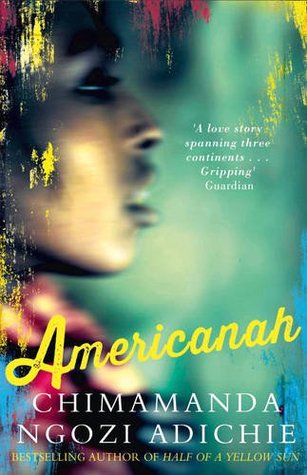
“You can’t write an honest novel about race in this country,” a secondary African American character declares at an evening salon Ifemelu attends. Adichie puts the lie to that statement: her slight outsider status allows her to cut through stereotypes and pretenses and get right to the heart of the issue. The novel may be seven years old (and hearkens back to the optimism of Barack Obama’s first election), but it feels utterly fresh and relevant at a time when we are newly aware of the insidiousness of racism. Again and again, I nodded in wry acknowledgment of the truth of Ifemelu’s cutting observations:
Job Vacancy in America—National Arbiter in Chief of ‘Who Is Racist’: In America, racism exists but racists are all gone. Racists belong to the past. Racists are the thin-lipped mean white people in the movies about the civil rights era. Here’s the thing: the manifestation of racism has changed but the language has not. So if you haven’t lynched somebody then you can’t be called a racist.
Through Ifemelu’s years of studying, working and blogging her way around the Eastern seaboard of the United States, Adichie explores the ways in which the experience of an African abroad differs from that of African Americans. These subtleties become especially clear through her relationships with Curt (white) and Blaine (African American), which involve a performative aspect and a slight tension that were absent with Obinze, her teenage sweetheart. Obinze, too, tries life in another country, moving to the UK illegally. Although they eventually earn financial success and good reputations – with Obinze a married property developer back in Nigeria – both characters initially have to do debasing work to get by.
Americanah is so wise about identity and perceptions, with many passages that resonated for me as an expat. When Ifemelu returns to Nigeria after 13 years, she doesn’t know if she or her country has changed: “She was no longer sure what was new in Lagos and what was new in herself … home was now a blurred place between here and there … there was something wrong with her. A hunger, a restlessness. An incomplete knowledge of herself.”
I loved Ifemelu’s close bond with her cousin, Dike, who is more like a little brother to her, and the way the narrative keeps revisiting a New Jersey hair salon where she is getting her hair braided. These scenes reminded me of Barber Shop Chronicles, a terrific play I saw with my book club last year. The prose is precise, insightful and evocative (“she would not unwrap from herself the pashmina of the wounded,” “There was something in him, lighter than ego but darker than insecurity, that needed constant buffing”).
On a sentence level as well as at a macro plot level, this was engrossing and rewarding – just what I want from a doorstopper. The question of whether Ifemelu and Obinze will get back together is one that will appeal to fans of Normal People – can these sustaining teenage relationships ever last? – but Ifemelu is such a strong, independent character that it’s merely icing on the cake. I’m moving on to her Women’s Prize winner, Half of a Yellow Sun, next.
Page count: 477 (but tiny type)
Source: Free bookshop
My rating: 
Deerbrook by Harriet Martineau (1839)
 This was meant to be a buddy read with Buried in Print, but I fell at the first hurdle and started skimming after 35 pages. I haven’t made it through a Victorian triple-decker in well over a decade; just since 2012, I’ve failed to get through three novels by Charles Dickens, whom I used to call my favorite author. I’m mildly disappointed in myself, but may have to accept the change in my reading tastes. In my early 20s, I loved chunky nineteenth-century novels and got my MA in Victorian Literature, but nowadays I look at one of these 500+-page classics and think, why wade through something so tortuously verbose over a matter of weeks when I could read three or more contemporary novels that will have more bearing on my life, for the same word count and time?
In any case, Deerbrook is interesting from a cultural history point of view, sitting between Austen and the Brontës or George Eliot in terms of timeline, style and themes. In the fictional Midlands village of Deerbrook, the Greys and Rowlands are neighbors engaged in a polite feud while sharing a summer house and a governess. Orphaned sisters Hester and Margaret Ibbotson, 21 and 20, come to live with the Greys, their distant cousins and known dissenters. Hester got “all the beauty,” so it’s no surprise that, after a visit from a local doctor, Edward Hope, everyone is pairing him with her in their minds. I liked an early passage voicing the thoughts of Maria Young, the crippled governess (“How I love to overlook people,—to watch them acting unconsciously, and speculate for them!”), but soon tired of the matchmaking and moralizing. A world in which everyone does their duty is boring indeed.

Martineau, though, seems like a fascinating figure I’d like to read more about. She wrote a two-volume Autobiography, which I would also skim if I could find it from a library. Just her one-page bio at the front of my Virago paperback contained many astonishing sentences: “her education was interrupted by advancing deafness, requiring her to use an ear trumpet in later life”; “Her fiancé, John Hugh Worthington, having gone insane also died”; [after writing Deerbrook] “She then collapsed into bed where she was to remain for the next five years. In 1845 Harriet Martineau was dramatically cured by mesmerism,” etc.
Page count: 523 (again, tiny type)
Source: A UK secondhand bookshop 15+ years ago
New Reading Projects! (Join Me?)
It’s only one week since we announced the Not the Wellcome Prize winner, the culmination of a month-long project that was months more in the planning. I don’t think I’ll be coordinating another blog tour anytime soon, as it was a lot of work finding participants, working out a schedule and keeping on top of the publicizing via social media. Still, it was a lot of fun, and already I’m missing the buzz and ready to get stuck into more projects.
I’d love it if you joined me for one or more of these. Some could be combined with your 20 Books of Summer or other challenges, too.
Ongoing buddy reads
 It would have been Richard Adams’s 100th birthday on the 9th. That night I started rereading his classic tale of rabbits in peril, Watership Down, which was my favorite book from childhood even though I only read it the once at age nine. I’m 80 pages in and enjoying all the local place names. Who would ever have predicted that that mousy tomboy from Silver Spring, Maryland would one day live just 6.5 miles from the real Watership Down?!
 My husband is joining me for the Watership Down read (he’s not sure he ever read it before), and we’re also doing a buddy read of Arctic Dreams by Barry Lopez. In that case, we ended up with two free copies, one from the bookshop where I volunteer and the other from The Book Thing of Baltimore, so we each have a copy on the go. Lopez’s style, like Peter Matthiessen’s, lends itself to slower, reflective reading, so I’m only two chapters in. It’s novel to journey to the Arctic, especially as we approach the summer.
I plan to take my time over these two, so tell me if you have a copy of either and feel like picking it up at any point over the next few months.
Bibliotherapy self-prescriptions
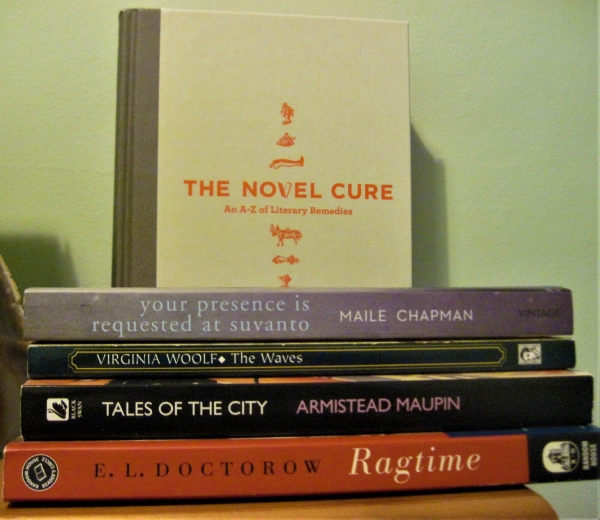
The other day I got out my copy of The Novel Cure by School of Life bibliotherapists Ella Berthoud and Susan Elderkin and browsed through the categories for some prescriptions that might feel relevant to the current situation. I found four books I own that fit the bill:
From the list of “The Ten Best Novels to Lower Your Blood Pressure”: Your Presence Is Requested at Suvanto by Maile Chapman & The Waves by Virginia Woolf (and I’ve read another three of them, including, recently, Crossing to Safety).
One of several prescriptions for Loneliness: Tales of the City by Armistead Maupin.
The cure for Zestlessness: Ragtime by E. L. Doctorow.
If you have access to one of these, or have a copy of The Novel Cure and are keen on following up on another of the prescriptions, let me know.
And now for two memes that I (think I) have created. Although I’m sure something similar has been done in the past, I couldn’t find any specific blogs about them. I don’t know about you, but I always need encouragement to pick up books from my own shelves – even though libraries are currently closed, I’m still working my way through a library stack, and I’m tempted to make another order of new books from Hungerford Bookshop. It’s great to support libraries and independent bookstores, of course, but there could be no better time to mine your own bookshelves for treasures you bought ages ago but still have never read.
Journey through the Day with Books
I enjoyed picking out 18 books from my shelves that refer to particular times of day or meals or activities associated therewith. Four of these are books I’ve already read and four are ones I’m currently reading. You can piggyback on my selections if you wish, or find your own set.
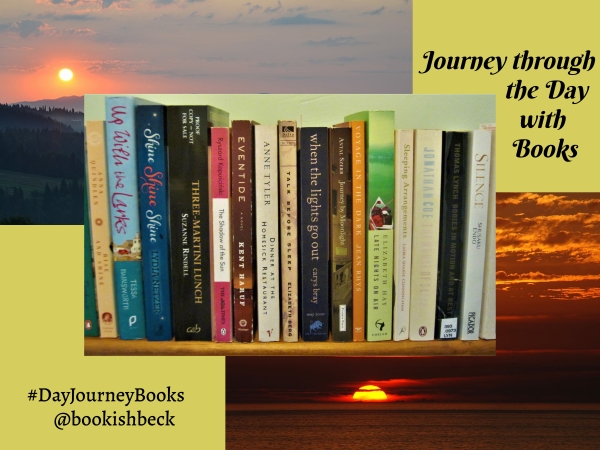
Here’s my full list:
Zennor in Darkness by Helen Dunmore
Rise and Shine by Anna Quindlen
Up with the Larks by Tessa Hainsworth
Shine Shine Shine by Lydia Netzer
Three-Martini Lunch by Suzanne Rindell
The Shadow of the Sun by Ryszard Kapuściński
Eventide by Kent Haruf
Dinner at the Homesick Restaurant by Anne Tyler
Talk before Sleep by Elizabeth Berg
When the Lights Go Out by Carys Bray
Journey by Moonlight by Antal Szerb
Voyage in the Dark by Jean Rhys
Late Nights on Air by Elizabeth Hay
Sleeping Arrangements by Laura Shaine Cunningham
The House of Sleep by Jonathan Coe
Bodies in Motion and at Rest by Thomas Lynch
Silence by Shūsaku Endō
Arctic Dreams by Barry Lopez
The Four in a Row Challenge
I’ve been contemplating this one for quite a while. It’s inspired by Phyllis Rose’s The Shelf –from LEQ to LES: Adventures in Extreme Reading (one of Simon’s favourite books – see his review), for which she picked a shelf of the New York Society Library, eliminated duplicates and repeat entries from the same author, and read the remainder – whether she’d heard of them or not; whether they were awful or not. (“Hands down the worst book on the shelf is Le Queux’s Three Knots, a mystery that reads as if it were written by an eight-year-old on Percocet.”)

This is a variation in that you’re looking at your own TBR shelves and picking a set of four books in a row. For many, that will be four novels whose authors’ surnames all start with the same letter. But if you organize your books differently (especially within nonfiction), you may find that the set of four is more arbitrary. You never know what they might have in common, though (book serendipity!).
I’m no strict challenge host, so if you want to engineer your shelf order, or if you decide to swap a book in later on, that is no problem at all. My one firm rule is only one book per author.
I’ve picked out a few appealing sets, all from my fiction shelves. F, G, L and M had particularly rich pickings. I’ll report back as I finish each set, while the “Journey through a Day” may well take me the whole rest of the year.
Still ongoing (more here): Projects to read as many Bellwether Prize, Wellcome Book Prize and Women’s Prize winners as possible, as well as Wellcome long- and shortlistees.
Can I tempt you to take part in any of these reading projects?
[Journey through the Day: Sunrise in Pieniny, Poland (Pudelek / CC BY-SA (https://creativecommons.org/licenses/by-sa/4.0)) / Sunset (Alvesgaspar / CC BY-SA (https://creativecommons.org/licenses/by-sa/3.0))
Four in a Row: Four pelicans in a row (Sheba_Also 43,000 photos / CC BY-SA (https://creativecommons.org/licenses/by-sa/2.0)) / Phone boxes, Market Place, Ripon (Tim Green from Bradford / CC BY (https://creativecommons.org/licenses/by/2.0))]
Paul Auster Reading Week: Winter Journal & The New York Trilogy
Before this year, I’d read only one book by Paul Auster: Timbuktu, which fit into last year’s all-animal 20 Books of Summer for its canine main character. This year I’ve enjoyed having Annabel’s Paul Auster Reading Week as an excuse to binge on more Auster, including one of his memoirs, Winter Journal, and his most famous set of novels, the New York Trilogy. I’m reading another two Auster books, one fiction and nonfiction, and will see if I can finish and write them up before the week ends.

Winter Journal (2012)
This is one of the most remarkable memoirs I’ve ever read. Approaching age 64 and the winter of his life, Auster decided to assemble his most visceral memories. Here he parades them past in a seemingly random order yet manages to give a sense of the sweep of his life. The use of the second person draws readers in to (re-)experience things along with the author, while also creating an artistic distance between the subject and his reminiscences. Auster describes his aim thus:
Time is running out, after all. Perhaps it is just as well to put aside your stories for now and try to examine what it has felt like to live inside this body from the first day you can remember being alive until this one. A catalogue of sensory data. What one might call a phenomenology of breathing.
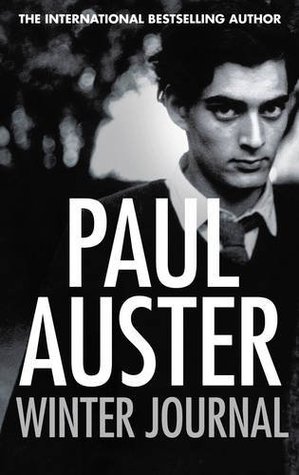 His life reappears through scars, through accidents and near-misses, through what his hands felt and his eyes observed. A three-year-old rips his cheek open on a protruding nail in a department store. A teenager slowly builds up a portfolio of sexual experiences. A young man lives and works in Paris and the South of France. A marriage to one fellow author (Lydia Davis) ends and a relationship with another (Siri Hustvedt) begins. A fiftysomething rushing to get home to the toilet makes an ill-advised turn against traffic and totals his car – luckily, he and his family escape unhurt. Numbness after his mother’s death cedes to a panic attack.
I particularly enjoyed the 53-page section in which Auster gives tours through the 21 places he’s lived since infancy, recounting the details he remembers of the dwellings and what happened during his time there. It’s impressive how much he can condense, but also how much he can convey in just a few pages on each home. This is the sort of format I could imagine borrowing for a short autobiographical piece – it would be a way of redeeming that involuntarily nomadic period when my husband and I moved every six to 18 months.
Reading this alongside the New York Trilogy allowed me to spot the ways, big and small, in which those novels draw on Auster’s life story. I’m now keen to read more of his nonfiction, especially The Invention of Solitude, which offended his relatives by revealing the shameful family story of how his grandmother shot and killed his grandfather in their kitchen.
Annabel says: “The book is written in the second person – addressing himself; it gives a real sense of intimacy to his story. … Auster is an unconventional, analytical and eloquent writer, and this unconventional memoir was a delight to read, he can look with humour at himself as well as being serious.”
Laura F. says: “You know how people say they’d read anything by their favourite author, even a grocery list? Winter Journal gets pretty close to that territory. … I’ve never read a memoir like this, and though focused on the physical, it’s a fully emotional experience.”
Some favorite lines:
“as long as you continue to travel, the nowhere that lies between the here of home and the there of somewhere else will continue to be one of the places where you live.”
“We are all aliens to ourselves, and if we have any sense of who we are, it is only because we live inside the eyes of others.”
“you can only conclude that every life is marked by a number of close calls, that everyone who manages to reach the age you have come to now has already wriggled out of a number of potentially absurd, nonsensical deaths. All in the course of what you would call ordinary life.”
Readalikes: I Am, I Am, I Am by Maggie O’Farrell & The Lost Properties of Love by Sophie Ratcliffe
The New York Trilogy
(also my Doorstopper of the Month at 580 pages)
City of Glass (1985)
 A metafictional mystery about a crime writer named Daniel Quinn who turns private investigator when he gets a phone call asking for the Paul Auster Detective Agency. This is one of those books where what actually happens is a lot less important than the atmosphere it creates. So what feels essential to me here is the sense of a labyrinthine New York City and a confusion of languages and relationships. Quinn, who is helpfully untethered after the death of his wife and son, is hired to tail Peter Stillman’s father, who has recently been released from a mental hospital, where he was sentenced after being judged insane for keeping his son in isolation in a dark apartment for nine years.
Feral children, maps, eggs, the Tower of Babel and Don Quixote are some of the recurring sources of metaphors in a deliberately disorienting and intertextually rich short novel that kept me turning the pages even when I didn’t know precisely what was going on. We get a glimpse of Auster himself, and are invited to muse on such tiny subjects as destiny, the limitations of language, the purpose of books, and the nature of truth. I’m curious to see whether the other two novels follow on from the story at all or just resemble it thematically.
Ghosts (1986)
I jumped straight into this from City of Glass, and it suffered by comparison. It is not a sequel per se, because it has different characters and is set in the late 1940s instead of the early 1980s, but it shares some of the same concerns (with literature, identity, doubling, the essential otherness of the writer, and so on) and again is a sort of metafictional mystery.
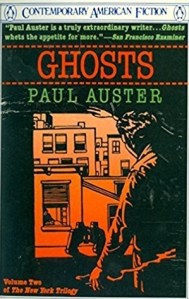 Part of why I couldn’t take this novella entirely seriously is the silly naming: White hires Blue to trail Black (really; all of the secondary characters are named after colors, too). It turns out Black is a writer who does little besides sit in his apartment, writing. Only when Blue disguises himself as a tramp and then as a salesman and meets Black in various other contexts does he realize that Black, too, is an investigator … writing up a case of following a writer who hardly leaves his desk.
While I appreciated the circularity and the uncertainty over whether these accidental twins would destroy each other, as well as the literary references to Whitman, Thoreau and Hawthorne, the whole felt slightly inconsequential (“Blue watches Black, and little of anything happens.”). Plotlessness is part of the point, but makes for only a moderately interesting read.
[There is one coded reference to Auster here: the fact that the book opens on February 3, 1947, the day he was born.]
The Locked Room (1986)
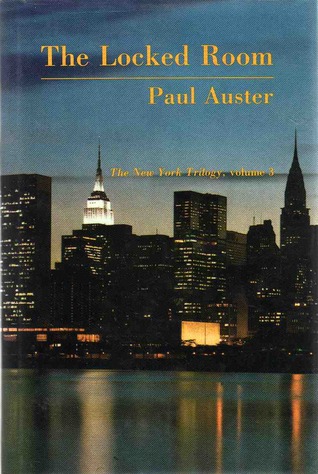 While most of the New York Trilogy is told in the third person, this is a first-person narrative that seems to pick up where City of Glass left off. It begins in 1977, when the unnamed narrator gets a letter from Sophie Fanshawe, the wife of his childhood best friend, telling him that Fanshawe disappeared six months ago, and despite the best efforts of a detective, Quinn (in another link to CoG, the narrator encounters Peter Stillman on a later trip to Paris), no trace can be found. The narrator has been named Fanshawe’s literary executor and takes it upon himself to get the man’s unpublished work out into the world: plays are produced, novels are published. He also starts writing a biography of the friend he always envied.
Except it’s more like he’s becoming Fanshawe, especially when he marries Sophie. Doubling has been a major theme of the trilogy, and here the metaphorical kill-or-be-killed situation seems to turn literal at the conclusion, which I didn’t particularly understand (e.g. he acquires and destroys a red notebook – is this in some way meant to be the same red notebook Quinn left behind at the end of CoG?). The narrator presents himself as the author of all three books, and asserts, “These three stories are finally the same story, but each one represents a different stage in my awareness of what it is about. I don’t claim to have solved any problems.”
The metafictional aspect of this novel is that Fanshawe’s early life is a lot like Auster’s as revealed in Winter Journal, while Sophie’s resembles his wife Siri Hustvedt’s (and the pair would later name their daughter Sophie).
 Themes of the trilogy:
- Identity complications, including disguises, doubles and substitutes
- Writers and writing; the creator versus characters
- The limits of language (e.g. Stillman’s monologue in CoG is astonishing)
- Freedom/randomness versus fate
One representative passage from each volume:
- “New York was an inexhaustible space, a labyrinth of endless steps, and no matter how far he walked, no matter how well he came to know its neighbourhoods and streets, it always left him with the feeling of being lost. Lost, not only in the city, but within himself as well. … New York was the nowhere he had built around himself” (City of Glass)
- “Writing is a solitary business. It takes over your life. In some sense, a writer has no life of his own. Even when he’s there, he’s not really there. / Another ghost. / Exactly.” (Ghosts)
- “In the end, each life is no more than the sum of contingent facts, a chronicle of chance intersections, of flukes, of random events that divulge nothing but their own lack of purpose.” (The Locked Room)
My rating for the trilogy as a whole:
Have you tried anything by Paul Auster? Grab one of his books and join us for this week’s readalong!
Reading Robertson Davies Week: Fifth Business
I’m grateful to Lory (of The Emerald City Book Review) for hosting this past week’s Robertson Davies readalong, which was my excuse to finally try him for the first time. Of course, Canadians have long recognized what a treasure he is, but he’s less known elsewhere. I do remember that Erica Wagner, one of my literary heroes (an American in England; former books editor of the London Times, etc.), has expressed great admiration for his work.
I started with what I had to hand: Fifth Business (1970), the first volume of The Deptford Trilogy. In the theatre world, the title phrase refers to a bit player who yet has importance to the outcome of a drama, and that’s how the narrator, Dunstan Ramsay, thinks of himself. I was reminded right away of the opening of Charles Dickens’s David Copperfield: “Whether I shall turn out to be the hero of my own life, or whether that station will be held by anybody else, these pages must show.” In the first line Ramsay introduces himself in relation to another person: “My lifelong involvement with Mrs. Dempster began at 5.58 o’clock p.m. on 27 December 1908, at which time I was ten years and seven months old.”

 Specifically, he dodged a snowball meant for him – thrown by his frenemy, Percy Boyd Staunton – and it hit Mrs. Dempster, wife of the local Baptist minister, in the back of the head, knocking her over and 1) sending her into early labor with Paul, who also plays a major role in the book; and 2) permanently compromising her mental health. Surprisingly, given his tepid Protestant upbringing, Ramsay becomes a historian of Christian saints, and comes to consider Mrs. Dempster part of his personal pantheon for a few incidents he thinks of as miracles – not least his survival during First World War service. And this is despite Mrs. Dempster being caught in a situation that seriously compromises her standing in Deptford.
The novel is presented as a long, confessional letter Ramsay writes, on the occasion of his retirement, to the headmaster of the boys’ school where he taught history for 45 years. Staunton, later known simply as “Boy,” becomes a sugar magnate and politician; Paul becomes a world-renowned illusionist known by various stage names. Both Paul and Ramsay are obsessed with the unexplained and impossible, but where Paul manipulates appearances and fictionalizes the past, Ramsay looks for miracles. The Fool, the Saint and the Devil are generic characters we’re invited to ponder; perhaps they also have incarnations in the novel?
Fifth Business ends with a mysterious death, and though there are clues that seem to point to whodunit, the fact that the story segues straight into a second volume, with a third to come, indicates that it’s all more complicated than it might seem. I was so intrigued that, thanks to my omnibus edition, I carried right on with the first chapter of The Manticore (1972), which is also in the first person but this time narrated by Staunton’s son, David, from Switzerland. Freudian versus Jungian psychology promises to be a major dichotomy in this one, and I’m sure that the themes of the complexity of human desire, the search for truth and goodness, and the difficulty of seeing oneself and others clearly will crop up once again.
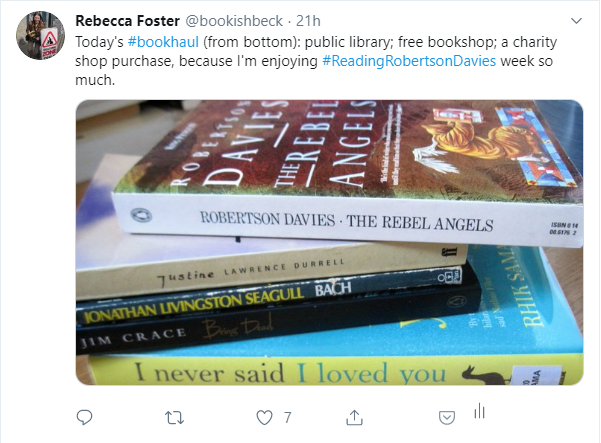
This was a very rewarding reading experience. I’d recommend Davies to those who enjoy novels of ideas, such as Iris Murdoch’s. I’ll carry on with at least the second volume of the trilogy for now, and I’ve also acquired the first volume of another, later trilogy to try.
My rating:
Some favorite lines:
“I cannot remember a time when I did not take it as understood that everybody has at least two, if not twenty-two, sides to him.”
“Forgive yourself for being a human creature, Ramezay. That is the beginning of wisdom; that is part of what is meant by the fear of God; and for you it is the only way to save your sanity.”
It’s also fascinating to see the contrast between how Ramsay sees himself, and how others do:
“it has been my luck to appear more literate than I really am, owing to a cadaverous and scowling cast of countenance, and a rather pedantic Scots voice”
vs.
“Good God, don’t you think the way you rootle in your ear with your little finger delights the boys? And the way you waggle your eyebrows … and those horrible Harris tweed suits you wear … And that disgusting trick of blowing your nose and looking into your handkerchief as if you expected to prophesy something from the mess. You look ten years older than your age.”
Fourth Blog Anniversary
I launched my blog four years ago today. Is that ages, or no time at all? Like I said last year, it feels like something I’ve been doing forever, and yet there are bloggers out there who are coming up on a decade or more of online writing about books.

By Incabell [CC BY-SA 4.0 (https://creativecommons.org/licenses/by-sa/4.0)%5D.
This is my 542nd post, so the statistics tell me that I’ve been keeping up an average of just over 2.5 posts a week. Although I sometimes worry about overwhelming readers with ‘too many’ posts, I keep in mind that a) no one is obliged to read everything I post, b) a frequently updated blog is a thriving blog, and c) it only matters that it’s a manageable pace for me.
In the last year or so, I’ve gotten more involved in buddy reads and monthly challenges (things like Reading Ireland Month, 20 Books of Summer, R.I.P., Margaret Atwood Reading Month, and Novellas and Nonfiction in November); I’ve continued to take part in literary prize shadow panels and attend literary events when I can. I’ve hosted the Library Checkout for nearly a year and a half now and there are a few bloggers who join in occasionally (more are always welcome!). The posts I most enjoy putting together are write-ups of my travels, and seasonal and thematic roundups, which are generally good excuses to read backlist books from my own shelves instead of getting my head turned by new releases.
Some statistics from the past year:
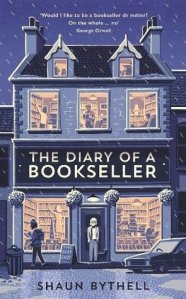 My four most viewed posts were:
The Diary of a Bookseller by Shaun Bythell
Clock Dance by Anne Tyler: Well…
Mixed Feelings about Elena Ferrante
I got the most likes in December 2018, and the most unique visitors and comments in August.
 My four favorite posts I wrote in the past year were:
A Trip to Wigtown, Scotland’s Book Town
Painful but Necessary: Culling Books, Etc.
Why We Sleep … And Why Can’t I Wake Up?
A President’s Day Reading Special (No Trump in Sight)
Thanks to everyone who has supported me this past year, and/or all four years, by visiting the site, commenting, re-tweeting, and so on. You’re the best!
Iris Murdoch Readalong: The Sacred and Profane Love Machine (1974)
A later Murdoch – her sixteenth novel – and not one I knew anything about beforehand. In terms of atmosphere, characters and themes, it struck me as a cross between A Severed Head and The Nice and the Good. Like the former, it feels like a play with a few recurring sets: Hood House, where the Gavenders (Blaise, Harriet and David) live; their next-door neighbor Montague Small’s house; and the apartment where Blaise keeps his mistress, Emily McHugh, and their eight-year-old son Luca. A sizeable dramatis personae radiates out from the central love triangle: lodgers, neighbors, other family members, mutual friends and quite a few dogs.

Blaise is a psychoanalyst but considers himself a charlatan because he has no medical degree; he’s considering returning to his studies to rectify that. Harriet reminded me of Kate from The Nice and the Good: a cheerful, only mildly unfulfilled matriarch who is determined to choreograph much of what happens around her. (“She wanted simply to feel the controls firmly in her hands. She wanted to be the recognizer, the authorizer, the welcomer-in, the one who made things respectable and made them real by her cognizance of them.”) Their son David, 16, looks like a Pre-Raphaelite god and is often disgusted by fleshly reality. Montague writes successful but formulaic detective novels and is mourning his wife’s recent death.
I loved how on first introduction to most characters we hear about the dreams from which they’ve just awoken, involving mermaids, cats, dogs and a monster with a severed head. “Dreams are rather marvellous, aren’t they,” David remarks to Monty. “They can be beautiful in a special way like nothing else. Even awful things in dreams have style.” Scenes often open with dreams that feel so real to the characters that they could fool readers into belief.
Blaise knows he can’t sustain his double life, especially after Luca stows away in his car on a couple of occasions to see Hood House. When he confesses to Harriet via a letter, she seems to handle things very well. In fact, she almost glows with self-righteous pride over how reasonably she’s been responding. But both she and Emily end up resentful. Why should Blaise ‘win’ by keeping his wife and his mistress? “You must feel like the Sultan of Turkey,” Emily taunts him. “You’ve got us both. You’ve got away with it.” Here starts a lot of back-and-forth, will-they-won’t-they that gets somewhat tedious. Throughout I noticed overlong sections of internal monologue and narrator commentary on relationships.
 There’s a misperception, I think, that Murdoch wrote books in which not much happens, simply because her canvas can be small and domestically oriented. However, this is undoubtedly an eventful novel, including a Shocking Incident that Liz warned about. Foreshadowing had alerted me that someone was going to die, but it wasn’t who or how I thought. When it comes to it, Murdoch is utterly matter-of-fact: “[X] had perished”.
One of the pleasures of reading a Murdoch novel is seeing how she reworks the same sorts of situations and subjects. (Liz has written a terrific review set in the context of Murdoch’s whole body of work.) Here I enjoyed tracing the mother–son relationships – at least three of them, two of which are quite similar: smothering and almost erotic. Harriet later tries to subsume Luca into the family, too. I also looked out for the recurring Murdochian enchanter figure: first Blaise, for whom psychiatry is all about power, and then Harriet.
I hugely enjoyed the first 100 pages or more of the book, but engaged with it less and less as it went on. Ultimately, it falls somewhere in the middle for me among the Murdochs I’ve read. Here’s my ranking of the nine novels I’ve read so far, with links to my reviews:
Favorite: The Bell
The Sea, The Sea
The Sacred and Profane Love Machine
The Black Prince
Least favorite: An Accidental Rose
My rating:
A favorite passage (this is Monty on the perils of working from home!): “If I had an ordinary job to do I’d have to get on with it. Being self-employed I can brood all day. It’s undignified and bad.”
This is the last of the Murdoch paperbacks I bought as a bargain bundle from Oxfam Books some years ago. I’ll leave it a while – perhaps a year – and then try some earlier Murdochs I’ve been tempted by during Liz’s Iris Murdoch readalong project, such as The Unicorn.
 Bookish Beck = Rebecca Foster. American transplant to England. Freelance proofreader and book reviewer.
 Bookish Beck


.jpg)
.jpg)