Hay-on-Wye Trip & Book Haul (Plus a Little Life Complication)
Last week was our ninth time visiting Hay-on-Wye. Our previous trip was in October 2023 for my 40th birthday. Prompted by my overhaul post last month, I managed to finish a couple more of the 16 books I’d bought that time, taking me to 4 read and 1 skimmed; I’ve also read the first quarter of So Happy for You by Celia Laskey. Considering it was less than 18 months between visits, I’m going to call that an adequate showing. However, I will endeavour to be better about reading this latest book haul (below) in a timely fashion!
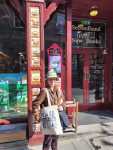 Because we were staying four nights, there was no need to rush through all the bookshops in a day or two, though that would be possible; instead, we parcelled them out and mixed up our shopping with walks, short outings in the car, and relaxing in the comfy cottage just over the English border in Cusop. I had work deadlines to meet within the first few days, but on another evening we took advantage of the place having Netflix to watch My Neighbor Totoro.
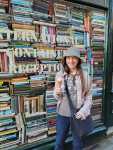 I’ve gotten secondhand book shopping in Hay down to a science over the years. Check on opening days and hours carefully or you can miss out. Thursday to Saturday is the best window to go: the Thursday market is excellent for local produce and crafts, and it’s nice to see the town bustling. (Though I’ve never seen it at Festival time, and wouldn’t want to!)


Start with the bargain options: the Little Free Library shelves by the river, where I scored Electricity by Victoria Glendinning; the sale area outside Hay Cinema Bookshop, the dedicated honesty shop beside Richard Booth’s Bookshop (new this trip), and the Book Passage beside Addyman Books – all £1/book; and the honesty shelves on the castle grounds, where it’s £2/book. Most of my purchases came from these areas. Just call me thrifty!

Next, the mid-priced options: Cinema, Broad Street Book Centre, Hay-on-Wye Booksellers, Clock Tower Books, and the new British Red Cross bookshop, which is not cheap for a charity shop but has a good selection of relatively recent stuff. (Oxfam, however, has moved away from books and primarily sells clothes, new products and bric-a-brac.) Cap it off with Addymans + Addyman Annexe, Cinema, Booth’s, the Poetry Bookshop and Green Ink Booksellers.
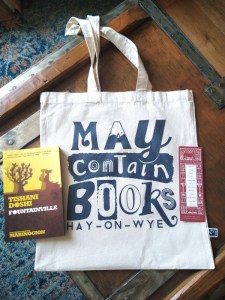 I had the best luck in Cinema this time, where I found two remainder books, three bargain books (one not pictured because it will be a gift) and the Howard Norman short stories – a particular thrill as his work is not often seen in the UK. Cinema and Booth’s are the greatest pleasure to browse. At Booth’s I bought my priciest book of the trip – Fountainville by Tishani Doshi, a retelling of stories from the Mabinogion – and indulged in a bookish tote bag (as if I needed another!). It was especially pleasing to find the Doshi and the Lewis in Hay as they are Welsh authors so will cover me for Reading Wales Month next year.
I wasn’t in the market for new books this time, not having any vouchers at my disposal, but those who are will also enjoy perusing Gay on Wye, North Books, and the large selection of new stock mixed in thematically at Booth’s. All told, that’s 15 places to shop for books.
Alas, The Bean Box, where you could get the best coffee in town, has now closed. We returned to Hay Distillery for delicious gin drinks and had Shepherd’s ice cream (a must) twice. New to us on this trip were nearby Talgarth and its excellent Mill café, the Burger Me (oh dear) restaurant at The Globe, a drink at Kilverts Inn, and an evening walk down the river to a nice shingle spit.


The weather was improbably warm and sunny – as in, I packed an umbrella and raincoat but never used them. I did need my woolly hat, scarf and gloves, but only on the first morning when we climbed up a hill. The rest of the time, it was blue skies and blossom, lambs in the fields, and 20 degrees C, for which, in early April, we could only be grateful – but also, as the lady on the till at Cinema rightly observed, it’s mildly disturbing.
This was our first major trip with our secondhand electric car, which needs rather frequent charging. En route we broke the journey at Gloucester and toured its cathedral; on the way back, we plumped for usefulness over aesthetics by stopping at carparks in Ross-on-Wye and Cirencester. We now choose routes that avoid motorways, which makes for more leisurely and scenic touring.

-

- Pwll y grach waterfall
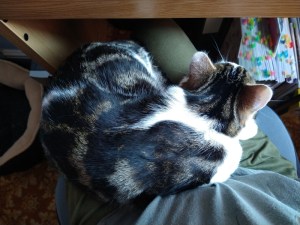
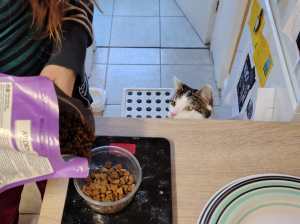
Two days after we bought the car from a local acquaintance, this creature entered our lives. I certainly didn’t intend to adopt another cat a shade under six weeks after Alfie’s death. (I haven’t even finished reading Grieving the Death of a Pet on my Kindle; I still haven’t brought myself to read your kind comments on my post about losing Alfie.) But we were deeply lonely in a way we hadn’t been expecting. I would object to the use of the word “replace” – there is no replacing Alfie; we still miss him for his predictability and dignity as well as all his own funny ways. I’ve come to realize that grief is ongoing, and all of a piece: mourning Alfie took me back to the same place of grief I inhabit for my mother, and missing them and others lost in recent years is tied into my helpless sadness over natural disasters, humanitarian crises, the state of affairs in my home country, the trajectory of the planet, and on and on.
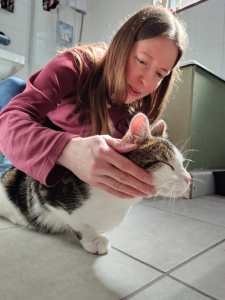
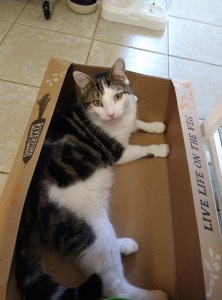
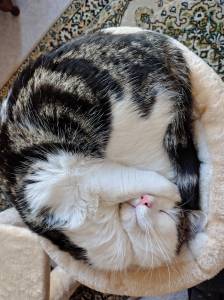
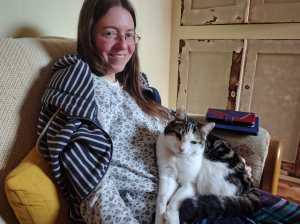
Any road, the adoption moved very quickly: from expressing interest on a Thursday to getting a call back on a Saturday to meeting and taking him home on a Sunday afternoon. Benny (“Tubbs” as was) is only a year old and full of energy. He came home with a tapeworm but got over it within a week after a targeted worming treatment. It’s been a big adjustment for us to have a cat who doesn’t sleep most of the day and can jump up onto any counter or piece of furniture. Benny considers every waking moment a chance for playtime and mischief. But he is also so sweet and affectionate. And we haven’t laughed this much in a long, long time.
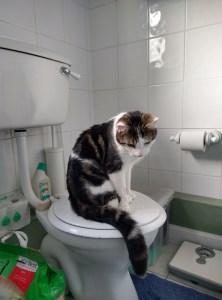
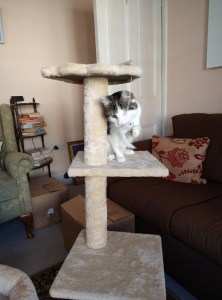
We had booked the Hay trip long before we knew about Benny and were concerned it would be too soon to leave him. But we needn’t have worried; he was settled in here from Day One. Our regular cat sitter visited twice a day and he was absolutely fine. She sent us WhatsApp updates on him and cute photos, in most of which he is a blur chasing his toy snake!

So that’s what’s been going on with me. And of course, I’ve been frantically reading there in the background (36 books on the go at the moment): pre-release e-books for paid reviews, review copies I’ve been sent for the blog, new releases from the library, and the rest of the McKitterick Prize longlist – my shortlist choices are due on the 23rd, eek! I still hope to read a couple of novels from the Carol Shields Prize longlist before the winner is announced, too.
Hope everyone is having a happy spring!
Making Plans for a Return to Hay-on-Wye & A Book “Overhaul”
I was last in Hay-on-Wye for my 40th birthday (write-up here). We’ve decided 18 months is a decent length between visits such that we can go back and find enough turnover in the bookshops and changes around the town. The plan is to spend four nights there in early April, in a holiday cottage we’ve not stayed in before. It’s in Cusop, just back over the border into England, which means a pleasant (if not pouring with rain) walk over the fields into the town. Normally we go for just a night or two, so this longer ninth trip to Hay will allow us time to do more local exploring besides thoroughly trawling all the bookshops and rediscovering the best eateries on offer.
An Overhaul of Last Trip’s Book Purchases
Simon of Stuck in a Book has a regular blog feature he calls “The Overhaul,” where he revisits a book haul from some time ago and takes stock of what he’s read, what he still owns, etc. (here’s the most recent one). With his permission, I occasionally borrow the title and format to look back at what I’ve bought. Previous overhaul posts have covered pre-2020 Hay-on-Wye purchases, birthdays, the much-lamented Bookbarn International, and Northumberland. It’s been a good way of holding myself accountable for what I’ve purchased and reminding myself to read more from my shelves.
So, earlier this week I took a look back at the 16 new and secondhand books I acquired in Hay in October 2023. I was quickly dismayed: 18 months might seem like a long time, but as far as my shelves go it is more like the blink of an eye.
Read: Only 1 – Uh oh…
- Learning to Drive by Katha Pollitt

But also:
Partially read: 4
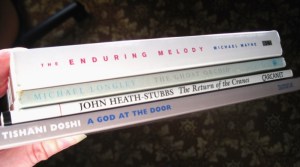
- A God at the Door by Tishani Doshi – Doshi is awesome. This is only my second of her poetry collections. I’ll finish it this month for Dewithon.
- Looking in the Distance by Richard Holloway – The problem with Holloway is that all of his books of recent decades are about the same – a mixture of mediations and long quotations from poetry – and I have one from last year on the review catch-up pile already. But I’m sure I’ll finish this at some point.
- The Ghost Orchid by Michael Longley – No idea why I set this one aside, but I’ve put it back on a current stack.
- The Enduring Melody by Michael Mayne – I have this journal of his approaching death as one of my bedside books and read a tiny bit of it at a time. (Memento mori?)
Skimmed: 1
- Love, Remember: 40 Poems of Loss, Lament and Hope by Malcolm Guite – I enjoyed the poetry selection well enough but didn’t find that the author’s essays added value, so I’m donating this to my church’s theological library.
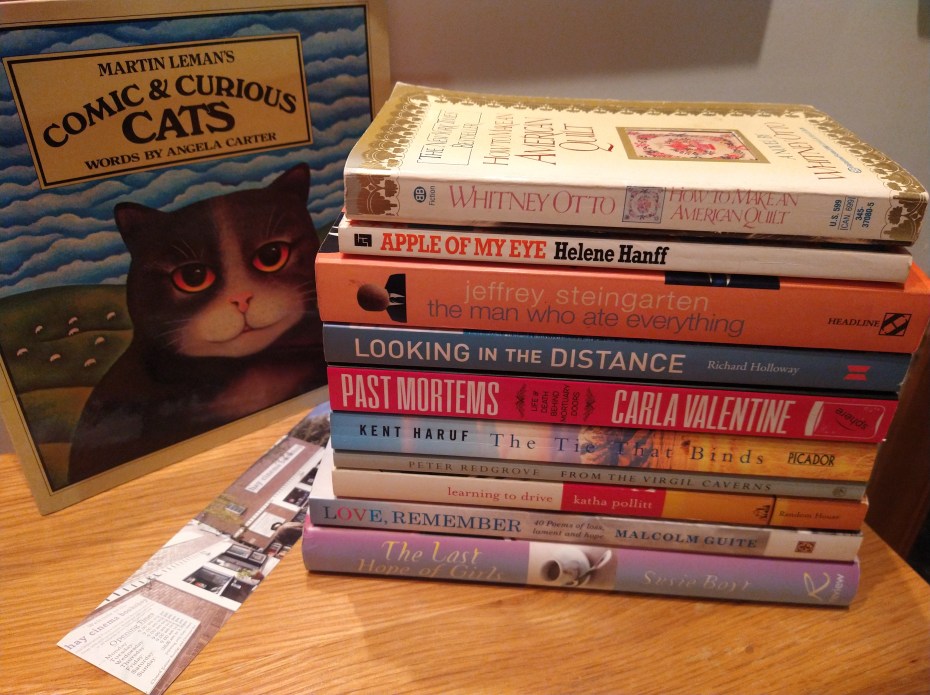
That left 10 still to read. Eager to make some progress, I picked up a quick win, Comic & Curious Cats, illustrated in an instantly recognizable blocky folk art style by Martin Leman (I also have his Twelve Cats for Christmas, a stocking present I gave my husband this past year) and with words by Angela Carter. Yes, that Angela Carter! It’s picture book size but not really, or not just, for children. Each spread of this modified abecedarian includes a nonsense poem that uses the letter as much as possible: the cat’s name, where they live, what they eat, and a few choice adjectives. I had to laugh at the E cat being labelled “Elephantine.” Who knows, there might be some good future cat names in here: Basil and Clarissa? Francesca and Gordon? Wilberforce? “I love my cat with an XYZ [zed] … There is really nothing more to be said.” Charming. (Secondhand purchase – Hay-on-Wye Booksellers)


Total still unread: 9
Luckily, I’m still keen to read all of them. I’ll start with the two I purchased new, So Happy for You by Celia Laskey, a light LGBTQ thriller about a wedding (from Gay on Wye with birthday money from friends, a sweet older lesbian couple – so it felt appropriate to use their voucher there!), and Past Mortems by Carla Valentine, a memoir set at a mortuary (remainder copy from Addymans); as well as a secondhand novel, The Tie that Binds by Kent Haruf (Hay-on-Wye Booksellers) and the foodie essays of The Man Who Ate Everything by Jeffrey Steingarten (Cinema).
Then, if I still haven’t read them before the trip (who am I kidding…), I’ll pack for the car a few small volumes that will fit neatly into my handbag: Apple of My Eye by Helene Hanff, How to Make an American Quilt by Whitney Otto, and one of the poetry collections.
There Should Be a Cat There
My world was knocked askew earlier this week. Since then I’ve been wandering around the house remarking on the sensation that something is missing. I turned around in my chair at the breakfast table one morning to gaze at the sofa corner behind me and said to my husband C, “There should be a cat there.” Alfie was a constant presence in our lives for 10 years and 8 months; my husband’s first pet ever, and my first as an independent adult. Wherever we went for a decade-plus, he was there when we got home (probably grumbling that his bowl was empty). We adopted him 10 months into my freelance career and he was a faithful work-from-home buddy. He has been with us our whole time in Newbury; I associate him inextricably with home and work life. Even if he spent most of a day sleeping or doing his own thing, just the knowledge that there was another creature in the house was all the company I needed. He was an expert at getting in the way, and just a matter of days ago I was still admonishing “Watch out for the cat” and hearing C trip over his food bowl and litter tray.


Both of our phones’ photo libraries are full of ridiculous and repetitive pictures of the cat asleep. Now I’ve been going around taking photographs of absences. Everything in our house was tailored to an older cat’s needs. His food and water bowls were raised on a fleet of Tupperware to make standing postures more comfortable for him. He used steps all through his mobility-challenged last years. We inherited a proper set of pet steps from a neighbour, but elsewhere rigged up makeshift ones from boxes, document files, crates and stools. In the final weeks, when his claws either slipped or got stuck on everything, I covered the steps in towels so he had something to grip onto and put a strip of carpet in front of his kitchen bowls.


I’ve taken away the food stations, dumped and washed the three litter trays, and laundered the blankets he used the most. It’s the steps I can’t bring myself to take away. I think it’s because I look at them and feel so proud of how he adapted to his limitations. He was by no means the sharpest crayon in the box – he regularly forgot how to use his cat flap to go outside and would ineffectually scrape at it or cry at the back door to come back in – but in the lounge he worked out how to climb the steps plus a pouffe to get to any of the seats. If he got to the top step and looked perplexed, I’d tap out a route for him and he’d follow it. While I would often accuse him of stealing my seat, I knew better. All of the seats were his.


Tuesday was the day. The next day’s sun and birdsong made it feel more like mid-autumn or early spring. The handyman came back to lay floor tiles in the bathroom. I iced my swollen eyes, went for a long walk by the canal, and then faced a day of bustle and noise. It was fine.
Since then it has been worse. Drizzle has set in, C has been away at work or networking events, and the house is too quiet. I half expect to hear, any moment, the pock-pock of the cat climbing the carpeted stairs one by one, claws catching threads on each; his final triumphant heave to the landing accompanied by a huff of effort. I’ll wheel around in my office chair to lock eyes and call, “Hi, buddy! Where you gonna go? Whatcha gonna do?” When I’m downstairs, I expect the opposite: the thump of him getting down from the bed and the steady plop of him gingerly lowering himself one stair at a time and landing at the bottom with a muffled jingle of his collar bell. I’ve found myself doing peculiar things: sniffing an empty Felix beef soup pouch (had I known it was his last meal, I’d have given him his favourite, lamb, instead) and sifting through the kitchen bin and lounge fluff for an empty claw casing to keep. No luck, alas.
I’m comfortable with the terms “cat lady” and “fur baby” despite the stereotypes surrounding them. I don’t apologize about the shape my life has taken. The combination of the unconditional love and weight of responsibility that I felt and the intimate physical care that I performed for him – especially in the few months between his seizures in late October and the day we knew a goodbye had been forced on us – is absolutely akin to what parents feel for their children or what it’s like to undertake the care of an elderly relative.


For 116 days I was a full-time kitty hospice nurse – just like my sister is a hospice nurse for humans in Frederick County, Maryland. Every day curved around his needs. My first tasks on getting up were to check his litter trays, top up kibble and water upstairs and down, add a blood pressure pill to the dry food, and set out a wet food breakfast. Twice a day, around 11, I’d prepare the other medications. The easiest way to get anti-seizure and steroid pills down him was to crush them in a ramekin and mix the powder with a yoghurt-like cat junk food and a dash of water. Then it was time to ambush him with Lick-e-Lix. I’d find him asleep in his basket or on a couch and gently wake him. Like a recalcitrant infant in a highchair, he’d turn his face this way and that, mouth firmly closed. Increasingly, I had to coax him by smearing a bit onto his nose or chin. I’d persist until he deigned to lick the spoon clean.
Early in January, a kind neighbour who could correctly be called a cat-a-holic came to check on Alfie one evening and morning so we could visit our friends in Exeter for an overnight. She brought with her a magical substance she called “cat putty” and, for a while, it was a game changer for pill-giving. Our next-door neighbour and the cat-sitter found it a cinch to get him to eat pills wrapped in putty when they looked in on him once each in early February so we could visit another set of friends in Bristol for a partial weekend. Still I kept going with the Lick-e-Lix. There was something so sweet about spoon-feeding him, regardless of the smelly goo that got all over his face and sometimes dripped on the couch.


The day of the seizures had been a dress rehearsal. We were forced to face his mortality in a more than theoretical way. Once his system adjusted to the phenobarbital, though, we all quickly found a new normal. For those 116 days he plodded along – if not quite as before, not in a significantly diminished way either. They were good days; we are grateful. But they could never be enough. We were greedy. We wanted more. I talked with the vet about the flexibility of medication timings so we could book holidays for the summer. We dreamed up a 17th birthday party for 9 May. I could have kept up this routine indefinitely. Alfie couldn’t.
In my review of Seven Cats I Have Loved by Anat Levit, I complained that too much space was given to each pet’s physical decline. “On the threshold of my cats’ demise, it prescribed the kind of suffering that seemed to have erased the sweetness of all their previous years at once,” she writes. We’re lucky that wasn’t the case. Alfie had quality of life right up until the day or two before the end. I want to remember every phase of his life, not just this final one of more docility and quietness than we’d ever have believed years ago. I would prefer not to focus on the suffering, yet I need to acknowledge that it happened and that it mattered.


I’ve always been interested in medical matters and, detective-like, have been running the sequence of events back through my mind. We never subjected him to expensive imaging or invasive procedures, so we can’t know what precisely was going on, but the vets had some educated guesses: that his weight loss was caused by lymphoma and his seizures by a brain tumour. This was in addition to early-stage kidney disease, high blood pressure and arthritis. So there were serious medical issues there. A cancer was always going to get him, but I’ve still been second-guessing how his last weeks went and whether there was more that I could have done. When did X first happen? When did we first notice Y? Why didn’t I start Z sooner? I can’t quite bear to think of it, but there were probably signs of pain that we didn’t recognize out of ignorance, assuming they were just old cat behaviours or him being weird. Towards the end, there must have been pain that went unmanaged. I will have to forgive myself.
Ultimately, I think we made the best decisions possible with the knowledge we had, as well as the guidance of vets who saw him three times in his last six days. Everything was shutting down and he had had enough. Still, guilt is clearly chasing me. I had a symbolic dream the following night set at one of my childhood homes. The back door opened onto a stairwell with a drain and concrete steps leading up to the backyard. When it rained an exceptional amount, the stairwell filled and the basement sometimes flooded. In the dream, the steps were so wide that Max – the Shetland sheepdog we had when I was ages 7 to 19, and the only other creature at whose death I have been present – and Alfie were side by side on the middle one, while Chewy, my sister’s mutt who lived with us and Max for a time, sat above them. As the water rose right up to their bellies, they remained calm and looked at me. But instead of rushing to help them, I thought that I had to go grab my phone to take pictures.


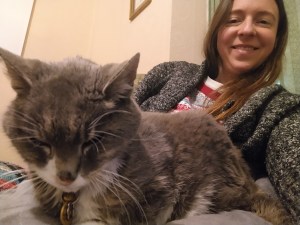
I had it after my mother’s 2022 death, too: a build-up of futile what-ifs, even though, likewise, a stroke was always going to get her. There was also an urgency to archive everything about her: every quirk, every maddening habit, every key incident. It’s different in that I treasure her own words in letters, cards, e-mails, and her 150 journals; it’s the same in that hundreds of photos can never bring back a presence. I don’t want to forget anything.
It was only Monday evening that Alfie napped on the bed while I took a Zoom call in the chair across from him. Monday night that he slurped up a little dish of gravy and spent hours on C’s lap. Tuesday morning (when he’d stopped eating and drinking) that I, in desperation, shoved an anti-seizure pill down his throat. Weak as he was, he fought me off as stubbornly as ever; I have the network of scratches on the knuckles of my left hand to prove it.
While the cuts are still fresh, while they still sting, I want to get the whole story down. I won’t think about how indulgent it is to post something this long. I won’t tell myself no one could possibly care. I’m writing mostly for myself, after all. As I narrate what happened, I seek to make sense. When I do write more personal material, I cherish the details years down the line. Have you loved another being with your whole heart and had them leave? However the circumstances differ, then, you know my pain. He was my most precious thing.


I’m in the middle of dozens of books, but my heart isn’t in any of my reading. Apart from those with deadlines for paid reviews and library due dates, I will only resume reading when I feel ready. If I miss pub. dates and challenges, so be it. I’m not sure yet whether I’ll be drawn to cat books later this year (“Reading the Meow” has run the past two Junes) or whether it will hurt too much. A couple of years ago I decided that A Cat in the Window by Derek Tangye was the perfect chronicle of life with a cat. Maybe I’ll pick it up to reread and imitate.
I know from my mom’s death that, after some time and cycles of depression and anger have passed, I will be able to take joy in everyday life again. Good memories will overtake those of the last day, and lingering regrets. Meanwhile, I’ll try to be gentle with myself and not run away from the loneliness and emptiness but sit with them. I don’t feel like much of a cat lady without a cat, but I won’t let a petty identity crisis rush me into anything. We may well adopt another cat or two in the future, but not right away. No one can ever replace Alfie anyway.
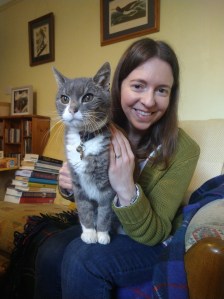
Some fun stuff:
- Alfie’s nicknames spreadsheet, introduced here, has been updated and categorized. There are 250+! (Some only applied to his heavy years and others to his old age.)
- He also had four theme tunes based on snippets from “Asleep on a Sunbeam” by Belle and Sebastian, “Don’t Bother Me” & “Old Enough” (“whatcha gonna do now?”) by the Raconteurs, and “I Just Don’t Know What to Do with Myself” by the White Stripes. (Jack White has the best hooks.) The last two captured his Foster-like indecision.
- I made a bloopers album of some of the more ridiculous photos of him.
- I’ve reviewed loads of cat books over the years. He made it into this post and this one.
Most Anticipated Books of the First Half of 2025
As I said the other week, I sometimes wonder if designating a book as “Most Anticipated” is a curse – if the chosen books are doomed to fail to meet my expectations. Nonetheless, I can’t resist compiling such a list at least once each year.
Also on my radar: fiction by Claire Adam, Amy Bloom, Emma Donoghue, Sarah Hall, Michelle Huneven, Eowyn Ivey, Rachel Joyce, Heather Parry and Torrey Peters; nonfiction by Melissa Febos, Robert Macfarlane, Lucy Mangan, Suzanne O’Sullivan and Sophie Pavelle. (Further ahead, I’ll seek out I Want to Burn This Place Down: Essays by Maris Kreizman and The Girls Who Grew Big by Leila Mottley in July, The Savage Landscape by Cal Flyn in Oct. and Tigers between Empires by Jonathan C. Slaght in Nov.)
However, below I’ve narrowed it down to the 25 books I’m most looking forward to for the first half of 2025, 15 fiction and 10 nonfiction. I’m impressed that 4 are in translation! And 22/25 are by women (all the fiction is). In release date order, with UK publication info given first if available. The blurbs are adapted from Goodreads. I’ve taken the liberty of using whichever cover is my favourite (almost always the U.S. one).

Fiction
 Live Fast by Brigitte Giraud (trans. from the French by Cory Stockwell) [Feb. 11, Ecco]: I found out about this autofiction novella via an early Shelf Awareness review. It “follows one woman’s quest to comprehend the motorcycle accident that took the life of her partner Claude at age 41. The narrator … recounts the chain of events that led up to the fateful accident, tracing the tiny, maddening twists of fate that might have prevented its tragic outcome. Each chapter asks the rhetorical question, ‘what if’ … A sensitive elegy to her husband”.
 The Unworthy by Agustina Bazterrica (trans. from the Spanish by Sarah Moses) [13 Feb., Pushkin; March 4, Scribner]: I wasn’t enamoured of the Argentinian author’s short stories, but Tender Is the Flesh was awesome. This is a short dystopian horror set in a convent. “In the House of the Sacred Sisterhood, the unworthy live in fear of the Superior Sister’s whip. … Risking her life, one of the unworthy keeps a diary in secret. Slowly, memories surface from a time before the world collapsed, before the Sacred Sisterhood became the only refuge. Then Lucía arrives.” (PDF copy for Shelf Awareness review)
 Victorian Psycho by Virginia Feito [13 Feb., Fourth Estate; Feb. 4, Liveright]: Feito’s debut, Mrs March, was deliciously odd, and I love the (U.S.) cover for this one. It sounds like a bonkers horror take on Henry James’s The Turn of the Screw, “a gruesome and gleeful new novel that probes the psyche of a bloodthirsty governess. Winifred Notty arrives at Ensor House prepared to play the perfect Victorian governess—she’ll dutifully tutor her charges, Drusilla and Andrew, tell them bedtime stories, and only joke about eating children.”

Three Days in June by Anne Tyler [13 Feb., Chatto & Windus (Penguin) / Feb. 11, Knopf]: I’m not a Tyler completist, but she’s reliable and this is a novella! “It’s the day before her daughter’s wedding and things are not going well for Gail Baines. First …, she loses her job … Then her ex-husband Max turns up at her door expecting to stay for the festivities. He doesn’t even have a suit. Instead, he’s brought memories, a shared sense of humour – and a cat looking for a new home. … [And] daughter Debbie discovers her groom has been keeping a secret.” Susan vouches for this. (Edelweiss download / on order from library)
 The Swell by Kat Gordon [27 Feb., Manilla Press (Bonnier Books UK)]: I got vague The Mercies (Kiran Millwood Hargrave) vibes from the blurb. “Iceland, 1910. In the middle of a severe storm two sisters, Freyja and Gudrun, rescue a mysterious, charismatic man from a shipwreck near their remote farm. Sixty-five years later, a young woman, Sigga, is spending time with her grandmother when they learn a body has been discovered on a mountainside near Reykjavik, perfectly preserved in ice.” (NetGalley download)
 Dream Count by Chimamanda Ngozi Adichie [4 March, Fourth Estate/Knopf]: This is THE book I’m most looking forward to; I’ve read everything Adichie has published and Americanah was a 5-star read for me. So I did something I’ve never done before and pre-ordered the signed independent bookshop edition from my local indie, Hungerford Bookshop. “Chiamaka is a Nigerian travel writer living in America. Alone in the midst of the pandemic, she recalls her past lovers and grapples with her choices and regrets.” The focus is on four Nigerian American women “and their loves, longings, and desires.” (New purchase)
 Kate & Frida by Kim Fay [March 11, G.P. Putnam’s Sons]: “Frida Rodriguez arrives in Paris in 1991 … But then she writes to a bookshop in Seattle … A friendship begins that will redefine the person she wants to become. Seattle bookseller Kate Fair is transformed by Frida’s free spirit … [A] love letter to bookshops and booksellers, to the passion we bring to life in our twenties”. Sounds like a cross between The Paris Novel and 84 Charing Cross Road – could be fab; could be twee. We shall see! (Edelweiss download)
 The Antidote by Karen Russell [13 March, Chatto & Windus (Penguin) / March 11, Knopf]: I love Russell’s Swamplandia! but haven’t gotten on with her other work I’ve tried, so I’m only tentatively enthusiastic about the odd Wizard of Oz-inspired blurb: “a historic dust storm ravages the fictional town of Uz, Nebraska. But Uz is already collapsing—not just under the weight of the Great Depression … but beneath its own violent histories. The Antidote follows a ‘Prairie Witch,’ … a Polish wheat farmer …; his orphan niece, a … witch’s apprentice …; a voluble scarecrow; and a New Deal photographer”. (Requested from publisher)
 Elegy, Southwest by Madeleine Watts [13 March, ONE (Pushkin) / Feb. 18, Simon & Schuster]: Watts’s debut, The Inland Sea, was a hidden gem. Given the news from L.A., this seems all the more potent: “In November 2018, Eloise and Lewis rent a car in Las Vegas and take off on a two-week road trip across the American southwest … [w]hile wildfires rage. … Lewis, an artist working for a prominent land art foundation, is grieving the recent death of his mother, while Eloise is an academic researching the past and future of the Colorado River … [and] beginning to suspect she might be pregnant”. (Edelweiss download)
 O Sinners! by Nicole Cuffy [March 18, One World (Random House)]: Cuffy’s Dances, which was longlisted for the Carol Shields Prize, was very good. The length of this sophomore novel (464 pages) gives me pause, but I do generally gravitate towards stories of cults. “Faruq Zaidi, a young journalist reeling from the recent death of his father, a devout Muslim, takes the opportunity to embed in a cult called The Nameless [b]ased in the California redwoods and shepherded by an enigmatic [Black] Vietnam War veteran.”
 The Accidentals: Stories by Guadalupe Nettel (trans. from the Spanish by Rosalind Harvey) [10 April, Fitzcarraldo Editions / April 29, Bloomsbury]: I really enjoyed Nettel’s International Booker-shortlisted novel Still Born. “When an albatross strays too far from its home, or loses its bearings, it becomes an ‘accidental’, an unmoored wanderer. The protagonists of these eight stories each find the ordinary courses of their lives disrupted by an unexpected event. … Deft and disquieting, oscillating between the real and the fantastical”. (PDF copy for Shelf Awareness review)
 Ordinary Saints by Niamh Ni Mhaoileoin [24 April, Manilla Press (Bonnier Books UK)]: “Brought up in a devout household in Ireland, Jay is now living in London with her girlfriend, determined to live day to day and not think too much about either the future or the past. But when she learns that her beloved older brother, who died in a terrible accident, may be made into a Catholic saint, she realises she must at last confront her family, her childhood and herself.” Winner of the inaugural PFD Queer Fiction Prize and shortlisted for the Women’s Prize Discoveries Award.
 Heartwood by Amity Gaige [1 May, Fleet / April 1, Simon & Schuster]: I loved Gaige’s Sea Wife. “In the heart of the Maine woods, an experienced Appalachian Trail hiker goes missing. She is forty-two-year-old Valerie Gillis, who has vanished 200 miles from her final destination. … At the centre of the search is Beverly, the determined Maine State Game Warden tasked with finding Valerie, who is managing the search on the ground. While Beverly is searching, Lena, a seventy-six-year-old birdwatcher in a retirement community, becomes an unexpected armchair detective.”
 Are You Happy?: Stories by Lori Ostlund [May 6, Astra House]: Ostlund is not so well known, especially outside the USA, but I enjoyed her debut novel, After the Parade, back in 2015. “Nine masterful stories that explore class, desire, identity, and the specter of violence in America–and in American families–against women and the LGBTQ+ community. … [W]e watch Ostlund’s characters as they try—and often fail—to make peace with their pasts while navigating their present relationships and responsibilities.” (Edelweiss download)
 Ripeness by Sarah Moss [22 May, Picador / Sept. 9, Farrar, Straus and Giroux]: Though I was disappointed by her last two novels, I’ll read anything Moss publishes and hope for a return to form. “It is the [19]60s and … Edith finds herself travelling to rural Italy … to see her sister, ballet dancer Lydia, through the final weeks of her pregnancy, help at the birth and then make a phone call which will seal this baby’s fate, and his mother’s.” Promises to be “about migration and new beginnings, and about what it is to have somewhere to belong.”
Nonfiction
 The Forgotten Sense: The New Science of Smell by Jonas Olofsson [Out now! 7 Jan., William Collins / Mariner]: Part of a planned deep dive into the senses. “Smell is … one of our most sensitive and refined senses; few other mammals surpass our ability to perceive scents in the animal kingdom. Yet, as the millions of people who lost their sense of smell during the COVID-19 pandemic can attest, we too often overlook its role in our overall health. … For readers of Bill Bryson and Steven Pinker”. (On order from library)
 Bread and Milk by Karolina Ramqvist (trans. from the Swedish by Saskia Vogel) [13 Feb., Bonnier Books / Feb. 11, Coach House Books]: I think I first found about this via the early Foreword review. “Bread and Milk traces a life through food, from carefully restricted low-fat margarine to a bag of tangerines devoured in one sitting to the luxury of a grandmother’s rice pudding. In this radiant memoir from one of Northern Europe’s most notable literary stylists, we follow several generations of women and their daughters as they struggle with financial and emotional vulnerability, independence, and motherhood.”
 My Mother in Havana: A Memoir of Magic & Miracle by Rebe Huntman [Feb. 18, Monkfish]: I found out about this from Rebecca Moon Ruark and by the time the publisher offered it to me I’d already downloaded it. The themes of bereavement and religion are right up my street. “As she explores the memory of her own mother, interlacing it with her search for the sacred feminine, Huntman leads us into a world of séance and sacrifice, pilgrimage and sacred dance, which resurrect her mother and bring Huntman face to face with a larger version of herself.” (Edelweiss download)
 Mother Animal by Helen Jukes [27 Feb., Elliott & Thompson]: This may be the 2025 release I’ve known about for the longest. I remember expressing interest the first time the author tweeted about it; it’s bound to be a good follow-up to Lucy Jones’s Matrescence. “When Helen Jukes falls pregnant, … she widens her frame of reference, looking beyond humans to ask what motherhood looks like in other species. … As she enters the sleeplessness, chaos and intimate discoveries of life with a newborn, these animal stories become … companions and guides.” (Requested from publisher)
 Alive: An Alternative Anatomy by Gabriel Weston [6 March, Vintage (Penguin) / March 4, David R. Godine]: I’ve read Weston’s Direct Red and appreciate her perspective. “As she became a surgeon, a mother, and ultimately a patient herself, Weston found herself grappling with the gap between scientific knowledge and unfathomable complexity of human experience. … Focusing on our individual organs, not just under the intense spotlight of the operating theatre, but in the central role they play in the stories of our lives.”
 The Lost Trees of Willow Avenue: A Story of Climate and Hope on One American Street by Mike Tidwell [March 25, St. Martin’s Press]: A must-read for me because it’s set in Takoma Park, Maryland, where I was born. “A love letter to the magnificent oaks and other trees dying from record heat waves and bizarre rain, [activist] Tidwell’s story depicts the neighborhood’s battle to save the trees and combat climate change. … Tidwell chronicles people on his block sick with Lyme disease, a church struggling with floods, and young people anguishing over whether to have kids, … against the global backdrop of 2023’s record heat domes and raging wildfires and hurricanes.”
 Breasts: A Relatively Brief Relationship by Jean Hannah Edelstein [3 April, Phoenix (W&N)]: I loved Edelstein’s 2018 memoir This Really Isn’t About You, and I regularly read her Substack. “As [Edelstein] comes of age, she learns that breasts are a source of both shame and power. In early motherhood, she sees her breasts transform into a source of sustenance and a locus of pain. And then, all too soon, she is faced with a diagnosis and forced to confront what it means to lose and rebuild an essential part of yourself.”
 Poets Square: A Memoir in Thirty Cats by Courtney Gustafson [8 May, Fig Tree (Penguin) / April 29, Crown]: Gustafson became an Instagram and TikTok hit with her posts about looking after a feral cat colony in Tucson, Arizona. The money she raised via social media allowed her to buy her home and continue caring for animals. “[Gustafson] had no idea about the grief and hardship of animal rescue, the staggering size of the problem in neighborhoods across the country. And she couldn’t have imagined how that struggle … would help pierce a personal darkness she’d wrestled for with much of her life.” (Proof copy from publisher)
 Lifelines: Searching for Home in the Mountains of Greece by Julian Hoffman [15 May, Elliott & Thompson]: Hoffman’s Irreplaceable was my book of 2019. “In the summer of 2000, Julian Hoffman and his wife Julia found themselves disillusioned with city life. Overwhelmed by long commutes, they stumbled upon a book about Prespa, Greece – a remote corner of Europe filled with stone villages, snow-capped mountains and wildlife. What began as curiosity soon transformed into a life-changing decision: to make Prespa their home.” I know next to nothing about Greece and this is a part of it that doesn’t fit the clichés.
 Spent: A Comic Novel by Alison Bechdel [22 May, Jonathan Cape (Penguin) / May 20, Mariner Books]: Bechdel’s Fun Home is an absolute classic of the graphic memoir. I’ve lost track of her career a bit but like the sound of this one. “A cartoonist named Alison Bechdel, running a pygmy goat sanctuary in Vermont, is existentially irked by a climate-challenged world and a citizenry on the brink of civil war.” After her partner’s wood-chopping video goes viral, she decides to create her own ethical-living reality TV show. Features cameos from some characters from her Dykes to Watch Out For series.
Other lists of anticipated books:
Clare – we overlap on a couple of our picks
Kate – one pick in common, plus I’ve already read a couple of her others
Laura – we overlap on a couple of our picks
Paul (mostly science and nature)
What catches your eye here? What other 2025 titles do I need to know about?
#1970Club: Desperate Characters & I’m the King of the Castle
Simon and Karen’s classics reading weeks are always a great excuse to pick up some older books. I found on my shelves a chilly Brooklyn-set novella that has been praised to the skies by the likes of Jonathan Franzen, and then borrowed a short and unsettling novel about warring English schoolboys from the library.

Desperate Characters by Paula Fox
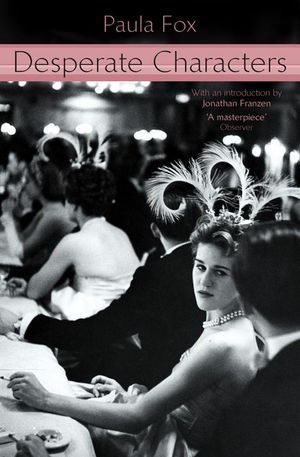 Other covers feature a cat, which is probably why this was on my radar. Don’t expect a cat lover’s book, though. The cat simply provides the opening incident. Sophie Bentwood is a forty-year-old underemployed translator; she doesn’t really need to work because her lawyer husband Otto keeps them in comfort. Feeding a feral cat, she is bitten savagely on the hand and over the next several days puts off seeking medical attention, wanting to stay in uncertainty rather than condemn herself to rounds of shots – and the cat to possible euthanasia. Both she and Otto live in this state of inertia. They were never able to have children but couldn’t take the step of adopting; Sophie had an affair but couldn’t leave Otto to commit elsewhere.
The cat bite seems to set off a chain of mishaps, culminating with the Bentwoods discovering that their house in the country has been vandalized. In the meantime, not a lot happens. The couple goes to a party and Sophie sneaks out for late-night drinks with her husband’s ex-partner, to whom she confides her affair. In Jonathan Franzen’s introduction, he compares to Bellow, Roth and Updike – but thinks Fox surpasses them all. The book explicitly references the Thoreau quote about people living lives of quiet desperation. I could sympathize with the midlife malaise depicted. As stagnant marriage stories go, this reminded me of what I’ve read by Richard Yates, just with a little less drinking. It would have made a good Literary Wives selection. In general, though, I can’t summon much enthusiasm. Given the cult classic status, I expected more. (Secondhand – Community Furniture Project, Newbury)
I’m the King of the Castle by Susan Hill
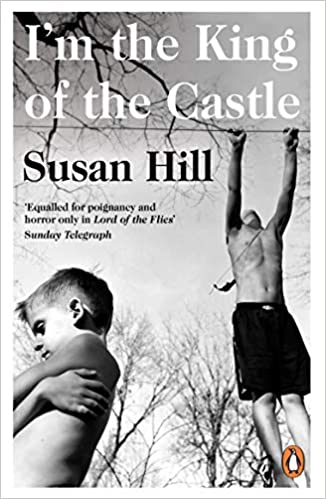 I’m almost tempted to mark this as an R.I.P. read, because it’s very dark indeed. Like The Woman in Black, it takes place in an ominous English mansion and its environs. Other scenes take place in a creepy forest and at castle ruins, adding to the Gothic atmosphere. Edmund Hooper and his father move into Warings after his grandparents’ death. Soon his father makes an unwelcome announcement: he’s hired a housekeeper, Helena Kingshaw, who will be moving in with her son, Charles, who is the same age as Edmund. Hooper writes Kingshaw (as the boys are called throughout the book, probably to replicate how they were known at their boarding schools) a note: “I DIDN’T WANT YOU TO COME HERE.”
That initial hostility erupts into psychological, and sometimes physical, abuse. Kingshaw quickly learns not to trust Hooper. “He thought, I mustn’t let Hooper know what I truly think, never, not about anything.” He tries running away to the woods but Hooper follows him; he makes friends with a local farm boy but it’s little comfort when he’ll soon be starting at Hooper’s school and it looks as if their lonely widowed parents might marry. The boys learn each other’s weaknesses and exploit them. At climactic moments, they have the opportunity to be gracious but retreat from every potential truce.
Heavy on dialogue and description, the book moves quickly with its claustrophobic scenes of nightmares come to life. Referring to the boys by surname makes them seem much older than 10 going on 11. Their antagonism is no child’s play – as the title ironically suggests – or harmless bullying. Is it evil? The reader feels for Kingshaw, the more passive one, yet what he does in revenge is nearly as bad. I was reminded somewhat of Harriet Said… by Beryl Bainbridge. It’s a deeply uncomfortable story, not least for how nature (pecking crows, cases of dead moths) is portrayed as equally menacing. (Public library)
Another 15 books from 1970 that I’ve read:
Jonathan Livingston Seagull by Richard Bach (in the running for worst book I’ve ever read)
Are You There, God? It’s Me, Margaret by Judy Blume
Runaway Ralph by Beverly Cleary
Fifth Business by Robertson Davies
84, Charing Cross Road by Helene Hanff
If Only They Could Talk by James Herriot
Ripley Under Ground by Patricia Highsmith
Crow by Ted Hughes
Moominvalley in November by Tove Jansson
Being There by Jerzy Kosiński
The Bluest Eye by Toni Morrison
Sing Down the Moon by Scott O’Dell
Love Story by Erich Segal
The Driver’s Seat by Muriel Spark
The Trumpet of the Swan by E.B. White
(Lots of children’s books there! Clearly they were considered modern classics during my 1980s childhood.)
I’ve previously participated in the 1920 Club, 1956 Club, 1936 Club, 1976 Club, 1954 Club, 1929 Club, 1940 Club and 1937 Club.
Sandwich by Catherine Newman (Blog Tour)
Catherine Newman’s second novel for adults, Sandwich, takes place during a week on Cape Cod, a popular Massachusetts beach resort. Rachel, nicknamed “Rocky,” is a fiftysomething mother to two young adults, Jamie and Willa. She and her husband Nick have been renting the same cottage for their family’s summer vacations for 20 years. Although Rocky narrates most of the novel in the first person, in the Prologue she paints the scene for the reader in the third person: “They’ve been coming here for so many years that there’s a watercolor wash over all of it now … pleasant, pastel memories of taffy, clam strips, and beachcombing.”
 Also present are Maya, Jamie’s girlfriend; Rocky’s ageing parents; and Chicken the cat (can you imagine taking your cat on holiday?!). With such close quarters, it’s impossible to keep secrets. Over the week of merry eating and drinking, much swimming, and plenty of no-holds-barred conversations, some major drama emerges via both the oldies and the youngsters. And it’s not just present crises; the past is always with Rocky. Cape Cod has developed layers of emotional memories for her. She’s simultaneously nostalgic for her kids’ babyhood and delighted with the confident, intelligent grown-ups they’ve become. She’s grateful for the family she has, but also haunted by inherited trauma and pregnancy loss.
There couldn’t be more ideal reading for women in the so-called “sandwich generation” who have children growing towards independence as well as parents starting to struggle with infirmity. (The contemporary storyline of Barbara Kingsolver’s Unsheltered, which coincidentally is about a character named Willa, is comparable in that respect.) Newman is frank about Willa’s lesbianism and Rocky’s bisexuality, and she doesn’t hold back about the difficulties of menopause, either. Rocky is challenged to rethink her responsibilities as a daughter, wife and mother when she’s surrounded by equally strong-willed people who won’t do what she wants them to. The novel is so quirky, funny and relatable that it’s impossible not to sympathize with Rocky even if, like me, you’re in a very different life situation.

I like the U.S. cover so much more!
One observation I would make is that Rocky is virtually identical to Ash in Newman’s debut, We All Want Impossible Things, and to the author in real life (as I know from subscribing to her Substack). If you read even the most basic information about her, it’s clear that it’s all autofiction. That’s not an issue for me as I don’t think inventing is inherently superior to drawing from experience; some authors write what they know in a literal sense and that’s okay. So, for her fans, more of the same will be no problem at all. But it is a very particular voice: intense, scatty, purposely outrageous. Rocky is a protagonist who says things like, “How am I a feminist, an advocate for reproductive rights, Our Bodies, Ourselves, hear me roar, blah blah, and I am only just now learning about vaginal atrophy?” (A companion nonfiction read would be Nina Stibbe’s Went to London, Took the Dog.)
In outlook Newman reminds me a lot of Anne Lamott, who is equally forthright and whose books similarly juxtapose life’s joy and sorrows, especially in this late passage: “this may be the only reason we were put on this earth. To say to each other, I know how you feel.”
This is a sweet, fun, chatty book that’s about a summer break – and would be perfect to read on a summer break.
With thanks to Anne Cater of Random Things Tours and Doubleday for the free e-copy for review.
Buy Sandwich from Bookshop.org [affiliate link]
I was delighted to help close out the blog tour for Sandwich. See below for details of where the other reviews have appeared.

Reading the Meow, Part II: Books by Bernardine Bishop and Matt Haig
This is my second contribution to the Reading the Meow challenge, hosted by Mallika of Literary Potpourri, after yesterday’s review of Sleeping with Cats by Marge Piercy. One of the below novels is obviously cat-themed; the other less so, but the cover and blurb convinced me to take a chance on a new-to-me author and I discovered a hidden gem.

The Street by Bernardine Bishop (2015)
Prices are so cheap at my local charity warehouse (3/£1 paperbacks) that I recently did something I almost never do: bought a book I’d never heard of, by an author I’d never heard of, and then (something I definitely never do!) read it almost right away instead of letting it gather dust on my shelves for years. Bishop’s biography is wild. As a new Cambridge graduate, she was the youngest witness in the Lady Chatterley trial in 1960, then published two novels in her early twenties. She married twice, had two sons and a psychotherapy career, and returned to writing fiction after 50 years – prompted by a cancer diagnosis. Unexpected Lessons in Love was shortlisted for the Costa Novel Award in 2013, while this and Hidden Knowledge were both published posthumously, after Bishop’s death in 2015.
So: there is a cat on the cover and the blurb mentions it, too: “a beloved cat achieves immortality.” (I should have realized that was a euphemism, but never mind.) The novel opens with news of the death at 90 of formidable Brenda Byfleet, who’d been a Greenham Common woman and taken part in peace protests right into old age. Neighbours quickly realize someone will need to care for her cat Benn (named for Tony Benn), and the duty falls to Anne and Eric, who have also taken in their grandson while his parents are in Canada.
 What follows is a low-key ensemble story that moves with ease between several key residences of Palmerston Street, London, introducing us to a couple struggling with infertility, a war veteran with dementia, an underemployed actor who rescues his wife from her boss’s unwanted attentions, and so on. Most touching is the relationship between Anne and Georgia, a lesbian snail researcher who paints Anne’s portrait. Their friendship shades into quiet, middle-aged love.
There are secrets and threats and climactic moments here, but always the reassuring sense that neighbours are a kind of second family and so someone will be there for you to rely on no matter what you face. (I can think of a certain soap opera theme that expresses a similar sentiment…) Bishop’s style reminds me most of Tessa Hadley’s. She is equally skilled at drawing children and the elderly, and clearly feels love and compassion for her flawed characters: “Everything and everyone in the street was bathed in a blessed ordinariness.”
From Brenda onward, Georgia’s rhetorical question hangs over the short novel: “What is a life?” The implied partial answer is: what is remembered by those left behind. The opening paragraph is perfect –
“Sometimes it is impossible to turn even a short London street into a village. But sometimes it can be easily done. It all depends on one or two personalities.”
… and the last page has kittens. This was altogether a lovely read. Dangit, why didn’t I also buy the other Bishop novel that was on shelf at the charity warehouse?! I’ll have to hope it’s still around the next time I go there. (Secondhand – Community Furniture Project, Newbury) 
To Be a Cat by Matt Haig (2012)
 This was a reasonably cute middle-grade fantasy and careful-what-you-wish-for cautionary tale. On his twelfth birthday, Barney Willow thinks life couldn’t get worse. His parents are divorced, his dad has recently disappeared, he’s bullied by Gavin Needle, and evil head teacher Miss Whipmire seems to have a personal vendetta against him. His only friend is Rissa Fairweather, who lives on a barge. Little does he know that an idle wish to switch places with a cat he pets on the street will set a dangerous adventure in motion. Now he’s a cat and Maurice the cat has his body. Soon Barney realizes there’s a whole subset of cats who are former humans (alongside “swipers,” proper fighting street cats; and “firesides,” who prefer to stay indoors), including Miss Whipmire, who used to be a Siamese cat and has an escape plan that involves Barney. I felt the influence of Roald Dahl and Terry Pratchett, but Haig doesn’t have their writing chops. Apart from Rissa, the characterization is too clichéd. I’m sure I would have enjoyed this at age eight, though. (Little Free Library)
#ReadingtheMeow2024 and 20 Books of Summer, 2: Sleeping with Cats by Marge Piercy
Reviews of books about cats have been a standard element on my blog over the years, and the second annual Reading the Meow challenge, hosted by Mallika of Literary Potpourri, was a good excuse to pick up some more. Tomorrow I’ll review two cat-themed novels; today I have a 2002 memoir that I have been meaning to read for ages.
I discovered Piercy through her poetry, then read Woman on the Edge of Time, a feminist classic that contrasts utopian and dystopian views of the future. Like May Sarton (whom Piercy knew), she devotes equal energy to both fiction and poetry and is an inveterate cat lady. Piercy is still publishing and blogging at 88; I have much to catch up on from her back catalogue. A précis of her life is almost stranger than fiction: she grew up in poverty in Detroit, joining a teen gang and discovering her sexuality first with other girls (“The first time I had an orgasm—I was eleven—I was astonished and also I had a feeling of recognition. Of course, that’s it. As if that was what I had been expecting or looking for”) then with men; had a couple abortions, including one self-administered, then got sterilized; honed her writing craft at college; married three times – briefly to a Frenchman, an unhappy open arrangement, and now for 40+ years to fellow writer Ira Wood; and wrote like a dervish yet has remained on the periphery of the literary establishment and thus struggled financially.
Political activism has been a constant for Piercy, whether protesting the Vietnam War or supporting women’s reproductive rights. She and Wood also nurtured a progressive Jewish community around their Cape Cod home. Again like Sarton, she has always embraced the term feminist but been more resistant to queerness. A generational thing, perhaps; nowadays we would surely call Piercy bisexual or at least sexually fluid, but she’s more apt to dismiss her teen girlfriends and her later affairs with women as a phase. The personal life and career mesh here, though there is more of a focus on the former, such that I haven’t really gotten a clear idea of which of her novels I might want to try. Each chapter ends with one of her poems (wordy, autobiographical free verse), giving a flavour of her work in other genres. She portrays herself as a nomad who wandered various cities before settling into an unexpectedly homely and seasonal existence: “I am a stray cat who has finally found a good home.”

I admired Piercy’s self-knowledge here: her determination to write (including to keep her late mother alive in her) and to preserve the solitude necessary to her work –
I know I am an intense, rather angular passionate woman, not easy to like, not easy to live with, even for myself. Convictions, causes jostle in me. My appetites are large. I have learned to protect my work time and my privacy fiercely. I have been a better writer than a person, and again and again I made that choice. Writing is my core. I do not regret the security I have sacrificed to serve it.
and her conviction that motherhood was not for her –
I did not want children. I never felt I would be less of a woman, but I feared I would be less of a writer if I reproduced. I didn’t feel anything special about my genetic composition warranted replicating it. … I liked many of my friends’ children as they grew older: I was a good aunt. But I never desired to possess them or have one of my own. … I have never regretted staying childless. My privacy, my time for work … are precious. I feel my life is full enough.
“There were no role models for a woman like me,” she felt at the end of college, but she can in her turn be a role model of the female artist’s life, socially engaged and willing to take risks.
As to the title: There is, of course, special delight here for cat lovers. Piercy has had cats since she was a child, and in the Cape Cod era has usually kept a band of five or so. In the interludes we meet some true characters: Arofa the Siamese, Cho-Cho who lived to 21, mother and son Dinah and Oboe, alpha male Jim Beam, and many more. Of course, they age and fall ill and there are some goodbye scenes. She mostly describes these unsentimentally – if you’ve read Doris Lessing on cats, I’d say the attitude is similar. There are extremes of both love and despair: she licks a kitten to bond with her; she euthanizes one beloved cat herself. She wrote this memoir at 65 and felt that her cats were teaching her how to age.
There is a sadness to living with old cats; also a comfort and pleasure, for you know each other thoroughly and the trust is almost absolute. … The knowledge of how much I will miss them is always with me, but so is the sense of my own time flowing out, my life passing and the necessity to value it as I value them. Old cats are precious.
Even those unfamiliar with Piercy’s work might enjoy reading a perspective on the radical movements of the 1960s and 70s. This was right up my street because of her love of cats, her defence of the childfree life, and her interest in identity and memory. Because she doesn’t talk in depth about her oeuvre, you needn’t have read anything else of hers to appreciate reading this. I hope you have a cat who will nap on your lap as you do so. (Secondhand, a gift from my wish list)
Carol Shields Prize Longlist Reads: Cocktail & Land of Milk and Honey
Two final reviews in advance of tomorrow’s shortlist announcement: a sophisticated, nostalgic short story collection and an intense future-set novel full of the pleasures of the flesh. Both make it onto my wish list at the end of this post.
Cocktail by Lisa Alward
The 12 stories of this debut collection brought to mind Tessa Hadley and Alice Munro for their look back at chic or sordid 1960s–1980s scenes and dysfunctional families or faltering marriages. They’re roughly half and half first-person and third-person (five versus seven). The title story opens the book with a fantastic line: “The problem with parties, my mother says, is people don’t drink enough.” Later, the narrator elaborates:
Her meaning is that if people drank more, they’d loosen up. Parties would be more fun, like they used to be. And I laugh along. Yes, I say, letting her top up my glass of Chardonnay. That’s it, not enough booze. But I’m thinking about Tom Collins.
 Not the drink, but an alias a party guest used when he stumbled into her bedroom looking for a toilet. She was about eleven at this point and she and her brother vaguely resented being shut away from their parents’ parties. While for readers this is an uncomfortable moment as we wonder if she’s about to be molested, in memory it’s taken on a rosy glow for her – a taste of adult composure and freedom that she has sought with every partner and every glass of booze since. This was a pretty much perfect story, with a knock-out ending to boot.
Dependence on alcohol recurs, and “Hawthorne Yellow,” is also about a not-quite affair, between a restless stay-at-home mother and the decorator who discovers antique sketches in the old servants’ quarters of her home. “Orlando, 1974” again contrasts childhood nostalgia with seedy reality: Disney World should have been an idyll, but the narrator mostly remembers a lot of vomiting. “Old Growth” and “Bear Country” have Ray renegotiating his relationship with his son after divorcing Gwyneth. “Hyacinth Girl,” too, is about complicated stepfamilies, while “Wise Men Say” looks back at cross-class romance. The protagonist of “Maeve” feels she can’t match the title character’s perfect parenting skills; the first-person plural in “Pomegranate” portrays a group of wild convent schoolgirls.
“Little Girl Lost” was the most Hadley-meets-Munro, with an alcoholic painter’s daughter seen first as a half-feral child and later as a hippie young woman. “How the Smoke Gets in Your Eyes” was the least essential with its elderly narrator piecing things together in the aftermath of a burglary. Along with the title story, the standout for me was “Bundle of Joy,” about a persnickety grandmother going to her daughter’s place to spend time with her new grandson. She disapproves of just about every decision Erin has made (leaving the dogs’ frozen turds in the backyard all winter, for instance), but her interference threatens to have lasting consequences. Not a dud in the dozen, and a very strong voice I’ll expect to read much more from. (Read via Edelweiss; published by Biblioasis)
Land of Milk and Honey by C Pam Zhang
We all die. We have only the choice, if we are privileged, of whether death comes with a whimper or a bang; of what worlds we taste before we go.
A real step up from How Much of These Hills Is Gold, which I read for book club last year – while it was interesting to see the queer, BIPOC spin Zhang put on the traditional Western, I found her Booker-longlisted debut bleak and strange in such a detached way that it was hard to care about. By contrast, I was fully involved in her sensuous and speculative second novel.
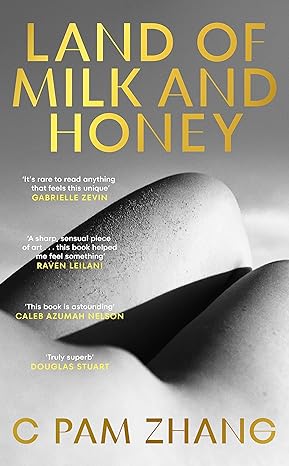 A 29-year-old Chinese American chef is exiled when the USA closes its borders while she’s working in London. On a smog-covered planet where 98% of crops have failed, scarcity reigns – but there is a world apart, a mountaintop settlement at the Italian border where money can buy any ingredient desired and threatened foods are cultivated in a laboratory setting. While peasants survive on mung bean flour, wealthy backers indulge in classic French cuisine. The narrator’s job is to produce lavish, evocative multi-course meals to bring investors on board. Foie gras, oysters, fine wines; heirloom vegetables; fruits not seen for years. But also endangered creatures and mystery meat wrested back from extinction. Her employer’s 21-year-old daughter, Aida, oversees the lab where these rarities are kept alive.
Ironically, surrounded with such delicacies, the chef loses her appetite for all but cigarettes – yet another hunger takes over. Her relationship with Aida is a passionate secret made all the more peculiar by the fact that the chef’s other role is to impersonate Aida’s dead mother, Eun-Young. It’s clear this precarious setup can’t last; ambition and technology keep moving on. The novel presents such a striking picture of desire at the end of the world. Each sentence is honed to flawlessness, with whole paragraphs of fulsome descriptions of meals. Zhang’s prose reminded me of Stephanie Danler’s and R.O. Kwon’s – no surprise, then, that they’re on the Acknowledgments list, as are a cornucopia of foods and other literary influences.
I’m not usually one for a dystopian novel, but the emotional territory keeps this one grounded even as the plot grows more sinister. My only complaint is that I would have left off the final chapter as I don’t think tracing the protagonist through four more decades of life adds much. I would rather have left this world in limbo than thought of the episode as a blip in a facile regeneration process – that’s the most unrealistic element of all. But this has still been my favourite read from the longlist so far. And there’s even a faithful pet cat, a “recalcitrant beast” that keeps coming back to the chef despite benign neglect. (Public library) 
My ideal shortlist, based on what I’ve read and still want to read, would be:


Cocktail by Lisa Alward
Dances by Nicole Cuffey
Brotherless Night by V.V. Ganeshananthan
I Have Some Questions for You by Rebecca Makkai
Land of Milk and Honey by C Pam Zhang
I wouldn’t be averse to seeing The Future or Chrysalis on there either. (Just not Loot, please!)
See Laura’s post for a recap of her reviews and her wish list. Marcie has also been reading from the longlist; see her first write-up here.
The Story Girl by L. M. Montgomery (1911) #ReadingStoryGirl
Six months after the Jane of Lantern Hill readalong, Canadian bloggers Naomi (Consumed by Ink) and Sarah Emsley have chosen an earlier work by Lucy Maud Montgomery, The Story Girl, and its sequel The Golden Road, for November buddy reading.
The book opens one May as brothers Felix and Beverley King are sent from Toronto to Prince Edward Island to stay with an aunt and uncle while their father is away on business. Beverley tells us about their thrilling six months of running half-wild with their cousins Cecily, Dan, Felicity, and Sara Stanley – better known by her nickname of the Story Girl, also to differentiate her from another Sara – and the hired boy, Peter. This line gives a sense of the group’s dynamic: “Felicity to look at—the Story Girl to tell us tales of wonder—Cecily to admire us—Dan and Peter to play with—what more could reasonable fellows want?”
Felicity is pretty and domestically inclined; Sara knows it would be better to be useful like Felicity, but all she has is her storytelling ability. Some are fantasy (“The Wedding Veil of the Proud Princess”); some are local tales that have passed into folk memory (“How Betty Sherman Won a Husband”). Beverley is in raptures over the Story Girl’s orations: “if voices had colour, hers would have been like a rainbow. It made words live. … we had listened entranced. I have written down the bare words of the story, as she told it; but I can never reproduce the charm and colour and spirit she infused into it. It lived for us.”

The cousins’ adventures are gently amusing and quite tame. They all write down their dreams in notebooks. Peter debates which church denomination to join and the boys engage in a sermon competition. Pat the cat has to be rescued from bewitching, and receives a dose of medicine in lard he licks off his paws and fur. The Story Girl makes a pudding with sawdust instead of cornmeal (reminding me of Anne Shirley and the dead mouse in the plum pudding). Life consistently teaches lessons in humility, as when they are all duped by Billy Robinson and his magic seeds, which he says will change whatever each one most resents – straight hair, plumpness, height; and there is a false alarm about the end of the world.
I found the novel fairly twee and realized at a certain point that I was skimming over more than I was reading. As was my complaint about Jane of Lantern Hill, there is a predictable near-death illness towards the end. The descriptions of Felicity and the Story Girl are purple (“when the Story Girl wreathed her nut-brown tresses with crimson leaves it seemed, as Peter said, that they grow on her—as if the gold and flame of her spirit had broken out in a coronal”); I had to remind myself that this reflects on Beverley more so than on Montgomery. From Naomi’s review of The Golden Road, I think that would be more to my taste because it has a clear plot rather than just stringing together pleasant but mostly forgettable anecdotes.
Still, it’s been fun to discover some of L. M. Montgomery’s lesser-known work, and there are sweet words about cats and the seasons:
“I am very good friends with all cats. They are so sleek and comfortable and dignified. And it is so easy to make them happy.”
“The beauty of winter is that it makes you appreciate spring.”
This effectively captures the long, magical summer days of childhood. I thought about when I was a kid and loved trips up to my mother’s hometown in upstate New York, where her brothers still lived. I was in awe of the Judd cousins’ big house, acres of lawn and untold luxuries such as Nintendo and a swimming pool. I guess I was as star-struck as Beverley. (University library) 
 Bookish Beck = Rebecca Foster. American transplant to England. Freelance proofreader and book reviewer.
 Bookish Beck