Some 2024 Reading Superlatives
Longest book read this year: The Bee Sting by Paul Murray

Shortest books read this year: The Wood at Midwinter by Susanna Clarke – a standalone short story (unfortunately, it was kinda crap); After the Rites and Sandwiches by Kathy Pimlott – a poetry pamphlet
 Authors I read the most by this year: Alice Oseman (5 rereads), Carol Shields (3 rereads); Margaret Atwood, Rachel Cusk, Pam Houston, T. Kingfisher, Sarah Manguso, Maggie O’Farrell, and Susan Allen Toth (2 each)
Publishers I read the most from: (Besides the ubiquitous Penguin Random House and its myriad imprints,) Carcanet (15), Bloomsbury & Faber (12 each), Alice James Books & Picador/Pan Macmillan (9 each)
My top author ‘discoveries’ of the year: Sherman Alexie and Bernardine Bishop
Proudest bookish achievements: Reading almost the entire Carol Shields Prize longlist; seeing The Bookshop Band on their huge Emerge, Return tour and not just getting my photo with them but having it published on both the Foreword Reviews and Shelf Awareness websites

Most pinching-myself bookish moment: Getting a chance to judge published debut novels for the McKitterick Prize
Books that made me laugh: Lots, but particularly Fortunately, the Milk… by Neil Gaiman, The Year of Living Biblically by A.J. Jacobs, and You Don’t Have to Be Mad to Work Here by Benji Waterhouse
Books that made me cry: On Chesil Beach by Ian McEwan, My Good Bright Wolf by Sarah Moss
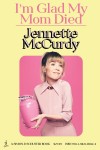 Two books that hit the laughing-and-crying-at-the-same-time sweet spot: The Absolutely True Diary of a Part-Time Indian by Sherman Alexie and I’m Glad My Mom Died by Jennette McCurdy
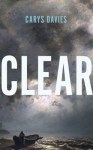
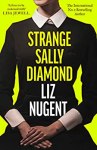
Best book club selections: Clear by Carys Davies, Howards End by E.M. Forster, Strange Sally Diamond by Liz Nugent
Best first lines encountered this year:
- From Cocktail by Lisa Alward: “The problem with parties, my mother says, is people don’t drink enough.”
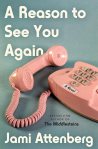
- From A Reason to See You Again by Jami Attenberg: “Oh, the games families play with each other.”
- From The Snow Queen by Michael Cunningham: “A celestial light appeared to Barrett Meeks in the sky over Central Park, four days after Barrett had been mauled, once again, by love.”

Best last lines encountered this year:
 From The Ministry of Time by Kaliane Bradley: “Forgiveness and hope are miracles. They let you change your life. They are time-travel.”
- From Mammoth by Eva Baltasar: “May I know to be alert when, at the stroke of midnight, life sends me its cavalry.”
- From Private Rites by Julia Armfield: “For now, they stay where they are and listen to the unwonted quiet, the hush in place of rainfall unfamiliar, the silence like a final snuffing out.”
- From Come to the Window by Howard Norman: “Wherever you sit, so sit all the insistences of fate. Still, the moment held promise of a full life.”
- From Intermezzo by Sally Rooney: “It doesn’t always work, but I do my best. See what happens. Go on in any case living.”
- From Barrowbeck by Andrew Michael Hurley: “And she thought of those Victorian paintings of deathbed scenes: the soul rising vaporously out of a spent and supine body and into a starry beam of light; all tears wiped away, all the frailty and grossness of a human life transfigured and forgiven at last.”
- From Small Rain by Garth Greenwell: “Pure life.”

Books that put a song in my head every time I picked them up: I’m the King of the Castle by Susan Hill (“Crash” by Dave Matthews Band); Y2K by Colette Shade (“All Star” by Smashmouth)
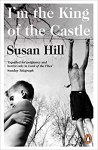
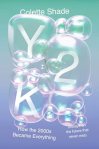
Shortest book titles encountered: Feh (Shalom Auslander) and Y2K (Colette Shade), followed by Keep (Jenny Haysom)
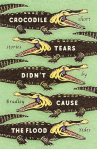 Best 2024 book titles: And I Will Make of You a Vowel Sound, I Can Outdance Jesus, Zombie Vomit Mad Libs, Crocodile Tears Didn’t Cause the Flood, This Is Why We Can’t Have Nice Things
Best book titles from other years: Recipe for a Perfect Wife, Tripping over Clouds, Waltzing the Cat, Dressing Up for the Carnival, The Met Office Advises Caution
Favourite title and cover combo of the year: I’m Mostly Here to Enjoy Myself by Glynnis MacNicol

Best punning title (and nominative determinism): Knead to Know: A History of Baking by Dr Neil Buttery
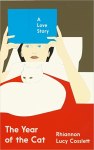 Biggest disappointments: The Glassmaker by Tracy Chevalier (I didn’t get past the first chapter because of all the info dumping from her research); The Year of the Cat by Rhiannon Lucy Cosslett; milk and honey by Rupi Kaur (that … ain’t poetry); 2 from the Observer’s 10 best new novelists feature (here and here)
A couple of 2024 books that everyone was reading but I decided not to: Creation Lake by Rachel Kushner, You Are Here by David Nicholls
 The worst books I read this year: Mammoth by Eva Baltasar, A Spy in the House of Love by Anaïs Nin
The downright strangest books I read this year: Zombie Vomit Mad Libs, followed by The Peculiar Life of a Lonely Postman. All Fours by Miranda July (I am at 44% now) is pretty weird, too.

My Best Backlist Reads of the Year
Like many bloggers and other book addicts, I’m irresistibly drawn to the new books released each year. However, I consistently find that many memorable reads were published earlier. A few of these are from 2022 or 2023 and most of the rest are post-2000; the oldest is from 1910. These 14 selections (alphabetical within genre but in no particular rank order), together with my Best of 2024 post coming up on Tuesday, make up about the top 10% of my year’s reading. Repeated themes included adolescence, parenting (especially motherhood) and trauma. The two not pictured below were read electronically.

Fiction
Fun facts:
- I read 4 of these for book club (Forster, Mandel, Munro and Obreht)
- 3 (Mandel, McEwan and Obreht) were rereads
- I read 2 as part of my Carol Shields Prize shadowing (Foote and Zhang)
 The Absolutely True Diary of a Part-Time Indian by Sherman Alexie: Groundbreaking for both Indigenous literature and YA literature, this reads exactly like a horny 14-year-old boy’s diary, but “Junior” (Arnold Spirit, Jr.) is also self-deprecating and sweetly vulnerable. Poverty, alcoholism, casinos: they don’t feel like clichés of Indian reservations because Alexie writes from experience and presents them matter-of-factly. Junior moves to a white high school and soon becomes adept at code-switching (and cartooning). Heartfelt; spot on.
 The Street by Bernardine Bishop: A low-key ensemble story about the residents of one London street: a couple struggling with infertility, a war veteran with dementia, and so on. Most touching is the relationship between Anne and Georgia, a lesbian snail researcher who paints Anne’s portrait; their friendship shades into quiet, middle-aged love. Beyond the secrets, threats and climactic moments is the reassuring sense that neighbours will be there for you. Bishop’s style reminds me most of Tessa Hadley’s. A great discovery.
 Coleman Hill by Kim Coleman Foote: Is this family memoir? Or autofiction? Foote draws on personal stories but also invokes overarching narratives of Black migration and struggle. The result is magisterial, a debut that is like oral history and a family scrapbook rolled into one, with many strong female characters. Like a linked story collection, it pulls together 15 vignettes from 1916 to 1989 and told in different styles and voices, including AAVE. The inherited trauma is clear, yet Foote weaves in counterbalancing lightness and love.
 Howards End by E.M. Forster: Rereading for book club, I was so impressed by its complexities – the illustration of class, the character interactions, the coincidences, the deliberate doublings and parallels. It covers so many issues, always without a heavy touch. So many sterling sentences: depictions of places, observations of characters, or maxims that are still true of life. Well over a century later and the picture of well-meaning wealthy intellectuals’ interference making others’ lives worse is just as cutting.
 Reproduction by Louisa Hall: Procreation. Duplication. Imitation. All three connotations are appropriate for the title of an allusive novel about motherhood and doppelgangers. A pregnant writer starts composing a novel about Mary Shelley and finds the borders between fiction and (auto)biography blurring. It’s a recognisable piece of autofiction, with a sublime clarity as life is transcribed to the page exactly as it was lived. A tale of transformation – chosen or not – and peril in a country hurtling toward self-implosion. Brilliantly envisioned.
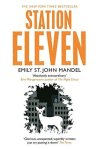 Station Eleven by Emily St. John Mandel: This has persisted as a definitive imagination of post-apocalypse life. On a reread, I was captivated by the different layers of the nonlinear story, from celebrity gossip to a rare graphic novel series, and the links between characters and storylines. Mandel also seeds subtle connections to later work. Themes that struck me were the enduring power of art and the value of the hyperlocal. It seems prescient of Covid-19, but more so of climate collapse. An ideal blend of the literary and the speculative.
 On Chesil Beach by Ian McEwan: A perfect novella. Its core is the July 1962 night when Edward and Florence attempt to consummate their marriage, but it stretches back to cover everything we need to know about them – their family dynamics, how they met, what they want from life – and forward to see their lives diverge. Is love enough? It’s a maturing of the author’s vision: tragedy is not showy and grotesque like in his early work, but quiet, hinging on the smallest action, the words not said. This absolutely flayed me emotionally on a reread.
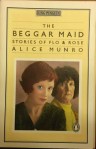 The Beggar Maid by Alice Munro: Linked short stories about a hardscrabble upbringing in small-town Ontario and a woman’s ongoing search for love. Rose’s stepmother Flo is resentful and stingy. She feels she’s always been hard done by, and takes it out on Rose. From early on, we know Rose makes it out of West Hanratty and gets a chance at a larger life, that her childhood becomes a tale of deprivation. Each story is intense, pitiless, and practically as detailed as an entire novel. Rich in insight into characters’ psychology.
 The Tiger’s Wife by Téa Obreht: Natalia, a medical worker in a war-ravaged country, learns of her grandfather’s death away from home. The only one who knew the secret of his cancer, she sneaks away from an orphanage vaccination program to reclaim his personal effects, hoping they’ll reveal something about why he went on this final trip. On this reread I was utterly entranced, especially by the sections about The Deathless Man. I had forgotten the medical element, which of course I loved. My favourite Women’s Prize winner.
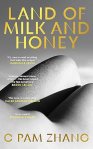 Land of Milk and Honey by C Pam Zhang: On a smog-covered planet where 98% of crops have failed, scarcity reigns – but there is a world apart, a mountaintop settlement at the Italian border where money can buy anything. The 29-year-old Chinese American chef’s job is to produce lavish, evocative multi-course meals. Her relationship with her employer’s 21-year-old daughter is a passionate secret. Each sentence is honed to flawlessness, with paragraphs of fulsome descriptions of meals. A striking picture of desire at the end of the world.
Nonfiction
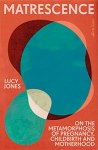 Matrescence: On the Metamorphosis of Pregnancy, Childbirth and Motherhood by Lucy Jones: A potent blend of scientific research and stories from the frontline. Jones synthesizes a huge amount of information into a tight narrative structured thematically but also proceeding chronologically through her own matrescence. The hybrid nature of the book is its genius. There’s a laser focus on her physical and emotional development, but the statistical and theoretical context gives a sense of the universal. For anyone who’s ever had a mother.
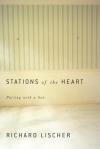 Stations of the Heart: Parting with a Son by Richard Lischer: Lischer opens by looking back on the day when his 33-year-old son Adam called to tell him his melanoma was back. Tests revealed metastases everywhere, including in his brain. The next few months were a Calvary of sorts, and Lischer, an emeritus professor at Duke Divinity School, draws deliberate parallels with biblical and liturgical preparations for Good Friday. His prose is a just right match: stately, resolute and weighted with spiritual allusion, yet never morose.
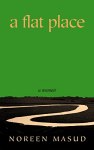 A Flat Place by Noreen Masud: A travel memoir taking in flat landscapes of the British Isles. But flatness is a psychological motif as well as a topographical reality. Growing up with a violent Pakistani father and passive Scottish mother, Masud chose the “freeze” option in fight-or-flight situations. A childhood lack of safety, belonging and love left her with complex PTSD. Her portrayals of sites and journeys are engaging and her metaphors are vibrant. Geography, history and social justice are a backdrop for a stirring personal story.
I’m Glad My Mom Died by Jennette McCurdy: True to her background in acting and directing, the book is based around scenes and dialogue, and present-tense narration mimics her viewpoint starting at age six. Much imaginative work was required to make her chaotic late-1990s California household, presided over by a hoarding Mormon cancer survivor, feel real. Abuse, eating disorders, a paternity secret: The mind-blowing revelations keep coming. So much is sad. And yet it’s a very funny book in its observations and turns of phrase.
What were some of your best backlist reads this year?
Book Serendipity, January to February 2024
I call it “Book Serendipity” when two or more books that I read at the same time or in quick succession have something in common – the more bizarre, the better. This is a regular feature of mine every couple of months. Because I usually have 20–30 books on the go at once, I suppose I’m more prone to such incidents. The following are in roughly chronological order.
- I finished two poetry collections by a man with the surname Barnett within four days in January: Murmur by Cameron Barnett and Birds Knit My Ribs Together by Phil Barnett.

- I came across the person or place name Courtland in The Optimist’s Daughter by Eudora Welty, then Cortland in a story from The Orange Fish by Carol Shields, then Cotland (but where? I couldn’t locate it again! Was it in Elizabeth Is Missing by Emma Healey?).
- The Manet painting Olympia is mentioned in Christmas Holiday by W. Somerset Maugham and The Paris Novel by Ruth Reichl (both of which are set in Paris).


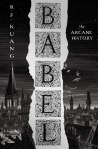
- There’s an “Interlude” section in Babel by R.F. Kuang and The Vulnerables by Sigrid Nunez.
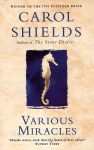
- The Morris (Minor) car is mentioned in Elizabeth Is Missing by Emma Healey and Various Miracles by Carol Shields.
- The “flour/flower” homophone is mentioned in Babel by R.F. Kuang and Various Miracles by Carol Shields.
- A chimney swift flies into the house in Cat and Bird by Kyoko Mori and The Optimist’s Daughter by Eudora Welty.
- A character named Cornelius in The Fruit Cure by Jacqueline Alnes and Wellness by Nathan Hill.
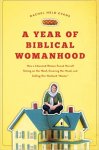
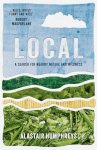
- Reading two year challenge books at the same time, A Year of Biblical Womanhood by Rachel Held Evans and Local by Alastair Humphreys, both of which are illustrated with frequent black-and-white photos by and of the author.
- A woman uses a bell to summon children in one story of Universally Adored and Other One Dollar Stories by Elizabeth Bruce and The Optimist’s Daughter by Eudora Welty.
- Apple turnovers get a mention in A Year of Biblical Womanhood by Rachel Held Evans and Wellness by Nathan Hill.
- A description of rolling out pie crust in A Year of Biblical Womanhood by Rachel Held Evans and Cat and Bird by Kyoko Mori.

- The idea of a house giving off good or bad vibrations in Wellness by Nathan Hill and a story from Various Miracles by Carol Shields.

- Emergency C-sections described or at least mentioned in Brother Do You Love Me by Manni Coe, The Unfamiliar by Kirsty Logan, Wellness by Nathan Hill, and lots more.
- Frustration with a toddler’s fussy eating habits, talk of “gentle parenting” methods, and mention of sea squirts in Wellness by Nathan Hill and Matrescence by Lucy Jones.
- The nickname “Poet” in The Tidal Year by Freya Bromley and My Friends by Hisham Matar.
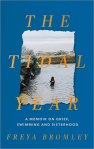
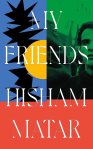
- A comment about seeing chicken bones on the streets of London in The Tidal Year by Freya Bromley and Went to London, Took the Dog by Nina Stibbe.
- Swans in poetry in The Tidal Year by Freya Bromley and Egg/Shell by Victoria Kennefick.
- A mention or image of Captcha technology in Egg/Shell by Victoria Kennefick and Went to London, Took the Dog by Nina Stibbe.
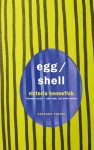

- An animal automaton in Loot by Tania James and Egg/Shell by Victoria Kennefick.
- A mention of Donna Tartt in The Tidal Year by Freya Bromley, Looking in the Distance by Richard Holloway, and Matrescence by Lucy Jones.
- Cathy Rentzenbrink appears in The Tidal Year by Freya Bromley and Went to London, Took the Dog by Nina Stibbe.
 Dialogue is given in italics in the memoirs The Tidal Year by Freya Bromley and The Unfamiliar by Kirsty Logan.
- An account of a man being forced to marry the sister of his beloved in A Year of Biblical Womanhood by Rachel Held Evans, Wellness by Nathan Hill, and The Tiger’s Wife by Téa Obreht.
- Saying that one doesn’t want to remember the loved one as ill (but really, not wanting to face death) so not saying goodbye (in Cat and Bird by Kyoko Mori) or having a closed coffin (Wellness by Nathan Hill).
- An unhappy, religious mother who becomes a hoarder in Wellness by Nathan Hill and I’m Glad My Mom Died by Jennette McCurdy.
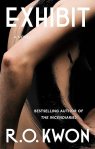
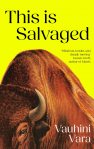
- Characters called Lidija and Jin in Exhibit by R. O. Kwon and Lydia and Jing in the first story of This Is Salvaged by Vauhini Vara.
- Distress at developing breasts in Cactus Country by Zoë Bossiere and I’m Glad My Mom Died by Jennette McCurdy.
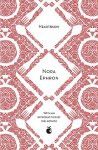
- I came across mentions of American sportscaster Howard Cosell in Heartburn by Nora Ephron and Stations of the Heart by Richard Lischer (two heart books I was planning on reviewing together) on the same evening. So random!
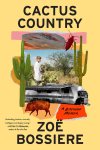
- Girls kissing and flirting with each other (but it’s clear one partner is serious about it whereas the other is only playing or considers it practice for being with boys) in Cactus Country by Zoë Bossiere and Winter’s Bone by Daniel Woodrell.
- A conversion to Catholicism in Places I’ve Taken My Body by Molly McCully Brown and Stations of the Heart by Richard Lischer.
- A zookeeper is attacked by a tiger when s/he goes into the enclosure (maybe not the greatest idea!!) in Tiger by Polly Clark and The Tiger’s Wife by Téa Obreht.
- The nickname Frodo appears in Tiger by Polly Clark and Brother Do You Love Me by Manni Coe.
- Opening scene of a parent in a coma, California setting, and striking pink and yellow cover to Death Valley by Melissa Broder and I’m Glad My Mom Died by Jennette McCurdy.

- An Englishman goes to Nigeria in Howards End by E.M. Forster and Immanuel by Matthew McNaught.
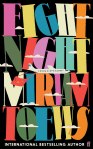 The Russian practice of whipping people with branches at a spa in Tiger by Polly Clark and Fight Night by Miriam Toews.
- A mother continues washing her daughter’s hair until she is a teenager old enough to leave home in Mrs. March by Virginia Feito and I’m Glad My Mom Died by Jennette McCurdy.
- Section 28 (a British law prohibiting the “promotion of homosexuality” in schools) is mentioned in A Bookshop of One’s Own by Jane Cholmeley, Some Kids I Taught and What They Taught Me by Kate Clanchy, and Brother Do You Love Me by Manni Coe.
- Characters named Gord (in one story from Various Miracles by Carol Shields, and in Fight Night by Miriam Toews), Gordy (in The Absolutely True Diary of a Part-Time Indian by Sherman Alexie), and Gordo (in Blood Red by Gabriela Ponce).

- Montessori and Waldorf schools are mentioned in Cactus Country by Zoë Bossiere and When Fragments Make a Whole by Lory Widmer Hess.
- A trailer burns down in The Absolutely True Diary of a Part-Time Indian by Sherman Alexie and Cactus Country by Zoë Bossiere.
What’s the weirdest reading coincidence you’ve had lately?
Remainders of the Day by Shaun Bythell & What Remains? by Rupert Callender
I raced to finish all the September releases on my stack by the 30th, thinking I’d review them in one go, but that ended up being far too unwieldy. There was way too much to say about each of these excellent books (the first two pairs are here and here; Blurb Your Enthusiasm by Louise Willder is still to come, probably on Wednesday). I’ve mentioned before that the month’s crop of nonfiction was about either books or death. Here’s one of each, linked by their ‘remain’ titles. Both: 
Remainders of the Day: More Diaries from The Bookshop, Wigtown by Shaun Bythell
 It’s just over five years since many of us were introduced to Wigtown and the ups and downs of running a bookshop there through Shaun Bythell’s The Diary of a Bookseller. (I’ve also reviewed the follow-up, Confessions of a Bookseller, which was an enjoyable read for me during a 2019 trip to Milan, and 2020’s Seven Kinds of People You Find in Bookshops.)
This third volume opens in February 2016. As in its predecessors, each monthly section is prefaced by an epigraph from a historical work on bookselling – this time R. M. Williamson’s 1904 Bits from an Old Bookshop. It’s the same winning formula as ever: the nearly daily entries start with the number of online orders received and filled, and end with the number of customers and the till takings for the day. (The average spend seems to be £10 per customer, which is fine in high tourist season but not so great in November and December when hardly anyone walks through the door.) In between, Bythell details notable customer encounters, interactions with shop helpers or local friends, trips out to buy book collections or go fishing, Wigtown events including the book festival, and the occasional snafu like the boiler breaking during a frigid November or his mum being hospitalized with a burst ulcer.
Reading May Sarton’s Encore recently, I came across a passage where she is reading a fellow writer’s journal (Doris Grumbach’s Coming into the End Zone):
I find hers extremely good reading, so I cannot bear to stop. I am reading it much too fast and I think I shall have to read it again. I know that I must not swallow it whole. There is something about a journal, I think, that does this to readers. So many readers tell me that they cannot put my journals down.
I’ve heard Zadie Smith say the same about Karl Ove Knausgaard’s My Struggle: it’s just the stuff of prosaic, everyday life and yet she refers to his memoirs/autofiction as literary crack.
I often read a whole month’s worth of entries at a sitting. I can think of a few specific reasons why Bythell’s journals are such addictive reading:
- “Sometimes you want to go where everybody knows your name.” Small-town settings are irresistible for many readers, and by now the fairly small cast of characters in Bythell’s books feel like old friends. Especially having been to Wigtown myself, I can picture many of the locations he writes about, and you get the rhythm of the seasons and the natural world as well as the town’s ebb and flow of visitors.
- (A related point) You know what to expect, and that’s a comforting thing. Bythell makes effective use of running gags. You know that when Granny, an occasional shop helper from Italy, appears, she will complain about her aches and pains, curse at Bythell and give him the finger. Petra’s belly-dancing class (held above the shop) will inevitably be poorly attended. If Eliot is visiting, he is sure to leave his shoes right where everyone will trip over them. Captain the cat will be portly and infuriating.
- What I most love about the series is the picture of the life cycle of books, from when they first enter the shop, or get picked up in his van, to when rejects are dropped at a Glasgow recycling plant. What happens in the meantime varies, with once-popular authors falling out of fashion while certain topics remain perennial bestsellers in the shop (railways, ornithology). There’s many a serendipitous moment when he comes across a book and it’s just what a customer wants, or buys a book as part of a lot and then sells it online the very next day. New, unpriced stock is always quick to go.
Also of note in this volume are his break-up with Amazon, after his account falls victim to algorithms and is suspended, the meta moment where he signs his first book contract with Profile, and the increasing presence of the Bookshop Band, who moved to Wigtown later in 2017. Bythell doesn’t seem to get much time to read – it’s a misconception of the bookselling life that you do nothing but read all day; you’d be better off as a book reviewer if that’s what you want – but when he does, it’s generally an intense experience: E.M. Forster’s sci-fi novella The Machine Stops (who knew it existed?!), Barbara Comyns’s A Touch of Mistletoe, Jonathan Safran Foer’s Everything Is Illuminated, and Oscar Wilde’s De Profundis.
I’m torn as to whether I hope there will be more year by year volumes filling in to the present day. As Annabel noted, the ‘where they are now’ approach in the Epilogue rather suggests that he and his publisher will leave it here at a trilogy. This might be for the best, as a few more pre-Covid years of the same routines could get old, though nosey parkers like myself will want to know how a confirmed bachelor turned into a family man…
Some favourite lines:
“Quiet day in the shop; even the cat looked bored.” (31 October)
“The life of the secondhand bookseller mainly involves moving boxes from one place to another, and trying to make them fit into a small space, like some sort of awful game of Tetris.”
(10 February and 15 March are great stand-alone entries that give a sense of what the whole is like. There are a lot of black-and-white photos printed amid the text in the first month; it’s a shame these don’t carry on through.)
With thanks to Profile Books for the free copy for review.
What Remains?: Life, Death and the Human Art of Undertaking by Rupert Callender
Call me morbid or call me realistic; in the last decade and a half I have read a lot of books about death, including terminal illness and bereavements. I’ve even read several nonfiction works by American mortician Caitlin Doughty. But I’ve not read anything quite like punk undertaker Rupert Callender’s manifesto about modern death and how much we get wrong in our conceptualization and conversations. It was poignant to be reading this in the weeks surrounding Queen Elizabeth II’s death – a time when death got more discussion than usual, yes, but when there was also some ridiculous pomp that obscured the basic human facts of it.
Callender is not okay with death, and never has been. When he was seven, his father died of a heart attack at age 63. His 1970s Edinburgh upbringing was shattered and his mother, who he has no doubt was doing her best, made a few terrible mistakes. First, a year before, she’d reassured him that his father wasn’t going to die. Second, she didn’t make him attend the funeral. (I still wish my mother had made me go back to tour my late grandmother’s house one final time when I was seven; instead, I stayed behind and played on a Ouija board with my cousins.) Third, she soon sent Callender away to boarding school, which left him feeling alone and betrayed. And lastly, when she died of cancer when he was 25, she had planned every detail of her funeral – whereas he believes that is a task for the survivors.
An orphan in his late twenties, Callender came across The Natural Death Handbook and it sealed his future. He’d been expelled from school and blown his inheritance; acid house culture had given him a sense of community. Now he had a vocation. The first funeral he coordinated was for a postman named Barry. The fourth was a suicide. Their first child burial was one of his partner’s daughter’s classmates.

Over the next two decades, he and his (now ex-)wife Claire based Totnes’ The Green Funeral Company on old-fashioned values and homespun ceremonies. They oppose the overmedicalization of death and the clinical detachment of places like crematoria. Callender is vehemently anti-embalming – an intrusive process that involves toxic substances. They encourage the bereaved to keep the body at home for the week before a funeral, if they feel able (ice packs like you’d use in a picnic cool bag will work a treat), and to be their own pallbearers to make the memory of the funeral day a physical one. He performs the eulogies himself, and they use cardboard coffins.
This is a slippery work for how it intersperses personal stories with polemic and poetic writing. Despite a roughly chronological throughline, it feels more like a thematic set of essays than a sequential narrative. Callender has turned death rituals into both performance art (including at festivals and in collaboration with The KLF) and political protests (e.g., a public funeral he conducted for a homeless man who died of exposure, the third such death in his town that year). While he doesn’t shy away from the gruesome realities of dealing with corpses, he always brings it back to fundamentals: matter is what we are, but who we were lives on in others’ loving memories. Death rituals plug us into a human lineage and proclaim meaning in the face of nothingness. Whether you’ve seen/read it all or never considered picking up a book about death, I recommend Callender’s sui generis approach.
Some favourite lines:
“[The practice of having official pallbearers] is all part of the emotional infantilising encouraged by the funeral industry, all part of being turned into an audience at one of the most significant moments in your family history, instead of being empowered as a family and a community.”
“each death we experience contains every death we have ever lived through, Russian dolls of bereavement waiting to be unpacked.”
“Only once you are dead can the full arc of your life be clearly seen, and telling that story out loud and truthfully to the people who shared it is a powerful social act that both binds us together and place us within our culture.”
With thanks to Chelsea Green for the proof copy for review.
And as a bonus, given that today is Indigenous Peoples’ Day in the USA, here’s an excerpt from my Shelf Awareness review of another book that came out last month:
No Country for Eight-Spot Butterflies: A Lyric Essay by Julian Aguon
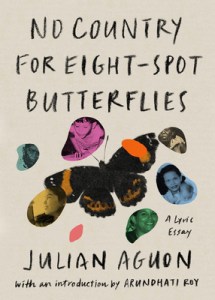 An indigenous human rights lawyer, Aguon is passionate about protecting his homeland of Guam, which is threatened by climate change and military expansion. His tender collage of autobiographical vignettes and public addresses inspires activism and celebrates beauty worth preserving. The U.S. Department of Defense’s plan to site more Marines and firing ranges on Guam will destroy more than 1,000 acres of limestone forest—home to endemic and endangered species, including the Mariana eight-spot butterfly. Aguon has been a lead litigator in appeals rising all the way to the U.S. Supreme Court. Rejecting fatalism, he endorses peaceful resistance. Two commencement speeches, poems, a eulogy and an interview round out the varied and heartfelt collection.
Short Stories in September, Part II: Tove Jansson, Brandon Taylor, Eley Williams
Each September I make a special effort to read short stories, which otherwise tend to languish on my shelves and TBR unread. After my first four reviewed last week, I have another three wonderfully different collections, ranging from bittersweet children’s fantasy in translation to offbeat, wordplay-filled love notes via linked stories suffused with desire and desperation.
Tales from Moominvalley by Tove Jansson (1962; 1963)
[Trans. from the Swedish by Thomas Warburton]
 I only discovered the Moomins in my late twenties, but soon fell in love with the quirky charm of Jansson’s characters and their often melancholy musings. Her stories feel like they can be read on multiple levels, with younger readers delighting in the bizarre creations and older ones sensing the pensiveness behind their quests. There are magical events here: Moomintroll discovers a dragon small enough to be kept in a jar; laughter is enough to bring a fearful child back from literal invisibility. But what struck me more was the lessons learned by neurotic creatures. In “The Fillyjonk who believed in Disasters,” the title character fixates on her belongings—
“we are so very small and insignificant, and so are our tea cakes and carpets and all those things, you know, and still they’re important, but always they’re threatened by mercilessness…”
—but when a gale and a tornado come and sweep it all away, she experiences relief and joy:
“the strange thing was that she suddenly felt quite safe. It was a very strange feeling, and she found it indescribably nice. But what was there to worry about? The disaster had come at last.”
My other favourite was “The Hemulen who loved Silence.” After years as a fairground ticket-taker, he can’t wait to retire and get away from the crowds and the noise, but once he’s obtained his precious solitude he realizes he needs others after all. The final story, “The Fir Tree,” is a lovely Christmas one in which the Moomins, awoken midway through their winter hibernation, get caught up in seasonal stress and experience the holiday for the first time. (Public library)
Filthy Animals by Brandon Taylor (2021)
Real Life was one of my five favourite novels of 2020, and we are in parallel fictional territory here. Lionel, the protagonist in four of the 11 stories, is similar to Wallace insomuch as both are gay African Americans at a Midwestern university who become involved with a (straight?) white guy. The main difference is that Lionel has just been released from hospital after a suicide attempt. A mathematician (rather than a biochemist like Wallace), he finds numbers soothingly precise in comparison to the muddle of his thoughts and emotions.
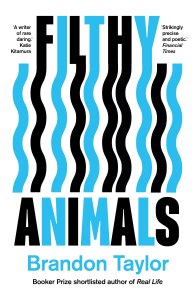 In the opening story, “Potluck,” he meets Charles, a dancer who’s dating Sophie, and the three of them shuffle into a kind of awkward love triangle where, as in Real Life, sex and violence are uncomfortably intertwined. It’s a recurring question in the stories, even those focused around other characters: how does tenderness relate to desire? In the throes of lust, is there room for a gentler love? The troubled teens of the title story are “always in the thick of violence. It moves through them like the Holy Ghost might.” Milton, soon to be sent to boot camp, thinks he’d like to “pry open the world, bone it, remove the ugly hardness of it all.”
Elsewhere, young adults face a cancer diagnosis (“Mass” and “What Made Them Made You”); a babysitter is alarmed by her charge’s feral tendencies (“Little Beast”); and same-sex couples renegotiate their relationships (Simon and Hartjes in “As Though That Were Love” and Sigrid and Marta in “Anne of Cleves,” one of my favourites). While the longer Lionel/Charles/Sophie stories, “Potluck” and “Proctoring,” are probably the best and a few others didn’t make much of an impression, the whole book has an icy angst that resonates. Taylor is a confident orchestrator of scenes and conversations, and the slight detachment of the prose only magnifies his characters’ longing for vulnerability (Marta says to Sigrid before they have sex for the first time: “I’m afraid I’ll mess it up. I’m afraid you’ll see me.” To which Sigrid replies, “I see you. You’re wonderful.”). (New purchase, Forum Books)
 A bonus story: “Oh, Youth” was published in Kink (2021), an anthology edited by Garth Greenwell and R.O. Kwon. I requested this from NetGalley just so I could read the stories by Carmen Maria Machado and Brandon Taylor. All of Taylor’s work feels of a piece, such that his various characters might be rubbing shoulders at a party – which is appropriate because the centrepiece of Real Life is an excruciating dinner party, Filthy Animals opens at a potluck, and “Oh, Youth” is set at a dinner party.
Grisha is here with Enid and Victor, his latest summer couple. He’s been a boytoy for hire since his architecture professor, Nate, surprised him by inviting him into his open marriage with Brigid. “His life at the time was a series of minor discomforts that accumulated like grit in a socket until rotation was no longer possible.” The liaisons are a way to fund a more luxurious lifestyle and keep himself in cigarettes.
While Real Life brought to mind Virginia Woolf, Taylor’s stories recall E.M. Forster or Thomas Mann. In other words, he’s the real deal: a blazing talent, here to stay.
Attrib. and Other Stories by Eley Williams (2017)
 After enjoying her debut novel, The Liar’s Dictionary, this time last year, I was pleased to find Williams’s first book in a charity shop last year. Her stories are brief (generally under 10 pages) and 15 of the 17 are first-person narratives, often voiced by a heartbroken character looking for the words to describe their pain or woo back a departed lover. A love of etymology is patent and, as in Ali Smith’s work, the prose is enlivened by the wordplay.
The settings range from an art gallery to a beach where a whale has washed up, and the speakers tend to have peculiar careers like an ortolan chef or a trainer of landmine-detecting rats. My favourite was probably “Synaesthete, Would Like to Meet,” whose narrator is coached through online dating by a doctor.
 I found a number of the stories too similar and thin, and it’s a shame that the hedgehog featured on the cover of the U.S. edition has to embody human carelessness in “Spines,” which is otherwise one of the standouts. But the enthusiasm and liveliness of the language were enough to win me over. (Secondhand purchase from the British Red Cross shop, Hay-on-Wye – how fun, then, to find the line “Did you know Timbuktu is twinned with Hay-on-Wye?”)
I’ll have one more set of short story reviews coming up before the end of the month, with a few other collections then spilling into October for R.I.P.
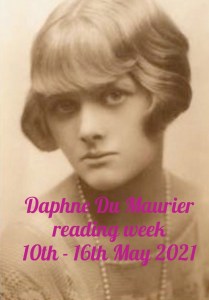
Daphne du Maurier Reading Week: My Cousin Rachel (1951)
It’s probably a decade or more since I read anything by Daphne du Maurier. The three novels of hers that I know are Rebecca (of course), Jamaica Inn, and The House on the Strand. HeavenAli’s annual reading week was the excuse I needed to pick up the copy of My Cousin Rachel that I grabbed from the closed-down free bookshop in the mall about a year ago as we were clearing it out. I’m glad I finally got to this one: it has a gripping storyline and the title character is a complex woman it’s impossible to make up your mind about.
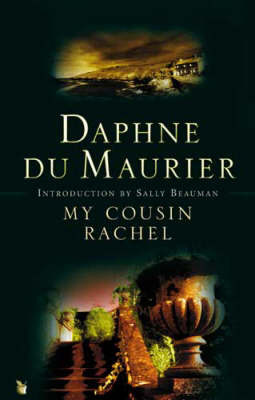 To start with, we have an opening line that’s sure to make my year-end superlatives post: “They used to hang men at Four Turnings in the old days.” The whole first chapter is heavy with foreboding, most of which I didn’t pick up on. It’s clear at once that the narrator, a young man named Philip Ashley, feels guilty for the situation he finds himself in, but can’t decide whether Rachel shares his culpability. Philip is the ward and heir of his older cousin, Ambrose, who winters in Florence for his health but on his latest trip marries Rachel, a widow and distant half-Italian cousin who also has roots in Cornwall, and stays in Italy.
From what little he learns of her through Ambrose’s increasingly incoherent letters, Philip is predisposed to dislike Rachel. When Ambrose dies of a suspected brain tumour, Philip is alarmed to hear that Rachel has already emptied their Florence villa and is reluctant to meet her when she arrives in Plymouth some weeks later. But she is not what he expected: just 35 and beautiful; with a passion for garden design and herbal medicine; witty and gently flirtatious. Before long Philip is smitten. “Why, in heaven’s name, did she have to be so different and play such havoc with my plans?”
The plot revolves around Ambrose’s unsigned will and what it means for the ownership of the Ashleys’ Cornwall estate. Philip is now 24, but on his 25th birthday, which happens to fall on April Fool’s Day, he will come into his inheritance and can make his own decisions. Will Rachel, notorious for her extravagant spending, bewitch him into altering the will to her advantage? A pearl necklace, hidden letters, a beggar woman, churchyard conversations, tisanes, lavish curtains, and a foppish Italian visitor form the backdrop to this Gothic tale.
 I never succeeded in dating the action: the only major clue is that it takes three weeks to travel between southwest England and Florence, which seems to point to the nineteenth century. But a lack of definite markers makes the story feel timeless and almost like a fairy tale. Although she shrewdly looks out for her own interests and can manipulate Philip’s emotions, Rachel is no stereotypical witch. Sally Beauman’s introduction to my Virago paperback usefully points out that we only ever see Rachel through the male gaze (Philip’s perhaps unreliable narration and Ambrose’s letters) and that from the title onward she is defined in relation to men. In making a bid for her own independent life, she is the true heroine of what Beauman calls du Maurier’s “most overtly feminist” novel.
I always love the murky atmosphere of du Maurier’s work, but can find her plots contrived. However, this ended up being my favourite of the four I’ve read so far. Initially, it reminded me of E.M. Forster’s Where Angels Fear to Tread, while by the end I was wondering if Janet Fitch took it as inspiration for White Oleander. There’s an unusual pair for you! Make of it what you will…
What else should I read by du Maurier?
Adventures in Rereading: The Sixteenth of June by Maya Lang
Last year I reviewed Tenth of December by George Saunders on its title date; this year I couldn’t resist rereading one of my favorites from 2014 for today’s date (which just so happens to be Bloomsday, made famous by James Joyce’s Ulysses), The Sixteenth of June.
I responded to the novel at length when it first came out. No point in reinventing the wheel, so here are mildly edited paragraphs of synopsis from my review for The Bookbag:
 Maya Lang’s playful and exquisitely accomplished debut novel, set on the centenary of the original Bloomsday, transplants many characters and set pieces from Ulysses to near-contemporary Philadelphia. Don’t fret, though – even if, like me, you haven’t read Ulysses, you’ll have no trouble following the thread. In fact, Lang dedicates her book to “all the readers who never made it through Ulysses (or haven’t wanted to try).” (Though if you wish to spot parallels, pull up any online summary of Ulysses; there is also a page on Lang’s website listing her direct quotations from Joyce.)
On June 16, 2004, brothers Leopold and Stephen Portman have two major commitments: their grandmother Hannah’s funeral is happening at the local synagogue in the morning; and their parents’ annual Bloomsday party will take place at their opulent Delancey Street home in the evening. Around those two thematic poles – the genuine emotions of grief and regret on the one hand, and the realm of superficial entertainment on the other – the novel expands outward to provide a nuanced picture of three ambivalent twenty-something lives.
The third side of this atypical love triangle is Nora, Stephen’s best friend from Yale – and Leo’s fiancée. Nora, a trained opera singer, is still reeling from her mother’s death from cancer one year ago. She’s been engaging in self-harming behavior, and Leo – a macho, literal-minded IT consultant – just wants to fix her. Nora and Stephen, by contrast, are sensitive, artistic souls who seem better suited to each other. Stephen, too, is struggling to find a meaning in death, but also to finish his languishing dissertation on Virginia Woolf.
Literature is almost as potent a marker of upper-class status as money here: some of the Portmans might not have even read Joyce’s masterpiece, but that doesn’t stop them name-dropping and maintaining the pretense of being well-read. While Lang might not mimic the extremes of Joyce’s stream-of-consciousness style, she prioritizes interiority over external action by using a close third-person voice that shifts between her main characters’ points of view. Their histories and thoughts are revealed mostly through interior monologues and conversations. Lang’s writing is full of mordant shards of humor; one of my favorite lines was “No one in a eulogy ever said, She watched TV with the volume on too loud.”
During my rereading, I was captivated more by the portraits of grief than by the subtle intellectual and class differences. I appreciated the characterization and the Joycean peekaboo, and the dialogue and shifts between perspectives still felt fresh and effortless. I could relate to Stephen and Nora’s feelings of being stuck and unsure how to move on in life. And the ending, which I’d completely forgotten, was perfect. I didn’t enjoy this quite as much the second time around, but it’s still a treasured signed copy on my shelf.
My original rating (June 2014): 
My rating now: 
Readalikes: Writers & Lovers by Lily King and The Emperor’s Children by Claire Messud (my upcoming Doorstopper of the Month).
(See also my review of Lang’s recent memoir, What We Carry.)
Alas, I’ve also had a couple of failed rereading attempts recently…
Everything Is Illuminated by Jonathan Safran Foer (2002)
 I remembered this as a zany family history quest turned into fiction. A Jewish-American character named Jonathan Safran Foer travels to (fictional) Trachimbrod, Ukraine to find the traces of his ancestors and, specifically, the woman who hid his grandfather from the Nazis. I had totally forgotten about the comic narration via letters from Jonathan’s translator/tour guide, Alexander, who fancies himself a ladies’ man and whose English is full of comic thesaurus use (e.g. “Do not dub me that,” “Guilelessly yours”). This was amusing, but got to be a bit much. I’d also forgotten about the dense magic realism of the historical sections. As with A Visit from the Goon Squad, what felt dazzlingly clever on a first read (in January 2011) failed to capture me a second time. [35 pages]
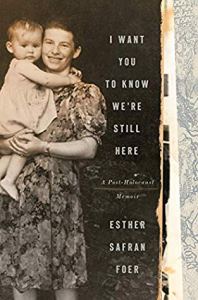 Interestingly, Foer’s mother, Esther, released a memoir earlier this year, I Want You to Know We’re Still Here. It’s about the family history her son turned into quirky autofiction: a largely fruitless trip he took to Ukraine to research his maternal grandfather’s life for his Princeton thesis, and a more productive follow-up trip she took with her older son in 2009. Esther Safran Foer was born in Poland and lived in a German displaced persons camp until she and her parents emigrated to Washington, D.C. in 1949. Her father committed suicide in 1954, making him almost a belated victim of the Holocaust. The stories she hears in Ukraine – of the slaughter of entire communities; of moments of good luck that allowed her parents to, separately, survive and find each other – are remarkable, but the book’s prose, while capable, never sings. Plus, she references her son’s novel so often that I wondered why someone would read her book when they could read his instead.
On Beauty by Zadie Smith (2005)
 This was an all-time favorite when it first came out. I remembered a sophisticated homage to E.M. Forster’s Howards End, featuring a biracial family in Cambridge, Mass. I remembered no specifics beyond a giant music store and (embarrassingly) an awkward sex scene. Howard Belsey’s long-distance rivalry with a fellow Rembrandt scholar gets personal when the Kipps family relocates from London to the Boston suburbs for Monty to be the new celebrity lecturer at the same college. Howard is in the doghouse with his African-American wife, Kiki, after having an affair. The Belsey boy and Kipps girl have an awkward romantic history. Zora Belsey is smitten with a lower-class spoken word poet she meets after a classical concert in the park when they pick up each other’s Discmans by accident (so dated!). All of the portraits felt like stereotypes to me, and there was so much telling, so much backstory, so many unnecessary secondary characters. Before I would have said this was my obvious Women’s Prize winner of winners, but now I have no idea what I’ll vote for. [107 pages]
Currently rereading: Watership Down by Richard Adams, Ella Minnow Pea by Mark Dunn, Dreams from My Father by Barack Obama
To reread soon: Heaven’s Coast by Mark Doty & Animal, Vegetable, Miracle by Barbara Kingsolver
Done any rereading lately?
Classic of the Month: Period Piece by Gwen Raverat (1952)
Later today we’re making a pilgrimage to Bookbarn International,* one of my favorite secondhand bookshops in the UK, on the way (ish) to seeing friends in Bristol and Exeter for the weekend. In the past we’ve managed to drop in to Bookbarn annually, but it’s been nearly 2.5 years since our last visit. At that special Harvest Supper and Scrabble** tournament in October 2017 (which I wrote about here), I got to meet William Pryor, the chairman of Bookbarn, and he gave me a copy of his grandmother Gwen Raverat’s memoir, Period Piece.
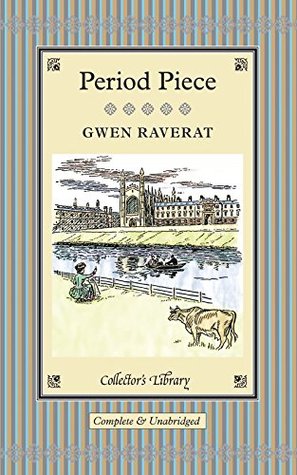 Raverat was a granddaughter of Charles Darwin (the first child of his son George) but never got to meet him as he died three years before her birth. Her book has the subtitle “A Cambridge Childhood,” which perfectly conveys the aim. This is not a comprehensive family history or autobiography, but a portrait of what it was like to grow up in a particular time and place. Raverat was born in 1885, but she begins two years earlier, when her American mother, Maud Du Puy, was 21 and in England for the first time to spend a summer with her great-aunt and -uncle. She had three suitors during that time, all of them Fellows of Trinity College. The rules had only just been changed to allow Fellows to marry, so George Darwin would be among the first married members, and Gwen was in the first batch of offspring.
Period Piece is a charming, witty look at daily life from the 1880s through about 1909 – ending with the marriage of her cousin Frances, which seemed to signal a definitive end to their collective youth. Raverat focuses on everyday sights and sounds but also points out life’s little absurdities. She proceeds thematically rather than chronologically, taking up topics like her mother’s parenting theories; her boarding school education and budding love of art; visits to Grandmamma at Down House, Kent; childhood fears and ghost stories; the five Darwin uncles; religion; sports and games; clothing; and social events such as dances.

Raverat’s childhood home in Cambridge, now part of Darwin College, University of Cambridge. CC BY-SA (https://creativecommons.org/licenses/by-sa/2.5).
Writing towards the end of her life and in the middle of the twentieth century, Raverat neatly draws contrasts between old-fashioned propriety and modern mores. For example, as a child she was often called upon to act as a chaperone to courting couples, and when ladies boated past a watering hole where boys swam naked, they would cover their faces with parasols. She herself managed to avoid the matter of sex entirely until she was an adult, though she does remember looking to an encyclopedia to find out where babies come from.
The utter reliance on servants, a profusion of buttons on every garment, and forced trips to church are a few elements that might strike today’s readers as alien. One incident felt eerily contemporary to me, though: once, walking home alone at around 10 p.m., Gwen saw a gang of dodgy-looking undergraduates carrying a drunk or dead young woman down the street and into a pub. After much internal debate, she decided not to say a word about it to her parents.
I often wonder how novelists and filmmakers get a historical setting just right. The answer is, probably by reading books like this one that so clearly convey quotidian details most people would leave out, e.g. a list of every piece of clothing a lady wore or a rundown of the steps to getting her mother out the door to catch the 8:30 train for a day out in London. Those who have visited or lived in Cambridge will no doubt enjoy spotting familiar locations. There are also amusing cameo appearances from Virginia Stephen (Woolf) and E.M. Forster.
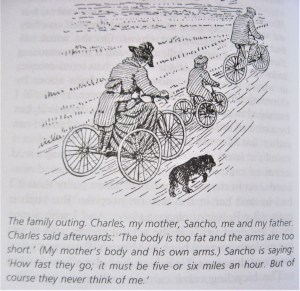 Raverat, a wood engraver, peppered Period Piece with her own illustrations (I have photographed one favorite, at left, but you can see them all in the archive here) – a lovely supplement to the highly visual text. Not just an invaluable record of domestic history, this is a very funny and impressively thorough memoir that could be used by anyone as a model for how to capture childhood. It has never been out of print, and still deserves to be widely read.
*They’ve recently had a renovation that I helped to crowdfund; I’m looking forward to seeing the results. I’ll also be sure to report back on my book haul.
**I was especially delighted to see that the Darwin family had a favorite word-making game, described in the middle of the “Sport” chapter, that sounds a fair bit like Scrabble – except that you only added one letter at a time and could scramble the letters to change the meaning.
Some favorite lines:
(describing one of her mother’s early letters home to America) “They got [rooms for the night] at last at ‘the St Pancreas Hotel’. I was delighted to find this spelling so early, as, to the end of her days, my mother always considered the saint and the internal organ as identical.”
(of their French nurserymaids) “By a provision of Providence they were always called Eugenie, so that when a new one came she could be called Newgenie.”
“The faint flavour of the ghost of my grandfather hung in a friendly way about the whole place [Down] – house, garden and all. … In fact, he was obviously in the same category as God and Father Christmas.”
My rating:
I read the 2014 Collector’s Library edition, an attractive pocket-sized book with gilt edging and a built-in red ribbon bookmark.

Birthday Happenings
One of the best things about being a home-based freelancer is that I can arrange my work schedule to suit my life. Having my birthday fall on a Friday this year was especially good because it meant I got until Monday to submit my daily editing load. My husband was working as usual, so I spent much of the day reading under the cat and charity shopping. I bought seven books, a nice mixture of England-themed nonfiction and juicy novels, plus new-to-me comfy black flats. (Total spend: £10.25.) Being short on time that evening, we lazily ordered delivery pizza for probably the first time in eight years, followed by cocktails and cake.
 I didn’t end up using my literary cakes and cocktails books this year, but that gives me a chance to proffer my own pun names for what we did make. We tried two gin cocktails we’d found recipes for in the Guardian. The one they called “Elderflower Collins” was absolutely delicious: lemon juice, elderflower cordial and gin, topped up with San Pellegrino Limonata (lemon soda) and garnished with a lemon slice and a mint sprig. I dub it “A Visit from Mr. Collins,” as in the Bennet girls will have to down quite a few of these before…
Unfortunately, the second cocktail was not a hit. The “Miss Polly Hawkins” combines chamomile-flavored gin (I steeped two chamomile teabags in 60 mL of gin for a week), rose syrup (we didn’t have it or want to buy it so substituted our homemade rosehip syrup), plain gin and egg white. Egg white is a fairly frequent ingredient in cocktails – it adds gloss and body – but we found that it made the drink gloopy. That plus the overall floral and medicinal notes meant this was fairly hard to swallow; we had to drown it in sparkling water and ice cubes to get it down. Alas, I modify Iris Murdoch to call this “An Unappealing Rose.”
 However, my cake was an unqualified success. I usually go for chocolate or chocolate/peanut butter desserts, but decided to be different this year and requested the Italian Pear and Ginger Cheesecake from Genevieve Taylor’s cookbook A Good Egg. It was sophisticated and delicious. Running with the Italy thing, I’ll pick out a Forster title and call it “Where Angels Pear to Tread.” (It doesn’t make a whole lot of sense; then again, neither do a lot of the names in Tequila Mockingbird and Scone with the Wind!)
On Sunday the birthday fun continued with a trip to Hungerford Bookshop (our nearest independent bookshop) and a gentle country walk. I bought two secondhand books but came away with a total of four – in the basement they have a table covered in free proof copies, so my husband and I grabbed one each (how I wish I could have taken the lot!). It’s a great idea for rewarding customer loyalty and dealing with unwanted proofs; perhaps I’ll donate a stack of mine to them next time I’m there.


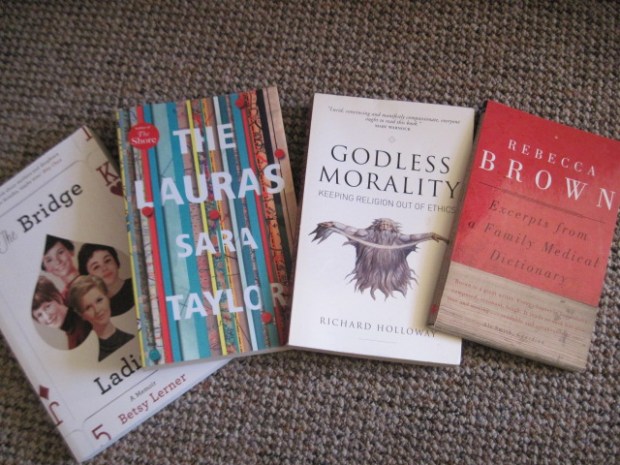
Two proofs (left) and two nonfiction purchases.
This year I got a Kindle case and two bookshop-themed memoirs as presents: The Little Bookstore of Big Stone Gap by Wendy Welch and Books, Baguettes and Bedbugs by Jeremy Mercer. I started reading the former – the story of a married couple opening a bookshop in recession-era Virginia – right away. I also got a poster frame so I can finally hang my literary map of the British Isles on the wall above my desk, and a “Shhhh, reading in progress” mug.

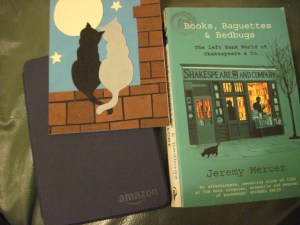

Consuming tasty food and drink + acquiring a baker’s dozen of books + getting out into the countryside = a great birthday weekend!
What are the ingredients for your perfect birthday?
Reviews Roundup, February–March
One of my goals with this blog was to have one convenient place where I could gather together all my writing that appears in disparate online locations. To that end, once a month I provide links to all book reviews I’ve published elsewhere, with a rating (below each description) and a taster so you can decide whether to read more. A few exceptions: I don’t point out my Kirkus Indie, BlueInk or Publishers Weekly reviews since I don’t get a byline. Meanwhile, I’ve done my first article for the Los Angeles Review of Books – exciting!
The Bookbag
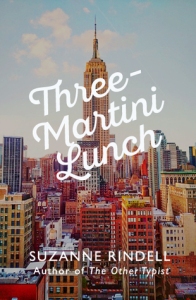
Three-Martini Lunch by Suzanne Rindell: Brings the late 1950s, specifically the bustling, cutthroat New York City publishing world, to life through the connections between three young people who collide over a debated manuscript. The three first-person voices fit together like a dream. It’s an expert evocation of Beat culture and post-war paranoia over Communism and homosexuality. Walking into Eden’s office, especially, you’ll think you’ve landed on the set of Mad Men. This classy, well-plotted follow-up will win Rindell even more fans and tide us all over until the film version of The Other Typist – produced by and starring Keira Knightley – appears. Releases May 19th in the UK.

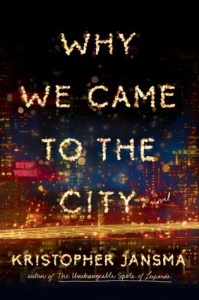 Why We Came to the City by Kristopher Jansma: Five university friends strive to make their lives count against the indifferent backdrop of recession-era New York City. When one of them falls ill, they pull together like a family. The tone of the novel lies somewhere between A Little Life and the sitcom Friends (a Mexican version of which the characters watch obsessively). Even as his characters realize that they are not special and not in control of their lives, Jansma never lets his book descend too far into gloom. Narrowly misses out on 5 stars from me because the storyline loses momentum in Part Two. Rich with emotion and literary allusions (from Walden to The Iliad), this is my favorite novel of the year so far.
Waltzing in Vienna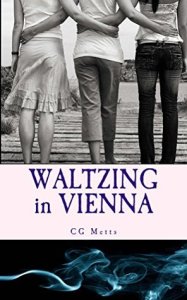 by C.G. Metts (& interview): Three girlfriends – a singer staging a comeback, a psychology professor reawakening to sexuality after being widowed, and a socialite Southern Belle – are reunited in Charleston, South Carolina in their early forties. Remembering their wild college days, they wonder how to make midlife count. There’s a fun Sex and the City or Ya-Ya Sisterhood vibe to this recommended debut novel. I liked the mixture of nostalgia and gentle feminism, and I think this may also inspire readers to see South Carolina’s coastal landscape for themselves. The title phrase is the friends’ shorthand for smoking marijuana together.

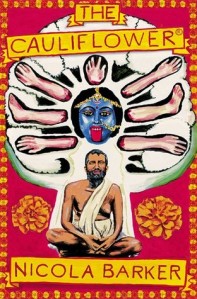 The Cauliflower® by Nicola Barker: Put simply, this is a fictionalized biography of the largely illiterate Hindu guru Sri Ramakrishna (1836–1886). That may sound dry as dust, but Barker makes it a playful delight by skipping around in time and interspersing aphorisms, imagined film scenes, questions and answers, and even a recipe with the narrative chapters. The kernel of the story – set in 1857 at the Dakshineswar Kali Temple, six miles north of Calcutta – is narrated in the first person by the guru’s nephew, Hriday. Scripture of all types (the Bible is also cited) is a relevant, joyful echo here rather than a dull set of rules. Bizarre but very readable. Releases April 21st.
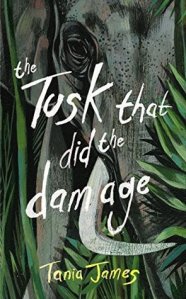 The Tusk That Did the Damage by Tania James: This composite picture of the state of wildlife conservation in India is told from three perspectives: an elephant named the Gravedigger, a poacher, and a documentary filmmaker. James ably intersperses three voices as she explores how people fail to live up to their ideals and make harmful assumptions. Despite these attributes, it was one of those books I had to force myself through. Perhaps it was the environmental agenda: if a book is going to wear its message so openly, it has to live up to it in terms of the writing. I might have preferred it if the whole novel had been from Emma’s point of view, with one climactic encounter with the Gravedigger to make the poaching question immediate and not simply academic.

BookBrowse
Dog Run Moon: Stories by Callan Wink [subscription service]: Wink’s debut story collection, set mostly under Montana’s open skies, stars a motley cast of aimless young men, ranchers, Native Americans, and animals live and dead. He plays around with Western stereotypes in intriguing ways. A few of the tales are a bit less compelling, and I would have preferred more variety in narration (8 of 9 are third person), but the stand-outs more than make up for it. My two favorites were “Runoff” (there’s a double meaning to the title) and “Exotics,” in which all the characters are lured by the life they don’t currently have.
 For Books’ Sake
Interview with Rachel B. Glaser, author of Paulina & Fran [my review of which was in last month’s roundup]
Foreword Reviews
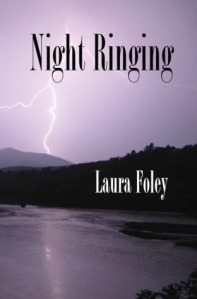 Night Ringing by Laura Foley: Foley’s strong fifth collection ruminates on romance and family via autobiographical free verse. One of the collection highlights is “In the Honda Service Area,” which unexpectedly unites modern technology with ancient literature. While a woman describes her impending hip replacement surgery to a friend, Foley tries to concentrate on Homer’s Iliad. The collection is dedicated to Foley’s partner, Clara Giménez, and lesbian romance is a subtle undercurrent. Especially recommended for fans of Jane Hilberry and Adrienne Rich.
The Temple of Paris by Laura DeBruce: This second volume in Laura DeBruce’s Quicksilver Legacy trilogy is a fast-paced fantasy adventure novel. In the previous book, the author introduced the “Immortals,” centuries-old creatures who are impervious to disease and aging due to a magic elixir. If Hana, the teenage protagonist, can learn how to use the elixir in her possession correctly, she can save her mother from a potentially fatal blood disorder. Although the complicated plot might be challenging for those new to the series, older teens will appreciate the rollicking story and the chance for vicarious European sightseeing.

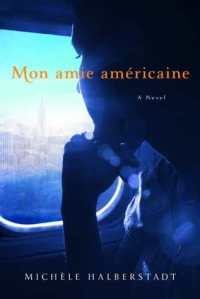 Mon amie américaine by Michèle Halberstadt: After years of heavy smoking and migraines, a brain aneurysm plunges forty-year-old Molly into a coma. The novel is presented as Michèle’s confessional letter to her American friend Molly, addressed in the second person. During Molly’s coma and after she wakes up, Michèle ponders their unlikely friendship and also frets over her threatened marriage. The novella is like a cross between Jenny Offill’s Dept. of Speculation and Jean-Dominique Bauby’s The Diving-Bell and the Butterfly, and bears tantalizing traces of deliberate homage to Pedro Almodóvar’s coma-themed Talk to Her: an understated dual account of betrayal and disability.
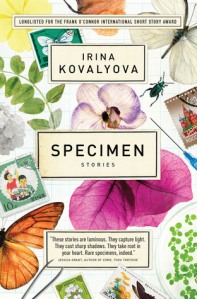 Specimen: Stories by Irina Kovalyova: “People like to pretend that our genes define the truth for us. But I assure you that’s not the case,” a character insists in the title story. Diverse in setting and form, these nine stories, long-listed for the Frank O’Connor International Short Story Award, contrast the scientific understanding of genetics with deeper wisdom about the bonds of love and family. Nestling science into rich psychological narratives, Kovalyova’s work is reminiscent of that of Andrea Barrett and A. S. Byatt; in fact, the latter is directly referenced in one story. She also channels Anthony Marra and Adam Johnson by affirming love’s survival in spite of repressive situations.
Of Crime and Passion by Jonathan Harnisch: In this novella, a proud young man seeks to transcend his underprivileged upbringing by worming his way into the homes of the rich and seducing powerful women. At its heart, the book is about the ongoing conflict between economic and social classes. With the melodramatic action and old-fashioned dialogue, though, it is easy to imagine this coming-of-age tale working better in the form of a play.
Hakai Magazine
(a Canadian publication highlighting coastal ecosystems)
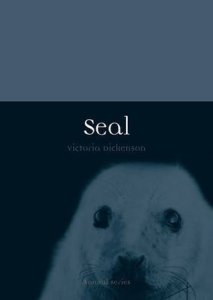 Seal by Victoria Dickenson: “It is hard to imagine a creature more distant from the human species in bodily form, habits, and habitat than the seal,” Dickenson writes in her introduction, “yet our mutual regard tells of a long, shared history of interaction.” Seal is the latest in the 80-strong Animal series from Reaktion Books. Like other volumes, this gives a brief discussion of the featured animal’s evolutionary biology, followed by an interdisciplinary survey of how it has entered human culture throughout history. In the final two chapters—the highlight of an occasionally dry book—Dickenson gives a balanced account of the history of hunting seals.
Los Angeles Review of Books
“Rediscovering an Overlooked Woman Novelist”: A dual review of Constance Fenimore Woolson: Portrait of a Lady Novelist by Anne Boyd Rioux () and Miss Grief and Other Stories (), a new selection of Woolson’s short fiction.
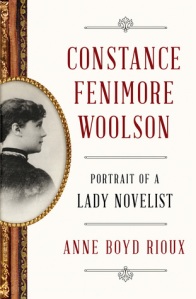
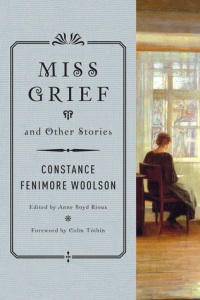 Constance Fenimore Woolson (1840–1894) is most often remembered for her connection to male writers; her great-uncle was pioneering American novelist James Fenimore Cooper, and in her later years as an expatriate in Europe she associated with Henry James, fueling rumors of a romance between them. Deserving to be known in her own right, Woolson represents key junctures between realism and regionalism, and between American and European styles. Gives a remarkable picture of a bold, bright woman who paved the way for writers such as Edith Wharton, E. M. Forster, and Willa Cather, and who arguably might be hailed in the same breath as Henry James and George Eliot.
Nudge
My quick response to Instructions for a Heatwave, for a Maggie O’Farrell retrospective: Another spot-on tale of family and romantic relationships – O’Farrell always gets the emotional tenor just right. You may spot hints of Rachel Joyce’s The Unlikely Pilgrimage of Harold Fry or Bernhard Schlink’s The Reader, but the psychological and linguistic precision is all O’Farrell’s own. Her descriptive language is unfailingly elegant. I love how she opens with the heat as the most notable character: “It inhabits the house like a guest who has outstayed his welcome: it lies along corridors, it circles around curtains, it lolls heavily on sofas and chairs.”
Pretentiousness: Why It Matters by Dan Fox: This wide-ranging essay discusses pretentiousness as it relates to class, taste, and modern art. Fox grew up outside of Oxford but now lives in New York City, where he is the co-editor of frieze. From its Latin etymology we learn that pretentious means “to stretch before,” so to hold something in front of you like a mask. He thus starts off by talking about acting techniques and rhetoric, then broadens this out to themes of authenticity and self-discovery. The most interesting part of the book concerns class connotations. This is a somewhat meandering work, and though it has good individual lines it is not always riveting.
 Third Way magazine
I’ve reviewed books, mostly fiction, for them for the last 2.5 years; sadly, the April 2016 issue will be the final one. It’s a shame; the progressive Christian perspective on popular culture is a niche it will be hard to fill.
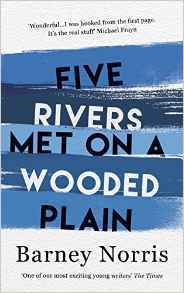
Five Rivers Met on a Wooded Plain by Barney Norris: Barney Norris is a playwright in his twenties, so it’s no surprise that there’s something a little staged to his debut novel. The lives of the book’s five narrators collide one night when a car hits a moped in Salisbury town center. We hear from each protagonist in turn as they reflect on their losses and wonder whether religion – represented by Salisbury Cathedral and the scripture and rituals of Christianity – might help. Rita is the liveliest and most engaging character, difficult as her expletive-strewn narrative might be to traverse. Like David Nicholls, Norris prizes emotional connection and delivers a theatrical plot. If he can avoid the more clichéd aspects of a novel like One Day, he could have a long career in fiction ahead of him. Releases April 21st.
I also post reviews of most of my casual reading and skimming on Goodreads:
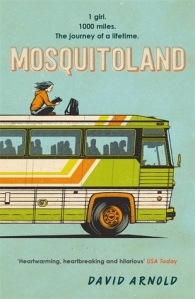 Mosquitoland by David Arnold: I don’t read a whole lot of YA, but the voice of this one captured me right away. Like Hazel in The Fault in Our Stars, Mim (Mary Iris Malone) is a lovably sarcastic oddball – she describes herself as “a young Ellen Page” à la Juno – with some hidden issues that come out over the course of the book. Here Mim’s journey takes the form of a road trip from Mississippi, where she lives with her father and new stepmother, back to Ohio to be with her sick mother. She meets a kooky cast of secondary characters along the way, narrowly escapes danger, and even gets a chance at romance.
A Change of World: Poems by Adrienne Rich: This is a forthcoming Norton reissue of Rich’s first collection from 1951. I’d always thought of her as a later, feminist poet, so it was jolting to see an introduction from W.H. Auden – that made it feel like a real generational crossover. It’s a very impressive debut, full of mannered, rhyme-rich verse. Two favorites were “Walden 1950” (“Thoreau, lank ghost, comes back to visit Concord, / Finds the town like all towns, much the same— / A little less remote, less independent”) and “The Innocents.” I’ll be interested to read some of her later work and see if she loosened up with form. Releases June 21st.
 The Shadow Hour by Kate Riordan: A clever dual-timeline novel with a pleasing Gothic flavor. In 1922 Grace Fairford takes up a governess position at Fenix House near Cheltenham, the very place where her grandmother, Harriet Jenner, worked in 1878. Every few chapters the perspective shifts from Grace (first person) to Harriet (third person). The novel is full of coincidences and the sense of history repeating itself. Riordan’s writing is capable, sometimes clichéd, but the echoes of Jane Eyre and The Turn of the Screw make this a delicious guilty-pleasure read.
Life’s Too Short to Pretend You’re Not Religious by David Dark: Etymologically, the word “religion” means to bind together again. Simply put, Dark’s thesis is that we’re all connected: we are in relationship with the people around us and can’t pretend otherwise. What we need is a shared vision for our shared life, and that involves engaging with other people. No pie-in-the-sky theology here; Dark affirms Daniel Berrigan’s assertion that “the actual world is our only world,” so things like climate change, gun control, immigration, and foreign policy are religious issues because they affect us all in this life. Together we have to imagine another story that isn’t capitalism and American imperialism as usual.
Adios, Cowboy by Olja Savičević Ivančević: In summer 2009, Dada (aka Rusty) returns to her Croatian hometown to care for her mother. Going home facing up to the fact of her brother’s death – when he was 18 he threw himself under a train. “One has to sit down beside one’s demon and mollify it until it’s calm – that’s all, perhaps, that can be done,” she muses. Now for the title: Dada’s late father, brother, and friends (“the Iroquois Brothers”) were all big on cowboys and Indians. When news comes that a spaghetti western actor/director named Ned Montgomery will be passing through town, it causes Dada to think about her father and her brother and, what’s more, about the workings of her own memory.
Now Go Out There: (and Get Curious) by Mary Karr: There’s not much to this Syracuse University commencement speech. Leftovers of sob-story autobiography and clichéd advice cobbled together. Disappointing given how much I loved Karr’s recent The Art of Memoir. For a truly inspirational graduation address, I recommend David Foster Wallace’s This Is Water.

 How to Be Here: A Guide to Creating a Life Worth Living by Rob Bell: Bell left his pastoral role to become a motivational speaker so, unsurprisingly, this book is closer to self-help than theology. He’s good pals with Elizabeth Gilbert, and this book would make a great companion piece to her Big Magic. It’s about how to find what gets you out of bed in the morning and live mindfully. As always, his formatting – bite-size paragraphs, stretching out phrases with line breaks – is slightly annoying. I didn’t learn a whole lot; it was more a case of being reminded of things I knew deep down. He prefaces most chapters with an anecdote about his creative ventures, some of which were utter failures.
And my highest recommendation goes to…
The Summer Guest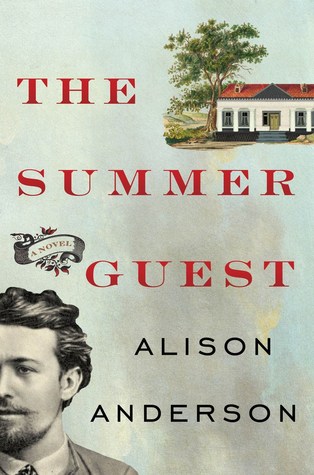 by Alison Anderson: The kernel of the novel is a true story: for two summers in the late 1880s, Chekhov stayed at the Lintvaryovs’ guest house in Luka, Ukraine. One strand of the narration is a journal kept during those years by Zinaida, the family’s eldest daughter, a doctor dying of a brain tumor. Zina’s story is offset by those of two contemporary women. Katya, a Russian émigré in London who’s trying to keep her failing publishing house afloat, sends the never-before-published diary to Ana, a translator based near the French border with Switzerland. There’s a touch of mystery here: where was the diary found? And what became of the novel Chekhov mentions he had in progress? Ana’s search for answers takes her to the Lintvaryov estate, even though Ukraine in 2014 is a hotbed of unrest. Having recently watched the BBC War & Peace miniseries with rapt interest and seen a Tchaikovsky symphony performance, it was the perfect time to get lost in an intricate, playful novel about how Russian literature still resonates. I’ll certainly be looking up Anderson’s other novels.
 Bookish Beck = Rebecca Foster. American transplant to England. Freelance proofreader and book reviewer.
 Bookish Beck