Short Stories in September, Part II: Brautigan, Doyle, Minot, Simpson
Every time I do this self-set challenge, I am amazed anew by how different short story collections can be in mood and theme – even if their overall concerns are the same as in most fiction: life and death, relationships, identity, choices. Today I have one debut work, two new-to-me authors, and a disappointing showing from an old favourite.
Revenge of the Lawn: Stories 1962–1970 by Richard Brautigan (1972)
 There are more than five dozen stories in this slim volume, most just one to three pages and in the first person (55 of 62); bizarre or matter-of-fact slices of life in the Pacific Northwest or California, often with a grandiose title that’s then contradicted by the banality of the contents (e.g., in the three-page “A Short History of Religion in California,” some deer hunters encounter a group of Christian campers). The simple declarative sentences and mentions of drinking and hunting made me think of Carver and Hemingway, but Brautigan is funnier, coming out with the occasional darkly comic zinger. Here’s “The Scarlatti Tilt” in its entirety: “‘It’s very hard to live in a studio apartment in San Jose with a man who’s learning to play the violin.’ That’s what she told the police when she handed them the empty revolver.”
In the absurdist “Homage to the San Francisco YMCA,” a man replaces his plumbing with poetry: “He took out his bathtub and put in William Shakespeare. The bathtub did not know what was happening. He took out his kitchen sink and put in Emily Dickinson. The kitchen sink could only stare back in wonder.” Brautigan has an incomer’s admiration for California: “I come from someplace else and was gathered to the purpose of California like a metal-eating flower gathers the sunshine.” Many of the flash stories feel autobiographical and bridge country and city life with themes of bear hunting versus movie-going and riding buses.
There are some macho attitudes towards women, who are generally objects of male desire rather than subjects in their own right. But I appreciated this flash fiction collection for its unexpected metaphors and tonal range, from the over-the-top humour of “Complicated Banking Problems” to a pathos-filled rundown of a life in “The World War I Los Angeles Aeroplane.” (Secondhand – Westwood Books, Sedbergh, 2023) 
I Meant It Once by Kate Doyle (2023)
 A debut collection of 16 stories, three of them returning to the same sibling trio. Many of Doyle’s characters are young people who still define themselves by the experiences and romances of their college years. In “That Is Shocking,” Margaret can’t get over the irony of her ex breaking up with her on Valentine’s Day after giving her a plate of heart-shaped scones. Former roommates Christine and Daisy are an example of fading friendship in “Two Pisces Emote about the Passage of Time.”
The title phrase comes from “Cinnamon Baseball Coyote,” one of the Helen–Grace–Evan stories, when the sparring sisters are children and the one writes down “I hate my sister” and saves the paper in her desk because, as she tells their father, “I don’t mean it anymore. I only kept it because I meant it once.” Moments of great drama or emotion, and the regret that comes in their aftermath, are the stuff of these mainly New York City-set stories.
Across nine first-person and seven third-person stories, the content and point of view are pretty samey and minor; nothing here to make you feel you’re reading a rising star of American fiction. I only found a few standouts. “Hello It’s You” is about Meg’s history of same-sex partners: though she’s with Sara now, she can’t stop thinking about Jenny, her college girlfriend. “Aren’t We Lucky” has a soupçon of magic as it imagines a house and its ghosts resisting renovations. But my favourite was “Moments Earlier,” about Kelly’s medical crisis and the friends who never get past it. 
With thanks to Corsair for the free copy for review. See also Susan’s review.
Why I Don’t Write and Other Stories by Susan Minot (2020)
 Minot was new to me (as was Brautigan). These stories were first published between 1991 and 2019, so they span a good chunk of her career. “Polepole” depicts a short-lived affair between two white people in Kenya, one of whom seems to have a dated colonial attitude. In “The Torch,” a woman with dementia mistakes her husband for an old flame. “Occupied” sees Ivy cycling past the NYC Occupy camp on her way to pick up her daughter. The title story, published at LitHub in 2018, is a pithy list of authorial excuses. “Listen” is a nebulous set of lines of unattributed speech that didn’t add up to much for me. “The Language of Cats and Dogs” reminded me of Mary Gaitskill in tone, as a woman remembers her professor’s inappropriate behaviour 40 years later.
Eight of the stories are in the third person and two in the first person. They’re almost all accomplished in terms of scene setting and creating characters and motivations, but I can’t say Minot won me over such that I’ll seek out more of her work. Only a few stories will stay with me: “Green Glass,” in which a man encounters his ex-girlfriend at a wedding and cuts her down to size in a way that alarms his current partner; “Boston Common at Twilight,” an account of a strange but ultimately non-consensual sexual encounter; and my favourite, “Café Mort,” the only one with a speculative edge, about an establishment that only serves the dead. (New bargain purchase – Dollar Tree, Hagerstown, Maryland, 2023)
Hey Yeah Right Get a Life by Helen Simpson (2000)
This was my sixth collection from Simpson, who only appears to write short fiction. This was one of my least favourite of her books, unfortunately, because her common theme of frazzled mothers trying to balance parenting with career felt tired. The title story is about Dorrie, mum of three, and this set of characters recurs in the final piece, “Hurrah for the Hols.” Simpson does get the mindset just right:
She had to be thinking of other people all the time or the whole thing fell apart.
I can’t see how the family would work if I let myself start wanting things again, thought Dorrie; give me an inch and I’d run a mile, that’s what I’m afraid of.
The whole pattern of family life hung for a vivid moment above the chopping board as a seamless cycle of nourishment and devoural.
It was like being on holiday with Punch and Judy – lots of biffing and shrieking and fights over sausages.

But I’ve read too many of her exasperated-mum stories at this point. Two here were about female bankers. One, “Burns and the Bankers,” set at a seemingly endless Burns Night supper, rather outstayed its welcome and made overly obvious its message about this being a man’s field. Do read Simpson, but maybe not this (despite the amazing title); I’d recommend Four Bare Legs in a Bed or In the Driver’s Seat (UK title: Constitutional) instead. (Secondhand – Books for Amnesty, York, 2023)
I’ll have one more set of reviews and a roundup on the last day of the month.
Currently reading: If I Survive You by Jonathan Escoffery; The Best Short Stories 2023: The O. Henry Prize Winners, ed. Lauren Groff; How to Disappear by Tara Masih; Hateship, Friendship, Courtship, Loveship, Marriage by Alice Munro; The Human Origins of Beatrice Porter and Other Essential Ghosts by Soraya Palmer; Close Company: Stories of Mothers and Daughters, ed. Christine Park; Small, Burning Things by Cathy Ulrich
Books of Summer, 6–8: Elizabeth Berg, Patricia Lockwood & Wendy Mitchell
Although I have foodie lit as a background theme for the summer’s reading, my main goal is simply to read books that I own, especially recent acquisitions and long-time shelf-sitters (whereas last year, in slavish conformity to a theme, I substituted in a bunch of library books, review books and e-books). My latest batch includes a slightly twee novel, an outlandish poetry collection, and an uneven nonfiction swan song.
The Year of Pleasures by Elizabeth Berg (2005)
 From the cover, I was expecting this to be more foodie than it was. The protagonist does enjoy cooking for other people and reading cookbooks, though. Betta Nolan, 55 and recently widowed by cancer, drives from Boston to the Midwest and impulsively purchases a house in a Chicago suburb, something she and her late husband had fantasized about doing in retirement. It’s the kind of sweet little town where the only realtor is a one-woman operation and Betta as a newcomer automatically gets invited onto the local radio show. She also reconnects with her college roommates, tries dating, and mulls over her dream of opening a women’s boutique that sells silk scarves, handmade journals, essential oils and brownies.
While Berg is true to the shifting emotions that accompany grief, and gives Betta plenty of cute opportunities to make friends across the generations – with Lydia, the nonagenarian former owner of her house, now in a nursing home; Matthew, the fickle young man who does some odd jobs for her; and Benny, the next-door neighbor’s nine-year-old boy – I found the subplot about Matthew’s messy house and relationships silly, and Betta’s “What a Woman Wants” shop idea is so stereotyping I could feel myself rolling my eyes. Still, Berg’s novels, of which this was my fifth, are always reliably light and pleasant reads in an Anne Tyler vein. (Secondhand – 2nd & Charles)
Motherland Fatherland Homelandsexuals by Patricia Lockwood (2014)
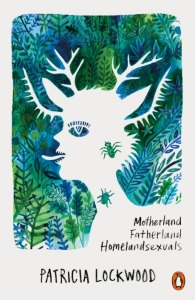 One of the more bizarre books I’ve ever read. I loved both Priestdaddy and No One Is Talking About This, but had no idea what to expect from Lockwood’s poems. They’re somewhere between absurdist monologues and thought experiments, often choosing an object or abstraction to animate (“A Recent Transformation Tries to Climb the Stairs”) and generally sexualized to the max (“Nessie Wants to Watch Herself Doing It”). Though they’re in stanzas, they aren’t heavy on poetic techniques. Some tangential topics are Bambi, Canada, basketball, waterfalls, King Kong adaptations, American poetry, Shirley Temple, and childhood hobbies like Animorphs, Egyptology and Magic Eye puzzles.
But really, her poetry is only “about” things in the loosest sense; the repetition, wordplay and snark are paramount. If you’ve heard of one, it’s likely to be the lengthy “Rape Joke,” which went as viral as it’s possible for a poem to and is, ironically, probably the sincerest entry here. Presumably based on her own bad experience with a teenage boyfriend, it is heartbreakingly banal: “The rape joke is that he was your father’s high school student … The rape joke is that come on, you should have seen it coming. … The rape joke is that you asked why he did it. The rape joke is he said he didn’t know, like what else would a rape joke say?”
A couple of my favourites were “List of Cross-Dressing Soldiers” and “He Marries the Stuffed-Owl Exhibit at the Indiana Welcome Center”; “The Father and Mother of American Tit-Pics,” in which a resurrected Emily Dickinson and Walt Whitman swap genders, had some of the more outrageous lines: “Walt Whitman is the Number Two Beach Body every year, because look at the way he snapped back into shape only months after giving birth to American Poetry.” Not really like any other poetry I’ve ever read. (New purchase with Christmas money)
One Last Thing: Conversations on Life, Death and Assisted Dying by Wendy Mitchell with Anna Wharton (2023)
“We talk so often about prolonging life, but we are actually prolonging death by not discussing the suffering part of it.”
Wendy Mitchell’s first two books, Somebody I Used to Know and What I Wish People Knew About Dementia, are valuable peeks into daily life with young-onset Alzheimer’s. She has been a dedicated activist and educator in the nine years since her diagnosis, and I admire the work she’s done to get dementia services into the public eye.
 The problem with her final book is that I’ve read so much about preparations for dying and the question of assisted suicide and she doesn’t bring much new to the discussion – apart from the specific viewpoint of someone deciding when and how to end their life when they don’t know what the future course of their illness looks like. Mitchell believes people should have this choice, but current UK law does not allow for assisted dying. A loophole is voluntarily stopping eating and drinking (VSED), which she deems her best option. She stopped attending assessments in 2017 and has filed forms with her GP refusing treatment – her nightmare situation is being reliant on care in hospital and she doesn’t want to become that future, dependent Wendy.
Like Henry Marsh’s farewell book, And Finally, this gives the impression of having been written in a hurry and rushed into print, and so could have been edited more. As it is, it’s fairly scattered, repetitive and unpolished. The interviews could all be streamlined and tidied up, and the one with Kathryn Mannix is split up in a confusing way.
For readers new to the topic, however, this could be a useful introduction to the issues. It’s up-to-date in that Mitchell attends a Death Café, meets an end-of-life doula, and talks through the different forms (power of attorney, advance directive and so on) with experts. I also thought the epilogue was a lovely touch: after going for a ‘wing walking’ airplane adventure, she imagines that, having taken a bus into York, she sees her pre-diagnosis self and tells her everything she would want her to know, good and bad, about the challenges to come. (Proof copy from Hungerford Bookshop Summer Reading Celebration) [Different subtitle on finished edition?] 
Barbellion Prize Shortlist: Book of Hours by Letty McHugh
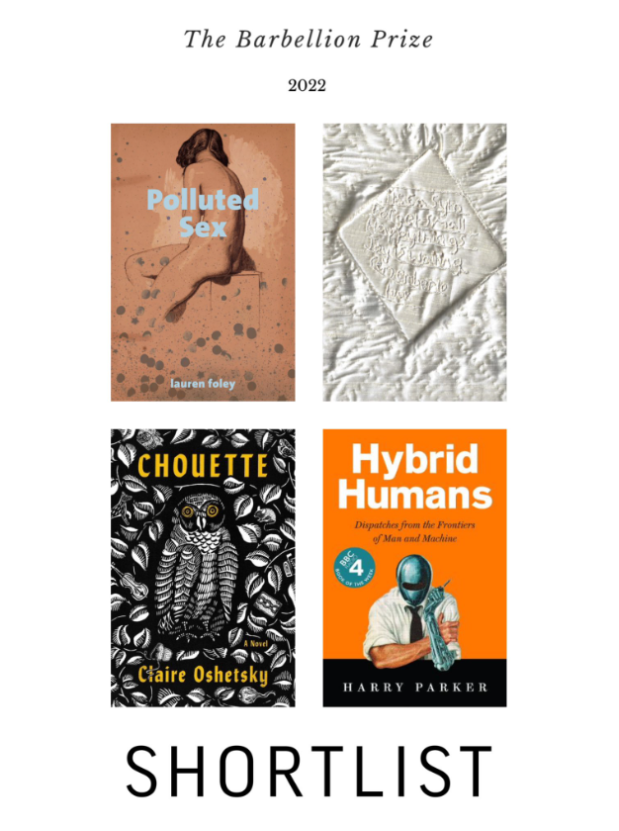
The Barbellion Prize shortlist, announced yesterday, consists of the short story collection Polluted Sex and the novel Chouette, both of which I’m still keen to read; and two nonfiction works, Hybrid Humans, which I reviewed last year, and Letty McHugh’s hybrid memoir, Book of Hours: An Almanac for the Seasons of the Soul.
I’m saving up tiny joys the way a bear fattens up for the coming winter
A patchwork quilt of ordinary leftover happiness
to keep me warm through the darkest part of the night.
In medieval times, a book of hours was a devotional book that set out the day’s prayers. Usually an illuminated manuscript, it was a precious object for laypeople, and a way of marking time. For Letty McHugh, a Yorkshire-based visual artist who lives with chronic pain and illness, this book of hours is many things: a journal, a scrapbook, an enquiry into the monastic impulse, and an interrogation of the potential meanings of physical suffering.
 In April 2020, McHugh experienced a relapse of MS so bad she had to move back in with her parents and was sleeping 20 hours a day. Her sphere had contracted to a single room. If only, she wished, there was “something to concentrate on that wasn’t my unravelling body or the unravelling world.” A Catholic upbringing and childhood holidays in Northumberland made her think about the early Christian hermits and saints like Aidan, Cuthbert and Julian of Norwich who salvaged something from solitude, who out of the privations of monasticism made monuments of faith and, sometimes, written documents, too.
This was the inspiration behind her own book of hours, which intersperses poems and photographs of found objects (wildflowers, animal skulls, sea glass and shells) with biographical sketches of saints, short autobiographical essays about her childhood and career, and musings on faith and pain. Metaphors of magic and outer space contrast with the claustrophobia of “the illness place,” somewhere she knows she’ll return to again and again. Although she knows she will never be perfectly holy or perfectly productive, she is encouraged to know that even those with confined lives (such as Emily Dickinson) can have a rich inner existence. While she resists the desire for a cure, or for a simple meaning to suffering, she bears witness to the fact that creativity can emerge in spite of everything.
I enjoyed spending time with this meticulously crafted and meditative work that engages with the present moment but also the eternal. It’s perfect onward reading for fans of the inaugural Barbellion Prize winner, Golem Girl by Riva Lehrer, and A Still Life by Josie George, a shortlistee from last year.
Book of Hours was self-published with assistance from Disability Arts Online. You can buy a signed copy of the handmade book from her Etsy shop, or read the text for free here.
With thanks to Letty McHugh for sending a free e-copy for review.
This year’s Barbellion Prize judges are Dr Emmeline Burdett, Lynn Buckle (last year’s winner) and scholar Ray Davis. The winner will be announced in February.
Until the Future: “Tomorrow” Novels by Emma Straub & Gabrielle Zevin
These two 2022 novels I read from the library recently were such fun, but also had me fighting back tears – they’re lovely, bittersweet reads that think seriously about time and failure and loss (and prompted me to ask myself, “Was everything better in 1995–6?” The answer to which is an emphatic YES). If you’re a city-goer, you’ll appreciate the loving depictions of New York City and Los Angeles. They’re also perfect literary/ commercial crossovers that I can imagine recommending to just about any of my readers. Both:
This Time Tomorrow by Emma Straub
Emma Straub is one of the most reliable authors I know for highly readable literary fiction (see also: Jami Attenberg, Maggie O’Farrell and Ann Patchett): while there’s always a lot going on in terms of family dysfunction and character dynamics, her plots are juicy and the prose slides right down (especially Modern Lovers, as well as The Vacationers). Here Alice Stern is a frustrated 40-year-old who feels stuck career- and relationship-wise, working in admissions in the same NYC private school she once attended and living with an okay boyfriend she secretly hopes won’t propose. She devotes much of her emotional energy to her seriously ill father, Leonard, who it seems may never be released from the hospital.
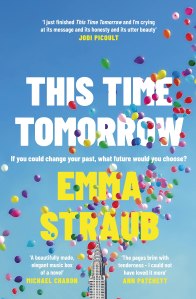 Leonard is the one-hit sci-fi author of a cult classic about time travel, and when an inebriated Alice falls asleep near her childhood home on the night of her 40th birthday, she has her own time-travel adventure, waking up on her 16th birthday in 1996. This is her chance, she thinks: to make sure things go right with her high school crush, and to encourage her father to write more and adopt healthier habits so he won’t be dying in a hospital 24 years down the line. As she figures out the rules of this personal portal and attempts the same transition again and again, she starts to get the hang of what works; what she can change and what is inexorable. And she tries to be a better person, both then and now.
True sci-fi aficionados would probably pick holes in the reasoning, but I would say so long as you pick this up expecting a smart commentary on relationships, ageing, loss and regret rather than a straight-up time-travel novel, you’ll be just fine. Straub is closer to my older sister’s age than mine, but I still loved the 1990s nostalgia, and looking back at your childhood/teen years from a parent’s perspective can only ever be an instructive thing to do.
It’s clever how Straub starts cycling through the time changes faster and faster so they don’t get repetitive. The supporting characters like Sam (Alice’s African American best friend), Kenji and even Ursula the cat are great, and there are little nods throughout to other pop culture representations of time travel. This was entertaining and relatable, but also left me with a lump in the throat. And it was all the more poignant to have been reading it just as news hit of author Peter Straub’s death; it’s a daughter’s tribute.
Some favourite lines:
(Alice thinking about Leonard) “She would feel immeasurably older when he was gone.”
“Maybe, she thought, … her mistake had been assuming that somewhere along the line, everything would fall into place and her life would look just like everyone else’s.”
(in 1996) “Everyone was gorgeous and gangly and slightly undercooked, like they’d been taken out of the oven a little bit too early”
“Any story could be a comedy or a tragedy, depending on where you ended it. That was the magic, how the same story could be told an infinite number of ways.”
Tomorrow, and Tomorrow, and Tomorrow by Gabrielle Zevin
I didn’t think I’d ever read another novel by Zevin after the dud that was The Storied Life of A.J. Fikry (by far my most popular negative review on Goodreads), but Laura’s fantastic review changed my mind.
Here’s the summary I wrote for Bookmarks magazine:
Sadie Green and Sam Masur met in unlikely circumstances. In 1986, Sam’s serious foot injury had him in a children’s hospital, where Sadie was visiting her sister, who had cancer. They hit it off talking video games, but Sam was hurt to learn Sadie kept up the visits to earn community service hours for her bat mitzvah. When they meet again during college in Boston, they decide to co-design a game. Helped by his roommate and her boyfriend, they create a bestseller, Ichigo, based on The Tempest. Over the decades, these gaming friends collaborate multiple times, but life throws some curveballs. A heartwarming story for gamers and the uninitiated alike.
 The novel was more complicated than I expected, mostly because it spans nearly 30 years – and my main critique would probably be that a shorter timeline would have been more intense. It also goes to some dark places as it probes the two central characters’ traumas and tendency to depression. But their friendship, which over the years becomes a business partnership that also incorporates Sam’s college roommate, Marx Watanabe, is a joy. The creative energy and banter are enviable. Marx is the uncomplicated, optimistic go-between when Sam and Sadie butt heads and take offense at perceived betrayals. Underneath Sam and Sadie’s conflicts is a love different from, and maybe superior to, romantic love (I think Sam might best be described as ace).
Gaming comes across as better than reality in that it offers infinite possibilities for do-overs. Life, on the other hand, only goes in one direction and is constrained by choices, your own and others’. Part VII, “The NPC” (for non-player character), is in second person narration and is beautiful as well as heartbreaking – I’ll say no more for fear of spoilers.
Apart from playing Super Mario with older cousins at 1990s family reunions and a couple of educational computer games with my childhood best friend, I don’t have any history with gaming at all, yet Zevin really drew me in to the fictional worlds Sadie and Sam created with their games. What with the vivid imagery and literary allusions, EmilyBlaster, Ichigo and Master of the Revels are real works of art, bridging high and low culture and proving that Dickinson’s poetry and Shakespeare’s plays are truly timeless. I was also interested to see how games might be ahead of their time socio-politically.
This reminded me most of The Animators and The Art of Fielding, similarly immersive stories of friendship and obsessive commitment to work and/or play. In the same way that you don’t have to know anything about cartooning or baseball to enjoy those novels, you don’t have to be a gamer to find this a nostalgic, even cathartic, read.
Some favourite lines:
“for Marx, the world was like a breakfast at a five-star hotel in an Asian country—the abundance of it was almost overwhelming. Who wouldn’t want a pineapple smoothie, a roast pork bun, an omelet, pickled vegetables, sushi, and a green-tea-flavoured croissant? They were all there for the taking and delicious, in their own way.”
Sam to Sadie: “We work through our pain. That’s what we do. We put the pain into the work, and the work becomes better.”
Marx (who was a college actor) in the early years, citing Macbeth: “What is a game? It’s tomorrow, and tomorrow, and tomorrow. It’s the possibility of infinite rebirth, infinite redemption. The idea that if you keep playing, you could win. No loss is permanent, because nothing is permanent, ever.”
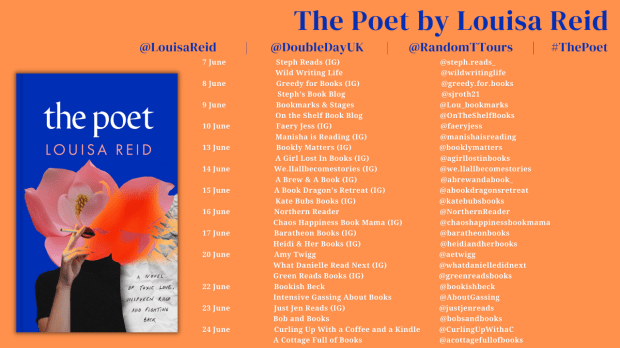
The Poet by Louisa Reid (Blog Tour Review)
The Poet lured me with the prospect of a novel in verse (Girl, Woman, Other and Mary Ann Sate, Imbecile are two others I would recommend) and the theme of a female poet caught up in a destructive relationship with her former professor. Emma Eliot published a poetry collection at age 21 before embarking on an abandoned PhD on Charlotte Mew. Tom Abbot, a charming Oxford don in his early forties, left his wife and daughters for her, but Emma has found that the housewife existence doesn’t suit her and longs to return to academia. Tom relies on Emma to boost his ego, play stepmum and help him with his publications, but scorns her working-class upbringing and can’t conceive of her having her own life and desires.

Tom’s students and ex-wife commiserate with Emma over his arrogance, but in the end it’s up to her whether she’ll break free. She tells her story of betrayal, gaslighting and the search for revenge in free verse that flows effortlessly. Sometimes her words are addressed to Tom:
Miles of misunderstanding waver
between us
Anything would be better than the stink
of your
superiority.
– and other times to the reader.
Give me the confidence of a mediocre white man
who thinks he has the right to
a woman’s work –
her words
and womb –
and everything else.
if the bed seems too big
then perhaps that is because I have shrunk
to fit the space,
or am lost in the wasteland of what was.
There are a few poetry in-jokes like that one, with Emma quoting Emily Dickinson and Tom likening her early work to Sylvia Plath’s. Usually this feels like reading fiction rather than poetry, though the occasional passage where alliteration and internal rhymes bloom remind you that Emma is meant to be an accomplished poet.
I wanted to sit in a book-lined room
wombed in words.
I didn’t see the tomb that waited
for the woman
who underrated herself.
That said, I didn’t particularly rate this qua poetry, and the storytelling style wasn’t really enough to make a rather thin story stand out. Still, I’d recommend it to poetry-phobes, as well as to readers of The Wife by Meg Wolitzer and especially Here Is the Beehive by Sarah Crossan (who, like Reid, wrote YA fiction before producing an adult novel in verse).
My thanks to Doubleday and Anne Cater of Random Things Tours for my proof copy for review.
I was delighted to be part of the blog tour for The Poet. See below for details of where other reviews have appeared or will be appearing soon.
Four June Releases (Fiction & Poetry): Bennett, Gabrielsen, Kwek and Watts
(A rare second post in a day from me, to make way for tomorrow’s list of the best books of the first half of the year.) My four new releases for June are a novel about the complications of race and sexuality in 1950s–80s America, a novella in translation about a seabird researcher struggling through a time of isolation, and two new poetry books from Carcanet Press. As a bonus just in time for Pride Month, I finish with a mini write-up of The Book of Queer Prophets, an anthology of autobiographical essays that was published late last month.
The Vanishing Half by Brit Bennett
 Like some lost mid-career gem from Toni Morrison, this novel is meaty with questions of racial and sexual identity and seems sure to follow in the footsteps of Ruby and An American Marriage with a spot in Oprah’s book club and on Barack Obama’s summer reading list.
It’s the story of light-skinned African American twins Stella and Desiree Vignes, and how their paths divide in 1954. Both are desperate to escape from Mallard, Louisiana, where their father was lynched and their mother cleans white people’s houses. Desiree works in fingerprinting for the FBI in Washington, D.C., but in 1968 leaves an abusive marriage to return to Mallard with her dark-skinned daughter, Jude Winston. Stella, on the other hand, has been passing as white for over a decade. She was a secretary for the man who became her husband, Blake Sanders, and now lives a life of comfort in a Los Angeles subdivision.
The twins’ decisions affect the next generation, too. Both have one daughter. Jude goes to college in L.A., where she meets and falls in love with photographer Reese (born Therese), who is, in a different sense, “passing” until he can afford the surgery that will align his body with his gender. In a coincidence that slightly strains belief, Jude runs into Stella’s daughter, Kennedy, and over the next seven years the cousins – one a medical student; the other an actress – continue to meet occasionally, marvelling at how two family lines that started in Mallard, a tiny town that doesn’t even exist anymore, could have diverged so dramatically.
This is Bennett’s second novel, after The Mothers, which I’m keen to read. It’s perceptive and beautifully written, with characters whose struggles feel genuine and pertinent. Though its story line ends in the late 1980s, it doesn’t feel passé at all. The themes of self-reinvention and running from one’s past resonate. I expected certain characters to be forced into moments of reckoning, but the plot is a little messier than that – and that’s more like real life. A shoo-in for next year’s Women’s Prize list.
My rating: 
My thanks to Dialogue Books for the free copy for review.
Ankomst by Gøhril Gabrielsen (2017)
[Translated from the Norwegian by Deborah Dawkin]
 The unnamed narrator of Gabrielsen’s fifth novel is a 36-year-old researcher working towards a PhD on the climate’s effects on populations of seabirds, especially guillemots. During this seven-week winter spell in the far north of Norway, she’s left her three-year-old daughter behind with her ex, S, and hopes to receive a visit from her lover, Jo, even if it involves him leaving his daughter temporarily. In the meantime, they connect via Skype when signal allows. Apart from that and a sea captain bringing her supplies, she has no human contact.
Daily weather measurements and bird observations still leave too much time alone in a cramped cabin, and this starts to tell in the protagonist’s mental state: she’s tormented by sexual fantasies, by memories of her life with S, and by the thought of a local family, the Berthelsens, who experienced a disastrous house fire in 1870. More and more frequently, she finds herself imagining what happened to Olaf and Borghild Berthelsen. Solitude and this growing obsession with ghosts of the past make her start to lose her grip on reality.
I’d encountered an unreliable narrator and claustrophobic setting before from Gabrielsen with her second novel, The Looking-Glass Sisters. Extreme weather and isolation account for this being paired with Snow, Dog, Foot by Claudio Morandini as the first two books in Peirene’s 2020 “Closed Universe” trilogy. I was also reminded of Sarah Moss’s Night Waking. However, I found this novella’s metaphorical links – how seabirds and humans care for their young; physical and emotional threats; lowering weather and existential doom – too obvious.
My rating: 
My thanks to Peirene Press for the free copy for review.
Moving House by Theophilus Kwek
 This is the first collection of the Chinese Singaporean poet’s work to be published in the UK. Infused with Asian history, his elegant verse ranges from elegiac to romantic in tone. Many of the poems are inspired by historical figures and real headlines. There are tributes to soldiers killed in peacetime training and accounts of high-profile car accidents; “The Passenger” is about the ghosts left behind after a tsunami. But there are also poems about the language and experience of love. I also enjoyed the touches of art and legend: “Monologues for Noh Masks” is about the Pitt-Rivers Museum collection, while “Notes on a Landscape” is about Iceland’s geology and folk tales. In most places alliteration and enjambment produce the sonic effects, but there are also a handful of rhymes and half-rhymes, some internal.
My individual favorite poems included “Prognosis,” “Sophia” (made up of two letters Sir Thomas Stamford Raffles writes home to his wife while surveying in Singapore), and “Operation Thunderstorm.” As an expat and something of a nomad, I especially loved the title poem, which comes last and explains the cover image: “every house has a skeleton – / while the body learns it must carry less / from place to place, a kind of tidiness / that builds, hardens. Some call it fear, // of change, or losing what we cannot keep. / Others, experience.” Recommended to fans of Mary Jean Chan, Nausheen Eusuf, Kei Miller and Ocean Vuong.
My rating:
My thanks to Carcanet Press for the PDF copy for review.
Red Gloves by Rebecca Watts
 I noted the recurring comparison of natural and manmade spaces; outdoors (flowers, blackbirds, birds of prey, the sea) versus indoors (corridors, office life, even Emily Dickinson’s house in Massachusetts). The style shifts from page to page, ranging from prose paragraphs to fragments strewn across the layout. Most of the poems are in recognizable stanzas, though these vary in terms of length and punctuation. Alliteration and repetition (see, as an example of the latter, her poem “The Studio” on the TLS website) take priority over rhymes. I was reminded of Elizabeth Bishop in places, while “Whereas” had me thinking of Stephen Dunn’s collection of that name (Layli Long Soldier also has a poetry book of the same title). A few of my individual favorite poems were “Surveillance,” “Building” and “Admission” (on a medical theme: “What am I afraid of? / The breaching of skin. / Violation of laws that / separate outside from in. / Liquidation of the thing / I call me.”).
My rating: 
My thanks to Carcanet Press for the PDF copy for review.
And a bonus for Pride Month:
The Book of Queer Prophets: 24 Writers on Sexuality and Religion, edited by Ruth Hunt
 There isn’t, or needn’t be, a contradiction between faith and queerness, as the authors included in this anthology would agree. Many of them are stalwarts at Greenbelt, a progressive Christian summer festival – Church of Scotland minister John L. Bell even came out there, in his late sixties, in 2017. I’m a lapsed regular attendee, so a lot of the names were familiar to me, including those of poets Rachel Mann and Padraig O’Tuama.
Most of the contributors are Christian, then, including ordained priests like Desmond Tutu’s daughter, Mpho, and LGBT ally Kate Bottley, but we also hear from Michael Segalov, a gay Jewish man in London, and from Amrou Al-Kahdi (author of Unicorn: The Memoir of a Muslim Drag Queen), who describes the affirmation they found in the Sufi tradition. Dustin Lance Black tells of the exclusion LGBT Mormons still encounter.
Jarel Robinson-Brown addresses his lament on mistreatment to his nephew, as James Baldwin did in “My Dungeon Shook” (in The Fire Next Time). Tamsin Omond recounts getting married to Melissa on a London bridge in the middle of an Extinction Rebellion protest. Erin Clark, though bisexual, knows she can pass as straight because she’s marrying a man – so is she ‘gay enough?’ Two trans poets write of the way cathedrals drew them into faith. The only weaker pieces are by Jeanette Winterson (there’s nothing new if you’ve read her memoir) and Juno Dawson (entirely throwaway; ‘I’m an atheist, but it’s okay to be religious, too’).
Again and again, these writers voice the certainty that they are who God means them to be. A few of them engage with particular passages from the Bible, offering contextual critiques or new interpretations, but most turn to scripture for its overall message of love and justice. Self-knowledge is a key component of their search for truth. And the truth sets people free.
My rating:
I read an e-copy via NetGalley.
What recent releases can you recommend?
Recommended March Releases: Magnusson, May, Moor and More
March has been a huge month for new releases. With so many authors feeling let down about book tours and events being cancelled, it’s a great time for bloggers to step in and help. I attended two virtual book launches on Twitter on the 19th and have another one coming up on the 31st. I also have three more March releases on order from my local indie bookstore: Greenery by Tim Dee, tracking the arrival of spring; Footprints by David Farrier, about the fossil traces modern humans will leave behind; and The Bass Rock by Evie Wyld, a novel about violence against women set on the Scottish coast in three different time periods.
Today I have short reviews of five March releases I recommend (plus a bonus one now out in paperback): a Victorian pastiche infused with Scottish folklore, an essay collection about disparate experiences of motherhood, a thriller about victims of domestic violence, poems in graphic novel form, a novel about natural and personal disasters in Australia, and a lovely story of friendship and literature changing a young man’s life forever. All:
The Ninth Child by Sally Magnusson
(Published by Two Roads on the 19th)
 Like Hannah Kent’s The Good People and Sarah Perry’s The Essex Serpent, this is an intense, convincing work of fiction that balances historical realism with magical elements. In mid-1850s Britain, in the wake of a cholera epidemic, there is a drive to ensure clean water. Alexander Aird, hired as the on-site physician for the Glasgow waterworks, moves to the Loch Katrine environs with his wife, Isabel, who has had eight miscarriages or stillbirths. With no living babies requiring her care, Isabel spends her days wandering the hills and meets a strange scarecrow of a man, Reverend Robert Kirke … who died in 1692.
A real-life Episcopalian minister, Kirke wrote a book about fairies and other Celtic supernatural beings and, legend has it (as recounted by Sir Walter Scott and others), was taken into the faery realm after his death and continued to walk the earth looking for rest. It takes a while for Isabel to learn the truth about Kirke – though her servant, Kirsty McEchern, immediately intuits that something isn’t right about the man – and longer still to understand that he wants something from her. “Whatever else, Robert Kirke could be relied on to ruffle this mind of hers that was slowly opening to experience again, and to thinking, and to life.”
This was a rollicking read that drew me in for its medical elements (premature birth, a visit to Joseph Lister, interest in Florence Nightingale’s nursing methods) as well as the plot. It often breaks from the omniscient third-person voice to give testimonies from Kirsty and from Kirke himself. There are also amusing glimpses into the Royal household when Victoria and Albert stay at Balmoral and return to open the waterworks during the “heaviest, windiest, most umbrella-savaging, face-slashing deluge that Scotland had experienced in twenty years.” Best of all, it gives a very different picture of women’s lives in the Victorian period.
My thanks to the publisher for the proof copy for review.
The Best Most Awful Job: Twenty Writers Talk Honestly about Motherhood, edited by Katherine May
(Published by Elliott & Thompson on the 19th)
 These are essays for everyone who has had a mother – not just everyone who has been a mother. I enjoyed every piece separately, but together they form a vibrant collage of women’s experiences. Care has been taken to represent a wide range of situations and attitudes. The reflections are honest about physical as well as emotional changes, with midwife Leah Hazard (author of Hard Pushed) kicking off with an eye-opening rundown of the intimate scarring some mothers will have for the rest of their lives. We hear from a mother of six who’s “addicted” to pregnancy (Jodi Bartle), but also from a woman who, after an ectopic pregnancy, realized “there are lots of ways to mother, even if your body won’t let you” (Peggy Riley, in one of my two favorite pieces in the book).
Women from BAME communities recount some special challenges related to cultural and family expectations, but others that are universal. An autistic mother (Joanne Limburg) has to work out how to parent a neurotypical child; queer parents (including author Michelle Tea) wonder how to raise a son at a time of toxic masculinity. There are also several single mothers, one of them disabled (Josie George – hers was my other favorite essay; do follow her on Twitter via @porridgebrain if you don’t already).
What I most appreciated is that these authors aren’t saying what they think they should say about motherhood; they’re willing to admit to boredom, disappointment and rage: “motherhood is an infinite, relentless slog from which there is no rest or recuperation … a ceaseless labour, often devoid of acknowledgment, recognition and appreciation” (Javaria Akbar); “I step barefoot on a rogue piece of Lego and it’s game over. I scream” (Saima Mir). These are punchy, distinctive slices of life writing perfectly timed for Mother’s Day. I plan to pass the book around my book club; mothers or not, I know everyone will appreciate it.
My thanks to the publisher for the proof copy for review.
Keeper by Jessica Moor
(Published by Viking/Penguin on the 19th)
 Val McDermid and Jeanette Winterson are among the fans of this, Penguin’s lead debut title of 2020. When a young woman is found drowned at a popular suicide site in the Manchester area, the police plan to dismiss the case as an open-and-shut suicide. But the others at the women’s shelter where Katie Straw worked aren’t convinced, and for nearly the whole span of this taut psychological thriller readers are left to wonder if it was suicide or murder.
The novel alternates between chapters marked “Then” and “Now”: in the latter story line, we follow the police investigation and meet the women of the refuge; in the former, we dive into Katie’s own experience of an abusive relationship back in London. While her mother was dying of cancer she found it comforting to have a boyfriend who was so attentive to her needs, but eventually Jamie’s obsessive love became confining.
I almost never pick up a mystery, but this one was well worth making an exception for. I started suspecting the twist at maybe the two-thirds point, but that didn’t detract from my enjoyment. Based on Moor’s year working in the violence against women sector, it’s a gripping and grimly fascinating story of why women stay with their abusers and what finally drives them to leave.
I picked up a proof copy at a Penguin Influencers event.
 Poems to See by: A Comic Artist Interprets Great Poetry by Julian Peters
(To be published by Plough Publishing House on the 31st)
Peters is a comics artist based in Montreal. Here he has chosen 24 reasonably well-known poems by the likes of e.e. cummings, Emily Dickinson, Robert Frost, Seamus Heaney, Langston Hughes, Edgar Allan Poe, Christina Rossetti and W.B. Yeats and illustrated each one in a markedly different fashion. From black-and-white manga to a riot of color and music, from minimalist calligraphy-like Japanese watercolor to imitations of Brueghel, there is such a diversity of style here that at first I presumed there were multiple artists involved (as in one of my favorite graphic novels of last year, ABC of Typography, where the text was written by one author but each chapter had a different illustrator). But no, this is all Peters’ work; I was impressed by his versatility.
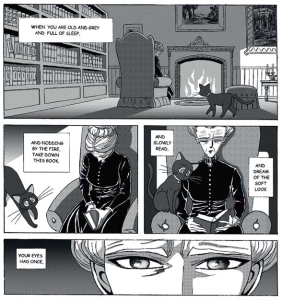
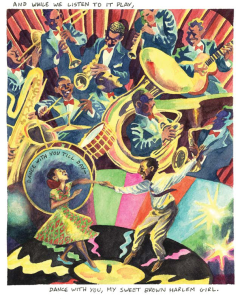
The illustrations range from realistic to abstract, with some more obviously cartoon-like. A couple of sequences reminded me of the style of Raymond Briggs. For “Caged Bird” by Maya Angelou, lines are inlaid on the squares of a painted patchwork quilt. Other sets look to have been done via wood engraving, or with old-fashioned crayons. You could quibble with the more obvious poetry selections, but I encountered a few that were new to me, including “Buffalo Dusk” by Carl Sandburg and “Conscientious Objector” by Edna St. Vincent Millay. Peters has grouped them into six thematic categories: self, others, art, nature, time and death. Teenagers, especially, will enjoy the introduction to a variety of poets and comics styles.
I read an e-copy via NetGalley.
The Inland Sea by Madeleine Watts
(Published by ONE/Pushkin on the 5th)
 “Emergency police fire, or ambulance?” The young female narrator of this debut novel lives in Sydney and works for Australia’s emergency call service. Over her phone headset she gets appalling glimpses into people’s worst moments: a woman cowers from her abusive partner; a teen watches his body-boarding friend being attacked by a shark. Although she strives for detachment, her job can’t fail to add to her anxiety – already soaring due to the country’s flooding and bush fires.
Against that backdrop of natural disasters, a series of minor personal catastrophes play out. The narrator is obsessed with a rape/murder case that’s dominating the television news, and narrowly escapes sexual assault herself. She drinks to excess, keeps hooking up with her ex-boyfriend, Lachlan, even after he gets a new girlfriend, and seems to think abortion and the morning after pill are suitable methods of birth control. Irresponsible to the point of self-sabotage, she’s planning a move to London but in the meantime is drifting through life, resigned to the fact that there is no unassailable shelter and no surefire way to avoid risk.
The title comes from the quest of John Oxley (presented here as the narrator’s ancestor), who in 1817 searched for a water body in the Australian interior. Quotations from his journals and discussions of the work of Patrick White, the subject of Lachlan’s PhD thesis, speak to the search for an Australian identity. But the inland sea is also the individual psyche, contradictory and ultimately unknowable. Like a more melancholy version of Jenny Offill’s Weather or a more cosmic autofiction than Yara Rodrigues Fowler’s Stubborn Archivist, this is a timely, quietly forceful story of how women cope with concrete and existential threats.
My thanks to the publisher for the PDF copy for review.
And a bonus…
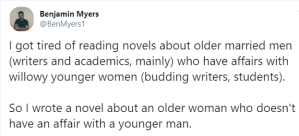
The Offing by Benjamin Myers (2019)
(Paperback published by Bloomsbury on the 5th)
 With the Second World War only recently ended and nothing awaiting him apart from the coal mine where his father works, sixteen-year-old Robert Appleyard sets out on a journey. From his home in County Durham, he walks southeast, doing odd jobs along the way in exchange for food and lodgings. One day he wanders down a lane near Robin Hood’s Bay and gets a surprisingly warm welcome from a cottage owner, middle-aged Dulcie Piper, who invites him in for tea and elicits his story. Almost accidentally, he ends up staying for the rest of the summer, clearing scrub and renovating her garden studio.
Dulcie is tall, outspoken and unconventional – I pictured her as (Meryl Streep as) Julia Child in the movie Julie & Julia. She introduces Robert to whole new ways of thinking: that not everyone believes in God, that Germans might not be all bad, that life can be about adventure and pleasure instead of duty. “The offing” is a term for the horizon, as well as the title of a set of poems Robert finds in the dilapidated studio, and both literature and ambition change his life forever. Bright, languid and unpredictable, the novel delights in everyday sensual pleasures like long walks with a dog, dips in the ocean and an abundance of good food. I can’t think of another book I’ve read that’s quite like it – how refreshing is that?
I pre-ordered the paperback using a Waterstones voucher I got for Christmas.
What recent releases can you recommend?
Advent Reading: In the Bleak Midwinter by Rachel Mann & More
Today marks 189 years since poet Christina Rossetti’s birth in 1830. You could hardly find better reading for Advent than poet–priest Rachel Mann’s new seasonal devotional, In the Bleak Midwinter, which journeys through Advent and the 12 days of Christmas via short essays on about 40 Rossetti poems.
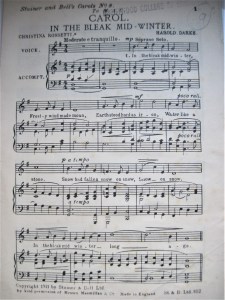
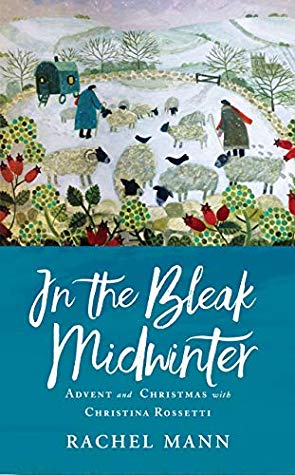 If your mental picture of Rossetti’s work is, like mine was, limited to twee repetition (“Snow had fallen, snow on snow, / Snow on snow,” as the title carol from 1872 goes), you’ll gain a new appreciation after reading this. Yes, Rossetti’s poetry may strike today’s readers as sentimental, with a bit too much rhyming and overt religion, but it is important to understand it as a product of the Victorian era.
Mann gives equal focus to Rossetti’s techniques and themes. Repetition is indeed one of her main tools, used “to build intensity and rhythm,” and some of her poems are psalm-like in their diction and emotion. I had no idea that Rossetti had written so much – and so much that’s specific to the Christmas season. She has multiple poems entitled “Advent” and “A Christmas Carol” (the technical title of “In the Bleak Midwinter”) or variations thereon.
The book’s commentary spins out the many potential metaphorical connotations of Advent: anticipation, hope, suffering, beginnings versus endings. Mann notes that Rossetti often linked Advent and apocalypse as times of change and preparation. Even as Christians await the birth of Christ, the poet seems to say, they should keep the end of all things in mind. Thus, some of the poems include surprisingly dark or premonitory language:
The days are evil looking back,
The coming days are dim;
Yet count we not His promise slack,
But watch and wait for Him. (from “Advent,” 1858)
Death is better far than birth,
You shall turn again to earth. (from “For Advent”)
 Along with that note of memento mori, Mann suggests other hidden elements of Rossetti’s poetry, like desire (as in the sensual vocabulary of “Goblin Market”) and teasing mystery (“Winter: My Secret,” which reminded me of Emily Dickinson). Not all of her work is devotional or sweet; those who feel overwhelmed or depressed at Christmastime will also find lines that resonate for them here.
Mann helped me to notice Rossetti’s sense of “divine time” that moves in cycles. She also makes a strong case for reading Rossetti to understand how we envision Christmas even now: “In some ways, ‘In the Bleak Midwinter’ offers the acme of our European cultural representations of this season.”
My rating:
With thanks to Canterbury Press for the free copy for review.
(I also reviewed Mann’s poetry collection, A Kingdom of Love, earlier in the year.)
 For December I’m reading Do Nothing, the Advent booklet Stephen Cottrell (now the Bishop of Chelmsford; formerly Bishop of Reading) wrote in 2008 about a minimalist, low-stress approach to the holidays. I have to say, it’s inspiring me to cut way back on card-sending and gift-giving this year.
A few seasonal snippets spotted in my recent reading:
“December darkens and darkens, and the streets sprout forth their Christmas tinsel, and the Salvation Army brass band sings hymns and jingles its bells and stirs up its cauldron of money, and loneliness blows in the snowflurries”
(from The Robber Bride by Margaret Atwood)
“Fine old Christmas, with the snowy hair and ruddy face, had done his duty that year in the noblest fashion, and had set off his rich gifts of warmth and colour with all the heightening contrast of frost and snow.”
(from The Mill on the Floss by George Eliot)
A week to Christmas, cards of snow and holly,
Gimcracks in the shops,
Wishes and memories wrapped in tissue paper,
Trinkets, gadgets and lollipops
And as if through coloured glasses
We remember our childhood’s thrill
… And the feeling that Christmas Day
Was a coral island in time where we land and eat our lotus
But where we can never stay.
(from Autumn Journal by Louis MacNeice)


 I’m always on the lookout for books that seem to fit the season. Here are the piles I’ve amassed for winter (Early Riser imagines a human hibernation system for the winters), Christmas and snow. I’ll dip into these over the next couple of months. I plan to get more “winter,” “snow” and “ice” titles out from the library. Plus I have this review book (at left), newly in paperback, to start soon.
Have you read any Advent or wintry books recently?
Book Serendipity, 2019 Second Half
I call it serendipitous when two or more books that I’m reading at the same time or in quick succession have something pretty bizarre in common. Because I have so many books on the go at once – usually between 10 and 20 – I guess I’m more prone to such incidents. I post these occasional reading coincidences on Twitter. What’s the weirdest one you’ve had lately? (The following are in rough chronological order.)
[Previous 2019 Book Serendipity posts from April and July.]
- Two novels in which a character attempts to glimpse famous mountains out of a train window but it’s so rainy they can barely be seen: The Unchangeable Spots of Leopards by Kristopher Jansma and The Pine Islands by Marion Poschmann.


- Ex-husbands move from England to California and remarry younger women in The Stillness The Dancing by Wendy Perriam and Heat Wave by Penelope Lively.
 References to Edgar Allan Poe in both Timbuktu by Paul Auster and The Unchangeable Spots of Leopards by Kristopher Jansma.
- An account of Percy Shelley’s funeral pyre in both The Unchangeable Spots of Leopards by Kristopher Jansma and Frankissstein by Jeanette Winterson.
- Mentions of barn owls being killed by eating poisoned rats in Owl Sense by Miriam Darlington and Homesick by Catrina Davies.


- Miriam Rothschild is mentioned in Irreplaceable by Julian Hoffman and An Obsession with Butterflies by Sharman Apt Russell.
- Gorse is thrown on bonfires in Homesick by Catrina Davies and The Stillness The Dancing by Wendy Perriam.
 A character has a nice cup of Ovaltine in Some Tame Gazelle by Barbara Pym and The Stillness The Dancing by Wendy Perriam.
- I started two books with “Bloom” in the title on the same day.

 Two books I finished about the same time conclude by quoting or referring to the T. S. Eliot lines about coming back to the place where you started and knowing it for the first time (Owl Sense by Miriam Darlington and This Is Not a Drill, the Extinction Rebellion handbook).
- Three books in which the narrator wonders whether to tell the truth slant (quoting Emily Dickinson, consciously or not): The Unchangeable Spots of Leopards by Kristopher Jansma, The Poisonwood Bible by Barbara Kingsolver and The Hiding Game by Naomi Wood.
- On the same day, I saw mentions of crullers in both On Chapel Sands by Laura Cumming and The Dutch House by Ann Patchett.


- There are descriptions of starling murmurations over Brighton Pier in both Irreplaceable by Julian Hoffman and Expectation by Anna Hope. (Always brings this wonderful Bell X1 song to mind!)
- I was reading The Outermost House by Henry Beston and soon after found an excerpt from it in Irreplaceable by Julian Hoffman; later I started The Easternmost House by Juliet Blaxland, whose title is a deliberate tip of the hat to Beston.
 At a fertility clinic, the author describes a pair of transferred embryos as “two sequins of light” (in On Chapel Sands by Laura Cumming) and “two points of light” (in Expectation by Anna Hope).
- Mentions of azolla ferns in Time Song by Julia Blackburn and Bloom (aka Slime) by Ruth Kassinger.
 Incorporation of a mother’s brief memoir in the author’s own memoir in On Chapel Sands by Laura Cumming and All Things Consoled by Elizabeth Hay.
- Artist mothers in On Chapel Sands by Laura Cumming, All Things Consoled by Elizabeth Hay, and Expectation by Anna Hope.
- Missionary fathers in The Poisonwood Bible by Barbara Kingsolver and The Wind that Lays Waste by Selva Almada.


- Twins, one who’s disabled from a birth defect and doesn’t speak much, in Golden Child by Claire Adam and The Poisonwood Bible by Barbara Kingsolver.
 An Irish-American family in a major East Coast city where the teenage boy does construction work during the summers in Ask Again, Yes by Mary Beth Keane and The Dutch House by Ann Patchett.
- SPOILERS: A woman with terminal cancer refuses treatment so she can die on her own terms and is carried out into her garden in Expectation by Anna Hope and A Reckoning by May Sarton.
- A 27-year-old professor has a student tearfully confide in her in Crow Lake by Mary Lawson and The Small Room by May Sarton.


- Reading The Yellow House by Sarah M. Broom at the same time as The Dutch House by Ann Patchett.
 “I was nineteen years old and an idiot” (City of Girls, Elizabeth Gilbert); “I was fifteen and generally an idiot” (The Dutch House, Ann Patchett).
- Mentions of a conjuring tricks book in Time Song by Julia Blackburn and Fifth Business by Robertson Davies.
- A teen fleeces their place of employment in Sweet Sorrow by David Nicholls and Who Will Run the Frog Hospital? by Lorrie Moore.


- A talking parrot with a religious owner in The Poisonwood Bible by Barbara Kingsolver and Olive Kitteridge by Elizabeth Strout.
- Pictorial book serendipity: three books I was reading, and another waiting in the wings, had a red, black and white color scheme.

 Kripalu (a Massachusetts retreat center) is mentioned in Fleishman Is in Trouble by Taffy Brodesser-Akner and Once More We Saw Stars by Jayson Greene.
- The character of Netty Quelch in Robertson Davies’s The Manticore reminds me of Fluffy in Ann Patchett’s The Dutch House.
- The artist Chardin is mentioned in How Proust Can Change Your Life by Alain de Botton and Varying Degrees of Hopelessness by Lucy Ellmann.
- A Czech grand/father who works in a plant nursery in the opening story of Andrea Barrett’s Ship Fever and Patricia Hampl’s The Florist’s Daughter.


- The author was in Eva Le Gallienne’s NYC theatre company (Madeleine L’Engle’s Two-Part Invention and various works by May Sarton, also including a biography of her).
 Gillian Rose’s book Love’s Work is mentioned in both Notes Made while Falling by Jenn Ashworth and My Year Off by Robert McCrum. (I will clearly have to read the Rose!)
- Sarah Baartman (displayed in Europe as the “Hottentot Venus”) is mentioned in Shame on Me by Tessa McWatt and Hull by Xandria Phillips.
Rebecca Stott, Duke Special & More at Greenbelt 2018
After five years away, we finally made it back to Greenbelt, a progressive Christian summer arts festival held on the grounds of Boughton House, on the Bank Holiday. The festival is a mixture of talks, music, performances and more, and given how much we’d paid and how far we’d traveled just for the one day, we tried to pack in as much as possible.

We started the day with “Beyond Forgiveness,” a presentation by Jo Berry and Pat Magee. Berry’s father, a Tory MP, was killed when the IRA bombed the Conservative Party conference in Brighton in 1984. Magee spent 14 years in prison for his role in the bombing. When he got out of jail, he met Berry at her request and they talked and listened to each other for several hours. For the first time, Magee said, he could see her father as a real person and realized that the IRA had been just as guilty of dehumanizing and misrepresenting people as the English were. Berry, too, felt that “I’d met my enemy and seen his humanity.” The two have now shared a stage more than 200 times, speaking about the value of empathy in healing broken relationships while also addressing imbalances of power that lead to violence.
To my surprise, cookery displays and musical comedy seemed to be the order of the day. A model kitchen is a new addition to the festival, giving celebrity chefs hour-long sessions to demonstrate a particular dish. Jack Monroe, promoting her new book Cooking on a Bootstrap, cooked a sausage lasagna. She made us all laugh with her idea of “the inverse sausage fallacy” – the cheaper a sausage is, the better it tastes because of all the salt, sugar and spices added to cheaper bits of meat. She started writing recipes when she was a single mother on the dole, and so she encouraged audience members to donate nice things you would like to eat, as well as everyday hygiene products, to food banks. For a “What Vegans Eat” session, Brett Cobley (aka EpiVegan) made a pea and asparagus risotto and answered questions about protein sources, egg replacements, plant milks and harder-to-find ingredients.
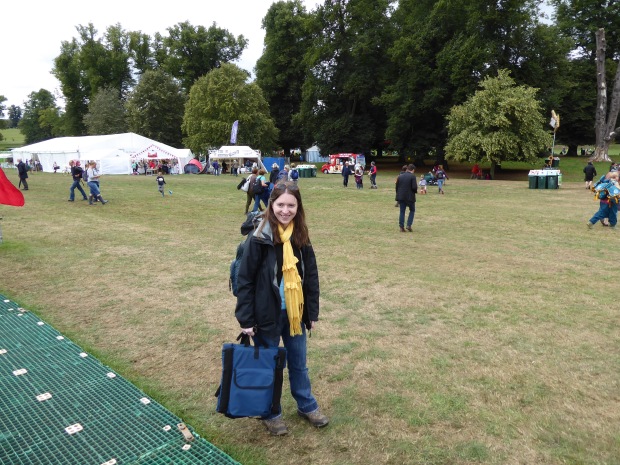
Uproarious musical comedy came in the form of Harry & Chris, who made up impromptu raps about New Year’s Day, the Teletubbies and phobias, and Flo & Joan, who sang about divorce statistics, unnecessary inventions for women, and sex robots (the show was fairly crude and came with an 18+ warning). The overall musical highlight of the day was Duke Special, a Greenbelt favorite we’ve seen play quite a number of times now. His pop combines his smooth Belfast tenor with music hall and Big Band stylings, and his songs are often drawn from poetry and 1920s–40s songbooks. His latest project, Hallow, is a beautiful set of Michael Longley poems set to music. He played “Another Wren” and “Emily Dickinson” from that album, various covers (including two bizarre ditties by Ivor Cutler), and crowd favorites “Last Night I Nearly Died,” “Freewheel” and “Our Love Goes Deeper than This.” We also sampled performances by Martyn Joseph, Wallis Bird and CC Smugglers.
Duke Special was a good bridge between music and literature. From the literature program I also saw Rabbi Jonathan Wittenberg speak on “Things My Dog Has Taught Me about Being a Better Human,” the title of his recent book. (His dog Mitzpah had a special dispensation to join him on stage; no animals are allowed on site otherwise!) The rabbi spoke about lessons in listening, attention, trust and seizing the moment. Mitzi and his previous dog Safi have also given him a connection with the rest of creation. Although he lives in the London suburbs and has an inner-city synagogue, they have accompanied him on long walks in Scotland and Germany. Wittenberg was a warm and witty speaker and I very much liked the sound of his book. It could make a good follow-up to The Power of Dog.
My other festival highlight was Rebecca Stott, in conversation with Radio 4 presenter Malcolm Doney. I read her Costa Prize-winning memoir In the Days of Rain: A daughter. A father. A cult in April and it’s been one of my stand-out reads of the year so far. The book conveys a huge amount of information about the Exclusive Brethren and Stott’s family history but never loses sight of what is most important: what it was like to be in a cult and have your life defined by its rules and its paranoia about the outside world. Stott remembers 6 a.m. Sunday communion services and her constant terror of being left behind in the Rapture.
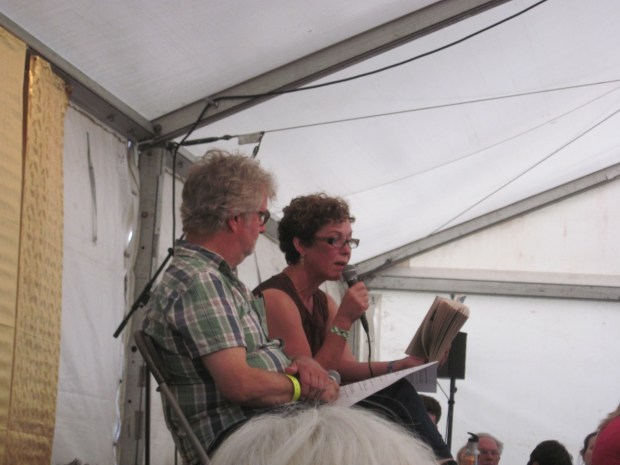
Rebecca Stott reading from In the Days of Rain.
Unfortunately, the talk didn’t add much to my experience of reading her book. The interviewer, catering to those who haven’t read the book yet, led her through her whole story bit by bit, and because I’d read it fairly recently it was all familiar. However, Stott spoke wonderfully and was full of wry compassion for her younger self. I was most interested to hear about the book’s aftermath: she’s received 300 letters from ex-Brethren that her daughter is transcribing to send to a Brethren Church archive in Manchester. When asked during a Q&A where she sees cult tendencies today, she mentioned Trump supporters!


Whereas I read In the Days of Rain from the library, I happen to own two Stott books I haven’t read yet, so I cheekily brought along my paperback of Ghostwalk for signing. She was intrigued to see the older cover design and told me she thinks the prose style in her debut novel is much richer than in Rain, and she hopes I’ll like it. I thanked her for the talk, told her how much I’d enjoyed her memoir, and recommended her two books vaguely about cults: Educated by Tara Westover, which she already knew well, having done some events with Westover, and The Incendiaries by R.O. Kwon, which was new to her (my blog tour review is coming up on Monday). I caught myself using the word “brilliant” three times in speaking about Stott’s work and these other books – nuance and vocabulary alike clearly go out the window when nervously speaking to admired authors!
Some readers of this blog would have been delighted by the event I rushed to straight after Stott’s talk: Jon McGregor giving readings from Reservoir 13, with Sigur Rós-esque backing and interlude music from Haiku Salut. I heard about the police reconstruction with actors from Manchester, and collecting bilberries on the heath in August. Unfortunately, I found it just as dull read aloud as I did when I tried the book last year, and I left early.
During bits of down time I pulled out a Katherine Mansfield story collection I found in a charity shop last week and read “Bank Holiday” and “The Garden Party.” The former is a very short piece whose carnival atmosphere rises to a note of indeterminate striving:
“And up, up the hill come the people, with ticklers and golliwogs, and roses and feathers. Up, up they thrust into the light and heat, shouting, laughing, squealing, as though they were being pushed by something, far below, and by the sun, far ahead of them – drawn up into the full, bright, dazzling radiance to…what?”
 It was my first time reading the famous “The Garden Party,” which likewise moves from a blithe holiday mood into something weightier. The Sheridans are making preparations for a lavish garden party dripping with flowers and food. Daughter Laura is dismayed when news comes that a man from the cottages has been thrown from his horse and killed, and thinks they should cancel the event. Everyone tells her not to be silly; of course it will go on as planned. The story ends when, after visiting his widow to hand over leftover party food, she unwittingly sees the man’s body and experiences an epiphany about the simultaneous beauty and terror of life. “Don’t cry,” her brother says. “Was it awful?” “No,” she replies. “It was simply marvellous.” Mansfield is especially good at first and last paragraphs. I’ll read more by her someday.
 Bookish Beck = Rebecca Foster. American transplant to England. Freelance proofreader and book reviewer.
 Bookish Beck