The Writer’s Table by Valerie Stivers (Blog Tour)
In 2017, Valerie Stivers started writing about food in classic fiction for The Paris Review. Her particular project for the “Eat Your Words” column would be cooking and baking her way through literature. It was a larger undertaking than she realized and became something of an obsession. A selection of the greatest hits made it into The Writer’s Table. Each few-page biographical profile opens with a recipe drawn from that author’s work or developed by Stivers. A surprising number of writers published cookbooks – or had one compiled after their death – including Maya Angelou, Jane Austen (of family friend and housekeeper Martha Lloyd’s recipes), Ernest Hemingway, Barbara Pym, George Sand and Alice B. Toklas.
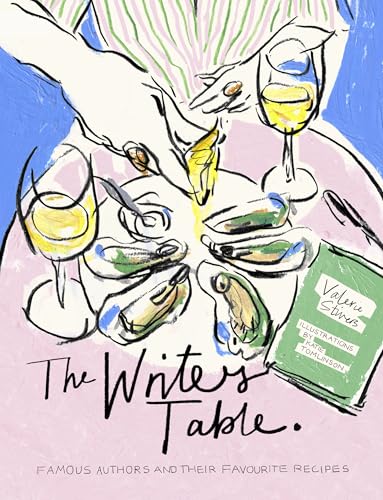 Though I’ve read a lot by and about D.H. Lawrence, I didn’t realise he did all the cooking in his household with Frieda, and was renowned for his bread. And who knew that Emily Dickinson was better known in her lifetime as a baker? Her coconut cake is beautifully simple, containing just six ingredients. Flannery O’Connor’s peppermint chiffon pie also sounds delicious. Some essays do not feature a recipe but a discussion of food in an author’s work, such as the unusual combinations of mostly tinned foods that Iris Murdoch’s characters eat. It turns out that that’s how she and her husband John Bayley ate, so she saw nothing odd about it. And Murakami’s 2005 New Yorker story “The Year of Spaghetti” is about a character whose fixation on one foodstuff reflects, Stivers notes, his “emotional … turmoil.”
The alphabetical arrangement of the pieces emphasizes the wide range of eras, regions, and genres. It’s a fun book for browsing, though I might have liked more depth on fewer authors. I especially liked the listicles on “Writers’ Favourite Cocktails” – E.B. White’s triple-strength gin martinis sound lethal! – and “Writers Who Didn’t Eat Proper Meals.” Proust subsisted on croissants and café au lait, while Highsmith ate nothing but bacon and eggs (hers being mostly a liquid diet). Katie Tomlinson’s colourful sketches are delightful. I enjoyed having this around to flick through and can recommend it as a gift for the literary foodie in your life.
With thanks to Anne Cater of Random Things Tours and Frances Lincoln (Quarto Books) for the free copy for review.
Buy The Writer’s Table from Bookshop.org [affiliate link]
I was pleased to be part of the blog tour for The Writer’s Table. See below for details of where other reviews have appeared or will appear soon.
20 Books of Summer, 8: Au Revoir, Tristesse by Viv Groskop
This is a substitute I picked out as a potential (now belated) #ParisinJuly2025 contribution. There’s been little time for writing over the past week while we’ve been hosting my sister and brother-in-law. Their whirlwind trip was shortened by a day due to a cancelled flight from the States, but we managed to pack in a lot, including a two-night mini-break down in Devon.

Reminiscent of Something to Declare by Julian Barnes and How Proust Can Change Your Life by Alain de Botton, this is a lighthearted tour through a dozen great works of French literature and the lessons they might offer modern readers on how to live well. Ever since her school days of studying French and spending every family holiday in France, Groskop has been obsessed with the language and culture. In most of the chapters, she undertakes a rereading of a novel she first read as a teenager or Cambridge student, marveling at how much more she gets out of it with greater life experience.
 Although her choices are indisputable classics, she acknowledges they can only ever be an incomplete and biased selection, unfortunately all white and largely male, though she opens with Bonjour Tristesse and also includes Colette and Duras novels. I’d only read three of her dozen, in translation: along with the Sagan, Dangerous Liaisons and Madame Bovary (as well as other books by two of the additional authors), but it didn’t make much difference whether I was familiar with a plot or not. So long as one is not allergic to spoilers, it’s possible to enjoy these miniature essays’ witty combination of literary criticism, biographical information, self-help messaging, and a bit of autobiographical context.
The male writers tended to be syphilitic workaholics – Balzac is reputed to have drunk 50 cups of coffee per day to sustain his output – while the women flouted social conventions by drinking, taking much younger (and/or female) lovers and driving recklessly. While the subtitle promises “Lessons in Happiness,” from Hugo to Camus these are in fact pretty miserable narratives in which, as was especially common in the 19th century, protagonists are punished for ambition or transgressions, or never reach contentment because of self-delusion.
In boiling down each plot to one line of advice for a chapter title, Groskop’s tone alternates between earnest (“Our greatest weaknesses conceal our greatest strengths” = Cyrano de Bergerac) and tongue in cheek (“Social climbing rarely pays off, but you’ll probably want to do it anyway” = Le Rouge et le Noir). She describes the works with genuine affection and clearly believes they are still worth reading, yet isn’t afraid to question those aspects that have aged less well. Controversially, she suggests being selective with Proust’s mammoth oeuvre: “skim-read, rereading the passages you fall in love with and discarding the rest.” She also surveys how the stories live on through adaptations. Of the new-to-me, I’m most drawn to Bel-Ami but also fancy La Cousine Bette. This was a delight I wouldn’t hesitate to recommend to fellow Francophiles. (New purchase – remainder from Hay Cinema Bookshop) 

20 Books of Summer, 8–10: Marram, Orchid Summer, and Bonsai
Halfway through my flora-themed reading challenge with less than half of the summer left to go. However, I’m actually partway through another seven relevant reads, so I’m confident I’ll get to 20. The sticking point for me, as always, is finishing what I’ve started!
Today I have brief responses to the two nature/travel quest memoirs I took with me to the Outer Hebrides, plus a forthcoming Chilean novella about how a relationship is to be memorialized.
Marram: Memories of Sea and Spider Silk by Leonie Charlton (2020)
I think I’d already downloaded this to my Kindle when I saw Charlton interviewed by the Bookshop Band on their breakfast-time variety show during the 2020 online Wigtown Book Festival. In 2017, Charlton and her friend Shuna undertook a three-week pony trek through the Outer Hebrides. Like many, they worked their way south to north, starting at Barra and finishing on Lewis (we travelled in the opposite direction on our recent trip).
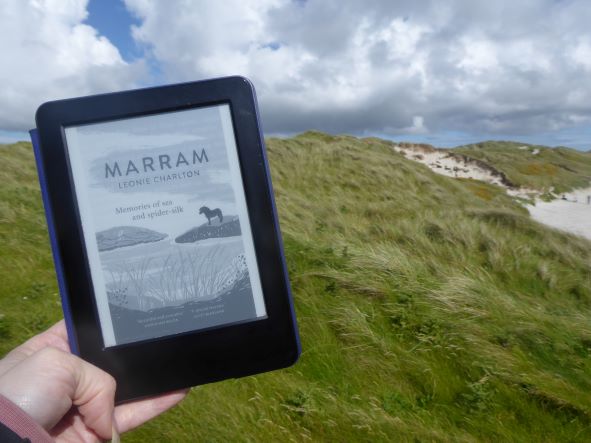
Marram grass on a Benbecula beach.
Although it was a low-key fundraising project for her daughter’s traditional music school, for Charlton there was another underlying reason. Her difficult mother, a jewellery maker, had died of brain cancer seven years before, and she had the idea of leaving beads from her mum’s collection (she’d actually nicknamed her daughter “Beady,” though for her eyes) along the route to lay her and their complicated relationship to rest. As one of her mother’s friends put it, “She was a nightmare, and wonderful, and totally impossible.”
I enjoyed the blend of topics – the amazing scenery, the rigours of the trail, the kindness of acquaintances and strangers who gave them places to camp and graze the ponies, and painful memories – and probably got more out of it because I was reading on location. Her regrets about her mother formed a larger part of the book than expected, but that wasn’t a problem for me; you might steer clear if this would be triggering, though. (Read via NetGalley)
Orchid Summer: In Search of the Wildest Flowers of the British Isles by Jon Dunn (2018)
Dunn saw all but one of Britain’s native species of orchid (51–55, depending on how you count; subspecies are still being debated) between the spring and autumn of 2016; only the ghost orchid eluded him. He alternates between his whistlestop travels, the backstory to his nature obsession, and the historical and cultural associations with orchids. “I was rapidly learning that orchids exert an influence unlike any other plant upon those who fall under their spell, he writes” (in that vein, I also recommend Susan Orlean’s The Orchid Thief).
I most enjoyed the chapters set in North Uist – where he goes to find the Hebridean marsh orchid – and his adopted home of Shetland; it’s always fun to read about somewhere I am or have been before (also including Lindisfarne). The number-driven quest seems like a peculiarly male undertaking, e.g. the similar The Butterfly Isles by Patrick Barkham, and orchids in particular are surrounded by secrecy – you have to be in the know to locate rarities, which often seem to be in roadside ditches. Dunn evades potential accusations of elitism or machismo, though, by recounting vulnerable moments: when he inadvertently strayed onto a golf course and got verbally abused; when some lads stopped their car to harass him.
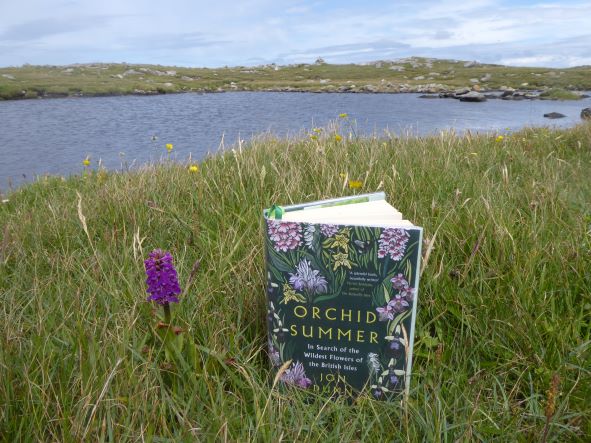
A marsh orchid at Balranald nature reserve, North Uist.
In general, this is denser with information than all but the keenest amateur botanists need, so I didn’t engage with it as much as his book about hummingbirds, The Glitter in the Green, but Dunn is a top-class nature and travel writer who really brings places and species to life on the page through his enthusiastic descriptions. Still, I wish this could have been illustrated with colour plates, as the author is an equally accomplished photographer. (Public library)
Bonsai by Alejandro Zambra (2006; 2022)
[Translated from the Spanish by Megan McDowell]
“In Emilia and Julio’s story … there are more omissions than lies, and fewer omissions than truths”
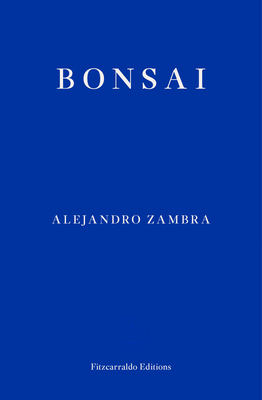 These college students’ bond is primarily physical, with an overlay of intellectual pretentiousness: they read to each other from the likes of Proust before they go to bed. Zambra, a Chilean poet and fiction writer, zooms in and out to spotlight each one’s other connections with friends and lovers and presage how the past will lead to separate futures. Already we see Julio thinking about how this time-limited relationship will be remembered in memory and in writing. The plot of a story Zambra references in this allusion-heavy work, “Tantalia” by Macedonio Fernández, provides the title: a couple buy a small plant to signify their love, but realize that maybe wasn’t a great idea given that plants can die.
Tending a bonsai is like writing, thinks Julio. Writing is like tending a bonsai, Julio thinks.
At scarcely 60 pages, with plenty of blank space between sections, this feels most like a short story. Bonsai symbolism aside, I didn’t find much to latch onto. Zambra is playing literary games here – “Let’s say her name is or was Emilia and that his name is, was, and will be Julio,” he writes in the first paragraph – and indulging an appetite for metafiction. Drawing attention to the arbitrary nature of creation made this feel generic and soulless, like the author wasn’t committed to or fond of his characters and their story. This wasn’t my cup of tea, but fans of Open Water and Normal People who also love spare writing in translation might enjoy it.
With thanks to Fitzcarraldo Editions for the free copy for review. Bonsai will be published on August 17th.
Review Book Catch-Up: Bamforth, McGrath, Mertz
Today I have a book of medico-philosophical musings, a triptych of novels about the resonant moments of a Canadian childhood, and a varied collection of ekphrastic poems.
Scattered Limbs: A Medical Dreambook by Iain Bamforth (2020)
 A doctor based in Strasbourg, Iain Bamforth offers a commonplace book full of philosophical musings on medicine and wellness from the ancient world to today. All through December I would read just a few pages at a time as a palate cleanser between larger chunks of other books. Most of the entries are under three pages in length, with some one-sentence dictums interspersed. The point of reference is broadly European, with frequent allusions to English, French, and German literature (Charles Dickens, Marcel Proust, and Thomas Mann) and to Greek thinkers like Aristotle and Plato. The themes include memory, overtreatment, technology, and our modern wellness culture. If you’re equally interested in medicine and philosophy, this is a perfect bedside book for you; if you only gravitate towards one or the other, it’s possible that you could run low on patience for the high-brow rumination. My favourite piece was on “panicology,” and two stand-out lines are below.
“Prognostication is where writers and doctors resemble each other most.”
“A proper attitude to death can be a source of life. That is medicine’s only profundity.”
With thanks to Galileo Publishers for the free copy for review.
The Santa Rosa Trilogy by Wendy McGrath (2011–19)
I’m indulging in one last listen to our holiday music compilations as I write, before putting everything away until a hoped-for ‘Christmas in July’ with family and friends. Yesterday I devoured Broke City, the third novella in Wendy McGrath’s Santa Rosa Trilogy, in one sitting and treasured all the Christmas and pine tree references: they bind the book together but also connect it satisfyingly back to Book 1, Santa Rosa, which opened with Christine’s neighbour preparing a Christmas cake one summer. That annual ritual and its built-in waiting period take on new significance when the adult Christine’s life changes suddenly.
In this trio of linked narratives about Christine’s 1960s Edmonton childhood, totem objects and smells evoke memories that persist for decades: Pine-Sol, her parents’ cigarettes, the local meat-packing plant. Even at age seven, Christine is making synaesthetic links between colours and scents as she ponders language and imagines other lives. That her recollections – of a carnival, the neighbourhood grocery store, queasy road trips to her grandmother’s in Saskatchewan, a drive-in movie, and Christmas Eve with her father’s side of the family – so overlap with my late-1980s mental flipbook proves not that suburban Maryland and upstate New York (where I grew up and my mother’s home turf, respectively) are so similar to Alberta, but that this is the universal stuff of a later 20th-century North American childhood.


The other night, discussing The Light Years by Elizabeth Jane Howard, my book club noted how difficult it is to capture childhood in all its joy and distress. McGrath does so superbly, exploiting the dramatic irony between what Christine overhears and what she understands. Readers know her parents’ marriage is in trouble because she never sees them laughing or happy, and she hears her mother complain to her father about his drinking. We know the family is struggling because a man from the City delivers a box of Spam, standard issue to all those who are out of work over the winter. A simple mishearing (“clatteral,” “brain tuber”; thinking that an abattoir sounds “like a fancy ballroom”) can be a perfect example of the child perspective, too. Meanwhile, the pop culture references situate the story in the time period.
Towards the end of Broke City, young Christine declares, “I shall be unusual.” As we root for the girl to outrun her sadder memories and forge a good life, we hope that – like all of us – she’ll find a balance between the ordinary and the exceptional through self-knowledge. While Broke City was my favourite and could probably stand alone, it’s special to chart how moments turn into memories across the three books. I’d recommend the trilogy to readers of Tove Ditlevsen, Tessa Hadley, and Elizabeth Hay. I particularly loved the hybrid-poetry style of the Prologue to Santa Rosa (similar to what Bernardine Evaristo employs), so I would also be interested to try one of McGrath’s two poetry collections.
Some favourite passages:
“he walks at the same time everyday summer and winter
early morning when the day still makes promises” (Santa Rosa)
“Christine thought of herself as a child, with no idea of the world but all the ideas in the world. … Christine is the girl that used to live here, but the girl has disappeared. Her ghost is here, existing parallel to the person she is now. How did this happen? There must have been something she wasn’t paying attention to, something she didn’t see coming.” (Broke City)
With thanks to Wendy McGrath and Edmonton’s NeWest Press for the e-copies for review. I learned about the books from Marcie; see her appreciation of McGrath’s work at Buried in Print.
Color and Line by Carole Mertz (2021)
 “Ekphrastic” was a new vocabulary word for me – or, if I’d heard it before, I needed a reminder. It refers to poetry written to describe or respond to artworks. Many of Carole Mertz’s poems, especially in the first section, attest to her love of the visual arts. This is the Ohio church organist’s first full-length collection after the 2019 chapbook Toward a Peeping Sunrise and extensive publication in literary magazines. She was inspired by art ranging in date from 1555 to 2019. “Come Share a Glass with Me,” for instance, is a prose poem that imagines the story behind a Van Gogh. I loved the line “The ewer sits expectant” in a short poem capturing The Staircase by Xavier Mellery.
One could look up all of the artworks discussed, but the descriptions here are so richly detailed that I often didn’t feel I needed to. Two paintings in a row depict sisters. A poem about Salome and the beheading of John the Baptist draws on the Bible story, but also on its many portrayals through art history. Other topics include concern for the Earth and beloved works of literature. I particularly enjoyed “The Word in Joseph’s Hand,” a Christmas hymn that can be sung to the tune of “Lo, How a Rose E’er Blooming,” and a haiku about a cardinal, “a flash of bright red / … in the garden”. Below is my favourite of the poems; it incorporates the titles of 14 books, nine of them by Anne Tyler. See if you can spot them all!
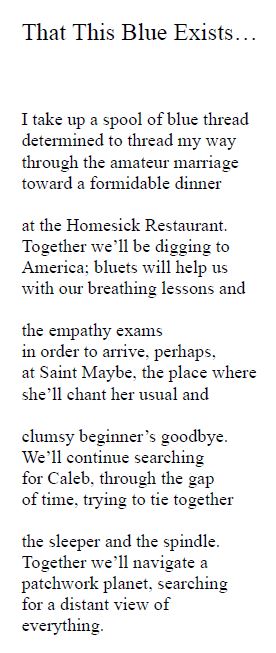
Color and Line was released by Kelsay Books on the 2nd. My thanks to Carole Mertz for the e-copy for review.
Would you be interested in reading one or more of these?
And, just for fun, put a description of or link to your favourite Bernie-in-mittens meme in the comments.
August Releases: Fiction Advocate, Kingsolver Poetry, Sarah Moss & More
My five new releases for August include two critical responses to contemporary classics; two poetry books, one a debut collection from Carcanet Press and the other by an author better known for fiction; and a circadian novel by one of my favorite authors.
I start with two of the latest releases from Fiction Advocate’s “Afterwords” series. The tagline is “Essential Readings of the New Canon,” and the idea is that “acclaimed writers investigate the contemporary classics.” (I reviewed the monographs on Blood Meridian, Fun Home, and The Year of Magical Thinking in this post.)
Dear Knausgaard: Karl Ove Knausgaard’s My Struggle by Kim Adrian
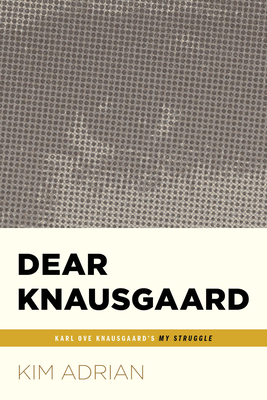 Karl Ove Knausgaard turned his pretty ordinary life into thousands of pages of autofiction that many readers have found addictive. Adrian valiantly grapples with his six-volume exploration of identity, examining the treatment of time and the dichotomies of intellect versus emotions, self versus other, and life versus fiction. She marvels at the ego that could sustain such a project, and at the seemingly rude decision to use all real names (whereas in her own family memoir she assigned aliases to most major figures). At many points she finds the character of “Karl Ove” insufferable, especially when he’s a teenager in Book 4, and the books’ prose dull. Knausgaard’s focus on male novelists and his stereotypical treatment of feminine qualities, here and in his other work, frequently madden her.
So why is My Struggle compelling nonetheless? It occupies her mind and her conversations for years. Is it something about the way that Knausgaard extracts meaning from seemingly inconsequential details? About how he stretches and compresses time in a Proustian manner to create a personal highlights reel? She frames her ambivalent musings as a series of letters written as if to Knausgaard himself (or “KOK,” as she affectionately dubs him) between February and September 2019. Cleverly, she mimics his style in both the critical enquiry and the glimpses into her own life, including all its minutiae – the weather, daily encounters, what she sees out the window and what she thinks about it all. It’s bold, playful and funny, and, all told, I enjoyed it more than Knausgaard’s own writing.
(I myself have only read Book 1, A Death in the Family, and wasn’t planning on continuing with My Struggle, but I think I will make an exception for Book 3 because of my recent fascination with childhood memoirs. I had better luck with Knausgaard’s Seasons Quartet, of which I’ve read all but Spring. I’ve reviewed Summer and Winter.)
My rating: 
My thanks to Fiction Advocate for the free e-copy for review.
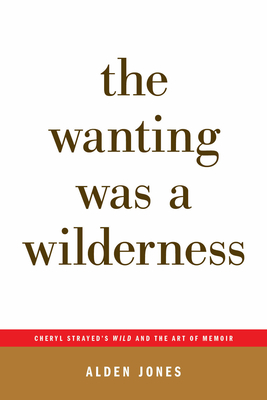
The Wanting Was a Wilderness: Cheryl Strayed’s Wild and the Art of Memoir by Alden Jones
Hiking is boring, yet Cheryl Strayed turned it into a beloved memoir. Jones explores how Wild works: how Strayed the author creates “Cheryl,” likeable despite her drug use and promiscuity; how the fixation on the boots and the backpack that carry her through her quest reflect the obsession over the loss of her mother; how the flashbacks break up the narrative and keep you guessing about whether she’ll reach her literal and emotional destinations.
 Jones also considers the precedents of wilderness literature and the 1990s memoir boom that paved the way for Wild. I most enjoyed this middle section, which, like Mary Karr’s The Art of Memoir, surveys some of the key publications from a burgeoning genre. Another key point of reference is Vivian Gornick, who draws a distinction between “the situation” (the particulars or context) and “the story” (the message) – sometimes the map or message comes first, and sometimes you only discover it as you go along.
I was a bit less interested in Jones’s reminiscences of her own three-month wilderness experience during college, when, with Outward Bound, she went to North Carolina and Mexico and hiked part of the Appalachian Trail and a volcano. This was the trip on which she faced up to her sexuality and had a short-lived relationship with a fellow camper, Melissa. But working out that she was bisexual and marrying a woman were both, as presented here, false endings. The real ending was her decision to leave her marriage – even though they had three children; even though the relationship was often fine. She attributes her courage to go, believing something better was possible, to Strayed’s work. And that’s the point of this series: rereading a contemporary classic until it becomes part of your own story.
My rating: 
My thanks to Fiction Advocate for the free e-copy for review.
Two poetry releases:
Growlery by Katherine Horrex
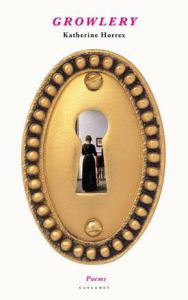 As in Red Gloves by Rebecca Watts, released by Carcanet in June, I noted the juxtaposition of natural and industrial scenes. Horrex’s “Four Muses” include a power plant and a steelworks, and she writes about pottery workers and the Manchester area, but she also explores Goat Fell on foot. Two of my favorite poems were nature-based: “Omen,” about corpse flowers, and “Wood Frog.” Alliteration, metaphors and smells are particularly effective in the former. Though I quailed at the sight of an entry called “Brexit,” it’s a subtle offering that depicts mistrust and closed minds – “People personable as tents zipped shut”. By contrast, “House of Other Tongues” revels in the variety of languages and foods in an international student dorm. A few poems circle around fertility and pregnancy. The linking themes aren’t very strong across the book, but there are a few gems.
My rating: 
My thanks to Carcanet Press for the free e-copy for review.
How to Fly (in Ten Thousand Easy Lessons) by Barbara Kingsolver
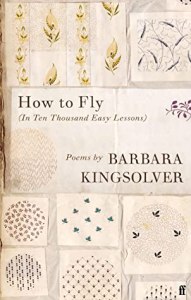 Kingsolver may not be well known for her poetry, but this is actually her second collection of verse after the bilingual Another America/Otra America (1992). The opening segment, “How to Fly,” is full of folk wisdom from nature and the body’s intuitive knowledge. “Pellegrinaggio” is a set of travel poems about accompanying her Italian mother-in-law back to her homeland. “This Is How They Come Back to Us” is composed of elegies for the family’s dead; four shorter remaining sections are inspired by knitting, literature, daily life, and concern for the environment. As with The Undying by Michel Faber, the book’s themes are stronger than its poetic techniques, but Kingsolver builds striking natural imagery and entrancing rhythms.
Two favorite passages to whet your appetite:
How to drink water when there is wine— / Once I knew all these brick-shaped things, / took them for the currency of survival. / Now I have lived long and I know better.
Tiptoe past the dogs of the apocalypse / asleep in the shade of your future. / Pay at the window. You’ll be surprised: you / can pass off hope like a bad check. You still / have time, that’s the thing. To make it good.
(To be reviewed in full, in conjunction with other recent/upcoming poetry releases, including Dearly by Margaret Atwood, for Shiny New Books.)
My rating:
I read an advanced e-copy via Edelweiss. (I’m unsure of the line breaks above because of the formatting.)
And finally, a much-anticipated release – bonus points for it having “Summer” in the title!
Summerwater by Sarah Moss
This is nearly as compact as Moss’s previous novella, Ghost Wall, yet contains a riot of voices. Set on one long day at a Scottish holiday park, it moves between the minds of 12 vacationers disappointed by the constant rain – “not that you come to Scotland expecting sun but this is a really a bit much, day after day of it, torrential” – and fed up with the loud music and partying that’s come from the Eastern Europeans’ chalet several nights this week. In the wake of Brexit, the casual xenophobia espoused by several characters is not surprising, but still sobering, and paves the way for a climactic finale that was not what I expected after some heavy foreshadowing involving a teenage girl going off to the pub through the woods.
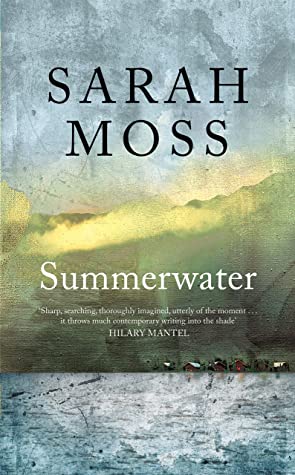 The day starts at 5 a.m. with Justine going for a run, despite a recent heart health scare, and spends time with retirees, an engaged couple spending most of their time in bed, a 16-year-old kayaker, a woman with dementia, and more. We see different aspects of family dynamics as we revisit a previous character’s child, spouse or sibling. I had to laugh at Milly picturing Don Draper during sex with Josh, and at Claire getting an hour to herself without the kids and having no idea what to do with it beyond clean up and make a cup of tea. Moss gets each stream-of-consciousness internal monologue just right, from a frantic mum to a sarcastic teen.
Yet I had to wonder what it all added up to; this feels like a creative writing student exercise, with the ending not worth waiting for. Cosmic/nature interludes are pretentious à la Reservoir 13. It’s not the first time this year that I’ve been disappointed by the latest from a favorite author (see also Hamnet). But my previous advice stands: If you haven’t read Sarah Moss, do so immediately.
My rating:
My thanks to Picador for the free copy for review.
 Bookish Beck = Rebecca Foster. American transplant to England. Freelance proofreader and book reviewer.
 Bookish Beck