Women in Translation Month 2019, Part II: Almada and Fenollera
All Spanish-language choices this time: an Argentinian novella, a Spanish novel, and a couple of Chilean short stories to whet your appetite for a November release.
The Wind that Lays Waste by Selva Almada (2012; English translation, 2019)
[Translated by Chris Andrews]
 Selva Almada’s debut novella is also her first work to appear in English. Though you might swear this is set in the American South, it actually takes place in her native Argentina. The circadian narrative pits two pairs of characters against each other. On one hand we have the Reverend Pearson and his daughter Leni, itinerants who are driven ever onward by the pastor’s calling. On the other we have “The Gringo” Brauer, a mechanic, and his assistant, José Emilio, nicknamed “Tapioca.”
On his way to visit Pastor Zack, Reverend Pearson’s car breaks down. While the Gringo sets to work fixing the vehicle, the preacher tries witnessing to Tapioca. He senses something special in the boy, perhaps even recognizing a younger version of himself, and wants him to have more of a chance in life than he’s currently getting at the garage. As a violent storm comes up, we’re left to wonder how Leni’s cynicism, the Reverend’s zealousness, the Gringo’s suspicion, and Tapioca’s resolve will all play out.
Different as they are, there are parallels to be drawn between these characters, particularly Leni and Tapioca, who were both abandoned by their mothers. I particularly liked the Reverend’s remembered sermons, printed in italics, and Leni’s sarcastic thoughts about her father’s vocation: “They always ended up doing what her father wanted, or, as he saw it, what God expected of them” and “she admired the Reverend deeply but disapproved of almost everything her father did. As if he were two different people.”
The setup and characters are straight out of Flannery O’Connor. The book doesn’t go as dark as I expected; I’m not sure I found the ending believable, even if it was something of a relief.
My rating: 
My thanks to Charco Press for the free copy for review. Last year I reviewed two Charco releases: Die, My Love and Fish Soup.
See also Susan’s review.
The Awakening of Miss Prim by Natalia Sanmartin Fenollera (2013; English translation, 2014)
[Translated by Sonia Soto]
 San Ireneo de Arnois is a generically European village that feels like it’s been frozen in about 1950: it’s the sort of place that people who are beaten down by busy city life retreat to so they can start creative second careers. Prudencia Prim comes here to interview for a job as a librarian, having read a rather cryptic job advertisement. Her new employer, The Man in the Wingchair (never known by any other name), has her catalogue his priceless collection of rare books, many of them theological treatises in Latin and Greek. She’s intrigued by this intellectual hermit who doesn’t value traditional schooling yet has the highest expectations for the nieces and nephews in his care.
In the village at large, she falls in with a group of women who have similarly ridiculous names like Hortensia and Herminia and call themselves feminists yet make their first task the finding of a husband for Prudencia. All of this is undertaken with the aid of endless cups of tea or hot chocolate and copious sweets. The village and its doings are, frankly, rather saccharine. No prizes for guessing who ends up being Prudencia’s chief romantic interest despite their ideological differences; you’ll guess it long before she admits it to herself at the two-thirds point.
As much as this tries to be an intellectual fable for bibliophiles (Prudencia insists that The Man in the Wingchair give Little Women to his niece to read, having first tried it himself despite his snobbery), it’s really just a thinly veiled Pride and Prejudice knock-off – and even goes strangely Christian-fiction in its last few pages. If you enjoyed The Readers of Broken Wheel Recommend and have a higher tolerance for romance and chick lit than I, you may well like this. It’s pleasantly written in an old-fashioned Pym-homage style, but ultimately it goes on my “twee” shelf and will probably return to a charity shop, from whence it came.
My rating: 
Humiliation by Paulina Flores (2016; English translation, 2019)
[Translated by Megan McDowell]
I’ve read the first two stories so far, “Humiliation” and “Teresa,” which feature young fathers and turn on a moment of surprise. An unemployed father takes his two daughters along to his audition; a college student goes home with a single father for a one-night stand. In both cases, what happens next is in no way what you’re expecting. These are sharp and readable, and I look forward to making my way through the rest over the next month or two.
My rating: 
Humiliation will be published by Oneworld on November 7th. My thanks to Margot Weale for a proof copy. I will publish a full review closer to the time.
Did you do any special reading for Women in Translation month this year?
Women in Translation Month 2019, Part I: Ernaux and Poschmann
Two rather different books to start off #WITMonth: a brief (c. 70 pp.) account of a mother’s decline with dementia; and a haiku-inspired novel of the quest for life and death in disorienting modern Japan. Both are admirable but detached – a judgment I seem more likely to make about work in translation – so don’t earn my wholehearted recommendation. My rating for both:
I Remain in Darkness by Annie Ernaux (1997; English translation, 1999)
[Translated from the French by Tanya Leslie]
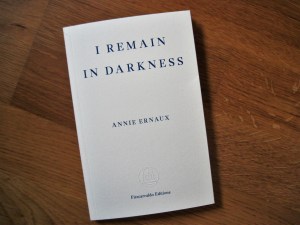 This is the second short, somewhat harrowing autobiographical work I’ve read by Ernaux this year (after Happening, her account of her abortion, in March). A collection of mostly present-tense fragments, it’s drawn from the journal she kept during her mother’s final years, 1983–6. “I Remain in Darkness” were the last words her mother wrote, in a letter to a friend (“Je ne suis pas sortie de ma nuit,” which more literally means “I have not left my night,” strikes me as cryptic and poetic, though maybe I’m missing a colloquialism). Slipping into Alzheimer’s, her mother spent these years in a long-term hospital geriatric ward. Ernaux could see her mother becoming like a child again:
This morning she got up and, in a timid voice, said: ‘I wet the bed. I couldn’t help it.’ The same words I would use when I was a child.
Now her room is on the third floor. A bunch of women circle us, addressing my mother with the familiar tu form: ‘You’re going to be in our group?’ They are like kids talking to the ‘new girl’ at school. When I take leave of her, she looks at me in panic and confusion: ‘You’re not leaving, are you?’
—and herself becoming like her mother: “It’s crystal-clear: she is me in old age and I can see the deterioration of her body threatening to take hold of me – the wrinkles on her legs, the creases in her neck”. Ernaux vacillates between guilt, fear and cruelty in how she approaches her mother. She tenderly shaves the older woman’s face every week when she visits, and buys her all manner of sweets. Food is one of her mother’s last remaining pleasures, though she often misses her mouth when she tries to eat the cakes her daughter brings.
Superficially, this is very similar to another book I’ve reviewed this year, Be With by Mike Barnes, a series of short letters written during his time as a caregiver to his mother, who also has Alzheimer’s. But where Barnes is reassuring and even humorous at times, Ernaux refuses to give any comfort, false or otherwise. This hospital is a bleak place that reeks of urine and is hiding excrement everywhere (really). A lazier reviewer than I generally try to be would brandish the word “unflinching.”
The entries from a few days after her mother’s death explain what the author is trying to do with her work, whether memoir or autofiction: “I am incapable of producing books that are not precisely that – an attempt to salvage part of our lives, to understand, but first to salvage … I’ll have to tell her story in order to ‘distance myself from it’.” That dual purpose, saving and distancing, makes her work honest yet unemotional, such that I have trouble warming to it.
This is easily read in a sitting. I may try again to get into Ernaux’s novel The Years, which, like the Poschmann (below), was on this past year’s Man Booker International Prize shortlist.
I Remain in Darkness will be released on September 18th. With thanks to Fitzcarraldo Editions for the free copy for review.
The Pine Islands by Marion Poschmann (2017; English translation, 2018)
[Translated from the German by Jen Calleja]
(Though I read this mostly in July, I finished it on August 1st, so I’m including it in my WIT Month coverage. It’s the first of the author’s books to be made available in English.)
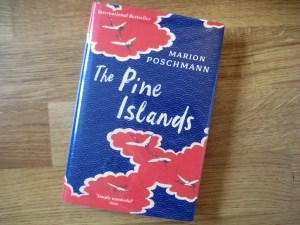 A man wakes up from a dream convinced that his wife is cheating on him, and sets off for Tokyo on a whim, where he embarks on a Bashō-inspired pilgrimage to the pine islands of Matsushima. This Gilbert Silvester, a beard historian, acquires an unlikely companion: a young man named Yosa, who’s looking for the best place to kill himself and takes Gilbert along to cliffs and forests famous for their suicide rates. Although there are still cherry blossoms and kabuki theatre, Gilbert soon learns that this isn’t Bashō’s Japan anymore.
From the haikus he composes and the letters he writes to Mathilda back home, we track his inward journey as it contrasts with the outward ones he undertakes. I enjoyed the surreal touches – Yosa says he once dated a woman who was actually a fox – and the Murakami setup (the wife’s adultery and the hair patterns are reminiscent of The Wind-Up Bird Chronicle).
Somehow, though, for me this is a book that succeeds more in its ideas (searching for the essence of a place but only finding the clichés; coniferous versus deciduous trees as a metaphor for what lasts in life versus what fades) than in its actual execution. It never all quite comes together, and the inconclusive ending makes you question how much of this has been a dream or a fantasy. It’s ambitious and intellectually impressive, but something about its dignified aloofness is hard to be enthusiastic about.
Do watch Lost in Translation, one of my favorite films, afterwards…
And a DNF: The Days of Abandonment by Elena Ferrante. The time has come to admit that I simply do not appreciate Ferrante’s work. I could only make it 25 pages into this one; I’ve read a different short novel of hers (The Lost Daughter), and skimmed another (My Brilliant Friend). While I enjoyed the narrator’s voice well enough, and loved the scene in which her errant husband finds broken glass in his dinner, I found that I had no interest in how this seemingly predictable story of the end of a marriage might play out.
Up next for Part II: The Wind that Lays Waste by Selva Almada, on its way from Charco Press, and The Awakening of Miss Prim by Natalia Sanmarin Fenollera.
Are you doing any special reading for Women in Translation month this year?
August’s Reading Plans: Too Many Projects!
My August is looking chock-full of reading projects – many of them self-imposed, to be fair.
20 Books of Summer: I’ve finished a few more books and just need to write them up; I’m in the middle of another nine, including Tisala as my doorstopper for the month.
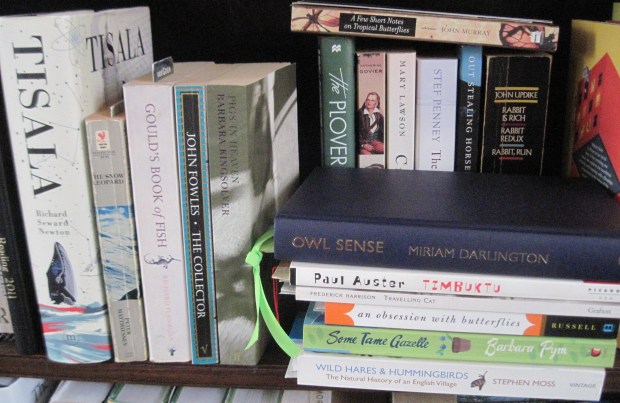
Summer theme: Books with summer/sun/shine in the title, and others set in summer, like The Go-Between by L.P. Hartley, my classic for the month.

Women in Translation month: I’ve started the Ferrante and also want to get to the Fenollera and start the Flores stories (all those Fs!), which are coming out from Oneworld in November. Also, in yesterday’s post I received a surprise copy of a forthcoming Fitzcarraldo Editions essay by Annie Ernaux about her mother’s dementia, so I will squeeze that in too.

Robertson Davies week: In the final week of August I’ll be joining in with Lory’s (The Emerald City Book Review) Robertson Davies readalong by starting Fifth Business, the first volume in The Deptford Trilogy.

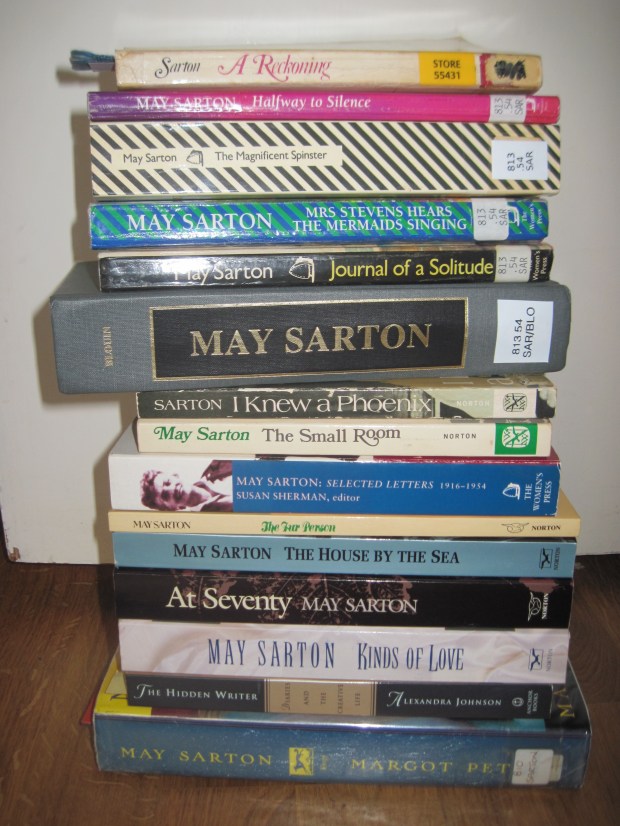
May Sarton article: I’m writing a profile for Bookmarks magazine this month, and am currently in the throes of research: finishing the Margot Peters biography I started last year and set aside for ages; reading another novel or two by Sarton; skimming back through various of the journals, novels and poems I’ve read before; and exploring other external sources. Luckily, my husband was able to forage for loads from his university library for me.
What’s keeping you busy this month?
Upcoming Reading Plans: Milan Trip and Summer Books
“Centre of fashion, business and finance,” “muggy and mosquito-ridden in summer” – from the guidebook descriptions it could hardly sound less like our kind of place, and yet Milan is where we’re off to tomorrow. While it wouldn’t be our first-choice destination, my husband is attending a landscape ecology conference there and presenting a paper; I’m going along for the week to have a holiday. It’s Italy. Why not?! I doubt the northern plain will be as much to our taste as Tuscany, which we explored on a wonderfully memorable trip in April 2014 (on which I first drank coffee), but there will still be history and culture around every corner, and we plan on eating very well and getting out of the city to see some of the Lakes region, too.
We’re traveling the slow way: a train to London; the Eurostar to Paris, where we’ll stay for one night; and a seven-hour train ride to Milan the following day. If the weather remains as hot as it has been in Continental Europe (e.g. 40°C / 105°F in Paris this week – ugh!), I’m not sure I’ll be up for a lot of solo sightseeing. I’ll put in a much-reduced work load for the week, but for much of the rest of the time when my husband is at the conference I may just lounge around our Airbnb, with a stack of print books, in front of the USB-powered fan I’ve ordered.
So of course I’ve been having great fun thinking about what reading material I might pack. I’ve assembled a main stack, and a subsidiary stack, of books that seem appropriate for one or more reasons.
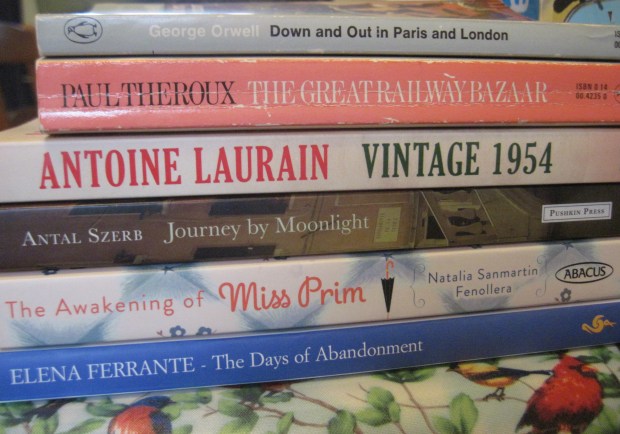
Down and Out in Paris and London, George Orwell – To read on the Eurostar between London and Paris. Orwell’s first book and my first try with his nonfiction: an account of the living conditions of the poor in two world cities.
Bonus goal it fulfills: Classic of the month
Vintage 1954, Antoine Laurain – For a Nudge review; to read en route to and in Paris. Drinking a 1954 Beaujolais transports a Parisian and his neighbors – including an Airbnb guest – back to the 1950s. Sounds like good fun.
Bonus goal it fulfills: Lit in translation
The Great Railway Bazaar, Paul Theroux – To read on the long train ride to Milan. Theroux travels from London to Tokyo on trains, then returns via the Trans-Siberian Express. I’ve always meant to try his work.
Bonus goal it fulfills: Travel classics
Journey by Moonlight, Antal Szerb – A Hungarian novel set on an Italian honeymoon. Try to resist these first lines: “On the train everything seemed fine. The trouble began in Venice, with the back-alleys.”
Bonus goals it fulfills: Lit in translation; 20 Books of Summer substitute (horse on the cover)
The Awakening of Miss Prim, Natalia Sanmarin Fenollera – Promises to be a cozy, fluffy novel about what happens when librarian Prudencia Prim arrives in a small village. I had the feeling it was set in Italy, but maybe it’s actually Spain? I’ll find out.
Bonus goal it fulfills: Lit in translation
The Days of Abandonment, Elena Ferrante – I’ve tried two Ferrante novels and not been too impressed, yet still I keep trying. This one’s set during a heat wave. Maybe I’ll get on with it better than I did with My Brilliant Friend or The Lost Daughter?
Bonus goal it fulfills: Lit in translation
The extra stack:
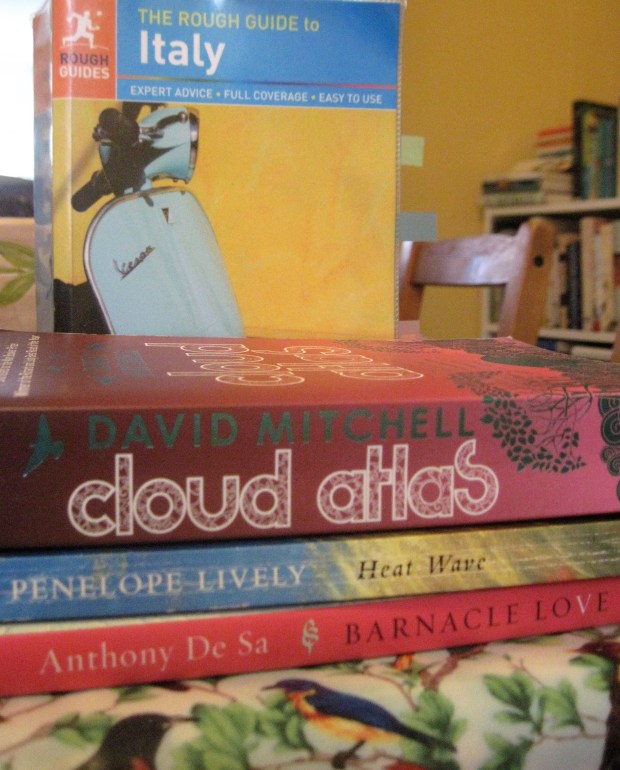
Heat Wave, Penelope Lively – The title says it all.
Bonus goal it fulfills: Reading with the seasons
Barnacle Love, Anthony De Sa – An extra animal book for 20 Books of Summer.
Cloud Atlas, David Mitchell – A novel I’ve meant to read for years. I’ve earmarked it for our super-long day of travel back to the UK.
Bonus goal it fulfills: Doorstopper of the Month
Considering getting from the library:
The Last Supper, Rachel Cusk – I’ve only made it through one of the three Cusk books I’ve attempted, but perhaps a travel memoir is a more surefire selection?
On my Kindle:
 The Fourth Shore, Virginia Baily – There’s an Italian flavor to this WWII novel, as there was to Baily’s previous one, Early One Morning. However, I’ve heard that this is mostly set in Tripoli, so I won’t make it a priority.
From Scratch, Tembi Locke – An actress’s memoir of falling in love with an Italian chef and her trips to his family home in Sicily with their adopted daughter. (Foodie and bereavement themes!)
I’ll read the first few pages of lots of these to make sure they ‘take’ and will try to pack a sensible number. (Which probably means all but one or two!) We’ll be packing light in general, since there’s only so many clothes one can wear in such heat, so I don’t mind carrying a backpack full of books – I’m used to it from weekly treks to the library and flights to America, and I know that I don’t find reading on Kindle as satisfying, though it certainly is convenient for when you’re on the go.
If you’d like to put in a good word for any of the above options, or want to dissuade me from a book I might not find worthwhile, let me know.
Meanwhile, I’ve been slow out of the gate with my 20 Books of Summer, but I finally have a first set of mini-reviews coming up tomorrow.
Other summer-themed books that I have on hand or will get from the library soon include One Summer: America, 1927 by Bill Bryson, The Go-Between by L.P. Hartley, The Sun Does Shine by Anthony Ray Hinton, The Summer Book by Tove Jansson, and Sunburn by Laura Lippman.
 Bookish Beck = Rebecca Foster. American transplant to England. Freelance proofreader and book reviewer.
 Bookish Beck