Five Nonfiction Review Books: Hammond, Iorio, Rault, Riley & Rutt
A diagnosis of motor neurone disease; a father’s dispiriting experience of censorship trials. An illustrated history of fonts; an essay on grief; a cold weather-appropriate record of geese-watching. I gear up for Nonfiction November by catching up on five nonfiction review books I’ve been sent over the last couple of months. You can’t say that I don’t read a variety, even within nonfiction! See if one or more of these tempts you.
A Short History of Falling: Everything I Observed about Love whilst Dying by Joe Hammond
 Hammond, a playwright, takes a wry, clear-eyed approach to his diagnosis of motor neurone disease (ALS) and the knowledge that his physical capacities will only deteriorate from here on out. “New items arrive almost daily and I am unexpectedly becoming the curator of the Museum of my own Decline.” Yet he also freezes funnier moments, like blowing his nose on a slice of bread because he couldn’t reach a tissue box, or spending “six hours of my fiftieth birthday sat on this hospice toilet, with a bottle of good Scotch wedged between my knees.”
Still, Hammond regrets that he’s become like a third small child for his wife Gill to look after, joining his sons Tom and Jimmy, and that he won’t see his boys grow up. (This book arose from an article he wrote for the Guardian in 2018 about making 33 birthday cards for his sons to open in the years after his death.) Although I wasn’t as interested in the details of Hammond’s earlier life, or his relationship with his narcissistic father, I appreciated his quiet acceptance of disability, help and impending death. 
Favorite lines:
“I’ve waited all my life to know this peace. To know that I am nothing more than this body.”
“my place in all of this is becoming smaller, historic and just the right size of important.”
With thanks to 4th Estate for the free copy for review.
An Author on Trial: The Story of a Forgotten Writer by Luciano Iorio
 The author’s father, Giuseppe Jorio, was a journalist and schoolteacher who wrote an infamous novel based on an affair he had in the 1930s. Using italicized passages from his father’s diary and letters to Tina, who was 19 when their affair started, Iorio reconstructs the sordid events and unexpected aftermath in fairly vivid detail. Tina fell pregnant and decided to abort the baby. Meanwhile, Giuseppe’s wife, Bruna, got the truth out of him and responded with more grace than might be expected. Giuseppe was devastated at the loss of his potential offspring, and realized he wanted to have a child with Bruna. He bid Tina farewell and the family moved to Rome, where the author was born in 1937.
Giuseppe’s novel inspired by the affair, Il Fuoco del Mondo (The Fire of the World) was rejected by all major publishers and accused of obscenity in a series of five trials that threatened his reputation and morale. It’s a less familiar echo of the Lady Chatterley’s Lover trial, and a poignant portrait of a man who felt he never lived up to his potential because of bad luck and societal disapproval. I enjoyed learning a bit about Italian literature. However, inconsistent use of tenses and shaky colloquial English (preposition issues, etc.) suggest that a co-writer or translator was needed to bring this self-published work up to scratch. 
With thanks to the publicist for the free copy to review as part of a blog tour.
ABC of Typography by David Rault
[Translated from the French by Edward Gauvin]
 From cuneiform to Gutenberg to Comic Sans, this history of typography is delightful. Graphic designer David Rault wrote the whole thing, but each chapter has a different illustrator, so the resulting book is like a taster course in comics styles. As such, I would highly recommend it to those who are fairly new to graphic novels and want to see whose work appeals to them, as well as to anyone who enjoyed Simon Garfield’s book about fonts, Just My Type.
I found it fascinating to explore the technical characteristics (serif vs. sans serif, etc.) and aesthetic associations of various fonts. For instance, I didn’t realize that my mainstay – Times New Roman – is now seen as a staid choice: “Highly readable, but overexposed in the early days of the Internet, it took on a reputation for drabness that it hasn’t shed since the ’90s.” Nowadays, some newspapers and brands pay typeface creators to make a font for their exclusive use. Can you name the typeface that is used on German road signs, or in Barack Obama’s campaign materials? (You’ll be able to after you read this.) 


With thanks to SelfMadeHero for the free copy for review.
Time Lived, Without Its Flow by Denise Riley
 What Virginia Woolf’s essay “On Being Ill” does for sickness, this does for bereavement. Specifically, Riley, whose son Jake died suddenly of a heart condition, examines how the experience of time changes during grief. “I’ll not be writing about death, but about an altered condition of life,” she opens. In short vignettes written from two weeks to three years after her son’s death, she reflects on how her thinking and feelings have morphed over time. She never rests with an easy answer when a mystery will do instead. “What if” questions and “as if” imaginings proliferate. Poetry – she has also written an exquisite book of poems, Say Something Back, responding to the loss of Jake – has a role to play in the acceptance of this new reality: “rhyme may do its minute work of holding time together.”
Max Porter provides a fulsome introduction to this expanded version of Riley’s essay, which first appeared in 2012. This small volume meant a lot more to him than it did to me; I preferred Riley’s poetic take on the same events. Still, this is sure to be a comfort for the bereaved.
Favorite passages:
“I’ll try to incorporate J’s best qualities of easy friendliness, warmth, and stoicism, and I shall carry him on in that way. Which is the only kind of resurrection of the dead that I know about.”
“I don’t experience him as in the least dead, but simply as ‘away’. Even if he’ll be away for my remaining lifetime. My best hope’s to have a hallucination of his presence when I’m dying myself.”
With thanks to Picador for the free copy for review.
Wintering: A Season with Geese by Stephen Rutt
 Rutt’s The Seafarers: A Journey among Birds, one of my favorite recent nature/travel books, came out in May. What have we done to deserve another publication from this talented young author just four months later?! I didn’t enjoy this as much as The Seafarers, yet it does a lot of the same things well: it provides stunning word portraits of individual bird species, explores the interaction between nature and one’s mental state, and gathers evidence of the cultural importance of birds through legends and classical writings.
Here the focus is on geese, which the author had mostly overlooked until the year he moved to southern Scotland. Suddenly they were impossible to ignore, and as he became accustomed to his new home these geese sightings were a way of marking the seasons’ turn. Ethical issues like hunting, foie gras and down production come into play, and, perhaps ironically, the author eats goose for Christmas dinner!
Rutt’s points of reference include Paul Gallico (beware plot spoilers!), Aldo Leopold, Mary Oliver and Peter Scott. The writing in this short book reminded me most of Horatio Clare (especially The Light in the Dark) and Jim Crumley (who’s written many short seasonal and single-species nature books) this time around.
A favorite passage (I sympathize with the feelings of nomadism and dislocation):
“I envy the geese their certainty, their habits of home. I am forever torn between multiple places that feel like home. Scotland where I live or Suffolk, Essex, Norfolk: the flatlands of golden evenings and reeds, mud and water and sand. The distant horizon and all the space in between I grew up with, which seems to lurk somewhere, subconsciously calling me back.”
[Neat aside: My husband and I both got quotes (about The Seafarers) on the press release for this book!]

With thanks to Elliott & Thompson for the free copy.
Would you be interested in reading one or more of these?
Doorstopper of the Month: The Stillness The Dancing (1985) by Wendy Perriam
When she read my review of As a God Might Be by Neil Griffiths, Liz Dexter suggested Wendy Perriam’s books as readalikes and very kindly sent me one to try: The Stillness The Dancing – a title whose lack of punctuation confused me until I discovered that it’s taken from a line of T. S. Eliot’s “East Coker”: “So the darkness shall be the light, and the stillness the dancing.” It took me nearly a year and a half to get around to it, but I’ve finally read my first Perriam (fairly autobiographical, it seems) and found it very striking and worthwhile.
 The comparison with the Griffiths turned out to be apt: both are hefty, religion-saturated novels dwelling on themes of purpose, mysticism, asceticism, and the connection between the mind and body, especially when it comes to sex. Perriam’s protagonist is Morna Gordon, a 41-year-old translator. The end of her marriage was nearly as disorienting for her as the loss of her Catholic faith. Occasional chapters spotlight the perspective of the other women in this family line: Morna’s mother, Bea, who’s been a widow for as long as Morna has been alive and finally finds a vocation at an age when most people are retiring; and Morna’s daughter Chris, who’s tasting freedom before starting uni and settling down with her diver boyfriend, Martin.
When Morna accompanies Bea on a week-long religious retreat in the countryside, she meets David Anthony, a younger man she initially assumes is a priest. Here to deliver a lecture on miracles, he’s a shy scholar researching a seventh-century Celtic saint, Abban, who led an austere life on a remote Scottish island. Morna is instantly captivated by David’s intellectual passion, and in lieu of flirting offers to help him with his medieval translations. Still bruised by her divorce, she longs to make a move yet doesn’t want to scare David off. After 14 years of Neil telling her she was frigid, she’s startled to find herself in the role of sexual temptress.
Staid suburban England is contrasted with two very different locales: Saint Abban’s island and the outskirts of Los Angeles, where Morna and Chris travel for a few weeks in January so Chris can spend time with her father and meet his new family: (younger) wife Bunny and Chris’s four-year-old half-brother, Dean. California is “another world completely,” a fever dream of consumerism and excess, and Morna does things that are completely outside her comfort zone, like spending hours submerged in a sensory deprivation tank and breaking down in tears in the middle of Bunny’s women’s consciousness-raising circle.
The differences between England and California are exaggerated for comic effect in a way that reminded me of David Lodge’s Changing Places – but if for Chris it’s all about hedonistic self-expression, for Morna America is more of an existential threat, and she rushes back to be with David. There are several such pivotal moments when Morna flees one existence for another, often accompanied by a time of brain fog: alcohol, sleeping pills or grief disrupt her normal thought processes, as reflected in choppy, repetitive sentences.
I bristled slightly at the melodramatic nature of the final 60 pages, unsure to what extent the ending should be seen as altering the book’s overall message: Morna is denied a full transformation, but it seems she’s still on the spiritual path towards detachment from material things. Though still a lapsed Catholic, she finds some fresh meaning in the Church’s history and rituals. As her mother and daughter both embark on their new lives, her ongoing task is to figure out who she is apart from the connections that have defined her for so many years.
My favorite parts of the novel, not surprisingly, were Morna’s internal monologue – and her conversations with David – about faith and doubt. Perhaps I wasn’t wholeheartedly convinced that all the separately enjoyable components fit together, or that all the strands were fully followed through, but it’s an exuberant as well as a meditative work and I will certainly seek out more from Perriam.
Some favorite lines:
(Morna thinks) “If one had been exhorted all one’s girlhood to live for God alone, then how could one have purpose if He vanished?”
David: “I know our society shies away from any type of self-denial, regards it as neurotic or obsessional, but I disagree with that. Anything worth having is worth suffering for.”
Morna: “Are you still a Catholic? I know you said you believed in God, but that’s not the same, is it?” / David: “I’m still redefining all my terms. That can take a lifetime.”
Author note: Wendy Perriam’s name was completely new to me, though this was her 11th novel. Now in her 70s, she is still publishing fiction, with a crime novel released in 2017.
Page count: 536
My rating:
20 Books of Summer, #1–4: Alexis, Haupt, Rutt, Tovey
I was slow to launch into my 20 Books of Summer reading, but have now finally managed to get through my first four books. These include two substitutes: a review copy I hadn’t realized fit in perfectly with my all-animals challenge, and a book I’d started earlier in the year but set aside and wanted to get back into. Three of the four were extremely rewarding; the last was somewhat insubstantial, though I always enjoy reading about cat antics. All have been illuminating about animal intelligence and behavior, and useful for thinking about our place in and duty towards the more-than-human world. Not all of my 20 Books of Summer will have such an explicit focus on nature – some just happen to have an animal in the title or pictured on the cover – but this first batch had a strong linking theme so was a great start.
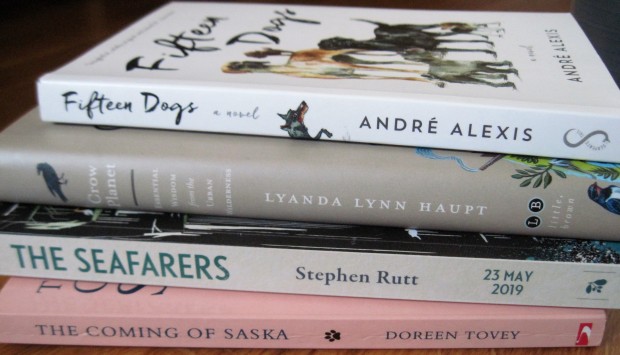
Fifteen Dogs by André Alexis (2015)
In this modern folk tale with elements of the Book of Job, the gods Apollo and Hermes, drinking in a Toronto tavern, discuss the nature of human intelligence and ponder whether it’s inevitably bound up with suffering. They decide to try an experiment, and make a wager on it. They’ll bestow human intelligence on a set of animals and find out whether the creatures die unhappy. Apollo is willing to bet two years’ personal servitude that they will be even unhappier than humans. Their experimental subjects are the 15 dogs being boarded overnight at a nearby veterinary clinic.
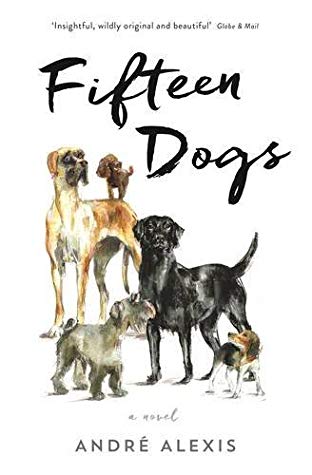 The setup means we’re in for an And Then There Were None type of picking-off of the 15, and some of the deaths are distressing. But strangely – and this is what the gods couldn’t foresee – knowledge of their approaching mortality gives the dogs added dignity. It gives their lives and deaths the weight of Shakespearean tragedy. Although they still do doggy things like establishing dominance structures and eating poop, they also know the joys of language and love. A mutt called Prince composes poetry and jokes. Benjy the beagle learns English well enough to recite the first paragraph of Vanity Fair. A poodle named Majnoun forms a connection with his owner that lasts beyond the grave. The dogs work out who they can trust; they form and dissolve bonds; they have memories and a hope that lives on.
It’s a fascinating and inventive novella, and a fond treatment of the relationship between dogs and humans. When I read in the Author’s Note that the poems all included dogs’ names, I went right back to the beginning to scout them out. I’m intrigued by the fact that this Giller Prize winner is a middle book in a series, and keen to explore the rest of the Trinidanian-Canadian author’s oeuvre.
These next two have a lot in common. For both authors, paying close attention to the natural world – birds, in particular – is a way of coping with environmental and mental health crises.
Crow Planet: Essential Wisdom from the Urban Wilderness by Lyanda Lynn Haupt (2009)
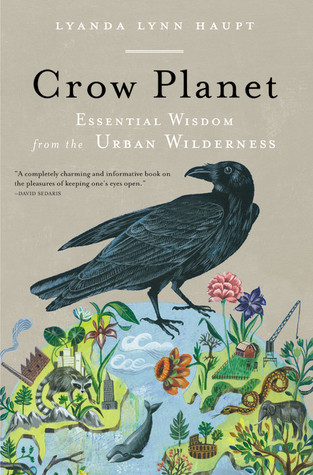 Lyanda Lynn Haupt has worked in bird research and rehabilitation for the Audubon Society and other nature organizations. (I read her first book, Rare Encounters with Ordinary Birds, quite a few years ago.) During a bout of depression, she decided to start paying more attention to the natural world right outside her suburban Seattle window. Crows were a natural place to start. From then on she took binoculars everywhere she went, even on walks to Target. She spent time watching crows’ behavior from a distance or examining them up close – devoting hours to studying a prepared crow skin. She even temporarily took in a broken-legged fledgling she named Charlotte and kept a close eye on the injured bird’s progress in the months after she released it.
Were this simply a charming and keenly observed record of bird behavior and one woman’s gradual reawakening to the joys of nature, I would still have loved it. Haupt is a forthright and gently witty writer. But what takes it well beyond your average nature memoir is the bold statement of human responsibility to the environment. I’ve sat through whole conference sessions that try to define what nature is, what the purpose of nature writing is, and so on. Haupt can do it in just a sentence, concisely and effortlessly explaining how to be a naturalist in a time of loss and how to hope even when in possession of all the facts. 
A few favorite passages:
“an intimate awareness of the continuity between our lives and the rest of life is the only thing that will truly conserve the earth … When we allow ourselves to think of nature as something out there, we become prey to complacency. If nature is somewhere else, then what we do here doesn’t really matter.”
“I believe strongly that the modern naturalist’s calling includes an element of activism. Naturalists are witnesses to the wild, and necessary bridges between ecological and political ways of knowing. … We join the ‘cloud of witnesses’ who refuse to let the more-than-human world pass unnoticed.”
“here we are, intricate human animals capable of feeling despair over the state of the earth and, simultaneously, joy in its unfolding wildness, no matter how hampered. What are we to do with such a confounding vision? The choices appear to be few. We can deny it, ignore it, go insane with its weight, structure it into a stony ethos with which we beat our friends and ourselves to death—or we can live well in its light.”
The Seafarers: A Journey among Birds by Stephen Rutt (2019)
 In 2016 Rutt left his anxiety-inducing life in London in a search for space and silence. He found plenty of both on the Orkney Islands, where he volunteered at the North Ronaldsay bird observatory for seven months. In the few years that followed, the young naturalist travelled the length and breadth of the British Isles – from Skomer to Shetland – courting encounters with seabirds. He’s surrounded by storm petrels one magical night at Mousa Broch; he runs from menacing skuas; he watches eider and terns and kittiwakes along the northeast coast; he returns to Orkney to marvel at gannets and fulmars. Whether it’s their beauty, majesty, resilience, or associations with freedom, such species are for him a particularly life-enhancing segment of nature to spend time around.
Discussion of the environmental threats that hit seabirds hardest, such as plastic pollution, makes for a timely tie-in to wider conservation issues. Rutt also sees himself as part of a long line of bird-loving travellers, including James Fisher and especially R.M. Lockley, whose stories he weaves in. This is one of the best nature/travel books I’ve read in a long time, especially enjoyable because I’ve been to a lot of the island locations and the elegantly evocative writing, making particularly effective use of varied sentence lengths, brought back to me just what it’s like to be in the far north of Scotland in the midst of an endless summer twilight, a humbled observer as a whole whirlwind of bird life carries on above you. 
A favorite passage:
“Gannets nest on the honeycombs of the cliff, in their thousands. They sit in pairs, pointing to the sky, swaying heads. They stir. The scent of the boat’s herring fills the air. They take off, tessellating in a sky that is suddenly as much bird as light. The great skuas lurk.”
My husband also reviewed this, from a birder’s perspective.
With thanks to Elliott & Thompson for the proof copy for review.
The Coming of Saska by Doreen Tovey (1977)
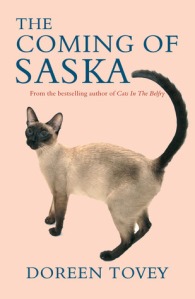 I’ve read four of Tovey’s quaint Siamese cat books now; this was the least worthwhile. It’s partially a matter of false advertising: Saska only turns up for the last 15 pages, as a replacement of sorts for Seeley, who disappeared one morning a year earlier and was never seen again. Over half of the book, in fact, is about a trip Tovey and her husband Charles took to Edmonton, Canada. The Canadian government sponsored them to come over for the Klondike Days festivities, and they also rented a camper and went looking for bears and moose. Mildly amusing mishaps, close shaves, etc. ensue. They then come back and settle into everyday life with their pair of Siamese half-siblings; Saska had the same father as Shebalu. Entertaining enough, but slight, and with far too many ellipses.
Hard Pushed: A Midwife’s Story by Leah Hazard
“For fans of Adam Kay’s This Is Going to Hurt and Christie Watson’s The Language of Kindness,” the blurb on my press release for Leah Hazard’s memoir opens. The publisher’s comparisons couldn’t be more perfect: Hard Pushed has the gynecological detail and edgy sense of humor of Kay’s book (“Another night, another vagina” is its first line, and the author has been known to introduce herself with “Midwife Hazard, at your cervix!”), and matches Watson’s with its empathetic picture of patients’ plights and medical professionals’ burnout.
Hazard alternates between anonymized case studies of patients she has treated and general thoughts on her chosen career (e.g. “Notes on Triage” and “Notes on Being from Somewhere Else”). Although all of the patients in her book are fictional composites, their circumstances are rendered so vividly that you quickly forget these particular characters never existed. Visceral details of sights, smells and feelings put you right there in the delivery room with Eleanor, one-half of a lesbian couple welcoming a child thanks to the now-everyday wonder of IVF; Hawa, a Somali woman whose pregnancy is complicated by the genital mutilation she underwent as a child; and Pei Hsuan, a Chinese teenager who was trafficked into sex work in Britain.
Sometimes we don’t learn the endings to these stories. Will 15-year-old Crystal have a healthy baby after she starts leaking fluid at 23 weeks? What will happen next for Pei Hsuan after her case is passed on to refugee services? Hazard deliberately leaves things uncertain to reflect the partial knowledge a hospital midwife often has of her patients: they’re taken off to surgery or discharged, and when they eventually come back to deliver someone else may be on duty. All she can do is to help each woman the best she can in the moment.
 A number of these cases allow the author to comment on the range of modern opinions about pregnancy and childrearing, including some controversies. A pushy new grandmother tries to pressure her daughter into breastfeeding; a woman struggles with her mental health while on maternity leave; a rape victim is too far along to have a termination. At the other end of the spectrum, we meet a hippie couple in a birthing pool who prefer to speak of “surges” rather than contractions. Hazard rightly contends that it’s not her place to cast judgment on any of her patients’ decisions; her job is simply to deal with the situation at hand.
I especially liked reading about the habits that keep the author going through long overnight shifts, such as breaking the time up into 15-minute increments, each with its own assigned task. The excerpts from her official notes – in italics and full of shorthand and jargon – are a neat window into the science and reality of a midwife’s work, with a glossary at the end of the book ensuring that nothing is too technical for laypeople.
Hazard, an American, lives in Scotland and has a Glaswegian husband and two daughters. Her experience of being an NHS midwife has not always been ideal; there were even moments when she was ready to quit. Like Kay and Watson, she has found that the medical field can be unforgiving what with low pay, little recognition and hardly any time to wolf down your dinner during a break, let alone reflect on the life-and-death situations you’ve been a part of. Yet its rewards outweigh the downsides.
Hard Pushed has none of the sentimentality of Call the Midwife – a relief since I’m not one to gush over babies. Still, it’s a heartfelt read as well as a vivid and pacey one, and it’s alternately funny and sobering. If you like books that follow doctors and nurses down hospital hallways, you’ll love it. This was one of my most anticipated books of the first half of the year, and it lived up to my expectations. It’s also one of my top contenders for the 2020 Wellcome Book Prize so far.
A few favorite passages:
“So many things in midwifery are ‘wee’ [in Scotland, at least!] – a wee cut, a wee tear, a wee bleed, the latter used to describe anything from a trickle to a torrent. Euphemisms are one of our many small mercies: we learn early on to downplay and dissemble. The brutality of birth is often self-evident; there is little need to elaborate.”
“Whenever I dress a wound in this way, I remember that this is an act of loving validation; every wound tells a story, and every dressing is an acknowledgement of that story – the midwife’s way of saying, I hear you, and I believe you.”
“midwives do so much more than catch babies. We devise and implement plans of care; we connect, console, empathise and cheerlead; we prescribe; we do minor surgery. … We may never have met you until the day we ride into battle for you and your baby; … you may not even recognise the cavalry that’s been at your back until the drapes are down and the blood has dried beneath your feet.”
My rating:
Hard Pushed was published in the UK on May 2nd (just a few days before International Midwives’ Day) by Hutchinson. My thanks to the publisher for the free proof copy for review.
Following Up on the Prescriptions from My Bibliotherapy Appointment
In January 2018 I had the wonderful opportunity to have a free bibliotherapy session at the School of Life in London with Ella Berthoud, one of the authors of The Novel Cure. I wrote about the experience in this post. I quickly got hold of all but a couple of my prescribed reads, but have been slower about actually reading them. Though I’ve read five now, I’ve only written up four, two of which I only managed to finish this week. (These 250-word reviews are in order of my reading.)
Heligoland by Shena Mackay (2002)
(CURE: moving house)
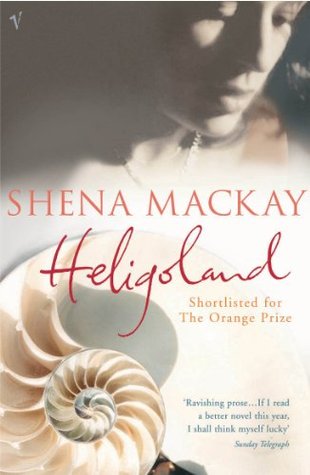 Heligoland is a Scottish island best known from the shipping forecast, but here it’s an almost mythical home. Rowena Snow was orphaned by her Indian/Scottish parents, and a second time by her aunt. Since then she’s drifted between caring and cleaning jobs. The Nautilus represents a fresh chance at life. This shell-shaped artists’ commune in South London houses just three survivors: Celeste Zylberstein, who designed the place; poet Francis Campion; and antiques dealer Gus Crabb. Rowena will be the housekeeper/cook, but she struggles with self-esteem: does she deserve to live in a haven for upper-class creative types?
The omniscient perspective moves between the Nautilus residents but also on to lots of other minor hangers-on, whose stories are hard to keep track of. Mackay’s writing reminded me somewhat of Tessa Hadley’s and is lovely in places – especially when describing a buffet or a moment of light-filled epiphany in a garden. There’s not much to be said beyond what’s in the blurb: Mackay is attempting to give a picture of a drifter who finds an unconventional home; in the barest sense she does succeed, but I never felt a connection with any of the characters. In this ensemble cast there is no one to love and thus no one to root for. While I didn’t love this book, it did inspire me to pick up others by Mackay: since then I’ve read The Orchard on Fire, which I liked a lot more, and the first half of Dunedin.
My rating:
Family Matters by Rohinton Mistry (2002)
(CURE: worry over ageing parents)
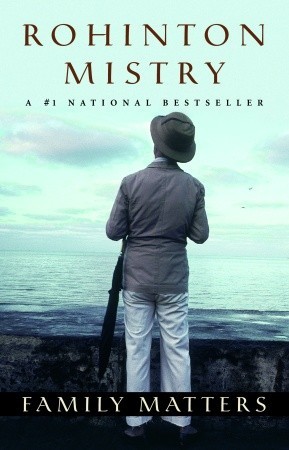 Retired professor Nariman Vakeel, 79, has Parkinson’s disease and within the first few chapters has also fallen and broken his ankle. His grown stepchildren, Coomy and Jal, reluctant to care for him anyway, decide they can’t cope with the daily reality of bedpans, sponge baths and spoon feeding in their large Chateau Felicity apartment. He’ll simply have to recuperate at Pleasant Villa with his daughter Roxana and her husband and sons, even though their two-bedroom apartment is barely large enough for the family of four. You have to wince at the irony of the names for these two Bombay housing blocks, and at the bitter contrast between selfishness and duty.
Perhaps inevitably, Nariman starts to fade into the background. An increasingly speechless invalid, he only comes alive through his past: italicized sections, presented as his night-time ravings, tell of his love for Lucy, whom his parents refused to let him marry, and the untimely end of his arranged marriage. I enjoyed time spent in a vibrantly realized Indian city and appreciated a chance to learn about a lesser-known community: Nariman and family are Parsis (or Zoroastrians). There’s also a faint echo here of King Lear, with one faithful daughter set against two wicked children.
As to ageing parents, this is a pretty relentlessly bleak picture, but there are sparks of light: joy in life’s little celebrations, and unexpected kindnesses. Mistry’s epic has plenty of tender moments that bring it down to an intimate scale. I’m keen to read his other novels.
My rating:
Maggie & Me by Damian Barr (2013)
(A supplementary prescription because I love memoirs and didn’t experience Thatcher’s Britain.)
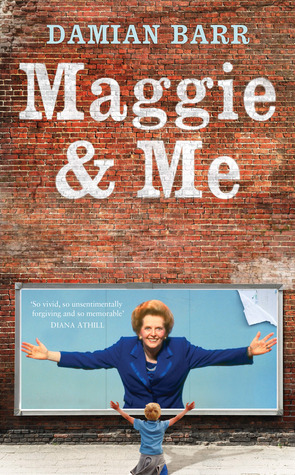 Like a cross between Angela’s Ashes and Toast, this recreates a fairly horrific upbringing from the child’s perspective. Barr was an intelligent, creative young man who early on knew that he was gay and, not just for that reason, often felt that there was no place for him: neither in working-class Scotland, where his father was a steelworker and his brain-damaged mother flitted from one violent boyfriend to another; nor in Maggie Thatcher’s 1980s Britain at large, in which money was the reward for achievement and the individual was responsible for his own moral standing and worldly advancement. “I don’t need to stand out any more,” he recalls, being “six foot tall, scarecrow skinny and speccy with join-the-dots spots, bottle-opener buck teeth and a thing for waistcoats. Plus I get free school dinners and I’m gay.”
There are a lot of vivid scenes in this memoir, some of them distressing ones of abuse, and the present tense, dialect, and childish grammar and slang give it authenticity. However, I never quite bought in to the Thatcher connection as an overarching structure. Three pages at the start, five at the end, and a Thatcher quote as an epigraph for each chapter somehow weren’t enough to convince me that the framing device was necessary or apt. Still, I enjoyed this well enough as memoirs go, and I would certainly recommend it if you loved Nigel Slater’s memoir mentioned above. I also have Barr’s recent debut novel, You Will Be Safe Here, on my Kindle.
My rating:
The Monsters of Templeton by Lauren Groff (2008)
(A supplementary prescription for uncertainty about having children.)
 I enjoyed this immensely, from the first line on: “The day I returned to Templeton steeped in disgrace, the fifty-foot corpse of a monster surfaced in Lake Glimmerglass.” Twenty-eight-year-old Willie Upton is back in her hometown, pregnant by her older, married archaeology professor after a summer of PhD fieldwork in Alaska. “I had come home to be a child again. I was sick, heartbroken, worn down.” She gives herself a few weeks back home to dig through her family history to find her father – whom Vi has never identified – and decide whether she’s ready to be a mother herself.
We hear from various leading lights in the town’s history and/or Willie’s family tree through a convincing series of first-person narratives, letters and other documents. Groff gives voice to everyone from a Mohican chief to a slave girl who catches her master’s eye. Willie and Vi are backed up by a wonderful set of secondary characters, past and present. Groff wrote this in homage to Cooperstown, New York, where she grew up. (If you’ve heard of it, it’s probably for the baseball museum; it’s not far from where my mother is from in upstate New York.) Templeton is “a slantwise version” of Cooperstown, Groff admits in an opening Author’s Note, and she owes something of a debt to its most famous citizen, James Fenimore Cooper. What a charming way to celebrate where you come from, with all its magic and mundanity. This terrific debut novel cemented my love of Groff’s work.
My rating:
I also have Ella to thank for the inspiration to reread a childhood favorite, Little Women by Louisa May Alcott, last year; the experiment formed the subject of my first piece for Literary Hub. I also worked my way through The Artist’s Way by Julia Cameron, another of my prescriptions, over a number of months in 2018, but failed to keep up with the regular writing exercises so didn’t get the maximum benefit.
My husband and I made a start on reading a few books aloud to each other, including Sum: Forty Tales from the Afterlives by David Eagleman, but that fell by the wayside after a handful of weeks.
(Incidentally, I had forgotten that Cutting for Stone turns up in The Novel Cure on a list of the 10 best books to combat xenophobia.)
 Still to read: Jitterbug Perfume by Tom Robbins (CURE: horror of ageing)
And one I still have to get hold of but haven’t been able to find cheap secondhand because it’s a Persephone classic: The Victorian Chaise-Longue by Marghanita Laski (a supplementary prescription because I love Victorian pastiches).
This Really Isn’t About You by Jean Hannah Edelstein
This was the book I wanted Places I Stopped on the Way Home to be: a wry, bittersweet look at the unpredictability of life as an idealistic young woman in the world’s major cities. Edelstein’s memoir also fits into several of my favorite subgenres: it’s a family memoir, a medical memoir and a bereavement memoir all at once. The story opens in Brooklyn in February 2014 as Edelstein, age 32, is trying to build an adult life back in America after 14 years in London and Berlin. Two years earlier her father had told her via Skype from Baltimore that he had lung cancer, and she returned to the States to be closer to help. But when the moment came, she was still unprepared: “if someone had said to me: What would you like to be doing when your father dies? I would not have said, I would like to be looking for love on OKCupid. But I did not have the luxury to make that decision. Who does?”
 Her father never smoked yet died of lung cancer; his mother had colon cancer and died at 42. Both had Lynch syndrome, a genetic disease that predisposes people to various cancers. Six months after her father’s death, Edelstein took a genetic test, as he had wanted her to, and learned that she was positive for the Lynch syndrome mutation. The book’s structure (“Between” – “Before” – “After”) plunges readers right into the middle of the family mess, then pulls back to survey her earlier life, everything from childhood holidays in her mother’s native Scotland to being a secretary to a London literary agent who hated her, before returning to the turning point of that diagnosis. How is she going to live with this knowledge hanging over her? Doctors want her to have a prophylactic hysterectomy, but how can she rule out children when she doesn’t yet have a partner in her life?
So many aspects of this book resonated for me, especially moving between countries and having a genetic disease in the family. Beyond those major themes, there were tiny moments that felt uncannily familiar to me, like when she’s helping her mother prepare for an online auction of the contents of the family home in Maryland, or comparing the average cleanliness and comfort of rental properties in England and the States. There are so many little memorable scenes in this memoir: having an allergic reaction to shellfish two days after her arrival in the States, getting locked out of her sublet and having to call an Uzbek/Israeli locksmith at 3 a.m., and subsisting on oatmeal three times a day in London versus going on all-expenses-paid trips to Estonia and Mauritius for a conference travel magazine.
This is a clear-eyed look at life in all its irony (such as the fact that she’s claustrophobic and dreads getting MRI tests when it was her own father, a nuclear physicist, who built the world’s first full-body MRI scanner at Aberdeen) and disappointment. I’m prizing this as a prime example of life writing that’s not comprehensive or strictly chronological yet gives a clear sense of the self in the context of a family and in the face of an uncertain future.
My rating: 
Readalikes:
The Family Gene by Joselin Linder
My Salinger Year by Joanna Rakoff
Mrs Gaskell & Me by Nell Stevens
Favorite lines:
“when I was in London, … I wondered if the problem of having my whole life ahead of me, free and clear and open for anything, was that having an unlimited number of options made the chance of choosing the wrong thing so high.”
“I was not yet old enough to realize that I’d never really know, that there would never be a time when I could think: I am here. This is me, without becoming uncertain again a moment later.”
“When I lived in England I drank a lot of tea, many cups a day, even though I didn’t like it. I learned quite fast after I arrived in London that drinking tea was an important way to connect with people: when I went over to their homes, or if we worked together in an office. Being offered a cup of tea meant that you were being offered an entry to something, and accepting it was important.”
This Really Isn’t About You was published by Picador on August 23rd. My thanks to the publisher for the free copy for review.
The Shortest of the Short: Four Novellas of under 50 Pages

Outside Stamford Library.
It’s a tradition now in its third and last year: I spend one day at the New Networks for Nature conference with my husband, and then (to save money, and because I’ve usually had my fill of stimulating speakers by then) wander around Stamford and haunt the public library on the other day.
 This past Saturday I browsed the charity shops and found a short story collection I’ve been interested in reading, but otherwise just spent hours in Stamford’s library looking through recent issues of the Times Literary Supplement and The Bookseller and reading from the stack of novellas I’d brought with me. I read four in one sitting because all were shorter than 50 pages long: two obscure classics and two nature books.

Fiction:
The Man Who Planted Trees by Jean Giono (1953)
[Translated from the French by Barbara Bray; 46 pages]
 Trees have been a surprise recurring theme in my 2018 reading. This spare allegory from a Provençal author is all about the difference one person can make. The narrator meets a shepherd and beekeeper named Elzéard Bouffier who plants as many acorns as he can; “it struck him that this part of the country was dying for lack of trees, and having nothing much else to do he decided to put things right.” Decades pass and two world wars do their worst, but very little changes in the countryside. Old Bouffier has led an unassuming but worthwhile life.
 There’s not very much to this story, though I appreciated the message about doing good even if you won’t get any recognition or even live to see the fruits of your labor. What’s most interesting about it is the publication history: it was commissioned by Reader’s Digest for a series on “The Most Extraordinary Character I Ever Met,” and though the magazine accepted it with rapture, there was belated outrage when they realized it was fiction. It was later included in a German anthology of biography, too! No one recognized it as a fable; this became a sort of literary in-joke, as Giono’s daughter Aline reveals in a short afterword.
Bartleby the Scrivener by Herman Melville (1853)
[40 pages from my Penguin Classics copy of Billy Budd, Sailor and Other Stories]
 You probably know the basic plot even if you’ve never read the story. Hired as the fourth scrivener in a Wall Street office of law-copyists, Bartleby seems quietly efficient until one day he mildly refuses to do the work requested of him. “I prefer not to” becomes his refrain. First he stops proofreading his copies, and then he declines to do any writing at all. (More and more these days, I find I have the same can’t-be-bothered attitude as Bartleby!) As the employer/narrator writes, “a certain unconscious air … of pallid haughtiness … positively awed me into my tame compliance with his eccentricities.” Farce ensues as he finds himself incapable of getting rid of Bartleby, even after he goes to the extreme of changing the premises of his office. Three times he even denies knowing Bartleby, but still the man is a thorn in his flesh, a nuisance turned inescapable responsibility. A glance at the introduction by Harold Beaver tells me I’m not the first to make such Christian parallels. (This was the first Melville I’ve read since an aborted attempt on Moby-Dick during college.)
Nonfiction:
The Company of Swans by Jim Crumley (1997)
[Illustrated by Harry Brockway, who also did the wood engravings for the Giono; 39 pages]

 Crumley is an underappreciated Scottish nature writer. Here he tells the tale of a pair of mute swans on a loch in Highland Perthshire. He followed their relationship with great interest over a matter of years. First he noticed that their nest had been robbed, twice within a few weeks, and realized otters must be to blame. Then, although it’s a truism that swans mate for life, he observed the cob (male) leaving the pen (female) for another! Crumley was overtaken with sympathy for the abandoned swan and got to feed her by hand and watch her fall asleep. “To suggest there was true communication between us would be outrageous, but I believe she regarded me as benevolent, which was all I ever asked of her,” he writes. Two years later he learns the end of her story. A pleasant ode to fleeting moments of communion with nature.
Favorite passages:
“Swans this wild let you into only a certain portion of their lives. They give you intimate glimpses. But you can never have any part in the business of being a swan. You can offer them no more than the flung tribute of your admiring gaze.”
“I think there is nothing in all nature that outshines that lustrous lacing of curves [of swan necks], nothing in all theatre that outperforms its pivotal tension.”
Holloway by Robert Macfarlane (2013)
[Illustrated by Stanley Donwood; 39 pages]
 In 2011 Macfarlane set out to recreate a journey through South Dorset that he’d first undertaken with the late Roger Deakin in 2005, targeting the sunken paths of former roadways. This is not your average nature or travel book, though; it’s much more fragmentary and poetic than you’d expect from a straightforward account of a journey through the natural world. I thought the stream-of-consciousness style overdone, and got more out of the song about the book by singer-songwriter Anne-Marie Sanderson. (Her Book Songs, Volume 1 EP, which has been one of my great discoveries of the year, is available to listen to and purchase on her Bandcamp page. It also includes songs inspired by Ian McEwan’s Sweet Tooth, Barbara Kingsolver’s The Poisonwood Bible, Sarah Hall’s Haweswater, and Doris Lessing’s Mara and Dann.) The black-and-white illustrations are nicely evocative, though.


Lines I liked:
“paths run through people as surely as they run through places.”
“The holloway is absence; a wood-way worn away by buried feet.”
Have you read any of these super-short novellas? Which one takes your fancy?
Out and About in Edinburgh
After going to Wigtown in April, I never expected I’d be back in Scotland this year. This was a fairly last-minute trip we booked so that my husband could attend a short rewilding workshop for PhD students. They all met up in Edinburgh and proceeded by bus into the Cairngorms to see sites of habitat restoration and potential future wildlife releases. I stayed behind at our Airbnb flat and kept up a reduced work load while enjoying the city break.
Day 1, Wednesday the 19th: A travel day. Our journey – two train rides plus a short walk at either end – should have taken just over 7 hours. Instead, it took 14. Recent storms had taken down wires at Durham and left debris on the line, so our original train was terminated at York. We managed to get a connection to Newcastle, queued outside for two hours for rail replacement buses that never came, and finally got a very delayed train through to Edinburgh. Our poor Airbnb hostess’s parents had to wait up for us until 12:40 a.m.
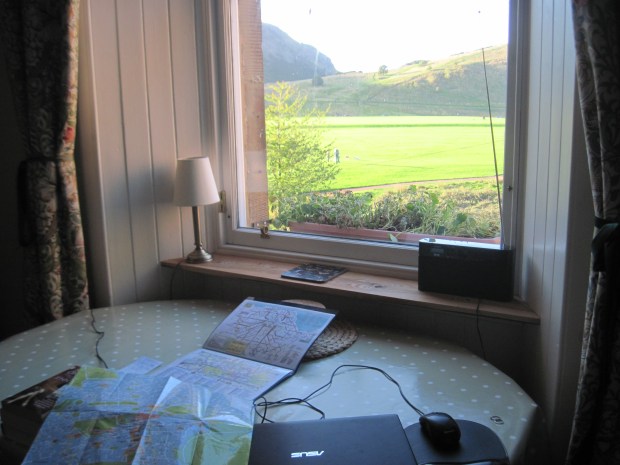
Day 2, Thursday the 20th: After just a few hours of sleep, we were up early so that Chris could leave by 7:15 for his meet-up on the Edinburgh campus. The props and sketches scattered about suggest that the flat owner is a theatre costume and set designer. The view overlooking Holyrood Park and Arthur’s Seat is spectacular – a great place to put in a few hours of proofreading before heading out to town after lunch.


On Clare’s recommendation I started with the Surgeons’ Hall Museums on the Royal College of Surgeons campus. They have several collections covering the history of surgery, dentistry, and pathology specimens. Many of the names and developments were familiar to me from Lindsey Fitzharris’s The Butchering Art. Joseph Lister’s frock coat is on display, and in one corner rare video footage plays of Sir Arthur Conan Doyle (who was initially a practicing physician) explaining how he based Sherlock Holmes on his university mentor, Joseph Bell.
 It’s not a place for the squeamish as there are mummified skeletons, details about Burke and Hare’s grave-robbing, surgical tools, and tumors and other anatomical deformities in jars everywhere. I found it all fascinating and spent a good two hours poking around. My favorite bits were the case full of foreign bodies removed from noses, stomachs and intestines and the temporary exhibition, “A Quest for Healing” by Zhang Yanzi, who had a residency at the museums in the summer of 2017. Her pieces included a 2D mountain made of pill packets, a cotton and gauze sculpture bristling with acupuncture needles, a matching hanging sculpture of capillaries, two surgical beds, and various silk screen panels.
The pathology museum, spread across two floors, was a little overwhelming and almost distressingly faceless – so many human beings reduced to the conditions that had defined and perhaps killed them. The most striking specimen for me, then, was one that actually included a face. I think it was a First World War soldier whose nose had been sewn back together, and what was so remarkable was that you could see his ginger whiskers and eyebrows, and his eyes were closed as if he was just taking a nap. (For ever. In a museum case.)

The sculpture outside is From Here Health by Denys Mitchell (1994).
There are only explanatory panels about a select few samples, so it can be hard to spot just what’s wrong with the organs unless you have specialist medical knowledge. I appreciated the few places where notes have been added along the lines of “see your doctor if…” There were four polycystic kidneys on display in various cases, so including mine there were at least six present in the building that day. “More lives would be saved if more people carried kidney donor cards,” one caption read. Amen.
Clare also recommended the university area for its charity shops. I had a good trawl around Nicolson Street and bought one book, but a lot of the shops are geared towards vintage and High Street fashion. I had better luck at the Salvation Army store on Forrest Road (near the National Museum), where I found three books and two classical CDs.


On to the Writers’ Museum, which commemorates Robert Burns, Sir Walter Scott and Robert Louis Stevenson. I was most interested in the Stevenson material, including memorabilia from his later life on Samoa, especially as I’m currently reading a novel about his relationship with the American divorcee Fanny Osbourne. By now I was museum-ed out and headed back to the flat for a leftovers dinner and some reading before an early bedtime.


Day 3, Friday the 21st: Another morning of work followed by an afternoon of wandering on foot between free attractions and charity shops and avoiding the drizzle. I visited the unusual Scottish Parliament building (which cost a cool £414 million) and saw inside the debating chamber. Four books from the Lothian Cat Rescue charity shop; quick jaunts around the Museum of Childhood, the Museum of Edinburgh, Canongate Kirk, the Music Museum, and the Central Library. When it came to it I couldn’t be bothered to pay £14 to go around Holyrood Palace, but I enjoyed a reasonably priced cappuccino and carrot cake at their café. Chris was back in the evening for a dinner of frozen pizza with local beer and cider.


Day 4, Saturday the 22nd: Our one full day in the City together. We weren’t feeling up to the Arthur’s Seat walk, so we did a gentle stroll up the Salisbury Crags and back instead. Then we caught a bus out to the Stockbridge area for more charity shopping (two more books) and a scrumptious brunch at The Pantry. This was a recommendation on chef David Lebovitz’s food blog and it more than lived up to expectations. It’s no wonder we had to wait half an hour for a table. I could have eaten anything on the menu, but in the end I had smoked salmon eggs Benedict followed by a cherry and Nutella brownie.


After a brief browse at Golden Hare Books, we went on along the Water of Leith to the lovely Royal Botanic Garden. It’s free to walk around, but we also paid to tour the Glasshouses, which recreate the flora of 10 different climates. The RBG is also home to the National Memorial for Organ and Tissue Donors, a peaceful circular space set back in the woods and marked out by a few benches and stone monuments. As I have organ donors to thank for the continued life and health of my mother and several other relatives, it was well worth a visit.


Back into town for gelato (I had a delicious poached plum and cinnamon sorbet) at Mary’s Milk Bar, which is on Grassmarket across from the Castle and was another Lebovitz recommendation. A quick circuit of the animal hall at the National Museum before it closed, a stroll along the Royal Mile, and a rest with tea and books back at the flat before going back out for a veggie curry.
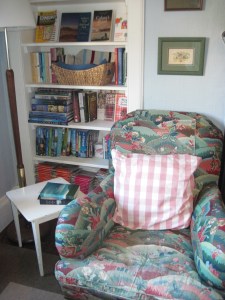
Airbnb bedroom reading nook
Day 5, Sunday the 23rd: Return travel day. No major issues, but still enough of a delay to apply for compensation – refunds from LNER and my husband’s work will have made the journey very cheap indeed.
I was sad to leave Edinburgh this time. I loved our Airbnb flat and felt very at home in it. If I had a bicycle to get into town a little faster, I could easily live there. The tourists would probably drive me mad, but Edinburgh is a wonderful place with so much to see and do and such incredible scenery within a short drive.
Thank you to everyone who offered suggestions of what to see and do. I managed to fit in most of what you recommended!
What I read:
The bulk of Unsheltered, Barbara Kingsolver’s bold new novel about distrust and displacement in America then (the 1870s) and now (during the rise of Trump), and Come to Me by Amy Bloom, a wonderful story collection about people who love who they shouldn’t love. More about this one in my upcoming round-up of short stories I’ve read this month.
 A Ladder to the Sky by John Boyne is a delicious piece of literary suspense with a Tom Ripley-like hero you’ll love to hate: Maurice Swift, who wants nothing more than to be a writer but doesn’t have any ideas of his own, so steals them from other people. I loved how we see this character from several outside points of view – first Erich Ackerman, whose Nazi-era history provides the basis for Maurice’s first novel; then Gore Vidal, to whose Italian home Maurice pays a visit with his new mentor; and finally Maurice’s wife Edith, a celebrated author in her own right – before getting Maurice’s own perspective. By this point we know enough about him to understand just how unreliable a narrator he is. My one criticism is that I would have binned the whole subplot about Edith’s sister and brother-in-law. (A nice touch: at one point Maurice buys a reprint copy of Maude Avery’s Like to the Lark, which should ring a bell from The Heart’s Invisible Furies.)
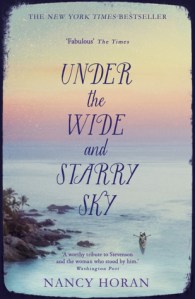 I also read over half of Jenny Diski’s Stranger on a Train, a memoir about two long train journeys she took across America in the late 1990s that also incorporates memories from a troubled adolescence – she started smoking at 14 and was in and out of mental hospitals at 15 – in which she loved nothing more than to read while riding the Circle line all day long. I’m a quarter of the way through both Nancy Horan’s Under the Wide and Starry Sky, about Stevenson and his wife, and Peter Hill’s Stargazing, a memoir about dropping out of art school to become a Scottish lighthouse keeper in 1973; he started on Pladda, a tiny island off of Arran. And on my Nook I read a good bit of All You Can Ever Know, Nicole Chung’s forthcoming memoir about being raised by adoptive white parents in Oregon and meeting members of her Korean family in her mid-twenties, just as she became a mother herself.
These Days
It’s mid-September and crunch time: my husband intends to hand in a complete draft of his PhD thesis next week. He’s been studying part time while working full time and technically has another year to submit, but this month is his self-imposed deadline before the frantic busyness of a new academic year. For weeks now, he’s been going to campus just once or twice a week, working mostly at home out of a makeshift office in our summer house, to which he reels an extension lead each morning so he can plug in his laptop and desk lamp. There’s no Internet signal that far from the house, so it’s a distraction-free zone – or at least the distractions are mostly pleasant ones like birdsong and the cat padding in and out. He’s been known to stay out there until well past 10 at night working on his writing and mapping.
It’s been nice for me to have a bit of company at home during the day (though it’s definitely for the best that we work in different spaces). We reconvene for morning coffee and afternoon tea and also break for lunch. Twice a day I’ll traipse out to the summer house with a tray of hot drinks and snacks and a tote bag of books over my shoulder to spend an hour or so relaxing before getting back to my proofreading or other work upstairs. I’ve tried to be kind and supportive through all the catastrophic announcements about the results being wrong, the statistics going screwy, and the project being basically impossible to finish.
On a practical level, I help out by preparing very simple meals – bean burgers from the freezer section at Aldi plus homemade coleslaw and corn-on-the-cob; fresh oven chips with a fried egg and steamed broccoli – or at least doing the sous chef chopping for complicated ones. My husband cooked for himself during his last two years of uni and enjoys improvising meals, so he’s done pretty much all the cooking for the 11+ years of our marriage. When I was in America I picked up a “Vidalia Chop Wizard” from Bed Bath & Beyond. Some will be thinking “what a pointless, cheaty device!” – but I knew without it I’d never get more involved in cooking, especially because I hate to have lingering savory smells on my fingers.

It’s been a stressful couple of months for my husband, and that stress has of course spilled over to me somewhat. Still, I’m trying not to wish these days away, even as I look forward to the relief of his thesis being finished. It’s never good to wish your life away. I even tried to do some peaceful sitting in nature (i.e., our garden) last week, which led to this short Guardian Country Diary-style piece. (However, you’d better believe I have plans for the post-PhD evenings and weekends. After all these weeks of letting my hubby off the hook, the chores have piled up. I envision a deep clean of the kitchen, tidying up all the little half-finished projects that are sitting around, gardening, banking, and much more.)
This past Saturday we gave ourselves the day off to attend Newbury Real Ale Festival. It’s held just across the canal from our house, so we could hardly pass up the opportunity to sample 146 beers and 118 ciders (my tipple of choice). The music was terrible but the weather stayed decent for much of the five hours we were there. Along with plenty of reading and snacking on crisps, I had the chance to try six ciders, which ranged from the almost undrinkable (beetroot and orange flavor sounded interesting!) to the sublime.


Appropriately enough, the best of the bunch was from Thistly Cross, a cider company based in Scotland: next Wednesday, to celebrate (we hope) the thesis being handed in, we’re off to Edinburgh for a long weekend. It’s something of a work trip for my husband – he’s traveling on to the Cairngorms for a two-day PhD student workshop while I stay behind at our Airbnb – but we’ll have a couple of days to enjoy the city together as well as two very long train rides on which to sink into books.
You’ll be unsurprised to learn that I started planning what books I’d pack weeks ago: some on a train theme; some by or about Scottish writers; some set in Scotland. I’ll also take at least one October review book (probably Barbara Kingsolver’s Unsheltered or Sarah Perry’s Melmoth) and one of the multiple library reservations that have arrived for me all at once (most likely John Boyne’s A Ladder to the Sky or Melissa Harrison’s All Among the Barley).

I’ve been to Edinburgh twice before, but both trips were brief and the most recent one was in 2005. What should I see and do? Where should I eat? (I’ll have to find at least one meal out in the city on my own.) I plan to visit the Writers’ Museum for the first time, and may drop into the National Gallery again. Since I was too skint to do so in my early twenties, I’ll probably also treat myself to a tour of the Castle (though, 17 quid – really?!). Any other recommendations of secondhand bookshops, cafés, free/inexpensive attractions and casual dining establishments will be much appreciated!
A Trip to Wigtown, Scotland’s Book Town
Wigtown is tucked away in the southwest corner of Scotland in Galloway, a region that doesn’t draw too many tourists. It did remind us a lot of Hay-on-Wye, the Book Town in Wales, what with the dry-stone walls, rolling green hills with more imposing mountains behind, sheep in the fields, and goodly number of bookshops. Wigtown is a sleepier place – it’s really just one main street and square – and has fewer bookshops and eateries overall, but the shops it does have are mainly large and inviting, and several are lovely bookshops-cum-cafés where you can pause for tea/coffee and cake before continuing with your book browsing. It rained for much of our trip and even snowed on a couple of brief occasions, but we got one day of very good weather and made the best of all the rest.


Day 1, Monday the 2nd: Six-plus hours of driving, partially in the sleet and snow, saw us arriving to our spacious and comfortable B&B by 6 p.m., giving us an hour to freshen up before dinner in the dining room. Cullen skink (leek and potato soup with chunks of smoked haddock); pork chops in a mustard cream sauce with roast parsnips, boiled potatoes and carrots, and mashed swede (aka rutabaga); and chocolate cake with gingerbread sauce. All delicious!
Day 2, Tuesday the 3rd: Smoked salmon and scrambled eggs for breakfast, accompanied by plenteous tea and toast. Off in the drizzle to see some local sites: Torhouse stone circle and Crook of Baldoon RSPB bird reserve. Nice sightings of whooper swans, pink-footed geese and lapwings, and a panoramic view of Wigtown across the way. Back to the car in the steady rain to find that we had a flat tire. Thanks to our foot pump, we got back to the W. Barclay garage in town, where they ordered a new tire and fitted the spare wheel. In the afternoon we drove to the Isle of Whithorn to see the 13th-century St. Ninian’s Chapel ruins and St. Ninian’s Cave. In the evening we went to Craft for beer/cider and the weekly acoustic music night, which, alas, just ended up being two old guys playing Americana songs on guitars.


Today’s book shopping: Glaisnock Café, where we also stopped for coffee and a tasty slice of courgette and avocado cake; The Open Book (run by Airbnb customers – this week it was Maureen from Pennsylvania and her niece Rebecca from Switzerland; they’d booked the experience two years ago, and the wait is now up to three years); the Wigtown Community shop (a charity shop); and browsing at Old Bank Books and Byre Books.


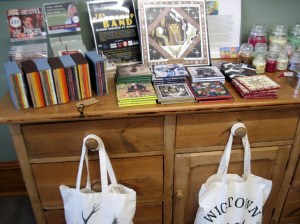
I loved seeing lots of Bookshop Band merchandise around. This was in the Festival Shop.
Day 3, Wednesday the 4th: Vegetarian ‘full Scottish’ cooked breakfast to fuel us for a rainy day of bookshops and explorations further afield. 12 p.m.: return trip to the garage to have our tire fitted. All the staff were so friendly and pleasant. They seemed delighted to see tourists around, and were interested in where we came from and what we were finding to do in the area. Mr. Barclay himself had one of the thickest Scottish accents I’ve ever heard, but I managed to decipher that he thinks of Galloway as “the next best place to heaven,” despite the weather. We spotted a local ‘celebrity’, Ben of the Bookshop Band, in the Co-op, but didn’t say hello as he was trying to pay for his shopping and had the baby in tow.
In the afternoon we ventured to Newton Stewart, the nearest big town, to buy petrol, picnic supper food, and another secondhand book at the community shop there. We retreated from the sudden snow for a scrumptious dinner of smoked salmon, black pudding and haggis (all of them battered and fried, with chips!) at a diner-like smokehouse. Back in Wigtown, we got a mainly dry evening to do the Martyrs’ Walk. In 1685 two Covenanters (Scottish reformers who broke from Charles I’s Anglican Church), Margaret McLachlan, 63, and Margaret Wilson, 18, were tied to stakes on the mud flats and allowed to drown in the rising tide.


Today’s book shopping: THE BOOKSHOP. I’ve meant to visit ever since I read Jessica Fox’s memoir, Three Things You Need to Know about Rockets, in February 2013. Previously based in California, Fox decided on a whim to visit a bookshop in Scotland and ended up here at the country’s largest. She promptly fell in love with the bookshop owner and with Wigtown itself; though she and Shaun Bythell are no longer an item, she has been a major mover and shaker in the town, playing a role in the annual festival and establishing The Open Book.


The Bookshop is a wonderfully rambling place with lots of nooks and crannies housing all sorts of categories. Look out for the shot and mounted Kindle, the Festival bed, the stuffed badger, a scroll of bookseller’s rules, Captain the cat, and a display of Bythell’s The Diary of a Bookseller. Together we found £35 worth of books we wanted to buy – whew! – thanks to my husband’s niche nature books, and had a nice chat with the man himself at the till. He signed my book, commiserated with us about the weather and our trip to see “Willie” (Barclay), and gave us tips for what to see locally. You’d hardly believe he’s the same curmudgeon who wrote the book. Now that I’ve been to the town and the shop, it’s time for me to start rereading it.


We also perused the smallish but very nice selection at Beltie Books, where we made a welcome stop for a cappuccino and some cookies, and I bought a cut-price new book at the Festival Shop. (They stock books by festival speakers plus a curated selection of new releases.)
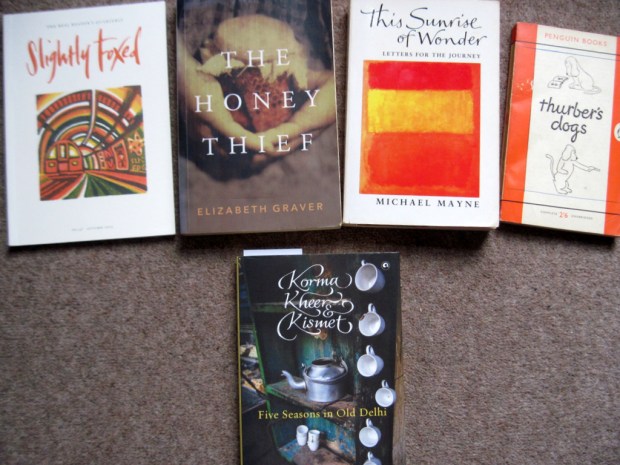
Day 4, Thursday the 5th: SUNSHINE, at last! After hearty omelettes, we headed to the hill that overlooks the town to get the best views of the week. On to Monreith for a charming coastal walk up to the Gavin Maxwell monument of a bronze otter. (He wrote Ring of Bright Water, which my husband brought along to read on our trip.) After a lunch stop back in town, it was out to the red kite feeding station about 40 minutes away – I came for the books; my husband came for the red kites. Though they’re common enough in our part of Berkshire, he was keen to see the site of another recent reintroduction. Wales also has a feeding station we visited some years ago, and on both occasions seeing dozens of birds swoop down for meat was quite the spectacle – though here you sit on an open porch, even closer to the action. We did a few other short walks in the area, finishing off with a sunset sit in Wigtown’s bird hide.


Today’s book shopping: ReadingLasses calls itself Britain’s only women’s bookshop. They stock Persephone Books direct from Bloomsbury, and they also have a large selection of secondhand books. This is the best place to go in town for a light meal and a snack. We had delicious homemade soup with soda bread for an early lunch, followed by coffee and tiffin. I bought a novel by Candia McWilliam, a Scottish author I’ve only read nonfiction by before.


At Curly Tale Books, the children’s bookshop next-door to The Bookshop, we bought a picture book about the local ‘belted’ Galloway cows for our niece. We didn’t realize the shop owner is also the author! She offered to sign the book for us, but we decided that a five-year-old wouldn’t appreciate it enough.
Day 5, Friday the 6th: Full Scottish breakfast to see us on our way, and a farewell to the two B&B cats, including the fluffiest cat on earth. To break up the rather arduous journey, we stopped early on at the Cairn Holy stone circle/tomb and the Cream o’ Galloway farm shop for cheese and ice cream. Home at 7:30 p.m. to find something from the freezer for dinner, unpack and shelve all these new books.
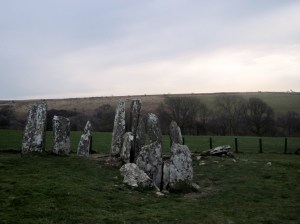
Cairn Holy
Total acquisitions: 13 books for me, 7 books for my husband, 3 books for gifts
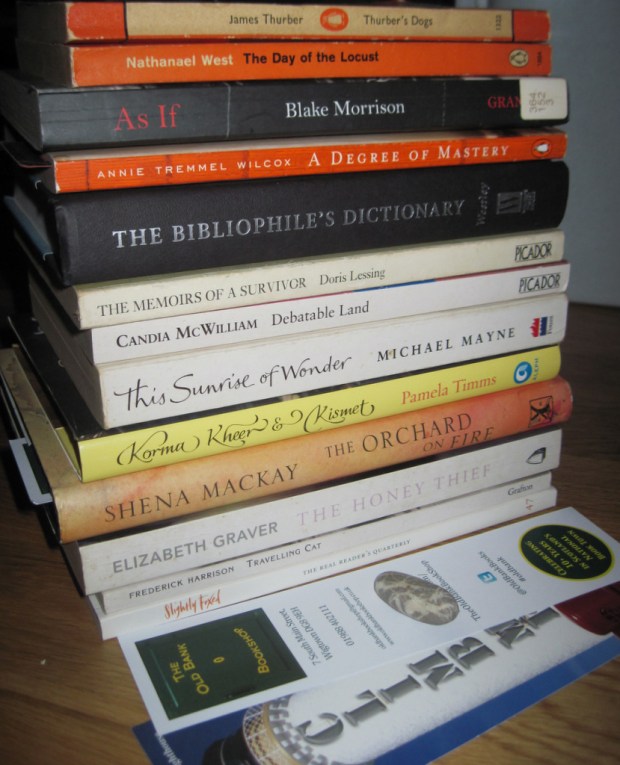
Wigtown is more than twice as far away as Hay is for us, so we’re less likely to go back. (It’s also a tough place to find a decent evening meal.) However, I’d like to think that life will take me back to Wigtown someday, perhaps for the Festival, or for a stay at The Open Book – though I’d have to start planning ahead to 2021!
What I read:
Bits of lots of books I had on the go, but mostly a few vaguely appropriate titles:
Under the Skin by Michel Faber was the perfect book for reading on rainy Scottish highways. I’m so glad I decided at the last minute to bring it. Isserley drives along Highland roads picking up hitchhikers – but only the hunky males – to take back to her farm near the Moray Firth. It’s likely that you already know the setup of this even if you haven’t read it, perhaps from the buzz around the 2013 film version starring Scarlett Johansson. It must have been so difficult for the first reviewers and interviewers to discuss the book without spoilers back in 2000. David Mitchell, in his introduction to my Canons series reprint, does an admirable job of suggesting the eeriness of the contents without giving anything significant away.
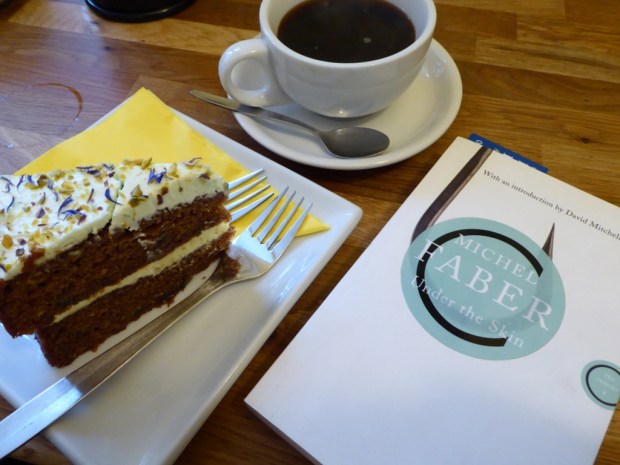
Shelve this under science fiction, though it veers towards horror and then becomes a telling allegory. I knew the basic plot beforehand, but there were still some surprises awaiting me, and I was impressed with how Faber pulled it all off. Keep an eye open for how he uses the word “human.” This has a lot to say about compassion and dignity, and how despite our differences we are fundamentally the same “under the skin.”
An atmospheric line: “The fields all around her house were shrouded in snow, with patches of dark earth poking through here and there as if the world were a rich fruit cake under cream.”
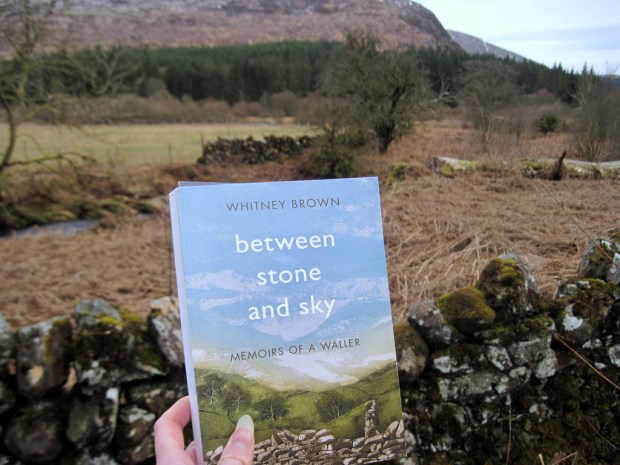
Between Stone and Sky: Memoirs of a Waller by Whitney Brown: For a TLS review. Brown, from South Carolina, trained as a dry-stone waller in Wales (where she fell in love with a man who wouldn’t marry her), but we saw plenty such walls in Scotland too. As an expat I could relate to her feeling of being split between two countries. (Releases May 17th.)
I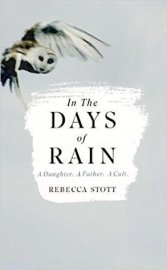 n the Days of Rain: A daughter. A father. A cult. by Rebecca Stott: I read the first two-fifths or so, mostly in the car and over our leisurely B&B breakfasts. One branch of Stott’s Exclusive Brethren family came from Eyemouth, a Scottish fishing village. A family memoir, a bereavement memoir, a theological theme: this brings together a lot of my favorite things. And it won last year’s Costa Biography Award, so you know it’s got to be good.
I also started two books by Scottish novelists, The Orchard on Fire by Shena Mackay and The Accidental by Ali Smith – though I don’t know if I’ll make it through the latter.
 Bookish Beck = Rebecca Foster. American transplant to England. Freelance proofreader and book reviewer.
 Bookish Beck