Miscellaneous for #ReadIndies: Grenville & Holman-Hunt, Trans History & Travel Poetry, Kathleen Jamie & Kristen Zory King
Squeaking in some more reviews on the last day of a challenge, as is my wont. Today I have mini-responses to a wide selection: a graphic novel companion to LGBTQ history, an exposé that will have you checking the ingredients lists on all your toiletries and other household cleaning products, a memoir of an eccentric Edwardian childhood, poems about modes of travel and the states of mind they produce, superb nature essays blending personal and environmental writing, and a mini collection of flash fiction about young women.
Trans History: From Ancient Times to the Present Day by Alex L. Combs and Andrew Eakett (2025)
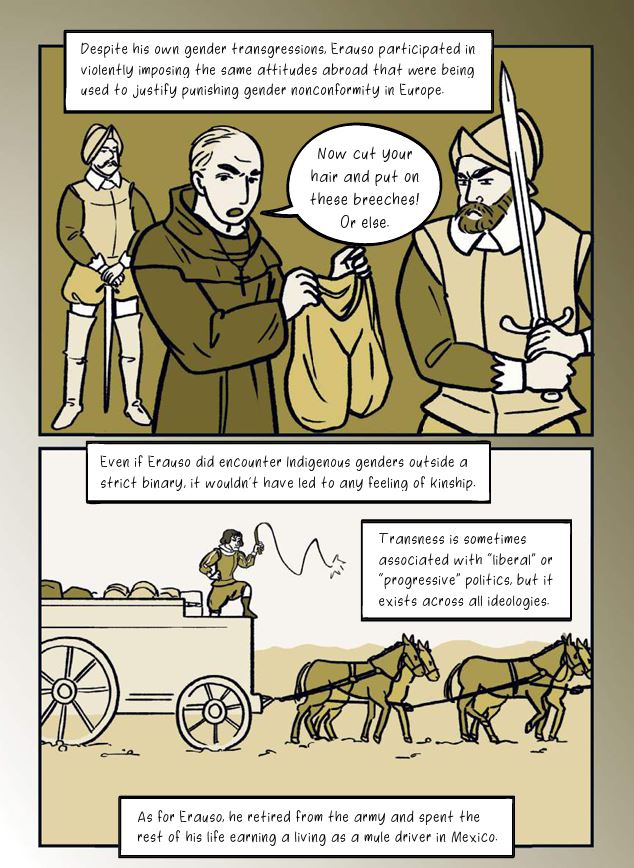
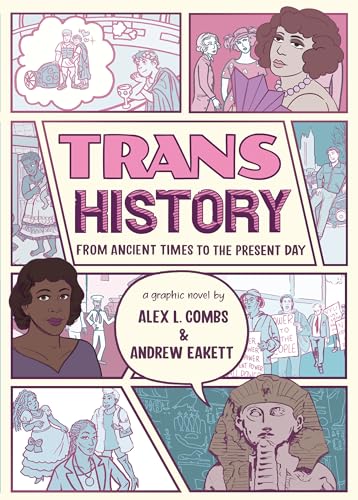 Queer people of all varieties have always been with us; they just might have understood their experience or talked about it in different terms. So while Combs and Eakett are careful not to apply labels retrospectively, they feature a plethora of people who lived as a different gender to that assigned at birth. Apart from a few familiar names like Lili Elbe and Marsha P. Johnson, most were new to me. For every heartening story of an emperor, monk or explorer who managed to live out their true identity in peace, there are three distressing ones of those forced to conform. Many Indigenous cultures held a special place for gender-nonconforming individuals; colonizers would have seen this as evidence of desperate need of civilizing. Even doctors who were willing to help with early medical transitions retained primitive ideas about gender and its connection to genitals. The structure is chronological, with a single colour per chapter. Panes reenact scenes and feature talking heads explaining historical developments and critical theory. A final section is devoted to modern-day heroes campaigning for trans rights and seeking to preserve an archive of queer history. This was a little didactic, but ideal for teens, I think, and certainly not just one for gender studies students.
Readalike: Meg-John Barker’s Sexuality: A Graphic Guide
 (Read via Edelweiss) [Candlewick Press]
The Case Against Fragrance by Kate Grenville (2017)
 File this with other surprising nonfiction books by well-known novelists. In 2015, Grenville started struggling while on a book tour: everything from a taxi’s air freshener and a hotel’s cleaning products to a fellow passenger’s perfume was giving her headaches. She felt like a diva for stipulating she couldn’t be around fragrances, but as she started looking into it she realized she wasn’t alone. I thought this was just going to be about perfume, but it covers all fragranced products, which can list “parfum” on their ingredients without specifying what that is – trade secrets. The problem is, fragrances contain any of thousands of synthetic chemicals, most of which have never been tested and thus are unregulated. Even those found to be carcinogens or endocrine disruptors in rodent studies might be approved for humans because it’s not taken into account how these products are actually used. Prolonged or repeat contact has cumulative effects. The synthetic musks in toiletries and laundry detergents are particularly bad, acting as estrogen mimics and likely associated with prostate and breast cancer. I tend to buy whatever’s on offer in Boots, but as soon as my Herbal Essences bottle is empty I’m going back to Faith in Nature (look for plant extracts). The science at the core of the book is a little repetitive, but eased by the social chapters to either side, and you can tell from the footnotes that Grenville really did her research.
Readalike: Chris van Tulleken’s Ultra-Processed People
 (Secondhand – gift from my wish list) [Text Publishing]
My Grandmothers and I by Diana Holman-Hunt (1960)
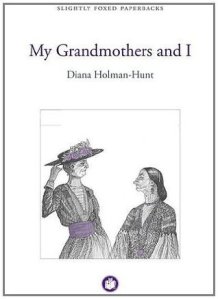 The author was the granddaughter of Pre-Raphaelite painter William Holman Hunt (The Light of the World et al.). While her father was away in India, she was shunted between two homes: Grandmother and Grandfather Freeman’s Sussex estate, and the mausoleum-cum-gallery her paternal grandmother, “Grand,” maintained in Kensington. The grandparents have very different ideas about the sorts of foodstuffs and activities that are suitable for little girls. Both households have servants, but Grand only has the one helper, Helen. Grand probably has a lot of money tied up in property and paintings but lives like a penniless widow. Grand encourages abstemious habits – “Don’t be ruled by Brother Ass, he’s only your body and a nuisance” – and believes in boiled milk and margarine. The single egg she has Helen serve Diana in the morning often smells off. “Food is only important as fuel; whether we like it or not is quite immaterial,” Grand insists. Diana might more naturally gravitate to the pleasures of the Freeman residence, but when it comes time to give a tour of the Holman Hunt oeuvre, she does so with pride. There are some funny moments, such as Diana asking where babies come from after one of the Freemans’ maids gives birth, but this felt so exaggerated and fictionalized – how could she possibly remember details and conversations at the distance of several decades? – that I lost interest by the midpoint.
Readalike: Gwen Raverat’s Period Piece
 (Secondhand – Community Furniture Project) [Slightly Foxed]
In Transit: Poems of Travel, ed. Sarah Jackson and Tim Youngs (2018)
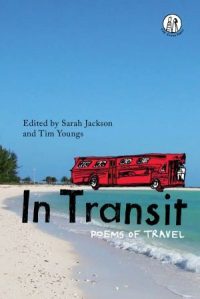 Some methods of transport are just more romantic than others. The editors’ introduction notes that “Trains were by far the most popular … followed by aeroplanes and then boats.” Walks and car journeys were surprisingly scarce, they observed, though there are a couple of poems about wandering in New York City. Often, the language is of maps, airports, passports and long flights; of trading one place for another as exile, expatriate or returnee. The collection circuits the globe: China, the Middle East, Greece, Scandinavia, the bayous of the American South. France and Berlin show up more than once. The Emma Press anthologies vary and this one had fewer standout entries than average. However, a few favourites were Nancy Campbell’s “Reading the Water,” about a boy launching out to sea in a kayak; Simon Williams’s “Aboard the Grey Ghost,” about watching for dolphins on a wartime voyage from England to the USA; and Vicky Sparrow’s “Dual Gauge,” which follows a train of thought – about humans as objects moving, perhaps towards death – during a train ride.
(New purchase from publisher) [The Emma Press]
Findings by Kathleen Jamie (2005)
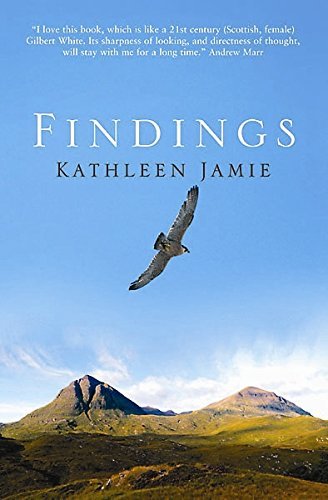 As I found when I reread Sightlines in 2022, Jamie’s topics couldn’t be better suited to my interests: Scottish islands, seabirds, medical history, and the meaning we derive from mortality. She visits the Orkney Islands just before the winter solstice, which draws a faithful few to the tomb of Maes Howe. From her attic room in Fife, she watches peregrine falcons on a cliff face. A gannet’s skull is her prized souvenir from a boat tour to an uninhabited Hebridean island. Vigilance pays off when she hears, then sees, corncrake on the Isle of Coll. Although she has a penchant for empty places, she also writes about cityscapes and hospitals. “Skylines” looks out over Edinburgh, also the setting for “Surgeons’ Hall,” about the pathology museum on the Royal College of Surgeons campus (my 2018 visit). In “Fever” her husband has a scary bout of pneumonia. Jamie is one of our wisest writers on nature and human culture. She asks whether any creatures are truly wild given the pervasiveness of human influence. Even as she seeks out the ancient, she knows we are all ephemeral. “Sabbath” is the best single essay, combining a visit to Lewis with her worry for her mother, who’s had a stroke, and her grandmother, who is to move into a care home. She explores the island “relishing the movement of my body, its own small continuing strength. It wouldn’t last forever – that was the truth of it – but today I could cycle along a road, to see where it led.”
(University library) [Sort Of Books]
My rating in 2012:
My rating now: 
Ladies, Ladies, Ladies by Kristen Zory King (2025)
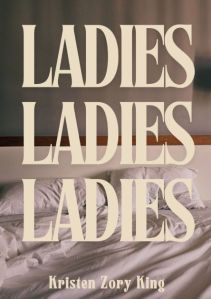 I’d never encountered “chapbook” being used for prose rather than poetry, but it’s an apt term for this 61-page paperback containing 18 stories. It’s remarkable how much King can pack into just a few pages: a voice, a character, a setting and situation, an incident, a salient backstory, and some kind of epiphany or resolution. Fifteen of the pieces focus on one named character, with another three featuring a set (“Ladies,” hence the title). Laura-Jean wonders whether it was a mistake to tell her ex’s mother what she really thinks about him in a Christmas card. A love of ice cream connects Margot’s past and present. A painting in a museum convinces Paige to reconnect with her estranged sister. Alice is sure she sees her double wandering around, and Mary contemplates stealing other people’s cats. The women are moved by rage or lust; stymied by loneliness or nostalgia. Is salvation to be found in scripture or poetry? Each story is distinctive, with no words wasted. I’ll look out for future work by King.
(Duplicate copy passed on by Marcie – thank you!) [Stanchion Books]
Which of these do you fancy reading?
Six more indie publishers spotlighted, for a total of 19 books and 18 publishers this month – job done!
Also covered:
Ansell, Farrier, Febos, Hoffman, Orlean, Stacey
Chevillard, Hopkins & Bateman, McGrath, Richardson
Victorian-Themed Novels by Annie Elliot and Livi Michael
There are plenty more indie books that I’m in the middle of, or picked out but didn’t get to in February. As much as possible, I’ll continue reading (indie) books from my shelves this year.
#ReadIndies Nonfiction Catch-Up: Ansell, Farrier, Febos, Hoffman, Orlean and Stacey
These are all 2025 releases; for some, it’s approaching a year since I was sent a review copy or read the book. Silly me. At last, I’ve caught up. Reading Indies month, hosted by Kaggsy in memory of her late co-host Lizzy Siddal, is the perfect time to feature books from five independent publishers. I have four works that might broadly be classed as nature writing – though their topics range from birdsong and technology to living in Greece and rewilding a plot in northern Spain – and explorations of celibacy and the writer’s profession.
The Edge of Silence: In Search of the Disappearing Sounds of Nature by Neil Ansell
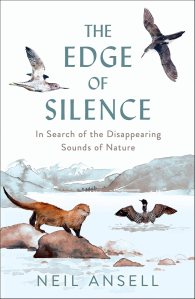 Ansell draws parallels between his advancing hearing loss and the biodiversity crisis. He puts together a wish list of species – mostly seabirds (divers, grebes), but also inland birds (nightjars) and a couple of non-avian representatives (otters) – that he wants to hear and sets off on public transport adventures to find them. “I must find beauty where I can, and while I still can,” he vows. From his home on the western coast of Scotland near the Highlands, this involves trains or buses that never align with the ferry timetables. Furthest afield for him are two nature reserves in northern England where his mission is to hear bitterns “booming” and natterjack toads croaking at night. There are also mountain excursions to locate ptarmigan, greenshank, and black grouse. His island quarry includes Manx shearwaters (Rum), corncrakes (Coll), puffins (Sanday), and storm petrels (Shetland).
Camping in a tent means cold nights, interrupted sleep, and clouds of midges, but it’s all worth it to have unrepeatable wildlife experiences. He has a very high hit rate for (seeing and) hearing what he intends to, even when they’re just on the verge of what he can decipher with his hearing aids. On the rare occasions when he misses out, he consoles himself with earlier encounters. “I shall settle for the memory, for it feels unimprovable, like a spell that I do not want to break.” I’ve read all of Ansell’s nature memoirs and consider him one of the UK’s top writers on the natural world. His accounts of his low-carbon travels are entertaining, and the tug-of-war between resisting and coming to terms with his disability is heartening. “I have spent this year in defiance of a relentless, unstoppable countdown,” he reflects. What makes this book more universal than niche is the deadline: we and all of these creatures face extinction. Whether it’s sooner or later depends on how we act to address the environmental polycrisis.
With thanks to Birlinn for the free copy for review.
Nature’s Genius: Evolution’s Lessons for a Changing Planet by David Farrier
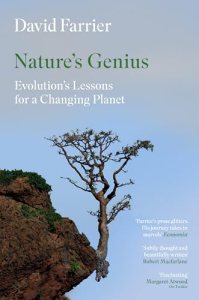 Farrier’s Footprints, which tells the story of the human impact on the Earth, was one of my favourite books of 2020. This contains a similar blend of history, science, and literary points of reference (Farrier is a professor of literature and the environment at the University of Edinburgh), with past changes offering a template for how the future might look different. “We are forcing nature to reimagine itself, and to avert calamity we need to do the same,” he writes. Cliff swallows have evolved blunter wings to better evade cars; captive breeding led foxes to develop the domesticated traits of pet dogs.
It’s not just other species that experience current evolution. Thanks to food abundance and a sedentary lifestyle, humans show a “consumer phenotype,” which superseded the Palaeolithic (95% of human history) and tends toward earlier puberty, autoimmune diseases, and obesity. Farrier also looks at notions of intelligence, language, and time in nature. Sustainable cities will have to cleverly reuse materials. For instance, The Waste House in Brighton is 90% rubbish. (This I have to see!)
There are many interesting nuggets here, and statements that are difficult to argue with, but I struggled to find an overall thread. Cool to see my husband’s old housemate mentioned, though. (Duncan Geere, for collaborating on a hybrid science–art project turning climate data into techno music.)
With thanks to Canongate for the free copy for review.
The Dry Season: Finding Pleasure in a Year without Sex by Melissa Febos
Febos considers but rejects the term “sex addiction” for the years in which she had compulsive casual sex (with “the Last Man,” yes, but mostly with women). Since her early teen years, she’d never not been tied to someone. Brief liaisons alternated with long-term relationships: three years with “the Best Ex”; two years that were so emotionally tumultuous that she refers to the woman as “the Maelstrom.” It was the implosion of the latter affair that led to Febos deciding to experiment with celibacy, first for three months, then for a whole year. “I felt feral and sad and couldn’t explain it, but I knew that something had to change.”
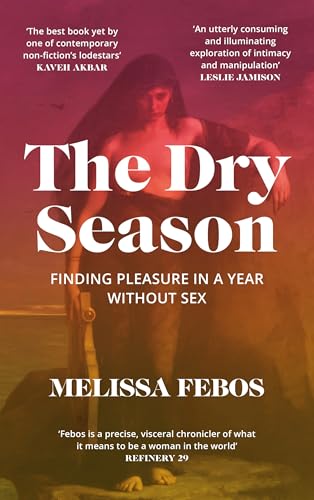 The quest involved some research into celibate movements in history, but was largely an internal investigation of her past and psyche. Febos found that she was less attuned to the male gaze. Having worn high heels almost daily for 20 years, she discovered she’s more of a trainers person. Although she was still tempted to flirt with attractive women, e.g. on an airplane, she consciously resisted the impulse to spin random meetings into one-night stands. (A therapist had stopped her short with the blunt observation, “you use people.”) With a new focus on the life of the mind, she insists, “My life was empty of lovers and more full than it had ever been.” (This reminded me of Audre Lorde’s writing on the erotic.) As Silvana Panciera, an Italian scholar on the beguines (a secular nun-like sisterhood), told her: “When you don’t belong to anyone, you belong to everyone. You feel able to love without limits.”
Intriguing that this is all a retrospective, reflecting on her thirties; Febos is now in her mid-forties and married to a woman (poet Donika Kelly). Clearly she felt that it was an important enough year – with landmark epiphanies that changed her and have the potential to help others – to form the basis for a book. For me, she didn’t have much new to offer about celibacy, though it was interesting to read about the topic from an areligious perspective. But I admire the depth of her self-knowledge, and particularly her ability to recreate her mindset at different times. This is another one, like her Girlhood, to keep on the shelf as a model.
With thanks to Canongate for the free copy for review.
Lifelines: Searching for Home in the Mountains of Greece by Julian Hoffman
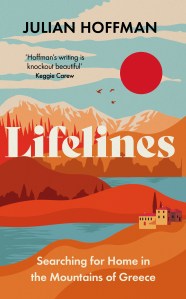 Hoffman’s Irreplaceable was my nonfiction book of 2019. Whereas that was a work with a global environmentalist perspective, Lifelines is more personal in scope. It tracks the author’s unexpected route from Canada via the UK to Prespa, a remote area of northern Greece that’s at the crossroads with Albania and North Macedonia. He and his wife, Julia, encountered Prespa in a book and, longing for respite from the breakneck pace of life in London, moved there in 2000. “Like the rivers that spill into these shared lakes, lifelines rarely flow straight. Instead, they contain bends, meanders and loops; they hold, at times, turns of extraordinary surprise.” Birdwatching, which Hoffman suggests is as “a way of cultivating attention,” had been their gateway into a love for nature developed over the next quarter-century and more, and in Greece they delighted in seeing great white and Dalmatian pelicans (which feature on the splendid U.S. cover. It would be lovely to have an illustrated edition of this.)
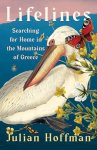 One strand of this warm and fluent memoir is about making a home in Greece: buying and renovating a semi-derelict property, experiencing xenophobia and hospitality from different quarters, and finding a sense of belonging. They’re happy to share their home with nesting wrens, who recur across the book and connect to the tagline of “a story of shelter shared.” In probing the history of his adopted country, Hoffman comes to realise the false, arbitrary nature of borders – wildlife such as brown bears and wolves pay these no heed. Everything is connected and questions of justice are always intersectional. The Covid pandemic and avian influenza (which devastated the region’s pelicans) are setbacks that Hoffman addresses honestly. But the lingering message is a valuable one of bridging divisions and learning how to live in harmony with other people – and with other species.
With thanks to Elliott & Thompson for the free copy for review.
Joyride by Susan Orlean
As a long-time staff writer for The New Yorker, Orlean has had the good fortune to be able to follow her curiosity wherever it leads, chasing the subjects that interest her and drawing readers in with her infectious enthusiasm. She grew up in suburban Ohio, attended college in Michigan, and lived in Portland, Oregon and Boston before moving to New York City. Her trajectory was from local and alternative papers to the most enviable of national magazines: Esquire, Rolling Stone and Vogue. Orlean gives behind-the-scenes information on lots of her early stories, some of which are reprinted in an appendix. “If you’re truly open, it’s easy to fall in love with your subject,” she writes; maintaining objectivity could be difficult, as when she profiled an Indian spiritual leader with a cult following; and fended off an interviewee’s attachment when she went on the road with a Black gospel choir.
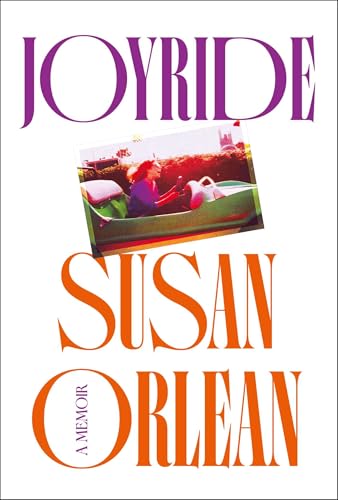 Her personal life takes a backseat to her career, though she is frank about the breakdown of her first marriage, her second chance at love and late motherhood, and a surprise bout with lung cancer. The chronological approach proceeds book by book, delving into her inspirations, research process and publication journeys. Her first book was about Saturday night as experienced across America. It was a more innocent time, when subjects were more trusting. Orlean and her second husband had farms in the Hudson Valley of New York and in greater Los Angeles, and she ended up writing a lot about animals, with books on Rin Tin Tin and one collecting her animal pieces. There was also, of course, The Library Book, about the wild history of the main Los Angeles public library. But it’s her The Orchid Thief – and the movie (not) based on it, Adaptation – that’s among my favourites, so the long section on that was the biggest thrill for me. There are also black-and-white images scattered through.
It was slightly unfortunate that I read this at the same time as Book of Lives – who could compete with Margaret Atwood? – but it is, yes, a joy to read about Orlean’s writing life. She’s full of enthusiasm and good sense, depicting the vocation as part toil and part magic:
“I find superhuman self-confidence when I’m working on a story. The bashfulness and vulnerability that I might otherwise experience in a new setting melt away, and my desire to connect, to observe, to understand, powers me through.”
“I like to do a gut check any time I dismiss or deplore something I don’t know anything about. That feels like reason enough to learn about it.”
“anything at all is worth writing about if you care about it and it makes you curious and makes you want to holler about it to other people”
With thanks to Atlantic Books for the free copy for review.
No Paradise with Wolves: A Journey of Rewilding and Resilience by Katie Stacey
I had the good fortune to visit Wild Finca, Luke Massey and Katie Stacey’s rewilding site in Asturias, while on holiday in northern Spain in May 2022, and was intrigued to learn more about their strategy and experiences. This detailed account of the first four years begins with their search for a property in 2018 and traces the steps of their “agriwilding” of a derelict farm: creating a vegetable garden and tending to fruit trees, but also digging ponds, training up hedgerows, and setting up rotational grazing. Their every decision went against the grain. Others focussed on one crop or type of livestock while they encouraged unruly variety, keeping chickens, ducks, goats, horses and sheep. Their neighbours removed brush in the name of tidiness; they left the bramble and gorse to welcome in migrant birds. New species turned up all the time, from butterflies and newts to owls and a golden fox.
Luke is a wildlife guide and photographer. He and Katie are conservation storytellers, trying to get people to think differently about land management. The title is a Spanish farmers’ and hunters’ slogan about the Iberian wolf. Fear of wolves runs deep in the region. Initially, filming wolves was one of the couple’s major goals, but they had to step back because staking out the animals’ haunts felt risky; better to let them alone and not attract the wrong attention. (Wolf hunting was banned across Spain in 2021.) There’s a parallel to be found here between seeing wolves as a threat and the mild xenophobia the couple experienced. Other challenges included incompetent house-sitters, off-lead dogs killing livestock, the pandemic, wildfires, and hunters passing through weekly (as in France – as we discovered at Le Moulin de Pensol in 2024 – hunters have the right to traverse private land in Spain).
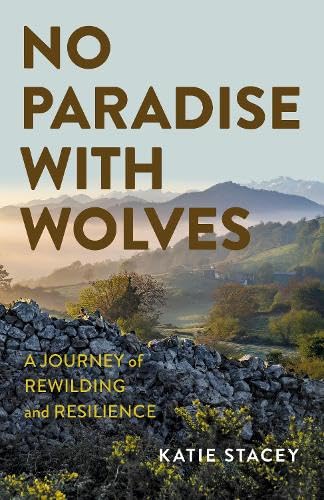
Luke and Katie hope to model new ways of living harmoniously with nature – even bears and wolves, which haven’t made it to their land yet, but might in the future – for the region’s traditional farmers. They’re approaching self-sufficiency – for fruit and vegetables, anyway – and raising their sons, Roan and Albus, to love the wild. We had a great day at Wild Finca: a long tour and badger-watching vigil (no luck that time) led by Luke; nettle lemonade and sponge cake with strawberries served by Katie and the boys. I was clear how much hard work has gone into the land and the low-impact buildings on it. With the exception of some Workaway volunteers, they’ve done it all themselves.
Katie Stacey’s storytelling is effortless and conversational, making this impassioned memoir a pleasure to read. It chimed perfectly with Hoffman’s writing (above) about the fear of bears and wolves, and reparation policies for farmers, in Europe. I’d love to see the book get a bigger-budget release complete with illustrations, a less misleading title, the thorough line editing it deserves, and more developmental work to enhance the literary technique – as in the beautiful final chapter, a present-tense recreation of a typical walk along The Loop. All this would help to get the message the wider reach that authors like Isabella Tree have found. “I want to be remembered for the wild spaces I leave behind,” Katie writes in the book’s final pages. “I want to be remembered as someone who inspired people to seek a deeper connection to nature.” You can’t help but be impressed by how much of a difference two people seeking to live differently have achieved in just a handful of years. We can all rewild the spaces available to us (see also Kate Bradbury’s One Garden against the World), too.
With thanks to Earth Books (Collective Ink) for the free copy for review.
Which of these do you fancy reading?
Nature Book Catch-Up: Sally Huband, Richard Smyth & Anna Vaught
I’m catching up with a few nature- and travel-based 2023 releases that were sent to me for review. I’ve grouped them together because these British authors share some of the same interests and concerns. They celebrate beloved places that become ours through the time we spend in them and the attention we grant; they mourn the loss of biodiversity from rockpools and gardens and seabird cliffs. What kind of diminished world they’re raising their children into is a major worry for all three, and for Huband and Vaught the unease is exacerbated by chronic illness. Wild creatures, and the fellow authors who have hymned them, ease the hurt.
Sea Bean: A beachcomber’s search for a magical charm by Sally Huband
After more than a decade in her adopted home of Shetland, Sally Huband is still a newcomer. A tricky path to motherhood and ensuing chronic illness (the autoimmune disease palindromic rheumatism) limited her mobility and career. Beachcombing is at once her way of belonging to a specific place and feeling part of the wider world – what washes up on a Shetland beach might come from as far away as Atlantic Canada or the Caribbean. Sea glass, lobster pot tags, messages in bottles, driftwood … and a whole lot of plastic, of course. Early on, Huband sets her sights on a sea bean – also known as a drift-seed, from the tropics – which in centuries past was a talisman for ensuring safe childbirth. Possession of one was enough to condemn a 17th-century local woman to death for witchcraft, she learned.
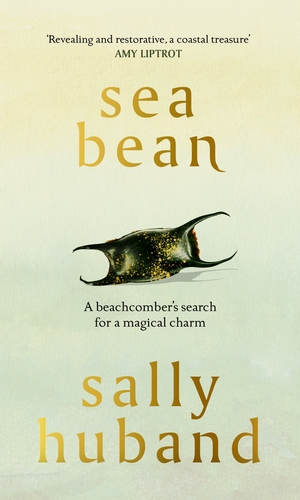 Stories of motherhood, the quest to find effective treatment in a patriarchal medical system, volunteer citizen science projects (monitoring numbers of dead seabirds, returning beached cetaceans to the water, dissecting fulmar stomachs to assess their plastic content), and studying Shetland’s history and customs mingle in a fascinating way. Huband travels around the archipelago and further afield, finding a vibrant beachcombing culture on the Dutch island of Texel. As in Moby-Duck by Donovan Hohn, one of my all-time favourite nonfiction books, there is delight at the randomness of what the ocean delivers.
I requested this book because Huband’s was my favourite essay in the Antlers of Water anthology. In it, she deplored the fact that women were still not allowed to participate in the Up Helly Aa fire festival in Lerwick. Good news: that is no longer the case, thanks to campaigning by Huband and others. In a late chapter, she also reports that blackface was recently banned from the festivals, and a Black Lives Matter demonstration drew 2000 people. Change does come, but slowly to a traditional island community. And sometimes it is not the right sort of change, as with an enormous wind farm, resisted vigorously by residents, that will primarily enrich a multinational company instead of serving the local people.
In many ways, this is a book about coming to terms with loss, and Huband presents the facts with sombre determination. Passages about the threats to birds and marine life had me near tears. But she writes with such poetic tenderness that the evocative specifics of island life point towards what’s true for all of us making the best of our constraints. I was lucky enough to visit several islands of Shetland in 2006; whether you have or not, this is a radiant memoir I would recommend to readers of Kathleen Jamie, Jean Sprackland and Malachy Tallack.
Some favourite lines:
No island can ever live up to the heightened expectations that we always seem to place on them; life catches up with us, sooner or later.
With each loss, emotional pain accretes for those who have paid attention.
If hope is a hierarchy of wishes then I am happy enough, each time that I beachcomb, to find fragments of the bark of paper birch
I’ve come to think of the ocean as an archive of sorts.
With thanks to Hutchinson Heinemann for the proof copy for review.
The Jay, the Beech and the Limpetshell: Finding Wild Things with My Kids by Richard Smyth
all around us
the stuff of spells. Our parents
let us go to scamper deeper,
leap from stumps lush with moss.
Everything aloof about me
fell into the soil once charged
with younger siblings
and freedoms of a wood.
…
I give you a damp valley floor,
this feather for your pocket.
~an extract from “Arger Fen,” from Latch by Rebecca Goss
I know Richard Smyth for his writing on birds (I’ve reviewed both A Sweet, Wild Note and An Indifference of Birds) and his somewhat controversial commentary on modern nature writing. This represents a change in direction for him toward more personal reflection, and with its focus on the phenomena of childhood and parenthood it recalls Wild Child by Patrick Barkham and The Nature Seed by Lucy Jones and Kenneth Greenway. But, as I knew to expect from previous works, he has such talent for reeling in the tangential and extrapolating from the concrete to the abstract that this lively read ends up being about everything: what it is to be human on this fading planet.
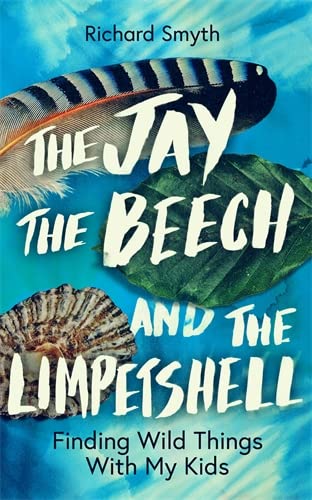 And this despite the fact that four of five chapter headings suggest pandemic-specific encounters with nature. Lockdown walks with his two children, and the totems they found in different habitats – also including a chaffinch nest and an owl pellet – are indeed jumping-off points, punctuating a wide-ranging account of life with nature. Smyth surveys the gateway experiences, whether books or television shows or a school tree-planting programme or collecting, that get young people interested; and talks about the people who beckon us into greater communion – sometimes authors and celebrities; other times friends and family. He also engages with questions of how to live in awareness of climate crisis. He acknowledges that he should be vegetarian, but isn’t; who does not harbour such everyday hypocrisies?
It’s still, unfortunately, rare for men to write about parenthood (and especially pregnancy loss – I only think of Native by Patrick Laurie and William Henry Searle’s books), so it’s great to see that represented, and it’s a charming idea that we create “downfamily” because the “upfamily” doesn’t last forever. Although there’s nostalgia for his childhood here, and anxiety about his kids’ chances of seeing wildlife in abundance, Smyth doesn’t get mired in the past or in existential dread. He has a humanist belief that people are essentially good and can do positive things like build offshore wind farms, and in the meantime he will take Genevieve and Daniel into the woods to play so they will develop a sense of wonder at all that lives on. Even for someone like me who doesn’t have children, this was a captivating, thought-provoking read: We’re all invested in the future of life on this planet.
With thanks to Icon Press for the free copy for review.
These Envoys of Beauty: A Memoir by Anna Vaught
Anna Vaught is a versatile author: I have a copy of her mental health-themed novel Saving Lucia, longlisted for the inaugural Barbellion Prize, on the shelf; she’s written a spooky set of stories, Famished (see Susan’s review); and I gave some early reader feedback on the opening pages of her forthcoming work of quirky historical fiction, The Zebra and Lord Jones. She’s also publishing a book on writing, and editing a collection of pieces submitted for the first Curae Prize for writers who are also carers. I was drawn to her first nonfiction release by reviews by fellow bloggers – it’s always good when a blog tour achieves its aim!
These dozen short essays are about how nature doesn’t necessarily heal, but is a most valued companion in a life marked by chronic illness and depression. The evocative title and epigraphs are from Ralph Waldo Emerson’s essay “Nature” (1836). The pieces loop through Vaught’s past and present, focussing on favourite places in Wiltshire, where she lives, and at the Pembrokeshire coast. It’s the second memoir about complex PTSD that I’ve read this year (see also What My Bones Know). Both at the time and now, when flashbacks of her parents’ verbal and physical abuse haunt her, lying down in a grassy field, exploring a sea cave or sucking on a gorse flower could be a salve. “Nature offered stability and satisfying detail; pattern, form and things that made sense.”
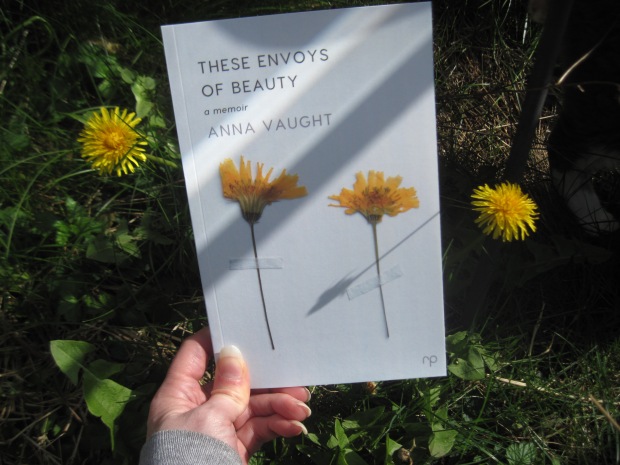
Vaught has a particular love for trees, flowers and moss – even just reciting their Latin names gives her a thrill, and she adds additional information about some species in footnotes. Although her childhood was painful, she retains gratitude for its wide-eyed wonder, and in the exuberance of her prose you can sense a willed childlike perspective (“But back to the list of clouds and writing about clouds!”). I found the frequent self-referential nature of the essays and direct reader address a little precious, but appreciated the thoughts about how nature holds us: “I have always felt a generosity around me, and that I was less lonely outside; at the very least, I could find something to comfort me”. She’s a bookish kindred spirit as well. I’ll be sure to try her work in other genres.
With thanks to Reflex Press for the free copy for review.
October Poetry Releases: Bergin, Draycott, Lopez, Rizwan, Skoulding
It was a prolific month for poetry. There is so much variety here in form and topic, from the tongue-in-cheek aphorisms of Tara Bergin’s Savage Tales to the maritime and ornithological portrait of Anglesey in Zoë Skoulding’s A Marginal Sea. Something for everyone, I’d like to think, and I hope these capsule reviews and sample poems give you a taste.
Savage Tales by Tara Bergin
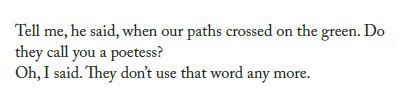
 This is the third collection by the Irish poet; I’d previously read her The Tragic Death of Eleanor Marx. Grouped into nine thematic sections, these very short poems take the form of few-sentence aphorisms or riddles, with the titles, printed in the bottom corner, often acting as something of a punchline – especially because I had them on my e-reader and they only appeared after I’d turned the digital ‘page’. Some appear to be autobiographical, about life for a female academic. Others are political (I loved “Tenants and Landlords”), or about wolves or blackbirds. The verse in “Constructions” takes different shapes on the page. Here are “The Subject Field” and “The Actor”:

With thanks to Carcanet Press for the free e-copy for review.
The Kingdom by Jane Draycott
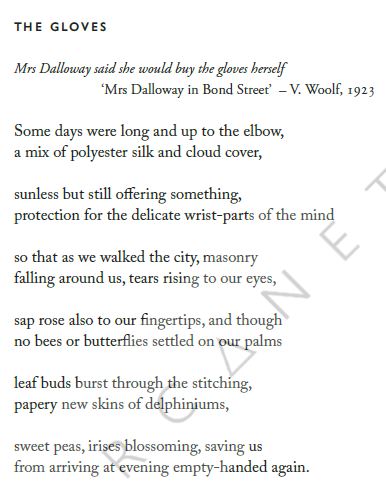
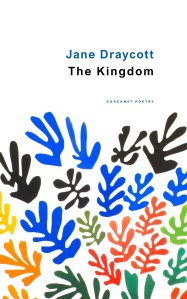 I love the Matisse cut-outs on the cover of Draycott’s fifth collection. The title poem’s archaic spelling (“hyther,” “releyf”) contrast with its picture of a modern woman seeking respite from “the men coming on to you / the taxi drivers saying here jump in no / no you don’t need no money.” Country vs. city, public vs. private, pastoral past and technological future are some of the dichotomies the verse plays with. I enjoyed the alliteration and references to an old English herbarium, Derek Jarman and polar regions. However, it was hard to find overall linking themes to latch onto.
With thanks to Carcanet Press for the free e-copy for review.
We Borrowed Gentleness by J. Estanislao Lopez
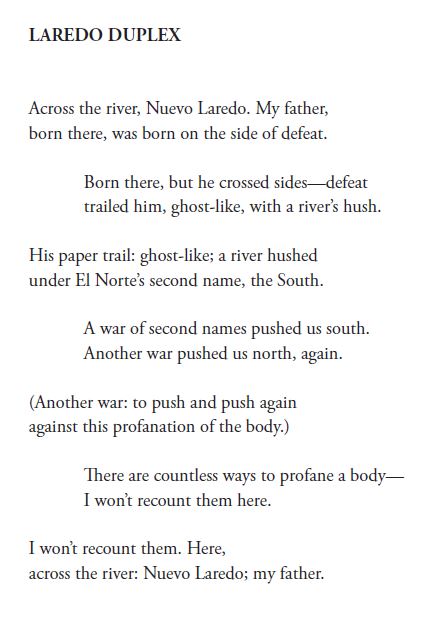
 Brimming with striking metaphors and theological echoes, the first poetry collection by the Houston-based writer is an elegant record of family life on both sides of the Mexican border. “Laredo Duplex” (below) explains how violence prompted the family’s migration. “The Contract” recalls acting as a go-between for a father who didn’t speak English; in “Diáspora” the speaker is dubious about assimilation: “I am losing my brother to whiteness.” The tone is elevated and philosophical (“You take the knife of epistemology and the elegiac fork”), with ample alliteration. Flora and fauna and the Bible are common sources of unexpected metaphors. Lopez tackles big issues of identity, loss and memory in delicate verse suited to readers of Kaveh Akbar. (My full review is on Shelf Awareness.)
With thanks to Alyson Sinclair PR for the free e-copy for review.
Europe, Love Me Back by Rakhshan Rizwan
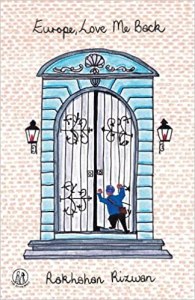 This debut collection has Rizwan juxtaposing East and West, calling out European countries for the prejudice she has experienced as a Muslim Pakistani in academia. She has also lived in the UK and USA, but mostly reflects on time spent in Germany and the Netherlands, where her imperfect grasp of the language was an additional way of standing out. “Adjunct” is the source of the cover image: she knocks and knocks for admittance, but finds herself shut out still. Rizwan takes extended metaphors from marriage, motherhood and women’s health: in “My house is becoming like my country,” she imagines her husband instituting draconian laws; in “I have found in my breast,” a visit to a doctor about a lump only exposes her own exoticism (“Basically, the Muslims are metastasizing”). In “Paris Proper,” she experiences the city differently from a friend because of the colonial history of the art. (See also Liz’s review.)
Some favourite lines:
“my breasts harden / with milk, that peculiar ache of women’s bodies / which do only half the sin / but carry all the history” (from “Half the Sin”)
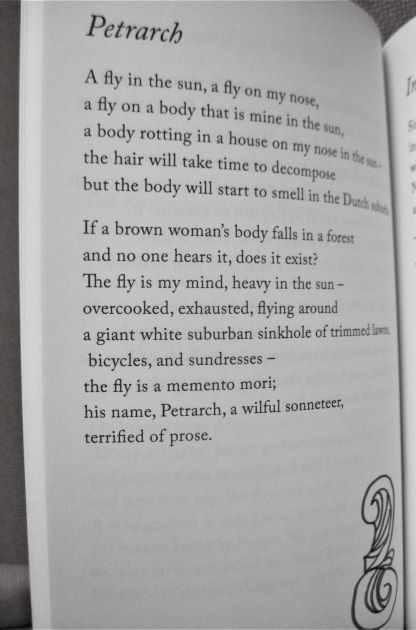
With thanks to The Emma Press for the proof copy for review.
A Marginal Sea by Zoë Skoulding
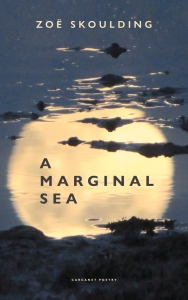 Skoulding’s collection is said to be all about Anglesey in Wales, but from that jumping-off point the poems disperse to consider maps, maritime vocabulary, seabirds, islands, tides and much more. There are also translations from the French, various commissions and collaborations, and pieces about the natural vs. the manmade. Some are in paragraph form and there’s a real variety to how lines and stanzas are laid out on the page. I especially liked “Red Squirrels in Coed Cyrnol.” I’ll read more by Skoulding.
 With thanks to Carcanet Press for the free e-copy for review.
Read any good poetry recently?
Northumberland Trip, Book Haul, and Reading & 20 Books #9 Emerald
We spent the first 11 days of July on holiday in Northumberland (via stays with friends in York on the way up and back) – our longest spell of vacation since 2016, and our longest UK break since 2013. The trip also happened to coincide with our 14th anniversary. It was a fantastic time of exploring England’s northeast corner, a region new to me. I loved the many different types of landscape, from sandy beaches and rocky coasts and islands to moorland and lovely towns. It’s the county for you if you like castles. We joined the National Trust so we could make stops at lots of stately homes and other historic sites. Some highlights were:
- Cherryburn, the off-the-beaten-track home of engraver Thomas Bewick.
- A cheap and delicious meal of authentic Mexican street food in Hexham, of all places (at Little Mexico).
- Walking along a tiny fraction of Hadrian’s Wall from Housesteads Roman Fort.


- Cragside, the over-the-top home of a Victorian inventor (and the first international arms dealer – whoops), nestled in a plantation of pines and rhododendrons.
- A boat trip to the Farne Islands with a landing on Inner Farne, giving close-up views of puffins, other seabirds, and grey seals. We also sailed past the lighthouse made famous by Grace Darling’s rescue of shipwreck victims in 1838. (Relevant song by Duke Special, by way of a Michael Longley poem.)
- Whiling away a rainy morning in Barter Books, one of Britain’s largest secondhand bookshops (located in an old Victorian railway station), and the charity shops of Alnwick.
- An adventurous (and very wet) walk along the coast to the Dunstanburgh Castle ruin.


- Searching the dunes for rare orchids on Holy Island, followed by a delicious and largely vegan lunch at Pilgrims Coffee House.
- Another seabird-filled boat trip, this one round Coquet Island. Sightings included roseate terns and the Duke of Northumberland.
- Our second Airbnb, The Lonnen (near Rothbury), was a rural idyll shared mostly with sheep and gray wagtails. We were spoiled by Ruth’s excellent interior décor and cooked breakfasts. You can get a feel for the place via her Instagram.
- Coffee and snacks at Corbridge Larder’s Heron Café – so good we made a second trip.


It was also, half unexpectedly, a week filled with book shopping. First up was Forum Books in Corbridge, a lovely independent bookshop. I don’t often buy new books, so enjoyed the splurge here. The Flyn and Taylor were two of my most anticipated releases of 2021. It felt appropriate to pick up a Bloodaxe poetry title as the publisher is based in nearby Hexham.
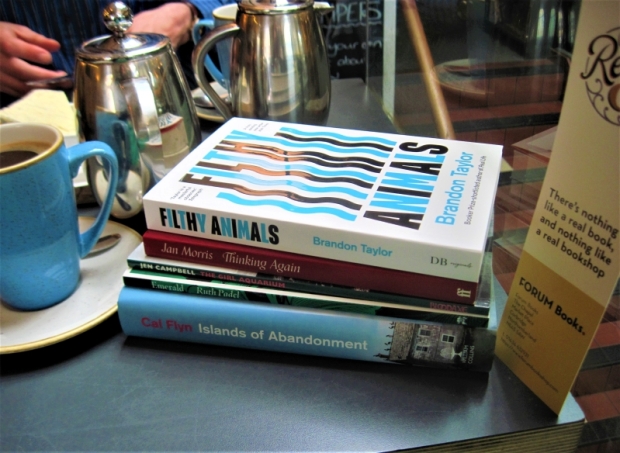
Next came a bounteous charity shop haul in Hexham.

On the Tuesday we holed up in Barter Books for hours while it rained – and the queue lengthened – outside. I was surprised and delighted that the nine antiquarian books I resold to Barter more than paid for my purchases, leaving me in credit to spend another time (online if, as seems likely, I don’t get back up in person anytime soon).


Alnwick also has a number of charity shops. I had the most luck at the Lions bookshop.

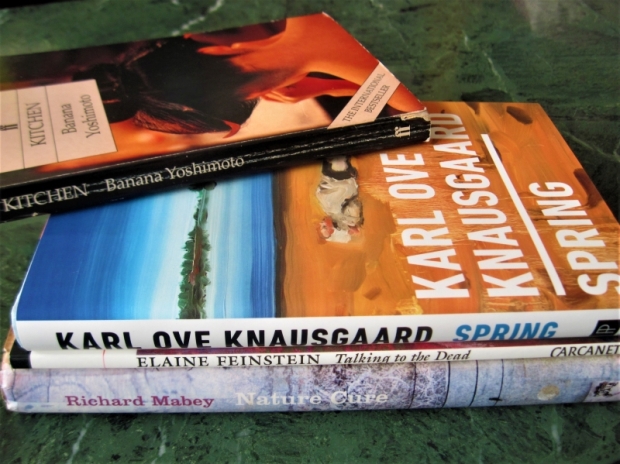
I seemed to keep finding books wherever I went. Kitchen came from a bookshelf in a shop/café on Holy Island. A secondhand/remainders shop near York Minster was the source of the other three.
What I Read:
The holiday involved significant car journeys as Northumberland is a big county with an hour or more between destinations. Alongside my navigating and DJ duties, I got a lot of reading done during the days, as well as in the evenings.
Finished second half or so of:
 Phosphorescence by Julia Baird – An intriguing if somewhat scattered hybrid: a self-help memoir with nature themes. Many female-authored nature books I’ve read recently (Wintering, A Still Life, Rooted) have emphasized paying attention and courting a sense of wonder. To cope with recurring abdominal cancer, Baird turned to swimming at the Australian coast and to faith. Indeed, I was surprised by how deeply she delves into Christianity here. She was involved in the campaign for the ordination of women and supports LGBTQ rights.
 Open House by Elizabeth Berg – When her husband leaves, Sam goes off the rails in minor and amusing ways: accepting a rotating cast of housemates, taking temp jobs at a laundromat and in telesales, and getting back onto the dating scene. I didn’t find Sam’s voice as fresh and funny as Berg probably thought it is, but this is as readable as any Oprah’s Book Club selection and kept me entertained on the plane ride back from America and the car trip up to York. It’s about finding joy in the everyday and not defining yourself by your relationships.
 Site Fidelity by Claire Boyles – I have yet to review this for BookBrowse, but can briefly tell you that it’s a terrific linked short story collection set on the sagebrush steppe of Colorado and featuring several generations of strong women. Boyles explores environmental threats to the area, like fracking, polluted rivers and an endangered bird species, but never with a heavy hand. It’s a different picture than what we usually get of the American West, and the characters shine. The book reminded me most of Love Medicine by Louise Erdrich.
 Every Minute Is a Day by Robert Meyer, MD and Dan Koeppel – The Bronx’s Montefiore Medical Center serves an ethnically diverse community of the working poor. Between March and September 2020, it had 6,000 Covid-19 patients cross the threshold. Nearly 1,000 of them would die. Unfolding in real time, this is an emergency room doctor’s diary as compiled from interviews and correspondence by his journalist cousin. (Coming out on August 3rd. Reviewed for Shelf Awareness.)
 Virga by Shin Yu Pai – Yoga and Zen Buddhism are major elements in this tenth collection by a Chinese American poet based in Washington. She reflects on her family history and a friend’s death as well as the process of making art, such as a project of crafting 108 clay reliquary boxes. “The uncarved block,” a standout, contrasts the artist’s vision with the impossibility of perfection. The title refers to a weather phenomenon in which rain never reaches the ground because the air is too hot. (Coming out on August 1st.)
Read most or all of:
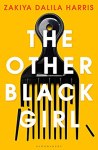 The Other Black Girl by Zakiya Dalila Harris – I feel like I’m the last person on Earth to read this buzzy book, so there’s no point recounting the plot, which initially is reminiscent of Luster by Raven Leilani but morphs into its own thing as Nella realizes her rivalry with Hazel, her new Black colleague at Wagner Books, is evidence of a wider social experiment. The prose is hip, bringing to mind Queenie and Such a Fun Age. It was a fun road trip read for me, but I could have done without the silliness of magical hair care products.
 Heartstopper, Volume 1 by Alice Oseman – It’s well known at Truham boys’ school that Charlie is gay. Luckily, the bullying has stopped and the others accept him. Nick, who sits next to Charlie in homeroom, even invites him to join the rugby team. Charlie is smitten right away, but it takes longer for Nick, who’s only ever liked girls before, to sort out his feelings. This black-and-white YA graphic novel is pure sweetness, taking me right back to the days of high school crushes. I raced through and placed holds on the other three volumes.
 The Vacationers by Emma Straub – Perfect summer reading; perfect holiday reading. Like Jami Attenberg, Straub writes great dysfunctional family novels featuring characters so flawed and real you can’t help but love and laugh at them. Here, Franny and Jim Post borrow a friend’s home in Mallorca for two weeks, hoping sun and relaxation will temper the memory of Jim’s affair. Franny’s gay best friend and his husband, soon to adopt a baby, come along. Amid tennis lessons, swims and gourmet meals, secrets and resentment simmer.
 Kitchen by Banana Yoshimoto – A pair of poignant stories of loss and what gets you through. In the title novella, after the death of the grandmother who raised her, Mikage takes refuge with her friend Yuichi and his mother (once father), Eriko, a trans woman who runs a nightclub. Mikage becomes obsessed with cooking: kitchens are her safe place and food her love language. Moonlight Shadow, half the length, repeats the bereavement theme but has a magic realist air as Satsuki meets someone who lets her see her dead boyfriend again.
I also made a good start on a few of my other purchases from the trip: Islands of Abandonment, No Time to Spare, Filthy Animals, and Female Friends.
Alas, most of the in-demand library books I brought along with me – Great Circle by Maggie Shipstead, Malibu Rising by Taylor Jenkins Reid, and Still Life by Sarah Winman – didn’t hit the spot, so I’ve returned them unread and will borrow them at another point later in the year (except Malibu Rising, which felt soapy and insubstantial).
It’s been a struggle getting back into the routines of work and writing since we got back, but I’ve managed to review one more of my 20 Books of Summer. This is #9, slipped in from my Forum Books pile, and I’m currently working on books #10–13.
Emerald by Ruth Padel (2018)
 This was my 11th book from Padel; I’ve read a mixture of her poetry, fiction, narrative nonfiction and poetry criticism. Emerald consists mostly of poems in memory of her mother, Hilda, who died in 2017 at the age of 97. The book pivots on her mother’s death, remembering the before (family stories, her little ways, moving her into sheltered accommodation when she was 91, sitting vigil at her deathbed) and the letdown of after. It made a good follow-on to one I reviewed last month, Kate Mosse’s An Extra Pair of Hands.
Emerald, the hue and the gemstone, recurs frequently in ornate imagery of verdant outdoor scenes and expensive art objects. Two favourites were travel-based: “Jaipur,” about the emerald-cutters of India, where Padel guiltily flew while her mother was ill; and “Salon Noir,” about a trip down into prehistoric caves of France the summer after Hilda’s death. Overall, I expected the book to resonate with me more than it did. The bereavement narrative never broke through to touch me; it remained behind a silk screen of manners and form.
Two favourite stanzas:
“Your voice is your breath.
The first thing that’s yours
and the last.” (from “Fragile as Breath”)
“that’s all of us
sifting the dark
in our anonymities and hope.” (from “Above is the Same as Below”)
My rating:
Next books in progress: The Glitter in the Green by Jon Dunn and Nothing but Blue Sky by Kathleen MacMahon
Four June Releases (Fiction & Poetry): Bennett, Gabrielsen, Kwek and Watts
(A rare second post in a day from me, to make way for tomorrow’s list of the best books of the first half of the year.) My four new releases for June are a novel about the complications of race and sexuality in 1950s–80s America, a novella in translation about a seabird researcher struggling through a time of isolation, and two new poetry books from Carcanet Press. As a bonus just in time for Pride Month, I finish with a mini write-up of The Book of Queer Prophets, an anthology of autobiographical essays that was published late last month.
The Vanishing Half by Brit Bennett
 Like some lost mid-career gem from Toni Morrison, this novel is meaty with questions of racial and sexual identity and seems sure to follow in the footsteps of Ruby and An American Marriage with a spot in Oprah’s book club and on Barack Obama’s summer reading list.
It’s the story of light-skinned African American twins Stella and Desiree Vignes, and how their paths divide in 1954. Both are desperate to escape from Mallard, Louisiana, where their father was lynched and their mother cleans white people’s houses. Desiree works in fingerprinting for the FBI in Washington, D.C., but in 1968 leaves an abusive marriage to return to Mallard with her dark-skinned daughter, Jude Winston. Stella, on the other hand, has been passing as white for over a decade. She was a secretary for the man who became her husband, Blake Sanders, and now lives a life of comfort in a Los Angeles subdivision.
The twins’ decisions affect the next generation, too. Both have one daughter. Jude goes to college in L.A., where she meets and falls in love with photographer Reese (born Therese), who is, in a different sense, “passing” until he can afford the surgery that will align his body with his gender. In a coincidence that slightly strains belief, Jude runs into Stella’s daughter, Kennedy, and over the next seven years the cousins – one a medical student; the other an actress – continue to meet occasionally, marvelling at how two family lines that started in Mallard, a tiny town that doesn’t even exist anymore, could have diverged so dramatically.
This is Bennett’s second novel, after The Mothers, which I’m keen to read. It’s perceptive and beautifully written, with characters whose struggles feel genuine and pertinent. Though its story line ends in the late 1980s, it doesn’t feel passé at all. The themes of self-reinvention and running from one’s past resonate. I expected certain characters to be forced into moments of reckoning, but the plot is a little messier than that – and that’s more like real life. A shoo-in for next year’s Women’s Prize list.
My rating: 
My thanks to Dialogue Books for the free copy for review.
Ankomst by Gøhril Gabrielsen (2017)
[Translated from the Norwegian by Deborah Dawkin]
 The unnamed narrator of Gabrielsen’s fifth novel is a 36-year-old researcher working towards a PhD on the climate’s effects on populations of seabirds, especially guillemots. During this seven-week winter spell in the far north of Norway, she’s left her three-year-old daughter behind with her ex, S, and hopes to receive a visit from her lover, Jo, even if it involves him leaving his daughter temporarily. In the meantime, they connect via Skype when signal allows. Apart from that and a sea captain bringing her supplies, she has no human contact.
Daily weather measurements and bird observations still leave too much time alone in a cramped cabin, and this starts to tell in the protagonist’s mental state: she’s tormented by sexual fantasies, by memories of her life with S, and by the thought of a local family, the Berthelsens, who experienced a disastrous house fire in 1870. More and more frequently, she finds herself imagining what happened to Olaf and Borghild Berthelsen. Solitude and this growing obsession with ghosts of the past make her start to lose her grip on reality.
I’d encountered an unreliable narrator and claustrophobic setting before from Gabrielsen with her second novel, The Looking-Glass Sisters. Extreme weather and isolation account for this being paired with Snow, Dog, Foot by Claudio Morandini as the first two books in Peirene’s 2020 “Closed Universe” trilogy. I was also reminded of Sarah Moss’s Night Waking. However, I found this novella’s metaphorical links – how seabirds and humans care for their young; physical and emotional threats; lowering weather and existential doom – too obvious.
My rating:
My thanks to Peirene Press for the free copy for review.
Moving House by Theophilus Kwek
 This is the first collection of the Chinese Singaporean poet’s work to be published in the UK. Infused with Asian history, his elegant verse ranges from elegiac to romantic in tone. Many of the poems are inspired by historical figures and real headlines. There are tributes to soldiers killed in peacetime training and accounts of high-profile car accidents; “The Passenger” is about the ghosts left behind after a tsunami. But there are also poems about the language and experience of love. I also enjoyed the touches of art and legend: “Monologues for Noh Masks” is about the Pitt-Rivers Museum collection, while “Notes on a Landscape” is about Iceland’s geology and folk tales. In most places alliteration and enjambment produce the sonic effects, but there are also a handful of rhymes and half-rhymes, some internal.
My individual favorite poems included “Prognosis,” “Sophia” (made up of two letters Sir Thomas Stamford Raffles writes home to his wife while surveying in Singapore), and “Operation Thunderstorm.” As an expat and something of a nomad, I especially loved the title poem, which comes last and explains the cover image: “every house has a skeleton – / while the body learns it must carry less / from place to place, a kind of tidiness / that builds, hardens. Some call it fear, // of change, or losing what we cannot keep. / Others, experience.” Recommended to fans of Mary Jean Chan, Nausheen Eusuf, Kei Miller and Ocean Vuong.
My rating:
My thanks to Carcanet Press for the PDF copy for review.
Red Gloves by Rebecca Watts
 I noted the recurring comparison of natural and manmade spaces; outdoors (flowers, blackbirds, birds of prey, the sea) versus indoors (corridors, office life, even Emily Dickinson’s house in Massachusetts). The style shifts from page to page, ranging from prose paragraphs to fragments strewn across the layout. Most of the poems are in recognizable stanzas, though these vary in terms of length and punctuation. Alliteration and repetition (see, as an example of the latter, her poem “The Studio” on the TLS website) take priority over rhymes. I was reminded of Elizabeth Bishop in places, while “Whereas” had me thinking of Stephen Dunn’s collection of that name (Layli Long Soldier also has a poetry book of the same title). A few of my individual favorite poems were “Surveillance,” “Building” and “Admission” (on a medical theme: “What am I afraid of? / The breaching of skin. / Violation of laws that / separate outside from in. / Liquidation of the thing / I call me.”).
My rating:
My thanks to Carcanet Press for the PDF copy for review.
And a bonus for Pride Month:
The Book of Queer Prophets: 24 Writers on Sexuality and Religion, edited by Ruth Hunt
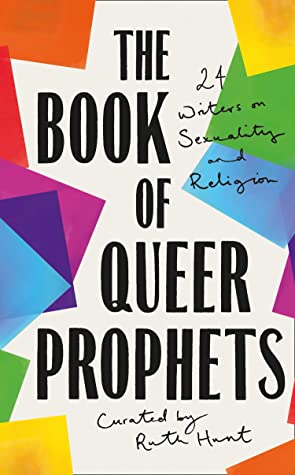 There isn’t, or needn’t be, a contradiction between faith and queerness, as the authors included in this anthology would agree. Many of them are stalwarts at Greenbelt, a progressive Christian summer festival – Church of Scotland minister John L. Bell even came out there, in his late sixties, in 2017. I’m a lapsed regular attendee, so a lot of the names were familiar to me, including those of poets Rachel Mann and Padraig O’Tuama.
Most of the contributors are Christian, then, including ordained priests like Desmond Tutu’s daughter, Mpho, and LGBT ally Kate Bottley, but we also hear from Michael Segalov, a gay Jewish man in London, and from Amrou Al-Kahdi (author of Unicorn: The Memoir of a Muslim Drag Queen), who describes the affirmation they found in the Sufi tradition. Dustin Lance Black tells of the exclusion LGBT Mormons still encounter.
Jarel Robinson-Brown addresses his lament on mistreatment to his nephew, as James Baldwin did in “My Dungeon Shook” (in The Fire Next Time). Tamsin Omond recounts getting married to Melissa on a London bridge in the middle of an Extinction Rebellion protest. Erin Clark, though bisexual, knows she can pass as straight because she’s marrying a man – so is she ‘gay enough?’ Two trans poets write of the way cathedrals drew them into faith. The only weaker pieces are by Jeanette Winterson (there’s nothing new if you’ve read her memoir) and Juno Dawson (entirely throwaway; ‘I’m an atheist, but it’s okay to be religious, too’).
Again and again, these writers voice the certainty that they are who God means them to be. A few of them engage with particular passages from the Bible, offering contextual critiques or new interpretations, but most turn to scripture for its overall message of love and justice. Self-knowledge is a key component of their search for truth. And the truth sets people free.
My rating:
I read an e-copy via NetGalley.
What recent releases can you recommend?
The Seafarers by Stephen Rutt (Paperback Release)
It’s the paperback release date for The Seafarers: A Journey among Birds by Stephen Rutt, one of my highlights from last year’s summer reading and ultimately one of my top 5 nonfiction reads of 2019.
I’ve been asked to repost my review, and you get a bonus: I’m also posting part of the review my husband wrote for his blog last year, which opens with memories of seabird-rich trips he and I have taken. (Chris is a lecturer in animal ecology at the University of Reading, a Newbury Town councillor, and an off-and-on nature blogger.)
Rebecca’s review:
 In 2016 Rutt left his anxiety-inducing life in London in a search for space and silence. He found plenty of both on the Orkney Islands, where he volunteered at the North Ronaldsay bird observatory for seven months. In the few years that followed, the young naturalist travelled the length and breadth of the British Isles – from Skomer to Shetland – courting encounters with seabirds. He’s surrounded by storm petrels one magical night at Mousa Broch; he runs from menacing skuas; he watches eider and terns and kittiwakes along the northeast coast; he returns to Orkney to marvel at gannets and fulmars. Whether it’s their beauty, majesty, resilience, or associations with freedom, such species are for him a particularly life-enhancing segment of nature to spend time around.
Discussion of the environmental threats that hit seabirds hardest, such as plastic pollution, make for a timely tie-in to wider conservation issues. Rutt also sees himself as part of a long line of bird-loving travellers, including James Fisher and especially R. M. Lockley, whose stories he weaves in. This is one of the best nature/travel books I’ve read in a long time, especially enjoyable because I’ve been to a lot of the island locations and the elegantly evocative writing, making particularly effective use of varied sentence lengths, brought back to me just what it’s like to be in the far north of Scotland in the midst of an endless summer twilight, a humbled observer as a whole whirlwind of bird life carries on above you.
A favorite passage:
“Gannets nest on the honeycombs of the cliff, in their thousands. They sit in pairs, pointing to the sky, swaying heads. They stir. The scent of the boat’s herring fills the air. They take off, tessellating in a sky that is suddenly as much bird as light. The great skuas lurk.”
Chris’s review
Scotland, 2005. That’s the trip I always cite as my ‘conversion experience’ as a birder. Perhaps the most memorable element was a boat trip out to the seabird colonies of the Treshnish Isles. Puffins were the draw, but other memories are more vivid. The sudden appearance of a great skua, powering through at low level causing consternation among other birds and excitement among birdwatchers. A minke whale blowing spray near the boat. The dark eye of a shag up close, inscrutably ancient, a pterodactyl that somehow survived to the present.

Puffins at Hermaness, Shetland. Photo by Chris Foster.
Captivated by the peace and isolation of Scottish islands and the incredible sights, sounds and smells of seabirds we did it all again the following year, heading farther north. We started on mainland Orkney, travelling overland by train before catching the ferry from Thurso. During a few days on Westray we experienced a small island community, intriguing to a child of English suburbia, though mostly I remember the rain and superb traybakes in the village café. Finally on to Shetland, making our way up to Hermaness, the very northern end of Britain on the island of Unst. Towering skua-ruled cliffs with the most inquisitive, trusting puffins I have ever known, no land between us and the North Pole. Some four years later we visited Skomer in Pembrokeshire, another famed seabird destination, but since then our visits to Britain’s seabird islands have, alas, largely dried up. I’ve caught up with seabirds on and off since but perhaps let the full wonder of seabirds and the magic of islands drift out of my life.
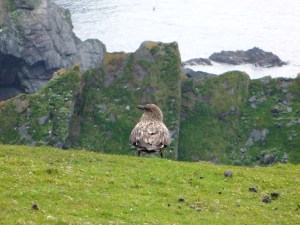
Great skua at Hermaness, Shetland. Photo by Chris Foster.
In that respect The Seafarers was a timely read. It takes the reader, via a series of personal journeys, through the major groups of ocean-going birds that visit Britain while also introducing a significant seabird location in each chapter. It’s an appealing blend of travel, descriptive nature writing, popular science and biography. Author Stephen Rutt balances a highly personal account of what seabirds have meant for him with some solid seabird facts which are well explained, detailed but not at all dense. Rutt is a young birder, naturalist and writer. Since I too am a bearded, balding young (though not nearly so young as he) birder who is not fond of crowds I was probably predisposed to enjoy his voice, and I did, but I also admired its freshness. He successfully avoids the ‘lone white male’ cliché often accused of dominating nature writing. The writing is accomplished throughout and Rutt’s prose is distinctive, concise yet poetic. The life-affirming, simple joy of birding shines through.
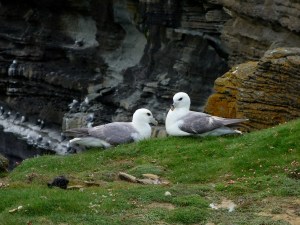
Fulmars on Westray, Orkney Islands. Photo by Chris Foster.
The particularly well-crafted short chapter on vagrant birds may be one of those rare pieces of writing to actually change my mind. Where I have lately been inclined toward the view that twitching exotic vagrants is “a morbid act, a premature wake for a waif that won’t last out the day,” as Rutt puts it, I was won over by his “faith in the wondrous, sense-defying, thrilling capacity that birds have of being lost and making that seem … OK.”
The Seafarers follows just two years after Adam Nicolson’s The Seabird’s Cry. The latter is the more complete (and global) treatment of seabirds, what we know about them and why they matter, but that’s not really a criticism of Rutt’s book. The Seafarers is as much an autobiographical account of the transformative power of birding as it is a compilation of seabird lore. What they have in common is that both books are love letters to this extraordinary group of animals.
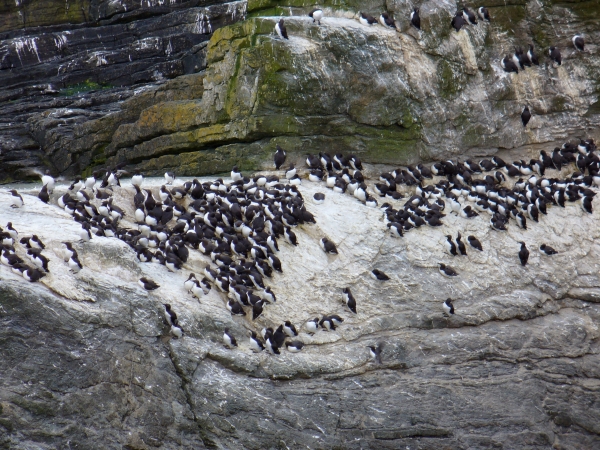
Guillemots at Sumburgh Head, Shetland. Photo by Chris Foster.
Rutt has added his own unique chapter to the shared history of people and seabirds on these islands, as well as establishing himself as a writer with real promise. I look forward to seeing what he turns his thoughts to next.
[The answer was geese; see my review of Rutt’s second 2019 publication, Wintering.]
Note: The Seafarers won the Saltire First Book of the Year award and was longlisted for the Highland Book Prize 2019.
(Order from your local independent bookstore, Hive or Waterstones.)
Best of 2019: Nonfiction
For me, 2019 has been a more memorable year for nonfiction than for fiction. Like I did last year, I’ve happened to choose 12 favorite nonfiction books – though after some thematic grouping this has ended up as a top 10 list. Bodies, archaeology, and the environmental crisis are recurring topics, reflecting my own interests but also, I think, something of the zeitgeist.
Let the countdown begin!
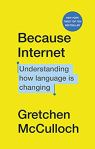 Because Internet: Understanding how language is changing by Gretchen McCulloch: Surprisingly fascinating stuff, even for a late adopter of technology. The Internet popularized informal writing and quickly incorporates changes in slang and cultural references. The book addresses things you may never have considered, like how we convey tone of voice through what we type and how emoji function as the gestures of the written word. Bursting with geeky enthusiasm.
-
 Surfacing by Kathleen Jamie: A fusion of autobiography with nature and travel writing – two genres that are too often dominated by men. Jamie has a particular interest in birds, islands, archaeology and the oddities of the human body, all subjects that intrigue me. There is beautiful nature writing to be found in this volume, as you might expect, but also relatable words on the human condition.
-
 Mother Ship by Francesca Segal: A visceral diary of the first eight weeks in the lives of the author’s daughters, who were born by Caesarean section at 29 weeks in October 2015 and spent the next two months in the NICU. Segal describes with tender precision the feeling of being torn between writing and motherhood, and crafts twinkly pen portraits of others she encountered in the NICU, including the staff but especially her fellow preemie mums.
-
 Surrender: Mid-Life in the American West by Joanna Pocock: Prompted by two years spent in Missoula, Montana and the disorientation felt upon a return to London, this memoir-in-essays varies in scale from the big skies of the American West to the smallness of one human life and the experience of loss and change. This is an elegantly introspective work that should engage anyone interested in women’s life writing and the environmental crisis.
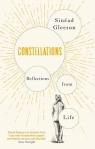
- (A tie) Constellations by Sinéad Gleeson / The Undying by Anne Boyer / Notes Made while Falling by Jenn Ashworth: Trenchant autobiographical essays about female pain. All three feel timely and inventive in how they bring together disparate topics to explore the possibilities and limitations of women’s bodies. A huge theme in life writing in the last couple of years and a great step toward trauma and chronic pain being taken seriously. (See also Notes to Self by Emilie Pine and the forthcoming Pain Studies by Lisa Olstein.)


-
 Time Song: Searching for Doggerland by Julia Blackburn: Deep time is another key topic this year. Blackburn follows her curiosity wherever it leads as she does research into millions of years of history, including the much shorter story of human occupation. The writing is splendid, and the dashes of autobiographical information are just right, making her timely/timeless story personal. This would have been my Wainwright Prize winner.
-
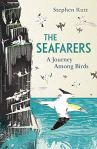 The Seafarers: A Journey among Birds by Stephen Rutt: The young naturalist travelled the length and breadth of the British Isles – from Skomer to Shetland – courting encounters with seabirds. Discussion of the environmental threats that hit these species hardest, such as plastic pollution, makes for a timely tie-in to wider issues. The prose is elegantly evocative, and especially enjoyable because I’ve been to a lot of the island locations.
-
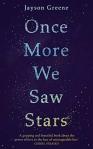 Once More We Saw Stars by Jayson Greene: In 2015 the author’s two-year-old daughter, Greta, was fatally struck in the head by a brick that crumbled off an eighth-story Manhattan windowsill. Music journalist Greene explores all the ramifications of grief. I’ve read many a bereavement memoir and can’t remember a more searing account of the emotions and thoughts experienced moment to moment. The whole book has an aw(e)ful clarity to it.
-
 The Body: A Guide for Occupants by Bill Bryson: Bryson is back on form indulging his layman’s curiosity. Without ever being superficial or patronizing, he gives a comprehensive introduction to every organ and body system. He delights in our physical oddities, and his sense of wonder is contagious. Shelve this next to Being Mortal by Atul Gawande in a collection of books everyone should read – even if you don’t normally choose nonfiction.
-
 Irreplaceable: The Fight to Save Our Wild Places by Julian Hoffman: Species and habitat loss are hard to comprehend even when we know the facts. This exquisitely written book is about taking stock, taking responsibility, and going beyond the numbers to tell the stories of front-line conservation work. Irreplaceable is an elegy of sorts, but, more importantly, it’s a call to arms. It places environmentalism in the hands of laypeople and offers hope that in working together in the spirit of defiance we can achieve great things. So, if you read one 2019 release, make it this one.
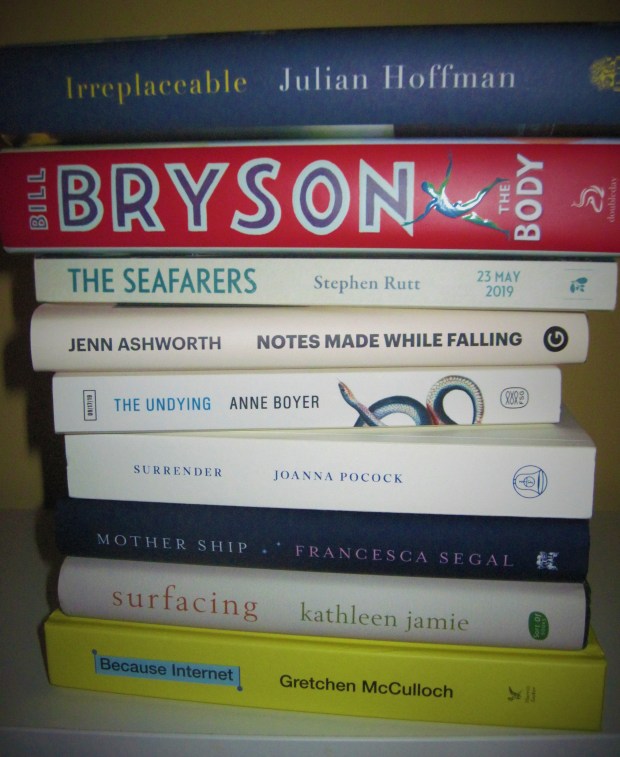
(Books not pictured were read from the library or on Kindle.)
What were some of your top nonfiction reads of the year?
Upcoming posts:
28th: Runners-up
29th: Other superlatives and some statistics
30th: Best backlist reads
31st: The final figures on my 2019 reading
20 Books of Summer, #1–4: Alexis, Haupt, Rutt, Tovey
I was slow to launch into my 20 Books of Summer reading, but have now finally managed to get through my first four books. These include two substitutes: a review copy I hadn’t realized fit in perfectly with my all-animals challenge, and a book I’d started earlier in the year but set aside and wanted to get back into. Three of the four were extremely rewarding; the last was somewhat insubstantial, though I always enjoy reading about cat antics. All have been illuminating about animal intelligence and behavior, and useful for thinking about our place in and duty towards the more-than-human world. Not all of my 20 Books of Summer will have such an explicit focus on nature – some just happen to have an animal in the title or pictured on the cover – but this first batch had a strong linking theme so was a great start.
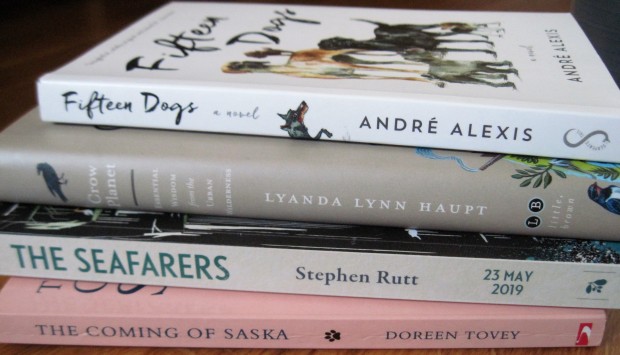
Fifteen Dogs by André Alexis (2015)
In this modern folk tale with elements of the Book of Job, the gods Apollo and Hermes, drinking in a Toronto tavern, discuss the nature of human intelligence and ponder whether it’s inevitably bound up with suffering. They decide to try an experiment, and make a wager on it. They’ll bestow human intelligence on a set of animals and find out whether the creatures die unhappy. Apollo is willing to bet two years’ personal servitude that they will be even unhappier than humans. Their experimental subjects are the 15 dogs being boarded overnight at a nearby veterinary clinic.
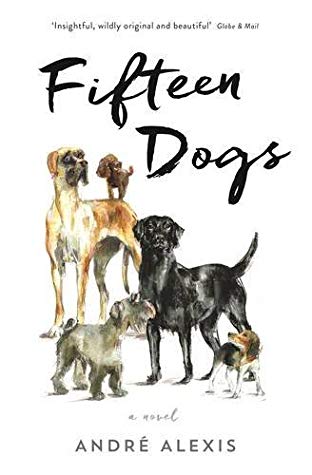 The setup means we’re in for an And Then There Were None type of picking-off of the 15, and some of the deaths are distressing. But strangely – and this is what the gods couldn’t foresee – knowledge of their approaching mortality gives the dogs added dignity. It gives their lives and deaths the weight of Shakespearean tragedy. Although they still do doggy things like establishing dominance structures and eating poop, they also know the joys of language and love. A mutt called Prince composes poetry and jokes. Benjy the beagle learns English well enough to recite the first paragraph of Vanity Fair. A poodle named Majnoun forms a connection with his owner that lasts beyond the grave. The dogs work out who they can trust; they form and dissolve bonds; they have memories and a hope that lives on.
It’s a fascinating and inventive novella, and a fond treatment of the relationship between dogs and humans. When I read in the Author’s Note that the poems all included dogs’ names, I went right back to the beginning to scout them out. I’m intrigued by the fact that this Giller Prize winner is a middle book in a series, and keen to explore the rest of the Trinidanian-Canadian author’s oeuvre.
These next two have a lot in common. For both authors, paying close attention to the natural world – birds, in particular – is a way of coping with environmental and mental health crises.
Crow Planet: Essential Wisdom from the Urban Wilderness by Lyanda Lynn Haupt (2009)
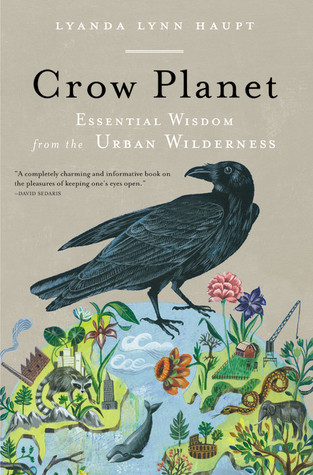 Lyanda Lynn Haupt has worked in bird research and rehabilitation for the Audubon Society and other nature organizations. (I read her first book, Rare Encounters with Ordinary Birds, quite a few years ago.) During a bout of depression, she decided to start paying more attention to the natural world right outside her suburban Seattle window. Crows were a natural place to start. From then on she took binoculars everywhere she went, even on walks to Target. She spent time watching crows’ behavior from a distance or examining them up close – devoting hours to studying a prepared crow skin. She even temporarily took in a broken-legged fledgling she named Charlotte and kept a close eye on the injured bird’s progress in the months after she released it.
Were this simply a charming and keenly observed record of bird behavior and one woman’s gradual reawakening to the joys of nature, I would still have loved it. Haupt is a forthright and gently witty writer. But what takes it well beyond your average nature memoir is the bold statement of human responsibility to the environment. I’ve sat through whole conference sessions that try to define what nature is, what the purpose of nature writing is, and so on. Haupt can do it in just a sentence, concisely and effortlessly explaining how to be a naturalist in a time of loss and how to hope even when in possession of all the facts. 
A few favorite passages:
“an intimate awareness of the continuity between our lives and the rest of life is the only thing that will truly conserve the earth … When we allow ourselves to think of nature as something out there, we become prey to complacency. If nature is somewhere else, then what we do here doesn’t really matter.”
“I believe strongly that the modern naturalist’s calling includes an element of activism. Naturalists are witnesses to the wild, and necessary bridges between ecological and political ways of knowing. … We join the ‘cloud of witnesses’ who refuse to let the more-than-human world pass unnoticed.”
“here we are, intricate human animals capable of feeling despair over the state of the earth and, simultaneously, joy in its unfolding wildness, no matter how hampered. What are we to do with such a confounding vision? The choices appear to be few. We can deny it, ignore it, go insane with its weight, structure it into a stony ethos with which we beat our friends and ourselves to death—or we can live well in its light.”
The Seafarers: A Journey among Birds by Stephen Rutt (2019)
In 2016 Rutt left his anxiety-inducing life in London in a search for space and silence. He found plenty of both on the Orkney Islands, where he volunteered at the North Ronaldsay bird observatory for seven months. In the few years that followed, the young naturalist travelled the length and breadth of the British Isles – from Skomer to Shetland – courting encounters with seabirds. He’s surrounded by storm petrels one magical night at Mousa Broch; he runs from menacing skuas; he watches eider and terns and kittiwakes along the northeast coast; he returns to Orkney to marvel at gannets and fulmars. Whether it’s their beauty, majesty, resilience, or associations with freedom, such species are for him a particularly life-enhancing segment of nature to spend time around.
Discussion of the environmental threats that hit seabirds hardest, such as plastic pollution, makes for a timely tie-in to wider conservation issues. Rutt also sees himself as part of a long line of bird-loving travellers, including James Fisher and especially R.M. Lockley, whose stories he weaves in. This is one of the best nature/travel books I’ve read in a long time, especially enjoyable because I’ve been to a lot of the island locations and the elegantly evocative writing, making particularly effective use of varied sentence lengths, brought back to me just what it’s like to be in the far north of Scotland in the midst of an endless summer twilight, a humbled observer as a whole whirlwind of bird life carries on above you. 
A favorite passage:
“Gannets nest on the honeycombs of the cliff, in their thousands. They sit in pairs, pointing to the sky, swaying heads. They stir. The scent of the boat’s herring fills the air. They take off, tessellating in a sky that is suddenly as much bird as light. The great skuas lurk.”
My husband also reviewed this, from a birder’s perspective.
With thanks to Elliott & Thompson for the proof copy for review.
The Coming of Saska by Doreen Tovey (1977)
 I’ve read four of Tovey’s quaint Siamese cat books now; this was the least worthwhile. It’s partially a matter of false advertising: Saska only turns up for the last 15 pages, as a replacement of sorts for Seeley, who disappeared one morning a year earlier and was never seen again. Over half of the book, in fact, is about a trip Tovey and her husband Charles took to Edmonton, Canada. The Canadian government sponsored them to come over for the Klondike Days festivities, and they also rented a camper and went looking for bears and moose. Mildly amusing mishaps, close shaves, etc. ensue. They then come back and settle into everyday life with their pair of Siamese half-siblings; Saska had the same father as Shebalu. Entertaining enough, but slight, and with far too many ellipses.
Best Backlist Reads of 2018
Like a lot of book bloggers, I’m irresistibly drawn to the shiny new books released each year. However, I’ve noticed recently that many of my most memorable reads were published years or even decades ago. In 2018 I even came across a handful of books that are for me among the very best representatives of their genre, whether that’s nature, travel, family memoir, historical fiction or science fiction. The below selections are in alphabetical order by author name, and account for all the rest of my 4.5- and 5-star ratings of the year (another 27!).

My best backlist reads of the year (most of the ones I own in print, anyway).
Fiction
 March by Geraldine Brooks (2005): The best Civil War novel I’ve read. The best slavery novel I’ve read. One of the best historical novels I’ve ever read, period. Brooks’s second novel uses Little Women as its jumping-off point but is very much its own story. The whole is a perfect mixture of what’s familiar from history and literature and what Brooks has imagined.
 Marlena by Julie Buntin (2017): The northern Michigan setting pairs perfectly with the novel’s tone of foreboding: you have a sense of these troubled teens being isolated in their clearing in the woods, and from one frigid winter through a steamy summer and into the chill of the impending autumn, they have to figure out what in the world they are going to do with their terrifying freedom. It’s basically a flawless debut, one I can’t recommend too highly.
 Reading in the Dark by Seamus Deane (1996): Ireland’s internecine violence is the sinister backdrop to this family’s everyday sorrows, including the death of a child and the mother’s shaky mental health. The book captures all the magic, uncertainty and heartache of being a child, in crisp scenes I saw playing out in my mind.
 The Life and Loves of Lena Gaunt by Tracy Farr (2013): Lena Gaunt: early theremin player, grande dame of electronic music, and opium addict. I loved how Farr evokes the strangeness and energy of theremin music, and how sound waves find a metaphorical echo in the ocean’s waves – swimming is Lena’s other great passion.
 Late Nights on Air by Elizabeth Hay (2007): A tight-knit cast gathers around the local radio station in Yellowknife, a small city in Canada’s Northwest Territories: Harry and Gwen, refugees from Ontario starting new lives; Dido, an alluring Dutch newsreader; Ralph, the freelance book reviewer; menacing Eddie; and pious Eleanor. This is a marvellous story of quiet striving and dislocation; I saw bits of myself in each of the characters, and I loved the extreme setting, both mosquito-ridden summer and bitter winter.
 The Leavers by Lisa Ko (2017): An ambitious and satisfying novel set in New York and China, with major themes of illegal immigration, searching for a mother and a sense of belonging, and deciding what to take with you from your past. This was hand-picked by Barbara Kingsolver for the 2016 PEN/Bellwether Prize for Socially Engaged Fiction.
 The Invisible Bridge by Julie Orringer (2010): Hungarian Jew Andras Lévi travels from Budapest to Paris to study architecture, falls in love with an older woman who runs a ballet school, and – along with his parents, brothers, and friends – has to adjust to the increasingly strict constraints on Jews across Europe in 1937–45. It’s all too easy to burn out on World War II narratives these days, but this is among the very best I’ve read.
 The Sparrow by Mary Doria Russell (1996): For someone like me who struggles with sci-fi at the best of times, this is just right: the alien beings are just different enough from humans for Russell to make fascinating points about gender roles, commerce and art, but not so peculiar that you have trouble believing in their existence. All of the crew members are wonderful, distinctive characters, and the novel leaves you with so much to think about: unrequited love, destiny, faith, despair, and the meaning to be found in life.
 Salt Creek by Lucy Treloar (2015): Hester Finch is looking back from the 1870s – when she is a widowed teacher settled in England – to the eight ill-fated years her family spent at Salt Creek, a small (fictional) outpost in South Australia, in the 1850s–60s. This is one of the very best works of historical fiction I’ve read; it’s hard to believe it’s Treloar’s debut novel.
 Christmas Days: 12 Stories and 12 Feasts for 12 Days by Jeanette Winterson (2016): I treated myself to this new paperback edition with part of my birthday book token and it was a perfect read for the week leading up to Christmas. The stories are often fable-like, some spooky and some funny. Most have fantastical elements and meaningful rhetorical questions. Winterson takes the theology of Christmas seriously. A gorgeous book I’ll return to year after year.
Poetry
 Available Light by Marge Piercy (1988): The subjects are diverse: travels in Europe, menstruation, identifying as a Jew as well as a feminist, scattering her father’s ashes, the stresses of daily life, and being in love. Some of my favorites were about selectively adhering to the lessons her mother taught her, how difficult it is for a workaholic to be idle, and wrestling the deity for words.
Nonfiction
 Deep Country: Five Years in the Welsh Hills by Neil Ansell (2011): One of the most memorable nature/travel books I’ve ever read; a modern-day Walden. Ansell’s memoir is packed with beautiful lines as well as philosophical reflections on the nature of the self and the difference between isolation and loneliness.
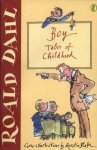 Boy by Roald Dahl (1984): Pranks and larks and holidays: these are all here; so is crushing homesickness and a bitter sense of injustice at being at the mercy of sadistic adults. Nearly 60 years later, Dahl could use memory and imagination to fully inhabit his childhood self and give a charming survey of the notable events of his life up to age 20.
 This Cold Heaven: Seven Seasons in Greenland by Gretel Ehrlich (2001): I thoroughly enjoyed my armchair trek across a frigid island nation in the company of Gretel Ehrlich, who traveled here repeatedly between 1995 and 2001 and intersperses her journeys with those of her historical model, Inuit–Danish explorer Knud Rasmussen, whose seven Arctic expeditions took in the west coast of Greenland and the far north of the North American continent. Every time she finds a fresh way to write about ice and sun glare and frigid temperatures.
 Ali: A Life by Jonathan Eig (2017): It’s a riveting account of outliving segregation and developing a personal style and world-beating confidence; it’s a sobering tale of facing consequences and having your own body fail you. I’m the furthest thing from a sports fan you could imagine, but I approached this as a book about a cultural icon and read it with a spirit of curiosity about how Eig would shape this life story and separate the facts from the legend. I loved it.
 The Book of Forgotten Authors by Christopher Fowler (2017): A charming introduction to 99 more or less obscure writers. Each profile is a perfectly formed mini-biography with a survey of the author’s major work: in just two or three pages, Fowler is able to convey all a writer’s eccentricities and why their output is still worth remembering.
 To the Is-Land: An Autobiography by Janet Frame (1982): This is some of the best writing about childhood and memory that I’ve ever read, infused with music, magic and mystery. The prose alternates between dreamy and matter-of-fact as Frame describes growing up in New Zealand one of five children in the Depression and interwar years.
 Leaving Before the Rains Come by Alexandra Fuller (2015): This poignant sequel to Don’t Let’s Go to the Dogs Tonight is a portrait of Fuller’s two-decade marriage, from its hopeful beginnings to its acrimonious end. What I most appreciated about the book was Fuller’s sense of being displaced: she no longer feels African, but nor does she feel American.
 West With the Night by Beryl Markham (1942): Markham writes so vividly about the many adventures of her life in Africa: hunting lions, training race horses, and becoming one of the continent’s first freelance pilots, delivering mail and locating elephant herds. Whether she’s reflecting on the many faces of Africa or the peculiar solitude of night flights, the prose is just stellar.
 And When Did You Last See Your Father? by Blake Morrison (1993): An extraordinary memoir based around the author’s relationship with his father. Alternating chapters give glimpses into earlier family life and narrate Morrison’s father’s decline and death from cancer. This is simply marvelously written, not a bad line in the whole thing.
 The Seabird’s Cry: The Lives and Loves of Puffins, Gannets and Other Ocean Voyagers by Adam Nicolson (2017): This is an extraordinarily well-written and -researched book (a worthy Wainwright Prize winner) about the behavior, cultural importance, and current plight of the world’s seabirds. Each chapter takes up a different species and dives deep into everything from its anatomy to the legends surrounding it, simultaneously conveying the playful, intimate real lives of the birds and their complete otherness.
 The Long Goodbye: A Memoir of Grief by Meghan O’Rourke (2011): I read a whole lot of bereavement memoirs; this has been one of the very best. O’Rourke tells her story with absolute clarity – a robust, plain-speaking style that matches her emotional transparency. The heart of the book is her mother’s death from colorectal cancer on Christmas Day 2008, but we also get a full picture of the family life that preceded it and the first couple of years of aftermath.
 Ghosts of the Tsunami: Death and Life in Japan’s Disaster Zone by Richard Lloyd Parry (2017): Eighteen and a half thousand people died in the earthquake and tsunami that hit Japan in March 2011. It’s not really possible to get your head around a tragedy on that scale so, wisely, Parry focuses on a smaller story within the story: 74 died at Okawa primary school because the administration didn’t have a sufficient disaster plan in place. This is a stunning portrait of a resilient people, but also a universal story of the human spirit facing the worst.
 Lots of Candles, Plenty of Cake by Anna Quindlen (2012): A splendid memoir-in-essays that dwells on aging, parenting and female friendship. Some of its specific themes are marriage, solitude, the randomness of life, the process of growing into your own identity, and the special challenges her generation (roughly my mother’s) faced in seeking a work–life balance. Her words are witty and reassuring, and cut right to the heart of the matter in every case.
 The Happiness Project: Or, Why I Spent a Year Trying to Sing in the Morning, Clean My Closets, Fight Right, Read Aristotle, and Generally Have More Fun by Gretchen Rubin (2009): Probably the best self-help book I’ve read; dense (in the best possible way) with philosophy, experience and advice. What I appreciated most is that her approach is not about undertaking extreme actions to try to achieve happiness, but about finding contentment in the life you already have by adding or tweaking small habits – especially useful for pessimists like me.
 In the Days of Rain: A daughter. A father. A cult by Rebecca Stott (2017): This was a perfect book for my interests, and just the kind of thing I would love to write someday. It’s a bereavement memoir that opens with Stott’s father succumbing to pancreatic cancer and eliciting her promise to help finish his languishing memoir; it’s a family memoir that tracks generations through England, Scotland and Australia; and it’s a story of faith and doubt, of the absolute certainty experienced inside the Exclusive Brethren (a Christian sect that numbers 45,000 worldwide) and how that cracked until there was no choice but to leave.
 Writers & Company by Eleanor Wachtel (1993): Erudite and fascinating author interviews from Wachtel’s weekly Canadian Broadcasting Corporation radio program. Whether I’d read anything by these authors (or even heard of them) or not, I found each Q&A chock-full of priceless nuggets of wisdom about creativity, mothers and daughters, drawing on autobiographical material, the writing process, and much more.
And if I really had to limit myself to just two books – my very best fiction and nonfiction reads of the year – they would be March by Geraldine Brooks and And When Did You Last See Your Father? by Blake Morrison.

 Bookish Beck = Rebecca Foster. American transplant to England. Freelance proofreader and book reviewer.
 Bookish Beck