Scottish Travels & Book Haul: Wigtown, Arran, Islay and Glasgow
When I was a kid, one-week vacations were rare and precious – Orlando or Raleigh for my dad’s church conferences, summer camp in Amish-country Pennsylvania, spring break with my sister in California – and I mourned them when they were over. As an adult, I find that after a week I’m ready to be home … and yet just days after we got back from Scotland, I’m already wondering why I thought everyday life was so great. Oh well. I like to write up my holidays because otherwise it’s all too easy to forget them. This one had fixed start and end points – several days of beetle recording in Galloway for my husband; meeting up with my sister and nephew in Glasgow one evening the next week – and we filled in the intervening time with excursions to two new-to-us Scottish islands; we’re slowly collecting them all.
First Stop, Wigtown
Hard to believe it had been over five years since our first trip to Wigtown. The sleepy little town had barely changed; a couple of bookshops had closed, but there were a few new ones I didn’t remember from last time. The weather was improbably good, sunny and warm enough that I bought a pair of cutoffs at the Community Shop. Each morning my husband set off for bog or beach or wood for his fieldwork and I divided the time until he got back between bits of paid reviewing, reading and book shopping. Our (rather spartan) Airbnb apartment was literally a minute’s walk into town and so was a perfect base.


I paced myself and parcelled out the eight bookshops and several other stores that happen to sell books across the three and a bit days that I had. It felt almost like living there – except I would have to ration my Reading Lasses visits, as a thrice-weekly coffee-and-cake habit would soon get expensive as well as unhealthy. (I spent more on books than on drinks and cakes over the week, though only ~25% more: £44 vs. £32.)


I also had the novelty of seeing my husband interact with his students when we were invited to a barbecue at one’s family home on the Mull of Galloway – and realizing that we’re almost certainly closer in age to the mum than to the student. Getting there required two rural bus journeys to the middle of nowhere, an experience all in itself.
‘Pro’ tips: New Chapter Books was best for bargains, with sections for 50p and £1 paperbacks and free National Geographics. Well-Read Books was good for harder-to-find fiction: among my haul were two Jane Urquhart novels, and the owner was knowledgeable and pleasant. Byre Books carries niche subjects and has scant opening hours, but I procured two poetry collections and a volume of Dorothy Wordsworth’s journals. The Old Bank Bookshop and The Bookshop are the two biggest shops; wander for an hour or more if you can. The Open Book tends to get castoffs from other shops and withdrawn library stock, but I still made two purchases and ended up being the first customer for the week’s hosts: Debbie and Jenny, children’s book authors and long-distance friends from opposite coasts of the USA. Overall, I was pleased with my novella, short story and childhood memoir acquisitions. A better haul than last time.

‘Celebrity’ sightings: On our walk down to the bird hide on the first evening, we passed Jessica Fox, an American expat who’s been influential in setting up the literary festival and The Open Book. She gave us a cheery “hello.” I also spotted Ben of The Bookshop Band twice, once in Reading Lasses and another time on his way to the afternoon school run. Both times he had the baby in tow and I decided not to bother him, not even to introduce myself as one of their Patreon supporters.
On our last morning in town, we lucked out and found Shaun Bythell behind the counter at The Bookshop. He’d just taken delivery of a book-print kilt his staff surprised him by ordering with his credit card, and Nicky (not as eccentric as she’s portrayed in Diary of a Bookseller; she’s downright genteel, in fact) had him model it. He posted a video to Facebook that includes The Open Book hosts on the 23rd, if you wish to see it, and his new cover photo shows him and his staff members wearing the jackets that match the kilt. I bought a few works of paperback fiction and then got him to sign my own copies of two of his books.


As last time, he was chatty and polite, taking an interest in our travels and exhorting us to come back sooner than five years next time. I congratulated him on his success and asked if we could expect more books. He said that depends on his publisher, who worry the market is saturated at the moment, though he has another SIX YEARS of diaries in draft form and the Remainders of the Day epilogue would be quite different if he wrote it now. Tantalizing!
Note to self: Next time, plan to be in town through a Friday evening – we left at noon, so I was sad to miss out on a Beth Porter (the other half of The Bookshop Band) children’s songs concert at Foggie Toddle Books at 3:00, followed by a low-key cocktail party at The Open Book at 5:30 – but not until a Monday, as pretty much everything shuts that day. How I hope someone buys Reading Lasses (the owner is retiring) and maintains the café’s high standard!
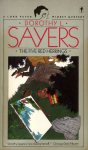 Appropriate reading: I read the first third of Dorothy L. Sayers’s The Five Red Herrings because it’s set in the area (first line: “If one lives in Galloway, one either fishes or paints”), and found it entertaining, though not enough to care whodunnit. In general, I’m terrible for trying mystery series and DNFing or giving up after the first book. Lord Peter Wimsey seemed like he’d be an amusing detective in the Sherlock Holmes vein, but the rendering of Scottish accents was OTT and the case relied too much on details of train schedules and bicycles.
Arran
Our short jaunt to Arran started off poorly with a cancelled ferry sailing, leaving us stranded in Ardrossan (which Bythell had almost prophetically dubbed a “sh*thole” that morning!) for several hours until the next one, and we struggled with a leaky rear tyre and showery weather for much of the time, but we were still enamoured with this island that calls itself “Scotland in miniature.” That was particularly delightful for me because I come from the state nicknamed “America in miniature,” Maryland. This Airbnb was plush by comparison, we obtained excellent food from the Blackwater Bakehouse and a posh French takeaway, and we enjoyed walks at the Machrie stone circles and Brodick Castle as well as at the various bays (one with a fossilized dinosaur footprint) that we stopped off at on our driving tour.


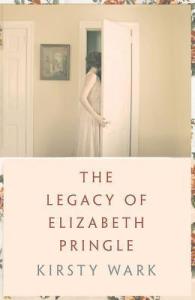 Appropriate reading: The Legacy of Elizabeth Pringle by Kirsty Wark, the only Arran-set novel on my library’s catalogue, is an enjoyable dual-timeline story linked by the Lamlash home of the title character. When she died in her nineties in 2006, she bequeathed her home to a kind woman who used to walk past on summer holidays with her daughter in a pram. Martha Morrison was that baby, and with her mother, Anna, suffering from dementia, it’s up to her to take possession and root out Elizabeth’s secrets. Every other chapter is a first-person fragment from Elizabeth’s memoir, cataloguing her losses of parents and lovers and leading ever closer to the present, when she befriended Saul, an American Buddhist monk based at Holy Island across the water, and Niall, a horticulturist at Brodick Castle. It’s a little too neat how the people in her life pair off (sub-Maggie O’Farrell; more Joanna Trollope, perhaps), but it was fun to be able to visualize the settings and to learn about Arran’s farming traditions and wartime history.
Islay
Islay is a tourist mecca largely because of its nine distilleries – what a pity we don’t care for whiskey! – but we sought it out for its wildlife and scenery, which were reminiscent of what we saw in the Outer Hebrides last year. Our B&B was a bit fusty (there was a rotary phone in the hall!), but we had an unbeatable view from our window and enjoyed visiting two RSPB reserves. The highlight for me was the walk to the Mull of Oa peninsula and the cow-guarded American Monument, which pays tribute to the troops who died in two 1918 naval disasters – a torpedoed boat and a shipwreck – and the heroism of locals who rescued survivors.


We spent a very rainy Tuesday mooching from one distillery shop to another. There are two gin-makers whose products we were eager to taste, but we also relished our mission to buy presents for two landmark birthdays, one of an American friend who’s a whiskey aficionado. Even having to get the tyre replaced didn’t ruin the day. There’s drink aplenty on Islay, but quality food was harder to acquire, so if we went back we’d plump for self-catering.


Incidental additional hauls: I found this 50th anniversary Virago tote bag under a bench at Bowmore harbour after our meal at Peatzeria. I waited a while to see if anyone would come back for it, but it was so sodden and sandy that it must have been there overnight. I cleaned it up and brought home additional purchases in it: two secondhand finds at a thrift store in Tarbert, the first town back on the mainland, and a Knausgaard book I got free with my card points from a Waterstones in Glasgow.


Glasgow
 My 15-year-old nephew is currently on a school trip to Scotland and my sister went along as an unofficial chaperone. I couldn’t let them come to the UK without meeting up, so for months we’d pencilled in an evening in Glasgow. When we booked our Airbnb room in a suburb, it was because it was on a super-convenient train line … which happened to be closed for engineering works while we were there. Plan B: rail replacement buses, which were fine. We greatly enjoyed the company of Santos the Airbnb cat, who mugged us for scraps of our breakfasts.
With our one day in Glasgow, we decided to prioritize the Burrell Collection, due to the enthusiastic recommendations from Susan, our Arran hosts, and Bill Bryson in Notes on a Small Island (“Among the city’s many treasures, none shines brighter, in my view”). It’s a museum with a difference, housed in a custom-built edifice that showcases the wooded surroundings as much as the stunning objects. We were especially partial to the stained glass.


Our whistle-stop city tour also included a walk past the cathedral, a ramble through the Necropolis (where, pleasingly, I saw a grave for one Elizabeth Pringle), and the Tenement Museum, a very different sort of National Trust house that showed how one woman, a spinster and hoarder, lived in the first half of the 20th century. Then on to an exceptional seafood-heavy meal at Kelp, also recommended by Susan, and an all-too-brief couple of hours with my family at their hotel and a lively pub.


We keep returning to Scotland. Where next in a few years? Possibly the southern islands of the Outer Hebrides, which we didn’t have time for last year, or the more obscure of the Inner Hebrides, before planning return visits to some favourites. All the short ferry rides were smooth this time around, so I can cope with the thought of more.

We got home to find our mullein plants attempting to take over the world.
A May Sarton Birthday Celebration
These days I consider May Sarton one of my favourite authors, but I’ve only been reading her for about nine years, since I picked up Journal of a Solitude on a whim. (Ten years prior, when I was a senior in college working in a used bookstore on evenings and weekends, a customer came up and asked me if we had anything by May Sarton. I had never heard of her so said no, only later discovering that we shelved her in with Classic literature. Huh. I can only apologize to that long-ago customer for my ignorance and negligence.)
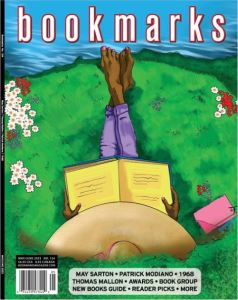 A general-interest article I wrote on May Sarton’s life and work appears in the May/June 2023 issue of Bookmarks magazine, for which I am an associate editor. I submitted this feature back in August 2019, so it’s taken quite some time for it to see the light of day, but I’m pleased that the publication happened to coincide with the anniversary of her birth. In fact, today, May 3rd, would have been her 111th birthday. For the article, I covered a selection of Sarton’s fiction and nonfiction, and gave a brief discussion of her poetry (which the magazine doesn’t otherwise cover).

The two below, a journal and a novel, are works I’ve read more recently. Both were secondhand purchases, I think from Awesomebooks.com.
Encore: A Journal of the Eightieth Year (1993)
 Sarton is one of those reasonably rare authors who published autobiography, fiction AND poetry. I know I’m not alone in thinking that the journals and memoirs are where she really shines. (She herself was proudest of her poetry, and resented the fact that publishers only seemed to be interested in novels because they were what sold.) I came to her through her journals, which she started writing in her sixties, and I love them for how frankly they come to terms with ageing and the ill health and loss it inevitably involves. They are also such good, gentle companions in that they celebrate seasonality and small joys: her beautiful New England homes, her gardening hobby, her pets, and her writing routines and correspondence.
Encore was the only journal I had left unread; soon it will be time to start rereading my top few. When Sarton wrote this in 1991–2, she was recovering from a spell of illness and assumed it would be her final journal. (In fact, At Eighty-Two would appear two years later.) Although she still struggles with pain and low energy, the overall tone is of gratitude and rediscovery of wonder. Whereas a few of the later journals can get a bit miserable because she’s so anxious about her health and the state of the world, here there is more looking back at life’s highlights. Perhaps because Margot Peters was in the process of researching her biography (which would not appear until after her death), she was nudged into the past more often. I especially appreciated a late entry where she lists “peak experiences,” ranging from her teen years to age 80. What a positive way of thinking about one’s life!
For many months I kept this as a bedside book and read just an entry or two a night. When I started reading it more quickly and straight through, I did note some repetition, which Sarton worried would result from her dictating into a recording device. But I don’t think this detracts significantly. In this volume, events of note include a trip to London and commemorative publications plus a conference all to mark her 80th birthday. She’s just as pleased with tiny signs of her success, though, such as a fan letter saying The House by the Sea inspired the reader to put up a bird feeder. 
The Education of Harriet Hatfield (1988)
This is my eighth Sarton novel. In general, I’ve had less success with her fiction as it can be formulaic: characters exist to play stereotypical roles and/or serve as mouthpieces for the author’s opinions. That’s certainly true of Harriet Hatfield, who, like the protagonist of Mrs. Stevens Hears the Mermaids Singing, is fairly similar to Sarton. After the death of her long-time partner, Vicky, who ran a small publishing house, sixty-year-old Harriet decides to open a women’s bookstore in a Boston suburb. She has no business acumen, just enthusiasm (and money, via the inheritance from Vicky). College girls, housewives, nuns and older feminists all become regulars, but Hatfield House also attracts unwanted attention in this dodgy neighbourhood, especially after a newspaper outs Harriet: graffiti, petty theft and worse. The police are little help, but Harriet’s brothers and a local gay couple promise to look out for her.
 The central struggle for Harriet is whether she will remain a private lesbian – as one customer says to her, “you are old and respectable and no one would ever guess”; that is, she can pass as straight – or become part of a more audible, visible movement toward equal rights. It’s cringe-worthy how unsubtly Sarton has Harriet recognize (the “Education” the title speaks of) her privilege and accept her parity with other minorities through friendships with a Black mother, a battered wife who gets an abortion, and a man whose partner is dying of AIDS. Harriet’s brother, too, comes out to her as gay, and I was uneasy with the portrayal of him and the AIDS patient as promiscuous to the point of bringing any suffering on themselves.
Still, when I consider that Sarton was in her late seventies at the time she was writing this, and that public knowledge of AIDS would have been poor at best, I think this was admirably edgy. Harriet’s dilemma reflects Sarton’s own identity crisis, as expressed in Encore: “I do not wish to be labeled as a lesbian and do not wish to be labeled as a woman writer but consider myself a universal writer who is writing for human beings.” Nowadays, though, what Harriet deems discretion comes across as cowardice and priggishness.
While there are elements of Harriet Hatfield that have not aged well, if you focus on the Bythell-esque bookshop stuff (“I find that the people I love best are those who come in to browse, the silent shy ones, who are hungry for books rather than for conversation”) rather than the consciousness-raising or the mystery subplot, you might enjoy it as much as I did. Kudos for the first and last lines, anyway: “How rarely is it possible for anyone to begin a new life at sixty!” and “It’s the real world and I am fully alive in it.”
Book Serendipity, Mid-August to Mid-October 2022
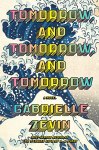
It’s my birthday today and we’re off to Kelmscott Manor, where William Morris once lived, so I’ll start with a Morris-related anecdote even if it’s not a proper book coincidence. One of his most famous designs, the Strawberry Thief, is mentioned in Tomorrow, and Tomorrow, and Tomorrow by Gabrielle Zevin, and I happen to be using a William Morris wall calendar this year. I will plan to report back tomorrow on our visit plus any book hauls that occur.
I call it “Book Serendipity” when two or more books that I read at the same time or in quick succession have something in common – the more bizarre, the better. This is a regular feature of mine every few months. Because I usually have 20–30 books on the go at once, I suppose I’m more prone to such incidents. The following are in roughly chronological order.
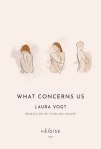
 There’s a character named Verena in What Concerns Us by Laura Vogt and Summer by Edith Wharton. Add on another called Verona from Stories from the Tenants Downstairs by Sidik Fofana.
- Two novels with a female protagonist who’s given up a singing career: Brief Lives by Anita Brookner and What Concerns Us by Laura Vogt.
- Two books featuring Black characters, written in African American Vernacular English, and with elements of drug use and jail time plus rent rises driving people out of their apartments and/or to crime (I’ve basically never felt so white): Stories from the Tenants Downstairs by Sidik Fofana and Nightcrawling by Leila Mottley.

- Two books on my stack with the protagonist an African American woman from Oakland, California: Red Island House by Andrea Lee and Nightcrawling by Leila Mottley
- A middle-aged woman’s hair is described as colourless and an officious hotel staff member won’t give the protagonist a cup of coffee/glass of wine in Brief Lives by Anita Brookner and Oh William! by Elizabeth Strout.
- There’s a central Switzerland setting in Mountain Song by Lucy Fuggle and What Concerns Us by Laura Vogt.
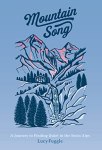
- On the same day, I encountered two references to Mary Oliver’s famous poem “The Summer Day” (“what is it you plan to do / with your one wild and precious life?”): in Mountain Song by Lucy Fuggle and This Beauty by Nick Riggle. (Fuggle and Riggle – that makes me laugh!)
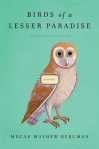
- In the same evening I found mentions of copperhead snakes in Demon Copperhead by Barbara Kingsolver (no surprise there), but also on the very first page of Birds of a Lesser Paradise by Megan Mayhew-Bergman.

- Crop circles are important to What Remains? by Rupert Callender and The Perfect Golden Circle by Benjamin Myers.
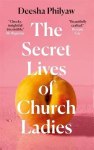
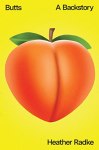
- I was reading two books with provocative peaches on the cover at the same time: The Secret Lives of Church Ladies by Deesha Philyaw and Butts: A Backstory by Heather Radke.
- A main character is pregnant but refuses medical attention in The Language of Flowers by Vanessa Diffenbaugh and What Concerns Us by Laura Vogt.
- An Australian setting and the slang “Carn” or “C’arn” for “come on” in Cloudstreet by Tim Winton and one story (“Halflead Bay”) from The Boat by Nam Le.
- Grape nuts cereal is mentioned in Leap Year by Helen Russell and This Time Tomorrow by Emma Straub.
- A character wagers their hair in a short story from Bratwurst Haven by Rachel King and one from Anthropology by Dan Rhodes.
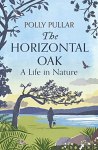
- Just after I started reading a Jackie Kay poetry collection (Other Lovers), I turned to The Horizontal Oak by Polly Pullar and found a puff from Kay on the front cover. And then one from Jim Crumley, whose The Nature of Spring I was also reading, on the back cover! (All Scottish authors, you see.)
- Reading two memoirs that include a father’s suicide – Sinkhole by Juliet Patterson and The Horizontal Oak by Polly Pullar – at the same time.
- Middle school students reading Of Mice and Men in Ms. Hempel Chronicles by Sarah Shun-lien Bynum and Stories from the Tenants Downstairs by Sidik Fofana.
- A second novel in two months in which Los Angeles’s K-Town (Korean neighbourhood) is an important location: after Which Side Are You On by Ryan Lee Wong, Tomorrow, and Tomorrow, and Tomorrow by Gabrielle Zevin.
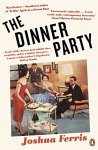
- The main character inherits his roommate’s coat in one story of The Dinner Party by Joshua Ferris, and Tomorrow, and Tomorrow, and Tomorrow by Gabrielle Zevin.
- The Groucho Marx quote “Whatever it is, I’m against it” turns up in What Remains? by Rupert Callender and Blurb Your Enthusiasm by Louise Willder (where it’s adapted to “we’re” as the motto of 3:AM Magazine).
 In Remainders of the Day by Shaun Bythell, Polly Pullar is mentioned as one of the writers at that year’s Wigtown Book Festival; I was reading her The Horizontal Oak at the same time.
- Marilyn Monroe’s death is mentioned in Sinkhole by Juliet Patterson and Tomorrow, and Tomorrow, and Tomorrow by Gabrielle Zevin.
- The types of standard plots that there are, and the fact that children’s books get the parents out of the way as soon as possible, are mentioned in And Finally by Henry Marsh and Blurb Your Enthusiasm by Louise Willder.
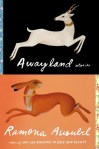
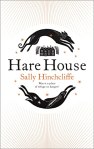
- Two books in quick succession with a leaping hare (and another leaping mammal, deer vs. dog) on the cover: Awayland by Ramona Ausubel, followed by Hare House by Sally Hinchcliffe.
- Three fingers held up to test someone’s mental state after a head injury in The House Is on Fire by Rachel Beanland and The Fear Index by Robert Harris.
- A scene where a teenage girl has to help with a breech livestock delivery (goat vs. sheep) in Belzhar by Meg Wolitzer and The Truants by Kate Weinberg.
- Two memoirs by a doctor/comedian that open with a scene commenting on the genitals of a cadaver being studied in medical school: Catch Your Breath by Ed Patrick wasn’t funny in the least, so I ditched it within the first 10 pages or so, whereas Undoctored by Adam Kay has been great so far.
What’s the weirdest reading coincidence you’ve had lately?
Remainders of the Day by Shaun Bythell & What Remains? by Rupert Callender
I raced to finish all the September releases on my stack by the 30th, thinking I’d review them in one go, but that ended up being far too unwieldy. There was way too much to say about each of these excellent books (the first two pairs are here and here; Blurb Your Enthusiasm by Louise Willder is still to come, probably on Wednesday). I’ve mentioned before that the month’s crop of nonfiction was about either books or death. Here’s one of each, linked by their ‘remain’ titles. Both:
Remainders of the Day: More Diaries from The Bookshop, Wigtown by Shaun Bythell
 It’s just over five years since many of us were introduced to Wigtown and the ups and downs of running a bookshop there through Shaun Bythell’s The Diary of a Bookseller. (I’ve also reviewed the follow-up, Confessions of a Bookseller, which was an enjoyable read for me during a 2019 trip to Milan, and 2020’s Seven Kinds of People You Find in Bookshops.)
This third volume opens in February 2016. As in its predecessors, each monthly section is prefaced by an epigraph from a historical work on bookselling – this time R. M. Williamson’s 1904 Bits from an Old Bookshop. It’s the same winning formula as ever: the nearly daily entries start with the number of online orders received and filled, and end with the number of customers and the till takings for the day. (The average spend seems to be £10 per customer, which is fine in high tourist season but not so great in November and December when hardly anyone walks through the door.) In between, Bythell details notable customer encounters, interactions with shop helpers or local friends, trips out to buy book collections or go fishing, Wigtown events including the book festival, and the occasional snafu like the boiler breaking during a frigid November or his mum being hospitalized with a burst ulcer.
Reading May Sarton’s Encore recently, I came across a passage where she is reading a fellow writer’s journal (Doris Grumbach’s Coming into the End Zone):
I find hers extremely good reading, so I cannot bear to stop. I am reading it much too fast and I think I shall have to read it again. I know that I must not swallow it whole. There is something about a journal, I think, that does this to readers. So many readers tell me that they cannot put my journals down.
I’ve heard Zadie Smith say the same about Karl Ove Knausgaard’s My Struggle: it’s just the stuff of prosaic, everyday life and yet she refers to his memoirs/autofiction as literary crack.
I often read a whole month’s worth of entries at a sitting. I can think of a few specific reasons why Bythell’s journals are such addictive reading:
- “Sometimes you want to go where everybody knows your name.” Small-town settings are irresistible for many readers, and by now the fairly small cast of characters in Bythell’s books feel like old friends. Especially having been to Wigtown myself, I can picture many of the locations he writes about, and you get the rhythm of the seasons and the natural world as well as the town’s ebb and flow of visitors.
- (A related point) You know what to expect, and that’s a comforting thing. Bythell makes effective use of running gags. You know that when Granny, an occasional shop helper from Italy, appears, she will complain about her aches and pains, curse at Bythell and give him the finger. Petra’s belly-dancing class (held above the shop) will inevitably be poorly attended. If Eliot is visiting, he is sure to leave his shoes right where everyone will trip over them. Captain the cat will be portly and infuriating.
- What I most love about the series is the picture of the life cycle of books, from when they first enter the shop, or get picked up in his van, to when rejects are dropped at a Glasgow recycling plant. What happens in the meantime varies, with once-popular authors falling out of fashion while certain topics remain perennial bestsellers in the shop (railways, ornithology). There’s many a serendipitous moment when he comes across a book and it’s just what a customer wants, or buys a book as part of a lot and then sells it online the very next day. New, unpriced stock is always quick to go.
Also of note in this volume are his break-up with Amazon, after his account falls victim to algorithms and is suspended, the meta moment where he signs his first book contract with Profile, and the increasing presence of the Bookshop Band, who moved to Wigtown later in 2017. Bythell doesn’t seem to get much time to read – it’s a misconception of the bookselling life that you do nothing but read all day; you’d be better off as a book reviewer if that’s what you want – but when he does, it’s generally an intense experience: E.M. Forster’s sci-fi novella The Machine Stops (who knew it existed?!), Barbara Comyns’s A Touch of Mistletoe, Jonathan Safran Foer’s Everything Is Illuminated, and Oscar Wilde’s De Profundis.
I’m torn as to whether I hope there will be more year by year volumes filling in to the present day. As Annabel noted, the ‘where they are now’ approach in the Epilogue rather suggests that he and his publisher will leave it here at a trilogy. This might be for the best, as a few more pre-Covid years of the same routines could get old, though nosey parkers like myself will want to know how a confirmed bachelor turned into a family man…
Some favourite lines:
“Quiet day in the shop; even the cat looked bored.” (31 October)
“The life of the secondhand bookseller mainly involves moving boxes from one place to another, and trying to make them fit into a small space, like some sort of awful game of Tetris.”
(10 February and 15 March are great stand-alone entries that give a sense of what the whole is like. There are a lot of black-and-white photos printed amid the text in the first month; it’s a shame these don’t carry on through.)
With thanks to Profile Books for the free copy for review.
What Remains?: Life, Death and the Human Art of Undertaking by Rupert Callender
Call me morbid or call me realistic; in the last decade and a half I have read a lot of books about death, including terminal illness and bereavements. I’ve even read several nonfiction works by American mortician Caitlin Doughty. But I’ve not read anything quite like punk undertaker Rupert Callender’s manifesto about modern death and how much we get wrong in our conceptualization and conversations. It was poignant to be reading this in the weeks surrounding Queen Elizabeth II’s death – a time when death got more discussion than usual, yes, but when there was also some ridiculous pomp that obscured the basic human facts of it.
Callender is not okay with death, and never has been. When he was seven, his father died of a heart attack at age 63. His 1970s Edinburgh upbringing was shattered and his mother, who he has no doubt was doing her best, made a few terrible mistakes. First, a year before, she’d reassured him that his father wasn’t going to die. Second, she didn’t make him attend the funeral. (I still wish my mother had made me go back to tour my late grandmother’s house one final time when I was seven; instead, I stayed behind and played on a Ouija board with my cousins.) Third, she soon sent Callender away to boarding school, which left him feeling alone and betrayed. And lastly, when she died of cancer when he was 25, she had planned every detail of her funeral – whereas he believes that is a task for the survivors.
An orphan in his late twenties, Callender came across The Natural Death Handbook and it sealed his future. He’d been expelled from school and blown his inheritance; acid house culture had given him a sense of community. Now he had a vocation. The first funeral he coordinated was for a postman named Barry. The fourth was a suicide. Their first child burial was one of his partner’s daughter’s classmates.

Over the next two decades, he and his (now ex-)wife Claire based Totnes’ The Green Funeral Company on old-fashioned values and homespun ceremonies. They oppose the overmedicalization of death and the clinical detachment of places like crematoria. Callender is vehemently anti-embalming – an intrusive process that involves toxic substances. They encourage the bereaved to keep the body at home for the week before a funeral, if they feel able (ice packs like you’d use in a picnic cool bag will work a treat), and to be their own pallbearers to make the memory of the funeral day a physical one. He performs the eulogies himself, and they use cardboard coffins.
This is a slippery work for how it intersperses personal stories with polemic and poetic writing. Despite a roughly chronological throughline, it feels more like a thematic set of essays than a sequential narrative. Callender has turned death rituals into both performance art (including at festivals and in collaboration with The KLF) and political protests (e.g., a public funeral he conducted for a homeless man who died of exposure, the third such death in his town that year). While he doesn’t shy away from the gruesome realities of dealing with corpses, he always brings it back to fundamentals: matter is what we are, but who we were lives on in others’ loving memories. Death rituals plug us into a human lineage and proclaim meaning in the face of nothingness. Whether you’ve seen/read it all or never considered picking up a book about death, I recommend Callender’s sui generis approach.
Some favourite lines:
“[The practice of having official pallbearers] is all part of the emotional infantilising encouraged by the funeral industry, all part of being turned into an audience at one of the most significant moments in your family history, instead of being empowered as a family and a community.”
“each death we experience contains every death we have ever lived through, Russian dolls of bereavement waiting to be unpacked.”
“Only once you are dead can the full arc of your life be clearly seen, and telling that story out loud and truthfully to the people who shared it is a powerful social act that both binds us together and place us within our culture.”
With thanks to Chelsea Green for the proof copy for review.
And as a bonus, given that today is Indigenous Peoples’ Day in the USA, here’s an excerpt from my Shelf Awareness review of another book that came out last month:
No Country for Eight-Spot Butterflies: A Lyric Essay by Julian Aguon
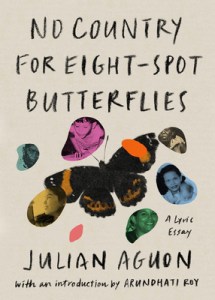 An indigenous human rights lawyer, Aguon is passionate about protecting his homeland of Guam, which is threatened by climate change and military expansion. His tender collage of autobiographical vignettes and public addresses inspires activism and celebrates beauty worth preserving. The U.S. Department of Defense’s plan to site more Marines and firing ranges on Guam will destroy more than 1,000 acres of limestone forest—home to endemic and endangered species, including the Mariana eight-spot butterfly. Aguon has been a lead litigator in appeals rising all the way to the U.S. Supreme Court. Rejecting fatalism, he endorses peaceful resistance. Two commencement speeches, poems, a eulogy and an interview round out the varied and heartfelt collection.
#NonFicNov Review Book Catch-Up: Cohen, Gilbert, Hodge, Piesse, Royle
I have a big backlog of review books piled beside my composition station (a corner of the lounge by the front window; an ancient PC inherited from my mother-in-law and not connected to the Internet; a wooden chair with leather seat that had been left behind in a previous rental house’s garage). Nonfiction November is the excuse I need to finally get around to writing about lots of them; at least one more catch-up will be coming later this month. My apologies to the publishers for the brief reviews.
Today I have a therapist’s take on classic literature, an optimist’s research on data use, a journalist’s response to her sister’s and father’s deaths, a professor’s search for the remnants of Charles Darwin at his family home, and a bibliophile’s tales of book-collecting exploits.
How to Live. What to Do.: In Search of Ourselves in Life and Literature by Josh Cohen
“Literature and psychoanalysis are both efforts to make sense of the world through stories, to discover the recurring problems and patterns and themes of life. Read and listen enough, and we soon come to notice how insistently the same struggles, anxieties and hopes repeat themselves down the ages and across the world.”
 This is the premise for Cohen’s work life, and for this book. Moving through the human experience from youth to old age, he examines anonymous case studies and works of literature that speak to the sorts of situations encountered in that stage. For instance, he recommends Alice in Wonderland as a tonic for the feeling of being stuck – Lewis Carroll’s “let’s pretend” attitude can help someone return to the playfulness and openness of childhood. William Maxwell’s They Came Like Swallows, set during the Spanish flu, takes on new significance for Cohen in the days of Covid as his appointments all move online; he also takes from it the importance of a mother for providing emotional security. A bibliotherapy theme would normally be catnip for me, but I often found the examples too obvious and the discussion too detailed (and thus involving spoilers). Not a patch on The Novel Cure.
(Ebury Press, February 2021.) With thanks to the publicist for the free copy for review.
Good Data: An Optimist’s Guide to Our Digital Future by Sam Gilbert
 Gilbert worked for Experian before going back to university to study politics; he is now a researcher at the Bennett Institute for Public Policy at the University of Cambridge. At a time of much anxiety about “surveillance capitalism,” he seeks to provide reassurance. He explains that Facebook and the like, with their ad-based business models, use profile data and behavioural data to make inferences about you. This is not the same as “listening in,” he is careful to assert. Gilbert contrasts broad targeting and micro-targeting, and runs through trends in search data. He highlights instances where social media and data mining have been beneficial, such as in creating jobs, increasing knowledge, or aiding communication during democratic protests. I have to confess that a lot of this went over my head; I’d overestimated my interest in a full book on technology, having reviewed Born Digital earlier in the year.
(Welbeck, April 2021.) With thanks to the publisher for the proof copy for review.
The Consequences of Love by Gavanndra Hodge (2020)
 In 1989, Hodge’s younger sister Candy died on a family holiday in Tunisia when a rare virus brought on rapid organ failure. The rest of the family exhibited three very different responses to grief: her father retreated into existing addictions, her mother found religion, and she went numb and forgot her sister as much as possible – despite having a photographic memory in general. After her father’s death, Hodge finally found the courage to look back to her early life and the effect of Candy’s death. Hers was no ordinary upbringing; her father was a drug dealer who constantly disappointed her and from her teens on roped her into his substance abuse evenings. Often she was the closest thing to a sober and rational adult in the drug den their home had become. This is a very fluidly written bereavement memoir and a powerful exploration of memory and trauma. It was unfortunate that it felt that little bit too similar to a couple of other books I’ve read in recent years: When I Had a Little Sister by Catherine Simpson and especially Featherhood by Charlie Gilmour.
(Paperback: Penguin, July 2021.) With thanks to the publicist for the free copy for review.
The Ghost in the Garden: In Search of Darwin’s Lost Garden by Jude Piesse
 When Piesse’s academic career took her back to her home county of Shropshire, she became fascinated by the Darwin family home in Shrewsbury, The Mount. A Victorian specialist, she threw herself into research on the family and particularly on the traces of the garden. Her thesis is that here, and on long walks through the surrounding countryside, Darwin developed the field methods and careful attention that would serve him well as the naturalist on board the Beagle. Piesse believes the habit of looking closely was shared by Darwin and his mother, Susannah. The author contrasts Susannah’s experience of childrearing with her own – she has two young daughters when she returns to Shropshire, and has to work out a balance between work and motherhood. I noted that Darwin lost his mother early – early parent loss is considered a predictor of high achievement (it links one-third of U.S. presidents, for instance).
I think what Piesse was attempting here was something like Rebecca Mead’s wonderful My Life in Middlemarch, but the links just aren’t strong enough: There aren’t that many remnants of the garden or the Darwins here (all the family artefacts are at Down House in Kent), and Piesse doesn’t even step foot into The Mount itself until page 217. I enjoyed her writing about her domestic life and her desire to create a green space, however small, for her daughters, but this doesn’t connect to the Darwin material. Despite my fondness for Victoriana, I was left asking myself what the point of this project was.
(Scribe, May 2021.) With thanks to the publisher for the free copy for review.
White Spines: Confessions of a Book Collector by Nicholas Royle
 From the 1970s to 1990s, Picador released over 1,000 paperback volumes with the same clean white-spined design. Royle has acquired most of them – no matter the author, genre or topic; no worries if he has duplicate copies. To build this impressive collection, he has spent years haunting charity shops and secondhand bookshops in between his teaching and writing commitments. He knows where you can get a good bargain, but he’s also willing to pay a little more for a rarer find. In this meandering memoir-of-sorts, he ponders the art of cover design, delights in ephemera and inscriptions found in his purchases (he groups these together as “inclusions”), investigates some previous owners and the provenance of his signed copies, interviews Picador staff and authors, and muses on the few most ubiquitous titles to be found in charity shops (Once in a House on Fire by Andrea Ashworth, Bridget Jones’s Diary by Helen Fielding, anything by Kathy Lette, and Last Orders by Graham Swift). And he does actually read some of what he buys, though of course not all, and finds some hidden gems.
In 2013 I read Royle’s First Novel, which also features Picador spines on its cover and a protagonist obsessed with them. I’d read enthusiastic reviews by fellow bibliophiles – Paul, Simon, Susan – so couldn’t resist requesting White Spines. While I enjoyed the conversational writing, ultimately I thought it quite an indulgent undertaking (especially the records of his dreams!), not dissimilar to a series of book haul posts. The details of shopping trips aren’t of much interest because he’s solely focused on his own quest, not on giving any insight into the wider offerings of a shop or town, e.g., Hay-on-Wye and Barter Books. But if you’re a fan of Shaun Bythell’s books you may well want to read this too. It’s also a window into the collector’s mindset: You know Royle is an extremist when you read that he once collected bread labels!
(Salt Publishing, July 2021.) With thanks to the publicist for the free copy for review.
Are you interested in reading one or more of these?
Sixth Blog Anniversary (& International Women’s Day)
Bookish Beck launched six years ago today. This is the 874th post, which means I’m producing 2.8 posts per week – a pleasing average.


My six most popular posts of all time, with the number of views, are:


Some new interest there in super-short novellas and in a Barbara Kingsolver event. Me daring to admit I don’t love Elena Ferrante has been quite a draw. My The Diary of a Bookseller review was in my most popular lists last year and the year before as well. The First Bad Man was one of the first reviews I ever published here and has always been among my top posts, for some reason. The Clock Dance review was in the top four at the time of my fourth anniversary, took a break last year, and is now back in the rankings.
It’s also International Women’s Day today. Six of my favorite books by women that I’ve read in the last few years are:
Fiction
 March by Geraldine Brooks
The Poisonwood Bible by Barbara Kingsolver*
Moon Tiger by Penelope Lively
Nonfiction
 Traveling Mercies by Anne Lamott*
Priestdaddy by Patricia Lockwood
A Three Dog Life by Abigail Thomas*
*These were rereads and I loved them even more the second time around.
Thanks to all who support my blog by commenting, retweeting, and so on. You’re stars!
Three for Novellas in November: Bythell, Carey and Diop
I started my reading for Novellas in November early with these three review books, one nonfiction and two fiction. They have in common the fact that they are published today –although I believe two were released early to beat the lockdown. Don’t worry, though; there are still plenty of ways of getting hold of new books: most publishers and bookshops are still filling orders, or you can use the UK’s newly launched Bookshop.org site and support your local indie.
Seven Kinds of People You Find in Bookshops by Shaun Bythell
[137 pages]
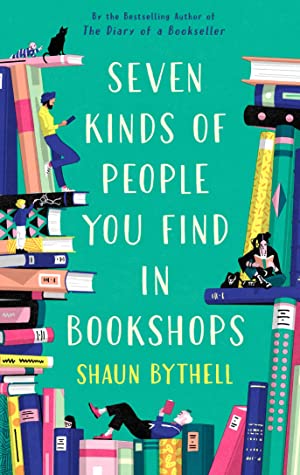 Cheerfully colored and sized to fit into a Christmas stocking, this is a fun follow-up to Bythell’s accounts of life at The Bookshop in Wigtown, The Diary of a Bookseller and Confessions of a Bookseller. Within his seven categories are multiple subcategories, all given tongue-in-cheek Latin names as if naming species. When I saw him chat with Lee Randall at the opening event of the Wigtown Book Festival, he introduced a few, such as the autodidact who knows more than you and will tell you all about their pet subject (the Homo odiosus, or bore). This is not the same, though, as the expert who shares genuinely useful knowledge – of a rare cover version on a crime paperback, for instance (Homo utilis, a helpful person).
There’s also the occultists, the erotica browsers, the local historians, the self-published authors, the bearded pensioners (Senex cum barba) holidaying in their caravans, and the young families – now that he has one of his own, he’s become a bit more tolerant. Setting aside the good-natured complaints, who are his favorite customers? Those who revel in the love of books and don’t quibble about the cost. Generally, these are not antiquarian book experts looking for a bargain, but everyday shoppers who keep a low-key collection of fiction or maybe specifically sci-fi and graphic novels, which fly off the shelves for good prices.
So which type am I? Well, occasionally I’m a farter (Crepans), but you won’t hold that against me, will you? I’d like to think I fit squarely into the normal people category (Homines normales) when I visited Wigtown in April 2018: we went in not knowing what we wanted but ended up purchasing a decent stack and even had a pleasant conversation with the man himself at the till – he’s much less of a curmudgeon in person than in his books. I do recommend this to those who have read and loved his other work.
With thanks to Profile Books for the free copy for review.
The Swallowed Man by Edward Carey
[160 pages]
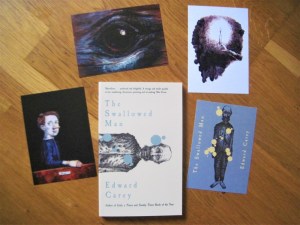
 Carey’s historical novel Little was one of my highlights of 2018, so I jumped at the chance to read his new book. Interestingly, this riff on the Pinocchio story, narrated by Geppetto from the belly of a giant shark, originally appeared in Italian to accompany an exhibition hosted by the Fondazione Nazionale Carlo Collodi at the Parco di Pinocchio in Collodi. Geppetto came from a pottery-painting family but turned to wood when creating a little companion for his loneliness, the wooden boy who astounded him by coming to life. Now a son rather than a mere block of wood, Pinocchio sets off for school but never comes home. When he gets word that a troublesome automaton has been thrown into the sea, Geppetto sets out in a dinghy to find his son but is swallowed by the enormous fish that has been seen off the coast.
The picture of this new world-within-a-world is enthralling. Geppetto finds himself inside a swallowed ship, the Danish schooner Maria. Within the vessel is all he needs to occupy himself, at least for now: wood on which to paint the women he has loved; candle wax and hardtack for sculpting figures. Seaweed to cover his bald spot. Squid ink for his pen so he can write this notebook. A crab that lives in his beard. Relics of the captain’s life to intrigue him.
As a narrator, Geppetto is funny and gifted at wordplay (“This tome is my tomb”; “I unobjected him. Can you object to that?”), yet haunted by his decisions. Carey deftly traces Geppetto’s state of mind as he muses on his loss and imprisonment. The Afterword adds a sly pseudohistorical note to the fantasy. There are black-and-white illustrations throughout, as well as photos of the objects described in the text (and, presumably, featured in the exhibition). For me this didn’t live up to Little, but it would be a great introduction to Carey’s work.
With thanks to Gallic Books for the free copy for review.
At Night All Blood Is Black by David Diop
[145 pages; translated from the French by Anna Moschovakis]
 I had no idea that Africans (“Chocolat soldiers”) fought for France in World War I. Diop’s second novel, which has already won several major European prizes, is about two Senegalese brothers-in-arms caught up in trench warfare. Alfa Ndaiye, aged 20, considers Mademba Diop his blood brother or “more-than-brother” (the novel’s French title is “Soul Brother”). From the start we know that Mademba has died. Gravely injured in battle, entrails spilling out, he begged Alfa to end his misery; three times Alfa refused. Having watched his friend die in agony, he knows he did the wrong thing. Slitting the man’s throat would have been the compassionate choice. From now on, Alfa will atone by brutally wreaking Mademba’s method of death on Germans. “The captain’s France needs our savagery, and because we are obedient, myself and the others, we play the savage.” Alas, I thought this bleak exploration of (in)humanity was marred by the repetitive language and unpleasantly sexualized metaphors.
With thanks to Pushkin Press for the proof copy for review.
Do any of these novellas take your fancy?
What November releases can you recommend?
Wigtown Book Festival 2020: The Bookshop Band, Bythell, O’Connell & Stuart
During the coronavirus pandemic, we have had to take small pleasures where we can. One of the highlights of lockdown for me has been the chance to participate in literary events like book-themed concerts, prize shortlist announcements, book club discussions, live literary award ceremonies and book festivals that time, distance and cost might otherwise have precluded.
In May I attended several digital Hay Festival events, and this September to early October I’ve been delighted to journey back to Wigtown, Scotland – even if only virtually.
The Bookshop Band
The Bookshop Band have been a constant for me this year. After watching their 21 Friday evening lockdown shows on Facebook, as well as a couple of one-off performances for other festivals, I have spent so much time with them in their living room that they feel more like family than a favorite band. Add to that four of the daily breakfast chat shows from the Wigtown Book Festival and I’ve seen them play over 25 times this year already!
(The still below shows them with, clockwise from bottom left, guests Emma Hooper, Stephen Rutt and Jason Webster.)

Ben and Beth’s conversations with featured authors and local movers and shakers, punctuated by one song per guest, were pleasant to have on in the background while working. The songs they performed were, ideally, written for those authors’ books, but other times just what seemed most relevant; at times this was a stretch! I especially liked seeing Donal Ryan, about whose The Spinning Heart they’ve recently written a terrific song; Kate Mosse, who has been unable to write during lockdown so (re)read 200 books instead, including all of Agatha Christie, Ngaio Marsh et al.; and Ned Beauman, who is nearing the deadline for his next novel, a near-future story of two scientists looking for traces of the venomous lumpsucker (a made-up fish) in the Baltic Sea. Closer to science fiction than his previous work, it’s a funny take on extinctions, he said. I’ve read all of his published work, so I’m looking forward to this one.
Shaun Bythell
The opening event of the Festival was an in-person chat between Lee Randall and Shaun Bythell in Wigtown, rather than the split-screen virtual meet-ups that made up the rest of my viewing. Bythell, owner of The Book Shop, has become Wigtown’s literary celebrity through The Diary of a Bookseller and its sequel. In early November he has a new book coming out, Seven Kinds of People You Find in Bookshops. I’m halfway through it and it has more substance than its stocking-stuffer dimensions would imply. Within his seven categories are multiple subcategories, all given tongue-in-cheek Latin names, as if he’s naming species.
The Book Shop closed for 116 days during COVID-19: the only time in more than 40 years that it has been closed for longer than just over the Christmas holidays. He said that it has been so nice to see customers again; they’ve been a ray of sunshine for him, something the curmudgeon would never usually say! Business has been booming since his reopening, with Agatha Christie his best seller – it’s not just Mosse who’s turning to cozy mysteries. He’s also been touched by the kindness of strangers, such as one from Monaco who sent him £300, having read an article by Margaret Atwood about how hard it is for small businesses just now and hoping it would help the shop survive until they could get there in person.
(Below: Bythell on his 50th birthday, with Captain the cat.)

Randall and Bythell discussed a few of the types of customers he regularly encounters. One is the autodidact, who knows more than you and intends for you to know it. This is not the same, though, as the expert who actually helps you by sharing their knowledge (of a rare cover version on an ordinary-looking crime paperback, for instance). There’s also the occultists, the erotica browsers, the local historians and the young families – now that he has one of his own, he’s become a bit more tolerant.
Mark O’Connell
 Appearing from Dublin, Mark O’Connell was interviewed by Scottish writer and critic Stuart Kelly about his latest book, Notes from an Apocalypse (my review). He noted that, while all authors hope their books are timely, perhaps he overshot with this one! The book opens with climate change as the most immediate threat, yet now he feels that “has receded as the locus of anxiety.” O’Connell described the “flattened” experience of being alive at the moment and contrasted it with the existential awfulness of his research travels. For instance, he read a passage from the book about being at an airport Yo Sushi! chain and having a vision of horror at the rampant consumerism its conveyor belt seemed to represent.
Kelly characterized O’Connell’s personal, self-conscious approach to the end of the world as “brave,” while O’Connell said, “in terms of mental health, I should have chosen any other topic!” Having children creates both vulnerability and possibility, he contended, and “it doesn’t do you any good as a parent to indulge in those predilections [towards extreme pessimism].” They discussed preppers’ white male privilege, New Zealand and Mars as havens, and Greta Thunberg and David Attenborough as saints of the climate crisis.

O’Connell pinpointed Dr. Seuss’s The Lorax as the work he spends more time on in his book than any other; none of your classic nihilist literature here, and he deliberately avoided bringing up biblical references in his secular approach. In terms of the author he’s reached for most over the last few years, and especially during lockdown, it’s got to be Annie Dillard. Speaking of the human species, he opined, “it should not be unimaginable that we should cease to exist at some point.”
This talk didn’t add much to my experience of reading the book (vice versa would probably be true, too – I got the gist of Roman Krznaric’s recent thinking from his Hay Festival talk and so haven’t been engaging with his book as much as I’d like), but it was nice to see O’Connell ‘in person’ since he couldn’t make it to the 2018 Wellcome Book Prize ceremony.
Douglas Stuart
Glasgow-born Douglas Stuart is a fashion designer in New York City. Again the interviewer was Lee Randall, an American journalist based in Edinburgh – she joked that she and Stuart have swapped places. Stuart said he started writing his Booker-shortlisted novel, Shuggie Bain, 12 years ago, and kept it private for much of that time. Although he and Randall seemed keen to downplay how autobiographical the work is, like his title character, Stuart grew up in 1980s Glasgow with an alcoholic single mother. As a gay boy, he felt he didn’t have a voice in Thatcher’s Britain. He knew many strong women who were looked down on for being poor.
 It’s impossible to write an apolitical book about poverty (or a Glasgow book without dialect), Stuart acknowledged, yet he insisted that the novel is primarily “a portrait of two souls moving through the world,” a love story about Shuggie and his mother, Agnes. The author read a passage from the start of Chapter 2, when readers first meet Agnes, the heart of the book. Randall asked about sex as currency and postulated that all Agnes – or any of these characters; or any of us, really – wants is someone whose face lights up when they see you.
The name “Shuggie” was borrowed from a small-town criminal in his housing scheme; it struck him as ironic that a thug had such a sweet nickname. Stuart said that writing the book was healing for him. He thinks that men who drink and can’t escape poverty are often seen as loveable rogues, while women are condemned for how they fail their children. Through Agnes, he wanted to add some nuance to that double standard.
The draft of Shuggie Bain was 900 pages, single-spaced, but his editor helped him cut it while simultaneously drawing out the important backstories of Agnes and some other characters. He had almost finished his second novel by the time Shuggie was published, so he hopes it will be with readers soon.
[I have reluctantly DNFed Shuggie Bain at p. 100, but I’ll keep my proof copy on the shelf in case one day I feel like trying it again – especially if, as seems likely, it wins the Booker Prize.]
 Bookish Beck = Rebecca Foster. American transplant to England. Freelance proofreader and book reviewer.
 Bookish Beck
Silly Stuff (Recent Follows, Likes, Searches, and Comments)
Another review catch-up post and the first few of my 20 Books of Summer are coming up later this week. Before that … I’ve been saving up some funny follows and spam comments, as well as a couple of likes on Goodreads that were too apt not to share. I also always enjoy looking at the random searches that have led people to my blog. (Previously surveyed in May 2016, October 2016, June 2017, and July 2020.)
My blog has divine approval.
(I especially love the idea that I can find out “what he’s up to” by reading his blog.)
The right readers found my reviews.
Random searches:
July 29, 2020: shaun bythell anna, val howlett, ruth pavey, romance novel with a butler named bolt
September 15: meaning of ian love doreen, what is the meaning of the title clock dance?
November 20: ordinary planet comic, isabelle’s appearance in olive again
February 10, 2021: promise and fail soap by celestial church, review of the moon and sixpence, books less than 50 pages, winter soldier novel zimmer smoking pipe
March 24: one foot in the grave mr prosnett, employer and “silvie braun”, short poem about a black cat called scarlett
May 7: shaun bythell wedding, jessica fox shaun, who is shaun bythell wife, shaun bythell partner anna
(So much enduring interest in Shaun Bythell’s love life!!)
Spam comments that made me laugh:
August 22, 2020: “Ranunculus, Wax Flowers, Combined Greenery.” (from “Get well soon cards with flowers”)
November 27: “Hi there mates, fastidious paragraph and nice urging commented here, I am truly enjoying by these.”
December 2: “hi, i am woo from Sweden and i want to explain any thing about “pandemic”. Please ask me 🙂”
March 2, 2021: “carrie underwood songs sad”
If you blog, too, do you keep an eye on these things?
What’s the funniest one you had lately?