20 Books of Summer, #1–4: Adichie, de Bernières, Egan, and Styron
The first four books for this summer’s colour theme took me from Australia to New York City to Nigeria, and into a mind plagued by depression.
Purple Hibiscus by Chimamanda Ngozi Adichie (2003)
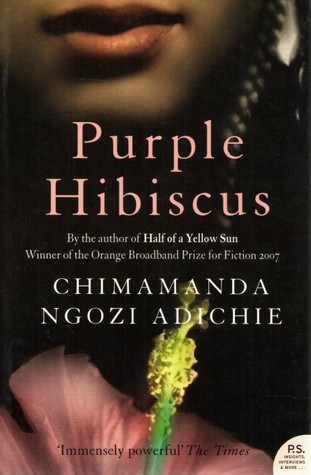 This was my last remaining unread book by Adichie, and that probably goes a long way toward explaining why I found it underwhelming. In comparison to her two later novels, and even her short stories (of which this reminded me the most), the canvas is small and the emotional scope limited. Kambili is a Nigerian teenager caught between belief systems: her grandfather’s traditional (“pagan”) ancestor worship versus the strict Catholicism that is the preserve of her abusive father, but also of the young priest on whom she has a crush. She and her brother try to stay out of their father’s way, but they are held to such an impossibly high standard of behaviour that it seems inevitable that they will disappoint him.
Adichie’s debt to her literary hero, Chinua Achebe, is evident from the first line onward: “Things started to fall apart at home when my brother, Jaja, did not go to communion and Papa flung his heavy missal across the room and broke the figurines on the étagère.” It also sets up, with a certain lack of subtlety, the way in which religion is wielded as a weapon in the novel. Meanwhile, the title suggests rarity, beauty, and fragile hope. Had this been my first taste of Adichie’s fiction, I probably would have stopped there, so in a way I’m glad that I read her first book last. Now I just have to wait with tapping fingers for the next one… (Free from a neighbour) 
Blue Dog by Louis de Bernières (2016)
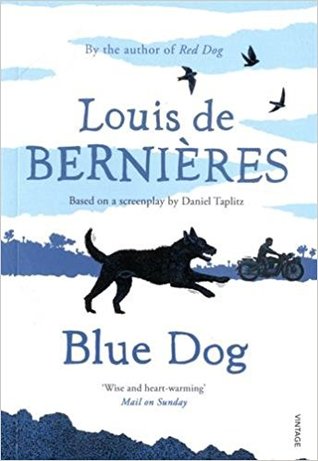 A sweet coming-of-age novella about a boy moving to the Australian Outback to live with his grandfather in the 1960s and adopting a stray dog – a red cloud kelpie, but named Blue. I didn’t realize that this is a prequel (to Red Dog), and based on a screenplay. It was my third book by de Bernières, and it was interesting to read in the afterword that he sees this one as being suited to 12-year-olds, yet most likely to be read by adults.
Mick’s father is dead and his mother has had a breakdown, so Granpa is the only one around to look after him, though out at the cattle station the boy mostly fends for himself, having adventures with stinging lizards and cyclones and bushfires and cursed caves. All along, Blue and his motorcycle are constant companions. Taylor Pete, a wry Aboriginal man, and Betty Marble, a pretty blonde hired as his teacher, are two amusing secondary characters.
This reminded me of Gerald Durrell’s writing about his childhood, and was pleasant airport and plane reading for me: light and fun, but not fluffy, and offering an armchair traveling opportunity. I especially liked the Australian lingo and the blue and black illustrations at the head and foot of each chapter, with a flipbook-style cartoon of a running dog in the upper right corner of each odd-numbered page. (Public library) 
Emerald City by Jennifer Egan (1993)
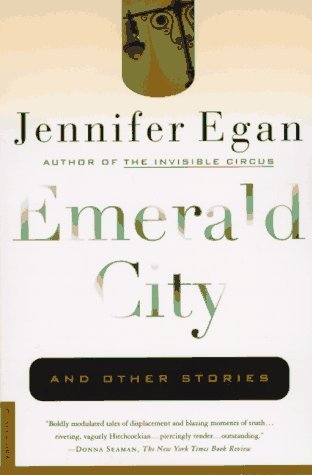 Each of these 11 stories has a fantastic first line – my favorite, from “Sacred Heart,” being “In ninth grade I was a great admirer of Jesus Christ” – but often I felt that these stories of relationships on the brink did not live up to their openers. Most take place in a major city (Chicago, New York, San Francisco) or a holiday destination (Bora Bora, China, Mexico, Spain), but no matter the setting, the terrain is generally a teen girl flirting with danger or a marriage about to implode because the secret of a recent or long-ago affair has come out into the open.
Recurring elements include models/stylists/fashion photographers and people getting conned out of money. The title story is set in New York, described as “a place that glittered from a distance even when you reached it.”
To me the best story, for offering something a bit different, was “One Piece,” about a brother who seems to hurt everything he touches but comes through for his sister when it counts. Egan’s characters are caught between emotional states: remembering a golden age, regretting a moment that changed everything, or hoping that the best is yet to come. “The Stylist” was the one story that reminded me most of A Visit from the Goon Squad. As soon as I closed the book, I found that I had trouble remembering details of any of the stories. (Little Free Library in suburban Philadelphia, May 2019)
Darkness Visible: A Memoir of Madness by William Styron (1990)
 (Visible darkness must have a colour, right?) I had long wanted to read this and finally came across a secondhand copy the other day. What I never realized was that, at 84 pages, it is essentially an extended essay: It started life as a lecture given at Johns Hopkins in 1989, was expanded into a Vanity Fair essay, and then further expanded into this short book.
Approaching age 60 and on his way to Paris to accept a prestigious award, Styron could feel his depression worsening. Rather than being proud or grateful, he could only doubt his own talent. The pills his doctor prescribed him for insomnia exacerbated his feelings of despair. When he threw away the journal he had been keeping, he knew it was a potential prelude to suicide. Hearing a piece by Brahms on a movie soundtrack was the one thing that reminded him of the beauty of the world and the richness of his life, enough for him to reach out and get seven weeks of treatment at a mental hospital, which was what saved him. These experiences, recounted in sections VI and VII, are the highlight of the book.
Styron also muses on the creative temperament and the ubiquity of suicide among writers, especially those who, like him, had an early trauma (his mother died when he was 13). The prose is forthright and intimate, ably evoking a psychic pain that is “quite unimaginable to those who have not suffered it.” This made me want to try his fiction, too. (Secondhand purchase, June 2021) 
Favourite lines:
“each day’s pattern of distress exhibits fairly predictable alternating periods of intensity and relief. The evening’s relief for me—an incomplete but noticeable letup, like the change from a torrential downpour to a steady shower—came in the hours after dinnertime and before midnight, when the pain lifted a little and my mind would become lucid enough to focus on matters beyond the immediate upheaval convulsing my system.”
“Alcohol was an invaluable senior partner of my intellect, besides being a friend whose ministrations I sought daily—sought also, I now see, as a means to calm the anxiety and incipient dread that I had hidden away for so long somewhere in the dungeons of my spirit.”
Next two in progress: A Pair of Blue Eyes by Thomas Hardy and Ruby by Ann Hood.
Read any of these? Interested?
Three on a Theme for Mother’s Day
In advance of (American) Mother’s Day, I picked up two novels and a set of short stories that explore the bonds between mothers and their children, especially daughters. The relationships can be fraught or fractured, but always provide good fodder for psychologically astute fiction.
Mother for Dinner by Shalom Auslander (2020)
Hope: A Tragedy, Auslander’s 2012 debut, is among my absolute favorites, an outrageously funny novel that imagines Anne Frank is alive and dwelling in a suburban attic, frantically tapping out her endless magnum opus. Solomon Kugel, the sap blessed to have an icon sharing his home, has a deluded mother who actually grew up in Brooklyn but believes she survived the Holocaust and now hoards food and curses the Nazis who ruined her life.
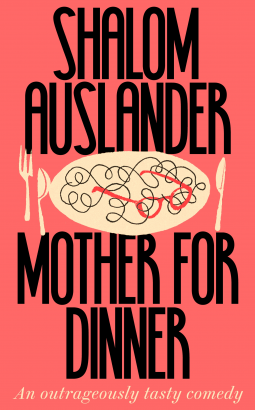 I start with that bit of synopsis because Mother for Dinner showcases rather analogous situations and attitudes, but ultimately didn’t come together as successfully for me. It’s a satire on the immigrant and minority experience in the USA – the American dream of ‘melting pot’ assimilation that we see contradicted daily by tribalism and consumerism. Seventh Seltzer works in Manhattan publishing and has to vet identity stories vying to be the next Great American Novel: “The Heroin-Addicted-Autistic-Christian-American-Diabetic one” and “the Gender-Neutral-Albino-Lebanese-Eritrean-American” one are two examples. But Seventh is a would-be writer himself, compelled to tell the Cannibal-American story.
For years Mudd, the Seltzer family matriarch, has been eating Whoppers for each meal in a customary fattening-up called the Cornucopiacation. She expects her 12 children, who are likely the last of the Cannibal kind, to carry on the tradition of eating her corpse after her death. It’s a way for ancestors to live on in their descendents. The Cannibal Guide, disguised as a deer processing manual, sets out the steps: Drain (within two hours), Purge, Partition, Consume (within 24 hours). Unclish, the Seltzers’ uncle, drilled the rules into them when they were kids through rhymes like “A bite and half / and you won’t need another, / whether it’s your father, your sister, / or even your mother.” From her deathbed, Mudd apportions her body parts to her offspring, some tenderly and some vengefully. Their inheritance – a Brooklyn dump that will still net $5.2 million – is conditional on them performing the ritual.
Interspersed with sections on the practicalities of butchering and cooking a morbidly obese woman are flashbacks to key moments of Cannibal history, which has turned into myth. In 1914, Julius Seltzer left the paradisiacal “Old Country” with his sister Julia, who pretended to be his wife and traveled with him to Detroit to work for Henry Ford. (An overt parody of Jeffrey Eugenides’ Middlesex.) Mudd is vocally intolerant of all other minority groups, from Blacks to homosexuals, and always chooses the version of history that reflects best on her own ancestors, while the Seltzers’ father was more willing to admit flaws.

My proof copy, with a joke on the cover, came with a napkin!
Auslander is pushing the boundary of what an author can get away with, not just with a literal cannibalism storyline but also with jokes about historical atrocities and the recent trend for outing beloved figures as reprehensible (what Seventh calls “Contemporary Assholization Studies”). He shares Lionel Shriver’s glee for tipping sacred cows. I did appreciate his picture of the pervasiveness of xenophobia – the “You’re Not Me” look that anyone can get when walking in an unfamiliar neighborhood – and his willingness to question the value of beliefs and ceremonies once they’ve stopped being reasonable or of use. But with all the siblings known by numbers, it’s hard to distinguish between them. The novel ends up heavy on ideas but light on characterization, and as a whole it leaves a bit of a bad taste in the mouth.
My rating:
With thanks to Picador for the proof copy for review.
The Mothers by Brit Bennett (2016)
{CONTAINS MILD SPOILERS.}
Like so many who were impressed with the Women’s Prize-shortlisted The Vanishing Half, I rushed to get hold of Bennett’s California-set first novel, which, while not as skillfully put together, is nearly as emotionally engaging. After her mother’s suicide, 17-year-old Nadia Turner only has her father, a Marine, but they are bolstered by their church family at Upper Room Chapel. Nadia is a bright girl headed to Michigan for college, but in her senior year she gets mixed up with Pastor Sheppard’s 21-year-old son, Luke, leading to a pregnancy and abortion that his parents swiftly cover up / pay for. Luke drops her at the clinic and hands over the money, but doesn’t pick her up; that looks the acrimonious end of their relationship.
But in the years to come, especially when Nadia takes a break from law school to care for her father, their lives will intersect again. Nadia’s best friend in that final year of high school was Aubrey Evans, who is estranged from her mother, who failed to protect the girl from sexual abuse at the hands of her own boyfriend. Now Aubrey wears a purity ring, enamored with the idea that faith will make her clean again. Once Nadia leaves, she starts dating Luke, ignorant of her best friend’s history with him. This sets up a love triangle mired in layers of secrets.
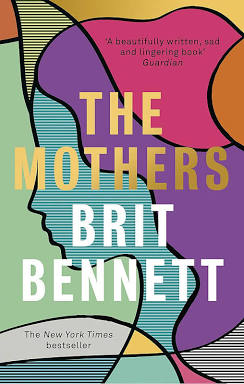 There is dramatic irony here between what the characters know about each other and what we, the readers, know – echoed by what “we,” the church Mothers, observe in the first-person plural sections that open most chapters. I love the use of a Greek chorus to comment on a novel’s action, and The Mothers reminded me of the elderly widows in the Black church I grew up attending. (I watched the video of a wedding that took place there early this month and there they were, perched on aisle seats in their prim purple suits and matching hats.)
Nadia and Aubrey are relatable characters, and Luke earns our sympathy after the cruel return of his football injury. (I was intrigued to see that Peter Ho Davies was one of Bennett’s teachers – his novel A Lie Someone Told You About Yourself is a rare picture of male grief after abortion, also present here.) Bennett explores multiple facets of motherhood: memories of a mother, the absence of a mother, the choice to become a mother, and people who act in the place of a mother by providing physical care or being a source of moral support.
The timeline is a bit too long, which makes the plot wander more than it needs to, but this is a warm and bittersweet novel that always held my interest. Bennett has produced two winners in a row, and I look forward to seeing what she’ll do next.
A favorite line: “Maybe mothers were inherently vast and unknowable.” (not literally vast like in the Auslander!)
Source: Birthday gift (secondhand) from my wishlist last year
My rating: 
Close Company: Stories of Mothers and Daughters, ed. by Christine Park and Caroline Heaton (1987)
I read 14 of 25 stories, skipping to the ones that most interested me (by familiar names like Sue Miller, Sylvia Plath, and Jeanette Winterson), and will read the rest next year. The only story I’d encountered before was Margaret Atwood’s “Significant Moments in the Life of My Mother,” originally published in Bluebeard’s Egg. The title phrase comes from Jamaica Kincaid’s story. A recurring theme is women’s expectations for their daughters, who might repeat or reject their own experiences. As the editors quote from Simone de Beauvoir in the introduction, “the daughter is for the mother at once her double and another person.”
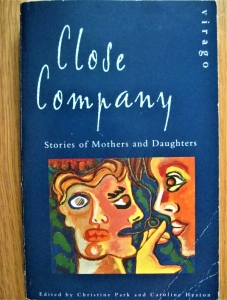 I particularly liked “The Pangs of Love” by Jane Gardam, a retelling of the Hans Christian Andersen fairy tale of “The Little Mermaid,” and “Swans” by Janet Frame, in which a mother takes her two little girls for a cheeky weekday trip to the beach. Fay and Totty are dismayed to learn that their mother is fallible: she chose the wrong beach, one without amenities, and can’t guarantee that all will be well on their return. A dusky lagoon full of black swans is an alluring image of peace, quickly negated by the unpleasant scene that greets them at home.
Two overall standouts thus far were “Everyday Use” by Alice Walker and “The Unnatural Mother” by Charlotte Perkins Gilman. In Walker’s story, which draws on the parable of the Prodigal Son, a hip Afro-wearing daughter returns to her mother’s rural home and covets the quilts and butter churn – to her this is quaint folk art that she wants to take away and display, but her mother and sister resent her condescension towards their ‘backward’ lives.
Gilman is best known for The Yellow Wallpaper, but this story has a neat connection with another classic work: the main character is named Esther Greenwood, which is also the protagonist’s name in Plath’s The Bell Jar (consider this a preview of my next Book Serendipity roundup!). A gossiping gaggle of women discuss Esther’s feral upbringing and blame it for her prioritizing altruism over her duty to her child. A perfect story.
Source: Free mall bookshop
My rating: (so far)
If you read just one … Make it The Mothers. (But do also pick out at least a few stories from the Close Company anthology.)
Book Serendipity, Mid-March to Early May 2021
In early April, the publisher Canongate ran a newsletter competition for one reader to win a stack of their recent releases. All you had to do was reply with your favourite word. On Twitter they gave a rundown of the most popular responses. Turning up several times each were petrichor, mellifluous, and oleaginous. Most frequent of all was serendipity: I was one of 15 to submit it! And one of those entries, but not mine, won. Anyway, fun little story there.
I call it Book Serendipity when two or more books that I read at the same time or in quick succession have something pretty bizarre in common. Because I have so many books on the go at once (usually 20‒30), I suppose I’m more prone to such incidents. I’ve realized that, of course, synchronicity is really the more apt word, but this branding has stuck.
The following are in roughly chronological order.
- A white peacock is mentioned in Indelicacy by Amina Cain and The Mermaid of Black Conch by Monique Roffey, both of which were on the 2021 Rathbones Folio Prize shortlist.

- Speaking of that Rathbones Folio Prize shortlist, four of the eight were paperbacks with French flaps.
- The main character takes ballet lessons in Indelicacy by Amina Cain and A Feather on the Breath of God by Sigrid Nunez.
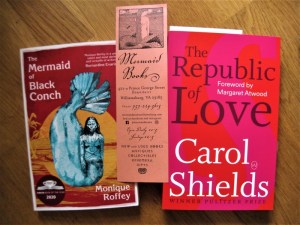
- Mermaids! A big theme in The Mermaid of Black Conch by Monique Roffey (of course) and The Republic of Love by Carol Shields, but they’re also mentioned in the opening story of The Office of Historical Corrections by Danielle Evans and are main characters in “The Pangs of Love” by Jane Gardam in the anthology Close Company.
- The Brothers Grimm story about brothers who have been transformed into swans and their sister who sews shirts out of nettles to turn them back is reworked in The Charmed Wife by Olga Grushin and used as a metaphor in Dusk, Night, Dawn by Anne Lamott.
- An electric carving knife is mentioned as a means of suicide (yipes!) in The Inevitable by Katie Engelhart and Woman on the Edge of Time by Marge Piercy.
- A discussion of the distinction between the fear of dying and the fear of being dead in This Party’s Dead by Erica Buist and The Inevitable by Katie Engelhart.
- Two novels in a row in which an older man is appalled by the squalor of his young girlfriend’s apartment, and she calls him “daddy” during sex (double yipes!), made the Dylan Thomas Prize shortlist: Luster by Raven Leilani and My Dark Vanessa by Kate Elizabeth Russell.


- Architect husbands in The Push by Ashley Audrain and The Art of Falling by Danielle McLaughlin (and, last year, in A Celibate Season by Blanche Howard and Carol Shields), as well as a female architect as a main character in The Living Sea of Waking Dreams by Richard Flanagan earlier this year.
- The next-to-last essay in the Trauma anthology quotes from The Bell Jar by Sylvia Plath, which I was also reading at the time.
- A mention of the eels in London absorbing cocaine from the Thames in the final essay in the Trauma anthology; I then moved right on to the last 40 pages of Nobody Is Talking About This by Patricia Lockwood and the same bizarre fact was mentioned. A week and a half later, there it was again, this time in Asylum Road by Olivia Sudjic.
- A mention of sailors’ habit of getting tattoos of swallows in The Circling Sky by Neil Ansell (who has a swallow tattoo, even though he’s not a sailor) and Birdsong in a Time of Silence by Steven Lovatt.

- A father and teenage child wander an unfamiliar city and enter a sex shop together (yipes yet again!) in Three O’Clock in the Morning by Gianrico Carofiglio and Ten Days by Austin Duffy.
- A mention of the same University of Virginia study in which people self-administered electric shocks to alleviate the boredom of sitting alone with their thoughts in Rooted by Lyanda Lynn Haupt and You’re Not Listening by Kate Murphy.
- Basho’s poetry and George Monbiot’s Feral are both cited in The Circling Sky by Neil Ansell and Rooted by Lyanda Lynn Haupt.
- A dead sister named Mattie in Consent by Annabel Lyon and Drowning Ruth by Christina Schwarz.

- A young Black female protagonist and the same family dynamic (the mother committed suicide and the father is in the Marines/Navy) in The Mothers by Brit Bennett and Luster by Raven Leilani.
- On the same night, I read about two pets encountering snow for the first time: a cat in Close Encounters of the Furred Kind by Tom Cox and a dog in Open Water by Caleb Azumah Nelson.
- A character is described as being as wide as they are tall in Mother for Dinner by Shalom Auslander and The Absolute Book by Elizabeth Knox.


- A character is known as Seventh in Mother for Dinner by Shalom Auslander and the story “The Pangs of Love” by Jane Gardam in the Close Company anthology. Plus, there’s Septimus in Mrs Dalloway by Virginia Woolf, which I’m reading concurrently with those two.
What’s the weirdest reading coincidence you’ve had lately?
BanksRead 2021: Espedair Street (1987)
The dead end just off Lonely Street
It’s where you go, after Desperation Row
Espedair Street
 I had my first taste of Iain Banks’s work last year with The Crow Road and was glad to have an excuse to read more by him for Annabel’s BanksRead challenge.
I chose Espedair Street, which was in surprisingly high demand at my local library: I was in the middle of a queue of five people waiting for a novel released nearly 35 years ago! Luckily, the system’s single copy came in for me in early April.
This was Banks’s fourth novel. I recognized the Glasgow and western Scotland settings and witty dialogue as recurring elements. The Scottish dialect and slang were somehow easier to deal with here than in books like Shuggie Bain. Daniel Weir (nicknamed “Weird”) is a former rock star, washed up though only in his early thirties and contemplating suicide. He has all the money he could ever want, but his relationships seem to have fizzled.
Dan takes us back to the start of his time with the band Frozen Gold in the 1970s. He acknowledges that he only ever had limited musical talent; although he can play the bass well enough, his real gift is for lyrics. Songwriting was mostly what he had to offer when he met bandmates Dave and Christine after their gig at the Union:
What am I doing here? I thought once more. They don’t need me, no matter how good the songs are. They’ll always be heading in different directions, moving in different circles, higher spheres. Jesus, this was life or death to me, my one chance to make the great working class escape. I couldn’t play football; what other hope was there to get into the supertax bracket?
Boldly, he told them that night that they were a good covers band but needed their own material, and he had sheaves of songs at the ready. From here, it was an unlikely road to a world tour in 1980, but a perhaps more predictable slide into the alcohol abuse and gratuitous displays of wealth that will leave Dan questioning what of true value he retains.
Dan’s voice, as in the passage above, is mischievous yet confessional. The sex, drugs, and rock ‘n’ roll theme made me think of Taylor Jenkins Reid’s Daisy Jones & the Six, a rather more enjoyable novel for its interview format and multiple perspectives, but both include pleasing made-up lyrics. Here Dan’s frequent use of ellipses threatened to drive me mad. It might seem a small thing but it’s one of my pet peeves.
I think I’ll make The Bridge my next from Banks – my library owns a copy, and he called it his favourite of his books.
Do check out all of Annabel’s coverage from the past week: she’s given a great sense of the breadth of Banks’s work, from science fiction to poetry.

February Releases by de Visser, George, Lawson, and Smiley
Nonfiction about doctors’ memorable patients and a life of chronic pain and disability; novels set in 1970s Canada and contemporary (but magically outside-of-time) Paris.
That One Patient: Doctors’ and nurses’ stories of the patients who changed their lives forever by Ellen de Visser
[Translated from the Dutch by Brent Annable]
Ellen de Visser is a science writer for the most popular newspaper in the Netherlands, De Volkskrant. Her “That One Patient” column, which began in the summer of 2017, turns interviews with medical professionals into punchy first-person narratives. A collection of them was published in Dutch in 2019. This English translation tacks on 10 additional pieces based on conversations with English and American practitioners (including Dr. Anthony Fauci, immunologist and presidential medical advisor), four of them explicitly reflecting on COVID-19.
Many of the cases are decades old yet stuck with the doctor or nurse in question because of a vital lesson learned. Overtreatment is regretted just as much as an omission of care. Again and again, these medical professionals conclude that it’s impossible to judge someone else’s decisions or quality of life. For instance, a surgeon admits he had a hard time empathizing with his obese patients undergoing stomach reduction until he followed up with a young woman who told him about how invisible she’d felt before her surgery. Premature and disabled children bring grief or joy, not always in the expected doses. A doctor resents the work his team puts into repairing a woman who jumped from an eighth-floor window – why the heroic measures for someone who wanted to die? – until he learns she was pushed. A cancer surgeon develops breast cancer and now knows exactly what her patients go through.
 Some of these stories are disturbing: being stalked by a patient with a personality disorder, a man poisoning his girlfriend, a farmer predicting the very day and time of his death. A gynaecologist changes his mind about abortion after he meets a 15-year-old who gave birth at home and left her baby outside in a plastic bag to die of exposure. Other pieces are heart-warming: A paramedic delivers a premature, breech baby right in the ambulance. Staff throw a wedding at the hospital for a dying teen (as in Dear Life by Rachel Clarke). A woman diagnosed with cancer while pregnant has chemotherapy and a healthy baby – now a teenager. There’s even a tale from a vet who crowdfunded prostheses for a lively terrier.
One unique thing about the Netherlands is that euthanasia is legal and provided by doctors upon the express request of a patient suffering from a terminal illness. It is taken for granted in these essays, yet some interviewees express their discomfort with it as an option for young patients. De Visser is careful to note that, even with the situation as it is, only 4% of deaths in the Netherlands are by euthanasia, and the majority of these are end-stage cancer cases.
As with any collection of this nature, some stories are more enticing than others, but overall I found it a surprising and moving set of reflections that is alive to ethical complexities and grapples with tough issues like disability, doctor error, loneliness, pain, and sense of purpose.
Two quotes, in particular, stood out to me, one from a nurse – “We are only ever guests in other people’s lives, and that’s how we ought to behave” – and the other from Dr. Fauci’s piece. In 2014 he treated a doctor who had been volunteering in Sierra Leone after an Ebola outbreak but became ill with the virus and had to be evacuated. “He cited Hippocrates: ‘It is far more important to know what sort of person has the disease, rather than what sort of disease the person has.’ You treated me like a person, not a disease, he said. And that’s what medicine is all about.” 
With thanks to 4th Estate for the proof copy for review.
A Still Life: A Memoir by Josie George
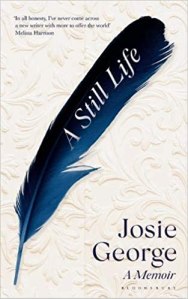 Over a year of lockdowns, many of us have become accustomed to spending most of the time at home. But for Josie George, social isolation is nothing new. Chronic illness long ago reduced her territory to her home and garden. The magic of A Still Life is in how she finds joy and purpose despite extreme limitations. Opening on New Year’s Day and travelling from one winter to the next, the book is a window onto George’s quiet existence as well as the turning of the seasons. (My full review will appear in a forthcoming issue of the Times Literary Supplement. See also Eleanor’s thorough review.) This is top of my wish list for next year’s Barbellion Prize shortlist.
With thanks to Bloomsbury for the proof copy for review.
A Town Called Solace by Mary Lawson
I discovered Mary Lawson in 2015 with Road Ends and caught up with Crow Lake in the summer of 2019. All four of her books are set in fictional locations inspired by the villages and rural areas of Northern Ontario, where the author grew up before moving to England in 1968. So Solace, while not a real town, is true to her memory and, despite the sometimes gruff or know-it-all locals, an emotional landmark for the three central characters, all of whom are processing trauma and looking for places of comfort where they can start over.
 1972. First we meet Clara, a plucky seven-year-old sitting vigil. She’s waiting for the return of two people: her sixteen-year-old sister, Rose, who ran away from home; and their next-door neighbour, Mrs. Orchard, whose cat, Moses, she’s feeding until the old lady gets back from the hospital. As days turn into weeks, though, it seems less likely that either will come home, and one day Clara sees a strange man moving boxes around in Mrs. Orchard’s house. This is Liam Kane, who’s inherited the house from a family friend. In his thirties and recently divorced, he’s taking a break in this tiny town, never imagining that he might find a new life. The third protagonist, and only first-person narrator, is Elizabeth, who lies in a hospital bed with heart trouble and voices her memories as a monologue to her late husband.
As we cycle through these three characters’ perspectives in alternating chapters, we gradually come to understand the connections between them. There are satisfying parallels in that, on multiple occasions but in slightly different ways, a child attaches to an older person or an adult stands in as a guardian for a neglected child. All of Lawson’s creations, even the secondary figures, are dealing with distressing memories or a loss of some kind, the details of which might only emerge much later on. Solace offers myriad opportunities for recovery, whether kitty playtime at Mrs. Orchard’s or diner food and homemade ice cream.
Like Lawson’s other works, this is a slow burner featuring troubled families. Her characters, often full of regret and sorrow, take a shadowy past as a prompt to reset their lives. They’re charming in spite of their flaws. I recalled that Crow Lake also looks back to the climactic happenings experienced by a seven-year-old girl. And like Road Ends, A Town Called Solace makes a convincing case for present decisions being influenced by historical trauma. It’s a tender and inviting story I’d recommend to readers of Wendy McGrath and Anne Tyler, with Clever Girl by Tessa Hadley and Olive, Again by Elizabeth Strout as specific readalikes. (My dilemma now is whether to read my only remaining Lawson novel, The Other Side of the Bridge, right away or save it: she’s not the most prolific author, with four books in 19 years.)
A favorite passage:
[Liam’s] life prior to coming north seemed to be taking on the quality of an old movie, one in which he’d been deeply engrossed while watching it but which now seemed trivial, unconvincing and profoundly lacking in either colour or plot. Solace had colour and plot in spades, maybe too much. In every way it was coming to seem more real than Toronto, with its endless malls and traffic jams and high-powered jobs. Though maybe, if he went back to Toronto, the same would be true in reverse. Maybe when he’d been back for a couple of months he’d find that it was Solace that seemed unreal, its unremarkable streets and stores like something from a dream, its dramatic landscape fading to nothing, like a holiday photo left in the sun.
With thanks to Chatto & Windus for the free copy for review.
The Strays of Paris by Jane Smiley
(Published in the USA in December 2020 under the title Perestroika in Paris. It’s been given a The Boy, the Mole, the Fox and the Horse treatment for its UK release.)
 My summary for Bookmarks magazine: “A racehorse, Perestroika—nicknamed Paras—strays from her unlocked suburban stable one day, carrying her groom’s purse in her mouth, and ends up in Paris’s Place du Trocadéro. Here she meets Frida the dog, Sid and Nancy the mallards, and Raoul the raven. Frida, whose homeless owner died, knows about money. She takes euros from the purse to buy food from a local market, while Paras gets treats from a baker on predawn walks. Etienne, an eight-year-old orphan who lives with his ancient great-grandmother, visits the snowy park to feed the wary animals (who can talk to each other), and offers Paras a home. A sweet fable for animal lovers.”
Yes, this is a talking animal book, but the animals only talk to each other; they communicate with humans through their gestures and soulful eyes. Kindly shopkeepers work out what Frida wants to buy based on what she stares at or points to with a paw; the baker whose window Paras passes on her early morning walks intuits that the horse is hungry; Etienne, who gives a couple of the stray animals a home during a chill winter, learns to understand when Paras needs to go out to relieve herself, after piles of dung build up in the sitting room.
I liked how patiently and convincingly Smiley builds the portrait of each character – human or animal – and the overall situation of kindness and good fortune. Raoul is particularly amusing for his birdsplaining: “It is a feature of age. I have learned so many things in my life that they just force their way out of my beak,” he says. However, a crow would be much more realistic for Paris (or any city) than a raven, and, overall, this was a little twee and farfetched for my tastes. It was nice to read something a bit different from Smiley, who I haven’t tried since her Last Hundred Years Trilogy. She has a sideline in YA horse novels; this should probably have been lumped with those. (Annabel liked it a bit more.)
I was sent an unsolicited review copy by Picador/Mantle.
What recent releases can you recommend?
The Clock Winder by Anne Tyler (1972)
This year I’m joining in Liz’s Anne Tyler readalong for all of the Tyler novels that I own and haven’t read yet (at least the ones I can access; others are marooned in a box in the States). The Clock Winder was Tyler’s fourth novel and the first to take place in Baltimore, her trademark setting. It’s the earliest of her works that I’ve read. (See also Liz’s review.)
When I reviewed Clock Dance back in 2018, I wondered if there could be a connection between the two novels beyond their titles. A clock, of course, symbolizes the passage of time, so invites us to think about how the characters change and what stays the same over the years. But there is, in fact, another literal link: in both books, there is a fairly early mention of a gun – and, if you know your Chekhov quotes, that means it’s going to go off. Whereas in Clock Dance the gunshot has no major consequences, here it’s a method of suicide. So the major thing to surprise me about The Clock Winder is that it goes to a dark place that Tyler’s fiction rarely visits, though an additional later threat comes to nothing.
 As the novel opens in 1960, Pamela Emerson fires the Black handyman who has worked for her for 25 years. “The house had outlived its usefulness,” what with Mr. Emerson dead these three months and all seven children grown up and moved out. Mrs. Emerson likes to keep up appearances – her own hair and makeup, and the house’s porch furniture, which a passerby helps her move. This helpful stranger is Elizabeth Abbott, a Baptist preacher’s daughter from North Carolina who is taking on odd jobs to pay for her senior year of college. Mrs. Emerson hires Elizabeth as her new ‘handyman’ for $40 a week. One of her tasks is to wind all the clocks in the house. Though she’s a tall tomboy, Elizabeth attracts a lot of suitors – including two of the Emerson sons, Timothy and Matthew.
We meet the rest of the Emerson clan at the funeral for the aforementioned suicide. There’s a very good post-funeral meal scene reminiscent of Carol Shields’s party sequences: disparate conversations reveal a lot about the characters. “We’re event-prone,” Matthew writes in a letter to Elizabeth. “But sane, I’m sure of that. Even Andrew [in a “rest home” for the mentally ill] is, underneath. Probably most families are event-prone, it’s just that we make more of it.” In the years to come, Elizabeth tries to build a life in North Carolina but keeps being drawn back into the Emersons’ orbit: “Life seemed to be a constant collision … everything recurred. She would keep running into Emersons until the day she died”.
The main action continues through 1965 and there is a short finale set in 1970. While I enjoyed aspects of the characters’ personalities and interactions, the decade span felt too long and the second half is very rambly. A more condensed timeline might have allowed for more of the punchy family scenes Tyler is so good at, even this early in her career. (There is a great left-at-the-altar scene in which the bride utters “I don’t” and flees!) Still, Elizabeth is an appealing antihero and the setup is out of the ordinary. I liked comparing Baltimore then and now: in 1960 you get a turkey being slaughtered in the backyard for Thanksgiving, and pipe smoking in the grocery store. It truly was a different time. One nice detail that persists is the 17-year cicadas.
You can see the seeds of some future Tyler elements here: large families, sibling romantic rivalries, secrets, ageing and loss. The later book I was reminded of most was Back When We Were Grown-ups, in which a stranger is accepted into a big, bizarre family and has to work out what role she is to play. A Tyler novel is never less than readable, but this ended up being my least favorite of the 12 I’ve read so far, so I doubt I’ll read the three that preceded it. Those 12, in order of preference (greatest to least), are:
Dinner at the Homesick Restaurant
Ladder of Years
The Accidental Tourist
Breathing Lessons
Digging to America
Vinegar Girl
Clock Dance
Back When We Were Grown-ups
A Blue Spool of Thread
The Beginner’s Goodbye
Redhead by the Side of the Road
The Clock Winder
Source: Charity shop
My rating: 
Next up for me will be Earthly Possessions in mid-April.
October Releases by Rachel Mann, Sigrid Nunez and Ruth Janette Ruck
A calmer month for new releases after September’s bumper crop. I read a sophisticated mystery set at a theological college, a subtle novel about empathy and being a good friend, and a memoir of raising one of Britain’s first llamas.
The Gospel of Eve by Rachel Mann
Last year I dipped into Mann’s poetry (A Kingdom of Love) and literary criticism/devotional writing (In the Bleak Midwinter); this year I was delighted to be offered an early copy of her debut novel. The press materials are full of comparisons to Donna Tartt’s The Secret History; it’s certainly an apt point of reference for this mystery focusing on clever, Medieval-obsessed students training for the priesthood at a theological college outside Oxford.
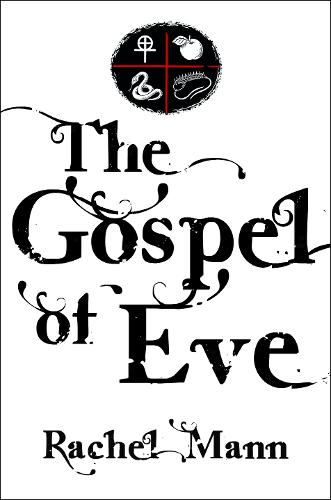 It’s 1997 and Catherine Bolton is part of the first female intake at Littlemore College. She has striven to rid herself of a working-class accent and recently completed her PhD on Chaucer, but feels daunted by her new friends’ intelligence and old-money backgrounds: Ivo went to Eton, Charlie is an heiress, and so on. But Kitty’s most fascinated with Evie, who is bright, privileged and quick with a comeback – everything Kitty wishes she could be.
If you think of ordinands as pious and prudish, you’ll be scandalized by these six. They drink, smoke, curse and make crude jokes. In seminars with Professor Albertus Loewe, they make provocative mention of feminist theory and are tempted by his collection of rare books. Soon sex, death and literature get all mixed up as Kitty realizes that her friends’ devotion to the Medieval period goes as far as replicating dangerous rituals. We know from the first line that one of them ends up dead. But what might it have to do with the apocryphal text of the title?
I didn’t always feel the psychological groundwork was there to understand characters’ motivations, but I still found this to be a beguiling story, well plotted and drenched in elitism and lust. Mann explores a theology that is more about practice, about the body, than belief. Kitty’s retrospective blends regret and nostalgia: “We were the special ones, the shining ones,” and despite how wrong everything went, part of her wouldn’t change it for the world.
My thanks to publicist Hannah Hargrave for the proof copy for review. Published today by Darton, Longman & Todd Ltd.
What Are You Going Through by Sigrid Nunez
A perfect follow-up to The Friend and very similar in some ways: again we have the disparate first-person musings of an unnamed narrator compelled to help a friend. In Nunez’s previous novel, the protagonist has to care for the dog of a man who recently killed himself; here she is called upon to help a terminally ill friend commit suicide. The novel opens in September 2017 in the unfamiliar town she’s come to for her friend’s cancer treatments. While there she goes to a talk by an older male author who believes human civilization is finished and people shouldn’t have children anymore. This prophet of doom is her ex.
 His pessimism is echoed by the dying friend when she relapses. The narrator agrees to accompany her to a rental house where she will take a drug to die at a time of her choosing. “Lucy and Ethel Do Euthanasia,” the ex jokes. And there is a sort of slapstick joy early in this morbid adventure, with mishaps like forgetting the pills and flooding the bathroom.
As in Rachel Cusk’s Outline trilogy, the voice is not solely or even primarily the narrator’s but Other: her friend speaking about her happy childhood and her estrangement from her daughter; a woman met at the gym; a paranoid neighbor; a recent short story; a documentary film. I felt there was too much recounting of a thriller plot, but in general this approach, paired with the absence of speech marks, reflects how the art we consume and the people we encounter become part of our own story. Curiosity about other lives fuels empathy.
With the wry energy of Jenny Offill’s Weather, this is a quiet novel that sneaks up to seize you by the heartstrings. “Women’s stories are often sad stories,” Nunez writes, but “no matter how sad, a beautifully told story lifts you up.” Like The Friend, which also ends just before The End, this presents love and literature as ways to bear “witness to the human condition.”
With thanks to Virago for the proof copy for review.
Along Came a Llama: Tales from a Welsh Hill Farm by Ruth Janette Ruck
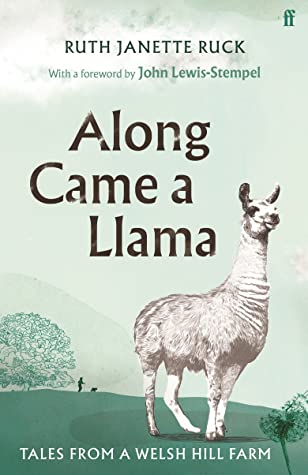 Originally published in 1978 (now reissued with a foreword by John Lewis-Stempel), this is an enjoyably animal-stuffed memoir reminiscent of Gerald Durrell and especially Doreen Tovey. Ruck (d. 2006) and her family – which at times included her ill sister, her elderly mother and/or her sister-in-law – lived on a remote farm in the hills of North Wales. On a visit to Knaresborough Zoo, Ruck was taken with the llamas and fancied buying one to add to their menagerie of farm animals. It was as simple as asking the zoo director and then taking the young female back to Wales in a pony box. At that time, hardly anyone in the UK knew anything about llamas or the other camelids. No insurance company would cover their llama in transit; no one had specialist knowledge on feeding or breeding. Ruck had to do things the old-fashioned way, finding books and specialist scientific papers.
But they mostly learned about Ñusta (the Quechua word for princess) by spending time with her. At holidays they discovered her love of chocolate Easter eggs and cherry brandy. The cud-chewing creature sometimes gave clues to what else she’d been eating, as when she regurgitated plum stones. She didn’t particularly like being touched or trailed by an orphaned lamb, but followed Ruck around dutifully and would sit sociably in the living room. Life with animals often involves mild disasters: Ñusta jumps in a pool and locks Ruck’s husband in the loo, and the truck breaks down on the way to mate her with the male at Chester Zoo.

A vintage cover I found on Goodreads.
From spitting to shearing, there was a lot to get used to, but this account of the first three years of llama ownership emphasizes the delights of animal companionship. There were hardships in Ruck’s life, including multiple sclerosis and her sister’s death, but into the “austere but soul-rewarding life of a hill firm … like a catalyst or a touch of magic, the llama came along.” I was into llamas and alpacas well before the rest of the world – in high school I often visited a local llama farm, and I led a llama in a parade and an alpaca in a nativity play – so that was my primary reason for requesting this, but it’s just right for any animal lover.
With thanks to Faber & Faber for the free copy for review.
What recent releases can you recommend?
Completing the Women’s Prize Winners Reading Project and Voting
In this 25th anniversary year of the Women’s (previously Orange/Baileys) Prize, people have been encouraged to read all of the previous winners. I duly attempted to catch up on the 11 winners I hadn’t yet read, starting with Fugitive Pieces by Anne Michaels; Half of a Yellow Sun by Chimamanda Ngozi Adichie and A Crime in the Neighborhood by Suzanne Berne as part of a summer reading post; and When I Lived in Modern Times by Linda Grant, Property by Valerie Martin and Larry’s Party by Carol Shields (a reread) in this post.
This left just four for me to read before voting for my all-time favorite in the web poll. I managed two as recent buddy reads but had to admit defeat on the others, giving them just the barest skim before sending them back to the library.
The Idea of Perfection by Kate Grenville (1999; 2001 prize)
(Buddy read with Laura T.; see her review here)
 This is essentially an odd-couple romance, but so awkward I don’t think any of its scenes could accurately be described as a meet-cute. Harley Savage, a thrice-married middle-aged widow, works for the Applied Arts Museum in Sydney. The tall, blunt woman is in Karakarook, New South Wales to help the little town launch a heritage museum. Douglas Cheeseman is a divorced engineer tasked with tearing down a local wooden bridge and building a more suitable structure in its place. Their career trajectories are set to clash, but the novel focuses more on their personal lives. From the moment they literally bump into each other outside Douglas’ hotel, their every meeting is so embarrassing you have to blush – she saves him from some angry cows, while he tends to her after a bout of food poisoning.
Grenville does well to make the two initially unappealing characters sympathetic, primarily by giving flashes of backstory. Douglas is the posthumous child of a war hero, but has never felt he’s a proper (macho) Australian man. In fact, he has a crippling fear of heights, which is pretty inconvenient for someone who works on tall bridges. Harley, meanwhile, is haunted by the scene of her last husband’s suicide and is also recovering from a recent heart attack.
The title is, I think, meant to refer to how the protagonists fail to live up to ideals or gender stereotypes. However, it more obviously applies to the subplot about Felicity Porcelline, a stay-at-home mother who has always sought to be flawless – a perfect pregnancy, an ageless body (“Sometimes she thought she would rather be dead than old”), the perfect marriage – but gets enmired in a dalliance with the town butcher. I was never convinced Felicity’s storyline was necessary. Without it, the book might have been cut from 400 pages to 300.
Still, this was a pleasant narrative of second chances and life’s surprises. The small-town setting reminded Laura of Olive Kitteridge in particular, and I also thought frequently of Anne Tyler and her cheerfully useless males (“There was a lot to be said for being boring, and it was something [Douglas] was good at”). But I suspect the book won’t remain vivid in my memory, especially with its vague title that doesn’t suggest the contents. I enjoyed Grenville’s writing, though, so will try her again. In my mind she’s more known for historical fiction. I have a copy of The Secret River, so will see if she lives up to that reputation.
My rating:
How to Be Both by Ali Smith (2014)
(Buddy read with Marcie of Buried in Print.)
 A book of two halves, one of which I thoroughly enjoyed; the other I struggled to engage with. I remembered vaguely as I was reading it that this was published in two different versions. As it happened, my library paperback opened with the contemporary storyline.
New Year’s Day marks the start of George’s first full year without her mother, a journalist who died at age 50. Her mother’s major project was “Subvert,” which used Internet pop-ups to have art to comment on politics and vice versa. George remembers conversations with her mother about the nature of history and art, and a trip to Italy. She’s now in therapy, and has a flirty relationship with Helena (“H”), a mixed-race school friend.
Smith’s typical wordplay comes through in the book’s banter, especially in George and H’s texts. George is a whip-smart grammar pedant. Her story was, all in all, a joy to read. There is even a hint of mystery here – is it possible that her mother was being monitored by MI5? When George skips school to gaze at her mother’s favorite Francesco del Cossa painting in the National Gallery, she thinks she sees Lisa Goliard, her mother’s intense acquaintance, who said she was a bookbinder but acted more like a spy…
The second half imagines a history for Francesco del Cossa, who rises from a brick-making family to become a respected portrait and fresco painter. The artist shares outward similarities with George, such as a dead mother and homoerotic leanings. There are numerous tiny connections, too, some of which I will have missed as my attention waned. The voice felt all wrong for the time period; I sensed that Smith wasn’t fully invested in the past, so I wasn’t either. (In dual-timeline novels, I pretty much always prefer the contemporary one and am impatient to get back to it; at least in books like Unsheltered and The Liar’s Dictionary there are alternate chapters to look forward to if the historical material gets tedious.)
An intriguing idea, a very promising first half, then a drift into pretension. Or was that my failure to observe and appreciate? Smith impishly mocks: “If you notice, it changes everything about the picture.” With her format and themes, she questions accepted binaries. There are interesting points about art, grief and gender, even without the clever links across time. But had the story opened with the other Part 1, I may never have gotten anywhere.
My rating:
Skims
I made the mistake of leaving the three winners that daunted me the most stylistically – McBride, McInerney and Smith – for last. I eventually made it through the Smith, though the second half was quite the slog, but quickly realized these two were a lost cause for me.
 A Girl Is a Half-formed Thing by Eimear McBride: I’d glanced at the first few pages in a shop before and found the style immediately off-putting. When I committed to this #ReadingWomen project, I diligently requested a copy from the university library even though I seriously doubted I’d have the motivation to read it. It turns out my first impression was correct: I would have to be paid much more than I’ve ever been paid for writing about a book just to get through this one. From the first paragraph on, it’s deliberately impenetrable in a sub-Joycean way. Ron Charles, the Washington Post book critic and one of my literary heroes/gurus, found the subject matter relentlessly depressing and the obfuscating style elitist. (Might it work as an audiobook? I can’t say; I’ve never listened to one.)
 The Glorious Heresies by Lisa McInerney: Not as stylistically difficult as expected, though there is mild dialect and long passages in italics (one of my reading pet peeves). But I’m not drawn to gangster stories, and after a couple of chapters didn’t feel like pushing myself through the book. I did enjoy the setup of Maureen killing an intruder with a holy stone, eliciting this confession: “I crept up behind him and hit him in the head with a religious ornament. So first I suppose God would have to forgive me for killing one of his creatures and then he’d have to forgive me for defiling one of his keepsakes.” For Anna Burns and Donal Ryan fans, perhaps?
It’s been many years since I’ve read some of these novels, such that all I have to go on is my vague memories and Goodreads ratings, and there are a handful there towards the bottom that I couldn’t get through at all, but I still couldn’t resist having a go at ranking the 25 winners, from best to least. My completely* objective list:
(*not at all)
Larry’s Party by Carol Shields
Half of a Yellow Sun by Chimamanda Ngozi Adichie
We Need to Talk about Kevin by Lionel Shriver
An American Marriage by Tayari Jones
The Tiger’s Wife by Téa Obreht
On Beauty by Zadie Smith
Home Fire by Kamila Shamsie
A Crime in the Neighborhood by Suzanne Berne
The Road Home by Rose Tremain
When I Lived in Modern Times by Linda Grant
The Idea of Perfection by Kate Grenville
Fugitive Pieces by Anne Michaels
The Lacuna by Barbara Kingsolver
Bel Canto by Ann Patchett
May We Be Forgiven by A.M. Homes
Property by Valerie Martin
Small World by Andrea Levy
Home by Marilynne Robinson
How to Be Both by Ali Smith
The Power by Naomi Alderman
Hamnet by Maggie O’Farrell
A Spell of Winter by Helen Dunmore
The Glorious Heresies by Lisa McInerney
The Song of Achilles by Madeline Miller
A Girl Is a Half-formed Thing by Eimear McBride
You can see the arbitrary nature of prizes at work here: some authors I love have won for books I don’t consider their best (Adichie, Kingsolver, O’Farrell, Patchett), while some exceptional female authors have been nominated but never won (Toni Morrison, Elizabeth Strout, Anne Tyler). Each year the judges are different, and there are no detailed criteria for choosing the winner, so it will only ever be the book that five people happen to like the best.
As she came out top of the heap with what is, coincidentally, the only one of the winning novels that I have managed to reread, my vote goes to Carol Shields for Larry’s Party. (People’s memory for prize winners is notoriously short, so I predict that one of the last two years’ winners, Tayari Jones or Maggie O’Farrell, will win the public’s best of the best vote.)

You have until midnight GMT on Sunday November 1st to vote for your favorite winner at this link. That’s less than a week away now, so get voting!
Note: If you’re interested in tracking your Women’s Prize reading over the years, check out Rachel’s extremely helpful list of all the nominees. It comes in spreadsheet form for you to download and fill out. I have read 138 nominees (out of 477) and DNFed another 19 so far.
Who gets your vote?
Short Stories in September, Part I
Each September I make a bit more of an effort to read short stories, which otherwise tend to sit on my shelves and Kindle unread. I’ve read three collections recently, all of them released this August or September, and I have a few more on the go to report on later in the month.
Likes by Sarah Shun-Lien Bynum
 This was a hit and miss collection for me: I only loved one of the stories, and enjoyed another three; touches of magic realism à la Aimee Bender produce the two weakest stories, and there are a few that simply tail off without having made a point. My favorite was “Many a Little Makes,” about a trio of childhood best friends whose silly sleepover days come to an end as they develop separate interests and one girl sleeps with another one’s brother. In “Tell Me My Name,” set in a post-economic collapse California, an actress who was a gay icon back in New York City pitches a TV show to the narrator’s wife, who makes kids’ shows.
“Julia and Sunny,” about two couples – one that makes it and one that doesn’t – who all met in medical school, reminded me of a Wallace Stegner plot. “The Bears” has a wispy resemblance to Goldilocks and the Three Bears and stars a woman convalescing from a miscarriage at a retreat center while writing a chapter on William James. In James’s famous metaphor involving a bear, bodily action precedes emotion – we are afraid because we flee; not vice versa. The touch of magic in this story is light enough to not be off-putting, whereas “The Erlking” and “The Young Wife’s Tale” take their fairy tale similarities too far.
The title story, about a father trying to understand his 12-year-old through her Instagram posts either side of the Trump election, is promising but doesn’t go anywhere, and “The Burglar” and “Bedtime Story” struck me as equally insubstantial, making nothing of their setups. Seven of these nine stories had been previously published in other publications in some form.
My rating:
Published in the USA by Farrar, Straus and Giroux. I read an advanced e-copy via Edelweiss.
Black Light by Kimberly King Parsons
 Parsons’s debut collection, longlisted for the U.S. National Book Award in 2019, contains a dozen gritty stories set in or remembering her native Texas. Eleven of the 12 are in the first person, with the mostly female narrators unnamed or underdeveloped and thus difficult to differentiate from each other. The homogeneity of voice and recurring themes – drug use, dysfunctional families, overweight bodies, lesbian or lopsided relationships – lead to monotony.
“Glow Hunter” and “We Don’t Come Natural to It” are representative: in the former, Sarah and her girlfriend Bo have sex and go for a drive while tripping on magic mushrooms; in the latter, the narrator has a crush on her co-worker Suki, who has lost 200 pounds, and they remain obsessed with their and others’ fat bodies (the references are inescapable: “a pudgy,” “the fatty,” “some cow,” “thinspiration”). The opening story, “Guts,” is uncomfortable for the way that it both fetishizes fat and medicalizes sex: when unreliable, alcoholic receptionist Sheila turns up at her boyfriend Tim’s hospital saying there’s something wrong with her internally, he performs an examination that’s part striptease and part children playing doctor.
“The Light Will Pour In” is refreshingly different for its Lolita-type situation. “Into the Fold,” set at a girls’ boarding school, reminded me of Scarlett Thomas’s Oligarchy. In “Fiddlebacks,” my favorite, siblings on a night hunt for creepy-crawlies come across their newly religious mother and the handyman trysting in a car. “Starlite,” the only one in the third person, has colleagues, one a supervisor and both married, meet up in a seedy motel for drugs and junk food. The shortest stories at just a few pages each, “In Our Circle” and “The Animal Part” animate art therapy in a mental hospital and urban legends told while camping (though I’d forgotten it, I’d encountered the former in The Best Small Fictions 2017).
These stories engaged me at neither the sentence level nor the plot level, but many readers (and critics) have felt otherwise. Here are two lines I liked, from “Glow Hunter”: “Bo says everything that scares you is something to poke at with a stick, to pick up and turn in your hands” & “I’m very aware that we are organisms on the surface of a rock, orbiting a burning star.”
My rating: 
My thanks to Atlantic Books for the free copy for review.
You Will Never Be Forgotten by Mary South
“In the modern world, you might be easily forgotten, but you could also carve out your own niche.”

In the 10 stories of this debut collection, characters turn to technology to stake a claim on originality, compensate for their losses, and leave a legacy. In “Keith Prime,” a widowed nurse works at a warehouse that produces unconscious specimens for organ harvesting. When her favorite Keith wakes up, she agrees to raise him at home, but human development and emotional connection are inconveniences in a commodity. The narrator of “FAQs about Your Craniotomy” is a female brain surgeon who starts out by giving literal answers to potential patient questions and then segues into bitterly funny reflections on life after her husband’s suicide.
In “Architecture for Monsters,” a young woman interviews Helen Dannenforth, a formidable female architect whose designs are inspired by anatomy, specifically by her disabled daughter’s condition. The narrator’s mother, a molecular biologist, was assaulted and murdered by a lab technician. Dannenforth is a hero/replacement mother figure to her, even after she learns about the complicated situation with the architect’s sister, who was the surrogate for her niece but then got cut out of the child’s life.
I particularly liked “The Age of Love,” a funny one in which the nurses at a nursing home listen in to their elderly patients’ calls to phone sex lines. Their conversations aren’t about smut so much as they’re about loneliness and nostalgia. Another favorite of mine was “Camp Jabberwocky for Recovering Internet Trolls,” about a Martha’s Vineyard camp for teens who need a better relationship with social media. When camper Rex Hasselbach, who had posted foul content in his father’s name to get revenge on being beaten up at home, goes missing, three counselors with guilt or identity issues of their own go looking for him. The title story also engages with social media as a woman obsessively tracks her rapist and works as a “digital media curator” deleting distressing video content.
All of the characters have had a bereavement or other traumatic incident and are looking for the best way to move on, but some make bizarre and unhealthy decisions – such as to restage events from a dead daughter’s life, to breastfeed grown men, or to communicate by text with a deceased wife. These quirky, humorous stories never strayed so far into science fiction as to alienate me. I loved the medical themes and the subtle, incisive observations about a technology-obsessed culture. I’ll be looking out for what Mary South does next.
(Note: The cover image is a creepily pixelated version of the author’s photo.)
My rating:
My thanks to Picador for the proof copy for review.
Are you a short story fan? Read any good ones recently?
20 Books of Summer: Bourdain, Ozeki and More
Over halfway through the summer and my numbers are looking poor. It’s not that I’m not reading a ton – in general, I am – it’s just that I’m having trouble finishing any foodie books. I’m in the middle of two food-related memoirs plus Cakes and Ale by W. Somerset Maugham, and have recently started buddy-reading Mother’s Milk by Edward St Aubyn with Annabel, so more reviews will be along eventually, but I predict August will be a scramble.
Today I review an in-your-face tell-all about the life of a chef, and a novel set between Japan and the United States that exposes the seamy side of meat production. A lite road trip and an iffy California classic follow as bonuses.
Kitchen Confidential: Adventures in the Culinary Underbelly by Anthony Bourdain (2000)
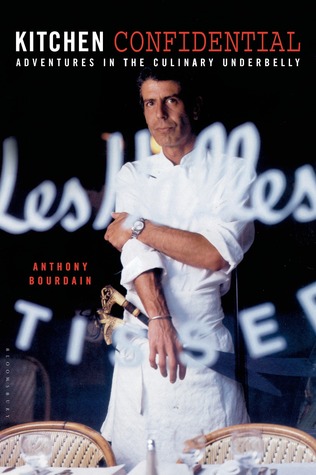 (20 Books of Summer, #5) “Get that dried crap away from my bird!” That random line about herbs is one my husband and I remember from a Bourdain TV program and occasionally quote to each other. It’s a mild curse compared to the standard fare in this flashy memoir about what really goes on in restaurant kitchens. His is a macho, vulgar world of sex and drugs. In the “wilderness years” before he opened his Les Halles restaurant, Bourdain worked in kitchens in Baltimore and New York City and was addicted to heroin and cocaine. Although he eventually cleaned up his act, he would always rely on cigarettes and alcohol to get through ridiculously long days on his feet.
From “Appetizer” to “Coffee and a Cigarette,” the book is organized like a luxury meal. Bourdain charts his development as a chef, starting with a childhood summer in France during which he ate vichyssoise and oysters for the first time and learned that food “could be important … an event” and describing his first cooking job in Provincetown and his time at the Culinary Institute of America. He also discusses restaurant practices and hierarchy, and home cook cheats and essentials. (I learned that you should never order fish in a restaurant on a Monday – it’ll be left over from Thursday’s order.) The pen portraits of his crazy sous-chef and baker are particularly amusing; other subjects include a three-star chef he envies and the dedicated Latino immigrants who are the mainstay of his kitchen staff.
My dad is not a reader but he is a foodie, and he has read Bourdain’s nonfiction (and watched all his shows), so I felt like I was continuing a family tradition in reading this. I loved my first taste of Bourdain’s writing: he’s brash, passionate, and hilariously scornful of celebrity chefs and vegetarianism (“the enemy of everything good and decent in the human spirit, an affront to all I stand for, the pure enjoyment of food”). Being in charge of a restaurant sounds manic, yet you can see why some would find it addictive. How ironic, though, to find a whole seven references to suicide in this book. Sometimes he’s joking; sometimes he’s talking about chefs he’s heard about who couldn’t take the pressure. Eighteen years after this came out, he, too, would kill himself.
(See also this article about rereading Bourdain in the 20th anniversary year of Kitchen Confidential.)
Source: Local swap shop (free)
My rating:
(These two are linked by a late chapter in the Bourdain, “Mission to Tokyo,” in which he advises on a new Les Halles offshoot in Japan and gorges himself on seafood delights.)
My Year of Meats by Ruth Ozeki (1998)
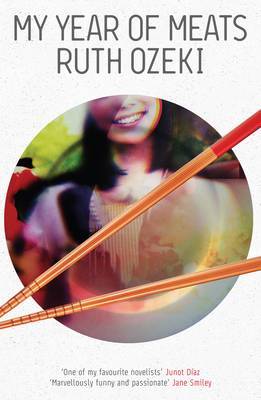 (20 Books of Summer, #6) I don’t know what took me so long to read another novel by Ruth Ozeki after A Tale for the Time Being, one of my favorite books of 2013. This is nearly as fresh, vibrant and strange. Set in 1991, it focuses on the making of a Japanese documentary series, My American Wife, sponsored by a beef marketing firm. Japanese American filmmaker Jane Takagi-Little is tasked with finding all-American families and capturing their daily lives – and best meat recipes. The traditional values and virtues of her two countries are in stark contrast, as are Main Street/Ye Olde America and the burgeoning Walmart culture.
There is a clear message here about cheapness and commodification, but Ozeki filters it through the wrenching stories of two women with fertility problems: Jane, whose reproductive system was damaged by DES, a synthetic estrogen her mother took during pregnancy to prevent a miscarriage; and Akiko, the wife of Jane’s boss, who struggles with an eating disorder and domestic violence.
Jane starts sneaking controversial subjects into her shoots: a lesbian couple, a family formed by interracial adoption, and a five-year-old who has already undergone puberty due to the hormones used on her family’s cattle feedlot. What is “natural,” and what gets branded alien or invasive? From the kudzu that strangles the South to a murdered Japanese exchange student, Ozeki probes the related issues of nativism and racism. Her two protagonists’ stories – one in the first person; the other in the third person – come together in a surprising manner as Jane decides that she has a more pressing obligation than creating a diverting television show.
This is a bold if at times discomforting novel. At first it brought to mind the exaggerated comedy of Julian Barnes’s England, England and Jane Smiley’s Moo, but as it grew darker it reminded me more of Han Kang’s The Vegetarian. It’s tricky, when a work of fiction tackles ethical or environmental matters, to balance storytelling and consciousness-raising, but Ozeki pulls it off with style. The only aspect that didn’t mean much to me, perhaps simply because of my unfamiliarity, was the excerpts from The Pillow Book of Shōnagon. How sad to think that I only have one more Ozeki awaiting me, All Over Creation. She averages a book every 5‒10 years; we can only hope that another is on the way soon.
Source: Charity shop
My rating: 
I picked up another two food-adjacent books that didn’t work for me, though I ended up skimming them to the end.
America Unchained: A Freewheeling Roadtrip in Search of Non-Corporate USA by Dave Gorman (2008)
 (20 Books of Summer, #7) I read the first couple of chapters, in which he plans his adventure, and then started skimming. I expected this to be a breezy read I would race through, but the voice was neither inviting nor funny. I also hoped to find more about non-chain supermarkets and restaurants – that’s why I put this on the pile for my foodie challenge in the first place – but, from a skim, it mostly seemed to be about car trouble, gas stations and fleabag motels. The only food-related moments are when Gorman (a vegetarian) downs three fast food burgers and orders of fries in 10 minutes and, predictably, vomits them all back up; and when he stops at an old-fashioned soda fountain for breakfast.
Source: Free bookshop
Tortilla Flat by John Steinbeck (1935)
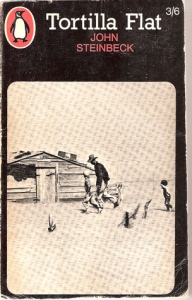 (20 Books of Summer, #8) I read the first 25 pages and then started skimming. This is a story of a group of friends – paisanos, of mixed Mexican, Native American and Caucasian blood – in Monterey, California. During World War I, Danny serves as a mule driver and Pilon is in the infantry. When discharged from the Army, they return to Tortilla Flat, where Danny has inherited two houses. He lives in one and Pilon is his tenant in the other (though Danny will never see a penny in rent). They’re a pair of loveable scamps, like Huck Finn all grown up, stealing wine and chickens left and right.
Steinbeck novels seem to fall into two camps for me. This is one of his inconsequential, largely unlikable novellas (like The Pearl and The Red Pony, which I studied in school – I’m lucky they didn’t put me off Steinbeck forever), whereas The Grapes of Wrath and East of Eden are masterful. It may also have something to do with the slight air of condescension towards characters of a different race: Steinbeck renders their speech with “thee” and “thou,” trying to imitate a Romance language’s informal pronouns, but it feels dated and alienating.
Source: Free bookshop
 Bookish Beck = Rebecca Foster. American transplant to England. Freelance proofreader and book reviewer.
 Bookish Beck