20 Books of Summer, #18–19: The Other’s Gold and Black Dogs
Today’s entries in my colour-themed summer reading are a novel about a quartet of college friends and the mistakes that mar their lives and a novella about the enduring impact of war set just after the fall of the Berlin Wall.
The Other’s Gold by Elizabeth Ames (2019)
Make new friends but keep the old,
One is silver and the other’s gold.
Do you know that little tune? We would sing it as a round at summer camp. It provides a clever title for this story of four college roommates whose lives are marked by the threat of sexual violence and ambivalent feelings about motherhood. Alice, Ji Sun, Lainey and Margaret first meet as freshmen in 2002 when they’re assigned to the same suite (with a window seat! how envious am I?) at Quincy-Hawthorn College.
 They live together for the whole four years – a highly unusual situation – and see each other through crises at college and in the years to come as they find partners and meander into motherhood. Iraq War protests and the Occupy movement form a turbulent background, but the friends’ overriding concerns are more personal. One girl was molested by her brother as a child and has kept secret her act of revenge; one has a crush on a professor until she learns he has sexual harassment charges being filed against him by multiple female students. Infertility later provokes jealousy between the young women, and mental health issues come to the fore.
As in Expectation by Anna Hope, the book starts to be all about babies at a certain point. That’s not a problem if you’re prepared for and interested in this theme, but I love campus novels so much that my engagement waned as the characters left university behind. Also, the characters seemed too artificially manufactured to inject diversity (Ji Sun is a wealthy Korean; adopted Lainey is of mixed Latina heritage, and bisexual; Margaret has Native American blood) and embody certain experiences. And, unfortunately, any #MeToo-themed read encountered in the wake of My Dark Vanessa is going to pale by comparison.
Part One held my interest, but after that I skimmed to the end. Ideally, I would have chosen replacements and not included skims like this and Green Mansions, but it’s not the first summer that I’ve had to count DNFs and skimmed books – my time and attention are always being diverted by paid review work, review copies and library books with imminent deadlines. I’ve read lots of fiction about groups of female friends this summer, partly by accident and partly by design, and will likely do a feature on it in an upcoming month. For now, I’d recommend Lara Feigel’s The Group instead of this. 
With thanks to Pushkin Press (ONE imprint) for the free e-copy for review.
Black Dogs by Ian McEwan (1992)
 When I read the blurb, I worried I’d read this before and forgotten it: all it mentions is a young couple setting off on honeymoon and having an encounter with evil. Isn’t that the plot of The Comfort of Strangers? I thought. In fact, this only happens to have the vacation detail in common, and has a very different setup and theme overall.
Jeremy lost his parents in a car accident (my least favourite fictional trope – far too convenient a way of setting a character off on their own!) when he was eight years old, and is self-aware enough to realize that he has been seeking for parental figures ever after. He becomes deeply immersed in the story of his wife’s parents, Bernard and June, even embarking on writing a memoir based on what June, from her nursing home bed, tells him of their early life (Part One).
After June’s death, Jeremy takes Bernard to Berlin (Part Two) to soak up the atmosphere just after the Wall comes down, but the elderly man is kicked by a skinhead. The other key thing that happens on this trip is that he refutes June’s account of their honeymoon. At June’s old house in France (Part Three), Jeremy feels her presence and seems to hear the couple’s voices. Only in Part Four do we learn what happened on their 1946 honeymoon trip to France: an encounter with literal black dogs that also has a metaphorical dimension, bringing back the horrors of World War II.
I think the novel is also meant to contrast Communist ideals – Bernard and June were members of the Party in their youth – with how Communism has played out in history. It was shortlisted for the Booker, which made me feel that I must be missing something. A fairly interesting read, most similar in his oeuvre (at least of the 15 I’ve read so far) to The Child in Time. (Secondhand purchase from a now-defunct Newbury charity shop) 
Coming up next: The latest book by John Green – it’s due back at the library on the 31st so I’ll aim to review it before then, possibly with a rainbow-covered novel as a bonus read.
The Amateur Marriage by Anne Tyler (2004)
 This year I’ve been joining in Liz’s Anne Tyler readalong for most of the novels I own and hadn’t read yet. Just this summer, I’ve discovered two new favourites: Saint Maybe and now The Amateur Marriage – which surprised me because it was her sixteenth novel and not part of what I consider to be her golden mid-period of the 1980s-90s. Both Saint Maybe and The Amateur Marriage are, like Dinner at the Homesick Restaurant (my absolute favourite and, I was gratified to discover, Tyler’s favourite, too), effectively linked short story collections in which the chapters are self-contained narratives set at a particular point in a dysfunctional family’s life, with each one often focusing on a different character.
The Amateur Marriage feels unique in Tyler’s oeuvre for how it bridges historical fiction and her more typical contemporary commentary. Spanning 60 years precisely, it opens with the Pearl Harbor attack in 1941. In this Baltimore neighbourhood full of Polish immigrants, a spontaneous patriotic parade breaks out. In the excitement, Pauline jumps off a tram and hits her head on a lamppost. Her friends rush her to the Antons’ general store for a bandage and when Michael Anton meets her their fate is sealed. Pauline assumes Michael is bound for war and, so as not to disappoint her, he signs up. After his discharge, they marry – though Pauline had a near change of heart because they have so little in common and do nothing but fight.
{SPOILERS FOLLOW}
“Not quite forever”
The Antons’ marriage continues in the same volatile vein – until it doesn’t. I was taken aback that a story about marriage kept going even when Michael + Pauline ended, and even after one of them was no more. About two-thirds of the way through the book, on their 30th wedding anniversary, they find that their reminiscences are mostly of bitter arguments. Pauline wryly shakes her head over their antics, but Michael says to Pauline, “It has not been fun. It’s been hell.” She goads him into leaving, and he does.
I’ve jokingly heard women saying of their husbands, “I’m training him for his second wife,” and that seems to me to be the spirit of the title. These two characters had no idea that ‘opposites attract’ but don’t make for a stable marriage, and have muddled their way through for decades without figuring out how to change anything for the better. I sensed Tyler’s deep compassion for their foibles and how they affect the next generation.
A major thread of the novel is their eldest daughter Lindy’s teenage rebellion and eventual disappearance, reminding me a lot of Mary Lawson’s A Town Called Solace. Michael and Pauline retrieve her young son, Pagan, from San Francisco and raise him themselves, partly via shared custody. This theme of unexpected grandparent responsibility is a link to Saint Maybe and especially (along with the West as a setting) Clock Dance. There is no rapturous reunion to come, but the remnant of the family does eventually get back together.
Michael and Pauline are quintessential Tyler characters: the one easygoing if slightly useless (“He wished he had inhabited more of his life, used it better, filled it fuller”); the other highly strung and contrary, yet strong and efficient – “the ones who kept the planet spinning.” Michael never ceases to admire Pauline, even when he stops being married to her. In the penultimate chapter, the family swaps “Pauline stories” that exemplify how maddening but lovable she could be. You have someone in your family who’s just like that, right?
{END OF SPOILERS}
My U.S. paperback appends an interview with Tyler that I found illuminating. She knows that she doesn’t tend to break new ground with her fiction: “face it, I always write more or less the same sort of story,” she admits. During this reading project I’ve been debating whether this is a bad thing. Does it make her later work redundant? Does it mean she only had a limited store of good ideas? Are her characters types rather than three-dimensional creations? Marcie at Buried in Print loves the connections between the novels. I’m sure Liz does, too, but she’s also acknowledged that she finds individual plots strangely unmemorable.
I haven’t fully answered the above questions for myself. There are certainly Tyler books that I like more than others, but they have all been comforting and (mostly) compulsive reading. Her characters and situations feel so true to life that we don’t observe from the outside, but journey alongside and within them. (Secondhand purchase from 2nd & Charles, Hagerstown, MD, USA) See also Liz’s review.
Favourite lines:
“Was it possible to dislike your own wife? Well, no, of course not. This was just one of those ups-and-downs that every couple experienced.”
“so much about their parents had been embarrassing. Or did all children feel that way? But it seemed to George that the Antons’ lives were more extreme than other people’s. … People didn’t stay on an even keel in the Anton family. They did exaggerated things like throwing out their clothes or running away from home”
Another readalike: Larry’s Party by Carol Shields
My rating: 
The 15 Tyler novels I’ve read, in order of preference (greatest to least), are:
Dinner at the Homesick Restaurant
Saint Maybe
The Amateur Marriage
Ladder of Years
The Accidental Tourist
Earthly Possessions
Breathing Lessons
Digging to America
Vinegar Girl
Back When We Were Grown-ups
Clock Dance
A Blue Spool of Thread
The Beginner’s Goodbye
Redhead by the Side of the Road
The Clock Winder
Next up for me will be Noah’s Compass later in September.
Three May Graphic Novel Releases: Orwell, In, and Coma
These three terrific graphic novels all have one-word titles and were published on the 13th of May. Outwardly, they are very different: a biography of a famous English writer, the story of an artist looking for authentic connections, and a memoir of a medical crisis that had permanent consequences. The drawing styles are varied as well. But if the books share one thing, it’s an engagement with loneliness: It’s tempting to see the self as being pitted against the world, with illness an additional isolating force, but family, friends and compatriots are there to help us feel less alone and like we are a part of something constructive.
Orwell by Pierre Christin; illustrated by Sébastien Verdier
[Translated from the French by Edward Gauvin]
 George Orwell was born Eric Blair in Bengal, where his father worked for the colonial government. As a boy, he loved science fiction and knew that he would become a writer. He had an unhappy time at prep school, where he was on reduced fees, and proceeded to Eton and then police training in Burma. Already he felt that “imperialism was an evil thing.” Among this book’s black-and-white panes, the splashes of colour – blood, a British flag – stand out, and guest artists contribute a two-page colour spread each, illustrating scenes from Orwell’s major works. His pen name commemorates a local river and England’s patron saint, marking his preoccupation with the essence of Englishness: something deeper than his hated militarism and capitalism. Even when he tried to ‘go native’ for embedded journalism (Down and Out in Paris and London and The Road to Wigan Pier), his accent marked him out as posh. He was opinionated and set out “rules” for clear writing and the proper making of tea.
The book’s settings range from Spain, where Orwell went to fight in the Civil War, via a bomb shelter in London’s Underground, to the island of Jura, where he retired after the war. I particularly loved the Scottish scenery. I also appreciated the notes on where his life story entered into his fiction (especially in A Clergyman’s Daughter and Keep the Aspidistra Flying). During World War II he joined the Home Guard and contributed to BBC broadcasting alongside T.S. Eliot. He had married Eileen, adopted a baby boy, and set up a smallholding. Even when hospitalized for tuberculosis, he wouldn’t stop typing (or smoking).
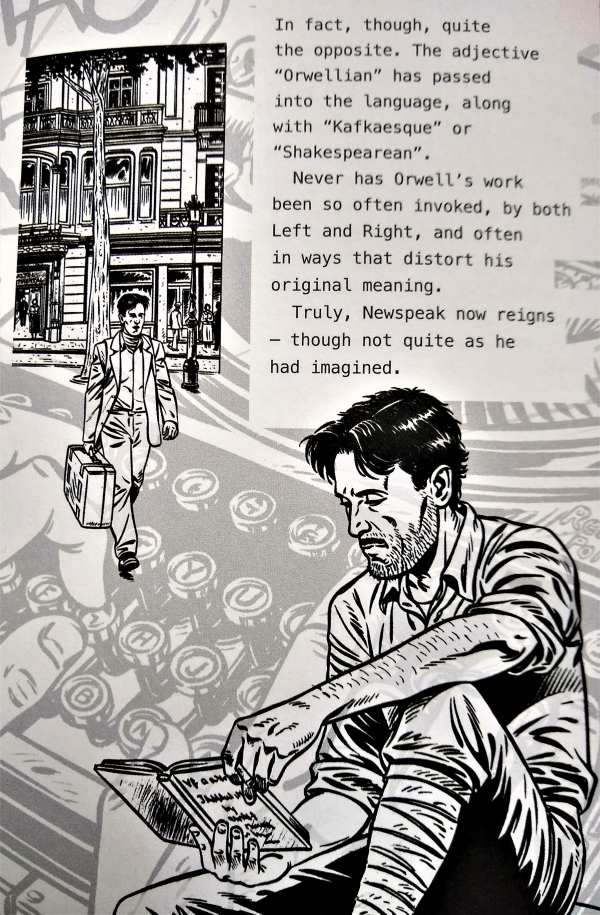 Christin creates just enough scenes to give a sense of the sweep of Orwell’s life, and incorporates plenty of the author’s own words in a typewriter font. He recognizes all the many aspects, sometimes contradictory, of his subject’s life. And in an afterword, he makes a strong case for Orwell’s ideas being more important now than ever before. My knowledge of Orwell’s oeuvre, apart from the ones everyone has read – Animal Farm and 1984 – is limited; luckily this is suited not just to Orwell fans but to devotees of life stories of any kind.
With thanks to SelfMadeHero for the free copy for review.
In by Will McPhail
Nick never knows the right thing to say. The bachelor artist’s well-intentioned thoughts remain unvoiced, such that all he can manage is small talk. Whether he’s on a subway train, interacting with his mom and sister, or sitting in a bar with a tongue-in-cheek name (like “Your Friends Have Kids” or “Gentrificchiato”), he’s conscious of being the clichéd guy who’s too clueless or pathetic to make a real connection with another human being. That starts to change when he meets Wren, a Black doctor who instantly sees past all his pretence.
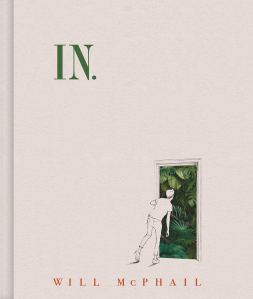 Like Orwell, In makes strategic use of colour spreads. “Say something that matters,” Nick scolds himself, and on the rare occasions when he does figure out what to say or ask – the magic words that elicit an honest response – it’s as if a new world opens up. These full-colour breakthrough scenes are like dream sequences, filled with symbols such as a waterfall, icy cliff, or half-submerged building with classical façade. Each is heralded by a close-up image on the other person’s eyes: being literally close enough to see their eye colour means being metaphorically close enough to be let in. Nick achieves these moments with everyone from the plumber to his four-year-old nephew.
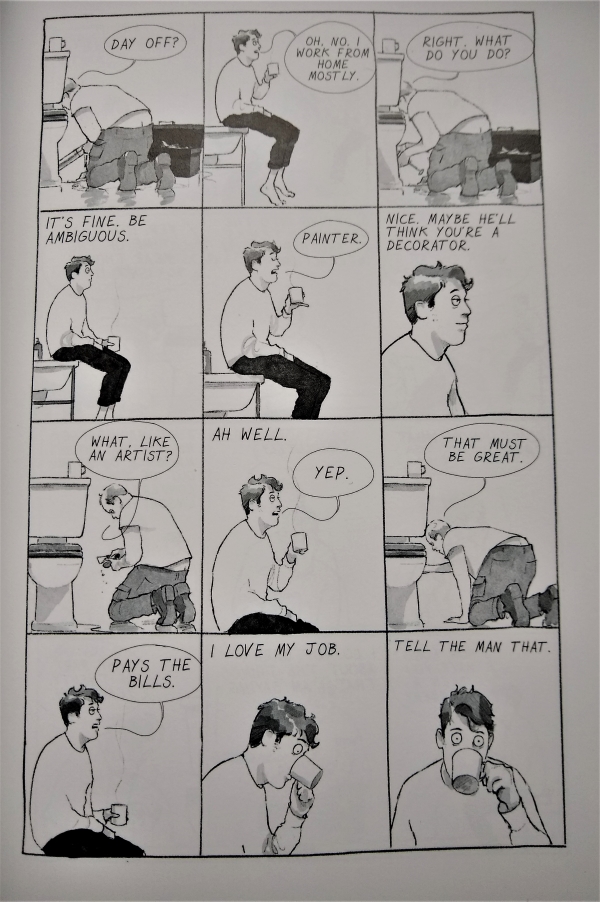
Alternately laugh-out-loud funny and tender, McPhail’s debut novel is as hip as it is genuine. It’s a spot-on picture of modern life in a generic city. I especially loved the few pages when Nick is on a Zoom call with carefully ironed shirt but no trousers and the potential employers on the other end get so lost in their own jargon that they forget he’s there. His banter with Wren or with his sister reveals a lot about these characters, but there’s also an amazing 12-page wordless sequence late on that conveys so much. While I’d recommend this to readers of Alison Bechdel, Craig Thompson, and Chris Ware (and expect it to have a lot in common with Kristen Radtke’s forthcoming Seek You: A Journey through American Loneliness), it’s perfect for those brand new to graphic novels, too – a good old-fashioned story, with all the emotional range of Writers & Lovers. I hope it’ll be a wildcard entry on the Sunday Times Young Writer of the Year Award shortlist.
With thanks to Sceptre for the free copy for review.
Coma by Zara Slattery
In May 2013, Zara Slattery’s life changed forever. What started as a nagging sore throat developed into a potentially deadly infection called necrotising fascitis. She spent 15 days in a medically induced coma and woke up to find that one of her legs had been amputated. As in Orwell and In, colour is used to differentiate different realms. Monochrome sketches in thick crayon illustrate her husband Dan’s diary of the everyday life that kept going while she was in hospital, yet it’s the coma/fantasy pages in vibrant blues, reds and gold that feel more real.
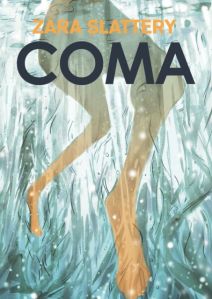 Slattery remembers, or perhaps imagines, being surrounded by nightmarish skulls and menacing animals. She feels accused and guilty, like she has to justify her continued existence. In one moment she’s a puppet; in another she’s in ancient China, her fate being decided for her. Some of the watery landscapes and specific images here happen to echo those in McPhail’s novel: a splash park, a sunken theatre; a statue on a plinth. There’s also a giant that reminded me a lot of one of the monsters in Spirited Away.
Meanwhile, Dan was holding down the fort, completing domestic tasks and reassuring their three children. Relatives came to stay; neighbours brought food, ran errands, and gave him lifts to the hospital. He addresses the diary directly to Zara as a record of the time she spent away from home and acknowledges that he doesn’t know if she’ll come back to them. A final letter from Zara’s nurse reveals how bad off she was, maybe more so than Dan was aware.


This must have been such a distressing time to revisit. In this interview, Slattery talks about the courage it took to read Dan’s diary even years after the fact. I admired how the book’s contrasting drawing styles recreate her locked-in mental state and her family’s weeks of waiting – both parties in limbo, wondering what will come next.
Brighton, where Slattery is based, is a hotspot of the Graphic Medicine movement spearheaded by Ian Williams (author of The Lady Doctor). Regular readers know how much I love health narratives, and with my keenness for graphic novels this series couldn’t be better suited to my interests.
With thanks to Myriad Editions for the free copy for review.
Read any graphic novels recently?
Snow and Winter Reads, Part II
Since I wrote about my first batch of wintry reads in early February, it’s turned much more spring-like here in southern England, with blue skies and the daffodils blooming. Still, temperatures continue chilly and some nights I’ve had trouble falling asleep because of the wind tearing down the street and flapping the bin lids. With meteorological spring due to start tomorrow, I’m bidding farewell to winter with a few more snow-covered reads: a children’s classic, a modern classic from the 1990s, and an implausible but enjoyably rollicking thriller.
The Wolves of Willoughby Chase by Joan Aiken (1962)
 Aiken’s books were not part of my childhood, but I was vaguely aware of this first book in a long series when I plucked it from a neighbor’s giveaway pile. The snowy scene on the cover and described in the first two paragraphs drew me in and the story, a Victorian-set fantasy with notes of Oliver Twist and Jane Eyre, soon did, too. In this alternative version of the 1830s, Britain already had an extensive railway network and wolves regularly used the Channel Tunnel (which did not actually open until 1994) to escape the Continent’s brutal winters for somewhat milder climes.
One winter, the orphaned Sylvia travels by train from London to the north of England to live with her cousin Bonnie and her parents, Sir Willoughby and Lady Green. But dodgy things are afoot at Willoughby Chase: Miss Slighcarp, a distant cousin, has been hired as the girls’ governess but, just as soon as Bonnie’s parents leave on a long trip, she sets about taking over the house. Bonnie and Sylvia, exiled to a workhouse, rely on a secret network of friends and servants to keep them safe and get them home via an intrepid journey.
Miss Slighcarp is just one of the novel’s Dickensian villains – balanced out by some equally Dickensian urchins and helpful adults, all of them with hearts of gold. There’s something perversely cozy about the plight of an orphan in children’s books: the characters call to the lonely child in all of us, and we rejoice to see how ingenuity and luck come together to defeat wickedness. There are charming passages here in which familiar smells and favorite foods offer comfort. I especially loved their friend Simon’s cave and his little rituals. This would make a perfect stepping stone from Roald Dahl to one of the actual Victorian classics.
My only quibble with the book overall would be that the wolves seem unnecessary: they only truly appear once, for a climactic scene during the train ride, and the rest of the time are just a background menace. From fairy tales onwards, wolves have gotten a bad rap, and we don’t need to perpetuate myths about how dangerous they are to humans. 
Snow Falling on Cedars by David Guterson (1994)
 My first 5-star read of the year! It certainly took a while, but I’m now on a roll with a bunch of 4.5- and 5-star ratings bunching together. I remember the buzz surrounding this novel, mostly because of the Ethan Hawke film version that came out when I was a teenager. Even though I didn’t see it, I was aware of it, as I was of other literary fiction that got turned into Oscar-worthy films at about that time, like The Shipping News and House of Sand and Fog.
The novel is set in 1954 on San Piedro, an island of 5,000 off the coast of Washington state. A decade on from the war, the community’s chickens come home to roost when a Japanese American man, Kabuo Miyamoto, is charged with murdering a fellow fisherman, Carl Heine. The men had been engaged in a dispute over some land – seven acres of strawberry fields that were seized from the Miyamoto family when, like the rest of the country’s Japanese population, they were rounded up in internment camps. Meanwhile, Ishmael Chambers, who runs the local newspaper and lost an arm in the war, stumbles on a piece of evidence that might turn the case around. Still in love with Hatsue, now Kabuo’s wife but once his teenage obsession, he is torn between winning her back and wanting to do what’s right.
Guterson alternates between trial scenes and flashbacks to war service or stolen afternoons Ishmael and Hatsue spent kissing in the shelter of massive cedar trees. The mystery element held me completely gripped – readers are just as in the dark as the jurors until very close to the end – but this is mostly a powerful picture of the lasting effects of racism. All the characters are well drawn, even minor ones like elderly defense attorney Nels Gudmundsson. Even though I only read 10 or 15 pages at a sitting over the course of a month, every time I picked up the book I was instantly immersed in the atmosphere, whether it was a warm courtroom with a snowstorm swirling outside or a troop ship entering the Pacific Theater. This has the epic feel of a doorstopper, though it’s only 400 pages. I can’t recommend it highly enough. 
The Quality of Silence by Rosamund Lupton (2015)
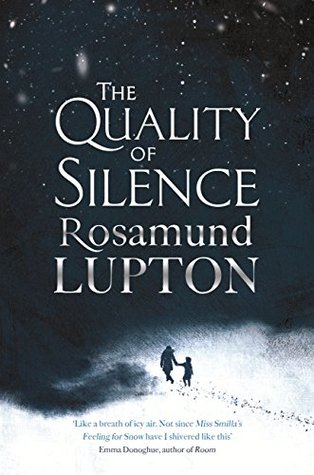 Ten-year-old Ruby and her mother Yasmin have arrived in Alaska to visit Ruby’s dad, Matt, who makes nature documentaries. When they arrive, police inform them that the town where he was living has been destroyed by fire and he is presumed dead. But Yasmin won’t believe it and they set out on a 500-mile journey north to find her husband, first hitching a ride with a trucker and then going it alone in a stolen vehicle. All the time, with the weather increasingly brutal, they’re aware of someone following them – someone with malicious intent.
The narration is in short segments, alternating between Ruby’s first person and a third-person account from Yasmin’s point-of-view. There are many interesting elements here: Ruby is deaf so communicates via a combination of sign language, voice recognition software, blogs and social media, and describes things synesthetically; Yasmin is a physicist drawing metaphors to scientific concepts, but can’t explain her own mystical certainty that Matt is still alive; and there is an environmentalist message behind the fracking cover-up plot.
But starting with the first page, there are so many improbabilities in play, from a 10-year-old having a Twitter account to Yasmin managing to drive a big rig on ice roads in a foreign country. I knew from reviewing Three Hours last year that Lupton writes addictive thrillers. This one was perfectly readable, but not as good. It’s our book club read for early March, and I expect I won’t be the only one to find it hardly believable.
Plus a skim:
Arctic Dreams by Barry Lopez (1986)
 This was my first time trying the late Lopez. It was supposed to be a buddy read with my husband because we ended up with two free copies, but he raced ahead while I limped along just a few pages at a time before admitting defeat and skimming to the end (it was the 20 pages on musk oxen that really did me in). For me, the reading experience was most akin to The Snow Leopard by Peter Matthiessen in that both are about a literal journey in an extreme environment, yet what stands out are the philosophical musings. Where Matthiessen was animated by Buddhist ideas about selfhood and loss, Lopez takes the secular long view of human life and responsibility in light of potential extinction. The epilogue, in particular, is endlessly quotable. It’s depressing to encounter books like this now, though: 30+ years ago, literary nature writers were issuing clarion calls about climate disaster, and we didn’t listen.
Some favorite passages:
“Whenever I met a collared lemming on a summer day and took its stare I would think: Here is a tough animal. Here is a valuable life. … If it could tell me of its will to survive, would I think of biochemistry, or would I think of the analogous human desire? If it could speak of the time since the retreat of the ice, would I have the patience to listen?”
“The cold view to take of our future is that we are therefore headed for extinction in a universe of impersonal chemical, physical, and biological laws. A more productive, certainly more engaging view, is that we have the intelligence to grasp what is happening, the composure not to be intimidated by its complexity, and the courage to take steps that may bear no fruit in our lifetimes.”
“One of the oldest dreams of mankind is to find a dignity that might include all living things. And one of the greatest of human longings must be to bring such dignity to one’s own dreams, for each to find his or her own life exemplary in some way. The struggle to do this is a struggle because an adult sensibility must find some way to include all the dark threads of life. A way to do this is to pay attention to what occurs in a land not touched by human schemes, where an original order prevails.”
Did you read anything particularly wintry this year, or are you and your book stack moving on to spring already?
Young Writer of the Year Award: Shortlist Reviews and Predictions
Being on the shadow panel for the Sunday Times Young Writer of the Year Award was a bookish highlight of 2017 for me. I’m pleased for this year’s shadow panelists, a couple of whom are blogging friends (one I’ve met IRL), to have had the same opportunity, and I look forward to attending the prize ceremony at the London Library on December 5th.
I happened to have already read two of the shortlisted titles, the poetry collection The Perseverance by Raymond Antrobus and the debut novel Stubborn Archivist by Yara Rodrigues Fowler, which was one of my specific wishes/predictions. The kind folk of FMcM Associates sent me the other two shortlisted books, a short story collection and another debut novel, for blog reviews so that I could follow along with the shadow panel’s deliberations.
Salt Slow by Julia Armfield (2019)
These nine short stories are steeped in myth and magic, but often have a realistic shell. Only gradually do the fantastical or dystopian elements emerge, with the final paragraph delivering a delicious surprise. For instance, the narrator of “Mantis” attends a Catholic girls’ school and is caught up in a typical cycle of self-loathing and obsessing over boys. It’s only at the very end that we realize her extreme skin condition is actually a metamorphosis that enables her to protect herself. The settings are split between the city and the seaside; the perspective is divided almost perfectly down the middle between the first and third person. The body is a site of transformation, or a source of grotesque relics, as in “The Collectables,” in which a PhD student starts amassing body parts she could only have acquired via grave-robbing.
 Two favorites for me were “Formerly Feral,” in which a 13-year-old girl acquires a wolf as a stepsister and increasingly starts to resemble her; and the final, title story, a post-apocalyptic one in which a man and a pregnant woman are alone in a fishing boat, floating above a drowned world and living as if outside of time. This one is really rather terrifying. I also liked “Cassandra After,” in which a dead girlfriend comes back – it reminded me of Margaret Atwood’s The Robber Bride, which I’m currently reading for #MARM. “Stop Your Women’s Ears with Wax,” about a girl group experiencing Beatles-level fandom on a tour of the UK, felt like the odd one out to me in this collection.
Armfield’s prose is punchy, with invented verbs and condensed descriptions that just plain work: “Jenny had taken to poltergeisting round the house”; “skin like fork-clawed cottage cheese,” “the lobster shells gleam a slick vermilion” and “The sky is gory with stars.” There’s no shortage of feminist fantasy stories out there nowadays – Aimee Bender, Kelly Link, Carmen Maria Machado and Karen Russell are just a few others working in this vein – but the writing in Salt Slow really grabbed me even when the plots didn’t. I’ll be following Armfield’s career with interest.
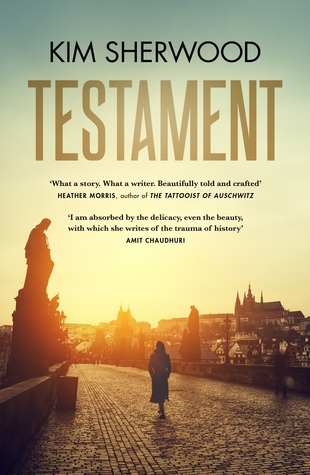
Testament by Kim Sherwood (2018)
Eva Butler is a 24-year-old MA student specializing in documentary filmmaking. She is a live-in carer for her grandfather, the painter Joseph Silk (real name: József Zyyad), in his Fitzroy Park home. When Silk dies early on in the book, she realizes that she knows next to nothing about his past in Hungary. Learning that he wrote a testament about his Second World War experiences for the Jewish Museum in Berlin, she goes at once to read it and is distressed at what she finds. With the help of Felix, the museum’s curator, who did his PhD on Silk’s work, she travels to Budapest to track down the truth about her family.
 Sherwood alternates between Eva’s quest and a recreation of József’s time in wartorn Europe. Cleverly, she renders the past sections more immediate by writing them in the present tense, whereas Eva’s first-person narrative is in the past tense. Although József escaped the worst of the Holocaust by being sentenced to forced labor instead of going to a concentration camp, his brother László and their friend Zuzka were in Theresienstadt, so readers get a more complete picture of the Jewish experience at the time. All three wind up in the Lake District after the war, rebuilding their lives and making decisions that will affect future generations.
It’s almost impossible to write anything new about the Holocaust these days, and overfamiliarity was certainly a roadblock for me here. I was especially reminded of Julie Orringer’s The Invisible Bridge, what with its focus on the Hungarian Jewish experience. However, I did appreciate the way Sherwood draws on her family history – her grandmother is a Hungarian Holocaust survivor – to consider how trauma still affects the second and third generation. This certainly doesn’t feel like a debut novel. It’s highly readable, and the emotional power of the story cannot be denied. The Young Writer of the Year Award is great for highlighting books that risk being overlooked: in a year dominated by The Testaments, poor Testament was otherwise likely to sink without notice.
Note: “Testament” is also the title of the poem written by Sherwood’s great-grandfather that she recited at her grandfather’s funeral – just as Eva does in the novel. It opens this Telegraph essay (paywalled, but reprinted in the paperback of Testament) that Sherwood wrote about her family history.
General thoughts and predictions:
Any of these books would be a worthy winner. However, as Raymond Antrobus has already won this year’s £30,000 Rathbones Folio Prize as well as the 2018 Geoffrey Dearmer Award from the Poetry Society, The Perseverance has had sufficient recognition – plus it’s a woman’s turn. Testament is accomplished, and likely to hold the widest appeal, but it strikes me as the safe choice. Salt Slow would be an edgier selection, and feels quite timely and fresh. But Stubborn Archivist has stuck with me since I reviewed it in March. I called it “Knausgaard for the Sally Rooney generation” and wrote that “the last book to have struck me as truly ‘novel’ in the same way was Lincoln in the Bardo.” From a glance at the shadow panel’s reviews thus far, I fear it may prove too divisive for them, though.
Based on my gut instincts and a bit of canny thinking about the shadow panelists and judges, here are my predictions:
Shadow Panel:
- What they will pick: Testament [but they might surprise me and go with Salt Slow or Stubborn Archivist]
- What they should pick: Salt Slow
Official Judging Panel:
- What they will pick: Stubborn Archivist [but they might surprise me and go with Salt Slow]
- What they should pick: Stubborn Archivist
I understand that the shadow panel is meeting today for their in-person deliberations. I wish them luck! Their pick will be announced on the 28th. I’ll be intrigued to see which book they select, and how it compares with the official winner on December 5th.
Have you read anything from this year’s shortlist?
We Are the Weather by Jonathan Safran Foer
I’ve read all of Jonathan Safran Foer’s major releases, from Everything Is Illuminated onwards, and his 2009 work Eating Animals had a major impact on me. (I included it on a 2017 list of “Books that (Should Have) Literally Changed My Life.”) It’s an exposé of factory farming that concludes meat-eating is unconscionable, and while I haven’t gone all the way back to vegetarianism in the years since I read it, I eat meat extremely rarely, usually only when a guest at others’ houses, and my husband and I often eat vegan meals at home.
 When I heard that Foer’s new book, We Are the Weather: Saving the Planet Begins at Breakfast, would revisit the ethics of eating meat, I worried it might feel redundant, but still wanted to give it a try. Here he examines the issue through the lens of climate change, arguing that slashing meat consumption by two-thirds or more (by eating vegan until dinner, i.e., for two meals a day) is the easiest way for individuals to decrease their carbon footprint. I don’t disagree with this proposal. It would be churlish to fault a reasonable suggestion that gives ordinary folk something concrete to do while waiting (in vain?) for governments to act.
My issues, then, are not with the book’s message but with its methods and structure. Initially, Foer successfully makes use of historical parallels like World War II and the civil rights movement. He rightly observes that we are at a crucial turning point and it will take self-denial and joining in with a radical social movement to protect a whole way of life. Don’t think of living a greener lifestyle as a sacrifice or a superhuman feat, Foer advises; think of it as an opportunity for bravery and for living out the convictions you confess to hold.
As the book goes on, however, the same reference points come up again and again. It’s an attempt to build on what’s already been discussed, but just ends up sounding repetitive. Meanwhile, the central topic is brought in as a Trojan horse: not until page 64 (of 224 in the main text) does Foer lay his cards on the table and admit “This is a book about the impacts of animal agriculture on the environment.” Why be so coy when the book has been marketed as being about food choices? The subtitle and blurb make the topic clear. “Our planet is a farm,” Foer declares, with animal agriculture the top source of deforestation and methane emissions.
Fair enough, but as I heard a UK climate expert explain the other week at a local green fair, you can’t boil down our response to the climate crisis to ONE strategy. Every adjustment has to work in tandem. So while Foer has chosen meat-eating as the most practical thing to change right now, the other main sources of emissions barely get a mention. He admits that car use, number of children, and flights are additional areas where personal choices make a difference, but makes no attempt to influence attitudes in these areas. So diet is up for discussion, but not family planning, commuting or vacations? This struck me as a lack of imagination, or of courage. Separating Americans from their vehicles may be even tougher than getting them to put down the burgers. But that doesn’t mean it’s not worth trying.
 Part II is a bullet-pointed set of facts and statistics reminiscent of the “Tell the Truth” section in the Extinction Rebellion handbook. It’s an effective strategy for setting things out briefly, yet sits oddly between narrative sections of analogies and anecdotes. My favorite bits of the book were about visits to his dying grandmother back at the family home in Washington, D.C. It took him many years to realize that his grandfather, who lost everything in Poland and began again with a new wife in America, committed suicide. This family history,* nestled within the canon of Jewish stories like Noah’s Ark, Masada and the Holocaust, dramatizes the conflict between resistance and self-destruction – the very battle we face now.
 Part IV, Foer’s “Dispute with the Soul,” is a philosophical dialogue in the tradition of Talmudic study, while the book closes with a letter to his sons. Individually, many of these segments are powerful in the way they confront hypocrisy and hopelessness with honesty. But together in the same book they feel like a jumble. Although it was noble of Foer to tackle the subject of climate change, I’m not convinced he was the right person to write this book, especially when we’ve already had recent works like The Uninhabitable Earth by David Wallace-Wells. Arriving at a rating has been very difficult for me because I support the book’s aims but often found it a frustrating reading experience. Still, if it wakes up even a handful of readers to the emergency we face, it will have been worthwhile.
My rating: 
A favorite passage: “Climate change is not a jigsaw puzzle on the coffee table, which can be returned to when the schedule allows and the feeling inspires. It is a house on fire.”
 *I’m looking forward to his mother Esther Safran Foer’s family memoir, I Want You to Know We’re Still Here: A Post-Holocaust Memoir, which is coming out from Tim Duggan Books on March 31, 2020.
We Are the Weather is published today, 10th October, in the UK by Hamish Hamilton (my thanks for the proof copy for review). It came out in the States from Farrar, Straus and Giroux last month.
Doorstopper of the Month: The Flight Portfolio by Julie Orringer
Julie Orringer’s The Invisible Bridge was the highlight of my 20 Books of Summer last year. I was thus delighted to hear that her second novel, The Flight Portfolio, nearly a decade in the making, was coming out this year, and even more thrilled to receive the review copy I requested while staying at my mother’s in America.
 The Invisible Bridge was the saga of a Hungarian Jewish family’s experiences in the Second World War; while The Flight Portfolio again charts the rise of Nazism and a growing awareness of Jewish extermination, it’s a very different though equally affecting narrative. Its protagonist is a historical figure, Varian Fry, a Harvard-educated journalist who founded the Emergency Rescue Committee to help at-risk artists and writers escape to the United States from France, and many of the supporting characters are also drawn from real life.
In 1940, when Varian is 32, he travels to Marseille to coordinate the ERC’s operations on the ground. Every day his office interviews 60 refugees and chooses 10 to recommend to the command center in New York City. Varian and his staff arrange bribes, fake passports, and exit visas to get Jewish artists out of the country via the Pyrenees or various sea routes. Their famous clients include Hannah Arendt, André Breton, Marc Chagall, André Gide and members of Thomas Mann’s family, all of whom make cameo appearances.

Varian Fry [Public domain]
Like The Invisible Bridge, The Flight Portfolio is a love story, if not in the way you might expect. Soon after he arrives in Marseille, Varian is contacted by a Harvard friend – and ex-lover – he hasn’t heard from in 12 years, Elliott Grant. Grant begs Varian to help him find his Columbia University teaching colleague’s son and get him out of Europe. Even though Varian doesn’t understand why Grant is so invested in Tobias Katznelson, he absorbs the sense of urgency. As Varian and Grant renew their clandestine affair, Tobias’s case becomes a kind of microcosm of the ERC’s work. Amid layers of deception, it stands as a symbol of the value of one human life. Varian gradually comes to accept that he can’t save everyone, but maybe if he can save Tobias he’ll win Grant back.
Nearly eighty years on, this plot strand still feels perfectly timely. Varian is married to Eileen and has been passing for straight, yet he doesn’t fit the stereotype of a homosexual hiding behind marriage to a woman. In fact, the novel makes it plain that Varian was bisexual; he truly loved Eileen, but Grant was the love of his life. Can he face the truth and find courage to live as he truly is? The same goes for Grant, who has an additional secret. Orringer’s Author’s Note, at the end of the book, explains how much of this is historical and how much is made up, and what happened next for Varian. I’ll let you discover it for yourself.

Varian Fry street in Berlin. Alhimik [CC0]
On the whole, though, this is historical fiction at its best. It conveys how places smell and sound with such rich detail. The sorts of descriptive passages one skims over in other books are so gorgeous and evocative here that they warrant reading two or even three times. The story of an accidental hero torn between impossible choices is utterly compelling. I’m convinced, if I wasn’t already, that Julie Orringer is among our finest living writers, and this is my top novel of 2019 so far.
Two favorite passages:
“If we could pin down the moments when our lives bifurcate into before and after—if we could pause the progression of millisecond, catch ourselves at the point before we slip over the precipice—if we could choose to remain suspended in time-amber, our lives intact, our hearts unbroken, our foreheads unlined, our nights full of undisturbed sleep—would we slip, or would we choose the amber?”
“Evening was falling, descending along the Val d’Huveaune like a shadow cloak, like a tissue-thin eyelid hazed with veins. Varian stood at the open window, dressing for dinner; Grant, at the harpsichord downstairs, conjured a Handel suite for the arriving guests. … From outside came the scent of sage and wet earth; a rainstorm had tamped down the afternoon’s dust, and the mistral blew across the valley. A nightingale lit in the medlar tree beneath the window and launched into variegated song. It occurred to Varian that the combination of voices below … made a music soon to be lost forever.”
Page count: 562
My rating:
With thanks to Knopf for the free copy for review.
Next month: Cloud Atlas by David Mitchell
#16–17: The Life and Loves of Lena Gaunt & The Invisible Bridge
I’m coming towards the close of my 20 Books of Summer challenge. Now, I’ve done plenty of substituting – some of my choices from early in the summer will have to spill over into the autumn (for instance, I’m reading the May Sarton biography slowly and carefully so am unlikely to finish it before early September) or simply wait for another time – but in the end I will have read 20+ books I own in print by women authors. (Ongoing/still to come are a few buddy reads: Half of a Yellow Sun by Chimamanda Ngozi Adichie with Anna Caig; Late Nights on Air by Elizabeth Hay with Naomi of Consumed by Ink and Penny of Literary Hoarders; and West with the Night by Beryl Markham with Laila of Big Reading Life.)
The two #20Booksof Summer I finished most recently have been the best so far. I’d heard great things about these debut novels but let years go by before getting hold of them, and then months more before picking them up. Though one is more than twice the length of the other, they are both examples of large-scale storytelling at its best: we as readers are privy to the sweep of a whole life, and get to know the protagonists so well that we ache for their sorrow. What might have helped the authors tap into the emotional power of their stories is that both drew on family history, to different extents, when creating the characters and incidents.
The Life and Loves of Lena Gaunt by Tracy Farr (2013)
 Lena Gaunt: early theremin player, grande dame of electronic music, and opium addict. When we meet our 81-year-old narrator, she’s just performed at the 1991 Transformer Festival and has caught the attention of a younger acolyte who wants to come interview her at home near Perth, Australia for a documentary film – a setup that reminded me a bit of May Sarton’s Mrs. Stevens Hears the Mermaids Singing. It’s pretty jolting the first time we see Lena smoke, but as her life story unfolds it becomes clear that it’s been full of major losses, some nearly unbearable in their cruelty, so it’s no surprise that she would wish to forget.
Though Lena bridles at Mo’s many probing questions, she realizes this may be her last chance to have her say and starts typing up a record of her later years to add to a sheaf of autobiographical stories she wrote earlier in life. These are interspersed with the present action to create a vivid collage of Lena’s life: growing up with a pet monkey in Singapore, moving to New Zealand with her lover, frequenting jazz clubs in Paris, and splitting her time between teaching music in England and performing in New York City.
With perfect pitch and recall, young Lena moved easily from the piano to the cello to the theremin. I loved how Farr evokes the strangeness and energy of theremin music, and how sound waves find a metaphorical echo in the ocean’s waves – swimming is Lena’s other great passion. Life has been an overwhelming force from which she’s only wrested fleeting happiness, and there’s a quiet, melancholic dignity to her voice. This was nominated for several prizes in Australia, where Farr is from, but has been unfairly overlooked elsewhere.
Favorite lines:
“I once again wring magic from the wires by simply plucking and stroking my fingers in the aether.”
“I felt the rush of the electrical field through my body. I felt like a god. I felt like a queen. I felt like a conqueror. And I wanted to play it forever.”
“All of the stories of my life have begun and ended with the ocean.”
My rating:
The Life and Loves of Lena Gaunt was published in the UK by Aardvark Bureau in 2016. My thanks to the publisher for a free copy for review.
The Invisible Bridge by Julie Orringer (2010)
 It’s all too easy to burn out on World War II narratives these days, but this is among the very best I’ve read. It bears similarities to other war sagas such as Birdsong and All the Light We Cannot See, but the focus on the Hungarian Jewish experience was new for me. Although there are brief glimpses backwards and forwards, most of the 750-page book is set during the years 1937–45, as Andras Lévi travels from Budapest to Paris to study architecture, falls in love with an older woman who runs a ballet school, and – along with his parents, brothers, and friends – has to adjust to the increasingly strict constraints on Jews across Europe.
A story of survival against all the odds, this doesn’t get especially dark until the last sixth or so, and doesn’t stay really dark for long. So if you think you can’t handle another Holocaust story, I’d encourage you to make an exception for Orringer’s impeccably researched and plotted novel. Even in labor camps, there are flashes of levity, like the satirical newspapers that Andras and a friend distribute among their fellow conscripts, while the knowledge that the family line continues into the present day provides a hopeful ending.
This is a flawless blend of family legend, wider history, and a good old-fashioned love story. I read the first 70 pages on the plane back from America but would have liked to find more excuses to read great big chunks of it at once. Sinking deep into an armchair with a doorstopper is a perfect summer activity (though also winter … any time, really). [First recommended to me by Andrea Borod (aka the Book Dumpling) over five years ago.]
Favorite lines:
“He felt the stirring of a new ache, something like homesickness but located deeper in his mind; it was an ache for the time when his heart had been a simple and satisfied thing, small as the green apples that grew in his father’s orchard.”
“[It] seemed to be one of the central truths of his life: that in any moment of happiness there was a reminder of bitterness or tragedy, like the ten plague drops spilled from the Passover cup, or the taste of wormwood in absinthe that no amount of sugar could disguise.”
“For years now, he understood at last, he’d had to cultivate the habit of blind hope. It had become as natural to him as breathing.”
My rating:
What to Look Out for in April
April will be a busy month on the blog what with four Wellcome Book Prize shortlist reviews plus posts on our shadow panel decision and the awards ceremony, three blog tours within a week, and various other review books jostling for my attention.

To be reviewed at any time.
April 5th seems to be a huge day for new releases. I own four print books that are all coming out on that day; alas, the only one I’ve been able to start is Elizabeth J. Church’s All the Beautiful Girls, for an upcoming Shiny New Books review. I’m approaching the one-quarter point. The others may well have to wait for a quieter time.
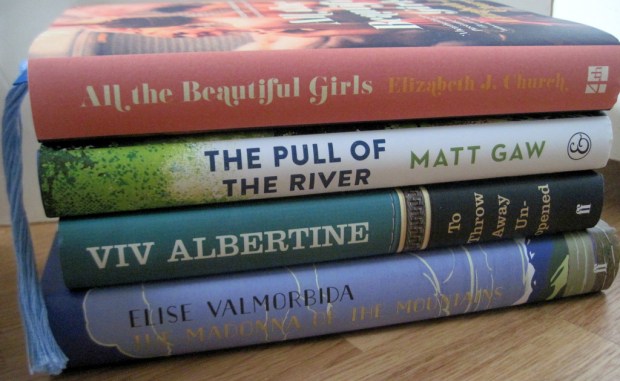
April 5th releases.
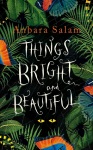 I started another April 5th release on my Kindle a couple of weeks ago, Things Bright and Beautiful by Anbara Salam. It’s about a missionary couple whose lives are disrupted by the return of an older missionary. I was thinking of abandoning it until I got to the last line of the prologue, which threw in a pretty great twist. So maybe I’ll go back to it.
For now, I can recommend the one April 5th release I actually managed to finish:
Dear Mrs. Bird by A.J. Pearce
 If you loved The Guernsey Literary and Potato Peel Pie Society, I have just the book for you: another feel-good World War II-set novel with characters you’ll cheer for. December 1940, London: Twenty-two-year-old Emmeline Lake dreams of being a Lady War Correspondent, but for now she’ll start by typing up the letters submitted to Henrietta Bird’s advice column in Woman’s Friend. All too quickly, though, the job feels too small for Emmy. Mrs. Bird refuses to print letters on Unpleasant subjects, which could include anything from an inappropriate crush to anxiety. She thinks cowardly readers bring their troubles on themselves and need to buck up instead of looking to others for help. But Emmy can’t bear to throw hurting people’s missives away. Perhaps she could send some advice of her own?
Emmy shares a flat with her best friend Bunty, and they each have a fiancé who is part of the war effort. As a volunteer for the Fire Brigade, Emmy sees the effects of Luftwaffe bombings up close. But it’s only after heartache hits home for both of these young women that they really understand how much is at stake in the war. The novel got a little melodramatic for me in its last quarter, but it’s overall a charming “Keep Calm and Carry On” and Stick It to Hitler-style story that never strays far from jollity for too long.
Other readalikes: My Salinger Year by Joanna Rakoff and The Night Watch by Sarah Waters
Some favorite lines:
“I told myself we could all get blown up by tomorrow so we might just as well enjoy ourselves.”
“Granny didn’t spend half her life chaining herself to railings for today’s woman to moon around waiting for some chap to look after her.”
My rating:
 On Monday we’re off to Wigtown, Scotland’s Book Town, for five days. Though we’ve been to Hay-on-Wye, Wales six times, we’ve never been to Wigtown despite meaning to for years. When I read Shaun Bythell’s Wigtown bookselling memoir last autumn, it felt like a sign that it was time. Did you see his The Diary of a Bookseller has been described in French as le quotidien d’un libraire misanthrope écossais (literally, “the daily life of a misanthropic Scottish bookseller”)?
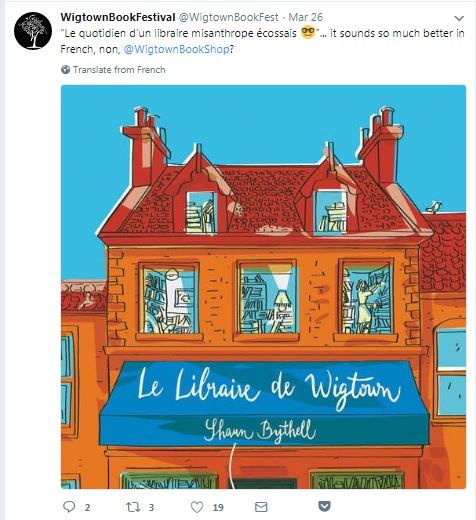
That’s too good! If only it were the official French title. I will of course be visiting his shop, and asking for a signature on my proof copy if I can pluck up the nerve. We’ll strive to be model customers lest we become the subject of a grumpy Tweet or Facebook post.
Coals to Newcastle and all that, but here’s the pile I’ve packed for Wigtown.
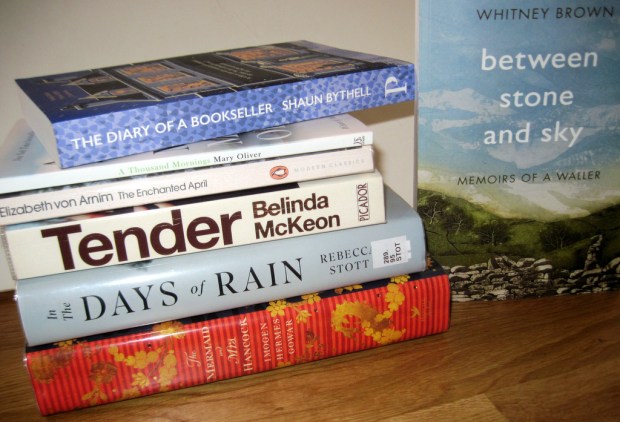
This is mostly for the six-hour car rides there and back. During the days we’ll be busy with outings to the surrounding countryside plus book shopping and café visits, but I daresay there will be some time for reading at the B&B in the afternoons and evenings.
For once I haven’t scoured my shelves for place-appropriate books; I don’t think I own any particularly Scottish reads, unless Michel Faber’s Under the Skin counts (ah wait, I also have an Ali Smith novel on the shelf).
Anyway, this time I’ve really just put together a pile of books I’ve been wanting to read for ages. The only ‘work’-related one is Between Stone and Sky, for a TLS review; otherwise I’m giving myself from Easter through the 6th off. I’m not even sure I’ll take my Kindle, except as a backup – that kind of thing could get you (or, rather, your Kindle) shot in this town. If I do, I’ll be sure to leave it behind in the B&B room or the glove box when we go into town for the day!
What are you up to in April?
A Publisher Party and a One-Man Play
I was a veritable social butterfly this past week: I went out two evenings in a row! (Believe me, that’s rare.) On Tuesday I met up with bloggers Annabel, Eric and Kim at the Faber Spring Party held at Crypt on the Green in London, and on Wednesday my husband and I attended a performance at the University of Reading of Michael Mears’s one-man play on the plight of Britain’s conscientious objectors during World War I, This Evil Thing.
Faber Spring Party
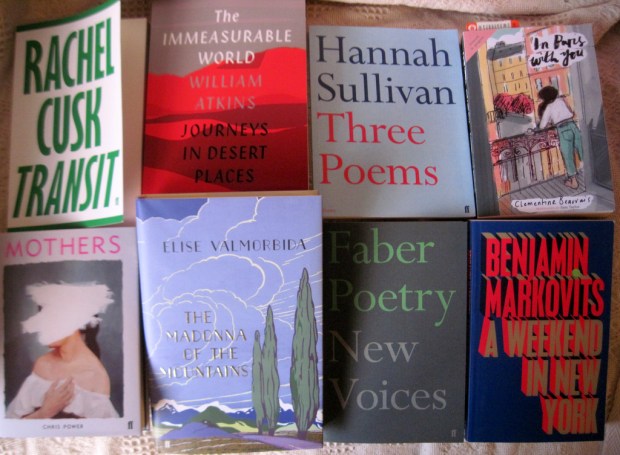
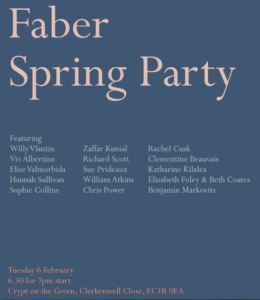 I’ve never been to an event quite like this. Publisher Faber & Faber, which will be celebrating its 90th birthday in 2019, previewed its major releases through to September. Most of the attendees seemed to be booksellers and publishing insiders. Drinks were on a buffet table at the back; books were on a buffet table along the side. Glass of champagne in hand, it was time to plunder the free books on offer. I ended up taking one of everything, with the exception of Rachel Cusk’s trilogy: I couldn’t make it through Outline and am not keen enough on her writing to get an advanced copy of Kudos, but figured I might give her another try with the middle book, Transit.

For the evening’s presentation, each featured author had a few minutes to introduce their new book and/or give a short reading.
Rachel Cusk opened the evening with a reading from Kudos. If you’re familiar with her recent work, you won’t be surprised at this synopsis: a man on a plane recounts having his dog put to sleep. (Out on May 3rd.)
William Atkins’s book on deserts, The Immeasurable World, is based on three years of travel and is, he is not ashamed to say, in the old-fashioned travel writing tradition. (Out on June 7th.)
Hannah Sullivan’s Three Poems is a hybrid work of poem-essays. #2 is more philosophical, she said; #3 is about her father’s death and her son’s birth. She read sonnet 3.21. (Out now.)
Clémentine Beauvais’s In Paris with You is a YA romance in free verse, loosely based on Eugene Onegin. I don’t know the source text but started this on the train ride home and it’s enjoyable thus far. I’m in awe at how translator Sam Taylor has taken the French of her Songe à la douceur and turned it into English poetry. (Out on June 7th.)
Chris Power’s Mothers is a book of linked short stories, three of which are about a character named Eva. He read a portion of a story about her having an encounter with an unpleasant man in Innsbruck. (Out on March 1st.)
Elise Valmorbida’s The Madonna of the Mountains, set in 1923–50, is a saga that resembles “an Italian Mother Courage,” she says. She read a scene in which a character comes across a madwoman. (Out on April 5th.)
Zaffar Kunial read the poem “Spark Hill” from his forthcoming collection Us. It’s about a childhood fight in the area of Birmingham where he grew up. He had a folder open in front of him but, impressively, recited the long poem completely from memory. (Out on July 5th.)
American novelist Benjamin Markovits was a professional basketball player in Germany for six months. Like the tennis-playing protagonist of his upcoming book, A Weekend in New York, he got tired of being measured. After 15 years, his hero is eager to escape a life of being constantly ranked. This is the first in a quartet of novels that inevitably invites comparison with John Updike’s “Rabbit” books. (Out on June 7th.)
I confess I didn’t previously know the name Viv Albertine; she was the guitarist for the female punk band The Slits, and To Throw Away Unopened is her second memoir. Albertine realized that it was her mother who had made her an angry rebel; the title is the label on a bag she found in her mother’s room after her death. (Out on April 5th.)
Sophie Collins incorporates hybrid forms in her poetry – what she calls “lyric essays.” The theme of her book Who Is Mary Sue? is perceptions of women’s writing (with “Mary Sue” as a metonym for the stereotypical good girl). She read from “Engine.” (Out now.)
Katharine Kilalea’s debut novel Ok, Mr Field is about an injured concert pianist who becomes obsessed with a house he buys in South Africa. (Out on June 7th.)
Elizabeth Foley and Beth Coates are the authors of two Homework for Grown-Ups books. Their new book, What Would Boudicca Do?, is about lessons we can draw from the women of history. For instance, the sampler booklet has pieces called “Dorothy Parker and Handling Jerks” and “Frida Kahlo and Finding Your Style.” There’s a heck of a lot of books like this out this year, though, and I’m not so sure this one will stand out. (Out on September 6th.)
Richard Scott read two amazingly intimate poems from his upcoming collection, Soho. One, “cover-boys,” was about top-shelf gay porn; the other was about mutilated sculptures of male bodies in the Athens archaeological museum. If you appreciated Andrew McMillan’s Physical, you need to get hold of this the second it comes out. I went back and read “cover-boys” in the sampler booklet and it wasn’t nearly as powerful as it was aloud; Scott’s reading really brought it to life, in contrast to some other authors’ dull delivery. (Out on April 5th.)
Sue Prideaux’s forthcoming biography of Friedrich Nietzsche is entitled I Am Dynamite! She encountered her subject when she wrote her first biography, of Edvard Munch. Although Nietzsche has been embraced by far-right groups in America, he was in fact against racism, nationalism, and anti-semitism, so he has important messages for us today. I’ll be keen to get hold of this one. (Out on September 6th.)
Guitar in hand, Willy Vlautin closed the evening with a performance of the title track from the soundtrack album to his fifth novel, Don’t Skip Out on Me – he was the singer in Portland, Oregon alt-country band Richmond Fontaine, which has recently stopped touring. He said the novel asks, “can you make the scars of broken people bearable?” (Out now.)

Now that I’ve got this terrific stack of books, wherever do I start?! I’m currently reading the Beauvais; from there I’ll focus on ones that have already been released, starting with Vlautin and the two poetry collections. The titles that aren’t out until June can probably wait – though it’s tempting to be one of the privileged few who get to read them nearly four months early. One Faber book per week should see me getting through all these by the final release date.
This Evil Thing
Michael Mears plays about 50 different characters in this one-man production. He’s an actor and pacifist who has written a number of solo pieces over 20 years. In this commemorative year of the end of the First World War, he knew we would hear a lot about battles, soldiers, and their families back home. But conscientious objectors weren’t likely to be remembered: theirs is a “story that’s rarely told,” he realized. This Evil Thing sets out to correct that omission. The title phrase refers not to war in general but specifically to conscription.
 The two main characters Mears keeps coming back to in the course of the play are Bert Brocklesby, a Yorkshire preacher, and philosopher Bertrand Russell. Brocklesby refused to fight and, when he and other COs were shipped off to France anyway, resisted doing any work that supported the war effort, even peeling the potatoes that would be fed to soldiers. He and his fellow COs were beaten, placed in solitary confinement, and threatened with execution. Meanwhile, Russell and others in the No-Conscription Fellowship fought for their rights back in London. There’s a wonderful scene in the play where Russell, clad in nothing but a towel after a skinny dip, pleads with Prime Minister Asquith.
As in solo shows I’ve seen before (e.g. A Christmas Carol with Patrick Stewart), Mears had to find subtle ways to distinguish between characters: he used a myriad different voices, including regional accents; he quickly donned a jacket, hat, or pair of glasses. Russell was identified by his ever-present pipe. The most challenging scene, Mears said in the Q&A at the end, was one with four characters in a French street café.
Mears reveals during the play that his grandfather fought in WWI and his father in WWII, but he has never had to put his own pacifist views to the test. What about Hitler? people always ask. Mears is honest and humble enough to admit that he doesn’t know what he would have done had he been called on to fight Hitler, or had he faced persecution as a CO in WWI. Ultimately, what Mears hopes audiences take from his play, which won acclaim at the Edinburgh Festival Fringe, is that “this is not an irrelevant piece of history.” Standing up for what you believe in, especially if it goes against the spirit of the times, is always valuable.
 Bookish Beck = Rebecca Foster. American transplant to England. Freelance proofreader and book reviewer.
 Bookish Beck