April Releases by Brownrigg, Ernaux, O’Connor, Waterman and Wood
Family history is a common element for the first four of these review books: a multi-generational story (incorporating autofiction in places) about Anglo-American writers and the legacy of suicide; a brief slice of memoir about the loss of a mother; a historical novella inspired by family stories and set on an island at the cusp of war; and a poetry collection drawing on a father’s death as well as on local folklore. Addiction and dementia are specific links between pairs. And to round off, a set of short stories about pregnancy and motherhood.
The Whole Staggering Mystery: A Story of Fathers Lost and Found by Sylvia Brownrigg
“The dead don’t come back, but they are not as far away as you think.”
I knew Brownrigg’s name as a novelist thanks to Susan’s blog (see her review of Pages for Her), but when I read about this family memoir it piqued my interest more than her fiction might have. The Brownrigg clan are nobility (really – her brother has the title “Baronet”) but have rejected conventional Englishness over the past century. First her grandfather, Gawen, separated from his wife and moved to Nairobi to work as a journalist. He also published two obscure novels before dying at age 27. The empty bottle of Nembutal and recent changes to his will suggested suicide, though his mother resisted the notion vociferously. Gawen’s son, Nicholas, was raised in California by his mother, Lucia, and became an alcoholic who lived off-grid on a ranch and had an unpublished Beats-influenced novel.
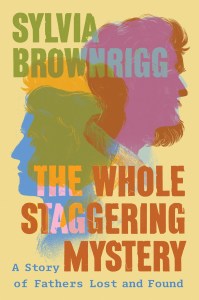 After Nicholas’s death in 2018, Brownrigg was compelled to trace her family’s patterns of addiction and creativity. It’s a complex network of relatives and remarriages here. The family novels and letters were her primary sources, along with a scrapbook her great-grandmother Beatrice made to memorialize Gawen for Nicholas. Certain details came to seem uncanny. For instance, her grandfather’s first novel, Star Against Star, was about, of all things, a doomed lesbian romance – and when Brownrigg first read it, at 21, she had a girlfriend.
Along with the more traditional memoir sections, there are the documents that speak for themselves and extended passages of autofiction. I loved an imaginary letter by Gawen’s older brother, who died in young childhood, and a third-person segment about Beatrice’s life in England during the Second World War. But I mostly skipped over the 90 lightly fictionalized pages about the author’s (“Sophie’s”) life with her father in California. You might view this as a showcase of possible methods for engaging with family history, some of which work better than others. All of it is fascinating material, though.
Published by Counterpoint in the USA. With thanks to Nectar Literary for the advanced e-copy for review.
A Woman’s Story by Annie Ernaux (1988; 2024)
[Translated from the French by Tanya Leslie]
 This memoir of Ernaux’s mother’s life and death is, at 58 pages, little more than an extended (auto)biographical essay. Confusingly, it covers the same period she wrote about in I Remain in Darkness (originally published nine years later), a diary of her mother’s final years with dementia; I even remembered two specific events and quotes. Why not combine the two into a full-length biographical recollection? Or pair it with A Man’s Place, Ernaux’s memoir of her father, in one volume? Perhaps her works will be repackaged in the future. But this came first: Ernaux started writing just a couple of weeks after her mother’s death, and spent 10 months over it. It’s clear she was determined to salvage what she could of her mother’s life:
It’s a difficult undertaking. For me, my mother has no history. She has always been there. When I speak of her, my first impulse is to ‘freeze’ her in a series of images unrelated to time … This book can be seen as a literary venture as its purpose is to find out the truth about my mother, a truth that can be conveyed only by words. … I believe I am writing about my mother because it is my turn to bring her into the world.
Ernaux opens with news of the death, and the funeral. But soon she’s pushing back into the past. Her mother grew up in poverty near Rouen and worked in a factory before her marriage, when she and her husband took on a grocery store and café. The Second World War was in some romantic way the great drama of her life. She was exacting of her daughter: “Her overriding concern was to give me everything she hadn’t had. But this involved so much work, so much worrying about money”. In her widowhood she came to live with Ernaux, who was then divorced with two sons, and tried to find a middle way between independence and connection. Eventually, though, her memory loss required admission to a nursing home.
I’ve felt the same about all three short works I’ve read by Ernaux so far: though precisely observed, they conceal themselves behind emotional distance. So while this might seem similar to A Very Easy Death by Simone de Beauvoir, I found the latter more engaging.
With thanks to Fitzcarraldo Editions for the free copy for review.
Whale Fall by Elizabeth O’Connor
 The remote Welsh island setting of O’Connor’s debut novella was inspired by several real-life islands that were depopulated in the twentieth century due to a change in climate and ways of life: Bardsey, St Kilda, the Blasket Islands, and the Aran Islands. (A letter accompanying my review copy explained that the author’s grandmother was a Welsh speaker from North Wales and her Irish grandfather had relatives on the Blasket Islands.)
Eighteen-year-old Manod Llan is the older daughter of a lobster fisherman. Her sweetheart recently left to find work in a mainland factory. It’s 1938 and there are vague rumbles about war, but more pressing is the arrival of strangers here to study a vanishing culture. Anthropologists Edward and Joan learn snatches of Welsh and make recordings of local legends and songs, which are interspersed with the fragmentary narrative. Manod, star-struck, seeks the English researchers’ approval as she helps with translation and other secretarial duties, but becomes disillusioned with their misinterpretations and fascist leanings.
The gradual disintegration of a beached whale casts a metaphorical shadow of decay over the slow-burning story. I kept waiting for momentous events that never came. More definitive consequences? Something to do with Manod’s worries for her little sister, Llinos? A flash-forward to the abandoned island’s after-years? Or to Manod’s future? As it is, the sense of being stuck at a liminal time makes it all feel like prologue. But O’Connor’s writing is quite lovely (“The milk had formed a film over the surface and puckered, like a strange kiss”; “All of my decisions felt like trying to catch a fish that did not exist until I caught it”) and the book is strong on atmosphere and tension. I’ll look out for her next work.
With thanks to Picador for the free copy for review.
Come Here to This Gate by Rory Waterman
I was most drawn to the poems in Part I, “All but Forgotten,” about his father’s last year or so.
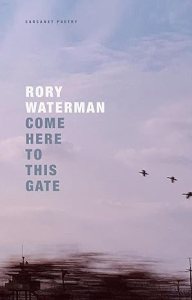
The titles participate in telling the story: “Alcoholic Dementia,” followed by “Twin Oaks Nursing Home.”
The sheep-tracks of your mind were worn to trenches.
…
Then what you’ve turned yourself into – half there
on one side of a final single bed
you might not leave till the rest of you has left –
starts, stares through me, says ‘I’m being held
against my will!’, tells a nurse to ‘Just fuck off’
then thanks her. Old boy, when did you get like this?
The sheep-tracks of my mind are worn to trenches.
Then they moved you to a home
that still wasn’t home. ‘Why
am I in this fucking place?
Nothing’s wrong with me.’
So I’d tell you all over again,
but only the easy part (‘You’re
not remembering things well
at present.’ ‘Yes I fucking am’)
and you relearned that you’d
never learn – mindless torture,
until I stopped it. Your
silences were trains departing.
From the miscellany of Part II, I plucked out “Gooseberries” and “Perennials,” both of which conceal emotion among plants. Then Part III, “Lincolnshire Folk Tales,” turns the tone mischievous, with the ABCB end-rhymes of “Yallery Brown,” “The Metheringham Lass,” “The Lincoln Imp,” and “Nanny Rutt” (I felt I’d stumbled on a limerick with its rhythm: “Math Wood is a small plot of trees south of Bourne, / next to McDonald’s and Lidl. / It’s privately owned, full of shot-gun shells, pheasants – / but still, a bit of an idyll”). Plenty of good stuff, then, but it doesn’t all seem to fit together in the same collection.
With thanks to Carcanet Press for the advanced e-copy for review.
This Is Why We Can’t Have Nice Things by Naomi Wood
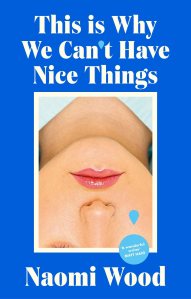 I requested this because a) I had enjoyed Wood’s novels Mrs. Hemingway and The Hiding Game and b) I couldn’t resist the title. These nine contemporary stories (five in the first person and four in the third person) all feature women who are pregnant and/or mothers of young children. Three dwell on work–life balance in particular, with the female protagonists of “Lesley, in Therapy” and “Dracula at the Movies” an animator and a filmmaker, respectively. The third, “Hurt Feelings,” in which a medical emergency forces a choice between career and motherhood, was my favourite. Claudia is working on an advertising campaign for a large pharmaceutical company whose newest product targets chronic pain. Although she suspects it’s a placebo, she knows how valuable it is for these people to have their pain acknowledged given it’s as invisible as her history of pregnancy loss.
Other highlights included “Peek-a-Boo,” in which pregnant twin sisters fly to Italy to remonstrate with their father, who refuses to cede a holiday flat to the next renters; and “Wedding Day,” about a woman bitter enough to try to sabotage her ex’s big day by demanding he bring their daughter, the flower girl, home by bedtime. “Flatten the Curve” is about restrictions and desires during Covid lockdown. Family, neighbour, and co-worker dynamics fuel the drama. In a few cases, Wood imagined promising situations but didn’t deliver on them. I could hardly believe “Comorbidities,” about a mother who films a sex tape with her husband to distract from her eco-anxiety, won the 2023 BBC National Short Story Award. If Wood was aiming for edgy, she landed on peevish instead. “Dino Moms,” the final story, was worst, with its absurd dinosaur-vet reality-TV setup. Overall, the collection is too one-note because of the obsession with motherhood (“It is not very interesting to be in love with your child; it’s commonplace, this sacrificial love”). Back to novels soon, please.
With thanks to Phoenix (Orion) for the free copy for review.
Does one of these catch your eye? What April releases can you recommend?
Love Your Library, April 2024
Thanks to Laila, Laura, Marcie (the middle and right-hand images below), and Naomi (here and here) for posting about their recent library reading! Everyone is welcome to join in with this meme that runs on the last Monday of the month.


It was National Library Week in the USA the week of the 7th, and I enjoyed Gretchen Rubin’s post about the libraries that have been special to her over the years. I can think of so many that have meant something to me, mostly back home in Maryland: the Silver Spring, Bowie and Frederick public libraries, and the Hood College library. And in England, the University of Reading library, the University of Leeds Brotherton library, the King’s College Maughan Library, Senate House Library, and all the county branch libraries I’ve been a member of, up through Newbury Library now. How about for you?

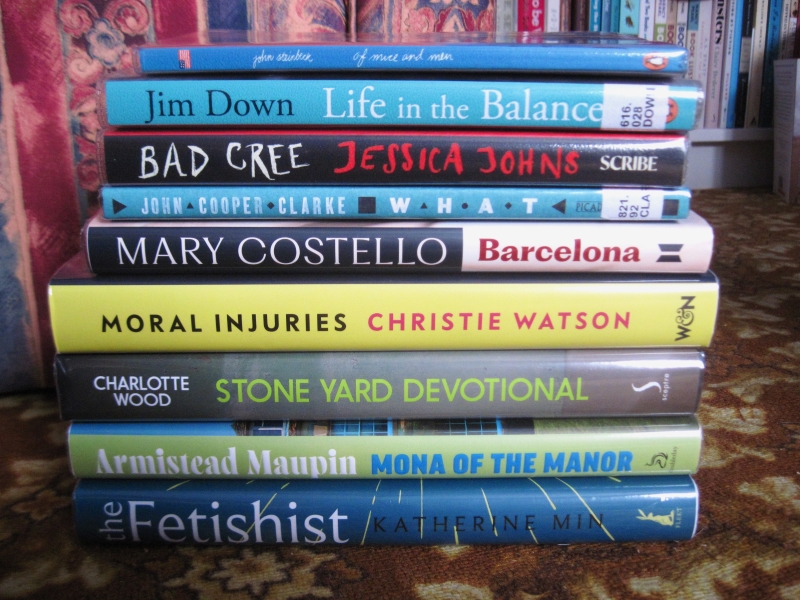
I’ve read some great stuff over the past month! I link to my reviews of anything I haven’t already covered on the blog.
READ
- Barcelona by Mary Costello

- Life in the Balance: A Doctor’s Stories of Intensive Care by Jim Down
- The Paris Wife by Paula McLain (a reread for book club)
- The Bee Sting by Paul Murray
- Come and Get It by Kiley Reid

- The Collected Stories of Carol Shields
- Of Mice and Men by John Steinbeck (a reread)
- Moral Injuries by Christie Watson

- Stone Yard Devotional by Charlotte Wood
- Land of Milk and Honey by C Pam Zhang

SKIMMED
- Brotherless Night by V.V. Ganeshananthan
- Blood: The Science, Medicine, and Mythology of Menstruation by Dr Jen Gunter

- How to Raise a Viking: The Secrets of Parenting the World’s Happiest Children by Helen Russell
- Before the Light Fades: A Memoir of Grief and Resistance by Natasha Walter
CURRENTLY READING
- Cloistered: My Years as a Nun by Catherine Coldstream
- Enter Ghost by Isabella Hammad
- The Door-to-Door Bookstore by Carsten Henn
- Kay’s Incredible Inventions by Adam Kay
- Mona of the Manor by Armistead Maupin
- After Dark by Haruki Murakami
- Lunar New Year Love Story by Gene Luen Yang
CHECKED OUT, TO BE READ
- Jungle House by Julianne Pachico
& the rest of what is pictured above and below:

What have you been reading or reviewing from the library recently?

Share a link to your own post in the comments. Feel free to use the above image. The hashtag is #LoveYourLibrary.
Carol Shields Prize Reading: Daughter and Dances
Two more Carol Shields Prize nominees today: from the shortlist, the autofiction-esque story of a father and daughter, both writers, and their dysfunctional family; and, from the longlist, a debut novel about the physical and emotional rigours of being a Black ballet dancer.
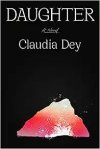
Daughter by Claudia Dey
Like her protagonist, Mona Dean, Dey is a playwright, but the Canadian author has clearly stated that her third novel is not autofiction, even though it may feel like it. (Fragmentary sections, fluidity between past and present, a lack of speech marks; not to mention that Dey quotes Rachel Cusk and there’s even a character named Sigrid.) Mona’s father, Paul, is a serial adulterer who became famous for his novel Daughter and hasn’t matched that success in the 20 years since. He left Mona and Juliet’s mother, Natasha, for Cherry, with whom he had another daughter, Eva. There have been two more affairs. Every time Mona meets Paul for a meal or a coffee, she’s returned to a childhood sense of helplessness and conflict.
I had a sordid contract with my father. I was obsessed with my childhood. I had never gotten over my childhood. Cherry had been cruel to me as a child, and I wanted to get back at Cherry, and so I guarded my father’s secrets like a stash of weapons, waiting for the moment I could strike.
It took time for me to warm to Dey’s style, which is full of flat, declarative sentences, often overloaded with character names. The phrasing can be simple and repetitive, with overuse of comma splices. At times Mona’s unemotional affect seems to be at odds with the melodrama of what she’s recounting: an abortion, a rape, a stillbirth, etc. I twigged to what Dey was going for here when I realized the two major influences were Hemingway and Shakespeare.
 Mona’s breakthrough play is Margot, based on the life of one Hemingway granddaughter, and she’s working on a sequel about another. There are four women in Paul’s life, and Mona once says of him during a period of writer’s block, “He could not write one true sentence.” So Paul (along with Mona, along with Dey) may be emulating Hemingway.
And then there’s the King Lear setup. (I caught on to this late, perhaps because I was also reading a more overt Lear update at the time, Private Rites by Julia Armfield.) The larger-than-life father; the two older daughters and younger half-sister; the resentment and estrangement. Dey makes the parallel explicit when Mona, musing on her Hemingway-inspired oeuvre, asks, “Why had Shakespeare not called the play King Lear’s Daughters?”
Were it not for this intertextuality, it would be a much less interesting book. And, to be honest, the style was not my favourite. There were some lines that really irked me (“The flowers they were considering were flamboyant to her eye, she wanted less flamboyant flowers”; “Antoine barked. He was barking.”; “Outside, it sunned. Outside, it hailed.”). However, rather like Sally Rooney, Dey has prioritized straightforward readability. I found that I read this quickly, almost as if in a trance, inexorably drawn into this family’s drama.
Related reads: Monsters by Claire Dederer, The Wren, The Wren by Anne Enright, The Wife by Meg Wolitzer, Mrs. Hemingway by Naomi Wood
With thanks to publicist Nicole Magas and Farrar, Straus and Giroux for the free e-copy for review.
Also from the shortlist:
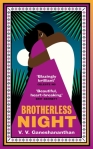 Brotherless Night by V.V. Ganeshananthan – The only novel that is on both the CSP and Women’s Prize shortlists. I dutifully borrowed a copy from the library, but the combination of the heavy subject matter (Sri Lanka’s civil war and the Tamil Tigers resistance movement) and the very small type in the UK hardback quickly defeated me, even though I was enjoying Sashi’s quietly resolute voice and her medical training to work in a field hospital. I gave it a brief skim. The author researched this second novel for 20 years, and her narrator is determined to make readers grasp what went on: “You must understand: that word, terrorist, is too simple for the history we have lived … You must understand: There is no single day on which a war begins.” I know from Laura and Marcie that this is top-class historical fiction, never mawkish or worthy, so I may well try it some other time when I have the fortitude.
Longlisted:
Dances by Nicole Cuffy
This was a buddy read with Laura (see her review); I think we both would have liked to see it on the shortlist as, though we’re not dancers ourselves, we’re attracted to the artistry and physicality of ballet. It’s always a privilege to get an inside glimpse of a rarefied world, and to see people at work, especially in a field that requires single-mindedness and self-discipline. Cuffy’s debut novel focuses on 22-year-old Celine Cordell, who becomes the first Black female principal in the New York City Ballet. Cece marvels at the distance between her Brooklyn upbringing – a single mother and drug-dealing older brother, Paul – and her new identity as a celebrity who has brand endorsements and gets stopped on the street for selfies.
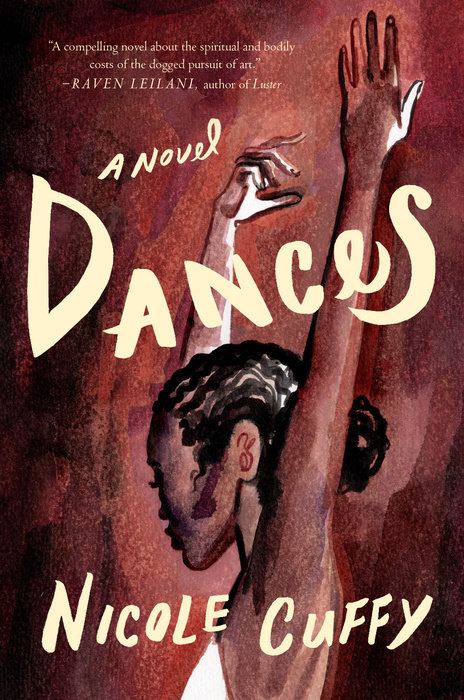
Even though Kaz, the director, insists that “Dance has no race,” Cece knows it’s not true. (And Kaz in some ways exaggerates her difference, creating a role for her in a ballet based around Gullah folklore from South Carolina.) Cece has always had to work harder than the others in the company to be accepted:
Ballet has always been about the body. The white body, specifically. So they watched my Black body, waited for it to confirm their prejudices, grew ever more anxious as it failed to do so, again and again.
A further complication is her relationship with Jasper, her white dance partner. It’s an open secret in the company that they’re together, but to the press they remain coy. Cece’s friends Irine and Ryn support her through rocky times, and her former teachers, Luca and Galina, are steadfast in their encouragement. Late on, Cece’s search for Paul, who has been missing for five years, becomes a surprisingly major element. While the sibling bond helps the novel stand out, I most enjoyed the descriptions of dancing. All of the sections and chapters are titled after ballet terms, and even when I was unfamiliar with the vocabulary or the music being referenced, I could at least vaguely picture all the moves in my head. It takes real skill to render other art forms in words. I’ll look forward to following Cuffy’s career. 
With thanks to publicist Nicole Magas and One World for the free e-copy for review.
Currently reading:
(Shortlist) Coleman Hill by Kim Coleman Foote
(Longlist) Between Two Moons by Aisha Abdel Gawad
Up next:
(Longlist) You Were Watching from the Sand by Juliana Lamy
I’m aiming for one more batch of reviews (and a prediction) before the winner is announced on 13 May.
You may also have seen me on…
Kim’s blog, Reading Matters (recommending three books for “Triple Choice Tuesday”)

&
Shelf Awareness, where I’m in conversation with another reviewer for the National Poetry Month special issue.

Just a very quick post to link to my work elsewhere over the past week.
Back to book reviews tomorrow!
Rereading Of Mice and Men for #1937Club
A year club hosted by Karen and Simon is always a great excuse to read more classics. Between my shelves and the library, I had six options for 1937. But I started reading too late, and had too many books on the go, to finish more than one – a reread. No matter; it was a good one I was glad to revisit, and I’ll continue with the other reread at my own pace.
Of Mice and Men by John Steinbeck
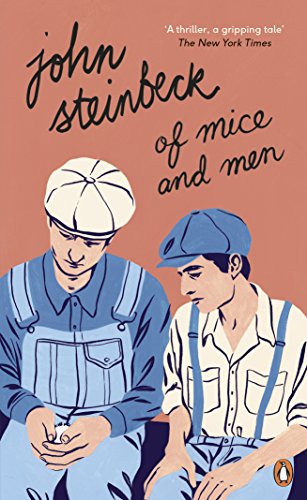 Are teenagers doomed to dislike the books they read in school? I think this must have been on the curriculum for 11th grade English. It was my third Steinbeck novella after The Red Pony and The Pearl, so to me it confirmed that he wrote contrived, depressing stuff with lots of human and animal suffering. Not until I read The Grapes of Wrath in college and East of Eden (THE Great American Novel) five years ago did I truly recognize Steinbeck’s greatness.
George and Lennie are itinerant farm workers in Salinas Valley, California. Lennie is a gentle giant, intellectually disabled and aware of his own strength when hauling sacks of barley but not when stroking mice and puppies. George looks after Lennie as a favour to Aunt Clara and they’re saving up to buy their own smallholding. This dream is repeated to the point of legend, somewhere between a bedtime story and scripture:
‘Someday—we’re gonna get the jack together and we’re gonna have a little house and a couple of acres an’ a cow and some pigs and—’ ‘An’ live off the fatta the lan’,’ Lennie shouted. ‘And have rabbits.’
They quickly settle in alongside the other ranch-hands and even convert two to their idyllic picture of independence. But the foreman, Curley, is a hothead and his bored would-be-starlet wife won’t stop roaming into the men’s quarters. No matter how much George tells Lennie to stay away from both of them, something is set in motion – an inevitable repeat of an incident from their previous employment that forced them to move on.
I remembered the main contours here but not the ultimate ending, and this time I appreciated the deliberate echoes and heavy foreshadowing (all that symbolism to write formulaic school essays about!): this is Shakespearean tragedy with the signs and stakes writ large against a limited background. Bar some paragraphs of scene-setting descriptions, it is like a play; no surprise it’s been filmed several times. (I wish I didn’t have danged John Malkovich in my head as Lennie; I can’t think of anyone else in that role, whereas Gary Sinise doesn’t necessarily epitomize George for me.) The characterization of the one Black character, Crooks, and the one woman are uncomfortably of their time. However, Crooks is given the dubious honour of conveying the bleak vision: “Nobody never gets to heaven, and nobody gets no land. It’s just in their head.” Like Hardy, Steinbeck knows what happens when the lower classes make the mistake of wanting too much. It’s a timeless tale of grit and desperation, the kind one can’t imagine not existing. (Public library)
Apposite listening: “The Great Defector” by Bell X1 (known for their quirky lyrics):
You’ve been teasing us farm boys
’til we start talking ’bout those rabbits, George
oh, won’t you tell us ’bout those rabbits, George?
Original rating (1999?):
My rating now:


Currently rereading: The Hobbit by J.R.R. Tolkien – My father gave me this for Christmas when I was 10. I think I finally read it sometime in my later teens, about when the Lord of the Rings films were coming out. I’m on page 70 now. I’d forgotten just how funny Tolkien is about the set-in-his-ways Bilbo and his devotion to a cosy, quiet life. When he’s roped into a quest to reclaim a mountain hoard of treasure from a dragon – along with 13 dwarves and Gandalf the wizard – he realizes he has much discomfort and many a missed meal ahead of him.


 DNFed: Journey by Moonlight by Antal Szerb – My second attempt with Hungarian literature, and I found it curiously similar to the other novel I’d read (Embers by Sandor Márai) in that much of it, at least the 50 pages I read, is a long story told by one character to another. In this case, Mihály, on his Italian honeymoon, tells his wife about his childhood best friends, a brother and sister. I wondered if I was meant to sense homoerotic attachment between Mihály and Tamás, which would appear to doom this marriage right at its outset. (Secondhand – Edinburgh charity shop, 2018)
 Skimmed: Out of Africa by Karen Blixen – I enjoyed the prose style but could tell I’d need a long time to wade through the detail of her life on a coffee farm in Kenya, and would probably have to turn a blind eye to the expected racism of the anthropological observation of the natives. (Secondhand – Way’s in Henley, 2015)
Here’s hoping for a better showing next time!
(I’ve previously participated in the 1920 Club, 1956 Club, 1936 Club, 1976 Club, 1954 Club, 1929 Club, and 1940 Club.)
Book Serendipity, March to April 2024
I call it “Book Serendipity” when two or more books that I read at the same time or in quick succession have something in common – the more bizarre, the better. This is a regular feature of mine every couple of months. Because I usually have 20–30 books on the go at once, I suppose I’m more prone to such incidents. The following are in roughly chronological order.
- I encountered quotes from “The Second Coming” by W.B. Yeats on the same day in Immanuel by Matthew McNaught and Waiting for the Monsoon by Rod Nordland. A week or so later, I found another allusion to it – a “rough _________ slouching toward ________” – in Mothership by Greg Wrenn.
- Reading my second memoir this year in which the author’s mother bathed them until they were age 17 (in other words, way past when it ceased to be appropriate): I’m Glad My Mom Died by Jennette McCurdy was followed by Mothership by Greg Wrenn.
- Quoting a poem with the word “riven” in it (by Christian Wiman) in Places I’ve Taken My Body by Molly McCully Brown and (by a character in the novel) in Bright and Tender Dark by Joanna Pearson. The word “riven” (which is really not a very common one, is it?) also showed up in Sleepless by Annabel Abbs. And then “riving” in one of the poems in The Intimacy of Spoons by Jim Minick.
- East Timor as a destination in Waiting for the Monsoon by Rod Nordland and Mothership by Greg Wrenn.
- Quoting John Donne in Places I’ve Taken My Body by Molly McCully Brown and The Bee Sting by Paul Murray (to which a Donne line is the epigraph); mimicking Donne in one poem of Fields Away by Sarah Wardle.
- “Who do you think you are?” as a question an abusive adult asks of a child in The Beggar Maid (aka Who Do You Think You Are?) by Alice Munro and Mothership by Greg Wrenn.
- Sylvia Plath is mentioned in Sleepless by Annabel Abbs and The Bee Sting by Paul Murray … and Katherine Mansfield in Sleepless by Annabel Abbs and The Beggar Maid by Alice Munro.
- Mosquitoes are mentioned in a poem in Rapture’s Road by Seán Hewitt and Divisible by Itself and One by Kae Tempest.

- Reading two memoirs that quote a Rumi poem (and that released on 9 April and that I reviewed for Shelf Awareness): Fi: A Memoir of My Son by Alexandra Fuller and Somehow: Thoughts on Love by Anne Lamott. (Rumi was also quoted as an epigraph in Viv Fogel’s poetry collection Imperfect Beginnings.)
- Bereavement memoirs that seek significance in eagle sightings (i.e. as visitations from the dead): Sleepless by Annabel Abbs and Fi: A Memoir of My Son by Alexandra Fuller.
- Snyder’s pretzels as a snack in Somehow: Thoughts on Love by Anne Lamott and Come and Get It by Kiley Reid.

- Reading two C-PTSD memoirs at the same time: A Flat Place by Noreen Masud and Mothership by Greg Wrenn.
 Information about coral reefs dying in Martyr! by Kaveh Akbar and Mothership by Greg Wrenn.
- The gay slang term “twink” appears in The Bee Sting by Paul Murray and Mothership by Greg Wrenn.
- Assisting a mother who reads tarot cards in Intervals by Marianne Brooker and The Year of the Cat by Rhiannon Lucy Cosslett. (Tarot is also read in First Love by Lilly Dancyger and The Future by Catherine Leroux.)

- An Asian American character who plays poker in a graphic novel: Advocate by Eddie Ahn and Lunar New Year Love Story by Gene Luen Yang.
- Vivian Gornick’s Fierce Attachments, which I was also reading at the time, is mentioned in Intervals by Marianne Brooker.
 An Uncle Frank in an Irish novel with no speech marks: Trespasses by Louise Kennedy and The Bee Sting by Paul Murray.
- Martin Luther King’s “I Have a Dream” speech is quoted in Some Kids I Taught & What They Taught Me by Kate Clanchy and How to Raise a Viking by Helen Russell.
- Using quarters for laundry in Come and Get It by Kiley Reid and one story from Dressing Up for the Carnival by Carol Shields.

- A scene of someone watching from a lawn chair as someone else splits wood in Martyr! by Kaveh Akbar and Becoming Little Shell by Chris La Tray.
 Quotes from cultural theorist Sara Ahmed in Intervals by Marianne Brooker and A Flat Place by Noreen Masud.
- I read about windows being blocked up because of high taxes on the same evening in Trespasses by Louise Kennedy and one story from Dressing Up for the Carnival by Carol Shields.
- I saw Quink ink mentioned in The Silence by Gillian Clarke and Trespasses by Louise Kennedy on the same evening.
- The song “It’s a Long Way to Tipperary” is mentioned in You’re on Your Own, Snoopy by Charles M. Schulz and Welcome to Glorious Tuga by Francesca Segal.
- A pet magpie in George by Frieda Hughes and A Council of Dolls by Mona Susan Power.

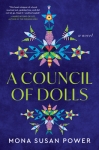
- A character tests to see what will happen (will God strike them down?) when they mess with the Host (by stealing the ciborium or dropping a wafer on the floor, respectively) in A Council of Dolls by Mona Susan Power and one story from Dressing Up for the Carnival by Carol Shields.
- Marrying the ‘wrong’ brother in The Bee Sting by Paul Murray and A Council of Dolls by Mona Susan Power.
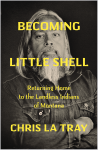 Indigenous author, Native versus Catholic religion, and descriptions of abuse and cultural suppression at residential schools in Becoming Little Shell by Chris La Tray and A Council of Dolls by Mona Susan Power.
- Teen girls obsessed with ‘sad girl’ poetry, especially by Sylvia Plath, in First Love by Lilly Dancyger and The Bee Sting by Paul Murray.
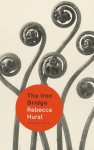
- “Hyacinth” is a poem in Solutions for the Problem of Bodies in Space by Catherine Barnett, and “Hyacinth Girl” a story in Cocktail by Lisa Alward. (Hyacinths are also mentioned in a poem in The Iron Bridge by Rebecca Hurst.)


- A character named Sissy in A Council of Dolls by Mona Susan Power and Stone Yard Devotional by Charlotte Wood.
- Harming amphibians, whether deliberately or accidentally, in a story in Barcelona by Mary Costello, a poem in Baby Schema by Isabel Galleymore, and Mothership by Greg Wrenn.
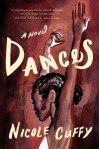
- A significant character called Paul in Dances by Nicole Cuffy, Daughter by Claudia Dey (those two were both longlisted for the Carol Shields Prize), and Moral Injuries by Christie Watson.

- Out of Africa (the film and then the book), which I was looking through for the #1937Club, is mentioned in The Whole Staggering Mystery by Sylvia Brownrigg – her writer grandfather lived in Nairobi’s “Happy Valley” in the 1930s.
- Reading two novels at the same time in which a teen girl’s plans to study medicine are derailed by war: Brotherless Night by V.V. Ganeshananthan and The Snow Hare by Paula Lichtarowicz.

What’s the weirdest reading coincidence you’ve had lately?
Dressing Up for the Carnival by Carol Shields (Buddy Reread)
Marcie of Buried in Print and I have spent the first few months or so of 2024 rereading Carol Shields’s short stories: one volume per month from the Collected Stories. (Previous reviews: Various Miracles (1985) and The Orange Fish (1989).) Dressing Up for the Carnival was a late collection, published in 2000 – just a few years before the author’s death. Like Various Miracles, it’s a long book; in fact, at 22 stories, it’s the longest of the three. And, just like the other two, it opens with the title story, which is itself akin to “Various Miracles” with its pile-up of seemingly random happenings. All the examples are of how the things that people wear, or carry, create a persona. I noted pleasing symmetry in that “Dressing Up for the Carnival” opens the book, while the final story is “Dressing Down,” about a married couple divided by the husband’s devotion to naturism for one month out of each year.
 I hadn’t realized that Unless, Shields’s final, Booker-shortlisted novel, arose from one of these stories: “A Scarf.” It took me just two paragraphs to figure it out, based on her narrator’s punning novel title (My Thyme Is Up). I’d also forgotten about the fun Shields pokes at literary snobbishness through her protagonist winning the Offenden Prize, which “recognizes literary quality and honors accessibility”. (There is actually a UK prize that rewards ease of reading, the Goldsboro Books Glass Bell Award.)
Many main characters throughout Shields’s work are artists, musicians, writers or poets. When windows are subject to an exorbitant tax, two painters decide to create their own, a joint project that brings the couple closer (in “Windows”). The elevated diction and proliferating French phrases skewer the narrator’s pretensions. Edging towards surrealism is another custom of Shields’s, seen here in “Weather,” where meteorological phenomena – or the lack thereof – are literal and a metaphor for marriage. This one finds an echo in “Stop!”, a fable about a queen who avoids all risk and change and thus disallows weather.
A number of the flash-length stories are similarly allegorical, or linguistic experiments, e.g., “Absence,” which is lipogrammatic (no “I”). “Flatties: their Various Forms and Uses” is a faux-anthropological one about flatbreads that reminded me of “Today Is the Day.” “The Harp” looks at the aftermath of the freak accident of a harp falling from the sky. “Keys” is a daisy-chain type of story (like “Home” et al.), with the keys symbolic of access, ownership, secrets, home, and more. Academia is another frequent subject for Shields. “Ilk” has the same academic jargon (“narrativity is ovarian, not ejaculatory”) and mockery of a predominantly male preserve as in “The Metaphor Is Dead–Pass It On” and “Salt.”
A topic shared with The Orange Fish is the biographer’s art. I loved “Edith-Esther,” about a biographer who becomes so obsessed with the expression of spirituality in his subject’s works that he completely skews her life story towards it, even though she tells him flat out she doesn’t believe in God. What a nightmare for an author to be so misunderstood; it’s no accident, of course, that it’s a male critic doing it to a female writer. “Invention” imagines creation scenarios for everything from steering wheel covers to daydreaming.
 In “Dying for Love,” an early standout for me, three wronged women consider suicide. The vocabulary quickly alerts the reader to a change of time period after each section break. All three decide “Life is a thing to be cherished”. My three favourites, though, were the final three – all slightly cheeky with the focus on sex (and naturism). They were together an excellent way to close the volume, and the Collected Stories. In “The Next Best Kiss,” single mother Sandy meets a new paramour at a conference. She and Todd share garrulousness, and a sexual connection. But he doesn’t’ see the appeal of her biography’s subject, a Gregor Mendel-meets-John Clare type, and she is aghast to learn that he still lives with his mother.
“Eros,” set at a sexually charged dinner party (and you know from Larry’s Party that Shields is brilliant at party scenes), spools back through Ann’s erotic life, all the way to childhood ignorance and curiosity. “Everyone knew this awful secret which was everywhere suggested but which for Ann lay, still, a quarter-inch out of reach.” That Ann has lost a breast to cancer treatment made me ponder whether this story reflected Shields’s own experience – she died in 2003 of a recurrence of breast cancer.
There were a few too many second-tier stories here compared to The Orange Fish, but several gems; and I always appreciate Shields’s wordplay and insider’s satire on being an academic and/or a writer.
My original rating (c. 2008):
My rating now:
Bonus
Shields’s final short story, “Segue,” is printed first in the Collected Stories. Dutiful Marcie read it first, whereas I saved it for last to try to preserve a sense of chronological order. Max Sexton writes novels, the latest of which sounds exactly like The Corrections – a 2001 publication, and Shields also references 9/11. Jane Sexton, the narrator, writes sonnets (“little sounds”) and thinks about ageing, routine, and the transmutation of life into art. A sonnet typically involves a “turn,” which I suppose is the origin of the title. Coming to the end of her life, did Shields think of herself primarily as a poet? This line did strike me as autobiographical: “Forget you are a sixty-seven-year-old woman with a girlish white pageboy.” The Oak Park, Illinois setting inevitably reminded me of Hemingway, but Shields, too, was from Chicago. The final line captures the bittersweet nature of so much of her work: “if it weren’t for my particular circumstances I would be happy.”
Rereading Shields is a habit I plan to keep up. For my next reread, I fancy Mary Swann.
Carol Shields Prize Longlist Reads: Cocktail & Land of Milk and Honey
Two final reviews in advance of tomorrow’s shortlist announcement: a sophisticated, nostalgic short story collection and an intense future-set novel full of the pleasures of the flesh. Both make it onto my wish list at the end of this post.
Cocktail by Lisa Alward
The 12 stories of this debut collection brought to mind Tessa Hadley and Alice Munro for their look back at chic or sordid 1960s–1980s scenes and dysfunctional families or faltering marriages. They’re roughly half and half first-person and third-person (five versus seven). The title story opens the book with a fantastic line: “The problem with parties, my mother says, is people don’t drink enough.” Later, the narrator elaborates:
Her meaning is that if people drank more, they’d loosen up. Parties would be more fun, like they used to be. And I laugh along. Yes, I say, letting her top up my glass of Chardonnay. That’s it, not enough booze. But I’m thinking about Tom Collins.
 Not the drink, but an alias a party guest used when he stumbled into her bedroom looking for a toilet. She was about eleven at this point and she and her brother vaguely resented being shut away from their parents’ parties. While for readers this is an uncomfortable moment as we wonder if she’s about to be molested, in memory it’s taken on a rosy glow for her – a taste of adult composure and freedom that she has sought with every partner and every glass of booze since. This was a pretty much perfect story, with a knock-out ending to boot.
Dependence on alcohol recurs, and “Hawthorne Yellow,” is also about a not-quite affair, between a restless stay-at-home mother and the decorator who discovers antique sketches in the old servants’ quarters of her home. “Orlando, 1974” again contrasts childhood nostalgia with seedy reality: Disney World should have been an idyll, but the narrator mostly remembers a lot of vomiting. “Old Growth” and “Bear Country” have Ray renegotiating his relationship with his son after divorcing Gwyneth. “Hyacinth Girl,” too, is about complicated stepfamilies, while “Wise Men Say” looks back at cross-class romance. The protagonist of “Maeve” feels she can’t match the title character’s perfect parenting skills; the first-person plural in “Pomegranate” portrays a group of wild convent schoolgirls.
“Little Girl Lost” was the most Hadley-meets-Munro, with an alcoholic painter’s daughter seen first as a half-feral child and later as a hippie young woman. “How the Smoke Gets in Your Eyes” was the least essential with its elderly narrator piecing things together in the aftermath of a burglary. Along with the title story, the standout for me was “Bundle of Joy,” about a persnickety grandmother going to her daughter’s place to spend time with her new grandson. She disapproves of just about every decision Erin has made (leaving the dogs’ frozen turds in the backyard all winter, for instance), but her interference threatens to have lasting consequences. Not a dud in the dozen, and a very strong voice I’ll expect to read much more from. (Read via Edelweiss; published by Biblioasis)
Land of Milk and Honey by C Pam Zhang
We all die. We have only the choice, if we are privileged, of whether death comes with a whimper or a bang; of what worlds we taste before we go.
A real step up from How Much of These Hills Is Gold, which I read for book club last year – while it was interesting to see the queer, BIPOC spin Zhang put on the traditional Western, I found her Booker-longlisted debut bleak and strange in such a detached way that it was hard to care about. By contrast, I was fully involved in her sensuous and speculative second novel.
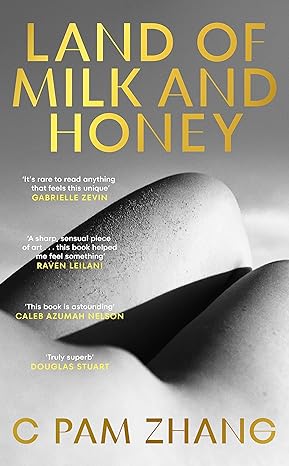 A 29-year-old Chinese American chef is exiled when the USA closes its borders while she’s working in London. On a smog-covered planet where 98% of crops have failed, scarcity reigns – but there is a world apart, a mountaintop settlement at the Italian border where money can buy any ingredient desired and threatened foods are cultivated in a laboratory setting. While peasants survive on mung bean flour, wealthy backers indulge in classic French cuisine. The narrator’s job is to produce lavish, evocative multi-course meals to bring investors on board. Foie gras, oysters, fine wines; heirloom vegetables; fruits not seen for years. But also endangered creatures and mystery meat wrested back from extinction. Her employer’s 21-year-old daughter, Aida, oversees the lab where these rarities are kept alive.
Ironically, surrounded with such delicacies, the chef loses her appetite for all but cigarettes – yet another hunger takes over. Her relationship with Aida is a passionate secret made all the more peculiar by the fact that the chef’s other role is to impersonate Aida’s dead mother, Eun-Young. It’s clear this precarious setup can’t last; ambition and technology keep moving on. The novel presents such a striking picture of desire at the end of the world. Each sentence is honed to flawlessness, with whole paragraphs of fulsome descriptions of meals. Zhang’s prose reminded me of Stephanie Danler’s and R.O. Kwon’s – no surprise, then, that they’re on the Acknowledgments list, as are a cornucopia of foods and other literary influences.
I’m not usually one for a dystopian novel, but the emotional territory keeps this one grounded even as the plot grows more sinister. My only complaint is that I would have left off the final chapter as I don’t think tracing the protagonist through four more decades of life adds much. I would rather have left this world in limbo than thought of the episode as a blip in a facile regeneration process – that’s the most unrealistic element of all. But this has still been my favourite read from the longlist so far. And there’s even a faithful pet cat, a “recalcitrant beast” that keeps coming back to the chef despite benign neglect. (Public library)
My ideal shortlist, based on what I’ve read and still want to read, would be:

Cocktail by Lisa Alward
Dances by Nicole Cuffey
Brotherless Night by V.V. Ganeshananthan
I Have Some Questions for You by Rebecca Makkai
Land of Milk and Honey by C Pam Zhang
I wouldn’t be averse to seeing The Future or Chrysalis on there either. (Just not Loot, please!)
See Laura’s post for a recap of her reviews and her wish list. Marcie has also been reading from the longlist; see her first write-up here.
Recent Poetry Releases by Clarke, Galleymore, Hurst, and Minick
All caught up on March releases now. There’s a lot of nature and environmental awareness in these four poetry collections, but also pandemic lockdown experiences, folklore, travel, and an impasse over whether to have children. Three are from Carcanet Press, my UK poetry mainstay; one was my introduction to Madville Publishing (based in Lake Dallas, Texas). After my thoughts, I’ll give one sample poem from each book.
The Silence by Gillian Clarke
Clarke was the National Poet of Wales from 2008 to 2016. I ‘discovered’ her just last year through Making the Beds for the Dead, which shares with this eleventh collection a plague theme: there, the UK’s foot and mouth disease outbreak of 2001; here, Covid-19. Forced into stillness and attention to the wonders near home, the poet tracks nature through the seasons and hymns trees, sunsets and birds. Many poems are titled after months or calendar points such as Midsummer and Christmas Eve. She also commemorates Welsh landmarks and remembers her mother, a nurse.

The verse is full of colours and names of flora:
May-gold’s gone to seed, yellows fallen –
primrose, laburnum, Welsh poppy.
June is rose, magenta, purple,
pink clematis, mopheads of chives,
cranesbill flowering where it will,
a migration of foxgloves crossing the field.
(from “Late June”)
Even as she revels in beauty, though, she bears in mind suffering elsewhere:
There is time and silence
to tell the names of the dying, the dead,
under empty skies unscarred
by transatlantic planes.
(from “Spring Equinox, 2020”)
I noted alliteration (“At the tip of every twig, / a water-bead with the world in it”) and end rhymes (“After long isolation, in times like these, / in the world’s darkness, let us love like trees.”). All told, I found this collection lovely but samey and lacking bite. But Clarke is in her late eighties and has a large back catalogue for me to explore.

With thanks to Carcanet Press for the free copy for review.
Baby Schema by Isabel Galleymore
 I knew Galleymore’s name from her appearance at the New Networks for Nature conference in 2018. The University of Birmingham lecturer’s second collection is a slant-wise look at environmental crisis and an impending decision about motherhood. The title comes from Konrad Lorenz’s identification of features that invite nurture. Galleymore edges towards the satirical fantasies of Caroline Bird or Patricia Lockwood as she imagines alternative scenarios of caregiving and contrasts sentimentality with indifference.
What is worthy of maternal concern? There are poems about a houseplant, a childhood doll, a soft toy glimpsed through a car window. A research visit to Disneyland Paris in the centenary year of the Walt Disney Company leads to marvelling at the surreality of consumerism. Does cuteness merit survival?
Because rhinos haven’t adopted the small
muscle responsible for puppy dog eyes,
the species goes bankrupt.
Its regional stores close down.
(from “The Pitch”)
The speaker acknowledges how gooey she goes over dogs (“Morning”) and kittens (“So Adorable”). But “Mothers” and “Chosen” voice ambivalence or even suspicion about offspring, and “Fable” spins a mild nightmare of infants taking over (“babies nesting in other babies / of cliff and reef and briar”). By the time, in “More and More,” she pictures a son, “a sticky-fingered, pint-sized / version of myself toddling through the aisles,” she concludes that we live in a depleted “world better off without him.”
Extinction and eco-grief on the one hand, yes, but the implacability of biological cycles on the other:
That night, when I got home, I learnt
a tree frog species had been lost
and my body was releasing its usual sum of blood.
I only had a few years left, my mother
often warned
(from “Release”)
Sardonic yet humane, and reassuringly indecisive, this is a poetry highlight of the year so far for me. I’ll go back and find her debut, Significant Other, too.

With thanks to Carcanet Press for the free e-copy for review.
The Iron Bridge by Rebecca Hurst
Manchester-based Hurst’s debut full-length collection struck me first for its gorgeous nature poetry arising from a series of walks. Most of these are set in Southern England in the current century, but date and location stamps widen the view as far as 1976 in the one case and Massachusetts in the other. The second section entices with its titles drawn from folklore and mythology: “How the Fox Lost His Brush,” “The Animal Bridegroom,” “The Needle Prince,” “And then we saw the daughter of the minotaur.”

An unexpected favourite, for its alliteration, assonance and book metaphors in the first stanza, was “Cabbage”:
Slung from a trug it rumbles across
the kitchen table, this flabby magenta fist
of stalk and leaf, this bundle of pages
flopping loose from their binding
this globe cleaved with a grunt leaning hard
on the blade
Part III, “Night Journeys,” has more nature verse and introduces a fascination with Russia that continues through the rest of the book. I loved the mischievous quartet of “Field Notes” prose poems about “The careless lover,” “The theatrical lover,” “The corresponding lover,” and “The satisfying lover” – three of them male and one female. The final section, “An Explorer’s Handbook,” includes found poems adapted from the published work of travel writers contemporary (Christina Dodwell) and Victorian (nurse Kate Marsden). Another series, “The Emotional Lives of Soviet Objects,” gives surprising power to a doily, a slipper and a potato peeler.
There’s a huge range of form and subject matter here, but the language is unfailingly stunning. Another standout from 2024 and a poet to watch. From my other Carcanet reading, I’d liken this most to work by Laura Scott and Helen Tookey.

With thanks to Carcanet Press for the free e-copy for review.
The Intimacy of Spoons by Jim Minick
 A new publisher and author for me. Minick has also published fiction and nonfiction; this is his third poetry collection. Between the opener, “To Spoon,” and the title piece that closes the book, there are five more spoon-themed poems that create a pleasing thematic throughline. Why spoons? Unlike potentially violent knives and forks, which cut and spear, spoons are gentle. They’re also reflective surfaces, and because of their concavity, they can hold things and nestle together. In “The Oldest Spoon,” they even bring to mind a guiding constellation.
The rest of the book is full of North American woodland and coastal scenes and wildlife. Minick displays genuine affection for and familiarity with birds. He is also realistic in noting all that is lost with habitat destruction and dwindling populations. “Lasts” describes the bittersweet sensation of loving what is disappearing: “Goodbye, we always say too late, / or we never get a chance to say at all.” He wrestles with human mortality, too, through elegies and minor concerns about his own ageing body. I loved the seasonal imagery and alliteration in “Spangled” and the Rolling Stones refrain to “Gas,” about boat-tailed grackles encountered in the parking lot at a Georgia truck stop.
Why not embrace all that is ugly
& holy & here—the grackle’s song
that isn’t a song, a breadcrumb dropped,
the shiny ribbon of gasoline
that will get me closer to home.
For something a bit different, I appreciated the true-crime monologue of “Tim Slack, the Fix-It Man.” With playfulness and variety, Minick gives us new views on the everyday – which is exactly why it is worth reading poetry.

With thanks to Madville Publishing for the free e-copy for review.
Carol Shields Prize Longlist: A Council of Dolls by Mona Susan Power
my doll is a collector of tragedy … the device I use to hide from something I already know
Mona Susan Power’s fourth novel, A Council of Dolls, is an Indigenous saga that draws on her own family history. Through first-person narratives by three generations of Dakhóta and Lakhóta women, she explores the ongoing effects of trauma resulting from colonialist oppression. The journey into the past begins with Sissy, a little girl in racist 1960s Chicago with an angry, physically abusive mother, Lillian. This section sets up the book’s pattern of ascribing voice and agency to characters’ dolls. Specifically, Sissy dissociates from her own emotions and upsetting experiences by putting them onto Ethel, her Black doll. Power relies on the dramatic irony between Sissy’s childhood perspective and readers’ understanding.
Moving backward: In 1930s North Dakota, we see Lillian coping with her father’s alcohol-fuelled violence by pretending she is being directed in a play. She loses her Shirley Temple doll, Mae, in an act of charity towards a sickly girl in the community. Lillian and her sister, Blanche, attend an Indian school in Bismarck. Run by nuns, it’s even crueller than the institution their parents, Cora and Jack, attended: the infamous Carlisle Indian Industrial School in Pennsylvania (also a setting in Wandering Stars by Tommy Orange). Cora’s beautifully introspective journal from the 1910s reveals the systematic cultural annihilation that took place there. Her doll, Winona, rescued from a massacre in the time of Sitting Bull, was on the pyre of precious belongings – tribal costumes, instruments, medals, sacred feathers – burned on students’ arrival. But her stone heart survives as a totem of resilience.

This is a powerful but harrowing story. The characterization and narration are strong, and the nesting-dolls structure means we get glimpses into the future for all three protagonists. However, I was disappointed by a number of Power’s decisions. It appeared that a fourth and final narrator close to the present day would introduce another aspect, but in fact Jesse is a new name that Sissy chose for herself. Now a 50-year-old academic and writer, she becomes a medium for the dolls’ accounts – but this ends up repeating material we’d already encountered. The personification of familial tragedy in the figure of “the injured woman” who appears to Cora verges on mawkish, and the touches of magic realism to do with the dolls sit uneasily beside clinical discussions of trauma. In Jesse’s section, there is something unsubtle about how this forms the basis of a conversation between her and her friend Izzy:
(Jesse thinks) “I wanted that chance to break the chain of passing on harmful inner scripts, the self-loathing that comes from brutally effective colonization.”
(Izzy says) “whoo, that’s a big fat pipe full of misery … Our people have been pathologized from the very beginning. Still are.”
It’s possible I would have responded to this with more enthusiasm had it been packaged as a family memoir. As it is, I was unsure about the hybridization of autofiction and magic realism and wondered what white readers coming to the novel should conclude. I kept in mind Elaine Castillo’s essay “How to Read Now,” about her sense of BIPOC writers’ job: “if our stories primarily serve to educate, console and productively scold a comfortable white readership, then those stories will have failed their readers”. Perhaps Power’s novel was not primarily intended to serve in that way.
I’ll let her have the last word, via the Author’s Note: “outrageously prejudiced depictions of my ancestors and our people are one reason I became a writer. From childhood I felt an urgent need to speak my truth, which was long suppressed. Writing this book was a healing endeavor. May it support the healing of others.”
With thanks to publicist Nicole Magas and Mariner Books for the free e-copy for review.
This was a buddy read with Laura; see her review here.
Before the shortlist is announced on 9 April, I plan to review my two current reads, Cocktail by Lisa Alward and Land of Milk and Honey by C Pam Zhang, and concoct a personal wish list.
 Bookish Beck = Rebecca Foster. American transplant to England. Freelance proofreader and book reviewer.
 Bookish Beck