Nonfiction Week of #NovNov: Short Memoirs by Lucille Clifton, Alice Thomas Ellis and Deborah Levy
It’s nonfiction week of Novellas in November, which for me usually means short memoirs (today) and nature books (coming up on Wednesday). However, as my list of 10 nonfiction favorites from last year indicates, there’s no shortage of subjects covered in nonfiction works of under 200 pages; whether you’re interested in bereavement, food, hospitality, illness, mountaineering, nature, politics, poverty or social justice, you’ll find something that suits. This week is a great excuse to combine challenges with Nonfiction November, too.

We hope some of you will join in with our buddy read for the week, The Story of My Life by Helen Keller (free to download here from Project Gutenberg if you don’t already have access). At a mere 85 pages, it’s a quick read. I’ve been enjoying learning about her family history and how meeting her teacher was the solution to her desperate need to communicate.
My first three short nonfiction reads of the month are all in my wheelhouse of women’s life writing, with each one taking on a slightly different fragmentary form.
Generations: A Memoir by Lucille Clifton (1976)
[87 pages]
 After her father’s death, Clifton, an award-winning poet, felt compelled to delve into her African American family’s history. Echoing biblical genealogies, she recites her lineage in a rhythmic way and delivers family anecdotes that had passed into legend. First came Caroline, “Mammy Ca’line”: born in Africa in 1822 and brought to America as a child slave, she walked north from New Orleans to Virginia at age eight, became a midwife, and died free. Mammy Ca’line’s sayings lived on through Clifton’s father, her grandson: she “would tell us that we was Sayle people and we didn’t have to obey nobody. You a Sayle, she would say. You from Dahomey women.” Then came Caroline’s daughter, Lucy Sale, famously the first Black woman hanged in Virginia – for shooting her white lover. And so on until we get to Clifton herself, who grew up near Buffalo, New York and attended Howard University.
The chapter epigraphs from Walt Whitman’s “Song of Myself” call into question how much of an individual’s identity is determined by their family circumstances. While I enjoyed the sideways look at slavery and appreciated the poetic take on oral history, I thought more detail and less repetition would have produced greater intimacy. 
Reissued by NYRB Classics tomorrow, November 9th, with a new introduction by Tracy K. Smith. My thanks to the publisher for the proof copy for review.
Home Life, Book Four by Alice Thomas Ellis (1989)
[169 pages]
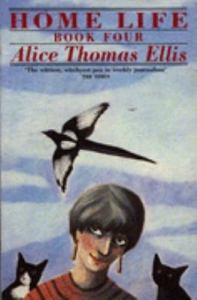 For four years, Ellis wrote a weekly “Home Life” column for the Spectator. Her informal pieces remind me of Caitlin Moran’s 2000s writing for the Times – what today might form the kernel of a mums’ blog. In short, we have a harried mother of five trying to get writing done while maintaining a household – but given she has homes in London and Wales AND a housekeeper, and that her biggest problems include buying new carpet and being stuck in traffic, it’s hard to work up much sympathy. These days we’d say, Check your privilege.
The sardonic complaining rubbed me the wrong way, especially when the subject was not finding anything she wanted to read even though she’d just shipped four boxes of extraneous books off to her country house, or using noxious sprays to get rid of one harmless fly, or a buildup of rubbish bags because they’d been “tidying.” These essays feel of their time for the glib attitude and complacent consumerism. It’s rather a shame they served as my introduction to Ellis, but I think I’d still give her fiction a try. (Secondhand purchase, Barter Books) 
The Cost of Living by Deborah Levy (2018)
[187 pages]
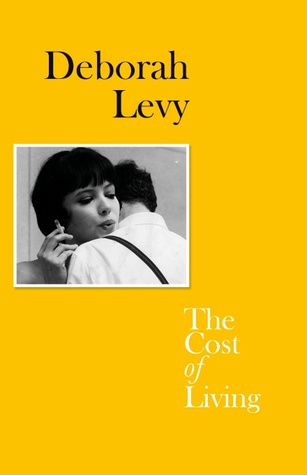 In the space of a year, Levy separated from her husband and her mother fell ill with the cancer that would kill her. Living with her daughters in a less-than-desirable London flat, she longed for a room of her own. Her octogenarian neighbor, Celia, proffered her garden shed as a writing studio, and that plus an electric bike conferred the intellectual and physical freedom she needed to reinvent her life. That is the bare bones of this sparse volume, the middle one in an autobiographical trilogy, onto which Levy grafts the tissue of experience: conversations and memories; travels and quotations that have stuck with her.
It’s hard to convey just what makes this brilliant. The scenes are everyday – set at her apartment complex, during her teaching work or on a train; the dialogue might be overheard. Yet each moment feels perfectly chosen to reveal her self, or the emotional truth of a situation, or the latent sexism of modern life. “All writing is about looking and listening and paying attention to the world,” she writes, and it’s that quality of attention that sets this apart. I’ve had mixed success with Levy’s fiction (though I loved Hot Milk), but this was flawless from first line to last. I can only hope the rest of the memoir lives up to it. (New purchase) 
Keep in touch via Twitter (@bookishbeck / @cathy746books) and Instagram (@bookishbeck / @cathy_746books). We’ll add any of your review links in to our master posts. Feel free to use the terrific feature image Cathy made and don’t forget the hashtag #NovNov.
Any short nonfiction on your reading pile?
Six Degrees of Separation: What Are You Going Through to No Saints Around Here
I’ve become an occasional Six Degrees of Separation post-er, when the mood strikes me and/or I get a flash of inspiration. This month we began with What Are You Going Through, which I reviewed back in October 2020. (See Kate’s opening post.)
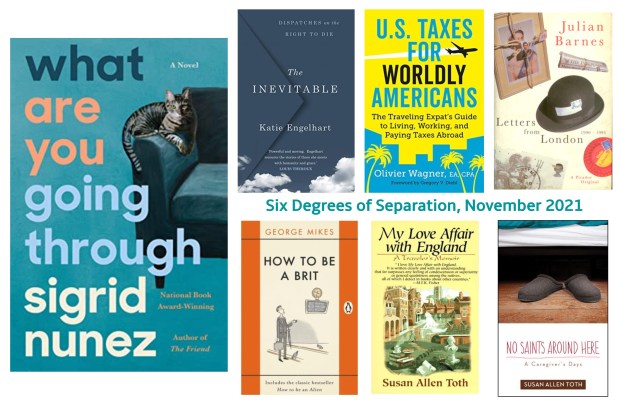
 Between that, The Friend and A Feather on the Breath of God, Sigrid Nunez has quickly become one of my favourite contemporary authors. I have two more of her novels on the shelf to read soon, one from my birthday haul.
In What Are You Going Through, the narrator is called upon to help a terminally ill friend commit suicide. However, I summed up the message as “Curiosity about other lives fuels empathy,” and noted “a sort of slapstick joy early in this morbid adventure.”
 #1 One of the stand-out books from my 2021 reading so far has been The Inevitable, which is about assisted dying. The case studies are wrenching but compassionately told. Katie Engelhart explores the nuances of situations, crafting expert portraits of suffering people and the medical professionals who seek to help them, and adding much in the way of valuable context.
 #2 As the saying goes, if there’s one thing inevitable besides death, it’s taxes. And if you’re a U.S. citizen, you will remain accountable to the IRS until the day you die, no matter where you live. (Eritrea is the only other country that requires expatriates to fill in tax returns.) I’ve now gotten my U.S. tax forms down to a science, keeping a list of pointers and previous years’ forms as scanned files so that I just have to plug in the year’s numbers, put zeroes in all the important boxes (since I’ve already paid income tax in the UK), and send it off. A matter of an hour or two’s work, rewarded by a G&T.
But I distinctly remember the Junes when I would spend days muddling through byzantine IRS forms, so I am very grateful that an offer for this e-book arrived in my inbox via my blog contact form in 2017: U.S. Taxes for Worldly Americans by Olivier Wagner. It goes through each form, often line by line. Three cheers for actually helpful self-help guides!
 #3 Another expat tip that I found extremely useful, small as it might seem, is that “quite” means something different in American vs. British English. To an American it’s a synonym for “very”; to the guarded Brits, it’s more like “rather.” I have the Julian Barnes essay collection Letters from London to thank for this vital scrap of etymological knowledge.
 #4 Unsurprisingly, I have built up a small library of books about understanding the English and their ways. In the How to Be a Brit omnibus, collecting three short volumes from the 1940s–70s, George Mikes (a Hungarian immigrant) makes humorous observations that have, in general, aged well. His mini-essays on tea, weather and queuing struck me as particularly apt. I would draw a straight line from this through Bill Bryson’s Notes from a Small Island to the Very British Problems phenomenon.
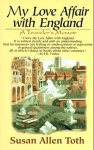 #5 As I was preparing to fly to England for the first time for my study abroad year, one of the authors who most whetted my appetite for British travel was Susan Allen Toth, whose trilogy of UK-themed memoirs-with-recommendations began with My Love Affair with England – included in one of my Landmark Books in My Life posts. I’m rereading one of the other three now.
 #6 Toth is a very underrated author, I feel. I’ve read most of her memoirs and have a short nonfiction work of hers on my pile for #NovNov. Her most recent book is No Saints Around Here: A Caregiver’s Days (2014), in which she chronicled the last 18 months of her husband James’s life, as she and an army of caregivers coped with his decline from Parkinson’s disease. Toth gets the tone just right: although she is honest, she is never melodramatic; although she often feels sorry for herself, she also recognizes how lucky she has been, not just to have done a good job of looking after James, but to have had him in her life at all.
I’ve gone full circle from one story of caregiving to another, via death, taxes and Englishness. The starting and ending books are reminders that you never fully know what another person is going through; all we can do is our best while cutting others some slack.
Where will your chain take you? Join us for #6Degrees of Separation! (Hosted on the first Saturday of each month by Kate W. of Books Are My Favourite and Best.) Next month’s starting point is our buddy read for week 4 of #NovNov, Ethan Frome by Edith Wharton.
Have you read any of my selections? Are you tempted by any you didn’t know before?
Open Water & Other Contemporary Novellas Read This Year (#NovNov)
Open Water is our first buddy read, for Contemporary week of Novellas in November (#NovNov). Look out for the giveaway running on Cathy’s blog today!
I read this one back in April–May and didn’t get a chance to revisit it, but I’ll chime in with my brief thoughts recorded at the time. I then take a look back at 14 other novellas I’ve read this year; many of them I originally reviewed here. I also have several more contemporary novellas on the go to round up before the end of the month.
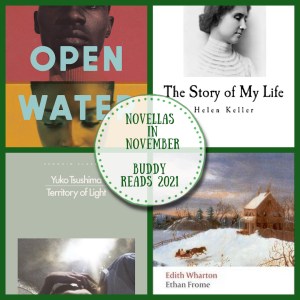
Open Water by Caleb Azumah Nelson (2021)
[145 pages]
 I always enjoy the use of second person narration, and it works pretty well in this love story between two young Black British people in South London. The title is a metaphor for the possibilities and fear of intimacy. The protagonist, a photographer, doesn’t know what to do with his anger about how young Black men are treated. I felt Nelson was a little heavy-handed in his treatment of this theme, though I did love that the pivotal scene is set in a barbershop, a place where men reveal more of themselves than usual – I was reminded of a terrific play I saw a few years ago, Barber Shop Chronicles.
Ultimately, I wasn’t convinced that fiction was the right vehicle for this story, especially with all the references to other authors, from Hanif Abdurraqib to Zadie Smith (NW, in particular); I think a memoir with cultural criticism was what the author really intended. I’ll keep an eye out for Nelson, though – I wouldn’t be surprised if this makes it onto the Sunday Times Young Writer of the Year Award shortlist in January. I feel like with his next book he might truly find his voice.
Readalikes:
- Assembly by Natasha Brown (also appears below)
- Poor by Caleb Femi (poetry with photographs)
- Normal People by Sally Rooney
Other reviews:
Other Contemporary Novellas Read This Year:
(Post-1980; under 200 pages)


Somebody Loves You by Mona Arshi
Assembly by Natasha Brown
Indelicacy by Amina Cain 
A Lie Someone Told You About Yourself by Peter Ho Davies

Blue Dog by Louis de Bernières 
The Office of Historical Corrections by Danielle Evans 
Anarchipelago by Jay Griffiths
Tinkers by Paul Harding


An Island by Karen Jennings
Ness by Robert Macfarlane
Black Dogs by Ian McEwan


Broke City by Wendy McGrath 
A Feather on the Breath of God by Sigrid Nunez
In the Winter Dark by Tim Winton
Currently reading:
- Inside the Bone Box by Anthony Ferner
- My Monticello by Jocelyn Nicole Johnson
- The Cemetery in Barnes by Gabriel Josipovici
What novellas do you have underway this month? Have you read any of my selections?
Book Serendipity, September to October 2021
I call it Book Serendipity when two or more books that I read at the same time or in quick succession have something pretty bizarre in common. Because I have so many books on the go at once (usually 20–30), I suppose I’m more prone to such incidents. I’ve realized that, of course, synchronicity is really the more apt word, but this branding has stuck. This used to be a quarterly feature, but to keep the lists from getting too unwieldy I’ve shifted to bimonthly.
The following are in roughly chronological order.
- Young people studying An Inspector Calls in Somebody Loves You by Mona Arshi and Heartstoppers, Volume 4 by Alice Oseman.
- China Room (Sunjeev Sahota) was immediately followed by The China Factory (Mary Costello).


- A mention of acorn production being connected to the weather earlier in the year in Light Rains Sometimes Fall by Lev Parikian and Noah’s Compass by Anne Tyler.
- The experience of being lost and disoriented in Amsterdam features in Flesh & Blood by N. West Moss and Yearbook by Seth Rogen.
- Reading a book about ravens (A Shadow Above by Joe Shute) and one by a Raven (Fox & I by Catherine Raven) at the same time.


- Speaking of ravens, they’re also mentioned in The Elements by Kat Lister, and the Edgar Allan Poe poem “The Raven” was referred to and/or quoted in both of those books plus 100 Poets by John Carey.
- A trip to Mexico as a way to come to terms with the death of a loved one in This Party’s Dead by Erica Buist (read back in February–March) and The Elements by Kat Lister.
- Reading from two Carcanet Press releases that are Covid-19 diaries and have plague masks on the cover at the same time: Year of Plagues by Fred D’Aguiar and 100 Days by Gabriel Josipovici. (Reviews of both coming up soon.)


- Descriptions of whaling and whale processing and a summary of the Jonah and the Whale story in Fathoms by Rebecca Giggs and The Woodcock by Richard Smyth.
 An Irish short story featuring an elderly mother with dementia AND a particular mention of her slippers in The China Factory by Mary Costello and Blank Pages and Other Stories by Bernard MacLaverty.
- After having read two whole nature memoirs set in England’s New Forest (Goshawk Summer by James Aldred and The Circling Sky by Neil Ansell), I encountered it again in one chapter of A Shadow Above by Joe Shute.
- Cranford is mentioned in Corduroy by Adrian Bell and Cut Out by Michèle Roberts.
- Kenneth Grahame’s life story and The Wind in the Willows are discussed in On Gallows Down by Nicola Chester and The Elements by Kat Lister.


- Reading two books by a Jenn at the same time: Ghosted by Jenn Ashworth and The Other Mothers by Jenn Berney.
- A metaphor of nature giving a V sign (that’s equivalent to the middle finger for you American readers) in On Gallows Down by Nicola Chester and Light Rains Sometimes Fall by Lev Parikian.
- Quince preserves are mentioned in The Book of Difficult Fruit by Kate Lebo and Light Rains Sometimes Fall by Lev Parikian.
- There’s a gooseberry pie in Talking to the Dead by Helen Dunmore and The Book of Difficult Fruit by Kate Lebo.


- The ominous taste of herbicide in the throat post-spraying shows up in On Gallows Down by Nicola Chester and Damnation Spring by Ash Davidson.
- People’s rude questioning about gay dads and surrogacy turns up in The Echo Chamber by John Boyne and the DAD anthology from Music.Football.Fatherhood.
- A young woman dresses in unattractive secondhand clothes in The Echo Chamber by John Boyne and Beautiful World, Where Are You by Sally Rooney.

- A mention of the bounty placed on crop-eating birds in medieval England in Orchard by Benedict Macdonald and Nicholas Gates and A Shadow Above by Joe Shute.
- Hedgerows being decimated, and an account of how mistletoe is spread, in On Gallows Down by Nicola Chester and Orchard by Benedict Macdonald and Nicholas Gates.
 Ukrainian secondary characters in Ghosted by Jenn Ashworth and The Echo Chamber by John Boyne; minor characters named Aidan in the Boyne and Beautiful World, Where Are You by Sally Rooney.
- Listening to a dual-language presentation and observing that the people who know the original language laugh before the rest of the audience in The Book of Difficult Fruit by Kate Lebo and Beautiful World, Where Are You by Sally Rooney.
- A character imagines his heart being taken out of his chest in Tender Is the Flesh by Agustina Bazterrica and The Book of Form and Emptiness by Ruth Ozeki.

- A younger sister named Nina in Talking to the Dead by Helen Dunmore and Sex Cult Nun by Faith Jones.
- Adulatory words about George H.W. Bush in The Echo Chamber by John Boyne and Thinking Again by Jan Morris.
- Reading three novels by Australian women at the same time (and it’s rare for me to read even one – availability in the UK can be an issue): Sorrow and Bliss by Meg Mason, The Performance by Claire Thomas, and The Weekend by Charlotte Wood.


- There’s a couple who met as family friends as teenagers and are still (on again, off again) together in Sorrow and Bliss by Meg Mason and Beautiful World, Where Are You by Sally Rooney.
- The Performance by Claire Thomas is set during a performance of the Samuel Beckett play Happy Days, which is mentioned in 100 Days by Gabriel Josipovici.
 Human ashes are dumped and a funerary urn refilled with dirt in Tender Is the Flesh by Agustina Bazterrica and Public Library and Other Stories by Ali Smith.
- Nicholas Royle (whose White Spines I was also reading at the time) turns up on a Zoom session in 100 Days by Gabriel Josipovici.
- Richard Brautigan is mentioned in both The Mystery of Henri Pick by David Foenkinos and White Spines by Nicholas Royle.


- The Wizard of Oz and The Railway Children are part of the plot in The Book Smugglers (Pages & Co., #4) by Anna James and mentioned in Public Library and Other Stories by Ali Smith.
What’s the weirdest reading coincidence you’ve had lately?
Novellas in November (#NovNov) Begins! Leave Your Links Here
I always look forward to November’s reading. Since 2016 I’ve been prioritizing novellas in this month, but this is only the second year that Cathy of 746 Books and I have co-hosted Novellas in November as a proper reading challenge.
We have four weekly prompts and “buddy reads” as below. We hope you’ll join in reading one or more of these with us. The host for the week will aim to publish her review on the Thursday, but feel free to post yours at any time in the month. (A reminder that we suggest 150–200 pages as the upper limit for a novella, and post-1980 for the contemporary week.)
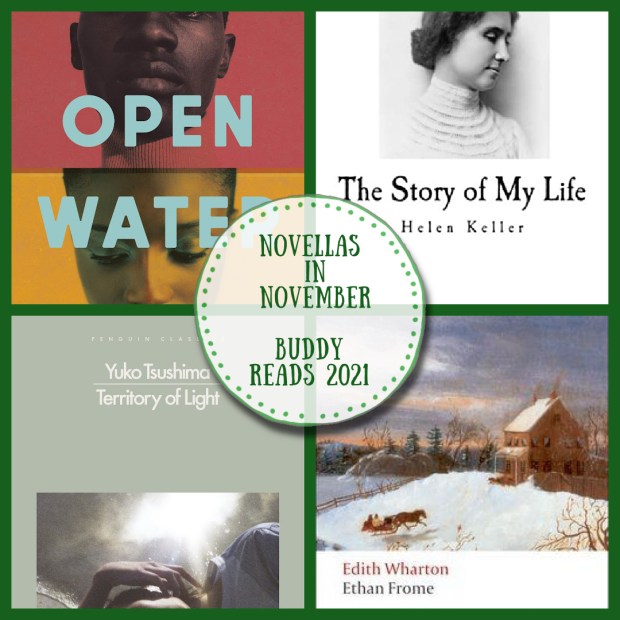
1–7 November: Contemporary fiction (Cathy)
Open Water by Caleb Azumah Nelson – including a giveaway of a signed copy!
8–14 November: Short nonfiction (Rebecca)
The Story of My Life by Helen Keller (free to download here from Project Gutenberg. Note: only the first 85 pages constitute her memoir; the rest is letters and supplementary material.)
15–21 November: Literature in translation (Cathy)
Territory of Light by Yuko Tsushima
22–28 November: Short classics (Rebecca)
Ethan Frome by Edith Wharton (free to download here from Project Gutenberg)
Leave links to any of your novellas coverage in the comments below or tag us on Twitter (@bookishbeck / @cathy746books) and/or Instagram (@bookishbeck / @cathy_746books) and we’ll add them to a master list.
Enjoy your reading!
Ongoing list of Novellas in November 2021 posts:
Five novellas: de Kat, Lynch, Mingarelli, Sjón, Terrin (reviewed by Susan at A life in books)
The Fell by Sarah Moss (reviewed by Dr Laura Tisdall)
The Disinvent Movement by Susanna Gendall (reviewed by Lisa at ANZ LitLovers)
Four novellas with screen adaptations (a list by Diana at Ripple Effects)
Contemporary novellas from the archives (a list by Annabel at Annabookbel)
Moral Hazard by Kate Jennings (reviewed by Cathy at 746 Books)
A Child in the Theatre by Rachel Ferguson (reviewed by Simon at Stuck in a Book)
The Death of the Author by Gilbert Adair (reviewed by Karen at Kaggsy’s Bookish Ramblings)
Come Closer by Sara Gran (reviewed by Cathy at 746 Books)
Amsterdam by Ian McEwan (reviewed by Simon at Stuck in a Book)
Five novellas: Burley, Capote, Hill, Steinbeck, Welsh (reviewed by Margaret at BooksPlease)
Often I Am Happy by Jens Christian Grøndahl (reviewed by Simon at Stuck in a Book)
Vertigo by Amanda Lohrey (reviewed by Nancy Elin)
Open Water by Caleb Azumah Nelson (reviewed by Cathy at 746 Books)
Open Water & Other Contemporary Novellas Read This Year
An Island by Karen Jennings (reviewed by Lisa at ANZ LitLovers)
At Night All Blood Is Black by David Diop (reviewed by Anokatony at Tony’s Book World)
Stone in a Landslide by Maria Barbal (reviewed by Karen at BookerTalk)
A Whole Life by Robert Seethaler (reviewed by Imogen at Reading and Watching the World)
I’m Ready Now by Nigel Featherstone (reviewed by Nancy Elin)
Small Things Like These by Claire Keegan (reviewed by Cathy at 746 Books)
The Lonely by Paul Gallico (reviewed by Simon at Stuck in a Book)
The Love Child by Edith Olivier (reviewed by Liz at Adventures in reading, running and working from home)
Murder Included by Joanna Cannan (reviewed by Simon at Stuck in a Book)
The Bookshop by Penelope Fitzgerald: From Novella to Movie (reviewed by Diana at Ripple Effects)
The River by Rumer Godden (reviewed by Lisa at ANZ LitLovers)
The Rector and The Doctor’s Family by Mrs Oliphant (reviewed by Liz at Adventures in reading, running and working from home)
Less than Zero by Bret Easton Ellis (reviewed by Kate at Books Are My Favourite and Best)
Open Water by Caleb Azumah Nelson (reviewed by Laura at Reading in Bed)
Foe by J.M. Coetzee (reviewed by Lisa at ANZ LitLovers)
The Writer’s Cats by Muriel Barbery (reviewed by Davida at TCL Book Reviews)
Short Non-fiction from the archives (a list by Annabel at Annabookbel)
Nonfiction November: Book Pairing – Novellas and Nonfiction (a list by Cathy at 746 Books)
Casanova’s Homecoming by Arthur Schnitzler (reviewed by Marina Sofia at Finding Time to Write)
Which Way? by Theodora Benson (reviewed by Liz at Adventures in reading, running and working from home)
Short Memoirs by Lucille Clifton, Alice Thomas Ellis and Deborah Levy
Aimez-vous Brahms? by Françoise Sagan (reviewed by Lisa at ANZ LitLovers)
The Writer’s Cats by Muriel Barbery (reviewed by Annabel at Annabookbel)
Burning Secret by Stefan Zweig (reviewed by Chris at Calmgrove)
The Cost of Living by Deborah Levy (reviewed by Cathy at 746 Books)
The Birds of the Innocent Wood by Deirdre Madden (reviewed by Simon at Stuck in a Book)
Baron Bagge by Alexander Lernet-Holenia (reviewed by Grant at 1streading)
The Poor Man by Stella Benson (reviewed by Simon at Stuck in a Book)
Somebody Loves You by Mona Arshi (reviewed by Davida at TCL Book Reviews)
Short Nature Books by John Burnside, Jim Crumley and Aimee Nezhukumatathil
Hiroshima by John Hersey (reviewed by Cathy at 746 Books)
Short nonfiction by Athill, Herriot and Mantel (reviewed by Margaret at BooksPlease)
The Fell by Sarah Moss (reviewed by Susan at A life in books)
The Story of Stanley Brent by Elizabeth Berridge (reviewed by Simon at Stuck in a Book)
The Parakeeting of London by Nick Hunt and Tim Mitchell (reviewed by Liz at Adventures in reading, running and working from home)
The Story of My Life by Helen Keller
Taking a Look Back at Novellas Read in 2021 (a list by JDC at Gallimaufry Book Studio)
Small Things Like These by Claire Keegan (a review by Mairead at Swirl and Thread)
The Story of My Life by Helen Keller (reviewed by Cathy at 746 Books)
The Faces by Tove Ditlevsen (reviewed by Anokatony at Tony’s Book World)
Coda by Thea Astley (reviewed by Nancy Elin)
I’d Rather Be Reading by Anne Bogel (reviewed by Karen at The Simply Blog)
Notes from an Island by Tove Jansson (reviewed by Simon at Stuck in a Book)
The Fell by Sarah Moss (reviewed by Clare at Years of Reading Selfishly)
Small Things Like These by Claire Keegan (reviewed by Susan at A life in books)
The Looking Glass by Carla Sarett (reviewed by Davida at TCL Book Reviews)
Daisy Miller by Henry James (reviewed by Diana at Thoughts on Papyrus)
Heritage by Vita Sackville-West (reviewed by Simon at Stuck in a Book)
One Billion Years to the End of the World by Arkady and Boris Strugatsky (reviewed by Chris at Calmgrove)
The Sense of an Ending by Julian Barnes (reviewed by Tracy at Bitter Tea and Mystery)
We Kill Stella by Marlen Haushofer and Come Closer by Sara Gran (reviewed by Marina Sofia at Finding Time to Write)
Tea and Sympathetic Magic by Tansy Rayner Roberts (reviewed by Nancy Elin)
Passing by Nella Larsen, from Novella to Screen (reviewed by Diana at Ripple Effects)
The Employees by Olga Ravn and A Psalm for the Wild-Built by Becky Chambers (reviewed by Annabel at Annabookbel)
Maigret in Court by Georges Simenon (reviewed by Karen at BookerTalk)
No. 91/92: A Diary of a Year on the Bus by Lauren Elkin (reviewed by Rebecca at Reading Indie)
Six Scottish Novellas: Gray, Mackay Brown, Mitchison, Muir, Owens, Smith (reviewed by Grant at 1streading)
Cain by José Saramago (reviewed by Lisa at ANZ LitLovers)
The Pear Field by Nana Ekvtimishvili (Booktube review by Jennifer at Insert Literary Pun Here)
Tinkers by Paul Harding (reviewed by Simon at Stuck in a Book)
Concrete by Thomas Bernhard (reviewed by Emma at Book Around the Corner)
Frida Kahlo and My Left Leg by Emily Rapp Black (reviewed by Imogen at Reading and Watching the World)
Utility Furniture by Jon Mills (reviewed by Liz at Adventures in reading, running and working from home)
Symposium by Muriel Spark (reviewed by Chris at Calmgrove)
Griffith Review #66, The Light Ascending, annual Novella Project edition (reviewed by Lisa at ANZ LitLovers)
SixforSunday: Novellas Read in 2021 before November (reviewed by Davida at TCL Book Reviews)
The Silent Traveller in Oxford by Chiang Yee (reviewed by Simon at Stuck in a Book)
The War of the Poor by Éric Vuillard (reviewed by Lisa at ANZ LitLovers)
The Spoke by Friedrich Glauser (reviewed by Marina Sofia at Finding Time to Write)
Dinner by César Aira (reviewed by Cathy at 746 Books)
The Scrolls from the Dead Sea by Edmund Wilson (reviewed by Reese at Typings)
The Story of My Life by Helen Keller (reviewed by Laura at Reading in Bed)
The White Riband by F. Tennyson Jesse (reviewed by Simon at Stuck in a Book)
Translated fiction novellas from the archives, including Territory of Light by Yuko Tsushima (reviewed by Annabel at Annabookbel)
I Don’t Want to Go to the Taj Mahal by Charlie Hill (reviewed by Liz at Adventures in reading, running and working from home)
Miss Peabody’s Inheritance by Elizabeth Jolley (reviewed by Karen at BookerTalk)
Hotel Iris by Yoko Ogawa (reviewed by Cathy at 746 Books)
Crusade by Amos Oz (reviewed by Nancy Elin)
Barbarian Spring by Jonas Lüscher (reviewed by Marina Sofia at Finding Time to Write)
My Monticello by Jocelyn Nicole Johnson (reviewed by Susan at A life in books)
The Fell by Sarah Moss (reviewed by Eric at Lonesome Reader)
Winter Flowers by Angélique Villeneuve (reviewed by Cathy at 746 Books)
Particularly Cats by Doris Lessing (reviewed by Simon at Stuck in a Book)
Territory of Light by Yuko Tsushima
Territory of Light by Yuko Tsushima (reviewed by Cathy at 746 Books)
The Murder Farm by Andrea Maria Schenkel and The Peacock by Isabel Bogdan (reviewed by Annabel at Annabookbel)
Assembly by Natasha Brown (reviewed at Radhika’s Reading Retreat)
Ludmilla by Paul Gallico (reviewed by Simon at Stuck in a Book)
The Woman from Uruguay by Pedro Mairal (reviewed by Susan at A life in books)
An interview with Stella Sabin of Peirene Press (by Cathy at 746 Books)
Behind the Mask by Kate Walter
The Pigeon and The Appointment
In the Company of Men and Winter Flowers
Who Was Changed and Who Was Dead by Barbara Comyns
The Deal of a Lifetime by Fredrik Backman (reviewed by Karen at The Simply Blog)
Carte Blanche by Carlo Lucarelli (reviewed by Tracy at Bitter Tea and Mystery)
Inspector Chopra & the Million Dollar Motor Car by Vaseem Khan (reviewed by Chris at Calmgrove)
Bunner Sisters by Edith Wharton (reviewed by Diana at Ripple Effects)
Father Malachy’s Miracle by Bruce Marshall (reviewed by Simon at Stuck in a Book)
Ignorance by Milan Kundera (reviewed by Simon at Stuck in a Book)
Rider on the Rain by Sébastien Japrisot and The Saint-Fiacre Affair by Georges Simenon (reviewed by Annabel at Annabookbel)
Hotel Splendid by Marie Redonnet and Fear by Stefan Zweig (reviewed by Cathy at 746 Books)
Some classics from my archives (reviewed by Annabel at Annabookbel)
The Cardinals by Bessie Head (reviewed by Marina Sofia at Finding Time to Write)
These Lifeless Things by Premee Mohamed, A Psalm for the Wild-Built by Becky Chambers, The Deep by Rivers Solomon (reviewed by Dr Laura Tisdall)
Four novellas, four countries, four decades (reviewed by Emma at Book Around the Corner)
Daphnis and Chloe by Longus (reviewed by Reese at Typings)
The Invisible Host by Gwen Bristow and Bruce Manning (reviewed by Simon at Stuck in a Book)
In Youth Is Pleasure by Denton Welch (reviewed by Imogen at Reading and Watching the World)
The Newspaper of Claremont Street by Elizabeth Jolley (reviewed by Nancy Elin)
Six Short Cat Books: Muriel Barbery, Garfield and More
Catholics by Brian Moore (reviewed by Cathy at 746 Books)
I’d Rather Be Reading by Anne Bogel (reviewed by Simon at Stuck in a Book)
A River in Darkness by Masaji Ishikawa (reviewed by Karen at BookerTalk)
The Witch of Clatteringshaws by Joan Aiken (reviewed by Chris at Calmgrove)
The Old Man and the Sea by Ernest Hemingway (reviewed by Margaret at BooksPlease)
The Turn of the Screw by Henry James (reviewed by Cathy at 746 Books)
Three to See the King by Magnus Mills (reviewed by Simon at Stuck in a Book)
Ethan Frome by Edith Wharton (reviewed by Cathy at 746 Books)
Touring the Land of the Dead by Maki Kashimada and Stranger Faces by Namwali Serpell (reviewed by Dr Laura Tisdall)
Ethan Frome by Edith Wharton (reviewed by Davida at TCL Book Reviews)
Love by Angela Carter (reviewed by Simon at Stuck in a Book)
Picnic at Hanging Rock by Joan Lindsay (reviewed by Margaret at BooksPlease)
Novellas in November 2021 Wrap Up (by Carol at Reading Ladies)
A Guide to Modernism in Metroland by Joshua Abbott and Black London by Avril Nanton and Jody Burton (reviewed by Liz at Adventures in reading, running and working from home)
Ethan Frome by Edith Wharton (reviewed by Karen at The Simply Blog)
Signs Preceding the End of the World by Yuri Herrera (reviewed by Karen at BookerTalk)
Madonna in a Fur Coat by Sabahattin Ali (reviewed by Imogen at Reading and Watching the World)
Small Things Like These by Claire Keegan (reviewed by Davida at TCL Book Reviews)
Clara’s Daughter by Meike Ziervogel (reviewed by Chris at Calmgrove)
Breakfast at Tiffany’s: from Novella to Screen (reviewed by Diana at Ripple Effects)
Child of All Nations by Irmgard Keun (reviewed by Marina Sofia at Finding Time to Write)
Territory of Light by Yuko Tsushima (reviewed by Laura at Reading in Bed)
Three Contemporary Novellas: Moss, Brown and Gaitskill (reviewed by Cathy at 746 Books)
Seven Final Novellas: Crumley, Morris, Rapp Black; Hunter, Johnson, Josipovici, Otsuka
In Pious Memory by Margery Sharp (reviewed by HeavenAli)
Murder in the Dark by Margaret Atwood, The Story of Stanley Brent by Elizabeth Berridge, Under the Tripoli Sky by Kamal Ben Hameda (reviewed by HeavenAli)
The Penelopiad by Margaret Atwood (reviewed by She Reads Novels)
Caravan Story by Wayne Macauley (reviewed by Lisa at ANZ LitLovers)
Farmer Giles of Ham by J.R.R. Tolkien (reviewed by Lisa at ANZ LitLovers)
I Am God, a Novel by Giacomo Sartori (reviewed by Lisa at ANZ LitLovers)
White Fragility by Robin DiAngelo (reviewed by Liz at Adventures in reading, running and working from home)
The Aunt Who Wouldn’t Die by Shirshendu Mukhopadhyay (reviewed by Erdeaka at The Bookly Purple)
Second-Class Citizen by Buchi Emecheta (reviewed by Liz at Adventures in reading, running and working from home)
The Invention of Morel by Adolfo Bioy Casares (reviewed by Emma at Words and Peace)
The Fell by Sarah Moss (reviewed by Callum McLaughlin)
Women & Power by Mary Beard and Come Closer by Sara Gran (reviewed by Callum McLaughlin)
The Tobacconist by Robert Seethaler and I Was Jack Mortimer by Alexander Lernet-Holenia (reviewed by Madame Bibi Lophile)
Things I Don’t Want to Know and The Cost of Living by Deborah Levy (reviewed by Madame Bibi Lophile)
Touch the Water, Touch the Wind by Amos Oz (reviewed by Kim at Reading Matters)
The Woman in the Blue Cloak by Deon Meyer (reviewed by Kim at Reading Matters)
The White Woman by Liam Davison (reviewed by Kim at Reading Matters)
Boys Don’t Cry by Fiona Scarlett (reviewed by Kim at Reading Matters)
Fludd by Hilary Mantel (reviewed by Margaret at BooksPlease)
Pietr the Latvian by Georges Simenon (reviewed by Margaret at BooksPlease)
In Translation by Annamarie Jagose (reviewed by Lisa at ANZ LitLovers)
The Red Chesterfield by Wayne Arthurson, The Book of Eve by Constance Beresford-Howe, Tower by Frances Boyle, Winter Wren by Theresa Kishkan, and The Santa Rosa Trilogy by Wendy McGrath (reviewed by Naomi at Consumed by Ink)
An essay on Kate Jennings’ Snake (reviewed by Whispering Gums)
Life in Translation by Anthony Ferner and Friend Indeed by Katharine d’Souza (reviewed by Liz at Adventures in reading, running and working from home)
Every Day Is Gertie Day by Helen Meany (reviewed by Whispering Gums)
Cold Enough for Snow by Jessica Au (reviewed by Brona’s Books at This Reading Life)
A Dream Life by Claire Messud (reviewed by Brona’s Books at This Reading Life)
Why Do I Like Novellas? Barnes, Brown, Jones, Ravn (reviewed by Stargazer)
Small Things Like These by Claire Keegan (reviewed by Callum McLaughlin)
Foster by Claire Keegan (reviewed by Smithereens)
The Light in the Piazza by Elizabeth Spencer (reviewed by Anokatony at Tony’s Book World)
King City by Stephen Pennell (reviewed by Liz at Adventures in reading, running and working from home)
Missus by Ruth Park (reviewed by Lisa at ANZ LitLovers)
Inseparable by Simone de Beauvoir (reviewed by Anokatony at Tony’s Book World)
I Heard the Owl Call My Name by Margaret Craven (reviewed by Robin at A Fondness for Reading)
Maigret Defends Himself by Georges Simenon (reviewed by Chris at Calmgrove)
My Week with Marilyn by Colin Clark (reviewed by Kate at Books Are My Favourite and Best)
Ethan Frome by Edith Wharton (reviewed by Margaret at BooksPlease)
Miguel Street by V.S. Naipaul (reviewed by Liz at Adventures in reading, running and working from home)
The Swallowed Man by Edward Carey, Naturally Supernatural by Wendy Mann, The Hothouse by the East River by Muriel Spark, Trouble with Lichen by John Wyndham (reviewed by Simon at Stuck in a Book)
Ethan Frome by Edith Wharton (reviewed by Laura at Reading in Bed)
Assembly by Natasha Brown, Treacle Walker by Alan Garner, All the Devils Are Here by David Seabrook, Space Exploration by Dhara Patel (reviewed by Annabel at Annabookbel)
Bellow, Powell, Wolkers, Bomans, al-Saadawi, de Jong, Buck, Simenon, Boschwitz (reviewed by Sarah at Market Garden Reader)
R.I.P. Reads for Halloween: Ashworth, Bazterrica, Hill, Machado & More
I don’t often read anything that could be classed as suspense or horror, so the R.I.P. challenge is a fun excuse to dip a toe into these genres each year. This year I have an eerie relationship study, a dystopian scenario where cannibalism has become the norm, some traditional ghost stories old and new, and a bonus story encountered in an unrelated anthology.

Ghosted: A Love Story by Jenn Ashworth (2021)
Laurie’s life is thrown off kilter when, after they’ve been together 15 years, her husband Mark disappears one day, taking nothing with him. She continues in her job as a cleaner on a university campus in northwest England. After work she visits her father, who is suffering from dementia, and his Ukrainian carer Olena. In general, she pretends that nothing has happened, caring little how odd it will appear that she didn’t call the police until Mark had been gone for five weeks. Despite her obsession with true crime podcasts, she can’t seem to imagine that anything untoward has happened to him. What happened to Mark, and what’s with that spooky spare room in their flat that Laurie won’t let anyone enter?
 If you find unreliable narrators delicious, you’re in the right place. The mood is confessional, yet Laurie is anything but confiding. Occasionally she apologizes for her behaviour: “I realise this does not sound very sane” is one of her concessions to readers’ rationality. So her drinking problem doesn’t become evident until nearly halfway through, and a bombshell is still to come. It’s the key to understanding our protagonist and why she’s acted this way.
Ghosted wasn’t what I expected. Its air of supernatural menace mellows; what is to be feared is much more ordinary. The subtitle should have been more of a clue for me. I appreciated the working class, northern setting (not often represented; Ashworth is up for this year’s Portico Prize) and the unusual relationships Laurie has with Olena, as well as with co-worker Eddie and neighbour Katrina. Reminiscent of Jo Baker’s The Body Lies and Sue Miller’s Monogamy, this story of a storm-tossed marriage was a solid introduction to Ashworth’s fiction – this is her fifth novel – but I’m not sure the payoff lived up to that amazing cover.
With thanks to Sceptre for the free copy for review.
Tender Is the Flesh by Agustina Bazterrica (2017; 2020)
[Translated from the Spanish by Sarah Moses]
 This sledgehammer of a short Argentinian novel has a simple premise: not long ago, animals were found to be infected with a virus that made them toxic to humans. During the euphemistic “Transition,” all domesticated and herd animals were killed and the roles they once held began to be filled by humans – hunted, sacrificed, butchered, scavenged, cooked and eaten. A whole gastronomic culture quickly developed around cannibalism.
Marcos is our guide to this horrific near-future world. Although he works in a slaughterhouse, he’s still uneasy with some aspects of the arrangement. The standard terminology is an attempt at dispassion: the “heads” are “processed” for their “meat.” Smarting from the loss of his baby son and with his father in a nursing home, Marcos still has enough compassion that when he’s gifted a high-quality female he views her as a person rather than potential cuts of flesh. His decisions from here on will call into question his loyalty to the new system.
I wondered if there would come a point where I was no longer physically able to keep reading. But it’s fiendishly clever how the book beckons you into analogical situations and then forces you to face up to cold truths. It’s impossible to avoid the animal-rights message (in a book full of gruesome scenes, the one that involves animals somehow hits hardest), but I also thought a lot about how human castes might work – dooming some to muteness, breeding and commodification, while others are the privileged overseers granted peaceful ends. Bazterrica also conflates sex and death in uncomfortable ways. In one sense, this was not easy to read. But in another, I was morbidly compelled to turn the pages. Brutal but brilliant stuff. (Public library/Edelweiss)
Fear: Tales of Terror and Suspense, selected by Roald Dahl (2017)
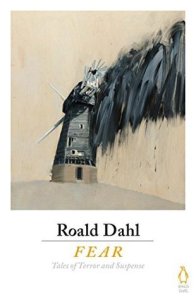 I reviewed the five female-penned ghost stories for R.I.P. back in 2019. This year I picked out another five, leaving a final four for another year. (Review copy)
“W.S.” by L.P. Hartley: The only thing I’ve read of Hartley’s besides The Go-Between. Novelist Walter Streeter is confronted by one of his characters, to whom he gave the same initials. What’s real and what’s only going on in his head? Perfectly plotted and delicious.
“In the Tube” by E.F. Benson: The concept of time is called into question when someone witnesses a suicide on the London Underground some days before it could actually have happened. All recounted as a retrospective tale. Believably uncanny.
“Elias and the Draug” by Jonas Lie: A sea monster and ghost ship plague Norwegian fishermen.
“The Ghost of a Hand” by J. Sheridan Le Fanu: A disembodied hand wreaks havoc in an eighteenth-century household.
“On the Brighton Road” by Richard Middleton: A tramp meets an ill boy on a road in the Sussex Downs. A classic ghost story that pivots on its final line.
The Small Hand: A Ghost Story by Susan Hill (2010)
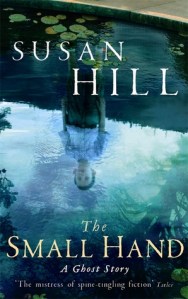 This was my fourth of Hill’s classic ghost stories, after The Woman in Black, The Man in the Picture and Dolly. They’re always concise and so fluently written that the storytelling voice feels effortless. I wondered if this one might have been inspired by “The Ghost of a Hand” (above). It doesn’t feature a disembodied hand, per se, but the presence of a young boy who slips his hand into antiquarian book dealer Adam Snow’s when he stops at an abandoned house in the English countryside, and again when he goes to a French monastery to purchase a Shakespeare First Folio. Each time, Adam feels the ghost is pulling him to throw himself into a pond. When Adam confides in the monks and in his brother, he gets different advice. A pleasant and very quick read, if a little predictable. (Free from a neighbour)
And a bonus story:
 Carmen Maria Machado’s “The Lost Performance of the High Priestess of the Temple of Horror” appears in Kink (2021), a short story anthology edited by Garth Greenwell and R.O. Kwon. (I requested it from NetGalley just so I could read the stories by Machado and Brandon Taylor.) It opens “I would never forget the night I saw Maxa decompose before me.” A seamstress, obsessed with an actress, becomes her dresser. Set in the 19th-century Parisian theatre world, this pairs queer desire and early special effects and is over-the-top sensual in the vein of Angela Carter, with hints of the sadomasochism that got it a place here.
Sample lines: “Women seep because they occupy the filmy gauze between the world of the living and the dead.” & “Her body blotted out the moon. She was an ambulatory garden, a beacon in a dead season, life where life should not grow.”
Also counting the short stories by Octavia E. Butler and Bradley Sides, I did some great R.I.P. reading this year! I think the book that will stick with me the most is Tender Is the Flesh.
More Ideas of Novellas to Read for #NovNov
Still in need of ideas for what to read in November? Here are our novella-friendly lists of authors and publishers that fit the bill!
Authors who tend(ed) to write short books:
- James Baldwin
- J.L. Carr
- Barbara Comyns
- Alice Thomas Ellis
- Penelope Fitzgerald
- Paul Gallico
- Kaye Gibbons
- Susan Hill
- Denis Johnson – Train Dreams was one of our most-reviewed books last year
- Gabriel Josipovici
- Claire Keegan
- Shena Mackay
- Ian McEwan
- Sarah Moss’s three latest
- Jean Rhys
- Georges Simenon
- Muriel Spark
- John Steinbeck
- Nathanael West
- Jacqueline Woodson
In nonfiction – nature books:
- Jim Crumley
- John Lewis-Stempel
In nonfiction – animal/pet books:
- Derek Tangye
- Doreen Tovey
UK publishers that specialize in novellas:
Fitzcarraldo Editions (especially their early releases)
Penguin’s Little Black Classics series
Worldwide publishers that specialize in novellas:
Fish Gotta Swim Editions (Canada)
Melville House – “The Art of the Novella” series (USA)
Nouvella (USA) – Take a look at the last couple of rows on their merchandise page!
Quattro Books (Canada)
UK publishers that specialize in novellas in translation:
Charco Press – contemporary Latin American literature
Fitzcarraldo Editions
Holland Park Press
Les Fugitives – translations from the French
Lolli Editions (thanks to Annabel for this one)
Peirene Press – Cathy will be hosting an interview with them during translation week!
Pushkin Press
UK sources of short nonfiction:
Bloomsbury’s Object Lessons series
Fitzcarraldo Editions – some of their longform essays are under 200 pages
Penguin’s Great Ideas series
Little Toller Books – mostly nature and travel monographs
The School of Life – most of the ones in this particular series are under 200 pages
Oxford University Press’s Very Short Introductions series
Wellcome Collection Books – a number of their recent releases are under 200 pages
You could also check out some of last year’s Novellas in November content: 89 posts from 30 bloggers, including single reviews, multi-reviews and favourites lists.
Still stumped? Try these articles:
(Note: not all of the suggestions stick to our definition of a novella.)
- Brona’s list of Australian novellas
- “20 of the Best Short Classic Books” (Book Riot)
- Novellas: A Life List (Fish Gotta Swim)
- “10 Best Books Shorter than 150 Pages” (Publishers Weekly)
- “50 Must-Read Short Books in Translation” (Book Riot)
- “50 Must-Read Short Books under 250 Pages” (Book Riot)
- “50 Short Nonfiction Books You Can Read in a Day (or Two)” (Book Riot)
And, if you’re looking for a bit of context, the other year Laura F. put together a history of the Novellas in November challenge.
Talking to the Dead x 2: Helen Dunmore and Elaine Feinstein
My fourth title-based dual review post this year (after Ex Libris, The Still Point and How Not to Be Afraid), with Betty vs. Bettyville to come in December if I can manage them both. Today I have an early Helen Dunmore novel about the secrets binding a pair of sisters and an Elaine Feinstein poetry collection written after the loss of her husband. Their shared title seemed appropriate as Halloween approaches. Both: 
Talking to the Dead by Helen Dunmore (1996)
 Nina, a photographer, has travelled to stay with her sister in Sussex after the birth of Isabel’s first child, Antony. A house full of visitors, surrounded by an unruly garden, is perfect for concealment. A current secret trades off with one from deep in the sisters’ childhood: their baby brother Colin’s death, which they remember differently. Antony and Colin function like doubles, with the sisters in subtle competition for ownership of the past and present. This was a delicious read: as close as literary fiction gets to a psychological thriller, dripping with sultry summer atmosphere and the symbols of aphrodisiac foods and blowsy flowers. From the novel’s title and opening pages, you have an inkling of what’s to come, but it still hits hard when it does. Impossible to say more about the plot without spoiling it, so just know that it’s a suspenseful story of sisters with Tessa Hadley, Maggie O’Farrell and Polly Samson vibes. I hadn’t much enjoyed my first taste of Dunmore’s fiction (Exposure), but I’m very glad that Susan’s enthusiasm spurred me to pick this up. (Secondhand purchase, Honesty bookshop outside the Castle, Hay-on-Wye)
Talking to the Dead by Elaine Feinstein (2007)
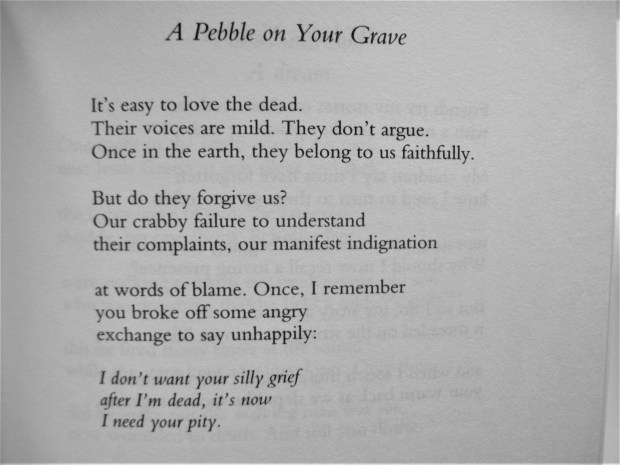
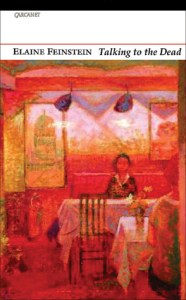 Much like Margaret Atwood’s Dearly, my top poetry release of last year, this is a tender and playful response to a beloved spouse’s death. The short verses are in stanzas and incorporate the occasional end rhyme and spot of alliteration as Feinstein marshals images and memories to recreate her husband’s funeral and moments from their marriage and travels beforehand and her widowhood afterwards – including moving out of their shared home. The poems flow so easily and beautifully from one to another; I’d happily read much more from Feinstein. This was her 13th poetry collection; before her death in 2019, she also wrote many novels, stories, biographies and translations. I’ll leave you with a poem suitable for the run-up to the Day of the Dead. (Secondhand purchase, Minster Gate Bookshop, York)
Does one or both of these appeal to you?
How Not to Be Afraid (of Everything): Gareth Higgins and Jane Wong
I’ve done a couple of other dual review posts this year (and I have another planned for Friday) where the books’ titles are so similar that I couldn’t resist discussing them together, even if the books themselves were extremely different. First I featured two books called Ex Libris; later I reviewed The Still Point with The Still Point of the Turning World. This time I have two 2021 releases: How Not to Be Afraid, Gareth Higgins’s self-help/theology book about resisting despair and living in faith; and Chinese American poet Jane Wong’s collection How to Not Be Afraid of Everything, which draws on her family history. Together the titles seemed like a perfect antidote to R.I.P. (more coming up for that on Halloween!).
How Not to Be Afraid: Seven Ways to Live When Everything Seems Terrifying by Gareth Higgins
 I saw Higgins at the online Church Times Festival of Faith and Literature in April, after which I promptly ordered all the speakers’ books; I’m still reading the other three. He grew up in Northern Ireland in the waning days of the Troubles and has been involved in peacemaking projects as well as in artistic expressions of progressive Christianity such as Wild Goose Festival, which he co-founded, and The Porch, an online magazine he edits. Fear was ingrained in him from his upbringing and reinforced by the bullying he experienced over his sexuality. He writes that it took him decades to learn that fear is a story, one often based on false assumptions about our powerlessness, and that we can change the story.
There’s a psychological/self-help bent to the book as Higgins invites readers, through the exercises at the end of each chapter, to ponder what myths about the true self and its possibilities are limiting their lives. The “seven” of the subtitle actually refers to seven main types of fear, each addressed in turn, such as “fear of having done something that can’t be fixed,” “fear of not having enough,” and “fear of a meaningless life.” There’s a good mix of memoir, theory, anecdotes and therapy speak (though it’s never jargon-y), and while the perspective is Christian, the content is not so religious as to turn off anyone – unless they’re dead set against faith. Many passages hit me right in the solar plexus and made me long to work out how my life can be bigger and part of telling a better story. Particularly recommended to fans of Barbara Brown Taylor, Brian McLaren and Richard Rohr. (New purchase)
How to Not Be Afraid of Everything by Jane Wong
 Wong is an assistant professor of creative writing at Western Washington University. The centerpiece of her second collection is “When You Died,” a 20-page epic about her grandparents’ experience during China’s “Great Leap Forward,” a 1950s–60s Maoist campaign of agricultural reform that led to severe famine. Her grandfather survived it and her mother was born at the tail end of it. Wong was born to immigrant parents in New Jersey and the atmosphere and imagery she uses to describe her living situation there reminded me of Qian Julie Wang’s in her memoir Beautiful Country.
Foodstuffs provide the figurative palette, with decay never far behind. I most enjoyed the multi-part poem “The Frontier” (“The frontier arranges itself / around me like a moat. / The frontier drops fruit / upon my head. I break open, / hot cantaloupe in winter. / I wobble around, spilling fruit / everywhere. All day, fruit flies / pay their respects.”) and “The Cactus,” about her spiky self-preservation instincts. This is the theme of the title poem as well:
How to not punch everyone in the face.
How to not protect everyone’s eyes from
my own punch. I have been practicing
my punch for years, loosening my limbs.
My jaw unhinged creates a felony I refuse
to go to court for.
There are many unusual metaphors and word choices, and a lot of the alliteration I love. Opening poem “Mad” is playfully set up like a Mad Libs game with all the key words as blanks. But at the same time, there are loads of prose poems – never my favourite thing to come across in a collection – and some long ones that I kept getting lost in.
Released by Alice James Books on the 12th. With thanks to Nectar Literary for the free e-copy for review.
Love Your Library Begins: October 2021
It’s the opening month of my new Love Your Library meme! I hope some of you will join me in writing about the libraries you use and what you’ve borrowed from them recently. I plan to treat these monthly posts as a sort of miscellany.
Although I likely won’t do thorough Library Checkout rundowns anymore, I’ll show photos of what I’ve borrowed, give links to reviews of a few recent reads, and then feature something random, such as a reading theme or library policy or display.

Do share a link to your own post in the comments, and feel free to use the above image. I’m co-opting a hashtag that is already popular on Twitter and Instagram: #LoveYourLibrary.
Here’s a reminder of my ideas of what you might choose to post (this list will stay up on the project page):
- Photos or a list of your latest library book haul
- An account of a visit to a new-to-you library
- Full-length or mini reviews of some recent library reads
- A description of a particular feature of your local library
- A screenshot of the state of play of your online account
- An opinion piece about library policies (e.g. Covid procedures or fines amnesties)
- A write-up of a library event you attended, such as an author reading or book club.
If it’s related to libraries, I want to hear about it!
Recently borrowed


Stand-out reads
The Echo Chamber by John Boyne
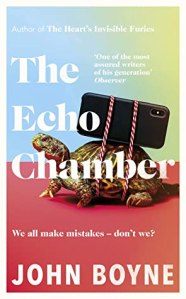 John Boyne is such a literary chameleon. He’s been John Irving (The Heart’s Invisible Furies), Patricia Highsmith (A Ladder to the Sky) and David Mitchell (A Traveller at the Gates of Wisdom). Now, with this Internet-age state-of-the-nation satire featuring variously abhorrent characters, he’s channelling the likes of Jamie Attenberg, Jonathan Coe, Patricia Lockwood, Lionel Shriver and Emma Straub. Every member of the Cleverley family is a morally compromised fake. Boyne gives his characters amusing tics, and there are also some tremendously funny set pieces, such as Nelson’s speed dating escapade and George’s public outbursts. He links several storylines through the Ukrainian dancer Pylyp, who’s slept with almost every character in the book and has Beverley petsit for his tortoise.
What is Boyne spoofing here? Mostly smartphone addiction, but also cancel culture. I imagined George as Hugh Bonneville throughout; indeed, the novel would lend itself very well to screen adaptation. And I loved how Beverley’s new ghostwriter, never given any name beyond “the ghost,” feels like the most real and perceptive character of all. Surely one of the funniest books I will read this year. (Full review).
Beautiful World, Where Are You by Sally Rooney
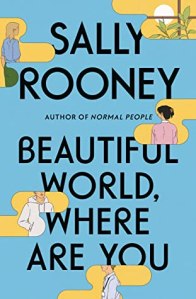 I was one of those rare readers who didn’t think so much of Normal People, so to me this felt like a return to form. Conversations with Friends was a surprise hit with me back in 2017 when I read it as part of the Sunday Times Young Writer of the Year Award shadow panel the year she won. The themes here are much the same: friendship, nostalgia, sex, communication and the search for meaning. BWWAY is that little bit more existential: through the long-form e-mail correspondence between two friends from college, novelist Alice and literary magazine editor Eileen, we imbibe a lot of philosophizing about history, aesthetics and culture, and musings on the purpose of an individual life against the backdrop of the potential extinction of the species.
Through their relationships with Felix (a rough-around-the-edges warehouse worker) and Simon (slightly older and involved in politics), Rooney explores the question of whether lasting bonds can be formed despite perceived differences of class and intelligence. The background of Alice’s nervous breakdown and Simon’s Catholicism also bring in sensitive treatments of mental illness and faith. (Full review).
This month’s feature
I spotted a few of these during my volunteer shelving and then sought out a couple more. All five are picture books composed by authors not known for their writing for children.
 Islandborn by Junot Díaz (illus. Leo Espinosa): “Every kid in Lola’s school was from somewhere else.” When the teacher asks them all to draw a picture of the country they came from, plucky Lola doesn’t know how to depict the Island. Since she left as a baby, she has to interview relatives and neighbours for their lasting impressions. For one man it’s mangoes so sweet they make you cry; for her grandmother it’s dolphins near the beach. She gathers the memories into a vibrant booklet. The 2D cut-paper style reminded me of Ezra Jack Keats.
 The Islanders by Helen Dunmore (illus. Rebecca Cobb): Robbie and his family are back in Cornwall to visit Tamsin and her family. These two are the best of friends and explore along the beach together, creating their own little island by digging a channel and making a dam. As the week’s holiday comes toward an end, a magical night-time journey makes them wonder if their wish to make their island life their real life forever could come true. The brightly coloured paint and crayon illustrations are a little bit Charlie and Lola and very cute.
 Rose Blanche by Ian McEwan (illus. Roberto Innocenti): Patriotism is assumed for the title character and her mother as they cheer German soldiers heading off to war. There’s dramatic irony in Rose being our innocent witness to deprivations and abductions. One day she follows a truck out of town and past barriers and fences and stumbles onto a concentration camp. Seeing hungry children’s suffering, she starts bringing them food. Unfortunately, this gets pretty mawkish and, while I liked some of the tableau scenes – reminiscent of Brueghel or Stanley Spencer – the faces are awful. (Based on a story by Christophe Gallaz.)
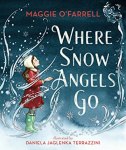 Where Snow Angels Go by Maggie O’Farrell (illus. Daniela Jaglenka Terrazzini): The snow angel Sylvie made last winter comes back to her to serve as her guardian angel, saving her from illness and accident risks. If you’re familiar with O’Farrell’s memoir I Am, I Am, I Am, this presents a similar catalogue of near-misses. For a picture book, it has a lot of words – several paragraphs’ worth on most of its 70 pages – so I imagine it’s more suitable for ages seven and up. I loved the fairy tale atmosphere, touches of humour, and drawing style.
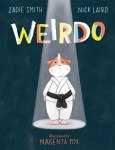 Weirdo by Zadie Smith and Nick Laird (illus. Magenta Fox): Kit’s birthday present is Maud, a guinea pig in a judo uniform. None of the other household pets – Derrick the cockatoo, Dora the cat, and Bob the pug – know what to make of her. Like in The Secret Life of Pets, the pets take over, interacting while everyone’s out at school and work. At first Maud tries making herself like the others, but after she spends an afternoon with an eccentric neighbour she realizes all she needs to be is herself. It’s not the first time married couple Smith and Laird have published an in-joke (their 2018 releases – an essay collection and a book of poems, respectively – are both entitled Feel Free): Kit is their daughter’s name and Maud is their pug’s. But this was cute enough to let them off.
 Bookish Beck = Rebecca Foster. American transplant to England. Freelance proofreader and book reviewer.
