20 Books of Summer, 8: Au Revoir, Tristesse by Viv Groskop
This is a substitute I picked out as a potential (now belated) #ParisinJuly2025 contribution. There’s been little time for writing over the past week while we’ve been hosting my sister and brother-in-law. Their whirlwind trip was shortened by a day due to a cancelled flight from the States, but we managed to pack in a lot, including a two-night mini-break down in Devon.

Reminiscent of Something to Declare by Julian Barnes and How Proust Can Change Your Life by Alain de Botton, this is a lighthearted tour through a dozen great works of French literature and the lessons they might offer modern readers on how to live well. Ever since her school days of studying French and spending every family holiday in France, Groskop has been obsessed with the language and culture. In most of the chapters, she undertakes a rereading of a novel she first read as a teenager or Cambridge student, marveling at how much more she gets out of it with greater life experience.
 Although her choices are indisputable classics, she acknowledges they can only ever be an incomplete and biased selection, unfortunately all white and largely male, though she opens with Bonjour Tristesse and also includes Colette and Duras novels. I’d only read three of her dozen, in translation: along with the Sagan, Dangerous Liaisons and Madame Bovary (as well as other books by two of the additional authors), but it didn’t make much difference whether I was familiar with a plot or not. So long as one is not allergic to spoilers, it’s possible to enjoy these miniature essays’ witty combination of literary criticism, biographical information, self-help messaging, and a bit of autobiographical context.
The male writers tended to be syphilitic workaholics – Balzac is reputed to have drunk 50 cups of coffee per day to sustain his output – while the women flouted social conventions by drinking, taking much younger (and/or female) lovers and driving recklessly. While the subtitle promises “Lessons in Happiness,” from Hugo to Camus these are in fact pretty miserable narratives in which, as was especially common in the 19th century, protagonists are punished for ambition or transgressions, or never reach contentment because of self-delusion.
In boiling down each plot to one line of advice for a chapter title, Groskop’s tone alternates between earnest (“Our greatest weaknesses conceal our greatest strengths” = Cyrano de Bergerac) and tongue in cheek (“Social climbing rarely pays off, but you’ll probably want to do it anyway” = Le Rouge et le Noir). She describes the works with genuine affection and clearly believes they are still worth reading, yet isn’t afraid to question those aspects that have aged less well. Controversially, she suggests being selective with Proust’s mammoth oeuvre: “skim-read, rereading the passages you fall in love with and discarding the rest.” She also surveys how the stories live on through adaptations. Of the new-to-me, I’m most drawn to Bel-Ami but also fancy La Cousine Bette. This was a delight I wouldn’t hesitate to recommend to fellow Francophiles. (New purchase – remainder from Hay Cinema Bookshop) 

#ReadingtheMeow2025, Part II: Books by Mayo, Reinhold, Taylor and More
This year’s Reading the Meow challenge is drawing to a close. I’m adding to my first set of reviews with these selections: a novelty book about women and cats, an autobiographical sequel about an animal-lover’s menagerie in Provence, and a travel book about Scottish wildcats – plus a one-off essay that drew me in for its title and one more children’s book.

Behind Every Great Woman Is a Great Cat (2019)
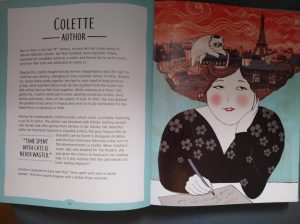
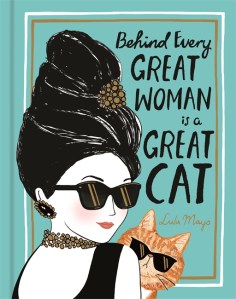 The only name on the cover is Lulu Mayo, who does the illustrations. That’s your clue that the text (by Justine Solomons-Moat) is pretty much incidental; this is basically a YA mini coffee table book. I found it pleasant enough to read bits of at bedtime but it’s not about to win any prizes. (I mean, it prints “prolificate” twice; that ain’t a word. Proliferate is.) Among the famous cat ladies given one-page profiles are Georgia O’Keeffe, Jacinda Ardern, Vivien Leigh, and Anne Frank. I hadn’t heard of the Scottish Fold cat breed, but now I know that they’ve become popular thanks Taylor Swift. The few informational interludes are pretty silly, though I did actually learn that a cat heads straight for the non-cat person in the room (like our friend Steve) because they find eye contact with strangers challenging so find the person who’s ignoring them the least threatening. I liked the end of the piece on Judith Kerr: “To her, cats were symbols of home, sources of inspiration and constant companions. It’s no wonder that she once observed, ‘they’re very interesting people, cats.’” (Christmas gift, secondhand)
Watchers in the Sun: Life at Mas des Chats by Margaret Reinhold (1994)
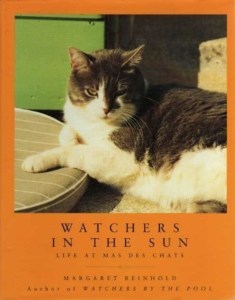 Last year I read the previous book, Sanctuary in the South (also titled Watchers by the Pool) on holiday. This is more of the same: pleasant stories about the personalities and interactions of a rotating cast of cats, some of whom she’d brought with her from England to Provence, others who transformed from strays she fed outdoors to part of the indoor hierarchy. Lily is the grande dame with private quarters upstairs; Monsieur le Gris is the top cat, bullying several younger cats but forming strong bonds with others. Most of the time Reinhold seems to hit a natural limit of nine, but that’s with several dying and being replaced by cats who wandered in or kittens people brought her. She also has two dogs and at one point rescues an old, deaf spaniel from drowning. Her French neighbours seem (to her, and probably us readers) strangely unsentimental about their pets by comparison. I enjoyed this a bit less than the first book because it was so similar – again with the Doreen Tovey-like anecdotes about the local humans – and because with the former I had the benefit of reading it on location in the South of France. The photographs by William Gooddy are a quaint reminder of the days when you shot a roll of film and had no idea how your photos had turned out until you got it developed. Even if some were blurry or underexposed, you used them because that was the best you had! (Secondhand purchase – Awesomebooks.com)
Tracking the Highland Tiger: In Search of Scottish Wildcats by Marianne Taylor (2019)
 A perfect segue from Reading the Meow to our Scotland holiday coming up on Friday. I’d not heard of Taylor although she’s a prolific natural history writer. Such species quest narratives have become very common. The contextual information about the world’s cat species and the difference between Scottish wildcats and domestic cats, including the example of a half-feral cat she adopted, is fairly interesting, but the way she separates it from her trips to Speyside and Ardnamurchan to look for wildcats in 2013–18, which are each given their own chapter, feels odd. A similar book being published today would have blended the travel, research, and autobiographical information better. There’s plenty of habitat in the Scottish mountains for wildcats; the problem they face is hybridization with domestic cats. There’s no such thing as a purebred anymore. Captive breeding and reintroductions are the only way the species is likely to survive. “Timing a trip to look for Scottish wildcats is difficult in a way, but in another way it’s not: no matter what time you go, you’re almost guaranteed not to see one.” (At least she’s self-deprecating about it.) For most of the way through, you’re convinced the author will never find one. But you’ve got to keep hoping…
[I got this from a Little Free Library on Lewis, probably the most remote one I’ve ever frequented. Alas, it’s the only one in the Outer Hebrides and there aren’t any others that we’ll pass by on our travels in the Highlands.]
And a couple of bonus books:
 The Mousehole Cat by Antonia Barber; illus. Nicola Bayley (1990) – The town of Mousehole in Cornwall (the far southwest of England) relies on fishing. Old Tom brings some of his catch home every day for his cat Mowzer; they have a household menu with a different fishy dish for each day of the week. One winter a storm prevents the fishing boats from leaving the cove and the people – and kitties – start to starve. Tom decides he’ll go out in his boat anyway, and Mowzer goes along to sing and tame the Great Storm-Cat. This story of bravery was ever so cute, words and pictures both, and I especially liked how Mowzer considers Tom her pet. (Free from a neighbour)
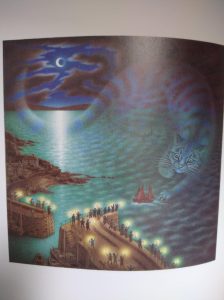
“A Conversation with a Cat” from A Conversation with a Cat and Others by Hilaire Belloc (1931) – I have no idea how I came across this but I had to borrow it for the title. Alas, only the six-page opening story is actually about a cat; the rest is, I suspect, light essays in the vein of Jerome K. Jerome. In the title piece, a man stops for a beer at a railway station bar and a beautiful long-haired cat jumps up onto his lap. “If it be true that nations have the cats they deserve, then the English people deserve well in cats, for there are none so prosperous or friendly in the world,” he thinks. He considers himself chosen and names the cat “Amathea.” He monologues to her about how comforting her presence is (“there is not a man living who knows better than I that the four charms of a cat lie in its closed eyes, its long and lovely hair, its silence, and even its affected love”) and how wonderful it is that she knows nothing of mortality. “You will never leave me. I will respect your sleep and we will sit here together through all uncounted time,” he vows. At which point she, of course, hops down and promptly approaches another patron for attention. Just like a cat. (University library)


I also enjoyed this page from Awkward Family Photos by Mike Bender and Doug Chernack, which I perused from the Little Free Library:

I’ve had such fun with Reading the Meow this year! Thanks again to Mallika for hosting it. My favourite read of the challenge was Poets Square, followed by Mornings without Mii. The Mousehole Cat was great, too. (All are pictured below apart from Mii, which I read on Kindle.)

January Releases: Greathead, Kauffman, Mills & Watts (#ReadIndies)
I feel out of practice writing reviews after the endless period of sluggish and slightly lackluster reading that was January. Here we are at the start of Kaggsy and Lizzy Siddal’s Reading Independent Publishers Month challenge and I’m happy to make this my first tie-in post as these four books all happen to be from independent publishers. The first two are American novels (that could arguably be called linked short story collections) very much in my wheelhouse for their focus on dysfunctional families and disappointing characters. I also have a group biography aiming to illuminate bisexuality, and a poetry collection about girlhood/womanhood and nature.

The Book of George by Kate Greathead
The marketing for this novel courts relatability: you probably know a George – you might have dated one (women read the most litfic). Each chapter dates to a different period in George’s life, adolescence to late thirties. From the fact that 9/11 happened when he was a college freshman, I know he’s my exact contemporary, and I could indeed see bits of myself in this Everyman schmuck: indecisive, lazy, underachieving, privileged but never living up to his own or others’ expectations. Life keeps happening around him, but you wonder if he’ll ever make something happen for himself. Two gags are revealing: In college he is known for his impression of a clinically depressed penis going through airport security, and later he has 15 minutes of fame for appearing in a hidden-camera Super Bowl commercial. He’s been writing fiction for years – first a Stoner rip-off, then a Kerouac homage – but by the time he gets a short story collection together, it’s the height of #MeToo and he’s missed his moment to publish. Meanwhile, his cohort is doing great things, winning awards for documentaries (his pal Jeremiah) or becoming pro bono lawyers (his longsuffering girlfriend Jenny).
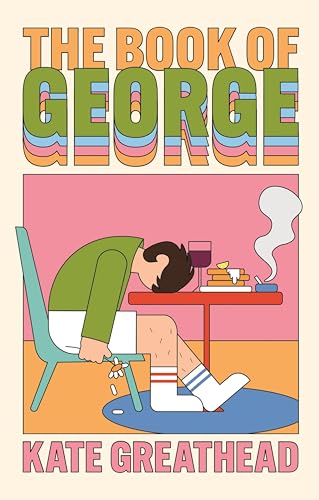 If you need to like a protagonist, expect frustration. Some of George’s behaviour is downright maddening, as when he obsessively plays his old Gameboy while his mother and Jenny pack up his childhood room. Tracing his relationships with his mother, his sister Cressida, and Jenny is rewarding. Sometimes they confront him over his shortcomings; other times they enable him. The novel is very funny, but it’s a biting, ironic humour, and there’s plenty of pathos as well. There are a few particular gut-punches, one relating to George’s father and others surrounding nice things he tries to do that backfire horribly. I thought of George as a rejoinder to all those ‘So-and-So Is Not Okay at All’ type of books featuring a face-planting woman on the cover. Greathead’s portrait is incisive but also loving. And yes, there is that hint of George, c’est moi recognition. His failings are all too common: the mildest of first-world tragedies but still enough to knock your confidence and make you question your purpose. For me this had something of the old-school charm of Jennifer Egan and Jonathan Safran Foer novels I read in the Naughties. I’ll seek out the author’s debut, Laura & Emma.
With thanks to Atlantic Books for the free copy for review. (Published in the USA by Henry Holt and Co. in 2024.)
I’ll Come to You by Rebecca Kauffman
Is 30 years long enough ago to count as historical fiction? In any case, this takes us through the whole of 1995, proceeding month by month and rotating through the close third-person perspectives of the members of one extended family as they navigate illnesses, break-ups and fraught parenting journeys. Corinne and Paul are trying to get pregnant; Paul’s mother, Ellen (again!), is still smarting from her husband leaving with no explanation; Corinne’s father, Bruce, has dementia but his wife, Janet, is doing her best to keep his cognitive deficiencies from the rest of the family. Son Rob is bitter about his ex-wife moving on so quickly, but both he and Ellen will have new romantic prospects before the end.
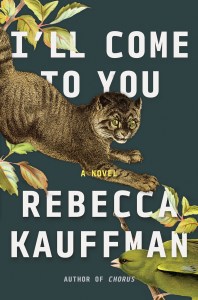 The family’s lies and secrets – also involving a Christmas run-in with Bruce’s shell-shocked brother decades ago – lead to everything coming to a head in a snowstorm. (As best I can tell, the 1995 setting was important mostly so there wouldn’t be cell phones during this crisis.) As with The Book of George, the episodic nature of the narrative means that particular moments are memorable but the whole maybe less so, and the interactions between characters stand out more than the people themselves. I’ll Come to You, named after a throwaway line in the text, is poorly served by both its cover and title, which give no sense of the contents. However, it’s a sweet, offbeat portrait of genuine, if generic, Americans; I was most reminded of J. Ryan Stradal’s work. Although I DNFed Kauffman’s The Gunners some years back, I’d be interested in trying her again with Chorus, which sounds like another linked story collection.
With thanks to Counterpoint (USA) for the advanced e-copy for review.
Uneven: Nine Lives that Redefined Bisexuality by Sam Mills
Back in 2022 I reviewed Julia Shaw’s Bi: The hidden culture, history and science of bisexuality, which took a social sciences approach. By contrast, this is a group biography of nine bisexuals – make that 10, as there are plenty of short memoir-ish passages from Mills, too. Oscar Wilde, Colette, Marlene Dietrich, Anaïs Nin, Susan Sontag: more or less familiar names, though not all of them are necessarily known for their sexuality. The chapters deliver standard potted biographies of the individuals’ work and relationships, probably containing little that couldn’t be found elsewhere in recent scholarship and not really living up to the revolutionary promise of the subtitle. However, it was worthwhile for Mills to recover Wilde as a bisexual rather than a closeted homosexual. A final trilogy of chapters comes more up to date with David Bowie, Jean-Michel Basquiat and Madonna. The closer to the present day, the more satisfying connections there are between figures. For instance, Madonna looked to both Dietrich and Bowie as role models and fashion icons, and she and Basquiat were lovers.
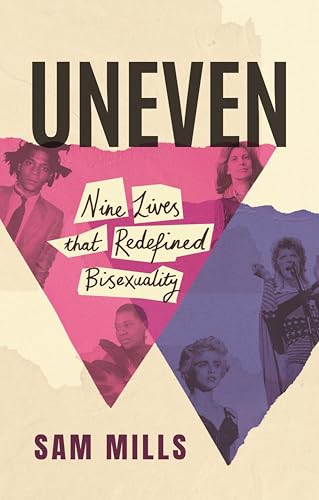 Mills and Shaw consider the same fundamental issues: bi erasure, with bisexuality the least understood and most easily overlooked element of LGBT and many passing as straight if in heterosexual marriages; and the stereotype of bis as hypersexual or promiscuous. Mills is keen to stress that bisexuals have very different trajectories and phases. Like Wilde, they might have a heterosexual era of happy marriage and parenthood followed by a homosexual spree. Or they might have simultaneous lovers of multiple genders. Some might never even act on strong same-sex desires. (Late last year I encountered a similar unity-in-diversity approach in Daniel Tamet’s Nine Minds, a group biography about autistic people.)
The 1890s to 1980s window allows for a record of changing mores yet means that the book seems rather dated. Were it written by an author of a later generation (Mills, who I knew for The Fragments of My Father, is around 50), the point of view and terminology would likely be quite different. Also, including a section on Bessie Smith within a chapter mostly on Colette felt tokenistic. (Though later considering Basquiat separately does add a BIPOC view.) Ultimately, though, my problem with Uneven was that I don’t want to know about behaviour – which is all that a biography can usually document – so much as the internal, soul stuff. Even from Mills, whose accounts of her long-term relationships and flings (including, yes, a threesome) can be titillating but not very enlightening, I didn’t get a sense of what it feels like. So neither the Shaw nor the Mills gave me precisely what I was looking for, which means that the perfect book on bisexuality either doesn’t exist or is out there but I haven’t found it yet. Any suggestions?
With thanks to Atlantic Books for the free copy for review.
The Face in the Well by Rebecca Watts
 I’ve also read Watts’ The Met Office Advises Caution and Red Gloves; this is her third collection. The Suffolk and Cambridgeshire scenery of her early and adult lives weaves all through, sometimes as an idyll that blurs the lines between humans and nature (“Private No Access”) but other times provoking anxiety about common or gendered dangers, as in the title poem or “The Old Mill” (“What happened there, / down by the old mill, / they never tell. // Something about / a man and a girl / is the most you’ll hear.”). “Woman Seeks” is a tongue-in-cheek advert for the perfect man. Animals – a dolphin, a shark, rodents, a wandering albatross, a robin – recur, as do women poets, especially Emily Brontë, and Victorian death culture (“Victoriana” and “Baroque”). Adulthood brings routine whereas childhood stands out for minor miracles, such as a free soda from a vending machine.
The format and tone vary a lot, so the book is more of a grab bag than a cohesive statement. I noted slant rhymes and alliteration, always a favourite technique of mine. I especially liked “Entropy,” about finding a slice of cake in the freezer labeled by someone who is now dead (“Nothing ever // really dies: all the pieces of you / persist, riven and reconfigured / in infinite unknowable ways”) and “Personal Effects,” about the artefacts from her childhood that her mother guards under the bed (“twists of my hair, my teeth, / my bracelet from the hospital.”).
With thanks to Carcanet Press for the advanced e-copy for review.
Which of these appeal to you? What indie publishers have you been reading from recently?
#WITMonth, Part I: Novellas by Eva Baltasar and Françoise Sagan
I’m starting off my Women in Translation month coverage with mini responses to two novellas: one Catalan and one French; both about disaffected women trying to work out what they want from life.
Mammoth by Eva Baltasar (2022; 2024)
[Translated from the Catalan by Julia Sanches]
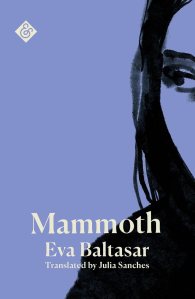 I’d been vaguely attracted by descriptions of the Spanish poet’s novels Permafrost and Boulder, which are also about lesbians in odd situations. Mammoth is the third book in a loose trilogy. Its 24-year-old narrator is so desperate for a baby that she’s decided to have unprotected sex with men until a pregnancy results. In the meantime, her sociology project at nursing homes comes to an end and she moves from Barcelona to a remote farm where she develops subsistence skills and forms an interdependent relationship with the gruff shepherd. “I’d been living in a drowning city, and I need this – the restorative silence of a decompression chamber. … my past is meaningless, and yet here, in this place, there is someone else’s past that I can set up and live in awhile.” For me this was a peculiar combination of distinguished writing (“The city pounces on the still-pale light emerging from the deep sea and seizes it with its lucrative forceps”) but absolutely repellent story, with a protagonist whose every decision makes you want to throttle her. An extended scene of exterminating feral cats certainly didn’t help matters. I’d be wary of trying Baltasar again.
With thanks to And Other Stories for the proof copy for review.
Aimez-vous Brahms… by Françoise Sagan (1959; 1960)
[Translated from the French by Peter Wiles]
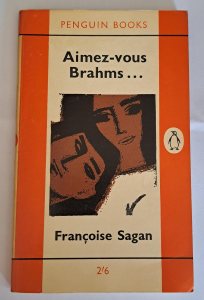 At age 39, divorced interior decorator Paule is “passionately concerned with her beauty and battling with the transition from young to youngish woman”. (Ouch. But true.) It’s an open secret that her partner Roger is always engaged in a liaison with a young woman; people pity her and scorn Roger for his infidelity. But when Paule has a dalliance with a client’s son, 25-year-old lawyer Simon, a double standard emerges: “they had never shown her the mixture of contempt and envy she was going to arouse this time.” Simon is an idealist, accusing her of “letting love go by, of neglecting your duty to be happy”, but he’s also indolent and too fond of drink. Paule wonders if she’s expected too much from an affair. “Everyone advised a change of air, and she thought sadly that all she was getting was a change of lovers: less bother, more Parisian, so common”.
I was by turns reminded of Chéri by Colette, In a Summer Season by Elizabeth Taylor, and even The Graduate (“Mrs. Robinson,” anyone?). Simon asks the title question to invite Paule to a concert; that she has to ponder it carefully tells her she’s “losing herself, losing track of herself”. But it’s all too easy for the status quo to be reinstated after a brave act. Middle-aged woman makes bid for freedom but ultimately nothing changes: same plot as The Funeral Cryer and any number of other books, but this was so much better. How did Sagan manage such insight at age 24 (and this was her fourth book)?! While not quite as memorable as Bonjour Tristesse, this is another incisive slice of fiction that has aged well apart from using “sodomite” and “Negress” as matter-of-fact terms for bit players. I’d read anything else I can find by Sagan. (Secondhand – Community Furniture Project, Newbury)

June Releases by Caroline Bird, Kathleen Jamie, Glynnis MacNicol and Naomi Westerman
These four books by women all incorporate life writing to an extent. Although the forms differ, a common theme – as in the other June releases I’ve reviewed, Sandwich and Others Like Me – is grappling with what a woman’s life should be, especially for those who have taken an unconventional path (i.e. are queer or childless) or are in midlife or later. I’ve got a poet up to her usual surreal shenanigans but with a new focus on lesbian parenting; a hybrid collection of poetry and prose giving snapshots of nature in crisis; an account of a writer’s hedonistic month in pandemic-era Paris; and mordant essays about death culture.
Ambush at Still Lake by Caroline Bird
 Caroline Bird has become one of my favourite contemporary poets over the past few years. Her verse is joyously cheeky and absurdist. A great way to sample it is via her selected poems, Rookie. This seventh collection is muted by age and circumstance – multiple weddings and a baby – but still hilarious in places. Instead of rehab or hospital as in In These Days of Prohibition, the setting is mostly the domestic sphere. Even here, bizarre things happen. The police burst in at 4 a.m. for no particular reason; search algorithms and the baby monitor go haywire. Her brother calls to deliver a paranoid rant (in “Up and at ’Em”), while Nannie Edna’s dying wish is to dangle her great-grandson from her apartment window (in “Last Rites”). The clinic calls to announce that their sperm donor was a serial killer – then ‘oops, wrong vial, never mind!’ A toddler son’s strange and megalomaniac demands direct their days. My two favourites were “Ants,” in which a kitchen infestation signals general chaos, and “The Frozen Aisle,” in which a couple scrambles to finish the grocery shop and get home to bed before a rare horny moment passes. A lesbian pulp fiction cover, mischievous wit and topics of addiction and queer parenting: this is not your average poetry.
With thanks to Carcanet Press for the free copy for review.
A sample poem:
Siblings
A woman gave birth
to the reincarnation
of Gilbert and Sullivan
or rather, two reincarnations:
one Gilbert, one Sullivan.
What are the odds
of both being resummoned
by the same womb
when they could’ve been
a blue dart frog
and a supply teacher
on separate continents?
Yet here they were, squidged
into a tandem pushchair
with their best work
behind them, still smarting
from the critical reception
of their final opera
described as ‘but an echo’
of earlier collaborations.
Cairn by Kathleen Jamie
 As she approached age 60, Kathleen Jamie found her style changing. Whereas her other essay collections alternate extended nature or travel pieces with few-page vignettes, Cairn eschews longer material and instead alternates poems with micro-essays on climate crisis and outdoor experiences. In the prologue she calls these “distillations and observations. Testimonies” that she has assembled into “A cairn of sorts.”
As in Surfacing, she writes many of the autobiographical fragments in the second person. The book is melancholy at times, haunted by all that has been lost and will be lost in the future:
What do we sense on the moor but ghost folk,
ghost deer, even ghost wolf. The path itself is a
phantom, almost erased in ling and yellow tormentil (from “Moor”)
In “The Bass Rock,” Jamie laments the effect that bird flu has had on this famous gannet colony and wishes desperately for better news:
The light glances on the water. The haze clears, and now the rock is visible; it looks depleted. But hallelujah, a pennant of twenty-odd gannets is passing, flying strongly, now rising now falling They’ll be Bass Rock birds. What use the summer sunlight, if it can’t gleam on a gannet’s back? You can only hope next year will be different. Stay alive! You call after the flying birds. Stay alive!
Natural wonders remind her of her own mortality and the insignificance of human life against deep time. “I can imagine the world going on without me, which one doesn’t at 30.” She questions the value of poetry in a time of emergency: “If we are entering a great dismantling, we can hardly expect lyric to survive. How to write a lyric poem?” (from “Summer”). The same could be said of any human endeavour in the face of extinction: We question the point but still we continue.
My two favourite pieces were “The Handover,” about going on an environmental march with her son and his friends in Glasgow and comparing it with the protests of her time (Greenham Common and nuclear disarmament) – doom and gloom was ever thus – and the title poem, which piles natural image on image like a cone of stones. Although I prefer the depth of Jamie’s other books to the breadth of this one, she is an invaluable nature writer for her wisdom and eloquence, and I am grateful we have heard from her again after five years.
With thanks to Sort Of Books for the free copy for review.
I’m Mostly Here to Enjoy Myself: One Woman’s Pursuit of Pleasure in Paris by Glynnis MacNicol
 I loved New York City freelance writer Glynnis MacNicol’s No One Tells You This (2018), which approached her 40th year as an adventure into the unknown. This second memoir is similarly frank and intrepid as MacNicol examines the unconscious rules that people set for women in their mid-forties and gleefully flouts them, remaining single and childfree and delighting in the freedom that allows her to book a month in Paris on a whim. She knows that she is an anomaly for being “untethered”; “I am ready for anything. To be anyone.”
This takes place in August 2021, when some pandemic restrictions were still in force, and she found the city – a frequent destination for her over the years – drained of locals, who were all en vacances, and largely empty of tourists, too. Although there was still a queue for the Mona Lisa, she otherwise found the Louvre very quiet, and could ride her borrowed bike through the streets without having to look out for cars. She and her single girlfriends met for rosé-soaked brunches and picnics, joined outdoor dance parties and took an island break.
And then there was the sex. MacNicol joined a hook-up app called Fruitz and met all sorts of men. She refused to believe that, just because she was 46 going on 47, she should be invisible or demure. “All the attention feels like pure oxygen. Anything is possible.” Seeing herself through the eyes of an enraptured 27-year-old Italian reminded her that her body was beautiful even if it wasn’t what she remembered from her twenties (“there is, on average, a five-year gap between current me being able to enjoy the me in the photos”). The book’s title is something she wrote while messaging with one of her potential partners.
As I wrote yesterday about Others Like Me, there are plenty of childless role models but you may have to look a bit harder for them. MacNicol does so by tracking down the Paris haunts of women writers such as Edith Wharton and Colette. She also interrogates this idea of women living a life of pleasure by researching the “odalisque” in 18th- and 19th-century art, as in the François Boucher painting on the cover. This was fun, provocative and thoughtful all at once; well worth seeking out for summer reading and armchair travelling.
(Read via Edelweiss) Published in the USA by Penguin Life/Random House.
Happy Death Club: Essays on Death, Grief & Bereavement across Cultures by Naomi Westerman
 Like Erica Buist (This Party’s Dead) and Caitlin Doughty (Smoke Gets in Your Eyes, From Here to Eternity and Will My Cat Eat My Eyeballs?), playwright Naomi Westerman finds the comical side of death. Part of 404 Ink’s Inklings series (“Big ideas, pocket-sized books” – perfect for anyone looking for short nonfiction for Novellas in November!), this is a collection of short essays about her own experiences of bereavement as well as her anthropological research into rituals and beliefs around death. “The Rat King of South London” is about her father’s sudden death from an abdominal aneurysm. An instantaneous death is a good one, she contends. More than 160,000 people die every day, and what to do with all those bodies is a serious question. A subversive sense of humour is there right from the start, as she gives a rundown of interment options. “Mummification: Beloved by Ancient Egyptians and small children going through their Ancient Egypt phase, it’s a classic for a reason!” Meanwhile, she legally owns her father’s plot so also buries dead pet rats there.
Other essays are about taking her mother’s ashes along on world travels, the funeral industry and “red market” sales of body parts, grief as a theme in horror films, the fetishization of dead female bodies, Mexico’s Day of the Dead festivities, and true crime obsession. In “Batman,” an excerpt from one of her plays, she goes to have a terrible cup of tea with the man she believes to be responsible for her mother’s death – a violent one, after leaving an abusive relationship. She also used the play to host an on-stage memorial for her mother since she wasn’t able to sit shiva. In the final title essay, Westerman tours lots of death cafés and finds comfort in shared experiences. These pieces are all breezy, amusing and easy to read, so it’s a shame that this small press didn’t achieve proper proofreading, making for a rather sloppy text, and that the content was overall too familiar for me.
With thanks to 404 Ink and publicist Claire Maxwell for the free copy for review.
Does one or more of these catch your eye?
What June releases can you recommend?
Nine Days in France and What I Read
Who would have predicted that the South of France would be colder and rainier than the England we left behind? Nonetheless, we had a pleasant, low-key week at the Limousin–Dordogne border. We stayed in a gîte at Le Moulin de Pensol, a complex run by an English couple who keep horses, donkeys and chickens but are otherwise rewilding their land (similar to the Wild Finca project we visited in Spain two years ago). Their site is known for butterflies, including multiple almost indistinguishable fritillary species, so there was plenty of insect and bird watching for my husband in brief bursts of sunshine between showers. When it was too wet to go out, we played board games, drank wine and read books.
-

- Our gite. Photos by Chris Foster.
-
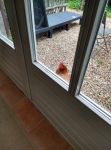
- The chickens wanted in!
-

- Wandering the meadows
-

- Butterfly watching
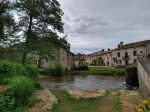
However, we did manage a few short outings: the Trou de Philippou gorge; a peek at a Saturday morning repair café (I’m a volunteer doing admin and publicity for our local repair café, which started in February) and its “recyclerie” charity shop in a nearby village; and St-Jean-de-Côle, “one of the loveliest villages in the Dordogne” according to the Rough Guide. We were taken by the main square’s church, castle and screaming swift parties – so much bigger than back home – which we’d likewise watched circling the château in the attractive medieval town of Saumur on the Loire, where we stopped for a night on the way down. There were also fresh cheeses and produce, including the most delicious strawberries ever (the “Charlotte” variety), from the two closest markets. Piégut’s is the largest market in southwest France but we had to use our imaginations as the downpour kept plenty of sellers away.


-

- St-Jean-de-Cole’s main square
-

- Photo by Chris Foster.
The highlight of the trip was a visit to Grotte de Villars, a cave network with spectacular stalactites and stalagmites. Less well known than Lascaux, which is now inaccessible to visitors except via a reproduction, it too has prehistoric cave paintings of horses and bison, and 20,000-year-old bear claw marks. The paintings are gradually disappearing behind the constant calcite-creating drips; I pondered whether they will vanish before the human race does. We were lucky to find it so quiet that we got a private English-language tour. Proprietors were also so kind as to speak English to us when we shopped at a nano-brewery and did a tasting at a cider and calvados producer in Normandy on our way back to the ferry. Otherwise, we muddled through with the bare minimum of French at shops and eateries.
-

- Abbaye de Nouaillé-Maupertuis (lunch stop en route)
-

- (Photo at left by Chris Foster.)
-

- Saumur castle
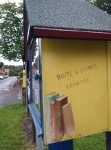
My other highlight was finding two Little Free Libraries, a walk-in one that we happened to pass in Saint-Martin-l’Ars on our initial drive down south and another in Abjat-sur-Bandiat. I felt slightly bad about taking a book at the first because of its insistence on returning or replacing once you’d read it, so I made up for it by donating Cold Spring Harbor to the book exchange box in Abjat when we returned to its crêperie for our one meal out of the holiday.
-

- Le Pese Lettres, Saint-Martin-l’Ars
-
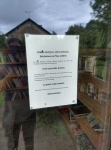
- Stricter than the usual LFL policy
-
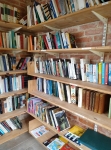
- Several English-language shelves
-
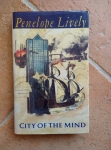
- My chosen book
-

- Abjat-sur-Bandiat book exchange box
-

- Cute cat mural in Abjat
What I Read
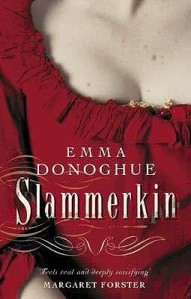 Slammerkin by Emma Donoghue (2000): A slammerkin was, in eighteenth-century parlance, a loose gown or a loose woman. Donoghue was inspired by the bare facts about Mary Saunders, a historical figure. In her imagining, Mary is thrown out by her family at age 14 and falls into prostitution in London. Within a couple of years, she decides to reform her life by becoming a dressmaker’s assistant in her mother’s hometown of Monmouth, but her past won’t let her go. The close third person narration shifts to depict the constrained lives of the other women in the household: the mistress, Mrs Jones, who has lost multiple children and pregnancies; governess Mrs Ash, whose initial position as a wet nurse was her salvation after her husband left her; and Abi, an enslaved Black woman. This was gripping throughout, like a cross between Alias Grace and The Crimson Petal and the White. The only thing that had me on the back foot was that, it being Donoghue, I expected lesbianism. (Secondhand purchase – Awesomebooks.com)
 Paris Trance by Geoff Dyer (1998): Only my second novel from Dyer, an annoyingly talented author who writes whatever he wants, in any genre, inimitably. This reminded me of Jeff in Venice, Death in Varanasi for its hedonistic travels. Luke and Alex, twentysomething Englishmen, meet as factory workers in Paris and quickly become best mates. With their girlfriends, Nicole and Sahra, they form what seems an unbreakable quartet. The couples carouse, dance in nightclubs high on ecstasy, and have a lot of sex. A bit more memorable are their forays outside the city for Christmas and the summer. The first-person plural perspective resolves into a narrator who must have fantasized the other couple’s explicit sex scenes; occasional flash-forwards reveal that only one pair is destined to last. This is nostalgic for the heady days of youth in the same way as Sweetbitter. I was intrigued to learn that random lines were sampled from Fiesta; though it is lad lit, I wouldn’t have expected a Hemingway homage from the style. (Secondhand purchase – Awesomebooks.com)
 Sanctuary in the South: The Cats of Mas des Chats by Margaret Reinhold (1993): Reinhold (still alive at 96?!) is a South African psychotherapist who relocated from London to Provence, taking her two cats with her and eventually adopting another eight, many of whom had been neglected by owners in the vicinity. This sweet and meandering book of vignettes about her pets’ interactions and hierarchy is generally light in tone, but with the requisite sadness you get from reading about animals ageing, falling ill or meeting with accidents, and (in two cases) being buried on the property. “Les chats sont difficiles,” as a local shop owner observes to her. But would we cat lovers have it any other way? Reinhold often imagines what her cats would say to her. Like Doreen Tovey, whose books this closely resembles, she is as fascinated by human foibles as by feline antics. One extended sequence concerns her doomed attempts to hire a live-in caretaker for the cats. She never learned her lesson about putting a proper contract in place; several chancers tried the role and took advantage of her kindness. (Secondhand purchase – Community Furniture Project)
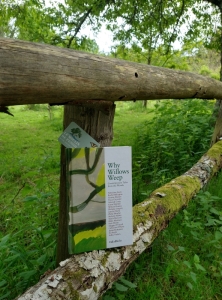
Why Willows Weep: Contemporary Tales from the Woods, ed. Tracy Chevalier and Simon Prosser (2011): These 19 short fictions, rather like Rudyard Kipling’s Just-So Stories, imagine how certain tree species developed their particular characteristics. I wasn’t expecting the fable setup and probably would have preferred a miscellany of essays and various fictional approaches. However, there is a run of great stories in the middle: from Susan Elderkin on “How the Blackthorn Got Its Flowers” to Terence Blacker on “Why Elms Die Young.” The stand-outs for me were by Rachel Billington and Maria McCann. It was a cute touch to have each author’s mini-bio end with their favourite tree, except, um, bamboo isn’t one (it’s a giant grass). I’ll probably keep this for the randomness of where I found it and the Leanne Shapton illustrations. (Secondhand purchase – La Monnerie recyclerie) 
 And the first two-thirds of Daughters of the House by Michèle Roberts (1993): Thérèse and Léonie are cousins: the one French and the other English but making visits to her relatives in Normandy every summer. In the slightly forbidding family home, the adolescent girls learn about life, loss and sex. Each short chapter is named after a different object in the house. That Thérèse seems slightly otherworldly can be attributed to her inspiration, which Roberts reveals in a prefatory note: Saint Thérèse, aka The Little Flower. Roberts reminds me of A.S. Byatt and Shena Mackay; her work is slightly austere and can be slow going, but her ideas always draw me in. (Secondhand – Newbury charity shop)
A DNF: Claudine at School by Colette (a free download), which was dull and in way too small a print on my e-reader.
Plus portions of: various e-books for paid reviews, two May review books, and several library books including Moominpappa at Sea by Tove Jansson and The Invention of Hugo Cabret by Brian Selznick.


I’m happy to be home with my cat and canal, the two things I miss most when we’re away.
#1920Club Classics of the Month: Agatha Christie and F. Scott Fitzgerald
I’m sneaking in a couple of quick reviews on the final day to join in with Simon and Karen’s latest reading week, The 1920 Club. Speaking of books that were published a century ago, I happened to review Chéri by Colette as one of my monthly classics last year, and I’m currently reading The Age of Innocence by Edith Wharton in advance of our May book club meeting.

The Mysterious Affair at Styles by Agatha Christie
 I don’t think I’ve read an Agatha Christie mystery since I was about … 13? (It was And Then There Were None.) But over the years I’ve watched countless Poirot and Miss Marple cases on TV with my mother. This was Poirot’s first outing, and it’s narrated by Hastings, the slightly dim Watson to the Belgian detective’s Sherlock Holmes.
One July, invalided home from the war at age 30, Hastings goes to visit old family friends at Styles, their Essex manor house: brothers John and Lawrence Cavendish and their elderly stepmother, who has recently (and somewhat shockingly) remarried. When old Mrs. Cavendish is found dead of strychnine poisoning, Poirot is brought in to sort through the potential suspects. Coffee and cocoa cups, a fragment of a charred will, a fake beard, a candle wax stain and a bolted door will be among his major clues.
Like Hastings, we as readers are quick to point to the obvious: hey, that foreigner who happens to be an expert on poisons, it’s him, right?! But as Poirot carefully explains, again and again, “If the fact will not fit the theory, let the theory go. … Real evidence is usually vague and unsatisfactory. It has to be examined, sifted. But here the whole thing is cut and dried.”
I rarely pick up a mystery novel, though when I can get stuck in I do tend to enjoy them. This was a super-quick read and I found myself turning to it more often than to other books on my stack that felt weightier in subject matter. In the end I find crime novels inconsequential, so can’t imagine needing to try another Poirot or Marple for another 20 years or so. But if you’re struggling to read in a time of anxiety, you could certainly do worse than a Christie novel.
My rating: 
This Side of Paradise by F. Scott Fitzgerald
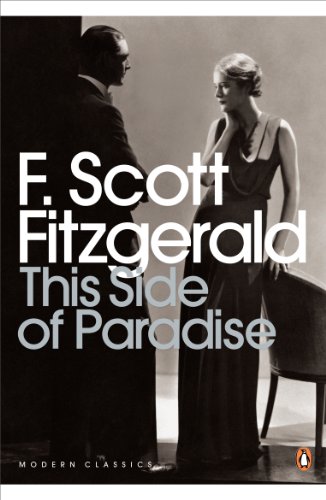 Fitzgerald has long been one of my literary blind spots. The Great Gatsby is a masterpiece, sure: I studied it in school and have read it another couple of times since, as well as lots of background nonfiction and some contemporary novels that riff on the story line. But everything else of his that I’ve tried (Tender Is the Night was the other one) has felt aimless and more stylish than substantive.
Amory Blaine is a wealthy Midwesterner who goes from boarding school to Princeton and has literary ambitions and various love affairs. He’s convinced he’s a “boy marked for glory.” But Monsignor Darcy, his guru, encourages the young man to focus on developing his character more than his dashing personality.
Hugely popular at its first release, this debut novel won Fitzgerald his literary reputation – as well as Zelda Sayre’s hand in marriage. What with the slang (“Oh my Lord, I’m going to cast a kitten”), it felt very much like a period piece to me, most impressive for its experimentation with structure: parts are written like a film script or Q&A, and there are also some poems and lists. This novelty may well be a result of the author cobbling together drafts and unpublished odds and ends, but still struck me as daring.
In a strange way, though, the novel is deliberately ahistorical in that it glosses over world events with a flippancy that I find typical of Fitzgerald. Even though Amory is called up to serve, his general reaction to the First World War is dispatched in a paragraph; Prohibition doesn’t get much more of a look-in.
I understand that the book is fairly autobiographical and in its original form was written in the first person, which I might have preferred if it led to greater sincerity. I could admire some of the witty banter and the general coming-of-age arc, but mostly felt indifferent to this one.
My rating: 
Classics of the Month: Colette and Hemingway
I had the hardest time settling to a classic this month. I tried Elizabeth Bowen’s The Heat of the Day for Reading Ireland Month, but couldn’t get past page 35; I barely made it to the second page of (in quick succession) Backwater by Dorothy Richardson, The Years and The Waves by Virginia Woolf. Meanwhile, I started Full Tilt by Dervla Murphy and Woolf’s The Voyage Out, and have been enjoying both, but they may well take me a few months to read.
In the end I read two short classics about obsessive love, both set in the France of the 1920s.
Chéri by Colette (1920)
 [Translated from the French by Roger Senhouse]
My first time trying Colette. The novella, set in the Paris suburbs, circles the relationship of Léa de Lonval, an ageing courtesan, and Frédérick Peloux, her handsome, supercilious lover boy (“the set of his head! quite a statue! But what a little beast he is! When he laughs, you’d swear it’s a greyhound snarling!”). Although they’ve been together for six years, the young man, whom she simply calls Chéri (“dear one”) is just 25 – about half her age. When Chéri’s mother arranges a financially beneficial marriage for him, he and Léa convince themselves it means nothing, but later question whether they’ve lost their chance at true love.
These are both aloof characters who sometimes have trouble accessing their emotions (“My temperature’s normal, so it’s nothing physical. I see. I’m just unhappy,” Léa realizes; “Well, why shouldn’t I have a heart like everybody else?” Chéri asks). To what extent is Léa a replacement mother figure for Chéri? Does love always entail possession and a loss of freedom? These psychological questions and the complex characters held my interest, though in the end the story is fairly thin. I’d read more by Colette: her memoirs come recommended, for instance.
My rating:
The Garden of Eden by Ernest Hemingway (1986)
I find Hemingway offputtingly macho at the best of times, so was surprised to learn he’s the favorite author of a go-getting feminist type from my neighborhood book club. When she put this forward as our April selection I hadn’t even heard of it. It was Hemingway’s second posthumous publication. My main problems are that: 1) it reads like an early draft of an early novel – unpolished and with no proper ending, and 2) it reads like a male having-it-all fantasy, in which two women simultaneously lavish him with sexual attention and switching from one to the other presents no serious consequences.
It’s thought that Hemingway began writing the book in 1946, but was casting his mind back to the late 1920s, when he was preparing to leave his first wife, Hadley Richardson, for his second, Pauline Pfeiffer. In 1927 he and Pauline honeymooned in France’s Le Grau-du-Roi, which is where The Garden of Eden opens. Hemingway’s stand-in is writer David Bourne, who’s had success with a novel about flying in the war and is now dividing his time between Africa-set short stories that reflect on his childhood and his relationship with his father, and an autobiographical narrative drawing on his life with his new wife, Catherine.
 They’re on an extended honeymoon in France and Spain, and the title invites you to think of this as an idyllic time-outside-of-time spent swimming, feasting, taking long drives and making love. Catherine doesn’t want to do what others expect. She loves feeling that she and David have created a whole world unto themselves; they’re free to go anywhere and do anything. Obsessed with equality, she gets a close-cut gamine haircut that matches David’s exactly. But before long their heads are turned by a young woman they meet in a café, and this Marita becomes the third in an increasingly uncomfortable ménage à trois.
To the extent that this is a dramatization of the Genesis story and its accompanying Jewish myths, it is a reasonably successful plot. David calls Catherine “Devil,” but really she’s the Lilith figure, with David (Adam) later moving on to Marita (Eve). Alternatively, Marita could be thought of as the snake, a temptress destroying the couple’s perfect union. Catherine is much the most interesting character, mercurial and driven by odd compulsions: to sleep with a woman, to burn David’s stories and clippings. It was edgy for Hemingway to be thinking about gender fluidity and bisexuality, but the way these two women slavishly attend to David’s needs so that he can go on with his heroic writing work didn’t sit well with me.
What I most enjoyed about the novel were the descriptions of food and drink and the scenes in which David is sitting down to work (“You’d better write another story. Write the hardest one there is to write that you know.”) and reliving the elephant hunt. As usual, though, there’s the annoyances of the Hemingway style: underpunctuated; too many adjectives (sometimes as many as four in a row); simplistic language, including about good and evil; flat and unrealistic dialogue. Apparently Hemingway worked on the manuscript off and on for 15 years until it ballooned to 800 pages, yet he never finished it. Editors cut it down to a manageable size, but the ending? It’s as if nothing ever happened. Utterly frustrating.
Some favorite lines:
David: “Everyone’s full of charm. Charm and sturgeon eggs.”
David to Catherine: “Why can’t you want something that makes sense?” / Catherine: “I do. But I want us to be the same and you almost are and it wouldn’t be any trouble to do it.”
Catherine, towards the end: “I wish it hadn’t ended in complete disillusion too”
My rating: 
Next month’s plan: To tie in with our travels (we’re having another go at our attempted French getaway next weekend): A Breath of French Air by H.E. Bates and Thérèse Raquin by Emile Zola; Cider with Rosie by Laurie Lee to read in Stroud the final Sunday of the month.
 Bookish Beck = Rebecca Foster. American transplant to England. Freelance proofreader and book reviewer.
 Bookish Beck