A Quick Look Back at Hamnet by Maggie O’Farrell for #LiteraryWives
I read Maggie O’Farrell’s Women’s Prize winner, Hamnet, at its release in 2020. Unfortunately, it has been my least favourite of her novels (I’ve read all but My Lover’s Lover now), and it turns out 3.5 years is too soon to reread and appreciate anew. But I had a quick skim back through, this time focusing on the central marriage and the question we ask for the Literary Wives online book club:
What does this book say about wives or about the experience of being a wife?

From my original review: O’Farrell imagines the context of the death of William Shakespeare’s son Hamnet and the effect it had on the playwright’s work – including, four years later, Hamlet. Curiously, she has decided never to mention Shakespeare by name in her novel, so he remains a passive, shadowy figure seen only in relation to his wife and children – he’s referred to as “the father,” “the Latin tutor” or “her husband.” Instead, the key characters are his wife, Agnes (most will know her as Anne, but Agnes was the name her father, Richard Hathaway, used for her in his will), and Hamnet himself.
It is refreshing, especially for the time period, to have the wife’s experience and perspective be primary, and the husband in the background to the extent of being unnamed. Both, however, blame themselves for not being there when 11-year-old Hamnet fell ill with what O’Farrell posits was the Plague. Shakespeare was away in London with his theatre company; Agnes was off tending her bees. Shakespeare is only present in flashbacks – in which he morphs from eager tutor to melancholy drinker – until three-quarters of the way through the novel, when he returns to Stratford, too late. All he can do then is carry his son’s corpse.
I have heard it said many times that few marriages survive the death of a child. And for a while that looks like it will be the case here, too:
Her husband takes her arm as they reach the gate; she turns to look at him and it is as if she has never seen him before, so odd and distorted and old do his features seem. Is it their long separation, is it grief, is it all the tears? she wonders, as she regards him. Who is this person next to her, claiming her arm, holding it to him?
How were they to know that Hamnet was the pin holding them together? That without him they would all fragment and fall apart, like a cup shattered on the floor?
With his earnings, Shakespeare buys the family a new house, but never moves them to London as he once intended. He continues to stay away for long periods at a time, leaving Agnes to her grief. When, four years after Hamnet’s death, Agnes and their daughters learn that he has written a play about a character called Hamlet, they feel betrayed, but Agnes goes to a performance and her anger melts as she recognizes her son. “It is him. It is not him. … grown into a near-man, as he would be now, had he lived, on the stage, walking with her son’s gait, talking in her son’s voice, speaking words written for him by her son’s father.”
Although O’Farrell leaves it there, creating uncertainty about the couple’s future, she implies that the play has been the saving of both of them. For Shakespeare, it was the outlet for his grief. For Agnes, it was the proof she needed that he loved their son, grieved him as bitterly as she did, and still remembers him. That seems to be enough to hold them together.
While her next novel, The Marriage Portrait, which I liked a lot more as historical fiction goes, might seem on the surface better suited for this club, Hamnet was in fact perfect for the prompt, revealing an aspect I don’t recall looking at before: the strain that a child’s illness and death can place on a marriage. At my first reading I found the prose flat and detached, to the point of vagueness, and thought there was anachronistic language and unsubtle insertion of research. This time, I was more aware of how the deliberate evenness softens the emotion, making it more bearable – though, still, I have a friend who gave up reading this partway because she found it too raw.
See also Kay’s and Naomi’s responses!
The next book, for March 2024, will be Mrs. March by Virginia Feito.
#WITMonth, Part I: de Beauvoir, Jansson, NDiaye
My first four reads for Women in Translation month were quite a varied selection: a sobering autobiographical essay about the loss of a mother, a characteristically impish children’s novel, a confoundingly elliptical family memoir, and a preview of a forthcoming Mexican novel about women’s friendships and handicraft. Another four coming up later in August.
A Very Easy Death by Simone de Beauvoir (1964; 1965)
[Translated from the French by Patrick O’Brian]
“When someone you love dies you pay for the sin of outliving her with a thousand piercing regrets.”
I’d read a lot about Simone de Beauvoir but not one of her own works until this reissue came my way. It was right up my street as a miniature bereavement memoir (just 84 pages) that doesn’t shy away from the physical details of decline or the emotional complications of a fraught mother–daughter relationship.
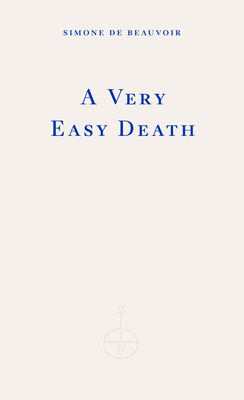 In October 1963, de Beauvoir was in Rome when she got a call informing her that her mother had had an accident. Expecting the worst, she was relieved – if only temporarily – to hear that it was a fall at home, resulting in a broken femur. But when Françoise de Beauvoir got to the hospital, what at first looked like peritonitis was diagnosed as stomach cancer with an intestinal obstruction. Her daughters knew that she was dying, but she had no idea (from what I’ve read, this paternalistic notion that patients must be treated like children and kept ignorant of their prognosis is more common on the Continent, and continues even today).
Over the next month, de Beauvoir and her sister Poupette took turns visiting. Initially alarmed by their mother’s condition, they soon grew used to the deterioration. “I was not worried by her nakedness any more: it was no longer my mother, but a poor tormented body.” They found her in varying states of awareness and discomfort. “In this race between pain and death we most earnestly hoped that death would come first.” Some nurses were better than others. De Beauvoir makes tantalizing references to the standoff between her and her mother about the Catholic faith Simone left behind. (I’ll need to read Memoirs of a Dutiful Daughter for more on that.) Even the hope of heaven didn’t fully neutralize self-pity and physical suffering for the dying woman because she feared her daughters wouldn’t be joining her.
The title is what a nurse told the grieving daughters: that their mother’s had been a very easy death in the end (and an upper-class one, de Beauvoir adds). The word used in French for easy, douce, can also be translated as “gentle,” a tie-in to the epigraph from Dylan Thomas’s “Do not go gentle into that good night.” Is it better for a loved one to die suddenly, or protractedly? I’ve debated this with myself and a few others since my mother’s death from a stroke in October. Ultimately, it’s pointless to ask; any death is an affront, hard to accept and adjust to no matter how much warning is given. I appreciated how matter-of-factly and concisely de Beauvoir’s essay encapsulates the duties and feelings surrounding a death. Frank and unshowy yet potent, this is a classic of the subgenre. 
Published as Fitzcarraldo Editions Classics No. 2 in June. With thanks to the publisher for the free copy for review.
(Books of Summer, #10)
Finn Family Moomintroll by Tove Jansson (1948; 1950)
[Translated from the Swedish by Elizabeth Portch]
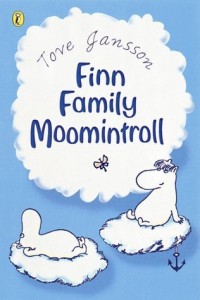 My sixth Moomins book, and ninth by Jansson overall. The novella’s gentle peril is set in motion by the discovery of the Hobgoblin’s Hat, which transforms anything placed within it. As spring moves into summer, this causes all kind of mild mischief until Thingumy and Bob, who speak in spoonerisms, show up with a suitcase containing something desired by both the Groke and the Hobgoblin, and make a deal that stops the disruptions.
As always, the creatures and events, conveyed by Jansson’s black-and-white drawings as much as by her words, are inventive and whimsical. There’s a cosy charm to the seasonal rituals, like the end-of-summer pancake party here. But what I value even more is the pointed accounts of the secondary characters’ neuroses. The Moomins are generally on a pretty even keel, though there is mention of Moominpappa’s sense of being hard done by because of childhood bullying and an enduring lack of respect. However, characters like the Muskrat and the Hemulen get a wry smile and shake of the head from me because their predicaments are so familiar: The Muskrat, terrified of mortifying situations, decides the life of a hermit might be preferable; the Hemulen gives up stamp collecting and switches to botanizing because there’s no joy in a finished quest, only in an ongoing search. The Moomins books offer the perfect combination of the familial and routine with the novel and adventurous. Even staid adults should give them a try. (Little Free Library)
Self-Portrait in Green by Marie NDiaye (2005; 2015)
[Translated from the French by Jordan Stump]
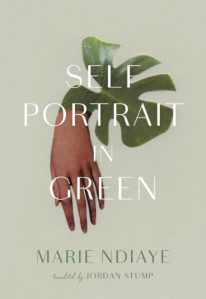 I tend to love a memoir that tries something new or experimental with the form (such as Constructing a Nervous System or In the Dream House), but this was a step too far for me; the self referred to in the title is almost wholly absent. NDiaye, a French–Senegalese author, opens in 2003 with the expected flooding of the Garonne in southwest France. Fragments of narrative from 2000–2003 chart her encounters with various women dressed in green, starting with one she thinks she sees under a banana tree (though her four children see nothing). Then there’s Katia Depetiteville, dead 10 years … NDiaye’s stepmother, once her childhood best friend; her friend Jenny’s rival for Ivan’s affection; and her mother, who now has a new family. What is a ‘woman in green’? The author explicitly associates the colour with cruelty, with presumably the usual connotation of jealousy as well. But it still feels arbitrary.
It’s all rather dreamlike, with poetic repetition, rhetorical questions and black-and-white photos that seem marginally relevant. “I’m saying to myself: Is all this really real?” NDiaye writes, and the reader will surely be asking the same. “I’m always interested in stories,” she adds, and while I’d agree, I need to know that they’re being told to build to some greater meaning. It was only in the last fifth of the book, when the author goes to a literary symposium in Ouagadougou and visits her father (a many-times-married former restaurateur and amateur architect now suffering from cataracts) and stepmother that I felt like there was a purpose: a bringing together of past and present for psychological clarity. I was relieved that this was only 112 pages. (Edelweiss) 
The 10th anniversary edition is being reissued by Two Lines Press next month.
And a bonus preview:
Cross-Stitch by Jazmina Barrera (2021; 2023)
[Translated from the Spanish by Christina MacSweeney]
 In the inventive debut novel by Mexican author Jazmina Barrera, a sudden death provokes an intricate examination of three young women’s years of shifting friendship. Their shared hobby of embroidery occasions a history of women’s handiwork, woven into a relationship study that will remind readers of works by Elena Ferrante and Deborah Levy. Citlali, Dalia, and Mila had been best friends since middle school. Mila, a writer with a young daughter, is blindsided by news that Citlali has drowned off Senegal. While waiting to be reunited with Dalia for Citlali’s memorial service, she browses her journal to revisit key moments from their friendship, especially travels in Europe and to a Mexican village. Cross-stitch becomes its own metaphorical language, passed on by female ancestors and transmitted across social classes. Reminiscent of Still Born and A Ghost in the Throat. (Edelweiss)
Coming out on 7 November from Two Lines Press. My full review for Shelf Awareness is pending.
Books of Summer, 6–8: Elizabeth Berg, Patricia Lockwood & Wendy Mitchell
Although I have foodie lit as a background theme for the summer’s reading, my main goal is simply to read books that I own, especially recent acquisitions and long-time shelf-sitters (whereas last year, in slavish conformity to a theme, I substituted in a bunch of library books, review books and e-books). My latest batch includes a slightly twee novel, an outlandish poetry collection, and an uneven nonfiction swan song.
The Year of Pleasures by Elizabeth Berg (2005)
 From the cover, I was expecting this to be more foodie than it was. The protagonist does enjoy cooking for other people and reading cookbooks, though. Betta Nolan, 55 and recently widowed by cancer, drives from Boston to the Midwest and impulsively purchases a house in a Chicago suburb, something she and her late husband had fantasized about doing in retirement. It’s the kind of sweet little town where the only realtor is a one-woman operation and Betta as a newcomer automatically gets invited onto the local radio show. She also reconnects with her college roommates, tries dating, and mulls over her dream of opening a women’s boutique that sells silk scarves, handmade journals, essential oils and brownies.
While Berg is true to the shifting emotions that accompany grief, and gives Betta plenty of cute opportunities to make friends across the generations – with Lydia, the nonagenarian former owner of her house, now in a nursing home; Matthew, the fickle young man who does some odd jobs for her; and Benny, the next-door neighbor’s nine-year-old boy – I found the subplot about Matthew’s messy house and relationships silly, and Betta’s “What a Woman Wants” shop idea is so stereotyping I could feel myself rolling my eyes. Still, Berg’s novels, of which this was my fifth, are always reliably light and pleasant reads in an Anne Tyler vein. (Secondhand – 2nd & Charles) 
Motherland Fatherland Homelandsexuals by Patricia Lockwood (2014)
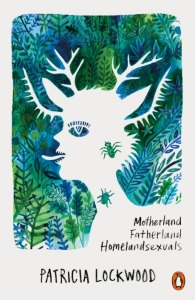 One of the more bizarre books I’ve ever read. I loved both Priestdaddy and No One Is Talking About This, but had no idea what to expect from Lockwood’s poems. They’re somewhere between absurdist monologues and thought experiments, often choosing an object or abstraction to animate (“A Recent Transformation Tries to Climb the Stairs”) and generally sexualized to the max (“Nessie Wants to Watch Herself Doing It”). Though they’re in stanzas, they aren’t heavy on poetic techniques. Some tangential topics are Bambi, Canada, basketball, waterfalls, King Kong adaptations, American poetry, Shirley Temple, and childhood hobbies like Animorphs, Egyptology and Magic Eye puzzles.
But really, her poetry is only “about” things in the loosest sense; the repetition, wordplay and snark are paramount. If you’ve heard of one, it’s likely to be the lengthy “Rape Joke,” which went as viral as it’s possible for a poem to and is, ironically, probably the sincerest entry here. Presumably based on her own bad experience with a teenage boyfriend, it is heartbreakingly banal: “The rape joke is that he was your father’s high school student … The rape joke is that come on, you should have seen it coming. … The rape joke is that you asked why he did it. The rape joke is he said he didn’t know, like what else would a rape joke say?”
A couple of my favourites were “List of Cross-Dressing Soldiers” and “He Marries the Stuffed-Owl Exhibit at the Indiana Welcome Center”; “The Father and Mother of American Tit-Pics,” in which a resurrected Emily Dickinson and Walt Whitman swap genders, had some of the more outrageous lines: “Walt Whitman is the Number Two Beach Body every year, because look at the way he snapped back into shape only months after giving birth to American Poetry.” Not really like any other poetry I’ve ever read. (New purchase with Christmas money)
One Last Thing: Conversations on Life, Death and Assisted Dying by Wendy Mitchell with Anna Wharton (2023)
“We talk so often about prolonging life, but we are actually prolonging death by not discussing the suffering part of it.”
Wendy Mitchell’s first two books, Somebody I Used to Know and What I Wish People Knew About Dementia, are valuable peeks into daily life with young-onset Alzheimer’s. She has been a dedicated activist and educator in the nine years since her diagnosis, and I admire the work she’s done to get dementia services into the public eye.
 The problem with her final book is that I’ve read so much about preparations for dying and the question of assisted suicide and she doesn’t bring much new to the discussion – apart from the specific viewpoint of someone deciding when and how to end their life when they don’t know what the future course of their illness looks like. Mitchell believes people should have this choice, but current UK law does not allow for assisted dying. A loophole is voluntarily stopping eating and drinking (VSED), which she deems her best option. She stopped attending assessments in 2017 and has filed forms with her GP refusing treatment – her nightmare situation is being reliant on care in hospital and she doesn’t want to become that future, dependent Wendy.
Like Henry Marsh’s farewell book, And Finally, this gives the impression of having been written in a hurry and rushed into print, and so could have been edited more. As it is, it’s fairly scattered, repetitive and unpolished. The interviews could all be streamlined and tidied up, and the one with Kathryn Mannix is split up in a confusing way.
For readers new to the topic, however, this could be a useful introduction to the issues. It’s up-to-date in that Mitchell attends a Death Café, meets an end-of-life doula, and talks through the different forms (power of attorney, advance directive and so on) with experts. I also thought the epilogue was a lovely touch: after going for a ‘wing walking’ airplane adventure, she imagines that, having taken a bus into York, she sees her pre-diagnosis self and tells her everything she would want her to know, good and bad, about the challenges to come. (Proof copy from Hungerford Bookshop Summer Reading Celebration) [Different subtitle on finished edition?] 
Learning How to Be Sad via Books by Susan Cain and Helen Russell
There’s been a lot of sadness in my life over the past few months. If there’s a key lesson I learned from the latest work by these authors, who are among the best self-help writers out there, it’s that denying sadness is the worst thing we could do. Accepting sadness helps us to be compassionate towards others and to acknowledge but ultimately let go of generational pain. There are measures we can take to mitigate sadness – a focus of the second half of Russell’s book – but it can’t be avoided altogether. Alongside the classics of bereavement literature I have been rereading, I found these two books to be valuable companions in grief.
Bittersweet: How Sorrow and Longing Make Us Whole by Susan Cain (2022)
Cain’s Quiet must be one of the best-known nonfiction books of the millennium. It felt like vindication for introverts everywhere. Bittersweet is a little more nebulous in strategy but, boiled down, is a defence of the melancholic personality, one of the types identified by Aristotle (also explored in Richard Holloway’s The Heart of Things). Sadness is not the same as clinical depression, Cain rushes to clarify, though the two might coexist. Melancholy is often associated with creativity and sensitivity, and can lead us into empathy for others. Suffering and death seem like things to flee, but if we sit with them, we will truly be part of the human race and, per the “wounded healer” archetype, may also work toward restoration.
 A love for minor-key music, especially songs by Leonard Cohen, is what initially drew Cain to this topic, but there are other autobiographical seeds: the deaths of many ancestors, including her rabbi grandfather’s entire family, in the Holocaust; her difficult relationship with her controlling mother, who now has dementia; and the deaths from Covid of both her brother, a hospital doctor, and her elderly father in 2020.
Through interviews and attendance at conferences and other events, she draws in various side topics, like the longing that prompts mysticism (Kabbalah and Sufism), loving-kindness meditation, an American culture of positivity that demands “effortless perfection,” ways the business world could cultivate empathy, and how knowledge of death makes life precious. (The only chapter I found less than essential was one about transhumance – the hope of escaping death altogether. Mark O’Connell has that topic covered.) Cain weaves together her research with autobiographical material naturally. As a shy introvert with melancholy tendencies, I found both Quiet and Bittersweet comforting.
With thanks to Viking (Penguin) for the proof copy for review.
How to Be Sad: The Key to a Happier Life by Helen Russell (2021)
A reread, though I only skimmed the first time around – my tiny points of criticism would be that the book is a tad long – the print in the paperback is really rather small – and retreads some of the same ground as Leap Year (e.g., how exercise and culture can contribute to a sense of wellbeing). I read that just last year, after enjoying The Year of Living Danishly with my book club. She’s a reliable nonfiction author; I’d liken her to a funnier Gretchen Rubin.
 Russell has an appealingly self-deprecating style and breezily highlights statistics alongside personal anecdotes. Here she faces sources of sadness in her life head-on: her younger sister’s death from SIDS and the silence that surrounded that loss; her parents’ divorce and her sense of being abandoned by her father; struggles with eating disorders and alcohol and exercise addiction; and relationship trials, from changing herself to please boyfriends to undergoing IVF with her husband, T (aka “Legoman”), and adjusting to life as a mother of three.
As in her other self-help work, she interviews lots of experts and people who have gone through similar things to understand why we’re sad and what to do about it. I particularly appreciated chapters on “arrival fallacy” and “summit syndrome,” both of which refer to a feeling of letdown after we achieve what we think will make us happy, whether that be parenthood or the South Pole. Better to have intrinsic goals than external ones, Russell learns.
She also considers cultural differences in how we approach sadness: for instance, Russians relish sadness and teach their children to do the same, whereas the English, especially men, are expected to bury their feelings. Russell notes a waning of the rituals that could help us cope with loss, and a rise in unhealthy coping mechanisms. Like Cain, she also covers sad music (vs. one of her interviewees prescribing Jack Johnson as a mood equalizer). There are lots of laughs to be had, but the epilogue can’t fail to bring a tear to the eye. (Public library)
Both:
I found this quote from the Russell a handy summary of both authors’ premise. Dr Lucy Johnstone says:
“The key question when encountering someone with mental or emotional distress shouldn’t be, ‘What’s wrong with you?’ but rather, ‘What’s happened to you?’”
Suffering is coming for all of us, so why not arm yourself to deal with it and help others through? That’s always been one of my motivations for reading widely: to understand other people’s situations and prepare myself for what the future holds.
Could you see yourself reading a book about sadness?
Five Final Novellas: Adichie, Glück, Jhabvala, Victory for Ukraine, Woodson (#NovNov22)
We’ll wrap up Novellas in November and give some final statistics tomorrow. Today, I have mini reviews of another five novellas I read this month: one short nonfiction reread and then fiction ranging from India in the 1920s to short stories in comics about the war in Ukraine.
Notes on Grief by Chimamanda Ngozi Adichie (2021)
[85 pages]
 This came out in May last year – I pre-ordered it from Waterstones with points I’d saved up, because I’m that much of a fan – and it’s rare for me to reread something so soon, but of course it took on new significance for me this month. Like me, Adichie lived on a different continent from her family and so technology mediated her long-distance relationships. She saw her father on their weekly Sunday Zoom on June 7, 2020 and he appeared briefly on screen the next two days, seeming tired; on June 10, he was gone, her brother’s phone screen showing her his face: “my father looks asleep, his face relaxed, beautiful in repose.”
My experience of my mother’s death was similar: everything was sudden; my sister was the one there at the hospital, while all I could do was wait by the phone/laptop for news. So these details were particularly piercing, but the whole essay resonated with me as she navigates the early days of grief and remembers what she most admires about her father, including his piety, record-keeping and pride in her. (How lucky I am that Covid travel restrictions were no longer a factor; they delayed his memorial service.) My original review is here. Cathy also reviewed it. If you wish, you can read the New Yorker piece it arose from here.
Marigold and Rose: A Fiction by Louise Glück (2022)
[52 pages]
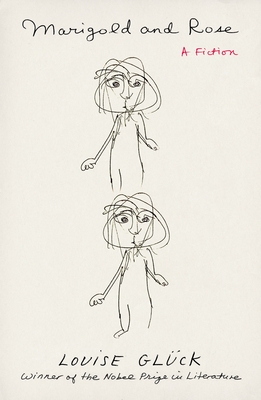 The first (and so far only) fiction by the poet and 2020 Nobel Prize winner, this is a curious little story that imagines the inner lives of infant twins and closes with their first birthday. Like Ian McEwan’s Nutshell, it ascribes to preverbal beings thoughts and wisdom they could not possibly have. Marigold, the would-be writer of the pair, is spiky and unpredictable, whereas Rose is the archetypal good baby.
Marigold did not like people. She liked Mother and Father; everyone else had not yet been properly inspected. Rose did like people and she intended them to like her. … Everyone understood that Marigold lived in her head and Rose lived in the world.
Now every day was like the days when the twins did not perform well at naptime. Then Mother and Father would begin to look tired and harassed. Mother explained that babies got tired too; often, they cried because they were tired. I don’t cry because I’m tired, Marigold thought. I cry because something has disappointed me.
As a psychological allegory, this tracks personality development and the growing awareness of Mother and Father as separate people with their own characteristics, some of which each girl replicates. But I failed to find much of a point. 
With thanks to Carcanet Press for the free e-copy for review.
Heat and Dust by Ruth Prawer Jhabvala (1975)
[181 pages]
 A lesser-known Booker Prize winner that we read for our book club’s women’s classics subgroup. My reading was interrupted by the last-minute trip back to the States, so I ended up finishing the last two-thirds after we’d had the discussion and also watched the movie. I found I was better able to engage with the subtle story and understated writing after I’d seen the sumptuous 1983 Merchant Ivory film: the characters jumped out for me much more than they initially had on the page, and it was no problem having Greta Scacchi in my head.
In 1923, Olivia is a bored young officer’s wife in India who becomes infatuated with the Nawab, an Indian prince involved in some dodgy dealings. In the novel’s present day, Olivia’s step-granddaughter (never named; in the film she’s called Anne, played by Julie Christie and changed to a great-niece for some reason) is also in India, enjoying the hippie freedom and rediscovering Olivia’s life through the letters she wrote to her sister. Both novel and film cut quickly and often between the two time periods to draw increasingly overt parallels between the women’s lives, culminating in unexpected pregnancies and difficult decisions to be made. I enjoyed the atmosphere (see also The Painted Veil and China Room) and would recommend the film, but I doubt I’ll seek out more by Jhabvala. (Public library)
PEREMOHA: Victory for Ukraine (2022)
[96 pages]
 Various writers and artists contributed these graphic shorts, so there are likely to be some stories you enjoy more than others. “The Ghost of Kyiv” is about a mythical hero from the early days of the Russian invasion who shot down six enemy planes in a day. I got Andy Capp vibes from “Looters,” about Russian goons so dumb they don’t even recognize the appliances they haul back to their slum-dwelling families. (Look, this is propaganda. Whether it comes from the right side or not, recognize it for what it is.) In “Zmiinyi Island 13,” Ukrainian missiles destroy a Russian missile cruiser. Though hospitalized, the Ukrainian soldiers involved – including a woman – can rejoice in the win. “A pure heart is one that overcomes fear” is the lesson they quote from a legend. “Brave Little Tractor” is an adorable Thomas the Tank Engine-like story-within-a-story about farm machinery that joins the war effort. A bit too much of the superhero, shoot-’em-up stylings (including perfectly put-together females with pneumatic bosoms) for me here, but how could any graphic novel reader resist this Tokyopop compilation when a portion of proceeds go to RAZOM, a nonprofit Ukrainian-American human rights organization? (Read via Edelweiss)
Another Brooklyn by Jacqueline Woodson (2016)
[175 pages]
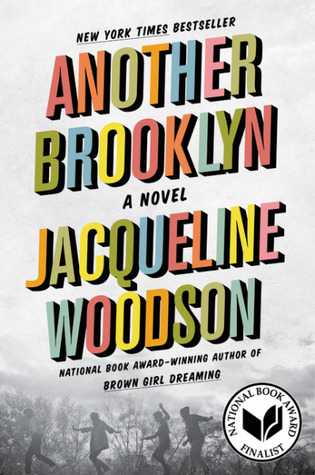 August looks back on her coming of age in 1970s Bushwick, Brooklyn. She lived with her father and brother in a shabby apartment, but friendship with Angela, Gigi and Sylvia lightened a gloomy existence: “as we stood half circle in the bright school yard, we saw the lost and beautiful and hungry in each of us. We saw home.” As in Very Cold People, though, this is not an untroubled girlhood. Male threat is everywhere, and if boyfriends bring sexual awakening they are also a constant goad to do more than girls are ready for. In short, flitting paragraphs, Woodson explores August’s past – a childhood in Tennessee, her uncle who died in the Vietnam War, her father’s growing involvement with the Nation of Islam. What struck me most, though, was August’s coming to terms with her mother’s death, a fact she doesn’t even acknowledge at first, and the anthropological asides about other cultures’ death rituals. This was my second from Woodson after the Women’s Prize-longlisted Red at the Bone, and I liked them about the same. A problem for me was that Brown Girls, which, with its New York City setting and focus on friendships between girls of colour, must have at least partially been inspired by Another Brooklyn, was better. (Public library)
In total, I read 17 novellas this November, though if you add in the ones I’d read in advance and then reviewed over the course of the month, I managed 24. All things considered, I think that’s a great showing. The 5-star stand-outs for me were The Hero of This Book and Body Kintsugi, but Up at the Villa was also a great read.
Margaret Atwood Reading Month: The Door (#MARM)
It’s my fifth year participating in the annual Margaret Atwood Reading Month (#MARM), hosted by indomitable Canadian blogger Marcie of Buried in Print. In previous years for this challenge, I’ve read Surfacing and The Edible Woman, The Robber Bride and Moral Disorder, and Wilderness Tips; and reread The Blind Assassin. Today is Atwood’s 83rd birthday, so what better time to show her some love?
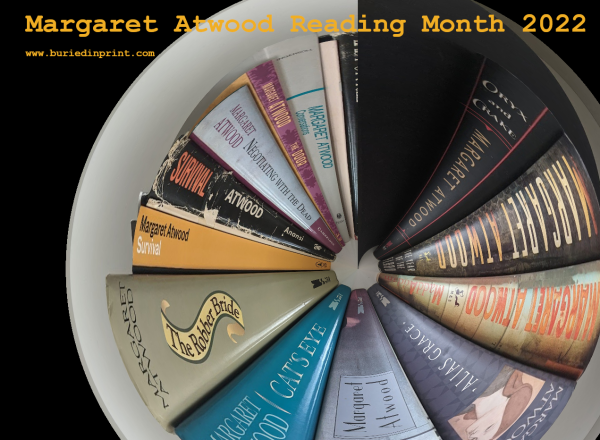
Like the Beatles, she’s worked in so many different genres and styles that I don’t see how anyone could say they don’t like her – you just haven’t explored her oeuvre deeply enough. Although she’s best known for her fiction, she started off as a poet, with a whole five collections published in the 1960s before her first novel appeared. I’d previously read her Eating Fire: Selected Poetry 1965–1995 and Dearly, my top poetry read of 2020.
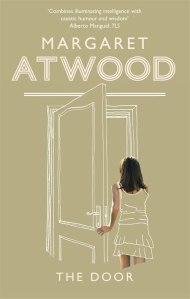 The Door (2007) was at that point her first poetry release in 12 years and features a number of the same themes that permeate her novels and nonfiction: memory, writing, ageing, travel and politics. I particularly like the early poems where she reinhabits memories of childhood and early adulthood, often through objects. Such artifacts are “pocketed as pure mementoes / of some once indelible day,” she writes in “Year of the Hen.”
These are followed by a trilogy about the death of the family’s pet cat, Blackie. “We get too sentimental / over dead animals. / We turn maudlin,” she acknowledges in “Mourning for Cats,” yet “Blackie in Antarctica” injects some humour as she remembers how her sister kept the cat’s corpse in the freezer until she could come home to bury it. Also on the lighter side is a long “where are they now?” update for the Owl and the Pussycat.
There are also meta reflections on poetry, slightly menacing observations on the weather (an implacable, fate-like force) and the seasons (autumn = hunting), virtual visits to the Arctic, mild complaints about the elderly not being taken seriously, and thoughts on duty.
Four in a row muse about war – the Vietnam War in particular, I think? “The Last Rational Man” is a sinister standout, depicting a figure who is doomed under Caligula’s reign. Whoever she may have had in mind when she wrote this, it’s just as relevant 15 years later.
In the final, title poem, which appears to be modelled on the Seven Ages of Man, a door is a metaphor for life’s transitions and, ultimately, for death.
The door swings open:
O god of hinges,
god of long voyages,
you have kept faith.
It’s dark in there.
You confide yourself to the darkness.
You step in.
The door swings closed.
Apart from a few end rhymes, Atwood relies more on theme than on sonic technique or form. That, I think, makes her poetry accessible to those who are new to or suspicious of verse. Happy birthday, M.A., and thank you for your literary wisdom and innovation! (Little Free Library)
Remainders of the Day by Shaun Bythell & What Remains? by Rupert Callender
I raced to finish all the September releases on my stack by the 30th, thinking I’d review them in one go, but that ended up being far too unwieldy. There was way too much to say about each of these excellent books (the first two pairs are here and here; Blurb Your Enthusiasm by Louise Willder is still to come, probably on Wednesday). I’ve mentioned before that the month’s crop of nonfiction was about either books or death. Here’s one of each, linked by their ‘remain’ titles. Both:
Remainders of the Day: More Diaries from The Bookshop, Wigtown by Shaun Bythell
 It’s just over five years since many of us were introduced to Wigtown and the ups and downs of running a bookshop there through Shaun Bythell’s The Diary of a Bookseller. (I’ve also reviewed the follow-up, Confessions of a Bookseller, which was an enjoyable read for me during a 2019 trip to Milan, and 2020’s Seven Kinds of People You Find in Bookshops.)
This third volume opens in February 2016. As in its predecessors, each monthly section is prefaced by an epigraph from a historical work on bookselling – this time R. M. Williamson’s 1904 Bits from an Old Bookshop. It’s the same winning formula as ever: the nearly daily entries start with the number of online orders received and filled, and end with the number of customers and the till takings for the day. (The average spend seems to be £10 per customer, which is fine in high tourist season but not so great in November and December when hardly anyone walks through the door.) In between, Bythell details notable customer encounters, interactions with shop helpers or local friends, trips out to buy book collections or go fishing, Wigtown events including the book festival, and the occasional snafu like the boiler breaking during a frigid November or his mum being hospitalized with a burst ulcer.
Reading May Sarton’s Encore recently, I came across a passage where she is reading a fellow writer’s journal (Doris Grumbach’s Coming into the End Zone):
I find hers extremely good reading, so I cannot bear to stop. I am reading it much too fast and I think I shall have to read it again. I know that I must not swallow it whole. There is something about a journal, I think, that does this to readers. So many readers tell me that they cannot put my journals down.
I’ve heard Zadie Smith say the same about Karl Ove Knausgaard’s My Struggle: it’s just the stuff of prosaic, everyday life and yet she refers to his memoirs/autofiction as literary crack.
I often read a whole month’s worth of entries at a sitting. I can think of a few specific reasons why Bythell’s journals are such addictive reading:
- “Sometimes you want to go where everybody knows your name.” Small-town settings are irresistible for many readers, and by now the fairly small cast of characters in Bythell’s books feel like old friends. Especially having been to Wigtown myself, I can picture many of the locations he writes about, and you get the rhythm of the seasons and the natural world as well as the town’s ebb and flow of visitors.
- (A related point) You know what to expect, and that’s a comforting thing. Bythell makes effective use of running gags. You know that when Granny, an occasional shop helper from Italy, appears, she will complain about her aches and pains, curse at Bythell and give him the finger. Petra’s belly-dancing class (held above the shop) will inevitably be poorly attended. If Eliot is visiting, he is sure to leave his shoes right where everyone will trip over them. Captain the cat will be portly and infuriating.
- What I most love about the series is the picture of the life cycle of books, from when they first enter the shop, or get picked up in his van, to when rejects are dropped at a Glasgow recycling plant. What happens in the meantime varies, with once-popular authors falling out of fashion while certain topics remain perennial bestsellers in the shop (railways, ornithology). There’s many a serendipitous moment when he comes across a book and it’s just what a customer wants, or buys a book as part of a lot and then sells it online the very next day. New, unpriced stock is always quick to go.
Also of note in this volume are his break-up with Amazon, after his account falls victim to algorithms and is suspended, the meta moment where he signs his first book contract with Profile, and the increasing presence of the Bookshop Band, who moved to Wigtown later in 2017. Bythell doesn’t seem to get much time to read – it’s a misconception of the bookselling life that you do nothing but read all day; you’d be better off as a book reviewer if that’s what you want – but when he does, it’s generally an intense experience: E.M. Forster’s sci-fi novella The Machine Stops (who knew it existed?!), Barbara Comyns’s A Touch of Mistletoe, Jonathan Safran Foer’s Everything Is Illuminated, and Oscar Wilde’s De Profundis.
I’m torn as to whether I hope there will be more year by year volumes filling in to the present day. As Annabel noted, the ‘where they are now’ approach in the Epilogue rather suggests that he and his publisher will leave it here at a trilogy. This might be for the best, as a few more pre-Covid years of the same routines could get old, though nosey parkers like myself will want to know how a confirmed bachelor turned into a family man…
Some favourite lines:
“Quiet day in the shop; even the cat looked bored.” (31 October)
“The life of the secondhand bookseller mainly involves moving boxes from one place to another, and trying to make them fit into a small space, like some sort of awful game of Tetris.”
(10 February and 15 March are great stand-alone entries that give a sense of what the whole is like. There are a lot of black-and-white photos printed amid the text in the first month; it’s a shame these don’t carry on through.)
With thanks to Profile Books for the free copy for review.
What Remains?: Life, Death and the Human Art of Undertaking by Rupert Callender
Call me morbid or call me realistic; in the last decade and a half I have read a lot of books about death, including terminal illness and bereavements. I’ve even read several nonfiction works by American mortician Caitlin Doughty. But I’ve not read anything quite like punk undertaker Rupert Callender’s manifesto about modern death and how much we get wrong in our conceptualization and conversations. It was poignant to be reading this in the weeks surrounding Queen Elizabeth II’s death – a time when death got more discussion than usual, yes, but when there was also some ridiculous pomp that obscured the basic human facts of it.
Callender is not okay with death, and never has been. When he was seven, his father died of a heart attack at age 63. His 1970s Edinburgh upbringing was shattered and his mother, who he has no doubt was doing her best, made a few terrible mistakes. First, a year before, she’d reassured him that his father wasn’t going to die. Second, she didn’t make him attend the funeral. (I still wish my mother had made me go back to tour my late grandmother’s house one final time when I was seven; instead, I stayed behind and played on a Ouija board with my cousins.) Third, she soon sent Callender away to boarding school, which left him feeling alone and betrayed. And lastly, when she died of cancer when he was 25, she had planned every detail of her funeral – whereas he believes that is a task for the survivors.
An orphan in his late twenties, Callender came across The Natural Death Handbook and it sealed his future. He’d been expelled from school and blown his inheritance; acid house culture had given him a sense of community. Now he had a vocation. The first funeral he coordinated was for a postman named Barry. The fourth was a suicide. Their first child burial was one of his partner’s daughter’s classmates.

Over the next two decades, he and his (now ex-)wife Claire based Totnes’ The Green Funeral Company on old-fashioned values and homespun ceremonies. They oppose the overmedicalization of death and the clinical detachment of places like crematoria. Callender is vehemently anti-embalming – an intrusive process that involves toxic substances. They encourage the bereaved to keep the body at home for the week before a funeral, if they feel able (ice packs like you’d use in a picnic cool bag will work a treat), and to be their own pallbearers to make the memory of the funeral day a physical one. He performs the eulogies himself, and they use cardboard coffins.
This is a slippery work for how it intersperses personal stories with polemic and poetic writing. Despite a roughly chronological throughline, it feels more like a thematic set of essays than a sequential narrative. Callender has turned death rituals into both performance art (including at festivals and in collaboration with The KLF) and political protests (e.g., a public funeral he conducted for a homeless man who died of exposure, the third such death in his town that year). While he doesn’t shy away from the gruesome realities of dealing with corpses, he always brings it back to fundamentals: matter is what we are, but who we were lives on in others’ loving memories. Death rituals plug us into a human lineage and proclaim meaning in the face of nothingness. Whether you’ve seen/read it all or never considered picking up a book about death, I recommend Callender’s sui generis approach.
Some favourite lines:
“[The practice of having official pallbearers] is all part of the emotional infantilising encouraged by the funeral industry, all part of being turned into an audience at one of the most significant moments in your family history, instead of being empowered as a family and a community.”
“each death we experience contains every death we have ever lived through, Russian dolls of bereavement waiting to be unpacked.”
“Only once you are dead can the full arc of your life be clearly seen, and telling that story out loud and truthfully to the people who shared it is a powerful social act that both binds us together and place us within our culture.”
With thanks to Chelsea Green for the proof copy for review.
And as a bonus, given that today is Indigenous Peoples’ Day in the USA, here’s an excerpt from my Shelf Awareness review of another book that came out last month:
No Country for Eight-Spot Butterflies: A Lyric Essay by Julian Aguon
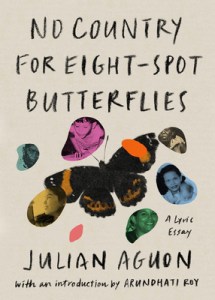 An indigenous human rights lawyer, Aguon is passionate about protecting his homeland of Guam, which is threatened by climate change and military expansion. His tender collage of autobiographical vignettes and public addresses inspires activism and celebrates beauty worth preserving. The U.S. Department of Defense’s plan to site more Marines and firing ranges on Guam will destroy more than 1,000 acres of limestone forest—home to endemic and endangered species, including the Mariana eight-spot butterfly. Aguon has been a lead litigator in appeals rising all the way to the U.S. Supreme Court. Rejecting fatalism, he endorses peaceful resistance. Two commencement speeches, poems, a eulogy and an interview round out the varied and heartfelt collection.
Short Stories in September, Part II: Andreades, Ferris, Fliss and Mulvey
It’s my aim to read as many short story collections as possible in September. After a first three earlier in the month, here are my next four.
Brown Girls by Daphne Palasi Andreades (2022)
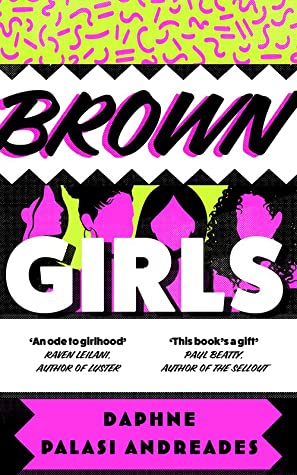 It was Susan’s review that first enticed me to read this linked story collection. I’m always intrigued by the use of the first-person plural, though it can have downsides – in trying to be inclusive of the breadth of experiences of the “us,” the content can edge toward generic. I worried things were going that way in the early chapters about girlhood “in the dregs of Queens, New York,” but the more I read the more I admired Andreades’s debut. Each chapter is a fantastic thematic fragment adding up to a glistening mosaic of what it means to be a woman of colour in the USA. Desires and ambitions shift as they move from childhood to adolescence to college years to young adulthood, but some things stay the same: their parents’ high expectations, the pull of various cultures, and near-daily microaggressions.
Our families’ legacies, the histories we’ve inherited: grandparents who never learned to read, U.S.-backed dictatorships, bombs, wars, refugee camps, naval bases, canals, gold, diamonds, oil, missionaries, brain drain, the American Dream.
No matter their zip code or tax bracket, listen as these white people deem us and our families the good immigrants, the hard-working ones—not like the lazy people in this country who are a burden on the system.
The fulcrum is the sudden death of one of their number, Trish, which has repercussions through the second half of the book. It raises questions of mental health and whether friendships will last even when they move beyond Queens.
I especially loved Part Five, about a trip back to the motherland that leaves the brown girls disoriented from simultaneous sensations of connection, privilege and foreignness. “The colonized, the colonizer. Where do we fall?” My individual favourite chapters were “Duty,” about giving up on parentally prescribed medical studies to pursue a passion for art; “Patriotic,” about deciding whether or not to have children; and “Our Not-Reflections,” about age allowing them to understand what their mothers went through when they were new to the country. One critique: I would have omitted the final Part Eight, which is about Covid and death in general; the book didn’t need an update to feel timely. It’s a shame this wasn’t at least longlisted for the Women’s Prize this past year. (New purchase with a book token)
The Dinner Party by Joshua Ferris (2017)
 I’ve read a couple of Ferris’s novels but this collection had passed me by. “More Abandon (Or Whatever Happened to Joe Pope?)” is set in the same office building as Then We Came to the End. Most of the entries take place in New York City or Chicago, with “Life in the Heart of the Dead” standing out for its Prague setting. The title story, which opens the book, sets the tone: bristly, gloomy, urbane, a little bit absurd. A couple are expecting their friends to arrive for dinner any moment, but the evening wears away and they never turn up. The husband decides to go over there and give them a piece of his mind, only to find that they’re hosting their own party. The betrayal only draws attention to the underlying unrest in the original couple’s marriage. “Why do I have this life?” the wife asks towards the close.
Marital discontent and/or infidelity is a recurring feature, showing up in “A Night Out” and “The Breeze,” which presents the different ways a couple’s evening might have gone. I liked this line about the difficulty of overcoming incompatibilities: “Why could she not be more like him and why could he not be more like her?” It seems from my short story reading that there is always one story I would give a different title. Here I would rename “The Valetudinarian” (about a Florida retiree who ends up in a comical health crisis) “They don’t give you a manual” after his repeated catchphrase.
A few of the 11 stories weren’t so memorable, but the collection ends with a bang. “A Fair Price” appears to have a typically feeble male protagonist, frustrated that the man he’s hired to help move his belongings out of a storage unit is so taciturn, but the innocuous setup hides a horrific potential. (Public library)
The Predatory Animal Ball by Jennifer Fliss (2021)
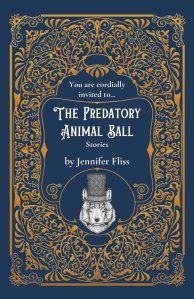 These 40 flash fiction stories try on a dizzying array of genres and situations. They vary in length from a paragraph (e.g., “Pigeons”) to 5–8 pages, and range from historical to dystopian. A couple of stories are in the second person (“Dandelions” was a standout) and a few in the first-person plural. Some have unusual POV characters. “A Greater Folly Is Hard to Imagine,” whose name comes from a William Morris letter, seems like a riff on “The Yellow Wallpaper,” but with the very wall décor to blame. “Degrees” and “The Thick Green Ribbon” are terrifying/amazing for how quickly things go from fine to apocalyptically bad.
Grief and especially pregnancy loss are repeated elements. In “Yolk,” a woman finds a chicken embryo inside a cracked egg and it brings back memories of her recent stillbirth. In “All Your Household Needs,” a bereaved voice-over artist sympathizes with a child who picks up a stuffed Lucky the Dog whose speech she recorded. In “What Goes with Us,” an unreturned library book is a treasured reminder of a dead partner; “May His Memory Be a Blessing” lists many other such mementoes. Even the title story, whose main character is a mouse, opens with the loss of a loved one and posits compassion from an unexpected source.
It’s hard to get a sense of an author’s overall style from such disparate material, so I was pleased to learn that Fliss is working on her first novel, which I’ll be keen to read.
With thanks to publicist Lori Hettler for the e-copy for review.
Hearts & Bones: Love Songs for Late Youth by Niamh Mulvey (2022)
 Having read these 10 stories over the course of a few months, I now struggle to remember what many of them were about. If there’s an overarching theme, it’s (young) women’s relationships. “My First Marina,” about a teenager discovering her sexual power and the potential danger of peer pressure in a friendship, is similar to the title story of Milk Blood Heat by Dantiel W. Moniz. In “Mother’s Day,” a woman hopes that a pregnancy will prompt a reconciliation between her and her estranged mother. In “Childcare,” a girl and her grandmother join forces against the mum/daughter, a would-be actress. “Currency” is in the second person, with the rest fairly equally split between first and third person. “The Doll” is an odd one about a ventriloquist’s dummy and repeats events from three perspectives.
I had two favourites: “Feathers” and “Good for You, Cecilia.” In the former, a woman rethinks her relationship with her boyfriend when the 2010 volcanic eruption restricts her to his French flat and she gets chatting with his cleaner. In the latter, a mother and daughter go to watch their daughter/sister’s dance recital in Dublin and witness the fall of a statue of St. Cecilia in a church they stop into. These are all matter-of-fact, somewhat detached stories set in European cities over the last decade or so. None of the protagonists had me particularly emotionally engaged with their plights. Overall, this felt reminiscent of Wendy Erskine’s work (I’ve reviewed Dance Move), but not as original or powerful.
With thanks to Picador for the proof copy for review.
Currently reading: Ms. Hempel Chronicles by Sarah Shun-lien Bynum, Delicate Edible Birds by Lauren Groff, Playing Sardines by Michèle Roberts
Up next: The High Places by Fiona McFarlane, Birds of America by Lorrie Moore
Four for #WITMonth: Jansson, Lamarche, Lunde and Vogt
I’ve managed four novels for this year’s Women in Translation month: a nostalgic, bittersweet picture of island summers poised between childhood and old age; a brief, impressionistic account of domestic violence and rape; the third in a series looking at how climate change and species loss reverberate amid family situations; and a visceral meditation on women’s bodies and relationships. Two of these were review copies from the recently launched Héloïse Press, which “champions world-wide female talent”.

The Summer Book by Tove Jansson (1972; 1974)
[Translated from the Swedish by Thomas Teal]
It was just the same long summer, always, and everything lived and grew at its own pace.
 This was only the second time I’ve read one of Jansson’s books aimed at adults (as opposed to five from the Moomins series). Whereas A Winter Book didn’t stand out to me when I read it in 2012 – though I will try it again this winter, having acquired a free copy from a neighbour – this was a lovely read, so evocative of childhood and of languid summers free from obligation. For two months, Sophia and Grandmother go for mini adventures on their tiny Finnish island. Each chapter is almost like a stand-alone story in a linked collection. They make believe and welcome visitors and weather storms and poke their noses into a new neighbour’s unwanted construction.
Six-year-old Sophia, based on Jansson’s niece of the same name, is precocious and opinionated, liable to change her mind in an instant. In “The Cat,” one of my favourite stand-alone bits, she’s fed up with their half-feral pet who kills lots of birds and swaps him for a friend’s soppy lap cat, but then regrets it. She’s learning that logic and emotion sometimes contradict each other, which becomes clearer as she peppers Grandmother with questions about religion and superstition.
As is common to Jansson’s books, there’s a melancholy undercurrent here.
Everything was fine, and yet everything was overshadowed by a great sadness. It was August, and the weather was sometimes stormy and sometimes nice, but for Grandmother, no matter what happened, it was only time on top of time, since everything is vanity and a chasing after the wind.
Sophia’s mother died, and although her grandmother has the greater presence, Papa is also around, dealing with practicalities in the background. Death stalks around the edges, reminding Grandmother of her mortality through bouts of vertigo that have her grabbing for her heart medication. On just the second page we have this memento mori:
“When are you going to die?” the child asked.
And Grandmother answered, “Soon. But that is not the least concern of yours.”
And so it doesn’t feel like our concern either; the focus is on the now, on these beautiful little moments of connection across the generations – like in “Playing Venice,” when Grandmother stays up all night rebuilding Sophia’s model city that was washed away by the rain. (Public library)
The Memory of the Air by Caroline Lamarche (2014; 2022)
[Winner of an English PEN Award; translated from the French by Katherine Gregor]
 In a hypnotic monologue, a woman tells of her time with a violent partner (the man before, or “Manfore”) who thinks her reaction to him is disproportionate and all due to the fact that she has never processed being raped two decades ago. When she goes in for a routine breast scan, she shows the doctor her bruised arm, wanting there to be a definitive record of what she’s gone through. It’s a bracing echo of the moment she walked into a police station to report the sexual assault (and oh but the questions the male inspector asked her are horrible).
The novella opens with an image that returns in dreams but is almost more a future memory of what might have been: “I went down into a ravine and, at the bottom, found a dead woman. She was lying in a shroud, on a carpet of fallen leaves.” I read this in one sitting – er, yoga session – and it has stayed in my mind in intense flashes like that and the flounce of her red dress on the summer day that turned into a nightmare. At an intense 70 pages, this reminded me of Annie Ernaux’s concise autofiction (I’ve reviewed Happening and I Remain in Darkness). An introduction by Dr Dominique Carlini-Versini contextualizes the work by considering the treatment of rape in contemporary French women’s writing.
The Memory of the Air will be published on 26 September. With thanks to Héloïse Press for the proof copy for review.
The Last Wild Horses by Maja Lunde (2019; 2022)
[Translated from the Norwegian by Diane Oatley]
The third in Lunde’s “Climate Quartet,” with its recurring elements of migration, shortages and environmental collapse. Always, though, the overall theme is parent–child relationships and the love that might be the only thing that keeps us going in the face of unspeakable challenges. Here she returns to the tripartite structure of The History of Bees (much my favourite of the three): a historical strand, a near-contemporary one, and a dystopian future story line. The link between the three is Przewalski’s horses (aka takhi).
 In the early 1880s, Mikhail Alexandrovich Kovrov, assistant director of St. Petersburg Zoo, is brought the hide and skull of an ancient horse species assumed extinct. Although a timorous man who still lives with his mother, he becomes part of an expedition to Mongolia to bring back live specimens. In 1992, Karin, who has been obsessed with Przewalski’s horses since encountering them as a child in Nazi Germany, spearheads a mission to return the takhi to Mongolia and set up a breeding population. With her is her son Matthias, tentatively sober after years of drug abuse. In 2064 Norway, Eva and her daughter Isa are caretakers of a decaying wildlife park that houses a couple of wild horses. When a climate migrant comes to stay with them and the electricity goes off once and for all, they have to decide what comes next. This future story line engaged me the most.
I appreciated some aspects: queer and middle-aged romances, the return of a character from The End of the Ocean, the consideration across all three plots of what makes a good mother. However, the horses seemed neither here nor there. There are also many, many animal deaths. Perhaps an unsentimental attitude is necessary to reflect past and future values, and the apparent cruelty of natural processes, but it limits the book’s appeal to animal lovers. Maybe the tone fits the Norwegian prose, which the translator describes as lean.
The fourth book of the quartet, publishing in Norway next month, is called something like The Dream of a Tree; a focus on trees would be a draw for me. After the disappointment of Books 2 and 3, I’m unsure whether I want to bother with the final volume, but it makes sense to do so, if only to grasp Lunde’s full vision. (Public library)
What Concerns Us by Laura Vogt (2020; 2022)
[Translated from the German by Caroline Waight]
 Vogt’s Swiss-set second novel is about a tight-knit matriarchal family whose threads have started to unravel. For Rahel, motherhood has taken her away from her vocation as a singer. Boris stepped up when she was pregnant with another man’s baby and has been as much of a father to Rico as to Leni, the daughter they had together afterwards. But now Rahel’s postnatal depression is stopping her from bonding with the new baby, and she isn’t sure this quartet is going to make it in the long term.
Meanwhile, Rahel’s sister Fenna knows she’s pregnant but refuses a doctor’s care. When she comes to stay with Rahel, she confides that the encounter with her partner, Luc, that led to conception was odd, rough; maybe not consensual. And all this time, the women’s mother, Verena, has been undergoing treatment for breast cancer. All three characters appear to be matter-of-factly bisexual; Rahel and Fenna’s father has long been out of the picture, replaced in Verena’s affections by Inge.
As I was reading, I kept thinking of the declaration running through A Ghost in the Throat by Doireann Ní Ghríofa: “This is a female text.” Vogt’s vision is all breasts and eggs, genitals actual and metaphorical. I loved the use of food in the novel: growing up, the girls cherished “silly nights” when their mother prepared an egg feast and paired it with a feminist lecture on reproduction. Late on, there’s a wonderful scene when the three main characters gorge on preserved foodstuffs from the cellar and share their secrets. (Their language is so sexually frank; would anyone really talk to their mother and siblings in that way?!) As in the Lunde, the main question is what it means to be a mother, but negotiating their relationships with men stretches the bonds of this feminine trio. One for fans of Rachel Cusk and Sally Rooney.
With thanks to Héloïse Press for the proof copy for review.
Reviews: de Jongh, Eipe, Parker and Scull
Today’s roundup includes a graphic novel set during the U.S. Dust Bowl, a Dylan Thomas Prize-shortlisted poetry collection infused with Islamic imagery, a book about adaptive technologies for the disabled, and a set of testimonies from the elderly and terminally ill.
Days of Sand by Aimée de Jongh (2021; 2022)
[Translated from the Dutch by Christopher Bradley]
Dust can drive people mad.
 This terrific Great Depression-era story was inspired by the real-life work of photographers such as Dorothea Lange who were sent by the Farm Security Administration, a new U.S. federal agency, to document the privations of the Dust Bowl in the Midwest. John Clark, 22, is following in his father’s footsteps as a photographer, leaving New York City to travel to the Oklahoma panhandle. He quickly discovers that struggling farmers are believed to have brought the drought on themselves through unsustainable practices. Many are fleeing to California. The locals are suspicious of John as an outsider, especially when they learn that he is working to a checklist (“Orphaned children”, “Family packing car to leave”).
“The best photos have an instant impact. Right away, they grab our attention. They tell a story, or deliver a message. The question is: how do you make that happen?” one of his employers had asked. John grows increasingly uncomfortable with being part of what is essentially a propaganda campaign when he develops a personal fondness for Cliff, a little boy who offers to be his assistant, and Betty, a pregnant widow whose runaway horse he finds. The deprivation and death he sees at close hand bring back memories of his father’s funeral four years ago.
Whether a cityscape or the midst of a dust storm, de Jongh’s scenes are stark and evocative. Each chapter opens with a genuine photograph from the period (de Jongh travelled to the USA for archival and on-the-ground research thanks to a grant from the Dutch Foundation for Literature), and some panes mimic B&W photos the FSA team took. It’s rare for me to find the story and images equally powerful in a graphic novel, but that’s definitely the case here.


With thanks to SelfMadeHero for the free copy for review.
Auguries of a Minor God by Nidhi Zak/Aria Eipe (2021)
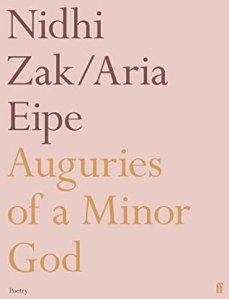 This debut poetry collection is on the Dylan Thomas Prize shortlist. I’ve noted that recent winners – such as Lot by Bryan Washington and Luster by Raven Leilani – have in common a distinctive voice and use of language, which chimes with what Thomas was known for (see my recent review of Under Milk Wood) and clarifies what the judges are looking for.
The placement of words on the page seems to be very important in this volume – spread out or bunched together, sometimes descending vertically, a few in grey. It’s unfortunate, then, that I read an e-copy, as most of the formatting was lost when I put it on my Nook. The themes of the first part include relationships, characterized by novelty or trauma; tokens of home experienced in a new land; myths; and nature. Section headings are in Malayalam.
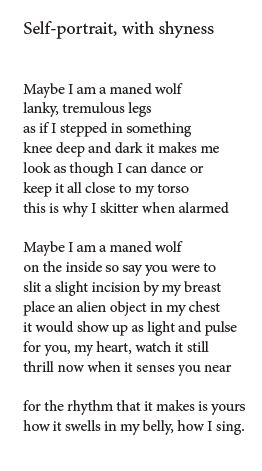
The book culminates in a lengthy, astonishingly nimble abecedarian in which a South Asian single father shepherds his children through English schooling as best he can while mired in grief over their late mother. This bubbles over in connection with her name, Noor, followed by a series of “O” apostrophe statements, some addressed to God and others exhorting fellow believers. Each letter section gets progressively longer. I was impressed at how authentically the final 30-page section echoes scriptural rhythms and content – until I saw in the endnotes that it was reproduced from a 1997 translation of the Quran, and felt a little cheated. Still, “A is for…” feels like enough to account for this India-born poet’s shortlisting. (The Prize winner will be announced on Thursday the 12th.)
With thanks to Midas PR for the free e-copy for review.
Hybrid Humans: Dispatches from the Frontiers of Man and Machine by Harry Parker (2022)
 I approached this as a companion to To Be a Machine by Mark O’Connell and that is precisely what I found, with Parker’s personal insight adding a different angle to the discussion of how technology corrects and transcends flawed bodies. Parker was a captain in the British Army in Afghanistan when an IED took his legs. Now he wears prostheses that make him roughly 12% machine. “Being a hybrid human means expensive kit – you have to pay for the privilege of leading a normal life.” He revisits the moments surrounding his accident and his adjustment to prostheses, and meets fellow amputees like Jack, who was part of a British medical trial on osseointegration (where titanium implants come out of the stump for a prosthesis to attach to) that enabled him to walk much better. Other vets they know had to save up and travel to Australia to have this done because the NHS didn’t cover it.
Travelling to the REHAB trade fair in Karlsruhe, Parker learns that disability, too, can be the mother of invention. Virtual reality and smartphone technology are invaluable, with an iPhone able to replace up to 11 single-purpose devices. Yet he also encounters disabled people who are happy with their lot and don’t look to tech to improve it, such as Jamie, who’s blind and relies only on a cane. And it’s not as if tools to compensate for disability are new; the book surveys medical technologies that have been with us for decades or even centuries: from glass eyes to contact lenses; iron lungs, cochlear implants and more.
Pain management, PTSD, phantom limbs, foreign body rejection, and deep brain stimulation for Parkinson’s disease are other topics in this wide-ranging study that is at the juncture of the personal and political. “A society that doesn’t look after the vulnerable isn’t looking after anyone – I’d learnt first-hand that we’re all just a moment from becoming vulnerable,” Parker concludes. I’ll hope to see this one on next year’s Barbellion Prize longlist.
With thanks to Profile Books/Wellcome Collection for the free copy for review.
Regrets of the Dying: Stories and Wisdom that Remind Us How to Live by Georgina Scull (2022)
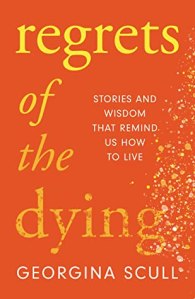 A medical crisis during pregnancy that had her minutes from death was a wake-up call for Scull, leading her to rethink whether the life she was living was the one she wanted. She spent the next decade interviewing people in her New Zealand and the UK about what they learned when facing death. Some of the pieces are like oral histories (with one reprinted from a blog), while others involve more of an imagining of the protagonist’s past and current state of mind. Each is given a headline that encapsulates a threat to contentment, such as “Not Having a Good Work–Life Balance” and “Not Following Your Gut Instinct.” Most of her subjects are elderly or terminally ill. She also speaks to two chaplains, one a secular humanist working in a hospital and the other an Anglican priest based at a hospice, who recount some of the regrets they hear about through patients’ stories.
Recurring features are not spending enough time with family and staying too long in loveless or unequal relationships. Two accounts that particularly struck me were Anthea’s, about the tanning bed addiction that gave her melanoma, and Millicent’s, guilty that she never went to the police about a murder she witnessed as a teenager in the 1930s (with a NZ family situation that sounds awfully like Janet Frame’s). Scull closes with 10 things she’s learned, such as not to let others’ expectations guide your life and to appreciate the everyday. These are readable narratives, capably captured, but there isn’t much here that rises above cliché.
With thanks to publicist Claire Morrison and Welbeck for the free copy for review.
Would you be interested in reading one or more of these?
 Bookish Beck = Rebecca Foster. American transplant to England. Freelance proofreader and book reviewer.
 Bookish Beck