The Best Books from the First Half of 2021
Hard to believe we’ve already crossed the midpoint of the year. My top 20 releases of 2021 thus far, in alphabetical order within genre (fiction is dominating this year!), are below. I link to those I’ve already reviewed in full here or on Goodreads:
Fiction
 Under the Blue by Oana Aristide: Fans of Station Eleven, this one’s for you: the best dystopian novel I’ve read since Mandel’s. Aristide started writing in 2017, and unknowingly predicted a much worse pandemic than Covid-19. In July 2020, Harry and sisters Ash and Jessie are among mere thousands of survivors worldwide. Their plan is to flee England for Uganda, out of range of Europe’s at-risk nuclear reactors. An epic road trip ensues. A propulsive cautionary tale that also reminded me of work by Louisa Hall and Maja Lunde.
 The Push by Ashley Audrain: Blythe Connor, living alone with her memories, ponders what went wrong with her seemingly perfect family: a handsome architect husband, Fox, and their daughter Violet and baby son Sam. How much of what happened was because of Violet’s nature, and how much was Blythe’s fault for failing to be the mother the girl needed? The fact that her experience with Sam was completely different makes her feel ambivalent about motherhood. A cracking psychological thriller with an unreliable narrator.
 A Lie Someone Told You About Yourself by Peter Ho Davies: Davies’ minimalist approach – short sections skating over the months and years, wryly pulling out representative moment – crystallizes fatherhood, illuminating its daily heartaches and joys. The tone is just right in this novella, showing both sides of parenthood and voicing things you aren’t allowed to think, or at least not to admit to, starting with abortion, which would-be fathers aren’t expected to have strong feelings about. I loved the rumination on the role that chance plays in a life.
 The Living Sea of Waking Dreams by Richard Flanagan: Extinction, personal and global, is at the heart of this timely and enchanting story. It starts off as a family drama. Francie, the 86-year-old matriarch, is in a Tasmanian hospital after a brain bleed. Her three middle-aged children can’t bear to let her go. In an Australia blighted by bushfires, species loss mirrors Francie’s physical and mental crumbling. Smartphone addiction threatens meaningful connection. And then characters start to literally disappear, part by part…
 Mrs Death Misses Death by Salena Godden: Grief Is the Thing with Feathers meets Girl, Woman, Other would be my marketing shorthand for this one. Poet Salena Godden’s debut novel is a fresh and fizzing work, passionate about exposing injustice but also about celebrating simple joys, and in the end it’s wholly life-affirming despite a narrative stuffed full of deaths real and imagined. The novel balances the cosmic and the personal through Wolf’s family story. Unusual, musical, and a real pleasure to read.
 Early Morning Riser by Katherine Heiny: This tickled my funny bone. A cross between Kitchens of the Great Midwest and Olive Kitteridge, it’s built of five extended episodes, crossing nearly two decades in the lives of Jane and Duncan and lovingly portraying the hangers-on who compose their unusual family constellation in Boyne City, Michigan. All the characters are incorrigible but wonderful. Bad things happen, but there’s a core of love as Heiny explores marriage and parenting. A good-natured book that feels wise and bittersweet.
 No One Is Talking About This by Patricia Lockwood: This starts as a flippant skewering of modern life. A woman who became a social media star by tweeting quips like “Can a dog be twins?” reflects on life on “the portal” and under “the dictator.” Midway through the book, she gets a wake-up call when her mother summons her back to the Midwest for a family emergency. It’s the about-face that makes this novel, forcing readers to question the value of a digital existence based on glib pretence. Funny, but with an ache behind it.
 In by Will McPhail: Alternately laugh-out-loud funny and gentle. This debut graphic novel is a spot-on picture of modern life in a generic city. Nick never knows the right thing to say. The bachelor artist’s well-intentioned thoughts remain unvoiced; all he can manage is small talk. That starts to change when he meets Wren, a Black doctor who sees past his pretence. If only he can find the magic words that elicit honesty, he might make real connections with other human beings. A good old-fashioned story, with a wide emotional range.
 Detransition, Baby by Torrey Peters: A sparkling, sexy comedy with a tender heart beneath the zingers. Peters has set herself up as the Jane Austen of the trans community, tracing the ins and outs of relationships with verve and nuance. For me this was a valuable book simply for normalizing trans sexuality. The themes are universal, after all: figuring out who you are and what the shape of your life will be. I admire when authors don’t pander to readers by making things easy for those who are unfamiliar with a culture. Great lines abound.
 Brood by Jackie Polzin: Polzin’s debut is a quietly touching story of a woman in the Midwest raising chickens and coming to terms with the shape of her life. The unnamed narrator is Everywoman and no one at the same time. At one point she reveals, with no fanfare, that she miscarried four months into pregnancy in the bathroom of one of the houses she cleans. There is a bittersweet tone to this short work. It’s a low-key, genuine portrait of life in the in-between stages and how it can be affected by fate or by other people’s decisions.
Nonfiction
 The Circling Sky by Neil Ansell: Hoping to reclaim an ancestral connection, Ansell visited the New Forest some 30 times between January 2019 and January 2020, observing the unfolding seasons and the many uncommon and endemic species its miles house. He weaves together his personal story, the shocking history of forced Gypsy relocation into forest compounds starting in the 1920s, and the unfairness of land ownership in Britain. The New Forest is a model of both wildlife-friendly land management and freedom of human access.
 The Inevitable by Katie Engelhart: Engelhart spends time with doctors and patients who are caught up in the assisted dying argument, chiefly in Western Europe and the United States. Each case is given its own long chapter, like an extended magazine profile. The stories are wrenching, but compassionately told. The author explores the nuances of each situation, crafting expert portraits of suffering people and the medical professionals who seek to help them, and adding much in the way of valuable context. A voice of reason and empathy.
 The Screaming Sky by Charles Foster: A Renaissance man as well versed in law and theology as he is in natural history, Foster is obsessed with swifts and ashamed of his own species: for looking down at their feet when they could be watching the skies; for the “pathological tidiness” that leaves birds and other creatures no place to live. He delivers heaps of information on the birds but refuses to stick to a just-the-facts approach. The book quotes frequently from poetry and the prose is full of sharp turns of phrase and whimsy.
 Intensive Care by Gavin Francis: Francis, an Edinburgh physician, reflects on “the most intense months I have known in my twenty-year career.” He journeys back through 2020, from the January day when he received a bulletin about a “novel Wuhan coronavirus” to November, when he learned of promising vaccine trials but also a rumored third wave and winter lockdown. An absorbing first-hand account of a medical crisis, it compassionately bridges the gap between experts and laymen. The best Covid chronicle so far.
 A Still Life by Josie George: Over a year of lockdowns, many of us became accustomed to spending most of the time at home. But for Josie George, social isolation is nothing new. Chronic illness long ago reduced her territory to her home and garden. The magic of A Still Life is in how she finds joy and purpose despite extreme limitations. Opening on New Year’s Day and travelling from one winter to the next, the book is a window onto George’s quiet existence as well as the turning of the seasons. (Reviewed for TLS.)
 Dusk, Night, Dawn by Anne Lamott: Lamott’s best new essays in nearly a decade. The central theme is how to have hope in God and in other people even when the news – Trump, Covid, and climate breakdown – only heralds the worst. One key thing that has changed for her is getting married for the first time, in her mid-sixties, to a Buddhist. In thinking of marriage, she writes about friendship, constancy, and forgiveness, none of which comes easy. Opportunities for maintaining quiet faith in spite of the circumstances arise all the time.
 A Braided Heart by Brenda Miller: Miller, a professor of creative writing, delivers a master class on the composition and appreciation of autobiographical essays. In 18 concise pieces, she tracks her development as a writer and discusses the “lyric essay”—a form as old as Seneca that prioritizes imagery over narrative. These innovative and introspective essays, ideal for fans of Anne Fadiman, showcase the interplay of structure and content. (Coming out on July 13th from the University of Michigan Press. My first review for Shelf Awareness.)
 Sanctuary by Emily Rapp Black: A continuation of The Still Point of the Turning World, about the author’s son Ronan, who died of Tay-Sachs disease at age three. In the months surrounding his death, she split from her husband and raced into another relationship that led to her daughter, Charlie. Rapp Black questions the sorts of words she got branded with: “brave,” “resilient.” Sanctuary is full of allusions and flashbacks, threading life’s disparate parts into a chaotic tapestry. It’s measured and wrought, taming fire into light and warmth.
Poetry
 Pilgrim Bell by Kaveh Akbar: An Iranian American poet imparts the experience of being torn between cultures and languages, as well as between religion and doubt, in this gorgeous collection of confessional verse. Food, plants, animals, and the body supply the book’s imagery. Wordplay and startling juxtapositions lend lightness to a wistful, intimate collection that seeks belonging and belief. (Coming out on August 3rd from Graywolf Press. Reviewed for Shelf Awareness.)
 Eat or We Both Starve by Victoria Kennefick: In this audacious debut collection, the body is presented as a battleground: for the brain cancer that takes the poet’s father; for disordered eating that entwines with mummy issues; for the restructuring of pregnancy. Families break apart and fuse into new formations. Cannibalism and famine metaphors dredge up emotional states and religious doctrines. There’s a pleasingly morbid cast to the book, but it also has its lighter moments. Rich with imagery and alliteration, this is just my kind of poetry.
What are some of the best books you’ve read so far this year?
What 2021 releases do I need to catch up on right away?
Recent Online Literary Events with George Saunders and Kazuo Ishiguro
I’ve been taking advantage of various free and inexpensive literary events – a bonus of our temporarily virtual-only world. I have five of them stored up to write about, but to keep this post from getting absurdly long I’ll focus on two for now and feature the rest another time.
George Saunders in Conversation with Max Porter
(5×15 event)
 Saunders’s latest book, A Swim in a Pond in the Rain, is a written version of the graduate-level masterclass in the Russian short story that he offers at Syracuse University, where he has taught in the Creative Writing Program since 1997. His aim here was to “elevate the short story form,” he said. While the book reprints and discusses just seven stories (three by Anton Chekhov, two by Leo Tolstoy, and one each by Nikolai Gogol and Ivan Turgenev), in the class he and his students tackle more like 40. He wants people to read a story, react to the story, and trust that reaction – even if it’s annoyance. “Work with it,” he suggested. “I am bringing you an object to consider” on the route to becoming the author you are meant to be – such is how he described his offer to his students, who have already overcome 1 in 100 odds to be on the elite Syracuse program but might still need to have their academic egos tweaked.
The book is, thus, not just a set of essays on the Russian masters but also a guide to how to write well. It was clear there was mutual admiration between Saunders and Max Porter, who interviewed him. They discussed the revision process as an accumulation of micro-decisions that make the work better. For instance, Saunders compared two Tolstoy stories, “The Snowstorm” and “Master and Man” (written 20 years later), and noted that, though they are thematically similar, the later one is more organized.
Saunders spoke about writing as a dual process of intuition and iteration; a bunch of different “yous” have acted on a text by the time it’s done. Early on in his career, he thought that he had to choose which writer he wanted to be (e.g., Hemingway or Kerouac), but as he aged he realized that the mind is never fixed. He went surprisingly deep into Buddhism at this point, likening writing to meditation – both are practices pursued with intensity. To his younger self, he would say to keep going: improving is simply a matter of time (i.e., that 10,000 hours figure that’s bandied about as necessary for developing expertise).

The only drawback to this event was that Saunders was speaking from his snow-encased upstate New York basement and had a horrible Internet connection; often his voice was faint and delayed, while his image stayed static. We and Porter could only stare gormlessly and wait for his face to move to match his words! I think the book would be too niche for me – I’ve hardly read anything by the Russians, and since I don’t write fiction I’m not in need of a guide to those kinds of writing decisions – but it was nice to ‘meet’ Saunders ‘in person’.
An Evening with Kazuo Ishiguro
(Faber Members / Guardian Live event)
 Ishiguro’s new novel, Klara and the Sun, was published by Faber yesterday. This conversation with Alex Clark also functioned as its launch event. It’s one of my most anticipated books of the year, so I pre-ordered a signed copy along with my ticket and look forward to it arriving soon. Klara is an Artificial Intelligence “friend” purchased to combat teenage loneliness. A childlike figure, she is cheerful and treats the sun like a god. Ishiguro said that the book developed from a story he wrote for children aged five to six, about a little girl who takes a doll home – except his daughter, author Naomi Ishiguro, told him no way was it suitable for young children, being far too dark. He likes “displaced or alien narrators, fish out of water,” he said, because the limited perspective allows him to focus on oddness.
In addition to Clark’s questions, a few pre-recorded questions from literary celebs (Daisy Johnson, Bernardine Evaristo, and David Mitchell) encouraged Ishiguro to create a tripartite schema for his novels, reflect on his writing about Japan, and look back at the devices he has used. Asked by Johnson about the connections between his novels, he admitted that his first three novels all retread the same ground: a man who has made a mess of his life or career picks over the past. Then his mid period is set in dreamscapes, while his most recent three novels are dystopian fantasies (though he does not see Klara as set in a dystopian world).
In response to Evaristo’s question about whether he felt an obligation to write about Japan, he said that with his early work he was conscious of needing to represent a group of people who even then (due to World War II) were viewed with suspicion or antipathy. He left Japan at age five so the country didn’t seem entirely real to him. What he knew was based on very early memories, what his mother told him, comic books sent by his grandparents, etc. As he stated in his Nobel Prize acceptance speech, writing about Japan in his twenties therefore felt like “an act of preservation.” Still, he wants his characters and situations to be universal.

Replying to Mitchell’s three questions (cheeky!), he explained that his first ambition was to be a singer/songwriter, and he wrote 100+ songs. Songwriting taught him minimalism. “You can say a huge amount by what you don’t say,” he noted. He hopes to create spaces, or rather vacuums that suck in the reader’s attention. Unlike Mitchell, he always knows the ending of a book before he begins, and his decisions are all about wanting to lodge in the reader’s brain. Thus, memorable endings are a priority for him, whereas they might not be for other writers. I was struck by his characterization of his own life: when he looks back, he doesn’t see a clear path that arose from his choices; instead, he sees a “weird, incoherent mess.” For this reason, he’s turned against the reflective device of his first three books. If he can come up with a theme, he’s hankering to write a book about hitchhikers in the north of England.
Towards the end of the (overlong) discussion, he mentioned that he has been questioning the novelist’s role due to the events of the past year: wondering about the meaning of fiction when so many have died and so many believe fake news. It was a melancholy but realistic point to end on. While I’m not an Ishiguro completist (The Unconsoled doesn’t appeal to me at all and I’m not sure I can be bothered with When We Were Orphans, but I will try The Buried Giant; I’ve read the rest), the event whetted my appetite to read his new book. (See also this Goodreads interview. I loved the anecdotes about learning he’d won the Nobel!)
Bookish online events coming up soon: The Rathbones Folio Prize announcement on the 24th and Claire Fuller’s book launch for Unsettled Ground on the 25th.
Have you attended any online literary events recently?
Margaret Atwood Reading Month: Wilderness Tips and CWWA Symposium
For this third annual Margaret Atwood Reading Month (#MARM), hosted by Canadian bloggers extraordinaires Marcie of Buried in Print and Naomi of Consumed by Ink, I picked up Wilderness Tips, a short story collection I’m not sure I’d even heard of before I liberated this battered paperback from the Hay-on-Wye Airbnb where we stayed in September (shhhhhh!).
I also listened in to one of the papers given at the Contemporary Women’s Writing Association’s mini online symposium held to mark her 81st birthday yesterday.

Wilderness Tips (1991)
 If pressed to give a one-line summary, I would say the overall theme of this collection is the power that women have (or do not have) in relationships – this is often a question of sex, but not always. Much of the collection falls neatly into pairs: “True Trash” and “Death by Landscape” are about summer camp and the effects that experiences had there still have decades later; “The Bog Man” and “The Age of Lead” both use the discovery of a preserved corpse (one a bog body, the other a member of the Franklin Expedition) as a metaphor for a frozen relationship; and “Hairball” and “Weight” are about a mistress’s power plays. I actually made myself a key on the table of contents page, assigning A, B, and C to those topics. The title story I labeled [A/C] because it’s set at a family’s lake house but the foreign spouse of one of the sisters has history with or designs on all three.
“Uncles,” a standout, didn’t fit into my framework. Susanna’s three uncles played a major role in her life, so when she got a job with a Toronto newspaper she welcomed her colleague Percy’s avuncular attentions. To her surprise, though, his tell-all autobiography reveals he wasn’t so happy about his protégée’s success after all. Two overall favorites were “Hairball,” about a mistress’s superbly executed act of revenge, and the final story, “Hack Wednesday,” in which Marcia takes stock of her life as she prepares for her children coming home for Christmas. Swap the Berlin Wall and Noriega for, I don’t know, Syria and Trump or suchlike, and it would be absolutely current, what with her partner Eric’s eco-warrior escapades (and hypocrisy) and her wish to situate herself in the context of history but also transcend it. I marked out the most passages in this one, and so many made me laugh:
Time is going faster and faster; the days of the week whisk by like panties. The panties she’s thinking about are the kind she had when was a little girl, in pastels, with ‘Monday,’ ‘Tuesday,’ ‘Wednesday’ embroidered on them. Ever since then the days of the week have had colours for her: Monday is blue, Tuesday is cream, Wednesday is lilac. You counted your way through each week by panty, fresh on each day, then dirtied and thrown into the bin. Marcia’s mother used to tell her that she should always wear clean panties in case a bus ran over her, because other people might see them as her corpse was being toted off to the morgue. It wasn’t Marcia’s potential death that loomed uppermost in her mind, it was the state of her panties.
“One of these days I’m going to kill that beast,” says Eric. … “You poor baby!” says Marcia, scooping up the cat, which is overweight. It’s on a diet, but mooches in secret from the neighbours. Marcia sympathizes. “I just let the damn thing out. In, out, in, out. It can’t make up its mind,” says Eric. “It’s confused,” says Marcia.
Marcia will get a little drunk on the eggnog, and later, after the dishes are done, she will cry silently to herself, shut into the bathroom and hugging in her festive arms the grumbling cat, which she will have dragged out from under a bed for this purpose. She will cry because the children are no longer children, or because she herself is not a child any more, or because there are children who have never been children, or because she can’t have a child any more, ever gone. Her body has gone past too quickly for her.
My rating: 
CWWA Symposium
 To open the afternoon program, Dr. Fiona Tolan of Liverpool John Moores University spoke on “21st-century Gileads: Feminist Dystopian Fiction after Atwood.” She noted that The Handmaid’s Tale casts a long shadow; it’s entered into our cultural lexicon and isn’t going anywhere. She showed covers of three fairly recent books that take up the Handmaid’s red: The Power, Vox, and Red Clocks. However, the two novels she chose to focus on do not have comparable covers: The Water Cure by Sophie Mackintosh (my review) and The Natural Way of Things by Charlotte Wood. I was unfamiliar with the premise of the Wood. Ten young women who have been involved in public sex scandals (e.g. with politicians) are kidnapped and imprisoned in a compound in the Outback; their heads are shaven and they are forced to undertake hard labor. Although it’s a female-dominated space, the patriarchy is perpetuated. Is sisterhood a possibility here?
Atwood has said, “Some books haunt the reader and some haunt the writer.” Tolan argued that Handmaid’s clearly does both, since Atwood chose to return to Gilead with The Testaments. While Tolan believes Atwood’s overall emphasis has always been on liberty, she notes that the author has been reluctant to be associated with feminism as a movement.
I feel like my #MARM participation has been somewhat half-hearted this year – I won’t be getting a Bingo on this chart! – but I always enjoy engaging with Atwood’s writing and thinking. With any luck, I’ll still get to read her new poetry collection, Dearly, for review in 2020, and before long I can start planning what I’ll read for this challenge next November.
Booker Prize 2020: Two More Shortlist Reviews and a Prediction
The 2020 Booker Prize will be announced on Thursday the 19th. (Delayed from the 17th, the date on my commemorative bookmark, so as not to be overshadowed by the release of the first volume of Barack Obama’s presidential memoirs.) After I reviewed Burnt Sugar and correctly predicted half of the shortlist in this post, I’ve managed to finish another two of the novels on the shortlist, along with two more from the longlist. As sometimes happens with prize lists – thinking also of the Women’s Prize race in 2019 – this year’s shortlist fell into rough pairs: two stark mother–daughter narratives, two novels set in Africa, and two gay coming-of-age stories.

The New Wilderness by Diane Cook
In a striking opening to a patchy novel, Bea goes off to the woods to give birth alone to a stillborn daughter. It’s such a different experience to when she birthed Agnes in a hospital eight years ago. Now, with coyotes and buzzards already circling, there’s no time for sentimentality; she turns her back on the baby and returns to the group. Bea is part of a wilderness living experiment that started out with 20 volunteers, but illness and accidents have since reduced their number.
 Back in the toxic, overcrowded City, Bea was an interior decorator and her partner a professor of anthropology. Bea left to give Agnes a better chance at life; like so many other children, she had become ill from her polluted surroundings. Now she is a bright, precocious leader in the making, fully participating in the community’s daily chores. Settlement tempts them, but the Rangers enforce nomadism. Newcomers soon swell their numbers, and there are rumors of other groups, too. Is it even a wilderness anymore if so many people live in it?
The cycles of seasons and treks between outposts make it difficult to get a handle on time’s passing. It’s a jolt to realize Agnes is now of childbearing age. Only when motherhood is a possibility can she fully understand her own mother’s decisions, even if she determines to not repeat the history of abandonment. The blurb promised a complex mother–daughter relationship, but this element of the story felt buried under the rigor of day-to-day survival.
It is as if Cook’s primary interest was in how humans would react to being returned to primitive hunter–gatherer conditions – she did a lot of research into Native American practices, for instance, and she explores the dynamics of sex and power and how legends arise. As a child I was fascinated by Native cultures and back-to-the-land stories, so I enjoyed the details of packing lists, habits, and early rituals that form around a porcelain teacup.
But for me some nuts and bolts of storytelling were lacking here: a propulsive plot, a solid backstory, secondary characters that are worthwhile in their own right and not just stereotypes and generic roles. The appealing description induced me to overcome my usual wariness about dystopian novels, but a plodding pace meant it took me months to read. A lovely short epilogue narrated by Agnes made me wonder how much less tedious this chronicle might have been if told in the first person by Bea and Agnes in turn. I’ll try Cook’s story collection, Man V. Nature, to see if her gifts are more evident in short form.
My rating: 
My thanks to Oneworld for the free copy for review.
Real Life by Brandon Taylor
 Over the course of one late summer weekend, Wallace questions everything about the life he has built. As a gay African American, he has always been an outsider at the Midwestern university where he’s a graduate student in biochemistry. Though they vary in background and include several homosexuals, some partnered and some unattached, most of his friends are white, and he’s been so busy that he’s largely missed out on evening socializing by the lake – and skipped his father’s funeral (though there are other reasons for that as well).
Tacit prejudice comes out into the open in ugly ways in these few days. When he finds his nematode experiments sabotaged, a female colleague at his lab accuses him of misogyny, brandishing his identity as a weapon against him: “you think that you get to walk around because you’re gay and black and act like you can do no wrong.” Then, in a deliciously awkward dinner party scene, an acquaintance brings up Wallace’s underprivileged Alabama upbringing as if it explains why he’s struggling to cope in his academic career.
Meanwhile, Wallace has hooked up with a male – and erstwhile straight – friend, and though there is unwonted tenderness in this relationship, there is also a hint of menace. The linking of sexuality and violence echoes the memories of abuse from Wallace’s childhood, which tumble out in the first-person stream of consciousness of Chapter 5. Other male friends, too, are getting together or breaking apart over mismatched expectations. Kindness is possible, but built-in injustice and cruelty, whether vengeful or motiveless, too often take hold.
There are moments when Wallace seems too passive or self-pitying, but the omniscient narration emphasizes that all of the characters have hidden depths and that emotions ebb and flow. What looks like despair on Saturday night might feel like no big deal come Monday morning. I so admired how this novel was constructed: the condensed timeframe, the first and last chapters in the past tense (versus the rest in the present tense), the contrast between the cerebral and the bodily, and the thematic and linguistic nods to Virginia Woolf. A very fine debut indeed.
My rating: 
I also read two more of the longlisted novels from the library:
Such a Fun Age by Kiley Reid
 Such a fun book! I’d read the first chapter earlier in the year and set it aside, thinking it was too hip for me. I’m glad I decided to try again – it was a great read, so assured and contemporary. Once I got past a slightly contrived first chapter, I found it completely addictive. The laser-precision plotting and characterization reminded me of Jennifer Egan, Jonathan Franzen and Zadie Smith at their peak, but the sassy voice is all Reid’s own. There are no clear villains here; Alix Chamberlain could easily have filled that role, but I felt for her and for Kelley as much as I did for Emira. The fact that I didn’t think anyone was completely wrong shows how much nuance Reid worked in. The question of privilege is as much about money as it is about race, and these are inextricably intertwined.
Love and Other Thought Experiments by Sophie Ward
 An intriguing set of linked short stories that combine philosophy and science fiction. Rachel and Eliza are preparing to have a baby together when an ant crawls into Rachel’s eye and she falls ill. Eliza wants to believe her partner but, as a scientist, can’t affirm something that doesn’t make sense (“We don’t need to resort to the mystical to describe physical processes,” she says). Other chapters travel to Turkey, Brazil and Texas – and even into space. It takes 60+ pages to figure out, but you can trust all the threads will converge around Rachel and her son, Arthur, who becomes an astronaut. I was particularly taken by a chapter narrated by the ant (yes, really) as it explores Rachel’s brain. Each section is headed by a potted explanation of a thought experiment from philosophy. I wasn’t entirely sure what to make of the alternative future of the two final chapters. Still, I was impressed with the book’s risk-taking and verve. It’s well worth making a rare dip into sci-fi for this one.
Back in September I still thought Hilary Mantel would win the whole thing, but since her surprise omission from the shortlist I’ve assumed the prize will go to Shuggie Bain by Douglas Stuart. This was a DNF for me, but I’ll try it again next year in case it was just a matter of bad timing (like the Reid and The Go-Between – two books I attempted a second time this year and ended up loving). Given that it was my favorite of the ones I read, I would be delighted to see Real Life win, but I think it unlikely. My back-up prediction is The Shadow King by Maaza Mengiste, which I would consider reserving from the library if it wins.

Have you read anything from the Booker shortlist?
Which book do you expect to win?
September Releases: Gyasi, McKay, Sheldrake, Tremain, Woolfson
September is always a big month in the publishing world, but even more so this year because of all the titles delayed from the spring and summer – apparently 600 books were published in the first week of September in the UK alone.
Still, I only ended up with my usual, manageable five new releases (with a few more on the way from the library). I read a beautiful novel about addiction and religion in contemporary America, speculative fiction about communication with wildlife in mid-pandemic (!) Australia, everything you ever wanted to know about fungi, historical fiction about outsiders in England and Borneo, and a study of our broken relationship with other animals.
Two of these are from my most anticipated list for the second half of 2020. Four of the five can be linked by the tenet that humans are only one species among many others necessary to life on this Earth, and not in some way above and beyond.
Transcendent Kingdom by Yaa Gyasi
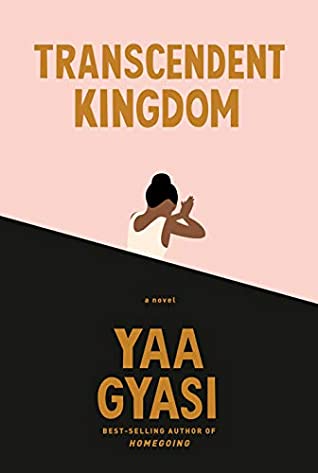 This follow-up to Gyasi’s dazzling, centuries-spanning linked story collection, Homegoing, won’t be out in the UK until March 2021, but I couldn’t resist reading an e-copy of the American edition (Knopf) from Edelweiss. It’s altogether a more subdued and subtle book, but its treatment of themes of addiction, grief, racism and religion is so spot on that it packs a punch. Gifty is a PhD student at Stanford, researching pleasure and reward circuits in the mouse brain. She gets mice hooked on a sugary drink and then performs experiments to see if she can turn off their compulsion to keep pressing a lever for more. Sometimes when they press the lever they get an electric shock. Certain mice give up; others never will. Why?
People who know Gifty well assume she chose her field because of a personal tragedy. When she was 10, her 16-year-old brother, Nana, a high school basketball star in this Ghanaian-American family’s Alabama town, died of an opiate overdose. He’d gotten addicted to prescription drugs after a sports injury. At one level, Gifty acknowledges she is trying to atone for her brother’s death, but she won’t see it in those terms. An intensely private person, she shoulders almost impossible burdens of grief and responsibility for her mother, who has plunged into depression and, when she comes to live with Gifty, spends all her time in bed.
The most compelling aspect of the novel for me was Gifty’s attitude towards the religion of her childhood. Though they were the only black family at their Pentecostal church, she was a model believer, writing prayers in her journal, memorizing scriptures, and never doubting that everything happens for a reason. Nana’s death shattered it all. Though she now looks to science for answers, she misses the certainty she once had: that she was saved, that humans are special, that someone was looking out for her and her family, that it all mattered. I highlighted dozens of passages, but it’s possible the book won’t mean quite as much to readers for whom there’s no personal resonance. The complex mother–daughter relationship is an asset, and musings on love and risk are tenderly expressed. I wanted a more climactic conclusion to take this into 5-star territory, but I’ve still added it to my Best of 2020 shelf.
Favorite lines:
the species Homo sapiens, the most complex animal, [is] the only animal who believed he had transcended his Kingdom, as one of my high school biology teachers used to say.
At times, my life now feels so at odds with the religious teachings of my childhood that I wonder what the little girl I once was would think of the woman I’ve become … I am looking for new names for old feelings. My soul is still my soul, even if I rarely call it that.
the more I do this work the more I believe in a kind of holiness in our connection to everything on Earth. Holy is the mouse.
My rating:
I read an advanced e-copy via Edelweiss.
The Animals in That Country by Laura Jean McKay
 McKay has a PhD in literary animal studies and serves as an animal expert and presenter on Australia’s ABC radio show Animal Sound Safari. Pair her academic background with the fact that this shares a title with a Margaret Atwood poetry collection and you’ll have some idea of what to expect here: mysterious but mostly believable speculative fiction that hinges on human communication with animals.
Jean Bennett isn’t your average grandma: a wise-cracking alcoholic, she drives the tourist train through the Australian wildlife park her daughter-in-law manages but wishes she could be a fully fledged ranger. Her ex-husband, Graham, left her and went down south, and eventually their only son Lee did the same. Now all Jean has left is Kim, her six-year-old granddaughter. Jean entertains Kim by imagining voices for the park’s animals. This no longer seems like a game, though, when news filters through of the “zooflu,” which has hit epidemic levels and has as a main symptom the ability to understand what animals say.
When Kim is kidnapped, Jean steals a camper van and takes Sue the dingo along to help her find her granddaughter. “There’s a new normal now,” a bus driver tells her. “And around here, not wearing a mask means you’ve gone animal. I’d put on my protective if I was you. Put that mutt in a cage.” It was uncanny reading this in the midst of a pandemic, but the specifics of McKay’s novel are hard to grasp. The animal language isn’t audible, necessarily, but a combination of smells, noises and body language. For a long time, they seem like pure nonsense, but gradually they resemble a sort of rough poetry. Here’s one example from Sue:
My front end
takes the food
quality.
Muzzle
for the Queen
(Yesterday).
(Sue usually calls Jean “Queen” or “Mother,” showing that she respects her authority, and “Yesterday” is frequently used to suggest a primitive sense of the past or of an older person.)
As entertaining a protagonist as Jean is, I lost interest in her road trip. If you focus on the journey into the wilderness and don’t mind a sudden ending, you may find this a worthwhile heir to Hollow Kingdom by Kira Jane Buxton and The Road by Cormac McCarthy.
My rating: 
I read a proof copy for a Nudge review, but it’s never shown up on their website.
Entangled Life: How Fungi Make Our Worlds, Change Our Minds, and Shape Our Futures by Merlin Sheldrake
 I first heard about Sheldrake through Robert Macfarlane’s Underland. He struck me as a mad genius – an impression that was only strengthened by reading his detailed, enthusiastic book about fungi. Sheldrake researches fungal life in the tropical forests of Panama, accompanies truffle hunters in Italy, takes part in a clinical study on the effects of LSD (derived from a fungus), observes lichens off the coast of British Columbia, and attends a conference in Oregon on Radical Mycology. But more than a travel memoir, this is a work of science – there are over 100 pages devoted to notes, bibliography and index.
Basic information you’ll soon learn: mushrooms are only the fruiting bodies of fungi; under the ground is the material bulk, the mycelium, a sprawling network of hyphae. In what’s sometimes called the “Wood Wide Web,” fungal networks link the trees in a forest, and join up with plants, such as in lichens. “I feel a … sense of vertigo when I think about the complexity of mycorrhizal relationships – kilometers of entangled life – jostling beneath my feet,” Sheldrake confesses. He gives examples of fungi navigating and solving problems – what of our concept of intelligence if a creature without a brain can do such things?
Fungi are very adaptable to extreme conditions. Research is underway to grow edible mushrooms on some of our most troublesome waste, such as used diapers (nappies) and cigarette butts. And, of course, for millennia we’ve relied on certain fungi – yeasts – to create products like bread and beer. Sheldrake is a very hands-on writer: When he wants to know something, he does it, whether that’s scrumping Isaac Newton’s apples in Cambridge and fermenting the juice into cider at home or growing mushrooms on a copy of this very book.
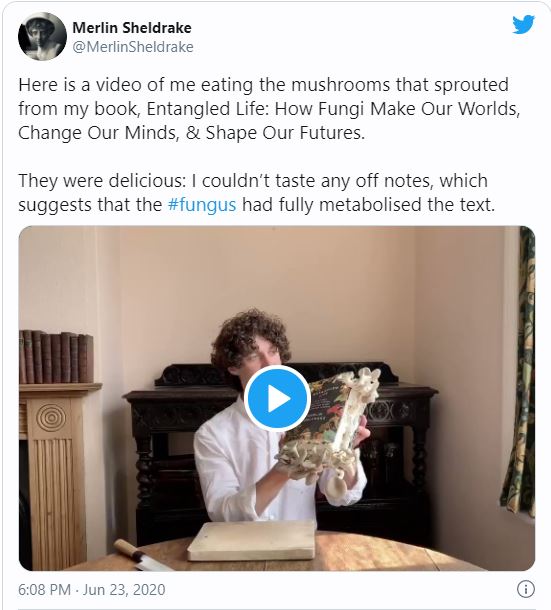
During the month I was reading this, I felt like I kept coming across references to fungi. (I even had a patch of ringworm!)

It’s a perspective-altering text, but one that requires solid concentration. I’ll confess that at times it went over my head and I wished for a glossary and diagrams. A greater than average interest in biology and/or botany would thus be a boon to a potential reader. But if you can keep up, the book will elicit many a cry of “wow!” and “what?!” I kept launching “did you know?” questions at my husband, especially about the zombie fungi that parasitize insects. What a strange and wonderful world.
Favorite lines: “Paying more attention to animals than plants contributes to humans’ plant-blindness. Paying more attention to plants than fungi makes us fungus-blind.”
My rating:
My thanks to Bodley Head for the free copy for review.
Islands of Mercy by Rose Tremain
 I read this back in June to prepare for writing a profile of Tremain for a forthcoming issue of Bookmarks magazine. Here’s the summary I wrote: “In Bath, England in 1865, 24-year-old nurse Jane Adeane is nicknamed ‘The Angel of the Baths’ for her healing touch. If she marries Dr. Valentine Ross, a colleague of her surgeon father, she can earn respectability – but will have to hide her love for Julietta, a married woman. Meanwhile, Dr. Ross’s brother, Edmund, a naturalist following in the footsteps of Alfred Russel Wallace, has journeyed to Borneo. Ill with malaria, he is taken in by British eccentric Sir Ralph Savage, a lover of native men and benevolent local rajah who funds infrastructure projects like a paved road and a hospital. Exiled or inwardly tortured for loving the wrong people, Tremain’s characters search for moments of wonder and comfort – whether those come in a primitive hut in the Malay Archipelago or in a cozy tearoom in Bath.”
It’s a slightly odd title, but tells you a lot about what Tremain is doing in this 14th novel. Often at the mercy of forces internal and external, her outcast characters look for places where they can find rest and refuge after a time of suffering. Will they, in turn, extend mercy? The split perspective and the focus on people who have to hide their sexuality are most similar to Sacred Country. The Victorian tip of the hat is mostly directed, I think, to George Eliot; of recent work, I was reminded of The Doll Factory and The Essex Serpent. I especially liked Jane’s painter aunt, Emmeline, and Clorinda, the Irish woman whose opening of a tearoom sets the plot going. The settings are surprising and vivid, and if Tremain doesn’t quite bring them and their story lines together seamlessly, she is still to be applauded for her ambition. This is probably my joint favorite of her novels that I’ve read so far, with The Road Home.
Favorite lines:
We must be unconventional in our joys and find them wherever we can.
life, so often so cruel in the way it thrust the human soul into prisons from which there seemed to be no escape, could sometimes place it athwart an open door.
My rating:
I read an advanced e-copy via NetGalley.
Between Light and Storm: How We Live with Other Species by Esther Woolfson
 If you’ve read Woolfson’s Corvus, you’ve already met Chicken, an orphaned rook she raised. For over 31 years, Chicken was a constant presence in her home. The recently departed bird is the dedicatee of her new book, feted as “Colleague, companion, friend.” (No mere pet.) Relationships with these creatures with whom she shared her life led her to think differently about how we as humans conceive of the animal world in general. “If I had ever believed humans to be the only ones to live profound and interconnected lives, I couldn’t any more. … If we’re the gods now, shouldn’t we be better than we are?” From her introduction, it’s clear that her sympathy toward the more-than-human world extends even to spiders, and her language throughout – using words like “who” and “his” in reference to animals, rather than “that” or “its” – reinforces the view that all species are equally valuable.
Or, at least, should be. But our attitudes are fundamentally distorted, Woolfson believes, and have been since the days of Aristotle (whose Ladder of Nature is an origin of the ideas that nature is there for man to use) and the Old Testament writers (one of the two creation accounts in Genesis established the idea of “dominion”). From cave paintings to animal sacrifice, intensive farming to fur coats, taxidermy to whaling, she surveys what others have thought and said about how animals are, or should be, perceived. There was more of an academic tone to this book than I expected, and in early chapters I found too much overlap with other works I’ve read about deep time (Time Song, Surfacing, Underland again!).
I most appreciated the fragments of nature writing and memoir and would have liked more in the way of personal reflection. Woolfson’s perspective – as a Jewish woman in Scotland – is quite interesting. She is clearly troubled by how humans exploit animals, but mostly recounts others’ reasoning rather than coming to conclusions of her own. (Though there is a brilliant takedown of the gender politics of Watership Down.) It’s a book that demands more time and attention than I was able to give just now. As I only skimmed it, I’m going to refrain from assigning a rating and will pass this on to my husband and return to it one day. [I do wish the title, on its own (subtitle aside), was more indicative of the contents.]
My thanks to Granta for the free copy for review.
Which of those 600+ September releases can you recommend?
Booker Prize 2020: Longlist Progress & Shortlist Predictions
The 2020 Booker Prize shortlist will be announced tomorrow, September 15th. Following on from my initial thoughts … I’ve only managed to read one more book from the longlist, reviewed in brief below along with some thoughts on a few other nominees I’ve sampled.
Burnt Sugar by Avni Doshi
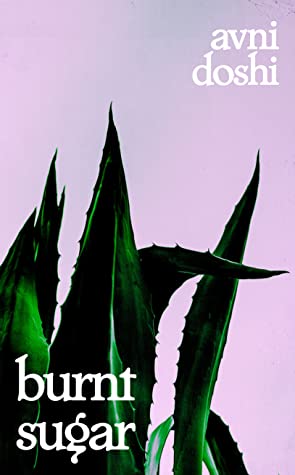 This short, intense novel is about two women locked into resentful competition. Tara and Antara also happen to be mother and daughter. When the long-divorced Tara shows signs of dementia, artist Antara and her American-born husband Dilip take her into their home in Pune, India. Her mother’s criticism and strange behavior stir up flashbacks to the 1980s and 1990s, when Antara felt abandoned by Tara during the four years they lived in an ashram and then her time at boarding school. Emotional turmoil led to medical manifestations like excretory issues and an eating disorder, and both women fell in love in turn with a homeless photographer named Reza Pine.
When Antara learns she is pregnant, the whole cycle of guilt and maternal ambivalence looks set to start again. Memory is precarious and full of potential hurt here, and Antara’s impassive narration is perfectly suited to the story of a toxic relationship. Neither the UK title nor the one for the original Indian publication (Girl in White Cotton) seems quite right to me; I might have chosen something related to the cover and endpaper image of the aloe plant: something that is as spiky as a cactus yet holds out hope of balm. This was a good fictional follow-up to a memoir I read earlier in the year about dementia’s effect on an Indian-American mother–daughter pair, What We Carry by Maya Shanbhag Lang.
Favorite passages:
It seems to me now that this forgetting is convenient, that she doesn’t want to remember the things she has said and done. It feels unfair that she can put away the past from her mind while I’m brimming with it all the time. I fill papers, drawers, entire rooms with records, notes, thoughts, while she grows foggier with each passing day.
I will never be free of her. She’s in my marrow and I’ll never be immune.
My rating:
My thanks to Hamish Hamilton for the free copy for review.
DNFed:
Apeirogon by Colum McCann
 Reminiscent of the work of David Grossman, this is the story of two fathers, one Israeli and one Palestinian, who lost their daughters to the ongoing conflict between their nations: Rami Elhanan’s 13-year-old daughter Smadar was killed by a Palestinian suicide bomber, while Bassam Aramin’s 10-year-old daughter Abir was shot by Israeli border police. The two men become unlikely friends through their work with a peacemaking organization, with Bassam also expanding his sense of compassion through his studies of the Holocaust.
It doesn’t take long to piece the men’s basic stories together. But the novel just keeps going. It’s in numbered vignettes ranging in length from one line to a few pages, and McCann brings in many tangentially related topics such as politics, anatomy, and religious history. Bird migration is frequently used as a metaphor. Word association means some lines feel arbitrary and throwaway. Looking ahead, I could see the numbering goes up to 500, at which point there is a long central section narrated in turn by the two main characters, and then goes back down to 1, mimicking the structure of the One Thousand and One Nights, mentioned in #101.
The narrative sags under the challenge McCann has set for himself. At 200 pages, this might have been a masterpiece. Though still powerful, it sprawls into repetition and pretension. (I read the first 150 pages.)
My rating:
Set aside temporarily:
 The New Wilderness by Diane Cook: The blurb promised an interesting mother–daughter relationship, but so far this is dystopia by numbers. A wilderness living experiment started with 20 volunteers, but illnesses and accidents have reduced their number. Bea was an interior decorator and her partner, Glen, a professor of anthropology – their packing list and habits echo primitive human culture. I loved the rituals around a porcelain teacup, but in general the plot and characters weren’t promising. I read Part I (47 pages) and would only resume if this makes the shortlist, which seems unlikely. (See this extraordinarily detailed 1-star Goodreads review from someone who DNFed the novel near where I am now.)
 Shuggie Bain by Douglas Stuart: Dialect + depressing subject matter = a hard slog. Poverty and alcoholism make life in 1980s Glasgow a grim prospect for Agnes Bain and her three children. So far, the novel is sticking with the parents and the older children, with the title character barely getting a mention. I did love the scene where Catherine goes to Leek’s den in the pallet factory. This is a lot like the account Damian Barr gives of his childhood in Maggie & Me. I left off on page 82 but will go back to this if it makes the shortlist.
So that makes a total of 2 read, 4 DNFed, 2 set aside (and might yet DNF), 2 I still hope to read (one of which I’m awaiting from the library; the other is on my birthday wish list), and 3 I don’t intend to read. Not a great showing at all this year!
Still, I can never resist an opportunity to make predictions about a prize shortlist, so here’s what I expect to still be in the running after tomorrow. Weighty, diverse; a mixture of historical and contemporary.
- The Mirror & The Light by Hilary Mantel (will win)
- Apeirogon by Colum McCann
- The Shadow King by Maaza Mengiste
- Shuggie Bain by Douglas Stuart
- Real Life by Brandon Taylor
- How Much of These Hills Is Gold by C. Pam Zhang
What have you read from the longlist? What do you expect to be shortlisted?
Six Degrees of Separation: From The Road to On Being Different
This month’s Six Degrees of Separation (see Kate’s introductory post) starts with Cormac McCarthy’s bleak dystopian novel The Road (2006).
I’ve read several of McCarthy’s novels, including this one. Believe it or not, this is not the darkest – that would be Blood Meridian.

#1 Sticking with the road trip theme, I’ll start by highlighting one of my favorite novels from 2018, Southernmost by Silas House. Tennessee preacher Asher Sharp’s family life falls apart when he welcomes a homosexual couple into his church. After being voted out of his post, he kidnaps his son and drives to Key West, Florida, where his estranged gay brother lives.


#2 A minister is also the main character in Abide with Me by Elizabeth Strout (2006). I finished this one, my fourth novel from Strout, a couple of weeks ago. She tenderly probes the dark places of a mid-twentieth century Maine community and its pastor’s doubts, but finds the light shining through. From first line to last word, this was gorgeous.
#3 “Abide with Me,” Reverend Tyler Caskey’s favorite hymn, gives the novel its title. Also named after a song is Norwegian Wood by Haruki Murakami (1987/2000). I have a copy on the shelf and tried the first 20 pages a couple of months ago, but it was so normal – compared to The Wind-Up Bird Chronicle, anyway – that I felt disoriented and set it aside.


#4 Returning to bleakness … the Norwegian reference takes me one of the first books from Norway I remember reading: Hunger by Knut Hamsun (1890). It’s a spare story of a starving writer who wanders the streets of Oslo looking for opportunities for food and publication, tramping about simply to keep warm at the onset of a bitter Scandinavian winter.
#5 Same title; rather different contents: Hunger by Roxane Gay (2017) is a collection of short autobiographical essays that riff on weight, diet, exercise and body image. The writing style is matter-of-fact and never self-pitying. This is still the only thing I’ve read by her, but I mean to read more, starting with her novel An Untamed State.
[#5.5 Her surname takes me to the title of my cheaty half-step, A Gay and Melancholy Sound by Merle Miller (1962), a semi-autobiographical novel about a man from Iowa who helps free the concentration camps and then has a career as a theatrical producer. It was Nancy Pearl’s first Book Lust Rediscoveries reprint book and is on my TBR.]
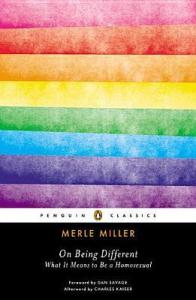 #6 While it’s not implied by that title, Miller was, er, gay, which leads to another of his books, On Being Different. I have Pearl to thank for leading me to this 1971 essay, which was republished in book form in 2013. It’s an insider’s view of what it is like to be a homosexual. A period piece now, it feels like a precursor to the revolution in gay rights. It’s one of the books (along with Straight by Hanne Blank and Conundrum by Jan Morris) that have most boosted my tolerance and compassionate understanding.
(This loops nicely back to #1 and the story of a preacher accepting homosexuality in his family as well as in his church congregation.)
Join us for #6Degrees of Separation if you haven’t already!
Have you read any of my selections? Are you tempted by any you didn’t know before?
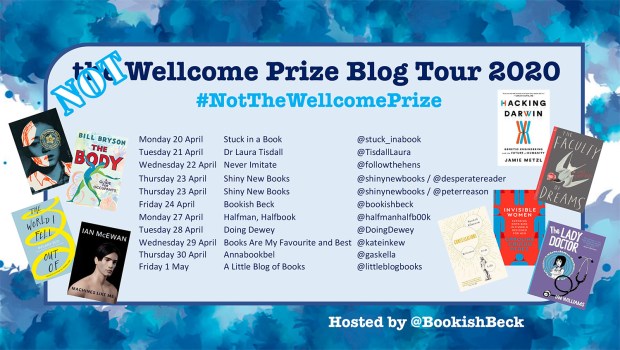
Recapping the Not the Wellcome Prize Blog Tour Reviews
It’s hard to believe the Not the Wellcome Prize blog tour is over already! It has been a good two weeks of showcasing some of the best medicine- and health-themed books published in 2019. We had some kind messages of thanks from the authors, and good engagement on Twitter, including from publishers and employees of the Wellcome Trust. Thanks to the bloggers involved in the tour, and others who have helped us with comments and retweets.
This weekend we as the shadow panel (Annabel of Annabookbel, Clare of A Little Blog of Books, Laura of Dr. Laura Tisdall, Paul of Halfman, Halfbook and I) have the tough job of choosing a shortlist of six books, which we will announce on Monday morning. I plan to set up a Twitter poll to run all through next week. The shadow panel members will vote to choose a winner, with the results of the Twitter poll serving as one additional vote. The winner will be announced a week later, on Monday the 11th.

First, here’s a recap of the 19 terrific books we’ve featured, in chronological blog tour order. In fiction we’ve got: novels about child development, memory loss, and disturbed mental states; science fiction about AI and human identity; and a graphic novel set at a small-town medical practice. In nonfiction the topics included: anatomy, cancer, chronic pain, circadian rhythms, consciousness, disability, gender inequality, genetic engineering, premature birth, sleep, and surgery in war zones. I’ve also appended positive review coverage I’ve come across elsewhere, and noted any other awards these books have won or been nominated for. (And see this post for a reminder of the other 56 books we considered this year through our mega-longlist.)

 Notes Made While Falling by Jenn Ashworth & The Remarkable Life of the Skin by Monty Lyman: Simon’s reviews
*Monty Lyman was shortlisted for the 2019 Royal Society Science Book Prize.
[Bookish Beck review of the Ashworth]
[Halfman, Halfbook review of the Lyman]
Exhalation by Ted Chiang & A Good Enough Mother by Bev Thomas: Laura’s reviews


 Constellations by Sinéad Gleeson & War Doctor by David Nott: Jackie’s reviews
*Sinéad Gleeson was shortlisted for the 2020 Rathbones Folio Prize.
[Rebecca’s Goodreads review of the Gleeson]
[Kate Vane’s review of the Gleeson]
[Lonesome Reader review of the Gleeson]
[Rebecca’s Shiny New Books review of the Nott]
Vagina: A Re-education by Lynn Enright: Hayley’s Shiny New Books review
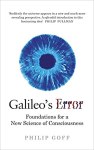
Galileo’s Error by Philip Goff: Peter’s Shiny New Books review

 Mother Ship by Francesca Segal & The Lady Doctor by Ian Williams: Rebecca’s reviews
[A Little Blog of Books review of the Segal]
[Annabookbel review of the Williams]
Chasing the Sun by Linda Geddes & The Nocturnal Brain by Guy Leschziner: Paul’s reviews
[Bookish Beck review of the Geddes]


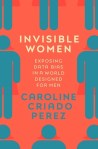 Invisible Women by Caroline Criado-Pérez: Katie’s review
*Caroline Criado-Pérez won the 2019 Royal Society Science Book Prize.
[Liz’s Shiny New Books review]
The Faculty of Dreams by Sara Stridsberg: Kate’s review

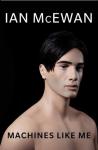
Machines Like Me by Ian McEwan: Kate’s review

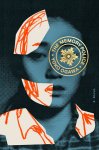 Hacking Darwin by Jamie Metzl & The Memory Police by Yoko Ogawa: Annabel’s reviews
*Yoko Ogawa is shortlisted for this year’s International Booker Prize.
[Lonesome Reader review of the Ogawa]

 The Body by Bill Bryson & The World I Fell Out Of by Melanie Reid: Clare’s reviews
[Bookish Beck review of the Bryson]
[Rebecca’s Goodreads review of the Reid]
And there we have it: the Not the Wellcome Prize longlist. I hope you’ve enjoyed following along with the reviews. Look out for the shortlist, and your chance to vote for the winner, here and via Twitter on Monday.
Which book(s) are you rooting for?
Young Writer of the Year Award: Shortlist Reviews and Predictions
Being on the shadow panel for the Sunday Times Young Writer of the Year Award was a bookish highlight of 2017 for me. I’m pleased for this year’s shadow panelists, a couple of whom are blogging friends (one I’ve met IRL), to have had the same opportunity, and I look forward to attending the prize ceremony at the London Library on December 5th.
I happened to have already read two of the shortlisted titles, the poetry collection The Perseverance by Raymond Antrobus and the debut novel Stubborn Archivist by Yara Rodrigues Fowler, which was one of my specific wishes/predictions. The kind folk of FMcM Associates sent me the other two shortlisted books, a short story collection and another debut novel, for blog reviews so that I could follow along with the shadow panel’s deliberations.
Salt Slow by Julia Armfield (2019)
These nine short stories are steeped in myth and magic, but often have a realistic shell. Only gradually do the fantastical or dystopian elements emerge, with the final paragraph delivering a delicious surprise. For instance, the narrator of “Mantis” attends a Catholic girls’ school and is caught up in a typical cycle of self-loathing and obsessing over boys. It’s only at the very end that we realize her extreme skin condition is actually a metamorphosis that enables her to protect herself. The settings are split between the city and the seaside; the perspective is divided almost perfectly down the middle between the first and third person. The body is a site of transformation, or a source of grotesque relics, as in “The Collectables,” in which a PhD student starts amassing body parts she could only have acquired via grave-robbing.
 Two favorites for me were “Formerly Feral,” in which a 13-year-old girl acquires a wolf as a stepsister and increasingly starts to resemble her; and the final, title story, a post-apocalyptic one in which a man and a pregnant woman are alone in a fishing boat, floating above a drowned world and living as if outside of time. This one is really rather terrifying. I also liked “Cassandra After,” in which a dead girlfriend comes back – it reminded me of Margaret Atwood’s The Robber Bride, which I’m currently reading for #MARM. “Stop Your Women’s Ears with Wax,” about a girl group experiencing Beatles-level fandom on a tour of the UK, felt like the odd one out to me in this collection.
Armfield’s prose is punchy, with invented verbs and condensed descriptions that just plain work: “Jenny had taken to poltergeisting round the house”; “skin like fork-clawed cottage cheese,” “the lobster shells gleam a slick vermilion” and “The sky is gory with stars.” There’s no shortage of feminist fantasy stories out there nowadays – Aimee Bender, Kelly Link, Carmen Maria Machado and Karen Russell are just a few others working in this vein – but the writing in Salt Slow really grabbed me even when the plots didn’t. I’ll be following Armfield’s career with interest.
Testament by Kim Sherwood (2018)
Eva Butler is a 24-year-old MA student specializing in documentary filmmaking. She is a live-in carer for her grandfather, the painter Joseph Silk (real name: József Zyyad), in his Fitzroy Park home. When Silk dies early on in the book, she realizes that she knows next to nothing about his past in Hungary. Learning that he wrote a testament about his Second World War experiences for the Jewish Museum in Berlin, she goes at once to read it and is distressed at what she finds. With the help of Felix, the museum’s curator, who did his PhD on Silk’s work, she travels to Budapest to track down the truth about her family.
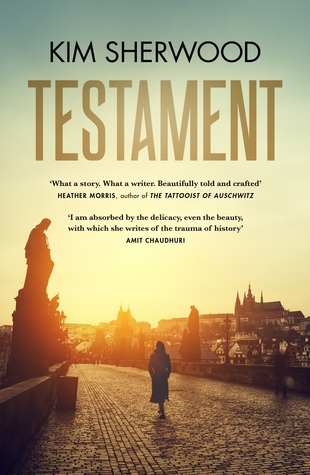 Sherwood alternates between Eva’s quest and a recreation of József’s time in wartorn Europe. Cleverly, she renders the past sections more immediate by writing them in the present tense, whereas Eva’s first-person narrative is in the past tense. Although József escaped the worst of the Holocaust by being sentenced to forced labor instead of going to a concentration camp, his brother László and their friend Zuzka were in Theresienstadt, so readers get a more complete picture of the Jewish experience at the time. All three wind up in the Lake District after the war, rebuilding their lives and making decisions that will affect future generations.
It’s almost impossible to write anything new about the Holocaust these days, and overfamiliarity was certainly a roadblock for me here. I was especially reminded of Julie Orringer’s The Invisible Bridge, what with its focus on the Hungarian Jewish experience. However, I did appreciate the way Sherwood draws on her family history – her grandmother is a Hungarian Holocaust survivor – to consider how trauma still affects the second and third generation. This certainly doesn’t feel like a debut novel. It’s highly readable, and the emotional power of the story cannot be denied. The Young Writer of the Year Award is great for highlighting books that risk being overlooked: in a year dominated by The Testaments, poor Testament was otherwise likely to sink without notice.
Note: “Testament” is also the title of the poem written by Sherwood’s great-grandfather that she recited at her grandfather’s funeral – just as Eva does in the novel. It opens this Telegraph essay (paywalled, but reprinted in the paperback of Testament) that Sherwood wrote about her family history.
General thoughts and predictions:
Any of these books would be a worthy winner. However, as Raymond Antrobus has already won this year’s £30,000 Rathbones Folio Prize as well as the 2018 Geoffrey Dearmer Award from the Poetry Society, The Perseverance has had sufficient recognition – plus it’s a woman’s turn. Testament is accomplished, and likely to hold the widest appeal, but it strikes me as the safe choice. Salt Slow would be an edgier selection, and feels quite timely and fresh. But Stubborn Archivist has stuck with me since I reviewed it in March. I called it “Knausgaard for the Sally Rooney generation” and wrote that “the last book to have struck me as truly ‘novel’ in the same way was Lincoln in the Bardo.” From a glance at the shadow panel’s reviews thus far, I fear it may prove too divisive for them, though.
Based on my gut instincts and a bit of canny thinking about the shadow panelists and judges, here are my predictions:
Shadow Panel:
- What they will pick: Testament [but they might surprise me and go with Salt Slow or Stubborn Archivist]
- What they should pick: Salt Slow
Official Judging Panel:
- What they will pick: Stubborn Archivist [but they might surprise me and go with Salt Slow]
- What they should pick: Stubborn Archivist
I understand that the shadow panel is meeting today for their in-person deliberations. I wish them luck! Their pick will be announced on the 28th. I’ll be intrigued to see which book they select, and how it compares with the official winner on December 5th.
Have you read anything from this year’s shortlist?
Doris Lessing’s Centenary & The Grass Is Singing
Today would have been Doris Lessing’s 100th birthday; she in fact died in 2013. Reading Lara Feigel’s Free Woman last year encouraged me to try more from Lessing, and I’m glad that I did so this month. I started with The Fifth Child, a horror novella for R.I.P., followed by the novel Lessing brought with her when she left Southern Rhodesia (now Zimbabwe) for England.
.jpg)
Doris Lessing at Cologne Literature Festival, 2006. Elke Wetzig / Juan Pablo Arancibia Medina [CC BY-SA 3.0 (http://creativecommons.org/licenses/by-sa/3.0/)%5D.
The Grass Is Singing (1950)
I had trouble believing that this novel a) was Lessing’s debut and b) is now nearly 70 years old. It felt both fresh and timeless, and I could see how it has inspired writing about the white experience in Africa ever since, especially a book like Fiona Melrose’s Midwinter, in which an English farmer and his son are haunted by the violent death of the young man’s mother back in Zambia 10 years ago.
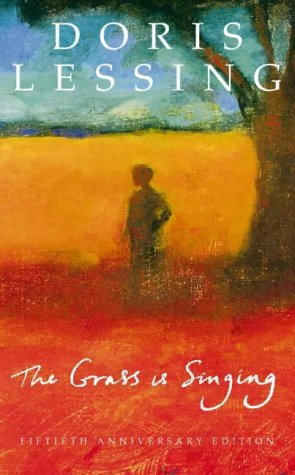 For The Grass Is Singing begins with two sly words, “MURDER MYSTERY”: a newspaper headline announcing that Mary, wife of Rhodesian farmer Dick Turner, has been found murdered by their houseboy. It’s a tease because in one sense there’s no mystery to this at all: we know from the first lines what happened to Mary. And yet we are drawn in, wondering why she was killed and how the Turners went from an idealistic young couple enthusiastic about their various money-making schemes – a shop, chickens, tobacco – to a jaded, distant pair struggling for their health, both mental and physical.
The breakdown of their marriage and the failure of their farm form a dual tragedy that Lessing explores in searing psychological detail, all while exposing (with neither judgment nor approval) how Anglos felt about the natives at that time.
There’s a sense in which this was all fated: Dick is weak, someone Mary pities rather than loves and respects; and Mary’s mixed-up feelings toward her black servants – fear, contempt, curiosity and attraction – were bound to lead to an explosion. The land itself seems to be conspiring against them, too, or is at least indifferent to their plans and dreams.
So many passages struck me for their effortless profundity. I cringed to see myself so clearly in Mary’s boredom and restlessness, along with her ambivalence about the idea of motherhood: “She hated the idea of a baby, when she thought of its helplessness, its dependence, the mess, the worry. But it would give her something to do.”
This was the fifth full-length book I’ve read by Lessing, and by far the best.
My rating: 
Alas, I had a Lessing DNF this month, too:
The Memoirs of a Survivor (1974)
 This was shelved in with the memoirs in The Bookshop, Wigtown. I’m not blaming Mr. Bythell or his staff, as this would be a very easy shelving error to make, even for those well versed in literature. But I was disappointed to realize that it’s actually one of Lessing’s detached, dreamy dystopian novels. I tried really hard with this but couldn’t make it past page 48. There’s just not much detail to latch onto. You know that it is set in a vague but believable near future (London?) in which there has been political and social breakdown, followed by gangs, looting and fighting. The narrator hides out in her apartment and is able to live a fairly normal life (“We can get used to anything at all”), at least until an adolescent girl named Emily Cartright is deposited into her care. The novel still feels relevant – the comments on rumor and gossip being as important as news; the sense that the narrator’s generation has ruined things for Emily’s generation and should accept guilt and responsibility – but there is just no plot to speak of.
Next up for me from Lessing’s works will be at least one of her heavily autobiographical Martha Quest novels.
 Bookish Beck = Rebecca Foster. American transplant to England. Freelance proofreader and book reviewer.
 Bookish Beck