February Releases by Hess, Kim, Sides (#ReadIndies); Atwood and Shah
I’m pleased to have, between this post and yesterday’s review catch-up, featured 9 books from 8 independent publishers for Read Indies this month. (I have also done some indie reading from my shelves, which I’ll summarize early in March.) Three of the books in my February review stacks were indie releases. I’ve got a hybrid memoir that blends poetic exploration of scripture with personal psychological reflections; an out-of-the-ordinary mystery about a father’s disappearance that comments on disability, racism and much more; and a terrific set of fabulist short stories. My two bonus (non-indie) February books are an unconvincing collaborative novel and a counselling-focussed bibliotherapy guide.

When Fragments Make a Whole: A Personal Journey through Healing Stories in the Bible by Lory Widmer Hess
 Some of you may know Lory, who is training as a spiritual director, from her blog, Enter Enchanted. It was so kind of her to get in touch offering her first book for review. It’s a unique combination of poetry, scriptural exegesis, and fragments of memoir. Each chapter considers a different healing story from the Gospels. As in the lectio divina I learned from college Christian fellowships, the idea with the verse retellings from the Bible is to imagine oneself into a character’s position and consider the crises that led to seeking Jesus’ help. I especially liked the poem “Talitha, Koum,” which links the stories of the woman with the issue of blood and the resurrection of Jairus’ daughter. In both, faith reverses a seemingly hopeless situation.
The short sections of commentary draw in a lot of context as well as etymology from the Greek. The autobiographical essays chart a history of physical and mental challenges, including dissociation, low self-esteem and shame, and offer openness to healing as its own miracle when there are no easy answers. They are notable for their vulnerability, especially when discussing marital problems. The outlook is intellectual and psychological rather than the spiritualizing I’m used to from my evangelical background – Lory comes from the anthroposophy tradition, which I don’t claim to fully understand but (I think) eschews dogma like original sin and atonement and instead makes the spiritual journey a matter of human reconnection with God through free will and the intellect. This is nicely balanced, though, by her work with developmentally disabled adults in residential homes in New England and Switzerland, which reminds her “there is a truth beyond intellectual knowledge, a language beyond words”. It is a calm, honest, methodical book that will intrigue anyone interested in thinking through how the Bible is applicable to the challenges of daily life.
With thanks to the author and Floris Books (Edinburgh) for the free copy for review.
Happiness Falls by Angie Kim
Buzz from across the pond about Kim’s novels led me to request this even though I don’t typically read mysteries. The bulk is set over 2.5 days in June 2020 as the Korean American Parkson family investigates, on their own and with the help of police and various local tip-offs, what happened to the father, Adam, who’d been at River Falls Park with the severely disabled 14-year-old son, Eugene, who is autistic and has mosaic Angelman syndrome. Mother Hannah and 20-year-old twins Mia and John, home from college for the lockdown, quickly realise something is wrong when Eugene, who has blood on his shirt and under his nails, stumbles home on his own and Adam is unreachable by phone. There’s more to the setup than that, and many complicated side-tracks to the investigation, but the basic questions remain for 300+ pages: What happened to Adam? and What was Eugene’s part in it?
Mia narrates, and it’s a pleasure spending time with her quick, systematic brain as she runs through all the options and deals with each new theory and red herring. She clearly gets it from her father, whose recovered notebook is full of amateur experimentation on the “Happiness Quotient”. Her wit and garrulousness (sample aside: “I’m sorry, but I don’t care how much you love fun fonts—you cannot talk about prison rape in Comic Sans”) spills over into footnotes as if in effusive counterpoint to Eugene, who is nonspeaking.
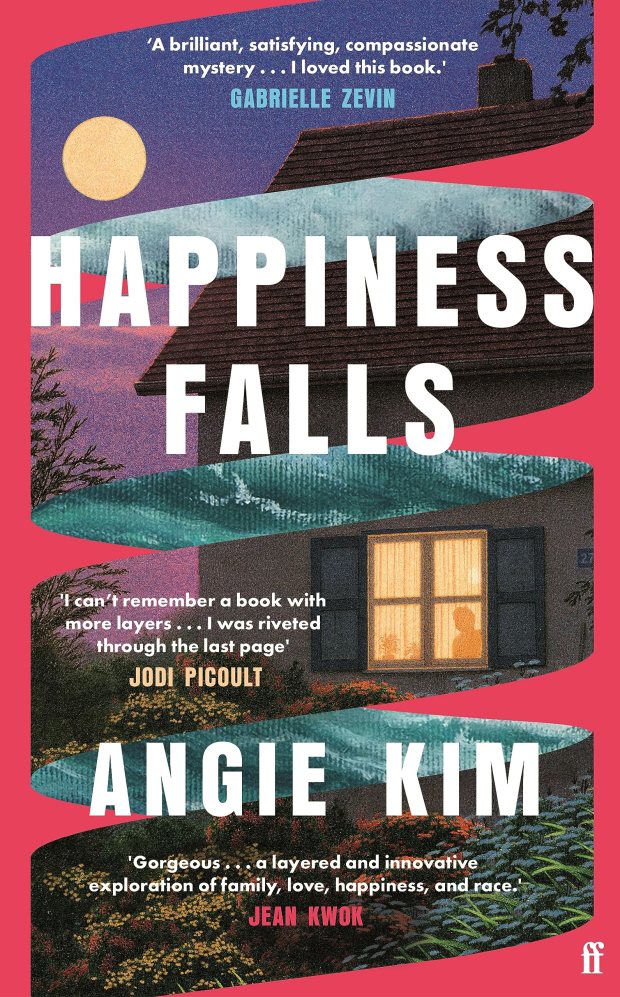
The pandemic setting places interesting constraints on the official proceedings, and the prospect of a new communication method (involving painstaking spelling with a letter stencil) revolutionizes this family as they grasp that Eugene is far from nonverbal and has been ‘locked in’ all along. The account a therapist elicits from him seems to clinch the case, but uncertainty lingers.
This is like a blend of Celeste Ng’s Everything I Never Told You, Rebecca Makkai’s I Have Some Questions for You, and Naoki Higashida’s The Reason I Jump; if you’ve liked one or more of these, I would strongly recommend it. Mystery readers may lack patience for the digressions. The solution is eclipsed by the many issues – prejudice based on race and disability, how one’s circumstances affect contentment, nuances of communication, sibling relationships and twin ESP – explored along the way. Because I am not a crime reader, the pace was no problem for me. My annoyances were with the preponderance of hindsight (“I wish I’d said something,” “It didn’t occur to me until much later”) and the fact that Mia says “begs the question” for raising a question (misuse of a rhetorical term) several times. I found personal meaning in the book because of the Washington, DC-area locales and my severely disabled, nonverbal goddaughter. What if there really is something going on in her mind, and we could find out what it was… I mused. I’ll be keen to read Kim’s debut, Miracle Creek.
With thanks to Faber for the free copy for review.
Crocodile Tears Didn’t Cause the Flood by Bradley Sides
 These 17 flash fiction stories fully embrace the possibilities of magic and weirdness, particularly to help us reconnect with the dead. Brad and I are literary acquaintances from our time working on (the now defunct) Bookkaholic web magazine in 2014–15. I liked this even more than his first book, Those Fantastic Lives (2021), although the contours are very similar. Young people, animals and monsters abound – and sometimes the lines between those identities are unclear. There’s a lot of experimentation with form: a choose-your-own-adventure narrative, a police transcript, a two-truths-and-a-lie challenge, a story all in questions, an English exam, and a letter. A few of my favorite stories were “The Guide to King George,” about an amusement farm’s resident pond monster; “Claire & Hank,” in which a paleontologist’s unearthed Pteranodon becomes a sister to his motherless son; and “Dying at Allium Farm,” whose sassy undead owners think they’re fooling their Tennessee customers. And can you imagine a better title and cover combination?!
With thanks to Montag Press and publicist Lori Hettler for the e-copy for review.
And a couple of bonus February releases that are not from indie publishers:
Fourteen Days, ed. Margaret Atwood and Douglas Preston
This Authors Guild Foundation collaborative project is a Covid-era Decameron update in which the residents of an increasingly derelict New York City apartment complex meet on the rooftop every evening for two early lockdown weeks to clap for healthcare workers, indulge in adult beverages, and swap random stories. The tenants all go by nicknames like “Hello Kitty,” “Florida” and “Vinegar.” The frame narrative has the building superintendent (Yessie, a lesbian of Romanian heritage) worrying over her father’s wellbeing in a care home and surreptitiously recording the oral stories on her phone to later transcribe into the “bible” kept by the previous super. We’re told up front that the manuscript ends up in police custody.
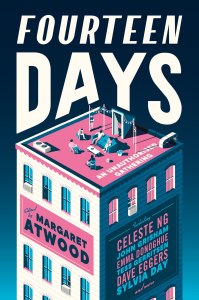 I had a misconception that each chapter would be written by a different author. I think that would actually have been the more interesting approach. Instead, each character is voiced by a different author, and sometimes by multiple authors across the 14 chapters (one per day) – a total of 36 authors took part. I soon wearied of the guess-who game. I most enjoyed the frame story, which was the work of Douglas Preston, a thriller author I don’t otherwise know.
There was a promising idea here, but problems with the execution. One is that, for the most part, the stories are pointless. The characters get hung up on whether they’re ‘true’ or not, but for readers it’s all made up and, while one or two individual tales might be amusing, they do nothing to build a plot and so I found myself mostly skipping over them to get back to the interactions on the roof and the super’s commentary. Another is that, to stand out from an ensemble cast, a voice needs to be really distinctive, and only “Eurovision” (flamboyantly gay) was that for me – based on my love for his rabbit story in particular, I should be reading Joseph Cassara. And finally, the book culminates with an annoying twist that made me cross.
With thanks to Chatto & Windus (Penguin) for the proof copy for review.
Bibliotherapy: The Healing Power of Reading by Bijal Shah
Bibliotherapy is one of my niche bookish interests (see my write-up of my bibliotherapy appointment with Ella Berthoud at the School of Life), so I was delighted to be offered a copy of another relevant book. Bijal Shah grew up in an East African Indian community before moving to the UK with her family as a teenager. When she was in training as a psychodynamic counsellor and attended therapy sessions herself, she realised how helpful literature was in helping her think through traumatic experiences from her past, such as sexism, colourism and a painful break-up. “I have lived half my life in the pages of books,” she observes, “relying on them to put my real life into perspective.” I feel the same way.

The emphasis is very much on therapy here, as Shah elaborates on practices such as literary journaling, recording audio notes, writing poetry, and focusing on gratitude. About half of the book is given over to anonymized sample case studies where she looks at the reasons why a client might come to her for bibliotherapy, the books and exercises she prescribed them, and the sorts of realizations people came to when reflecting on their own lives in relation to what they read. I suspect that the majority of readers, unless they have a vested interest in counselling, will, like me, most enjoy browsing the A–Z list of book prescriptions in the final 20% of the book (with more on Shah’s website). There is good variety to these in terms of author diversity, new vs. backlist reads, and both YA and adult fiction, though most of the recommendations are nonfiction, particularly psychology and self-help: these are much more literal (and, generally, obvious) prescriptions than Berthoud and Elderkin’s playful take.
With thanks to the author and Piatkus (Hachette) for the free copy for review.
October Reading Plans
My plans for the rest of the month’s reading, in pictures.
A handful of October releases (not counting the ones I’ve reviewed in advance for Shelf Awareness et al., one for a blog tour, or what I’ll be reading for November deadlines).


I turn 40 on the 14th, so have made a halfhearted attempt to gather my last four unread from The Novel Cure’s books to read in your thirties before that milestone passes. Whether I’ll actually read them, I’m less sure about. I’ve owned this copy of The Jungle for decades; I’ve not enjoyed Trollope since my student days. Time runs short, anyway, but I’ll see how I get on with the Sinclair at least, and perhaps skim the Trollope to get a sense of why Berthoud and Elderkin chose it for that list.
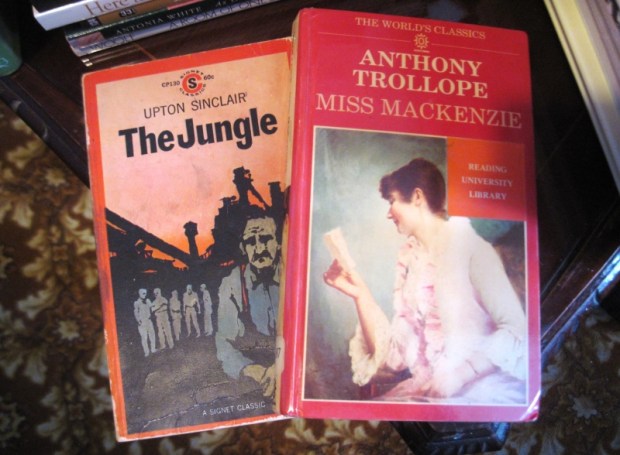
[The others are London Fields by Martin Amis, which is on loan just as I need it, and The Best of It All by Rona Jaffe, which I borrowed once and didn’t get far in; now it appears to have been withdrawn from the system. (My DNF review from 2018: “I read the first chapter and had a weird reverse case of déjà vu: this is awfully similar to Mad Men, Suzanne Rindell’s Three-Martini Lunch, and A.J. Pearce’s Dear Mrs Bird, though of course they would have been based on Jaffe’s novel rather than the other way round. Caroline Bender, fresh out of a broken engagement, arrives for her first day as a typist at a New York City publishing house and has to adjust to the catty office politics. I think I’ll truly enjoy this, but I need to find another time when I can give it my full attention. It’s nearly 450 pages of small print, so I need a chunk of time when I can really sink into it, like a flight or a long train ride.)]
Also in conjunction with that big birthday, I’ve collected some notable 1983 releases, including 5 out of the 10 most popular on Goodreads’ list. (The Ephron and Hill would be rereads for me.) I’ll work on them in these last few months of the year.
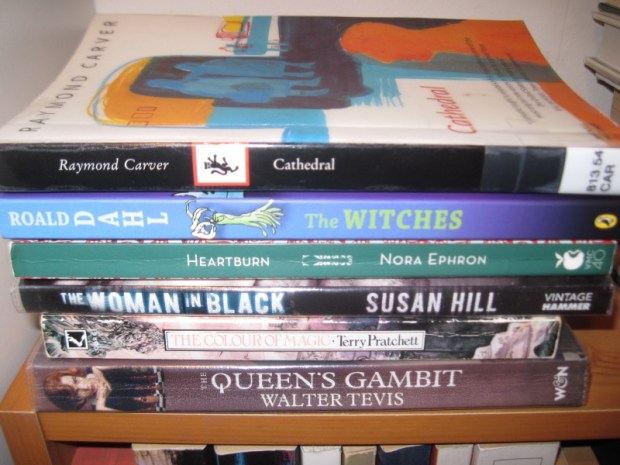
A lesser-known Margaret Drabble novel for our women’s classics book club subgroup; Pale Fire for 1962 Club; two potential books for AusReading Month.

Some spooky or death-themed R.I.P. options (I know the challenge technically starts in September, but I only ever think to read such books as Halloween approaches).
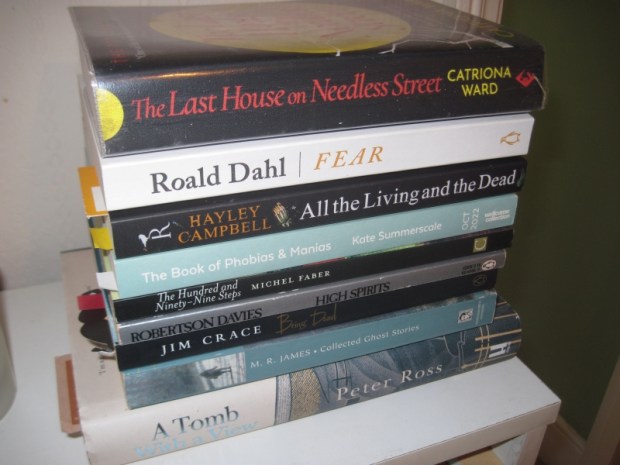
I’ll be spending my birthday weekend in Hay-on-Wye, one of my special places. Here’s my Wales-themed and/or Hay-related pile. I’ll take all of these and probably many of the above as well; I like to have lots to choose from!

First Four in a Row: Márai, Maupin, McEwan, McKay
I announced a few new TBR reading projects back in May 2020, including a Four in a Row Challenge (see the ‘rules’, such as they are, in my opening post). It only took me, um, nearly 11 months to complete a first set! The problem was that I kept changing my mind on which four to include and acquiring more that technically should go into the sequence, e.g. McCracken, McGregor; also, I stalled on the Maupin for ages. But here we are at last. Debbie, meanwhile, took up the challenge and ran with it, completing a set of four novels – also by M authors, clearly a numerous and tempting bunch – back in October. Here’s hers.

I’m on my way to completing a few more sets: I’ve read one G, one and a bit H, and I selected a group of four L. I’ve not chosen a nonfiction quartet yet, but that could be an interesting exercise: I file by author surname even within categories like science/nature and travel, so this could throw up interesting combinations of topics. Do feel free to join in this challenge if, like me, you could use a push to get through more of the books on your shelves.
Embers by Sándor Márai (1942)
[Translated from the Hungarian by Carol Brown Janeway]
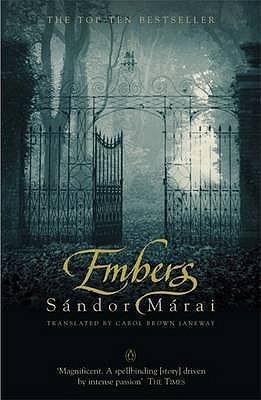 My first work of Hungarian literature.* This was a random charity shop purchase, simply because I’m always trying to read more international literature and had enjoyed translations by Carol Brown Janeway before. In 1940, two old men are reunited for the first time in 41 years at a gloomy castle, where they will dine by candlelight and, over the course of a long conversation, face up to the secret that nearly destroyed their friendship. This is the residence of 75-year-old Henrik, usually referred to as “the General,” who lives alone apart from Nini, his 91-year-old wet nurse. His wife, Krisztina, died 33 years ago.
Henrik was 10 when he met Konrad at an academy school. They were soon the best of friends, but two things came between them: first was the difference in their backgrounds (“each forgave the other’s original sin: wealth on the one hand and poverty on the other”); second was their love for the same woman.
I appreciated the different setup to this one – a male friendship, just a few very old characters, the probing of the past through memory and dialogue – but it was so languid that I struggled to stay engaged with the plot. 
*My next will be Journey by Moonlight by Antal Szerb, another charity shop find.
Favourite lines:
“My homeland was a feeling, and that feeling was mortally wounded.”
“Life becomes bearable only when one has come to terms with who one is, both in one’s own eyes and in the eyes of the world.”
Tales of the City by Armistead Maupin (1978)
I’d picked this up from the free bookshop we used to have in the local mall (the source of my next two as well) and started it during Lockdown #1 because in The Novel Cure it is given as a prescription for Loneliness. Berthoud and Elderkin suggest it can make you feel like part of a gang of old friends, and it’s “as close to watching television as literature gets” due to the episodic format – the first four Tales books were serialized in the San Francisco Chronicle.
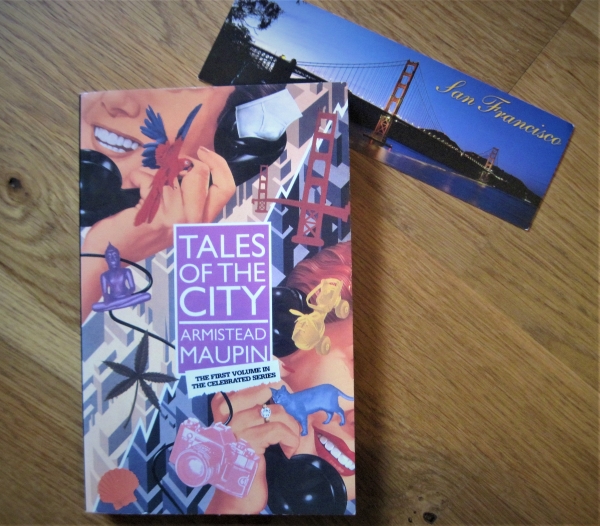
How I love a perfect book and bookmark combination!
The titled chapters are each about three pages long, which made it an ideal bedside book – I would read a chapter per night before sleep. The issue with this piecemeal reading strategy, though, was that I never got to know any of the characters; because I’d often only pick up the book once a week or so, I forgot who people were and what was going on. That didn’t stop individual vignettes from being entertaining, but meant it didn’t all come together for me.
Maupin opens on Mary Ann Singleton, a 25-year-old secretary who goes to San Francisco on vacation and impulsively decides to stay. She rooms at Anna Madrigal’s place on Barbary Lane and meets a kooky assortment of folks, many of them gay – including her new best friend, Michael Tolliver, aka “Mouse.” There are parties and affairs, a pregnancy and a death, all told with a light touch and a clear love for the characters; dialogue predominates. While it’s very much of its time, it manages not to feel too dated overall. I can see why many have taken the series to heart, but don’t think I’ll go further with Maupin’s work.
Note: Long before I tried the book, I knew about it through one of my favourite Bookshop Band songs, “Cleveland,” which picks up on Mary Ann’s sense of displacement as she ponders whether she’d be better off back in Ohio after all. Selected lyrics:
Quaaludes and cocktails
A story book lane
A girl with three names
A place, post-Watergate
Freed from its bird cage
Where the unafraid parade
[…]
Perhaps, we should all
Go back to Cleveland
Where we know what’s around the bend
[…]
Citizens of Atlantis
The Madrigal Enchantress cries
And we decide, to stay and bide our time
On this far-out, far-flung peninsula.
The Children Act by Ian McEwan (2014)
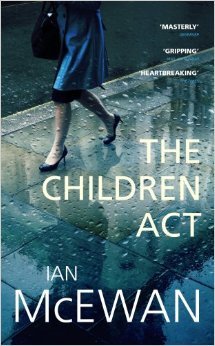 Although it’s good to see McEwan take on a female perspective – a rarer choice for him, though it has shown up in Atonement and On Chesil Beach – this is a lesser novel from him, only interesting insomuch as it combines elements from two of his previous works, The Child in Time (legislation around child welfare) and Enduring Love (a religious stalker). Fiona Maye, a High Court judge, has to decide whether 17-year-old Adam, a bright and musical young man with acute leukaemia, should be treated with blood transfusions despite his Jehovah’s Witness parents’ objection.
[SPOILERS FOLLOW]
She rules that the doctors should go ahead with the treatment. “He must be protected from his religion and from himself.” Adam, now better but adrift from the religion he was raised in, starts stalking Fiona and sending her letters and poems. Estranged from her husband, who wants her to condone his affair with a young colleague, and fond of Adam, Fiona spontaneously kisses the young man while traveling for work near Newcastle. But thereafter she ignores his communications, and when he doesn’t seek treatment for his recurring cancer and dies, she blames herself.
[END OF SPOILERS]
It’s worth noting that the AI in McEwan’s most recent full-length novel, Machines Like Me, is also named Adam, and in both books there’s uncertainty about whether the Adam character is supposed to be a child substitute. 
The Birth House by Ami McKay (2006)
Dora is the only daughter to be born into the Rare family of Nova Scotia’s Scots Bay in five generations. At age 17, she becomes an apprentice to Marie Babineau, a Cajun midwife and healer who relies on ancient wisdom and appeals to the Virgin Mary to keep women safe and grant them what they want, whether that’s a baby or a miscarriage. As the 1910s advance and the men of the village start leaving for the war, the old ways represented by Miss B. and Dora come to be seen as a threat. Dr. Thomas wants women to take out motherhood insurance and commit to delivering their babies at the new Canning Maternity Home with the help of chloroform and forceps. “Why should you ladies continue to suffer, most notably the trials of childbirth, when there are safe, modern alternatives available to you?” he asks.
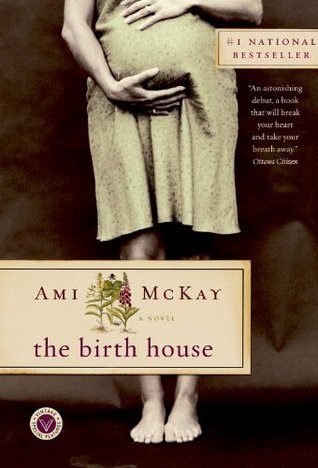 Encouraged into marriage at an early age, Dora has to put her vocation on hold to be a wife to Archer Bigelow, a drunkard with big plans for how he’s going to transform the area with windmills that generate electricity. Dora’s narration is interspersed with journal entries, letters, faux newspaper articles, what look like genuine period advertisements, and a glossary of herbal remedies – creating what McKay, in her Author’s Note, calls a “literary scrapbook.” I love epistolary formats, and there are so many interesting themes and appealing secondary characters here. Early obstetrics is not the only aspect of medicine included; there is also an exploration of “hysteria” and its treatment, and the Spanish flu makes a late appearance. Dora, away in Boston at the time, urges her friends from the Occasional Knitters’ Society to block the road to the Bay, make gauze masks, and wash their hands with hot water and soap.
There are a few places where the narrative is almost overwhelmed by all the (admittedly, fascinating) facts McKay, a debut author, turned up in her research, and where the science versus superstition dichotomy seems too simplistic, but for the most part this was just the sort of absorbing, atmospheric historical fiction that I like best. McKay took inspiration from her own home, an old birthing house in the Bay of Fundy. 
Recent Literary Awards & Online Events: Folio Prize and Claire Fuller
Literary prize season is in full swing! The Women’s Prize longlist, revealed on the 10th, contained its usual mixture of the predictable and the unexpected. I correctly predicted six of the nominees, and happened to have already read seven of them, including Claire Fuller’s Unsettled Ground (more on this below). I’m currently reading another from the longlist, Luster by Raven Leilani, and I have four on order from the library. There are only four that I don’t plan to read, so I’ll be in a fairly good place to predict the shortlist (due out on April 28th). Laura and Rachel wrote detailed reaction posts on which there has been much chat.
Rathbones Folio Prize
This year I read almost the entire Rathbones Folio Prize shortlist because I was lucky enough to be sent the whole list to feature on my blog. The winner, which the Rathbones CEO said would stand as the “best work of literature for the year” out of 80 nominees, was announced on Wednesday in a very nicely put together half-hour online ceremony hosted by Razia Iqbal from the British Library. The Folio scheme also supports writers at all stages of their careers via a mentorship scheme.
It was fun to listen in as the three judges discussed their experience. “Now nonfiction to me seems like rock ‘n’ roll,” Roger Robinson said, “far more innovative than fiction and poetry.” (Though Sinéad Gleeson and Jon McGregor then stood up for the poetry and fiction, respectively.) But I think that was my first clue that the night was going to go as I’d hoped. McGregor spoke of the delight of getting “to read above the categories, looking for freshness, for excitement.” Gleeson said that in the end they had to choose “the book that moved us, that enthralled us.”
All eight authors had recorded short interview clips about their experience of lockdown and how they experiment with genre and form, and seven (all but Doireann Ní Ghríofa) were on screen for the live announcement. The winner of the £30,000 prize, author of an “exceptional, important” book and teller of “a story that had to be told,” was Carmen Maria Machado for In the Dream House. I was delighted with this result: it was my first choice and is one of the most remarkable memoirs I’ve read. I remember reading it on my Kindle on the way to and from Hungerford for a bookshop event in early March 2020 – my last live event and last train ride in over a year and counting, which only made the reading experience more memorable.

I like what McGregor had to say about the book in the media release: “In the Dream House has changed me – expanded me – as a reader and a person, and I’m not sure how much more we can ask of the books that we choose to celebrate.”
There are now only two previous Folio winners that I haven’t read, the memoir The Return by Hisham Matar and the novel Lost Children Archive by Valeria Luiselli, so I’d like to get those two out from the library soon and complete the set.
Other literary prizes
 The following day, the Dylan Thomas Prize shortlist was announced. Still in the running are two novels I’ve read and enjoyed, Pew by Catherine Lacey and My Dark Vanessa by Kate Elizabeth Russell, and one I’m currently reading (Luster). Of the rest, I’m particularly keen on Kingdomtide by Rye Curtis, and I would also like to read Alligator and Other Stories by Dima Alzayat. I’d love to see Russell win the whole thing. The announcement will be on May 13th. I hope to participate in a shortlist blog tour leading up to it.
I also tuned into the Edward Stanford Travel Writing Awards ceremony (on YouTube), which was unfortunately marred by sound issues. This year’s three awards went to women: Dervla Murphy (Edward Stanford Outstanding Contribution to Travel Writing), Anita King (Bradt Travel Guides New Travel Writer of the Year; you can read her personal piece on Syria here), and Taran N. Khan for Shadow City: A Woman Walks Kabul (Stanford Dolman Travel Book of the Year in association with the Authors’ Club).
Other prize races currently in progress that are worth keeping an eye on:
- The Jhalak Prize for writers of colour in Britain (I’ve read four from the longlist and would be interested in several others if I could get hold of them)
- The Republic of Consciousness Prize for work from small presses (I’ve read two; Doireann Ní Ghríofa gets another chance – fingers crossed for her)
- The Walter Scott Prize for historical fiction (next up for me: The Dictionary of Lost Words by Pip Williams, to review for BookBrowse)
Claire Fuller
Yesterday evening, I attended the digital book launch for Claire Fuller’s Unsettled Ground (my review will be coming soon). I’ve read all four of her novels and count her among my favorite contemporary writers. I spotted Eric Anderson and Ella Berthoud among the 200+ attendees, and Claire’s agent quoted from Susan’s review – “A new novel from Fuller is always something to celebrate”! Claire read a passage from the start of the novel that introduces the characters just as Dot starts to feel unwell. Uniquely for online events I’ve attended, we got a tour of the author’s writing room, with Alan the (female) cat asleep on the daybed behind her, and her librarian husband Tim helped keep an eye on the chat.
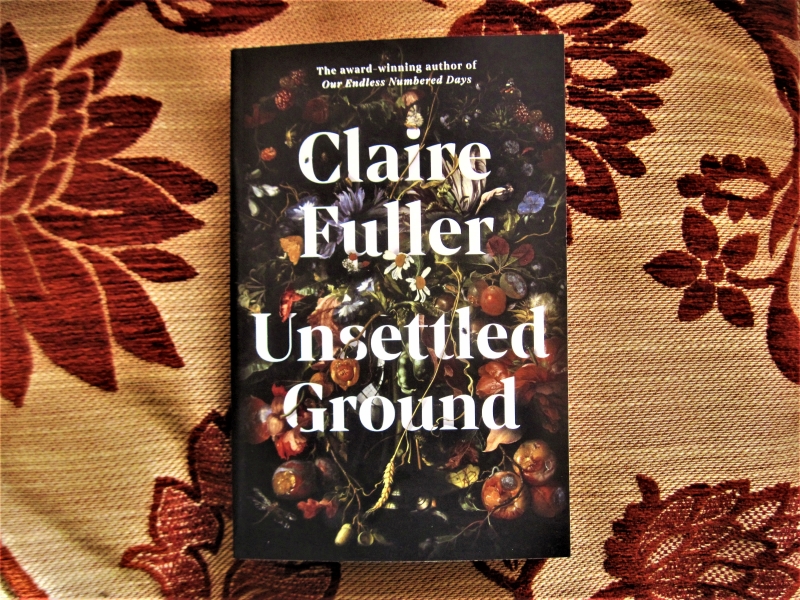
After each novel, as a treat to self, she buys a piece of art. This time, she commissioned a ceramic plate from Sophie Wilson with lines and images from the book painted on it. Live music was provided by her son Henry Ayling, who played acoustic guitar and sang “We Roamed through the Garden,” which, along with traditional folk song “Polly Vaughn,” are quoted in the novel and were Claire’s earworms for two years. There was also a competition to win a chocolate Easter egg, given to whoever came closest to guessing the length of the new novel in words. (It was somewhere around 89,000.)
Good news – she’s over halfway through Book 5!
New Reading Projects! (Join Me?)
It’s only one week since we announced the Not the Wellcome Prize winner, the culmination of a month-long project that was months more in the planning. I don’t think I’ll be coordinating another blog tour anytime soon, as it was a lot of work finding participants, working out a schedule and keeping on top of the publicizing via social media. Still, it was a lot of fun, and already I’m missing the buzz and ready to get stuck into more projects.
I’d love it if you joined me for one or more of these. Some could be combined with your 20 Books of Summer or other challenges, too.
Ongoing buddy reads
 It would have been Richard Adams’s 100th birthday on the 9th. That night I started rereading his classic tale of rabbits in peril, Watership Down, which was my favorite book from childhood even though I only read it the once at age nine. I’m 80 pages in and enjoying all the local place names. Who would ever have predicted that that mousy tomboy from Silver Spring, Maryland would one day live just 6.5 miles from the real Watership Down?!
 My husband is joining me for the Watership Down read (he’s not sure he ever read it before), and we’re also doing a buddy read of Arctic Dreams by Barry Lopez. In that case, we ended up with two free copies, one from the bookshop where I volunteer and the other from The Book Thing of Baltimore, so we each have a copy on the go. Lopez’s style, like Peter Matthiessen’s, lends itself to slower, reflective reading, so I’m only two chapters in. It’s novel to journey to the Arctic, especially as we approach the summer.
I plan to take my time over these two, so tell me if you have a copy of either and feel like picking it up at any point over the next few months.
Bibliotherapy self-prescriptions

The other day I got out my copy of The Novel Cure by School of Life bibliotherapists Ella Berthoud and Susan Elderkin and browsed through the categories for some prescriptions that might feel relevant to the current situation. I found four books I own that fit the bill:
From the list of “The Ten Best Novels to Lower Your Blood Pressure”: Your Presence Is Requested at Suvanto by Maile Chapman & The Waves by Virginia Woolf (and I’ve read another three of them, including, recently, Crossing to Safety).
One of several prescriptions for Loneliness: Tales of the City by Armistead Maupin.
The cure for Zestlessness: Ragtime by E. L. Doctorow.
If you have access to one of these, or have a copy of The Novel Cure and are keen on following up on another of the prescriptions, let me know.
And now for two memes that I (think I) have created. Although I’m sure something similar has been done in the past, I couldn’t find any specific blogs about them. I don’t know about you, but I always need encouragement to pick up books from my own shelves – even though libraries are currently closed, I’m still working my way through a library stack, and I’m tempted to make another order of new books from Hungerford Bookshop. It’s great to support libraries and independent bookstores, of course, but there could be no better time to mine your own bookshelves for treasures you bought ages ago but still have never read.
Journey through the Day with Books
I enjoyed picking out 18 books from my shelves that refer to particular times of day or meals or activities associated therewith. Four of these are books I’ve already read and four are ones I’m currently reading. You can piggyback on my selections if you wish, or find your own set.

Here’s my full list:
Zennor in Darkness by Helen Dunmore
Rise and Shine by Anna Quindlen
Up with the Larks by Tessa Hainsworth
Shine Shine Shine by Lydia Netzer
Three-Martini Lunch by Suzanne Rindell
The Shadow of the Sun by Ryszard Kapuściński
Eventide by Kent Haruf
Dinner at the Homesick Restaurant by Anne Tyler
Talk before Sleep by Elizabeth Berg
When the Lights Go Out by Carys Bray
Journey by Moonlight by Antal Szerb
Voyage in the Dark by Jean Rhys
Late Nights on Air by Elizabeth Hay
Sleeping Arrangements by Laura Shaine Cunningham
The House of Sleep by Jonathan Coe
Bodies in Motion and at Rest by Thomas Lynch
Silence by Shūsaku Endō
Arctic Dreams by Barry Lopez
The Four in a Row Challenge
I’ve been contemplating this one for quite a while. It’s inspired by Phyllis Rose’s The Shelf –from LEQ to LES: Adventures in Extreme Reading (one of Simon’s favourite books – see his review), for which she picked a shelf of the New York Society Library, eliminated duplicates and repeat entries from the same author, and read the remainder – whether she’d heard of them or not; whether they were awful or not. (“Hands down the worst book on the shelf is Le Queux’s Three Knots, a mystery that reads as if it were written by an eight-year-old on Percocet.”)

This is a variation in that you’re looking at your own TBR shelves and picking a set of four books in a row. For many, that will be four novels whose authors’ surnames all start with the same letter. But if you organize your books differently (especially within nonfiction), you may find that the set of four is more arbitrary. You never know what they might have in common, though (book serendipity!).
I’m no strict challenge host, so if you want to engineer your shelf order, or if you decide to swap a book in later on, that is no problem at all. My one firm rule is only one book per author.
I’ve picked out a few appealing sets, all from my fiction shelves. F, G, L and M had particularly rich pickings. I’ll report back as I finish each set, while the “Journey through a Day” may well take me the whole rest of the year.
Still ongoing (more here): Projects to read as many Bellwether Prize, Wellcome Book Prize and Women’s Prize winners as possible, as well as Wellcome long- and shortlistees.
Can I tempt you to take part in any of these reading projects?
[Journey through the Day: Sunrise in Pieniny, Poland (Pudelek / CC BY-SA (https://creativecommons.org/licenses/by-sa/4.0)) / Sunset (Alvesgaspar / CC BY-SA (https://creativecommons.org/licenses/by-sa/3.0))
Four in a Row: Four pelicans in a row (Sheba_Also 43,000 photos / CC BY-SA (https://creativecommons.org/licenses/by-sa/2.0)) / Phone boxes, Market Place, Ripon (Tim Green from Bradford / CC BY (https://creativecommons.org/licenses/by/2.0))]
The Art of Mindful Reading by Ella Berthoud
Ella Berthoud is one of the bibliotherapists at the School of Life in London and co-author of The Novel Cure. (I wrote about my bibliotherapy session with her in this post.) For her contribution to a Leaping Hare Press series on mindfulness – whose titles range from The Mindful Art of Wild Swimming to Mindfulness and the Journey of Bereavement – she’s thought deeply about how reading can be an active, deliberate practice rather than a time of passive receiving or entertainment. Through handy exercises and quirky tips she encourages readers to take stock of how they read and to become more aware of each word on the page.

To start with, a close reading exercise using a passage from Alice in Wonderland invites you to find out whether you’re an auditory, visual or kinesthetic reader. I learned that I’m a cross between auditory and visual: I hear every word aloud in my head, but I also picture the scenes, usually unfolding in black and white in settings that are familiar to me (my childhood best friend’s home used to be a common backdrop, for instance). The book then discusses ways to incorporate reading into daily life, from breakfast to bedtime and from a favorite chair to the crook of a tree, and how to combine it with other activities. I will certainly be trying out the reading yoga poses!
As I discovered at my bibliotherapy appointment, Ella is passionate about getting people reading in as many different ways as possible. That can include listening to audiobooks, reading aloud with a partner, or reading silently but in company with other people. She also surveys the many ways there are of sharing an enthusiasm for books nowadays, such as Book Crossing, book clubs and Little Free Libraries.
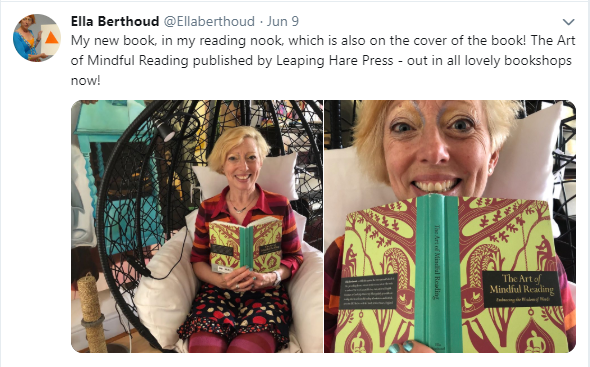
Although she acknowledges the place of e-readers and smartphones, Ella generally describes reading as a tactile experience, and insists on the importance of keeping a print reading journal as well as a ‘Golden Treasury’ of favorite passages, two strategies that will combat the tendency to forget a book as soon as you’ve finished it.
Some of her suggestions of what to do with physical books are beyond the pale for me – such as using a knife to slice a daunting doorstopper into more manageable chunks, or beating up a much-hyped book to “rob [it] of its glamour and gloss, and bring it down from its pedestal to a more humble state, a place where you can read it in comfort” – but there are ideas here to suit every kind of reader. Take a quick break between novels and use this book to think about how you read and in what ways you could improve or intensify the experience.
Favorite passages:
“As a bibliotherapist, I believe that every novel you read shapes the person that you are, speaking to you on a deep, unconscious level, and altering your very nature with the ideas that it shows you.”
“I often find that people imagine reading fiction is a self-indulgent thing to do, and that they ought to be doing something else. Much research has been conducted into the benefits of reading fiction, which deepens your empathy and emotional intelligence, helps with making important life decisions and allows your brain to rest. Research has shown that reading provides as much relaxation as meditation”
My rating: 
With thanks to Leaping Hare Press for the free copy for review.
Following Up on the Prescriptions from My Bibliotherapy Appointment
In January 2018 I had the wonderful opportunity to have a free bibliotherapy session at the School of Life in London with Ella Berthoud, one of the authors of The Novel Cure. I wrote about the experience in this post. I quickly got hold of all but a couple of my prescribed reads, but have been slower about actually reading them. Though I’ve read five now, I’ve only written up four, two of which I only managed to finish this week. (These 250-word reviews are in order of my reading.)
Heligoland by Shena Mackay (2002)
(CURE: moving house)
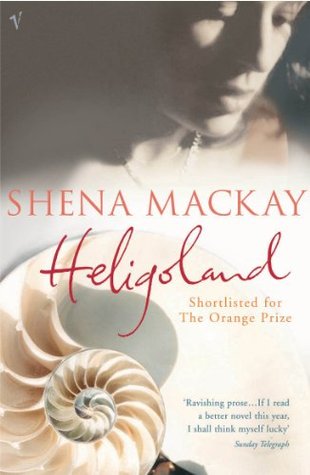 Heligoland is a Scottish island best known from the shipping forecast, but here it’s an almost mythical home. Rowena Snow was orphaned by her Indian/Scottish parents, and a second time by her aunt. Since then she’s drifted between caring and cleaning jobs. The Nautilus represents a fresh chance at life. This shell-shaped artists’ commune in South London houses just three survivors: Celeste Zylberstein, who designed the place; poet Francis Campion; and antiques dealer Gus Crabb. Rowena will be the housekeeper/cook, but she struggles with self-esteem: does she deserve to live in a haven for upper-class creative types?
The omniscient perspective moves between the Nautilus residents but also on to lots of other minor hangers-on, whose stories are hard to keep track of. Mackay’s writing reminded me somewhat of Tessa Hadley’s and is lovely in places – especially when describing a buffet or a moment of light-filled epiphany in a garden. There’s not much to be said beyond what’s in the blurb: Mackay is attempting to give a picture of a drifter who finds an unconventional home; in the barest sense she does succeed, but I never felt a connection with any of the characters. In this ensemble cast there is no one to love and thus no one to root for. While I didn’t love this book, it did inspire me to pick up others by Mackay: since then I’ve read The Orchard on Fire, which I liked a lot more, and the first half of Dunedin.
My rating: 
Family Matters by Rohinton Mistry (2002)
(CURE: worry over ageing parents)
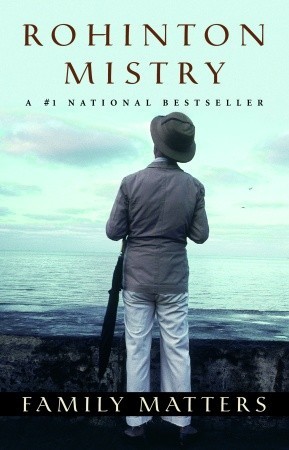 Retired professor Nariman Vakeel, 79, has Parkinson’s disease and within the first few chapters has also fallen and broken his ankle. His grown stepchildren, Coomy and Jal, reluctant to care for him anyway, decide they can’t cope with the daily reality of bedpans, sponge baths and spoon feeding in their large Chateau Felicity apartment. He’ll simply have to recuperate at Pleasant Villa with his daughter Roxana and her husband and sons, even though their two-bedroom apartment is barely large enough for the family of four. You have to wince at the irony of the names for these two Bombay housing blocks, and at the bitter contrast between selfishness and duty.
Perhaps inevitably, Nariman starts to fade into the background. An increasingly speechless invalid, he only comes alive through his past: italicized sections, presented as his night-time ravings, tell of his love for Lucy, whom his parents refused to let him marry, and the untimely end of his arranged marriage. I enjoyed time spent in a vibrantly realized Indian city and appreciated a chance to learn about a lesser-known community: Nariman and family are Parsis (or Zoroastrians). There’s also a faint echo here of King Lear, with one faithful daughter set against two wicked children.
As to ageing parents, this is a pretty relentlessly bleak picture, but there are sparks of light: joy in life’s little celebrations, and unexpected kindnesses. Mistry’s epic has plenty of tender moments that bring it down to an intimate scale. I’m keen to read his other novels.
My rating: 
Maggie & Me by Damian Barr (2013)
(A supplementary prescription because I love memoirs and didn’t experience Thatcher’s Britain.)
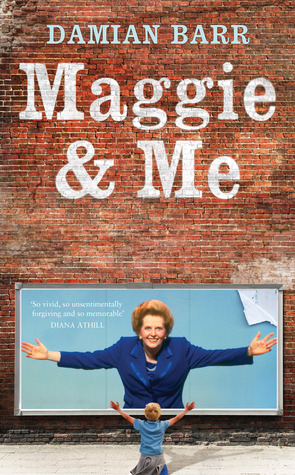 Like a cross between Angela’s Ashes and Toast, this recreates a fairly horrific upbringing from the child’s perspective. Barr was an intelligent, creative young man who early on knew that he was gay and, not just for that reason, often felt that there was no place for him: neither in working-class Scotland, where his father was a steelworker and his brain-damaged mother flitted from one violent boyfriend to another; nor in Maggie Thatcher’s 1980s Britain at large, in which money was the reward for achievement and the individual was responsible for his own moral standing and worldly advancement. “I don’t need to stand out any more,” he recalls, being “six foot tall, scarecrow skinny and speccy with join-the-dots spots, bottle-opener buck teeth and a thing for waistcoats. Plus I get free school dinners and I’m gay.”
There are a lot of vivid scenes in this memoir, some of them distressing ones of abuse, and the present tense, dialect, and childish grammar and slang give it authenticity. However, I never quite bought in to the Thatcher connection as an overarching structure. Three pages at the start, five at the end, and a Thatcher quote as an epigraph for each chapter somehow weren’t enough to convince me that the framing device was necessary or apt. Still, I enjoyed this well enough as memoirs go, and I would certainly recommend it if you loved Nigel Slater’s memoir mentioned above. I also have Barr’s recent debut novel, You Will Be Safe Here, on my Kindle.
My rating: 
The Monsters of Templeton by Lauren Groff (2008)
(A supplementary prescription for uncertainty about having children.)
 I enjoyed this immensely, from the first line on: “The day I returned to Templeton steeped in disgrace, the fifty-foot corpse of a monster surfaced in Lake Glimmerglass.” Twenty-eight-year-old Willie Upton is back in her hometown, pregnant by her older, married archaeology professor after a summer of PhD fieldwork in Alaska. “I had come home to be a child again. I was sick, heartbroken, worn down.” She gives herself a few weeks back home to dig through her family history to find her father – whom Vi has never identified – and decide whether she’s ready to be a mother herself.
We hear from various leading lights in the town’s history and/or Willie’s family tree through a convincing series of first-person narratives, letters and other documents. Groff gives voice to everyone from a Mohican chief to a slave girl who catches her master’s eye. Willie and Vi are backed up by a wonderful set of secondary characters, past and present. Groff wrote this in homage to Cooperstown, New York, where she grew up. (If you’ve heard of it, it’s probably for the baseball museum; it’s not far from where my mother is from in upstate New York.) Templeton is “a slantwise version” of Cooperstown, Groff admits in an opening Author’s Note, and she owes something of a debt to its most famous citizen, James Fenimore Cooper. What a charming way to celebrate where you come from, with all its magic and mundanity. This terrific debut novel cemented my love of Groff’s work.
My rating:
I also have Ella to thank for the inspiration to reread a childhood favorite, Little Women by Louisa May Alcott, last year; the experiment formed the subject of my first piece for Literary Hub. I also worked my way through The Artist’s Way by Julia Cameron, another of my prescriptions, over a number of months in 2018, but failed to keep up with the regular writing exercises so didn’t get the maximum benefit.
My husband and I made a start on reading a few books aloud to each other, including Sum: Forty Tales from the Afterlives by David Eagleman, but that fell by the wayside after a handful of weeks.
(Incidentally, I had forgotten that Cutting for Stone turns up in The Novel Cure on a list of the 10 best books to combat xenophobia.)
 Still to read: Jitterbug Perfume by Tom Robbins (CURE: horror of ageing)
And one I still have to get hold of but haven’t been able to find cheap secondhand because it’s a Persephone classic: The Victorian Chaise-Longue by Marghanita Laski (a supplementary prescription because I love Victorian pastiches).
Nonfiction November: Fiction/Nonfiction Pairings
I’d never participated in Nonfiction November before because I tend to read at least 40% nonfiction anyway, but I couldn’t resist the temptation to put together some fiction and nonfiction pairings based on books I’ve read this year and last. (This week of the month-long challenge is posted by Sarah’s Book Shelves, a blog I love for its no-nonsense recommendations of what to read – and what not to read – from the recent U.S. releases.)
My primary example is two books that reveal what it’s really like to have Alzheimer’s disease. Mitchell’s, in particular, is a book that deserves more attention. When it came out earlier this year, it was billed as the first-ever “dementia memoir” (is that an oxymoron?) – except, actually, there had been one the previous year (whoops!): Memory’s Last Breath by Gerda Saunders, which I have on my Kindle and still intend to read. [See also Kate W.’s picks, which include a pair of books with a dementia theme.]
Still Alice by Lisa Genova (2007)
 Genova’s writing, Jodi Picoult-like, keeps you turning the pages; I read 225+ pages in an afternoon. There’s true plotting skill to how Genova uses a close third-person perspective to track the mental decline of Harvard psychology professor Alice Howland, who has early-onset Alzheimer’s disease. “Everything she did and loved, everything she was, required language,” yet her grasp of language becomes ever more slippery even as her thought life remains largely intact. I also particularly enjoyed the descriptions of Cambridge and its weather, and family meals and rituals. There’s a certain amount of suspension of disbelief required – Would the disease really progress this quickly? Would Alice really be able to miss certain abilities and experiences once they were gone? – and ultimately I preferred the 2014 movie version, but this would be a great book to thrust at any caregiver or family member who’s had to cope with dementia in someone close to them.
My rating:
 Other fictional takes on dementia that I can recommend: Unforgettable: Short Stories by Paulette Bates Alden, The Only Story by Julian Barnes, Everything Under by Daisy Johnson and Turn of Mind by Alice LaPlante.
&
Somebody I Used to Know by Wendy Mitchell with Anna Wharton (2018)
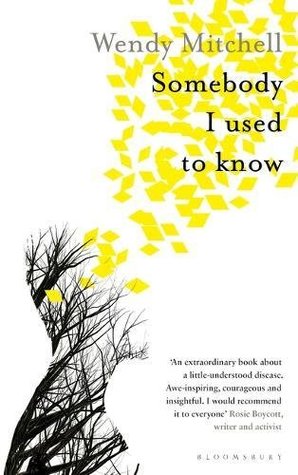 A remarkable insider’s look at the early stages of Alzheimer’s. Mitchell took several falls while running near her Yorkshire home, but it wasn’t until she had a minor stroke in 2012 that she and her doctors started taking her health problems seriously. In July 2014 she got the dementia diagnosis that finally explained her recurring brain fog. She was 58 years old, a single mother with two grown daughters and a 20-year career in NHS administration. Having prided herself on her good memory and her efficiency at everything from work scheduling to DIY, she was distressed that she couldn’t cope with a new computer system and was unlikely to recognize the faces or voices of colleagues she’d worked with for years. Less than a year after her diagnosis, she took early retirement – a decision that she feels was forced on her by a system that wasn’t willing to make accommodations for her.
The book, put together with the help of ghostwriter Anna Wharton, gives a clear sense of progression, of past versus present, and of the workarounds Mitchell uses to outwit her disease. The details and incidents are well chosen to present the everyday challenges of dementia. For instance, baking used to be one of Mitchell’s favorite hobbies, but in an early scene she’s making a cake for a homeless shelter and forgets she’s already added sugar; she weighs in the sugar twice, and the result is inedible. By the time the book ends, not only can she not prepare herself a meal; she can’t remember to eat unless she sets an alarm and barricades herself into the room so she won’t wander off partway through.
In occasional italicized passages Mitchell addresses her past self, running through bittersweet memories of all that she used to be able to do: “It amazes me now how you did it, because you didn’t have anyone to help you. You were Mum, Dad, taxi, chef, counsellor, gardener and housekeeper, all rolled into one.” Yet it’s also amazing how much she still manages to do as an ambassador for the Alzheimer’s Society and Dementia Friends. She crisscrosses the country to give speeches, attend conferences, and advise universities; she writes a blog and has appeared on radio to promote this book. Like many retired people, she’s found she’s busier than ever, and her engagements help her to feel purposeful and like she’s giving a positive impression of early-stage dementia. No matter that she has to rely on dozens of reminders to self in the form of Post-It notes, iPad alarms and a wall of photographs.
The story lines of this and Still Alice are very similar in places – the incidents while running, the inability to keep baking, and so on. And in fact, Mitchell reviewed the film and attended its London premiere, where she met Julianne Moore. Her book is a quick and enjoyable read, and will be so valuable to people looking to understand the experience of dementia. She is such an inspiring woman. I thank her for her efforts, and wish her well. This is one of my personal favorites for the shortlist of next year’s Wellcome Book Prize for medical reads.
My rating: 
 Other nonfiction takes on dementia that I can recommend: In Pursuit of Memory by Joseph Jebelli and The Summer of the Great-Grandmother by Madeleine L’Engle.
Additional pairings I would commend to you (all are books I have read and rated or above):


Talk before Sleep by Elizabeth Berg
&
Let’s Take the Long Way Home by Gail Caldwell and Truth and Beauty by Ann Patchett
- Celebrating the strength of female friendship, even in the face of life-threatening illness.


Bad News by Edward St. Aubyn
&
Portrait of an Addict as a Young Man by Bill Clegg
- Vivid portrayals of drug addiction.


Miss Smilla’s Feeling for Snow by Peter Høeg
&
This Cold Heaven by Gretel Ehrlich
- Armchair traveling in Greenland.


Sweetbitter by Stephanie Danler
&
Cork Dork by Bianca Bosker
- Glimpses into the high-class world of fine dining – and fine wine.
 Dear Fahrenheit 451: Love and Heartbreak in the Stacks by Annie Spence is chock-full of recommendations and reading pairs. The Novel Cure is also good for this sort of thing, though it is (no surprise) overwhelmingly composed of fiction suggestions.
Today Is World Read Aloud Day
 An unprecedented second post in one day for me. I recently learned from Ron Charles’s article in the Washington Post that today, February 1st, is World Read Aloud Day, an annual celebration hosted by LitWorld to draw attention to ongoing literacy challenges. I mentioned in my write-up of my bibliotherapy experience that one recommendation I was given was to try reading aloud with my husband. To that end, I got hold of the three suggested books below and we’ve dipped into all of them on recent evenings. At the moment we’re managing to do a bit of reading aloud every few days, which isn’t so bad for a start.

Dimitri’s book includes extracts by everyone from Neil Gaiman to Robert Macfarlane, all arranged under thematic headings. A special index at the back of the book orders the pieces according to how long they are estimated to take to read, ranging from three minutes to more like 15. So far we’ve tackled a handful of the shorter pieces; any of the longer ones we’ll probably split and each take half.
David Eagleman’s flash fiction collection is billed as being about the afterlife. The first story was a laugh-out-loud inventory of all the time the average human spends on different activities. Thirty-three hours sleeping versus 14 minutes experiencing pure joy. That kind of thing. I look forward to the rest.
Ella Berthoud particularly recommended Saki’s short story “Tobermory” since it’s about a talking cat (but is rather dark!), so we started with that one. Many of the others are only a couple of small-print pages. Have you read any Saki? What can you recommend?
Apart from classroom experiences, the last time I remember doing concerted reading aloud was with my mother when I was in my early teens. After I got home from school in the afternoons we’d convene on her bed to read Mark Twain short stories like “The Celebrated Jumping Frog of Calaveras County.”
Have you done any reading aloud lately?
My Bibliotherapy Appointment at the School of Life
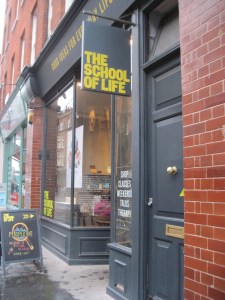 I’ve been interested in bibliotherapy for years, and I love The Novel Cure (see my review), the learned and playful advice book from Ella Berthoud and Susan Elderkin, two of the bibliotherapists at Alain de Botton’s London School of Life. Earlier this month I had the tremendous opportunity to have a personalized bibliotherapy appointment with Ella Berthoud at the School of Life. She’d put out a call on Twitter for volunteers to come for a free session (usually £100) to be observed by a journalist from La Repubblica writing about bibliotherapy – the translation of The Novel Cure has sold remarkably well in Italy. The feature will be part of a special color supplement in February, and I look forward to seeing if my story makes the cut! That is, if I can decipher any of the Italian.
Now, you might not think I’m the kind of person who needs a bibliotherapy assessment since I already find 300+ books per year I want to read; I worried that too, and felt a little bit guilty, but in the end I couldn’t pass up the chance, and Ella was happy to have me.
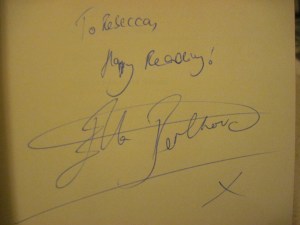
I took my copy of The Novel Cure along for Ella to sign.
Before my appointment I’d been asked to complete a two-page questionnaire about my reading habits and likes/dislikes, along with what’s going on in my life in general (the ‘therapy’ aspect is real). Once we were set up in the basement therapy room with hot drinks, Ella asked me more about how I read. I’d told her my reading was about two-thirds print books and one-third e-books. Had I ever tried audiobooks or reading aloud, she asked? The answer to both of those is no, I’m afraid. There’s no obvious place for audiobooks in my life because I work from home. However, as I’d mentioned I haven’t been able to get through a Dickens novel in five years, Ella suggested I try listening to one – abridged, it can be more like eight hours long instead of 42, and you still get a terrific story. She also highly recommended New Yorker and Guardian podcasts based around short stories and discussion.
 For reading aloud with my husband, Ella prescribed one short story per evening sitting – a way for me to get through short story collections, which I sometimes struggle to finish, and a different way to engage with books. We also talked about the value of rereading childhood favorites such as Watership Down and Little Women, which I haven’t gone back to since I was nine and 12, respectively. In this anniversary year, Little Women would be the ideal book to reread (and the new television adaptation is pretty good too, Ella thinks).
One other reading habit Ella is adamant about is keeping a physical reading journal in which you record the title of each book you read, where you read it, and about a paragraph of thoughts about it. It’s not meant to be a comprehensive response to every book; more like an aide-mémoire that you can get off the shelf in years to come to remind yourself of what you thought about a book. Specifically, Ella thinks writing down the location of your reading (e.g., on a train to Scotland) allows you to put yourself back in the moment. I tend to note where I bought a book, but not necessarily where I read it – for that, I would probably have to cross-reference my annual book list against a calendar. Since 2010 I’ve kept my book lists and responses in computer files, and I also keep full records via Goodreads, but I can see why having a physical journal would be a good back-up as well as a more pleasant representation of my reading. I’ll think about starting one.
 Various books came up over the course of our conversation: Abraham Verghese’s Cutting for Stone [appearance in The Novel Cure: The Ten Best Novels to Cure the Xenophobic, but Ella brought it up because of the medical theme], Tom Robbins’ Jitterbug Perfume [cure: ageing, horror of], and Julia Cameron’s The Artist’s Way, a nonfiction guide to thinking creatively about your life, chiefly through 20-minute automatic writing exercises every morning. We agreed that it’s impossible to dismiss a whole genre, even if I do find myself weary of certain trends, like dystopian fiction (I introduced Ella to Claire Vaye Watkins’ Gold Fame Citrus, one of my favorite recent examples).
 I came away with two instant prescriptions: Heligoland by Shena Mackay [cure: moving house], about a shell-shaped island house that used to be the headquarters of a cult. It’s a perfect short book, Ella tells me, and will help dose my feelings of rootlessness after moving more than 10 times in the last 10 years. She also prescribed Family Matters by Rohinton Mistry [cure: ageing parents] and an eventual reread of Jonathan Franzen’s The Corrections. As we discussed various other issues, such as my uncertainty about having children, Ella said she could think of 20 or more books to recommend me. “That’s a good thing, right?!” I asked.


Before I left, I asked Ella if she would ever prescribe nonfiction. She said they have been known to do so, usually if it’s written in a literary style (e.g. Robert Macfarlane and Alain de Botton). We chatted about medical memoirs and reading with the seasons for a little while, and then I thanked her and headed on my way. I walked around the corner to Skoob Books but, alas, didn’t find any of the books Ella had mentioned during our session. On the way back to the Tube station, though, I stopped at Judd Books and bought several secondhand and remaindered goodies, including these two:


(Imagine my surprise when I spotted The Year of the Hare in The Novel Cure under midlife crisis! Age seemed to be the theme of the day.)
 As soon as I got back from London I ordered secondhand copies of Heligoland, Jitterbug Perfume and The Artist’s Way, and borrowed Family Matters from the public library the next day. Within a few days four further book prescriptions arrived for me by e-mail. Ella did say that her job is made harder when her clients read a lot, so kudos to her for prescribing books I’d not read – with the one exception of Sebastian Barry’s Days Without End, which I love.
I’ve put in another order for Maggie and Me, the memoir by Damian Barr, plus (for reading aloud) Sum: Forty Tales from the Afterlives by David Eagleman and the collected short stories of Saki. I’m also keen to find The Victorian Chaise-Longue by Marghanita Laski, Ella’s final prescription, but as the Persephone Books reprint is pricey at the moment I may hold off and hope to chance upon a secondhand copy later in the year. Ella has been very generous with her recommendations, especially considering that I didn’t pay a penny. I certainly have plenty to be getting on with for now! I’ll report back later on in the year when I’ve had the chance to read some of these prescriptions.
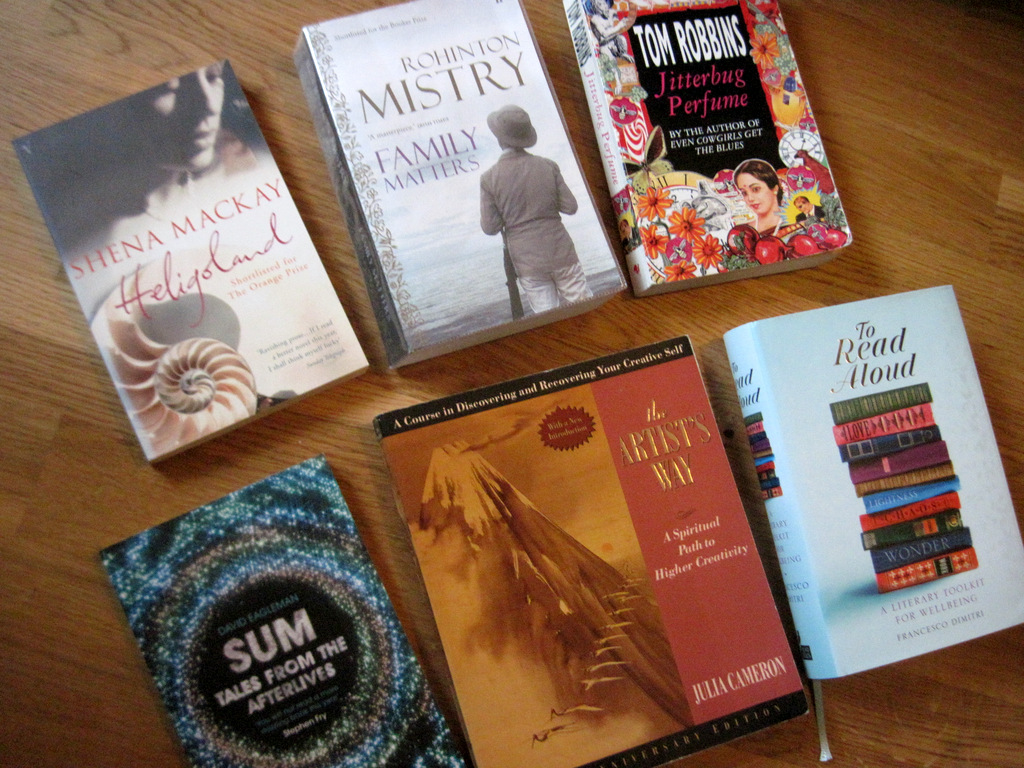
The prescribed books I have gotten hold of so far.
 Bookish Beck = Rebecca Foster. American transplant to England. Freelance proofreader and book reviewer.
 Bookish Beck


.jpg)
.jpg)