Richard Rohr at Greenbelt Festival (Online) & The Naked Now Review
Back in late August, I attended another online talk that really chimed with the one by Richard Holloway, this time as part of Greenbelt Festival, a progressive Christian event we used to attend annually but haven’t been to in many years now.
Not just as a Covid holdover but also in a conscious sustainability effort, Greenbelt hosted a “fly-free zone” where overseas speakers appeared on a large screen instead of travelling thousands of miles. So Richard Rohr, who appeared old and frail to me – no wonder, as he is now 81 and has survived five unrelated cancers (doctors literally want to do a genetic study on him) – appeared from the communal lounge of his Center for Action and Contemplation in New Mexico to introduce his upcoming book The Tears of Things, due in March 2025. The title is from the same Virgil quote as Holloway’s The Heart of Things. It’s about the Old Testament prophets’ shift from rage to lamentation to doxology (“the great nevertheless,” he called it): a psychological journey we all must make as part of becoming spiritually mature.
From reading his Falling Upward, I was familiar with Rohr’s central teaching of life being in two halves: the first, ego-led, is about identity and argumentation; the second is about transcending the self to tap into a universal consciousness. “It’s a terrible burden to carry your own judgementalism,” he declared. A God encounter provokes the transformation, and generally it comes through suffering, he said; you can’t take a shortcut. Anger is a mark of “incomplete” prophets such as John the Baptist, he explained. Rage might seem to empower, but it’s unrefined and only gives people permission to be nasty to others, he said. We can’t preach about a wrathful God or we will just produce wrathful people, he insisted; instead, we have to teach mercy.
When Rohr used to run rites of passage for young men, he would tell them that they weren’t actually angry, they were sad. There are tears that come from God, he said: for Gaza, for Ukraine. We know that Jesus wept at least twice, as recorded in scripture: once for Jerusalem (the collective) and once for his dead friend Lazarus (the individual). Doing the “grief work” is essential, he said. A parallel to that anger to sadness to praise trajectory is order to disorder to reorder, a paradigm he takes from the Bible’s wisdom literature. Brian McLaren’s recent work is heavily influenced by these ideas, too.
During the question time, Rohr was drawn out on the difference between Buddhism and Christianity (the latter gives reality a personal and benevolent face, he said) and how he understands hope – it is participation in the life of God, he said, and it certainly doesn’t come from looking at the data. He lauded Buddhism for its insistence on non-dualism or unitive consciousness, which he also interprets as the “mind of Christ.” The love of God is the Absolute, he said, and although he has experienced it throughout his life, he has known it especially when (as now) he was weak and poor.
Non-dualism is the theme that led me to go back to a book that had been on my bedside table, partly read, for months.
The Naked Now: Learning to See as the Mystics See (2009)
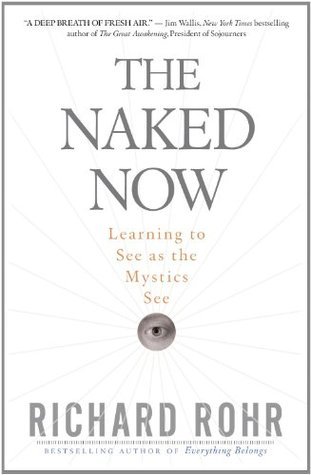 This was my fourth book by Rohr, and as with The Universal Christ, I feel at a loss trying to express how wise and earth-shaking it is. The kernel of the argument is simple. Dualistic thinking is all or nothing, us and them. The mystical view of life involves nonduality; not knowing the right things but “knowing better” through contemplation. It’s an opening of the heart that then allows for a change of mind. And yes, as he said at Greenbelt, it mostly comes about through great suffering – or great love. Jesus embodies nonduality by being not human or divine, but both, as does God through the multiplicity of the Trinity.
The book completely upends the fundamentalist Christianity I grew up with. Its every precept is based on Bible quotes or Christian tradition. It’s only 160 pages long, very logical and readable; I only went through it so slowly because I had to mark out and reread brilliant passages every few pages.
You can tell adult and authentic faith by people’s ability to deal with darkness, failure, and nonvalidation of the ego—and by their quiet but confident joy!
[I’ve met people who are like this.]
If your religious practice is nothing more than to remain sincerely open to the ongoing challenges of life and love, you will find God — and also yourself.
[This reminded me of “God is change,” the doctrine in Parable of the Sower by Octavia E. Butler.]
If you can handle/ignore a bit of religion, I would recommend Rohr to readers of Brené Brown, Susan Cain (thinking of Bittersweet in particular) and Anne Lamott, among other self-help and spirituality authors – e.g., he references Eckhart Tolle. Rohr is also known for being one of the popularizers of the Enneagram, a personality tool similar to the Myers-Briggs test but which in its earliest form dates back to the Desert Father Evagrius Ponticus. 
20 Books of Summer, #10–11: Dabiri and McDonald on Whiteness
I didn’t jump on the antiracist books bandwagon last year. Instead, my way into the topic was a work I became aware of through the online Church Times Festival of Faith and Literature. I was on the Church House website to buy books by several of the weekend’s contributors and a forthcoming release being advertised jumped out at me for its provocative title and fabulous cover: God Is Not a White Man. I promptly pre-ordered. It never fails to put this Gungor song in my head, and seemed an ideal way to engage with the issues from a perspective that makes sense to me. So for this latest batch of colour-themed summer reads I’m thinking about whiteness from the point of view of women of colour based in England and Ireland.
God Is Not a White Man (And Other Revelations) by Chine McDonald (2021)
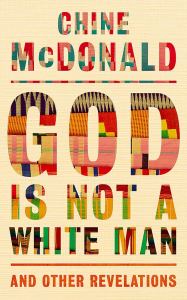 Here’s where McDonald is coming from: she moved to England from Nigeria with her family as a small child, grew up on the Evangelical end of Anglicanism, works for Christian Aid, and is married to a white man. She’s used to being the only Black person in the room when she steps into a church or other Christian setting in the UK. “It is a sad fact that the Church often lags behind on racial justice, remaining intransigent on issues that the world has long since labelled oppressive and unjust [such as opposing interracial marriage].” Always in the background for her is the way Black people are being treated in other parts of the world: although she wrote the bulk of this book before George Floyd’s murder, she has updated it with details about Donald Trump’s late outrages and the Black Lives Matter movement. Her chief concern is for her young son, growing up as a male with brown skin.
The book is shaped around moments of revelation large and small. For instance, McDonald opens with the first time she saw a God who looked like her. It was through The Shack, a bestselling novel by William P. Young in which God the Father is portrayed as a big Black woman (played by Octavia Spencer in the film version). She notes how important such symbolism is: “When a Black woman only sees God reflected as a white man, then somewhere in her subconscious she believes that white men are better representations of God than she is, that she is made less in the image of God than they are.” Other topics are the importance of equal access and education (she went to Cambridge), and standards of beauty. Beyoncé helped her to love her body, curves and all, and feel a sense of Black sisterhood. I liked getting glimpses into her life, such as her big Nigerian wedding to Mark. (New purchase)
Links between the two books: The authors’ Nigerian heritage, plus McDonald mentions that she interviewed Dabiri at Greenbelt Festival in 2019 and has been trying to get up the courage to return to her natural hair, as Dabiri encouraged her (the Natural Hair Movement is the topic of Dabiri’s first book, Don’t Touch My Hair).
What White People Can Do Next: From Allyship to Coalition by Emma Dabiri (2021)
Another terrific cover with a bold sans serif font. This is clearly in the mould of 2020’s antiracist books, but Dabiri wouldn’t thank you for considering her under the same umbrella. She doesn’t like the concept of allyship because it reinforces unhelpful roles: people of colour as victims and white people as the ones with power who can come and save the day.
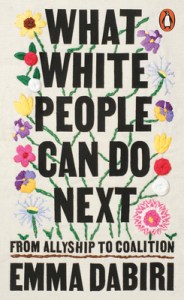 Dabiri is Irish and Nigerian and grew up in the USA and Ireland. Her experience of racism was much more overt than McDonald’s, including verbal and physical abuse. She challenges white people to stop the denial: ‘whiteness’ and ‘blackness’, though artificial constructs, have been with us since at least the 1660s, so racism is a system we have all been born into. “We’ve been conditioned to see the world through that lens for centuries. … over that you have no control. What you do have control over is what you do next.”
Like McDonald, Dabiri emphasizes that monolithic categories like white and Black flatten a huge diversity of people and experiences (McDonald has a chapter entitled “Africa Is Not a Country”). But Dabiri has a more political (as well as, of course, a completely secular) approach: She wants readers to interrogate capitalism and think about how resources can be redistributed more fairly. Her notion of coalition is about identifying common ground and shared goals. “On the most basic level, we have to see our struggles as interconnected because they are, and because we are.”
Reading this was like encountering an extended TED talk. I wasn’t taken enough with Dabiri’s writing style to seek out her previous book, but if you have an interest in the subject matter you may as well pick up this 150-pager. It was small enough for me to pack in the back of our booze bag and read a bit of during a neighbour’s outdoor birthday party last weekend. I got a couple of “huh” looks, but that may have been just for reading during a party at all rather than for the specific content. (Public library)
Would I say that I enjoyed reading these two books? That’s a tough question. They were worthwhile, but also tedious in places, such that I did plenty of skimming. History, politics, sociology: these fields are not my reading comfort zone. The theological bent to McDonald’s work made it more to my taste than Dabiri’s contribution. Still, my whole reason for avoiding antiracist books was that I questioned my motivation. I didn’t want to read them because I felt I should; a sense of obligation is a recipe for resentment when it comes to books. I’m not sure to what extent readers should read things they feel they must. I look to books for learning opportunities, yes, but also for escape and pleasure. But maybe it’s valuable simply to show willing, to get outside your reading comfort zone and be open to hearing new ideas.
How about you? Would you pick up one of these for the educational value?
I have ALL of the rest of my 20 Books of Summer in progress at the moment. The only question is when I will next finish some!
Four June Releases (Fiction & Poetry): Bennett, Gabrielsen, Kwek and Watts
(A rare second post in a day from me, to make way for tomorrow’s list of the best books of the first half of the year.) My four new releases for June are a novel about the complications of race and sexuality in 1950s–80s America, a novella in translation about a seabird researcher struggling through a time of isolation, and two new poetry books from Carcanet Press. As a bonus just in time for Pride Month, I finish with a mini write-up of The Book of Queer Prophets, an anthology of autobiographical essays that was published late last month.
The Vanishing Half by Brit Bennett
 Like some lost mid-career gem from Toni Morrison, this novel is meaty with questions of racial and sexual identity and seems sure to follow in the footsteps of Ruby and An American Marriage with a spot in Oprah’s book club and on Barack Obama’s summer reading list.
It’s the story of light-skinned African American twins Stella and Desiree Vignes, and how their paths divide in 1954. Both are desperate to escape from Mallard, Louisiana, where their father was lynched and their mother cleans white people’s houses. Desiree works in fingerprinting for the FBI in Washington, D.C., but in 1968 leaves an abusive marriage to return to Mallard with her dark-skinned daughter, Jude Winston. Stella, on the other hand, has been passing as white for over a decade. She was a secretary for the man who became her husband, Blake Sanders, and now lives a life of comfort in a Los Angeles subdivision.
The twins’ decisions affect the next generation, too. Both have one daughter. Jude goes to college in L.A., where she meets and falls in love with photographer Reese (born Therese), who is, in a different sense, “passing” until he can afford the surgery that will align his body with his gender. In a coincidence that slightly strains belief, Jude runs into Stella’s daughter, Kennedy, and over the next seven years the cousins – one a medical student; the other an actress – continue to meet occasionally, marvelling at how two family lines that started in Mallard, a tiny town that doesn’t even exist anymore, could have diverged so dramatically.
This is Bennett’s second novel, after The Mothers, which I’m keen to read. It’s perceptive and beautifully written, with characters whose struggles feel genuine and pertinent. Though its story line ends in the late 1980s, it doesn’t feel passé at all. The themes of self-reinvention and running from one’s past resonate. I expected certain characters to be forced into moments of reckoning, but the plot is a little messier than that – and that’s more like real life. A shoo-in for next year’s Women’s Prize list.
My rating: 
My thanks to Dialogue Books for the free copy for review.
Ankomst by Gøhril Gabrielsen (2017)
[Translated from the Norwegian by Deborah Dawkin]
 The unnamed narrator of Gabrielsen’s fifth novel is a 36-year-old researcher working towards a PhD on the climate’s effects on populations of seabirds, especially guillemots. During this seven-week winter spell in the far north of Norway, she’s left her three-year-old daughter behind with her ex, S, and hopes to receive a visit from her lover, Jo, even if it involves him leaving his daughter temporarily. In the meantime, they connect via Skype when signal allows. Apart from that and a sea captain bringing her supplies, she has no human contact.
Daily weather measurements and bird observations still leave too much time alone in a cramped cabin, and this starts to tell in the protagonist’s mental state: she’s tormented by sexual fantasies, by memories of her life with S, and by the thought of a local family, the Berthelsens, who experienced a disastrous house fire in 1870. More and more frequently, she finds herself imagining what happened to Olaf and Borghild Berthelsen. Solitude and this growing obsession with ghosts of the past make her start to lose her grip on reality.
I’d encountered an unreliable narrator and claustrophobic setting before from Gabrielsen with her second novel, The Looking-Glass Sisters. Extreme weather and isolation account for this being paired with Snow, Dog, Foot by Claudio Morandini as the first two books in Peirene’s 2020 “Closed Universe” trilogy. I was also reminded of Sarah Moss’s Night Waking. However, I found this novella’s metaphorical links – how seabirds and humans care for their young; physical and emotional threats; lowering weather and existential doom – too obvious.
My rating: 
My thanks to Peirene Press for the free copy for review.
Moving House by Theophilus Kwek
 This is the first collection of the Chinese Singaporean poet’s work to be published in the UK. Infused with Asian history, his elegant verse ranges from elegiac to romantic in tone. Many of the poems are inspired by historical figures and real headlines. There are tributes to soldiers killed in peacetime training and accounts of high-profile car accidents; “The Passenger” is about the ghosts left behind after a tsunami. But there are also poems about the language and experience of love. I also enjoyed the touches of art and legend: “Monologues for Noh Masks” is about the Pitt-Rivers Museum collection, while “Notes on a Landscape” is about Iceland’s geology and folk tales. In most places alliteration and enjambment produce the sonic effects, but there are also a handful of rhymes and half-rhymes, some internal.
My individual favorite poems included “Prognosis,” “Sophia” (made up of two letters Sir Thomas Stamford Raffles writes home to his wife while surveying in Singapore), and “Operation Thunderstorm.” As an expat and something of a nomad, I especially loved the title poem, which comes last and explains the cover image: “every house has a skeleton – / while the body learns it must carry less / from place to place, a kind of tidiness / that builds, hardens. Some call it fear, // of change, or losing what we cannot keep. / Others, experience.” Recommended to fans of Mary Jean Chan, Nausheen Eusuf, Kei Miller and Ocean Vuong.
My rating:
My thanks to Carcanet Press for the PDF copy for review.
Red Gloves by Rebecca Watts
 I noted the recurring comparison of natural and manmade spaces; outdoors (flowers, blackbirds, birds of prey, the sea) versus indoors (corridors, office life, even Emily Dickinson’s house in Massachusetts). The style shifts from page to page, ranging from prose paragraphs to fragments strewn across the layout. Most of the poems are in recognizable stanzas, though these vary in terms of length and punctuation. Alliteration and repetition (see, as an example of the latter, her poem “The Studio” on the TLS website) take priority over rhymes. I was reminded of Elizabeth Bishop in places, while “Whereas” had me thinking of Stephen Dunn’s collection of that name (Layli Long Soldier also has a poetry book of the same title). A few of my individual favorite poems were “Surveillance,” “Building” and “Admission” (on a medical theme: “What am I afraid of? / The breaching of skin. / Violation of laws that / separate outside from in. / Liquidation of the thing / I call me.”).
My rating: 
My thanks to Carcanet Press for the PDF copy for review.
And a bonus for Pride Month:
The Book of Queer Prophets: 24 Writers on Sexuality and Religion, edited by Ruth Hunt
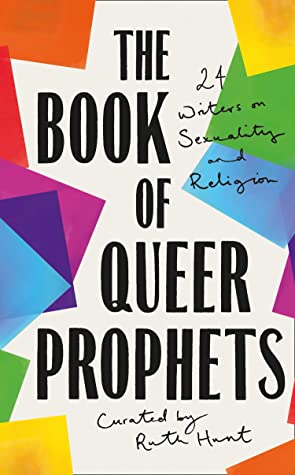 There isn’t, or needn’t be, a contradiction between faith and queerness, as the authors included in this anthology would agree. Many of them are stalwarts at Greenbelt, a progressive Christian summer festival – Church of Scotland minister John L. Bell even came out there, in his late sixties, in 2017. I’m a lapsed regular attendee, so a lot of the names were familiar to me, including those of poets Rachel Mann and Padraig O’Tuama.
Most of the contributors are Christian, then, including ordained priests like Desmond Tutu’s daughter, Mpho, and LGBT ally Kate Bottley, but we also hear from Michael Segalov, a gay Jewish man in London, and from Amrou Al-Kahdi (author of Unicorn: The Memoir of a Muslim Drag Queen), who describes the affirmation they found in the Sufi tradition. Dustin Lance Black tells of the exclusion LGBT Mormons still encounter.
Jarel Robinson-Brown addresses his lament on mistreatment to his nephew, as James Baldwin did in “My Dungeon Shook” (in The Fire Next Time). Tamsin Omond recounts getting married to Melissa on a London bridge in the middle of an Extinction Rebellion protest. Erin Clark, though bisexual, knows she can pass as straight because she’s marrying a man – so is she ‘gay enough?’ Two trans poets write of the way cathedrals drew them into faith. The only weaker pieces are by Jeanette Winterson (there’s nothing new if you’ve read her memoir) and Juno Dawson (entirely throwaway; ‘I’m an atheist, but it’s okay to be religious, too’).
Again and again, these writers voice the certainty that they are who God means them to be. A few of them engage with particular passages from the Bible, offering contextual critiques or new interpretations, but most turn to scripture for its overall message of love and justice. Self-knowledge is a key component of their search for truth. And the truth sets people free.
My rating:
I read an e-copy via NetGalley.
What recent releases can you recommend?
Thinking about the Future with David Farrier & Roman Krznaric (Hay Festival)
My last of three digital Hay Festival* talks this year was by Roman Krznaric, a School of Life philosopher with a background in politics and gardening. I discovered him through Greenbelt Festival eight years ago and have since enjoyed several of his books on the topics of empathy, finding purposeful work, and models for living well. His talk on his upcoming book, The Good Ancestor: How to Think Long Term in a Short Term World, was an ideal follow-up to one of the top three 2020 nonfiction works I’ve read so far:
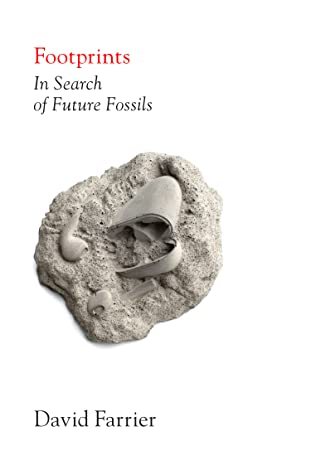
Footprints: In Search of Future Fossils by David Farrier
Look on my Works, ye Mighty, and despair!
Nothing beside remains. Round the decay
Of that colossal Wreck, boundless and bare
The lone and level sands stretch far away.
~from “Ozymandias” by Percy Bysshe Shelley
In May 2013 a set of fossil human footprints was found at Happisburgh in Norfolk. At 850,000 years old, they were the oldest outside of Africa. In the same month, atmospheric CO2 passed 400 ppm for the first time. It’s via such juxtapositions of past and future, and longevity versus precariousness, that Farrier’s book – a sophisticated lattice of human and planetary history, environmental realism and literary echoes – tells the story of the human impact on the Earth.
Unusually, Farrier is not a historian or a climate scientist, but a senior lecturer in English literature at the University of Edinburgh specializing in nature and place writing, especially in relation to the Anthropocene. That humanities focus allowed him to craft a truly unique, interdisciplinary work in which the canon both foreshadows and responds to environmental collapse. On a sabbatical in Australia, he also gets to hold an ice core taken by an icebreaker, swim above coral reefs and visit a uranium mine exempted from protection in a national park.
 He travels not just through space, but also through time, tracing a plastic bottle from algal bloom to oil to factory to river/landfill to ocean; he thinks about how cultural memory can preserve vanished landscapes; he imagines propitiatory rites arising around radioactive waste to explain poisoned lakes and zinc-lined coffins; and he wonders how to issue appropriate warnings to the future when we don’t even know if English, or language in general, will persist (a nuclear waste storage site in Carlsbad uses a combination of multilingual signs, symbols, monoliths and planned oral tradition, while one in Finland is unmarked).
Each chapter is an intricate blend of fact, experience and story. For example, “The Insatiable Road” is about cars and the concrete landscapes they zip through – all made possible by oil. Farrier wins a chance to be among the first to cross the new Forth Bridge on foot and finds himself awed by the human achievement. Yet he knows that, in a car, the bridge will be crossed in seconds and soon taken for granted. Whether as a driver or a passenger, we have become detached from the journey and from the places we are travelling through. The road trip, a standard element of twentieth-century art and literature, has lost its lustre. “Really, we have conceded so much,” he writes. “Most of us live and wander only where road networks permit us to, creeping along their edges and lulled into deafness by their constant roar.” Ben Okri’s legend provides the metaphor of a famished road that swallows all in its path.
What will the human species leave behind? “The entire atmosphere now bears the marks of our passage … Perhaps no one will be around to read our traces, but nonetheless we are, everywhere, constantly, and with the most astonishing profligacy, leaving a legacy that will endure for hundreds of thousands or even hundreds of millions of years to come.” That legacy includes the concrete foundations of massive road networks, the remnants of megacities on coastal plains, plastics that will endure for many centuries, carbon and methane locked up in permafrost, the 2300-km fossil of the dead Great Barrier Reef, nuclear waste in isolation plants, jellyfish-dominated oceans and decimated microbial life.
Thinking long term doesn’t come naturally. In the same way that multiple books of 2019 (Time Song, Surfacing, Underland) helped us think about the place of humanity in reference to deep time, Footprints offers an invaluable window onto the deep future. Its dichotomies of hubris and atonement, and culpability versus indifference, are essential to ponder. It was always going to be sobering to read about how we have damaged our only home, but I never found this to be a needlessly depressing book; it is clear-eyed and forthright, but also meditative and beautifully constructed. Life on the planet continues in spite of our alterations, but all the diminishment was unavoidable, and perhaps some of it is remediable still.
My rating: 
 Related reading: Notes from an Apocalypse by Mark O’Connell. I’m only up to page 36 and at the moment it’s just him watching loads of crackpot preppers’ videos on YouTube, but already I think that Footprints should have had this book’s spot on the Wainwright Prize for Writing on Global Conservation longlist (a new prize run in addition to the standard UK nature writing one) for being more directly engaged with conservation issues rather than just humorously commenting on the end-of-the-world mindset.
Roman Krznaric at Hay Festival
 Krznaric’s discussion of being a “good ancestor” resonated in connection with the long-term thinking of Farrier’s book. “This is the age of the tyranny of the now,” he began, but “humankind has colonized the future” as well, treating it as a tempus nullius where we can dump our ecological waste and tech failures. Yet long-termism is needed more than ever as a way of planning for environmental challenges (and pandemics and the like). Future generations have no say in the decisions we make now that will affect them. To put this in perspective, he showed an image of three spheres, proportionally sized: one represented the 100 billion dead, one was the 7.7 billion currently living, and one was the 6.75 trillion in unborn generations (if the current birth rate continues).
It was Jonas Salk, creator of the polio vaccine, who asked, “Are we being good ancestors?” Krznaric invited the audience to come up with examples (in the chat window on the sidebar) of long-term projects through which people are trying to help future generations, such as the Svalbard Seed Depository, the Green New Deal, the 10,000-Year Clock (inside a mountain in the Texas desert), the Long Play piece of music to last 1,000 years, rewilding, archives and libraries, and tree planting. He had also opened the talk with his own modest contribution: he and his partner ‘gave’ their 11-year-old twins their votes in the latest election.
Krznaric elaborated on four of his book’s six ways of thinking about the future: 1) Rethink human nature by using the “acorn brain” (long-term thinking) rather than the “marshmallow brain” (instant gratification). 2) Embark on projects with long time horizons (“cathedral thinking”). 3) Think in terms of legacies, whether familial or transcendent – leaving a gift to the citizens of the future (e.g. The Future Library of 100 books not published or read until 2114). 4) Create a politics for the future, e.g. the citizen assembly movement.
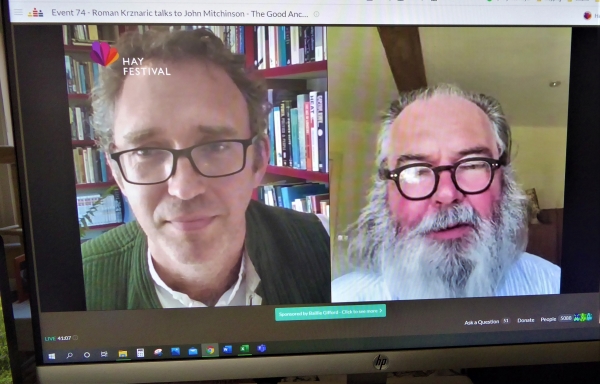
Roman Krznaric at the digital Hay Festival. Q&A led by John Mitchinson (right).
In the case of the UK, Krznaric advocates abolishing the House of Lords, replacing it with a citizens’ assembly and a Minister for the Future, and establishing legal rights for future generations. He noted that globally we’re at a “devil’s fork” where there’s a danger of authoritarian regulations continuing around the world after quarantine ends, endangering the future of social democracy. Instead, we need grassroots activism and “doughnut economics.” He pictures devolution of power away from central governments, with progressive cities becoming new loci of power. Individual actions like vowing not to fly and installing solar panels can inspire peers, but only collective action can tackle environmental breakdown.
 Related reading: I’ll be reviewing Eric Holthaus’s forthcoming book The Future Earth: A Radical Vision for What’s Possible in the Age of Warming for BookBrowse later this month. The meteorologist and science journalist fleshes out some of Krznaric’s ideas, such as a citizen assembly and the cyclical economy, in his proposal for the drastic changes needed over the next three decades.
*You can access the recorded Hay Festival talks by paying a £10 annual subscription here.
Have you read anything about the deep future?
Thinking about Dead Bodies with John Troyer (Hay Festival)
My second of three digital Hay Festival talks this year was by John Troyer, director of the interdisciplinary Centre for Death and Society at the University of Bath. Troyer is from Wisconsin (where he was speaking from, having been trapped there during a visit to his parents) and grew up with a father who owned a funeral home. This meant that he was aware of death from a young age: One of his earliest memories is of touching the hand of a dead woman when he went to visit his father at work.
 That’s not the only personal experience that went into his new book, Technologies of the Human Corpse, which I’m now keen to read. In 2018 his younger sister, Julie, died of brain cancer at age 43, so her illness and death became a late addition to the preface and also fed into a series of prose poems interspersed between the narrative chapters. She lived in Italy and her doctors failed to tell her that she was dying – that job fell to Troyer. (Unfortunately, this seems to be a persistent problem in Italy. In Dottoressa, her memoir of being an American doctor in Rome, which I read for a TLS review, Susan Levenstein writes of a paternalistic attitude among medical professionals: they treat their patients as children and might not even tell them about a cancer diagnosis; they just inform their family.)
Troyer discussed key moments that changed how we treat corpses. For instance, during the American Civil War there was a huge market for the new embalming technology; it was a way of preserving the bodies of soldiers so they could be returned home for funerals. Frauds also arose, however, and those taken in might find their loved one’s body arrived in a state of advanced decay. At around the same time, early photography captured corpses looking serene and sleeping. We might still take such photos, but we don’t tend to display them any more.
In the 1970s the “happy death” movement advocated for things like “natural death” and “death with dignity.” This piggybacked on the environmental and women’s movements and envisioned death as a taboo that had to be overcome. In recent decades a “necro-economy” based on the global trafficking of body parts (not organs for regulated transplant, Troyer clarified, but other tissue types) has appeared. While whole bodies may be worth just £2,000, “disarticulated” ones divided into their parts can net more like £100,000. Donating one’s body to science is, of course, a noble decision. Many people are also happy to donate their organs, though there remains a particular wariness about donating the eyes.
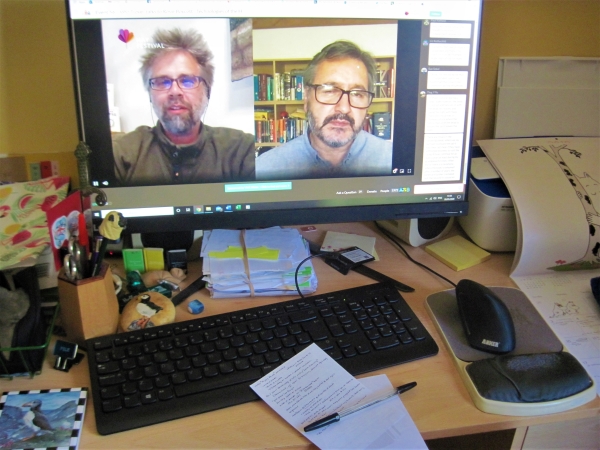
Troyer and Florence on my screen.
One section of Troyer’s book has become “uncannily resonant” in recent days, he noted. This is Chapter 3, on the AIDS corpse, an object of stigma. The biggest changes to death in the time of COVID-19 have been that family members are not able to be with a dying person in the ICU and that funerals cannot proceed as normal. In a viral pandemic, countries are producing a huge number of corpses that they aren’t prepared to deal with. (Indeed, the Washington, D.C. area is so overwhelmed with dead bodies that ice skating rinks have been requisitioned as makeshift morgues. The suburban Maryland rink I visited as a child is one such. Grim.)
Troyer spoke of the need for an everyday-ness to the discussion of death: talking with one’s next of kin, and encountering death in the course of a traditional education – he finds that even his final-year university students, studying in a related field, are very new to talking about death. A good way in that he recommends is simply to ask your loved ones what music they want played at their funerals, and the conversation can go from there.
We may not be able to commemorate the dead as we would like to at this time, but Troyer reminded the audience that funerals are for the living, whereas “the dead are okay with it – they know we’re doing our best.” The event was sensitively chaired by Peter Florence, the co-founder and director of Hay Festival (also responsible for last year’s controversial Booker Prize tie); the fact that Troyer got emotional talking about his sister only gave it more relevance and impact.
 I’ve read an abnormally large number of books about death, especially in the five years since my brother-in-law died of brain cancer (one reason why Troyer’s talk was so meaningful for me). Most recently, I read Bodies in Motion and at Rest (2000) by Thomas Lynch, a set of essays by the Irish-American undertaker and poet from Michigan. I saw him speak at Greenbelt Festival in 2012 and have read four of his books since then. His unusual dual career lends lyrical beauty to his writing about death. However, this collection was not memorable for me in comparison to his 1997 book The Undertaking, and I’d already encountered a shortened version of “Wombs” in the Wellcome Collection anthology Beneath the Skin. But this passage from “The Way We Are” stood out:
After years and years of directing funerals, I’ve come to the conclusion that seeing [the dead body] is the hardest and most helpful part. The truth, even when it hurts, has a healing in it, better than fiction or fantasy. When someone dies it is not them we fear seeing, it is them dead. It is the death. We fear that seeing will be believing. We fear not seeing too. We search the wreckage and the ruins, the battlefields and ocean floors. We must find our dead to let the loss be real.
Just for a bit of morbid fun, I decided to draw up my top 10 nonfiction books about death, dying and the dead. Many of these are personal accounts of facing death or losing a loved one. In contrast to the bereavement and cancer memoirs, the books by Doughty and Gawande are more like cultural studies, and Montross’s is about working with corpses. If you need a laugh, the Bechdel (a graphic memoir) and Doughty are best for black comedy.
 The Light of the World by Elizabeth Alexander
- Fun Home: A Family Tragicomic by Alison Bechdel (her father, too, was a funeral home director)
- Dear Life: A Doctor’s Story of Love and Loss by Rachel Clarke
- The Iceberg by Marion Coutts
- From Here to Eternity: Traveling the World to Find the Good Death by Caitlin Doughty
 Being Mortal: Medicine and What Matters in the End by Atul Gawande
- When Breath Becomes Air by Paul Kalanithi
- Body of Work: Meditations on Mortality from the Human Anatomy Lab by Christine Montross
- The Bright Hour: A Memoir of Living and Dying by Nina Riggs
- To Travel Hopefully: Journal of a Death Not Foretold by Christopher Rush
October Recommendations: Ashworth, Donoghue, Kay & McWatt
Intricate essays about writing in the wake of trauma, a feel-good novel about an odd couple on a trip to France, hilarious festive outtakes from a career in medicine, and a race-themed family memoir: I have four very different books to recommend to you this month. All: 
Notes Made while Falling by Jenn Ashworth
(Coming from Goldsmiths Press [UK] on the 15th; already out from MIT Press [USA])
Like Anne Boyer’s The Undying and Sinéad Gleeson’s Constellations, this is an incisive memoir-in-essays about the effects of trauma on a woman’s body. Specifically, Ashworth’s story starts with her son’s birth in 2010, a disaster she keeps returning to over the course of seven sinuous personal essays. A routine C-section was followed by haemorrhaging, blood transfusions and anaphylaxis. The effects lasted for years afterwards: haunted by the sound of her blood dripping and the feeling that her organs could fall out of her abdomen at any time, she suffered from vomiting, insomnia and alcoholism, drinking late into the night as she watched gruesome true crime films.
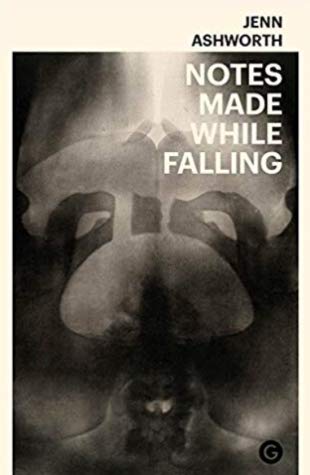 Ashworth toggles between experience, memory, and the transformation of experience into a written record. She admits she has lost faith in fiction, either reading or writing it (she is a lecturer at Lancaster University and the author of four novels). Her Mormon upbringing in Preston is a major part of her backstory, and along with her childhood indoctrination she remembers brief stays in a children’s home and in the hospital with chicken pox.
The essays experiment with structure and content. For instance, “Ground Zero” counts down from #8, with incomplete final lines in each section, then back up to #8, with each piece from the second set picking up where the first left off. Slashes and cross-outs represent rethinking or alternate interpretations. “Off Topic: On Derailment” encompasses so many topics, from excommunication to Agatha Christie to rollercoasters to Charles Dickens, that you have to read it to believe she can make it all fit together (elsewhere she muses on Chernobyl, magic tricks and hating King Lear).
“How to Begin: The Cut” started as a talk given at Greenbelt 2013, when I was in the audience. I especially loved “A Lecture on Influence,” a coy self-examination through creative writing lessons, and “How to Fall without Landing: Celestial City,” a meditation on the precariousness of the human condition. Her frame of literary reference is wide and surprising. This also reminded me of Sight by Jessie Greengrass, The Empathy Exams by Leslie Jamison, I Am, I Am, I Am by Maggie O’Farrell, and In the Days of Rain by Rebecca Stott; I would recommend it to readers of any of the above.
Some favorite lines:
“My God-hurt head has a hole in it or needs one; to let the world in, or out – I can’t ever decide.”
“how to write about everything? How to take in the things that don’t belong to you without being poisoned by them? How to make use of the things that live inside, those seedlings you never asked for? How to breathe in? How to breathe out? How to keep on doing that?”
“Some days it feels like writing truthfully about her own life is the most subversive thing a woman can do.”
My thanks to the publisher for the free copy for review.
Akin by Emma Donoghue
(Coming from Picador [UK] on the 3rd; already out from Little, Brown and Co. [USA])
I’ve read Donoghue’s six most recent works of fiction. Her books are all so different from each other in setting – a one-room prison in contemporary America, bawdy 1870s San Francisco, rural Ireland in the 1850s – that it’s hard to pin her down to one time period or roster of topics. She never writes the same book twice, and that’s got to be a good thing.
 Akin gets off to a slightly slow start but soon had me hooked. Noah Selvaggio, a childless widower and retired chemist in New York City, is looking forward to an imminent trip to Nice, where he was born, to celebrate his 80th birthday. He never guessed that he’d have company on his trip, much less a surly 11-year-old. This is Michael Young, his nephew Victor’s son. Victor died of a drug overdose a year and a half ago; the boy’s mother is in prison; his maternal grandmother has just died. There’s no one else to look after Michael, so with a rush passport he’s added to the itinerary.
In some ways Michael reminded me of my nephews, ages 11 and 14: the monosyllabic replies, the addiction to devices and online gaming, the finicky eating, and the occasional flashes of childlike exuberance. Having never raised a child, Noah has no idea how strict to be with his great-nephew about screen time, unhealthy food and bad language. He has to learn to pick his battles, or every moment of this long-awaited homecoming trip would be a misery. And he soon realizes that Michael’s broken home and troubled area of NYC make him simultaneously tougher and more vulnerable than your average kid.
The odd-couple dynamic works perfectly here and makes for many amusing culture clashes, not so much France vs. the USA as between these Americans of different generations. The dialogue, especially, made me laugh. Donoghue nails it:
[Noah:] “The genre, the style. Is rap the right word for it? Or hip-hop?”
[Michael:] “Don’t even try.” Michael turned his music back on.
(At the cathedral)
[Michael:] “This is some seriously frilly shit.”
[Noah:] “It’s called Baroque style.”
[Michael:] “I call it fugly.”
But there’s another dimension to the novel that keeps it from being pleasant but forgettable. Noah’s grandfather was a famous (fictional) photographer, Père Sonne, and he has recently found a peculiar set of photographs left behind by his late mother, Margot. One is of the hotel where they’re staying in Nice, known to be a holding tank for Jews before they were sent off to concentration camps. The more Noah looks into it, the more he is convinced that his mother was involved in some way – but which side was she on?
This is feel-good fiction in the best possible sense: sharp, true-to-life and never sappy. With its spot-on dialogue and vivid scenes, I can easily see it being made into a movie, too. It’s one of my favorite novels of the year so far.
My thanks to the publisher for the proof copy for review.
Twas the Nightshift before Christmas by Adam Kay
(Coming from Picador on the 17th)
 If you’ve read This Is Going to Hurt, the UK’s bestselling nonfiction title of 2018, you’ll know just what to expect from the comedian’s holiday-themed follow-up. It’s raunchy, morbid and laugh-out-loud funny. In the seven years that Kay was a medical doctor, he had to work on Christmas Day six times. He takes us through the holiday seasons of 2004 to 2009, from the sickeningly festive run-up to the letdown of Christmas day and its aftermath. With his Rudolph tie on and his Scrooge spirit intact, he attends to genital oddities, childbirth crises and infertility clients, and feebly tries to keep up his relationships with his family and his partner despite them having about given up on him after so many holiday absences.
This will be a stocking-stuffer for many this year, and I can see myself returning to it year after year and flicking through for a laugh. However, there’s one story here that Kay regrets omitting from This Is Going to Hurt as being too upsetting, and he also ends on a serious note, urging readers to spare a thought for those who give up their holidays to keep our hospitals staffed.
A favorite passage:
“A lot of the reward for this job comes in the form of a warm glow. It doesn’t make you look any less tired, you can’t pay the rent with it, and it’s worth a lot less than the social life you’ve traded it for, but this comforting aura of goodness and purpose definitely throws light into some dark corners and helps you withstand a lot of the shit.”
My thanks to the publisher for the proof copy for review.
Shame on Me: An Anatomy of Race and Belonging by Tessa McWatt
(Coming from Scribe UK on the 10th)
 “What are you?” This question has followed McWatt since she was eight years old. When her third-grade teacher asked the class if they knew what “Negro” meant, one boy pointed to her. “Oh, no, not Tessa,” the teacher replied, following up with a question: “What are you, Tessa?” But it has always been hard to put her mixed-race background into one word. Her family moved from Guyana to Canada and she has since settled in England, where she is a professor of creative writing; her ancestry is somewhat uncertain but may include Chinese, Indian, indigenous South American, Portuguese, French/Jewish, African, and Scottish.
The book opens with the startling scene of her grandmother, a young Chinese woman brought over to work the sugarcane fields of British Guiana, being raped by her own uncle. “To strangers, even friends—on some days also to myself—I am images of violence and oppression. I am the language of shame and destitution, of slavery and indenture, of rape and murder. I am images of power and privilege, of denial and shades of skin, shapes of faces,” McWatt writes.
Her investigation of the meaning of race takes the form of an academic paper, Hypothesis–Experiment–Analysis–Findings, and within the long third section she goes part by part through the bodily features that have most often been used as markers of racial identity, including the nose, eyes, hair and buttocks. She dives into family history but also into wider historical movements, literature and science to understand her hybrid self. It’s an inventive and sensitive work reminiscent of The Color of Water by James McBride. I would recommend it to anyone who enjoys reading (or feels they should try) interrogations of race.
A favorite line:
“as I try to square my politics with my privilege, it seems that my only true inheritance is that I am always running somewhere else.”
I won a signed proof copy in a Twitter giveaway.
Have you read any October releases that you would recommend? Do any of these tempt you?
Rebecca Stott, Duke Special & More at Greenbelt 2018
After five years away, we finally made it back to Greenbelt, a progressive Christian summer arts festival held on the grounds of Boughton House, on the Bank Holiday. The festival is a mixture of talks, music, performances and more, and given how much we’d paid and how far we’d traveled just for the one day, we tried to pack in as much as possible.

We started the day with “Beyond Forgiveness,” a presentation by Jo Berry and Pat Magee. Berry’s father, a Tory MP, was killed when the IRA bombed the Conservative Party conference in Brighton in 1984. Magee spent 14 years in prison for his role in the bombing. When he got out of jail, he met Berry at her request and they talked and listened to each other for several hours. For the first time, Magee said, he could see her father as a real person and realized that the IRA had been just as guilty of dehumanizing and misrepresenting people as the English were. Berry, too, felt that “I’d met my enemy and seen his humanity.” The two have now shared a stage more than 200 times, speaking about the value of empathy in healing broken relationships while also addressing imbalances of power that lead to violence.
To my surprise, cookery displays and musical comedy seemed to be the order of the day. A model kitchen is a new addition to the festival, giving celebrity chefs hour-long sessions to demonstrate a particular dish. Jack Monroe, promoting her new book Cooking on a Bootstrap, cooked a sausage lasagna. She made us all laugh with her idea of “the inverse sausage fallacy” – the cheaper a sausage is, the better it tastes because of all the salt, sugar and spices added to cheaper bits of meat. She started writing recipes when she was a single mother on the dole, and so she encouraged audience members to donate nice things you would like to eat, as well as everyday hygiene products, to food banks. For a “What Vegans Eat” session, Brett Cobley (aka EpiVegan) made a pea and asparagus risotto and answered questions about protein sources, egg replacements, plant milks and harder-to-find ingredients.
Uproarious musical comedy came in the form of Harry & Chris, who made up impromptu raps about New Year’s Day, the Teletubbies and phobias, and Flo & Joan, who sang about divorce statistics, unnecessary inventions for women, and sex robots (the show was fairly crude and came with an 18+ warning). The overall musical highlight of the day was Duke Special, a Greenbelt favorite we’ve seen play quite a number of times now. His pop combines his smooth Belfast tenor with music hall and Big Band stylings, and his songs are often drawn from poetry and 1920s–40s songbooks. His latest project, Hallow, is a beautiful set of Michael Longley poems set to music. He played “Another Wren” and “Emily Dickinson” from that album, various covers (including two bizarre ditties by Ivor Cutler), and crowd favorites “Last Night I Nearly Died,” “Freewheel” and “Our Love Goes Deeper than This.” We also sampled performances by Martyn Joseph, Wallis Bird and CC Smugglers.
Duke Special was a good bridge between music and literature. From the literature program I also saw Rabbi Jonathan Wittenberg speak on “Things My Dog Has Taught Me about Being a Better Human,” the title of his recent book. (His dog Mitzpah had a special dispensation to join him on stage; no animals are allowed on site otherwise!) The rabbi spoke about lessons in listening, attention, trust and seizing the moment. Mitzi and his previous dog Safi have also given him a connection with the rest of creation. Although he lives in the London suburbs and has an inner-city synagogue, they have accompanied him on long walks in Scotland and Germany. Wittenberg was a warm and witty speaker and I very much liked the sound of his book. It could make a good follow-up to The Power of Dog.
My other festival highlight was Rebecca Stott, in conversation with Radio 4 presenter Malcolm Doney. I read her Costa Prize-winning memoir In the Days of Rain: A daughter. A father. A cult in April and it’s been one of my stand-out reads of the year so far. The book conveys a huge amount of information about the Exclusive Brethren and Stott’s family history but never loses sight of what is most important: what it was like to be in a cult and have your life defined by its rules and its paranoia about the outside world. Stott remembers 6 a.m. Sunday communion services and her constant terror of being left behind in the Rapture.
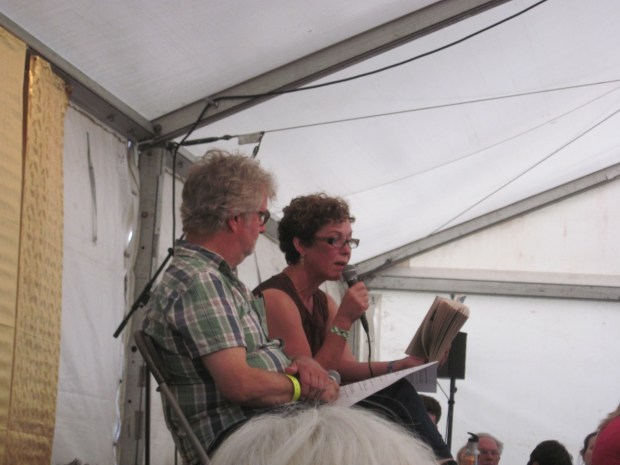
Rebecca Stott reading from In the Days of Rain.
Unfortunately, the talk didn’t add much to my experience of reading her book. The interviewer, catering to those who haven’t read the book yet, led her through her whole story bit by bit, and because I’d read it fairly recently it was all familiar. However, Stott spoke wonderfully and was full of wry compassion for her younger self. I was most interested to hear about the book’s aftermath: she’s received 300 letters from ex-Brethren that her daughter is transcribing to send to a Brethren Church archive in Manchester. When asked during a Q&A where she sees cult tendencies today, she mentioned Trump supporters!


Whereas I read In the Days of Rain from the library, I happen to own two Stott books I haven’t read yet, so I cheekily brought along my paperback of Ghostwalk for signing. She was intrigued to see the older cover design and told me she thinks the prose style in her debut novel is much richer than in Rain, and she hopes I’ll like it. I thanked her for the talk, told her how much I’d enjoyed her memoir, and recommended her two books vaguely about cults: Educated by Tara Westover, which she already knew well, having done some events with Westover, and The Incendiaries by R.O. Kwon, which was new to her (my blog tour review is coming up on Monday). I caught myself using the word “brilliant” three times in speaking about Stott’s work and these other books – nuance and vocabulary alike clearly go out the window when nervously speaking to admired authors!
Some readers of this blog would have been delighted by the event I rushed to straight after Stott’s talk: Jon McGregor giving readings from Reservoir 13, with Sigur Rós-esque backing and interlude music from Haiku Salut. I heard about the police reconstruction with actors from Manchester, and collecting bilberries on the heath in August. Unfortunately, I found it just as dull read aloud as I did when I tried the book last year, and I left early.
During bits of down time I pulled out a Katherine Mansfield story collection I found in a charity shop last week and read “Bank Holiday” and “The Garden Party.” The former is a very short piece whose carnival atmosphere rises to a note of indeterminate striving:
“And up, up the hill come the people, with ticklers and golliwogs, and roses and feathers. Up, up they thrust into the light and heat, shouting, laughing, squealing, as though they were being pushed by something, far below, and by the sun, far ahead of them – drawn up into the full, bright, dazzling radiance to…what?”
 It was my first time reading the famous “The Garden Party,” which likewise moves from a blithe holiday mood into something weightier. The Sheridans are making preparations for a lavish garden party dripping with flowers and food. Daughter Laura is dismayed when news comes that a man from the cottages has been thrown from his horse and killed, and thinks they should cancel the event. Everyone tells her not to be silly; of course it will go on as planned. The story ends when, after visiting his widow to hand over leftover party food, she unwittingly sees the man’s body and experiences an epiphany about the simultaneous beauty and terror of life. “Don’t cry,” her brother says. “Was it awful?” “No,” she replies. “It was simply marvellous.” Mansfield is especially good at first and last paragraphs. I’ll read more by her someday.
How did you all spend your Bank Holiday? / How do you plan to spend Labor Day?
Did any reading get done?
My Patchy Experience with Book Clubs
I know that a number of you have long-term, faithful book clubs. Boy, am I envious! You might find it surprising that I’ve only ever been in one traditional book club, and it wasn’t a resounding success. Partway through my time working for King’s College, London, an acquaintance from another library branch started the club. A group of five to eight of us from Library Services aimed to meet after work one evening a month at a Southbank venue or a staff room to discuss our latest pick. By poring over old e-mails and my Goodreads library, I’ve managed to remember 10 of the books we read between November 2011 and June 2013:
- Do Androids Dream of Electric Sheep?, Philip K. Dick [classic science fiction]
- The Little Shadows, Marina Endicott [Canadian historical fiction]
- A Spot of Bother, Mark Haddon [contemporary fiction]
- The Talented Mr. Ripley, Patricia Highsmith [classic suspense]
- The Vintner’s Luck, Elizabeth Knox [bizarre historical fiction/magic realism]
- What Was Lost, Catherine O’Flynn [contemporary fiction]
- Franny and Zooey, J.D. Salinger [classic short fiction]
- The Rabbi’s Cat, Joann Sfar [graphic novel in translation]
- Girl Meets Boy, Ali Smith [an update of Greek myth]
- Angel, Elizabeth Taylor [an obscure English classic]
That may well be the complete list. Although I was a member for 20 months until I quit to go freelance, we often only managed to meet every other month because we couldn’t find a mutually convenient free evening or no one had read the book in time. I was consistently frustrated that – even when our selections were only about 200 pages long – I was often one of the only people to have read the whole book.
Overall, the quality of books we chose struck me as mediocre: I rated half of these books 2 stars, and the rest 3 stars. (I think I was a harsher rater then, but it’s not a good sign, is it?) Perhaps this is part of the inevitable compromising that goes with book clubs, though: You humor other people in their choices and hope they’ll be kind about yours? My suggestion, for the record, was the pretty dismal Little Shadows, for which I got a free set of book club copies to review for Booktime magazine. But I also voted in favor of most of the above list.
Looking back, I am at least impressed by how varied our selections were. People were interested in trying out different genres, so we ranged from historical fiction to sci-fi, and even managed a graphic novel. But when we did get together for discussion there was far too much gossipy chat about work, and when we finally got around to the book itself the examination rarely went deeper than “I liked it” or “I hated all the characters.”
If it was profound analysis I was after, I got that during the years I volunteered at Greenbelt, an annual summer arts festival with a progressive Christian slant. I eagerly read the eclectic set of three books the literature coordinator chose for book club meetings in 2010 – Star of the Morning: The Extraordinary Life of Lady Hester Stanhope by Kirsten Ellis, The First Person and Other Stories by Ali Smith, and The Bridge of San Luis Rey by Thornton Wilder – and then as a literature volunteer for the next three years I read and prepared copious notes and questions about our festival “Big Read.” We did Exile by Richard North Patterson in 2011, Dark Eden by Chris Beckett in 2012 and So Many Ways to Begin by Chris Beckett in 2013, and each time I offered to chair the book club meetings.
Unfortunately, due at least in part to logistical considerations, these were run in the way many festival events are: a panel of two to five talking heads with microphones was at the front of the tent, sometimes on a raised dais, while the audience of whatever size sat towards the back. This created a disconnect between the “experts” and the participants, and with the exception of the McGregor meeting I don’t recall much audience input. I’ve mostly blanked out the events – as I tend to for anything that entails public speaking and nervous preparation for something you can’t control – but I was pleased to be involved and I should probably make more of this on my CV. It wasn’t your average book club setting, that’s for sure.
In recent years the closest thing I’ve had to a book club has been online buddy reading. The shadow panels for the Wellcome Book Prize and Sunday Times Young Writer of the Year Award fall into this category, as do online readalongs I’ve done for several Iris Murdoch novels and for C.S. Lewis’s Mere Christianity with various female family members. A few of us book bloggers chatted about Andrea Levy’s Small Island in an online document earlier this year, and my mom and I e-mailed back and forth while reading W. Somerset Maugham’s The Painted Veil in May. I’m also doing my last three of the #20BooksofSummer as online buddy reads, checking in occasionally on Twitter.
Of course, there are some inherent limitations to this kind of discussion – people read at different paces and don’t want to spoil the plot for others, and at some point the back-and-forth fizzles out – but it’s always been easier for me to organize my thoughts in writing, so I likely feel more comfortable contributing than I might in an in-person meeting.
This is all context for my decision to join my neighborhood book club next month. The club arose some months back out of our community’s Facebook group, a helpful resource run by a go-getting lady a few doors down from us. So far it’s turning out to be a small group of thirty- and fortysomething women who alternate meetings at each other’s houses, and the name they’ve chosen gives an idea of the tone: “Books, Booze and Banter.”
I made the mistake of not getting involved right at the start; I wanted to hang back and see what kind of books they’d choose. This means I wasn’t part of the early process of putting titles in a hat, so I’ve looked on snobbishly for several months as they lurched between crime and women’s fiction, genres I generally avoid. (Still, there were actually a couple books I might have joined them for had I not been in America and had they been readily available at the public library.) For many people a book club selection will be the only book they get through that month, so I can understand how they’d want it to be something ‘readable’ that they’d be happy to pick up anyway. Even though statistically I read 27 books a month, I’m still jealously protective of my reading time; I want everything I read to be worthwhile.
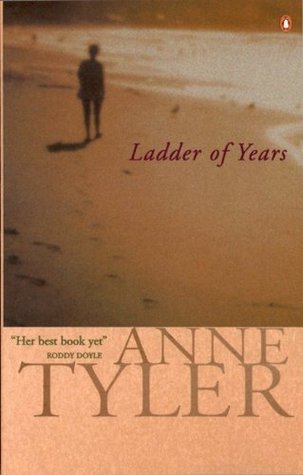 So for September I managed to steer the group away from a poorly received historical novel of over 400 pages and the new Joël Dicker and onto Ladder of Years by Anne Tyler, which the bookstore chain Waterstones has been promoting heavily as one of their books of the month. I already had a charity shop copy in hand and the others liked the sound of it, so we’re all set for September 12th! Future months’ literary fiction choices look promising, too, so provided I enjoy the discussion and the camaraderie I plan to stick with it: a backlist Pat Barker novel I’ve not read, and Kirsty Logan and Jonathan Coe novels I’ve read before and won’t reread but will remind myself about briefly before the meetings.
I’m out of practice with this book club thing. My mother tells me that I have a lot to contribute but that I must also be open to what I’ll learn from other people – even if I don’t expect to. So I don’t want to set myself up as some kind of expert. In fact, I probably won’t even mention that I’m a freelance book reviewer and book blogger. Mostly I’m hoping to find some friendly faces around the neighborhood, because even though we’ve lived here just over two years I still only know a handful of names and keep myself to myself as I work from home. Even if I have to read books I wouldn’t normally, it’ll be worth it to meet more people.
What has your experience with book clubs (in person and online) been?
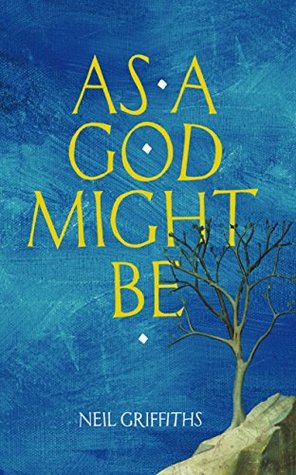
As a God Might Be by Neil Griffiths
[Note: A shortened, edited version of this review appeared in the June 15th, 2018 issue of the Church Times.]
Proctor McCullough isn’t a churchgoer. He’s not even particularly religious. Yet somehow he senses that God is calling him to build a chapel, with a little house beside it, on a cliff in the southwest of England. It’s a source of bewilderment for his partner, Holly, and their London friends. Is Mac mentally ill, or having a particularly acute midlife crisis? He’s handed off from a minister to a therapist to a neurologist, but no one knows what to make of him. This forty-four-year-old father of two, an otherwise entirely rational-seeming advisor to the government on disaster situations, won’t be deterred from his mission.
It’s important to get a sense of the way this character speaks:
I want a structure that will move people to contemplate something other than all the obvious stuff … to be confronted with a sense of something and only be able to define it as Other.
God is the transcendent Other for whom creation, what we know as life, is a gratuitous act of love, a dispossession of a portion of His infinite creativity given over to our thriving. It is a gift from His infinite excess. That we can know Him at all is because of the possibility of this excess within us, which we experience as love, art, great feats of the mind. Our bounty is Him.
Down at the project site, Mac acquires four young workers/disciples: Rebecca, Nathaniel, Terry and Rich. Rebecca is a sarcastic, voluptuous teenager who will be off to Cambridge in a few months. She perhaps represents vanity, temptation and judgment, while the other three are more difficult to slot into symbolic roles. Terry is a dreadlocked lager lout who takes care of a mother with early dementia; contrary to appearances, he’s also a thinker, and takes to carrying around a Bible along with a collection of other theological works. Nat and Rich are more sketch-like figures, just ciphers really, which became problematic for me later on.
 With Mac we shuttle between the building site and his home in London for weeks at a time. The idea of incorporating Pascal’s mystical hexagon into the church design captivates him, and the costs – initially set at £100,000 – balloon. Meanwhile, his relationship with Holly is strained almost to the breaking point as they each turn to alternative confidants, and there’s a renegotiation process as they decide whether their actions have torn them apart for good.
Like Sarah Moss, Neil Griffiths realistically blends serious concepts with everyday domestic tasks: sure, there may be a God-ordained chapel to build, but Mac also has to do the shopping and get his six-year-old twins fed and in bed at a decent hour. If Mac is meant to be a Messiah figure here, he’s a deeply flawed one; he can even be insufferable, especially when delivering his monologues on religion. If you’re like me, you’ll occasionally get incensed with him – particularly when, at the midpoint, he concocts a Clintonian justification for his behavior.
All the same, the themes and central characters were strong enough to keep me powering through this 600-page novel of ideas. Mac’s violent encounters with God and with the nature of evil are compelling, and although some of the events of the last third push the boundaries of credibility, it’s worth sticking with it to see where Griffiths takes the plot. There’s no getting past the fact that this is a dense theological treatise, but overlaid on it is a very human story of incidental families and how love sustains us through the unbearable.
If I had to point to the novel’s forebears, I’d mention Hamlet, A.S. Byatt’s The Virgin in the Garden, Michael Arditti’s Easter, and even Ayn Rand’s The Fountainhead. If you’ve read any Dostoevsky (I haven’t, yet) or Iris Murdoch, you’ll likely spot philosophical echoes. The title itself is from Wallace Stevens. It’s all unabashedly highbrow, and a greater than average familiarity with the Christian tradition is probably key. For the wary, I’d suggest not trying too hard to read metaphorical significance into character names or chapter and section titles – I’m sure those meanings are in there, but better to let the story carry you along rather than waste time trying to work it all out.
While reading this novel I was bitterly regretting the demise of Third Way magazine; it would have been a perfect place for me to engage with Griffiths’ envelope-pushing theology. I was also wishing I was still involved with Greenbelt Festival’s literature programming, as this would make a perfect Big Read. (Though however would we get people to read 600 pages?! In my experience of book clubs, it’s hard enough to get them to read 200.)
I’m grateful to Dodo Ink (“an independent UK publisher publishing daring and difficult fiction”) for stepping into the breach and taking a chance on a book that will divide Christians and the nonreligious alike, and to publicist Nicci Praça for the surprise copy that turned up on my doorstep. This turned out to be just my sort of book: big and brazen, a deep well of thought that will only give up its deeper meanings upon discussion and repeat readings.
My rating:
As a God Might Be was published in the UK by Dodo Ink on October 26th. This is Neil Griffiths’ third novel, after Betrayal in Naples (2004) and Saving Caravaggio (2006). He says that this most recent book took him seven years to write.
Reviews Roundup, October–November
One of my goals with this blog is to have one convenient place where I can gather together all my writing that has appeared in disparate online locations. To that end, once a month I provide links to all book reviews I’ve published elsewhere, with a rating (below each description) and a taster so you can decide whether to read more. A few exceptions: I won’t point out my Kirkus Indie, BlueInk or Publishers Weekly reviews since I don’t get a byline.
This month you may recognize a few books I already previewed in my posts on books as beautiful objects and library books read in October.
The Bookbag
Charlotte Brontë’s Secret Love by Jolien Janzing: Charlotte and Emily Brontë’s time in Belgium – specifically, Charlotte’s passion for her teacher, Constantin Heger – is the basis for this historical novel. The authoritative yet inviting narration is a highlight, but some readers may be uncomfortable with the erotic portrayal; it doesn’t seem to fit the historical record, which suggests an unrequited love affair. My other issue with the book is a couple of subplots that only seem to have minor significance.

In Fidelity by Jack Wilson: In this 1970s-set novel, the central couple’s relationship is tested by illness and extramarital sexual experiences. Moving from New England to Nigeria and back, the story asks what loyalty really requires when a once-strong connection has faded over time. Strongly reminiscent of John Updike in Part One, this is the male view of adultery. Something about the self-justifying tone stuck in my craw. A more balanced book would give the wife’s perspective, too, as Carol Shields did in Happenstance, or like Lauren Groff recently did to great success in Fates and Furies.

BookBrowse
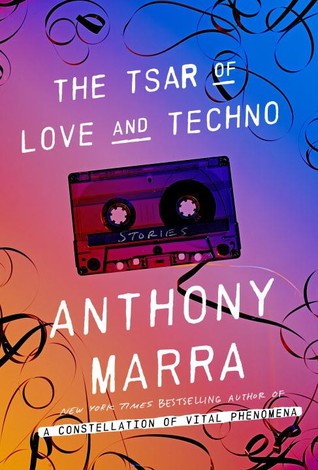 The Tsar of Love and Techno by Anthony Marra [subscription service]: This collection of tightly linked short stories, an intimate look at Russia and Chechnya in wartime and afterwards, reveals how politics, family, and art intertwine. Ranging from 1937 to 2013, the pieces show how fear and propaganda linger in the post-Stalinist era. In art as much as in politics, it can be difficult to distinguish airbrushed history from bitter reality. Just as he did in his excellent debut novel, A Constellation of Vital Phenomena, Marra renders unspeakable tragedies bearable because of his warm and witty writing. All his characters’ voices are well-realized and inviting, and he comes up with terrific one-liners.

BookTrib
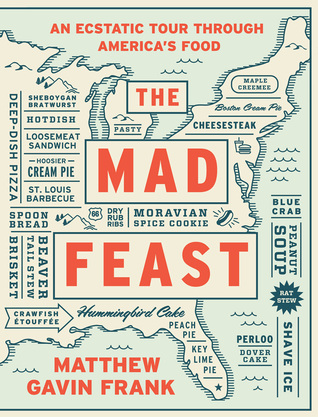 Mad Feast by Matthew Gavin Frank: This is the cookbook David Foster Wallace might have written. In an off-the-wall blend of memoir, travel, history and fiction, Frank proceeds region by region, choosing for each American state one beloved dish and interrogating its origins as well as its metaphors and associations. It’s a mixed bag of familiar foods and ones that only locals are likely to know about. Each chapter ends with a recipe for the signature plate, whether from a Lutheran church or a posh restaurant. Frank’s digressive, anecdotal approach takes some getting used to. If you appreciate the style of writers like Geoff Dyer, Maggie Nelson and Will Self, this should be your next food-themed read.
For Books’ Sake
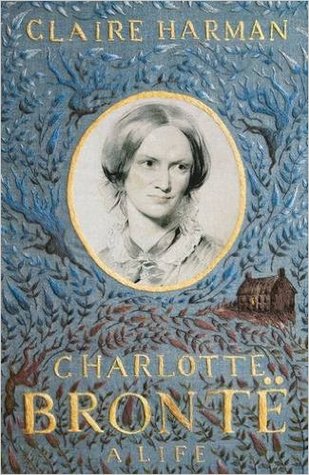 Charlotte Brontë: A Life by Claire Harman: With her bicentennial approaching in April 2016, it’s the perfect time to revisit Charlotte Brontë’s timeless stories. One of the things Harman’s biography does best is trace how the Brontës’ childhood experiences found later expression in fiction. A chapter on the publication of Jane Eyre is a highlight. Diehard fans might not encounter lots of new material, but Harman does make a revelation concerning Charlotte’s cause of death – not TB, as previously believed, but hyperemesis gravidarum (extreme morning sickness). This will help you appreciate afresh a “poet of suffering” whose novels were “all the more subversive because of [their] surface conventionality.”

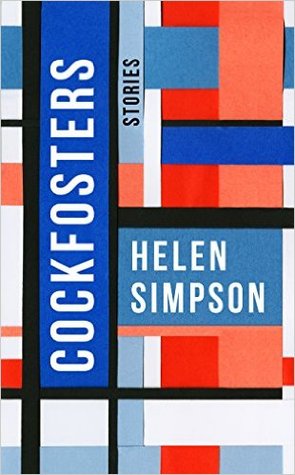
Cockfosters by Helen Simpson: Simpson’s sixth story collection is full of wry, incisive reflections on aging, loss, regrets, gender roles, and a changing relationship to sex. Most of Simpson’s characters are in their late forties, a liminal time when they’re caught between older parents and still-needy children. Many pieces are dialogue-driven, like scenes in plays. In “Kentish Town,” book club members meet to discuss Dickens’s The Chimes. Simpson weaves in discussion of the plot with commentary on the state of the nation as the ladies set the world to rights and make New Year’s resolutions. It’s a perfect story to read in the run-up to Christmas. The overall stand-out is “Erewhon,” named for Samuel Butler’s 1872 satirical utopian novel. It quickly becomes clear that gender roles are reversed in its fictional world.
Foreword Reviews
 Addiction Is Addiction by Raju Hajela, Paige Abbott and Sue Newton: This comprehensive, well-organized guide discusses the features of addictive thinking and feeling, suggests holistic recovery methods, and offers useful definitions, diagrams, and case studies. The authors are affiliated with Health Upwardly Mobile Inc., Calgary, Alberta. Tracing the history of addiction back to the eighteenth century, when it was first known as “alcoholic disease syndrome,” they present an expert view of the disease’s symptoms and outlook. Strongly recommended to those who have participated in groups like Alcoholics Anonymous or Narcotics Anonymous.
Kirkus
Indie Spotlight: Books about Religion: Self-publishing allows writers to tell their full stories. An article based on interviews with four indie religion authors and mini-reviews of their books.
Nudge
Notes on Suicide by Simon Critchley: Critchley is a philosophy professor at New York’s New School for Social Research. Although he reassures readers with his first line that “This book is not a suicide note,” he also hints that its writing was inspired by personal trouble: “my life has dissolved over the past year or so, like sugar in hot tea.” Not suicidal himself, then, but sympathetic to those who are driven to self-murder. This concise essay illuminates arguments surrounding suicide, with points of reference ranging from Greek philosophers to Robin Williams. Overall, though, it feels cursory and inconclusive.
 The Gratitude Diaries by Janice Kaplan: We can all do with a little encouragement to appreciate what we already have. In so many areas of life – finances, career, relationship, even the weather – we’re all too often hoping for more or better than what we are currently experiencing. Here Kaplan undertakes a year-long experiment to see if gratitude can improve every aspect of her life. She draws her information from interviews with researchers and celebrities, quotes from philosophers, and anecdotes from her own and friends’ lives. It’s easy, pleasant reading I’d recommend to fans of Gretchen Rubin.
 The Water Book by Alok Jha: An interdisciplinary look at water’s remarkable properties and necessity for life on earth. For the most part, Jha pitches his work at an appropriate level. However, if it’s been a while since you studied chemistry at school, you may struggle. Part IV, on the search for water in space, is too in-depth for popular science and tediously long. In December 2013 Jha was part of a month-long Antarctic expedition. He uses the trip as an effective framing device, but I would have liked more memoiristic passages. All in all, I was hoping for less hard science and more reflection on water’s importance to human culture.
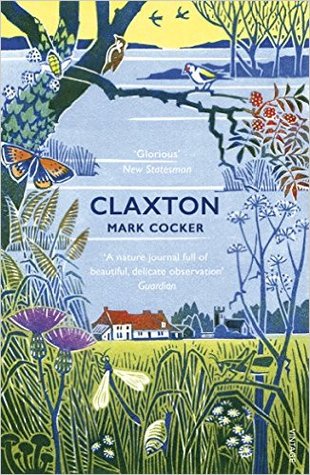 Claxton: Field Notes from a Small Planet by Mark Cocker: Mark Cocker is the Guardian’s country diarist for Norfolk. The short pieces in this book are reprints of his columns, some expanded or revised. I would advise keeping this as a bedside or coffee table book from which you read no more than one or two entries a week, so that you always stay in chronological sync. You’ll appreciate the book most if you experience nature along with Cocker, rather than reading from front cover to back in a few sittings. The problem with the latter approach is that there is inevitable repetition of topics across years. All told, after spending a vicarious year in Claxton, you’ll agree: “How miraculous that we are all here, now, in this one small place.”
 A Mile Down by David Vann: Vann, better known for fiction, tells the real-life story of his ill-fated journeys at sea. He hired a Turkish crew to build him a boat of his own, and before long shoddy workmanship, language difficulties, bureaucracy, and debts started to make it all seem like a very bad idea. Was he cursed? Would he follow his father into suicide? The day-to-day details of boat-building and sailing can be tedious, and there’s an angry tone that’s unpleasant; Vann seems to think everybody else was incompetent or a crook. However, he does an incredible job of narrating two climactic storms he sailed through.
Wasafiri
The Triumph of the Snake Goddess by Kaiser Haq: Beginning with the creation of the world and telling climactic tales of the snake goddess Manasa’s interactions with humans, Haq crafts a uniquely playful set of sacred stories that bear striking similarities to those from other religious traditions. Like Greek myths, the Manasa stories are full of shape-shifting and mistaken identity; rape and incest; jealousy and revenge; and over-the-top exploits of warring gods. She even wears snakes in her hair, like Medusa. Many parallels can also be drawn with the Hebrew and Christian scriptures. Haq’s rendering of the creation account, in particular, resembles the language of Genesis. This book will appeal to students of comparative religion, but can be read with equal enjoyment by laymen in search of engaging storytelling.
I also post reviews of most of my casual reading and skimming on Goodreads.
Mrs. Stevens Hears the Mermaids Singing by May Sarton: Although I’m a huge fan of Sarton’s memoirs, this was my first taste of her fiction. I was underwhelmed: it’s slight and strangely unfeminist. Part of the problem may be that I know so much about Sarton that I couldn’t help but see all the autobiographical detail here. Most of the novel’s action takes place in one day, as Mrs. Stevens awaits the arrival of two interviewers and reflects on past love affairs (some with women) and the meaning of the Muse. For me, Sarton’s journals are a better source of deep thoughts on the writer’s vocation, the value of solitude and the memory of love. This was seen as Sarton’s coming-out book, although it’s not at all sexually explicit.
 Running on the March Wind by Lenore Keeshig: Keeshig is a First Nations Canadian; these poems are full of images of Nanabush the Trickster, language from legal Indian acts, and sly subversion of stereotypes – cowboys and Indians, the only good Indian is a dead Indian (in “Making New”), the white man’s burden, and so on. In places I found these more repetitive and polemical than musical, though I did especially like the series of poems on trees.
The Cartographer Tries to Map a Way to Zion by Kei Miller: Kei Miller is a Jamaican writer who uses island patois and slang, and Rastafarian images and language, alongside standard English. Here he sets up (especially with the long, multi-part title poem) a playful contrast between the cartographer, emblem of civilization and unbiased science, and the rastaman, who takes an altogether more laidback approach to mapping his homeland. This was the perfect poetry collection to be reading in tandem with A Brief History of Seven Killings (see below).
 Very British Problems Abroad by Rob Temple: This is possibly ever so slightly funnier than the original (Very British Problems). A lot of it rings true. Once again the fact that the book originated as tweets means you can’t read too much of it at a time or the one-liners grow tiresome. A couple of my favorites were: “The feeling of dread as you approach the campsite and only then remembering that last year you said you’d never, ever do this again” and “Noticing an avalanche heading your way and hoping your umbrella’s up to the job.”
 Purity by Jonathan Franzen: By starting and ending with Purity ‘Pip’ Tyler, Franzen emphasizes his debt to Dickens: shades of both Bleak House and Great Expectations are there in the discovery of true parentage and unexpected riches. This is strong on the level of character and theme. Secrecy, isolation and compassion are recurring topics. East Germany, Bolivia and Oakland, California: Franzen doesn’t quite pull all his settings and storylines together, but this is close. With a more dynamic opening section, it might have been 5 stars.
 A Brief History of Seven Killings by Marlon James: This is an edgy, worthwhile Booker pick, but not for the faint-hearted. For the most part, James alternates patois and standard speech, but nearly every section is packed with local slang and expletives. Whether in monologue or dialogue, the many voices form a captivating chorus. The novel is in five parts, each named after a popular song or album of the time. James’s scope, especially as he follows Josey Wales to the Bronx, is too wide. All the narrative switches, once so dynamic, grow tiresome. At 350 pages this would have been a 5-star read. Nevertheless, I’ll be watching the HBO miniseries. (Full review to appear in December 2015 issue of Third Way magazine.)
 Kitchens of the Great Midwest by J. Ryan Stradal: One of my favorite debuts of 2015. Stradal has revealed that his grandmother’s Lutheran church cookbook was the inspiration for this culinary-themed novel that takes place over the course of 30 years. His unique structure takes what are essentially short stories from different perspectives and time periods and links them loosely through Eva Thorvald. Eva’s pop-up supper club gains fame thanks to her innovative adaptations of traditional Midwestern foods like venison or Scandinavian lutefisk; it charges $5,000 a head. I loved almost all of Stradal’s ordinary, flawed characters. If you want a peek at how average Americans live (apart from the $5,000 meals), you’ll find it here.
 The Japanese Lover by Isabel Allende: Allende is a wonderful storyteller. This isn’t up to the level of her South American novels (e.g. The House of the Spirits), and in elaborating both Alma’s and Irina’s stories there’s a bit too much telling rather than showing, but I thoroughly enjoyed the book all the same – I devoured it in just a few days. Allende is sensitive to both the process of aging and the various strategies for dealing with traumatic events from the past.
 Accidental Saints: Finding God in All the Wrong People by Nadia Bolz-Weber: I knew of Nadia Bolz-Weber through Greenbelt Festival. She’s a foul-mouthed, tattooed, fairly orthodox Lutheran pastor. This brief, enjoyable memoir is about how she keeps believing despite her own past issues and the many messed-up and outwardly unlovable people who show up at her church, House for All Sinners and Saints in Denver. In my favorite section, she zeroes in on one Holy Week and shows the whole range of emotions and trauma that religion can address. The Ash Wednesday chapter is the overall highlight.
 The Road to Little Dribbling: Adventures of an American in Britain by Bill Bryson: Bryson’s funniest book for many years. It meant a lot to me since I am also an American expat in England. Two points of criticism, though: although he moves roughly from southeast to northwest in the country, the stops he makes are pretty arbitrary, and his subjects of mockery are often what you’d call easy targets. Do we really need Bryson’s lead to scorn litterbugs and reality television celebrities? Still, I released many an audible snort of laughter while reading.
 Shaler’s Fish by Helen Macdonald: I was a huge fan of Macdonald’s memoir, H is for Hawk, so was excited to read her poetry collection, originally published in 2001 but to be reissued by Atlantic Monthly Press. Unfortunately, despite the occasional bird and nature imagery (e.g. in “Monhegan”), I found these poems largely inaccessible. Perhaps it was the sprinkling of archaic vocabulary and spellings, or the general lack of punctuation apart from annoying slashes and ampersands.

Portrait of an Addict as a Young Man: A Memoir by Bill Clegg: One of the finest memoirs I’ve come across (and I read a heck of a lot of them). Through this book I followed literary agent Bill Clegg on dozens of taxi rides between generic hotel rooms and bar toilets and New York City offices and apartments; together we smoked innumerable crack pipes and guzzled dozens of bottles of vodka while letting partners and family members down and spiraling further down into paranoia and squalor. Every structural and stylistic decision works: the present tense, short paragraphs, speech set out in italics, occasional flashback chapters distanced through third-person narration. Clegg achieves a perfect balance between his feelings at the time – being out of control and utterly enslaved to his next hit – and the hindsight that allows him to see what a pathetic figure he was becoming.
 Landfalls by Naomi J. Williams: An enjoyable novel of eighteenth-century maritime adventure, based on a true story and reminiscent of Matthew Kneale’s English Passengers and Peter Carey’s Parrot and Olivier in America. Williams moves between the perspectives of various crew members and outsiders, sometimes employing first person and sometimes third. Key chapters are set in South America, California, Alaska, Macao, and the Solomon Islands. I especially enjoyed a chapter from the point-of-view of a native Alaskan girl – one of the few times the novel focuses on female experience.
 Dept. of Speculation by Jenny Offill: Not as innovative or profound as I was expecting given the rapturous reviews from so many quarters. It’s an attempt to tell an old, old story in a new way: wife finds out her husband is cheating. Offill’s style is fragmentary and aphoristic. Some of the facts and sayings are interesting, but most just sit there on the page and don’t add to the story. What I did find worthwhile was tracing the several tense and pronoun changes: from first-person, past tense into present tense, then to third-person and back to first-person for the final page.
 As Far As I Know by Roger McGough: A bit silly for my tastes; lots of puns and other plays on words. In style they feel like children’s poems, but with vocabulary and themes more suited to adults. I did like “Indefinite Definitions,” especially BRUPT: “A brupt is a person, curt and impolite / Brusque and impatient / Who thinks he’s always right.” The whole series is like that: words with the indefinite article cut off and an explanation playing on the original word’s connotations. From the “And So to Bed” concluding cycle, I loved Camp bed: “A la Recherche du Temps Perdu / on the bedside table / Gardenia on the pillow / Silk pyjamas neatly folded.”
 The Penguin Lessons: What I Learned from a Remarkable Bird by Tom Michell: Marley & Me with a penguin. Well, sort of. A sweet if slight story about the author keeping a Magellanic penguin as a pet while teaching in an Argentina boarding school in the 1970s. On a vacation to Uruguay the twentysomething rescued a penguin from an oil spill and named him Juan Salvado. The uproarious process of cleaning the oil-sodden bird, achieved with a bidet, string bag, and plenty of dish soap, was my favorite passage. However, I’m hesitant about anthropomorphizing, and the language can be stiff – I would have dated this to the 1950s by the speech. Also, there’s precious little evidence of Argentina’s political upheaval.
 Bookish Beck = Rebecca Foster. American transplant to England. Freelance proofreader and book reviewer.
 Bookish Beck